The Google Ads landscape continues to evolve, with a growing emphasis on data usage that complies with strict privacy guidelines.
To support advertisers navigating this environment, Google introduced a robust toolset designed to advance their AI-driven marketing strategies.
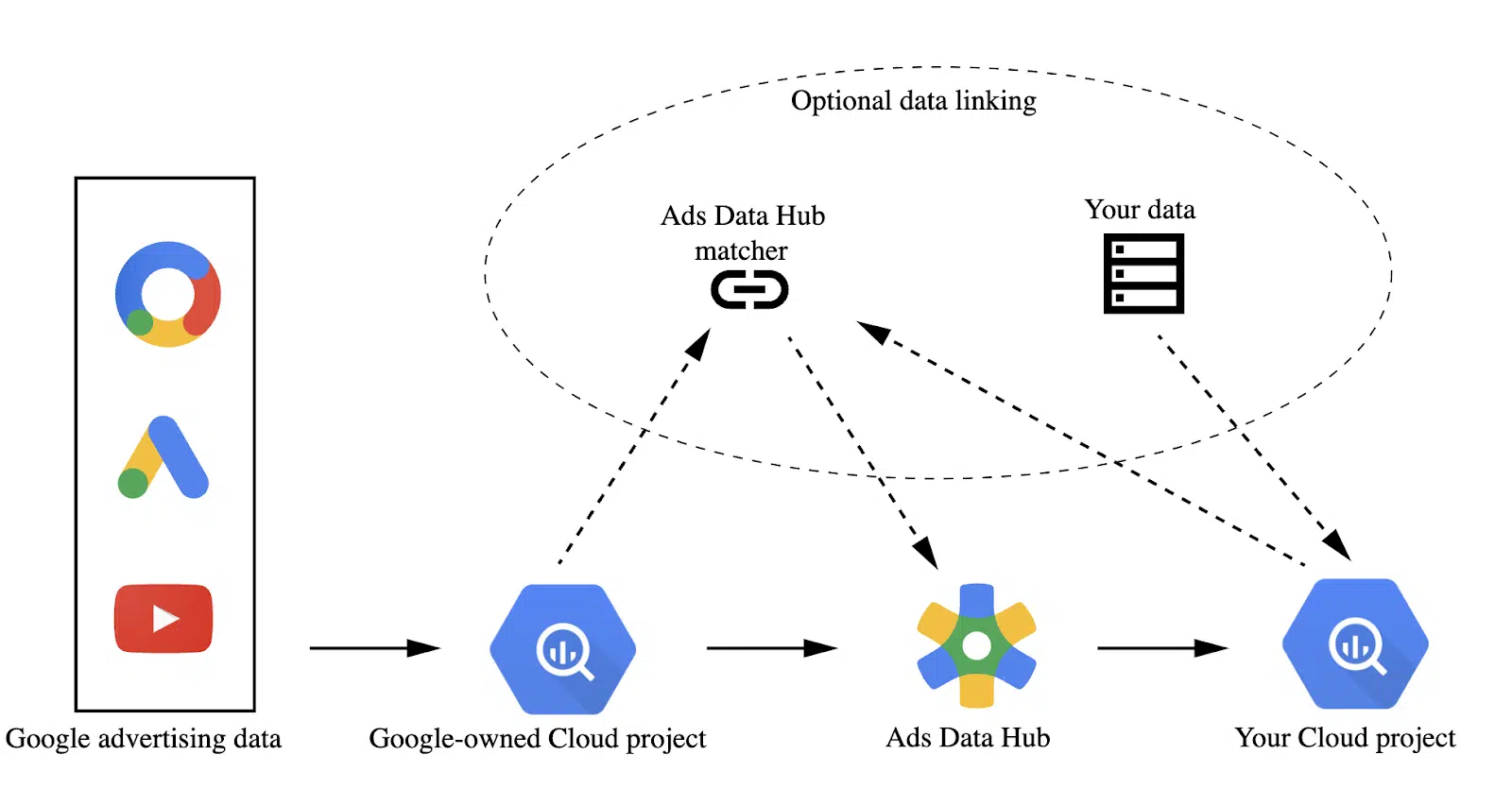
A key part of this transformation is Ads Data Hub (ADH), a platform built on Google Cloud.
ADH allows advertisers to integrate and analyze data from Google Ads and other sources, offering deeper insights into customer journeys and ad performance while maintaining privacy compliance.
This article explores what Ads Data Hub is, how it works and tips to maximize the tool while improving your Google Ads performance.
What is Ads Data Hub?
The Ads Data Hub is a centralized repository for all your marketing data, integrating information from:
Your Google Ads account (including search, display, video and shopping campaigns).
Your Google Analytics account.
Your CRM system.
First-party data collected from your websites, apps, physical stores or directly from customers.
Designed with privacy in mind, ADH aggregates all query results to prevent the identification of individual users within the dataset.
Minimum aggregation thresholds are established to avoid accidental exposure of personally identifiable information.
You also cannot download specific user data, ensuring compliance with today’s privacy guidelines and best practices across various industries.
Ads Data Hub: Setup and architecture
The platform’s architecture is specifically designed to securely and efficiently process large-scale advertising datasets. Let’s explore its key components and workflow in detail.
Data ingestion
Advertisers upload their first-party data to ADH, including customer interactions, website analytics and CRM information.
This data is matched with Google’s ad data (e.g., impressions, clicks, conversions) using hashed identifiers.
Cloud-based processing
The core of ADH is powered by Google Cloud’s BigQuery infrastructure.
Advertisers can write SQL queries to analyze data, joining their first-party data with Google’s advertising data.
This system allows businesses to run highly customized analyses without moving the data outside Google’s secure environment.
Querying
Users run SQL queries on aggregated datasets, with results compiled at a user level to protect personally identifiable information (PII).
ADH restricts the types of queries that can be executed to ensure individual user data remains private.
Output
Once the query is complete, ADH provides an aggregated report which can then be exported to BigQuery for further analysis or connected to other reporting tools like Looker Studio.
ADH’s limitations
Despite its robust features, Ads Data Hub has certain limitations that advertisers should be aware of.
No real-time data access: ADH does not offer real-time data access. There is often a delay in getting campaign data into the platform, which could impact time-sensitive decisions.
SQL expertise required: Running queries in ADH requires proficiency in SQL, making it necessary for advertisers to have data analysts or skilled marketers to extract meaningful insights.
Limited access to raw data: Since raw user-level data is inaccessible, you might find limitations in performing deep cohort analysis or certain types of data exploration.
When to use Ads Data Hub
Ads Data Hub provides valuable insights by integrating data from various sources across customer touchpoints.
It enables advertisers to analyze purchase history across channels, identify shopping cart abandoners and create customer segments and audiences. These insights can then be used to inform ad copy, optimize landing pages and improve ROI models.
Here are some specific examples of how Ads Data Hub can be applied:
Cross-platform measurement
ADH enables the analysis of user behavior across platforms, such as YouTube and Google Display Network.
This cross-platform measurement capability lets you understand the complete picture of user engagement and track conversions more effectively.
First-party data enrichment
Uploading first-party data can enrich your analysis, allowing you to gain insights into customer segments, lifetime value and conversion behaviors.
Combining first-party data with Google Ads data helps improve targeting and retargeting strategies.
Google provides a good table of use cases to help provide some starting points:
Use case examples
Here are a few examples of how businesses have used the Google Ads Data Hub to improve their Google Ads performance.
Churn prevention through ad interaction analysis
Identify users at risk of churning by analyzing their prior engagement with ads.
This helps create a targeted list of potentially churn-prone users who have previously interacted with your ads, indicating some level of engagement.
By focusing retention efforts on these users, businesses can develop personalized campaigns to re-engage them and reduce churn.
Maximizing lifetime value for high-value users
Use your CRM data to identify high-value users who are part of your existing customer base and actively engage with your YouTube campaigns.
By targeting these valuable users with personalized messaging and offers, you can further enhance their lifetime value, encouraging repeat purchases or deeper brand loyalty.
Geo-specific conversion propensity for affinity segments
Analyze affinity and in-market segments by region to understand user interests and behaviors at a granular level.
By evaluating the various interest categories users fall into, you can optimize your campaigns geographically, tailoring content to match regional preferences and increasing conversion rates within specific markets.
Optimizing retargeting with message sequencing
Create exclusion lists for negative retargeting by identifying users who have already converted or heavily interacted with previous campaigns.
This helps avoid over-targeting and ad fatigue, ensuring that your messaging is more relevant to potential customers who have yet to engage while efficiently managing your ad spend.
Tracking new CRM signups from ad exposure
Identify incremental users who signed up for your CRM after being exposed to your YouTube or Google Ads campaigns.
By analyzing the data, you can create a list of these newly enrolled users, allowing you to measure the effectiveness of your ad campaigns in driving CRM growth and optimizing future strategies for customer acquisition.
Ads Data Hub: Bridging data sources for enhanced marketing intelligence
Google’s Ads Data Hub is a powerful tool for advertisers seeking actionable insights while maintaining strict privacy standards.
By leveraging Google Cloud’s infrastructure and combining first-party and Google Ads data, the platform enables advanced analysis without compromising user privacy.
From campaign optimization to custom attribution modeling, ADH helps you succeed in a privacy-focused advertising landscape.
Contributing authors are invited to create content for Search Engine Land and are chosen for their expertise and contribution to the search community. Our contributors work under the oversight of the editorial staff and contributions are checked for quality and relevance to our readers. The opinions they express are their own.
If you haven’t picked up a copy of The Legend of Zelda: Echoes of Wisdom, you now have more places to buy it from. The brand-new Switch exclusive wasn’t available to preorder at Walmart or Amazon, but it’s finally available at both retailers. Walmart has Echoes of Wisdom online and in stores. Amazon’s listing(s), meanwhile, are for imported, region-free editions. At the moment, the online retailer doesn’t stock Nintendo’s releases in North America. But Amazon has made the prospect of buying an imported game, in this case from its official UK Global Store, a bit more enticing by offering a 10% discount on Zelda: Echoes of Wisdom.
Amazon US does not officially have Echoes of Wisdom, but Amazon UK does. Thanks to Amazon’s. UK Global Store, you can purchase the import just like you would any other item. The Switch isn’t a region-locked console, so games from other regions work the same (as long as they support English). The only difference you’ll see is the rating boards logo in the lower left-hand corner on the box.
At the moment, Amazon has two listings, one of which is shipped and sold by Amazon’s UK Global Store. You’ll get free shipping and save some cash in the process, as the UK edition is going for $54.24. You’ll still be backed by Amazon’s return policy, and customer service is provided by Amazon US.
If Amazon sells out of that one, the second listing has Echoes of Wisdom listed for $58.
$210
Nintendo released a limited-edition Switch Lite to commemorate the launch of Echoes of Wisdom.
The limited-edition console features a gold color scheme with black accents and has the Hylian Crest on the back. It also has a small Triforce beneath the right thumbstick.
With your Switch Online membership, you’ll be able to play a wide assortment of The Legend of Zelda games on this appropriately themed console. With Switch Online + Expansion Pack, you’ll gain access to over 100 of the best games for SNES, NES, Game Boy, Game Boy Color, Game Boy Advance, and Nintendo 64.
The Switch Online retro libraries include a bunch of Zelda games to play on your shiny new gold handheld:
The Legend of Zelda (NES)
Zelda II: Link’s Adventure (NES)
A Link to the Past (SNES)
Ocarina of Time (N64)
Majora’s Mask (N64)
Link’s Awakening DX (GBC)
Oracle of Ages (GBC)
Oracle of Seasons (GBC)
The Minish Cap (GBA)
A Link to the Past and Four Swords (GBA)
The Hyrule Edition is arguably the best Switch Lite “deal” right now, but it’s also worth noting Target still has its exclusive Switch Lite bundle featuring an Animal Crossing-themed console and a digital copy of Animal Crossing: New Horizons for $200. And if you want to play Zelda on your TV, the Mario Red Nintendo Switch OLED is discounted to its best price yet at Amazon.
Echoes of Wisdom is a pivotal entry in the beloved Nintendo franchise. For the first time in the franchise’s nearly 40-year history, the namesake steps. into the leading role. Well, it’s not technically the first time Zelda has been playable, but Nintendo would probably want fans to forget Zelda: The Wand of Gamelon and Zelda’s Adventure, two infamous Philips CD-i games, exist at all.
Thankfully, Echoes of Wisdom is a triumph, an inventive combination of modern and classic Zelda formulas. The sprawling top-down adventure features traditional dungeons of old while giving players the freedom to approach puzzles in many different ways. For more on how Zelda’s debut adventure succeeds, check out our 9/10 The Legend of Zelda: Echoes of Wisdom.
Echoes of Wisdom is the fifth(!) mainline Zelda game to receive a physical release on Switch, and you can save big on a few of Link’s adventures, too.
Numerous The Legend of Zelda Amiibo figures are back in stock for retail price at major retailers. In Echoes of Wisdom, you can use Amiibo to get extra crafting materials. You can also unlock three outfits for Zelda. These outfits are available in the game, so you won’t miss out by not having any figures to scan, but you’ll get an alternate version of the three outfits with select Amiibo. Here’s a list of the Amiibo available for retail price that will unlock these optional variants:
Unlock Blue Attire with:
Unlock Red Tunic with:
Unlock Black Cat Costume with:
The Legend of Zelda Echoes of Wisdom Review
Size:
Want us to remember this setting for all your devices?
Sign up or Sign in now!
Please use a html5 video capable browser to watch videos.
This video has an invalid file format.
Sorry, but you can’t access this content!
Please enter your date of birth to view this video
Read the following sentence: “Donald Trump and Kamala Harris walked into the bar, she sat down at a table.” We all immediately know that it was Kamala who sat at the table, not Donald. Pronouns like “she” help us to understand language, but pronouns can have multiple meanings. Depending on the context, we understand who the pronoun is referring to. But how is it that we are so good at this, and how does our brain link pronouns with their nouns?
To answer this question, an international team of neuroscientists, neurosurgeons, and neurologists joined forces. Doris Dijksterhuis and Matthew Self from Pieter Roelfsema’s group looked together with their colleagues at the brain activity of patients with epilepsy. As part of their treatment, these patients were implanted with depth electrodes in their hippocampus, a brain area involved in learning and memory. The research team took advantage of this and conducted additional tests with them.
“We can measure the activity of individual brain cells in the hippocampus while the patient performs a task,” says Matthew Self. In the hippocampus, there are cells that respond to a specific person, so-called “concept cells.” A well-known example is the “Jennifer Aniston cell,” which becomes active when you see a photo of Jennifer Aniston, hear her name or read the words “Jennifer Aniston.” We wondered if these cells also become active when you only read a pronoun, like ‘he’ or ‘she’. Are these cells able to link the pronoun to the right person?
Shrek cell
Doris Dijksterhuis: “To test this, we first showed the patients many photos until we found a cell that responded to one particular image. For example, we found a cell that responded to an image of ‘Shrek’ but not to other images. We call this cell a ‘Shrek concept cell’. When patients later read a sentence like: “Shrek and Fiona were having dinner. He poured out some wine.” the ‘Shrek’ cell indeed responded to the word “Shrek,” but also to the pronoun ‘He.’ This is interesting because such a pronoun can mean something entirely different in another sentence. For example, in the sentence ‘Donald Trump and Kamala Harris were having dinner. He poured out some wine,’ the same pronoun, ‘He’, refers to Donald Trump, and therefore the Shrek cell will not react. Individual hippocampal cells track who the pronoun refers to in a dynamic, flexible way.”
Self: “We had the participants answer a question at the end of the sentences about who performed the action. We could predict whether the patients would give the correct answer based on the activity of the individual concept cells. To make it a bit more challenging, we also added some trick questions, with two people of the same gender: “Jennifer Aniston and Kamala Harris walked into a bar. She sat at the table.” The patient had to decide themselves who performed the action. We observed that patients tended to choose the person that evoked the most activity in the hippocampus at the start of the sentence. This could be based on chance fluctuations in activity on a trial-by-trial basis or an internal preference for one of the two characters in the sentence.”
The bigger picture
Dijksterhuis: “The hippocampus is important for learning and memory, but it remains unclear how the hippocampus is involved in the interaction between memory and language. How do we remember what we’ve read? When you think of something you’ve read, you have different concepts that together create the story. Pronouns help us to understand who did what in the story and cells in the hippocampus encode these actions into our memory. Ultimately, we want to know how an entire memory is formed and represented in the brain.”
“It is of great value that this group of patients has given their permission to participate in our research. We can only very rarely measure the activity of single brain cells in people who are reading and it is impossible to study these processes in animals. When we get the chance, we try to get as much out of it as possible.”
Submissions are invited for the Ideas4Life Contest by Meri LiFE. Submit your entries by October 15 and win exciting prizes! About Ideas4Life Call for ideas on seven themes of LiFE for youngminds (students), research scholars/faculty members and other associated with Indian Institute of Technoloiges (IITs), Indian Institute of Managements (IIMs), National Law Schools, other universities […]
The post Ideas4Life Contest by Meri LiFE [Free; Online; College Students]: Submit by Oct 15! appeared first on Lawctopus.
How health-friendly is coffee? Let’s explore its robust qualities this International Coffee Day!
Is coffee health-friendly? Let’s explore.(Shutterstock)
Coffee is not just an eye-opener beverage. Caffeine augments fat burning and increases metabolic rate. The FDA (Food and Drug Administration) has indicated consumption of 400mg (3 to 4 cups of brewed coffee) of caffeine a day to be harmless for healthy adults.
Amrita Mishra, Senior Dietician, Delhi Diets, Noida, enlightens, “It reduces the risk of chronic diseases like developing type 2 diabetes, fatty liver, heart diseases, Parkinson’s Disease. It helps in cognitive function like feeling more alert and focused. Reduced risk of DNA strand breakage too.”
ALSO READ: Is coffee the new superfood? 6 health benefits you didn’t know about
Green vs roasted
Green or raw coffee beans are those which have not been roasted. Their taste can be compared to a fusion of herbal tea and coffee. The chlorogenic acid in unroasted coffee beans is known for its antioxidant and anti-inflammatory properties.
The roasting process alters the chemical structure of the beans, which influences the level of antioxidants present. Rishabh Sanghvi, Founder of Siolim Specialty Coffee Roaster divulges, “Lightly roasted coffee tends to retain more antioxidants compared to darker roasts, which might have slightly lower levels due to the extended roasting process. While light roasted coffee is acidic, darker roasts lend a smoky, bitter taste.”
ALSO READ: Sip smart: Make your coffee healthy by following these habits
Black coffee vs latte
It’s just the coffee experience. Coffee drinkers are less likely to have kidney stones and liver ailments. It activates the nervous system and boosts neurotransmitters like dopamine and serotonin. “Black coffee offers a purer, unadulterated taste, is lower in calories, making it an excellent choice for weight-watchers. Lattes offer a creamy and smoother experience, especially for people who prefer a milder taste,” feels Sanghvi.
Cold brews vs steaming hot
“It’s more about personal preference. Steaming hot coffees, particularly when brewed properly, release a fuller flavor profile,” informs Sanghvi. Cold brews tend to be less acidic, which makes them easier on the stomach, especially for those prone to acid reflux.
ALSO READ: This morning, drink a cup of coffee for these amazing benefits
2 tbsp chia seeds 1/4 cup strongly brewed espresso 1/4 cup coconut milk 1/2 tbsp maple syrup Vanilla Layer
2 tbsp chia seeds 1/2 cup coconut milk 1/2 tsp vanilla extract 1/2 tbsp maple syrup Cocoa powder to top (optional)
Method Chocolate layer: Whisk chia seeds, cocoa powder, coconut milk and maple syrup together in a bowl. Whisk until all the cocoa powder is incorporated. Then cover and place in the fridge to set for at least one hour. Coffee layer: Whisk chia seeds, espresso, coconut milk and maple syrup together in a bowl. Cover and place in the fridge to set. Vanilla layer: Whisk chia seeds, coconut milk, vanilla extract and maple syrup together in a bowl. Cover and place in the fridge to set. Assemble: Remove the three layers of chia pudding from the fridge. Layer a jar starting with chocolate on the bottom, followed by coffee and vanilla on top. Serve with a dusting of cocoa powder.
(Recipe by Chef Stefan Gadit – Head Chef at Torii, by Gauri Khan)
Gold, by Icecream Works, Bandra
Gold, by Icecream Works, Bandra
Ingredients:
2 scoops of vanilla ice cream 1 shot of hot espresso (about 30ml) Optional: chocolate shavings, biscotti, or a drizzle of liqueur (like Amaretto or Kahlua)
Method:
Prepare the espresso: Brew a fresh shot of hot espresso or strong brewed coffee. Place two generous scoops of vanilla ice cream into a serving glass or bowl. Immediately pour the hot espresso shot over the ice cream. The contrast of hot and cold creates the signature affogato experience. Optional toppings: Add a sprinkle of chocolate shavings, crushed biscotti, or a drizzle of liqueur for extra flavor. Serve and enjoy! The affogato should be served quickly, allowing the espresso to partially melt the ice cream.
Pfizer is pulling the sickle cell disease drug Oxbryta off the market and ending clinical trials of the medicine around the world due to safety concerns.
Clinical data “now indicates that the overall benefit of Oxbryta no longer outweighs the risk,” Pfizer said Wednesday. The company said data show an imbalance of deaths and vaso-occlusive crises, the excruciating episodes of pain that patients with sickle cell disease experience. The company said it notified regulatory authorities of the results.
Pfizer’s decision came a day before European regulators met to review Oxbryta’ safety. The European Medicines Agency started its review because of data from two trials, one that had a higher-than-anticipated number of deaths and another that showed more deaths among patients taking Oxbryta compared with those on placebo. On Thursday, the agency recommended Oxbryta’s clearance be suspended.
Dive Insight:
The withdrawal will remove one of the few treatment options for the millions of people around the world living with sickle cell disease, which causes severe pain and can lead to organ damage, stroke and death.
Oxbryta, a once-a-day tablet, was designed to reduce “sickling,” the warping of red blood cells that leaves them unable to move easily through the body. The drug first won approval in the U.S. in 2019, just days after another medicine called Adakveo from Novartis. Before that, Emmaus Medical’s Endari had been the first new sickle cell treatment in 20 years when it won approval in 2017.
Pfizer acquired Oxbryta via its $5.4 billion purchase of Global Blood Therapeutics in 2022. At the time, Pfizer said sales of Oxbryta and two more experimental sickle cell drugs developed by Global Blood could top $3 billion. Oxbryta revenue reached $92 million in the second quarter of this year.
The New York-based drugmaker is still working on other treatments for the disease. The two experimental medicines originally developed by Global Blood, inclacumab and osivelotor, are both in Phase 3. Osivelotor, previously known as GBT-601, is the successor to Oxbryta and showed promise in research released late last year.
The Food and Drug Administration also approved two gene therapies for the disease late last year. The treatments offer the promise of a potential lifelong respite from the disease, but come with drawbacks, including price tags that top $2 million per patient and a long testing and preparatory process that includes chemotherapy. Uptake has been slow, with to date only a few dozen patients beginning the arduous process.
Pfizer said patients currently taking Oxbryta should contact their doctors to discuss alternative treatments. The company said it’s continuing to analyze and review the safety findings from the drug.
By Cody Stavenhagen, Sam Blum and Stephen J. Nesbitt
Before he was one of the most famed actors of a generation, Tom Hanks was a boy in the Bay Area. He could see the lights of the Oakland Coliseum from his family’s home in the Lower Hills.
The A’s moved to Oakland when Hanks was 12. When he looks back now on 56 years of fandom, Hanks’ mind goes to Game 3 of the 1972 World Series, Oakland’s first time hosting a World Series game.
“When the A’s were in the World Series, the world came to Oakland,” Hanks wrote in an email to The Athletic. “Not San Francisco. Oakland.”
Hanks watched the TV broadcast and peered out the window as storm clouds rolled in. “A freak storm that featured the stub of a funnel cloud, like a tornado forming,” he recalled. First pitch was delayed as the Coliseum and the Hanks house were soaked with rain and pelted with sleet. That the game was postponed only extended Oakland’s moment at the center of the baseball universe.
The A’s won three World Series while Hanks was in high school. He went to “Hot Pants Day.” He witnessed Willie Mays’ final at-bat. He served as a Coliseum vendor, selling popcorn in the stands and sweating profusely on Opening Day when Vida Blue dazzled (“phee-nom”). Those A’s and the memories they gave him remain imprinted in Hanks’ memory. “Vida Blue. Joe Rudi. Mudcat Grant,” he wrote. “Campy Campaneris. Sal Bando. Ray Fosse. The original Reggie Jackson. Thank you, boys!”
Now the team Hanks loves is leaving Oakland. They’ll play their final game at the Coliseum on Thursday afternoon, then head to Sacramento and, sometime down the road, Las Vegas. The sense of finality has hit the same for so many A’s fans, from the diehards in the right-field bleachers to Hanks himself.
In the last days of the Oakland A’s, The Athletic contacted former A’s and notable fans — athletes, actors, musicians and politicians — to hear their favorite A’s memories and what it’s like saying goodbye.
Those short on time sent short missives. Milwaukee Bucks star Damian Lillard, who wears No. 0 in part to represent Oakland, replied, “It’s devastating for Oakland. Another sports team gone, another loss for the entire Oakland/Alameda (East Bay) communities. It’s sad to see the entire Coliseum complex empty.”
Los Angeles Chargers coach Jim Harbaugh lived his boyhood baseball dream coaching first base for the A’s in spring training. “That’s one of my most cherished memories, no doubt,” he said.
Others elaborated in conversations that went down memory lane and often alternated between therapy session and anger management. For so long, Oakland at least had the A’s. Now there will be nothing left.
Hanks throwing out the first pitch before a Yomiuri Giants game in Tokyo in 2009. (AP Photo / Koji Sasahara)
“How in the world,” Hanks wrote, “does Major League Baseball turn inside-out one of the most storied franchises in the history of the game? The Oakland A’s — not the East Bay Athletics or the California Golden A’s — the Oakland A’s could have/should have been the Northern California version of the the Cubs in Wrigley, the BoSox in Fenway, Pittsburgh’s Buccos on the Allegheny, Cleveland’s Guardians on the shores of Erie — beloved ball-teams with eternal hope every Opening Day until the millennium comes.
“I don’t blame that loss on the city managers of Oakland, nor the taxpayers of Alameda County. The owners and baseball blew the lead.”
Before Tony La Russa was a Hall of Fame manager, he was a light-hitting 23-year-old infielder who made the A’s Opening Day roster in 1968. He appeared in the first major league game at the Coliseum, with 50,164 filling the stadium, and roped a pinch-hit single to left field in the ninth inning.
“Coming to Oakland,” La Russa recalled, “they came in with a lot of (hope for the) future. And you’d put their history against anybody’s during that period. I think everyone that’s been a part of this is a combination of sad and angry.”
That’s a common refrain from former A’s.
Dennis Eckersley, the Hall of Fame closer who had 320 saves and won a World Series win with the A’s, moved back to the Bay Area a few years ago. If he hadn’t, Eckersley said, “it wouldn’t hurt so much. But the closer we get, where we’re (living), it’s gotten uglier inside. I’ve taken it on. Like, you can’t throw it all away. Whatever happened happened, memories and that sort of thing.
“But still, it hurts. I used to think, ‘Oh, no big deal. They’re leaving.’ But, oh my God, it’s the end! It sure does feel ugly inside.”
Rickey Henderson grew up in Oakland and became one of the most celebrated players in franchise history. Dave Stewart was a dominant postseason presence, winning World Series MVP in 1989. Both lamented the departure to the San Francisco Chronicle in March, though they placed more emphasis on the city’s role rather than on A’s owner John Fisher.
“It’s disappointing to see the A’s leaving,” Henderson, a special assistant to the A’s president, said. “But we’ve gone through so much with all the teams. The city, there’s something they’re not seeing. When you have a city that had three big-name professional sports teams, and you can’t keep any of them, something’s wrong.”
Eckersley took his 5-year-old twin grandchildren to the Coliseum last weekend. They got a kick out of the big-head mascot race between innings. It dawned on Eckersley that they, and so many young fans like them, will never have a chance to build their own memories at the old ballpark where he spent so many great seasons. He’ll tell the twins, “Remember when we went that one night?” And he’ll hope they do.
“Sometimes it helps people to be mad,” added Eckersley, who said he’s especially sad for the stadium workers he’s seen there for decades. “I’ve got that tendency where I get pissed off and just don’t want to deal. But it is what it is, and it’s sad. And I’m going to feel it. And I do.”
For La Russa, Thursday’s finale will bring him back to standing there for the home opener in 1968. He was there when it all began. Now he’s forced to watch it end.
“It’s hard to get through,” La Russa said. “The franchise had a great history and deserved a better fate.”
Last week at Oracle Park — home of the San Francisco Giants — Green Day stepped onto the stage. Lead singer Billie Joe Armstrong paced up and down holding a microphone close to his face. He touted the band’s East Bay roots, its eternal connection to the Bay Area. And then …
“We don’t take no s— from people like John f—— Fisher, who sold out the Oakland A’s to Las f—— Vegas,” Armstrong said. “I f—— hate Las Vegas. It’s the worst s—hole in America.”
Armstrong was born in Oakland and raised in Rodeo. He attended last season’s “reverse boycott” at the Oakland Coliseum. He is an investor in the independent Oakland Ballers, and earlier this year during a show at Toronto’s Rogers Centre, he posted a video of himself spray-painting over the A’s logo inside a stadium tunnel. He painted a “B” over the “A” and crossed out the word “Athletics.”
Armstrong declined an interview request. “Nothing more to add,” his publicist wrote in an email. (A few days later, at Oracle Park, Armstrong evidently had more to add.)
A long list of musicians with Oakland roots have stayed loyal to the team’s last remaining major pro sports franchise. MC Hammer (real name: Stanley Burrell) grew up dancing, singing and performing outside the Coliseum. He caught the eye of then-owner Charlie Finley, who hired the young Burrell to work as a bat boy. Legend has it Jackson first gave Burrell his “Hammer” nickname because he resembled Hammerin’ Henry Aaron. Years later, per a Rolling Stone cover story at the peak of Hammer’s fame, A’s players Dwayne Murphy and Mike Davis gave Burrell a loan as he worked toward releasing his first album.
That’s my Big Brother Chris celebrating our 3rd consecutive World Championship next to Reggie Jackson. I spoke with my other brother Big Lou earlier whom was the assistant clubhouse manager. We lived at the Coliseum !!! We shed a collective tear for the Eastbay. The team is… pic.twitter.com/nodsoBjXxY
The Bay Area rapper Too $hort (real name: Todd Shaw) often posts photos of himself in A’s gear on X, and recently posted on the site that he grew up selling sodas at the Coliseum. “Day one fan over here,” he wrote, “no bandwagon!
Adam Duritz, lead singer of Counting Crows, moved to California as a child. His father had been a fan of the Philadelphia A’s. The franchise was in the midst of its 1970s golden era, and Duritz was hooked. He cut school, took BART to the Coliseum and sat in the bleachers with a $2.50 ticket. (He learned recently that Counting Crows drummer Jim Bogios did the same.) By the late 1980s, Duritz was going to 50 games a year. He saw Henderson break the stolen base record and watched Nolan Ryan twirl his sixth no-hitter. Duritz identified with the underdog A’s in the Moneyball era and cherished every minute.
Now living a much different life, Duritz still gets nostalgic any time he walks out of a tunnel and into an open stadium. Green grass. Green seats. The sense of awe. “It reminds me of the Coliseum when I was a kid,” he told The Athletic last week, “and you could look up before they built Mount Davis, you could see the hills behind it.”
A few weeks ago, Counting Crows was on tour with Santana. Karl Perazzo, Santana’s percussionist, walked into Duritz’s dressing room one day and said, “Hey, I’ve got someone for you to talk to.” La Russa was on the phone. “It was just very cool for me as a huge fan,” Duritz said, “to talk to him for a little while about those days.”
Duritz, who followed the team’s elongated stadium saga, briefly hoped the A’s could complete their plan to build a ballpark at Howard Terminal. More than anything, he felt as powerless as any other A’s fan.
“It’s completely outside your purview as a fan,” he said. “You do feel that distance too, because, like, one day it’s gonna be fine, and then it’s not, and then they have a plan, and they don’t, and I’m kind of used to that with sports in the Bay Area.”
Duritz says he will still love the A’s even when they are gone. But there are parts of him that loathe Las Vegas, and parts that miss the A’s colorful characters from bygone years, and parts that wish time could be frozen when he was a kid sitting in the bleachers at the Coliseum.
“Well,” he said, “it’s pretty heartbreaking.”
Over the past five decades, A’s fandom has reached far and wide, even to the highest level of public office in the United States. President Barack Obama is an outspoken Chicago White Sox fan, for which Theo Epstein offered a “midnight pardon” when the World Series champion Chicago Cubs visited the White House in 2017, but long before he ever supported the South Siders Obama had another favorite team.
Obama was 11 when the A’s won Oakland’s first World Series in 1972.
Two thousand miles away from Obama in Honolulu, and not far from Hanks in the Lower Hills, two girl friends from Mills College were in the back of a convertible as it cruised along Grove Street in Oakland that night.
“We just rolled down the streets honking horns,” Representative Barbara Lee, from Oakland, recalled. “Yelling, screaming, applauding and congratulating the A’s.”
The celebration continued as the A’s captured back-to-back-to-back World Series titles. The A’s became a source of booming public pride. As Oakland emerged as a center of Black culture, its baseball team was led by Black stars such as Jackson, Henderson, Stewart, Blue Moon Odom, Bill North, Claudell Washington and Blue, who Lee came to know through activism work.
“In many ways, Oakland is a city that has always exemplified Black excellence,” Lee said. “Black culture. Black power. Leadership. The A’s were a part of that milieu. It was our team. There were so many African-Americans who saw these players like I did — as icons and heroes — and were proud.”
U.S. Rep Barbara Lee represents Oakland, and is a longtime fan of the A’s. (Courtesy of Barbara Lee)
Last year, as Lee ran against former 10-time MLB All-Star Steve Garvey in a U.S. Senate special election primary, she was endorsed by Henderson, Stewart, Dusty Baker, Shooty Babitt and Tye Waller, all of whom played or coached for the A’s.
As the A’s and the City of Oakland haggled over stadium deals for years, Lee occasionally welcomed A’s executives to her office in Washington D.C. for conversations about how to keep the A’s in Oakland. “It was a long process,” she said. “It was a grueling process.” And, in the end, a hopeless one.
After the A’s announced their intentions to relocate to Las Vegas, Lee introduced a bill, the “Moneyball Act,” requiring that the owners of a relocating club compensate the city they left. But the Oakland A’s could not be saved.
“It still hasn’t settled in,” Lee said. “That’s just how difficult it’s been for me and for a lot of people in Oakland. The Oakland A’s are us, and we are them. You feel in many respects abandoned.”
Lee recited the five stages of grief: denial, anger, bargaining, depression …
“I don’t know if I’ll ever get to the fifth,” she said.
Acceptance.
When Hanks was in Los Angeles last year to promote his novel, a former A’s employee in the audience at the Wilshire Ebell Theatre asked Hanks if he would buy the A’s to keep them in Oakland.
“I haven’t done that well, guys,” Hanks joked.
That didn’t stop him from airing his frustration.
“We’ve lost the Raiders. The Warriors moved to San Francisco. Now they’re going to take the A’s out of Oakland,” Hanks said. “Damn them all to hell.”
That sentiment is shared by fellow actor Blake Anderson, star of the show “Workaholics.” Anderson grew up in Concord, in the East Bay. He shrugged off so many rumors of the A’s relocating that he eventually became numb to them. A’s fans were “strung along and teased” for so many years, Anderson said, and all that false hope led to a feeling that they’d lost the A’s long before they left.
“With Oakland fandom,” he said, “you just know what it’s like for teams to evacuate.”
There are two reasons Anderson became an A’s fan.
The first is Henderson. As a kid, warring factions within Anderson’s family would try to sway him toward the Giants or the A’s. Then Henderson came back and won MVP.
“Nobody was cooler than Rickey Henderson, man,” Anderson said. “That sold it for me. I was such a young, impressionable kid, and there was so much more swagger on that side of the bay.”
The second reason was Will Clark. But not that Will Clark. Anderson had a youth baseball teammate with the same name as the Giants first baseman. Anderson was not a strong hitter, and he remembers stepping to the plate and hearing his teammate say, “Here comes another strikeout.”
“It was f—ing Will Clark, dude,” Anderson said.
Needless to say, he was all in on the A’s. In high school, he and his friends waited at the exit of the players parking lot at the Coliseum. His favorite player, Terrence Long, autographed the bill of Anderson’s black A’s cap. Then came Jason Giambi, whose walk-up music was the nWo Wolfpac theme song.
“We’re like, if we yell, ‘nWo for life,’ he’s going to stop the car,” Anderson recalled. Giambi hit the brakes and signed.
Anderson was 5 when the A’s won the 1989 World Series. He doesn’t claim that one.
“I don’t feel like as an A’s fan I got my championship,” Anderson said. “That was going to be my crowning achievement as a fan, living through one of those. That’s where I get super bummed out. I was always imagining being like those Cubs fans who waited 100 years and were like, finally, we can hoist the trophy.”
Only one emotion has surprised Anderson throughout this A’s saga: He still cares. He told himself he’d stop following, but he couldn’t. He’s grown to love the newest cast of A’s — Brent Rooker, J.P. Sears, Lawrence Butler, Mason Miller. He likes that they didn’t throw this season away. “I felt pride for the team again,” he said. As the team heads to Sacramento, he’s sworn to invest in the A’s at least until these guys disperse.
Anderson drove from Los Angeles to Oakland to watch Wednesday’s game with his mother, step-father, brother and a high-school buddy.
“I’ve got to go before it’s gone,” he said beforehand.
Anderson didn’t get tickets for the final game Thursday, but since he’d already be in town, he said, “maybe I’ll just BART in and kick it in the parking lot.” Those lots were where he made some of his best memories, where he met friends, where they shotgunned beers, where they reveled and toasted the green and gold.
Anderson wondered how he’d feel on the A’s last day in Oakland. He’d felt almost every emotion at the Coliseum before. He was there when Jason Isringhausen clinched the AL West in 2000. (“Nothing matched that kind of joy.”) He was there when Derek Jeter’s flip turned the 2001 ALDS. (“That was our year.”) But this would be different. Not euphoria or anguish. Just emptiness. Anderson figured he’d take a few laps around the old place, remember the good times, then give the filthy cement floor a kiss goodbye.
— The Athletic’s Evan Drellich, Chad Jennings and Eric Nehm contributed to this report.
(Illustration by Meech Robinson, The Athletic; Photos: Michael Zagaris / Oakland Athletics / Getty Images; Andrew D. Bernstein / NBAE via Getty Images; Lachlan Cunningham / Getty Images)
Google Pixel phones offer the best Android experience thanks to their clean interface, powerful AI features, and fast updates. However, many of its useful features aren’t enabled out of the box. So, I’ll share some settings you should change to get the most out of your Pixel.
1 Turn On Smooth Display
Most Google Pixel phones today support high refresh rate displays. However, unless you have a larger model like the Pixel 8 Pro or Pixel 9 Pro XL, this feature is disabled by default. Thankfully, you can easily turn on Smooth Display on your Pixel from the Settings app. Here’s how to do it:
Open Settings and go to Display.
Scroll down and toggle on Smooth display.
Note that Smooth Display doesn’t keep the refresh rate at the maximum value. Instead, it dynamically adjusts the refresh rate depending on what’s happening on the screen. This conserves energy while still providing a much smoother experience than the default setting.
2 Show Battery Percentage in the Status Bar
One thing you’ll notice when setting up your Google Pixel is that the battery percentage isn’t shown by default—only a battery icon appears in the status bar. While the icon gives a general idea, it’s not the best indicator of how much battery is left.
Thankfully, Google lets you enable the battery percentage to display in the status bar. Simply go to the Settings app, select Battery, and toggle on Battery percentage. The percentage will now start showing next to the battery icon in the status bar.
3 Enable Notification History
In today’s world, our phones are constantly buzzing with notifications, and it’s easy to miss something important amidst the flood of alerts. If you’re like me, you’ve probably hit that Clear all button in haste a lot of times, accidentally swiping away crucial notifications—or missed a notification about a message that someone deleted.
Thankfully, Pixel phones have a Notification History feature that maintains a record of all notifications received in the past 24 hours. To enable it, go to Settings > Notifications > Notification history and toggle on Use notification history. and select Notification history.From now on, your Pixel will log notifications and display them in order by time under the toggle.
4 Customize Gestures
Google Pixel phones have a range of exclusive features that make switching to a non-Pixel device challenging. One such key feature is the built-in quick gestures, which make everyday tasks faster and easier. However, you can accidentally trigger these gestures sometimes, which can be annoying. Fortunately enough, Google allows you to customize which gestures you want to use on your Pixel device.
To do this, go to Settings > System > Gestures. Then, choose which gestures to keep and which to disable. Personally, I find Flip to Shhh great for silencing calls in public, and Tap to check phone is perfect for quickly peeking at notifications.
5 Turn On Clear Calling
One of the best parts of owning a Google Pixel is having access to advanced AI features. While popular tools like Pixel Studio and the Reimagine feature in Magic Editor are great, I appreciate the smaller, practical AI features the most. One such standout feature for me is Clear Calling.
While the iPhone’s Voice Isolation feature is impressive, Google’s Clear Calling goes a step further by canceling background noise for both parties on a call. It not only removes background noise on your end but also filters out disturbances from the other caller. Here’s how to enable it:
Open the Settings app and select Sound & vibration.
Scroll down and tap Clear Calling.
Toggle on Use Clear Calling.
6 Change Lock Screen Shortcuts
The next setting to tweak is how your lock screen looks and functions. By default, Pixel phones only offer a single Google Home shortcut on the lock screen. While useful in some situations, it’s not always necessary, especially since it’s also accessible through the Quick Settings panel.
To customize the shortcuts on your Pixel’s lock screen in just a few taps, go to Settings > Wallpaper & style and tap Shortcuts to choose the ones you prefer. Personally, I rely on the good-old Camera shortcut, which is especially handy, given that I’ve disabled the camera gesture.
7 Enable Hidden Quick Settings
Like most Android devices, Google allows Pixel users to personalize their Quick Settings tiles. However, some useful tiles are hidden deeper within the Quick Settings menu. For example, Quick Setting for the Live Transcribe, which enables real-time transcription of spoken words, is hidden towards the bottom of the Quick Settings. Similarly, you can activate tiles for features like the Calculator, One-handed mode, Live Caption, and more.
8 Identify Songs Around You With Now Playing
Now Playing is easily one of the best features on Google Pixel phones. It’s like having Shazam built-in, constantly identifying music playing around you without any effort on your part. It even creates a list of songs you’ve heard so you can check them out later.
Despite how useful this feature is, many Pixel users don’t take advantage of it. While Google does offer the option to enable Now Playing during setup, it’s easy to miss in the excitement of setting up a new device.
To enable it, go to Settings > Display > Lock screen > Now Playing and toggle on Identify songs playing nearby. You can even customize the feature by adding a dedicated search button to the lock screen.
9 Rotate Screen Based on Your Face Orientation
If you’re like me, you probably toggle auto-rotate on and off throughout the day. We’ve all experienced the frustration of lying down with our phone, only for it to auto-rotate to landscape mode, forcing us to disable it just to get back to portrait mode.
Google Pixel phones have a feature that rotates the screen based on your face’s orientation, rather than relying solely on the phone’s accelerometer. Using the front-facing camera, the device detects your face’s position and adjusts the screen rotation accordingly. Here’s how to enable it:
Open the Settings app and select Display.
Scroll down and tap Auto-rotate screen.
Now toggle on Use auto-rotate and Face Detection.
While Google Pixel phones may not match the raw performance of the competition, like the Samsung Galaxy S24 Ultra or OnePlus 12, they come packed with useful features that make them worth the investment. The Pixel 9’s AI features take it even further, such as Add Me in the Camera app and Pixel Weather for easy weather updates.
However, the settings mentioned above are available on all Pixel devices, so you can enjoy these features without upgrading to the newest model.
<img src='https://news.cgtn.com/news/2024-09-29/China-to-see-175m-railway-trips-in-National-Day-holiday-travel-rush-1xi6myfrqqQ/img/2f25e20e2186400d85c885a182f42f20/2f25e20e2186400d85c885a182f42f20.png' alt='Passengers wait to board their trains at Guangzhou South Railway Station in Guangzhou, south China's Guangdong Province, September 29, 2024. /CFP'
China’s railway network is expected to handle 175 million passenger trips during the upcoming National Day holiday travel rush, China State Railway Group Co., Ltd. said Sunday.
China’s seven-day National Day holiday starting on October 1 and ends on October 7 this year.
The peak is expected on Tuesday, with over 21 million trips projected, according to the company.
The railway travel rush from Sunday to October 8 is expected to see a mix of tourists, family visits and student travels, the company said.
In response to the surge in passenger demand, measures will be taken to boost transportation capacity, enhance services, and ensure safe, orderly and enjoyable trips, it said.
Warning: the following contains major spoilers from the Season 3 finale of “Industry.”
After an interminable game of “Will They/Won’t They?,” “Industry” fans finally got an answer about Yasmin and Robert’s fate on Sunday night.
Bench sex be damned, these two will decidedly not be ending up together.
Yasmin stomped all over Rob’s poor little heart during Sunday’s Season 3 finale, revealing in brutal fashion that mere hours after being intimate with him for the first time, she’d gotten engaged to another man. Perhaps Rob (Harry Lawtey) never really stood a chance against the wealthy Henry (Kit Harington), especially now that Yasmin (Marisa Abela) is broke. Still, after she uttered “I love you” to Rob — the only time in her life she’d ever said the three words — we thought there was a sliver of hope for the HBO series’ resident sweethearts.
Alas, this is “Industry.” Expecting anyone to live according to a moral compass is foolhardy.
But let’s hear Abela and Lawtey break it all down themselves. Over a video chat from their native United Kingdom last week, the actors weighed in on their characters’ romance, Rob’s sexuality and how the hell this show will work next season if all of the Pierpoint vets are in different cities. (The conversation has been edited and condensed for clarity.)
First of all: Marisa, how could Yasmin do this to Robert?!
Abela: I kind of saw it coming, to be honest. I think that it’s the only decision she could have made in that moment. One choice she’s making is a choice that has a future attached to it — a future that she can understand that has security. And the other is to go back to London with Rob with no job, no finances, no protection against this onslaught of media attention that she’s been having to deal with. I think it’s quite a clear choice, actually, for someone like Yasmin.
Also, if you watch Episode 7, I don’t think they make that much sense together. They’re arguing 90% of the time. I think Yasmin feels like she’s disappointing Robert a lot. She’s not kind enough, gentle enough, patient enough. And I think Robert feels like he’s not impressive enough in what he’s offering her. They’re letting each other down, and that’s not a fun way to feel. Whereas Henry, although he doesn’t necessarily see her how she wants to be seen or cradle her emotionally, he doesn’t expect anything more from her than what she can give him. It’s a sort of business decision at the end of the day. I think that if she’d just come off two days in Wales with Robert that were blissful and beautiful and perfect, she’d have made that decision, but it wasn’t really clicking.
Abela says the couple’s sex is “simple and it’s tender and it’s intimate, you know, compared to pissing on someone in the shower.”
(Simon Ridgway / HBO)
It was clicking sexually!
Abela: Yes, exactly. They had this great sex. They told each other they loved each other, which I think they do in that moment, at least. But I think for Yasmin it’s just not enough. She has a lot on her plate back in London. She doesn’t have a home, a family. It would be a lot of pressure on Robert to put up with that. Imagine the opposite. They drive away from this big house together, and they go back to Finsbury Park and we watch them, like, make dinner that night or order a delivery that night. What does Yasmin do next? Other than feel like she’s with someone that she loves. I think we’re forgetting that we’re talking about Yasmin here. She’s brutal. Feeling the warm and cozy thing is not at the top of her list.
The sex that Robert and Yasmin have is kind of the most beautiful thing about their relationship. It’s simple and it’s tender and it’s intimate, you know, compared to pissing on someone in the shower.
Both of your characters are sexually open. Harry, do you think there is a world where Rob is bisexual?
Lawtey: Fundamentally, yes. That’s always been part of the conversation that me and the boys have had since the first season. And there are scenes that never made it to the edit that explored that slightly more.
The show is a coming-of-age story. They’re in these evolving years in their lives and they’re being put into these awkward, intense, claustrophobic situations as part of this big ecosystem, which they’re kind of designed to serve. And yet, at the same time, they’re trying to carve out personality within that. And of course, their sexual lives and identities certainly intersect with all of that. The show has always treated that as character work and development. They all kind of surprise one another, and they’re all open because they live such a radical lifestyle.
Abela: They’re dealing with large sums of money every day, long hours, huge stakes. These things kind of lend themselves to wanting to throw themselves into things with more abandon than a normal person. They’re all becoming more and more desensitized, so they’re more desperate to try something that’s going to stimulate them sexually or emotionally in their relationships. In Season 1, Yasmin was shocking herself with the things that she was asking people to do for her. And now it’s more sort of like, “Am I willing to go there with him? Yeah, maybe. Why not? Let’s see how it goes.”
I think fans shipped Yas and Rob because they always seemed like the two characters who had the softest centers in this harsh environment. But in the finale, Yasmin shows a brutality I didn’t know she had in her.
Abela: In terms of an audience wanting Yasmin to sit Robert down and tell him that she got engaged? I think she’s scared to do that. I don’t think it comes out of malice. Like, she’s not trying to humiliate him at the table. I think it would be a terrifying conversation for her to have with him, and I don’t think she’s capable of having it.
I definitely think that she’s gotten harder throughout the seasons. I agree that one of the things that brought her and Rob together in the past was that, compared to Harper [played by Myha’la], she had a sort of gooey center. She wasn’t as blindly driven by success. But Yasmin and Harper have become more and more similar as the seasons have gone on because Yasmin’s situation in life has become more desperate. Survival is No. 1 on her list now.
Abela, seen here with Kit Harington, says she doesn’t think Yasmin was “capable” of having the “terrifying conversation” where she admitted to Rob she was engaged.
(Simon Ridgway / HBO)
Lawtey: This is also a testament to how little we actually know [about the plot], because there was a certain point in Season 3 where we were taking bets on what we thought might happen for [Robert and Yasmin] at the end of the season. Naturally, I was slightly more hopeful, of course.
Where we find them in Season 3, there’s enough texture and integrity that they do love each other and see one another authentically for who they are — almost the way they wish to be seen, if they weren’t up against all these different challenges in their little universe. But ultimately, do they pound for pound make one another happy each day? Is that kind of connection sustainable? Maybe not.
Yasmin is in this bind where she’s forced into making a very practical choice that serves her. You can’t judge that, necessarily. And I think it’s fundamentally because Robert knows her, he gets it and accepts it pretty quickly in relation to how devastated he is. The speed with which he gathers himself is unlike Rob, but it’s because he knows that there’s a sliver of a world where this is wonderful and brilliant — but it’s a long shot. If anything, the ending of this season is a springboard for Robert to go and rediscover himself and try to recapture a part of him that has gone missing.
He does already kind of seem over it by the time he says goodbye to her in the driveway.
Lawtey: He knows her and he knows the system now. This season is a final look behind the curtain for Robert, socially and politically and professionally. He is coming to grips, finally, with the structure of how things operate and his place within that structure. Without being too cruel to himself, he’s accepted that ultimately, he’s not made for this world. And Yasmin is. And that’s where they have to part. It was a pipe dream, I think, their relationship. One that he believed in fervently for a minute. That scene that they have together by the lake, that’s kind of like a little window into that. But it’s a bit of a dream. I don’t think it would be like that.
Everyone in the show at Pierpoint has to ask themselves, “Why do I come to work? Why do I show up here? What do I get from this?” And I think almost all of those questions have been answered for Rob, apart from Yasmin. This is the final untethering for him. And so it’s very freeing. “Oh, I can just go and build my own life now, and I can try to be happy again.” He’s spent far too long for the last couple of years being sad.
“This is the final untethering for him,” Lawtey says of his character. “He’s spent far too long for the last couple of years being sad.”
(Nick Strasburg / HBO)
And Yasmin is left behind at this mansion. Is she really cut out to be a housewife in the English countryside?
Abela: I don’t think she’s cut out to sit idly by and be someone’s wife. But I don’t think that Henry’s gonna ask that of her, either. I don’t think that it’s gonna be a conventional marriage [Laughs]. I just get the feeling that neither of them really need that from the other one. I’m sure she’ll be up and down from London.
But I don’t think Yasmin should have ever been an investment banker. This season, so many traumatic events happen to her and I still think that Yasmin looks the most lost when she’s on the desk. I think that she looks far more comfortable on a boat, even after her father has just jumped overboard. She’s really a talented manipulator, and she’ll find a way of using that to her advantage.
I’m so glad that the show got renewed, especially because the showrunners really wrapped so many storylines up with a bow that I feared Season 3 would be the end of “Industry.” Did you ever worry about that?
Lawtey: With Mickey [Down] and Konrad [Kay, the showrunners], they always have this really exciting notion of just burning their best ideas and challenging themselves to come up with something interesting and dynamic and brave. They’ll always run it and see if they can write themselves out of that corner. So I never really second guess the direction they’re going in, because they always have something up their sleeves. They don’t save anything for final episodes or whatever. As we’ve seen from a few points of the season, no one’s ever really dead, either. They make the most of every inch of the characters in this show.
Abela: It does feel like an end of a chapter for all of them. But, you know, I kind of felt the same at the end of Season 2 with Harper leaving the bank. Season 1 was all about Harper’s relationship to Pierpoint. If they were going to keep going with “Industry,” it didn’t feel that tethered to Pierpoint anymore. These characters were sort of bursting out of that establishment.
Can you imagine an “Industry” where Yas is in England, Rob is in San Francisco, Harper is in New York, etc.?
Abela: I guess they’re probably not all in the same workplace. I don’t know where they’ll be.
Lawtey: Their lives are rapidly becoming broader, as is the general scope and scale of the show. I think it’s fair to say that in this season, the boys started taking much bigger swings in the tone and style and the landscape of the show, and I think that really suits the characters and their development. Those channels to one another are still going to be there, but they’re being stretched and pushed into different shapes. Which is exciting for us, to keep on having to rethink and recontextualize the way in which these people relate to one another.
The cast went to watch Ken Leung film the final scene of Episode 3 where he took a baseball bat to the Pierpoint offices.
(Simon Ridgway / HBO)
Was there any sadness in saying goodbye to the Pierpoint set?
Abela: You do get a little bit sentimental about this fake building that you sort of grew up. If we were sad about saying goodbye to it, it was more about saying goodbye to the season and what the end of a Season 3 meant. The show means a lot to us, and we as people, I think, mean a lot to each other. And so we all went down and watched the final scene with Ken [Leung, who plays Eric] swinging that bat around. It just kind of felt like a moment. We all kind of grew up in that mini trailer park.
Lawtey: It was like a really special thing to go and see Ken and send off that space for us. It does feel like a home, in a way, creatively. In the picture of our careers as actors, that represents HQ. The building where the trading floor was, they never took it down even in the long gaps between seasons. So, yeah, it was a strange thing to walk away from. When I think of that room, I think of the ensemble of the show. It’s been a collective and a community of people that has kind of revolved, but there’s been a nucleus that has stayed the same. And the home for those people is that space. We just had a lot of laughs there and some brilliant times. I was chatting to Ken the other day, and he said this season signifies the closing of a circle. And now you’ve just got to open a new circle, I think.
At the start of September, Nour was having an ordinary evening at home in Beirut—eating pumpkin seeds and watching Netflix—when the SMS hit her device like the smartphone version of a brick through her window. The sender name appeared as eight question marks, “????? ???”, and in the message preview she could read, in clunky, hard-to-understand Arabic, a threat: “We have enough bullets for everyone who needs them.”
To Nour, whose name has been changed to protect her anonymity, it was obvious who had sent this message. “Israel,” she says, “that’s their tone.” The Israeli military did not reply to WIRED’s question about whether they were the source of the message. But the text appeared at a time when Lebanon was on edge, days after Israel and the Lebanese-based group Hezbollah had exchanged air strikes and rockets. It’s unclear how many other people received the SMS threat, although Nour says she saw screenshots on social media of the same message. She was worried the text might contain a malicious link. “I didn’t dare open it,” Nour says.
In Lebanon, the idea of receiving a message from Israel is not new. In the early 2000s, people in Lebanon received recorded phone calls, asking for information about missing Israeli airman Ron Arad, whose plane went down during a bombing mission in the ’80s and is now presumed dead. The last time Nour received a message from a sender she believed to be Israel, it was 2006 and she was a teenager living in the southern suburbs of Beirut. She remembers picking up the landline to hear a robotic voice announce a message that started with the words: “Dear Lebanese people.” That call followed a monthlong war, which killed more than 1,000 people and forced 900,000 to flee their homes.
Violence accompanied last week’s text message too. Israel and Hezbollah have traded fire since the start of the war in Gaza, with a major escalation taking place this week. The latest Israeli airstrikes on Hezbollah targets on Lebanon have been the deadliest in decades, with 558 people killed on Monday alone, according to the country’s health minister.
On Wednesday, Hezbollah launched a rocket at Tel Aviv, which was shot down. There were no reports of casualties. As Lebanese people check on the safety of their family and friends, “most people are now more attached to their phones than usual,” says Mohamad Najem, executive director of the Beirut-based digital rights group SMEX. These messages puncture the feelings of safety people often feel around their phones. “It is definitely creating [a feeling of] insecurity for people and fear.”
Across the border, civilians in Israel have also been receiving threatening texts, with the eerie messages demonstrating the psychological role that personal smartphones are now playing in the conflict, on both sides of the border.
The week after Nour got that text, others in Lebanon reportedly began receiving messages via automated calls on their landlines or via text. “If you are in a building with Hezbollah weapons, stay away from the village until further notice,” the message said, echoing similar calls received in Gaza before an airstrike. Between 8 am and 8:30 am on Monday, 80,000 people across Lebanon received these messages, according to a spokesperson for Lebanese telecoms network Ogero who declined to be named. One of those calls rang through to the office of Lebanon’s minister of communication, Ziad Makary, who attributed the message to psychological warfare by the Israelis.
PayPal has announced that its US business account holders can now buy, sell, and hold cryptocurrencies directly through their PayPal accounts. With this feature, the platform aims to explore the practical applications of cryptocurrencies for its users. Currently, the crypto sector is under regulatory scrutiny in several regions worldwide, as governments express concerns over the potential for financial instability and misuse of these volatile assets. Despite these fears, millions of individuals and businesses continue to engage with the over 2.4 million cryptocurrencies in circulation, according to CoinMarketCap.
In recent years, PayPal has seen a rise in the demand for crypto services from its userbase. This has been confirmed by Jose Fernandez da Ponte, Senior Vice President of Blockchain, Cryptocurrency, and Digital Currencies at PayPal.
“Business owners have increasingly expressed a desire for the same cryptocurrency capabilities available to consumers. We’re excited to meet that demand by delivering this new offering, empowering them to engage with digital currencies effortlessly,” da Ponte said while commenting on the development.
With this service being enabled, US merchants using its platform will be allowed to facilitate cross-chain crypto transfers. The merchants will also have the option to withdraw their crypto savings.
“Today’s announcement is PayPal’s latest step to increase cryptocurrency’s utility by making increased functionality available to millions of merchants in the US,” the company added.
This is a game-changer for businesses using PayPal.
Integrating cryptocurrency directly into business accounts opens up new possibilities for expanding payment options and reaching a more tech-savvy customer base.
As adoption grows, it’s going to be interesting to see how…
This, however, is not the first time that PayPal has taken a crypto-friendly step. Back in 2020, the company had announced that it was going to let individual retail customers purchase, sell, and hold crypto assets directly from their PayPal and Venmo accounts. As per da Ponte, the enabling of this service helped the company get more crypto-related insights from its userbase.
Building on these insights, PayPal has regularly been updating its services portfolio with crypto-related features.
Back in 2023, PayPal announced the launch of its own stablecoin, PayPal USD (PYUSD). Pegged against the US dollar, this stablecoin is issued by Paxos Trust Company. In August this year, the PYUSD attained the market cap of $1 billion (roughly Rs. 8,367 crore).
PayPal claims that its services are available in over 200 nations and regions, supporting 25 fiat currencies. For now, PayPal has not disclosed any plans of expanding this crypto feature outside of the US.
Let’s face it: Turning raw data into actionable insights can be as cryptic as decoding ancient hieroglyphics, especially for the SEO rookies in your crew.
That’s the challenge I addressed in my SMX Advanced 2024 session.
Didn’t catch it? No worries. I’m recapping it all in this article series, one juicy nugget at a time. This is Part 2, so if you missed Part 1, check it out.
Get ready for a quick overview of key technical SEO metrics to track in Google Search Console. Compare your list with mine – you might spot something your SEO team has missed.
Senior SEO managers: This article is for your technical SEO newcomers. It explains how I would introduce Google Search Console metrics to bridge their knowledge gaps quickly.
Top tips for looking at Google Search Console metrics
Don’t limit comparisons to just two data points: Avoid comparing just two points in time (end of last month vs. prior month). It’s like looking at two photos and missing the whole movie – especially the drama in the middle. This is a common mistake I see when upskilling SEOs to become advanced SEOs. You need to look at the ups and downs all month.
Focus on one metric at a time: When looking at the stacked bar charts, look at each metric individually. Google likes to stack data in bar charts, often making fluctuations easier to overlook. This means you’ll turn off metrics to focus on each technical SEO metric one at a time.
Save charts for later: Screenshot the charts and tuck them away for future reference. Google’s data only goes back a few months, but those images may be gold down the line.
Record data regularly: Capture metrics in a spreadsheet that can be calculated in formulas. Choose a point in time, since getting daily data isn’t realistic unless you’re using the API. Consider a date at the end of each month. It’s not ideal, but it’s something that can be used in comparison charts to look for correlations.
Check for more metrics:Many reports show just the top 10 metrics by default. Always check the bottom right of your screen. More insights might be hiding on page two. Don’t miss out.
Investigate changes carefully: Every major shift calls for you to play detective. Pin down what date the metrics changed and determine if it’s something to investigate, correct, overlook or monitor closely. Chances are, you’ll need to loop in product management or the dev team for answers.
Track tickets in each website release: Knowing what went live and when will be extremely helpful for correlating changes to fluctuations in Google Search Console data. Product managers and developers can’t be bothered explaining possible causes of every little blip in the data. Stay plugged into what dev is doing and when it’s going live. This means you should join the dev standups and read the release notes.
Let’s zero in on the essential technical SEO metrics in Google Search Console.
Page indexing
These reports are the bread and butter of every technical SEO. The Page indexing section of Google Search Console tells you if your content is making it to the SERPs.
But don’t just glance at the numbers. Dig deeper than the end of the month numbers. Look for fluctuations over time, not just a snapshot of one day at the end of the month.
Pages indexed
This one seems easy, right? If your indexed pages go down, you have fewer URLs ranking over time. That’s usually a problem.
Too many SEOs miss fluctuations in these Google Search Console charts by looking at the default view.
This causes the combination of non-indexed and indexed pages in the chart muddy the waters, causing you to miss what is happening. Instead, turn off Pages not indexed to look at indexed pages alone.
Pages not indexed
This count reveals how many URLs Google knows about but hasn’t indexed. Remember to toggle off Pages indexed for a clearer view of what actually happened over time.
Why pages are not indexed
Here’s where the sleuthing kicks in because you can dive into why pages aren’t indexed. This section allows you to dig deeper and uncover why those pages aren’t getting indexed, along with a list of reasons and example URLs.
The most common culprits include:
404 errors.
5xx errors.
Redirect errors.
Noindex tags.
Duplicate content.
I ignore plenty of the usual suspects – unless that fourth column trend line starts shifting.
For my clients, these metrics rarely budge. So I spend three seconds or less looking at the trend line. If things are trending well and there aren’t any fluctuations, then move on.
The metrics that only get three seconds or less reviewing for major trend line fluctuations:
Crawled – currently not indexed.
Discovered – currently not indexed.
Blocked by robots.txt.
Soft 404.
Blocked due to other 4xx issue.
Note: Your Google Search Console might not show every possible reason for pages not being indexed because only the issues your site actually faces make it to your list of reasons why pages aren’t indexed. That said, most enterprise companies will see all (or nearly all) of the reasons above.
Videos indexed
This is where Google breaks down how many videos are indexed.
In the video mode update on Dec. 4, 2023, many videos were booted from the index for various reasons, which you will find in this section.
Videos indexed: This tally reveals how many of your videos are in the Google index. Remember to isolate this metric in the chart – switch off Pages not indexed.
Videos not indexed: This count shows how many videos didn’t make it into Google’s index. Remember to check this metric solo in the chart – turn off ‘Pages Not Indexed’.
Tip: If video indexing isn’t in your SEO roadmap, skip these metrics.
Why videos are not indexed
This is another place to figure out why Google has rejected your content (in this case, videos).
Google makes it very clear what must be done to get your videos indexed, and many of the reasons are technical SEO action items.
Tip: If video indexing isn’t in your SEO roadmap, you can breeze past these metrics. Unfortunately, many companies’ video SEO efforts have been sidelined by other priorities and if this is you, then you can probably skip this section until you’re ready to take action on video SEO.
Dig deeper: How to use Google Search Console to unlock easy SEO wins
XML sitemap errors
XML sitemaps are search engine fuel, packed with crucial signals. For small sites, issues here typically don’t create problems.
Enterprise SEOs, watch these like a hawk – any glitches can prevent new URLs from being crawled, create hreflang tag confusion for search engines and prevent search engines from catching updates and crawling fresh content.
Confirm each XML sitemap says “Success.”
XML sitemaps that index high priority pages, confirm all URLs are indexed.
How to do this:
Go go the XML sitemaps page.
Click on the XML sitemap to examine.
Page refreshes.
Click on the “Page Indexing” or “Video Page Indexing” link.
Page refreshes.
You’ll see the URLs indexed from the XML sitemap you are examining.
Tips:
For enterprise sites with hundreds of XML sitemaps, identify bellwether XML files to monitor – those replicated across countries, languages or divisions. Since they’re templated, you may be able to skip reviewing hundreds every month.
If the number of indexed pages drops significantly, you can use these reports to help figure out which part of the site is not indexed. This becomes particularly useful if XML sitemaps are bokeh into URLs for a particular directory, country, template, category, business line, etc.
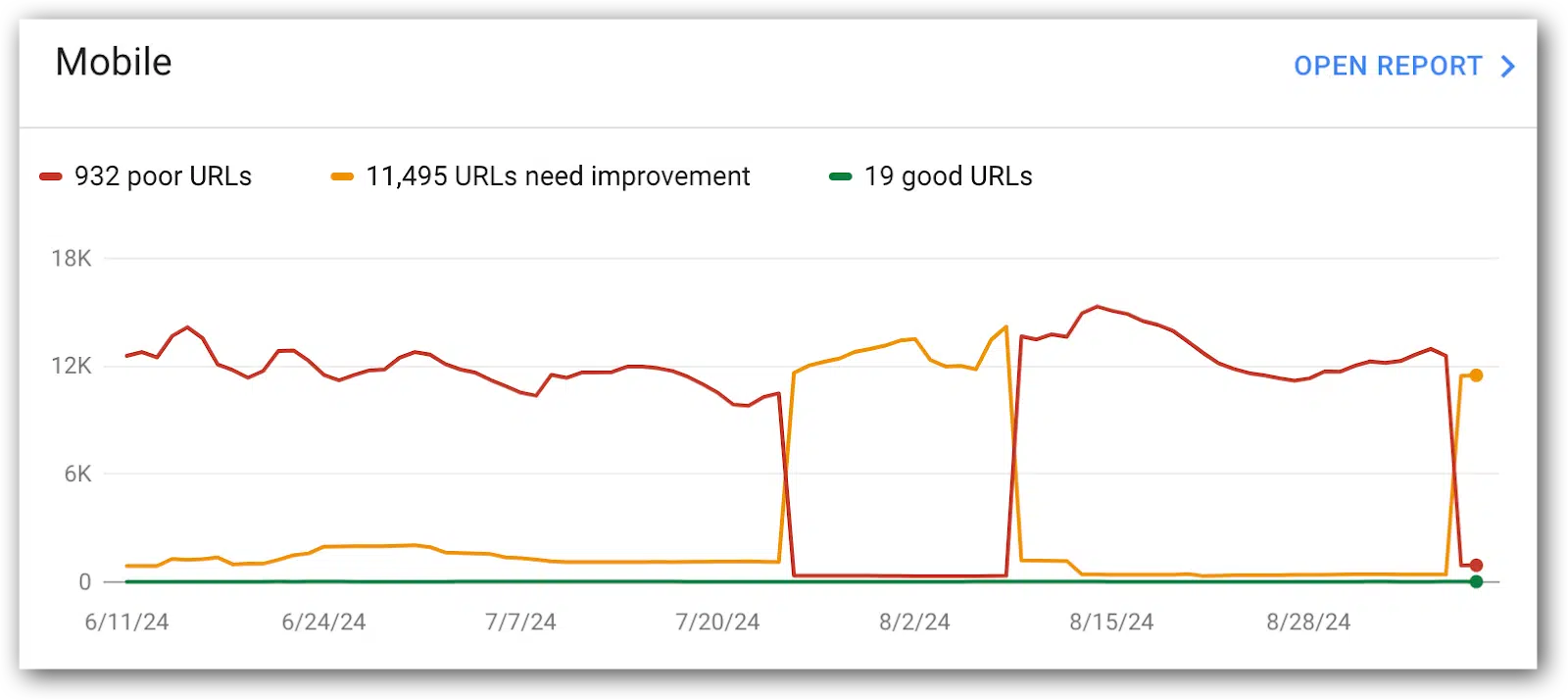
Mobile Core Web Vitals
Mobile Core Web Vitals are the most important for SEO and deserve the most attention. Google also has much higher expectations for these URLs, so this is where you’ll focus most of your Core Web Vitals attention.
This is a report I like developers to see regularly, because you can see how URLs are flipping between the metrics and on which date. This can help you troubleshoot by coordinating these dates with changes on the site, CMS, DAM, network, etc.
Metrics to monitor:
Mobile good URLs.
Mobile poor URLs.
Mobile needs improvement URLs.
The historical chart is great for quick trends, but it’s limited to a short window. For the bigger picture, drop the data into a spreadsheet and build your own chart.
You’ll often find that things look fine now, but 5 or 6 months ago, the metrics were far better – don’t let that slip past you.
Tip: This is a good report for development to see on a regular basis. Consider a regular metrics readout cadence with development to discuss what’s going on and compare it with what they know is happening in releases, server maintenance, third-party code and more.
Why mobile URLs don’t have a ‘good’ Core Web Vitals score
This data explains why particular URLs aren’t considered good by Google. Unfortunately, it doesn’t tell you how to address the problem (that requires you to do a Core Web Vitals audit).
In these metrics, you’ll get:
The count of URLs scoring low in any of the core web vitals audit.
A handy list of example URLs, thoughtfully grouped by Google based on similar issues. Unfortunately it’s not all URLs with similar issues, bit’s enough to help you spot patterns and identify areas for improvement.
Metrics to monitor in this report:
LCP issue: longer than 2.5s (mobile)
LCP issue: longer than 4s (mobile)
CLS issue: more than 0.1 (mobile)
CLS issue: more than 0.25 (mobile)
INP issue: longer than 200ms (mobile)
INP issue: longer than 500ms (mobile)
Developers usually need more than just metrics. They want the full list of URLs with low scores.
Luckily, Google gives you and your devs sample URLs to evaluate, though it’s not the comprehensive list they crave. To dig deeper for more URL examples, tap into the Google Search Console API for more data.
Tips:
Include these in your regular metrics readout with development.
The historical chart is handy for quick trends, but it’s got a short memory. For the full picture, toss the data into a spreadsheet and chart it yourself. Don’t let those historical highs and lows slip into the shadows. Even better if you grap the chart images because your spreadsheet likely won’t have metrics showing day-to-day fluctuations throughout each month.
Desktop Core Web Vitals metrics
This is exactly the same as mobile. Usually, I give this a quick gander, but most of the time is spent on mobile core web vitals metrics.
What is often interesting in the desktop metrics is correlations between metrics improving in desktop, but getting worse on mobile devices. This is a good place for development to figure out why mobile metrics got worse, but desktop improved.
Metrics to monitor:
Desktop Good URLs.
Desktop Poor URLs.
Desktop Needs Improvement URLs.
Why Desktop Core Web Vitals metrics are low
Frankly, this is not a priority for the sites I work on. Not that I never look at them, but in the grand scheme of things we prioritize fixing mobile issues, anticipating that fixing mobile issues will fix desktop issues.
For a few of my B2B enterprise clients, with a primarily desktop-focused audience, we dial up the attention on these metrics to make sure nothing slips through the cracks:
LCP issue: longer than 2.5s (desktop)
LCP issue: longer than 2.5s (desktop)
CLS issue: more than 0.25 (desktop)
CLS issue: more than 0.1 (desktop)
INP issue: longer than 200ms (desktop)
INP issue: longer than 500ms (desktop)
Rich results from Schema
Adding Schema markup to your site unlocks special features that enhance your organic listings, such as breadcrumb links, product information and more.
In Google Search Console, URLs with code intended to trigger these SERP enhancements are tracked in a section called “Enhancements.”
The list of “Enhancements” listed in Google Search Console will vary based, on your site’s setup. Here are the most common enhancements you’ll likely see:
Breadcrumbs.
FAQ.
Review Snippets.
Videos.
Unparsable Structured Data.
Product Snippets.
Merchant Listings.
And more.
Each of these enhancements have a report indicating the number of URLs that are valid, invalid and issues to address.
What’s next?
Now that you have the key Google Search Console metrics, make sure you track them regularly (monthly works best).
Remember to drop these metrics into a spreadsheet. Google’s limited historical data might leave you hanging when you need those insights down the road.
In the next article of this series, I’ll show you a few metrics tucked away in the “settings” section of Google Search Console that few SEOs talk about, but I like to keep an eye on.
Dig deeper: 3 underutilized Google Search Console reports for diagnosing traffic drops
Contributing authors are invited to create content for Search Engine Land and are chosen for their expertise and contribution to the search community. Our contributors work under the oversight of the editorial staff and contributions are checked for quality and relevance to our readers. The opinions they express are their own.
With just a few more weeks to go before Call of Duty: Black Ops 6 launches on October 25, Activision’s marketing machine is ramping up. A new campaign began today, September 29, bringing back the character The Replacer, played by Peter Stormare. For anyone just catching up, the conceit of the ads is that The Replacer is the person sent in to replace the person who took a day off their job to play Call of Duty instead.
Stormare’s The Replacer debuted in 2013 and has been a mainstay for Activision’s Black Ops marketing campaigns over the years. The first in a series of commercials for Black Ops 6 featuring The Replacer went live today during Sunday’s NFL game lineup.
Size:
Want us to remember this setting for all your devices?
Sign up or Sign in now!
Please use a html5 video capable browser to watch videos.
This video has an invalid file format.
Sorry, but you can’t access this content!
Please enter your date of birth to view this video
Now Playing: Call of Duty: Black Ops 6 The Replacer Live Action Trailer
This is just the first of many commercials on the way, as Activision said it has put together almost 30 videos that will roll out now until the game releases. Activision teased that “some notable names” will be replaced during this latest ad campaign, but didn’t offer any other specifics.
The new spot is pretty absurd, as The Replacer subs in for a firefighter saving a cat from a tree, a rideshare driver, and even a father at family dinner (along with a spicy conversation with the mom). Even the Pope plays Call of Duty, it seems, as The Replacer takes over his job as well for a day.
Black Ops 6 launches on October 25, and unlike past years, there is no early access to the campaign. In another big change, Black Ops 6 will be available on Game Pass at launch, but only for the most expensive tiers of the service.
Transport proteins are responsible for the ongoing movement of substrates into and out of a biological cell. However, it is difficult to determine which substrates a specific protein can transport. Bioinformaticians at Heinrich Heine University Düsseldorf (HHU) have developed a model — called SPOT — which can predict this with a high degree of accuracy using artificial intelligence (AI). They now present their approach, which can be used with arbitrary transport proteins, in the scientific journal PLOS Biology.
Substrates in biological cells need to be continuously transported inwards and outwards across the cell membrane to ensure the survival of the cells and enable them to perform their function. However, not all substrates that move through the body should be allowed to enter the cells. And some of these transport processes need to be controllable so that they only occur at a particular time or under specific conditions in order to trigger a cell function.
The role of these active and specialised transport channels is assumed by so-called transport proteins, or transporters for short, a wide variety of which are integrated into the cell membranes. A transport protein comprises a large number of individual amino acids, which together form a complex three-dimensional structure.
Each transporter is tailored to a specific molecule — the so-called substrate — or a small group of substrates. But which exactly? Researchers are constantly searching for matching transporter-substrate pairs.
Professor Dr Martin Lercher from the research group for Computational Cell Biology and corresponding author of a study, which has now been published in PLOS Biology: “Determining which substrates match which transporters experimentally is difficult. Even determining the three-dimensional structure of a transporter — from which it may be possible to identify the substrates — is a challenge, as the proteins become unstable as soon as they are isolated from the cell membrane.”
“We have chosen a different — AI-based — approach,” says Dr Alexander Kroll, lead author of the study and postdoc in the research group of Professor Lercher. “Our method — which is called SPOT — used more than 8,500 transporter-substrate pairs, which have already been experimentally validated, as a training dataset for a deep learning model.”
To enable a computer to process the transporter proteins and substrate molecules, the bioinformaticians in Düsseldorf first convert the protein sequences and substrate molecules into numerical vectors, which can be processed by AI models. After completion of the learning process, the vector for a new transporter and those for potentially suitable substrates can be entered into the AI system. The model then predicts how likely it is that certain substrates will match the transporter.
Kroll: “We have validated our trained model using an independent test dataset where we also already knew the transporter-substrate pairs. SPOT predicts with an accuracy above 92% whether an arbitrary molecule is a substrate for a specific transporter.”
SPOT thus suggests highly promising substrate candidates. “This enables us to limit the search scope for experimenters to a significant degree, which in turn speeds up the process of identifying which substrate is a definite match for a transporter in the laboratory,” says Professor Lercher, explaining the link between bioinformatic prediction and experimental verification.
Kroll adds: “And this applies for any arbitrary transport protein, not just for limited classes of similar proteins, as is the case in other approaches to date.”
There are various potential application areas for the model. Lercher: “In biotechnology, metabolic pathways can be modified to enable the manufacture of specific products such as biofuels. Or drugs can be tailored to transporters to facilitate their entry into precisely those cells in which they are meant to have an effect.”
To make a great buckwheat dish, cooking it the right way is key. The grain takes a bit longer to cook compared to other grains. “Start by rinsing it to remove any dust or bitterness. Then, cook it until tender but still slightly chewy for the perfect texture. For extra flavour, toast the buckwheat before cooking. A splash of lemon juice, a drizzle of olive oil, or even some ghee can make the dish even more delicious,” shares Gaurav Yadav, Chef De Cuisine at The Bombay Canteen, Mumbai.
One must steam buckwheat groats skillfully to cook them best. This method tackles the grain’s need for ample water and guarantees its proper cooking. “Equally essential is the tradition of soaking buckwheat before cooking. It is vital for achieving the intended texture and taste,” adds Gagandeep Sawhney, Executive Chef Shangri-La, Delhi. Buckwheat elevates salads with its nutty taste, unique texture, and health perks. Chef Jaspal of L’Opera, Delhi, says, “Add cooked groats to salads for a protein and fibre boost. Rinse and dry thoroughly to avoid excess moisture. Amp up texture with nuts, seeds, or radishes.”
Mastering a delightful buckwheat dish hinges on grasping its distinctive nature. “Balancing the smoky notes with vibrant herbs and a hint of lime juice takes the dish to exceptional levels,” adds Chef Bhim, Head Chef at Viet:Nom, Gurugram.
Looks like the fascination for buckwheat in fine dining is here to stay.
Nita Ambani channeled a red-carpet glam at an event, stunning in a bright saree.
Nita Ambani held an exclusive dinner at her Mumbai residence, Antilia, to felicitate the remarkable athletes- Manu Bhakar, Neeraj Chopra, Navdeep Singh, and Mona Agarwal. For the occasion, she embraced a classic evening look that was reminiscent of the glamorous style of the 90s.
Nita Ambani stunned in a red saree, radiating 90s Bollywood aesthetic.(Instagram/@manavmanglani)
More about Nita Ambani’s saree
Nita Ambani kept her signature saree style of heavy embroidery aside and looked glam in this red saree. (Instagram/@manavmanglani)
Nita Ambani has often served countless regal looks with intricate embroidery and threadwork, but this time, she embraced the quintessential Bollywood glamour with a simple red saree. The red saree she wore channeled a red-carpet-worthy aesthetic. As the saying goes, “less is more,” and in this case, the saree stood out precisely because it lacked any overpowering patterns or additional colors.
However, the saree wasn’t entirely plain. The borders along the pallu and hemline featured textured detailing. Subtle embroidery added a refined elegance to the outfit, without taking away from the boldness of the color. The intricate work along the edges provided a touch of sophistication that complemented her overall look. She paired the saree with a blouse embellished with dazzling red details, further enhancing the outfit’s dramatic, show-stopping appeal.
ALSO READ: Nita Ambani, Alia Bhatt’s hairstylist decodes hair Botox and Keratin treatments; why he never recommends them
Her 90s-inspired makeover
Nita’s 90s-inspired makeover brought the entire look together, enriching the ensemble with an extra layer of sophistication. Her hair was styled in loose waves, cascading elegantly down her shoulders, adding a striking oomph to the bold red saree. To allow her saree to take center stage, she kept her accessories minimal yet elegant. She wore delicate golden bangles, earrings, and a statement necklace that perfectly aligned with her style. Pairing gold with red was also a wise choice as the gold made the red stand out more.
As is true to Nita Ambani’s signature fashion choices, her understated accessories still included a breathtaking neckpiece that added a focal point of elegance. The style was unique for Nita Ambani and revealed that she can gracefully carry any look.
Catch every big hit,…
See more
Catch every big hit, every wicket with Crick-it, a one stop destination for Live Scores, Match Stats, Quizzes, Polls & much more. Explore now!.
Catch your daily dose of Fashion, Taylor Swift, Health, Festivals, Travel, Relationship, Recipe and all the other Latest Lifestyle News on Hindustan Times Website and APPs.
News / Lifestyle / Fashion / Nita Ambani rocks 90’s Bollywood glam in stunning red saree at Mumbai event
Two House Democrats have called for an investigation of former Food and Drug Administration device director Jeff Shuren after The New York Times reported on potential conflicts of interest.
Reps. Anna Eshoo, D-Calif., and Rosa DeLauro, D-Conn., sent a letter to the Office of Inspector General of the Department of Health and Human Services on Tuesday citing the article. The Times story covered how Jeff Shuren led the FDA’s device center while his wife worked as legal counsel for medtech companies.
“At the very least, the article raises serious questions of appearance and serious conflict of interest,” the representatives wrote in the letter, which was provided to MedTech Dive. The Times was the first to report on the investigation request Wednesday.
Dive Insight:
Jeff Shuren led the FDA’s Center for Devices and Radiological Health for 15 years before stepping down in July.
A month later, the Times reported that the former director’s wife, Allison Shuren, represented medical device companies as co-chair of law firm Arnold & Porter’s life sciences and healthcare practice.
Although Jeff Shuren signed ethics agreements, the article stated that their work sometimes intersected, such as when Arnold & Porter worked on an acquisition of Allergan as the FDA grappled with reports of a rare cancer associated with the company’s breast implants.
In response to the letter, an FDA spokesperson wrote Thursday that “the FDA takes seriously its obligation to help ensure that decisions made, and actions taken, by the agency and its employees are consistent with ethics laws and regulations.”
The spokesperson added that the FDA does not comment on whether matters involving specific employees are the subject of internal or external reviews.
Last month, the agency told MedTech Dive that it had no indication regulatory decisions were affected by Allison Shuren’s employment. However, an FDA spokesperson added that “it appears there were certain instances from about 10 years ago for which Dr. Shuren should have either recused himself or sought ethics authorization to participate to avoid any potential appearance of bias.”
In their letter, Eshoo and DeLauro wrote that the “only way to get to the truth” is through an independent review to determine “whether this is simply an appearance of impropriety or actual inappropriate and unethical conduct.”
A spokesperson for the Office of Inspector General said in an email to MedTech Dive, “We received the letter and are reviewing it for appropriate action.”
Consumer advocacy group Public Citizen called for the OIG to open an investigation when the news broke in August. Public Citizen said the FDA should appoint a new director who has no conflicts of interest and will prioritize patients’ interests.
Michelle Tarver was named acting director of the CDRH, and the FDA is searching for a permanent successor. Jeff Shuren is working with the agency as it transitions to a new leader.
The FDA spokesperson told MedTech Dive last month that Jeff Shuren had been advised to exercise greater caution in matters concerning recusal, and is being provided “additional administrative support to ensure future compliance.”
House prices increased by 0.3% over the September quarter, bringing the national median house price to $1,149,547. House prices have risen in 19 of the past 20 months, with an annual increase of 7.6% and a two-year growth of 13.2%.
National unit prices fell by 0.2% in September to a median of $657,112. However, unit prices are still up 6.1% year-on-year.
National home prices are expected to continue rising, especially in Perth, Brisbane, and Adelaide, driven by affordability and high buyer activity.
Value buying opportunities exist in Sydney and Melbourne, where prices are still below early 2022 peaks.
Factors like easing interest rate hikes, strong jobs growth, high migration, and wage increases will continue supporting housing demand, though the growth may moderate compared to 2023.
Chronic housing undersupply, high rents, and low vacancy rates persist, although early signs of increasing rental supply and easing tenant demand are emerging.
National house prices increased again over September although unit prices were lower over the month.
The national capital city median house price increased by 0.3% to $1,149,547 over the September quarter compared to the August quarter, according to the latest data from My Housing Market.
The national quarterly house price has now increased over 19 of the past 20 months, has risen by 7.6% over the year ending September 2024 and is higher by 13.2% over the past two years.
Perth was again the top capital city performer over the quarter with prices higher by 1.2% followed by Adelaide up 1.1%, Brisbane higher by 0.5%, Dawin up by 0.4% and Melbourne rising by 0.3%.
Prices however were lower by 0.1% in Canberra, Sydney down 0.3% and Hobart falling by 0.5% over the month.
House prices in a number of capitals remain sharply higher over the year ending the September quarter of 2024 with Perth still clearly the top performer up strongly by 26.9% followed by Adelaide up 17.3%, Brisbane higher by 16.2% and Sydney up 5.4%
And Melbourne’s annual house prices are however down by 0.7% followed by Hobart lower by 0.8%, Canberra down by 2.7% and Darwin falling 4.3%.
Median House Prices September 2024
Median
Month
This Year
1 Year
2 Year
Sydney
$1,628,532
-0.3%
4.0%
5.4%
12.3%
Melbourne
$1,052,758
0.3%
-0.7%
-0.7%
1.8%
Brisbane
$982,305
0.5%
10.8%
16.2%
21.7%
Adelaide
$970,073
1.0%
12.9%
17.3%
27.4%
Perth
$941,009
1.2%
19.1%
26.9%
40.0%
Hobart
$666,618
-0.5%
-1.6%
-0.8%
-10.3%
Darwin
$612,828
0.4%
-3.2%
-4.6%
-1.8%
Canberra
$935,740
-0.1%
-1.8%
-3.6%
-5.4%
National
$1,149,547
0.3%
5.5%
7.6%
13.2%
Median Unit Prices September 2024
National unit prices were lower over September, down by 0.2% to $657,112.
The national unit price however is now 6.1% higher than the September quarter 2023 result.
Brisbane and Perth were the top performers over September with unit prices each rising by 1.1%.
All other capitals however fell with Melbourne prices down 0.1%, Adelaide lower by 0.3%, Canberra down by 0.4%, Sydney falling 0.5%, Hobart down 3.9% and Darwin lower by 4.2%.
Median
Month
This Year
1 Year
2 Year
Sydney
$771,217
-0.5%
3.2%
4.2%
6.8%
Melbourne
$565,568
-0.1%
-0.8%
1.0%
1.3%
Brisbane
$556,788
1.1%
22.1%
24.5%
39.5%
Adelaide
$520,793
-0.3%
14.0%
21.1%
37.4%
Perth
$501,528
1.1%
21.5%
26.9%
35.4%
Hobart
$502,196
-3.9%
-0.6%
-5.0%
-8.6%
Darwin
$346,974
-4.2%
-2.0%
-4.7%
-1.9%
Canberra
$498,019
-0.4%
-2.6%
-2.7%
-1.5%
National
$657,112
-0.2%
4.7%
6.1%
9.4%
Perth, Brisbane and Adelaide continue to record clearly the highest annual unit price growth to September 2024, up by 26.9%, 24.5% and 21.1% respectively.
Sydney’s annual unit prices are now higher by 4.2% and Melbourne up by 1.0%.
Canberra, Darwin and Hobart however have recorded annual unit price decreases – down 2.7%, 4.7% and 5.0% respectively.
Capital city housing markets produced mixed results over September, with Perth and Brisbane continuing to record strong prices growth for both houses and units.
Melbourne maintained recent modest to flat home price outcomes, with Sydney prices now falling marginally after solid growth over the past year.
The smaller capitals of Hobart, Darwin and Canberra remain clear underperformers with prices mostly continuing to fall.
The early spring housing market however has remained active overall with continuing high numbers of seasonal listings and relatively high numbers of weekend home auction sales.
National home prices are likely to continue to increase over the coming months driven as usual by the ongoing boom markets of Perth, Brisbane and Adelaide, with robust buyer and seller activity reflecting the affordability positives remaining in those capitals.
Value opportunities also remain for buyers in Sydney and Melbourne where prices are currently below or similar to the previous peaks recorded in early 2022.
Growth rates over the remainder of 2024, although set to remain generally positive, are however unlikely to match the strong results recorded over the winter and spring period last year that reflected a robust, reviving market environment driven by a surge in buyer activity.
Underlying drivers will continue to support housing market activity with the spectre of higher interest rates easing with recent monthly inflation data falling sharply and approaching the RBA target range – at least for now.
The national economy however remains strong with still relatively low jobless rates and surging jobs growth driving record wage increases.
Continuing high levels of migration over the shorter term will exacerbate current chronic housing undersupply supporting high rents and low vacancy rates in capital city rental markets although early signs of rising rental supply and reduced tenant demand are now emerging.
High rents and higher prices generally however are providing clear incentives for first-home buyers and particularly investors chasing solid investment returns.
Capital city housing markets have recorded another mixed bag of price results over the September quarter with the sharp diversity of capital city consolidating as Perth, Brisbane and Adelaide continue as clear leaders in monthly and annual price growth.
Melbourne and Sydney remain clear underperformers of the major capitals with home price growth remaining subdued or waning – and awaiting an expected revival over the rest of the spring selling season.
Maarten Paes is the starting goalkeeper for Major League Soccer team FC Dallas. Yet he can walk down a busy street in Dallas, Texas, and nobody will notice him.
That is not the case online. Or in Indonesia.
Like his team-mates in the Indonesia national team, Paes is mobbed when he visits the country and has a huge social media following, far bigger than would be expected of a player yet to trouble football’s uppermost echelons.
Paes, 26, was born in the Netherlands but became an Indonesian citizen in April and was shocked by the rapid growth of his socials — he has 1.7million followers on Instagram and 1.2m on TikTok.
“You already know before it happens because you’ve seen it happen to other players. It’s such a huge country and they are all in love with soccer,” Paes says.
The 26-year-old knew he was eligible to play for Indonesia for a couple of years but at the end of last year, the team reached out to him again. “At that time, my grandmother was declining in her health,” he says.
“She’s from there and I spoke with her a lot about it. It was a thing I could do that would make her smile at the end of her life. That was huge for me. She said, ‘I would really love if you would do that’. So she encouraged me and it was an honour to do it for her.”
After news broke that he was switching to Indonesia, his life changed. “That was when I felt I needed to get a relationship with my social media in a different way, where you can put it away for a while because it can be a little bit overwhelming,” he says. “It’s surreal that suddenly you’re getting adored by so many followers and such big crowds.”
Paes, who represented the Netherlands at youth level, played his first two games for Indonesia during the recent break. He says the goalless draw against Australia, who were 109 places above Indonesia in FIFA’s world rankings, in front of more than 70,000 fans at the Gelora Bung Karno Stadium was eye-opening.
“It was like for the first time it all hit me, how big it is,” he says. “You see it on the internet, you see the numbers and you can’t really wrap your head around it. Then we couldn’t leave the hotel without security.”
Oxford United, who sit ninth in the Championship, England’s second tier, rarely generate big numbers on social media, but in August, a video they posted on Instagram hit 5.2million views.
Australian A-League side Brisbane Roar experienced a similarly curious upturn in engagement across social channels this month too. Like Oxford, Brisbane’s videos posted to Instagram are usually viewed thousands of times. Yet back-to-back videos posted to Instagram garnered 4.5million and 1.7million views for Roar.
The explanation? You’ve guessed it: the summer arrival of two Indonesian soccer superstars, in the form of the national team’s youngsters Marselino Ferdinan and Rafael Struick.
Ferdinan is a 20-year-old attacking midfielder who signed for Oxford from Belgian second-division side Deinze last month. Struick is a 21-year-old forward who joined Brisbane (owned by Indonesian conglomerate Bakrie Group) from ADO Den Haag, in Dutch football’s second tier, this month.
Neither arrived as a household name, at least in Europe or Australia, nor were they from well-known clubs.
Within days of Ferdinan joining Oxford, their follower count on Instagram grew from 83,000 to 226,000. Some of Brisbane’s previous posts received less than 10 replies. Struick’s announcement had 9,000.
This is the Indonesia effect. The country in south-east Asia has a population of more than 280million people and football is the No 1 sport. Cue adoration for national team players and fanaticism online and offline.
To illustrate the point, below are some stats compiled by The Athletic to compare Indonesia’s starting XI with the United States men’s national team’s starting XI — but we’re not looking at expected goals or progressive passing. We’re comparing Instagram followers.
Indonesia’s starting XI for their World Cup qualifier against Australia had a collective Instagram following of 26.9million. The 11 clubs they play for have a combined following of under 10m on the same app.
In comparison, USMNT’s last starting XI from their friendly against New Zealand had a combined following of only 1.4m.
That number could have been higher but Christian Pulisic, the AC Milan forward with 7.8m followers on Instagram, was on the bench.
What comparing the two starting XIs should highlight is the level of support for Indonesian players compared with, for example, a country of more than 335million people that will host the men’s World Cup in 2026.
The only players in the starting XI for Indonesia’s goalless draw with Australia who have fewer followers than the club they play for are Rizky Ridho, who plays centre-back for Indonesian Liga 1 side Persija Jakarta, and Justin Hubner, who is at Wolverhampton Wanderers in the Premier League.
Hubner, 21, joined Wolves’ youth ranks in 2020. He has yet to feature for the senior side and plays the majority of his games at academy level — but with the national team, he is treated like he plays week in and week out for Real Madrid, such is the fanfare he experiences online and in person.
“I can’t leave my hotel (in Indonesia) because there are people waiting for me, running to me. Everywhere I go it’s crazy,” Hubner tells The Athletic. “If I go into a shop and then walk out, there will be maybe 100 people waiting. I’m their idol, so they are waiting for me, for pictures and autographs.”
More on the world of social media and football…
Hubner was born in the Netherlands and played alongside Xavi Simons (an Instagram star as a teenager at Barcelona, he had one million followers before he was 14 and now plays for RB Leipzig) in Dutch youth national teams. With Indonesia once a Dutch colony, a growing number of players in the national team have dual citizenship.
“I had maybe 5,000 followers on Instagram and when the fans realised I had Indonesian blood it went to 30k and now I’m at 2.7million,” says Hubner. “In terms of social media, everything has just grown so fast. Everything from brand deals too. There’s so much coming to me now. It’s a dream.”
The day before speaking to The Athletic, his deal with deodorant firm Rexona was launched. “A lot of team-mates here at Wolves say, ‘Can I change my national team to Indonesia?’, as a joke.
“But the guys here support me and are happy for me. They also want followers because it’s nice to have, but it is not about followers, the important thing is that I’m playing for the national team and what comes with it is really nice.”
Hubner went on loan to Japanese side Cerezo Osaka last season and says there were always Indonesia fans there to watch him, but when he travelled back to England following the two World Cup qualifier games against Saudi Arabia and Australia, there was no welcome party like there would have been at Jakarta airport. He returned to his apartment alone and without the need for security.
“It’s a different world,” Hubner says about his quiet life in Wolverhampton. “When I come back to Europe it is like I am living my own life, no stress. In Indonesia, there is a crazy side. You have no privacy, wherever you go there’s always people recording you, it’s nice but it is also good to get back to your own space and privacy.
“When I landed in Indonesia, I tried to hide myself with a cap and a mask but they recognised me straight away. Even the security and police wanted pictures with me. There was 50 to 60 people who wanted a picture. My family are also quite famous now. I made an Instagram account for my mum and she has nearly 50,000 followers. Everyone recognises her. The first time she went to Indonesia, she was asking why people wanted pictures with her.”
When fans meet Hubner he says it is not uncommon for them to be overawed with emotion. Some have cried. His mother, Brigitte, has received direct messages from fans who dream of marrying her son. This star factor is something clubs are trying to tap into.
“Dallas have been noticing it,” goalkeeper Paes says. “There’s been a big boost in terms of engagement for the club. If I play for a club, I like to help them as much as possible because they help me a lot too. My main focus is to keep the balls out of the net for them, but help to build this club, build awareness.”
Oxford, Ferdinan’s new club, are co-owned by Erick Thohir, an Indonesian businessman who helped restore them to the second tier after a 25-year hiatus. Thohir was also appointed head of the Football Association of Indonesia last year and is behind the drive to improve the national team, youth teams and wider football across Indonesia.
“The exciting thing about Marselino is that he is the best young Indonesian talent,” says Thohir. “He’s 20, he’s been playing and training in Belgium.
“We need to be investing in young players at Oxford. He’s young but he has played more than 20 times for our national team, so the Oxford manager wants to give him a chance, and that’s the most important thing.
“If he brings more awareness to Oxford, it is an extra value.
“We want to see an opportunity for any players who can play,” he adds. “So let’s see if Marselino can survive in Oxford because we don’t give any red carpet or VIP treatment. He has to compete.”
Microsoft 365 offers full access to Office apps on the desktop and mobile with guaranteed updates.
You also get 1TB of OneDrive storage and stronger security with unlimited access to the Personal Vault.
Microsoft Defender, free VPN, and ad-free Outlook email are included, plus there are extra features on Teams.
I use Office apps like Word, Editor, and OneNote daily for work. While a standalone Office 2021 or the upcoming Office 2024 license may seem like a better option, I prefer the Microsoft 365 subscription for its added benefits. Here are the five reasons why I think an Office 365 subscription justifies the price.
1 Access to Full Microsoft Office Apps on Desktop and Mobile
A Microsoft 365 subscription offers full, offline and online access to its new Office apps, including Word, OneNote, Editor, Excel, and more on desktop and mobile. While you can use the limited free version online and on mobile devices, I prefer the performance of desktop apps, offline access, OneDrive cloud integration, and guaranteed security updates and enhancements.
Where the standalone Office app is limited to one device per license, Microsoft 365 offers multi-device support, allowing you to install office apps on up to five devices with a Personal plan. If you opt for the Family plan, you can share the account with up to six members, each with up to five device support and 1TB storage. Additionally, apps like Editor, Publisher and Access are now part of Microsoft 365.
The Office 365 Suite also tends to receive the latest earlier than the standalone versions.
2 1TB of OneDrive Storage and Stronger Security
One key factor that influenced my decision to choose Microsoft 365 over the standalone Office 2021 app was the need for more OneDrive storage. By default, free OneDrive accounts offer a meager 5GB storage shared across Outlook, Windows Backup, and OneDrive. Once the drive is full, one must frequently free up OneDrive storage space to even receive Outlook emails with attachments.
With Microsoft 365, the Personal plan includes 1TB of storage—plenty enough for all the backups, Outlook emails, and Microsoft Teams attachments. For an additional cost, you can add up to 1TB of extra storage to increase your total storage to 2TB.
On the security front, Microsoft 365 for OneDrive supports ransomware protection and notifies the user when an attack is detected. It also guides you through the recovery process to restore your files. However, without a subscription, you get only one free notification and recovery.
What’s more, it also offers unlimited access to Personal Vault, otherwise limited to three documents in the free plan. Personal Vault is a protected vault (folder) where you can store your documents, such as your passport copy, driver’s license, birth certificate, tax records, automotive insurance, work ID, and other valuable digital assets protected with encryption, even on a local drive.
3 Microsoft Defender
One lesser-known, but handy app in the Microsoft 365 ecosystem is Microsoft Defender. It’s a standalone security app that offers a different set of functionalities depending on the platform and region. That said, it’s important to note that Microsoft Defender shouldn’t be confused with the built-in Windows Security app on Windows computers.
For Android, it works as an antivirus solution with scanning and threat detection. In contrast, on Mac and iOS devices, it works as an extension of your existing antivirus software, offering protection against phishing and unsafe network connections from websites and emails. On a Windows computer, it complements the built-in Windows Security or any third-party antivirus software you might have installed.
What I like most about the app is its central dashboard, allowing you to manage and monitor security across all your devices. You can also view alerts and notifications from any device and even the past 30 days of device activity history.
But it’s not just the security perks. Microsoft Defender also offers VPN access for private browsing, capped at 50GB usage per month for subscribers in the U.S., Canada, the UK, and Germany. If you are in the U.S., it provides additional benefits like identity theft monitoring and identity theft insurance features. Unfortunately, not all features are available to everyone, which is a bit disappointing.
4 Ad Free Outlook Email with Advanced Security
Microsoft has discontinued its Outlook ad-free add-on and now includes the ad-free experience as part of the Microsoft 365 subscription. Additionally, it also offers enhanced security features, including advanced screening of email attachments for viruses and malware and Safelinks, which scans URLs to detect phishing and other threats.
Microsoft 365 Outlook also supports multiple options for email encryption. When sending an email, you can choose Do Not Forward as the encryption type to prevent the email from being copied or forwarded. If you set it to Encrypt, the recipient will need to enter a private key to read the email, otherwise, they’ll see a wall of indecipherable text.
5 Microsoft Teams Benefits
In addition to its core features, Microsoft 365 sweetens the deal for Microsoft Teams (Personal) users with some extras, including 30 hours of calling, more room for attachments with OneDrive, and unlimited chats. Personally, I use Teams for one-on-one calls, remote troubleshooting, and occasionally to organize family and social events, so these extended limits have come in handy.
If you use Skype, there’s something for you too. All Personal and Family users get 60 minutes of free Skye calling to landline and mobile phones each month. However, to access this benefit, you need to claim these free minutes by signing in to your Skype account on the web.
As for the pricing, the Microsoft 365 subscription costs $69.99/year for the Personal plan and $99.99/year for the Family plan. If you don’t want to commit a year of payment, the monthly Personal and Family plans cost $6.99 and $9.99, respectively. While these prices are already appealing, with a bit of planning, you can get the subscription at a deep discount during sales on e-commerce websites like Newegg, eBay, and Amazon.
Overall, Microsoft 365 as a bundle is a great value-for-money proposition, especially for those who extensively use Office apps and have increasing cloud storage needs. What’s more, with 365 Family, a six-way split works out to be $16.67 each per year. That said, if you want a competent productivity suite without the bells and whistles of Microsoft 365, there’s no dearth of free Microsoft Office 365 alternatives offering limited but essential features.
<img src='https://news.cgtn.com/news/2024-09-29/IMTA-2024-Conference-aims-to-help-empower-sustainable-mountain-tourism-1xieejfPWZq/img/e7d8ba1844bb407f9f46f96ff122400a/e7d8ba1844bb407f9f46f96ff122400a.png' alt='The 2024 International Mountain Tourism Alliance Annual Conference in Xingyi, southwest China's Guizhou Province, September 26, 2024. /CFP'
The 2024 International Mountain Tourism Alliance (IMTA) Annual Conference was held on September 26 in Xingyi, Guizhou Province. Themed “Inclusiveness, Mutual Learning, Innovation – Empowering Sustainable Mountain Tourism with New Quality Productive Forces,” the conference gathered industry leaders to explore innovative approaches for the future of sustainable mountain tourism.
IMTA Chairman Dominique de Villepin, in a video message, highlighted the conference as a key platform for dialogue and cooperation in the mountain tourism sector. He emphasized that as the global tourism industry transitions from recovery to sustainable growth, mountain tourism is evolving with growing demand for smart tourism and new business opportunities.
De Villepin stressed the need for a multidimensional analysis of industry trends and called for collaboration among governments and businesses to tackle the challenges facing international tourism.
He Yafei, IMTA vice chairman, noted that global tourism revenue reached $1.6 trillion in 2023, with tourist numbers recovering to 90 percent of pre-pandemic levels. He highlighted the IMTA’s role in promoting inclusive, sustainable mountain tourism by integrating culture, education and technology into tourism development.
Pansy Ho, IMTA vice chairman, underscored the impact of climate change, technological progress, and global supply chain shifts on the tourism industry. She emphasized that promoting sustainable mountain tourism not only drives economic growth but also fulfills social responsibilities such as protecting the environment and fostering cultural exchange. IMTA, since its inception, has promoted the sustainable use of mountain resources and the revitalization of local economies.
The conference also showcased IMTA’s achievements in 2024. Fu Yingchun, IMTA vice chairman and executive secretary-general, reviewed the alliance’s progress, noting that IMTA has strengthened its international reputation and expanded business opportunities. He also outlined objectives for 2025, focusing on fostering global cooperation and sustainable development in mountain tourism.
Future Initiatives
During the event, IMTA awarded the 2025 “International Mountain Tourism Day” hosting rights to Gran Canaria, Spain, a popular tourist destination known for its mountain and coastal attractions. Gran Canaria’s selection highlights the growing global interest in mountain tourism.
IMTA also announced the certification of 14 “World Famous Tourism Mountains,” including iconic sites such as Jungfrau in Switzerland, Annapurna in Nepal and Changbai Mountain in China. This initiative aims to promote sustainable tourism practices and protect mountain tourism resources worldwide.
Additionally, plaques were awarded to three new “IMTA International Mountain Hiking Demonstration Routes,” recognizing their contribution to high-quality hiking tourism. These routes, part of China’s renowned Five Sacred Mountains, are expected to set benchmarks for sustainable hiking tourism development globally.
The conference also saw the establishment of an IMTA liaison office in Xingyi, further cementing the city’s role as a hub for mountain tourism. The IMTA Expert Committee, formed in 2020, added several new members, including industry leaders and scholars, to provide strategic guidance on the future of mountain tourism.
Eleven new members, including the Chungcheongnam-do Tourism Association of South Korea and the Trekking Agencies’ Association of Nepal, were welcomed into the IMTA network, expanding its global reach. The alliance now includes 199 institutional and individual members from around the world.
As IMTA enters its eighth year, the organization remains committed to promoting sustainable mountain tourism through collaboration, innovation, and inclusivity. The 2024 Annual Conference marks a pivotal moment in shaping the future of the industry as it transitions from recovery to sustainable growth.
The major studios wouldn’t touch “Megalopolis,” the ambitious passion project from octogenarian Oscar-winner Francis Ford Coppola. Now it’s clear why.
The $120-million film, which Coppola financed with his own money, is on track to open with a disastrous $4 million in ticket sales this weekend from the U.S. and Canada, according to industry estimates, making it a epic flop for the legendary director known for the “Godfather” trilogy, “Apocalypse Now” and “The Conversation.”
The 2 hr. 18 min. epic, a sort of retelling of Roman history through a satirical science fiction lens, has been an obsession of Coppola’s for decades. He shouldered the financial risk himself, taking on the production budget plus marketing and distribution costs, selling off part of his wine business to make it happen.
Coppola, 85, had proven doubters wrong before, pouring millions into the tumultuous production of “Apocalypse Now,” which ended up nominated for the best picture Oscar and grossing more than $100 million worldwide, according to Box Office Mojo.
“Megalopolis” premiered at the Cannes Film Festival in May to a long standing ovation but mixed reviews, with some praising the scope and ambition and others calling it a jumbled mess. The Times’ Joshua Rothkopf compared its story to Tom Wolfe’s “The Bonfire of the Vanities,” “a funhouse image of a clashing New York City riven by money, power and race.”
The movie features a stacked cast, starring Adam Driver, Giancarlo Esposito, Nathalie Emmanuel, Aubrey Plaza, Shia LaBeouf, Jon Voight and Laurence Fishburne.
But moviegoers who saw “Megalopolis” rejected it, giving is a devastating “D+” rating from audience polling firm CinemaScore.
Lionsgate is distributing the movie for a fee, but is not carrying any of the financial risk (that’s all on Coppola). Still, the Santa Monica studio suffered a headache from the promotional campaign when it released a trailer that included fake quotes from real critics doubting some of Coppola’s classic past pictures. Lionsgate apologized and pulled the trailer.
Apart from “Megalopolis,” Lionsgate has fielded a number of bombs this year, including “Borderlands” and “The Crow.”
Universal and DreamWorks Animation’s “The Wild Robot” won the weekend, debuting with a projected $35 million domestically, topping pre-release expectations.
The wildly acclaimed animated movie, based on the Peter Brown children’s book of the same name, is off to a solid start given its reported $78-million production budget and strong word-of-mouth, indicated by an “A” CinemaScore and 98% “fresh” status on Rotten Tomatoes.
In second place was the hit Warner Bros. legacy sequel “Beetlejuice Beetlejuice,” which grossed $16 million Friday through Sunday for a domestic total of $250 million to date.
Under Chinese law, only 10 percent of a company’s staff is supposed to be made up of labor dispatch workers. But Zhang says the regulations are often not rigorously enforced. She noted that companies can also circumvent the limit by hiring workers categorized under different outsourcing schemes that function in largely the same way, a strategy that job advertisements indicate Shein is using.
A spokesperson for Shein confirmed to WIRED that the company “works with third-party vendors to staff the vast majority of our warehouse operations,” but declined to specify what percentage of the workers are categorized as labor dispatch. “Shein’s practices are aligned with industry standards and comply with local laws and regulations,” the spokesperson said in an email.
Because many of Shein’s warehouse staffers are classified as gig workers, they are not guaranteed a set hourly wage, just like Uber drivers and food delivery couriers. Job listings and several videos reviewed by WIRED indicate that while workers are promised a monthly base salary, their total compensation is calculated based on their productivity levels, a system summed up as “more work, more pay.”
This structure gives workers the option to hustle to earn higher incomes. But when the volume of Shein orders decreases, their wages may also drop due to no fault of their own, according to one of the videos. In a clip posted to the ByteDance-owned platform Xigua in January, one purported Shein worker complains that she can’t earn enough money because “the amount of goods is not enough.” She adds that she imagined having a more stable salary by this point in her life.
“Shein is committed to ensuring the fair and dignified treatment of all workers within our supply chain and is investing tens of millions of dollars in strengthening governance and compliance,” the spokesperson for Shein said.
Shein told WIRED that, based on records from its vendors, the company estimates junior warehouse staff are paid roughly 7,000 RMB ($997) per month, while senior workers can earn more than 12,000 RMB ($1,709) on average. The current monthly minimum wage for full-time employees in Guangzhou, a major Chinese city close to where many of Shein’s warehouses are located, is RMB 2,300 ($327), according to China Briefing, a website run by the consulting firm Dezan Shira & Associates (this figure excludes overtime pay and other forms of compensation).
Shein’s use of labor dispatch workers has been covered previously. In 2021, the Chinese news outlet Sixth Tone reported that Shein allegedly “appears to rely extensively” on dispatch agencies in its warehouses, which the article noted “are associated with a host of labor problems.”
But Shein has never mentioned the practice in its annual sustainability and social impact reports, which detail the company’s efforts to ensure its suppliers are adhering to local regulations and its code of conduct. In its latest report released in August, Shein disclosed that it hired third-party firms to audit 15 out of its 21 logistics warehouses in China last year and found they “all … performed well.”
WazirX, the Indian crypto exchange that suffered a $230 million hack in July, is actively working to restructure its finances and compensate affected users. In a recent development, a Singapore court has granted the exchange a four-month moratorium to finalize its financial restructuring. In a press release on Thursday, September 26, WazirX stated that this move lays the groundwork for a legally binding resolution to restore users’ crypto balances.
In August, Zettai, the Singapore-based majority stakeholder in WazirX, filed a moratorium request with a Singapore court. A moratorium grants struggling companies a court-sanctioned grace period to devise their recovery plan. While WazirX initially indicated that it would require six months to restructure its finances, the court has only granted a four-month period. It remains uncertain whether this timeline will be extended to accommodate WazirX’s original estimate.
In the press note obtained by Gadgets360, the exchange claimed that the Singapore court has acknowledged WazirX’s active engagement with creditors and promptness in filing for this moratorium.
“As part of the court’s conditions, WazirX will make wallet addresses public via a court affidavit, respond to user queries raised in the courtroom, release financial information, and ensure future voting for court applications is scrutinised by independent parties,” the note said.
In Singapore, WazirX has partnered with financial advisory firm Kroll to support its restructuring efforts. The exchange stated that it is collaborating with its advisors and stakeholders to develop a comprehensive plan that addresses the needs of all involved parties.
Amid intense criticism and social media backlash, WazirX co-founder and Zettai director Nischal Shetty expressed gratitude to the Singapore court for its latest ruling.
As of September 13, only 441 or 0.02 percent out of its registered user base of 16 million had agreed to WazirX’s restructuring plan via emails.
On July 18, a multi-signature wallet associated with WazirX and managed by Liminal Custody was hacked, leading to a loss of over $230 million (approximately Rs. 1,900 crore) and leaving users in distress. As a result, crypto withdrawals on the platform have been suspended since the incident. Currently, 34 percent of users’ INR funds remain frozen while the investigation is ongoing, but the remaining 66 percent of INR funds are available for withdrawal by users.
Meanwhile, reports have surfaced of the unidentified WazirX hacker laundering the stolen funds through software like Tornado Cash, which complicates any potential negotiations for recovering the stolen assets.
According to the WazirX team, the timeline for the company’s financial restructuring will remain in effect unless a “white knight” investor steps in to provide a capital infusion.
Are you a search marketer looking to expand your reach and drive even more impactful results? Look no further. Join us for How Search Marketing Turned the Tide for CTV Audience Targeting and learn how your existing search marketing expertise can be a valuable asset on this powerful advertising platform.
Connected TV (CTV) has a new feature that you may recognize right away: keyword targeting. This Search Engine Land webinar will show you how CTV fits seamlessly into your search strategy and how to use your existing keyword knowledge to reach your target audience on the big screen.
Explore the new frontier of keyword targeting and leverage your search marketing expertise across platforms. Click here to save your spot!
Edna Chavira is the Senior Director of Marketing Services at Third Door Media. She has over 20 years of experience helping B2B companies generate leads and acquire customers.
Monster Hunter Wilds is one of the most anticipated games of 2025, and with good reason. The previous two games in the series, 2018’s Monster Hunter World and 2021’s Monster Hunter Rise, were acclaimed by critics and audiences, and both broke sales records, with World still ranked as Capcom’s second-best-selling game of all time at over 26 million copies sold.
However, Monster Hunter has been around for a long time, and there were many games before World and Rise ushered in a new era for the franchise. While the franchise was already mega-popular in Japan pre-World, Monster Hunter had more of a cult following in North America. But the games have always been good.
Fans curious to try out some of those older titles can grab several classic Monster Hunter cartridges for around retail price on Nintendo Switch and 3DS right now–and the best place to start is with Monster Hunter Generations Ultimate. You can grab the Switch version for just $10 via the eShop (normally $40), and those who prefer buying physical media can snag a copy for $43.54 at Amazon. Generations Ultimate is out of print now, so physical edition prices fluctuate regularly. You can think of Generations Ultimate as a greatest hits album, as it compiles a staggering number of monsters and locales from the franchise’s history until World. If you only want one old Monster Hunter game, Generations Ultimate is the ideal pick.
Monster Hunter Generations Ultimate for Nintendo Switch
Monster Hunter Generations Ultimate
Monster Hunter Generations Ultimate is seen as the last entry in the series to feature the “old Monster Hunter” gameplay–and all the jank and charm that came with it. Originally released on 3DS as Monster Hunter X in Japan in 2015, the 2016 localization included the Generations rebranding. Capcom significantly expanded the adventure for the game’s 2018 release on Switch as Generations Ultimate. The game’s 3DS origins and hardcore classic Monster Hunter design will be evident to players who started with World or Rise. However, Generations Ultimate offers a much more approachable take on the formula compared to previous entries, featuring small quality-of-life tweaks and faster, more varied combat.
Despite its original incarnation being nearly a decade old, Generations Ultimate still reigns as the Monster Hunter game with the most stuff to do (and most monsters to hunt). Seriously, it’s packed with content. It has hundreds of quests and almost every monster, map, and town hub from all previous games. There are over 90 large monsters to hunt, including a few new ones.
World and Rise turned Monster Hunter into a multi-platform franchise, but Generations Ultimate remains a Switch exclusive. If you want to play it but don’t have a Switch, you can save on the Nintendo Switch OLED as well as the handheld-only Switch Lite at Amazon.
And now, let’s jump back another generation to hunt monsters rendered in stereoscopic 3D.
Monster Hunter Games for Nintendo 3DS
Monster Hunter 4 Ultimate
Monster Hunter games used to launch in two versions–a base game, followed a year or so later by an expanded “Ultimate” version that included new monsters, armor, hunting ranks, and more. Kind of like old-school Pokemon. Capcom typically skipped the base game in North America, opting to only release the upgraded version in English. While Generations Ultimate is the better of the two, Generations is still reasonably priced for $45.59 new at Amazon, and worth picking up if you don’t have a Switch and want to dust off your trusty 3DS or 2DS.
Quick note about playing Monster Hunter on 3DS: With the Switch eShop closed, physical editions could continue to climb in price as we inch closer to the launch of Monster Hunter Wilds. Also, Monster Hunter plays best on the New Nintendo 3DS XL or 2DS XL due to the addition of the C-stick, the quirky little second “analog stick” that looks like a pencil eraser. If you don’t have a New model, there is an accessory that adds a second Circle Pad to your 3DS or 3DS XL. Unfortunately, the Circle Pad Pro is hard to find for a reasonable price these days, unless you happen to have a Japanese Nintendo 3DS LL (the XL’s name in Japan).
Generations wasn’t the only traditional Monster Hunter game to release on 3DS. During its lifecycle, the 3DS was the sole home of the franchise. Monster Hunter 3 Ultimate released in North America in 2013, and it was followed by Monster Hunter 4 Ultimate in 2015.
While these games have less overall content than Generation Ultimate, they offer an even more authentic “classic Monster Hunter” experience. Both are highly regarded by long-time fans, particularly 4 Ultimate, which landed a high slot on GameSpot’s Monster Hunter series rankings list.
If you want to play these games but don’t have a 3DS, it’s worth noting there are plenty of 3DS and 3DS XL handhelds available at Amazon via its Renewed program. Though video game consoles and handhelds tend to cost a bit more on Amazon compared to eBay or Facebook Marketplace, you get the added benefit of Amazon’s 90-day guarantee. If the product doesn’t live up to expectations, you can return it for a full refund.
Monster Hunter Stories is a monster-taming spin-off similar to Pokemon.
For those who are entirely new to the series, Monster Hunter World and Rise–and their giant expansions–are still the best places for new players to start with the series before Wilds comes out. Physical copies for all these games are available at Amazon. You can also pick up copies of the turn-based RPG spinoff, Monster Hunter Stories and Monster Hunter Stories 2: Wings of Ruin in a discounted collection on Switch. It’s also worth mentioning that the official Monster Hunter Amiibo figures that Nintendo launched for Monster Hunter Rise and Monster Hunter Stories 2 are still available at Amazon and GameStop. Several discounted Monster Hunter art books and new figure preorders are also available at Amazon.
And let’s not forget that the next game, Monster Hunter Wilds, launches February 28 on PS5, Xbox Series X|S, and PC. Based on the latest previews, it seems like it could be the perfect jumping-on point for newcomers–so fret not if the older titles are too intimidating. Preorders are available now, and you can get your copy of the game with a limited-edition steelbook case for only five bucks more.
If you game on PC, you can save 18% on your Monster Hunter Wilds preorder at Fanatical. The digital storefront is selling Steam keys for Monster Hunter Wilds’ standard, Deluxe, and Premium Deluxe editions at this discount. The deal drops the price of the standard edition to only $57.39.
Disclosure: GameSpot and Fanatical are both owned by Fandom.
Researchers at the Francis Crick Institute have shown that the balance of bacteria in the gut can influence symptoms of hypopituitarism in mice.
They also showed that aspirin was able to improve hormone deficiency symptoms in mice with this condition.
People with mutations in a gene called Sox3 develop hypopituitarism, where the pituitary gland doesn’t make enough hormones. It can result in growth problems, infertility and poor responses of the body to stress.
In research published today in PLOS Genetics, the scientists at the Crick removed Sox3 from mice, causing them to develop hypopituitarism around the time of weaning (starting to eat solid food).
They found that mutations in Sox3 largely affect the hypothalamus in the brain, which instructs the pituitary gland to release hormones. However, the gene is normally active in several brain cell types, so the first task was to ask which specific cells were most affected by its absence.
The scientists observed a reduced number of cells called NG2 glia, suggesting that these play a critical role in inducing the pituitary gland cells to mature around weaning, which was not known previously. This could explain the associated impact on hormone production.
The team then treated the mice with a low dose of aspirin for 21 days. This caused the number of NG2 glia in the hypothalamus to increase and reversed the symptoms of hypopituitarism in the mice.
Although it’s not yet clear how aspirin had this effect, the findings suggest that it could be explored as a potential treatment for people with Sox3 mutations or other situations where the NG2 glia are compromised.
An incidental discovery revealed the role of gut bacteria in hormone production
When the National Institute for Medical Research (NIMR) merged with the Crick in 2015, mouse embryos were transferred from the former building to the latter, and this included the mice with Sox3 mutations.
When these mice reached the weaning stage at the Crick, the researchers were surprised to find that they no longer had the expected hormonal deficiencies.
After exploring a number of possible causes, lead author Christophe Galichet compared the microbiome — bacteria, fungi and viruses that live in the gut — in the mice from the Crick and mice from the NIMR, observing several differences in its makeup and diversity. This could have been due to the change in diet, water environment, or other factors that accompanied the relocation.
He also examined the number of NG2 glia in the Crick mice, finding that these were also at normal levels, suggesting that the Crick-fed microbiome was somehow protective against hypopituitarism.
To confirm this theory, Christophe transplanted faecal matter retained from NIMR mice into Crick mice, observing that the Crick mice once again showed symptoms of hypopituitarism and had lower numbers of NG2 glia.
Although the exact mechanism is unknown, the scientists conclude that the make-up of the gut microbiome is an example of an important environmental factor having a significant influence on the consequences of a genetic mutation, in this case influencing the function of the hypothalamus and pituitary gland.
Christophe Galichet, former Senior Laboratory Research Scientist at the Crick and now Research Operations Manager at the Sainsbury Wellcome Centre, said: “It was a huge surprise to find that changes in the gut microbiome reversed hypopituitarism in the mice without Sox3. It’s reinforced to me how important it is to be aware of all variable factors, including the microbiome, when working with animals in research and how nurture can influence nature.”
Robin Lovell-Badge, Group Leader of the Stem Cell Biology and Developmental Genetics Laboratory at the Crick, said: “Hypopituitarism can result from trauma as well as rare mutations, and it can have some profound effects on health in general. As well as suggesting potential options for treatment, our work reinforces how important the gut-brain link is. The next step for this research will be to work out exactly how aspirin and the microbiome influence NG2 glia, and then study this effect in people so we can see if these relatively accessible interventions could help treat hypopituitarism.”
If you are a regular at Delhi’s Lodhi colony, rejoice! There’s a new player in town—Dos—that gives your old favourites from across the globe—sometimes also your biggest rejects—an unexpected spin, making them as easy on the tummy as they are on the eye.
Food: The menu largely features regional ingredients—think raw banana, fish, kasundi, kalari cheese—and Dos scores in creating dishes that combine nostalgia with a modern thrill. An example is a dish served featuring split white peas and candy tomatoes, with a garnish of brown onions and radish.
The very first bite brings in familiar tangy notes of the Bengali ghugni, except the taste is elevated with a portion of the Kashmiri kalari cheese. The non-vegetarians can go for the Smokey Chipotle Prawns with yellow peas, brown onions and mayo oil, although there are plenty of options to choose from.
Scepticism may take over on spotting eggplant on the menu, but be brave, because what the chefs do to every pantry’s most hated vegetable in their Baked Eggplant Schnitzel is unimaginable. It is served on a bed of tahini yoghurt with a drizzle of Guntur chilli sauce.
For risk-averse non-vegetarians, there’s the classic grilled chicken breast that comes with double-cooked potatoes and seasoned with burnt cabbage, caramelised onions, and crumbled goat cheese, all of which comes together zestfully with a drizzle of mustard sauce. Brownie points for their mocktails that can cheer you up, even on a damp rainy evening. Recommendations include Spicy Smooth Raspados, Dreamer and Open Your Heart.
Décor: The experimentation in their food is tastefully reflected on the walls. Designed in an industrial theme, the exposed brick walls and contemporary lighting make the space cozy but not cramped.
Service: The staff is friendly, courteous and well-informed about the ingredients that go into the complex recipes.
Price: At Rs 2,500 for two, it is easy on the pocket.
Address: Fourth Ave Rd, Main Market, Block 8, Lodi Colony, New Delhi
The Consortium of National Law Universities (NLUs) has officially released the second sample paper for CLAT 2025 on September 28, 2024. CLAT 2025 is all set to be held on December 1, 2024 and aspiring candidates can use these sample questions to familiarise themselves with the latest pattern of CLAT examination.
CLAT sample papers offer students a realistic glimpse into the structure and types of questions they will face during the actual exam.
However, while these papers serve as a helpful guide for understanding question patterns and themes, they do not fully guarantee that the difficulty level in the real exam will be identical. There may be variations in complexity and the style of questions, making it essential to prepare beyond just the sample papers.
Rani Mukerji wore a satin grey Sabyasachi saree to the 2024 IIFA Awards. The internet called her ‘headmistress’ in the ensemble.
Rani Mukerji attended the International Indian Film Academy (IIFA) Awards last night in Abu Dhabi. The actor won the Best Actress Award for her role in Mrs Chatterjee vs Norway. She arrived at the event in a grey satin Sabyasachi saree and a matching blouse, styled with a coiffed retro-inspired hairdo that got mixed reactions from fans.
Rabi Mukerji attends the IIFA Awards.
Internet calls Rani Mukerji’s IIFA look ‘headmistress core’
Internet sensation Diet Sabya shared Rani Mukerji’s video from the IIFA Awards on Instagram with a comment from one of their followers. The netizen called Rani’s look ‘headmistress core’. Meanwhile, one user wrote, ‘What’s with the hairstyle? It makes her look older.’ “She always looks elegant, but this doesn’t work,” another netizen commented.
Rani Mukerji in the satin: Hit or miss
While Rani Mukerji has given us many stunning moments in the nine yards, this grey satin Sabyasachi saree look doesn’t work for her. From the simple silhouette to the boring hairstyle to complement the outfit, the traditional look doesn’t say red carpet-worthy. So, for us, this look is a miss.
Decoding the red carpet look
The satin Sabyasachi saree features a contrasting white lace-embroidered border. Rani draped the nine yards in traditional style, with pleats on the front and the pallu falling from her shoulder elegantly in a floor-grazing length. The actor paired the drape with a matching silk blouse featuring white polka dot borders, round neckline, and half-length sleeves.
Rani accessorised the ensemble with dainty pearl earrings, a pearl choker necklace, statement rings, bracelets, a hairpin, and stilettos. She also carried a Chanel clutch with the ensemble. Lastly, a side-parted coiffed retro bun, rouge cheeks, kohl-lined eyes, black eyeliner, pink lip shade, mascara-adorned lashes, and darkened brows rounded off the glam.
Catch every big hit,…
See more
Catch every big hit, every wicket with Crick-it, a one stop destination for Live Scores, Match Stats, Quizzes, Polls & much more. Explore now!.
Catch your daily dose of Fashion, Taylor Swift, Health, Festivals, Travel, Relationship, Recipe and all the other Latest Lifestyle News on Hindustan Times Website and APPs.
News / Lifestyle / Fashion / Internet calls Rani Mukerji headmistress as she attends IIFA 2024 in grey satin saree and coiffed retro hairdo
For the first time in more than two decades, a completely new form of antipsychotic medication will be available in the U.S. following an approval Thursday by the Food and Drug Administration.
While momentous, the approval may also put a renewed spotlight on an enduring defect of the American healthcare system. An effective medicine is coming to market, but patients may have a hard time getting it at first because of insurance barriers. Analysts on Wall Street are optimistic there won’t be many such hurdles, but some psychiatry specialists are cautious, citing past experience with new drugs.
The medicine, which will be sold as Cobenfy, was developed by Boston-based biotechnology company Karuna Therapeutics. In threemedium- to large-sized clinical trials, Karuna showed that treatment with Cobenfy significantly relieved schizophrenia symptoms in people with the mental disorder.
Not only that, the drug didn’t cause excessive weight gain, restlessness or movement issues — side effects that are common to existing antipsychotics and, historically, have led patients to either switch medications or stop taking them altogether.
The results have been met with excitement, especially since substantial portions of the schizophrenia population don’t respond to or stay on other therapies. Yet doctors, while eager to have another treatment option, say they aren’t sure how much Cobenfy will ultimately benefit patients.
One main concern is to what extent insurance providers will cover such a drug, given the abundance of cheaper alternatives. The FDA has already approved more than a dozen antipsychotics for schizophrenia, and many have inexpensive generic versions that patients may be encouraged to try first. Cobenfy, meanwhile, carries a list price of $22,500 for a year’s supply, before accounting for insurer rebates or discounts.
A Bristol Myers spokesperson said the company priced the drug “in line with the landscape of branded oral antipsychotics.” Most patients, the spokesperson added, won’t pay the list price.
“You really have to be sure it’s better than everything else out there that’s cheaper and more readily available,” Mitzi Gonzales, a neuropsychologist and director of translational research at Cedars-Sinai, said in an interview earlier this year.
Carol Lim, a psychiatrist at Massachusetts General Hospital, noted in an interview this year how, after approval of the schizophrenia drug Caplyta in 2019, it was hard to get insurance coverage until after other treatments failed.
Cobenfy’s rollout will be handled by Bristol Myers Squibb, which recently acquired Karuna for $14 billion. Bristol Myers’ Chief Commercial Officer, Adam Lenkowsky, said on an earnings call in late July that payers have given “very positive feedback” to the company and acknowledged Cobenfy “fills a significant unmet need.”
Lenkowsky added that a team at Bristol Myers has, for months, been pitching Cobenfy to state Medicaid directors and Medicare payers. Estimates hold that more than 80% of schizophrenia patients are on those programs, meaning buy-in from them will be “critical,” according to Lenkowsky.
Citing data from Clarivate, Bristol Myers estimates the U.S. schizophrenia population totals around 1.6 million.
Cobenfy’s labeling includes warnings of risks that include urinary retention, increased heart rate and swelling of the face and lips. The FDA advises against using the drug in people with moderate to severe kidney impairment, or with known liver impairment.
Bottles of Bristol Myers Squibb’s Cobenfy, a new drug for schizophrenia, are arranged in this photo illustration.
Permission granted by Bristol Myers Squibb
On Wall Street, expectations for Cobenfy are high. The investment firm Cantor Fitzgerald envisions annual sales reaching $1 billion starting in 2026. More broadly, analysts have predicted the drug will generate north of $3 billion by 2030, according to Leerink Partners.
“I think you’re going to get a massive bolus of early adopters,” Paul Matteis, an analyst at Stifel who previously covered Karuna, said late last year. “And I think Bristol [Myers] just has to not mess it up.”
Sales could rise higher if Cobenfy notches additional approvals, a goal Bristol Myers is already working toward. A roughly 400-person study is evaluating the drug as an add-on therapy for schizophrenia patients who aren’t adequately responding to their current atypical antipsychotics. Data from that experiment should come next year.
Also in 2025, Bristol Myers plans to push the drug into late-stage testing for both bipolar disorder and the agitation that often accompanies Alzheimer’s disease.
Then, in 2026, the company anticipates results from two trials of some 800 people with psychosis tied to Alzheimer’s.
Cobenfy isn’t like available antipsychotics, all of which work by balancing levels of the chemical messengers dopamine or serotonin. It instead activates “muscarinic receptors,” a type of protein researchers believe harmonizes certain brain circuits that aren’t properly functioning in schizophrenia and some other psychiatric conditions.
Boosted by Karuna’s results, muscarinic receptors have become a hot commodity. Just two weeks before Bristol Myers announced its acquisition plans, AbbVie agreed to buy Cerevel Therapeutics for almost $9 billion.
A Pfizer spinout, Cerevel has been developing a muscarinic drug, emraclidine, that could ultimately rival Cobenfy. A pair of emraclidine studies, which, together, have enrolled around 750 participants with schizophrenia, should produce initial data before the end of the year.
Further behind, companies like Neurocrine Biosciences, Neumora Therapeutics and MapLight Therapeutics are working on their own muscarinic agents.
Editor’s note: This story has been updated with pricing information from Bristol Myers.
A few weeks ago I wrote a blog about the one thing that stops most people from making the most of their financial opportunities including making regular investments.
It was my thesis that a lack of context is the main cause.
Having a long-term plan provides you with the context required to make mistake-free financial decisions.
It is difficult to work out what investments to make (and when) if you don’t know where you are heading and how you will get there.
A financial plan will give you sufficient context in which to measure your financial decisions.
We follow three distinct steps to develop and implement a financial plan for our clients.
We have refined this process over many decades and have found this disciplined and logical approach helps develop very efficient evidence-based plans.
Step 1: Develop a high-level financial strategy
Determine your future cash flow and net worth
The first step is to build a financial model.
A financial model will forecast your future income and expenses and therefore, how much cash flow you have to allocate towards investing.
It should also forecast your assets and liabilities i.e. net worth.
The purpose of a financial model is to do two things.
Firstly, to measure whether your chosen strategy will work i.e., achieve your goals.
For example, if you plan to invest in 2 properties and maximise super contributions, will that be enough to generate $100k p.a. of income (after-tax) that you require in retirement?
The second purpose of a financial model is to compare strategies to eliminate inferior ones and pick the one that has the highest probability of working i.e., the one that generates the highest returns for the lowest risk.
Financial modelling is part art, part science.
The science bit is the Excel skills and technical knowledge required to build financial models.
The art is knowing what strategies work best in various situations, which can only be acquired with many years/decades of experience.
Realistically, most people won’t have the skill and experience to complete their own financial modelling.
Mixture of asset classes
Most people would be well served by investing in a mixture of asset classes including super, residential property, share market investments, and so forth.
The financial modelling exercise will help you determine the optimum mixture of asset classes that suits your goals, risk profile, and financial position.
Level of gearing
Whether you will borrow money to invest and if so, to what extent is a major strategic consideration.
A financial model will assist with determining the right level of gearing.
It is important you consider whether you will have enough cash flow to service debt.
But even more important is to determine to what extent you need to repay the debt before you retire.
It is prudent to not take high levels of debt into retirement so you must have a debt retirement strategy.
Of course, a strategy is only useful if it can be implemented, so you will need to consider your present and future borrowing capacity i.e., how much will the banks lend you.
Ownership structures
Once you have determined the mixture of asset classes that you will invest in and how much gearing you will adopt, you can then determine the best investment ownership structures.
Considerations include income tax payable over your lifetime, land tax (for the property), CGT if your strategy includes selling, current and projected cash flow, borrowing capacity, and asset protection.
Retain high-level focus
It is important to avoid getting bogged down in detail during this strategy formulation stage.
The goal is to develop a high-level strategy only i.e. what assets to invest in and when.
If you get too detailed at this stage, you will likely confuse yourself and suffer from information overload.
Step 2: Develop the detail that underpins your financial strategy
Once you have determined a high-level strategy, the next step is to formulate the detail that underpins the strategy.
Your investment methodology and philosophy
Most importantly, you will need to consider how you will invest in various asset classes.
That is, what methodology you will use?
Anyone who is a regular reader of this blog knows that I’m a staunch believer in only using evidence-based investment methodologies.
Using evidence-based strategies dramatically reduces your investment risk.
If your strategy includes investing in shares, what approach will you use; (1) diversified, low-cost, and rules-based, (2) picking direct shares yourself or using a broker, (3) using an active fund manager, and so on.
If your strategy includes investment in property, what methodology will you use?
Will you invest in investment-grade property, try to identify a growth market, undertake property developments, or something different?
My book, Investopoly outlines the evidence-based methodologies that I follow myself and the reasons why.
How to invest your superannuation
You will need to decide how to invest in your superannuation.
Will you use a retail fund (no! should be the answer), an industry super fund, a wrap platform, or set up your own Self Managed Super Fund?
Borrowing strategy
If your strategy includes borrowing to invest, then you will need to engage with an experienced mortgage broker so that they can develop a borrowing strategy to help you implement your plan.
Their role is to help you obtain the required level of borrowings in the most cost and tax-effective manner.
Ancillary planning matters
Now that you have formulated a clear strategy, it will be easier to work out how much insurance you need and how to structure your estate plan.
Your current asset base, borrowing plans, and cash flow position will inform you how much insurance you may need (such as income protection, Life, and TPD).
It will also help you understand how you can minimise the cost of this over time.
That is, as your financial position strengthens and your financial commitments reduce (kids are older, home loan repaid, etc.), you typically need less insurance coverage.
For example, you may need a lot of coverage today but expect that you need dramatically less coverage in say 10 years’ time if your strategy goes to plan.
Your financial plan and asset ownership structure will dictate how your will should be structured and other estate documents.
It is important these documents align with your overall strategy.
Step 3: Implement, review and refine
Once you have defined your personal investment strategy, you can begin implementing it.
Typical strategy implementation includes:
Strategically divesting any under-performing assets.
Optimise super which could include switching to a superior super fund.
Make property investment/s. If the plan is to purchase 2 or more properties, we must develop a strategy regarding the timing of said investments. We must consider borrowing capacity and market opportunities.
Commence regular share market investing, often monthly.
Refer a client to an estate lawyer to draft estate planning documents (wills and power of attorneys).
Implement insurance to ensure strategy/financial risk is minimised.
Complete taxation planning including setup of any structures or restructure.
Navigate inevitable life changes
If there’s one thing that never changes it is change itself.
Therefore, it is unlikely that everything will go perfectly to plan.
You will probably have to adjust along the way, but at least you’ll have a framework and context for doing so.
Reviewing investment performance
You must regularly review the performance of each investment and your progress compared to your plan, to ascertain whether any adjustments are necessary.
Remember to always play the long game which often requires a lot of patience and discipline (a topic that I discuss in the coming weeks).
Ad hoc or strategic?
It stands to basic reason and logic that developing a long-term strategy will ensure you take the most efficient path to achieve your financial and lifestyle goals.
Therefore, investing the time and money to develop your own personalised financial strategy will pay substantial dividends for the rest of your life.
ALSO READ: The 17 steps to financial freedom through property investment
About Stuart Wemyss Stuart was a Chartered Accountant before establishing mortgage broking firm ProSolution Private Clients. He has authored two books and shares his experience with readers of Property Update. Visit www.prosolution.com.au
The World Anti-Doping Agency (WADA) has announced that it will appeal against the “no fault or negligence” finding in Jannik Sinner’s anti-doping case.
WADA is seeking a “period of ineligibility of one or two years,” in which the world No. 1 tennis player and two-time Grand Slam champion would be barred from competing in the sport at all levels. Sinner won the U.S. Open in New York just three weeks ago.
Sinner, who is currently playing at the China Open in Beijing, said he was “surprised” by WADA’s decision.
“Obviously I’m very disappointed and also surprised of this appeal, to be honest, because we had three hearings. All three hearings came out very positively for me,” he told reporters after beating Roman Safiullin to reach the last eight in Beijing.
“We always talk about the same thing. Maybe they just want to make sure that everything is in the right position.”
In a further statement, a “disappointed” Sinner added that there had been “three separate hearings in each case confirming my innocence” in the case.
“Several months of interviews and investigations culminated in three senior judges scrutinising every detail through a formal hearing,” the statement continued.
“They issued an in-depth judgement explaining why they determined me not at fault, with clear evidence provided and my cooperation throughout.
“On the back of such a robust process both the ITIA and the Italian anti-doping authority accepted it and waived their rights to appeal.”
Sinner added that the need for a “thorough investigation” was understandable and that he would “cooperate fully” in the investigation, but questioned why the process needed to be reopened.
Sinner tested positive for clostebol, a banned anabolic steroid, on two occasions: March 10, in-competition at the BNP Paribas Open held in Indian Wells, Calif, and March 18, out of competition.
An independent tribunal convened by the ITIA and conducted by Sports Resolutions ruled that Sinner bore “no fault or negligence” for those positive tests in a hearing on August 15, but still found Sinner to have committed two anti-doping violations, for which he was stripped of his ranking points, prize money, and results from that event.
It accepted the Italian world No.1’s explanation that Sinner’s physiotherapist, Umberto Ferrara, had brought an over-the-counter healing spray containing clostebol to Indian Wells. His trainer, physiotherapist, Giacomo Naldi, cut his hand, and then used the spray on that cut. Naldi then conducted massages on Sinner, which led to transdermal contamination with the clostebol from the healing spray.
Sinner parted company with Naldi and Ferrara on the eve of the U.S. Open.
WADA is now challenging the decision that Sinner was not at fault for his violation. In a statement released today Saturday September 28, it said: “The World Anti-Doping Agency (WADA) confirms that on Thursday 26 September, it lodged an appeal to the Court of Arbitration for Sport (CAS) in the case of Italian tennis player, Jannik Sinner, who was found by an independent tribunal of the International Tennis Integrity Agency (ITIA) to bear no fault or negligence having twice tested positive for clostebol, a prohibited substance, in March 2024.
“It is WADA’s view that the finding of “no fault or negligence” was not correct under the applicable rules. WADA is seeking a period of ineligibility of between one and two years. WADA is not seeking a disqualification of any results, save that which has already been imposed by the tribunal of first instance.”
GO DEEPER
World No 1 Jannik Sinner penalised after twice testing positive for banned substance
In response, the ITIA issued its own statement.
“The International Tennis Integrity Agency (ITIA) acknowledges the World Anti-Doping Agency (WADA) decision to appeal the ruling of No Fault or Negligence in the case of Italian tennis player Jannik Sinner, issued by an independent tribunal appointed by Sport Resolutions on 19 August 2024. Under the terms of the World Anti-Doping Code, WADA has the final right to appeal all such decisions,” an ITIA spokesperson said.
“Having reached an agreed set of facts following a thorough investigative process, the case was referred to a tribunal entirely independent of the ITIA to determine level of fault and therefore sanction because of the unique set of circumstances, and lack of comparable precedent.
“The process was run according to World Anti-Doping Code guidelines; however, the ITIA acknowledges and respects WADA’s right to appeal the independent tribunal’s decision in the Court of Arbitration for Sport.”
Jannik Sinner won the U.S. Open in the immediate aftermath of the ITIA ruling on his anti-doping case. (Al Bello / Getty Images)
In the ITIA’s full decision, Professor David Cowan said that “even if the administration had been intentional, the minute amounts likely to have been administered would not have had […] any relevant doping, or performance enhancing, effect upon the player.”
A positive test for clostebol carries a mandatory provisional suspension from tennis, but two further independent tribunals upheld Sinner’s appeals against those suspensions, which were active between April 4 and April 5 and April 17 and April 20. The success of those appeals meant that the two positive tests, and the attached suspensions, were not made public until the conclusion of the ITIA’s investigation into Sinner’s case. This drew allegations of double standards from some of Sinner’s tennis peers, but is in line with ITIA protocol.
In a statement released at the conclusion of the investigation, Sinner said: “I will now put this very challenging and hugely unfortunate period behind me.” The best men’s tennis player in the world will have to resume it now.
GO DEEPER
What players’ reaction to Sinner’s doping case says about their trust in their sport
‘The news that Sinner will have been fearing’
Analysis from Charlie Eccleshare, tennis writer
Sinner emerged from months of uncertainty to win the U.S. Open three weeks ago. Now he has been put back under investigation, and the renewed scrutiny of the initial ITIA ruling that will come with it.
It wasn’t as though the world No. 1 necessarily appeared liberated in New York — his post-match press conference after the final was as much subdued as it was celebratory — but there was an air of Sinner having temporarily closed a chapter behind him.
The prospect of a WADA appeal was always there however, and Saturday morning brought the news that Sinner will have been fearing. He was able to compartmentalize pretty well during the five months from being told of the positive test to it becoming public in August. He even won the Cincinnati Open two days before the full decision in his case was released.
But in his post-final press conference in New York, he acknowledged that his demeanor and personality had changed during the investigation.
“Obviously, it was very difficult to enjoy certain moments,” he said.
“Even the way I behaved or how I entered the court in some tournaments was no longer the same as before.”
Jannik Sinner answered numerous questions about his case at his pre-tournament press conference and throughout the U.S. Open. (Jamie Squire / Getty Images)
This decision from WADA, and the attached seeking of a ban of up to two years, will be another big challenge of his mentality.
When the independent tribunal convened by the ITIA ruled that Sinner bore “no fault or negligence” — the key term that WADA is challenging — numerous players, some of them high-profile, expressed a view that the swiftness of his case pointed to double standards in the sport.
In the higher echelons of tennis there will surely be dismay at the world’s best male player facing a doping investigation, as WADA’s appeal will now be referred to CAS.
While you can scroll through the Photos app to find photos like everyone else, you’ll have an easier time if you use the search feature. Below, I’ll share some search tips to help you find photos quickly in your iPhone’s native Photos app.
1 Look Up Photos Using Keywords
Using keywords is the fastest way to find a photo in the Photos app. A keyword can be anything, from people and places to events and objects. However, you need to tag people’s faces in the Photos app to be able to find them by their names.
To find photos using a keyword, tap the search icon at the top of the Photos app and type your keyword. As you do this, you’ll see suggestions for items, if available. These suggestions will have an icon to their left, denoting their type. For instance, you may see a Live Text icon or a screenshot icon in some cases, whereas a regular search icon in others.
Besides, you’ll also see a number to the right of these keyword suggestions indicating the number of photos available for that keyword. You can then tap a suggestion, per your preference, to view all the relevant results.
If a search term shows several photos, you can append more keywords to your search query to narrow down the results. For instance, you can combine the keyword “watch” with “Citizen” to find all the photos of watches from the Citizen brand in your library.
2 Look Up Photos by Date
For times when you want to view all the photos you took on a particular day in a specific month of a year, the Photos app lets you filter the results using the date.
Simply access the search. Then, type the date, month, and year like this: “18th April 2024,” and the Photos app will show all the photos from that date.
Likewise, you can find photos from a specific month of the year. Just type the month name and select it from the suggestions, then do the same for the year.
3 Search for Photos Using Captions
Another way to quickly find a photo in the Photos app on your iPhone is by looking up its caption. A caption is a text label you add to a photo to make it easier to find it later. So, if you’ve previously added captions to your photos, you can look them up by typing the caption in the search and selecting the suggestion with the Aa text.
On the other hand, if you’re hearing about captions for the first time, you’ll need to add captions to your photos first to be able to use them to find photos in the app. You can use a unique caption for each photo or the same one to tag similar photos.
4 Filter Photos Using App Names
The Photos app library shows photos from various sources. Although it creates albums for certain apps, like WhatsApp, it isn’t the case for all apps.
Thankfully, you can search for photos using app names to get to them quickly. Just type the name of the app in the search. Then, select the suggestion with the App Store icon next to it. You’ll now see all the photos you saved from that app in your library.
5 Look Up Photos by Device Names
Just like using an app name, Apple’s Photos app also lets you find photos captured using a particular device. This is useful when you want to quickly find photos you took on your camera or some other smartphone.
If you remember taking some photos with another device and storing them in the Photos app, type the name of the device in the search bar. Photos will show you some suggestions. Select the relevant one to see all its photos.
Mind you, this works as long as your photos have EXIF data. If you’ve removed EXIF data from your photos previously, the Photos app won’t be able to identify the device that captured the images and return relevant results for your searches.
6 Filter Photos by Image Types
With iOS 18, Apple has switched to a single view for the Photos app, so all your photos, videos, and other media now appear on a single page. Since this can make finding photos a little difficult, Apple has added the Media Types collection under your library; it categorizes all items into different media types, such as portrait, long exposure, screenshots, RAW, and more.
To access these, scroll down until you reach the end of your library, and you’ll see several collections, including Media Types.
7 Find Duplicates, Imports, and More With Utilities
Utilities is another collection in the Photos app that lists albums like Hidden, Recently Deleted, Duplicates, Receipts, Recently Edited, and more. To find it, scroll to the bottom of the Photos app below your library; you’ll see it right beneath the Media Types collection. From here, select a category to view all the relevant photos.
The Utilities collection, just like Media Types, helps you find what you need quickly. My favorites are Handwriting, QR codes, Receipts, and Recently Saved.
These tips will help you save time and effort when finding photos in your massive image library. Sure, you may forget to incorporate them into your searches initially, but once you do it a few times, they’ll become second nature.
<img src='https://news.cgtn.com/news/2024-09-28/Bronze-buffalo-from-Yinxu-displays-wild-beauty–1xgnnJJHT5m/img/d7cffe4e8b694adfa4c141f5fc4ad96a/d7cffe4e8b694adfa4c141f5fc4ad96a.png'A bronze buffalo vessel is seen on display at the newly opened Yinxu Museum in Anyang, Henan Province on September 23, 2024. /CGTN
<img src='https://news.cgtn.com/news/2024-09-28/Bronze-buffalo-from-Yinxu-displays-wild-beauty–1xgnnJJHT5m/img/d7cffe4e8b694adfa4c141f5fc4ad96a/d7cffe4e8b694adfa4c141f5fc4ad96a.png'A bronze buffalo vessel is seen on display at the newly opened Yinxu Museum in Anyang, Henan Province on September 23, 2024. /CGTN
<img src='https://news.cgtn.com/news/2024-09-28/Bronze-buffalo-from-Yinxu-displays-wild-beauty–1xgnnJJHT5m/img/d7cffe4e8b694adfa4c141f5fc4ad96a/d7cffe4e8b694adfa4c141f5fc4ad96a.png'A bronze buffalo vessel is seen on display at the newly opened Yinxu Museum in Anyang, Henan Province on September 23, 2024. /CGTN
<img src='https://news.cgtn.com/news/2024-09-28/Bronze-buffalo-from-Yinxu-displays-wild-beauty–1xgnnJJHT5m/img/d7cffe4e8b694adfa4c141f5fc4ad96a/d7cffe4e8b694adfa4c141f5fc4ad96a.png'A bronze buffalo vessel is seen on display at the newly opened Yinxu Museum in Anyang, Henan Province on September 23, 2024. /CGTN
Years ago, the tomb of Ya Zhang, a distinguished military general of the Shang Dynasty (1600-1046 BC), was unearthed. Over 200 bronze artifacts were found, including the only ox-shaped bronze vessel ever discovered at Yinxu, located in Anyang, central China’s Henan Province.
The vessel vividly captures the strength of an adult buffalo. Its muscular body and robust build are striking. On its neck and the inner wall of the lid, the inscription “Ya Zhang” is clearly visible. The rounded belly and short, thick legs contribute to its powerful stance, while its surface is intricately adorned with patterns of dragons, tigers, birds and fish.
Experts believe that the wild and untamed nature of these animals sparked awe and reverence among people, inspiring them to replicate and even worship these creatures in their art and rituals.
Former NBC News star Brian Williams is finalizing a deal to anchor live coverage of the presidential election results for Amazon’s Prime Video, in the streamer’s first attempt at live news coverage, according to two people familiar with the plan.
Williams, 65, has been off of television since leaving his professional home of 28 years in 2021. He has spoken with a number of networks and streaming services about projects, but this is the first to come to fruition. He would be in his comfort zone at Prime Video, as he led NBC’s presidential election night programs in 2008 and 2012 and its cable network MSNBC’s coverage in 2016 and 2020.
A representative for Prime Video declined comment. But those briefed on the matter said a deal is imminent.
Deep-pocketed Amazon’s entry into live news coverage will not be a welcome development for the legacy TV networks, which are struggling to maintain their financial footing as audiences shift to streaming. Nearly every news operation is looking to cut costs after the 2024 election.
In recent years, Prime Video has become a powerhouse in live sports by carrying the NFL’s Thursday night games. It will also be the streaming platform for the NBA starting in the 2025-26 season. Live news could be the streamer’s next frontier.
But as of now, the election night program would be a one-time-only event and not part of a larger effort to get Prime Video into the TV news business, according to one person familiar with the discussions.
Amazon executives were persuaded to experiment with news as millions of young viewers who don’t watch traditional TV are expected to participate in the election between Vice President Kamala Harris and former President Trump. Many of them are turning to TikTok and YouTube as information sources.
Prime Video’s election coverage will originate from Amazon’s studio in Culver City and start streaming live starting an hour before the polls close Nov. 5. The plan is to keep Williams on the stream until a winner is called, although there is a possibility of a close race that could take several days to sort out.
Prime Video does not have its own news operation. Amazon founder Jeff Bezos owns the Washington Post, but the newspaper would not be formally involved in the project. Jonathan Wald, a veteran TV news producer and executive who worked closely with Williams at NBC, would oversee the production.
The program would be different from traditional election coverage. The operation supporting Williams would not have a decision desk that examines data and calls winners. Prime Video would depend on the state-by-state calls made by the Associated Press.
Prime Video’s coverage will be closer in style to the nightly MSNBC program “The 11th Hour With Brian Williams,” where the anchor debriefed reporters, historians and pundits on the day’s events. Williams gained a strong following among viewers who tuned in for his sharp wit and breezy conversational approach to topics.
“The 11th Hour” also rehabilitated Williams’ career. He moved to MSNBC in 2015 following a scandal over false statements he made about his experiences covering the Iraq war, which cost him the prestigious anchor position at “NBC Nightly News” he held for 10 years.
Chinese regulators likely learned from the EU AI Act, says Jeffrey Ding, an assistant professor of Political Science at George Washington University. “Chinese policymakers and scholars have said that they’ve drawn on the EU’s Acts as inspiration for things in the past.”
But at the same time, some of the measures taken by the Chinese regulators aren’t really replicable in other countries. For example, the Chinese government is asking social platforms to screen the user-uploaded content for AI. “That seems something that is very new and might be unique to the China context,” Ding says. “This would never exist in the US context, because the US is famous for saying that the platform is not responsible for content.”
But What About Freedom of Expression Online?
The draft regulation on AI content labeling is seeking public feedback until October 14, and it may take another several months for it to be modified and passed. But there’s little reason for Chinese companies to delay preparing for when it goes into effect.
Sima Huapeng, founder and CEO of the Chinese AIGC company Silicon Intelligence, which uses deepfake technologies to generate AI agents, influencers, and replicate living and dead people, says his product now allows users to voluntarily choose whether to mark the generated product as AI. But if the law passes, he might have to change it to mandatory.
“If a feature is optional, then most likely companies won’t add it to their products. But if it becomes compulsory by law, then everyone has to implement it,” Sima says. It’s not technically difficult to add watermarks or metadata labels, but it will increase the operating costs for compliant companies.
Policies like this can steer AI away from being used for scamming or privacy invasion, he says, but it could also trigger the growth of an AI service black market where companies try to dodge legal compliance and save on costs.
There’s also a fine line between holding AI content producers accountable and policing individual speech through more sophisticated tracing.
“The big underlying human rights challenge is to be sure that these approaches don’t further compromise privacy or free expression,” says Gregory. While the implicit labels and watermarks can be used to identify sources of misinformation and inappropriate content, the same tools can enable the platforms and government to have stronger control over what users post on the internet. In fact, concerns about how AI tools can go rogue has been one of the main drivers of China’s proactive AI legislation efforts.
At the same time, the Chinese AI industry is pushing back on the government to have more space to experiment and grow since they are already behind their Western peers. An earlier Chinese generative-AI law was watered down considerably between the first public draft and the final bill, removing requirements on identity verification and reducing penalties imposed on companies.
“What we’ve seen is the Chinese government really trying to walk this fine tightrope between ‘making sure we maintain content control’ but also ‘letting these AI labs in a strategic space have the freedom to innovate,’” says Ding. “This is another attempt to do that.”
Dubai became one of the first jurisdictions in the world to clarify regulatory requirements for Web3 firms in 2022, and regulators are now making changes to its rules related to marketing of digital assets. The Virtual Asset Regulatory Authority (VARA) has announced that marketing content related to digital assets should carry a disclaimer notifying people that engaging with digital assets could be financially risky. The global crypto market, currently valued at $2.26 trillion, is infamous for its volatile nature that constantly faces the brunt of microeconomic and macroeconomic factors.
According to VARA, all digital assets firms releasing promotional material in Dubai after October 1 must add a disclaimer saying, “Virtual assets may lose their value in full or in part and are subject to extreme volatility.”
Dubai’s authorities are looking to warn people about the risk of financial losses while trading crypto assets. Explaining the characteristics of virtual assets, VARA highlighted that they can be recorded on public blockchains and may be subject to fraud, manipulation, and theft.
In the updated guidance to all virtual asset service providers (VASPs), VARA has clarified that any content containing contradictory messages, or ‘small print’ information will not be accepted by regulators. It also noted that marketing material of digital assets must not provoke individuals to engage with crypto assets, or transmit crypto assets to random wallet addresses.
“The new Marketing Regulations will apply to all marketing of or relating to virtual assets or VA activities in or targeting the UAE.
In March 2022, UAE Prime Minister Sheikh Mohammed bin Rashid Al Maktoum officially introduced VARA into existence to oversee the growth, development, and safety of the Web3 sector. All Web3 players looking to set up operations in Dubai are required to identify themselves with VARA.
However, it is not the only regulatory authority that has raised flags against improper promotion of crypto-related services. In 2022 Securities and Exchange Board of India (SEBI) reportedly raised concerns about celebrities endorsing crypto services and products. Later that year, the Advertising Standards Council of India (ASCI) asked virtual digital asset (VDA) advertisers to carry the disclaimer which reads, “Crypto products and NFTs are unregulated and can be highly risky. There may be no regulatory recourse for any loss from such transactions.”
In May 2023, the UK government said it would ban cold calling for cryptocurrencies to clampdown on fraudulent activities.
In digital marketing, agencies and in-house teams often separate into specialized units like SEO, PPC and content marketing.
While this division makes sense internally, it doesn’t align with how customers experience a brand online. Customers don’t think in silos – they interact with a brand’s digital presence holistically.
This reality calls for a unified approach to digital marketing, where SEO plays a pivotal role.
With its broad skill set encompassing research, copywriting, technical insights and digital PR, SEO professionals are uniquely positioned to bridge gaps between different marketing disciplines.
This article explores how SEOs can collaborate across digital marketing teams to create a more cohesive strategy, enhancing overall effectiveness and delivering better results for both businesses and customers.
Sharing research
SEO teams gather extensive research, which is the foundation of their strategy.
They analyze keywords customers use and search volumes, which I call the “voice of the customer” – a clear reflection of what they want.
They also research competitors, compiling data on what ranks well for them and how their sites perform.
This research provides valuable insight into competitors’ SEO strategies and the customer journey they are targeting. It shows what competitors prioritize based on their rankings and recent content.
This information is highly useful to the broader marketing team. For example, it can supply the paid media team with keyword data and give content teams insight into where competitors are focusing their efforts.
Dig deeper: Top 7 Google Ads and SEO synergies you should act upon
Copywriting: Skills sharing and training
Copywriting is a key skill for SEO, as content is one of its main pillars.
With Google’s improved understanding of context, SEO copy should now simply be excellent writing. While keyword themes are still important, the days of spammy SEO content are over.
This makes copywriting a valuable skill to share and train other teams on.
If other teams are creating website copy, they should understand SEO requirements to ensure the content is optimized.
Likewise, SEO teams can learn from paid media teams.
For example, meta descriptions are like paid ad headlines, so studying high-performing ad copy and click-through rates can help improve SEO content’s impact on search results.
Technical collaboration
Technical SEO pros possess specialized knowledge about how a website’s technical health and decisions affect its visibility on search engines.
This creates a significant opportunity for technical SEOs to collaborate with website product owners and web developers within the digital marketing team.
Building a strong relationship between these teams is crucial for a successful search strategy, especially since SEO can often seem mysterious to those outside the field.
Clear communication and data-driven decision-making can empower both teams.
Additionally, collaboration between the SEO team and the UX team is essential. A website that fails to convert users won’t support the SEO strategy and vice versa.
By working together on technical optimizations and design enhancements, both teams can improve performance and enhance the customer experience.
Dig deeper: Boosting search conversions: 5 behavioral strategies to test
Digital PR: Building authority for all
Digital PR is often treated as a subset of SEO, overlooking its broader benefits for the overall marketing strategy.
While it originated from link building efforts, in 2024, digital PR encompasses much more.
It closely connects with content, influencer outreach, social media and traditional PR. When these teams collaborate, they can create truly impactful results.
An effective digital PR strategy enhances every stage of the customer journey. Although link building remains a goal for SEO, the authority gained extends beyond that.
By working with the strategic team to understand audience personas and their online behavior, insights can guide targeted strategies.
Collaboration with the social media team also opens up opportunities to leverage trends.
For instance, at my agency, our pet insurance brand relies heavily on social media for topic generation, whether endorsing trends or advising against them, like the trend of dyeing dogs’ fur. This alignment between teams is vital for a successful strategy.
Metrics across the customer journey
Data is one of the greatest strengths and biggest challenges of digital marketing.
We have access to a wealth of information that can be reported in various ways, leading to numerous reports for different meetings and purposes.
Aligning data across teams is crucial. It helps everyone agree on how to attribute conversions and understand the customer journey, which can transform the digital marketing strategy.
When channels and campaigns have clarity on their roles, they can focus their efforts effectively.
Not every activity needs to show a direct ROI; some efforts are meant to raise awareness and spark interest, and that’s perfectly valid.
If the SEO team collaborates with other departments to create a unified approach to reporting on the customer journey – mapping their needs and actions – they can unlock tremendous potential for all teams involved.
Champions for the customer
In a digital marketing team, it’s essential to have champions for the customer – team members who remember that our ultimate goal is to inspire the audience to make a purchase, in whatever form that takes.
Whether from the SEO team, PPC team or others, all departments should unite to enhance the customer journey. I often liken the customer to a baton in a relay race; once a team has it, they need to effectively pass it through various channels.
Each team, including SEO, has valuable contributions to make. The key is to foster collaboration, share knowledge and maintain a customer-centric focus. The more teams understand each other’s strengths, the better they can work together.
When was the last time you shared knowledge with another department? If it’s been over six weeks, consider suggesting a lunch-and-learn session.
Improving collaboration isn’t just a leadership responsibility – anyone on the team can initiate it. So, think about how you can make a difference today.
Dig deeper: Customer-centric SEO: Adapting your search strategy for success
Contributing authors are invited to create content for Search Engine Land and are chosen for their expertise and contribution to the search community. Our contributors work under the oversight of the editorial staff and contributions are checked for quality and relevance to our readers. The opinions they express are their own.
Read Renuka Rayasam and Sam Whitehead’s “The First Year of Georgia’s Medicaid Work Requirement Is Mired in Red Tape”
KFF Health News senior correspondent Aneri Pattani discussed the series “Payback: Tracking the Opioid Settlement Cash,” a finalist for a Scripps Howard Journalism Award, on Scripps News’ “Morning Rush” on Sept. 19.
Read Pattani’s series, “Payback: Tracking the Opioid Settlement Cash”
KFF Health News is a national newsroom that produces in-depth journalism about health issues and is one of the core operating programs at KFF—an independent source of health policy research, polling, and journalism. Learn more about KFF.
Seven years after its initial release, Horizon Zero Dawn is getting a remastered version that upgrades its visuals and adds rebuilt and re-recorded dialogue scenes, bringing the original PlayStation 4 game more in line with its PS5 sequel, Horizon Forbidden West. If you’ve never played the first Horizon game, Sony will soon sell a physical edition of Horizon Zero Dawn Remastered for $50–but if you take advantage of its current upgrade track, you can nab a digital version of the remaster for a mere $20.
The trick here is to purchase the digital version of the original Horizon Zero Dawn. Sony offers an upgrade to Horizon Zero Dawn Remastered on PS5 for just $10, so instead of paying full price for the new game, you can buy the older, cheaper version and upgrade it. You can grab Horizon Zero Dawn from GameStop for just $10, so together with the upgrade, that’s $20 in total.
For a slightly fuller package, there’s the Horizon Zero Dawn Complete Edition, which includes the game and all its DLC. It’s slightly more expensive at $20 at GameStop, so with the upgrade, it brings your total to $30–but still cheaper than buying the remaster itself. And of course, if you already own Horizon Zero Dawn either on PS4 or PC, you’re already eligible for the $10 upgrade. Horizon Zero Dawn Remastered is set to launch on October 31.
It’s been a big week for the Horizon series. Alongside the announcement of Horizon Zero Dawn Remastered during Sony’s State of Play livestream, the publisher also announced Lego Horizon Adventures, a Lego game take on the franchise. That synergy makes sense, as Horizon is already big among Lego fans, thanks to a bunch of sets that let you build its iconic robot creatures–and they’re pretty impressive.
Leading the pack is the 1,222-piece Lego Tallneck, which is only available at Amazon. You can get it for $105, which is a little more than the $90 it cost when it was first released. The increase appears to be part of Amazon’s exclusivity, but the set is Prime-eligible for free shipping, and is still cheaper than trying to get it from a reseller.
Lego Tallneck from Horizon Forbidden West
The Horizon franchise also has action figures, graphic novels, and board games to keep you busy. Check out the full list of what you can get below.
Horizon Zero Dawn Board Game Deals
Horizon Zero Dawn: The Board Game focuses on tactical action against some of the Horizon world’s toughest robotic animals and is semi-cooperative for between one and four players. It also has a bunch of expansions with additional creatures to hunt.
Horizon Zero Dawn Graphic Novel Deals
PlayStation Action Figure Deals
Several great Sony game franchises have action figures–the Horizon ones capture Aloy as she’s seen in the second game, Horizon Forbidden West, alongside her loyal pal Varl.
In 2022, nearly 619,000 global deaths due to malaria were caused by Plasmodium falciparum, the most virulent, prevalent, and deadly human malaria parasite. For decades, the parasite’s resistance to all antimalarial drugs has posed a big challenge for researchers working to stop the spread of the disease.
A team led by scientists at UC Riverside, UC Irvine, and Yale School of Medicine has now designed a new drug against malaria and identified its mechanism of action. The researchers found the drug, called MED6-189, is effective against drug-sensitive and drug-resistant P. falciparum strains in vitro as well as in a humanized mouse model (the mice were engineered to have human blood).
The researchers report in the journal Science this week that MED6-189 works by targeting and disrupting not only the apicoplast, an organelle found in P. falciparum cells, but also the vesicular trafficking pathways. They found that this dual mode of action prevents the pathogen from developing resistance, making the drug a highly effective antimalarial compound and a promising new lead in the fight against malaria.
“Disruption of the apicoplast and vesicular trafficking blocks the parasite’s development and thus eliminates infection in red blood cells and in our humanized mouse model of P. falciparum malaria,” said Karine Le Roch, a professor of molecular, cell and systems biology at UCR and the paper’s senior author. “We found MED6-189 was also potent against other zoonotic Plasmodium parasites, such as P. knowlesi and P. cynomolgi.“
MED6-189 is a synthetic compound inspired by a compound extracted from marine sponges. The lab of Christopher Vanderwal, a professor of chemistry and pharmaceutical sciences at UC Irvine, synthesized the compound.
“Many of the best antimalarial agents are natural products, or are derived from them,” he said. “For example, artemisinin, initially isolated from the sweet wormwood plant, and analogues thereof, are critically important for treatment of malaria. MED6-189 is a close relative of a different class of natural products, called isocyanoterpenes, that seem to target multiple pathways in P. falciparum. That is beneficial because had only one pathway been targeted, the parasite could develop resistance to the compound more quickly.”
When researchers at GSK, a pharmaceutical company in Spain, administered MED6-189 to the mice infected with P. falciparum, they found it cleared the mice of the parasite. In collaboration with Choukri Ben Mamoun, a professor of medicine and microbial pathogenesis at the Yale School of Medicine, the team also tested the compound against P. knowlesi, a parasite that infects monkeys, and found it worked as intended, clearing the monkey’s parasite-infected red blood cells.
Next, the team plans to continue the optimization of MED6-189 and further confirm the modified compound’s mechanisms of action using a systems biology approach. Systems biology is a biomedical research approach to understanding the larger picture of a biological system. It offers researchers a way to examine how different living organisms and cells interact at larger scales.
Le Roch, Vanderwal, and Ben Mamoun were joined in the research by fellow scientists at the Stowers Institute for Medical Research in Kansas City, Missouri; GSK; and the University of Georgia.
The research was supported by a grant to Le Roch, Vanderwal, and Ben Mamoun and the National Institute of Allergy and Infectious Diseases of the National Institutes of Health. At UCR, Le Roch directs the Center for Infectious Disease and Vector Research.
The title of the research paper is “A Potent Kalihinol Analogue Disrupts Apicoplast Function and Vesicular Trafficking in P. falciparum Malaria.”
New research reveals that narcissists may appear self-obsessed and overconfident, but many accurately reflect their self-perception instead of exaggerating it.
Frequently, narcissists are seen as individuals with exaggerated and inflated self-ego, and they have a sense of superiority over others. A study published in Social Psychological and Personality Science challenges this notion, unveiling that many narcissists may not always possess an overly distorted view of how others perceive them. The study expands on the nuanced understanding of narcissists’ self-image. The researchers explained the discrepancy with the help of two forms of narcissism.
Narcissists may be pictured as self-obsessed and overconfident, but some of them project this behavior because that’s how they see themselves.(Pexels)
ALSO READ: New study finds men are prone to more overt narcissism than women
Narcissistic admiration
The study elaborated on the two forms of narcissism. The first is narcissistic admiration, which is the desire to be perceived positively regarding their social status. This research found that their self-perceptions are not delusions but in fact their realistic beliefs and self-image of their social appeal.
This contrasts with the popular assumption that narcissists have inflated egos and pretend to be different by asserting high self-importance in front of others. But in reality, individuals with narcissistic admiration actually believe in how they present themselves. They may even have an accurate sense of their reputation in social settings and project themselves in that manner.
ALSO READ: Common manipulation techniques that narcissists engage in
Narcissistic rivalry
Individuals with narcissistic rivalry adopt a competitive stance and often believe others are jealous, leading them to think they are viewed negatively.(Pexels)
The second form is narcissistic rivalry, which involves the tendency to believe everyone perceives them negatively, and that they have a competitive attitude. Due to this defensive and competitive behavior, individuals with narcissistic rivalry are more likely to anticipate negative evaluations.
These two forms of narcissism show that self-perception is not one-dimensional, but rather, multi-faceted in nature. It indicates a more complex picture of self-perception among individuals with narcissistic traits. The study also implies that narcissists are not completely out of touch with reality and base their self-perception not on inflated ego but on how they truly see themselves. It could also be based on how others interact with them or their performance.
ALSO READ: Narcissist or just confident? Here’s the difference
Catch every big hit,…
See more
Catch every big hit, every wicket with Crick-it, a one stop destination for Live Scores, Match Stats, Quizzes, Polls & much more. Explore now!.
Catch your daily dose of Fashion, Taylor Swift, Health, Festivals, Travel, Relationship, Recipe and all the other Latest Lifestyle News on Hindustan Times Website and APPs.
News / Lifestyle / Health / Study challenges common perceptions of narcissists, their inflated ego may reflect reality and accurate self-image
The Food and Drug Administration on Friday approved Regeneron Pharmaceuticals and Sanofi’s inflammatory disease drug Dupixent for a common lung condition. The decision could significantly expand use of what is already one of the industry’s best-selling medicines.
Dupixent is now cleared for use as an add-on maintenance treatment for adults with a certain kind of chronic obstructive pulmonary disease, or COPD, that can’t be controlled with other medications.
The decision makes Dupixent the first biologic medicine approved in the U.S. for COPD, a lung disease that makes it difficult to breathe and is typically treated with inhaled medicines. Regeneron estimates about 300,000 people in the U.S. have the specific type of COPD that would make them eligible for treatment with Dupixent, which is administered via injection under the skin.
The clearance is expected to further boost sales of Dupixent, which is a key source of revenue for both Sanofi and Regeneron. Since first reaching the U.S. market in 2017 as a treatment for eczema, Dupixent has now been cleared for six other diseases. Global sales reached almost $12 billion last year, and Sanofi has projected that number could climb further still as its use is broadened.
An approval in COPD has been viewed by Wall Street analysts as a way to meet those lofty projections. But the drug’s success in the disease wasn’t a sure thing, as biologics have historically struggled to treat COPD. The companies focused on a subset of COPD patients with Type 2 inflammation, a type of immune response Dupixent disrupts. They enrolled into a pair of late-stage trials nearly 1,900 people, all of whom were already receiving treatment with other COPD drugs. In both studies, Dupixent treatment was associated with a lower rate of “exacerbations,” when symptoms worsen, and improved lung function.
European regulators approved Dupixent for COPD in July, but Regeneron and Sanofi have had to wait longer in the U.S., where the FDA requested additional efficacy data from the two trials. Over that time, a potential new competitor has emerged in GSK’s Nucala, which the FDA rejected in 2018 but earlier this month succeeded in a Phase 3 trial. Others could join in the coming years, too, as biologic medicines from Roche and AstraZeneca are also in late-stage testing.
For Regeneron, which splits U.S. Dupixent revenue with Sanofi, the COPD approval is a needed boost. The company lost nearly $14 billion of its market value earlier this week after a setback in a court case that could allow Amgen to launch a biosimilar version of its eye drug Eylea sooner than investors expected. That decision made “uncertain” the future of the Eylea franchise, which still accounts for the bulk of Regeneron’s revenue, wrote Leerink Partners analyst David Risinger in a Tuesday note to clients.
It also heightened pressure on the rest of Regeneron’s pipeline, which includes medicines for cancer, obesity and another Sanofi-partnered drug, itepekimab, that’s in late-stage testing for asthma and COPD.
“Although the innovation behind the company’s pipeline is exciting, we view the product profiles and commercial
prospects for a number of programs as TBD,” Risinger wrote.
What’s my net worth? While I don’t answer this question with a definitive number, I’m always happy to talk to people about how I achieved my financial success in the hope that they can learn some lessons they could use.
I usually explain to them that throughout my journey I’ve had more than my share of failures (both personal and financial and many of them self-induced) but I’ve been lucky to also have my share of successes.
Well, maybe it wasn’t luck, because the more I learned about success, in all areas of life, the more I realised that luck has very little to do with it.
I explain the rich quietly build their asset base, while the average Australian works hard trying to increase their cash flow. The problem is, you can’t get rich through cash flow, you have to build your asset base first through the capital growth of well-located properties.
Residential Real Estate is a high-growth, relatively low-yield investment. Over the years I have bought properties to enable me to buy more properties, and then slowly lowered the loan-to-value ratio of my property portfolio and started living off my “cash machine” of properties.
I know a reasonably common Google search is “what is Michael Yardney’s net worth ?”
In fact, a question I’m asked frequently is, “Michael, what’s your net worth?”
And while I can understand that this may be of interest to some people, I’m sorry to disappoint you…
I don’t answer this question with a definitive number, but I’m always happy to talk to people about how I achieved my financial success in the hope that they can learn some lessons they could use.
I usually explain to them that throughout my journey I’ve had more than my share of failures (both personal and financial, and many of them self-induced) but I’ve been lucky to also have my share of successes.
Well, maybe it wasn’t luck, because the more I learned about success, in all areas of life, the more I realised that luck has very little to do with it.
So what is net worth?
Net worth is the amount by which your assets exceed your liabilities.
Fact is: all wealthy people have built a substantial asset base – it could be in property or shares or businesses.
However, while the rich quietly and steadily build their asset base, the average Australian works hard trying to increase their cash flow.
Either they try to earn more by working harder or longer (you’ll never get rich this way) or they look for properties that will give them positive cash flow.
The problem is you can’t get rich through cash flow.
Now don’t misunderstand me, cash flow is the ultimate aim — but that’s only once you’ve built your asset base (your net worth.)
This means your investment journey will comprise four stages:
The Education Stage – you really must develop a level of financial fluency before you start investing
The Accumulation Stage — is when you build your asset base (net worth) through capital growth of well-located properties.
You can speed up your wealth accumulation through leverage, compounding time, and “manufacturing” capital growth through renovations or development.
Transition Stage — once you have a sufficiently large asset base, you slowly lower your Loan to Value ratios so you can move on to the …
Cash Flow Stage — now you can live off your property portfolio and enjoy the longest holiday of your life.
Growing your net worth with property
Personally, I’ve used property as my wealth-creation vehicle because it provides:
High capital growth (if you own the right type of property), which grows your net worth, and;
Secure income, which increases over time (helping you pay the mortgage).
And while it takes a few decades to grow a sufficient size asset base to become financially independent there is a way to speed this up.
You see the wealthy have learned to use…
The power of leverage
Have you ever wondered why it’s easier for people who have money to make more of it?
I mean, why is it that the second and the third million are so much easier to earn than the first?
Do you want to know what the biggest difference is between how wealthy people build wealth and how poor and middle-income people do it?
It’s how they use leverage and I’m not just talking about borrowing money.
In my experience, there are at least four ways successful investors use leverage.
These are:
1. Money
One of the biggest differences between how wealthy people and the average Australian go about building wealth isn’t how they invest the money that they have… it’s how they leverage and use the money they don’t have that makes them wealthy.
You see, the average Australian rarely uses leverage in any focused or strategic way, partly because they are afraid of taking on debt.
On the other hand, wealthy investor has mastered the art of using money that they don’t have – other people’s money – to build their wealth.
They use borrowed money to magnify their investment activities and enjoy enhanced accelerated returns.
They take on more debt and borrow, gear, or leverage their assets to own even more assets.
Yet the average Australian is frightened of taking on more debt.
This is a huge difference in mindset.
When you have a more sophisticated understanding of the rules of using leverage, you are able to literally use it to take your wealth-building to the next level.
When I look at an investment, I don’t ask myself, “Can I afford this property?”
Instead, I ask myself, “How can I strategically use leverage to help pay for this investment in a way that enhances my overall return without taking on more risk?”
2. Relationships
You can also leverage your relationships or your network so successful investors build a great team around them – I know I have.
I also understand I don’t have to be an expert in every field if I develop a good network.
For investors, this network may include a good finance broker, a smart solicitor, a property-savvy accountant, and a knowledgeable property strategist.
Successful investors also have one or two mentors and they may belong to a mastermind group.
This is a group of like-minded people who encourage each other and act as “unreasonable friends” helping each other push forward towards their individual goals.
Having a great network around you enables you to leverage other people’s expertise.
I often say “if you are the smartest person in your team then you are in trouble.”
Your network of relationships is critical to growing your wealth, not just for what they themselves know, but often for the people, they know who could also help you.
3. Time
Successful investors have also learned how to leverage their time effectively.
Many first-time investors waste so much time trying to do everything themselves.
Successful investors value their time and have learned to leverage it by putting it to its highest and best use.
They do this by outsourcing minor tasks to their property manager and to other contractors.
Instead, they use their time to learn more, develop their relationships or find more deals.
4. Your mind
One of the greatest points of leverage is leveraging your “mind”, which means that successful property investors generally just think differently from the average person.
The not-so-rich have a different way of thinking – a different “reality”.
To put it simply your reality is what you think is real, in other words, your perception is your reality.
What stops many people from becoming successful investors isn’t what they know or don’t know.
They may say things like:
I can’t afford that
I can’t do that
I already know that
That’s wrong
I tried it once and it didn’t work
That’s impossible – you can’t do that.
If you want to become truly wealthy, you will need to open your mind to new ideas and develop the skills to take on possibilities greater than your current abilities.
I remember Robert Kiyosaki saying in one of his “Rich Dad Poor Dad” books that: “a cynic’s reality doesn’t let anything new in, while a fool’s reality doesn’t have the ability to keep foolish ideas out.”
You can also leverage your skills, your creativity, your intellectual property, your net worth, and your reputation to build wealth.
Back to how I grew my net worth…
When I first started investing I really didn’t know what I was doing and I made more than my share of mistakes.
“Luckily” around the time I bought my first property in the early 1970s, Gough Whitlam became prime minister and inflation in Australia rose from 5 per cent to more than 15 per cent.
It’s amazing how rampant inflation pushes up property values and helps cover up mistakes.
I bought my second property a few years later, using the increasing equity and rent from my first investment.
The problem is, one of the worst things that can happen to a novice property investor is to get it right the first time!
It gave me a false sense of confidence and invincibility.
Over the next few years, I bought and sold (another mistake) a few more properties until rising interest rates, a recession, and falling property values in the early 1980s taught me a few important lessons about the cyclical nature of the property.
Over the years I developed an investment strategy – I really didn’t have one when I started – and this made my investment results more predictable and reproducible.
It also took the emotion out of my investing.
This has morphed into my…
6 Stranded Strategic Approach
I use this to ensure I only buy the type of property that will outperform the averages:
I buy a property below its intrinsic value – that’s why I avoid new and off-the-plan properties that come at a premium price.
In an area that has a long history of strong capital growth and that will continue to outperform the averages because of the demographics in the area. This will be an area where more owner-occupiers want to live because of lifestyle choices and one where the locals will be prepared to and can afford to, pay a premium price to live because they have high disposable incomes. I buy in these more affluent areas because not only do the local residents have more money but so do the tenants. I recognise that my future cash flow will be dependent on my tenant’s ability to keep paying their rent and keep paying higher rent.I buy the type of property that would appeal to owner-occupiers because they’re the ones that drive up property values.
I buy a property with a high land-to-asset ratio – now that doesn’t always mean a big block of land – it could be a valuable piece of dirt under an apartment in a great location.
I look for a property with a twist – something unique, special, different, or scarce about it, and finally…
I buy a property where I can “manufacture” capital growth through refurbishment, renovations, or redevelopment.
The secret to building your net worth
So there you have it, the story behind Michael Yardney’s net worth.
While there’s no “secret” to achieving significant net worth, there is a strategy.
Mine was to first build my asset base through capital growth and only then, once I’d built a substantial asset base, to move to the “cash flow” stage of investing.
It also involves having a strategy and following a plan.
I recognise that property investment is a process – not an event.
In fact, it’s a long-term process over multi decades.
Capital growth first, then cash flow.
A big mistake I see many investors make is chasing cash flow-positive properties and never achieving a sufficiently large asset base.
Now I know that’s not what most people teach – but if I didn’t tell you something different to most people you’d be surprised wouldn’t you?
Tips: If you want to get a different result from most investors, you’ll have to do things differently – there’s simply no other answer!
Of course, I understand why many beginning investors want cash flow. It’s because they need more cash flow – they haven’t got enough cash.
The trouble is if they haven’t learned financial discipline and how to manage their money, taking on the debt required to invest in property only compounds their money problems – it doesn’t help them.
Note: Residential Real Estate is a high-growth, relatively low-yield investment.
Over the years the increasing value of my properties gave me the equity for my next deposit and the increasing rent (because the values of my properties increased faster than cash flow type properties) helped pay the mortgages.
In other words, while I had to save a deposit for my first property over the years the deposit and serviceability for future properties came from my existing property portfolio.
So I buy properties to enable me to buy more properties.
Then once I grew a substantial asset base, the next stage in growing my net worth was to slowly lower the loan-to-value ratio of my property portfolio and then start living off my “cash machine” of properties.
Note: While cash flow management was important to keep me in the investment game, it was really capital growth (my increasing net worth) that got me out of the rat race!
Now that I have a very substantial asset base, I balance my higher-growth residential properties with retail, industrial and commercial properties that deliver stronger cash flow but lower capital growth.
And that my friends are my strategy for property investment success and how I achieved a net worth that provides me with the life, and the lifestyle, that I always wanted.
So you might not know Michael Yardney’s net worth, but hopefully, this article has helped you realise you need to plan your own pathway to success.
You need to plan
Planning is bringing the future into the present so you can do something about it now!
If you’re a beginner looking for a time-tested property investment strategy or an established investor who’s stuck or maybe you just want an objective second opinion about your situation, I suggest you allow the team at Metropole to build you a personalised, customised Strategic Property Plan
When you have a Strategic Property Plan you’re more likely to achieve the financial freedom you desire because we’ll help you:
Define your financial goals;
See whether your goals are realistic, especially for your timeline;
Measure your progress towards your goals – whether your property portfolio is working for you, or if you’re working for it;
Find ways to maximise your wealth creation through property;
Identify risks you hadn’t thought of.
And the real benefit is you’ll be able to grow your wealth through your property portfolio faster and more safely than the average investor.
Click here now and learn more about this service and discuss your options with us.
Your Strategic Property Plan should contain the following components:
An asset accumulation strategy
A manufacturing capital growth strategy
A rental growth strategy
An asset protection and tax minimisation strategy
A finance strategy including long-term debt reduction and…
A living off your property portfolio strategy
Click here now and learn more about this service and discuss your options with us.
About Michael Yardney Michael is the founder of Metropole Property Strategists who help their clients grow, protect and pass on their wealth through independent, unbiased property advice and advocacy. He’s once again been voted Australia’s leading property investment adviser and one of Australia’s 50 most influential Thought Leaders. His opinions are regularly featured in the media.
Having etched her name across the record book during the 2024 WNBA season, Caitlin Clark has been named the league’s Rookie of the Year, league sources told The Athletic on Friday.
That Clark won the award came as little surprise considering how prolific her debut season was.
Clark broke both the WNBA’s single-season and single-game assist records. She scored the most points by a rookie ever, and the most points by a point guard ever. She became the first rookie to record two triple-doubles and the first Fever player ever to record a triple-double.
GO DEEPER
Caitlin Clark grades her rookie season as ‘solid’ after playoff exit
Those are just some of her many accomplishments among averaging 19.2 points and 8.4 assists per game — numbers that were even better in the second half of the season — and led the Fever to their first postseason appearance since 2016. Indiana also improved its win total by seven in 2024.
Clark, the No. 1 pick in the 2024 WNBA Draft, entered the league as the most-anticipated rookie in league history. She flourished at Iowa for four seasons, leading the Hawkeyes to two Final Fours and setting the women’s NCAA Division I and major college women’s basketball scoring records.
The spectacle around Clark followed her to the professional ranks. While Clark dazzled fans and tormented opponents, she also played an instrumental role in a season of explosive growth for the WNBA. Six different league television partners set viewership records this year for its highest viewed WNBA game, and all six included the Fever.
Attendance in Indianapolis hit a record high, with an average of 17,036 fans packing Gainbridge Fieldhouse for home games. Indiana led the league in attendance for the first time in WNBA history.
Friday’s news, however, is not a reflection of the off-court Clark Effect, but her successes between the court’s four lines.
“She’s been special,” Indiana coach Christie Sides said ahead of the playoffs. “She came into the best league in the world, the best women’s basketball league in the world. She found her footing. She’s continued to get better. She’s put herself in position to be called one of the best players in the league. That’s incredible for a rookie.”
GO DEEPER
From shaky start to playoff bound, how Caitlin Clark and the Indiana Fever revived their season
For the first half of the season, the Rookie of the Year race seemed as if it would be among the tightest ever. Through the first two months of the season, Angel Reese helped the Sky remain in playoff contention. She had 14 double-doubles in 20 games and broke Candace Parker’s consecutive double-double streak.
Reese, like Clark, earned All-Star honors and was awarded WNBA Rookie of the Month in June. She set the league’s single-season total rebound record (446) and recorded the highest per-game rebound average in WNBA history (13.1).
The No. 7 draft pick, Reese would have become only the third player taken after No. 6 in the WNBA Draft to win Rookie of the Year. But her second half proved different than her first. Chicago slumped and Reese eventually was ruled out for the rest of the season on Sept. 8 with a wrist injury. The Sky missed the postseason.
During the season Clark and Reese downplayed the importance of the race.
“I’m sure (Angel) would give you the same exact answer—I’m sure she has given you the same exact answer,” Clark said in late August. “So for us, everybody can write that, but our focus is on winning basketball games. It’s as simple as that.”
Said Reese: “We don’t either care about Rookie of the Year. I think you guys have made it a big thing. We haven’t. We both want to win. We’ve been wanting to win, and that’s what we’ve done in our collegiate career.”
Clark became the third consecutive No. 1 pick to win top rookie honors.
“I know there’s a lot of room for me to continue to improve,” Clark said after the Fever were knocked out of the playoffs by the Connecticut Sun. “I feel like I had a solid year, but for me, the fun part is I feel like I’m just scratching the surface.”
Collier wins DPOY award
From the beginning of the regular season until its conclusion, the Minnesota Lynx had one of the WNBA’s top defenses. And that defense now boasts the league’s top defender after Napheesa Collier was named the 2024 WNBA Defensive Player of the Year award winner, league sources told The Athletic on Friday.
The Lynx finished the year first in opponent field goal percentage (41), first in opponent 3-point percentage (30.1), first in opponent assist rate (18.6), and a close second in defensive rating (94.8). Collier’s versatility was key to all their success as an anchor Minnesota’s defense.
Often Collier was tasked with guarding an opponent’s top frontcourt players. At other moments, she rotated over to provide crucial help. She was especially impactful against top competition as the Lynx went 7-4 against the other top-four playoff seeds, including Minnesota’s Commissioner’s Cup victory.
Collier finished second in the WNBA in steals per game (1.9) and eighth in blocks (1.4 per game). According to Synergy Sports, opponents shot only 34.3 percent against her.
“I’m so proud of Phee’s defensive work in 2024. Her commitment to all aspects of our defense — deflections, denials, steals, blocks, rebounds — anchored one of the top defensive teams in the league and led to her best season yet as a pro,” Lynx coach Cheryl Reeve told the AP.
Minnesota finished second in the WNBA standings and swept the Phoenix Mercury in the first round of the playoffs. The Lynx, winners of four WNBA titles, will be looking to win their fifth this postseason. If they do, they would move into first place for titles won by an active WNBA franchise, breaking a tie with the Seattle Storm.
Tipoff for Game 1 of their semifinal series against the third-seeded Sun is set for 8:30 p.m. ET on Sunday.
Paid software is sometimes better, but there are plenty of great free video editing alternatives.
CapCut is ideal for short-form video editing with flexibility, 4K export, and comprehensive editing tools, including sliders and filters.
DaVinici Resolve offers several advanced features for free, including various color-editing options.
Paid video editing software is often still seen as the industry benchmark, but compared to 20 years ago, the number of free tools available now is substantial. If you don’t know whether you should pay for Adobe’s software, I’ll help you decide today.
DaVinci Resolve
DaVinci Resolve is by far my favorite video editing tool, and I find it absurd how many advanced features you get without upgrading to a paid subscription. I’m very process-oriented, and one of the ways that DaVinci Resolve helps me in this respect is by letting you create nodes. This is one of the biggest reasons I initially switched from Premiere Pro.
Another great benefit of DaVinci Resolve is that you can use the software on your iPad. If you have one of the newer iPad Pro models, you can edit in 4K; if not, you’ll still edit 1080p without problems.
DaVinci Resolve also has better color editing tools than Premiere Pro, but there is a catch: learning to use these is significantly more difficult than color grading in Premiere Pro.
I use a Fujifilm camera and have noticed that it’s easier to edit LOG files for my device in Premiere Pro than in DaVinci Resolve. I had to import various LUTs to help me out with the latter (Premiere Rush isn’t the best software for editing like this due to its lack of features). Speaking of which, learning about LUTS and how they’re used for color grading is a good idea before jumping into any video editing tool.
Another thing I don’t like too much about DaVinci Resolve is that importing and exporting files on your iPad is sometimes needlessly complex.
CapCut is my go-to video editing software for short-form video editing, though I did previously create Instagram Reels in Premiere Pro. CapCut has even more flexibility than DaVinci Resolve because you can download it on your smartphone and not just on your tablet.
CapCut was developed by the same company that owns TikTok, and unsurprisingly, it’s designed perfectly for editing short-form content. You can edit both videos and photos, which is ideal if you wish to keep everything in the same place. Premiere Pro isn’t the best option for this; you should download Photoshop or Lightroom if you wish to edit photos.
You can export up to 4K and 60 frames per second on CapCut, even if you don’t have a newer iPad. However, you should ensure that your files will continue to function properly in these formats; if you’re just posting on your personal social media accounts, 1080p is more than enough.
Also worth considering in CapCut are the numerous sliders for editing hue, temperature, saturation, color, contrast, and more. I think these are more comprehensive than what you’ll find in Premiere Rush—the same goes for the number of filters available. You do, however, need to upgrade to CapCut Pro for color wheels and color correction.
CapCut and Premiere Rush both have music libraries to choose from; I think that these are both about the same in terms of quality.
iMovie is limited compared to other video editing tools because it’s only available on Apple devices. However, it is completely free to use and not too difficult to learn. You can quickly batch clips together, making it ideal if you just want to create a short movie without creating dramatic edits.
When using iMovie, you can choose whether to create a full movie or just a storyboard. Moreover, you can import both videos and photos. The app has a reasonable selection of filters, but I personally prefer Premiere Rush’s options.
Many of iMovie’s other editing tools are quite similar to Premiere Rush. You can adjust the volume in each clip, for example, and adjust the speed of your content while splitting where necessary.
iMovie also allows you to add text to your videos, with multiple styles available. Besides making videos, it’s possible to create a video thumbnail in iMovie.
While the three options I’ve discussed are viable alternatives to Adobe Premiere Pro and Premiere Rush, I think some users would benefit more from using Adobe. Below, I’ll outline when you should think about getting Adobe’s video editing software and when it might be wise to look elsewhere.
My Case For Adobe
If you’re already in the Adobe ecosystem, you may find it much easier to use Premiere Pro or Premiere Rush—especially if you already have a Creative Cloud All Apps subscription. The interfaces for both apps are easy to navigate if you’ve used any other Adobe tool before.
You should also use Premiere Rush to make basic adjustments. I would not recommend it for color grading and whatnot, but it is helpful for putting your clips together if you don’t have access to iMovie.
I would also suggest using Premiere Pro if you want to start doing more professional editing. In my opinion, it’s the best starter tool for professionals due to its complex features but (somewhat) intuitive layout.
My Case Against Adobe
If you have an iPad (especially one of the newer iPad Pros), DaVinci Resolve is a better alternative for high-level editing on the go. You can edit 4K videos from your home, on the bus, in the studio, and anywhere else.
DaVinci Resolve is also better if you want to follow a logical workflow; its nodes are great for doing things in order. Another benefit is that most of the features you’ll need in DaVinci Resolve are free; this isn’t the case with Premiere Pro. Even if you do pay, the full version is a one-time fee rather than an on-going subscription.
I also don’t think that Premiere Rush is better than CapCut. If you’re planning to edit short-form videos for social media, the latter has a more intuitive interface and better features (for the most part).
Adobe’s video software is still worth paying for in some cases, but you may find it more beneficial to use one of the free alternatives. DaVinci Resolve is my top recommendation for long-form content, whereas CapCut is better suited if you need to make short video edits.
<img src='https://news.cgtn.com/news/2024-09-28/Treasures-from-the-abyss-revealed-in-Hainan-1xgnLEeDShy/img/e795af8b5e5840118e8cddf97d16f09e/e795af8b5e5840118e8cddf97d16f09e.png'A visitor is seen at an exhibition of deep-sea artifacts in Qionghai, Hainan Province on September 27, 2024. /CFP
<img src='https://news.cgtn.com/news/2024-09-28/Treasures-from-the-abyss-revealed-in-Hainan-1xgnLEeDShy/img/e795af8b5e5840118e8cddf97d16f09e/e795af8b5e5840118e8cddf97d16f09e.png'A visitor is seen at an exhibition of deep-sea artifacts in Qionghai, Hainan Province on September 27, 2024. /CFP
<img src='https://news.cgtn.com/news/2024-09-28/Treasures-from-the-abyss-revealed-in-Hainan-1xgnLEeDShy/img/e795af8b5e5840118e8cddf97d16f09e/e795af8b5e5840118e8cddf97d16f09e.png'A visitor is seen at an exhibition of deep-sea artifacts in Qionghai, Hainan Province on September 27, 2024. /CFP
<img src='https://news.cgtn.com/news/2024-09-28/Treasures-from-the-abyss-revealed-in-Hainan-1xgnLEeDShy/img/e795af8b5e5840118e8cddf97d16f09e/e795af8b5e5840118e8cddf97d16f09e.png'A visitor is seen at an exhibition of deep-sea artifacts in Qionghai, Hainan Province on September 27, 2024. /CFP
A special exhibition featuring the archaeological discoveries from the No. 1 and No. 2 shipwrecks on the northwest continental slope of the South China Sea opened on Friday in the city of Qionghai, south China’s Hainan Province.
With a vast number of artifacts spanning a wide variety of categories, the findings hold significant historical, scientific and artistic value. The investigative mission at the shipwreck sites is listed among China’s top 10 new archaeological discoveries of 2023, piecing together details of the maritime trade during the mid-Ming Dynasty (1368-1644).
The exhibition offers a comprehensive view of archaeological discoveries, excavation processes, technological applications and research outcomes, giving visitors an immersive deep-sea archaeological journey.
She didn’t spot any glaring red flags the first time she stalked his Instagram page. No photos of him boarding a private jet. Zero reels showing off bottle service sparklers. Nary a shirtless mirror selfie in sight.
Instead, what Erin Foster found as she scrolled through the account of the cute guy from her gym was disarmingly wholesome. Shots of him posing with his parents or playing on a local basketball team.
The photographic evidence led her to two possible conclusions: Either he was too good for her, or he was too nice — the kind of guy who’d fall all over himself trying to please her, causing her to inevitably get the ick.
Erin Foster, the creator of Netflix’s “Nobody Wants This,” at her home in West Hollywood this month.
(Christina House / Los Angeles Times)
Her assumptions about Simon Tikhman would end up, thankfully, being incorrect. But Foster’s early social media investigation into her new crush did not uncover a big part of his identity: He was Jewish. That didn’t matter to her — but the fact that she was a gentile mattered to him.
Tikhman mentioned it the first time they ever hung out in 2018, chatting over juice after the gym — “so L.A.,” they say in unison, rolling their eyes. “Whoever I marry, she has to be Jewish,” he’d said.
The story of how the couple fell in love while grappling with their different cultural backgrounds would go on to serve as the inspiration for Foster’s new show, “Nobody Wants This.” The series, which debuted on Netflix this week, stars Adam Brody as Noah, a rabbi who catches feelings for sex-advice podcaster Joanne, played by Kristen Bell.
Tikhman, 40, is not a spiritual leader — he co-founded a music management company. He doesn’t even consider himself particularly religious. But his parents fled the former Soviet Union in 1979 after being persecuted for being Jewish. When they settled in San Francisco, they instilled in Tikhman the notion that he had an obligation to continue the Jewish lineage.
“I really respect my parents and know the adversity they went through because they were Jewish,” he says. “I wouldn’t want to disappoint them.”
Foster, meanwhile, had been raised without religion in a nontraditional family. Her father, the songwriter David Foster, has been married five times — his second wife was Erin’s mom, former model Rebecca Dyer, with whom he had three of his six children. One of the men her mother dated later was Jewish, and Foster says she enjoyed going to temple during that period more than church. A decade later, she opted to attend a few classes about Judaism with a friend who was trying to delve deeper into her religion.
So the idea of converting — it didn’t scare her. Because of her “complicated family structure,” Foster found herself craving the type of tradition she never grew up with.
Kristen Bell and Adam Brody star in “Nobody Wants This,” which is loosely based on Erin Foster’s own love life.
(Stefania Rosini / Netflix)
“A big part of what drew me to Simon was that he was someone who was funny and cool and modern, but he had a bit of an old-fashioned feel about him,” says Foster, 42. “He’ll be like, ‘Hey, we should go check in on that person, or ‘We need to go see your grandma.’ I didn’t grow up with etiquette around those things.”
It’s early afternoon when Tikhman arrives home to the couple’s West Hollywood apartment, only a seven-minute drive from his office, which is housed in the Live Nation building. They’ve been living here for two years while the home they bought in Hancock Park is renovated. It’s a modern, new build with top-end amenities, but their floor-to-ceiling windows also overlook a grocery store parking lot.
Before coming over to kiss Foster, Tikhman peeks his head into the nursery where the couple’s 4-month-old daughter, Noa, has just woken up from a nap. The baby was born in this very apartment in May, the result of 20 grueling rounds of IVF over six years. After the birth, Foster posted pictures on Instagram of herself laboring here in an inflatable tub.
Online and on “The World’s First Podcast,” which she hosts with her sister Sara, Foster is exceptionally open about her life. When Tikhman initially accepted Foster’s Instagram friend request — he strategically, and annoyingly, waited two days to do so — he wasn’t thrilled to learn that she was a public figure.
“It wasn’t an ideal situation,” he admits to thinking. “I’m just more of a private person.”
It wasn’t enough to stop him from dating her. But a few years later, when she told him she’d sold a TV show idea based on their love story, he freaked out. It was one thing if Foster was in the spotlight, but he didn’t want to be. So he asked her not to move forward with writing the show.
“Simon is not sweet in a wimpy way. He has a feminist soul with a masculine energy,” Foster says of her husband.
(Courtesy of Erin Foster)
It was 2022, and she hadn’t written a word in three years. After a brief acting stint in her 20s — her biggest part was a five-episode arc on “The O.C.” — Foster made a career shift in 2012, landing a job as a staff writer on Ryan Murphy’s NBC show “The New Normal.” She and her sister Sara went on to co-create the VH1 mockumentary series “Barely Famous,” spoofing their Hollywood-adjacent lives. It lasted two seasons, and then in 2018, Foster sold a pilot called “Daddy Issues” to 20th Century Fox. She starred opposite Don Johnson as a girl whose father starts dating her best friend; it didn’t get picked up.
So Foster pivoted again. She partnered with Sara, working as creative heads for Bumble and then co-launching a fashion line, Favorite Daughter. At 35, she met Tikhman. But being in a healthy relationship wasn’t exactly a font of inspiration. She’d always written about characters who self-sabotaged, who made the same mistakes over and over without getting to the root of their issues. Without that cynical worldview, her writer’s block overwhelmed her.
“When I met Simon, I really felt like I might have to choose between being happy with the person I was meant to be with, or being inspired,” she says. “Because there was nothing funny about what was happening.”
“When I met Simon, I really felt like I might have to choose between being happy with the person I was meant to be with, or being inspired,” Erin Foster says.
(Christina House / Los Angeles Times)
That changed when she started going through the conversion process, which took place over 10 weeks at American Jewish University. Toward the end of the journey, she faced questions from a trio of rabbis about her intentions:
Are you sure you want to do this? It’s not easing being Jewish.
Are you ready to be hated by people?
If someone is being antisemitic and asks who is Jewish, are you going to stand up?
If you and your husband get divorced, will you keep being Jewish?
They were inquiries she’d never pondered before. She quickly nodded and agreed, but the quandaries stuck with her. It sparked her creativity for the first time in years, and soon she’d sold “Nobody Wants This” to Fox. (It was originally called “Shiksa,” a word that Brody’s character describes as an old Yiddish insult that “these days, just means you’re a hot, blonde non-Jew.”)
The only thing was, she never ran it past Tikhman.
“He was like, ‘Sorry, you sold a show about what?’” Foster recalls. “I immediately panicked. I hadn’t even considered it [being a problem]. To me, I was like, ‘Oh, my God, I’m taking our story and turning it into something cool. You’re welcome.’ And he had a different point of view.”
“I’m from a very private family,” Tikhman says, reiterating his perspective. “My mom would always tell us stories about how if you said the wrong thing in the Soviet Union as a Jew, you could be taken to jail.”
Fearful that the show could harm her relationship, Foster started trying to wish it away. She dragged her feet on a pilot script, hoping that the producers might just forget about the idea eventually. They didn’t.
But one of the EPs, Steve Levitan — the creator of “Modern Family” — had a script suggestion that helped to solve some of Foster’s problems. Noah was initially written to be a lot more like Tikhman, leaving Levitan unsure whether the stakes between a Jew and gentile who fall in love were high enough for a TV audience. A rabbi and a gentile who fall in love? Now there was some real conflict.
It also helped that Tikhman’s parents were totally on board, despite their son’s fears. She spent hours on the phone with his dad talking about potential storylines, and later during filming, she put her mother-in-law in the background of a scene shot at Sinai Temple.
“Also, this is what Erin’s supposed to be doing,” Tikhman says now. “She’s a writer and she’s incredible at it. I was sitting here the other day watching an episode and thinking, ‘I wish I was as good as this character.’ ”
“He was like, ‘Sorry, you sold a show about what?’’ ” Erin Foster recalls her husband, Simon Tikhman, saying. “I immediately panicked. I hadn’t even considered it [being a problem].”
(Christina House / Los Angeles Times)
The obsession with Brody’s hot rabbi will no doubt rival the early 2000s fan frenzy over Seth Cohen, his character who was a core of “The O.C.” He’s emotionally available, almost immediately telling Bell’s character that he’s interested in a serious relationship with her. He pulls out chairs, listens to her podcast to get to know her better, buys flowers for her mother. And he teaches her about Jewish traditions in a way that’s not condescending, like taking her outside to see the stars to mark the end of Shabbat.
Not all of that happened in real life, but Foster says the core of the character is true to Tikhman’s essence. Like when she had a 24-hour work trip booked to Dallas and Tikhman said he’d join. Foster was confused — it was such a short trip.
“He goes, ‘Doesn’t your grandma live there? I’ve never met her and I need to,’ ” says Foster, who hadn’t even been planning to see her. Plus, the couple had barely been dating four months. But sure enough, Tikhman came, they all met and soon, he and grandma were talking on the phone a couple of times a week.
Foster genuinely seems to view her spouse in an exalted light — frequently referencing his “goodness” or how much “better” he is than her. Predictably, this drives him crazy.
“Simon just exudes this energy that I assumed wouldn’t match up with mine — that I’d be too negative,” she says. “In my past, if I ever chose someone who was good, they were too soft for me — too sweet or a pushover. And Simon is not sweet in a wimpy way. He has a feminist soul with a masculine energy.”
As if on cue, the couple’s new nanny walks over with Noa; the caretaker just started two days ago and speaks Russian, which they hope their daughter will eventually learn.
“This is my other girl,” Tikhman says proudly, pinching the child’s cheek.
The reason Foster talks so much about him — about how happy their family makes her — is that she wasn’t always sure this was in the cards for her. She did, after all, date Chad Michael Murray in her 20s.
But for a long time, she enjoyed being single. She liked flirting and reveled in her routines — drinking her morning coffee in solace in her breakfast nook. She wondered who she’d ever want to give that up for, who she could deal with in her space all the time.
“I didn’t think it was possible, and I had gotten kind of OK with that,” she says. “And now I have to stop myself from going over and sitting in his lap. I’m obsessed with Simon; he’s my muse. And this show is like a love letter to him.”
If you step into the headquarters of the Internet Archive on a Friday after lunch, when it offers public tours, chances are you’ll be greeted by its founder and merriest cheerleader, Brewster Kahle.
You cannot miss the building; it looks like it was designed for some sort of Grecian-themed Las Vegas attraction and plopped down at random in San Francisco’s foggy, mellow Richmond district. Once you pass the entrance’s white Corinthian columns, Kahle will show you the vintage Prince of Persia arcade game and a gramophone that can play century-old phonograph cylinders on display in the foyer. He’ll lead you into the great room, filled with rows of wooden pews sloping toward a pulpit. Baroque ceiling moldings frame a grand stained glass dome. Before it was the Archive’s headquarters, the building housed a Christian Science church.
I made this pilgrimage on a breezy afternoon last May. Along with around a dozen other visitors, I followed Kahle, 63, clad in a rumpled orange button-down and round wire-rimmed glasses, as he showed us his life’s work. When the afternoon light hits the great hall’s dome, it gives everyone a halo. Especially Kahle, whose silver curls catch the sun and who preaches his gospel with an amiable evangelism, speaking with his hands and laughing easily. “I think people are feeling run over by technology these days,” Kahle says. “We need to rehumanize it.”
In the great room, where the tour ends, hundreds of colorful, handmade clay statues line the walls. They represent the Internet Archive’s employees, Kahle’s quirky way of immortalizing his circle. They are beautiful and weird, but they’re not the grand finale. Against the back wall, where one might find confessionals in a different kind of church, there’s a tower of humming black servers. These servers hold around 10 percent of the Internet Archive’s vast digital holdings, which includes 835 billion web pages, 44 million books and texts, and 15 million audio recordings, among other artifacts. Tiny lights on each server blink on and off each time someone opens an old webpage or checks out a book or otherwise uses the Archive’s services. The constant, arrhythmic flickers make for a hypnotic light show. Nobody looks more delighted about this display than Kahle.
Brewster Kahle, the Internet Archive’s founder and biggest cheerleader.
Photograph: Gabriela Hasbun
It is no exaggeration to say that digital archiving as we know it would not exist without the Internet Archive—and that, as the world’s knowledge repositories increasingly go online, archiving as we know it would not be as functional. Its most famous project, the Wayback Machine, is a repository of web pages that functions as an unparalleled record of the internet. Zoomed out, the Internet Archive is one of the most important historical-preservation organizations in the world. The Wayback Machine has assumed a default position as a safety valve against digital oblivion. The rhapsodic regard the Internet Archive inspires is earned—without it, the world would lose its best public resource on internet history.
Its employees are some of its most devoted congregants. “It is the best of the old internet, and it’s the best of old San Francisco, and neither one of those things really exist in large measures anymore,” says the Internet Archive’s director of library services, Chris Freeland, another longtime staffer, who loves cycling and favors black nail polish. “It’s a window into the late-’90s web ethos and late-’90s San Francisco culture—the crunchy side, before it got all tech bro. It’s utopian, it’s idealistic.”
The overall crypto market is witnessing a rally after the US introduced cuts in interest rates around last week. Bitcoin on Friday, September 27 recorded price hikes of 3.09 percent and 2.4 percent on international and national exchanges respectively. At the time of writing, BTC was trading at $65,314 (roughly Rs. 54.6 lakh) on foreign exchanges, showed CoinMarketCap. On Indian exchanges meanwhile, the most expensive crypto asset is trading at $66,251 (roughly Rs. 55.4 lakh).
“Bitcoin surpassing $65,000 (roughly Rs. 54.3 lakh) for the first time since early August. The U.S. Federal Reserve’s recent interest rate cut and positive macroeconomic conditions fuel this rally and the resurgence of investor interest in spot Bitcoin ETFs,” Shivam Thakral, CEO of BuyUcoin told Gadgets360.
Ether saw a price hike of 0.81 percent to trade at $2,695 (roughly Rs. 2.25 lakh) on Indian exchanges like CoinDCX, the crypto price tracker by Gadgets360 showed on Friday. On global exchanges, ETH is priced $2,648 (roughly Rs. 2.21 lakh).
“There’s a crucial moment for Ethereum because it needs to stay over the support level of $2,600 (roughly Rs. 2.17 lakh) to continue the momentum. Optimism is that the gains in BTC and other assets can lead to changes in positive market sentiments,” Avinash Shekhar, Co-Founder and CEO, Pi42 told Gadgets360.
Solana, Ripple, Cardano, Avalanche, Shiba Inu, Polkadot, and Near Protocol saw gains alongside BTC and ETH on Friday.
Cronos, Cosmos, Polygon, Zcash, and Bitcoin SV also recorded profits.
As reflected by CoinMarketCap, the total crypto market cap rose by 3.10 percent in the last 24 hours. The valuation of the sector presently stands at $2.3 trillion (roughly Rs. 1,92,48,723 crore).
Meanwhile Binance Coin, USD Coin, Dogecoin, Tron, and Chainlink saw losses on Friday.
Leo, Litecoin, Uniswap, and Stellar also registered price dips.
“Historically, September has been a challenging month for crypto, but renewed interest from retail and institutional players hints at a potential deviation from this trend, setting the stage for a strong finish to the month,” Vikram Subburaj, CEO, Giottus crypto exchange told Gadgets360.
Cryptocurrency is an unregulated digital currency, not a legal tender and subject to market risks. The information provided in the article is not intended to be and does not constitute financial advice, trading advice or any other advice or recommendation of any sort offered or endorsed by NDTV. NDTV shall not be responsible for any loss arising from any investment based on any perceived recommendation, forecast or any other information contained in the article.
AI can significantly streamline SEO tasks, freeing time to focus on high-impact strategies.
However, with new AI tools constantly emerging, it can be overwhelming to know which ones truly enhance productivity and which may complicate things.
From generating unique images to optimizing content, AI platforms like Grok, ChatGPT and Midjourney offer endless possibilities.
Below, I’ll share 15 AI tools I’ve used for SEO, each of which has delivered great results.
While many alternatives are available, these tools are a strong starting point for exploring and refining your SEO approach.
1. Alli AI
Alli AI works with any CMS, bypassing technical limitations to use AI to help automate on-page SEO for:
Links missing titles.
Missing image alt and title text.
External link targets.
Site speed optimization.
Content recommendations.
The tool analyzes your site and gives you a step-by-step guide that explains how to optimize it for better results.
I wouldn’t recommend blindly following every recommendation, but you can commit thousands of recommendations in a single click, which saves you countless hours of manual work.
2. RankIQ
RankIQ is a super-charged content optimizer that helps you analyze thousands of factors across blog posts to learn:
Suggested word count.
Topics to cover.
Keywords to include.
There’s even a title recommendation engine that will help you write more impactful titles.
If you need to find low-competition keywords, optimize posts or write new ones, RankIQ is a must-have option in your AI toolbox.
Dig deeper: AI content creation: A beginner’s guide
3. Surfer
Surfer isn’t new, but it continues to add to its tool that powers 150,000 content creators and agencies. You start with a keyword research engine and will gain access to:
Content guidelines.
Keywords and headers to include.
NLP suggestions.
Outlining and brief options.
A recent feature lets you auto-optimize posts and insert internal links on autopilot.
With Surfy, the writing assistant, you can have the platform rephrase the content, edit it and refine it while writing.
If your site needs content updates, Surfer can help you boost organic traffic.
4. NeuralText
NeuralText is a lot like Surfer, with score and word count suggestions and it’s designed to enhance your content creation.
You’ll gain access to tools used by some of the largest brands in the world, including:
Keyword clustering.
Live SERP analysis.
AI writing assistant.
Search console integration.
Research and keyword analysis alone are two reasons to use Neuraltext to help you refine blog posts and create content briefs that you can pass off to your content team.
If you’re focusing on content to drive organic traffic to your site, you can’t go wrong with Neuraltext.
5. MarketMuse
MarketMuse is a tool that I relied on heavily a few years ago when creating content, and it was always one step ahead of the competition.
You can create brief templates, conduct research, outline content and analyze clusters in an instant.
AI will help you:
Improve your writing.
Change your tone.
Summarize content.
Fix grammar and spelling.
Discover missing topics.
So much more.
If you want to create more impactful content, MarketMuse is a must-have tool.
Dig deeper: 6 guiding principles to leverage AI for SEO content production
6. Pictory
Do you want to create videos but have no editing experience? That’s where Pictory comes in.
You can leverage the power of video with written and video content that the platform’s AI will turn into short, shareable clips with:
AI voices.
Royalty-free music.
You can turn scripts or blog posts into videos in minutes and find matching footage.
Add in your video SEO, and you’ll have videos ranking for your most valuable keywords.
7. Canva
Canva remains a strong photo and video creation tool, but it has been beefed up with AI capabilities in the last year.
You and your team can collaborate together within Canva while using AI tools to:
Generate copy with Magic Write.
Transform photos with Magic Edit.
Create on-brand templates.
You can do a lot with Canva, but you can now customize your graphics with AI tools, brainstorm ideas and so much more.
If you need to edit a photo, change colors or remove a person from the background, you can do so with the help of AI.
8. Jasper
Jasper is another AI tool for brands and claims to be an “AI copilot.”
For brands creating a lot of content, the platform allows you to create extensive information on brand voice, style guides and knowledge bases.
You can use the platform to:
Write and edit copy.
Optimize copy.
Repurpose content.
Create captions for social media.
Help with email marketing.
With the help of Jasper, you can keep your brand unique without losing your voice.
9. Diib
Diib is designed to automate your SEO with an answer engine that dives deep into your analytic data to identify benchmarks that you can start using to grow online brands.
A few of the ways that Diib will help you optimize your site is with:
Identifying key issues.
Implementing improvements.
Monitoring rankings and opportunities.
So much more.
For smaller SEO projects, Diib is very useful and provides a wealth of monitoring options that help you get control of a site’s SEO.
Dig deeper: Can AI perform technical SEO analysis effectively?
10. Semrush
Semrush offers a suite of tools for SEOs, including ContentShake AI. This AI-powered tool is designed to create SEO-friendly articles to boost organic traffic.
ContentShake AI can generate weekly content ideas and images, optimize your content and even post to your WordPress site directly.
Content ideas are based on trending topics in your industry and target location. You can even generate entire blog posts that incorporate the best SEO practices and are written in your unique tone and style.
ContentShake AI says it can help you create content 12x faster and even generate compelling posts for any social media platform.
11. WordLift
WordLift markets itself as an AI-powered tool that “does the heavy lifting for you.”
It can add structured data to your site automatically and help you build knowledge graphs that help search engines understand the structure of our content.
But WordLift can also go beyond these technical tasks and help you create more engaging and informative content, thanks to the power of generative AI.
Semantic analytics further help you understand search intent and provide usable data that you can use to optimize your content.
WordLift offers solutions for ecommerce brands and enterprises alike.
12. ChatGPT
When you hear the words “artificial intelligence,” what’s the first thing that comes to mind? ChatGPT.
Type in a question and ChatGPT will give you the answer. Ask it for ideas or even to write a caption for your Instagram post and ChatGPT will deliver.
ChatGPT ushered in a wave of generative AI tools, but it remains the top tool of choice for many marketers. Today, it has more than 200 million weekly active users.
It’s not without its flaws – fact-checking is a must when using this tool – but for many marketers, it serves as a helpful tool to generate ideas, outlines, content inspiration, recommend on-page SEO changes and more.
Dig deeper: ChatGPT prompts for SEO: What you need to know
13. Topically
What’s the key to creating effective copy and content? Knowing your audience. What are their pain points? What is their intent?
Topically harnesses the power of artificial intelligence to help you analyze search intent and better understand your audience with the tap of a button.
Tools like topical maps, image labels and search modifiers provide valuable insights into your audience’s behavior. You can leverage these insights to improve your content strategy and SEO campaign.
The best part? You can get started for free to see if this tool will enhance your marketing strategy.
14. People Asked
What is the goal of every search engine? To answer people’s questions. If your site can provide these answers, it’s more likely to rank higher in the search results.
The question is: how do you figure out what people are asking? Keyword research can only take you so far and even with tools, the process can be tedious.
People Asked is an AI-powered tool that grabs insights and questions from across the web. Just type in a topic or keyword and it will generate relevant questions asked by real people.
You can use this data to connect with your audience, solve their problems and improve your content creation.
15. FormStory
Web form issues can lead to lost clients, revenue and reputation. FormStory helps you avoid this fate by capturing and storing form data, even if they are abandoned or broken.
This AI-powered tool will monitor your forms and notify you each time they fail to capture submissions. It even stores all of the data in any form fields the visitor filled in before the form was abandoned.
With FormStory, you can view form analytics and performance in real time and use captured data to improve site conversions and performance.
Final thoughts
There’s no shortage of AI tools for SEO, and the right combination of solutions can help streamline your workflows and processes.
These 15 tools are a great place to start. Take them for a test drive to see if they work for you and can easily integrate into your tech stack.
Contributing authors are invited to create content for Search Engine Land and are chosen for their expertise and contribution to the search community. Our contributors work under the oversight of the editorial staff and contributions are checked for quality and relevance to our readers. The opinions they express are their own.
The Nintendo Museum is preparing to open in Kyoto, Japan, and it looks to be an incredible collection of Nintendo ephemera. But it is also, perhaps inadvertently, a way to settle age-old internet disputes, and it has already supplied a definitive answer to the question: Is Yoshi’s Island (aka Super Mario World 2) a Yoshi game or a Mario game?
According to Dan Ryckert’s impressions from a special press preview of the museum, one exhibition room has space dedicated to specific franchises, separated into individual categories. The Mario franchise display was by far the largest, encompassing not just the plumber’s solo adventures but also the various spin-offs like kart racers and sports games. But he also noticed that Yoshi’s Island is not actually in the Mario display, and is rather included in a separate Yoshi franchise display.
So there you have it. According to Nintendo’s official categorization, in a space dedicated to careful cultivation of its own history, Yoshi’s Island is not a Mario game. If you had $20 riding on this very unlikely bet, now is your time to collect.
Granted, Ryckert also vowed to incessantly bother his Nintendo contacts until this so-called mistake is rectified, and we wouldn’t underestimate his ability to annoy anyone into compliance. So it’s very possible that Nintendo will recategorize, or just include Yoshi’s Island in both franchises, as space allows.
Yoshi’s Island stars Yoshi (or a series of Yoshis) as they ferry a baby Mario across colorful islands. It’s available as part of the Super NES library on the Nintendo Switch Online service, so you can play it there to judge for yourself which franchise it best fits into.
For more on the Nintendo Museum, be sure to read our detailed Nintendo Museum impressions, and check out a gallery of the Nintendo Museum displays.
The risk of sudden unexpected infant death (SUID) and sudden infant death syndrome (SIDS) increased during the COVID-19 pandemic compared to the pre-pandemic period, especially in 2021, according to a new study led by researchers at the Penn State College of Medicine. Monthly increases in SUID in 2021 coincided with a resurgence of seasonal respiratory viruses, particularly respiratory syncytial virus (RSV), suggesting that the shift in SUID rates may be associated with altered infectious disease transmission.
They published their findings today (Sept. 26) in JAMA Network Open.
“The cause of SUID is believed to be multi-factorial. Even with education about safe sleep environments and the back-to-sleep campaign encouraging parents to put babies to sleep on their backs, there’s still a high rate of SUID,” said Emma Guare, a fourth-year medical student at Penn State College of Medicine and first author of the paper. “It’s been hypothesized that there might be a link between infection and SUID and we wanted to better understand that connection, particularly as endemic infection rates shifted during the pandemic.”
In 2022, approximately 3,700 infants died unexpectedly in the United States, according to the Centers for Disease Control and Prevention (CDC). SUID is an umbrella term for unexpected death of an infant under the age of one year from known and unknown causes. SIDS is a type of SUID that occurs during sleep and where the cause of death is not known, even after a full investigation, and accounts for roughly one-third of SUID cases.
The research team examined the rate of both SUID and SIDS during the COVID-19 pandemic and compared it to the immediate period prior to the pandemic. Between March 1, 2018, and Dec. 31, 2021, there were 14,308 cases of SUID, based on national data on mortality provided by the CDC.
The research team found that the risk of SUID and SIDS increased during the pandemic when they compared monthly cases to the pre-pandemic period. The greatest increase was observed in 2021 when rates for SUID and SIDS increased 9% and 10%, respectively, compared to the pre-pandemic period. There was a notable shift in SUID rates from June to December 2021, when the monthly rate of SUID increased between 10% and 14% compared to pre-pandemic levels.
Measures put in place to mitigate the pandemic also interrupted the spread of respiratory illnesses like RSV, keeping rates low during 2020. However, as these measures were lifted during the second year of the pandemic, seasonal respiratory viruses began to circulate more widely at unexpected times and with more intensity.
While there were few RSV-related hospitalizations in 2020, cases surged between June and December 2021, an “off-season” for RSV, which typically is active between October and April. This seasonal shift in RSV closely mirrored the monthly changes in SUID that were observed in 2021.
“We don’t know what makes babies who die from SUID or SIDS more vulnerable, whether it’s genetics or something else. It could be that infections like RSV amplify those factors and make them more vulnerable,” said co-author Erich Batra, associate professor of pediatrics and family and community medicine at Penn State College of Medicine. “With RSV in particular, there have been questions about whether RSV causes more apnea, when you stop breathing temporarily, than other viruses and if that contributes to an environment conducive to SUID.”
The team noted that further research is needed to better understand the role of infection in SUID and SIDS and whether infections like RSV may contribute to a portion of SUID and SIDS cases.
“Practicing safe sleep practices is just as important, if not more important when babies are sick,” Batra said. He encouraged caregivers to continue to place babies to sleep on their backs, avoid soft bedding and not share a bed.
Other Penn State College of Medicine authors on the paper include Catharine Paules, associate professor of medicine; Vernon Chinchilli, Distinguished Professor of Public Health Sciences; Paddy Ssentongo, assistant professor of public health sciences; and Rong Zhao, doctoral student in biostatistics.
JNLUD is calling for original and previously unpublished articles, notes, comments, and book reviews for publication. About the Journal The Journal of National Law University Delhi is the flagship journal of National Law University Delhi. It is a general, double-blind peer-reviewed journal that publishes original articles in all branches of law, along with separate sections […]
The post CfP: Journal of National Law University, Delhi (JNLUD) [Volume 11; ISSN No: 2277-4017]: Submit by Jan 15! appeared first on Lawctopus.
Bhumi Pednekar is in her ‘Naagin’ era! The actor attended the 2024 GQ Best Dressed Awards last night. On the red carpet, Bhumi wore a glass armour saree by Raw Mango featuring a unique snake breastplate. The ‘naagincore’ look got mixed reactions from netizens.
Bhumi Pednekar poses in a snake breastplate saree.
Bhumi Pednekar brings ‘naagincore’ to the red carpet
Bhumi shared pictures of her custom snake breastplate saree look on Instagram with the caption, “Cinderella is ready in her armour #GQBestDressed2024.” Internet sensation Diet Sabya announced the look ‘naagincore’ as they shared the actor’s video from the GQ event with the caption, “Are we ready for naagincore?” Let’s decode the look.
Elements of Bhumi’s naagin breastplate saree look
The custom glass breastplate was attached to Bhumi’s blouse and featured two bronze gold snakes adorned over the bust, a protruding belly, and a snake pattern on the neckline. The 35-year-old star wore a strapless white blouse underneath. It has a plunging sweetheart neckline, pleated design, a curved hem, and a fitted silhouette.
Bhumi completed the look by draping a white, gold lotus-printed cotton saree like a lehenga skirt with the pallu trailing behind as a long train. She completed the look with a tassel-embellished dupatta wrapped around her arms.
Meanwhile, for the accessories, Bhumi chose glass bangles, gold snake bracelets, snake ear cuffs, a hath phool, and stilettos. Lastly, gold eye shadow, rouge cheeks, pink-tinted lips, and centre-parted wavy loose tresses completed the ‘naagincore’ look.
How did the internet react?
Netizens had a mixed reaction to Bhumi’s ensemble. While some praised the daring look, others were not a fan. One user wrote, “Girl, what is this.” Another commented, “Which part of ‘naagincore’ requires for the Indian uncle belly?”A netizen remarked, “What on earth is going on in the name of fashion? I’m confused and a bit worried. Lol.” Another said, “Behen kya kar rahi hai yaar.”
Kusha Kapila commented, “MOMMMMMMY [fire emoji],” under Bhumi’s post. A fan wrote, “Mommy ate and left no crumbs.” Bhumi’s sister, Samiksha, wrote, “Warrior Goddess.”
Today, a brief rundown of news from J&J and the FDA, as well as updates from Sage Therapeutics, Roche and Enanta Pharmaceuticals that you may have missed.
New data from two trials testing Johnson & Johnson’s multiple myeloma drug Talvey could help the company make the case for its use in combination with other medicines. The results were presented at this year’s annual meeting of the International Myeloma Society. In one Phase 1b study, Talvey together with J&J’s Darzalex curbed myeloma growth in 82% of patients with relapsed or refractory disease. In the other, Talvey and J&J’s other new myeloma drug Tecvayli led to complete responses in more than half of myeloma patients given the target dose. — Ned Pagliarulo
Data don’t support use of cancer immunotherapy in certain approved uses for digestive tract cancers, a Food and Drug Administration advisory committee voted Thursday. In gastric cancer and squamous cell esophageal cancer, Merck & Co.’s Keytruda and Bristol Myers Squibb’s Opdivo are approved to treat patients regardless of levels of a protein called PD-L1, while BeiGene has sought approval of Tevimbra in the same setting. The FDA said PD-L1 expression appears to predict whether people with the two cancers will respond, but clinical trials haven’t used the same tests and relied on different thresholds to determine whether people are positive. Asked whether data backed the use of the drugs in people with low PD-L1 levels, the committee, made up of outside advisers to the FDA, voted 10-2 against in the case of gastric cancer and 11-1 against esophageal cancer. — Jonathan Gardner
AbbVie’s acquisition last year of Cerevel Therapeutics may turn out better than expected. While AbbVie bought Cerevel for an antipyschotic called emraclidine, new study results strengthen the evidence behind an experimental Parkinson’s disease medicine known as tavapadon. The data, released Thursday, show tavapadon helped improve patient scores on a symptom rating scale in a second Phase 3 study, five months after the success of the first surprised analysts on Wall Street. More results are due from a third trial by the end of this year. — Ned Pagliarulo
Roche on Thursday said that Gazyva, a medicine it sells for lymphoma, succeeded in a Phase 3 study in a form of lupus that affects the kidneys. Roche didn’t provide details, but said a higher proportion of people with lupus nephritis who received Gazyva and standard therapy as opposed to typical drugs alone had a “complete renal response,” which is associated with the preservation of kidney function, after 76 weeks. Two secondary study goals correlated with disease control were also met, while some others weren’t. The drug is one of several Roche is testing against lupus, among them a pair of so-called T-cell engagers, which have become popular tools in immune drug research. — Ben Fidler
Biogen is terminating an agreement with Sage Therapeutics to license rights to an experimental drug for essential tremor, two months after the companies reported it failed a mid-stage study. In that study, none of the three tested drug doses outperformed placebo after three months of testing. The companies continue to work together on Zurzuvae, a medicine for postpartum depression that won U.S. approval last summer. — Ned Pagliarulo
Biotechnology company Enanta Pharmaceuticals said treatment with its experimental drug for respiratory syncytial virus showed a “rapid and sustained antiviral effect” in a human challenge study. Dubbed EDP-323, Enanta’s candidate is what’s known as an L-protein inhibitor. The company is developing it as a once-daily oral treatment for RSV, which can cause severe disease in infants and older adults. According to Enanta, adverse events were similar between EDP-323 and placebo. — Delilah Alvarado
Much has been made of the increasing presence of the “bank of mum and dad” in the lives of Australians.
We know financial support from parents to adult children is increasingly used for entering the housing market.
However, our new research shows that parents are also helping their young adult children in other ways, including meeting everyday expenses.
We’ve gained new insights into who is receiving support from parents and what it’s used for.
So what does this look like in practice, and what does it mean for intergenerational inequality in Australia?
Parental financial support becoming commonplace
We have surveyed a diverse group of young Australians for almost 18 years since they were in year 12 in 2006.
This has allowed us to follow the trajectory of a cohort of millennials as they have transitioned to adulthood.
One of the areas we ask about is their sources of financial support.
This includes their own income, savings and investments, and government support, but also gifts, loans and other transfers from their family.
Our findings show that financial support from family – typically parents – has become important for this generation well into young adulthood.
This support from family was very common for our participants when they were in their late teens.
Perhaps more surprisingly, for many this support continued into their 20s and, for a significant minority, into their late 20s and beyond.
So, are only rich parents providing this assistance?
Turns out, not really.
Our results show young adults from diverse socioeconomic backgrounds get financial help.
Surprisingly, the educational level and occupation status of their parents did not predict whether our participants were receiving support.
Parents with higher education and in managerial or professional careers are providing financial help.
But so too are parents of more modest means, even if the amount of support they can provide clearly differs.
It’s not just about houses
Our participants are using this support to pay basic expenses.
One in five 32-year-olds in our study report struggling to pay for three or more basic expenses (we ask about food, rent or mortgage repayments, house bills and healthcare costs).
These young adults are three times more likely than those not facing this struggle to report receiving financial support from their families.
These gifts and loans are also used to support parenting and to support those working part-time out of choice or necessity.
Some of our participants working part-time in their late 20s and early 30s are not in such a precarious position.
They are receiving parental support while they pursue graduate study in medicine or law, for example.
So while some are using support to meet day-to-day needs, we also see parents helping their children “get ahead”.
Financial support is also used to pursue extended education and manage a period of insecure and poorly paid employment on the way to more secure and well-paid careers in medicine, academia or journalism.
This intergenerational support has social ramifications that go beyond buying property.
Our research suggests it also shapes education pathways, employment, parenting, and potentially general well-being.
An outsized role for the Bank of Mum and Dad
Our results are an example of just how much life has changed in Australia.
The growing challenges of the cost of living and the effects of a booming housing market over many decades are changing the dynamics of inequality.
Most of the parents’ generation of the young people we have tracked are part of the Baby Boomer cohort.
While there is substantial economic inequality within it, overall, this group benefited from the housing and other asset booms over recent decades.
Many parents are using this foundation to help their children well beyond their teenage years.
Of course, wealthy parents might find it easier to provide this support but they are not the only parents providing it.
For less wealthy parents, this might potentially change their plans for their own future and retirement.
Previous research has highlighted that the bank of mum and dad is becoming crucial for buying a house and that this might exacerbate and entrench inequality for future generations.
Our work suggests it goes beyond housing.
Parents are helping combat financial insecurity for their young adult children across the board.
Our data shows this widespread insecurity emerged before the current cost-of-living crisis, but current conditions are going to exacerbate it.
So we need to ask whether we want the bank of Mum and Dad to continue to play an ever-growing role in life chances in Australia.
Based on our research, that change is already underway.
About Guest Expert Apart from our regular team of experts, we frequently publish commentary from guest contributors who are authorities in their field.
If you’re a hopeless romantic or married to one, you should definitely incorporate romantic letters in your marriage. They are perceived as sweet gestures and help you better express your feelings. If you’re wondering, “How do I write a heart-touching love letter to my wife?” Don’t worry. To inspire you and help you understand how to write a love letter for her, we’ve compiled some love letter ideas.
How Do I Write The Perfect Love Letter To My Wife? 35 Samples To Inspire You
Before we get to the love letter examples, let us quickly answer some of the questions that may be popping up in your mind about how to write a love letter:
If you’re not sure how to start a love letter, start by calling her a endearing name, such as love or darling to set a romantic tone
What to write in a love letter for her? Anything! Write about a cherished memory you have with her, or tell her how she makes your life better, or just fill the page with compliments. As long as the feelings are genuine, your wife would love it
Writing a love letter
Now that you’ve a basic idea about how to write romantic letters, here are some examples to help you further:
Heart touching love letter to my wife
In a marriage, it’s important to show appreciation to each other from time to time. You may think, “I love my wife, and she knows it, why say it again and again?” but you’d be incredibly wrong. Efforts and loving gestures are what keep a relationship strong. Love letters are one of those gestures that help you express your love to your wife and make her feel appreciated.
Again, if you are not a romantic, you may say, “I don’t know how to write a heart-touching love letter to my wife.” And that’s valid. Not all of us are good with words. So, here are some love letter examples to help you understand what to write in a love letter:
Heart touching love letter to wife
1. An angel sent from heaven
Dearest,
Trust me when I say that you are an angel sent from heaven. Our marriage has been filled with its twists and turns and I wouldn’t have it any other way. I am grateful to you for showering me with love and for everything that you do for me. I promise to love you forever and stand by your side as you do for me.
Your loving husband
2. You’re my strength
Sweetheart,
You always know how to make me smile when I am down. You have been my strength in the toughest of times and I am so grateful to have you. I hope to spend my entire life with you. I’ll keep on loving you till my last breath.
Many thanks,
<sender’s name>
Related Reading: 125 Sweet, Thoughtful, Heartfelt Words to Make Her Feel Special
3. You’re my best friend
Dear wifey,
Words are not enough to express my feelings for you. You’re beautiful and kind and intelligent and interesting and so much more. You are one in a million and how lucky I have been to have you by my side. You are not only my wife but also my best friend. I’d be lost without you.
Lots of love,
<sender’s name>
4. Richard Burton to Elizabeth Taylor (1964)
My blind eyes are desperately waiting for the sight of you. You don’t realise of course, E.B., how fascinatingly beautiful you have always been, and how strangely you have acquired an added and special and dangerous loveliness.
Related Reading: 51 Bonding Questions For Couples To Strengthen A Relationship
5. I may not be perfect but I will always try to be perfect for you
Dear [Her name],
I am not the most handsome husband, nor am I a perfect man. But you have always treated me like there’s no one better out there. Your constant support has inspired me to be a better partner everyday and I hope I have succeeded in giving you a happy and fulfilling life. Because your smile is the most beautiful thing I have ever seen and I wish to see it forever.
Letter to my wife during hard times
An important part of marriage is to support and stand with each other during ups and downs. And if your wife has had your back in tough times, she deserves some appreciation, right? if you are thinking, “I want to write a love letter to my wife during hard times to express how much I value her, but I can’t think of any romantic words for my wife,” we can help you out with that. Here are some love letter ideas that say “I love my wife”:
Letter to the wife during hard times
6. You are my light in the darkest days
My sunshine,
Thank you for never leaving my side even in the darkest days. Life wouldn’t have been the same without you. I am sorry for the hard times we’re going through right now. But I promise we’ll make it through as long as we are together. I promise to give you everything you deserve and more.
I love you,
<sender’s name>
7. You’re my safe space
Love,
You are my world. I feel blessed to have married such a kind, empathetic, and courageous person. You’ve made my life a thousand times better and brought me peace like I had never known before. Thank you for being my safe space and loving me when I couldn’t love myself. I love you.
Yours forever,
<sender’s name>
Related Reading: 55 Motivating Words Of Encouragement For A Man You Love During Hard Times
8. Your beauty mesmerizes me
My dear wife,
Your beauty had bewitched my body and soul long before. But your kindness is what keeps me going and makes me fall for you everyday. You are my dream woman, and as long as I have you, I can face every challenge with ease.
Lucky to have you,
<sender’s name>
9. Grateful to have found you
My sweet wife,
Your intelligence and calmness amazes me. You inspire me to keep a positive outlook in life even when there’s a lot to worry about. Your companionship helps me overcome the challenges life throws at me. I am grateful to you for always standing by me.
Yours,
<sender’s name>
Related Reading: 101 Meaningful Words Of Affirmation For Him That Actually Work
10. Love means support
Dear wifey,
Before meeting you, I thought love only included butterflies, gifts, kisses, and sex. But throughout the years we’ve spent together, you’ve made me realize love is much more than that. Love is providing support, a shoulder to cry, and a listening ear. It’s holding each other’s hands when the world seems against you. You remind me everyday, now more than ever as we go through these tough times, what true love is supposed to feel like. Thank you for loving me. I promise to love you back ten times more and give you everything you deserve.
Your partner in life,
<sender’s name>
Anniversary letter to wife
No matter how many years it has been, an anniversary should be a well celebrated occasion. In fact, the more years the better. An anniversary letter to wife is a perfect idea to incorporate in your anniversary celebration to set the mood for the day. You can fill the letter with compliments to make her blush or make it one of those sentimental love letters for her that make her cry. Here are some examples you can take inspiration from when writing a love letter for her:
Anniversary letter for wife
11. Cherishing the beautiful moments
My darling wife,
I vividly remember the moment we met. And the moment we said “I love you”. And the moment you said yes. And the moment we said ”I do”. I cherish these magical moments everyday and want to keep making more beautiful moments with you all my life. Happy 10th year anniversary love. Here’s to celebrating many more.
Your slightly annoying but mostly handsome husband
12. First anniversary
Dear wifey,
I can’t believe it’s been a year already. It feels like only yesterday that you walked the aisle in that mesmerizing white dress and we said our wedding vows. I hope I have made you a happy wife because you sure have made me the happiest man in the world. I promise to keep our love anew forever.
Your ever-loving husband.
Related Reading: The Best 51 Anniversary Wishes For Wife
13. Having a cute meet to spending years together
Dearest,
Do you remember how our first meeting was actually an argument in the grocery store? Oh how destiny works. That silly argument has led to 25 amazing years of my life and I have you to thank you for it. And I am sure there is a lot more fun in the store for us. Happy anniversary!
Your loving husband
14. A trip down the memory lane
My sweet darling,
As we celebrate another year of our journey together, I want to let you know how blessed I feel to have you as my wife. I knew we were meant to be the moment we met and it proves. I remember you in your red dress, a cocktail in hand, laughing with your friends. I fell for you then and there and continue to fall for you everyday. Thank you for choosing to spend your life with me. Happy anniversary!
Forever yours,
[Your name]
Related Reading: 21 Romantic Yet Unique Things To Do For Anniversary Celebration
15. Grateful for your companionship
My dearest [Wife’s Name],
Another year gone by filled with love and beautiful memories. Everyday spent with you is filled with laughter and happiness. You truly are my soulmate and I am excited to spend many more anniversaries with you. Happy wedding anniversary love.
Forever and always,
[Your Name]
Deep love letter for wife
It’s easy to start taking your spouse for granted when you are in a marriage. You fall into a monotonous routine and stop noticing all their amazing qualities or at least, stop appreciating them. If this resonates with you, writing a deep love letter for wife is a great way to break this routine and make her feel special. Once you have decided, “I want to write a heart-touching love letter to my wife,” Finding the right words is not that difficult. Here are some love letter ideas to help you understand how to start a love letter:
Deep love letter for wife
16. You’ve made me the luckiest man
Dear <recipient’s name>,
You are my favorite person and I am writing this letter to let you know how much I cherish your presence in my life. Thank you for choosing me as your husband and making me the luckiest man in the world. If not for you, I wouldn’t know what true love means. You mean the world to me.
Thank you,
<sender’s name>
17. You’re my constant through the ups and downs
My lady,
Your loyalty and support for our relationship makes me feel like a king. Your maturity and sense of contentment in tough times, even when I do not measure up to your expectations, have helped me very much in facing the challenges. My heart swells with love everytime I realize what a lovely queen I have for a wife. I love you.
Grateful to be yours,
<sender’s name>
Related Reading: 121 Words Of Affirmation For Her That Will Steal Her Heart
18. Every day, you make me fall in love with you
Hey,
When I saw you the first time, I had butterflies in my stomach. And they are still there everytime you show up in your favorite red dress or those snuggly purple PJs. No matter the outfit, you are always beautiful, and with every passing moment, I fall for you more.
Your hubby
19. If forever is real, I want to spend it with only you
My dearest wife,
You have made me a happier person. I will always remember how you supported me during hard times and loved me even when I couldn’t fulfill all your expectations. Now that we’re at a better place, it is because of you, and I’ll treat you like the princess that you are. I don’t know if forever is real, but if it is, I want to spend it with you.
Your amateur husband
Related Reading: “When A Good Marriage Is About Supporting Your Partner”
20. Thank you for giving me space to be myself
Dear wife,
You’ve been by my side in happy and sad times. You know how to handle my mood swings and rants. You’ve provided me with a space to be my authentic self and I can’t thank you enough for that. You’re surely my better half. I love you.
Your life partner,
<sender’s name>
Love letter to my future wife
Ah! The golden period between the proposal and actually being married — when you are not girlfriend/boyfriend but fiances. The engagement period is full of excitement and romance, and a lot of wedding planning. And if you’re an old school romantic, you must’ve thought among this chaos, “I should write a love letter to my future wife.” And you thought right. Writing a love letter for her is always a great idea but it is especially more romantic in this period.Doesn’t matter if it one of the emotional love letters for her that make her cry or a cheesy one, it will become a souvenir she will want to carry forever. Check out these love letter ideas for inspiration:
Love letter to future wife
21. We’ll grow together
To my soon-to-be-wife,
I felt like the luckiest man alive when you said yes. You’ve no idea how excited I am to spend my life with you! I promise that I’ll always support your dreams and goals. I hope we’ll stand together in this journey called life and help each other grow. Thank you for choosing me.
Waiting eagerly to be your husband,
<sender’s name>
22. I promise to be there for you
My dearest future wife,
I want you to know that I love and cherish every part of your personality – your strengths, weaknesses, and all the quirks. I promise to stand by you as a companion and friend, even through ups and downs. I promise to be the best husband for you.
With love,
Your fiance
Related Reading: 10 Ways To Build Your Relation After Getting Engaged And Before Marriage
23. Respect comes first
Dear princess,
I can’t believe it’s only a month till we get married and I get to call you my wife. But before that, let me promise you this. I know only love isn’t enough to keep a marriage going. So I assure you that I will treat you with utmost respect and care. And we’ll enter this marriage as equal partners.
24. You’re my love at first sight
Dear <recipient’s name>,
It was you that made me believe in love at first sight. I’ve always been cynical about love, until I met you and suddenly the flowers and chocolates and letters and songs all made sense. You’ve changed me for the better and I hope to spend the rest of my life with you.
With love,
<sender’s name>
Related Reading: 32 Birthday Gifts For Fiancé – Romantic Gifts For Him And Her
25. Excited to create memories together
To the love of my life,
I am so excited for the wedding, so excited to see you in that white dress walking down the aisle, looking like an angel. But more than that, I am excited to grow old together, create all the fun and mundane and silly memories with you. I can see us slow dancing in the living room or singing together loudly to our favorite song. I am so very excited to be husband and wife and I know you are too. I love you my queen.
With all my heart,
Your future husband.
Beautiful apology letter to wife
Is your wife upset with you? Maybe you forgot the anniversary or said something that hurt her. Whatever the reason may be, writing a beautiful apology letter to wife is an effective way to make it up to her. It gives you a way to explain yourself, show remorse for your actions and appreciate her, and of course, an old school letter is more likely to melt her heart. Check out these examples of apology letters:
Beautiful apology letter to wife
26. The silent treatment is torture
Hi love,
You’re my world and I get lost without you. I miss your smile and your sweet voice, it’s music to my ears. I messed up and I am sorry. Please talk to me.
Your stupid husband
<sender’s name>
27. To make up after a fight
Honey,
I regret everything I said. I lost my temper and ended up hurting you. I am so sorry for my thoughtless actions. I love you, please let me make it up to you.
Yours forever,
<sender’s name>
Related Reading: 18 Cute Apology Gift Ideas To Tell Her How Sorry You Are
28. To make things right again
My princess,
I am sorry for the pain I caused you. You’re right, I am an idiot. Can this idiot get another chance? I promise to make things right again. Please accept my apologies, love.
Yours and only yours,
<sender’s name>
29. A promise to be better
Sweetheart,
I know you don’t want to talk to me right now but please read this to the end. I am sorry for not being there when you needed me. You’re always by my side to support me and it’s unfair that I prioritized other things over you. Your anger is completely valid. But I want to be a better husband to you. Can you give me a chance to prove myself, please? I love you so much.
Only yours,
<sender’s name>
30. I am sorry for hurting you
Sweetheart,
You are my whole life, I am nothing without you. I regret my actions so much, I am sorry for not being the perfect husband that you deserve. Please forgive me. I promise this won’t happen ever again.
Want to stay forever yours,
<sender’s name>
Birthday letter to wife
Is your wife’s birthday coming up? Then you must be brainstorming birthday gifts right now. “What if I write a heart-touching love letter to my wife as a gift?” If this thought has occurred to you, you are right, a letter makes a great gift. Alternatively, you buy her something and pair it with the letter to add a personal touch. Here are examples of birthday letter to wife:
Birthday letter to wife
31. When she’s beautiful inside out
To the birthday girl,
If you could see yourself from my eyes, you’d see how beautiful you actually are. But that’s not it, your kind heart and your intelligence add so much to your beauty. I am grateful to have such a perfect wife, Happy birthday, love.
Forever yours,
<sender’s name>
32. When life turns into a fairytale
My sweet wife,
The day you came into my life, everything became more joyous. The flowers are more colorful, the air carries a scent and the trees look greener. You’ve turned my life into a fairytale where everyday is magical. Happy birthday, my magical queen!
Yours for eternity,
<sender’s name>
Related Reading: 100 Romantic Birthday Wishes To Make Your SO’s Day Extra Special
33. Johnny Cash’s letter to June Carter Cash (!994)
Happy Birthday Princess,
We get old and get used to each other. We think alike.
We read each other’s minds. We know what the other wants without asking. Sometimes we irritate each other a little bit. Maybe sometimes take each other for granted.
But once in awhile, like today, I meditate on it and realize how lucky I am to share my life with the greatest woman I ever met. You still fascinate and inspire me.
You influence me for the better. You’re the object of my desire, the #1 Earthly reason for my existence. I love you very much.
Happy Birthday Princess.
John
34. A token of love
Darling,
I wish I could express with words the joy I feel waking up to your smile. I admire the way you show appreciation for the little things in life. On your special day, I promise to shower you with all the love and care you deserve. A very happy birthday!
With lots of love,
<sender’s name>
35. A dream come true
My love,
Every second I get to spend with you feels like a blessing. I don’t know how I managed to find such a perfect life partner. It still feels like a dream sometimes. You’ve brought so much warmth and happiness in my life. I had never known love like this before meeting you. Thank you for choosing me everyday. I’ll make sure to make this day one of the happiest days of your life. Happy birthday, cupcake.
Your dearest hubby
Final Thoughts
Love letters make for great romantic gestures when you want to appreciate your wife and express your love for her. Especially if you’re bad with words, writing down your feelings gives you the time to think and frame your feelings correctly. Write about how she makes your life better, give her personalized compliments, cherish past moments, etc. Even if you borrow the words from elsewhere, make sure to keep the emotions genuine.
It was one of the ugliest off-court moments in recent NBA history. After Derrick Rose was found not liable for the alleged gang rape of his former girlfriend in 2016, jurors took pictures with the former league MVP outside the Los Angeles courthouse.
Rose, the longtime Chicago Bull, was free to start his career with the New York Knicks as just a basketball player, a former superstar felled by injuries who was trying to approach his previous heights after repeated recoveries knocked him off his seemingly divined path. That is a story, as sports fans, we have seen before and innately understand. He wouldn’t have to face the pesky distractions of an ongoing case or the incongruous blemish a different verdict would have caused. The verdict made it easier to forget about the case and focus on his career, if you were so inclined.
Rose went on to play in the NBA for eight more seasons, a noble professional career he ended officially on Thursday when he announced his retirement. After some rocky years trying to relocate his early brilliance, he became a valuable depth guard and a veteran mentor. Rose’s path, strictly on the court, is similar to the career arc of Vince Carter, who will go into the Hall of Fame next month in no small part for figuring out that transition better than any player ever.
With Rose, it isn’t that easy, is it? Nor should it be. Being found not liable is not the same thing as being found innocent. And if Rose is allowed to speak glowingly about how basketball was his first love and how it has allowed him to grow and evolve, then it is only right that his retirement serves as an opportunity to remind us who he was as one of the league’s brightest stars.
And for at least one moment, he was awful — and it showed us how unwell our culture was at the same time.
Almost by definition, a civil trial asks a jury to determine whether the plaintiff’s or defendant’s version of events is more believable. Even without spending time getting into the history of women’s sexual history being used against them in cases like this one — and that is a hell of a sentence fragment to consider — what Rose conceded did happen was and remains jarring.
• Yes, he and his friends went over to have sex with the woman, who was Rose’s girlfriend for two years.
• Yes, Rose repeatedly sent sexually explicit videos to the woman, asking her to engage in group sex, despite her refusal.
• No, Rose did not understand the concept of consent.
Those things aren’t up for debate. Sure, it would be naive to think some of those things don’t happen regularly with other athletes, celebrities and just regular people. That does not make it OK to slide the findings of the case under the on-court moments of a memorable and unique career. Those things did happen; that was how he operated in this instance.
That it happened 11 years ago and was tried eight years ago is irrelevant. Yes, Rose put together a remarkable career, a hometown player bringing one of the league’s marquee teams out of a lost decade and into the thick of title contention. It is understandable that Rose’s fans, and particularly his Chicagoan fans, developed a deep emotional link to him.
That doesn’t condone us forgetting about the people for whom Rose’s continued presence in the league made it harder to follow the sport. Rose’s case reminded us of the entitlement that athletes can enjoy and from which they can benefit. Rose likely wouldn’t have been impacted by this, but the NBA and NBPA collectively bargained a new policy on domestic abuse, sexual violence and child abuse that went into effect within a year of Rose’s case ending. It is an imperfect policy because we live in an imperfect society, and we cannot say if it has changed the behavior of people within the league. Incidents still occur, of course, and it can sometimes feel as if the main thing the policy has done is make team-building easier.
All of that makes Rose’s retirement complex. It is nearly impossible to hold what he did on the court and what the trial revealed about him together, but it is also irresponsible not to try. We don’t live in a world that affords us that luxury. Any attempt to separate the two is fundamentally selfish, an effort to neatly cordon off the brilliant from the brutal.
The best thing about being a sports fan is discovering what humans are capable of in exceptional circumstances. It’s the worst thing, too.
If you’re anything like me, you always want your controllers to be wired up to your PC. Convenience be damned, but I need to ensure every input is read as quickly as possible. Fortunately, it seems that LG and Razer are teaming up to give latency curmudgeons like me a Bluetooth controller that works just as quickly as a wired one.
LG and Razer Announce a New 1ms Latency Bluetooth Controller
As revealed on the LG Newsroom, the company is collaborating with Razer and MediaTek to make what it calls “the world’s first Bluetooth Ultra-Low Latency (BT ULL) controller.” They showed off his new technology during this year’s LG webOS Summit, and its main selling point is its incredible latency.
In the demo, the controller could send over commands in the span of 1 ms, which is lightning-fast for a Bluetooth controller. The demonstration used an LG webOS smart TV, so we’re not sure if this technology will work on all devices or just on LG’s televisions.
Because it was based on a smart TV, the demo mainly focused on cloud gaming services, showing off how the BT ULL controller helped reduce input lag. Because cloud gaming services hosts the game on an external server, there’s always some delay between your PC and the cloud, and using a Bluetooth controller only adds to it. With this controller, you would theoretically cut down that delay as close as possible, which is great news for competitive cloud gamers.
LG and Razer Haven’t Revealed Much About the Controller
So, what is this controller called, when will it come out, and how much will it cost? Unfortunately, the announcement didn’t cover these elements. It’s likely that the companies are still ironing out the details, such as designing the shell and working out an affordable price point.
Fortunately, there’s a good chance we’ll see this controller on store shelves one day. If LG and Razer at at the point where they can confidently show off this technology to the general public, it’s likely not a throwaway prototype doomed to never see the light of day. We’ll just have to wait for more details about this amazing new controller to arrive. Until then, check out how to reduce Bluetooth latency to get more out of your current tech.
<img src='https://news.cgtn.com/news/2024-09-27/Youth-led-revival-Ancient-architecture-tours-flourish-in-China-1xeTYY0FFf2/img/1e444d64dbfa4c0083fa774aa5a0a955/1e444d64dbfa4c0083fa774aa5a0a955.jpeg' alt='Wanchun Pavilion at Jingshan Park on the central axis of Beijing is illuminated at night in Beijing, China, August 31, 2024. /CFP'
Recently, a surge of interest in ancient architecture has been observed among China’s younger generation. Social media platforms and travel websites are abuzz with young people sharing their experience of exploring ancient Chinese buildings.
China has recognized 67,200 historic buildings, with Shanxi Province leading the count. The recent mid-autumn festival saw a significant influx of tourists to Shanxi.
During the three-day holiday, rental car orders for self-driving tours in Shanxi experienced a 16-percent increase compared to the Dragon Boat Festival holiday in June, according to data from a post-holiday travel summary released by Ctrip, a leading Chinese online travel agency.
In addition, the popularity of the game “Black Myth: Wukong” has driven a surge in visits to ancient buildings in Shanxi, such as Yungang Grottoes, Yingxian Wooden Pagoda, and Xuankong Temple (or Hanging Temple). All of them are featured in the game as backdrops. Data also reveals that nearly 50 percent of the ticket orders for these scenic spots were made by individuals in their 20s and 30s.
<img src='https://news.cgtn.com/news/2024-09-27/Youth-led-revival-Ancient-architecture-tours-flourish-in-China-1xeTYY0FFf2/img/83a01f5e5bc24c39aa907c71ff487066/83a01f5e5bc24c39aa907c71ff487066.jpeg' alt='A popsicle shaped like the Yingxian Wooden Pagoda in Shuozhou, Shanxi Province, north China, with the pagoda in the background. /CFP'
Meanwhile, traditional cultural activities such as lantern exhibitions, fireworks, moon viewing and garden tours in Chinese traditional clothing were popular choices for visitors during the Mid-Autumn Festival.
These activities, typically held at ancient architectural sites, not only allow tourists to immerse themselves in the atmosphere of traditional festivals but also bring vitality to the tourism industry in the areas where these ancient buildings are located.
<img src='https://news.cgtn.com/news/2024-09-27/Youth-led-revival-Ancient-architecture-tours-flourish-in-China-1xeTYY0FFf2/img/afd43f5769bc4666ab3fcc254f790cf2/afd43f5769bc4666ab3fcc254f790cf2.jpeg' alt='Tourists visit a traditional garden wearing Hanfu, or Chinese traditional clothing in Suzhou, Jiangsu Province, east China, June 12, 2024. /CFP'
Chinese architecture has maintained its distinctive characteristics for thousands of years, forming an integral part of Chinese civilization. Some historical and cultural blocks have also integrated new technologies with ancient buildings, allowing young people to fully imagine ancient life during their visits.
Experts suggest that the interest of young people in ancient building tourism represents an innovative practice for the protection and revitalization of architectural heritage. This is because ancient architecture contains rich information on aesthetics, technical knowledge and cultural customs.
<img src='https://news.cgtn.com/news/2024-09-27/Youth-led-revival-Ancient-architecture-tours-flourish-in-China-1xeTYY0FFf2/img/d528a0295f4442b3baf7c8bce023563e/d528a0295f4442b3baf7c8bce023563e.jpeg' alt='Aerial photo of an octagonal hall at Daxiangguo Temple, Kaifeng City, Henan Province, central China. /CFP'
This summer, to enrich the supply of cultural and tourism products, the Ministry of Culture and Tourism has recommended 82 rural tourism routes across China. This initiative guides visitors to explore villages rich in ancient architectural resources, stimulating the development of the local tourism industry.
“Visitors can enhance their interest and passion for traditional culture while experiencing the craftsmanship and culture of ancient Chinese architecture,” said Lyu Pinjing, vice president of the China Academy of Art, in an interview with Guangming Daily.
In 2024, China’s tourism industry is experiencing rapid growth, becoming one of the world’s largest domestic travel markets and also emerging as a major destination for international tourists.
Chappell Roan at the last minute has canceled her All Things Go festival shows scheduled for this weekend in New York City and Washington, citing her mental health.
“I apologize to people who have been waiting to see me in NYC & DC this weekend at All Things Go, but I am unable to perform,” the “Pink Pony Club” singer wrote Friday on her Instagram story. “Things have gotten overwhelming over the past few weeks and I am really feeling it.
“I feel pressures to prioritize a lot of things right now and I need a few days to prioritize my health. I want to be present when I perform and give the best shows possible. Thank you for understanding,” she wrote. “Be back soon xox.”
Representatives for Roan and the festival did not respond immediately Friday to The Times’ requests for comment.
While most social media commenters were wishing the 26-year-old well and hoping she was in good health, others were clear in their disappointment.
“not us finding out Chappell Roan canceled her All Things Go NYC appearance while already on the plane to NYC,” one TikTok read, ranking it among the “top 10 worst anime betrayals.”
Another person who said she bought tickets to the festival just to see Roan said she was disappointed but not angry at the singer for canceling.
“Think about how depressing it would be to watch her be up there on stage and not be having fun,” she said. “Part of the reason I love her so much is because I love watching her have fun on stage.”
Roan catapulted to Gen Z fame last year with her “The Rise and Fall of a Midwest Princess” album and its accompanying tour. The recording chronicled her journey in, out of and through L.A. since 2018 as she tried to make it in the music industry.
But Roan has taken to TikTok more recently to speak to fans directly about what she characterizes as abuse and harassment toward celebrities from fans. She clarified her comments about fans’ “creepy behavior.”
“I do not agree with the notion that I owe a mutual exchange of energy, time, or attention to people I do not know, do not trust, or who creep me out — just because they’re expressing admiration. Women do not owe you a reason why they don’t want to be touched or talked to,” she said.
Roan also faced backlash after she said she wouldn’t endorse a political candidate in an interview published last week by the Guardian.
“I have so many issues with our government in every way. There are so many things I would want to change,” she said. “There’s problems on both sides. I encourage people to use your critical thinking skills.”
After the “both sides” quote went viral, with internet users accusing her of riding the line between parties and being afraid to take a side, Roan said in a TikTok that she had been taken out of context.
Her words were not seen with the nuance she intended, she said. She encouraged her viewers to vote but to remain skeptical of authority figures and the government. In another video, she said she planned to vote for Vice President Kamala Harris.
“Actions speak louder than words, and I’m not gonna let this narrative of me playing both sides — no no no, this is not me playing both sides,” she said. “This is me questioning both sides.”
We already knew where OpenAI’s CEO, Sam Altman, stands on artificial intelligence vis-à-vis the human saga: It will be transformative, historic, and overwhelmingly beneficial. He has been nothing but consistent across countless interviews. For some reason, this week he felt it necessary to distill those opinions in a succinct blog post. “The Intelligence Age,” as he calls it, will be a time of abundance. “We can have shared prosperity to a degree that seems unimaginable today; in the future, everyone’s lives can be better than anyone’s life is now,” he writes. “Although it will happen incrementally, astounding triumphs—fixing the climate, establishing a space colony, and the discovery of all of physics—will eventually become commonplace.”
Maybe he published this to dispute a train of thought that dismisses the apparent gains of large language models as something of an illusion. Nuh-uh, he says. We’re getting this big AI bonus because “deep learning works,” as he said in an interview later in the week, mocking those who said that programs like OpenAI’s GPT4o were simply stupid engines delivering the next token in a queue. “Once it can start to prove unproven mathematical theorems, do we really still want to debate: ‘Oh, but it’s just predicting the next token?'” he said.
No matter what you think of Sam Altman, it’s indisputable that this is his truth: Artificial general intelligence–AI that matches and then exceeds human capabilities–is going to obliterate the problems plaguing humanity and usher in a golden age. I suggest we dub this deus ex machina concept The Strawberry Shortcut, in honor of the codename for OpenAI’s recent breakthrough in artificial reasoning. Like the shortcake, the premise looks appetizing but is less substantial in the eating.
Altman correctly notes that the march of technology has brought what were once luxuries to everyday people—including some unavailable to pharaohs and lords. Charlemagne never enjoyed air-conditioning! Working-class people and even some on public assistance have dishwashers, TVs with giant screens, iPhones, and delivery services that bring pumpkin lattes and pet food to their doors. But Altman is not acknowledging the whole story. Despite massive wealth, not everyone is thriving, and many are homeless or severely impoverished. To paraphrase William Gibson, paradise is here, it’s just not evenly distributed. That’s not because technology has failed—we have. I suspect the same will be true if AGI arrives, especially since so many jobs will be automated.
Altman isn’t terribly specific about what life will be like when many of our current jobs go the way of 18th-century lamplighters. We did get a hint of his vision in a podcast this week that asked tech luminaries and celebrities to share their Spotify playlists. When explaining why he chose the tune “Underwater” by Rüfüs du Sol, Altman said it was a tribute to Burning Man, which he has attended several times. The festival, he says, “is part of what the post-AGI can look like, where people are just focused on doing stuff for each other, caring for each other and making incredible gifts to get each other.”
Altman is a big fan of universal basic income, which he seems to think will cushion the blow of lost wages. Artificial intelligence might indeed generate the wealth to make such a plan feasible, but there’s little evidence that the people who amass fortunes—or even those who still eke out a modest living—will be inclined to embrace the concept. Altman might have had a great experience at Burning Man, but some kind souls of the Playa seem to be up in arms about a proposal, affecting only people worth over $100 million, to tax some of their unrealized capital gains. It’s a dubious premise that such people—or others who become super rich working at AI companies—will crack open their coffers to fund leisure time for the masses. One of the US’s major political parties can’t stand Medicaid, so one can only imagine how populist demagogues will regard UBI.
I’m also wary of the supposed bonanza that will come when all of our big problems are solved. Let’s concede that AI might actually crack humanity’s biggest conundrums. We humans would have to actually implement those solutions, and that’s where we’ve failed time and again. We don’t need a large language model to tell us war is hell and we shouldn’t kill each other. Yet wars keep happening.
Two YouTube channels of content creator Ranveer Allahbadia (also known as BeerBiceps) were hacked by crypto fraud-promoting miscreants. Allahbadia hosts interactive sessions with Indian celebrities, spiritual leaders, and politicians, with a collective subscriber base of over 12 million. Following the account breach, both of his channels were inaccessible to him, according to the creator. Meanwhile, the cybercriminals replaced related logos and images with those of Elon Musk and Tesla, and deleted all of the videos that were published on the channels. The scammers soon began to promote a crypto fraud scheme as well, using Allahbadia’s account.
YouTube has since restored access to Allahbadia’s channels following the breach. In the meanwhile, the hackers managed to display crypto schemes to entice viewers with promises of 200 percent returns. The hacker soon started a livestream on Allahbadia’s YouTube channels, featuring photos of Musk and Donald Trump. A QR code was displayed on screen, which when scanned, redirected users to a fake Tesla-inspired website. This website also featured a giveaway worth $100 million (roughly Rs. 836 million) to the participants, a report by Crypto.news said.
Crypto scammers are using more sophisticated methods to take advantage of unwitting users, FBI had said in a recent report. In this incident as well, the hacker displayed a calculator that let users check how much will they receive in return if they invested a certain amount in what appeared to be a donation for Trump’s presidential campaign.
“We welcome you to the official event from Elon Musk and Trump, this event was created to popularise cryptocurrency, to participate you need to send cryptocurrency to any wallet (BTC, ETH, DOGE, SOL) you see on the site, we will multiply the amount sent by two and return it to your wallet,” read a message displayed on the fake site created by hackers.
Subscribers noticed the suspicious activities on Allahbadia’s channels and started posting about it on X (formerly Twitter).
As per the report by Crypto.news, the streams of one of Allabadia’s hacked channels had exceeded the mark of 149,000 at one point – indicating that multiple people could have risked being scammed.
This is not the first time that such an incident has happened. Earlier this month, YouTube was spammed with deep fake videos of Apple CEO Tim Cook, promoting a crypto fraud scheme.
From your account reps to the interface itself, Google gives you plenty of recommendations on managing your ad campaigns. But are all of those good?
Should you ignore these recommendations and “hack” Google’s machine learning – or should you follow Google’s advice?
Two Google Ads experts – Ben Kruger and Anthony Higman – had an interesting debate on this topic at SMX Advanced.
Here are the key points from their discussion.
Performance Max (PMax) for non-ecommerce
Kruger, who was on the side of adopting, clearly took the stance that Performance Max is future and that all Google’s tools centers around it:
“My simple answer is that PMax is clearly the future of Google. It’s where everything is heading as, you know, if you’re talking to your reps, if you’re reading documentation, if you’re watching Gmail, which which happened, recently, everything seems to center around Pmax, and it’s talked about over and over again.”
“If you’re not learning and mastering the newest thing that Google is clearly pushing, then you’re potentially gonna get left behind when inevitably, whatever you’re used to gets sunsetted, deprecated or you’re forced to migrate over to PMax.”
PMax offers growth opportunities through AI-driven insights across various channels, but Kruger advised against relying solely on it, suggesting it should be part of a broader, strategic approach that includes learning from PMax to enhance dedicated campaigns.
Higman, who was on the side of hacking, said non-ecommerce brands, in particular, should avoid PMax. He sees “a lot of problems” with it:
“I do understand that Google is aggressively pushing PMax, But just because Google is pushing something doesn’t mean that everybody should jump on board.
“The more people that adopt PMax because of Google’s push for the new shiny object, the more they make it easier to deprecate certain things.
“My main beef with PMax is, again, the lack of transparency. They clearly wanna push everybody in automation, which I disagree with because not everybody fits into that box.”
Higman emphasized the importance of maintaining control and visibility over ad spend, especially for those with smaller budgets. He also expressed concern that widespread adoption of PMax could lead to the deprecation of more transparent tools.
Best match type
Kruger said there is a place for exact match, but if he had to choose, it would be broad match:
“Queries are getting way more, unique, specific and long tail. People are going to be conversing with Google search, asking it different ways, maybe using voice, maybe searching on Google Maps. Queries are evolving, and you’ll never be able to cover that with exact match.
“Broad match is analyzing past searches that this user has made, their location, thousands of other signals that only Broad Match has.
“With a growth mindset, it’s gonna find you new keywords. So with an exact match, your search terms are all your keywords, and you’re not gonna be able to move to that next frontier of growth to find new queries for you to acquire.”
Broad match is more effective in capturing the increasingly unique, specific and long-tail queries users are making, according to Kruger. It leverages Google’s AI to understand consumer intent and match ads to relevant searches by analyzing various signals, including the user’s past behavior and the content of landing pages.
Higman’s all-time favorite, of the present and past match types, is broad match modifier. But sticking to what is possible, he said he prefers exact match.
“This is another one of those control things. As Google removes control, their revenue goes up. Advertisers kinda get a little bit watered down results.”
“So I am a proponent of exact match, keeping things as tight as possible, and really targeting what you want to target.”
Kruger also noted that while exact match may be more expensive, it offers tighter control and more precise targeting compared to other match types. Despite still using phrase match for specific purposes, exact match is currently his preferred choice for achieving targeted campaign results.
Automation vs. control
When posed the question of automation versus control, Kruger said performance is what matters:
“That’s a trick question. I think the answer is performance, and I don’t care how I get there. That’s that’s all that matters to me, and I’m gonna use the best tools available to get the performance and the growth”
“That’s automation because it allows for performance at scale. I’m constantly finding new opportunities, for performance, and I’m able to find new levers of growth, to move my business along.”
While control is important, particularly for agencies focused on hitting specific targets within platforms like Google Ads, relying solely on controlled methods limits growth potential, Kruger said.
Balance is key, Kruger said, where strategic controls are combined with automation to drive significant business growth. In his experience, automation has consistently delivered the best performance outcomes.
Unsurprisingly, Higman’s stance is “1,000% control”:
“Google is pushing everybody into automation, which, again, it does have its use cases. I’m not saying that it does not, but we need to keep control to keep results.”
“I think that as privacy legislation meets automation, there’s gonna be a lot of problems down the road as there’s less data that can be fed to the the automation because of privacy legislation, things are gonna get wonky.”
“I also think from an agency perspective, control is extremely important. Client’s don’t want these weird things that are gonna happen with automation that bring in different kind of things that they’re really not going after.”
Higman is concerned that automation, with its lack of transparency, could lead to undesirable outcomes and urges others to resist the push toward automated systems that reduce control.
RSA (Responsive Search Ads) strategy
Maximizes all the headlines and descriptions that RSA’s have to offer, Kruger said:
“I completely max them out: 15 headlines, 5 descriptions, 20 images, all extensions, etc.
“I have seen first-hand that creative is targeting. You could have two different ad groups with the same keywords in it and if you change the assets in one of the RSAs to better match that keyword, the search terms that match to that ad group will move to the one that’s more relevant.
“Formats are completely gonna change. And by having a diverse set of assets in an RSA, you can increase your chances of landing different placements that those with an ETA definitely could not get into.”
As search engine results pages (SERPs) evolve, having a diverse set of assets in RSAs increases the chances of securing different placements, something expanded text ads (ETAs) cannot achieve, according to Kruger.
But Higman is not a fan of RSAs. He said:
“I think that the best RSA strategy is not RSAs. We still have accounts that have expanded text ads in them, and they outperform RSAs by miles every time, and they get all of the conversions.
“My RSA strategy is to keep RSAs as close to ETAs as possible.
“So we will only provide the minimum required headlines and descriptions, and we will pin those into place exactly where we want them based on past performance on expanded text ads.”
While Higman acknowledged the potential of RSAs to match headlines and descriptions to searches, that hasn’t been his experience. Overall, he has found that ETAs still significantly outperform RSAs.
Both experts agreed that ad strength scores may not be indicative of performance.
Nuanced perspectives
It should be noted that with each point each expert conceded that their “opponent” made valid points:
Higman conceded that automated solutions could benefit larger advertisers aiming for broad reach.
Kruger suggested that control-focused strategies might be more suitable for businesses with limited capacity to handle high lead volumes
The debate highlighted the ongoing tension in the PPC community between embracing Google’s automation push and maintaining granular control over campaigns.
The key takeaway is that while Google is clearly moving toward more automated solutions, the best approach depends on an advertiser’s specific goals, budget and capacity for growth.
Watch: The great debate: Should you hack or adopt Google Ads features?
You can watch the full session from SMX Advanced here:
The newly announced Meta Quest 3S has a pretty awesome launch bundle that makes the already budget-friendly headset more enticing. From now until April 30, 2025, while supplies last, the Quest 3S will come bundled with Batman: Arkham Shadow, a Quest 3-exclusive action game that pits the Caped Crusader against the Rat King. The Meta Quest 3S launch bundle is available in both storage configurations: 128GB for $300 and 256GB for $400. Preorders are live now at multiple major retailers, including Amazon and Best Buy.
Announced during Meta Connect 2024, the Quest 3S has the same chipset as the standard Quest 3, the Qualcomm Snapdragon XR2, and the same amount of RAM (8GB). Just like with the Quest 3, you’ll get a pair of Touch Pro controllers that support gesture controls to navigate menus. Battery life, according to Meta, is slightly better with the Quest 3S, with an average playtime between charges of two-and-a-half hours instead of two hours with the regular Quest 3.
Where it cuts costs is with the lenses. The Quest 3S is fitted with the 1832 x 1920 fresnel lenses found in the Meta Quest 2, whereas the pricier Meta Quest 3 has 2064 x 2208 pancake lenses for improved resolution and clarity. In addition to the lower-resolution lenses, the Quest 3S drops the depth sensor and has a narrower field of vision.
You can check out the Meta Quest 3S bundle details as well as an upcoming Quest 3 bundle below.
The base model 128GB Meta Quest 3S costs $300, the same price as the now-discontinued Meta Quest 2. Not only are you getting a more advanced piece of tech for the same price, Meta is throwing in one of the most exciting upcoming Meta Quest 3 and 3S exclusives, Batman: Arkham Shadow. The new Batman game releases October 22, one week after the Quest 3S arrives.
The limited-time Meta Quest 3S bundle also comes with three months of Meta Quest+, a subscription program that normally costs $8 per month. With Quest+, you get two free games each month (valued up to $50). Even if you cancel your subscription, you get to keep those freebies. If you’re new to the Meta Quest ecosystem, you’re essentially getting seven free games with the purchase of the Quest 3S. Since the Quest 3S launches in October, you’ll get two free games each month through the end of the year.
Amazon also has a bundle that includes the Elite Strap, one of the most popular first-party accessories for Meta Quest headsets. The Elite Strap replaces the default band and is designed to provide better weight distribution to minimize pressure on your face. The strap is fitted with a dial that allows you to make quick adjustments.
You can preorder the Meta Quest 3S bundle with the Elite Strap for $365.73 at Amazon. If Amazon drops the price bundle prior to launch, you’ll pay the lowest price offered when your preorder is shipped. If you’re unsure about the Elite Strap, you can buy it separately later on. At the moment, buying the headset and Elite Strap separately costs the same price as the bundle at Amazon.
The 256GB Meta Quest 3S is available to preorder for $400 at Amazon and Best Buy. Like the 128GB version, you’ll get Batman: Arkham Shadow and three months of Meta+. Amazon has the Quest 3S 256GB bundle with the Elite Strap included for $465.73.
If you want to play Batman: Arkham Shadow but would rather opt for the more powerful Meta Quest 3, the same bundle will be offered starting October 15. As we write this, preorders aren’t live, but Best Buy does have a listing page.
The Meta Quest 3 Batman: Arkham Shadow bundle costs $500, which sounds like quite the deal considering the price of the 512GB Quest 3 up until now. Meta revealed the bundle alongside a price drop for the Quest 3. The 512GB model previously cost $650 and will now go for $500.
Adults with hemophilia B saw their number of bleeding episodes drop by an average of 71 percent after a single infusion of gene therapy, according to the results of an international Phase III clinical trial published today in the New England Journal of Medicine by researchers from the University of Pennsylvania Perelman School of Medicine and a multicenter group of investigators.
Hemophilia is a genetic disorder that limits the blood’s ability to clot and affects around 30,000 people in the United States, mostly males. Left untreated, it can cause spontaneous bleeding, particularly internal bleeding into the joints, which, over time, can cause painful joint damage and mobility issues. Hemophilia B is caused by a lack of clotting factor IX. The gene therapy enables the liver to create factor IX, which allows the blood to clot and protects patients from frequent bleeds.
“What we saw from patients in this study was that within a few days of receiving the gene therapy infusion, it took root, and their bodies started making factor IX for the first time in their lives,” said study investigator and lead author Adam Cuker, MD, MS, section chief for Hematology, and clinical director of the Penn Blood Disorders Center and the Penn Comprehensive Hemophilia Program. “We always want to be careful about using the word ‘cure’ especially until we have longer follow-up data, but for many of these patients, it’s been life changing.”
After at least one year of follow-up, participants in the study had an average 71 percent reduction in bleed rate after receiving the gene therapy, compared to the year prior, when they were treated with prophylactic infusions of factor IX, the standard treatment for the disease. More than half of the 45 patients in the study did not have any bleeds after receiving gene therapy.
FDA-approved gene therapies available at Penn Medicine
Based on the results of this study, the FDA approved the gene therapy (fidanacogene elaparvovec) in April 2024. Cuker was the site lead for the clinical trial at Penn Medicine, which was one of the top-enrolling sites for the study. It represents the second form of gene therapy approved to treat hemophilia B. The first such therapy (etranacogene dezaparvovec-drlb) was approved in November 2022, and Penn Medicine is one of several medical centers in the United States where this treatment is available to patients.
Gene therapies have very specific guidelines that determine eligibility and require specialized knowledge to carry out patient screening and selection, education about treatment risks and benefits, and post-therapy monitoring. Penn Medicine offers access to numerous clinical trials for gene therapy and expertise in administering FDA-approved gene therapies.
In the current study, the most common adverse effect was related to an immune system attack on liver cells that were targeted by the gene therapy, which can render the gene therapy ineffective, if not quickly treated. In the study, affected patients were treated with steroids to limit this immune reaction. Patients in the study will continue to be followed for at least five years to monitor potential long-term side effects.
Life-changing impact
For patients with hemophilia B, the current standard of care of ongoing prophylactic infusions of factor IX is generally effective, but burdensome. Depending on the specific product, a patient may require regular infusions anywhere from once every two weeks up to several times a week. Most patients learn how to put their own IV in to be able to complete their infusions at home. The goal of this prophylactic treatment is to regularly give the body enough factor IX to prevent bleeds, though they still occur. By contrast, the new gene therapy only requires a single dose, and most patients in the study did not need to resume prophylactic factor IX treatments.
“We hear from people born with hemophilia that — even if their disease is well-managed — there’s this burden that’s always in the back of their mind. The frequent infusions, the cost of treatment, the need to plan for infusions when traveling, what happens if they do experience a bleed, and so on, is always there,” Cuker said. “Now that we have patients who were treated on this study and are essentially cured of their hemophilia, they’re telling us about realizing a new, ‘hemophilia-free state of mind.’ As a physician, it’s amazing to see my patients so happy with their new reality.”
The study was supported by Pfizer. Cuker has previously served as a paid consultant for Pfizer.
Applications are invited for the Justice S. Rangarajan Legal Aid Fellowship by Indian Council for Legal Aid and Advice. Apply by Oct 6! About the Fellowship Justice S. Rangarajan Legal Aid Fellowship is a three-month (extendable to six months) part time fellowship designed to provide first-generation law graduates with practical legal aid experience and mentorship […]
The post Justice S. Rangarajan Legal Aid Fellowship by Indian Council for Legal Aid and Advice [3 – 6 Months; Delhi High Court; Stipend of Rs. 10k; 20 Hours Week]: Apply by Oct 6! appeared first on Lawctopus.
Jordan is an underrated gem with surreal natural wonders and stunning landscapes that seem otherworldly. Offering numerous bucket-list-worthy experiences, Jordan is home to a plethora of breathtaking places that are not only visually stunning but also therapeutic. From UNESCO World Heritage sites to mesmerizing natural phenomena, Jordan captivates travelers with its rich history and awe-inspiring beauty, making it a destination that promises unforgettable moments. Here are some must-visit places in Jordan.
Jordan has numerous places that feel otherwordly and beautiful. (Pexels)
ALSO READ: Nepal to organise Yoga Retreat to promote spiritual tourism in shadow of the Himalayas
Dead Sea beach
It’s a surreal experience to float in the Dead Sea.(Pexels)
For non-swimmers, this lake is a paradise, as they can simply float effortlessly. This landlocked salt lake offers a once-in-a-lifetime experience. The high salt content makes the water extremely buoyant, allowing nothing to sink. It is the lowest water surface on Earth, located below sea level. The minerals in the adjacent mud by the banks are also highly therapeutic, making it a unique experience to slather on the mud and float in the buoyant waters.
ALSO READ: Nayanthara and Vignesh Shivan’s Mykonos getaway will spark your wanderlust: Top must-visit places on this Greek island
Wadi Rum
Wadi Rum is a red-sand desert.(Pexels)
The rocky red desert landscape, with its striking red sand and unusual rock formations, feels surreal, almost like Mars on Earth. Also known as the “Valley of the Moon,” Wadi Rum boasts stunning cliffs, canyons, and dunes that will take your breath away. Adding to the sci-fi atmosphere, dome-like accommodations dot the vast desert, enhancing the futuristic vibe. This area is also steeped in cultural heritage, as ancient inscriptions on the rock formations reveal that humans inhabited the region, dating back to ancient periods. The stark, rugged landscape is perfect for adventure seekers, offering a range of ways to explore, from camel rides to jeep safaris.
Petra
Petra is a UNESCO World Heritage site.(Pexels)
Petra is a UNESCO World Heritage Site and is famous for its rock-cut architecture. The ancient city is a must-visit place for history enthusiasts. Petra’s natural beauty, with towering sandstone cliffs and dramatic canyons, creates a breathtaking backdrop for the city’s historical wonders.
Dana Nature Reserve
It is a wildlife sanctuary and perfect for nature lovers. It’s home to a wide variety of flora and fauna like caracals, red foxes, mountain gazelles, and more. There are also hiking trails that offer picturesque views of the mountains.
Amman
The capital city of Jordan is a unique blend of ancient ruins and a bustling modern city. The Jordan Museum houses a large collection of ancient artifacts, while the Amman Citadel features impressive ruins atop a hill. Additionally, the Roman Theatre is a well-preserved amphitheater that showcases the city’s rich history.
ALSO READ: This Japanese-style pod hotel in Noida charges just ₹1k for a 12-hour stay. Take a tour
Genespire, an Italy-based biotechnology startup making “off-the-shelf” gene therapies treatment for rare pediatric genetic conditions, has raised €46.6 million euros, or about $52 million, in a Series B round announced Wednesday.
The capital infusion will help Genespire advance a method of delivering lentiviral gene therapies in a more convenient way. Typically, lentiviruses — viral carriers of genetic cargo — are used in a complex process in which cells are extracted from a patient, precisely modified and re-infused. Genespire says it’s created a group of novel lentiviruses designed to be injected directly into a person’s bloodstream instead. These viruses are shielded from the immune system, which could enable them to overcome some of the limitations of other lentivral gene therapies, the company claims.
“We believe our therapies have the potential to be more sustainable than alternative gene therapies, easily scalable and should have much lower dosing requirements,” said Karen Aiach-Pignet, Genespire’s CEO, in an email to BioPharma Dive.
Genespire is specifically targeting pediatric conditions, where the long-lasting effects of lentiviral therapies might offer unique advantages over other so-called viral vectors. Its first program, GENE202, is a prospective treatment for methylmalonic acidemia, a rare genetic disorder that prevents the body from being able to break down certain proteins and fats. The disease is typically diagnosed within the first year of a child’s life and can cause seizures, growth problems and developmental delays.
There are no curative therapies available. Moderna has an experimental, messenger RNA-based treatment in early-stage testing. Genespire could soon be joining it, as the financing announced Wednesday will help advance GENE202 into Phase 1/2 trials. Preclinical results presented at a medical meeting in May suggested the therapy has the potential to durably reduce levels of methylmalonic acid, which builds up in people with the disease and causes organ damage.
Karen Aiach-Pignet was named CEO of Genespire earlier this month.
Permission granted by Genespire
The company is also researching treatments for inherited metabolic diseases and bleeding disorders, though it hasn’t yet disclosed which ones.
Aiach-Pignet stepped into the leadership role two weeks before the Series B announcement, taking over for former CEO Julia Berretta. Aiach-Pignet previously founded Lysogene, a French biotech that went public in Europe and brought a gene therapy into late stage-testing, but liquidated after that treatment failed a key trial.
The Series B round is one of the largest for an Italian biotech startup, according to Genespire. The financing was co-led by Sofinnova Partners, XGEN Venture and CDP Venture Capital and involved Indaco Venture Partners SGR.
The funding was raised during what’s been a down year for gene and cell therapy investments, as investors have shifted resources to more commercially proven drugmaking methods. Still, there’s been an uptick in gene therapy approvals, which could help change the narrative, according to Aiach-Pignet.
“Although investor sentiment remains cautious, these successes are drawing investors back into this area with a focus on high quality science and next generation approaches,” she said.
Welcome to another monthly Big Picture episode of the Michael Yardney podcast.
Each month, I get together with leading financial commentator Pete Wargent, who brings decades of perspective to his views.
In this episode, we explore a range of topics from inflation and government spending to property investment strategies and market trends.
The Reserve Bank of Australia’s strategies to manage inflation and the implications of government spending on the economy
The easing of inflationary pressures due to falling oil and commodity prices,
Cooling trends in building costs and rental prices
The positive effects of high population growth
Strong job creation, particularly in the public sector
A buoyant stock market
“The Buy Right Approach to Property Investing,” a new book co-authored by Pete Wargent and Cate Bakos, emphasizes due diligence, long-term planning, and risk management
The contrasting narratives surrounding the Australian housing market
Recent ABS statistics show a rise in home lending among owner-occupiers and investors
Ongoing challenges in housing construction and the impact on meeting government targets for new homes
Housing market trends across different cities
Hopefully, we’ve provided a nuanced perspective on navigating the current economic environment and making informed property investment decisions today.
Also, please subscribe to my new podcast Demographics Decoded with Simon Kuestenmacher – just look for Demographics Decoded wherever you are listening to this podcast and subscribe so each week we can unveil the trends shaping your future.
Some of our favorite quotes from the show:
“There was the fixed interest rate cliff and all the other cliffs that didn’t occur. Australians would rather eat Maggi noodles than sell up their homes, and banks don’t particularly want people to sell up. If they do sell up, where are they going to live?” – Michael Yardney
“The most recent ABS statistics showed that there’s a growing number of people buying homes, including first home buyers, particularly investors.” – Michael Yardney
“Humans are hardwired to seek rewards for their efforts. That’s why, if no one’s rewarding you for a particularly tough accomplishment, you need to step in and reward yourself.” – Michael Yardney
PLEASE LEAVE US A REVIEW
Reviews are hugely important to me because they help new people discover this podcast. If you enjoyed listening to this episode, please leave a review on your favourite podcast app.
Football shirts were once an item of clothing for a) players to wear at work, and b) fans to sport on the terraces in solidarity with the lads out on the pitch.
Now, what must seem abruptly to the uninitiated, they have become the uniform for British music festivals and a source of inspiration for major fashion houses.
Several moments signalled the shift to football shirts becoming mainstream during the 2010s.
For example, Drake, the Canadian music artist, wore the 2015-16 season’s pink away shirt of leading Italian club Juventus, leading to an internet scramble from his fanbase. And two years later, the landscape changed completely again when Nigeria unveiled their kit for the 2018 World Cup finals.
“After 2016, we’d seen quite a few years of blank kits,” says Phil Delves, a kit collector, designer and influencer. “Many people rightly refer to the Nigeria kit (in 2018) and the interest around that, and I think while the design itself isn’t the craziest design we’ve seen, everything was massively amplified because of the moment it arrived and the fact it was coupled with a major tournament.”
Juventus in Pink
2015 – The latest instalment of the Juve pink kit was seen in 2015. It wasn’t just made famous by the big names, such as Pogba, on the pitch but reached a larger audience thanks to rapper Drake.
— Classic Football Shirts (@classicshirts) August 2, 2018
Before Nigeria took to the pitch at that tournament in Russia, the shirt they wore as they did so had taken on a life of its own. Designed by American artist Matthew Wolff as a tribute to that African nation’s performance in reaching the knockout phase of the 1994 World Cup, in what was their debut on the global stage, the kit featured a green and white torso with triangle-patterned black and white sleeves.
The bold and vibrant design in 2018 represented the nation’s history and an emerging ‘Naija’ culture centred on a hopeful view of the country’s future, embodied by a new generation of exciting players and a growing arts sector.
Following the kit announcement, internationally famous music artists, including Wizkid, the Nigerian singer from whom Bukayo Saka has borrowed the ‘Starboy’ nickname, and Skepta, a rapper born and raised in London to Nigerian parents, wore the shirt.
Nigeria’s jersey for the 2018 World Cup was a significant moment in the scene (Mark Ralston/AFP via Getty Images)
At the same time, England were enjoying their most successful international tournament since making the semi-finals of the 1996 European Championship, and staunch and casual fans alike went shopping for retro kits to wear while watching the games.
Shortly after that 2018 World Cup, serial French champions Paris Saint-Germain announced a collaboration with Nike’s Jordan Brand worth around €200million (£168m; $223m at current exchange rates). The striking black-and-white kits produced under the deal drew eyes from around the world as global superstars in football, including Neymar and recent World Cup winner Kylian Mbappe, played for PSG in the Champions League wearing a logo associated with U.S. basketball legend Michael Jordan.
This was not the first time PSG had taken inspiration from other fashion sectors — their 2006-07 Louis Vuitton-inspired away kit was among the first of its kind — but it marked a period when the once-niche collaboration between fashion and football went mainstream.
PSG’s Louis Vuitton-inspired away kit from 2006-07 (Pascal Pavani/AFP via Getty Images)
“For us as a business, the summer of 2018 is a real turning point,” says Doug Bierton, CEO and co-founder of Classic Football Shirts. “We opened our first retail store in London, and we got to see first-hand the passion and hype.”
Classic Football Shirts started life in 2006 when Bierton and co-founder Matt Dale went searching for a Germany kit from the 1990 World Cup for a fancy dress party. After purchasing the shirt from eBay, and an England one with Paul Gascoigne’s name printed on the back, the duo noted the dearth of authentic retro jerseys available online.
Bierton and Dale set up a business to buy and sell football shirts, reinvesting their profits into new stock. Less than two decades later, Classic Football Shirts has more than 1.3 million Instagram followers, stores in major cities in the UK and the United States and expects revenues north of $50million in 2024.
Following a $38.5million (£29m) cash injection from investment firm The Chernin Group in May, the company announced several other strategic investors this month. The new investors include actor and Wrexham co-owner Rob McElhenney, recently retired USWNT legend Alex Morgan and global sports and entertainment agency Wasserman.
Bierton is as equipped as anybody to chart how the business has developed from a relatively niche collector industry into one of the most prominent subcultures within football and fashion.
A model wearing a football shirt at the 2018 Paris Fashion Week (Christian Vierig/Getty Images)
“It was much more underground,” says Bierton. “It was only after the 1994 World Cup and the advent of the Premier League that football shirts started being produced with any volume, so when we set up the company in 2006, there was a limited range to look back to. When we began, shirts from the 1980s were more fashionable — like, indie style, the skinny Adidas trefoil type.
“People weren’t buying 1990s shirts from a fashion point of view because the baggy stuff wasn’t really on-trend. It was more ‘I want to get a David Beckham shirt because I’m into shirt collecting or just football in general’. But as the years go by, kids get older. People are harking back to different eras.”
Still, diehard football fans are only a portion of the industry.
Over the years, high-end fashion brands including Giorgio Armani, Dior, Stella McCartney, Yohji Yamamoto and Balenciaga have partnered with football teams to design special kits. Celebrities with no apparent ties to the sport, such as pop stars Rihanna and Sabrina Carpenter — the latter wore an England shirt over a Versace dress at the ‘Capital Summertime Ball’ festival in the UK during the recent Euros — have jumped on the hype train.
With the rise of ‘Blokecore’, an internet trend popularised on TikTok where people of all ages and genders wear retro football shirts with casual outfits, there are no limits on who wears these kits or where.
“We did a string of pop-ups in the autumn in the U.S. last year, and the turnout was insane,” says Bierton. “We had lines down the block in Los Angeles, New York and Miami.
“It was unbelievable to see the range of stuff people were wearing. It was a combination of hardcore fans who loved the game and wanted a shirt to show their knowledge and passion and those who think football shirts are pretty cool to wear. We had someone ask a customer why they were wearing an old Sheffield Wednesday shirt, and they responded, ‘I don’t even know what Sheffield Wednesday is!’.”
Some old football shirts are worth more than others (Adrian Dennis/AFP via Getty Images)
As the industry has grown, the chances of strolling into a charity shop and finding a rare shirt with a unique design have significantly declined.
People are far more conscious of the cost of used football shirts, and resellers and larger third-party retailers have increased the prices to reflect the demand. In some cases, legitimate good quality shirts in adult sizes, like the Netherlands kit from their victorious 1988 Euros campaign, can fetch more than £1,000 ($1,300). An authentic USMNT “denim” pattern shirt, worn by the host nation during the 1994 World Cup, regularly demands prices above £500.
Coupled with the increasing prices of contemporary shirts, which typically range from around £60 to £80 for the ‘replica’ version to more than three figures for the ‘player-issue’ versions produced for Premier League clubs, sales of fakes are now on the rise. According to Corsearch, a global leader in trademark and brand protection, the online market for counterfeit football shirts for Premier League clubs has risen to £180million per year.
“In the past two or three years, there have been a lot more fakes knocking about,” says Jack Mcandrew, owner of Sound Trout, an online independent vintage retailer. “It’s due to social media and the influencers who have been wearing football shirts, in some cases even wearing fakes themselves without realising, indirectly increasing the demand and creating opportunity.
“I’ve come across a lot, even from sellers who I know to be reputable. But because the shirts are so in demand and the quality is so high, people fall for them. It’s funny, because the factories that make the fakes aren’t even just doing the ones that are considered cool and coveted, like the Atletico Madrid home shirt from 2004-05 with the Spider-Man kit sponsor, they also do random generic ones.
“I’ve had to be a lot more careful. If a shirt is from the 1990s and it’s in ‘mint’ condition, nine times out of 10 it’s probably too good to be true.”
Authentic USMNT “denim” pattern shirts, worn during the 1994 World Cup, regularly demand prices north of £500 (Ben Radford/Getty Images)
For independent store owners like Mcandrew, the growing counterfeit market means they have to be extra careful when buying shirts from online outlets or inspecting in person at car-boot sales.
Classic Football Shirts, which operates a significantly larger operation with more than 160 employees, has staff responsible for sifting through fakes and procuring legitimate retro classics from all corners of the planet.
“We’ve got a rigorous authentication process,” says Bierton. “This includes looking at labels and product codes and comparing them to shirts we have. We used to have a thick written manual, and now it’s computer-based, but we have a team of around 20-odd people working on the process. It gets more challenging, particularly with the quality of fakes now produced, but once you’ve worked here for a couple of months, you can usually tell the difference.
“It’s still the case that over half the classic shirts are sold to us by people through the website. But there are crazy jobs within the company, basically hunters, whose role is to go out and find shirts in the wild for us. They go around the world, making connections to find old shirts.”
As the trend has popularised, it has become more of an international industry. While there have always been collectors worldwide — Classic Football Shirts sold its first jersey to a Liverpool fan in Norway and has had interest from “hardcore” kit enthusiasts from South Korea since its inception — subcultures have developed reflecting specific interests within populations.
“Particularly in the U.S., many fans are drawn to ‘hero printing’,” says Bierton. “It’s about players as much as teams. I think of the U.S. customers as similar to myself regarding Italian football of the 1990s. I wouldn’t necessarily support any of the teams, but I love the idea.
“I would have a Parma shirt, a Sampdoria shirt, a (Gabriel) Batistuta, (Francesco) Totti or (Roberto) Baggio shirt. That’s the Premier League to a lot of fans from the States. They might like Thierry Henry, Wayne Rooney or Sergio Aguero. They tend to be more interested in the technical aspect in Asia, preferring the player-issue shirts.”
The 1990s remain the golden era for long-time shirt collectors and those who have immersed themselves in the trend more recently. Manchester United and England tops with Beckham’s name printed on the back are among the most popular on Classic Football Shirts, competing with Cristiano Ronaldo and Lionel Messi ones.
With the introduction of ‘icon’ cards on the Ultimate Team mode of the EAFC video game, legends of the era such as Zinedine Zidane and the original, Brazilian Ronaldo have maintained their relevance to younger generations, and their shirts remain some of the most coveted.
Football in 1997 – when players’ shirts were definitely baggier (Alex Livesey/Allsport)
“The ’90s is the high water mark,” says Bierton. “There’s much more freedom of expression in the kits. They’re bolder, and they’re baggy. It’s not ‘Fly Emirates’ on the front of the shirt; it feels pre-commercialisation. It feels like there is still something pure about these shirts.
“There’s something about the 1990s and early noughties that has managed to capture the imagination of younger generations.”
GO DEEPER
A 1989 Liverpool kit and Beckham’s underpants: Why U.S. investors have bet £30m on retro football shirts
The macOS Sequoia update brings many new features, from iPhone Mirroring to a standalone Passwords app. But beyond the features that made the headlines, there are a bunch of lesser-known features that you’ll find useful as you use your Mac daily.
1 Safari Distraction Control
Everyone appreciates reading articles without distractions. However, doing so can be difficult when many web pages are saturated by ads and other content that distract you from the webpage. Fortunately, macOS Sequoia lets you remove distracting web page elements with the Distraction Control feature in Safari.
Safari doesn’t just let you remove ads but any piece of the webpage you find annoying. Safari will remember the parts of the webpage you removed so that the next time you visit it, you don’t have to repeat the steps all over again.
To start removing content from a webpage, click the Page Menu icon on the left side of the address bar. Then, choose Hide Distracting Items and click away the content you no longer wish to see. Distraction Control is also one of the several underrated features in iOS 18.
2 Rotate Your Wi-Fi Address
Trackers chase users all across the web in an attempt to gather as much information about them as possible. With the Rotate Wi-Fi Address feature in macOS Sequoia, users can put trackers off their scent by changing their Wi-Fi address as they browse the web. This prevents sites from collecting your online behavior to display personalized ads.
To set it up, open System Settings on your Mac and select Wi-Fi in the sidebar. Then, click Details next to the Wi-Fi network you’re connected to. In the subsequent menu, set the Private Wi-Fi address option to Rotating.
3 Highlight Text in Notes
I probably scribble down notes in the built-in Notes app a few times a day. But anyone who has used Apple’s Notes app knows that it’s not exactly the most aesthetically pleasing app to use. Fortunately, macOS Sequoia addresses this as the Notes app now supports highlighting.
Now, your notes can look just as colorful as the ones you used to take in history class. To access the feature, open a note and select the text you want to highlight. Then, click the Aa icon in the toolbar and select the color icon on the right of the context menu; you can choose from five different colors.
4 Record Audios in Notes
If the Highlighter feature we just discussed wasn’t impressive enough, you’d be happy to know that the Notes app can finally record audio. On top of that, Notes will also create a written transcript of the recorded conversation. You can even ask Notes to summarize the recording or organize it into bullet points.
After creating a new note or opening an existing note, click the soundwave icon; you’ll see a recording window pop up, allowing you to record an audio note.
5 Math Notes
macOS Sequoia also introduces a game-changing feature called Math Notes, which is hidden in Apple’s Notes app. Simply type out the equation in the app, and Notes will solve it for you.
If you’re more of a freehand mathematician, you can use the handwritten feature to scribble out an equation before letting Notes solve it. If you want to change the equation after it’s solved, simply make the change, and Notes will automatically update.
6 Unit Conversations in Calculator
Apple’s Calculator app has always been pretty basic, but thanks to the macOS Sequoia update, you can now convert currencies, distance, data, weight, speed, temperature, and more without turning to third-party calculator apps.
You can access the conversion feature by clicking the calculator icon in the app and choosing Convert from the context menu. Then, go through the various categories and choose your desired units for conversion.
7 Message Scheduling
Send Later is one of the handy features Apple’s Messages app offers in iOS 18 and macOS Sequoia. Users can now choose when they want to send out an important message.
To access this feature, open an iMessage conversation and click the plus (+) icon next to the text input field. Then, choose Send Later from the context menu. You can click the date or time to make adjustments as required.
I like responding to messages immediately, but I don’t like getting sucked into a conversation while I’m working. So, the ability to send a response hours later is a game-changer for me. You can schedule messages up to 14 days in advance. Unfortunately, you can’t schedule SMS or RCS texts in the Messages app.
I can’t remember the last time a major macOS update came with so many useful features, but I’m glad macOS Sequoia brings so much to the table. Don’t forget that these are just the hidden features; be sure to explore the standard features too—like mirroring your iPhone on your Mac.
<img src='https://news.cgtn.com/news/2024-09-25/Camels-the-incredible-survivors-of-the-Badain-Jaran-Desert-1xbwm3sP4Ri/img/97e5d8f42d5e4d909b340e7809c7d370/97e5d8f42d5e4d909b340e7809c7d370.jpeg'Herds of camels wander through the heart of the Badain Jaran Desert in Alxa Right Banner, Inner Mongolia Autonomous Region. /Photo provided to CGTN
<img src='https://news.cgtn.com/news/2024-09-25/Camels-the-incredible-survivors-of-the-Badain-Jaran-Desert-1xbwm3sP4Ri/img/97e5d8f42d5e4d909b340e7809c7d370/97e5d8f42d5e4d909b340e7809c7d370.jpeg'Herds of camels wander through the heart of the Badain Jaran Desert in Alxa Right Banner, Inner Mongolia Autonomous Region. /Photo provided to CGTN
<img src='https://news.cgtn.com/news/2024-09-25/Camels-the-incredible-survivors-of-the-Badain-Jaran-Desert-1xbwm3sP4Ri/img/97e5d8f42d5e4d909b340e7809c7d370/97e5d8f42d5e4d909b340e7809c7d370.jpeg'Herds of camels wander through the heart of the Badain Jaran Desert in Alxa Right Banner, Inner Mongolia Autonomous Region. /Photo provided to CGTN
<img src='https://news.cgtn.com/news/2024-09-25/Camels-the-incredible-survivors-of-the-Badain-Jaran-Desert-1xbwm3sP4Ri/img/97e5d8f42d5e4d909b340e7809c7d370/97e5d8f42d5e4d909b340e7809c7d370.jpeg'Herds of camels wander through the heart of the Badain Jaran Desert in Alxa Right Banner, Inner Mongolia Autonomous Region. /Photo provided to CGTN
Camels are famously known for being extremely resilient animals that are able to withstand the harshest of environments.
Herds of camels inhabit in the heart of the Badain Jaran Desert, with an estimated population of 68,000 occupying Alxa Right Banner, Inner Mongolia Autonomous Region. Over 20,000 of these camels produce milk for local herders, providing them with a substantial income.
Each spring and summer, the herders release the camels into the desert when the weather is more favorable. As winter approaches, the herders drive the camels out of the desert and into winter pastures to ensure the safety of their herds during the winter season.
Mariska Hargitay has not escaped unscathed after a quarter century of fictional — and more recently, real-life — crime fighting.
Since 1999, the Emmy Award-winning actor has played Manhattan Det. Olivia Benson in NBC’s “Law & Order: Special Victims Unit.” Unlike other shows in the franchise, “SVU” focuses on sexual offenses, wherein the victim survives and assists authorities in the investigation.
During her 25-year tenure on the show, Hargitay has struggled to remove herself emotionally from its plotlines — which, though fictional, are “ripped from the headlines,” she told “Only Murders in the Building” star Selena Gomez during a conversation published Monday in Interview magazine.
“When I started the show, I wasn’t aware of how deeply it would go into me,” Hargitay told Gomez. “I think I was definitely a victim of secondary trauma from being inundated with these stories and knowing that they were true.”
She added that whenever she and her husband travel, her first question is, “What’s the crime rate here?”
“SVU” episodes portray “especially heinous” crimes, as its opening sequence dubs them, from child trafficking to serial reproductive abuse. The subject matter is heavy enough that Hargitay keeps a private enclave on set, where she regularly goes to regroup off-camera.
“I barricade myself in here to get a little inspiration,” she told Parade magazine in 2019, “because I’d be lying if I said it isn’t difficult to be inundated with the material. It’s still a difficult world for me.”
Before the show, Hargitay told Gomez, she didn’t know much about sexual assault or domestic abuse.
Then, during the first year of “SVU,” she accompanied show creator Dick Wolf to an awards ceremony presented by the Mt. Sinai Sexual Assault and Violence Intervention Program. That night, she said, she heard the statistics — one in three women and one in six men are survivors of sexual violence — that compelled her to found her Joyful Heart Foundation.
Established in 2004, the nonprofit seeks to “transform society’s response to sexual assault, domestic violence, and child abuse, support survivors’ healing, and end this violence forever,” per its website.
Through its End the Backlog program, Joyful Heart over the last decade has worked with the Detroit Police Department to test thousands of backlogged rape kits, which led to the discovery of “22 serial rapists,” “Dateline: True Crime Weekly” podcast host Andrea Canning reported last month. Their effort was also detailed in HBO’s 2017 documentary “I Am Evidence,” which Hargitay produced and appears in.
“It’s having a ripple effect across the country,” Canning said. “It’s making changes everywhere, for police departments, for prosecutors’ offices.”
“These stories are not new. This has been going on since the beginning of time. But it’s getting the attention it deserves now, and it took awhile,” Hargitay told USA Today in 2019. “That’s why I’m so grateful for the #MeToo movement and Time’s Up because now our voices are in chorus together, and they’re just stronger together and louder together, and now the culture is changing because everyone is aware of it.”
Ultimately, Hargitay told Gomez, while “SVU” empowered her to raise awareness about sexual assault, Joyful Heart enabled her to “do something” about it.
“This has surpassed my wildest dreams in terms of a career, but also in terms of personal fulfillment — that I could marry my acting with my philanthropy or with a personal mission to have a part in people’s healing,” she said. “I think about that often.”
In the same way, she said, she’s had the privilege of evolving “both as Mariska and as Olivia Benson.”
In the early days of “SVU,” she continued, “I was not the boss and I had no power.”
“[Now], I know my worth, I know my power, I know what I have to offer, and I’m totally comfortable with my vulnerability, with all the ways I still feel like a little girl. That’s a really peaceful place to be.”
Season 26 of “Law & Order: Special Victims Unit” premieres Thursday, Oct. 3, at 9 p.m. ET on NBC.
Meta has dominated online social connections for the past 20 years, but it missed out on making the smartphones that primarily delivered those connections. Now, in a multiyear, multibillion-dollar effort to position itself at the forefront of connected hardware, Meta is going all in on computers for your face.
At its annual Connect developer event today in Menlo Park, California, Meta showed off its new, more affordable Oculus Quest 3S virtual reality headset and its improved, AI-powered Ray-Ban Meta smart glasses. But the headliner was Orion, a prototype pair of holographic display glasses that chief executive Mark Zuckerberg said have been in the works for 10 years.
Zuckerberg emphasized that the Orion glasses—which are available only to developers for now—aren’t your typical smart display. And he made the case that these kinds of glasses will be so interactive that they’ll usurp the smartphone for many needs.
“Building this display is different from every other screen you’ve ever used,” Zuckerberg said on stage at Meta Connect. Meta chief technology officer Andrew Bosworth had previously described this tech as “the most advanced thing that we’ve ever produced as a species.”
The Orion glasses, like a lot of heads-up displays, look like the fever dream of techno-utopians who have been toiling away in a highly secretive place called “Reality Lab” for the past several years. One WIRED reporter noted that the thick black glasses looked “chunky” on Zuckerberg.
As part of the on-stage demo, Zuckerberg showed how Orion glasses can be used to project multiple virtual displays in front of someone, respond quickly to messages, video chat with someone, and play games. In the messages example, Zuckerberg noted that users won’t even have to take out their phones. They’ll navigate these interfaces by talking, tapping their fingers together, or by simply looking at virtual objects.
There will also be a “neural interface” built in that can interpret brain signals, using a wrist-worn device that Meta first teased three years ago. Zuckerberg didn’t elaborate on how any of this will actually work or when a consumer version might materialize. (He also didn’t get into the various privacy complications of connecting this rig and its visual AI to one of the world’s biggest repositories of personal data.)
He did say that the imagery that appears through the Orion glasses isn’t pass-through technology—where external cameras show wearers the real world—nor is it a display or screen that shows the virtual world. It’s a “new kind of display architecture,” he said, that uses projectors in the arms of the glasses to shoot waveguides into the lenses, which then reflect light into the wearer’s eyes and create volumetric imagery in front of you. Meta has designed this technology itself, he said.
The idea is that the images don’t appear as flat, 2D graphics in front of your eyes but that the virtual images now have shape and depth. “The big innovation with Orion is the field of view,” says Anshel Sag, principal analyst at Moor Insights & Strategy, who was in attendance at Meta Connect. “The field of view is 72 degrees, which makes it much more engaging and useful for most applications, whether gaming, social media, or just content consumption. Most headsets are in the 30- to 50-degree range.”
The Bharat Web3 Association (BWA), India’s leading non-governmental advisory group for Web3, is expanding its international presence. On Wednesday, September 25, the BWA signed Memoranda of Understanding (MoUs) with Australia and Indonesia. This initiative aims to unite global Web3 efforts and collaboratively enhance the ecosystem’s growth. BWA Chairperson Dilip Chenoy noted that these MoUs represent a significant milestone in fostering a cohesive global Web3 landscape.
In an official statement, the BWA emphasised that the regulatory frameworks and policies established by international bodies to foster the safe and regulated growth of the Web3 sector could also benefit India’s blockchain industry.
Through these Memorandums of Understanding (MoUs), India, Australia, and Indonesia will collaborate on key Web3 areas such as research, education, and advocacy. The broader goal is to accelerate the adoption of blockchain-based solutions across multiple countries.
In Australia, the BWA signed an MoU with the Digital Economy Council of Australia (DECA), formerly known as Blockchain Australia, which represents businesses and individuals exploring blockchain technology.
Commenting on this MoU with the BWA, the spokesperson of the DECA said, “Recognising the growth and potential of this technology within India and Australia through fostering opportunities between our members, we hope to see the industry continue to flourish across borders.”
In Indonesia, the BWA has formed a partnership with the Asosiasi Blockchain Indonesia, a non-profit organization dedicated to advancing the adoption and development of blockchain technology in the region.
“We view our partnership with the BWA as a vital opportunity to collaboratively enhance cross-border blockchain adoption,” said Asih Karnengsih, Executive Director of Asosiasi Blockchain Indonesia, commenting on the development.
Prior to signing these MoUs with Australia and Indonesia, the BWA had teamed up with the Japan ANICANA Dealers Association (JADA) to collaborate on the growth of Web3 services.
In India, the BWA has urged the finance minister Nirmala Sitharaman to provide a level playing field for Web3 businesses.
Learn how personalization can boost average order value, click-through rates, and customer satisfaction, leading to increased engagement and loyalty.
Edna Chavira on September 25, 2024 at 11:30 am | Reading time: 1 minute
SearchBot is thinking ...
Discover how personalization can revolutionize your e-commerce business. Join our Martech webinar, Personalization at Scale: A Blueprint for Global Success and learn from the success of Le Col, a premium cycling apparel brand that saw a 20% increase in average order value and a 10% boost in customer engagement through targeted personalization.
Attend this webinar and:
Learn how personalization can boost average order value, click-through rates, and customer satisfaction, leading to increased engagement and loyalty.
Understand the importance of adaptability and cross-team collaboration in delivering personalized experiences that resonate with global audiences.
Discover how to harness data-driven insights to refine your personalization strategies and deliver ongoing value to your customers.
This webinar is perfect for anyone who wants to increase sales, build customer loyalty, and stay ahead of the competition. You can sign up here.
Edna Chavira is the Senior Director of Marketing Services at Third Door Media. She has over 20 years of experience helping B2B companies generate leads and acquire customers.
When Preston Nafz was 12, he asked his dad for permission to play lacrosse.
“First practice, he came back, he said, ‘Dad, I love it,’” recalled his father, Lothar Nafz, of Hoover, Alabama. “He lives for lacrosse.”
But years of youth sports took a toll on Preston’s body. By the time the teenager limped off the field during a lacrosse tournament last year, the pain in his left hip had become so intense that he had trouble with simple activities, such as getting out of a car or turning over in bed. Months of physical therapy and anti-inflammatory drugs didn’t help.
Not only did he have to give up sports, but “I could barely do anything,” said Preston, now 17.
The Medical Procedure
A doctor recommended Preston undergo a procedure called a sports hernia repair to mend damaged tissue in his pelvis, believed to be causing his pain.
The sports medicine clinic treating Preston told Lothar that the procedure had no medical billing code — an identifier that providers use to charge insurers and other payers. It likely would be a struggle to persuade their insurer to cover it, Lothar was told, which is why he needed to pay upfront.
With his son suffering, Lothar said, the surgery “needed to be done.” He paid more than $7,000 to the clinic and the surgery center with a personal credit card and a medical credit card with a zero-interest rate.
Preston underwent surgery in November, and his father filed a claim with their insurer, hoping for a full reimbursement. It didn’t come.
The Final Bill
$7,105, which broke down as $480 for anesthesia, a $625 facility fee, and $6,000 for the surgery.
The Billing Problem: No CPT Code
Before the surgery, Lothar said, he called Blue Cross and Blue Shield of Alabama and was encouraged to learn that his policy typically covers most medical, non-cosmetic procedures.
But during follow-up phone calls, he said, insurance representatives were “deflecting, trying to wiggle out.” He said he called several times, getting a denial just before the surgery.
By the time Preston limped off the field during a lacrosse tournament last year, he was experiencing hip pain so intense that he had trouble with simple activities, such as getting out of a car. Months of physical therapy and anti-inflammatory drugs didn’t help.(Charity Rachelle for KFF Health News)
Lothar said he trusted his son’s doctor, who showed him research indicating the surgery works. The clinic, Andrews Sports Medicine and Orthopaedic Center, has a good reputation in Alabama, he said.
Other medical providers not involved in the case called the surgery a legitimate treatment.
A sports hernia — also known as an “athletic pubalgia” — is a catchall phrase to describe pain that athletes may experience in the lower groin or upper thigh area, said David Geier, an orthopedic surgeon and sports medicine specialist in Mount Pleasant, South Carolina.
“There’s a number of underlying things that can cause it,” Geier said. Because of that, there isn’t “one accepted surgery for that problem. That’s why I suspect there’s not a uniform CPT.”
Email Sign-Up
Subscribe to KFF Health News’ free Morning Briefing.
CPT stands for “Current Procedural Terminology” and refers to the numerical or alphanumeric codes for procedures and services performed in a clinical or outpatient setting. There’s a CPT code for a rapid strep test, for example, and different codes for various X-rays.
The lack of a CPT code can cause reimbursement headaches, since insurers determine how much to pay based on the CPT codes providers use on claims forms.
More than 10,000 CPT codes exist. Several hundred are added each year by a special committee of the American Medical Association, explained Leonta Williams, director of education at AAPC, previously known as the American Academy of Professional Coders.
Codes are more likely to be proposed if the procedure in question is highly utilized, she said.
Not many orthopedic surgeons in the U.S. perform sports hernia repairs, Geier said. He said some insurers consider the surgery experimental.
Preston said his pain improved since his surgery, though recovery was much longer and more painful than he expected.
By the end of April, Lothar said, he’d finished paying off the surgery.
The Resolution: A billing statement from the surgery center shows that the CPT code assigned to Preston’s sports hernia repair was “27299,” which stands for “a pelvis or hip joint procedure that does not have a specific code.”
After submitting more documentation to appeal the insurance denial, Lothar received a check from the insurer for $620.26. Blue Cross and Blue Shield didn’t say how it came up with that number or which costs it was reimbursing.
Lothar said he has continued to receive confusing messages from the insurer about his claim.
Both the insurer and the sports medicine clinic declined to comment.
Preston with his father, Lothar Nafz, at their home near Birmingham, Alabama.(Charity Rachelle for KFF Health News)
The Takeaway
Before you undergo a medical procedure, try to check whether your insurer will cover the cost and confirm it has a billing code.
Williams of the AAPC suggests asking your insurer: “Do you reimburse this code? What types of services fall under this code? What is the likelihood of this being reimbursed?”
Persuading an insurer to pay for care that doesn’t have its own billing code is difficult but not impossible, Williams said. Your doctor can bill insurance using an “unlisted code” along with documentation explaining what procedure was performed.
“Anytime you’re dealing with an unlisted code, there’s additional work needed to explain what service was rendered and why it was needed,” she said.
Some patients undergoing procedures without CPT codes may be asked to pay upfront. You can also offer a partial upfront payment, which may motivate your provider to team up to get insurance to pay.
Bill of the Month is a crowdsourced investigation by KFF Health News and The Washington Post’s Well+Being that dissects and explains medical bills. Since 2018, this series has helped many patients and readers get their medical bills reduced, and it has been cited in statehouses, the U.S. Capitol, and at the White House. Do you have a confusing or outrageous medical bill you want to share? Tell us about it!
Capcom is going all out with an Ultra Collector’s edition of Monster Hunter Wilds in Japan that includes an actual bicycle. However, pump your brakes before getting too excited, because the package costs roughly $1,260 (converted from 181,590 yen).
Spotted by VGC, the Monster Hunter-themed folding bike isn’t the only part of the Ultra Collector’s edition. This bundle also comes with a steelbook with a PS5 copy of the action-adventure game, a weapon bag pouch, and a baby Seikret plush.
This Monster Hunter-themed folding bicycle is part of the Monster Hunter Wilds Ultra Collector’s edition in Japan that costs roughly $1,260. Image courtesy of e-capcom.com
Meanwhile, here in the US, Monster Hunter Wilds Steelbook edition preorders are now live. There is also a Digital Deluxe edition available for $90, while the Premium Deluxe edition retails for $110. These versions come with layered armor, gestures, extra hairstyles, and more–with the premium also including two future cosmetic DLC packs.
Earlier this week at the PlayStation State of Play, Capcom announced Monster Hunter Wilds will launch on February 28, 2025 for PC, PS5, and Xbox Series X|S. Last month, GameSpot got hands-on time with the game and thought Monster Hunter Wilds ruled.
Capcom confirmed last month at Gamescom that Monster Hunter Wilds won’t have gender-locked armor for the first time ever. Previously, armor sets were tied to men or women; now, anyone can pick what gear they prefer. Monster Hunter Wilds will also throw more monsters at you than ever before.
A classic psychedelic, similar to LSD, psilocybin and mescalin, was found to activate a cell type in the brain that silences other neighboring neurons, a result that provides insight into how such drugs reduce anxiety, according to a new study.
The findings show the psychedelic DOI (2,5-dimethoxy-4-iodoamphetamine) lessened anxiety in mice and rats while activating the ventral hippocampus and so-called fast-spiking interneurons there.
“It hasn’t been known what brain areas and cell types are involved when psychedelics suppress anxiety,” said Alex Kwan, associate professor of biomedical engineering at Cornell University and senior author of the study, which published today in the journal Neuron. “The idea is that if we know the neurobiology involved, we can design some better drug that would target these pathways.”
“The work provides an understanding of the cellular trigger for the psychedelic-induced relief of anxiety,” said Vidita Vaidya, senior professor of biological sciences at the Tata Institute of Fundamental Research in Mumbai, and the paper’s corresponding author.
The pathway in the ventral hippocampus — a brain structure involved in social memory, emotion and affect — does not appear to cause the hallucinations that are a hallmark of DOI, suggesting that some of the therapeutic effects of psychedelics — including reducing PTSD, depression and anxiety — may be isolated within discrete brain circuits, Vaidya said.
“That opens up the possibility to design psychedelic inspired drugs that target anxiety without evoking potent hallucinations,” she added.
The study builds on earlier research that identified abnormal hyperactivity in the ventral hippocampus when an animal is anxious, particularly neurons that communicate with the amygdala, the major processing center for emotions.
“There’s a hint that in the anxiety state, these cells are active, and maybe the drug works by then silencing some of these,” Kwan said.
Submit your entry for the International Student Competition 2025 by Trust for Sustainable Living by March 3, 2025! About the Competition The 2025 International Student Competition is now open, celebrating 15 years of fostering global youth engagement. Since its inception in 2010, over 14,000 entries from 120 countries have addressed environmental topics like biodiversity, climate […]
The post International Student Competition 2025 by Trust for Sustainable Living [Free; Online; Open to All; Prizes Worth Rs. 2L+]: Submit by March 3, 2025! appeared first on Lawctopus.
One of the most common issues in women during pregnancy is lower back pain and it can start as early as in the first trimester of pregnancy. So, we got an expert on board to spill the beans on how to avoid the backache or what can be done to safely take care of it during pregnancy.
Relieve pregnancy back pain fast: 5 simple exercises every mom-to-be needs (File Photo)
Why does the backache occur in pregnancy?
In an interview with HT Lifestyle, Kavita Singh, Physiotherapist and Lactation Expert at Cloudnine Group of Hospitals in New Delhi, answered –
The most common reason is weight gain. So, weight gain during a healthy pregnancy is typically between 9 and 15 kilograms and our spine has to support that weight. This causes lower back ache. The growing uterus is also putting pressure on the blood vessels and the nerves in the pelvis. Which further adds to the backache.
The second common reason is postural changes in pregnancy. The center of gravity shifts forward. Now, because of this, women tend to stand with their weight forward. So focusing on your posture is very important. As the baby grows, our center of gravity shifts forward, and so we tend to put an excess amount of stress on our low back because we tend to arch out a lot.
Third are changes in hormones during pregnancy. Your body makes a hormone called relaxin, which makes the ligaments in the pelvic area relax and become loose to help in the final delivery process. But the same hormone can cause the ligaments that support the spine to become loose, leading to instability and pain.
Fourth, as the uterus expands up to abdominal cavity the two parallel sheets of muscles give space. These are known as rectus abdominis muscles. They typically run from the ribcage to the pubic bone. They tend to separate along the center, and this separation also increases the back pain.
Do you know the biggest cause of back pain in pregnancy is stress?
According to Kavita Singh, any emotional stress can cause muscle tension and muscle spasm in the back, leading to backache.
Back pain in pregnancy (Photo by The Mom Love Blog)
How do I prevent backache in pregnancy?
Kavita Singh suggested, “Maintaining good posture is the best prevention. As your uterus and baby grow, your center of gravity shifts forward, leading to overarching of the back muscles. Now this is known as lumbar lordosis or anterior pelvic tilt, which can strain the muscles in your lower back.”
How to maintain the right posture in pregnancy?
Kavita Singh advised, “Learn to stand up straight with a neutral spine. Shoulders should be relaxed and backwards without drooping forward. Your head should not be going forward, and your shoulders are not rounded. Make sure that your spine is straight and neutral. When you stand, make sure your weight distribution on both legs is equal. In case of long standing, you can rest your one foot on a low step stool and take frequent breaks to change your legs.”
Exercises in pregnancy(Gustavo Fring )
Adding that your sitting posture is also important, Kavita Singh recommended, “Choose a chair that support your back nicely or place a small pillow for support. Always remember to sit up straight and tall. In case of a long sitting job, take a break after every 30 minutes, 1 hour to stand up or walk. Move away from your desk regularly for 5 minute break and get some fresh air or walk at lunchtime. Get the right footwear. Wear low-heeled, not flat, shoes with some good arch support.”
During the first and third trimesters, hormones are the most variable. Kavita Singh said, “You may see a woman who has barely gained any weight but is still complaining of low back pain because of relaxin, which moving her pelvis to get ready for baby. Which increases in the third trimester. Postural changes are also very common in the third trimester.”
Exercises to do
Kavita Singh asserted to always ask your obstetrician before starting any exercises during pregnancy.
Cat and camel exercise: To start the exercise, come to the all-fours position. With shoulders over your hands and hips over your knees. Gently exhale and contract your abdominal muscles, pushing your spine up toward the ceiling and touching your chin to your chest. Hold for 10-15 seconds with normal breathing and release the pose to come back in the starting position. Perform 10 repetitions.
Bridging: This is a beautiful exercise for back muscle strengthening. To do this exercise, lie down on your back and bend the knees so that your back is relaxed and flat on the floor. Place your hands on the side now, inhale, and gently lift up your hip and hold it for 5-10 seconds, then slowly exhale and bring the hip down again. Repeat the exercise 10 times.
Deep abdominal breathing: You can perform this exercise in a sitting or lying-down position. Place both your hands on the belly area and start with belly breathing. Inhale, move the belly button out, inhale through your mouth, and move the belly button towards the spine. Do 5-8 reps. Make sure to inhale and exhale without creating any extra pressure on the abdominal area. Move the belly in and out effortlessly in a rhythmical pattern. Make sure to relax your butt , and vaginal muscles.
Lion stretch: This is a wonderful stretch for your back, pelvis, and thighs. Start in the all-fours position. Keep your arms straight and your hands directly under your shoulders. Now increase the distance between your knees, and without moving your hands, sit back. Move your hip towards the heel as far as comfortable. Now drop the head and chest as well. Hold the position for 10 seconds and at least 5 repetitions.
Super women: Come to the all-fours position; keep your spine straight. Slowly raise your right arm and left leg up, parallel to the ground. Hold for 5-10 seconds and resume the starting position. Then alternate the exercise from the other side. Perform 10 repetitions.
Disclaimer: This article is for informational purposes only and not a substitute for professional medical advice. Always seek the advice of your doctor with any questions about a medical condition.
Struggling gene therapy developer Bluebird bio is again cutting costs, announcing Tuesday a plan to lay off about a quarter of its workforce to reduce spending.
In a statement, Bluebird said it turned to layoffs as part of a broader plan to break even financially on a quarterly basis in the second half of next year. That plan includes lowering its operating expenses by 20%, but also involves securing additional funding and scaling to the point of making 40 drug product deliveries per quarter, the company said.
The job cuts and spending reductions are coming across “the entire organization,” with the greatest impacts on research and development as well as general and administrative functions, said Chief Financial Officer O. James Sterling, on a conference call with analysts. Initial cost reductions are already underway, he added.
The company had 375 full-time employees as of the end of June, according to a regulatory filing earlier this month.
The expense cuts are designed “to optimize our cost structure and position the company to attract the additional capital required to unlock the significant commercial opportunity before us,” said CEO Andrew Obenshain, in the statement.
On the call, Sterling indicated Bluebird is looking at range of potential funding options, including debt and equity raises, to extend its current runway. The company currently has enough cash to operate through the second quarter of next year.
Bluebird has for years been a leading developer of gene therapies and a key figure in the technology’s renaissance over the last decade. It’s brought to market three gene therapies: Zynteglo for beta thalassemia, Lyfgenia for sickle cell disease and Skysona for cerebral adrenoleukodystrophy.
But a variety of clinical and commercial setbacks have caused its share price to erode and left the company strapped for cash. It wound down its business in Europe after trouble receiving reimbursement for its therapies, and trial delays allowed a sickle cell gene therapy from Vertex Pharmaceuticals and CRISPR Therapeutics to catch up. The company warned of insolvency in 2022 and laid off 30% of its workforce. Earlier this year, it also renegotiated a debt deal with Hercules Capital to push back stipulations tied to Lyfgenia’s patient starts and gross profit.
The newly announced restructuring is in intended to sharpen Bluebird’s focus on growing sales. The company has reported 41 patient starts across its portfolio since the start of the year, but indicated in a presentation Tuesday that uptake is accelerating, with about 40 people expected to begin the treatment process in the fourth quarter.
About 20 of those are receiving Lyfgenia, which the company expects to receive the largest demand of the three going forward, Sterling said.
“We stand here today with the potential for cash flow break even in our sights, and a sustainable gene therapy business on the horizon,” Obenshain added.
Bluebird shares have lost about two thirds of their value this year, and traded at less than $1 apiece on Tuesday.
When we talk about success, we often focus on hard work, talent, and determination, but Warren Buffett points out that luck plays an equally important role. Warren Buffett once said that if a genie came to you 24 hours before you were born, you could design the world you’d live in, but you couldn’t choose the circumstances of your birth.
The circumstances of one’s birth can significantly affect life outcomes, and the gap between the wealthy and the poor is widening. Those born into wealth are more likely to continue accumulating it, while those without such support face greater challenges in building their own financial security.
The role of education is becoming less straightforward in contemporary Australia, with tradespeople often out-earning university graduates. Yet, those born into families that value and understand the importance of education are still at an advantage.
Technology can help level the playing field by providing access to vast amounts of information and education, but the reality is more complex. Technology can exacerbate existing inequalities, further entrenching those who are already disadvantaged. Children from well-off families are more likely to have parents who understand and use technology effectively.
While the world is getting richer overall, the gap between the wealthiest and poorest is widening, and this is reflected in the housing market and the broader economy. The lack of affordable housing is a significant issue.
The ovarian lottery has a lasting impact on society. By acknowledging its role, we can work towards a future where success is determined not by the circumstances of our birth, but by our efforts, talents, and the opportunities we create for ourselves and others.
When we talk about success, we often focus on hard work, talent, and determination.
These are undeniably crucial elements, but as Warren Buffett, one of the most successful investors of all time, pointed out, there’s another factor that plays an equally important, if not more significant, role: luck.
Buffett’s concept, which he famously refers to as the “Ovarian Lottery,” suggests that much of our life’s trajectory is determined long before we take our first breath.
For weekly insights and strategic advice, subscribe to the Demographics Decoded podcast, where we will continue to explore these trends and their implications in greater detail.
Subscribe now on your favourite Podcast player:
Warren Buffett’s ovarian lottery: the randomness of birth
Imagine, as Buffett once did in a talk to university students, that a genie comes to you 24 hours before you’re born.
The genie tells you that you have the chance to design the world you’ll live in.
You might feel incredibly powerful with this opportunity, but there’s a catch: you don’t get to choose the circumstances of your birth.
The genie doesn’t tell you whether you’ll be born rich or poor, male or female, healthy or infirm, or even where in the world you’ll be born.
The only certainty is that you’ll be pulling one ball out of a barrel containing 5.8 billion balls (the number of people in the world at the time he gave the speech), each representing a different set of circumstances in life.
Buffett’s Ovarian Lottery is a powerful metaphor for the randomness of life.
It underscores that so much of what determines our success—our nationality, gender, race, health, and family background—is beyond our control.
These factors, determined at birth, can set us on vastly different life paths.
The Australian context: a land of unequal luck
While Australia is often celebrated as the “lucky country,” even here, the circumstances of one’s birth can significantly affect life outcomes.
The disparities within our society are stark, and where you’re born—whether in a major city, a rural area, into wealth or poverty—can influence everything from your life expectancy to your educational opportunities and health outcomes.
For instance, life expectancy in Australia is not uniform.
Those living in remote areas tend to have shorter lifespans compared to those in urban centres.
This isn’t merely due to lifestyle choices but also to access—or lack thereof—essential resources like healthcare and fresh food.
While Australia provides the freedom to move to better areas, the reality is that not everyone has the means or even the awareness to make such a move.
Invisible barriers, like socio-economic status, often keep people in less advantaged areas, creating pockets of inequality even in a country as developed as ours.
Economic disparity is another area where the Ovarian Lottery plays a significant role in Australia.
The gap between the wealthy and the poor is widening, with housing being a key factor.
Today, entering the property market often requires substantial financial assistance from parents—the so-called “Bank of Mum and Dad.”
This means that those born into wealth are more likely to continue accumulating it, while those without such support face greater challenges in building their own financial security.
The role of education: an equalizer or a divider?
Traditionally, education has been seen as the great equalizer, a pathway to success regardless of one’s background.
However, in contemporary Australia, the role of education in levelling the playing field is becoming less straightforward.
Our economy, driven by sectors like mining, agriculture, and tourism, doesn’t require the high level of education that we’ve been pushing for.
In fact, tradespeople—like plumbers and electricians—often out-earn university graduates, particularly when they run their own businesses.
This shift complicates the narrative that education is the key to success.
While a degree still opens doors, it’s no longer a guaranteed ticket to financial stability.
Yet, those born into families that value and understand the importance of education are still at an advantage, further perpetuating the disparities set in motion by the Ovarian Lottery.
Technology: the double-edged sword
In theory, technology offers unprecedented opportunities to level the playing field.
The internet, for example, provides access to vast amounts of information and education, potentially enabling anyone, anywhere, to learn and grow.
Massive Open Online Courses (MOOCs) and other online resources could, in theory, allow someone in a remote community to gain a top-tier education.
However, the reality is more complex.
Access to technology alone isn’t enough; the ability to leverage it effectively depends on a range of factors, including parental guidance, socioeconomic status, and prior education.
In many cases, technology may actually exacerbate existing inequalities, further entrenching those who are already disadvantaged.
For instance, children from well-off families are more likely to have parents who understand and use technology effectively, and who can guide their children in navigating the digital world.
In contrast, children from less advantaged backgrounds may not have this support, making it harder for them to benefit from the opportunities technology offers.
Thus, while technology has the potential to democratize education and opportunity, it can also reinforce the divides created by the Ovarian Lottery.
Global demographic shifts and the future of inequality
As we look to the future, it’s clear that global demographic shifts and economic changes will continue to shape the outcomes of the Ovarian Lottery.
The last 80 years have been marked by unprecedented political stability, especially in the developed world, which has contributed to a steady improvement in living standards for many.
However, recent years have seen an uptick in global instability, from conflicts like the war in Ukraine to economic disruptions caused by climate change and pandemics.
Australia has largely been insulated from these global shocks, benefiting indirectly from rising global food prices and demand for natural resources.
Yet, this luck is not guaranteed to last.
The country’s fortunes are tied to global trends, and changes in the international landscape could have profound impacts on our domestic situation.
One of the starkest global challenges is the growing inequality between rich and poor.
While the world is getting richer overall, and extreme poverty is declining, the gap between the wealthiest and the poorest is widening.
The top 0.1% of the global population controls an increasing share of the world’s wealth, a trend that’s been fueled by policies that tax income rather than wealth.
This has made it easier for the rich to accumulate and retain wealth, while the poor struggle to improve their circumstances.
In Australia, this growing inequality is reflected in the housing market and the broader economy.
While our social safety nets, like unemployment benefits and the National Disability Insurance Scheme (NDIS), provide some protection, the rising cost of living, particularly housing, has put these systems under strain.
The lack of affordable housing, in particular, is a significant issue, contributing to the rise of the “working poor”—people who are employed but still cannot afford basic necessities like housing.
Government policies: addressing the inequities of the ovarian lottery
Given the challenges posed by the Ovarian Lottery, what can be done to create a fairer society?
Government policies have a critical role to play in levelling the playing field, but this is no easy task.
One potential approach is to shift the focus of taxation from income to wealth.
This could include measures like a land tax, which would require those with significant property holdings to contribute more to the public purse.
Such policies could help reduce the influence of inherited wealth on life outcomes, ensuring that success is more closely tied to personal effort and ability rather than the circumstances of one’s birth.
However, these changes are likely to be incremental rather than revolutionary.
Australia has a strong tradition of social equality, and any significant policy shifts would need to reflect this ethos, balancing the need for fairness with the desire to reward hard work and innovation.
The responsibility of the fortunate
Ultimately, those of us who have been fortunate in the Ovarian Lottery—who were born into stable, affluent societies with access to education and opportunity—have a responsibility to help others who weren’t as lucky.
This isn’t about charity; it’s about creating a society where everyone has the opportunity to succeed based on their own merits, rather than the randomness of birth.
Australia, despite its challenges, remains one of the best places in the world to live.
Our quality of life, social stability, and economic opportunities are the envy of many.
But with this luck comes responsibility—the responsibility to use our good fortune to help create a fairer, more just society for everyone.
Looking forward: the continuing impact of the ovarian lottery
As we move forward, it’s crucial to keep in mind the lessons of the Ovarian Lottery.
While we can’t change the circumstances of our birth, we can work to create systems that offer everyone a fair chance to succeed.
This means not only addressing the symptoms of inequality—like access to education, healthcare, and housing—but also tackling the root causes, including the concentration of wealth and the barriers that prevent people from moving up the socio-economic ladder.
In conclusion, while luck will always play a role in life, understanding its impact can help us make more informed decisions, both as individuals and as a society.
By acknowledging the role of the Ovarian Lottery, we can work towards a future where success is determined not by the circumstances of our birth, but by our efforts, talents, and the opportunities we create for ourselves and others.
If you found this discussion helpful, don’t forget to subscribe to our podcast and share it with others who might benefit.
Subscribe now on your favourite Podcast player:
About Michael Yardney Michael is the founder of Metropole Property Strategists who help their clients grow, protect and pass on their wealth through independent, unbiased property advice and advocacy. He’s once again been voted Australia’s leading property investment adviser and one of Australia’s 50 most influential Thought Leaders. His opinions are regularly featured in the media.
Sitting on your couch, late into the night, all alone while your spouse is in the bedroom, fast asleep, oblivious to the angst of loneliness you’re grappling with. You crave that intimacy and connection you had hoped marriage would bring your way. But even the thought of making any real effort in that direction makes you shudder and shut down emotionally. The chasm continues to grow wider. If that sounds relatable, you’re dealing with emotional abandonment in marriage.
There is nothing more heartbreaking than having the person you chose to share your life with right next to you and yet not being able to reach out to them. Research shows if allowed to fester, this pattern of alienation and emotional suppression can take a toll on the psychological well-being of the people involved.
That’s why it’s important to recognize emotional abandonment in a relationship and actively work toward breaking the vicious cycle that keeps pulling partners apart. To that end, let’s look at the signs, causes, and effects of emotional abandonment and how to cope with it.
What Is Emotional Abandonment In Marriage?
Given the complexity of this issue, we must get the basics right so that you can be sure that the loneliness in marriage you’re struggling with amounts to emotional abandonment and isn’t a manifestation of an altogether different issue. So, what is emotional abandonment in marriage? It refers to the pattern of one spouse becoming emotionally distant or detached, leaving the other feeling lonely, rejected, or abandoned.
Unlike spousal abandonment, emotional abandonment is subtle and doesn’t require a couple to be physically apart from one another. In fact, more often than not, it happens while a couple still shares a life and is characterized by a lack of intimacy, communication, and emotional connection, leading to feelings of isolation and neglect.
To shed light on how emotional abandonment in a relationship takes hold, counseling psychologist Devaleena Ghosh shares the story of a couple she counseled. Let’s call them Sarah and David. Married for 12 years, their life together was smooth as can be when the 2008 recession cost David his job. It was a few months before he could find another, and their savings were wiped out just meeting everyday needs.
Afraid of ever having to contend with a similar fate ever again, David threw himself into his new job, working long hours, often weekends and holidays. Their relationship began to change. David was so consumed with thriving professionally that it took his focus off Sarah altogether. They rarely talked or spent any quality time together. Their once vibrant relationship turned into a routine of short, surface-level exchanges.
Emotional distance leads to feelings of loneliness and dejection
Meanwhile, Sarah was also juggling her work and most of the household duties. She began to feel lonely, neglected, and taken for granted. Whenever she tried to talk to David about it, he would brush her off. As the emotional distance grew, Sarah became increasingly frustrated and isolated. After many failed attempts at reconnecting with David, she decided on a trial separation. There was no point in living in the same house and sharing a life with someone who barely recognized her existence, she felt. It was this jolt that opened David’s eyes to what a shambles their marriage was. Eventually, they went into therapy and were able to work toward rebuilding trust and emotional intimacy.
Unmet emotional needs threatening a couple’s future together is hardly uncommon or unexpected. Experts agree that emotional abandonment can cause long-lasting harm in a marriage, often leading to depression, anxiety, or feelings of unworthiness in the abandoned spouse.
Related Reading: I Am Feeling Trapped In My Marriage
Dr. John Gottman, a renowned relationship expert, emphasizes the role of emotional responsiveness in relationships, and says, “When couples turn toward each other, they build an emotional bank account. When they turn away, they deplete it.” According to Gottman, emotional abandonment happens when couples consistently “turn away” from each other, failing to meet emotional bids for connection. This creates a disconnect that, if unaddressed, can lead to a relationship breakdown.
Echoing the same thought, Dr. Sue Johnson, the creator of Emotionally Focused Therapy (EFT) writes, “Emotional abandonment is often the result of unresolved attachment injuries. When we do not feel safe or valued in our emotional connection with our partner, we disengage to protect ourselves.”
Types of emotional abandonment in a relationship
Emotional abandonment can take different forms, depending on the underlying cause as well as the personalities of the people involved and the dynamics of the relationship between them. Here is a quick roundup of the different types in which emotional abandonment in a relationship manifests:
Emotional abandonment can be of many types
Differences between emotional abandonment and emotional neglect in a marriage
A similar issue that couples sometimes have to contend with is emotional neglect in marriage. While the underlying causes and manifestations overlap, the two are not the same. Emotional abandonment is often a conscious choice and its impact can be far more grievous. To be sure whether it’s neglect or abandonment you’re dealing with, take a look at the key differences between the two:
Emotional Abandonment
Emotional Neglect
Emotional withdrawal where one partner detaches or distances themselves, making the other feel isolated or rejected
A pattern of failing to meet a partner’s emotional needs, leading to emotional deprivation without intentional withdrawal
The abandoned partner feels rejected, and unwanted, and often experiences deep loneliness or distress
Usually unintentional and results from a lack of awareness or attention to emotional needs
The abandoned partner feels rejected, unwanted, and often experiences deep loneliness or distress
The neglected partner feels ignored or uncared for, but may not experience outright rejection
One partner is emotionally unavailable and disinterested in rekindling the connection.
Both partners may still desire emotional connection but fail to understand or meet each other’s emotional needs.
Related Reading: Emotional Abuse Checklist – 18 Devastating Signs
Causes Of Emotional Abandonment In Marriage
No one just wakes up one day and chooses spousal abandonment, even the emotional kind. People come together in marriage with the hope of companionship, love, and togetherness. So what brings a couple to a point where one of them checks out emotionally and the other is left grappling with loneliness in marriage? To understand, let’s look at these common causes of emotional abandonment in marriage:
1. Unresolved conflict
Small issues can pile up, driving you and your partner apart
Leaving conflicts unresolved causes pain, hurt, and disappointment to build up over time, which can, in turn, lead to emotional distancing. These unresolved issues can turn even the most benign arguments or disagreements into breeding grounds for hostility, triggering resentment and emotional withdrawal.
When repeated often enough, this cycle impedes a couple’s ability to tackle issues head-on, causing a breakdown in emotional intimacy. Dr. Gottman says, “Unresolved conflicts are like toxins in a marriage. When partners avoid or ignore difficult conversations, it leads to emotional estrangement and feelings of abandonment.”
2. Lack of emotional communication
An inability to communicate openly and be vulnerable with each other is a major cause of emotional abandonment. When one or both spouses shy away from sharing their feelings, frustrations, or emotional needs, it creates a disconnect, which leads to a lack of emotional transparency. In such an environment, trust and closeness cannot be fostered.
“Emotional communication is the lifeblood of a marriage. When couples stop expressing their feelings and concerns, they risk creating a deep emotional void.”
Dr. Sue Johnson, Creator of Emotionally Focused Therapy (EFT)
3. Busy lifestyles and prioritizing other commitments
When life gets busy and it feels like everything from your work to your children, household responsibilities, social commitments, and hobbies is pulling you in different directions, it’s easy to put your relationship with your spouse on the back burner because of the inherent sense of security that they’re always going to be there. However, it doesn’t quite work that way.
If you keep prioritizing external obligations over your relationship, you will invariably end up neglecting your spouse’s emotional needs. This can trigger feelings of abandonment and cause the emotional connection to deteriorate. As psychotherapist Ether Perel writes in her book, Mating in Captivity, “Couples often fall into the trap of living parallel lives, where the demands of work, children, and personal interests take precedence over the marriage. This creates an emotional distance that can feel like abandonment.”
4. Emotional burnout caused by stress
Stresses of everyday life can impede your connection with your spouse
Chronic stress from work, financial strain, or family issues can cause emotional burnout. When a partner is overwhelmed by stress, they may retreat emotionally, becoming less available to their spouse. This withdrawal can result in one’s spouse feeling emotionally abandoned and lead to relationship burnout. Clinical psychologist Dr. Alexandra Solomon says, “When people experience high levels of stress or burnout, they may not have the emotional resources left to give to their partner, leading to feelings of emotional isolation.”
5. Unhealed emotional trauma
Our past greatly determines how we behave in our relationships. Any unhealed emotional trauma, be it from childhood or past relationships, can cause emotional blockages in marriage. The person carrying such emotional wounds may find it difficult to show vulnerability and thus form an authentic connection with their significant other. They might unconsciously distance themselves from their spouse to protect themselves, leaving them feeling abandoned.
Explaining the impact of unresolved trauma on marriages, Dr. Bessel van der Kolk, author of The Body Keeps the Score, writes, “Unresolved trauma often plays a silent role in marriages. It creates emotional walls, making it hard for spouses to connect on a deeper level and leaving one partner feeling abandoned.”
9 Signs Of Emotional Abandonment In Marriage
Now that we’ve talked about what is emotional abandonment in marriage and its triggers, let’s shift our attention to another significant aspect: how it manifests. While different people may exhibit their emotional detachment from their partners differently and different people may experience loneliness in marriage to varying degrees, some common patterns do emerge. These are best summed up in these 9 tell-tale signs of emotional abandonment in marriage:
1. Frequent feelings of loneliness
A key sign of emotional abandonment is loneliness in marriage. Even when you’re physically with your partner, they may feel distant and unapproachable. Despite sharing a home and daily routines, you may feel like you’re going through life like you’re on your own. This dichotomy of being married but feeling single indicates that you feel isolated and left to fend for yourself.
Dr. Johnson says, “The most painful form of loneliness is feeling alone in a relationship, where emotional disconnection creates an internal sense of isolation.”
Related Reading: Why Am I So Depressed And Lonely In My Marriage?
2. Lack of emotional support
Nothing says spousal abandonment than not having your life partner by your side when you need them the most. Dr. Gottman says, “Emotional support is the backbone of a healthy relationship. When it’s missing, partners feel undervalued and abandoned.” So, if you often feel that your partner fails to provide support during difficult times or avoids engaging in emotional conversations, it’s one of the signs of unloving wife/husband who seems to have given up on you emotionally.
3. Reduced physical and emotional intimacy
Emotional abandonment wrecks intimacy
Of all the different forms of intimacy in a relationship, physical and emotional are perhaps the most crucial to cement a couple’s bond and keep it strong. However, when emotional abandonment in a relationship begins to take hold, these forms of intimacy begin to decline as well. This could manifet as,
Reduced displays of affection like hugging and kissing
Decline in sexual intimacy
Lack of meaningful conversations
4. Avoiding conflict and difficult conversations
As much as we’d like marriage to be a bed of roses with a side of rainbows and sunshine, the hard truth is that conflict and rough patches are par for the course when you embark on a lifelong journey with another person. In a healthy marriage, couples find a way to address issues as they arise, have difficult conversations, and work through their problems.
However, when there is an emotional disconnect, instead of confronting disagreements or conflicts, one spouse may shut down, making the other feel ignored or unimportant.
“When couples avoid conflict, they also avoid the opportunity to repair emotional wounds, which fosters emotional abandonment over time.”
Dr. Terri Orbuch, relationship expert
5. Apathy and indifference
Do you often feel that your spouse is indifferent to your emotional or personal struggles? Do you experience emotional invalidation in your marriage? Do you find yourself lamenting, “My wife/husband dismisses my feelings like they don’t matter”? Does your partner go about their day like nothing’s happened even when you’re visibly emotionally distressed? Do they go to sleep leaving you in tears after a big argument?
These are classic displays of apathy and indifference that indicate that your partner has become so emotionally withdrawn that they no longer care about you and your feelings. This can be a particularly distressing sign of emotional abandonment that can leave you thinking, “My wife/ my husband doesn’t love me anymore.” Psychologist Dr. Harriet Lerner says, “Apathy in relationships is a major red flag. It signifies that one or both partners have emotionally checked out, often leaving the other feeling abandoned.”
Related Reading: Indifference In Relationships — Causes, Signs And Coping Tips
6. Your spouse is emotionally withdrawn during difficult times
When tough times come calling, you expect your partner to be there by your side, as a rock-solid source of support. Just as you want to be there for them. Be it a financial crisis, a death in the family, dealing with sickness, professional hurdles, or any other crisis, surviving it becomes easier when partners lean on each other.
However, in an emotionally abandoned marriage, one spouse may withdraw during tough times. You may feel uneasy approaching your partner about how to deal with challenges or find yourself walking on eggshells around them during difficult times because you don’t know how they’d react.
This can intensify feelings of rejection and neglect. Clinical psychologist Dr. Alexandra Solomon says, “Emotional withdrawal during difficult times is often a defense mechanism, but it leaves the partner feeling unsupported and disconnected.”
7. Decreased interest in daily life
Dr. Gottman says, “When partners stop showing interest in each other’s inner world, it’s a sign that emotional abandonment is taking hold.” When a woman shuts down emotionally or a man checks out a relationship emotionally, this dwindling interest becomes inevitable. Your partner may stop asking questions or showing curiosity about your feelings, dreams, or aspirations. Or they may exhibit complete indifference and disinterest even when you share your day-to-day experiences, struggles, achievements, or future plans.
Related Reading: Why Is My Husband Not Interested In Me? 8 Reasons And Tips To Cope
8. Feeling unvalued
One of the most telling signs of emotional abandonment in marriage is that you constantly feel unvalued and unappreciated. This is when thoughts like, “My wife/my husband doesn’t love me anymore” or “My wife/husband dismisses my feelings like I don’t matter”, begin to circle your mind.
Dr. Gary Chapman, the author of The 5 Love Languages, says, “Feeling unvalued is a core experience of emotional abandonment, where one partner feels their worth is no longer recognized in the relationship.” This feeling often stems from a lack of acknowledgment or emotional investment from one’s spouse.
9. Emotional numbness
You feel emotionally numb
The constant rejection from your partner, lack of recognition, absence of affection and meaningful engagement, and feeling of loneliness in marriage can make the emotionally abandoned spouse shut down as a way to protect themselves. If repeated attempts to reconnect with your spouse have failed, it is only natural that you will begin to hesitate to reach out, open up, and be vulnerable.
This is one of the most worrying signs of emotional abandonment in marriage because it indicates you’ve resigned to the distance. Dr. Bessel van der Kolk, Author of The Body Keeps the Score, says, “Emotional numbness is often the result of repeated emotional neglect, where the partner gives up on trying to connect, believing that nothing will change.”
Related Reading: 9 Signs You Are In An Emotionally Draining Relationship
Effects Of Emotional Abandonment In Marriage
Emotional abandonment in marriage is often a gradual process that erodes emotional intimacy over time. However, if you and your partner fail to recognize the red flags in time and allow this distance to grow, the impact on your marriage can be devastating. Here are the most common effects of emotional abandonment in marriage:
1. Loneliness
The partner experiencing abandonment struggles with feelings of loneliness in marriage and feels as though they are navigating life alone.
2. Low self-esteem and self-worth
Emotional abandonment can make you question your worth
Emotional abandonment can lead to feelings of inadequacy and low self-esteem. If your spouse has given up on you emotionally, you may start to believe you are unworthy of love or attention. This can slowly chip away at your self-esteem and sense of self-worth.
3. Risk of anxiety and depression
The effects of emotional abandonment in marriage can extend to your mental health as well, putting you at higher risk of issues such as anxiety and depression. When prolonged, the constant feelings of rejection, loneliness, and worthlessness can take a toll on your emotional well-being.
Related Reading: “My Anxiety Is Ruining My Relationship”: 6 Ways It Does And 5 Ways To Manage It
4. Breakdown of trust
If you’re dealing with a breakdown of emotional support and connection, trust begins to erode. You may begin to feel you can no longer rely on your spouse, which, in turn, creates a deeper emotional divide and leads to insecurity in the relationship.
5. Resentment and anger
Of course, constantly being rejected, ignored, or shot down by your spouse can make you resent them. When this emotional disconnection is allowed to fester, resentment can turn into bitterness and anger, further escalating the hostility in the marriage.
6. Risk of infidelity
When your need for intimacy and connection is not met within your marriage, you may seek it outside the marriage. The lack of fulfillment within the relationship may push you or your spouse or both to pursue validation and intimacy elsewhere, exposing your marriage to the risk of extramarital affairs.
Related Reading: Expert Lists Out 9 Effects Of Cheating In A Relationship
7. Potential for separation or divorce
If emotional abandonment persists and is left unaddressed, it can lead to the breakdown of the marriage. Like Sarah, who moved out after getting tired of her husband’s indifference toward her, you, too, may begin toying with the idea of cutting the cord and turning over a new leaf when all your efforts to reconnect fall flat.
How To Cope With Emotional Abandonment In Marriage — 7 Expert-Backed Tips
Given the extent of damage emotional abandonment can cause, it can bring about feelings of dejection and hopelessness. So, before I take you through expert-backed tips on how to cope with emotional abandonment in marriage, allow me to share a story that demonstrates it’s possible to bounce back from this abyss.
Emily and Jake had been married for seven years when suspicions of infidelity rocked their relationship, driving them to the brink of separation. It all started when after seeing some rather cryptic texts on Jake’s phone, Emily started accusing him of infidelity without any proof. At first, Jake tried to placate her suspicions. But Emily found it hard to believe him.
She started snooping on him, demanded to check his phone, and tracked his whereabouts, day in and day out. After a while, Jake shut down and withdrew completely. This only further fueled Emily’s suspicions. “My husband doesn’t love me anymore,” she rued. Things got so out of hand that they not only disengaged emotionally but barely spoke to each other anymore.
You can find a way to reconnect and rebuild your emotional bond
Soon, Emily reached a breaking point and felt she couldn’t continue in a relationship where she felt emotionally abandoned. Jake, on the other hand, felt she displayed all the signs of unloving wife and was purposefully hurting him. Ultimately, they decided to give their marriage a chance by seeking professional help.
Through acknowledgment of the problem, continued efforts at improving communication, healthy boundary setting, and exercises to rebuild intimacy, they were able to reconnect emotionally. It took several months but their marriage became stronger, with both of them feeling more valued and supported. If you are in similar dire straits, don’t lose hope. It’s possible to reverse emotional abandonment. Here are a few steps that can help:
Related Reading: 9 Signs Of Bad Communication In A Relationship
1. Acknowledge and communicate your feelings
The first step in coping with emotional abandonment is acknowledging the feelings of disconnection and loneliness in marriage. It’s crucial to express these emotions to your partner openly and honestly, even if it’s uncomfortable. On the importance of communication in a relationship, Dr. Gottman says, “Healthy relationships are built on open communication. Expressing your feelings, even the difficult ones, is essential for emotional connection.”
2. Focus on self-care
Spousal abandonment can take quite a toll on your emotional well-being. To protect yourself, it’s important to prioritize emotional balance and inner strength by engaging in self-care activities like,
Exercise
Mindfulness
Pursuing hobbies
Researcher and author Dr. Brené Brown says, “When we prioritize our self-care, we build resilience, making it easier to cope with emotional challenges in relationships.”
3. Work toward rebuilding emotional intimacy gradually
Take baby steps toward finding a way back to one another
Psychologist Dr. Harriet Lerner says, “Intimacy grows through small, consistent acts of emotional responsiveness. By being present for each other in everyday moments, couples can reconnect.” When dealing with emotional abandonment in marriage, you cannot lose sight of the fact that your bond has taken a hit and resolution cannot happen overnight.
Instead of expecting an immediate change, take gradual steps to rebuild emotional intimacy. This might involve,
Spending quality time together
Engaging in meaningful conversations
Being more present for each other emotionally
4. Set boundaries and manage expectations
It’s important to set healthy boundaries and communicate your emotional needs clearly to your partner. Dr. Henry Cloud, author of Boundaries, says, “Clear boundaries define what is acceptable and expected in relationships. They are essential for protecting emotional well-being and fostering intimacy.”
You must make sure your partner understands what you expect emotionally and what behaviors make you feel emotionally abandoned. This can prevent future misunderstandings.
Related Reading: What Is Forgiveness In Relationships And Why Is It Important
5. Practice forgiveness and patience
Coping with emotional abandonment requires patience, as rebuilding trust and connection can take time. Forgiving your partner for past emotional neglect needs to be a part of the healing process, as long as you’re both on the same page and committed to working on the relationship.
“Forgiveness doesn’t mean forgetting the hurt, but it allows couples to let go of resentment and rebuild emotional trust.”
Dr. Gary Chapman, Author of The 5 Love Languages
6. Reconnect through shared activities
Therapist Dr. Laura Berman says, “Shared activities create positive interactions and memories, which help reinforce the emotional connection between partners.” Whether it’s cooking together, going for walks, or pursuing a joint interest, doing things as a team can foster bonding and help break emotional barriers.
7. Seek professional help
Marriage counseling or individual therapy can be an effective way to address emotional abandonment. Dr. Johnson explains, “Counseling creates a safe space where couples can explore their emotions and learn how to rebuild the emotional bond.” A trained therapist can help you and your spouse understand the root causes of the disconnection and provide strategies to reconnect emotionally. If you’re struggling with emotional abandonment and looking for help, skilled and experienced counselors on Bonobology’s panel are here for you.
Related Reading: 9 Ways To Fix A Broken Marriage And Save It
Key Pointers
Emotional abandonment happens when one spouse becomes emotionally distant or detached, leaving the other feeling lonely, rejected, or abandoned
The causes can range from unresolved conflict to lack of communication, busy lifestyles, and unhealed trauma
Signs of emotional abandonment include feelings of loneliness, lack of emotional support, reduced intimacy, apathy, and emotional numbness
If allowed to fester, emotional abandonment can result in low self-esteem and self-worth, risk of anxiety and depression, risk of infidelity, and even breakdown of marriage
To deal with emotional abandonment, you must acknowledge the problem, focus on self-care, work toward improving communication, and rebuilding intimacy
If necessary, don’t hesitate to seek professional help. A trained therapist can help you and your spouse understand the root causes of the disconnection and provide strategies to reconnect emotionally
Final Thoughts
Emotional abandonment neither takes hold in a vacuum nor does it happen overnight. It’s a gradual process fueled by a string of incidents that slowly pull you and your partner apart. The best resource is to prevent this emotional distance from taking root by staying vigilant, checking in with your partner often, and not sweeping issues under the rug. However, if you do find yourself in a situation where your spouse seems to have abandoned you emotionally, don’t lose heart. As long as both you and your partner are committed to making the relationship work, you can recover from this setback and find a way back to each other.
How To Deal With A Negative Spouse – 15 Expert-Backed Tips
We are about a quarter of the way through the college football season, and there has been no shortage of drama. Three of the 12 teams projected to make the College Football Playoff by my model in the preseason are no longer in the field, and three teams that were on the bubble have also fallen by the wayside. All of that in just four weeks.
When I wrote a stock report after Week 2, the teams that were trending up were Miami, Tennessee and USC. As it stands, Miami is the projected No. 3 seed as the team to beat in the ACC (72 percent chance to make the Playoff, 40 percent chance to win the ACC). Tennessee is coming off a road win at Oklahoma and is slotted as the 10 seed with a 73 percent chance to make the field. And despite a road loss to Michigan, USC is hanging on to a spot in the projected bracket as the 11 seed with a 45 percent chance. Miami and Tennessee have increased their projected seed since two weeks ago (up one spot each), while USC dropped one spot.
GO DEEPER
College Football Playoff 2024 projections: Utah back in, USC hangs on in bracket
On the other end, the three teams I wrote about who were trending down were Oregon, Notre Dame and Michigan. Oregon is still in the projected Playoff field as the No. 6 seed, and its Playoff odds have risen to 87 percent, even if its overall team rating has not increased in my rankings. Notre Dame has moved up on the bubble since two weeks ago after a crushing home defeat to Northern Illinois, but the Irish’s Playoff odds have risen only 5 percentage points to 37 percent.
As for Michigan? Yes, the Wolverines just earned a season-saving win against USC, but I’m not sold on the Wolverines yet, and neither is my model.
Stock up
Penn State
The Nittany Lions’ Playoff odds have gone up 8 percentage points over the past two weeks to 80 percent, sixth highest in the country. More importantly, their overall team strength has gone up 2.5 points (this is compared to an average FBS team). The defense has taken some bumps and bruises but still should be a top-20 unit. The major improvement has been the offense. Penn State ranks seventh in expected points added (EPA) per play on offense, 13th in offensive success rate and third in explosive play percentage, according to TruMedia. Sure, the Kent State game might be propping up these numbers a bit, but Penn State wiped the floor with West Virginia’s defense on the road and beat up on a solid Bowling Green team that just gave Texas A&M all it could handle in College Station.
The other thing that works out nicely for Penn State is its schedule. Penn State is projected to be favored in all but one game the rest of the year — and even in that one game at home against Ohio State, my model gives the Nittany Lions a 48 percent chance of winning. A road game at USC will be another tough task, but outside of that, the road trips to Wisconsin and Minnesota don’t look as daunting as they did at the start of the season.
My model has Penn State winning 10-plus games in 72 percent of simulations, which should get it into the Playoff.
GO DEEPER
What I think I know about Penn State as Big Ten play starts
Drew Allar ranks second in the FBS in pass efficiency rating. (Matthew O’Haren / Imagn Images)
Boise State
Boise State was a couple of bounces away from taking down Oregon in Eugene, but despite the early blemish, the Broncos’ Playoff odds have increased by 13 percentage points, all the way up to 36 percent from two weeks ago. Now, I must say that the Group of 5 projection could be a little wonky, as I’m not sure how the committee will view each conference. But one thing the Broncos have going for them is that Memphis (Navy) and Texas State (Arizona State) lost in the past two weeks, and neither loss will be as good as a road loss to Oregon. A win against Washington State this week, in a game in which it’s favored by around a touchdown, would be a huge boost to Boise State’s resume.
Boise State has arguably the best running back in college football in Ashton Jeanty, who could be the first running back taken in next year’s NFL Draft. He ranks first nationally in EPA per rush and third in percentage of rushes that go 20-plus yards. Even if defenses stack the box, Jeanty can burn you. If there was a Heisman Trophy given to a non-Power 4 player, Jeanty would be the favorite. And he’s the biggest reason why Boise State has the best Playoff odds in the Group of 5.
GO DEEPER
From Italy to Boise State, how RB Ashton Jeanty became a scoring sensation
Stock down
Michigan
Yes, Michigan just beat USC, but it passed for only 32 yards and won through big runs and a pick six. That’s going to be a hard recipe to sustain against quality opponents. Sure, the Alex Orji move at quarterback is best for the team, but at the end of the day, the Wolverines appear to be just a more athletic/talented version of the Iowa teams of the past few years. Can they win eight or nine games? Yes. But a Playoff run? That’s unlikely.
Michigan still has Oregon at home as well as a trip to Ohio State. Don’t sleep on road trips to Washington, Illinois and Indiana, either. My model gave Michigan just a 2 percent chance to make the Playoff last week, and that number increased to just 5 percent after the USC win. Such a slight increase paints the picture of the long-term concerns.
It’s possible Orji allows the Wolverines’ run game to be more explosive than it was the first three weeks. Kalel Mullings seems to be their best running back, and they leaned on him late against USC. And running the ball efficiently while taking care of the football with a great defense has been successful in past years of the Big Ten. I’m just not sure it’s a recipe to become a Playoff team. With a loss already on the schedule and the tricky slate still ahead, I have had time seeing Michigan getting to double-digit wins.
GO DEEPER
Michigan finds the right formula: Final thoughts on a classic win over USC
LSU
I expected some regression on offense after LSU lost a Heisman Trophy quarterback in Jayden Daniels along with two first-round wide receivers, but I also expected some improvement on defense. To this point, LSU just isn’t good enough on defense. It ranks 83rd in EPA per play, 74th in defensive success rate and 82nd in yards per play on first down. It’s also played a tough schedule with USC and South Carolina, and the upcoming SEC slate isn’t easy with Alabama, Ole Miss, Texas A&M and Oklahoma. The front seven was thin to begin the year and just lost star linebacker Harold Perkins Jr. to a season-ending injury.
My projections had LSU at 24 percent to make the Playoff two weeks ago, and that number has fallen to just 12 percent heading into Week 5. Narrowly escaping South Carolina and being tied with a bad UCLA team at home going into halftime isn’t going to give my model any confidence in LSU. Could the offense carry the Tigers for a few games? Yes, of course. I’m actually bullish on the offense for the rest of the season behind Garrett Nussmeier. Unfortunately, LSU hasn’t made the strides necessary on defense to become a Playoff contender.
GO DEEPER
LSU star LB Harold Perkins out for season with torn ACL: Source
With options like Claude, ChatGPT, and Gemini, choosing a chatbot can feel overwhelming. To help cut through the noise, I put all three to the test using an identical prompt to see which one delivers the best response.
Here’s what I found out.
Creating the Prompt
A well-crafted and detailed prompt plays a pivotal role in the quality of output any chatbot produces. As with all tools, the output is only as good as the skills of the person using it; AI chatbots are no different.
With this understanding, I instructed each model to create a basic guide focused on personal finance. This approach allowed me to evaluate multiple interconnected topics—specifically budgeting, saving, investing, and managing debt—within their responses. It also provided an opportunity to compare each language model’s proficiency in delivering clear and accurate information. To assess how each bot handles open-ended requests, I asked them to include practical advice and highlight common pitfalls to avoid.
The final prompt I used was:
Provide a beginner’s guide to understanding and managing personal finances. Cover budgeting, saving, investing, and dealing with debt. Include practical tips and common pitfalls to avoid.
ChatGPT vs. Claude vs. Gemini: Which Chatbot Is Best?
So, when given the same prompt, which AI chatbot delivers the best response?
ChatGPT’s response was comprehensive, well-structured, and exceptionally beginner-friendly, though there are multiple different ChatGPT models to choose from. It thoroughly covered all aspects of personal finance outlined in the prompt, dividing the guide into clear sections with headings and subheadings. The inclusion of practical tips and common pitfalls made the information actionable and relevant. The language used was accessible and free of jargon, which made the content engaging and easy to understand for readers new to personal finance.
However, the detailed nature of ChatGPT’s response might be a drawback for those seeking a quick overview. The extensive information provided could be overwhelming for someone looking for a concise summary. Readers pressed for time might find the length a bit cumbersome, as it requires a more extended reading session to digest all the material presented.
Claude delivered an organized response that covered all the key topics requested in the prompt. It included strategies for debt management and introduced investing concepts like diversification, adding valuable insights into complex subjects. The structured approach, using numbered lists and bullet points, made the information systematic and easy to follow for those comfortable with technical details.
On the downside, Claude’s use of more technical language could be challenging for beginners unfamiliar with financial terminology. The lack of practical examples and tools meant that readers did not receive specific guidance on how to implement the advice. This absence of real-world applications might make it harder for novices to translate the concepts into actionable steps, potentially limiting the guide’s overall effectiveness.
Gemini’s strength lay in its concise and easy-to-read response. It provided a quick summary of personal finance basics, making it suitable for readers who wanted a brief overview without delving into too much detail. The straightforward language ensured that the information was accessible to a broad audience, which is ideal for those new to the topic or short on time.
Nevertheless, Gemini’s response lacked depth and practical tips, which limited its usefulness for someone seeking comprehensive guidance. It did not offer detailed explanations or discuss common pitfalls, leaving readers without the critical insights needed to fully understand and manage their personal finances. This brevity might leave beginners with more questions than answers, making it less effective as a standalone resource for financial education.
Better still, you can use Gemini Pro for free for extra AI chatbot response quality.
What’s the Best AI Chatbot?
ChatGPT emerged as the clear winner with the most comprehensive and accessible guide. The inclusion of practical tips, common mistakes to avoid, and real-world examples set it apart from the others.
While ChatGPT stands out for its user-friendly approach, the choice of AI chatbot should align with your individual requirements and learning style. If you value in-depth explanations and practical guidance, ChatGPT offers a wealth of information. If you prefer a more technical and structured presentation, Claude provides that rigor. And if you’re seeking brevity and simplicity, Gemini delivers a straightforward summary. Consider what aspects are most important to you, but also don’t be hesitant to experiment.
There’s no wrong way to familiarize yourself with these tools, and if you have any questions, they all have useful answers.
<img src='https://news.cgtn.com/news/2024-09-24/The-mysterious-temple-deep-in-the-desert-1x9TKLg7gBy/img/eaeab512ac89497a809587dd83123f1a/eaeab512ac89497a809587dd83123f1a.jpeg'A photo taken on September 22, 2024 shows the Badain Jaran Temple deep in the desert of Alxa Right Banner, Inner Mongolia Autonomous Region. /CGTN
<img src='https://news.cgtn.com/news/2024-09-24/The-mysterious-temple-deep-in-the-desert-1x9TKLg7gBy/img/eaeab512ac89497a809587dd83123f1a/eaeab512ac89497a809587dd83123f1a.jpeg'A photo taken on September 22, 2024 shows the Badain Jaran Temple deep in the desert of Alxa Right Banner, Inner Mongolia Autonomous Region. /CGTN
<img src='https://news.cgtn.com/news/2024-09-24/The-mysterious-temple-deep-in-the-desert-1x9TKLg7gBy/img/eaeab512ac89497a809587dd83123f1a/eaeab512ac89497a809587dd83123f1a.jpeg'A photo taken on September 22, 2024 shows the Badain Jaran Temple deep in the desert of Alxa Right Banner, Inner Mongolia Autonomous Region. /CGTN
<img src='https://news.cgtn.com/news/2024-09-24/The-mysterious-temple-deep-in-the-desert-1x9TKLg7gBy/img/eaeab512ac89497a809587dd83123f1a/eaeab512ac89497a809587dd83123f1a.jpeg'A photo taken on September 22, 2024 shows the Badain Jaran Temple deep in the desert of Alxa Right Banner, Inner Mongolia Autonomous Region. /CGTN
<img src='https://news.cgtn.com/news/2024-09-24/The-mysterious-temple-deep-in-the-desert-1x9TKLg7gBy/img/eaeab512ac89497a809587dd83123f1a/eaeab512ac89497a809587dd83123f1a.jpeg'A photo taken on September 22, 2024 shows the Badain Jaran Temple deep in the desert of Alxa Right Banner, Inner Mongolia Autonomous Region. /CGTN
<img src='https://news.cgtn.com/news/2024-09-24/The-mysterious-temple-deep-in-the-desert-1x9TKLg7gBy/img/eaeab512ac89497a809587dd83123f1a/eaeab512ac89497a809587dd83123f1a.jpeg'A photo taken on September 22, 2024 shows the Badain Jaran Temple deep in the desert of Alxa Right Banner, Inner Mongolia Autonomous Region. /CGTN
The Badain Jaran Temple, also known as the “Forbidden City in the Desert,” was built some 200 years ago by devout followers of Tibetan Buddhism. At that time, all the bricks, tiles, and wood used to build the temple were carried across the desert by camels and livestock from hundreds of kilometers away, according to researchers.
The temple has a magnificent, solemn and elegant appearance. Although it is located on a lakeside, it has never been submerged, showing that the water levels there have changed very little.
Comedian Brittany Furlan snatched her dog from the jaws of a coyote that ran into her Woodland Hills backyard, according to an Instagram video posted Tuesday.
Furlan, wife of Mötley Crüe drummer Tommy Lee, posted Ring camera video that shows a coyote running into her yard at around 1 p.m., attacking her two dogs and grabbing her dachshund, Neena, from beside the pool.
Furlan begins screaming and chases the coyote out of camera view, eventually bringing the dog back into frame. When Lee runs outside, Furlan pulls Neena inside, screaming, “A coyote grabbed Neena!”
“Thank God she’s a little bit fat because he couldn’t make it over the wall with her,” Furlan wrote in her post. In the video description, Furlan said she climbed up the wall and grabbed the dog out of the coyote’s mouth.
“Please be very careful with your dogs,” Furlan wrote on the post. “I’ve lived here for four years and I’ve never seen one coyote and then today this happened. They are desperate.”
Food becomes more scarce in the fall for coyotes, experts say, and neighborhood pets could look like easy prey.
One coyote made it into a Simi Valley home through a dog door in May, targeting the family’s Chihuahua.
If approached or attacked by a coyote, resources from the California Department of Fish and Wildlife advise you to wave your arms, make noise and walk toward the coyote until it retreats, and avoid leaving animals or food in the backyard overnight in residential areas.
For five years, reactor one at Three Mile Island nuclear power station in Pennsylvania has lain dormant. Now, thanks to a deal with Microsoft, the reactor will start running again in 2028—this time to exclusively supply the tech firm with oodles of low-carbon electricity.
It’s all part of an ongoing flirtation between Big Tech and nuclear power. In March, Amazon Web Services agreed to buy a data center powered by Susquehanna nuclear power station in Pennsylvania. At an event at Carnegie Mellon University on September 18, Alphabet CEO Sundar Pichai mentioned small modular nuclear reactors as one potential source of energy for data centers. The links don’t stop there either: OpenAI CEO Sam Altman chairs the boards of nuclear startups Oklo and Helion Energy.
The AI boom has left technology companies scrambling for low-carbon sources of energy to power their data centers. The International Energy Agency estimates that electricity demand from AI, data centers, and crypto could more than double by 2026. Even its lowball estimates say that the added demand will be equivalent to all the electricity used in Sweden or—in the high-usage case—Germany.
This surge in energy demand is music to the ears of the nuclear power industry. Electricity demand in the US has been fairly flat for decades, but the sheer scale and intensity of the AI boom is changing that dynamic. One December 2023 report from a power industry consultancy declared the era of flat power demand over, thanks to growing demand from data centers and industrial facilities. The report forecasts that peak electricity demand in the US will grow by 38 gigawatts by 2028, roughly equivalent to 46 times the output of reactor one at Three Mile Island.
“[AI] is really taking off, and it’s garnering a lot of attention in the energy industry,” says John Kotek, senior vice president for policy development and public affairs at nuclear industry trade association the Nuclear Energy Institute. Kotek says there’s also a national security angle. “People legitimately see AI as a field of competition between the US and our global competitors.” The US falling behind in the AI race because it doesn’t have enough power “is something that’s really causing people to focus attention,” he says.
Nuclear power is attractive to tech companies because it provides low-carbon electricity round-the-clock, unlike solar and wind, which run intermittently unless coupled with a form of energy storage. Reactivating reactor one will provide Microsoft with 835 megawatts of low-carbon energy over the 20 years that the deal will run for. Since Microsoft has pledged to be carbon negative by 2030, spiraling electricity demand from AI poses a major threat to the firm’s climate plans unless it can find sources of low-carbon power. In 2023, Microsoft’s emissions increased by 29 percent compared with 2020, primarily driven by the construction of new data centers.
Three Mile Island nuclear power station has two reactors. The second reactor was infamously the site of a partial meltdown in 1979 and it has remained out of action ever since. But reactor one kept on chugging away without incident until 2019, when it was taken offline for financial reasons—mainly due to competition from gas- and wind-powered electricity. Kotek says there are relatively few idle reactors that could also be brought back online fairly quickly, but that a lot of power plant owners are interested in extending their operating licenses of their existing plants to try and ride the AI power wave.
The overall crypto chart showed more gains than losses on Wednesday, September 25. Bitcoin reflected a gain of 1.20 percent on Indian exchanges and a profit of 6.14 percent on international exchanges over the last 24 hours. At the time of writing, BTC was trading at $64,380 (roughly Rs. 53.7 lakh) on international exchanges, as per CoinMarketCap. On Indian exchanges meanwhile, the asset was priced at $66,630 (roughly Rs. 55.6 lakh).
Ether reflected minor losses of less than one percent on both national as well as international exchanges on Tuesday. As shown by Gadgets360’s crypto price tracker, ETH is trading at $2,731 (roughly Rs. 2.28 lakh) on Indian platforms like CoinDCX. Internationally, ETH is valued at $2,631 (roughly Rs. 2.19 lakh).
“The crypto market continues to rally. BTC remains bullish, but with over $10 billion (roughly Rs. 83,526 crore) in high-leveraged short positions at the $72,000 (roughly Rs. 60 lakh) liquidation level, we could see volatility and a possible rejection or pullback around that area. ETH and related tokens are performing well as ETH/BTC found strong trendline support, signaling further outperformance. Notably, the upcoming US GDP quarterly data release tomorrow is a key event to watch for the week,” the CoinDCX market desk told Gadgets360.
Binance Coin, Ripple, Dogecoin, Cardano, Tron, and Avalanche registered gains on Wednesday alongside Bitcoin.
Shiba Inu, Polkadot, Leo, Litecoin, Cronos, Cosmos, Polygon, Bitcoin SV, and Neo Coin also found their way onto the profit-making side of the crypto chart on Tuesday.
The overall crypto market cap went up by 1.89 percent in the last 24 hours. With this, the valuation of the crypto sector has reached $2.26 trillion (roughly Rs. 1,88,76,616 crore), showed CoinMarketCap.
“The global shift towards monetary easing, especially with China joining other major economies in loosening policies to counter economic slowdown, is largely responsible for this upward momentum,” Shivam Thakral, CEO of BuyUcoin told Gadgets360.
Solana and USD Coin joined ETH on the loss-making side of the crypto chart. Stellar, Zcash, Iota, Qtum, and Status also saw price dips.
“With central banks in the US, EU, and China cutting interest rates, the crypto market is seeing significant inflows, both directly and through ETFs, driven by improved economic sentiment,” Edul Patel, CEO Of Mudrex told Gadgets360.
Cryptocurrency is an unregulated digital currency, not a legal tender and subject to market risks. The information provided in the article is not intended to be and does not constitute financial advice, trading advice or any other advice or recommendation of any sort offered or endorsed by NDTV. NDTV shall not be responsible for any loss arising from any investment based on any perceived recommendation, forecast or any other information contained in the article.
Affiliate links may be automatically generated – see our ethics statement for details.
Browse the web these days, and you’ll likely run into AI-created content (whether you realize it or not).
The line between AI and human-written content continues to blur rapidly, causing confusion and misplaced trust in flawed AI detection tools.
But these so-called electronic gatekeepers – meant to separate human-crafted content from its artificial counterparts – mistakenly flag genuine human writing as AI-generated.
Despite their questionable reliability, many in our industry are turning to AI checkers as a misguided shield, potentially limiting their own content creation capabilities based on flawed analyses.
The irony?
This panic is largely unnecessary, especially considering Google’s clear support for responsible AI use in content creation.
We’re seeing a lot of commotion over a largely overstated problem.
Let’s be real: AI has already cemented its place in the content marketing world. Nearly half of businesses have embraced AI in content production in some form. At our agency, we’re not shying away from it either – but we’re using it responsibly (more on that later).
This article will debunk AI checker myths, show you how to use AI effectively and guide you in creating content that meets Google’s standards and keeps your audience coming back for more.
Let’s begin with an eye-opening case study featuring MediaFeed, one of our syndication partners, and Phrasly, an AI checker.
Real-world example: Our experience with a syndication partner and AI checkers
Our content team encountered an unexpected hurdle when MediaFeed ran one of our human-written pieces through an AI checker called Phrasly.
The tool flagged this top-funnel content piece (which required clear, concise and concrete definitions related to economics and currencies) as AI-generated, raising immediate concerns about the reliability of such tools.
Phrasly identifying our human-written content as 81% AI-generated.
We ran the same piece through GPTZero to demonstrate the inconsistency of AI checkers.
Interestingly, GPTZero identified the content as 93% human-written, directly contradicting Phrasly’s assessment.
This discrepancy highlighted the potential for false positives and the importance of not relying solely on these tools for content evaluation.
GPTZero identifying our human-written content as 93% human-generated.
Our content creation process
To address MediaFeed’s concerns, we provided a detailed breakdown of our content production process – one that responsibly incorporates AI.
Our process begins with topic cluster development, where our SEO team identifies keywords to target. Our content team then uses this information for manual SERP research and analysis. They also use approved AI tools to help transform their research into a comprehensive, fact-checked and sourced outline.
Our writers then use this outline as a foundation, employing AI tools for research assistance and to help rewrite specific sections when needed.
Here’s an example of how one of our writers could use AI to help rewrite a definition of a concept that’s been written about countless times:
Original sentence: “An exchange rate is how much of one nation’s currency you can buy with another nation’s currency.”
AI-assisted rewrite: “Think of an exchange rate as the price tag on one country’s money when shopping with another country’s cash. It’s like asking, ‘How many tacos can I get for this burger?’ but with currencies instead of food.”
Our writers then refine this output, ensuring it aligns with our strict quality standards and the client’s voice. Once finalized, our expert copy editors and content lead parse the draft to ensure it meets our best practices.
Each piece of content undergoes four stages of internal review before client delivery: writer, copy editor, content lead and client services. We also use Copyscape to verify originality.
Over the past year, we’ve invested significant time in researching and testing generative AI tools like ChatGPT, Claude, Gemini, Jasper and Perplexity to determine their appropriate use cases for content production.
This research, combined with decades of SEO, content marketing and professional writing experience, enables us to use generative AI properly, effectively and ethically.
Key learnings
This experience provided us with some valuable insights:
AI checker limitations: We learned that AI checkers can produce inconsistent results and shouldn’t be the sole way to determine content quality or origin.
Importance of transparency: Open communication about our process helped strengthen our relationship with MediaFeed.
Value of human expertise: Our approach, which combines AI assistance with human creativity and expertise, proved effective in producing high-quality, original content.
MediaFeed proceeded to publish the content without further concerns. This experience also led us to develop a more robust strategy for addressing AI-related queries from clients, emphasizing education and process transparency.
Dig deeper: 7 reasons why your AI content sucks (and how to fix it)
AI detectors promise to sniff out AI-generated content, but just like our Mediafeed snafu, they can be inaccurate and unreliable.
A good example of just how unreliable they are is the fact that OpenAI, the creator of ChatGPT, took down its AI-written text classifier in July 2023 due to its low accuracy rate.
Turnitin, one of the most well-known and widely used AI detector tools in the academic space, boasts a less than 1% false positive rate. However, they claim to miss 15% of AI-written text to achieve this.
Tools like GPTZero seemingly lead the way in accuracy, claiming a 99% success rate when analyzing text from Meta’s Llama 3.1 LLM. Our test also showed that GPTZero correctly identified our human-generated content compared to Phrasly.
But the company’s claims of “advanced algorithmic precision” and “robust training data” just don’t guarantee accuracy when concrete AI text identifiers (a.k.a. “watermarks”) don’t exist yet.
Technical limitations
Pattern recognition vs. understanding
AI checkers rely on similar training data sets that power LLMs and pattern recognition to look for statistical anomalies that might indicate AI-generated text.
One such way these tools look for patterns is through the lenses of “perplexity” and “burstiness,” which are qualities that often distinguish human-written content from AI-generated text.
Perplexity refers to the complexity and unpredictability of writing, while burstiness captures variations in sentence structure and rhythm.
These subtle characteristics are challenging for AI to replicate consistently and for AI checkers to evaluate accurately.
False positives and negatives
These tools are prone to errors in both directions.
They might flag a brilliantly creative piece as “AI-generated” simply because it’s unique or pings overly simplified perplexity and burstiness requirements.
Worse, they could miss actual AI-generated content that’s been cleverly tweaked. It’s a coin toss and that’s not good enough for professional content evaluation.
‘Fingerprinting’ AI text
Promising watermarking technology is being developed for AI-generated text, but it’s still in its infancy and must overcome some serious hurdles before becoming a foolproof solution.
OpenAI recently announced that its team successfully developed a highly accurate text watermarking method. However, it will not release it to the public until it can solve its issues with global tampering and potential biases.
The OpenAI team is also in the early stages of exploring cryptographically signed metadata as a text provenance technique, which would lead to zero false positives and be more efficient than standard watermarking – but this is currently more science fiction than fact.
Lagging behind AI advancements
LLMs are popping up everywhere and evolving at breakneck speeds while AI checkers struggle to keep up.
Ethical concerns
The problems with AI checkers go beyond technical issues. They raise serious ethical red flags:
Reputation damage
A false positive from an AI checker can have serious consequences.
Content creators might face lost credibility, damaged professional relationships and – in industries with strict regulatory requirements – even legal penalties.
This creates an environment where genuine creativity can be unfairly penalized.
Bias and discrimination
AI checkers can perpetuate biases, potentially discriminating against certain writing styles or voices.
This could lead to a bland, homogenized internet where diverse voices are silenced. Is that the future of content we want?
Creativity killer
When writers know these flawed tools will scrutinize their work, they might play it safe. No more creative risks, no more unique expressions.
The result? Boring, formulaic content that no one wants to read.
Black box problem
Many organizations rely on AI checkers without understanding how they work.
Some AI detector companies aren’t even transparent about their tools’ operations.
Dig deeper: How to survive the search results when you’re using AI tools for content
The dangers of relying on AI checkers
Think AI checkers are just harmless tools? Beyond their technical limitations, over-reliance on these detectors can lead to unexpected and far-reaching consequences.
Skewed content strategies
Companies might become obsessed with “passing” AI checks, prioritizing this over actual SEO best practices.
It’s like optimizing your website for a search engine that doesn’t exist – you’re playing the wrong game entirely.
This misguided focus can lead to ignoring user intent. You might lose sight of what your audience wants when you’re too fixated on beating AI detectors.
Remember, your readers are human, not algorithms.
Legal and compliance risks
In regulated industries, relying solely on AI checkers for content approval could create a false sense of compliance, leading to overlooking crucial issues.
These tools aren’t designed to understand complex regulatory requirements.
Market and competitive disadvantages
Avoiding AI-assisted content creation due to fear of detection might cause you to miss out on efficiency gains that your competitors are leveraging.
Investing heavily in unreliable AI detection tools means less budget for things that actually improve your content, like subject matter expert (SME) writers or reviewers or professional editing.
Moreover, constantly running content through AI checkers and dealing with false positives can significantly slow down your content production pipeline.
Long-term industry impacts
As AI checkers become more prevalent, they could create an additional barrier to entry for new writers or smaller organizations trying to enter the content market.
There’s also a risk of organizations valuing the “ability to pass AI checks” over actual writing skills, potentially changing hiring practices unintendedly.
If everyone’s trying to create content that passes the same AI checks, we risk an echo chamber effect, amplifying certain voices or styles while suppressing others. This would lead to a less diverse content ecosystem.
Remember, the goal isn’t to avoid AI altogether – it’s to use it responsibly while maintaining the human touch that makes content truly valuable.
Relying too heavily on AI checkers can paradoxically push us further from this goal.
So, what’s the alternative? How can we ensure content quality without falling into the AI checker trap?
Dig deeper: Is using AI-generated content for SEO plagiarism?
Alternative strategies for ensuring content quality
AI checkers aren’t the solution for analyzing content quality or origin. Let’s explore more effective strategies that actually work.
Embrace human expertise
There’s no substitute for skilled human editors. They catch nuances, inconsistencies and tone issues that AI checkers miss. Human experts can also better assess content for perplexity and burstiness.
For specialized content, involve SME writers or reviewers to ensure accuracy and depth. Their domain knowledge enables them to identify nuanced inaccuracies or oversimplifications that AI generators and checkers might miss.
Consider assembling diverse review teams to spot potential issues with tone, cultural sensitivity and audience relevance.
These teams can also evaluate how perplexity and burstiness manifest across different content types and subject areas, providing a more comprehensive assessment of content authenticity and quality.
Leverage more reliable tools
Plagiarism checkers like Copyscape remain valuable and trustworthy. While not perfect, they’re far more reliable than AI content detectors for identifying copied text.
Readability analyzers such as the Hemingway Editor help assess reading level, sentence structure and clarity, ensuring your content is accessible to your target audience.
SEO tools like Semrush Writing Assistant can also help you optimize for actual search engines and user intent, not AI detectors.
But there’s a caveat to these AI-powered readability and SEO tools, just like with AI detectors. Overreliance on them to make copy changes could also lead to homogenization in writing, especially regarding sentence flow and word choice.
When everyone uses the same tools to gauge writing quality and effectiveness, it can water down content all the same. Expert people are important, people!
Implement robust processes
Develop comprehensive content guidelines that reflect your brand voice, style and quality standards. This will provide a consistent framework for both human- and AI-assisted content.
Implement a tiered review process, starting with self-editing, moving to peer review and then to professional editing. It’s also important to regularly collect and analyze user feedback on your content to gauge its effectiveness and value.
Focus on value and originality
Prioritize original research by conducting your own surveys, interviews or data analysis. This ensures uniqueness and adds real value for your audience.
Whether using AI assistance or not, always incorporate unique insights and experiences. Focus on creating fewer pieces of higher quality rather than churning out content at scale just to feed the algorithm.
Dig deeper: AI can’t write this: 10 ways to AI-proof your content for years to come
Educate your content team
Ensure your content team understands AI’s capabilities and limitations in content creation. Develop clear policies on how and when to use AI in your content process.
Also, stay updated on AI developments and best practices in content creation and SEO, as things are changing rapidly.
The bigger picture
Despite their good intentions, AI checkers often produce unreliable results due to their reliance on pattern recognition rather than true understanding.
The potential for false positives and negatives, along with ethical concerns, make them an imperfect solution for reviewing content quality.
Instead of relying on them, we’ve outlined more effective methods for ensuring content quality, including using established plagiarism checkers and involving human expertise in the content creation and review process.
Our experience with MediaFeed also demonstrates the value of transparency and a balanced approach that combines AI assistance with human creativity.
Moving forward, it’s crucial to approach AI in content creation with a balanced perspective.
AI tools can significantly enhance content when used responsibly, but they should be seen as aids to human creativity rather than replacements for it.
The goal is to find a middle ground where technology enhances our creative capabilities.
As content creators, marketers and business leaders, we also must stay informed about AI developments and continually refine our strategies. We should be open to leveraging new technologies while recognizing the enduring value of human expertise, creativity and ethical judgment.
The future of content creation lies in our ability to thoughtfully integrate AI tools into a human-led creative process.
This will enable us to produce content that performs well in search rankings and genuinely serves and engages our audiences – the true measure of content success.
Dig deeper: Generative AI to create content: To use or not to use it?
Contributing authors are invited to create content for Search Engine Land and are chosen for their expertise and contribution to the search community. Our contributors work under the oversight of the editorial staff and contributions are checked for quality and relevance to our readers. The opinions they express are their own.
PlayStation unveiled multiple new controllers and PS5 console covers during the latest State of Play presentation. Most notably, Fortnite is getting its own limited-edition DualSense on November 7. It has a blue color scheme and graffiti-style decals inspired by the game. PlayStation also unveiled its new Chroma Collection, which gives three DualSense colors and matching console covers a flashy chrome finish.
The Fortnite controller certainly stands out with a chaotic design that’s the complete opposite of the recently released Astro Bot controller (sold out). Nevertheless, it’s a limited-edition DualSense controller themed around Fortnite, so it will likely sell out fast when preorders go live October 3.
Fortnite DualSense
Aside from the Fortnite theming, the controller is otherwise the same as other standard DualSense controllers, complete with features like haptic feedback, dynamic triggers, touchpad, and gyro controls. PlayStation recently raised the price of DualSense controllers by five bucks, and the Fortnite controller reflects this change with an $85 list price. The Astro Bot controller only costs $80 (if you can find it), probably because preorders were already available when the increase went into effect. Going forward, limited-edition DualSense controllers will likely cost $85.
More Fortnite controllers
PowerA’s official Fortnite edition controllers
If you’re interested in the Fortnite DualSense controller but aren’t able to get one when preorders go live, there are new and upcoming third-party wireless gamepads with official Fortnite themes for Xbox, Nintendo Switch, and PC. Two of them also happen to have very busy designs.
Despite its bright yellow design, the Peely-themed wireless Switch controller by PowerA is the most understated of the bunch. It connects wirelessly via Bluetooth and has a pair of remappable back buttons. The Peely controller released earlier this year for $65 and comes with a code for the Prickly Axe skin.
Xbox and PC users can preorder PowerA’s pro-style Fortnite controller for $100 ahead of its October 1 release. This limited-edition controller, which is on the left side of the above image, has a range of customizable features, including Hall Effect sticks and triggers, four remappable back buttons, trigger locks, and custom profiles. It comes bundled with the Tooth Pickaxe skin. This controller has very similar features as the recently launched PowerA OPS V3 Pro for PC, which we found to be quite impressive for the price.
The more budget-friendly controller in the OPS line, the V1, has a Fortnite-themed edition for $55. A wireless controller for PC and mobile, the Fortnite Edition OPS V1 is equipped with Hall Effect sticks and triggers, four remappable back buttons, and three-way trigger locks. You can connect wirelessly via 2.4GHz or Bluetooth. It’s available now at Amazon and comes with the Assault Bomber glider skin.
Chroma Collection DualSense Controllers and PS5 Console Covers
PlayStation’s new Chroma Collection goes up for preorder October 3 at 7 AM PT / 10 AM ET. The trio of PS5 controllers and console covers come in three iridescent color options: Chroma Pearl, Chroma Indigo, and Chroma Teal.
Chroma controllers retail for the new $80 price. Console covers for the PS5 Slim cost $65 each, five bucks more than than existing color options. Chroma Pearl and Indigo accessories release November 7, but Chroma Teal won’t be available until January 23, 2025.
November will be a busy month for PlayStation gear, as the PS5 Pro is also slated for a November 7 launch. Preorders for the PS5 Pro go live September 26 on PlayStation Direct and October 10 at major retailers. Two weeks after the PS5 Pro’s launch, PlayStation’s 30th Anniversary Collection will bring limited-edition consoles and controllers. All of the gear will likely sell out fast when the collection launches November 21.
If you’re looking for PS5 controller recommendations beyond the DualSense controller, check out our list of the best PS5 controllers, including the modular Victrix Pro BFG, which now has a Tekken edition and will soon be available with a new Call of Duty-themed design. The Call of Duty Field Op edition can be preordered at Amazon ahead of its October 25 launch, the same day as Black Ops 6.
Many human medications can directly inhibit the growth and alter the function of the bacteria that constitute our gut microbiome. EMBL Heidelberg researchers have now discovered that this effect is reduced when bacteria form communities.
In a first-of-its-kind study, researchers from EMBL Heidelberg’s Typas, Bork, Zimmermann, and Savitski groups, and many EMBL alumni, including Kiran Patil (MRC Toxicology Unit Cambridge, UK), Sarela Garcia-Santamarina (ITQB, Portugal), André Mateus (Umeå University, Sweden), as well as Lisa Maier and Ana Rita Brochado (University Tübingen, Germany), compared a large number of drug-microbiome interactions between bacteria grown in isolation and those part of a complex microbial community. Their findings were recently published in the journal Cell.
For their study, the team investigated how 30 different drugs (including those targeting infectious or noninfectious diseases) affect 32 different bacterial species. These 32 species were chosen as representative of the human gut microbiome based on data available across five continents.
They found that when together, certain drug-resistant bacteria display communal behaviours that protect other bacteria that are sensitive to drugs. This ‘cross-protection’ behaviour allows such sensitive bacteria to grow normally when in a community in the presence of drugs that would have killed them if they were isolated.
“We were not expecting so much resilience,” said Sarela Garcia-Santamarina, a former postdoc in the Typas group and co-first author of the study, currently a group leader in the Instituto de Tecnologia Química e Biológica (ITQB), Universidade Nova de Lisboa, Portugal. “It was very surprising to see that in up to half of the cases where a bacterial species was affected by the drug when grown alone, it remained unaffected in the community.”
The researchers then dug deeper into the molecular mechanisms that underlie this cross-protection. “The bacteria help each other by taking up or breaking down the drugs,” explained Michael Kuhn, Research Staff Scientist in the Bork Group and a co-first author of the study. “These strategies are called bioaccumulation and biotransformation respectively.”
“These findings show that gut bacteria have a larger potential to transform and accumulate medicinal drugs than previously thought,” said Michael Zimmermann, Group Leader at EMBL Heidelberg and one of the study collaborators.
However, there is also a limit to this community strength. The researchers saw that high drug concentrations cause microbiome communities to collapse and the cross-protection strategies to be replaced by ‘cross-sensitisation’. In cross-sensitisation, bacteria which would normally be resistant to certain drugs become sensitive to them when in a community — the opposite of what the authors saw happening at lower drug concentrations.
“This means that the community composition stays robust at low drug concentrations, as individual community members can protect sensitive species,” said Nassos Typas, an EMBL group leader and senior author of the study. “But, when the drug concentration increases, the situation reverses. Not only do more species become sensitive to the drug and the capacity for cross-protection drops, but also negative interactions emerge, which sensitise further community members. We are interested in understanding the nature of these cross-sensitisation mechanisms in the future.”
Just like the bacteria they studied, the researchers also took a community strategy for this study, combining their scientific strengths. The Typas Group are experts in high-throughput experimental microbiome and microbiology approaches, while the Bork Group contributed with their expertise in bioinformatics, the Zimmermann Group did metabolomics studies, and the Savitski Group did the proteomics experiments. Among external collaborators, EMBL alumnus Kiran Patil’s group at Medical Research Council Toxicology Unit, University of Cambridge, United Kingdom, provided expertise in gut bacterial interactions and microbial ecology.
As a forward-looking experiment, authors also used this new knowledge of cross-protection interactions to assemble synthetic communities that could keep their composition intact upon drug treatment.
“This study is a stepping stone towards understanding how medications affect our gut microbiome. In the future, we might be able to use this knowledge to tailor prescriptions to reduce drug side effects,” said Peer Bork, Group Leader and Director at EMBL Heidelberg. “Towards this goal, we are also studying how interspecies interactions are shaped by nutrients so that we can create even better models for understanding the interactions between bacteria, drugs, and the human host,” added Patil.
The post Online Certificate Course on ‘Contract Drafting & Negotiation’ by Lawctopus Law School [Oct 1 – Nov 30; 2 Months Access to ManuContract]: Register by Sept 25! appeared first on Lawctopus.
All zodiac signs have their own characteristics and traits which define someone’s personality. Wouldn’t it be helpful if you started your day by already knowing about what’s going to come your way? Read on to find out whether the odds will be in your favour today.
All zodiac signs have their own characteristics and traits which define someone’s personality.(Pixabay)
Aries (March 21-April 20)
A lifestyle disease will need to be kept in check. Moneywise, you will have enough to pay off a loan. Your sixth sense will prevent you from making a mistake at work. Family’s support and concern will be most encouraging. A business trip may prove a stroke of good fortune. Possession of a property may come to you. Doing well in academics is much indicated.
Love Focus: You may need to think hard regarding a peculiar situation on the romantic front.
Lucky Number: 7
Lucky Colour: Green
Taurus (April 21-May 20)
Taking someone close on a leisure trip is foreseen. Shifting accommodation is possible for some. Good financial management will help save money for spending on other major requirements. A family member is likely to prove a great help around the house. Some good offers may come your way on the academic front, so choose with care. You are likely to enjoy someone’s company today.
Love Focus: Your close association with someone at work may turn into budding romance.
Lucky Number: 1
Lucky Colour: Light Yellow
Gemini (May 21-Jun 21)
Good health will keep you energetic the whole day today. A conscious effort on your part will help boost earning. Good connections will help you further your interests on the professional front, but don’t bank too much on them. Spouse may line up something special for you today. You can volunteer to accompany someone on a trip. This is an excellent time to go in for renovation work of the house that you had been wanting for long. Students will have to put in more efforts to make a mark on the academic front.
Love Focus: Don’t impose yourself upon lover today, instead keep your romantic plans open ended.
Lucky Number: 11
Lucky Colour: Blue
Cancer (Jun 22-July 22)
Your good performance and hard work will make it easy for you to enter the promotion zone. A financial crunch being experienced by some will soon be over. Those not feeling too healthy may have to embark on the road to fitness. Arranging a party or a function at home is most likely for some. A vacation to someplace exotic is on the cards for some. You are likely to take the initiative in getting something constructed or renovated. You will expand your friends’circle by meeting new people.
Love Focus: Cupid’s arrow is likely to strike those bereft of love.
Lucky Number: 4
Lucky Colour: Grey
Leo (July 23-August 23)
Financial worries become a thing of the past as a monetary issue is decided in your favour. Unnecessarily worrying about health will serve no purpose. Nothing much may happen at work today, but you will need to be around. A fun time with family is foreseen and promises to enhance togetherness. A short vacation is on the cards for those on a budget. This is a good day for negotiating a property deal. If you are required to make a choice, go with your heart, rather than with your mind.
Love Focus: Romance is not a priority right now and is best not indulged in for some time.
Lucky Number: 6
Lucky Colour: Silver
Virgo (August 24-September 23)
An exciting time during a trip is envisaged. Those choosing a career must consult those already in the field. You are likely to overspend on things which you don’t exactly need. Avoid junk food for the sake of health, as those not heeding may suffer the consequences. Spouse may desire a change on the home front, so help him or her out. Luck is likely to shine for those who have applied for a house or plot. Participating in a prestigious event on the social front is foreseen for some.
Love Focus: Don’t disappoint someone out to express his or her love for you.
Lucky Number: 9
Lucky Colour: Magenta
Libra (September 24-October 23)
Some of you may be gearing up to enter a new field on the professional front. Timely and correct decision will help you in saving a lot of money. Health drinks may not provide what they promise. Family appears responsive and eager to cater to your needs. A business trip appears a distant possibility for some. A property deal promises to bring in big money. Your well wishers are likely to add to your prestige and reputation on the social front.
Love Focus: Lover’s comments can put you in a thoughtful mood.
Lucky Number: 5
Lucky Colour: Purple
Scorpio (October 24-November 22)
Good monetary decisions are likely to keep you financially secure. Your calculations can go awry on the work front and put you in a spot. You may start an exercise regimen to counter workplace stress. Fun time is foreseen as a family member returns from a trip. Property matters get sorted out. Unforeseen hurdles can affect your progress on the professional front today.
Love Focus: There is every possibility of getting romantically involved with a colleague or friend.
Lucky Number: 17
Lucky Colour: Saffron
Sagittarius (November 23-December 21)
Monetary condition will start showing signs of improvement. A business proposal presented by someone may seem exciting, but needs to be examined thoroughly. Health remains good, as you manage to regulate your diet well. You are likely to plan something with the family today. Don’t undertake a journey that has not been properly planned. Taking possession of a new house may become a reality for some. You will get the opportunity to tell your side of the story in a social gathering.
Love Focus: Suspicions of lover will have to be assuaged, if you hope for an enjoyable romantic evening.
Lucky Number:3
Lucky Colour: Baby Pink
Capricorn (December 22-January 21)
Go in for any important financial transactions today. You will manage to overcome temptations to retain good health. You will be able to tackle distractions and interruptions at work. A job on the home front will be possible, as you have the money now. Those travelling out of town need to carry adequate money. Setting up a new house is on the cards for some. Socially, it will be for your own good, if you remain in touch with others.
Love Focus: Falling in love with someone you have recently met cannot be ruled out.
Lucky Number: 2
Lucky Colour: Orange
Aquarius (January 22-February 19)
Career planning may be on the top of your mind. You may enroll in fitness training just to get back in shape. Learn to value money, as splurging seems to be your second nature. Some of you may take the initiative to make the home front aesthetically pleasing. Travel bug is likely to bite you, so start packing your bags! A property issue is likely to be resolve amicably. Your wish for a change is likely to come true.
Love Focus: There seems to be an outside chance of love at first sight happening for some!
Lucky Number: 8
Lucky Colour: Beige
Pisces (February 20-March 20)
A new opportunity to make money is likely to be seized by some. Health remains good, as you remain regular in workouts. This is a good day that will find you doing well professionally. Family may have high expectations from you, so don’t disappoint. Going for an overnight stay in an exotic location with someone near cannot be ruled out. Don’t be hasty in a property deal. Good professional guidance will find students making their mark on the academic front.
Love Focus: Love life may not be as good as it used to be and may need some rejuvenation.
Novo Nordisk’s top executive vowed to reopen price negotiations with insurers covering the company’s obesity and diabetes drugs at a congressional hearing on Tuesday in which lawmakers pressed Novo to lower the cost of the fast-selling medicines.
At the hearing, Novo CEO Lars Fruergaard Jørgensen said the company would consider new talks with insurers about the list prices of Wegovy and Ozempic if they follow through on a pledge to keep the medicines on their formularies. Novo has claimed that insurers have previously pulled coverage of its other medicines — such as insulins — once the company lowered list prices, because it resulted in less revenue for payers afterwards.
“If it works in a way where patients get access to a more affordable medicine, and we have certainty that it actually happens and not like when we lowered prices in prior rounds — that less people got access to our medicine — we will be positive towards it,” Jørgensen said.
Jørgensen was facing questions from Sen. Bernie Sanders, I-Vt., the chair of the Senate Health, Education, Labor and Pensions Committee. The Senate HELP committee convened the hearing to discuss the prices of Wegovy and Ozempic, the in-demand obesity and diabetes medicines that have quickly become some of the pharmaceutical industry’s fastest-selling products.
Sanders came to the hearing with, what he claimed, is a commitment from Cigna, UnitedHealth Group and CVS Health to commit to covering the two drugs even if lower list prices lead to lower rebates. The initiative for doing so was the difference in list and after-rebate prices for Wegovy and Ozempic in the U.S. compared to other countries.
In Germany, for instance, Ozempic has a list price of $59 per month compared to $969 in the U.S. Wegovy’s monthly cost in the U.K. is $92, compared to $1,349 in the U.S., according to the committee. Through the first six months of 2024, Novo recorded $8.4 billion in Ozempic revenue and $3.2 billion in Wegovy sales in the first half of 2024, most of which was from the U.S.
“All we are saying, Mr. Jørgensen, is treat the American people the same way that you treat people all over the world,” Sanders said.
Jørgensen argued that 80% of people with commercial insurance can access the drugs for $25 or less in out of pocket costs per month. Sanders countered that the remaining costs are passed on to consumers in the form of higher premiums.
Committee Republicans, along with Jørgensen, targeted pharmacy benefit managers, the middlemen that negotiate drug costs. These PBMs, they argued, give pharmaceutical companies no incentive to lower their list prices, because the fees they collect are based on the size of the rebates they can negotiate with drugmakers.
“Watever the cost is, Novo Nordisk keeps 26% of it, and the PBMs extract 74%, so really, the PBMs are making the bank here,” said Sen. Roger Marshall, R-Kan., who pressed Sanders to bring a PBM reform bill to a Senate vote.
Sen. Bill Cassidy, R-La., also cautioned that cutting prices too far would reduce drugmakers’ ability to re-invest profits into research and development, an argument pharmaceutical companies have long made. The industry is already dealing with the effects of the Inflation Reduction Act, which for the first time allowed Medicare to negotiate the prices for some prescription drugs.
“Without a profit motive, without something in return, it’s unclear that these drugs, or any drug is going to be developed,” Cassidy said. “There is a tension between the need to incentivize innovation and the ability to afford that innovation. And we are here struggling with that balance.”
The RBA kept the cash rate on hold at 4.35% at the September meeting, as expected, but the decision might attract some scrutiny.
Australia hasn’t gone as hard on monetary policy as most other Western nations, and has lagged behind most others in tightening the cash rate, with the rate increasing from May 2022 compared with March 2022 in the US and December 2021 in the UK.
Australian mortgages are on variable rates, which means changes in the cash rate flow through to household balance sheets and consumption quite rapidly.
Yesterday’s hold decision from the RBA implies the Bank is satisfied with the gradual downward trajectory of inflation, although it remains cautious about ‘sticky’ elements of inflation including services.
Tight labour market conditions could prolong the period of elevated interest rates, as strong jobs growth, low under-employment and a record-level participation rate are not compatible with the forecast slowdown in wage growth.
In a decision that was almost universally expected, the RBA kept the cash rate on hold at 4.35% at the September meeting.
With the US recently dropping their cash rate target by 50 basis points last week, alongside earlier cuts from the UK, Canada, NZ, China and the EU (among others), the RBA’s decision to keep the cash rate on hold might attract some scrutiny.
Importantly, Australia hasn’t gone ‘as hard’ on monetary policy as most other Western nations, increasing the cash rate by 425 basis points compared with a 525 basis point increase in the US and NZ, and a 515 basis point rise in the UK.
Also, our tightening cycle has lagged behind most other nations, with the cash rate increasing from May 2022 compared with the US where the hiking cycle commenced in March 2022 or the UK where interest rates started rising in December 2021, or NZ and the EU which commenced rate hikes even earlier, in October and July 2021 respectively.
Additionally, other jurisdictions have made further progress than Australia on reducing inflation, with the US headline rate of inflation reducing to 2.5% from a peak of 9.1% in June 2022.
NZ inflation reduced to 3.3% in Q2 and UK inflation has been in the low 2% range since April.
In comparison, Australia’s headline rate of inflation was 3.8% in the June quarter, down from a lower peak of 7.8% in the final quarter of 2022.
Another factor that supports Australia’s lagged and softer monetary policy trajectory is the speed at which policy decisions flow through to Australian borrowers.
Around 70% of Australian mortgages are on variable interest rates, meaning changes in the cash rate tend to flow through to household balance sheets and consumption quite rapidly.
At the opposite end of the spectrum, the vast majority of US mortgages are locked into long-term fixed mortgage rates (typically 30 years), which means changes in the cash rate may not be as immediate.
Yesterday’s hold decision should be seen as a positive outcome from the RBA.
The decision implies the RBA is satisfied with the gradual downward trajectory of inflation, although the Bank doesn’t expect core inflation to reach the top end of the 2-3% target range until late next year and remains cautious about ‘sticky’ elements of inflation including services.
Although headline inflation is reducing more visibly thanks to the ‘mechanical’ effect of energy rebates, the RBA is likely to be more focused on measures of core inflation that may be reduced more gradually.
Tight labour market conditions are another factor that could prolong the period of elevated interest rates.
With the unemployment rate holding at 4.2% in July and August, alongside strong jobs growth, low under-employment and a record-level participation rate, there is a risk that tight labour markets might not be compatible with the forecast slowdown in wage growth.
Overall, the hold decision could provide a boost to consumer sentiment, as more households firm up their opinion that rate hikes are over and the next move from the RBA will be a downward one… the only uncertainty at the moment is the timing and speed of rate cuts.
About Tim Lawless Tim heads up the Core Logic RP Data research and analytics team, analysing real estate markets, demographics and economic trends across Australia. Visit www.corelogic.com.au
By now, much of the rage has passed. The takes have gone cold, the vitriol has been spewed, and all the jokes have been told about the dopey owner being born on third base and thinking he’s hit a triple. The Oakland Athletics will soon pass into history, which means the time has come to move on from the sadness of the funeral and turn instead to a much-deserved celebration of life.
In that spirit, this should be said: To the Oakland A’s, thank you.
For 57 summers, Oakland has had its own team. By extension, so did every kid like me, who would get a whole lot more out of baseball than just a lovely diversion. This game brought me closer to belonging.
In retrospect, it made perfect sense, the tension that came from growing up with dueling cultures. My parents came to the East Bay from the Philippines in the 1970s, and each of them harbored different ideas about blending in. My dad seemed mostly indifferent to the Americanization of his children, and his enjoyment of sport seemed tied mostly to his ability to wager on the outcome. My mom, however, seemed bent on ensuring that we kept a connection to our origins. We would eat the food and, at least, understand the language.
These are wonderful thoughts, and they remain top of mind, especially now with my own daughter and son. But back then, they led to a feeling of not quite belonging. On TV, the families did not look like mine, and they did not eat the food that my family ate. All of it felt weird.
Then when I was nine, an older cousin introduced me to baseball by showing me a newspaper page he’d taped to his wall. The blaring headline referenced the 40/40 club, and the photo showed a man holding up a base while wearing a uniform of green and gold. It was impossible to miss José Canseco.
Something about it must have been intriguing, because from that moment on the A’s became my gateway to a new world. They gave me something to watch after school and then talk about the next day. I just got baseball, and it was such a good feeling that the other sports would soon become required viewing too. This was in the late ’80s and the Bash Brothers ruled the American League. Rickey Henderson could run. Dave Stewart stared a hole through opponents before dominating them. Mark McGwire hit the ball a long, long way. And when Dennis Eckersley came to the mound, the game was over after a flurry of pinpoint fastballs and nasty sliders. Baseball required no cultural proficiency — to appreciate it required no translation.
Summers were spent buying baseball cards, and playing Bases Loaded on my Nintendo, and providing the play-by-play myself, and peppering it with phrases like “Holy Toledo!” because that’s what Bill King did, and as everybody knew, Bill King was the best. As my siblings got older, they started watching too, and that only made it more fun. Years later, baseball gave us yet another thing to share.
But more than anything else, baseball gave me something to chase, and only later in life did I come to appreciate this as a wonderful gift. It hadn’t occurred to me that it is more common to not know the desired destination. While playing was out of the question, writing about baseball at least seemed within reach. Soon the goal became getting into the press box. Thanks to a bunch of lucky bounces, it actually happened.
Every fall, a Hall of Fame ballot arrives at my mailbox. I was there when Derek Jeter collected his 3,000th hit. I was there when Dallas Braden gave Alex Rodriguez an impromptu lesson on workplace boundaries. I was there when the Chicago Cubs won their first World Series since 1908. And, yes, I was there when Bartolo Colon hit a home run.
It probably sounds silly, but no matter what happens next, I’ll always be able to say that I know what it’s like to touch a dream.
It wouldn’t have happened without the Oakland A’s.
While taking stock of my blessings, it’s clear that so many of them flow from baseball. It remains a constant in my life. It’s there in the backdrop of so many conversations with my brother. It was there this summer during the big family camping trip, when we mimicked the batting stances of the A’s starting lineup from 1988, crouching like Rickey and waving the bat like Carney Lansford. It was there 20 years ago, when we lost one of my sisters way too soon, and we did something that we all knew she would have wanted. That’s why she rests with the No. 3 jersey of her favorite A’s player, Eric Chavez.
I think of my sister often, especially now, and I wonder what she’d make of how it all worked out. Journalism requires that fandom be left at the press box door, so it has been years since my mood has hinged upon the outcome of an A’s game. Yet, baseball allowed me to meet my wife, the Yankees fan, who I’m convinced once took me to see “Moneyball” so she could revel in the heartache caused by her team to mine. It worked out pretty well — our kids are growing up in a house in which a ballgame is always on. So at least we know we’ll get that part right.
One morning recently, while I read aloud from a story about Shohei Ohtani — one that declared him the best player in the game — my daughter looked up from her breakfast with a take. She’s only six, but she has already exhibited the beginnings of an outsized and loving personality, not unlike one of her namesakes, my sister.
“Excuse you,” she said. “What about Aaron Judge?”
My wife and I could only smile.
So, thank you to the Oakland A’s. Thank you for existing. Thank you for 1989. Thank you for (mostly) being so good at baseball. Thank you for the Big Three. Thank you for the 20-game winning streak. Thank you for all those Sunday afternoons in right field with my brother and my best friend. Thank you for inspiring a very lucky kid, who grew up to be a very lucky man, who hopes very much that in Sacramento or Las Vegas, there’s a kid somewhere who can still be moved by something as wonderful as having a baseball team to call your very own.
(Top photo of the Oakland A’s celebrating after capturing the 1989 World Series by defeating the Giants: MLB via Getty Images)
AI music falls short of human music quality despite impressive advancements in generation technology.
AI music lacks the high-fidelity and warm sound of human-produced music due to white noise.
AI music has not produced a hit song and struggles with legal issues due to sampling copyrighted music without permission.
AI music has come far in recent years, but it still pales in comparison to the music humans make. When you listen past the surface-level shine, it just doesn’t sound as good as what real musicians and producers can create.
How Exactly Is AI Music Generated?
Before AI came along, you created music by sitting down and playing an instrument, like a guitar or synthesizer, or singing. You have to physically move your body to make music, and then, on top of that, spend hours and hours of work to put all the pieces together into a song.
How AI systems create music is entirely different.
AI uses machine learning algorithms to process a dataset of recorded music and learn things about music like melody, chords, instruments and music genres. In order to recreate the music that skilled musicians and producers can make, an AI system needs to break music down into its fundamental building blocks.
Once they’ve learned how to adequately recreate music, generative music tools like Suno, or earlier attempts like Meta’s MusicGen, then allow you to interact with their AI music generator through prompts. You can use them to produce music by simply describing the music you want to create in a few words or sentences.
Compared to how we’ve been making music for thousands of years, it’s a bizarre way to create something that’s meant to be filled with meaning and emotion. You can try an AI music generator to see how it works for yourself.
AI Music Is Low-Fi, but Not the Cool Kind
Nailing the basic structure of a pop song was a big stumbling block in the early days. Just take Meta’s MusicGen as an example. But now we have sites like Suno that, on a technical front, create seriously impressive full music tracks.
In saying that, don’t be fooled into thinking the results stack up against the high-fidelity music that you might not have realized you’re used to. It’s like how watching videos at a minimum of 1080p is normal now, but in the past our screens or bandwidth limits meant not everyone could get that quality.
The tell-tale sign of low-fi audio quality is hearing a lot of white noise in the track. Think of an old record player, vinyl, or even a cassette tape. Remember listening to the hiss and crackle? You can hear something similar in AI music tracks, as if you’re hearing the music being played through an old radio.
Although it’s not as bad as it once was, this background noise is in just about every AI music track that I have listened to on Suno.
Here’s one example from Suno. This track is called ‘Strongest Duo’ and the noise is all throughout the vocals.
If I was producing this track myself, I wouldn’t be trying to add distortion to this voice because it sounds more punchy and tight if the vocals are crisp and clean.
Here’s another track on Suno, this time featuring a classical violin. Show this track to a trained violin player, or an audio engineer, and they will easily tell you the strings don’t sound anywhere near as good as they should.
There’s a whole genre of music called low-fi music which has this characteristic warm sound, but in modern music production it’s usually done on purpose. Clearly, with AI music, it’s not meant to be there, but AI companies have yet to figure out how to get rid of it.
AI Still Hasn’t Produced a Hit Song
AI-generated music has yet to hit the big time and land a spot in the music charts, which is a good indicator that AI music isn’t as good as you think.
Instead, examples such as the rap diss track “BBL Drizzy”, which sampled a portion of an AI-generated track, have caused massive copyright lawsuits to erupt. Brought by the world’s biggest record labels (Universal Music Group, Sony, and Warner Records), the Verge reports that Suno is under legal fire, as is another AI music company called Udio.
The uncomfortable fact about AI music generators is they wouldn’t exist if they hadn’t sucked up vast amounts of copyrighted music catalogs without permission. Creating useful AI music plugins for production is arguably a much more positive and better use of AI, instead of creating music tracks wholesale and bypassing music production altogether.
In any case, there is more to music than just how it sounds. The reason so many people adore Taylor Swift or Billie Eilish is because there’s a great story behind how they made it to where they are. We don’t just want to listen to their music, we want to hear their personal story, copy how they dress, and glimpse behind the curtain to witness their glamorous life.
Can AI music produce the same kind of intrigue? Not at all.
Music Is Far Too Complex for AI to Replicate
Taking an idea for a song and recording and releasing it to the world can take weeks, months, or years. Unlike AI music, which takes barely a few minutes to produce with a handful of words fed into a prompt, real music takes an incredible amount of skill, imagination, and emotion to create.
No matter how complex AI music algorithms are, human music-making is far more complex. Even if AI companies overcome the quality problem, there is no way that AI can produce music that truly sounds great, because at the end of the day, we’re interested in so much more than the basic structure of a song. We’re interested in the human behind the music.
<img src='https://news.cgtn.com/news/2024-09-24/The-lakes-and-dunes-of-the-UNESCO-listed-Badain-Jaran-Desert-1x9UYRcoczS/img/ad5926e0b466458c8ebd2f9bd58080e2/ad5926e0b466458c8ebd2f9bd58080e2.jpeg'An aerial view of the Badain Jaran Desert in Alxa Right Banner, north China’s Inner Mongolia Autonomous Region. /Photo provided to CGTN
<img src='https://news.cgtn.com/news/2024-09-24/The-lakes-and-dunes-of-the-UNESCO-listed-Badain-Jaran-Desert-1x9UYRcoczS/img/ad5926e0b466458c8ebd2f9bd58080e2/ad5926e0b466458c8ebd2f9bd58080e2.jpeg'An aerial view of the Badain Jaran Desert in Alxa Right Banner, north China’s Inner Mongolia Autonomous Region. /Photo provided to CGTN
<img src='https://news.cgtn.com/news/2024-09-24/The-lakes-and-dunes-of-the-UNESCO-listed-Badain-Jaran-Desert-1x9UYRcoczS/img/ad5926e0b466458c8ebd2f9bd58080e2/ad5926e0b466458c8ebd2f9bd58080e2.jpeg'An aerial view of the Badain Jaran Desert in Alxa Right Banner, north China’s Inner Mongolia Autonomous Region. /Photo provided to CGTN
<img src='https://news.cgtn.com/news/2024-09-24/The-lakes-and-dunes-of-the-UNESCO-listed-Badain-Jaran-Desert-1x9UYRcoczS/img/ad5926e0b466458c8ebd2f9bd58080e2/ad5926e0b466458c8ebd2f9bd58080e2.jpeg'An aerial view of the Badain Jaran Desert in Alxa Right Banner, north China’s Inner Mongolia Autonomous Region. /Photo provided to CGTN
<img src='https://news.cgtn.com/news/2024-09-24/The-lakes-and-dunes-of-the-UNESCO-listed-Badain-Jaran-Desert-1x9UYRcoczS/img/ad5926e0b466458c8ebd2f9bd58080e2/ad5926e0b466458c8ebd2f9bd58080e2.jpeg'An aerial view of the Badain Jaran Desert in Alxa Right Banner, north China’s Inner Mongolia Autonomous Region. /Photo provided to CGTN
Located in the hinterland of Alxa Right Banner, Inner Mongolia, the Badain Jaran Desert features one of the world’s most impressive sand dunes and network of lakes.
As the third largest desert in China, the Badain Jaran Desert is characterized by its unique and varied landscapes, including a high proportion of mega-dunes intersected by inter-dunal lakes.
The tallest mega-dune, called Bilutu, has a relative height of 460 meters, standing 1,611 meters above sea level, making it the tallest stabilized sand dune in the world.
Seven lakes can be spotted from the peak of Bilutu. These lakes are mostly saline and diversely colored, providing a thriving habitat for worms, mollusks, crustacea and certain species of fish.
The mega-dune and the lakes form a dynamic constellation, according to researchers. Some 144 lakes have been discovered in the desert area, 12 of which are freshwater.
With multiple sources of drinking water, a variety of plant and animal species thrive in the desert, including argali, sheep, camels, foxes and eagles. Efforts to restore the lakes and surrounding grasslands have been undertaken by the local government and nomads.
The Badain Jaran Desert was inscribed on UNESCO’s World Heritage List on July 26 this year at the 46th session of the World Heritage Committee meeting in New Delhi, India.
“Boy Meets World” alum Trina McGee says that her recent pregnancy has ended in a miscarriage.
The actor revealed over the summer that she was expecting her fourth child at “the tender age of 54.” But by the time she appeared on “The Tamron Hall Show” on Monday to discuss the geriatric pregnancy — what health professionals label a pregnancy over the age of 34 — she was no longer pregnant.
“I did lose the baby,” the actor said through tears on the daytime talk show. “It wasn’t expected. It was closer to the end of the first trimester. We really don’t have any real reasons why.”
The “Friday After Next” star said she was still grateful to have “the experience of being able to conceive at this age and at this time.” Unfortunately, the pregnancy loss led her “a lot of depression after,” making it hard to get out of bed, she said.
“There are so many things that come when you really want a family and you want your family to be complete and there’s so many dreams that you have,” McGee said. “And it’s really hard to face the fact that that’s not going to happen at this point in the junction.”
She also said that she isn’t sure if she wants to try to conceive again.
“Part of me doesn’t ever want to go through this again,” she said. “The conclusion I came to is, we’ll just keep loving each other, if something happens that way, fine, but I don’t want to put another anxiety on myself. Sometimes it really is better to let go and let God.”
McGee told Hall — who touted the interview as McGee’s “first open public conversation since that June headline” about the pregnancy — that so many women had reached out to her about her later-in-life pregnancy. And Hall, who wanted to discuss it on her show, was surprised to learn in her preinterview conversations with McGee that the pregnancy was over.
McGee rose to fame playing the witty and poetic Angela Moore on ABC’s “Boy Meets World” and its Disney Channel spinoff “Girl Meets World.” She has been married to Marcello Thedford for 16 years and has three adult children from previous relationships. She said that she and Thedford had been trying to conceive, but “not in a majorly aggressively way,” and that she tried “natural remedies,” wanted to “see what happened” and “have fun trying.”
Hall noted that by the time women hit 54, most women are in perimenopause or menopause, when their reproductive years come to an end. The American College of Obstetricians and Gynecologists says that the average age that women go through menopause is 51. For Black women, it’s earlier, according to some studies.
McGee, now 55, said that her period had slowed down recently, leading her to believe she was in perimenopause when she got pregnant. But that didn’t stop her from wanting to expand her family.
“I’m a very athletic-type person. I feel very young. I feel like I can bend over and pick up a child. And I wanted that experience with my current husband,” McGee said. “Also, just knowing so much more at this age. When you raise kids young, you miss some things. And that’s OK. But I wanted that chance to really pour into a child all of the knowledge that I have and get the results of this amazing human being that I have in my mind, given what me and my husband have to offer.”
She and her husband moved to Belize, where they have family, and she saw a holistic healer. She got “rid of the stress” and got in touch with her “feminine energy,” altered her diet, ate a lot healthier and changed her mindset during that time.
“To be honest I might’ve been a little immature [about the pregnancy] in that I was so excited. And so shocked,” she said. “And I did realize that this isn’t a bad thing. Along with the criticism, I realized there are so many women — even at 55 and older — who still want to get pregnant who don’t want to be boxed into this geriatric pregnancy thing.”
But, she clarified, “everybody’s body is different and you really should listen to your doctors and what they’re telling you about where you’re at.”
New Delhi, September 24: Tata Nexon has launched two new electric versions of its Nexon car in India—the Tata Nexon EV with a 45 kW battery and the Tata Nexon EV Red Dark Edition. The Nexon EV with a larger battery pack offers more range on a single charge. The Red Dark Edition model stands out from the regular model due to its different colour scheme and styling. It will likely be preferable to customers looking for a unique special edition model ahead of the festive season.
The Tata Nexon.ev with 45 kW battery comes at a starting price of INR 13.99 lakh (ex-showroom) in India. The model is launched in different variants in India including – Persona, Creative 45, Fearless 45, Empowered 45, Empowered+ 45 and Empowered + 45 Red #DARK edition. All of these Nexon EV variants come with different price tags. Tata Nexon iCNG Launched in India Starting at INR 8.99 Lakh; Check Prices of All Variants, Specifications and Features.
Tata Nexon EV with 45 kWh Battery Key Details and Prices
The 2024 Nexon EV claims to offer up to 489 km range on a single charge and says the real-world range would be around 350-370 km on a single charge. The electric vehicle comes with a 1.2C rating for the fast-charging speeds. Tata Nexon EV price in India starts at INR 13.99 lakh for the Creative 45 variant. The Fearless 45 variant is available at INR 14.99 lakh and Empowered 45 at INR 15.99 lakh. The Empowered + 45 is priced at INR 16.99 in India. All prices are ex-showroom.
Tata Nexon EV Red Dark Edition Key Details and Prices
Tata Nexon EV Red Dark Edition is launched in India at INR 17.19 lakh (ex-showroom). According to Tata Motors, the Red Dark Edition elevates its premium and desirability quotient and offers several exclusive features. The Nexon EV special edition comes with exclusive UI and UX for the infotainment system, instrument cluster, panoramic roof and a frunk. MG Windsor EV Variant-Wise Prices With Battery Pack Announced; Bookings To Commence October 3.
The Tata Nexon EV Empowered + 45 Red Dark Edition has a distinctive exterior and interior theme. The Nexon EV Red Dark Edition also offers the customers best-in-class features like Arcade EV, including smart welcome and goodbye sequence, vehicle-to-vehicle and vehicle-to-load technology, built-in front LED DRL and a phygital control panel inside.
(The above story first appeared on LatestLY on Sep 24, 2024 06:11 PM IST. For more news and updates on politics, world, sports, entertainment and lifestyle, log on to our website latestly.com).
The potency of Ellison’s testimony against Bankman-Fried will also have gone a long way to convincing the judge to show leniency, says Paul Tuchmann, a former US prosecutor and partner at the law firm Wiggin and Dana.
Testifying at Bankman-Fried’s criminal trial in October 2023, Ellison depicted her former paramour as the driving force behind the FTX fraud. On the stand, she painted Bankman-Fried as forceful and calculating and described for the jury his various deceptions, the careful curation of his public image, and his warped relationship with risk. Bankman-Fried “was totally comfortable with taking a risk, as long as he thought it was a positive expected value,” said Ellison, under examination by the prosecution. “He talked about being willing to take large coin flips, like a coin flip where if it comes up tails, you might lose $10 million, but if it comes up heads, you make slightly more than $10 million.”
Ellison cried on the stand as she recalled her “state of dread,” racked with guilt about the stolen funds, and the perverse relief she felt when FTX began to crumble. “It’s something that had been on my mind every day, worrying about what would happen when the truth finally came out,” said Ellison. “I felt a sense of relief that I didn’t have to lie anymore.”
“In cases like this, it is usually so important to the prosecution to have someone who is close to the lead defendant you are trying, who can take the jury inside,” says Tuchmann. “She was an immensely valuable witness in an immensely important case.”
The judge took that cooperation into account. “I’ve seen a lot of cooperators in 30 years. I’ve never seen one like Ms. Ellison,” said Kaplan. It was “remarkable” that there was “not one instance” where Ellison’s testimony and interviews with law enforcement differed from the material evidence in the case, he said.
The cost to Ellison likely also played a role in the judge’s leniency. “In this case, you had what was close to harassment [of Ellison] because of the very large amount of press coverage of the case. Then you had the fact that her personal, romantic life was revealed to the world—which would be very painful for anybody,” says Tuchmann. “You can get more credit if the cooperation has consequences. The consequences to her were great.”
As Ellison prepares to begin her time behind bars, other members of the FTX inner circle await their own sentences. Former FTX executives Nishad Singh and Gary Wang, both of whom have pleaded guilty to fraud, will be sentenced on October 30 and November 20, respectively.
Meanwhile, in a bid to escape his own lengthy prison sentence, Bankman-Fried is pushing for a retrial. “Sam Bankman-Fried was never presumed innocent … He was presumed guilty by the judge who presided over his trial,” wrote his lawyers in a filing in the US Court of Appeals. But the chances of the conviction being overturned are slim, and the decision to fight the charges against him to the bitter end—in contrast to Ellison and the other coconspirators—may continue to prove an unfruitful one.
“Kaplan is a highly respected judge, particularly in complex white-collar cases. The theme of the brief—that he got it all wrong—is a very hard argument to make,” says Naftalis. “The appeal is a long shot.”
As people filed out of the courtroom on Tuesday, Ellison’s two younger sisters were visibly, but silently, crying next to their parents. One of Ellison’s lawyers touched her back to comfort her. Ellison didn’t move.
This is a developing story. Please check back for updates.
Sweden has classified some crypto exchanges and crypto-related service providers as ‘professional money launderers’ claiming that these platforms are often used by criminals to launder proceeds from all types of crimes via cryptocurrency. In the official notice, the authorities have identified four types of crypto exchanges that have been designated as professional money launderers (PMLs). The Swedish Police Authority and the Financial Intelligence Unit (FIU) of Sweden have collectively finalised this classification of crypto exchanges in the country.
In a report compiled by Sweden’s FIU, the authority states that the ability to launder large volumes of assets between crypto wallets internationally, without the oversight of an intermediary, has drawn criminals towards the crypto sector.
“The assessment from FIU Sweden is that there is an increasing demand for PML from organised crime and that the services they provide are pivotal for the criminal economy,” the report said. “There are also individual crypto exchange providers that are more tightly connected to criminal networks, who do not typically advertise their services publicly.”
The Swedish authorities have divided illegal crypto exchanges (and those operating without a licence) into four profiles, outlining the different ways they are being exploited by criminals — node exchange providers, hawala exchange providers, asset exchange provider, and platform exchange provider.
Under the first two categories, Sweden blames crypto exchanges for playing a crucial role in maintaining the criminal economy while also harbouring underground banking networks. In the other two categories, the authorities there claim illicit businesses related to cryptocurrencies are also giving criminals ways to launder their unlawful funds.
“Crypto exchange providers in the form of PMLs can accommodate a diverse client base. The demand for crypto exchange services is very high among criminals, which suggests that the use of cryptocurrency is widespread within the criminal arena. By fueling the criminal infrastructure, the crypto exchange provider is part of a larger context. Their services support influential criminals in organised crime, thus helping to finance the spiral of violence and other serious crime,” the report noted.
Sweden reportedly considers cryptocurrencies such as Bitcoin taxable financial instruments. At present, the crypto sector is largely unregulated in the country.
The country is part of the European Union (EU) — and the bloc has already deployed a comprehensive set of regulations to govern the crypto sector called the MiCA framework. Sweden has suggested crypto trading platforms adhering to the MiCA laws to be very observant of any unrecognised patterns of trading on their client’s wallets.
TikTok is taking a direct shot at Google with the launch of TikTok Search Ads Campaign in the U.S. Advertisers can now target users on its search results page.
Previously, ads on TikTok’s search page were more generic. But now brands can tailor their ads to align with specific search behaviors.
Why it matters. TikTok has a growing role as a search engine for younger users – 57% of users use the app’s search function, according to internal TikTok data. This new feature lets you capture attention at critical moments of intent. TikTok’s move could threaten Google’s dominance, as younger users are increasingly using social media for search instead of traditional engines.
What can be done. Brands can now tailor ads to match TikTok’s unique search behaviors, which often blend intent-driven and spontaneous discovery.
The numbers. TikTok’s testing shows that combining Search Ads with In-Feed Ads boosts conversions by 20%, with users who don’t engage with an ad initially more likely to interact after seeing a related search ad.
The big picture. TikTok’s search capabilities continue to evolve, positioning the platform as a real contender in the search advertising space, and giving advertisers a new way to reach users who are actively seeking specific content.
But. The impending U.S. TikTok ban, which is expected to occur in January, could severely limit any threat to Google’s search ad dominance.
Anu Adegbola has been Paid Media Editor of Search Engine Land since 2024. She covers paid search, paid social, retail media, video and more.
In 2008, Anu’s career started with
delivering digital marketing campaigns (mostly but not exclusively Paid Search) by building strategies, maximising ROI, automating repetitive processes and bringing efficiency from every part of marketing departments through inspiring leadership both on agency, client and marketing tech side.
Outside editing Search Engine Land article she is the founder of PPC networking event – PPC Live and host of weekly podcast PPCChat Roundup.
She is also an international speaker with some of the stages she has presented on being SMX (US), SMX (Munich), Friends of Search (Amsterdam), brightonSEO, The Marketing Meetup, HeroConf (PPC Hero), SearchLove, BiddableWorld, SESLondon, PPC Chat Live, AdWorld Experience (Bologna) and more.
Donald Trump could have destroyed the Affordable Care Act, but “he chose to build upon [it].”
Sen. JD Vance (R-Ohio) on “Meet the Press,” Sept. 15
Sen. JD Vance (R-Ohio) on Sept. 15 told viewers of NBC’s “Meet the Press” that former President Donald Trump built up the Affordable Care Act, even though Trump could have chosen to do the opposite.
“Donald Trump had two choices,” Vance, Trump’s running mate, said. “He could have destroyed the program, or he could actually build upon it and make it better so that Americans didn’t lose a lot of health care. He chose to build upon a plan, even though it came from his Democratic predecessor.”
The remarks follow statements the former president made during his Sept. 10 debate with Vice President Kamala Harris in Philadelphia. Trump said of the ACA, “I saved it.”
The Affordable Care Act, aka Obamacare, has grown more popular as Americans have increasingly used it to gain health coverage. More than 20 million people enrolled this year in plans sold through the marketplaces it created. That makes the law a tricky political issue for Republicans, who have largely retreated from their attempts over the past decade to repeal it.
Both Vance’s and Trump’s statements are false. We contacted Vance’s campaign; it provided no additional information. But here’s a review of policies related to Obamacare that Trump pursued as president.
“The fact the ACA survived the Trump administration is a testament to the strength of the underlying statutory framework, and that the public rallied around it,” said Sabrina Corlette, co-director of the Center on Health Insurance Reforms at Georgetown University.
Most ACA provisions took effect in 2014, during Barack Obama’s presidential administration.
Average premium costs, already rising when Trump took office, jumped for some plans in 2018, before beginning a modest decline for the rest of his term, according to statistics from KFF, a health information nonprofit that includes KFF Health News.
Some of those increases were tied to a 2017 Trump administration decision to stop making payments to insurers, which was intended to reduce deductibles and copayments for people with low to moderate incomes. By law, though, insurers still had to offer the plans.
Two months earlier, the Congressional Budget Office warned that stopping the payments could cause some insurers to leave the ACA marketplace — and that premiums would rise by 20% in the first year.
Most states, however, let insurers make up for the lost payments by increasing monthly premiums. That had the unintended effect of boosting federal subsidies for people who buy Obamacare plans, because the subsidies are tied to the cost of premiums.
“By accident, that gave people cheaper access to better coverage in the exchange plans,” said Joe Antos, a senior fellow emeritus with the American Enterprise Institute.
Some Republicans think Trump deserves credit for this inadvertent improvement.
But Larry Levitt, KFF’s executive vice president for health policy, said that wasn’t the Trump administration’s intention.
“The one time when Trump improved the ACA, it was an unintended consequence of an attempt to weaken it,” he said.
Meanwhile, the Trump administration expanded access to some kinds of less expensive health coverage that aren’t compliant with ACA rules, including short-term plans that generally have more restrictions on care and can leave consumers with surprise medical bills. Democrats call the plans “junk insurance.”
Brian Blase, president of the Paragon Health Institute, a conservative health research group, said broader access to cheaper, less comprehensive plans helped more people get coverage. The plans’ critics say that if they had attracted too many healthy people from ACA-compliant insurance, increases could have spiked for people who remained.
Trump also supported congressional repeal-and-replace efforts, all of which failed — including on the memorable night when Sen. John McCain (R-Ariz.) helped kill the effort with a thumbs-down vote. The Trump administration never issued its own replacement plan, despite the former president’s many promises that he would.
Trump, during the debate with Harris, said that he has “concepts of a plan” to replace Obamacare and that “you’ll be hearing about it in the not-too-distant future.”
On “Meet the Press,” host Kristen Welker asked Vance when Trump’s plan would be ready. He didn’t answer directly but said it would involve “deregulating the insurance market.”
Critics say that’s code for letting insurers do business as they did pre-ACA, when sick people could be denied coverage or charged exorbitant premiums based on preexisting conditions.
Our Ruling
Vance’s assertion that Trump as president took steps to build upon the ACA and protect the health coverage of 20 million Americans is simply not supported by the record.
Trump administration policies, for example, didn’t buttress the ACA but often undermined enrollment outreach efforts or were advanced to sabotage the insurance marketplace. Also, Trump vocally supported congressional efforts to overturn the law and legal challenges to it.
Microsoft is leveraging the aesthetic power of the 2000s for its newly announced Xbox Ghost Cipher wireless controller. While the internals remain the same, externally is where this controller shines, as it sports a transparent clear design, silver interior, metallic features, and more. This will be available starting October 8, and it’s priced at $70 through the Xbox Store.
Xbox Ghost Cipher controller
This isn’t the first time that Microsoft has released a transparent Xbox controller–the Xbox 20th-anniversary controller combined a darker transparent shell with green highlights and the very blue Sky Cipher released earlier this year–but this design does allow you to get a really good look at what’s inside of the peripheral. The clear transparent top case is complemented by metallic and silver interior parts that shine through from the inside, while the bronze metallic triggers, matching D-pad, and ash grey rubberized grips add some elegant finishing touches.
Beyond that, this is the same Xbox controller that was introduced four years ago. It’s still a reliable jack-of-all-trades device, as it has a robust construction, durable face buttons, and a useful share button. These work not only on Xbox Series X|S and Xbox One consoles but also wirelessly on PC and smartphones via a Bluetooth connection. While it may not be as advanced as Sony’s DualSense controller, this is still a comfortable device to use for long gaming stretches. It also has an excellent battery life, and you can choose to use regular AA batteries or a rechargeable battery pack.
Xbox Controller Cipher series
Over at the Xbox Design Lab, you can also create your own custom transparent Elite Series 2 controller. This is a nostalgic collection inspired by ’90s and 2000s technology, and there are several retro-modern designs to choose from in the expanded Cipher series: Velocity, Astral, Surf, Candy, and Purple Cipher.
In addition to the Cipher Series, there are also two new chromatic D-pad and paddle designs–Energy Chroma and Sunset Chroma–that add even more colors to the controllers.
Researchers have created a computer program that can unravel the mysteries of how proteins work together — giving scientists valuable insights to better prevent, diagnose and treat cancer and other diseases. The tool uses artificial intelligence (AI) to build the three-dimensional atomic structure of large protein complexes.
Indian Oil Corporation Limited (IOCL) is inviting applications for the role of full-time law officers. About IOCL IOCL is a leading, diversified, and integrated energy major with presence across all streams of Oil, Gas, Petrochemicals and Alternative Energy sources. Contributing to the growth of nation year after year, Indian Oil has risen to position of […]
The post JOB POST: Law Officer at Indian Oil Corporation Limited (IOCL) [12 Vacancies; On-site; Full-time]: Apply by Oct 8 appeared first on Lawctopus.
Sotheby’s will auction an 18th-century necklace with 500 diamonds, potentially linked to Marie Antoinette, on November 11.
A mysterious 18th century necklace made from around 500 diamonds, some of which are believed to have been taken from a piece that contributed to Marie Antoinette’s demise, will go on sale in November, Sotheby’s said on Monday. The piece, from a private Asian collection, will go under the hammer in Geneva on November 11, with online bidding opening on the auction house’s website on October 25. The necklace, which is composed of three rows of diamonds finished with a diamond tassel at each end, will make its first public appearance in 50 years on Monday, and is expected to fetch between $1.8 and $2.8 million.
A gallery assistant poses wearing an 18th century diamond jewel necklace weighing approximately 300 carats at a press preview at Sotheby’s in London. This necklace will be the highlight of Sotheby’s jewellery sales and auctioned as part of the Royal and Noble sale taking place in Geneva on November 11 ahead of the Magnificent Jewels sale on 13 November. (hoto by HENRY NICHOLLS / AFP)
A Jewel with a Royal History
“It’s a wonderful find because, normally, jewellery in the 18th century was broken up in order to be repurposed… so to have an intact piece of the Georgian period of this importance, this amount of carats… is absolutely fabulous,” Andres White Correal, chairman of the Sotheby’s jewelry department, told AFP. “The jewel has passed from families to families. We can start at the early 20th century when it was part of the collection of the Marquesses of Anglesey,” he added.
Members of this aristocratic family are believed to have worn the jewel twice in public: once at the 1937 coronation of King George VI and once at his daughter Queen Elizabeth II’s coronation in 1953. Beyond that, little is known of the necklace, including who designed it and for whom it was commissioned, although the auction house believes that such an impressive antique jewel could only have been created for a royal family. It probably would have been made during the decade preceding the French Revolution, it added.
Ties to a Historic Scandal
It is thought that some of the diamonds may have come from the famous necklace linked to what became the scandal of the “Affair of the Necklace”, which contributed to the advent of the French Revolution and eventually Marie-Antoinette’s death, said Sotheby’s. The auction house said the diamonds are likely to have been sourced “from the legendary Golconda mines in India”.
The diamonds from Golconda are still considered to be the purest and most dazzling ever mined. The necklace will be on public display in London until Wednesday before beginning a tour that will take it to Hong Kong, New York and Taiwan.
Catch your daily dose…
See more
This story has been published from a wire agency feed without modifications to the text. Only the headline has been changed.
After more than two decades of work, partners Biogen and UCB say they finally have positive results from a late-stage clinical trial evaluating one of their experimental drugs for lupus.
The companies didn’t release any data, but said the drug, when paired with the current standard of care, was significantly better than a placebo at helping people with the most common form of lupus. The trial enrolled 321 participants with “moderate to severe” disease, and evaluated them over 48 weeks using a scale designed to measure the effects of lupus treatments.
Based on the results, Biogen and UCB plan on starting another large study this year. A Biogen spokesperson confirmed that “per global regulatory standards,” a second Phase 3 trial is required to confirm the drug’s safety and effectiveness.
Detailed results from the current study will be presented at an upcoming medical meeting, according to Biogen. Participants in that trial will also continue to be followed in a long-term study wherein everyone gets the drug, which is known scientifically as dapirolizumab pegol.
“These results demonstrate that dapirolizumab pegol has the promise to provide meaningful benefit in this serious, chronic, and often devastating disease,” Diana Gallagher, head of immunology development units at Biogen, said in a statement.
Should the drug ultimately gain approval, it would create another therapy for a hard-to-treat autoimmune disease. Estimates hold that more than 200,000 people in the U.S. have this form of lupus, called SLE for short, yet only a handful of drugs are available. The list includes older medications like corticosteroids as well as newer, targeted treatments like GSK’s Benlysta and AstraZeneca’s Saphnelo.
An approval would also put Biogen one step closer to a yearslong goal. Considered by some investors to be over-reliant on high-risk neuroscience projects, Biogen has tried to diversify and prove it can be a major player in immune research as well. To that end, this spring it agreed to spend up to $1.2 billion to acquire HI-Bio, a young biotechnology company developing a potential treatment for kidney conditions triggered by immune system problems.
One of those conditions is kidney inflammation caused by lupus, which is fitting given that Biogen has identified lupus as a good jumping off point in immunology. In addition to the HI-Bio drug and dapirolizumab pegol, Biogen has another experimental medicine, litifilimab, in late-stage testing for SLE and another form of lupus. UCB, which has been working with Biogen since 2003, is also partnered on that program.
In lupus, “we’re very solidly positioned there,” Gallagher said in an interview. But since the appointment of CEO Chris Viehbacher in late 2022, the company has been even more focused on using lupus as an anchor point and then broadening out.
Lupus, though, has proven to be a challenging foothold. In 2018, dapirolizumab pegol failed to outperform a placebo in a smaller study of SLE patients. According to Gallagher, Biogen and UCB ultimately concluded that the study’s design was in part to blame. They would test the drug further, in a trial that enrolled sicker patients and better controlled for background steroid use.
That decision now appears to have paid off, though the magnitude of the drug’s effects isn’t yet clear. Competition is heating up, too. At least a dozen companies are evaluating cell therapies and new types of antibody drugs for lupus that are already in or close to human trials. Meanwhile, many developers have recently pivoted to immune disease research with lupus as a starting point.
Biogen and UCB said that, in addition to meeting the study’s main goal, clinical improvements were observed among “key secondary endpoints” measuring disease activity and flare ups. The safety of the drug was also “generally consistent with previous studies.” Such studies have found it to be well-tolerated, with rates of serious treatment-emergent adverse events that are both low and similar to placebo groups.
Sydney has long been Australia’s most expensive city, but the premium has now reached historic extremes. Melbourne’s median house price is about 41% cheaper than Sydney’s.
Sydney’s geographic constraints limit housing supply and push land prices up, particularly in desirable areas near the coast or with water views. Taxes, charges and red tape account for 50% of the cost of building a new dwelling in Sydney.
Melbourne’s underperformance during the pandemic was stark. As people left the city in droves, Melbourne saw the largest net loss of residents, which weighed on housing demand, and house prices didn’t rise as sharply as in other cities.
Ms Creagh said that while Melbourne may continue to underperform in the short term, the gap between Sydney and Melbourne may begin to narrow in the coming years. She added that for those looking to enter the property market now, Melbourne may offer a rare window of opportunity.
Sydney has long held the crown as Australia’s most expensive city, consistently commanding a premium over Melbourne.
However, this premium has now reached historic extremes.
The latest PropTrack data reveals that the typical house in Sydney fetches a whopping 70% premium over its Melbourne counterpart.
Put simply, Melbourne’s median house price is about 41% cheaper than Sydney’s, representing a more than $600,000 difference as of August 2024.
This is the largest gap we’ve seen in over 20 years.
Traditionally, the average price discount between the two cities hovered around 29% over the past decade.
So, why has Sydney always been pricier, and more importantly, what has driven this recent surge?
Sydney’s persistent premium: the fundamentals
According to Eleanor Creagh, PropTrack’s Senior Economist, Sydney’s status as Australia’s most expensive city can be attributed to several key factors:
Geographic constraints: Sydney’s geography plays a critical role in limiting housing supply. Hemmed in by its beautiful but constraining harbour, national parks, and the Blue Mountains, the available land for new developments is limited. This natural scarcity pushes land prices up, particularly in desirable areas near the coast or with water views.
Global appeal: Sydney is not just an Australian city but a global one, with a strong international presence. Its economic fundamentals, iconic landmarks, and cosmopolitan appeal make it a magnet for both local and international buyers, which further drives up demand and, consequently, property prices.
Higher building costs: It’s more expensive to build in Sydney. A recent report from The Centre for International Economics (CIE) found that taxes, charges, and red tape accounted for 50% of the cost of a new dwelling in Sydney, compared to just 37% in Melbourne. This adds to the overall cost of housing in Sydney.
Limited supply, high demand: Sydney has historically faced lower housing completions per capita compared to Melbourne. Over the past decade, Victoria has built an average of 9.5 dwellings per 1,000 people each year, while New South Wales has only completed 7. This disparity has meant that Sydney’s supply has struggled to keep up with its strong demand, further exacerbating its premium pricing.
The recent surge: what’s driving Melbourne’s relative cheapness?
While Sydney has surged ahead, Melbourne has underperformed.
This isn’t just a post-pandemic phenomenon but part of a longer-term trend.
Melbourne has been the weakest-performing capital city since March 2020, a trend that has continued through 2024.
Ms Creagh explains:
“Melbourne’s underperformance during the pandemic was stark.
As people left the city in droves, Melbourne saw the largest net loss of residents, which weighed on housing demand.
As a result, house prices in Melbourne didn’t rise as sharply as in other cities.
And even after prices fell in 2022, the recovery has been slower, with values still sitting 4.7% below their peak in 2022.”
More supply, softer demand
In contrast to Sydney’s constrained land supply, Melbourne’s urban sprawl has allowed for more extensive housing development, contributing to a larger stock on the market.
In fact, in July 2024, Melbourne saw its highest number of total listings since November 2018, with listings 24% above the five-year average.
This increase in stock is giving buyers more choices and exerting downward pressure on prices.
Ms Creagh also noted that Victoria’s tax policies have also made the state less attractive to investors.
Increases in land taxes, particularly on investment properties, have encouraged some investors to sell while dissuading new investments.
This has been another factor contributing to Melbourne’s weaker performance compared to Sydney.
Looking ahead: will the price gap narrow?
Ms Creagh said that while Melbourne may continue to underperform in the short term, history suggests that these swings are cyclical.
As Melbourne’s house prices are currently at their lowest relative to Sydney in over a decade, we may eventually reach a point where Melbourne is viewed as undervalued.
She further said:
“If Victoria’s tax policies continue to deter investors, this could lead to lower levels of new building activity, particularly in the high-density segment, which relies heavily on pre-sales to investors to finance development.
This, combined with the rising cost of construction and strong population growth forecasts for Victoria, could eventually push prices higher and narrow the gap with Sydney.
At the same time, however, Sydney’s premium is unlikely to vanish entirely.
Its geographic constraints, global appeal, and limited housing supply will always make it a highly sought-after city, particularly in comparison to Melbourne’s more flexible and expansive urban landscape.”
In conclusion, Sydney continues to command a significant premium over Melbourne, with the gap between the two cities reaching unprecedented levels, for now.
However, these cycles tend to correct themselves over time.
As Melbourne remains a more affordable and attractive option for buyers, particularly investors, we could see the price gap begin to narrow in the coming years.
But for those looking to enter the property market now, Melbourne may offer a rare window of opportunity, with prices at their most affordable relative to Sydney in two decades.
About Brett Warren Brett Warren is National Director of Metropole Properties and uses his two decades of property investment experience to advise clients how to grow, protect and pass on their wealth through strategic property advice.
Bored on a lazy weekend? Tired of the same Friday movie-night routine? Dry texting throwing you off your game? Just started dating and want to know your guy better but not a fan of the usual getting to know you questions? Or simply want to have some fun with your bae? Different scenarios, one solution: funny questions to ask your boyfriend.
You can never go wrong with some light-hearted banter in a relationship. This eclectic mix of weird, silly, fun questions to ask your partner will have you both in splits, and in the process, create memories to last a lifetime.
250 Funny Questions To Ask Your Boyfriend
A sense of humor ranks pretty high on the qualities to look for in a partner. And with good reason. When life throws its many curveballs your way, getting through them becomes a little easier if you have by your side someone you can laugh with. Want to harness this humorous side of your bond with your partner to its full potential? We’re here to help you get started with not 10 or 20 or even 100, but a whopping 250 funny questions to ask your boyfriend.
Related Reading: How To Get A Guy To Like You: 20 Simple Techniques, No Mind Games
50 questions to ask your boyfriend to make him laugh
Like we’ve been saying, laughter is the secret sauce of any relationship. And who doesn’t love a good giggle with their boyfriend? If you’re looking to bring out those hearty chuckles, here are some playful questions to ask your boyfriend that’ll have him laughing in no time:
If your life were a movie, what would be the title of the sequel
If you could only communicate through animal noises for a day, which animal would you be?
What’s the weirdest thing you’ve ever Googled?
If you were a superhero, but your only power was to make things awkward, how would you do it?
What’s your go-to dance move in the shower?
If you could be a part of any reality TV show, which one would you choose and why?
Would you rather have the ability to instantly grow a beard at will or have your hair change color every time you blink?
If you had to be stuck in an elevator with one person from a cartoon, who would it be?
If your life were a movie, what would be the title of the sequel?
What’s the most ridiculous thing you’ve ever cried about?
Would you rather have spaghetti for hair or maple syrup for sweat?
If you could only eat one food for the rest of your life, but you had to wear it as a hat, what would it be?
What’s your ultimate guilty pleasure song that you secretly love jamming out to?
If you could switch bodies with your pet for a day, what’s the first thing you’d do?
Would you rather have fingers made of french fries or toes made of sausages?
If you had to replace your nose with any fruit, what fruit would you choose?
What’s the most embarrassing thing you’ve done trying to woo a crush?
If you could be any inanimate object for a day, what would you be?
What’s the weirdest nickname you’ve ever been given?
If you could only listen to one sound for the rest of your life, what would it be?
What would be your wrestling name and signature move?
If you could travel back in time but only to embarrass yourself, where would you go?
If you had to choose between being constantly itchy or never being able to bend your knees, which would you pick?
If you were invisible for a day, what’s the first silly thing you would do?
What’s the weirdest thing you’ve done in your sleep?
If you had to talk in rhyme for a day, what would your rapper name be?
If your favorite celebrity knocked on your door right now, what would you do?
If you could switch places with any character from a video game, who would it be and why?
What’s the most ridiculous outfit you’ve ever worn?
Would you rather have a pet dragon or a pet unicorn?
If you had to eat a crayon, what color would you choose?
If you were a professional wrestler, what would your entrance theme song be?
If you could only communicate by shouting for the rest of your life, what’s the first thing you would say?
If you could live in any fictional universe, which one would it be?
If you could only wear one outfit for the rest of your life, what would it be?
If you were stranded on an island and could only bring one condiment, which one would it be?
What’s the weirdest thing you’ve ever eaten?
Would you rather have hands for feet or feet for hands?
If you had to invent a new holiday, what would it be about?
If you had to choose one household item to defend yourself in a zombie apocalypse, what would it be?
If you could turn any chore into a fun game, which one would you pick?
What’s the strangest dream you’ve ever had?
If you could only say one word for the rest of the day, what would it be?
What’s your secret talent that nobody knows about?
If you could shrink down to the size of an ant for a day, what’s the first thing you’d do?
What’s the funniest thing you’ve ever seen in public?
If you had to change your name to something completely ridiculous, what would it be?
If you could make any inanimate object talk, what would you choose?
If you had to sing one song in front of an audience to save the world, what song would you choose?
Would you rather have a permanent clown nose or always wear clown shoes?
If you could trade lives with any animal for a day, which one would you choose?
Related Reading: 28 Fun Things To Do With Your Boyfriend At Home
50 silly get to know you questions to ask your boyfriend
Intimacy in a relationship doesn’t always stem from deep, meaningful conversations. Sometimes, the best way to know your bae better is through some fun and playfulness. These silly get to know you questions will not only have peeling layers of his personality that you didn’t even know existed but also leave you both wondering how you even got here. So, what are you waiting for? Dive into these funny questions to ask your boyfriend:
What’s your spirit junk food?
If you were a vegetable, what kind would you be, and why?
Would you rather fight 10 duck-sized horses or one horse-sized duck?
If you could only eat one type of cheese for the rest of your life, what would it be?
What’s your favorite dinosaur, and how would it fare in modern society?
If you were a kitchen appliance, which one would you be and why?
Would you rather have popcorn for teeth or jelly beans for fingernails?
If you were a professional wrestler, what would your entrance music be?
What’s your go-to karaoke song, and how much conviction do you sing it with?
If animals could talk, which one do you think would be the rudest?
What’s your spirit junk food?
Would you rather have an extra arm or an extra leg?
If you could only use one flirty emoji for the rest of your life, which one would it be?
If you had to name your autobiography after a fast food slogan, which one would it be?
Would you rather have the ability to speak to animals or be able to understand babies?
If you could swap lives with any fictional character for a day, who would it be and how fast would you ruin their life?
If your socks could talk, what would they say about your feet?
Would you rather live in a house made entirely of glass or one made entirely of Legos?
If you could combine two animals to make a new species, what would they be and what would you name it?
If you could swap your nose with any animal’s nose, which one would you choose?
If you were in charge of naming new colors for Crayola, what would your signature shade be called?
If you could only wear clothes made out of one material, what would it be?
Would you rather have a third arm or a second head that thinks for itself?
What’s the most absurd thing you’ve ever lost and never found?
If you were a fruit, which one would you be and why?
What’s the most ridiculous ringtone you’ve ever had?
If you had to replace your legs with something from nature, what would you pick?
If your life had a laugh track, when would it play the most?
What’s the weirdest thing you’ve ever done on a dare?
If you could only use one utensil for the rest of your life, what would it be and why?
What’s the weirdest thing you’ve ever found in your pocket?
If you had to live as a vegetable for a week, which one would you choose and why?
What’s your signature dance move at weddings or parties?
If you could live inside any video game for a day, which one would it be?
If you could choose any inanimate object to be your sidekick, what would it be?
If you had to name your car something ridiculous, what would you call it?
If you could only wear one shoe for the rest of your life, which foot would you pick?
If you had to smell like one food for a year, what would you smell like?
If you could shrink any animal to pocket size, which one would it be and why?
What’s the most nonsensical nickname you’ve ever been given?
If you could only watch one TV show in reverse, what would it be?
If you had to give a motivational speech to your socks, what would you say?
What’s the most unusual item you’ve ever accidentally sat on?
If you were a type of sandwich, what would be your ingredients?
What’s your go-to weird face in selfies?
If you could only eat dessert for breakfast, lunch, and dinner, what would your meals look like?
If your pet could talk, what do you think they’d say about your morning routine?
If you could switch accents for a day, which one would you choose and why?
If you were stuck in a library, which section would you spend the most time in and why?
What’s the funniest misunderstanding you’ve ever had with a stranger?
If you had to name your house something silly, what would it be?
Related Reading: 140+ Cute Nicknames To Call Your Boyfriend
50 fun questions to ask your partner to lighten up the mood
Whether you’re trying to establish rapport with your new boyfriend, trying to cut through boredom, or looking for ways to reconnect after a fight, a few fun, offbeat questions are just what you need to break the ice and lighten up the mood. If you’re looking to add some laughter to your relationship, these fun questions to ask your partner are just what you need!
strangest dream you’ve ever had
What’s the silliest thing you’ve ever done in public?
If you could swap lives with any fictional character for a day, who would it be and why?
What’s your go-to karaoke song, and how much would you embarrass yourself to sing it?
If you could have any animal as a pet, regardless of practicality, which one would you choose?
If you could instantly become an expert in any skill or hobby, what would it be?
What’s the most ridiculous thing you believed as a child?
If you were a kitchen utensil, which one would you be and why?
What’s the funniest way you’ve ever hurt yourself?
If you had to eat only one type of cuisine for the rest of your life, what would it be?
What’s your most unusual talent or party trick?
In what fictional world would you want to live if you could choose any?
What’s the strangest dream you’ve ever had?
If you could make any one of your favorite foods calorie-free, which one would you choose?
What’s your ultimate comfort movie or TV show that you could watch on repeat?
If you had to pick a theme song that plays every time you enter a room, what would it be?
What’s the weirdest food combination you actually enjoy?
If you could time travel to any era, past or future, where would you go and why?
If you had to live in a movie or TV show for a month, which one would you choose?
What’s your favorite joke or pun that always makes you laugh?
If you could be any cartoon character for a day, who would you choose?
What’s the most spontaneous thing you’ve ever done?
What’s one superpower you’d absolutely not want to have?
If you could have dinner with any three people, dead or alive, who would they be?
What’s the weirdest fashion trend you secretly wish would make a comeback?
If you had to live in a world where every day was a holiday, which holiday would you choose to celebrate every day?
What’s the most absurd conspiracy theory you’ve heard that you kind of want to believe?
If you could create your own national holiday, what would it be called and how would we celebrate it?
What’s the funniest or most bizarre nickname you’ve ever had?
If you could invent a new flavor of ice cream, what would it be and what would you name it?
What’s the most unusual compliment you’ve ever received?
If you had to choose a theme for a reality TV show about your life, what would it be?
What’s the most ridiculous thing you’ve ever purchased?
If you could switch places with a celebrity for a week, who would it be and why?
What’s the silliest argument you’ve ever had with someone?
If you could have any mythical creature as a roommate, which one would you choose?
What’s the most bizarre talent show act you’ve ever seen or performed?
If you could be any famous painting for a day, which one would you be and why?
What’s the most outlandish thing you’d do if you won the lottery?
What’s the most unusual hobby you’ve ever tried or wanted to try?
If you had to wear one costume for the rest of your life, what would it be?
What’s the most hilarious prank you’ve ever pulled or been a part of?
If you could be the world champion at any sport, but it had to be a completely made-up one, what would it be?
What’s the funniest thing that’s happened to you while traveling?
If you could have any fictional vehicle as your everyday ride, what would it be?
What’s the weirdest thing you’ve ever seen someone do in public?
If you had to choose a mascot for yourself, what would it be and why?
What’s the most bizarre compliment you’ve ever received from a stranger?
If you could turn any mundane activity into an Olympic sport, what would you choose?
What’s the most hilarious thing that’s happened to you while cooking or baking?
If you could add any fictional character to your family, who would it be and why?
Related Reading: 21 Exciting Conversation Games For Couples — Keep The Playfulness Alive!
50 weird questions to ask your BF
We’re all weird and quirky in our own way. Why not draw out these sides of your boyfriend’s personality with these weird questions to ask him? They’re perfect for spicing up your conversations and getting your boyfriend thinking outside the box. For added fun, make it a two-way street and take turns answering these questions.
weirdest talent you wish you had
If you could only eat one color of food for the rest of your life, what color would it be and why?
Would you rather have a pet made entirely of fire or one made entirely of ice?
If you had to live in a world where everyone had to wear the same outfit every day, what would you choose?
What’s the weirdest thing you’ve ever believed as a child?
If you could turn any everyday object into a weapon, what would you choose and how would you use it?
If you were a character in a video game, what would your special power be?
What’s the most bizarre food combination you’ve ever tried or would be willing to try?
If you had to choose an unusual animal to be your personal assistant, what would it be and what would it do?
Would you rather have to sing everything you say or dance everywhere you go?
If you could only speak in movie quotes for a day, which quotes would you choose?
What’s the funniest thing you’ve seen someone do while on public transport?
If you could switch lives with any fictional character for a week, who would it be and what’s the first thing you’d do in their world?
What’s the most ridiculous outfit you’ve ever worn or would wear?
If you could have any job, but it had to be completely absurd, what would it be?
What’s the weirdest talent you wish you had?
If you had to live in a house made entirely of food, what food would it be and why?
If you could be any household item for a day, which one would you choose and why?
What’s the strangest dream you’ve ever had?
If you had to take on the persona of a cartoon character for a day, who would it be and what would you do?
What’s the most unusual prank you’ve ever pulled or seen?
If you could have a mythical creature as a roommate, which one would it be and why?
Would you rather be able to read minds but only in reverse or have the ability to make anyone laugh uncontrollably?
If you could have any fictional gadget from movies or TV shows, what would it be and how would you use it?
What’s the most bizarre or unconventional way you’ve ever celebrated a special occasion?
If you could instantly become an expert in any totally random field, what would it be?
If you had to live in a world where everyone could only speak in rhyme, how would you handle it?
If you could create a new holiday that everyone had to celebrate, what would it be and how would it be celebrated?
If you had to wear a costume every day for a year, what costume would you choose?
If you could have a personal theme song that played whenever you entered a room, what would it be?
What’s the strangest thing you’ve ever bought on impulse?
If you could instantly master any one skill, but it had to be completely useless, what would it be?
What’s the weirdest place you’ve ever fallen asleep?
If you could choose any animal to be your life coach, which one would you pick and why?
What’s the most bizarre trend you’ve ever followed?
If you could have any fictional character as a neighbor, who would it be and what kind of neighbor would they be?
What’s the most ridiculous thing you’ve ever done to impress someone?
If you could live in any fictional universe, but had to pick an occupation from that world, what would it be?
What’s the weirdest compliment you’ve ever received?
If you had to eat a meal made entirely out of candy, what would your menu look like?
What’s the most unusual thing you’ve ever seen at a party?
If you could instantly be fluent in any made-up language from a movie or book, which one would it be?
What’s the most absurd thing you’ve ever done to try and win a game or competition?
If you could create a new emoji that doesn’t already exist, what would it look like and what would it mean?
What’s the weirdest thing you’ve ever done on a dare?
If you had to live in a world where everyone had to sing their responses, how would you handle it?
What’s the funniest or most random thing that’s ever happened to you while shopping?
If you could have any fictional gadget as your everyday item, what would it be and how would you use it?
What’s the most ridiculous conspiracy theory you’ve heard and secretly think might be true?
If you could create a bizarre new sport, what would it be and how would it be played?
What’s the most unexpected place you’ve ever met someone famous or important?
Related Reading: 23 FaceTime Date Ideas To Strengthen Your Bond
50 this or that questions funny — make him chuckle
When it comes to getting a good laugh, nothing beats a round of this or that questions funny style. These curious funny questions to ask your boyfriend will have him in splits. You can even make a date night game of it.
curious funny questions
Would you rather have a pet dinosaur or a pet dragon?
Would you prefer to have a personal chef or a personal comedian?
Would you rather always have to wear socks with sandals or have a permanent wedgie?
Would you choose to have the ability to speak every language but only in song, or be able to speak only one language but in perfect Shakespearean English?
Would you rather fight one hundred duck-sized horses or one horse-sized duck?
Would you rather be a master of every dance style but only on a trampoline, or an expert chef but only with a microwave?
Would you choose to live in a world where everyone suddenly has to wear clown shoes or where everyone has to wear superhero capes?
Would you prefer to have to sing everything you say or dance everywhere you go?
Would you rather always have to eat food that’s way too spicy or food that’s way too bland?
Would you choose to have a pet that constantly follows you around or one that only appears when you don’t need it?
Would you rather have the ability to teleport but only to places you’ve never been or be able to fly but only at walking speed?
Would you prefer to live in a house made of marshmallows or a house made of cheese?
Would you rather always have to wear a tutu or a full-body onesie in public?
Would you choose to have the ability to always find lost items but only at the most inconvenient times or to always have perfect weather but only when you’re indoors?
Would you prefer to have a magic wand that can only perform ridiculous spells or a jetpack that only works for ten seconds at a time?
Would you rather have a laugh that sounds like a duck’s quack or a sneeze that sounds like a foghorn?
Would you choose to have a pet rock that can’t move or a pet fish that’s always trying to escape?
Would you rather be able to turn invisible but only when no one is looking or to be able to read minds but only when everyone is thinking about food?
Would you prefer to have a never-ending supply of socks with odd patterns or a never-ending supply of mismatched shoes?
Would you choose to live in a world where everyone has to speak in puns or one where everyone has to speak in riddles?
Would you rather have the ability to turn anything you touch into gold but it can only be something you’ve already touched or to turn anything you touch into ice cream but it melts immediately?
Would you prefer to have a rewind button for embarrassing moments or a pause button for moments you want to savor forever?
Would you choose to always wear shoes that are too big or a hat that’s too small?
Would you rather be the world champion of competitive napping or of extreme pillow fort building?
Would you rather have a rewind button for your life or a pause button for your life?
Would you prefer to be able to talk to animals but they only gossip about each other, or have the ability to talk to plants but they’re really boring?
Would you choose to have a pet that can only talk in riddles or a pet that can only speak in movie quotes?
Would you rather always have to hop on one foot or always have to do the cha-cha when you walk?
Would you prefer to live in a world where every meal is dessert or every meal is breakfast food?
Would you choose to have a voice that sounds like a robot or a voice that sounds like a cartoon character?
Would you rather be stuck in an elevator with a mime or with a person who can’t stop talking about conspiracy theories?
Would you prefer to have a personal DJ who plays only polka music or a personal chef who only makes dishes with marshmallows?
Would you choose to have a permanent clown nose or always have to wear oversized glasses?
Would you rather have a bed that’s always too soft or one that’s always too hard?
Would you prefer to only be able to eat foods that are purple or only be able to eat foods that are green?
Would you choose to have a laugh that echoes or a sneeze that reverberates like a trumpet?
Would you rather be able to dance like a professional but only in your living room or sing like a star but only in the shower?
Would you prefer to always have to wear socks with holes or always have to wear shirts with stains?
Would you choose to have your own private island but it’s always raining or live in a bustling city but always have perfect weather?
Would you rather have to do karaoke every time you want to make a phone call or have to perform a magic trick every time you enter a room?
Would you prefer to have a remote control that can pause time or one that can fast-forward time?
Would you choose to have a hair that changes color every day or a beard that grows a foot every week?
Would you rather live in a house with walls that are always moving or in a house with furniture that constantly rearranges itself?
Would you prefer to have a shoe closet that’s always full of mismatched shoes or a wardrobe that’s always full of clothing you’ll never wear?
Would you choose to always have to wear a swimsuit or always have to wear a full suit and tie, regardless of the occasion?
Would you rather have to eat a meal made entirely of cheese or one made entirely of chocolate?
Would you prefer to be stuck in a time loop where you repeat the same day forever or in a dimension where everything is upside down?
Would you choose to have a phone that only works when you sing into it or a computer that only works when you dance around it?
Would you rather always have to speak in rhymes or always have to speak in alliteration?
Would you prefer to live in a world where everyone is always in costume or where everyone must always wear pajamas?
Final Thoughts
Armed with these funny questions to ask your boyfriend, you can be sure to beat every dull moment in your relationship and create new opportunities to deepen your connection with hearty bouts of laughter. A partner you can double over with laughter with. A relationship bustling with fun and playfulness. What more can you ask for?
55 Beautiful Ways To Say I Miss You Without Saying It
25 Fun Long-Distance Relationship Games For Couples To Grow Closer
How To Plan The Perfect Romantic Scavenger Hunt – 11 Tips and 7 Ideas
I always write a clear group description to set the purpose for the group and pin important updates and messages to keep crucial information easily accessible.
Using invite links along with approval for new members helps me add a large number of people while preventing potential spam or unwanted members.
In large WhatsApp groups, I appoint multiple co-admins to help manage the group and restrict members from editing settings to prevent unintended changes.
WhatsApp groups are a great way to connect families, friends, colleagues, and communities. However, managing these groups—especially the larger and more active ones—can be challenging. Here are some tips and features I rely on to manage my WhatsApp groups effectively.
1 Define a Clear Purpose in the Group Description
One of the first things I do when setting up a WhatsApp group is defining a clear purpose in the group description. While this may seem like a minor detail, it establishes the tone and sets expectations for everyone who joins. I ensure that the description briefly outlines the group’s purpose, the types of discussions that are encouraged, and any basic guidelines that members should follow.
For instance, if it’s a work-related group, I’d write down the types of updates and messages that are appropriate, such as sharing project deadlines, documents, and task details. This straightforward approach helps prevent irrelevant conversations and keeps everyone focused.
2 Pin Important Messages
In a large WhatsApp group, where messages can quickly overwhelm the chat, crucial information can sometimes get lost. That’s why I always pin important announcements, event details, and instructions, making them easily accessible to everyone. It’s a simple yet powerful way to keep everyone in the loop, even when conversations become fast-paced or cluttered.
To pin a message, all I have to do is long-press it and tap Pin. This has saved me from having to constantly repeat myself or re-send important details, especially when managing larger groups where not everyone is active at the same time or where new members might join later.
Initially, I used to add every new participant as a contact on my phone in order to add them to a group. Not only was this time-consuming, but it also cluttered my contact list with numbers I didn’t necessarily need.
To avoid this, I now prefer generating a direct invite link to the WhatsApp group. I can easily share it with anyone who needs to join the group—whether via email, a different messaging app, or even by generating a QR code. This makes it easy for me to add a large number of members while also allowing participants to decide whether or not to join the group.
Moreover, I can reset or disable the invite link at any time, giving me the necessary control. This is especially useful for managing access when the group is no longer open to new members.
4 Enable Approval for New Group Participants
While I create group invite links to make it easy for people to join, I don’t allow just anyone to enter without my consent. By enabling the “Approve New Members” setting in WhatsApp, I can review each join request before someone becomes a part of the group.
Whenever someone clicks on the invite link, I receive an alert and can decide whether to approve or disapprove. This helps me maintain control over who joins the group and keeps the group free from potential spam or unwanted members. It’s particularly useful for managing groups with a specific purpose or dealing with sensitive topics where privacy is crucial.
5 Prevent Members From Editing Group Settings
By default, WhatsApp allows group members to change the group name, icon, and description, as well as add new members. This can lead to unintended (or intentional) modifications of the group settings, which can affect the overall group experience. To keep things organized and ensure the group remains as intended, I always restrict members from editing these settings.
To do this, I access the group details page, tap on Group Permissions, and disable the toggles for Edit Group Settings and Add Other Members. This simple change goes a long way in maintaining control and avoiding unnecessary conflicts or misunderstandings.
6 Appoint Co-Admins
When I am the only admin of my WhatsApp group, I often find myself juggling multiple responsibilities—whether it’s moderating conversations, addressing member concerns, or keeping the group engaged. It can be overwhelming, especially during busy periods when I can’t dedicate as much time to the group.
To ease my stress, I usually appoint multiple co-admins who help me manage the group. This way, I know that even when I’m not around, the group will be well-managed and that any issues can be promptly addressed. All I need to do is locate the person in the members list, long-press their name, and select Make Group Admin.
7 Control Who Can Post Messages
In large WhatsApp groups, especially when the primary purpose is to share important information, I find it essential to control who can send messages. By restricting messaging to admins only, I create a more organized environment where information is communicated clearly, free from the distractions of unrelated chatter.
To set this up, I go into the group details page, tap on Group permissions, and disable the Send messages toggle under the “Members Can” section. This approach not only helps maintain focus but also makes the group less overwhelming for members. Without constant notifications from multiple participants, everyone can concentrate on key updates without distraction.
8 Regularly Review to Add or Remove Members
In groups with hundreds of members, I make it a habit to review the members list every few weeks. During these reviews, I look for members who may no longer be active or who might have accidentally left the group.
At the same time, these reviews provide an opportunity to add new members who should be part of the conversation. Whether they’re friends, colleagues, or acquaintances with shared interests, inviting the right people can bring fresh perspectives and energy to the group.
This practice not only helps maintain a positive and interactive environment but also ensures that everyone feels connected and relevant within the group.
Managing WhatsApp groups doesn’t necessarily have to be a tedious task. The tips and features I’ve shared make it easier for me to manage both small and large groups. If you’re managing one as well, I encourage you to try these tips to enhance your WhatsApp experience.
<img src='https://news.cgtn.com/news/2024-09-23/Performances-highlight-harvest-celebrations-in-Xizang–1x83rWaVkIM/img/eee65bd336e849f3a679e19bfc8b7f81/eee65bd336e849f3a679e19bfc8b7f81.jpeg'A harvest celebration takes place in a village in Shannan City, Xizang, on September 22, 2024. /CFP
<img src='https://news.cgtn.com/news/2024-09-23/Performances-highlight-harvest-celebrations-in-Xizang–1x83rWaVkIM/img/eee65bd336e849f3a679e19bfc8b7f81/eee65bd336e849f3a679e19bfc8b7f81.jpeg'A harvest celebration takes place in a village in Shannan City, Xizang, on September 22, 2024. /CFP
<img src='https://news.cgtn.com/news/2024-09-23/Performances-highlight-harvest-celebrations-in-Xizang–1x83rWaVkIM/img/eee65bd336e849f3a679e19bfc8b7f81/eee65bd336e849f3a679e19bfc8b7f81.jpeg'A harvest celebration takes place in a village in Shannan City, Xizang, on September 22, 2024. /CFP
<img src='https://news.cgtn.com/news/2024-09-23/Performances-highlight-harvest-celebrations-in-Xizang–1x83rWaVkIM/img/eee65bd336e849f3a679e19bfc8b7f81/eee65bd336e849f3a679e19bfc8b7f81.jpeg'A harvest celebration takes place in a village in Shannan City, Xizang, on September 22, 2024. /CFP
In Shannan City, southwest China’s Xizang Autonomous Region, the 2024 Chinese Farmers’ Harvest Festival was marked with joyful celebrations. Local folk troupes from across the region showcased vibrant song and dance performances, reflecting the joy of harvest in the region’s farming and pastoral communities.
September 22 marked the seventh year of this national festival celebrating an abundance of fruit and grain. A diverse range of festivities were held across the country to share the happiness of a bountiful harvest. More than 3,000 events were held both online and offline, involving millions of people and creating a festive atmosphere across the country.
A man who sent his 17-year-old son to rob and kill rapper PnB Rock was sentenced to 31 years to life in prison Monday.
Freddie Trone, 42, was convicted Aug. 7 of murder, robbery and conspiracy to commit robbery in Los Angeles County Superior Court. He was the defense’s only witness, claiming he “never had nothing to do with it. I wasn’t there. I didn’t tell nobody to do nothing. I didn’t hand nobody no gun.”
PnB Rock — whose legal name was Rakim Allen — walked into Roscoe’s House of Chicken & Waffles in South Los Angeles in September 2022 wearing “several hundred thousand dollars” in jewelry. Possibly as the result of an Instagram post from his fiancee geotagging them at the restaurant, he was targeted by Trone and another defendant, Tremont Jones, prosecutors alleged.
Lawyers for Freddie Trone reportedly plan to appeal.
(Los Angeles Police Department)
Trone sent his 17-year-old son into the restaurant with a gun and ski mask to steal Allen’s jewelry. When the rapper refused, the teenager shot him three times — once in the chest, then twice in the back — then threatened his fiancee.
Trone’s son, who is now 19, was charged with murder as a juvenile. A judge found he was not competent to stand trial, AP reported.
Allen’s mother, Deannea, traveled from Philadelphia to attend the hearing, according to Rolling Stone. “As a parent, I do not understand — and I’ve been trying these two whole years — I do not understand how a parent could directly put their child in danger. I just can’t comprehend it. That one action had a ripple effect, and it has ruined many lives,” she said during her witness impact statement.
“Rakim was the shining light in our family. He was a star to us. … We are devastated,” she said.
Coinbase and the US securities regulator faced off in a federal appeals court in Philadelphia on Monday as the cryptocurrency exchange pressed the agency to create new rules for digital assets.
Coinbase, the largest US crypto exchange, sued the Securities and Exchange Commission last year in an effort to compel the regulator to act on a petition for rulemaking Coinbase filed in 2022.
In that petition, it urged the SEC to provide clarity on circumstances under which a digital asset is a security and create a new market structure framework compatible with cryptocurrencies.
The SEC denied Coinbase’s petition for new rulemaking in December 2023, saying it fundamentally disagreed that current regulations are “unworkable” for the crypto sector.
Coinbase on Monday asked a federal appeals court to overturn that denial, saying the SEC has made it impossible for the crypto firm to operate and comply with US regulations.
Eugene Scalia, a lawyer for Coinbase, told the three-judge appeals court the SEC had been arbitrary and capricious in not giving Coinbase more answers on how to register with the agency and comply with US laws.
A lawyer for the SEC argued that the agency is not required to create a new rule for the sector, and that existing regulations should suffice.
“If Coinbase wants to arrange its business in a way that does not comply with the existing regulatory framework, that does not establish a right to have the framework adapted to meet their business,” SEC lawyer Ezekiel Hill said.
The three appeals court judges heard arguments from both sides, noting the SEC does have discretion in rulemaking priorities but also pressing the regulator on why cryptocurrency was not one of them.
The dispute is the latest in a broader tug-of-war between the crypto sector and the top U.S. markets regulator, which has repeatedly said most crypto tokens are securities and subject to its jurisdiction. The agency has sued several crypto companies, including Coinbase, for listing and trading crypto tokens which it says should be registered as securities.
Coinbase denies those allegations and is fighting them in a separate court case.
The crypto industry largely believes it operates in a regulatory gray area not governed by existing US securities laws, and that new legislation is needed to regulate the sector.
Google Ads is rolling out a new Video Enhancement feature for Performance Max (PMax) campaigns. This feature aims to improve video ad performance through automated adjustments.
Why we care. The feature is designed to optimize video creatives, but you may not want to give Google this level of control. So, depending on many caveats, it may be worth testing.
What’s happening. Advertisers reported seeing this feature in some campaigns, with the option being automatically opted-in by default.
Reactions. Some advertisers are wary of Google’s use of terms like “enhance” and “optimize,” suggesting a cautious approach to automated adjustments that could affect campaign outcomes.
Odi Caspi, Founder at EffectiveMarketing.uk responded to this update – “Any time Google use terms like ‘Enhance’ or ‘Optimise’ I get nervous”
First seen. This update was first brought to our attention by Natasha Kaura on X:
Bottom line. As Google continues to introduce AI-driven enhancements to its ad tools, advertisers should monitor how these changes impact campaign performance, and adjust settings as needed to maintain control over their creative assets.
Anu Adegbola has been Paid Media Editor of Search Engine Land since 2024. She covers paid search, paid social, retail media, video and more.
In 2008, Anu’s career started with
delivering digital marketing campaigns (mostly but not exclusively Paid Search) by building strategies, maximising ROI, automating repetitive processes and bringing efficiency from every part of marketing departments through inspiring leadership both on agency, client and marketing tech side.
Outside editing Search Engine Land article she is the founder of PPC networking event – PPC Live and host of weekly podcast PPCChat Roundup.
She is also an international speaker with some of the stages she has presented on being SMX (US), SMX (Munich), Friends of Search (Amsterdam), brightonSEO, The Marketing Meetup, HeroConf (PPC Hero), SearchLove, BiddableWorld, SESLondon, PPC Chat Live, AdWorld Experience (Bologna) and more.
You probably haven’t heard of Tomomi Sano before, but the Nintendo employee just broke a big barrier for The Legend of Zelda series. She is now the first female director for the franchise after helping to helm The Legend of Zelda: Echoes of Wisdom, which comes out in mere days.
Nintendo revealed the milestone for Sano in a new Ask the Developer volume focusing on Zelda: Echoes of Wisdom. She is part of the company’s Entertainment Planning and Development Department with Production Group 3 and previously collaborated with Grezzo on a handful of Zelda remakes: Ocarina of Time 3D, Majora’s Mask 3D, and Link’s Awakening. (Yes, Nintendo is finally confirming Grezzo’s involvement as the developer behind the new Switch exclusive.)
Zelda: Echoes of Wisdom Plays Like A Mini Tears Of The Kingdom
Size:
Want us to remember this setting for all your devices?
Sign up or Sign in now!
Please use a html5 video capable browser to watch videos.
This video has an invalid file format.
Sorry, but you can’t access this content!
Please enter your date of birth to view this video
Additionally, Nintendo and Grezzo revealed the origins of how Zelda: Echoes of Wisdom came to be. In fact, the project almost sounds like it started as a Zelda Maker title–similar to the Super Mario Maker series–but this time focused on dungeons to create and share. Grezzo’s Satoshi Terada, who co-directed the game with Sano, discussed his team’s opportunity to create a new game in the Zelda series and their different ideas.
“We were exploring a few different ways to play the game in parallel. In one approach, Link could copy and paste various objects, such as doors and candlesticks, to create original dungeons,” Terada said. “During this exploration phase, this idea was called an “edit dungeon” because players could create their own Legend of Zelda gameplay.”
Zelda producer Eiji Aonuma added that “while it’s fun to create your own dungeon and let other people play it,” what stood out to him was copying and pasting items. Obviously, that led to one of the game’s main hooks: “The gameplay was shifted from creating dungeons up until then to using copied-and-pasted items as tools to further your own adventure.”
This led to Sano mentioning that Aonuma basically upended the tea table, a phrase usually attributed to Shigeru Miyamoto. But she backed up Aonuma on the shift, saying: “Of course, creating dungeons was fun, but being able to copy various objects and use them in different places was even more fun.”
Earlier this month, the Zelda: Echoes of Wisdom ROM reportedly leaked, so be careful of spoilers online with the game releasing later this week on September 26. For more, check out GameSpot’s Zelda: Echoes of Wisdom preview, which notes the game plays like a mini Tears of the Kingdom.
A study of mostly climate science believers shows just how easily information — and misinformation — can blur people’s sense of the truth. All it takes is repetition.
In recent research published in the journal PLOS ONE, USC and Australian researchers explored the powerful effect of repetition on people’s beliefs.
In two rounds studies, they found that even the strongest believers in climate science — those categorized as “alarmed” believers — felt that the skeptical and pro-climate beliefs seemed more true when they encountered them a second time.
“It could take as little as a single repetition to make someone feel as though a claim were true,” said Norbert Schwarz, a study co-author and provost professor of psychology at USC Dornsife College of Letters, Arts and Sciences and USC Marshall School of Business. “It’s certainly concerning, especially when you consider how many people are exposed to both truthful and false claims and either spread them or are persuaded by them to make decisions that might affect the planet..”
Truthiness
According to psychology research, people are more likely to feel statements are true if those statements reflect their own beliefs.
However, their perceptions can be changed if they encounter repeated statements. The more they are exposed to those statements, the more valid the statements seem. Psychologists refer to this as “truthiness” — or, more formally — the “illusory truth effect.”
The team of researchers wondered how people who said they firmly believe in climate science would respond when they encountered climate-skeptical statements.
The researchers worked with 52 participants in the first round of study and 120 in the second. Almost all of the participants — except for 10% — believed in and endorsed climate science — evidence that humans are mainly responsible for climate change.
In both studies, the participants were asked to rate the truth of a series of statements that were climate-skeptical, supportive of climate-science, or weather-related filler statements. Fifteen minutes later, they reviewed another round of claims — half of which turned out to repeat the earlier statements. The participants then rated these claims on a six-point scale ranging from “definitely true” to “definitely false.”
In the second round, the participants also were asked to determine if the claim seemed scientific or climate-skeptic.
Most of the participants (90%) supported climate science. They ranged from “concerned” people, who believe climate change is a problem, but take little action, to “alarmed” people who report the highest level of concern about climate change. Less than 10% assumed that climate change is not an important problem.
Independent of the strength of their convictions, the climate science believers considered all of the claims, including those that opposed their own beliefs in climate science, more valid when they were repeated. This was true even among the so-called “alarmed” participants, who were strongest climate science believers.
“People find claims of climate skeptics more credible when they have been repeated just once,” said the study’s lead author, Mary Jiang, of The Australian National University. “Surprisingly, this increase in belief as a result of repetition occurs even when people identify as a strong endorser of climate science.”
Schwarz noted that the study indicates that there is a benefit to amplifying messages if they are truthful and reinforce action such as healthy behaviors. But repetition can also be harmful if the messages repeat falsehoods.
“In short, this study emphasizes what we have learned over the years, and that is: We should not repeat false information. Instead, we must repeat what is true so that it becomes familiar and more likely to be believed,” Schwarz said.
Submissions for blogs are invited by NLU Jodhpur Law Review Blog. Submissions on a Rolling Basis! NLUJ Law Review Blog The NLUJ Law Review Blog (“Blog”) builds on the legacy of the NLUJ Law Review journal, the flagship journal of National Law University, Jodhpur. The journal, known for its bi-annual, double-blind, student-reviewed and edited publications, […]
The post Call for Blogs by NLU Jodhpur Law Review Blog [ISSN: 2326-5320]: Submissions on a Rolling Basis! appeared first on Lawctopus.
All zodiac signs have their own characteristics and traits which define someone’s personality. Wouldn’t it be helpful if you started your day by already knowing about what’s going to come your way? Read on to find out whether the odds will be in your favour today.
All zodiac signs have their own characteristics and traits which define someone’s personality (Pixabay)(Pixabay)
ARIES (Mar 21-Apr 20)
You will need to put in extra time to complete a job that is lagging on the professional front. The money saved on a project is likely to be put to good use. Someone on the family front may not take no for an answer, so use tact and diplomacy to have your way! You are likely to become a proud owner of a prime property. Your academic performance is likely to please you. Cater for someone on a journey, as he or she is likely to join you.
Love Focus: Your romantic relationship can experience rough weather.
Lucky Number: 11
Lucky Colour: Dark Blue
TAURUS (Apr 21-May 20)
Health remains satisfactory but with efforts on your part. Good earning opportunities may come your way to make you more financially secure. A long trip is expected. Those dealing in property may get a deal of a lifetime. You are likely to catch up on the gossip by participating in a festival or an event. You’ll spend quality time with your parents and friends, and there will be an improvement in your bond.
Love Focus: Chances of a relationship going sour on the romantic front cannot be ruled out.
Lucky Number: 6
Lucky Colour: Brown
GEMINI (May 21-Jun 21)
An excellent opportunity is likely for those involved in trade. Wealth may come to you in the form of inheritance. A family member may make you proud. There is a fair chance of a flat or a plot getting allotted to you. A journey by air may be planned for something important. You will only enjoy good health by remaining regular in your workouts.
Love Focus: Cupid’s arrow is likely to find its mark and bring romance into your life.
Lucky Number: 1
Lucky Colour: Purple
CANCER (Jun 22-Jul 22)
Good networking will help you reach potential clients on the business front. You will enjoy helping out someone on the family front with your valuable suggestions. A journey or a function may become the perfect setting for romance to happen, so rejoice! Eat healthy food at regular intervals throughout the day to keep fit. A property issue can take an ugly turn, but don’t let it go the legal way. Your luck turns for the better on the academic front.
Love Focus: If love is what you seek, patience is a virtue worth developing!
Lucky Number: 9
Lucky Colour: Red
LEO (Jul 23-Aug 23)
Doing something together with the family is indicated. You will be able to maintain a good showing on the academic front. A short vacation is on the cards. Don’t burden others with your work. A health initiative you take will keep you fit. An important target is likely to be achieved on the professional front. Money may become a concern and get you in two minds regarding an important purchase.
Love Focus: Attempts to resurrect your dull love life may require more effort.
Lucky Number: 17
Lucky Colour: Orange
VIRGO (Aug 24-Sep 23)
Your confidence on the academic front promises to take you to the very top. Your hard work and dedication to a task will be hard to ignore. Frequent travelling proves beneficial on the professional front. Much fun is in store on the family front. Profits in a business venture promise to keep your financial front healthy. Something introduced on the health front is likely to benefit you. You will be able to get a good price for something that you decide to sell.
Love Focus: You may hide your romantic interest from your near and dear ones, but not for long.
Lucky Number: 7
Lucky Colour: Peach
LIBRA (Sep 24-Oct 23)
You are likely to keep a close watch on your spending. Taking the family out for a picnic or movie seems possible today. You will be able to establish yourself firmly on the professional front. A leisure trip can unexpectedly materialise and delight you. This is an excellent time to go all out to achieve your dreams. A health initiative proves beneficial. Shifting to a bigger house is indicated.
Love Focus: Judge for yourself if this is the first sign of a budding romance!
Lucky Number: 8
Lucky Colour: Yellow
SCORPIO (Oct 24-Nov 22)
Peace and tranquillity may be difficult to achieve at home today. Those in government service are likely to get in line for promotion. Travelling together to someplace enjoyable is foreseen. Shifting to a better residence is indicated for some. You will be able to proceed as per your plan on the academic front. Eating right and remaining active is your mantra for good health, so stick to it. An invite to a party will help raise your spirits.
Love Focus: Some appeasing may be required to make the romantic relationship strong.
Lucky Number: 22
Lucky Colour: Baby Pink
SAGITTARIUS (Nov 23-Dec 21)
You may have to keep your budget in mind while shopping. Purchasing a plot or flat is possible for those looking for one. Family’s support and concern will be most encouraging. You will enjoy good health and remain fit. An overseas vacation is on the cards and will prove enjoyable. Someone may turn cold towards you on the social front. You may be made responsible for some events.
Love Focus: Hurdles appearing on the romantic front are likely to disappear.
Lucky Number:9
Lucky Colour: Maroon
CAPRICORN (Dec 22-Jan 21)
Excellent returns are expected from property and previous investments. This is a good time to give practical shape to your ideas on the professional front. A family get-together will provide a welcome break from a monotonous routine. A trip gets postponed. A new exercise regimen will prove immensely useful. Property matters will progress satisfactorily through someone’s efforts. Restlessness needs to be guarded against on the academic front.
Love Focus: Lover can be in complaining mode, so give a sympathetic ear.
Lucky Number: 2
Lucky Colour: Cream
AQUARIUS (Jan 22-Feb 19)
You are likely to feel satisfied with whatever you have achieved at work today. You are likely to get a lucky break on the financial front. Positive steps may be required to restore perfect health. Delays may take the fun out of a journey. The social scene will be to your liking today. The domestic front will be most peaceful and the family most accommodating. Outside help will prove better for handling a property issue.
Love Focus: Someone you secretly admire is likely to set your heart aflutter on the romantic front!
Lucky Number:4
Lucky Colour: Beige
PISCES (Feb 20-Mar 20)
A healthy diet and meditation are the need of the hour for some. Be careful of your mood swings with the family. A much-anticipated leisure trip is possible. Setting up a new house is in the pipeline. A good showing on the academic front is likely to keep your morale high. Good profits accrue from a previous investment. Professionally, you may be chosen to represent a prestigious body or organisation.
Love Focus: A tight schedule can make it difficult for you to spend a quiet evening with your lover.
An experimental medicine from AstraZeneca and Daiichi Sankyo failed to help people with a common form of breast cancer live longer than those who received standard chemotherapy in a Phase 3 trial, the companies said Monday, raising more questions about the therapy’s approval prospects.
AstraZeneca and Daiichi previously said that the treatment, a so-called antibody-drug conjugate called datopotamab deruxtecan, met one of its study goals by meaningfully delaying tumor progression in certain people with advanced, HER2-negative breast cancer. The partners filed for approval based on that finding, and the Food and Drug Administration is expected to issue a decision by early 2025.
That result hasn’t translated to a survival benefit, though, which is a stronger measure of a cancer drug’s worth. In a statement, AstraZeneca said subsequent treatments study participants received after their disease progressed were “likely to have affected survival results.” But the finding “likely complicates regulatory discussions,” wrote Jefferies analyst Peter Welford in a Monday note to investors.
Dive Insight:
Wall Street analysts have high expectations for datopotomab deruxtecan, which is part of a lucrative alliance between AstraZeneca and Daiichi and is in clinical testing for several cancer types. Jefferies analysts have forecasted that, if approved, the drug could generate $9.4 billion in yearly sales at its peak, with $1.2 billion coming in breast cancer alone.
But the future of datopotomabderuxtecan, or dato-dxd for short, is now unclear. In lung cancer, it similarly delayed disease progression in a Phase 3 trial, but didn’t extend survival, even among those who had been expected to benefit the most from treatment. That result, which was disclosed earlier this month, led analysts at the investment bank Stifel to speculate that the FDA might delay an approval decision and convene a panel of outside advisers.
Dato-dxd could now face a more complex path to market in breast cancer too. Overall survival was one of the two main goals of its breast cancer trial and is the FDA’s gold standard for the approval of a cancer drug. Though comparing drugs across trials can be difficult, Jefferies analyst Welford noted that dato-dxd’s benefit on tumor progression was also “broadly in-line” with what was observed in testing of Gilead’s similar rival drug Trodelvy.
The results, then, could give Gilead a leg up against a potential competitor, according to RBC Capital Markets analyst Brian Abrahams. The FDA could conceivably reject dato-dxd altogether. But even if it doesn’t, the companies wouldn’t be able to claim a survival benefit compared to chemotherapy, which Trodelvy was able to achieve in testing, he wrote.
Furthermore, doctors sometimes retest patients’ HER2 status after disease progression. If they’re found to have low, but still detectable levels of the protein, clinicians could steer them towards AstraZeneca and Daiichi’s Enhertu, which is already marketed for breast cancer.
After a slow start, Trodelvy sales grew to $1.1 billion in 2023. It’s now Gilead’s fastest-growing drug, with year-over-year sales growing 30% through the first six months of 2024.
In today’s show, I chat with Ross Elliot, a prominent voice in the property market and urban development.
Ross recently penned a thought-provoking article titled “The Housing Fix We Actually Can Do,” where he delves into the impact of taxes on property affordability and offers practical solutions to this pressing issue.
We’ll discuss the current tax policies and their effects on housing affordability and explore feasible changes that could significantly improve the situation.
Unpacking Australia’s housing affordability crisis with Ross Elliott
In this episode, Ross Elliott and I chat about various aspects, from the impact of tax policies to the role of domestic and international investors and potential future strategies for making housing more accessible.
Ross Elliott and his perspectives on Australia’s housing affordability crisis
Current tax policies and their disproportionate impact on new housing versus established properties
Why policy-induced problems persist despite numerous inquiries and task forces
Unrealistic proposals like significantly reducing median house prices or increasing incomes and their economic implications
The roles of local and international investors in the housing market and their impact on housing affordability
Breakdown of tax policies such as negative gearing and capital gains tax, and how they compare to homeowner benefits
The complexities and controversies surrounding foreign investment in Australian property
The long-term implications of current housing policies, including declining urban birth rates and intergenerational equity issues
Future strategies for affordable housing, including potential policy changes and innovative financing methods
Ross Elliott provides a comprehensive analysis of the multifaceted housing affordability crisis in Australia, emphasising the need for practical solutions and strategic planning.
This episode is a must-listen for anyone interested in understanding the complexities of the housing market and exploring viable strategies for future affordability.
Also, please subscribe to my new podcast Demographics Decoded with Simon Kuestenmacher – just look for Demographics Decoded wherever you are listening to this podcast and subscribe so each week we can unveil the trends shaping your future.
Some of our favorite quotes from the show:
“I have kids and grandkids and a lot of people understand that the next generation has to get into the housing market. You said the government doesn’t want to be overseeing a housing collapse either. So there’s, I guess,there are too many vested interests.” – Michael Yardney
“Interestingly, one thing that’s often forgotten is the big tax benefit homeowners get, Ross. In other words, if you bought that $2.5 million home you mentioned a while ago and then your kids have left home and you want to right size and you sell it, there’s no capital gains tax.” – Michael Yardney
“Whilst the time we’ve got left is limited, there is enough of it to give us a meaningful life if we use it wisely and we’re conscious of how much of it we’ve got left.” – Michael Yardney
PLEASE LEAVE US A REVIEW
Reviews are hugely important to me because they help new people discover this podcast. If you enjoyed listening to this episode, please leave a review on your favourite podcast app.
Nearly three years ago, with a conference title on the line, Baylor’s defense turned into a brick wall.
In the final minute of the 2021 Big 12 Championship Game, Oklahoma State had four tries to get 2 yards and a go-ahead touchdown. The Bears allowed just 1 3/4, and Baylor won the Big 12 crown in coach Dave Aranda’s second season.
On Saturday night at Colorado, Baylor needed another game-sealing stop in the final minute, with lower stakes (the teams’ Big 12 opener) and much more wiggle room: 45 yards to defend and only two seconds for the Buffaloes to cover them. But in a scene reminiscent of the one Kordell Stewart and Michael Westbrook produced 30 years ago, Shedeur Sanders and LaJohntay Wester connected on a miracle Hail Mary to send the game to overtime, where the Buffaloes eventually won 38-31.
Those two endings, 33 months apart, encapsulate how far Baylor has fallen from its peak under Aranda, who’s now 25-27 with the program.
The Pulse Newsletter
Free, daily sports updates direct to your inbox.
Free, daily sports updates direct to your inbox.
Sign Up
“The end-of-regulation play is something I’ve never seen,” Aranda told reporters.
That might just be in-the-moment postgame hyperbole, but the Bears executed their defensive plan so poorly that it was reasonable to believe Aranda had never seen a game-winning Hail Mary.
Quarterback Sawyer Robertson and the Baylor Bears are 2-2 after their loss Saturday at Colorado. (Christopher Hanewinckel / Imagn Images)
Once the highest-paid assistant in college football revered for his defensive genius, Aranda entered the season squarely on the hot seat in Year 5 of his first head coaching job, and the Bears’ crushing loss to Colorado feels like a potential turning point. Can he recover?
Since the 2021 season, when Baylor went 12-2 with that Big 12 title and a Sugar Bowl victory, the program is 11-18. The offensive and defensive staffs have turned over, which has been a theme of Aranda’s tenure.
After the program appeared to hit rock bottom with a 3-9 finish last year, Aranda vowed to make more changes, going heavier into the transfer portal, leaning harder into name, image and likeness compensation and installing himself as the defensive play caller for the first time since serving as LSU’s defensive coordinator in 2019.
The first three weeks of the season offered promise. The Bears looked more talented and played with an edge that seemed to be missing last year, and Aranda’s transition to become more hands-on with the defense worked well.
GO DEEPER
Baylor is betting on Dave Aranda: Can he reward them with a revival?
Even against Colorado, there were encouraging signs. There were eight sacks of Sanders and many more pressures, several of which came from Texas Tech transfer Steve Linton. There were great offensive plays from quarterback Sawyer Robertson and receivers Monaray Baldwin and Hal Presley. There was a general look of competence throughout the team that didn’t often exist a year ago.
But how Baylor lost Saturday was embarrassing. The Bears gave up a 24-10 lead, and they squandered multiple opportunities to put the game away in regulation.
After back-to-back sacks of Sanders led to a punt on fourth-and-31, Baylor — leading 31-24 with 3:58 left — took over at the Colorado 26 with a chance to take a two-score lead. The Bears ran the ball three times and settled for a 46-yard Isaiah Hankins field goal attempt that sailed wide right with 2:16 left.
On Colorado’s final fourth-quarter drive, Baylor had the Buffaloes backed up, facing a second-and-24 at their own 31 with 55 seconds left. Yet the Bears gave up all those yards on the next three plays, keeping the Buffs alive.
And before Wester’s score-tying catch, Colorado flirted with a game-winner on the previous play, as receiver Will Sheppard dropped a pass from Sanders at the 2 after getting behind Baylor cornerback Caden Jenkins.
On Baylor’s final defensive play of regulation, which Aranda said is called “Victory Cigar,” the Bears pressured Sanders and flushed him from the pocket to his left before he launched the bomb to Wester. Aranda detailed a missed assignment on the pressure, which he said was “inexcusable” considering Baylor called timeout to set up the defense before the play.
“I take full responsibility for that,” he said. “I have to be able to coach that better.”
Baylor fans everywhere nodded in agreement. It might be the Bears’ most painful loss since Sept. 11, 1999. That night, Baylor led UNLV 24-21 and possessed the ball with 20 seconds left and the Rebels out of timeouts. Instead of taking a knee, the Bears ran the ball and fumbled; UNLV returned it for a 100-yard touchdown and a 27-24 win.
This Baylor team, instead of returning home 3-1 with positive momentum, must now recover from the emotional gut punch, with a smaller margin for error in this ultra-competitive conference.
GO DEEPER
Colorado forces OT with Hail Mary, beats Baylor in dramatic finish
If Saturday’s loss spawns a losing streak, it will be the third consecutive year of frustration for the Baylor faithful. The upcoming schedule is not forgiving. This weekend Baylor hosts No. 22 BYU, which just dominated Kansas State. Then comes consecutive road games at No. 18 Iowa State and Texas Tech before returning home for No. 20 Oklahoma State to close out October.
If the Bears can’t quickly pick themselves up, Aranda’s seat could be on fire heading into November. Although Baylor athletic director Mack Rhoades hasn’t publicly dictated a certain number of wins for Aranda to survive the season, making a bowl is a baseline expectation. That was made a lot harder by squandering Saturday’s game at Folsom Field.
The season is not over, by any means. Baylor (2-2) is just a third of the way through the schedule, and if the Bears can rebound quickly and snag a win over the Cougars, it would go a long way toward moving past Saturday’s nightmare finish. This year’s Big 12 is sure to be unwieldy, with three of the top four teams in the league’s preseason poll having lost their conference openers.
But urgency in flipping the script is paramount. The Big 12 championship season in 2021 is the outlier of the Aranda era. Baylor had losing records in the other three years and is now 13-25 overall combined in every year except 2021. The last time Baylor had consecutive winning seasons was the final two years of the Matt Rhule era (2018 and 2019).
Baylor leadership wants Aranda to succeed. He’s well liked around the building because he comes across as thoughtful and genuine. He’s not the fire-breathing caricature that is often the football coach stereotype. In college coaching, being a nice guy can buy you extra time, and it certainly helped earn Aranda this year, despite declining results.
Whether he gets another depends on how Baylor responds to its latest debacle. The decision won’t be made one way or another because of Saturday’s result. But the way the Bears lost will certainly stick out if there’s any ambiguity about the future when Rhoades weighs the decision at season’s end.
After Saturday’s loss, Aranda said the Bears would try to get their heart back in their body and called the loss “a big wake-up call.”
“I know we’ll respond,” he said. “I know this team. And I know we’ll come out stronger because of this.”
If they’re going to hoist another trophy of any kind under Aranda, they better.
Blocking people on social media is usually pretty straightforward; once someone is blocked, they can no longer see what you’re posting or interact with your posts. However, it seems that X (formerly Twitter) is getting an update to its block feature that changes how things work. Now, when you block people on your account, they are free to read everything you post publically, albeit they still cannot interact.
X Has Changed How Blocking People Works
In a post made on X, Elon Musk explains how blocking people on X will now work. Usually, when you block someone, they can no longer see your feed; instead, it’s replaced with a message stating that they’re blocked. Now, they can freely browse your feed; they’re just not allowed to interact or comment on your posts.
Replies to this announcement have been mixed. Some say that anyone you blocked could still use incognito mode or an alt account to see your posts, so allowing blocked users to see public posts is not that big of a deal. Others lamented that X’s blocking tools have become some of the weakest out of all the social media platforms, and feel concerned about keeping their posts and data safe from bad actors.
How to Handle X’s Block Feature Change
It seems that this update to blocking also retroactively applies to anyone you have blocked. As such, if you used your block list to prevent specific people from viewing your posts, they can now see everything unabated. Keep this in mind when making future posts on X.
If you want to continue using X, but you’re concerned that a bad actor is spying on your posts, consider making your X account private. This setting only allows your followers to view your posts, and anyone who wishes to follow you must first ask for permission. Even before X changed how the block function worked, private accounts were a great way for people to protect themselves from people who could easily get around the block feature with an alt account.
Nestled within lush mountains and ancient temples, the Leshan Giant Buddha Scenic Area in southwest China’s Sichuan Province is home to the world’s largest stone Buddha. Carved into a cliffside over 1,300 years ago, this 71-meter-tall Buddha peacefully watches over the confluence of three rivers. Deputy director of the Leshan Giant Buddha Scenic Area Culture and Tourism Bureau Wang Xinhe transforms herself into a Sichuan Opera star, complete with vibrant costume and makeup, to take you on an adventure through the stunning landscapes and rich heritage of Leshan. Let’s experience the beauty of this incredible city in style!
Janet Jackson’s false claims about Vice President Kamala Harris are now, in a strange twist of events, just as confusing as the efforts to move past them.
The “Unbreakable” pop superstar is distancing herself from reports that she issued an apology after questioning Harris’ mixed-race identity in a recent interview. Longtime representatives for Jackson told The Times on Monday that the apology did not come from their team, but rather from a man who claimed to be the singer’s manager.
In a wide-ranging interview with the Guardian published over the weekend, the 58-year-old singer shared her opinions about the 2024 presidential election. When the Guardian’s Nosheen Iqbal noted that Harris might become the United States’ first Black woman president, Jackson replied otherwise.
“She’s not Black. That’s what I heard,” Jackson said, echoing conspiracy theories about the Democratic nominee. “That she’s Indian.”
Iqbal said Harris is both Black and Indian, but Jackson doubled down. The “Control” singer claimed that Harris’ father is white (he is Jamaican), but admitted “I haven’t watched the news in a few days” before digging in her heels again. Iqbal wrote Jackson’s response “floored” her.
The singer added: “I don’t know. Honestly, I don’t want to answer that because I really, truthfully don’t know. I think either way it goes is going to be mayhem.”
Jackson evoked conspiracy theories and recent political discourse with her response. In recent months, former President Trump and running mate JD Vance have also spread misinformation about Harris’ mixed-race identity. In July, Trump contended that Harris “happened to turn Black and now she wants to be known as Black.” Vance told reporters in August that Harris “fakes who she is depending on the audience she’s in front of.”
Representatives for Jackson did not comment on the singer’s Guardian remarks or the subsequent online backlash, but noted that she lost her older brother Tito Jackson last week. (Her older brother Michael Jackson died in 2009.)
After the social media firestorm, severaloutlets on Sunday reported that an alleged representative for Jackson named Mo Elmasri had issued an apology about the Harris comments on the pop star’s behalf. The statement shared by Elmasri said Jackson “recognizes that her statements regarding Vice President Kamala Harris’ racial identity were based on misinformation,” according to Variety. The missive also reportedly praised “the diversity Harris represents” and touted Jackson’s commitment to “promoting unity and understanding.”
Variety reported that Elmasri’s IMDb biography described him as an Egyptian filmmaker and the founder of a consulting firm that has allegedly worked with other global stars including Beyoncé, Britney Spears and Selena Gomez. As of late Monday morning, Elmasri’s IMDb page had been wiped except for his name and headshot.
Jackson’s reps told The Times that her older brother Randy Jackson has been her manager and Elmasri has never been affiliated with the singer. In an email statement to The Times, Elmasri said the Jacksons “dismissed me from [Janet’s] team after I attempted to repair her public image.”
He added: “My goal was to address the concerns raised by her fans and the public, who were surprised by her remarks. I continue to stand by my actions and support Vice President Harris.”
Jackson’s controversial comments and the PR confusion come as she continues her Together Again tour with Wyclef Jean in Europe. The five-time Grammy winner will perform Wednesday in Paris before concluding the tour in October.
After the tour, Jackson launches a 10-show residency at Resort Worlds in Las Vegas. She will perform on New Year’s Eve and will play eight additional dates in January and February.
Mumbai, September 24: Mumbai, September 24: TVS Motor Company has launched an affordable variant of the Raider 125 motorcycle in India. Priced at INR 84,869 (ex-showroom, Delhi), the bike has a drum brake at both ends. It is about INR 10,000 more affordable than before. The new TVS Raider 125 drum variant sits under the single-disc trim in the lineup. The Chennai-headquartered two-wheeler maker offers the Raider 125 Drum in colour options – Striking Red and Wicked Black.
It’s worth noting that the TVS Raider 125 is one of the popular offerings in the commuter segment for various reasons, such as practicality, frugality and affordability. TVS Raider 125 Drum gets the same design, and in fact, the overall appearance goes with other variants of the range. However, hardware is the only section that differs from other trims. It has an LED headlamp, LCD panel and two riding modes – Eco and Power. The suspension duties are taken care of by a telescopic fork up front and a rear monoshock. 2025 Triumph Speed 400 With New Colours, Features Launched in India.
The mechanical front of the Raider 125 Drum remains untouched. It gets the same 124.8cc, air-cooled engine, that comes paired with a 5-speed gearbox. The unit makes 11.2 bhp of maximum power at 7,500 rpm and 11.2 Nm of peak torque at 6,000 rpm. As it is a base model, TVS offers the drum variant with a single-piece seat. The bike competes with the Hero Xtreme 125R and the Honda SP 125 in the Indian market.
(The above story first appeared on LatestLY on Sep 24, 2024 12:35 AM IST. For more news and updates on politics, world, sports, entertainment and lifestyle, log on to our website latestly.com).
Last month, venture capitalist Balaji Srinivasan announced the Network School, a three-month learning retreat marketed to people interested in “network nations,” a kind of utopia for the anarchocapitalist set. The inaugural class is 150 people. It starts today.
Details about the school have been shrouded in secrecy, even for the applicants. Aspiring Network School participants put down deposits of up to $2,000 without even knowing the Network School’s location. Srinivasan has still not disclosed it publicly, although social media posts and WIRED reporting indicate that it’s Forest City, Malaysia.
The Network School is one of the most ambitious projects yet for people interested in creating what Srinivasan calls a “decentralized country.” The goal is for people dissatisfied with their own society to band together and create a movement spawning “parallel” societies, special economic zones that have alternative education systems, media institutions, and currency—as well as wealth-friendly tax laws. A crucial step is having physical territory, and the Network School clears that bar. On Sunday, Srinivasan said he is working to “build out the real estate” with the goal of “scaling the school.”
While Srinivasan has still not publicly disclosed the Network School’s location, he’s been more clear about its values, to which he says students should conform. According to his Substack post introducing the Network School, these requirements include an admiration of “Western values,” seeing Bitcoin as the successor to the US Federal Reserve, and trusting AI over human courts and judges.
“It is for those who believe in technology, harmony, internationalism, and capitalism,” Srinivasan’s Substack post reads. “It’s for those who want Silicon Valley without San Francisco.”
Srinivasan added that the school is open to artists, athletes, and technologists from any country.
On the application for the school, people are asked to rate a series of things in different categories on a scale from negative 10 (not favorable) to positive 10 (favorable). The topics include “protocols” such as Solana and Bitcoin maximalism, “politics” such as Karl Marx and Jordan Peterson, “technology” such as AI accelerationism and military tech, “places” such as Dubai and Israel, “culture” such as tattoos and traditional masculinity and femininity, “policies” such as Drag Queen Story Hour and carbon credits, and “progress” such as artificial general intelligence and space exploration.
On X and Reddit, several people said they were accepted to the Network School and had to pay for the first month’s rent upfront within two business days of being accepted or risk losing their place. The time crunch, and not knowing where exactly they would be staying, caused stress for some people.
One tech worker who was accepted to the Network School tells WIRED that he’s very on board with the school’s premise, but that sending money without knowing key details was a bridge too far.
“I chatted about it with some friends, and they were like, ‘Wow, that sounds so dodgy’—and then I was like, ‘Yeah, you’re right,’” says the applicant, who asked for anonymity, citing privacy concerns.
In terms of day-to-day life at the Network School, Srinivasan says in his Substack post that students will complete daily problems in mini classrooms. These will involve a combination of coding and posting on social media, and earning “proof-of-learn” NFTs upon completion. Srinivasan says students can also compete for daily “crypto prizes” worth $1,000 “for open source projects, AI content creation, and microtasks.”
India is one of several countries actively working to integrate Central Bank Digital Currencies (CBDCs) into their financial systems. Over the weekend, the International Monetary Fund (IMF) proposed a framework aimed at facilitating widespread adoption of CBDCs, known as REDI, which stands for Regulation, Education, Design and Deployment, and Incentives. In its latest report, the IMF indicated that many jurisdictions are likely to view CBDCs as crucial policy tools for enhancing financial inclusion in the near future.
The IMF has noted that a new payment instrument such as a CBDC could face multiple challenges in terms of adoption, especially when its performance is currently being tested by only a handful of countries.
Understanding REDI
IMF’s report notes that the CBDC ecosystem must be regulated to ensure the safety of finances. A participation margin for intermediaries has been mentioned by the IMF to ensure oversight by financial regulators of the countries that are experimenting with CBDCs. The report also proposes that the CBDCs must be given the status of a legal tender alongside fiat currencies.
Echoing the insights of global financial experts, the report emphasizes that raising awareness and understanding of CBDCs is vital for promoting their adoption. It highlights the importance of communicating the benefits of CBDCs, collaborating with industry partners to enhance outreach, and leveraging media channels to educate the public. These efforts are identified as key catalysts for driving widespread acceptance of CBDCs.
Regarding the design and deployment of CBDCs, the IMF recommends that governments develop comprehensive strategies for onboarding users and lenders, including incentives to encourage participation. These incentives can take both monetary and non-monetary forms, aimed at enhancing engagement with CBDCs.
“Integrating nonbank entities could significantly expand the reach and accessibility of CBDC; however, they might also introduce complexities into the regulatory framework. Effective management of these challenges requires comprehensive regulatory adjustments to align nonbank standards with the strict security and operational requirements of incumbent financial institutions and the CBDC framework, ensuring stability and security,” the report added.
Current Global Landscape of CBDCs
A recent report from the US-based think tank Atlantic Council indicates that 134 countries, accounting for 98 percent of the global economy, are actively exploring digital versions of their currencies. The report highlights that all G20 nations are now investigating CBDCs, with a total of 44 countries currently piloting these initiatives.
China, Russia, Nigeria, and India are among the countries actively conducting advanced trials of Central Bank Digital Currencies (CBDCs) in both retail and wholesale settings.
About India’s eRupee CBDC
The retail pilot of the eRupee CBDC launched in December 2022, aiming to facilitate peer-to-peer transactions. Recently, RBI Governor Shaktikanta Das announced that the eRupee has already attracted five million users during its retail pilot phase.
Prior to the IMF’s report, India’s central bank had begun incentivising CBDC users for their participation in the trials. In January 2024, several banks, including HDFC, Kotak Mahindra Bank, Axis Bank, Canara Bank, and IDFC First Bank, started disbursing funds related to employee benefit schemes directly into employees’ CBDC wallets instead of their salary accounts. This initiative was designed to boost the adoption and usage of the eRupee.
According to Das, the eRupee is being positioned as a means to internationalise India’s fiat currency. The RBI is actively working to ensure that the eRupee is compatible with UPI QR codes, can process offline transactions, and provides users with financial privacy.
Many redesigned websites fail to improve SEO, often damaging existing rankings and creating challenges for SEO teams trying to recover lost traffic. This can severely affect business visibility, lead generation and sales.
I have been handed many a brand new website and asked to “SEO it” when untold damage has been done and significant time and effort must be spent just to get traffic levels back where they were before the redesign.
Many articles help with website SEO and how to retain SEO traffic during a redesign. There are also helpful books and frameworks for website planning.
Yet, seemingly no resource combines a sensible approach to planning a new site with the retention and improvement of SEO.
This article will outline how to plan a new website effectively to retain existing traffic and create a platform to improve your SEO.
To make following along easier, you can fill out the steps in the template below:
Website planning and SEO
To ensure your new website retains and improves your SEO, it is helpful to ensure you have a clearly defined SEO strategy and you have articulated this in a simple SEO plan.
The worst thing in any website design project is when unexpected problems or changes arrive during development.
A well-developed plan that has input from all stakeholders helps ensure less of this. More importantly, if the customer changes their mind or the scope creeps (the scope always creeps), you have the document to show the original scope and justify the necessary fee increases.
I wish I had a dollar for every time we were asked to review a new site that was almost finished – only to find that SEO hadn’t been considered, putting its success at risk.
We recently worked on a six-figure project for a business that thrived on organic traffic. The project would essentially destroy all the hard-earned SEO.
This took several months and probably another six figures in PPC spend (to replace what was free SEO traffic from an SEO vs. PPC perspective), as well as further SEO time and redevelopment. You want to avoid that if at all possible.
We have also seen other sites that had so comprehensively damaged SEO traffic that the only sensible approach was to roll back to the previous site.
Suffice it to say that ensuring you retain SEO traffic and set the scene for improvements is not something you can leave to chance.
The approach laid out here combines a fairly standard approach to website planning, which, done well, will save much time, money and pain, with the kind of jobs needed to retain existing SEO traffic while building a furtive platform for further SEO development.
The output of this process should be a document that either acts as the foundation of the website brief or is integrated into a traditional brief.
Note: Where the SEO brief and website brief are separate entities, I always recommend reviewing the final website brief to ensure the SEO brief has been incorporated before the project kicks off.
There are five key steps to work through to create your SEO-friendly website blueprint:
1. Existing rankings and traffic
Your must understand your traffic and where it comes from.
To do this, spend some time in Google Analytics and Google Search Console to identify:
High-ranking keywords.
High-traffic keywords.
High-traffic content.
High-opportunity pages.
High-opportunity keywords.
Your goal is to clearly document what works currently. These must be included in the new site.
If high-traffic content is removed, not correctly optimized, or lost in the new site’s hierarchy, then you are inviting problems.
Google Search Console
Google Search Console is a treasure trove of SEO information and will give you the straight dope on your rankings and traffic.
Here, you’ll see high-opportunity keywords and pages with lots of impressions but not many clicks.
Visit Search Console
Performance > Search Results
The main information you are looking for is in the queries and pages tabs. You can order this by clicks (traffic) and impressions (which is an opportunity).
Work through this information and document your findings in the template.
Crawl data
Crawl your website and save a copy of the crawl (Screaming Frog is a cost-effective or free way of doing this under 500 pages).
This will allow you to check links to the page and compare with the new site if (and when) problems arise.
SEO tools
You can also use any SEO tools for rank tracking.
Still, I prefer Search Console and Google Analytics for this as they give you real data and insight, not the extrapolated data the typical SEO tools provide, which can often be wildly inaccurate and misleading.
Dig deeper: Website redesign SEO checklist: Retaining and improving SEO
2. SEO and website goals
Goals are crucial to any project. Starting with clear goals helps you understand your destination, making it easier to find the right path forward.
Goals provide you with a tool for assessing all decisions throughout the project.
Will doing something help us hit our goals? If not, don’t do it. If so, go for it!
You may have goals for the website project overall, ideally these will be hierarchical. For instance, we may have one super goal that states the goal of the new website is to generate more leads.
You may then have sub-goals such as to improve SEO and improve conversion rates that work in service of the master goal.
Remember to make your SEO goals specific and measurable, so SMART goals are helpful here.
Overall, you may need a hierarchy of goals here that covers:
Website Goal: Generate more leads/sales.
SEO Goal 1: Rank our service pages more highly.
SEO Goal 2: Rank our upper funnel marketing content highly.
You may also find it useful to look at things you want to avoid with the new site. Determining what you are aiming at and what you are running away from can be just as helpful, if not more so.
Anti-goal: Avoid having a site that is essentially no different from our competitors.
Document your goals in the website plan template and move on.
3. Audience and customer segments
Carefully define your target audience(s) along with some considerations regarding your competitors.
Remember, in marketing, targeting everyone is targeting no one.
That is not to say you can’t target multiple audiences, but you do need to give some consideration to each audience and factor this into the structure and segmentation of your new site.
We want to carefully consider the goals, problems and jobs of our target audience to ensure our business goals, website goals and the goals of the people we serve are all finely aligned.
Audience questions
We want to start by simply identifying the different audiences: men, women, students, Gen X, Millennials, etc.
For each audience:
Audience name.
Demographics (age, sex, location).
What is the problem or goal of the target audience?
Where do they hang out or find information online?
The information you gather here will help you when it comes to structuring your site to support the individual needs of each audience (which, in turn, makes optimizing for each audience so much easier).
To explore each customer segment in more depth, you can use the SEO Value Proposition Template and SCAMPER to understand your customers and identify the content you need to hit your goals.
Remember that Google wants you to focus on creating helpful, people-first content. To do this, you need to understand your people (audience) and ensure you are writing for them.
This process feeds into your SEO like no other, so spend the time getting into the minds of your audience segments. Your SEO will thank you for it.
Note all of this down in the website plan template and move on.
4. Structure and sitemap
A sitemap provides a simple overview of the new site and can be cross-referenced with the existing goals.
For instance, the new sitemap should include high-traffic pages on the current site that drive business performance.
Sitemaps help gather feedback from all stakeholders and facilitate difficult conversations during the planning stages. Addressing these issues early can prevent problems later on with delivery, timelines and budgets.
I am a big fan of the idea that you should really thrash things out at this point and good ideas get strengthened and remain, while bad ideas can die here – rather than in costly development.
Creating your sitemap
You want to create a simple bullet point sitemap in the first instance.
Home
About Us
Category A
Category B
Resources
Contact
I recommend writing this all down in a spreadsheet so you have clarity and numbering for all pages (which will be useful in the next steps).
You can use your favorite drawing tool to create your sitemap. Draw.io has a useful set of templates, including various maps, that you can use for site mapping (all of which are saved to Google Docs).
A visual sitemap can be useful for the major categories and sections of the site and can aid in getting feedback from stakeholders.
The key takeaway here is that we want to create a sitemap that is segmented by our target audiences and serves the overarching marketing objectives.
If our SEO goals are to retain traffic and create an optimized structure, then we can assess that here.
Key pieces of content that have been identified should be recreated on the new site within an optimized structure that sets the scene for growth.
Remember, the hierarchy here will inform you of your site’s folder structure, which helps provide context for each document.
This, in turn, helps you structure your keywords from high-level broad keywords to more specific categories and longer-tail product/service keywords. The structure is key, so spend time here until you are happy.
5. Page scoping
The next step of the planning process is to determine what content will be on each page.
Based on the level of detail you want to use here, you can either create columns in your spreadsheet sitemap that you created previously or go into more detail.
Typically, for each page, we should include:
Goal of the page.
Functionality / Features (e.g., forms).
Content (images, text, video etc).
SEO (Notes, Page Title, Meta Description).
Notes.
The SEO aspect here is fairly obvious, and if we have a high-performing page currently, we want to ensure the main content is recreated.
There is little point in adding a page and changing things radically – minimize the variables wherever possible.
We want to examine the page’s goal and ensure that its functionality and content support it.
Some example goals for pages are:
Generate exposure from SEO (to feed remarketing).
Generate leads.
Funnel users to product pages.
Work through each page detailing the goal for that page and then outline the content that supports that and update the website plan template.
6. SEO specifics
The planning is important, but we must document a few SEO specifics to ensure this build aspect will be handled correctly.
Keep the old site live on a temporary URL if possible.
Create a list of redirections from the old pages to the new ones.
Migrate content, page titles and meta descriptions for high-performing pages.
Update external backlinks where possible.
Monitor performance after launch (rankings, traffic, impressions).
Factoring in these five areas will ensure the main SEO points are covered.
6. Your website plan
At this point, you should have a comprehensive but concise plan outlining what is needed on your new site.
The plan should cover:
Existing rankings and traffic.
Goals for the project.
Customer segments.
Website structure and sitemap.
Page scoping.
SEO specifics (redirects, etc.).
Most people don’t do this. They create a super skinny brief and leave it to the web developers.
But the web developers don’t know your business, so you have to put in the work to ensure the new site retains and improves your SEO (while also hitting the likely myriad of other goals that trickle down from management to marketing).
While it may seem like an additional step, planning will save you time, money and pain while improving your overall results – a win-win.
In a nutshell, you will get better results by doing the research and planning work.
Launch and beyond
The final aspects to consider are the monitoring of the launch and what your marketing and SEO KPIs are to measure results.
We always expect some turbulence, but keeping a close eye on the Search Console and your KPIs will help you spot issues and squash them quickly.
SEO-friendly website planning to retain and improve traffic
Most websites could be better planned.
If you follow the simple steps here, you will have done more pre-design planning than 99% of other website projects, which can help you join the 1% of companies that get all the results.
Ensure you understand what works currently and where you want to go. Weave that into the planning for your new site and prepare to fly high.
Contributing authors are invited to create content for Search Engine Land and are chosen for their expertise and contribution to the search community. Our contributors work under the oversight of the editorial staff and contributions are checked for quality and relevance to our readers. The opinions they express are their own.
Almost anyone can become a star in the age of social media, but few have had the reach of Shirley Curry aka Skyrim Grandma. At 88 years old, Curry may be the world’s oldest video game streamer. She’s also amassed 1.29 million subscribers on her YouTube page. But now, after nine years of making Skyrim gameplay videos, Curry is bringing that part of her life to a close.
Curry made the announcement in a newly released video where she explained why she’s hanging up her controller. “I’m just doing it for fun and it isn’t fun anymore,” said Curry. “I’m tired of it. I’m bored with it. I’m bored to death with it. So I am making the decision now, totally, finally. I am not going to be making any more game videos and uploading them.”
While Skyrim videos are no longer in her plans, Curry noted that she doesn’t intend to quit YouTube altogether. She plans to continue making videos about novels she’s read, a quilt she wants to make, and potentially a book that she may write. This decision shouldn’t be too surprising, since Curry had cut back on her posting schedule in 2020 after citing her dissatisfaction with some of the negative comments left on her page as well as a general desire to look after her own physical health.
Regardless, Curry’s Skyrim fandom earned her admirers all over the world, including inside Bethesda. In 2019, Bethesda revealed that Curry had lent her likeness to the company and may be featured as a NPC in The Elder Scrolls VI. If that happens, Curry’s legacy in Skyrim will live on beyond her videos.
Cells are highly controlled spaces that rely on every protein being in the right place. Many diseases, including cancers and neurodegenerative disorders, are associated with misplaced proteins. In some cancers, for instance, a protein that normally stands watch over DNA replicating in the nucleus is sent far from the DNA it is meant to monitor, allowing cancers to grow.
Steven Banik, assistant professor of chemistry in the School of Humanities and Sciences and institute scholar at Sarafan ChEM-H at Stanford University, and his lab have developed a new method to help force misplaced proteins back to their proper homes within cells. The method involves rewiring the activity of naturally occurring shuttles to help move proteins to different parts of the cell. The team has devised a new class of molecules called “targeted relocalization activating molecules” or TRAMs that convince these natural shuttles to take different cargo — like the proteins that get exported from the nucleus in some cancers — along for the ride. Published in Nature on Sept. 18, this strategy could lead to a therapeutic to correct the protein misplacement associated with diseases, and also to create new functions in cells.
“We are taking proteins that are lost and bringing them back home,” said Banik.
Shuttles and passengers
Our cells contain many compartments, like the nucleus, the secure home of DNA, or the mitochondria, where energy is produced. In between all these compartments is the cytoplasm. All throughout the cell’s many locations are proteins. They are responsible for all sorts of actions — building and breaking molecules, contracting muscles, sending signals — but for them to function properly, they have to do their respective actions in the right place.
“Cells are really crowded places,” said Banik. “Proteins are whizzing through the crowd passing by all kinds of other molecules like RNA, lipids, other proteins. So a protein’s function is limited by what it can do and by its proximity to other molecules.”
Diseases will sometimes take advantage of this need for proximity by mutating proteins that might otherwise be able to protect a cell from damage. These kinds of mutations are like putting the wrong address on a package, tricking proteins into going where they would never go in healthy cells.
Sometimes, this movement makes the protein stop working altogether. Proteins that act on DNA, for instance, will not find any DNA in the cytoplasm and float off doing nothing. Other times, this movement leads to a protein becoming a bad actor. In ALS, for example, a mutation sends a certain protein, called FUS, out of the nucleus and into the cytoplasm, where it aggregates into toxic clumps and eventually kills the cell.
Banik and his team wondered whether they could combat this purposeful misplacement of proteins by using other proteins as shuttles to carry passenger proteins to their proper home. But these shuttles often have other functions, so the team would need to convince the shuttle to take on cargo and transport it to a new place.
To do this, Banik and his team developed a new kind of two-headed molecule called a TRAM. One head is designed to stick to the shuttle, and the other is designed to stick to the passenger. If the shuttle is strong enough, it will carry the passenger to its rightful place.
Along for the ride
The team focused on two promising types of shuttles, one that drags proteins into the nucleus, and another that exports proteins from the nucleus. Christine Ng, a chemistry graduate student and first author on the paper, designed and built TRAMs that hitch together shuttle and passenger. If a passenger in the cytoplasm ended up in the nucleus, they would know their TRAM had worked.
The first challenge was immediate: there were no reliable methods to measure the amount of a protein in a specific location in individual cells. So Ng developed a new method to quantify the amount and location of passenger proteins within a cell at a given time. A chemist by training, she had to learn new skills of microscopy and computational analysis to do this.
“Nature is inherently complex and interconnected, so it’s crucial to have interdisciplinary approaches,” said Ng. “Borrowing logic or tools from one field to address a problem in another field often results in very exciting ‘what if’ questions and discoveries.”
Next, she put it to the test. Her TRAMs successfully moved passenger proteins into and out of the nucleus, depending on the shuttle they used. These early experiments helped her generate some basic “rules” for design, like how strong a shuttle had to be to overcome the passenger’s tendency to pull in another direction.
The next challenge was whether they could design TRAMs that could be medicines, ones that reverse disease-causing protein movement. First, they created a TRAM that would relocalize FUS, the protein that gets shipped out of the nucleus and forms dangerous granules in ALS patients. After treating cells with their TRAM, the team saw that FUS was transported back into its natural home in the nucleus, and that the toxic clumps decreased and the cells were less likely to die.
They then turned their attention to a well-known mutation in mice that makes them more resistant to neurodegeneration. The mutation, famously studied by the late Ben Barres and others, causes a certain protein to travel away from the nucleus down the axon in neurons.
The team wondered if they could build a TRAM that would mimic the protective effect of the mutation, taking the protein for a ride down to the end of the axon. Their TRAM not only moved the target protein down the axon, but also made the cell more resistant to stress that mimics neurodegeneration.
In all these examples, the team faced an ongoing challenge: Designing the passenger-targeting head of the TRAM is difficult because scientists have not yet identified all the possible molecules that could bind to their target passengers. To get around this, the team used genetic tools to install a sticky tag onto these passengers. In the future, though, they hope that they will be able to find naturally occurring sticky pieces on these passengers, and develop TRAMs into new kinds of medicines.
Though they focused on two shuttles, the method is generalizable to any other shuttles, like those that push things to the cell surface, where communication with other cells occurs.
And beyond sending mutated proteins back to where they belong, the team also hopes that TRAMs could be used to send healthy proteins to parts of the cell that they cannot normally access, creating new functions that we do not yet know are possible.
“It’s exciting because we are just starting to learn the rules,” said Banik. “If we shift the balance, if a protein suddenly has access to new molecules in a new part of the cell at a new time, what will it do? What functions could we unlock? What new piece of biology could we understand?”
Banik is also a member of Bio-X and of the Wu Tsai Human Performance Alliance. Other Stanford co-authors include Aofei Liu, a former graduate student in chemistry, and Bianxiao Cui, the Job and Gertrud Tamaki Professor of Chemistry. Cui is a member of Bio-X, the Cardiovascular Institute, and the Wu Tsai Neurosciences Institute, and is a faculty fellow of Sarafan ChEM-H. This work was supported by an A*STAR fellowship and by the NIH/NIGMS.
The post Legal Internship Opportunity at Advocate S.A. Khan’s Chamber, Lucknow [Offline; Oct 2024; 1 Month; No Stipend]: Apply Now! appeared first on Lawctopus.
Kalashtami holds significant religious importance for Hindus, as it is a day devoted entirely to the worship of Lord Kaal Bhairav, the fierce avatar of Lord Shiva. On this auspicious occasion, devotees observe fasts and offer heartfelt prayers to the deity. Taking place each month on the Ashtami Tithi of Krishna Paksha, which is the eighth day of the waning moon, Kalashtami inspires devotees to pay their respects to Lord Bhairav with deep reverence. Throughout the year, followers partake in these rituals, reaffirming their devotion and commitment to the Lord. From date to timings, scroll down to know more.
On Kalashtami, devotees honours Lord Kaal Bhairav.(Pinterest)
Kalashtami 2024 Date and Time
In September, the significant Hindu festival of Kalashtami will be observed on Tuesday, September 24. The auspicious timings to observe the occasion are as follows:
Ashtami Tithi Begins – 12:38 PM, September 24
Ashtami Tithi Ends – 12:10 PM, September 25
Kalashtami 2024 Significance
Kalashtami holds unique religious and spiritual significance in Hinduism. It is regarded as a powerful and sacred day dedicated to the worship of Lord Kaal Bhairav, the fiercest form of Lord Shiva. Devotees believe that worshipping Lord Kaal Bhairav can provide relief from the effects of black magic and other negative influences.
Kalashtami 2024 Puja Rituals
1. Rise early and take a holy bath before beginning your puja rituals.
2. Clean your home and the puja room thoroughly.
3. Light a diya with mustard oil in front of Lord Kaal Bhairav.
4. Many devotees visit temples to offer their prayers to Lord Kaal Bhairav.
5. Special prasad is offered to Kaal Bhairav Ji, including Meetha Rott, halwa, milk, and some devotees also present liquor.
6. Lighting a mustard oil diya is essential, as it helps connect you with divine spiritual energy.
7. Reciting the Kaal Bhairav Ashtakam is recommended to remove obstacles and challenges from your life.
Benefits of Observing Kalashtami Fast
Worshipping Lord Bhairav offers devotees protection from negative forces, black magic, and evil energy. He is also known to bestow material and spiritual prosperity, helping devotees achieve success. Observing the Kalashtami fast allows devotees to remove obstacles in their path and guides them toward their goals. Additionally, this practice fosters spiritual development, enabling a deeper connection with their transcendent selves and alleviating fears related to death.
The health benefits and market success of GLP-1 drugs are a hot topic in today’s pharmaceutical landscape. According to a MarketWatch report from February 2024, the global GLP-1 market is expected to reach $471 billion by 2032. As of February 2024, there were 15 GLP-1 medications approved by the FDA for glycemic and weight control, and more were already in development.
More than one billion people worldwide are living with obesity, which puts them at risk of major health complications, such as T2D, high blood pressure, heart disease, stroke, metabolic syndrome, fatty liver diseases, some cancers, kidney disease, breathing problems, and sleep apnea. Most of these diseases are interrelated, with glycemic control and weight loss being a major factor in improving the overall health of sufferers.
We are in an era where combinations of entero-pancreatic hormones can deliver significant weight loss, and patients are experiencing health benefits well beyond blood sugar management and weight loss.
“As we learn more about GLP-1 RAs, we realize that they target many organ systems, including the pancreas, the stomach, brain, heart, kidneys, immune system (due to reduced inflammation), skeletal muscle, control of metabolism of both white and brown adipose tissue, and positive effect in fatty liver disease (nonalcoholic fatty liver disease and steatohepatitis; MAFLD and MASH),” says Dr. Gaetano Morelli, Chief Medical Officer at Altasciences.
What GLP-1 is and how receptor agonists work
Dr. Gaetano Morelli explains, “GLP-1 is a hormone called an incretin or gut peptide released by endocrine cells in the small intestine in response to nutrient ingestion, mainly glucose and fat.”
Clinical data on GLP-1 RAs
GLP-1 RAs mimic the action of endogenous GLP-1 and, in head-to-head clinical studies, have demonstrated that all GLP-1 RAs are effective at reducing A1C levels. These initial pivotal studies that led to the first wave of GLP-1 RAs demonstrated that they work in several ways, including stimulating insulin release, slowing digestion, reducing appetite, and inhibiting glucagon release.
A guidance from the U.S. FDA (draft updated in March 2020) requires data on cardiovascular events in new T2D drug development programs. As a result, dedicated cardiovascular safety trials were implemented. Many demonstrated beneficial effects of GLP-1 RAs on the heart and kidneys in patients with T2D (with and without preexisting conditions), with those effects thought to be largely independent of glucose-lowering.
More recently, pharmaceutical companies have sponsored large cardiovascular outcomes trials (CVOTs) to assess the beneficial effects of GLP-1 RAs on the cardiovascular system in patients with T2D, with encouraging results.
What comes next
Looking to the next generation of clinical trials for obesity treatments, we see combinations of GLP-1 RAs with other entero-pancreatic hormones with complementary actions and/or synergistic potential (such as glucose-dependent insulinotropic polypeptide (GIP), glucagon, and amylin) to enhance the weight loss and cardiometabolic benefits of GLP-1 RAs. There are currently more than 140 of such compounds in development. Drug developers are also investigating the potential for longer-lasting injections.
Oral formulations are another future enhancement for GLP-1 RA medicines, with several pill forms in development. Various physiological barriers, such as mucus, intestinal, and enzymatic barriers, interfere with the oral delivery or absorption of protein and peptide-based therapeutics. Thus, novel approaches such as nanocarriers, site-specific, and stimuli-specific delivery, are being used to improve the success of oral GLP-1 RAs.
Sources indicate that newer GLP-1s have fewer side effects, although the most common gastrointestinal issues (nausea, vomiting, and diarrhea) may continue. Loss of muscle mass, often associated with rapid weight loss, is another potential side effect being investigated. Long-term side effects of GLP-1 usage are currently unknown, and researchers are accumulating data as this therapeutic area continues to boom.
“Promising programs have been halted due to challenges with side effect profiles and drug interactions, and diligent, expert program development will be critical as we move into the next generations of these important therapeutics,” says Dr. Morelli. “Developing newer and better GLP-1 RAs is a crucial contribution to global human health, and it is a field we at Altasciences are proud to be advancing.”
In the center of the United Arab Emirates is a metropolis, a place where you can locate high-end shopping and incredible funding options. Dubai, which is recognized for being prosperous and reducing edge, makes it handy for clever travelers and customers to get into its busy actual property market. People who prefer to make cash in the city’s booming actual property market will have a lot of selections in 2024. People who understand what they’re doing must buy villas for investment in Dubai, 2024, due to the fact that the high-end villas in this lovely metropolis make notable investments for clever investors. Dubai’s homes are attractive for more than simply their lovely architecture. They additionally have an extremely good actual property market that traders favor getting into.
Thrilling Desert Adventures in Dubai
Start an interesting trip in the stunning sand dunes with a barren region safari that you will by no means forget. In heart-pounding dune bashing, knowledgeable drivers deal with the sandy terrain with interesting turns and twists that will provide you with a rush of adrenaline. These wilderness journeys typically cost around $50 per individual and are an excellent way to spend a vacation. You can loosen up at a normal Bedouin camp beneath the stars after an enjoyable day of sand bashing and research about the area’s prosperous lifestyle and pleasant people.
Some greater matters to add to the article:
Take photographs of lovely wasteland surroundings at dawn or sunset, when the sky is shiny and the shades of the barren region stand out.
Enjoy true Arabian meals at the camp whilst listening to and staring at live tunes and dance acts from the area.
Riding a camel through the wilderness is an interesting trip that will help you connect with nature and experience the vastness of the sand dunes.
Sandboarding is a famous game that mixes the thrill of snowboarding with the hot sands of the desert. It’s a one-of-a-kind and thrilling experience.
Get worried about things to do like henna painting, smoking shisha, and looking at falconry, which suggest examining the records and traditions of the Bedouin people. This will make your barren region trip more interesting.
Discover Dubai’s Diverse Shopping Options.
If you prefer to save in an extra regular way, the energetic souks of Deira are the region to go to. They have busy alleyways full of stalls promoting the whole thing, from textiles and spices to intricately made crafts. The souks supply you with an appearance in the city’s wealthy cultural records and a threat to discover special presents and nearby treasures that will make every purchase a memorable section of your trip.
Tips: Events like the Shopping Festival, which occurs each and every year and turns the town into a shopper’s paradise with unbeatable deals, entertainment, and subculture experiences, make the town even more of an international purchasing hub. By searching into all the special areas of shopping, humans can discover secret gems, pricey treats, and the whole lot in between, making for a virtually memorable buying trip.
Immerse Yourself in Dubai’s Events
There are a lot of occasions and leisure selections in Dubai for humans with all sorts of tastes and hobbies. The festival is a fantastic tournament with enchanting income and gorgeous mild suggests that preserve humans there. People can come right here to revel in the active ecosystem while purchasing high-end items and gorgeous deals. While the Opera House, on the other hand, is an image of lifestyle and art, inserting world-class art suggests that it amazes crowds. The Opera House is an enchanting location for all sorts of events, from classical tracks to cutting-edge plays. The price of tickets to these super shows can be exchanged based totally on the performance, so there is something for anybody to experience properly in the center of this busy city. Visitors can additionally test out the range of eating places and cafes close to these venues, which will make their tournament trip even higher by means of taking them on a scrumptious culinary trip. The combination of enjoyment and way of life makes for a memorable experience for each person who enjoys the city’s enjoyable occasions and amusement scene.
Culinary Delights: The occasions and amusement scene are complemented by a vast variety of eating choices, from fancy eating places to cozy cafes, so humans can revel in a range of tastes earlier than or after an event.
Sites: iconic web sites like the Burj Khalifa and Palm Jumeirah can be visited with the aid of site visitors as part of their tournament and enjoyment plans. This way, they can thoroughly ride the city’s prosperous architectural and cultural history.
Cultural Festivals: In addition to the festival, the city hosts many different cultural activities and galas that honor art, music, and history. These give site visitors a chance to learn more about the traditions and innovative expressions that make up the brilliant identity.
Outdoor Activities: Besides indoor events, it provides a huge variety of out-of-doors activities, along with journeys to the seashore and theme parks, so visitors can balance their match experiences with interesting things to do outside.
Luxury Seamless Travel Dubai Airport.
The best high-class airport is Dubai International Airport (DXB). Vacationers enter the airport amid beautiful surroundings and a smooth ride. Duty-free shopping is excellent due to the fact that passengers can select from a large selection of high-end names and items. The high-end lounges are additionally a peaceable haven in the center of the busy airport, the place humans can loosen up and recharge earlier than their trips. With rapid and handy hyperlinks to locations all over the world, DXB makes sure that vacationers can get around the world with ease, making each outing an unforgettable experience.
Tips: The notable client provider at Dubai International Airport provides the popular high-class sense of the airport, along with the many high-end services that make visiting there a breeze.
People are made to feel like VIPs right from the start, with warm greetings at the entry gates and assistance at each step of the way. The luxurious trip is made even higher by how properly the airport personnel handle connections and make sure that modifications go smoothly. With its dedication to excellence and cautious interest in detail, Dubai International Airport genuinely lives up to the idea of a luxurious tour from the time vacationers arrive until they attain their remaining destinations.
Conclusion
Finally, Dubai has a lot of exceptional things to do, from interesting barren region adventures to high-class buying journeys and energetic amusement choices. The city’s world-class facilities, like Dubai Mall and Dubai International Airport, make sure that every traveler has an easy and fun trip. Dubai has something for everyone, whether or not you choose to get scared in the wilderness or spend your time buying and learning about the culture. Enjoy all that Dubai has to offer and make memories that will last a lifetime in this thrilling city. Visit https://emirates.estate/ for extra information, and begin making plans for your time out to Dubai right away!
About Guest Expert Apart from our regular team of experts, we frequently publish commentary from guest contributors who are authorities in their field.
Have you fallen for a guy but are not sure if he sees you just as a friend or if he also wants something more? If you’re too shy to make the first move, you need to figure out how to make him want you. But this isn’t a movie and there isn’t a magical love potion available. However, we do have a few tricks up our sleeves on how to get a guy to like you.
What Do Men Find Attractive In Women
Before discussing how to get a man to like you, let’s talk about how to attract a man first. While preferences can be subjective and different people can find different features attractive, there are some general preferences that are more commonly seen. We’ve curated a list of the features that men find attractive in women:
1. Hourglass figure
An hourglass figure includes a wide bust, narrow waist, and wide hips. While its common conception among women that a skinny figure is attractive to men, biology says different. Men instinctively find a figure attractive that is perceived better for reproduction, which includes wide hips.
Hourglass figure
Now there’s not much you can change about your body type and that’s okay. But if you do have wide hips, be proud to be a curvy girl and embrace those curves confidently.
2. Long and dark hair
When wondering how to attract a man, pay attention to your hair. Glamour cited a poll conducted by Pantene, that revealed that hair is an important feature for getting a guy’s attention. Here’s are the findings:
Quote: “74% of men said that they notice women because of their hair while 44% of men revealed that the first thing they notice in a woman is hair, as compared to her clothes (26%), legs (25%), or makeup (4%).”
Okay, but what type of hair? What style, what color? Let’s find out.
A 2003 study published in Human Nature found that long to medium length hair was perceived as more attractive among six different hairstyles, including: the top bun, disheveled, unkempt, short, medium-length, and long. This may be because long hair indicates health and longevity. Also, short hair is often associated with manliness and updos with being uptight.
As for hair color, Huff Post posted the results of a poll conducted by Badoo on men’s hair color preference. This poll surveyed over two thousand British men about their hair color preference in a female. Here are the results:
Quote: “60 percent of men found dark hair to be more preferred than light, with 33.1 percent picking brown hair as the most attractive and 28.6 saying black hair is the sexiest.”
3. Red is for Valentine
Black is a sexy color, no doubt, but a study has found, red may be sexier. A 2008 study conducted by researchers at the University of Rochester found that the color red is highly seductive and a big turn-on for guys. So, if you’re looking for advice on how to get a guy interested in you, here’s one. Try to incorporate some red in your look. Here are ways to do so:
Wear a red dress
Wear red lipstick
Red accessories such as heels, bag, earrings, etc.
Red dress looks attractive
4. Eye color and shape
They say eyes are the windows to the soul and rightly so. Beautiful eyes play a big role in attracting man. Here are some insights about eyes and their attractiveness:
Almond-shaped eyes are uniquely effective for drawing the attention of a man
When it comes to eye color, bright and light shades are perceived as more attractive than darker shades
Other than shape and color, eyes with curvy slopes and dark eyelashes are more successful in catching a man’s eye.
Related Reading: Flirting With Your Eyes: 11 Moves That Almost Always Work
5. Voice
Voice, while not being a part of physical attractiveness, plays a great role when focusing on how to attract a man. Women with a high-pitched voice are perceived as more conventionally attractive while deeper voices can be seen as manly.
The tone of voice also influences how people judge your personality. A mellow and sweet voice is associated with a kind and pleasant person, while a harsh tone may be perceived as rude.
6. Makeup
This is a tricky one, because we often hear guys saying, “I like girls with a natural look.” But is it really true? An analysis done by Zoosk, as cited by Bustle, found that female profiles with makeup on received three times as many male responses as received by bare-faced women.
Related Reading: What Do Men Want In A Woman? 11 Things That May Surprise You
So when guys say they don’t like makeup, it probably means they don’t like exaggerated or unnatural makeup. So if focusing on how to attract a man, maybe opt for a nude makeup and avoid bold shades. Except for the lipstick.
Lipstick is an exception when bolder shades are seen as more attractive. Red lipstick is especially a great addition to your look if your priority is how to make him want you.
20 Simple Techniques On How To Get A Guy To Like You
If you’re reading this, chances are that you have a crush on a man and are not sure if it’s mutual or one-sided. Maybe he doesn’t even know you exist yet, or maybe you have his number but don’t know how to make a guy like you. No matter which stage you’re at, we’ve compiled a list of techniques on how to get a man to like you.
Crush on a guy
How to get a guy to notice you
If it’s a classic case of love at first sight, these ones are for you. You’ve fallen heads over heels but he doesn’t even know you yet. Don’t worry, here are tips on how to get a guy to notice you:
1. Dress well
To clarify, this does not necessarily mean you should wear trendy or revealing clothes. Stay true to your style. Wear something that makes you feel confident and accentuates your body type. Choose an outfit that enhances your shape and best features. This will draw his attention.
Related Reading: 10 Outfits For First Date – What To Wear On A First Date [Expert Advice]
2. Apply red lipstick
If makeup isn’t usually a part of your look, then this tip isn’t for you. But if you do wear makeup, red lipstick is a simple but effective tip on how to make a guy like you. This is because red is a sexy color and is often associated with seduction.
Stylecaster referenced a University of Manchester study in which fifty men were shown images of either red-lipped, pink-lipped, or bare-lipped women. Here’s what the study found out:
“Men spent an average of 7.3 seconds staring at the women wearing red lipstick, 6.7 at the pink-lipped ladies, and only 2.2 seconds at those who wore no lipstick.”
A classic red lipstick is good enough. But if you wanna get creative, you can match the red to your skin tone: red with bluish undertones suits cool skin tones while red with orange undertones look better on warm skin tones.
3. Wear a scent
This is my favorite advice on how to get a guy to notice you as it can work even from across the room. Not only can a unique scent draw his attention, it will make him remember you. Choose a specific scent that you like and wear it around him multiple times. This way, he’ll associate the scent with you. For the scent, you may use:
Essential oils
Perfume
Scented lotion
Related Reading: Science Of Scent: You Have To Smell Good To Attract Attention
4. Hold eye contact
Holding eye contact for at least 2-3 seconds gives a hint that you’re interested. Add a smile to amplify the effect. While smiling adds to your attractiveness, it can also be seen as a subtle flirting. But don’t stare at him for too long — you don’t want to seem like a creep.
Use eye contact to flirt
5. Give a compliment
Nothing makes a guy remember you more than receiving a compliment from you. Trust me, he’ll be thinking about it all day. So see if you can incorporate some compliments for men in the conversation.
It could be something about his appearance:
“Nice shirt!”,
“Your hair looks great today.”
“Cool Shoes!”
Or a compliment for his personality:
“You’re so funny!”
“You’re such a gentleman”
Related Reading: 15 Quick Compliments For A Man’s Smile To Make Him Smile More
How to get a guy to like you over text
If you’ve already got his number but are not sure how to move ahead from friendly conversations to flirty texting, don’t worry, we’ve got you. Here are some tips on how to get a guy to like you over text:
6. Ask him thoughtful questions
If you’re wondering how to make a guy like you for your personality, questions are a great tool to move the conversation beyond the generic and superfluous topics. Gradually dive deeper with thoughtful and bonding questions. Asking questions will also make him think that you want to know more about him. Plus, it will give you space to share about yourself as well. This will create a bond between you two.
Try to keep the questions open-ended that can’t be answered with a simple yes or no. You could ask questions like:
How do you usually unwind in the evening?
What’s your favorite spot in the city?
What’s your favorite childhood memory?
Related Reading: 20 Questions To Build Emotional Intimacy And Bond With Your Partner On A Deeper Level
7. Share pictures
Texting can get boring after a while and the conversation can fade out. So, if you’re wondering how to get a guy to like you over text, incorporate fun pictures in your texts to keep the conversation going. The picture can be:
A goofy selfie
Showing off a new dress
Displaying a hobby you purse (A crocheted penguin, for example)
Showing your location if you’ve come out for an event, hiking, or any place worth showing
Bonus points if you have good photography skills, because then you can impress him with your cool shots.
Share pictures to keep your texts interesting
8. Share memes
Memes are the new love language. And they’re easy to incorporate between light fun conversations. Memes not only make the conversation less monotonous, but also opens a whole new door for sending indirect hints. Once they become a regular thing between you two, you can use memes to flirt, be playful, and drop hints.
9. Flirty texts
Of course, this tip depends on your comfort level. If you don’t feel as bold yet, let it be. But if you’re up for it, a little teasing or banter is a fool-proof answer to how to get a guy interested in you. So, try sprinkling a few flirty texts here and there, such as calling him cute or handsome.
10. Don’t text too fast
If he takes 2 hours to text back, don’t jump up and reply the minute you see the notification. It may seem petty but matching his energy is important. Seeming too eager or desperate may push him away. However, if he’s responding quickly, you can too. Quick replies mean he’s not busy, and if you aren’t as well, why not dedicate some time to your conversation?
Related Reading: 23 Tips On How To Respond When He Finally Texts You Back
How to get a guy to like you back
Are you already at the stage where you’re hanging out together, but feel like your feelings are one-sided? Check out these tips on how to get a man to like you back:
11. Act confident
Confidence makes you attractive. Your outfit and makeup are all secondary things. Here are some ways to display confidence:
Stand up tall
Don’t slouch
Make eye contact
Smile
If you have low self-esteem, work on building your confidence through positive self-talk by reminding yourself of your strengths and achievements.
Make eye contact to look confident
12. Display your passions
What are you passionate about? Maybe you’re a hard-core fan of a particular band, or hyper fixated on a hobby. Share these passions with him. You can either:
Weave these in the conversation
Reflect them through items such as t-shirts and hats
Post about them online
Being passionate about something makes you an interesting person. Plus, it makes you stand out and easy to remember. For example, if you tell him about a band you love, he’ll remember you every time the band is mentioned.
Related Reading: The Talking Stage: How To Navigate It Like A Pro
13. Don’t make yourself too available
When figuring out how to make a guy like you, remember to not seem too desperate. You don’t want the efforts to be one-sided. This applies to a couple of scenarios:
Checking your phone constantly and immediately replying even when you’re busy
Changing your plans constantly to hang out with him
Always choosing places or activities he likes, not taking your choice into consideration
If you want him to realize your worth and like you back, make him put efforts for you as well. Tell him sometimes that you have other weekend plans. The chase is an important factor in how to make him want you.
14. Make him laugh
No matter if it’s a guy or a girl, having a sense of humor is always an attractive trait. So if you want to make him like you back, make him laugh. Sometimes, a bit of playful flirting or a witty banter is all it takes to make a guy fall for you.
Make him laugh
15. Put efforts in getting to know him
How to get a guy to like you back? Make him feel valued. Put in efforts to get to know more about him. This shows him that you’re invested in him and not only for his looks but for his personality. Here are some methods for how to get a man to like you:
Ask questions about his personal life such as his family and childhood
Ask questions about details of his work or hobbies.
Ask thought-provoking questions about his opinions about different subjects such as world affairs
Related Reading: 51 Bonding Questions For Couples To Strengthen A Relationship
How to get a guy to like you again
Did you have a guy like you but lose interest over time? As a relationship moves forward, sometimes the romance can fade and things can get monotonous over time. But don’t worry, here are some tips on how to get a guy to like you again:
16. Make him feel needed
James Bauer, a relationship counselor, has mentioned hero instinct in his book, His Secret Obsession. He says that men have a biological need to feel needed in a relationship. So that’s how you make a guy like you again, by making him feel needed. Here are some ways to do that:
Ask him to help with physical work. Something as little as opening a jar or changing the oil in your car.
Ask for his opinions and make sure to show that you value them
Celebrate his achievements
Related Reading: Hero Instinct In Men: 15 Ways To Trigger It, With Examples
17. Ensure physical proximity
If you sense that he is losing interest in you, check if you guys are spending too much time apart from each other. Physical proximity is important in keeping a relationship going. Dr. Jennifer Croyle, a licensed psychologist, mentions in her book Social Psychology, that proximity is an important factor in ideal relationships.
To increase proximity, you guys can take on a project together, like painting your room or building furniture. Alternatively, you can go on a vacation or attend an event together to spend time with each other and remind him of your fun side.
Take up a project together
18. Take a break
If you’re already in close proximity, maybe a little too much, then that may be the issue. Without some alone time, partners can start to feel suffocated in a relationship and even get bored of each other. If this seems to resonate with you, consider spending some time apart to give him, and yourself, some space.
Distance can be a good tip on how to get a guy to like you again. As they say, distance makes the heart grow fonder. If love exists in the relationship, and has dulled down a bit, then he’s bound to miss you when you’re away.
Related Reading: 5 Reasons Why Taking a Break in A Relationship is Healthy
19. Don’t play games
Do you often play mind games where you make him feel jealous, pretend to ignore him, or test the ‘relationship tests’ on him that are popular on social media? As popular as these tricks may be, they are not the answer to how to make him want you more.
These gimmicks don’t work long-term and are definitely not signs of a healthy relationship. In fact, they may frustrate your man and push him away further.
20. Don’t be clingy
Guys don’t want a clingy girlfriend. Clinginess may seem cute initially but it taxes the other person and makes them feel suffocated. So avoid these behaviors to keep him interested:
Pushing him for public displays of affection if he feels uncomfortable with it
Constantly texting or calling him when he’s busy
Expecting him to spend all his free time with you
Making The Next Move: 9 Simple Tips To Keep Him Interested
You liked a guy, he liked you back and now you’re together. Yay! Congrats on your happily ever after. But remember, getting together doesn’t mean you stop putting in efforts to impress each other. For the relationship to work, you should be falling in love everyday and so should he.
So how do you keep a guy interested and prevent things from getting boring? While each relationship is different and has different needs, here are some general tips on how to keep him interested:
1. Appreciate his efforts
Nobody wants to be taken for granted. Appreciate the efforts he puts in to make you happy. Compliment if he dressed up really nice for a date or brought you a sweet treat. It will make him feel valued and want to continue making romantic gestures.
Related Reading: 15 Quick Compliments For A Man’s Smile To Make Him Smile More
2. Surprise him
Another tip for how to keep him interested is to pay attention to what he likes and dislikes in terms of food, fashion, hobbies, etc. And then surprise him with the stuff he likes. Here are some things you can do:
Bring him his favorite dessert treat
Buy him a shirt of his favorite color
Gift him a collectible/figurine associated with his favorite show/movie
Bring him something related to his hobbies (Such as a color palette for someone who practices
art)
Feeling known is a lovely feeling, and he’ll surely appreciate you paying attention.
Surprise him to make him feel appreciated
3. Don’t stop the flirting
Just because you’re now together doesn’t mean the flirting has to stop. In fact, flirting is more important in a relationship to not fall into a dull routine. All it takes is some naughty comments and playful touches to keep a guy interested.
4. Lose the hard-to-get game
A little chase keeps the relationship interesting but don’t play too hard-to-get. If he has to work hard all the time to get your attention, he may feel you’re not interested or may lose interest himself.
Related Reading: Mind Games In Relationships — What They Look Like And Why People Do It
5. Dress up for him
Dressing up is one of the most effective tips on how to keep him interested. It tells your man that you value him and your relationship with him. Everyone appreciates when their partner puts in efforts to keep the relationship interesting. Plus, dressing up will also make you feel sexy and confident, which may lead to some interesting activities in the bedroom.
Dress up to keep him interested
6. Make the first move sometimes
Don’t put it upon him to initiate sexy deeds every time. Keeping intimacy alive in the relationship is not his sole duty. Every so often, you should be the one to suggest getting intimate. You don’t have to make it too obvious. Maybe drop little naughty comments throughout the day to get him fired up. Or give him a sexy, suggestive smile for a quickie.
Related Reading: How Do Guys Feel About Girls Making The First Move?
7. Resolve issues calmly
Every relationship is going to face issues sooner or later. But not every issue needs to be escalated to a heated argument. Nobody wants a partner who fights constantly over petty things. So, to keep a guy interested, try having calm conversations instead. Most issues arise from simple misunderstandings and can be resolved with open communication.
Remind yourself that you love this person and both of you are on the same team. Here’s some things to keep in mind when trying to resolve an issue
Start the conversation with something positive
State what’s bothering you clearly, and try using “I feel” statements
Avoid name calling
Keep your tone calm
Make sure to reconnect once the issue is resolved
8. Know when to let go of a fight
So maybe things escalated a bit and ended in an argument — it’s okay, once in a while. But do not stretch out such fights. Try to let go as soon as possible. Or at least take a pause to cool down before coming back to the problem.
A major aspect of a healthy relationship is that your partner becomes your safe space. However, if there are constant dragged out fights, your guy may start wanting to escape instead of coming closer.
9. Recreate the initial days
Remind him what made him fall for you to keep the spark alive in your relationship. Occasionally, recreate the things you did at the beginning of your relationship to reconnect with your spouse. This could include:
Recreating your first date
Rewatching the first movie you saw together
Pursuing a hobby you used to do together
Key Pointers
Some attractive physical traits in women include an hourglass figure, long dark hair, and light and sharp eyes
Confidence, eye contact, and interesting hobbies also make a woman attractive to a man
To make a guy fall for you or keep him interested, try to make him feel needed, value him, and compliments are always a plus
Remember to not change yourself completely and lose your personality only to impress a guy
Final Thoughts
While there are studies that reveal some body types, hair colors, eye shapes, etc. to be more attractive, remember that preferences are still very subjective. Also, as mentioned in the above techniques, confidence is of highest priority, anything else is secondary.
So, here’s what to do to get a guy to like you. Wear what you feel the most confident in. Sure, a little experimentation here and there is alright. But don’t change your whole style only to impress someone.
Do I Like Him Or The Attention? Ways To Find Out The Truth
10 Signs You Are In A Truly Stable Relationship (Even If You Feel Otherwise)
ANN ARBOR, Mich. — Kalel Mullings’ teammates used to tease him because he didn’t look that fast.
Mullings, a former linebacker, stands 6 feet 2 and weighs 233 pounds. If Michigan’s skill-position players lined up at the goal line and ran a 100-yard sprint, he probably wouldn’t win. He entered this season in the shadow of Donovan Edwards, the star of last year’s national championship game, and wasn’t mentioned among the best running backs in the Big Ten.
Late in the fourth quarter against USC, with Michigan running out of ideas to revive a comatose offense, the Wolverines finally landed on something that worked. They gave the ball to Mullings, who ran through the arms of USC’s John Humphrey for a 63-yard gain. They gave it to him again. And again. And again. With 41 seconds on the clock, Michigan faced fourth-and-goal from the 1-yard line, needing one more play to take the lead.
Hmm … what to call? Naked bootleg? Philly special? Or how about giving it to Mullings one more time?
“We all knew what was about to happen,” quarterback Alex Orji said.
Mullings took the handoff and plowed into the end zone, giving No. 18 Michigan a 27-24 victory against the No. 11 Trojans. This was Michigan’s most improbable win in years, sparked by a running back who wasn’t supposed to be the No. 1 option. It’s clear now that every week is going to be a struggle for this Michigan team, but sometimes the struggle ends with a celebration.
“I feel like that’s a representation of who we are, always straining until the very end,” Mullings said. “Throughout that drive, it was just grit.”
Before that last drive, Michigan had the ball five times in the second half without a first down. The Wolverines gained 6 yards in the third quarter and had 32 passing yards for the game. None of this is in the how-to manual for beating a top-15 opponent.
Somehow, Michigan found a way. That was largely because of Mullings, who ran for 159 yards on 17 carries, his second consecutive game of more than 150 yards. Michigan’s offense has very few things it can depend on, but the Wolverines have learned they can depend on Mullings.
“He’s done everything for us,” coach Sherrone Moore said.
If nothing else, Michigan’s attempt to build an entire offense out of linemen, tight ends and former linebackers will be an interesting test of the Wolverines’ offensive ethos. Michigan has been a run-first team for the past several years, but with Orji at quarterback, it’s now a run-second and run-third team, too.
What Michigan did Saturday, beating a ranked opponent while attempting 12 passes, is likely unsustainable. At this point, the Wolverines aren’t looking for sustainability. They’re looking for whatever can help them win on a given Saturday. If that means running the ball 40-plus times per game, Moore will be the happiest person in the stadium.
“That’s my dream,” Moore said. “Yeah, I want to throw the ball, but when you can run the ball effectively, it kind of brings (the defense) down a little bit.”
Saturday was USC’s first conference game as a member of the Big Ten. It delivered exactly what the Big Ten wanted when it added four teams from the West Coast: a great scene, great drama, a clash of two iconic programs with contrasting styles.
GO DEEPER
USC let Michigan off the hook, and now the Trojans’ margin for error is slim
Michigan’s advantage in the trenches was significant. USC’s passing game was explosive; Michigan’s was non-existent. The game had wild momentum swings, including Will Johnson’s 42-yard interception return for a touchdown and Kenneth Grant’s fumble recovery that was taken back by USC’s Woody Marks.
Michigan looked to be in deep trouble after Edwards coughed up a fumble and USC scored to take a 24-20 lead midway through the fourth quarter. The offense stalled in the second half, and the switch from Davis Warren to Orji at quarterback wasn’t looking like a dramatic upgrade.
Warren was reasonably efficient in the short and intermediate passing game but threw six interceptions in three starts. The Wolverines barely tried to throw the ball beyond the line of scrimmage with Orji, but he played turnover-free football and ran 13 times for 43 yards.
“A bunch of people were asking what I wanted out of my first start,” Orji said. “I wanted a ball-secure victory, and we got that.”
GO DEEPER
Alex Orji is a ‘one in a million’ athlete. Now it’s time to prove he can play QB
Despite its struggles, Michigan is 3-1 with a loss to No. 1 Texas and a win against a USC team that was regarded as a College Football Playoff contender. That’s not a bad first month of the season. Looking at how the Wolverines have won the past two weeks, it’s hard to feel confident that what they’re doing now is going to translate over a full season. But if Michigan can beat USC without a functional passing game, the Wolverines should be able to beat a few other teams, too.
Nothing’s going to come easy for Michigan this season. The Wolverines are going to have to get comfortable with winning ugly. They don’t have a great answer at quarterback, and their best hope is to put their trust in Orji and help him out however they can.
Giving the ball to Mullings is a great way to do that. As good as he’s been, he could still use more touches. The Wolverines are a tough team to play when Mullings is breaking tackles and Michigan’s defense is flying around, as USC discovered in its first taste of Big Ten football.
Beating a ranked team with 32 passing yards isn’t something Michigan is likely to replicate. But success on the ground with Mullings is repeatable, and Michigan’s final drive was perfect repetition.
“Whether you run it, whether you throw it — (people) say you should throw it more — we won,” Moore said. “We beat a good team. For us, that’s what it was all about.”
The Withings ScanWatch Light offers smartwatch features in an analog timepiece with health insights and great battery life.
The well-designed app allows deeper data analysis for heart rate, steps, sleep tracking, and more on the watch screen.
With comfortable bands, long battery life, and various color options, it’s a great option for a fitness-focused smartwatch.
It’s not hard to find a smartwatch that provides a wealth of information at a glance. But sometimes, simple is better. If you’re looking for a hybrid smartwatch that looks like an analog timepiece but can provide a wealth of health insights, the Withings ScanWatch Light fits the bill. Along with an inexpensive price tag, the watch provides wonderful battery life and ties into a great health-focused ecosystem.
Withings ScanWatch Light
The Withings ScanWatch Light provides many advantages of a smartwatch in an analog timepiece. It can track a number of fitness metrics including heart rate, steps taken, respirator rate, and sleep. A small screen on top of the watch can give you a quick peek at important information. With the well-designed Withings app, you can take a deeper look the data. The watch itself looks great and available in a number of color combinations.
Pros
Beautifully designed analog timepiece
Can capture a wide assortment of health data
Withings app help you better understand the data
Up to 30 days of battery life on a single charge
Wide variety of case colors and strap options
Cons
Might not look great an a larger wrist
Most information needs the smartphone app
Pricing and Availability
The Withings ScanWatch Light is available for $249.95 at Amazon, Withings, Best Buy, and several other retailers. I reviewed the Pearl White model with a silver casing, but you can also choose from Black and Green, or Sand and Blue with a gold frame.
Specifications
Brand
Withings
Heart Rate Monitor
Yes
Color Screen
No
Battery Life
Up to 30 days
Onboard GPS
No
Offline Media Storage
No
Customizable Strap
Yes
Lens Material
Gorilla Glass
Case Material
Stainless steel
Connectivity
Bluetooth LE
Dimensions
37mm
Weight
27.1g without strap
A Smartwatch That Doesn’t Look Like One
Jerome Thomas / MakeUseOf
When taking a quick glance, you’d be hard-pressed to think the Withings ScanWatch Light has any smarts. The round watch looks like a classic analog timepiece.
Along with a 37mm stainless steel case, the watch is topped with Gorilla Glass, which looks great and should withstand everyday wear and tear. On top of the watch display is a small OLED screen that can show health data and provide a way to interact with different watch settings using the watch crown. On the back of the watch are the health sensors and charger pins. I tried out a white case and light gray strap made for activity and swimming. Withings offers four other case colors, each with a color-coordinated sport band. As a big plus, you can also purchase additional leather or stainless bands that provide a more upscale look.
Swapping out bands is one of the best parts of the Apple Watch experience, and it’s nice to see Withings offer a similar approach. When you want to swap out a band, you’ll push a small pin on the back of the band to release it. It’s easy to swap a new one in.
The band included with the watch is comfortable, easily adjustable, and has small ridges on the back to help keep air circulating around your wrist.
While the watch is marketed as unisex, men with larger wrists might want to take a closer look before purchasing. I usually wear the large, 49mm Apple Watch Ultra on my wrist. The Withings ScanWatch Light might look odd or out of place on a larger wrist thanks to its much smaller case. It didn’t bother me, but it might be an issue for some potential buyers.
I tested the watch for around two weeks and was definitely pleased with its fit and comfort. Coming from a much larger model, the Withings option felt great on my wrist. It didn’t shift around, even while working out.
You Won’t Be Tied to a Charger
Jerome Thomas / MakeUseOf
Getting the watch set up takes just a few minutes. If you don’t have the Withings Health Mate app for iPhone or Android installed, you’ll need to download it on your smartphone. After connecting the watch to your handset, there are a few steps to finish on-screen.
In the My Devices tab of the app, you can customize the watch further. One of my favorite options is Quicklook, which automatically wakes up the screen by turning your wrist. The default view on the screen shows the day, date, digital time, and a small graph showing how close you are to reaching a daily steps goal.
Another great option to customize in the settings is the long-press shortcut. This allows you to start something specific, like a workout, with a long press of the crown.
As a big plus, if you forget to start a workout manually, the watch will automatically detect activities like walking, running, or cycling. That feature worked well and always detected when I started a run or walk. Plus, I wore both my Apple Watch Ultra and the Withings ScanWatch Light for a few workouts, and the data was similar on both.
During the day, after turning your wrist, you can rotate the crown to take a heart rate reading, show a daily step count, start a workout, and more. You can also customize the screens you see in settings.
While the Withings ScanWatch Light is designed to not overwhelm you with information, you can choose to see notifications from a limited number of apps, such as Messages, Phone, Facebook, Instagram, Outlook, and others.
When a notification is received, the watch gently vibrates, and the information scrolls across the small screen. I didn’t find the notifications useful, though, on such a small screen, so I turned them off completely. But it is a nice option if you don’t want to completely detach from what’s happening on your phone.
Battery life is a huge plus of the watch compared to many other wearables. Withings says you can go for up to 30 days on a single charge. In around two weeks of use, my battery was a little less than 50%, putting that number well within reach.
It’s a nice benefit not to worry about nightly charging, especially since the watch can be used as a sleep tracker. There’s no need to worry about doing anything before bed; your sleep information will automatically be tracked and ready for you in the morning.
In the morning, you can head to the app to see a Sleep Quality Score. That includes other data like duration, depth, interruptions, and more. Most importantly, it shows insights and tips on what you need to work on to sleep better. While it’s not hard to find technology that can help track your sleep, I definitely liked that Withings tells you what you can do to actually improve in that important area.
A Great App to Help View and Understand Data
Jerome Thomas / MakeUseOf
While the watch’s fitness and exercise data can be imported into Apple Health and Google Fit, the Withings app is another big plus. It’s well-designed and easy to use, especially if you have another product from the company.
I also use the Withings Body Smart Scale that I reviewed, and the app gives me everything I ever wanted to know about my health and fitness.
The app has two major parts. In the Home section, you can see a rundown of all the latest measurements, such as daily step count, average heart rate, and more. Select the specific area to see more information. You can also see important trends, like how many workouts you did last week. The Measure tab provides all of the captured health data.
An optional Withings+ subscription service, available through the app, provides more features, such as a complete health assessment score, workout videos, recipes, and more.
Should You Buy the Withings ScanWatch Light?
In the world of the Apple Watch, the Withings ScanWatch Light provides a great alternative for anyone looking for an undercover smartwatch. It provides a wealth of accessible health and fitness information, including sleep tracking, from the Withings app.
Instead of needing to be tied to a charger every night, battery life is almost an afterthought when you can go for up to 30 days on a single charge. And with a wide variety of colors available, it’s perfect for enjoying the perks of a fitness-focused smartwatch in a beautiful package, all for the same price as the Apple Watch SE.
Withings ScanWatch Light
The Withings ScanWatch Light provides many advantages of a smartwatch in an analog timepiece. It can track a number of fitness metrics including heart rate, steps taken, respirator rate, and sleep. A small screen on top of the watch can give you a quick peek at important information. With the well-designed Withings app, you can take a deeper look the data. The watch itself looks great and available in a number of color combinations.
<img src='https://news.cgtn.com/news/2024-09-22/Autumn-Equinox-a-time-of-harvest-and-harmony-1x6ohLPOU5G/img/b981ad14cbd0435bbd6603a95a076419/b981ad14cbd0435bbd6603a95a076419.jpeg'A file photo shows a beautiful scene of a sunrise captured in autumn, Nantong City, Jiangsu Province. /CFP
<img src='https://news.cgtn.com/news/2024-09-22/Autumn-Equinox-a-time-of-harvest-and-harmony-1x6ohLPOU5G/img/b981ad14cbd0435bbd6603a95a076419/b981ad14cbd0435bbd6603a95a076419.jpeg'A file photo shows a beautiful scene of a sunrise captured in autumn, Nantong City, Jiangsu Province. /CFP
<img src='https://news.cgtn.com/news/2024-09-22/Autumn-Equinox-a-time-of-harvest-and-harmony-1x6ohLPOU5G/img/b981ad14cbd0435bbd6603a95a076419/b981ad14cbd0435bbd6603a95a076419.jpeg'A file photo shows a beautiful scene of a sunrise captured in autumn, Nantong City, Jiangsu Province. /CFP
<img src='https://news.cgtn.com/news/2024-09-22/Autumn-Equinox-a-time-of-harvest-and-harmony-1x6ohLPOU5G/img/b981ad14cbd0435bbd6603a95a076419/b981ad14cbd0435bbd6603a95a076419.jpeg'A file photo shows a beautiful scene of a sunrise captured in autumn, Nantong City, Jiangsu Province. /CFP
The Autumn Equinox, known as Qiufen in Chinese, is the 16th of the 24 solar terms in the traditional Chinese calendar. On this day, the sun is exactly above the equator, marking an equal length of day and night. Nature changes her hues to present a charming season with pleasant, comfortable weather. It also symbolizes a season of harvest. Farmers are busy bringing in their crops while people all across China celebrate this joyous time of the year.
The weather’s finally turned cool, the kids are back in school and network television shows are premiering — yes, fall is here!
Though it has become the thing to mock broadcast television as sub-prestige with its lower budgets, less stellar stars and greater tolerance for ridiculousness, it has its own, even superior sorts of pleasure to offer. It’s companionable, with casts made to feel like family, and the long seasons mean that practically any show you throw in with, good, bad or indifferent, will have a chance to grow on you. It is not always lifelike, but in the way it goes on, it is not unlike life.
Enter four new broadcast dramas joining the prime time parade. Three feature main characters who are geniuses; in the fourth, everyone is buff and athletic, which is its own kind of genius, I suppose. “Matlock” (CBS, premiering Sunday) offers Kathy Bates in a reboot, sort of, of the 1980s to 1990s Andy Griffith legal drama; in “High Potential” (ABC, Tuesdays) Kaitlin Olson is a hot human computer freelancing with the Los Angeles Police Department; “Brilliant Minds” (premiering Monday on NBC) stars Zachary Quinto as a fictionalized version of neurologist Oliver Sacks; and “Rescue: HI-Surf” (Fox, premiering Sunday, then moving to Mondays) is a more respectable take on “Baywatch.”
Of the four, “Matlock,” developed by Jennie Snyder Urman (“Jane the Virgin”), has had the most advance notice — it was even a joke at the Emmy Awards — and features the biggest star, Emmy-, Oscar- and Golden Globe-winner Bates. It also boasts the hook of reviving proven IP, and though it’s not exactly “Star Trek,” the original ran for nine years and is rerunning still; it has a seat in the collective unconscious.
All the new “Matlock” has in common with the old is its main character, though this Matlock is a Matty; she too is a lawyer, a senior citizen, and delivers homespun homilies in a folksy Southern accent that mask her preternatural craftiness. Here she comes out of retirement and manages, in no time at all — like, before lunch — to walk off the street and into a position of responsibility at a big-deal law firm through the sort of clockwork planning and psychological manipulation usually associated with heist movies.
The firm is nominally run by Beau Bridges between putts, with Jason Ritter as the boss’ son and Skye P. Marshall as Ritter’s estranged legal eagle wife. The series trends cozy and comical, but the cases they argue bring up serious issues and give Bates plenty of opportunity to go dramatically deep as she convinces reluctant witnesses to come forward or imparts the wisdom her years have earned her.
There is a background mystery we’re not supposed to reveal, but suffice it to say that each of these series features a main character dealing with some past trauma or unfinished business, because that’s what long arcs are made of.
Kaitlin Olson in “High Potential.”
(Nicole Weingart/Disney)
“High Potential” is a cheery police procedural that gallops along on the shoulders of Olson as Morgan, an unconventional free spirit with an IQ of 160, managing three kids on a shoestring budget and working nights cleaning the offices of an LAPD major crimes unit; one fateful night, dancing while she works, she knocks a file on the floor, slurps down its contents at a glance, goes to the murder board, crosses out “suspect” under one photo and writes “victim.”
One thing leads to another and she is brought in by the police (Judy Reyes as the chief, Daniel Sunjata as the handsome, grumpy lead detective) to account for herself. (Their threat to jail her for writing one word on an erasable board is not the least likely thing you’ll need to reckon with.) Naturally, she’s seen what a team of career professionals has missed, and the obvious value of having their own Sherlock Holmes on call results in a consultancy gig. Morgan sees the value of getting the department’s help solving a mystery of her own.
Buzzing about crime scenes in short skirts, high boots and animal prints as if the last five decades never happened, she’s averse to authority but not to a good time. The show is legitimately funny and quite delightful, not the least because both Olson and Morgan seem to be having a good time. “Castle” fans should feel at home here.
Zachary Quinto as Oliver Wolf in “Brilliant Minds.”
(NBC/Peter Kramer/NBC)
The heaviest of these light entertainments is “Brilliant Minds,” with Quinto’s Oliver Wolf sharing Oliver Sacks’ face-blindness, his love of power lifting, motorcycles and swimming in the rivers of New York City, and his abiding interest in the mysteries of the brain. I assume these cases — mass hysterical pregnancies; loss of the ability to form memories or to visualize one’s body — come from Sacks’ own case studies, as collected in “The Man Who Mistook His Wife for a Hat” and other works.
Having been booted from a series of hospitals for his unorthodox, rule-ignoring ways, he has recently fetched up at Bronx General, where his mother (Donna Murphy) is his boss and old friend (Tamberla Perry) is his other, lower boss; their routine exasperation will be mitigated of course by Wolf’s eventual successes. A variety pack of interns attends him, striking poses from sweet to doubtful to caustic.
As Quinto plays him, he’s a warmer version of his big-screen Spock — his best friend, seemingly, is a plant — and much humor is mined from Wolf’s utter unfamiliarity with popular culture. In the context of the series, he’s similar to a sensitive, empathetic version of Gregory House; like “House M.D.,” this is the medical show as mystery, and as in all such shows, the investigators will get it wrong before they get it right, offering plenty of occasions for sudden emergencies that lead into commercials. And as in most medical dramas, there are big questions about life and death one might find disturbing depending on one’s own life and circumstances. However, some comfort may be drawn from Wolf waxing thoughtful on a relevant element of human condition.
Kekoa Kekumano, left, and Robbie Magasiva in “Rescue: HI-Surf.”
(Zach Dugan/FOX)
Set on Oahu’s North Shore, “Rescue: HI-Surf” delivers just what its title promises. Surf. Rescues. (Fox is currently running two other rescue shows, “9-1-1” and “9 1-1: Lone Star,” whose final season begins this week.) Here again is that combination of lightly developed workplace issues, romantic complications and wisecracking banter one finds in most every broadcast procedural, a formula that can keep viewers watching for years. All conflicts are put aside, naturally, when lives are at stake, which here requires regular plunges into the Pacific in aid of tourists too dim to read the posted warnings or follow a lifeguard’s good advice, as well as the merely unlucky.
Robbie Magasiva plays the captain of the ocean safety team, who has bad dreams and oversees a crew leaning appropriately, if slightly, to Hawaiian and Asian actors; Arielle Kebbel is his lieutenant, who wants to be a captain herself. Adam Demos is her engaged ex, a laid-back Australian studying to be a firefighter, Kekoa Kekumano the hard-partying wolf, Alex Aiono the rich kid whose politician father weasels him a place on the team and Zoe Cipres the more talented poor girl whose place he takes (though she’ll get her own by the end of the pilot).
John Wells, of “The West Wing” fame (and “ER” and “Third Watch” and so on), who worked with creator Matt Kester on “Animal Kingdom,” directs the first two episodes and shoots the action in a dizzying array of camera angles and lenses, careening movements, drone shots, underwater shots and on-the-water shots, rapidly piled one upon another higgledy-piggledy; the effect is akin to being slammed by big waves, which might be the intended effect but makes the crises and the rescues seem more staged than not.
I would have liked a little boring local culture instead of the B-roll clips that speed by between scenes — lots of chickens — but that’s just me. Everybody’s pretty, the scenery’s nice, there’s some surfing. I can see people tuning in. “Baywatch” ran for 11 years.
It is a valid legal strategy, Alan Rozenshtein, an associate professor of law at the University of Minnesota Law School, explains to WIRED, as the First Amendment can consider a law unconstitutional “if the law hinges on solving a particular problem, does so in an extremely limited way, and leaves the law unsolved.”
But the judge didn’t seem to buy the argument. “It’s a rather blinkered view that the statute just singles out one company,” said Judge Douglas Ginsburg during the hearing. “It describes a category of companies, all of which are owned by or controlled by adversary powers, and subjects one company to an immediate necessity because it’s engaged in two years of negotiation with that company, held innumerable hearings, meeting after meeting after meeting, [and] an attempt to reach an agreement on a national security arrangement which failed.”
The DOJ also replied to TikTok’s problem with the exclusion clause, saying in a court brief that if the clause were to be found problematic, the right solution would be to simply take out that clause about excluding businesses, instead of invalidating the whole law.
In recent years, data security concerns have become one of the main friction points in tech policies in the US and China. While the Chinese government passed a law that regulates cross-border data transfers, the US government has taken a more piecemeal approach, investigating risks posed by products like TikTok and Chinese-made smart cars.
Some experts and lawmakers advocate for a more comprehensive legal framework to solve this issue. “This bill not only fails to solve the problem, but also jeopardizes the free speech and livelihoods of 170 million Americans who use the app. Instead, Congress should pass a bill to prevent apps, whether it’s TikTok or any other social media platform, from collecting or transferring data and make foreign interference in social media algorithms illegal,” said Representative Ro Khanna in an emailed statement. Khanna voted no on the PAFACA bill.
For now, Chinese ecommerce sites like Shein and Temu have faced much less scrutiny around data security than TikTok. But TikTok’s legal strategy of highlighting the alleged data security risks of other Chinese companies will no doubt put more pressure on them. If TikTok fails its legal challenge and is banned from operating in the US unless it is sold, it’s not hard to imagine that lawmakers might turn their attention to other prominent Chinese tech companies.
“There might be some kind of legal strategy behind this, but in terms of how the public will now perceive TikTok, it has voluntarily opted to be associated with Temu and Shein and has undone a lot of the narrative work it has been trying to do,” says Ivy Yang, the founder of Wavelet Strategy, a strategic PR consultancy who has worked in Alibaba’s PR department.
By comparing TikTok’s data security concerns to Shein’s and Temu’s, the company essentially has labeled itself among a number of Chinese companies considered security risks.
So far, Shein and Temu have not made any statement about the PAFACA bill and its potential implications on their businesses. A Shein spokesperson responded in an emailed statement: “SHEIN has robust data security policies and practices in line with industry standards, and we are committed to only collecting and using the minimum amount of data needed to fulfill orders. SHEIN stores US customer data within Microsoft’s US-based Azure cloud-based solution and within AWS’s US-based cloud-based solution.” Temu and TikTok did not reply to requests for comment.
The overall crypto market is struggling to stabilise with the presidential race between Donald Trump and Kamala Harris intensifying by the day in the US. On Monday, September 23, multiple cryptocurrencies reflected gains on the price charts. In the last 24 hours, Bitcoin registered profits of around 1.30 percent and 2.15 percent on Indian and international exchanges. As per India’s CoinDCX exchange, BTC is trading at $66,375 (roughly Rs. 55.4 lakh). Meanwhile, on international exchanges, BTC is priced $64,388 (roughly Rs. 53.8 lakh) as shown by CoinMarketCap.
“BTC has posted seven consecutive green daily candles, a streak not seen since February of this year. This pattern suggests a strong potential for another bullish run, especially in light of recent Fed rate cuts, which may inject renewed optimism into the market,” the CoinSwitch markets desk told Gadgets360, commenting on the market situation.
Ether incurred a price drop of 1.34 percent on Tuesday, showed the crypto price tracker by Gadgets360. At the time of writing, ETH was trading at $2,775 (roughly Rs. 2.77 lakh) as shown by India’s CoinDCX crypto exchange. On foreign exchanges, ETH is priced $2,674 (roughly Rs. 2.23 lakh).
“Ethereum is bouncing off a critical support level against Bitcoin, raising the question of whether this could be a reversal for ETH—we’ll have to wait and see,” said Avinash Shekhar, Co-Founder and CEO, Pi42.
Tether, Binance Coin, Shiba Inu, and Leo saw small gains.
Cosmos, Zcash, Cartesi, and Mobox also registered gains next to BTC and ETH on Monday.
The overall crypto market cap rose by 2.21 percent in the last 24 hours. With this, the valuation of the crypto sector has reached $2.26 trillion (roughly Rs. 1,88,65,361 crore) as shown by CoinMarketCap,
“Market sentiment has further strengthened after Kamala Harris, in her first public statement, pledged to support investment in AI and digital assets during a Wall Street fundraiser. As we approach the U.S. elections, this positive momentum could drive Bitcoin to new highs,” Edul Patel, CEO Of Mudrex told Gadgets360.
Solana, USD Coin, Ripple, Cardano, Avalanche, and Polkadot emerged on the loss-making side of the crypto chart on Monday.
Polygon, Bitcoin SV, and Iota also registered price dips.
In the days ahead, market analysts believe that the bulls could ramp up their engagement with the digital assets sector leaving the crypto market volatile.
“A major market shift was observed recently that saw altcoins outperform Bitcoin and Ethereum after the Federal Reserve lowered interest rates. The future of cryptocurrency is optimistic, as increased liquidity suggests bullish sentiment among investors,” Shivam Thakral, CEO of BuyUcoin told Gadgets360.
Cryptocurrency is an unregulated digital currency, not a legal tender and subject to market risks. The information provided in the article is not intended to be and does not constitute financial advice, trading advice or any other advice or recommendation of any sort offered or endorsed by NDTV. NDTV shall not be responsible for any loss arising from any investment based on any perceived recommendation, forecast or any other information contained in the article.
(This story has not been edited by NDTV staff and is auto-generated from a syndicated feed.)
Affiliate links may be automatically generated – see our ethics statement for details.
A successful Google Ads PPC strategy involves more than just picking a few keywords. It requires a structured plan that aligns with your business goals, optimizes your budget and uses data to boost performance.
Whether your audience is solution-aware or problem-aware, understanding the nuances of each stage in the sales funnel and selecting the right Google Ads campaign types is essential.
In this article, “solution-aware” refers to people who know a solution exists, while “problem-aware” describes those encountering innovative solutions that are new to the market.
Let’s dive in and get those ads working smarter, not harder.
Define your end goal: Revenue
Every successful PPC strategy starts with clearly understanding your end goal: revenue.
Not all revenue is the same. The path to earning it varies between ecommerce and lead generation, so your strategy should reflect those differences.
For ecommerce businesses, the objective is to generate sales directly through purchase checkouts.
This means your PPC campaigns should focus on attracting high-intent buyers ready to whip out their credit cards.
Think of high-conversion keywords and dynamic product ads that directly showcase your offerings and promotions in the search results.
You want to make the sale as efficiently as possible.
Lead generation businesses focus on gathering potential customers’ information – through forms, calls or other interactions – so you can later turn these leads into sales.
Here, success isn’t just about the volume of leads but their quality.
Your PPC campaigns should engage potential customers with compelling offers, informative content or demonstrations encouraging them to share their contact details. It’s about starting a conversation that successfully leads to a sale.
Google Ads strategies can maximize ecommerce and lead generation outcomes by tailoring campaigns to align with the specific stages of the sales funnel.
Dig deeper: Lead gen vs. ecommerce: How to tailor your PPC strategies for success
Evaluate first-party data
Before you launch any campaigns, look hard at the first-party data available. This is your goldmine for creating a targeted and effective strategy.
Zero data
If you’re starting from scratch, your focus should be on branded and high-intent campaigns to gather initial performance insights.
This will help refine audience targeting and identify high-performing segments.
Think about micro-conversion actions such as button clicks or add-to-carts to propel you faster.
Conversion data
Use past conversion data to optimize campaigns, honing in on keywords, audiences and ad strategies that have historically delivered.
Google’s bidding algorithms have a strong relationship with your conversion data. You want to preserve it to the best of your ability.
Customer match lists
If you have them, use customer match lists to create targeted remarketing campaigns and expand your reach through high-quality audience signals.
These lists are like a secret weapon – the higher the list quality the better your results will be.
First-party data is the backbone of your strategy, enabling you to make informed decisions and refine your approach over time. The more you know, the better your campaigns will perform.
Map out the sales funnel and develop strategies
Understanding the sales funnel is crucial to creating a PPC strategy that guides your audience from awareness to conversion.
Whether your audience is solution-aware or problem-aware, your approach should vary, using different campaign types and targeting methods to achieve optimal results.
Bottom of funnel (BOFU): Converting prospects to customers
The bottom of the funnel is where the magic happens. Your focus here is on converting high-intent prospects into customers.
This stage is crucial for increasing Return on Ad Spend (ROAS) and ensuring efficiency, so you should maximize your budget here first.
Branded search campaigns: Capture users searching specifically for your brand. It’s all about staying top-of-mind and ensuring you’re there when they’re ready to take action.
Non-branded search campaigns: Target high-intent, non-branded keywords that signal a readiness to purchase. Highlight your unique selling propositions (USPs) and competitive advantages to address the needs people are searching for.
Performance Max campaigns: These are your full-funnel champions, leveraging Google’s machine learning to optimize ad delivery and reach the right audience at the right time.
Remarketing campaigns: Reengage users who have interacted with your website but haven’t converted yet. Use messaging that emphasizes urgency – like limited-time offers or discounts – to nudge these users toward a purchase.
Focus on high-intent keywords and use clear, action-oriented messaging highlighting product benefits and competitive pricing.
Differentiate your product from competitors with comparisons, testimonials and guarantees. Show them why you’re the best choice, no contest.
Middle of funnel (MOFU): Nurturing prospects
Once you’ve nailed it at the bottom of the funnel, it’s time to move to the middle.
In the middle of the funnel, you nurture interested prospects who aren’t quite ready to commit. This is your opportunity to engage users in the research phase.
Non-branded search and dynamic search ads campaigns: Target broader keywords related to your product or service. These users are still browsing but are starting to get serious. Test different keywords and measure what works based on your average click costs and conversion rates.
Video campaigns: Use informative or educational videos to build trust and give more insight into your product. Storytelling helps create a connection and build credibility. Target custom segments and in-market audiences specific to your product or service.
Remarketing campaigns: Keep the conversation with users who have shown initial interest but need further nurturing before converting. Address their objections and provide additional information to guide them toward a decision.
For solution-aware audiences, provide content that emphasizes the effectiveness of your product or service, like case studies or detailed demonstrations.
For problem-aware audiences, focus on educating them about the problem and how your product can provide a solution. You’re not just selling a product; you’re solving a problem.
Top of funnel (TOFU): Building awareness
The top of the funnel is all about casting a wide net. Your goal here is to build brand awareness and attract a healthy, engaged audience.
Video campaigns (YouTube ads): Use video content to introduce your brand and its products to potential customers. Create engaging, informative content that captures interest and establishes your brand’s identity. Think of this as your brand’s first handshake.
Demand Gen campaigns: Target broader audience segments and lookalikes to engage users who haven’t visited your website before. Use soft calls to action, like “Learn More,” to encourage exploration.
For solution-aware audiences, use educational and entertaining content to pique curiosity and demonstrate the unique value proposition.
For problem-aware audiences, provide valuable insights or resources to help them understand their problem and consider your product a potential solution. You’re planting seeds that, with the right nurturing, will grow into loyal customers.
Dig deeper: How to implement a full-funnel PPC marketing strategy
Allocate budget strategically for maximum ROAS
If you have a limited budget, start at the bottom of the funnel and work your way up.
By focusing on high-intent, lower-funnel campaigns first, you maximize ROAS and ensure that your ad spend drives immediate and measurable results.
Once you’ve solidified that foundation, you can move up the funnel, allocating the remaining budget to nurture leads in the middle and build awareness at the top.
This approach ensures that you efficiently spend your budget on the highest-return activities first while still investing in future growth.
Why starting with the top of the funnel is a smart approach
When you have the budget to support it, starting with top-of-funnel (TOFU) strategies can be one of the smartest moves you make in your PPC campaigns. Here’s why:
Build brand awareness and trust early
Focusing on TOFU activities allows you to introduce your brand to potential customers who may not yet know they need your product or service.
By engaging them with educational content, videos and awareness campaigns, you establish trust and build a strong foundation for future conversions.
Trust and recognition are cultivated through consistent, valuable interactions, making your brand the go-to choice when they’re ready to buy.
Capture attention and influence decisions
Engaging customers early in their journey means you’re shaping their perception before they even consider your competitors.
The sooner you can capture their attention, the more you can influence their decision-making process, guiding them down the funnel towards conversion.
Prime your audience for conversion
A top-of-funnel strategy doesn’t just generate awareness – it primes your audience for conversion.
By nurturing these prospects with valuable content and building a relationship from the start, you’re setting the stage for higher conversion rates as they move through the funnel.
When they’re ready to make a purchase, they already know and trust your brand.
Starting at the top of the funnel isn’t just about casting a wide net; it’s about building a strong, loyal customer base that drives long-term success.
If your budget allows, don’t hesitate to invest in TOFU strategies. This forward-thinking approach pays dividends down the road.
Dig deeper: How to manage a paid media budget: Allocation, risk and scaling
Crafting a comprehensive PPC strategy for long-term success
By creating a comprehensive PPC strategy that encompasses every stage of the sales funnel, from awareness to conversion, you set your business up for immediate wins and sustainable growth.
With a thoughtful approach that considers both short-term and long-term goals, your Google Ads campaigns can drive meaningful results and build a loyal customer base.
Focus on building a strategy that is data-driven, customer-centric and adaptable to the changing landscape of digital advertising.
This way, you’ll achieve your revenue goals and cultivate a robust and loyal customer base that will sustain your business for years to come.
Gear up, plan smart and let your Google Ads campaigns work hard for you. Every click has the potential to build something great.
Contributing authors are invited to create content for Search Engine Land and are chosen for their expertise and contribution to the search community. Our contributors work under the oversight of the editorial staff and contributions are checked for quality and relevance to our readers. The opinions they express are their own.
The first time I watched Lord of the Rings, I wanted nothing more than to be a gorgeous, willowy, and effortlessly cool elf who was, as nearly all eight year-old girls desired, married to Orlando Bloom’s Legolas. In my late teens, I grew content with remaining human so long as I got the chance to swoon over Aragon. But now, at the wise age of almost-31, I know the truth: The greatest being that you could ever hope to be in Middle-earth is a hobbit. Fortunately, Tales of the Shire lets you do just that.
Wētā Workshop’s Tales of Shire is a cozy life-simulation game that revolves around Tolkien’s coziest creatures, hobbits. Considering the high-demand for wholesome titles and the enduring love for the Lord of the Rings series, I always felt it was simply a matter of time until a game celebrating these jovial and endlessly hungry creatures was developed. After all, what do hobbits do but tend to their land, drink, dance, be merry, and, occasionally, set off on an epic quest to save the world? I recently had the chance to do almost all these things while playing a two hour preview build of Tales of the Shire, but unfortunately, I didn’t walk away from the experience as content as a Gamgee snug in their hobbit-hole. While Tales of the Shire is charming and has some good fundamentals, Wētā Workshop will need to embark on a journey filled with several quality-of-life improvements and a few major overhauls if it wants to make this game something special.
Size:
Want us to remember this setting for all your devices?
Sign up or Sign in now!
Please use a html5 video capable browser to watch videos.
This video has an invalid file format.
Sorry, but you can’t access this content!
Please enter your date of birth to view this video
Now Playing: Tales Of The Shire Hands-On: Concerned About Hobbits
The preview follows your created character leaving their hometown of Bree to start a life of their own in one of The Shire’s quaintest villages, Bywater. When you get there, however, your first series of quests involves proving that Bywater actually is a village, as a local curmudgeon implies the village is more “Backwater” than Bywater.
This storyline serves as a sort of tutorial for the game, as it introduces you to some of your neighbors and the game’s core features: fishing, cooking, gardening, foraging, and nurturing relationships. Many of these features really worked for me. The game’s fishing mechanic, while not novel, is a fun, tension-based mini-game that avoids being annoying or grueling. Despite not being someone especially fond of in-game cooking or crafting–generally I do those things out of necessity–I actually found myself wanting to spend a significant amount of time in my kitchen. Rather than just hitting a few buttons to make a meal, you are encouraged to chop and cook your ingredients to create a more textured dish.
This ties in with gardening and foraging, as high-quality ingredients, spices, and herbs help elevate the meal’s overall flavor. I adored mindlessly wandering through the woods, picking up hops, puffball mushrooms, and currants. Another system I really enjoyed in Tales of the Shire is Companion Crops, which gives certain crops bonuses if they are grown next to a crop it gets along with. Conversely, there are some crops that should be kept in different beds, lest their quality decline. After harvesting, collecting, and fishing up ingredients, it was easy to throw ’em all into my massive pantry that you can seamlessly pull from while cooking. In short, the more “free-form” elements of Tales of the Shire work together splendidly.
However, the “nurturing relationships” aspect is a different story. Though one of the ways you can improve your relationships–inviting your neighbors over for a dinner party that will satiate their cravings–is fun, that is unfortunately about the extent of what I enjoyed. While I liked the game’s writing overall, many of the town’s villagers felt same-y to me, each offering the same cheeky banter and, more gratingly, frustrating fetch quests. So much of my time in the village was spent going back and forth between a select few hobbits, with a particularly egregious quest seeing me going back and forth between the same two hobbits upwards of four times.
And while the overall environment is lovely and evocative of The Shire we know and love–quaint, comforting, and verdant–I found myself continuously irked by the game’s quirks. Bywater is filled with hobbits, a clear effort to make the town feel lived-in that I understand completely. But it quickly grew frustrating when I was trying to walk around and meet my neighbors and just about every hobbit I bumped into was an NPC whom I could not interact with. Despite being filled with people, it began to feel a bit scarce.
In lieu of a traditional mini-map, compass, or some other form of “breadcrumb trail” to follow, Tales of the Shire chooses to immerse players by having them follow blue birds that will perch themselves atop fence posts and signs every so often. While cute in theory, it would often get a bit frustrating when I was going faster than the birds would appear, or when I was traversing through a denser area–such as the town square or woods–and would simply lose track of them. Considering Bywater is so deeply embedded in nature and filled with small bridges, winding roads, and only a couple handfuls of NPCs you can interact with, scattered about the map, not being able to fully rely on the birds was frustrating. Despite the game clearly not wanting you to be constantly pulling up your map and losing that sense of whimsical adventure, I felt like I had to. And these are just a couple of my gripes.
Between the fetch quests, my growing frustrations with certain features, and the lack of compelling characters or plot points, I eventually found myself not particularly interested in leaving my little hobbit-hole. However, unlike a game like Stardew Valley in which being fairly reclusive and focusing on creating your own little slice of paradise is viable, Tales of the Shire seems reliant upon you interacting with your neighbors. Partly because you’d be hard pressed to actually fill your entire day doing all the truly fun things, even if you do decide to spend a chunk of time giving your home a fun little makeover.
This then relegates you to doing quests that are not particularly unengaging for neighbors who are not particularly engaging. It’s also worth pointing out that, at least in the preview, there was no calendar filled with birthdays, festivals, or any other events. This gave me pause, as without something to break up the mundane aspects of the game, I am not sure that I would be compelled to keep playing. Ultimately, that is the biggest issue with Tales of the Shire right now: Even a life sim sicko like me (don’t ask how many hours I’ve put into Moonstone Island and Fields of Mistria this year) doesn’t feel pulled in by this game. Though it has some great features, lovely music, an art style that, while a bit clunky, feels suiting and adds a great deal of charm, and an incredible IP behind it, the whole package offered doesn’t quite work. Fortunately, the game was delayed out of 2024 and will instead be released in early 2025, hopefully giving the team a bit of time to polish the game into something Gollum would covet.
Investigators at the UCLA Health Jonsson Comprehensive Cancer Center have developed the largest collection of sarcoma patient-derived organoids to date that can help improve the understanding of the disease and better identify therapies that are most likely to work for each individual patient.
The approach, detailed in the journal Cell Stem Cell, uses patients’ own tumor cells that replicate the unique characteristics of a patient’s tumor allowing scientists to quickly screen a large number of drugs in order to identify personalized treatments that can target this rare and diverse group of cancers.
“Sarcoma is a rare and complex disease, which makes conducting clinical trials to identify effective treatments particularly challenging. Some of the rarer subtypes lack standard treatment altogether. Even when multiple therapy options are available, there is often no reliable, data-driven method to determine the best course of action for an individual patient. Choosing the most effective treatment is akin to searching for a needle in a haystack,” said Dr. Alice Soragni, the senior author of the study and assistant professor in the department of Orthopaedic Surgery at the David Geffen School of Medicine at UCLA. “Testing drugs with patient-derived tumor organoids has potential to help predict how a patient may respond to treatment, with the goal of improving patient outcomes for diseases where treatment options are often limited.”
While sarcomas, which can develop in the bones or soft tissues like muscles and adipose tissue, only account for less than 1% of all cancers, they carry a high mortality rate, particularly among young people. The rarity and diversity of sarcoma types — more than 100 distinct subtypes — makes them particularly difficult to study. Responses to conventional therapies can vary widely between patients, making it challenging to determine the most effective course of action for each individual.
To determine whether organoids could enhance the understanding of how a patient’s tumor might respond to specific drugs or combinations, the team assembled a biobank of 294 samples from 126 UCLA patients diagnosed with 25 different subtypes of bone and soft tissue sarcoma. While tumor organoids have been widely used to study carcinomas, this study is the first of its scale to extend organoid development to sarcoma.
The team successfully created tumor organoids from over 110 samples and conducted detailed histopathological and molecular analyses to confirm that the organoids retained the key characteristics of the original tumors. These organoids were then subjected to high-throughput drug screening using the mini-ring pipeline developed by Soragni and her team, enabling the testing of hundreds of drugs in a 3D format within a short timeframe.
Using this process, the team was able to identify at least one potentially effective U.S. Food and Drug Administration (FDA)-approved treatment for 59% of the samples tested. Additionally, they found the drug responses observed in the lab matched how the patients themselves responded to treatment for a small number of cases, suggesting that these organoids could be a powerful tool for guiding clinical decisions.
“We’ve shown that it’s possible to generate sarcoma organoids quickly — within a week after surgery or biopsy — and use them to screen a large number of drugs, including FDA-approved therapies and other treatments currently in clinical trials,” said Soragni.
“This gives us the ability to identify which drugs are most likely to work for a particular patient, which is crucial for a disease as complex as sarcoma, where genomic precision medicine has often fallen short,” added study author Dr. Noah Federman, the Glaser Family Endowed Chair and director of the UCLA Health Jonsson Comprehensive Cancer Center’s Pediatric Bone and Soft Tissue Sarcoma Program.
In addition, the study demonstrated that a large-scale, functional precision medicine program could be implemented within a single institution, offering a streamlined and scalable model for organoid-based testing.
“Organoids provide a tangible way to match patients with the most promising therapies and this could be a game-changer for sarcoma patients,” said Dr. Nicholas Bernthal, chair and executive medical director of the Department of Orthopaedic Surgery at UCLA. “We’re optimistic that this approach will lead to better, more personalized care for those who need it most.”
Following the results of this study, the UCLA team will validate the findings in a larger clinical trial that is aimed at confirming the effectiveness of the organoid-based approach in predicting treatment responses in patients with osteosarcoma, the most common type of bone cancer that mainly affects children and young adults.
Soragni, Federman and Bernthal are all members of the UCLA Health Jonsson Comprehensive Cancer Center. The study’s first authors are Ahmad Shihabi, a project scientist in the Soragni laboratory; Peyton Tebon, a visiting project scientist; and Huyen Thi Lam Nguyen, a graduate student. Other UCLA authors are Sara Sartini, Ardalan Davarifar, Alexandra Jensen, Miranda Diaz-Infante, Hannah Cox, Alfredo Enrique Gonzalez, Summer Swearingen, Helena Winata, Sorel Fitz-Gibbon, Takafumi Yamaguchi, Jae Jeong, Sarah Dry, Arun Singh, Bartosz Chmielowski, Joseph Crompton, Fritz Eilber, Scott Nelson, Paul Boutros and Jane Yanagawa.
The study was supported by grants from the National Cancer Institute, the Alan B. Slifka Foundation, David Geffen School of Medicine at UCLA and the UCLA Health Jonsson Comprehensive Cancer Center.
MILAN — Milan designers wrapped up six days of runway womenswear previews with a gala award ceremony at Milan’s famed Teatro alla Scala to honor innovations in sustainability.
HT Image
The first iteration of the awards was launched in 2017 in a bid to recognize green innovation in an industry long associated with excess, and better brand communication about steps they are taking to improve their carbon footprint.
This week also marked the second edition of the Black Carpet Awards, honoring excellence among people of color living and working in Italy as a means of promoting equity. Black Carpet awards return
British fashion designer Ib Kamara and Angolan supermodel Maria Borges handed out honors at the second edition of the Black Carpet Awards honoring contributions of people of color working in Italy across a variety of sectors.
Honorees included shot-putter Danielle Madam, actor Alberto Malachino, Cinzia Adanna Ebonine, an educator who founded a platform to promote inclusive education, Justin Randolph Thompson, founder of Black History Month Florence, and Alice Edun, the founder of Italy’s first haircare brand for curly hair.
Despite an international audience, many of the award winners made their remarks in Italian, expressing it as a political choice to demonstrate their full integration and self-identification as Italian.
“It remains correct to bet on the competencies of young Italians of foreign origin, in a context like Italy that too often marginalizes us, or wants to make us invisible,” Adanna Ebonine said. “This award makes me seen in my entirety, not just as a Black person who works in a prevalently white context, but as professional who tries to make a difference in her own way.”
Anna Wintour stopped by to meet the honorees before the evening ceremony.
Afro Fashion Week founder Michelle Francine Ngonmo, who launched the prizes, said she hopes that more sponsors come forward so future editions can come with prize money. Fashion-forward Ferrari
The fashion side of the Ferrari carmaker draws on automotive innovations for its luxury apparel collections aimed at brand aficionados.
Ferrari Style’s creative director, Rocco Iannone, offering supple leather looks inspired by sports cars interiors. Innovations this season include a treated leather for a worn, grease-monkey look, and denim with fibers that have been pulled in lines to create tactile pinstripes. The accessory of choice remains the hard-case clutch shaped like a sports car.
“Performance for us is craftmanship, and it is conveyed through fabrics,” Iannone said. Tokyo James touts imperfection
British-Nigerian designer Tokyo James took a swipe at the fashion world’s pursuit of perfection with a collection that include little misalignments, like wonky seams.
“We have to stop pursuing perfection all the time,” he said. ”It’s a fight against the way the industry is. We need to be more fluid.”
Tokyo James made his Milan debut several seasons ago when there appeared to be a Renaissance of Black designers on the Italian fashion scene. He is one of a few who remain.
“I’m hoping for better days,” James acknowledged backstage. Francesca Liberatore offers sculpted looks
Francesca Liberatore paid tribute to her father, the sculptor Bruno Liberatore, with a collection that made his pyramidal structures the leitmotif.
Models wore stylized bell skirts with jutting pyramids over knitwear for a fun, playful look that became more serious and wearable in a later mini version with pink cotton panels. Liberatore designed floral patterns that were embroidered white-on-white “to show the importance of roots.”
“It was my personal story, with my father,” Liberatore said.
This article was generated from an automated news agency feed without modifications to text.
A new company born out of research done by top Harvard genetic scientist George Church is promising to “revolutionize cell therapy.”
The company, GC Therapeutics, announced its launch Thursday with $75 million in financing from investors including Cormorant Asset Management and Mubadala Capital. Its board and list of advisers includes John Maraganore, the founding CEO of Alnylam Pharmaceuticals, and Steve Paul, the former CEO of Karuna Therapeutics, along with three executives representing investors.
GCTx is focused on induced pluripotent stem cells, which are derived from a person’s skin or blood cells and then reprogrammed so they can develop into any type of cell. The medical potential for the cells has attracted attention from researchers all over the world and resulted in a Nobel Prize in 2012 for two scientists who played critical roles in discovering how to induce the repogramming.
Church’s startup is taking the work a step further by building what it says is the first complete collection of human transcription factors, which control and direct the genes in a cell. That collection forms the basis of GCTx’s technology, dubbed TFome, and it allows the company to run a faster and simpler process to differentiate cells.
GCTx claims it can produce its “SuperCell” therapies up to 100 times faster than with conventional methods used to create off-the-shelf cell therapy products. And the same starting point can be used for different cells aimed at varied diseases, yielding faster drug development, the company said. It has tested the approach “across diverse cell types” in initial preclinical work.
“This approach harnesses the transformative potential of transcription factor biology to guide iPSC cell fate into any differentiated cell type in a single, seamless step,” Church said in the statement announcing the company’s launch. “It holds the promise to create cells that surpass the capabilities of those found in nature, generating a groundbreaking new class of SuperCell medicines.”
GCTx plans to begin with research on therapies for gastrointestinal, neurological and immunological diseases, but says its technology will allow it to expand to other therapeutic areas. The approach “has the potential to redefine the industry,” said Alaa Halawa, executive director and head of U.S. ventures at Mubadala, in the company’s statement.
In addition to Church, the company’s co-founders are Parastoo Khoshaklagh, who will serve as CEO; Alex Ng, GCTx’s chief scientific officer; and Cory Smith, head of discovery platforms. Church is a professor of genetics at Harvard and director of synthetic biology at the Wyss Institute.
Liveinvesting is a retirement strategy that involves investing more in your family home to live in a better location with strong growth potential, then downsizing your home as you approach retirement and using some of the equity to support your retirement.
Building equity in your home is a highly tax-effective way to build wealth, and investing in a high-value home can secure a property in a prime location that should experience stronger capital growth over time.
Downsizing your home provides a way to boost your super balance when you reach retirement age. You can contribute up to $1.56 million into super, which is another zero-tax environment.
Liveinvesting has a few drawbacks, including the fact that home loan interest isn’t tax-deductible. This makes home loans more expensive from an after-tax cash flow perspective, and you give up a current tax benefit in the form of negative gearing.
Melbourne property prices are relatively low by historical standards compared to other cities, and mean reversion suggests that Melbourne’s growth rates will likely improve over the next decade. Therefore, now could be the perfect time to implement a liveinvesting strategy.
In a blog I wrote back in late 2018, I introduced the term liveinvesting.
It’s inspired by the concept of rentvesting, where you rent a home in your desired location while investing in property elsewhere.
Considering that property prices in certain capital cities like Melbourne are currently more affordable relative to other locations, it’s a good time to reassess the advantages and disadvantages of this strategy.
What is liveinvesting?
Liveinvesting involves investing more in your family home to live in a better location with strong growth potential.
The idea is to position yourself in an area that’s likely to enjoy significant capital appreciation over time.
As you approach retirement, the plan is to downsize your home and use some of the equity to support your retirement.
In a recent blog, I estimated that to ensure you never run out of money, you’d need $2.75 million in investable assets, assuming you spend $120,000 per year.
If you expect to have around $2 million in superannuation in today’s dollar by retirement age, then perhaps the remaining circa $1 million could come from downsizing your home.
To make this retirement strategy successful, the key requirements are to (1) maximise super contributions and ensure super is invested wisely and (2) manage your mortgage repayments effectively between now and your retirement date.
Better to have one awesome asset
Thirty years ago, buying property in almost any location would have left you with a substantial amount of equity today.
In a rising tide, everything tends to rise.
However, as I’ve discussed before, the rise in property values over recent decades has been largely driven by increasing borrowing capacities i.e., people could borrow more money with the same income level in the year 2010 compared to 1980.
However, over the past decade, borrowing capacities have been decreasing and are likely to remain stable in the future.
Consequently, future property price growth will be largely dependent upon rising incomes or other sources of wealth, such as inheritances or bonuses.
If this forecast is correct, properties in locations that appeal to the wealthiest 20% of Australians will likely enjoy stronger capital growth.
Liveinvesting offers a unique advantage: it merges the benefits of owning an investment property and owning a family home.
Owning one great property is arguably better than owning two average-quality ones i.e., a home and a separate investment property.
Potential benefits of liveinvesting
Few things in life are tax-free, but building equity in your home is one of them, thanks to the main residence CGT exemption.
Accumulating equity in your family home is a highly tax-effective way to build wealth.
Generally, spending more on a property means attaining a better location and/or a higher standard of dwelling.
By stretching your budget and investing in a high-value home, you can secure a property in a prime location, which should experience stronger capital growth over time.
Even a small differential in capital growth over a long period of time has a massive compounding impact.
Owning a well-located home also offers significant lifestyle benefits.
Living near work, shops, restaurants, and other amenities enhance your quality of life.
Additionally, living in a reputable public school zone or close to revered private school/s, almost certainly positively impacts the property’s capital growth.
One of the challenges with building super is that we are limited by the concessional contribution cap of $30,000 per person.
However, downsizing your home provides a way to boost your super balance when you reach retirement age.
You can potentially move up to $1.56 million into super – which is another zero-tax environment.
Each spouse can contribute up to $480,000 in non-concessional contributions if you do it on either side of a financial year, as I explained here.
Plus, if you meet the eligibility criteria, each spouse can also make a $300,000 downsizer contribution.
Potential shortcomings of liveinvesting
The main drawback of liveinvesting is that home loan interest isn’t tax-deductible.
Unlike property investors who benefit from negative gearing, you miss out on these tax savings.
This makes home loans more expensive from an after-tax cash flow perspective.
Although you avoid a CGT liability, which is a future tax saving, you’re giving up a current tax benefit in the form of negative gearing.
Today, tax savings are more valuable due to the time value of money.
Additionally, while it’s possible to get an interest-only home loan, it’s not common and typically comes with a higher interest rate.
Therefore, there is a financial incentive to agree to principal and interest repayments which adds to the cash flow cost of maintaining a large home loan.
It’s crucial to be aware of the concentration risk with liveinvesting, as it involves putting most of your eggs in one basket.
If the property doesn’t deliver the capital growth you anticipated, perhaps due to a poor selection or unforeseen factors beyond your control, the strategy might not work as planned.
You can take steps to mitigate this risk, such as working with a reputable buyers’ agent to guide your purchase.
It also stands to logic that a higher quality asset exhibits lower risk as it has a higher probability of delivering above-average growth over the long run.
The final potential downside to consider with liveinvesting is that you might not want to downsize when you reach retirement.
There are several potential reasons for this.
You might not want to move to a different location, or a smaller property like a townhouse in the same area might not free up enough equity to make the strategy work.
Emotional attachment to your home can also be a significant factor.
Given these potential obstacles, it’s crucial to be conservative with your assumptions and stay realistic about your ability to downsize when the time comes.
Could now be the perfect time to implement this strategy?
Property prices in Melbourne, Sydney, Canberra, and Hobart are currently rising much slower than in other capital cities, with Hobart and Melbourne even experiencing slight declines.
Back in August, I highlighted that Melbourne property prices are relatively low by historical standards compared to other cities.
Mean reversion suggests that Melbourne’s growth rates will likely improve over the next decade, as the city plays catch-up.
Additionally, the average interest rate over the next decade is likely to be lower than current rates.
This means that if a home loan is affordable today, it should remain manageable in the future, barring any changes to your personal circumstances.
Given these conditions, now could be an ideal time to consider a liveinvesting strategy in Melbourne and possibly other locations.
About Stuart Wemyss Stuart was a Chartered Accountant before establishing mortgage broking firm ProSolution Private Clients. He has authored two books and shares his experience with readers of Property Update. Visit www.prosolution.com.au
Tab Merge extension quickly saves open tabs as a merged PDF for easy reading offline.
Print All Open Tabs extension captures scrolling screenshots to create PDFs of individual or all tabs.
Both extensions are free and provide convenient options to save web pages for later viewing offline.
If you ever want to save multiple web pages for offline viewing, these two Chrome extensions can come in handy.
Both these extensions save all open tabs in PDF format, so you can read stuff later, perhaps during your flight or commute.
1 Tab Merge
Tab Merge is a no-fuss extension that saves all open tabs in no time. After downloading the extension, click the extension icon and select Tab Merge. This opens a new tab with all other open tabs merged into it. In the top right corner, click on Print.
Then, from the Print dialog box, you can save the tabs as a PDF in your desired folder.
Though the extension works great, it doesn’t have a decent rating on the Chrome Web Store. Looking at the reviews, it is probably because it didn’t work properly in the past, but the latest reviews show that other users find it useful.
Print All Open Tabs is a simple extension with a pretty self-explanatory name.
Open all tabs you want to save for later, click the extension icon, and select Print All Open Tabs. The extension asks whether you want to save tabs as a single PDF or multiple PDFs (a separate PDF for each tab).
Once you choose an option, Print All Open Tabs automatically starts capturing scrolling screenshots of the open tabs, converts them to a PDF, and saves them to your default download folder.
Though a useful extension, the process takes a little time, as it captures screenshots. However, this retains the original layout of the web page, making it easier to read.
The 7th Silk Road (Dunhuang) International Cultural Expo offers a unique opportunity to experience the rich diversity of Chinese cultures. Kulimujian, a dancer from the Kazakh ethnic group in Jiuquan, Gansu Province, along with her dancing partner, performed the traditional Kazakh dance “Heizouma” at the event. The expo, which kicked off in Dunhuang, Gansu on September 21, also featured performances of songs, dances and music played on traditional instruments from other ethnic groups.
The Hollywood hills are alive, once again, with the dance rhythms of cumbia.
Noche de Cumbia is back and bigger than ever, with shows at both the Hollywood Bowl and the Ford. The two-night concert series features the originators and innovators of the Latin music genre. As its hissing güiro, whistling gaitas and lively horns flow through Los Angeles, Noche de Cumbia aims to celebrate its roots, embrace its variations and encourage a night full of dancing.
The well-loved genre originated along the Caribbean coast of Colombia, where a simple rhythm pattern took hold of the region’s Afro-Indigenous communities. Gaining popularity in the 1930s and 1940s, the musical style spread to other Latin American countries. As each area and country began to adopt the energetic style, the rhythms stayed the same, but with distinct spins. To this day, new kinds of cumbias, like rock and pop infusions, dominate Latin music.
Kicking off Saturday night at the Ford, artists like Los Gaiteros De San Jacinto, one of the genre’s earliest touring groups, and Reyna Tropical, who focuses her sound around activism, will share the stage, creating an expansive look at the history of cumbia. Co-presented by Cumbiaton, a Latina-led music collective and party series, the night will also highlight the marimba-rock of Son Rompe Pera and the uplifting sounds of Yeison Landero’s accordion.
On Sunday night, the Hollywood Bowl’s shell-like silhouette will be filled with the musical stylings of performers from Colombia, El Salvador and Mexico, including the father-son duo Grupo Cañaveral de Humberto Pabón and the orchestral sounds of La Sonora Dinamita and Los Hermanos Flores. Yeison Landero and Los Gaiteros De San Jacinto will also perform.
Beyond the programming at the Hollywood amphitheaters, cumbia can be heard all over the city as a part of Cumbiaweek. Events will be held daily through Sept. 27 and vary widely, from a marimba workshop with the band Son Rompe Pera to documentary screenings at the Consulate General of Mexico.
Get to know the Noche de Cumbia acts at two of L.A.’s most celebrated venues
The Ford
Son Rompe Pera Centered on the hollow tunes of the marimba, Son Rompe Pera brings the rebellious spirit of punk to the Afro-Indigenous beats of cumbia. From the Mexico City municipality of Naucalpan de Juárez, the band is made up of the three Gama brothers — marimba player and guitarist Allan “Mongo,” marimbist Jesús “Kacho” and percussionist José Ángel “Kilos” — as well as bassist Raúl Albarran and drummer Ricardo López. When experimenting more with the marimba, an instrument their late father taught them, they unintentionally created this fusion of rock-style cumbia.
“We weren’t looking for how to create this sound. It happened because we were playing and traveling with [Chilean cumbia group] Chico Trujillo and we just stumbled upon it,” Allan “Mongo” Gama said. “Right now, we feel very happy about that because it makes us work harder to keep making music like this.”
When reminiscing about playing the marimba at weddings and quinceañeras as a kid, he recalls the strong emotions he felt when listening to Mexican cumbias. He says there’s “always something that excites you about the sound” and looks forward to re-creating that energy.
“Sometimes we think that, [their shows are] going to be a relaxed party, and it always ends up crazy and in every place we’ve toured, everyone kind of explodes when we play. And honestly so do we,” he said. “If people are going through a bad time, sometimes our performances will help relieve them of that stress.”
Reyna Tropical Fabiola Reyna of Reyna Tropical “doesn’t make cumbias.” Instead, her sound “embodies the sounds of liberation,” emphasizing cumbia’s roots as the sound of African and Indigenous communities. The Mexican American singer-songwriter says that bringing attention to its origins through her music is the least she can do.
“My own personal experience as a queer brown woman from the border has always been one of very political nature,” she said. “I was born with that perspective of life. So, to find sounds like cumbia that are created for liberation, it just feels extremely nurturing and nourishing.”
The band started as a duo with Reyna and producer Nectali “Sumohair” Díaz, who died in 2022. Telling stories of queer love and channeling her grief into her debut album, “Malegria,” Reyna blends birdsong melodies with eclectic lines of percussion. With every song that she makes, the 32-year-old performer emphasizes the effects of the Latin diaspora, whether through lyricism or drum patterns.
“I think what’s important to talk about is Afro-Mexico and Afro-Indigenous innovation — the sounds of cumbia and reggaeton — these Latin sounds that we hear, are being built from and are being distributed from. For me, I think as a Norteña and as a queer person, it’s important to integrate the injustices of Afro-Latindad, one that I will never experience, but I can very well see.”
The Hollywood Bowl
Grupo Cañaveral de Humberto Pabón Of Corraleros del Majagual fame, Humberto Pabón Olivares and his son Emir Pabón continue their legacy in Mexican cumbias with Grupo Cañaveral. Formed in 1995, the group is the artistic initiative of Emir Pabón as he’s the main singer-songwriter and producer. He concentrates on bridging the gap between the styles of him and his father.
“I learned everything from my dad, from to interpreting music and to recording music,” Pabón said. “With Grupo Cañaveral, I want to create music without losing the essence of his sound but put the new sound that younger generations are working on today.”
Recently, they have focused on bringing together the styles of different kinds of música Mexicana such as corridos tumbados and mariachi — collaborating with Sonoran rapper Lefty SM and Norteño singer Adriel Favela. When performing these fusions with his father, he says the exchange between themselves and the crowd is what makes them memorable.
La Sonora Dinamita Every time La Sonora Dinamita lead singer Vilma Diaz performs, she looks forward to singing “Escandalo,” the group’s biggest hit. As the steady rhythm and peppy horns start to play, Diaz is typically greeted with loud screams from the audience and she absorbs the energy. Credited with helping popularize cumbia, the Colombian orchestra was first formed in 1960 and has always featured 10 brass instruments and a powerful female voice. Over the years, their lineup has changed several times, with Diaz joining as the vocalist in 1988.
“La Sonora Dimamita is totally different from the other cumbia bands,” Diaz said. “It’s practically the mother of the rest of the bands. Cumbias all have same rhythm, but the style in every country changes. We were one of the first bands that played original Colombian cumbia style around the world.”
Given cumbia’s danceable nature, she says she always tries to create the atmosphere of a family party at shows. Having played the Hollywood Bowl in 2017, she is going into this weekend’s show with high expectations.
“The Bowl had a beautiful audience. Everyone was full of energy and dancing,” Diaz said. “I always treat the crowd like my family. I’ll tell jokes in between the songs and ask everyone to get up and move. I play too much with them, but in a very good way.”
Los Hermanos Flores Nora “Nory” Flores has dedicated the past 56 years of her life to Los Hermanos Flores, known for its blend of traditional cumbia percussion and the jazzy sounds of the saxophone and trumpet. The Salvadoran outfit was founded in 1962 by her father, Don Andres Rodriguez. Joining the group with her 10 siblings, Flores started on the sax before becoming a vocalist. Today, she says she looks forward to sharing her family’s story and sound.
“In my country, if there is no cumbia at Christmas, there is no Christmas,” she said. “It’s something that’s very important to our country. Cumbia can never be missing in the homes, either by tradition or by memories.”
Los Hermanos Flores are considered to be one of the most prominent cumbia groups from El Salvador and widely considered the country’s musical ambassador. Today, Flores is one of three remaining family members in the ensemble, along a sibling and a nephew.
“We are still in charge of the orchestra, so we will continue to take it far with the same cumbia tradition of Los Hermanos Flores,” she said. “We hope to give our best.”
Playing the Hollywood Bowl and the Ford
Yeison Landero One thing Yeison Landero will always remember about his grandfather was his “desire to keep his music alive.” He is the grandson of Andres Landero, the first músico to incorporate the wind instrument into cumbia. Raised in the Montes de Maria, right outside of San Jacinto, Colombia, Landero picked up an accordion at age 7 — becoming his grandfather’s only musical apprentice. Trained in musical traditions of the campesinos, Landero emphasizes these sounds with his own modern spin.
“One of the main takeaways [from my grandfather] was to create my own style,” Landero said. “Even though I include a lot of traditional instruments, I will often take influences from all around the world. I will mix the accordion with a short flute and add in an electric guitar and the timbales.”
Ever since releasing his first album, “Landero Vive,” a tribute record to his grandfather, the accordionist has dedicated his life to touring and sharing his familial legacy.
“I believe that my grandfather is in heaven celebrating, happy [and] applauding, that cumbia continues to carry the same message of resistance and union for everyone as he created it,” he said.
Cumbiaton In between each of the acts, Cumbiaton will fill in the gaps. Responsible for keeping the energies high and the crowd on its feet, various performers from the all-female collective spin anything from psychedelic cumbias to sonideras. As the co-presenter of the Ford’s programming, Cumbiaton founder Zachil Vasquez, a.k.a. DJ Sizzle, uses the breaks between artists as a way to share the bigger picture of the genre with the audience.
“We were able to tell the story of the evolution of cumbia from what it started at its roots in Colombia to what it’s manifested into the fusion between Mexican, American, Chicano, soul, cumbia, and then go back into a full cumbia party,” said Vasquez. “It’s really beautiful to see not a single person sitting in their seats.”
In 2017, Vasquez started Cumbiaton on a stage made of milk crates, in a small bar in Boyle Heights. Her idea was to create a space for her friends to connect through cumbia in a safe space for women, queer people and people of color.
“I never saw myself in stages like the Ford or the Hollywood Bowl,” Vasquez said. “But the universe said, ‘Girl, dream bigger.’ ”
Los Gaiteros de San Jacinto Gabriel Torregrosa, director and drummer in Los Gaiteros, says the sound of the Colombian group emphasizes “ancestrality above all.” Since the 1950s, this traditional San Jacinto ensemble has taken one of cumbia’s earliest sounds, of airy flutes and forceful percussion, all over the world. To this day, the seven-part band takes pride in crafting its own organic instruments.
“Our main instrument, the gaita, is made from the cactus wood and beeswax,” said Torregrosa. “Even our maraca is made from a [hollowed] circular fruit that has seeds inside.”
Given the band’s longevity, many of the roles have been passed through generations, ensuring this kind of cumbia will always have a spot in the modern soundscape.
“The most important thing is that this tradition never dies,” Torregrosa said. “We have a big commitment to spreading our sound, teaching the music, the craftsmanship of our instrument and bringing this legacy and heritage to as many places as we can … never letting people forget about tradition and the Indigenous roots of cumbia.”
A United Nations report released today proposes having the international body oversee the first truly global effort for monitoring and governing artificial intelligence.
The report, produced by the UN secretary general’s High Level Advisory Body on AI, recommends the creation of a body similar to the Intergovernmental Panel on Climate Change to gather up-to-date information on AI and its risks.
The report calls for a new policy dialog on AI so that the UN’s 193 members can discuss risks and agree upon actions. It further recommends that the UN take steps to empower poorer nations, especially those in the global south, to benefit from AI and contribute to its governance. These should include, it says, creating an AI fund to back projects in these nations, establishing AI standards and data-sharing systems, and creating resources such as training to help nations with AI governance. Some of the report’s recommendations could be facilitated by the Global Digital Compact, an existing plan to address digital and data divides between nations. It finally suggests creating an AI office within the UN dedicated to coordinating existing efforts within the UN to meet the report’s goals.
“You’ve got an international community that agrees there are both harms and risks as well as opportunities presented by AI,” says Alondra Nelson, a professor at the Institute for Advanced Study who served on the UN advisory body at the recommendation of the White House and State Department.
The remarkable abilities demonstrated by large language models and chatbots in recent years have sparked hopes of a revolution in economic productivity but have also prompted some experts to warn that AI may be developing too rapidly and could soon become difficult to control. Not long after ChatGPT appeared, many scientists and entrepreneurs signed a letter calling for a six-month pause on the technology’s development so that the risks could be assessed.
More immediate concerns include the potential for AI to automate disinformation, generate deepfake video and audio, replace workers en masse, and exacerbate societal algorithmic bias on an industrial scale. “There is a sense of urgency, and people feel we need to work together,” Nelson says.
The UN proposals reflect high interest among policymakers worldwide in regulating AI to mitigate these risks. But it also comes as major powers—especially the United States and China—jostle to lead in a technology that promises to have huge economic, scientific, and military benefits, and as these nations stake out their own visions for how it should be used and controlled.
In March, the United States introduced a resolution to the UN calling on member states to embrace the development of “safe, secure, and trustworthy AI.” In July, China introduced a resolution of its own that emphasized cooperation in the development of AI and making the technology widely available. All UN member states signed both agreements.
“AI is part of US-China competition, so there is only so much that they are going to agree on,” says Joshua Meltzer, an expert at the Brookings Institute, a Washington, DC, think tank. Key differences, he says, include what norms and values should be embodied by AI and protections around privacy and personal data.
Generative AI is transforming how consumers discover and engage with content, making it essential for brands to rethink and adapt traditional SEO strategies.
Leading this shift is generative engine optimization (GEO) – an evolution of SEO that leverages AI-driven insights to optimize content for visibility and authority across platforms like ChatGPT, Perplexity and Google’s AI Overviews.
This article will dive into the five key strategies to help you implement GEO effectively:
Let’s explore these strategies so you can boost engagement, increase visibility and achieve lasting success, positioning your brand as a leader in AI-driven search.
1. Generative AI research and analysis
Generative AI research is the foundation of your GEO strategy, focused on gathering insights to optimize your content and enhance visibility.
By knowing what your audience is looking for and how your brand matches up with AI algorithms focusing on relevance and authority, you can ensure your content meets their needs.
Let’s break down GEO research into these core components:
GEO keyword research.
AI Overview response analysis.
Competitor research and analysis.
Brand perception intelligence.
GEO keyword research
GEO keyword research identifies the keywords, queries and conversational phrases that AI-driven search engines prioritize.
AI algorithms favor content that mirrors natural language and comprehensively addresses user intent, so creating contextually rich, conversational content has become more essential than ever.
With over a billion voice searches occurring every month and 8.4 billion voice assistantsexpected to be in use by the end of the year, optimizing for natural language is no longer optional – it’s crucial.
By effectively leveraging GEO keyword research, you can ensure your content gives users what they’re looking for and aligns with AI preferences, enhancing user engagement and creating stronger connections with your audience.
Actionable tips:
Understand your target audience:
Start by gaining a deep understanding of what drives your audience’s searches – are they looking for information, products or solutions?
Focus on the words, phrases and questions they use to craft content that effectively meets their needs.
Identify relevant keywords, phrases and entities:
Find keywords and phrases that resonate with your audience while aligning with AI’s focus on natural language processing:
Long-tail keywords and conversational queries: Longer, more specific phrases that capture user intent and reflect natural, conversational search behavior.
Semantic keywords: Related terms, synonyms or variations that add context and depth to your main keyword, making your content more meaningful and relevant.
Entities: Recognizable people, places, things or specific concepts that enable AI to accurately categorize and reference your content.
Contextually relevant phrases: Phrases that naturally occur within discussions around a topic and reinforce your content’s overall theme, helping AI understand the overall context of your content.
Incorporating these elements into your content will help meet user needs while making it easier for AI to interpret and categorize effectively.
Example: “best wireless headphones”
Long-tail keywords: best wireless headphones under $200, best wireless headphones for working out, wireless headphones with long battery life
Conversational queries: what are the best wireless headphones in 2024, which wireless headphones are best for noise cancellation?
Semantic keywords: Bluetooth headphones, wireless earbuds, over-ear wireless headphones
Entities: Apple, Bluetooth, Bose, Sony
Contextually relevant phrases: crystal-clear sound quality, long-lasting battery, comfortable fit for all-day wear
Example: “digital marketing strategies”
Long-tail keyword: best digital marketing strategies in 2024, digital marketing strategies for small businesses
Conversational query: what are the most effective digital marketing strategies, what type of marketing is best for small businesses
Semantic keywords: digital marketing channels, digital marketing tips, online advertising strategies, inbound marketing strategies
Contextually relevant phrases: grow your business, increase brand awareness, drive qualified traffic, reach your target audience
Explore SERP features and use AI tools:
Explore SERP features: Use tools like Google’s “People Also Ask” and Autocomplete to find long-tail queries and related search terms. Tools like AlsoAsked can extract additional insights from this data.
Leverage AI tools for topic research: Use platforms like ChatGPT to generate relevant concepts, phrases and queries. This will deepen your content’s relevance and align with AI’s understanding of the topic.
Prompt example
“Generate a list of long-tail keywords, conversational queries and contextually relevant phrases related to ‘[KEYWORD]’ that address different types of user intent (informational, navigational, commercial, transactional). Include common user queries, semantically related terms and key entities that should be emphasized to create comprehensive, user-focused content. Also, highlight areas where users often seek deeper insights, specific pain points or actionable solutions.”
AI Overview response analysis
AI Overview response analysis involves:
Identifying the queries that trigger AI-generated overviews in Google.
Understanding the prioritized topics and structures.
Ensuring your brand is well-represented.
As these overviews grow in popularity and become the go-to choice for users seeking personalized, quick and concise answers, they are becoming critical touchpoints with the power to significantly influence your content’s visibility and credibility.
Semrush AI Overview tracking enhancement: Semrush has enhanced its tracking for AI Overviews, simplifying large-scale analysis. While not all keyword data is fully integrated, the Organic Research report can help track the performance of queries triggering AI Overviews.
Actionable tips:
Track your key queries triggering AI Overviews:
Pinpoint the queries that trigger AI Overviews using a combination of tools to assess content performance and prioritize topics in your GEO strategy.
Keyword rank tracking tools: Use tools like Semrush, BrightEdge and others to track keywords, keeping in mind that visibility may still be limited for less frequent triggers.
Google Search Console: While it lacks direct AI Overview tracking, GSC provides valuable insights when used alongside other tools.
Google Chrome extensions
Google AI Overview Impact Analysis: This free extension tracks AI Overviews and cited sources across multiple keywords. You can export data, identify trends and refine your strategy.
Google AI Overview Citation Analysis: Use this free extension to compare links cited in AI Overviews with traditional SERPs, allowing for side-by-side comparisons, competitor tracking and trend identification.
Analyze your brand’s placement in AI Overviews:
Ensure your content appears in AI Overviews for key queries, especially if it ranks well organically. AI doesn’t always pull from top-ranking SERP content, so being featured in overviews is essential for maintaining visibility.
A recent seoClarity analysis by Mark Traphagen revealed that 99.5% of AI Overview citations now match one or more of the top 10 Google search results. However, the correlation can vary, making it essential to monitor regularly.
Tip: Use a regex pattern with ChatGPT to filter top queries from a ranking export likely to trigger AI Overviews. As seen below, run these keywords through the AI Overview Impact Analysis extension to identify which queries generate overviews and the sources cited.
By combining the downloaded report with your ranking data using VLOOKUP, you can effectively analyze AI Overviews in relation to your organic performance.
With conditional formatting, you can easily track your brand’s placement and monitor the sources being cited.
Analyze AI Overview response structures and content elements to:
Optimize your content for AI Overviews, it’s essential to understand how AI structures its responses to your key queries.
Identify the common formats – whether lists, tables or videos – and tailor your content to incorporate elements like data points, topics, multimedia and key phrases that AI deems relevant.
Examples:
“What is SEO” AI Overview: Begins with a concise paragraph, followed by headings and lists that cover the reasons SEO is important and ways to improve a website’s SEO performance. To increase chances of being featured, content should comprehensively address these core aspects.
“Best digital marketing strategies for small businesses” AI Overview: Combines text, images and a bulleted list that covers specific digital marketing channels, strategies and actionable tips. If you aim to target this AI Overview, adjust your content to mention similar topics and actionable tips.
Competitor research and analysis
GEO competitor research helps you identify how competitors perform in AI-driven search results. By analyzing their successes, you can uncover effective strategies, spot content gaps and refine your approach to improve visibility and stay competitive.
This research is an opportunity to learn from those excelling in AI-driven search. Analyze how competitors are referenced, then adapt their strategies to improve your own content.
Focus on areas where you can offer more insights or add value while always showcasing your brand’s unique perspective.
Actionable tips:
Track competitors cited by AI:
Start by identifying competitors frequently appearing in AI-generated overviews for your target keywords.
Use monitoring tools: Use the free tools mentioned above, like the AI Overview Impact Analysis and Citation Analysis Chrome extensions, to track competitors.
Leverage Advanced AI Tools: Integrate tools like the ChatGPT API with Google Sheets to build custom solutions that allow you to efficiently track and analyze your brand’s visibility in AI-driven responses.
Monitor trends and shifts in sources cited over time:
Stay updated on AI’s evolving content preferences, such as shifts toward newer publications or specialized sources and adjust your strategy to maintain relevance and competitiveness.
Analyze competitors’ source content and adapt successful strategies:
Analyze competitors’ content to uncover gaps and opportunities where you can offer more value.
Look at both the structure and depth of their content and adapt successful strategies to improve your own.
Evaluate structure and format: Identify the content formats competitors consistently use (e.g., lists, tables or multimedia) that AI may favor.
Assess the depth of coverage: Determine if competitors provide comprehensive coverage of key topics or if there are gaps you can fill by expanding on neglected areas.
Incorporate multimedia: If competitors frequently use visuals like infographics or videos, enhance your content by including similar elements to engage both AI algorithms and users.
Adopt effective formats: Pay attention to how competitors use structures like bullet points, QandA sections or visual elements that improve AI-driven content discoverability.
Enhance with your unique perspective: While adopting successful strategies, maintain your brand’s voice and insights to stand out from competitors.
Example:
For the keyword “benefits of content marketing,” if AI often references competitor content with numbered lists and visuals, consider using similar elements while incorporating your unique perspective to increase your chances of being featured.
Dig deeper: Entity-based competitor analysis: An SEO’s guide
Brand perception intelligence
Brand perception intelligence involves gathering insights from AI platforms on how both AI systems and users perceive your brand.
In an AI-driven world, brand perception and customer sentiment heavily influence search visibility. AI systems favor brands viewed as authoritative, credible and trustworthy, improving visibility and building customer trust.
Actionable tips:
Conduct research about your brand on AI platforms:
Regularly assess how AI platforms like ChatGPT and Perplexity portray your brand.
Analyze AI-generated summaries, user queries and brand representation in user-generated content (UGC) to identify gaps and areas for improvement.
Use UGC insights:
Analyze how AI platforms use UGC to gauge customer sentiment and overall brand perception.
Automate UGC collection and analysis with AI tools to refine your brand strategy.
Tip: Use tailored prompts and custom-built GPT solutions to automate the collection and analysis of brand perception data.
Example research output: Showcases a comprehensive sentiment analysis report, including key elements like general sentiment, specific aspects of product/service perception, comparisons with competitors, emotional connection and communication effectiveness.
Why this is useful: Helps quickly assess where your brand excels and where it needs improvement. By leveraging these insights, you can make data-driven improvements to your brand’s strategy, both in terms of product/service offerings and customer communication.
Adapt to customer sentiment:
Monitor AI-generated queries and responses to understand customer sentiment. Adjust your content and communication strategies to maintain a positive brand image across digital platforms.
Monitor brand perception on AI platforms over time:
As AI systems evolve, so will the perception of your brand. Continuously track how AI platforms represent your brand and adjust strategies to maintain a consistent and positive narrative as AI systems evolve.
Integrate insights into your brand strategy:
Use AI-driven insights to inform your overall content and brand strategy. Ensure consistency across all channels to enhance your brand’s perception, visibility and credibility.
Example: If AI frequently mentions your brand in connection with specific keywords or topics, analyze these mentions to ensure they align with your desired brand image. Adjust your content strategy as needed to emphasize key aspects of your brand.
Dig deeper: How to become a recommended solution provider on Google entity lists
2. Optimizing content for generative AI
Once your research is complete, the next step is putting those insights into action by optimizing your content and applying insights to ensure your content is relevant, structured and accessible for AI systems.
Today, high-quality content alone isn’t enough. Your content must be optimized for AI algorithms to maintain visibility and authority.
Content quality and relevance
Crafting credible, contextually rich and engaging content that meets user needs is essential. By aligning your content with AI systems, you ensure it remains relevant and trusted by both AI platforms and users.
Actionable tips:
Expand contextual relevance:
Incorporate relevant keywords: Use long-tail, conversational and semantic keywords identified during research to optimize your content. Integrate these keywords naturally to match how users search and interact with AI-driven platforms.
Expand related concepts: Apply insights from research to deepen your content, making it more comprehensive and valuable to users. Align with AI’s preference for in-depth content by filling market gaps and offering unique value.
Integrate key entities and phrases: Use key entities, phrases and concepts identified during research to build a narrative that resonates with AI’s contextual algorithms, ensuring relevance and authority.
Establish authority and credibility:
Citations: Reference credible, up-to-date sources to validate your claims and connect your content with established research.
Quotations: Incorporate authoritative quotes from industry experts to add depth and authority.
Statistics: Include relevant and timely data points presented in impactful formats like graphs or charts.
Align with E-E-A-T principles: Build websites demonstrating experience, expertise, authority and trustworthiness (E-E-A-T).
Craft comprehensive and engaging content:
Provide thorough, engaging and varied content that fully addresses user queries and aligns with AI preferences for diverse content types.
Provide comprehensive responses: Offer thorough answers that fully address user queries, as AI favors in-depth content.
Make content informative and engaging: Focus on creating content that is informative, easy to understand and provides clear, actionable insights.
Use varied multi-modal formats: Incorporate a mix of formats – blog posts, guides, videos and interactive content – to keep your audience engaged and align with AI’s preference for diverse content.
Maintain content freshness:
Regularly update your content to signal to search engines that the information is current and relevant. Fresh content aligns with current trends and user interests, improving your content’s relevance.
Example: Update a blog post on “2023 Digital Marketing Trends” to reflect the latest trends in 2024, ensuring it remains relevant, timely and more likely to be prioritized in results.
Content structure and clarity
A well-organized, clear structure is essential for engaging users and ensuring alignment with AI.
Simplifying language, maintaining logical flow and integrating visuals make your content more accessible to both AI systems and users.
Actionable tips:
Improve content clarity and readability:
Simplify language: Use clear, straightforward language, avoiding jargon and complex sentences.
Break down complex information: Use bullet points, lists and short paragraphs to make ideas more scannable and understandable.
Highlight key information: Emphasize important points with bold text, callout boxes or summaries to ensure they stand out.
Incorporate visuals and multimedia: Use high-quality images, infographics and other visuals to break up text and illustrate key concepts, enhancing engagement and readability.
Consistent formatting: Maintain uniform font sizes, styles and colors across all content elements to enhance readability.
Enable quick comprehension of your content:
Optimize your content to make key details easily accessible, ensuring that AI and users quickly grasp the most important points.
State what to expect: Clearly articulate the main purpose or topic at the beginning of the content.
Summarize key points: Include brief summaries or lists of key takeaways at the top of your content and throughout relevant sections.
Incorporate FAQ sections: Add FAQs to longer content to address common questions, increasing the likelihood of AI using it to answer specific queries.
Deliver quick answers: Provide direct answers to queries within the first few sentences, making it easier for AI and users to find the information they need quickly.
Example: For the query “What is Generative Engine Optimization?” AI tends to pull responses from content that provides clear, immediate answers, like those in the examples shown below. These examples use structured summaries and concise, digestible points throughout each piece, helping both AI systems and users digest the most relevant information.
Optimize content structure and fluidity:
Prioritize content fluidity: Create a smooth, logical progression throughout your content. Use clear transitions and well-structured paragraphs to enhance readability and engagement.
Use clear and descriptive headings: Organize your content with headings that logically guide readers and AI through the material.
Design effective navigation: Create a clear hierarchical structure using H1 to H5 headings and distinct sections like FAQs or step-by-step guides to enhance usability and relevance.
Leverage key insights from research:
Use insights from your GEO research to enhance content structure and clarity around your key queries.
Refine content structure and format: Adapt your content to align with trends observed in AI-generated responses and cited sources, incorporating elements like lists, tables and other effective formats.
Emphasize key information: Incorporate common data points, topics and details that AI frequently emphasizes, filling gaps in your content.
Integrate multimedia: Include videos, infographics or other visual elements if AI tends to favor these in its responses.
Leverage competitor strategies: Implement content structures and formats used by top competitors frequently cited by AI for your key queries.
Dig deeper: What is content readability and how to make your content easier to read
3. Technical optimization for AI accessibility
Now that your content is well-structured and engaging, it’s crucial to ensure AI systems can easily access, interpret and prioritize it in AI-driven search.
As the digital landscape evolves, traditional SEO must adapt to meet the sophisticated needs of AI, ensuring your content is not only visible but also understood and valued by search algorithms.
Structured data for AI understanding
Think of structured data as a roadmap that helps AI navigate your content, highlighting what’s most important and ensuring it’s interpreted accurately.
By using the right schema markup, you’re not just organizing your content – you’re making it easier for AI to recognize, categorize and present it in relevant searches.
Whether optimizing for voice search, product listings or user-generated content, the appropriate schema ensures AI delivers your message to the right audience.
Actionable tips:
Organize and structure content: Use schemas like Article, Organization and Breadcrumb to help AI understand your content’s structure and context, boosting visibility in relevant searches.
Support natural language queries: Implement FAQ and QandA schemas to optimize for voice search and generative AI, helping AI find direct answers and increasing your content’s chances of appearing in AI-generated results and featured snippets.
Highlight important elements: Apply schema markup to key content like products, reviews and FAQs to ensure AI recognizes and prioritizes these elements in enhanced search results.
Boost visual content visibility: Use ImageObject and VideoObject schemas to enhance the visibility of your visual and video content. Proper markup helps AI identify and prioritize this content in search results.
Showcase user-generated content: Implement Review, AggregateRating and Testimonial schemas to highlight user feedback, increasing your content’s credibility and visibility in AI-driven searches.
Broaden schema application: Consider using additional schema types to help AI better understand and prioritize your content in specific contexts.
Technical SEO enhancements
Structured data is just one piece of the puzzle. A strong SEO foundation that focuses on various technical aspects is essential to ensure your site is accessible and efficient, giving AI the best possible framework to work with.
Actionable tips:
Optimize for speed and accessibility: Ensure fast loading times, mobile-friendliness and clean code. These factors help search engines crawl and index your site efficiently, giving AI systems the data they need for generating relevant responses.
Enhance performance: Improve server response times, optimize images and fix crawl errors or broken links. A well-performing site is more likely to be accurately indexed, which leads to better search visibility.
Secure your site: Implement HTTPS and maintain strong security practices. AI systems prioritize secure sites, so ensuring your site is safe boosts credibility and trustworthiness.
Streamline site architecture: Clear content hierarchy and effective internal linking help AI understand relationships between different pieces of content, improving relevance in search results.
Prioritize mobile optimization: As mobile search dominates, ensure your content is mobile-friendly. AI favors content optimized for mobile, directly impacting your visibility.
By integrating structured data and improving your technical SEO, you create a solid foundation that allows search engines to accurately index your site. This enables AI to access, understand and prioritize your content based on the data collected.
4. Content distribution and engagement
Your content is only as powerful as the audience it reaches.
To maximize its impact, you need to strategically distribute it across multiple platforms, ensuring it resonates with different audience segments and meets the evolving demands of AI-driven systems.
The more places your content appears, the more opportunities AI has to recognize, elevate and share it, expanding your reach and influence.
Actionable tips:
Focus on the right platforms:
What to do: Identify 3-5 platforms where your audience is active (e.g., social media, Reddit, Quora) and tailor your content to fit each platform’s style while maintaining a consistent posting schedule.
Why: Spreading your content across these platforms signals to AI that it’s credible and worth prioritizing. More visibility across multiple channels increases the chances of AI recognizing and elevating your content.
Incorporate UGC:
What to do: Encourage your audience to share their experiences with campaigns like hashtag challenges or reviews and feature the best UGC on your platforms.
Why: User-generated content enhances your brand’s credibility by reflecting authentic user interactions, which AI systems prioritize. This authenticity boosts engagement and makes your content more appealing to both users and AI.
Engage proactively on social media:
What to do: Dedicate time daily to interact with your audience on social media by responding to comments, answering questions and joining conversations.
Why: Regular engagement shows AI that your content is relevant and valued, increasing its visibility and helping you reach a wider audience.
Create shareable content:
What to do: Create shareable content like infographics, tips and visually appealing posts. Use clear calls to action and social sharing buttons to encourage sharing.
Why: Shared content gains more visibility, signaling its importance to AI, which can lead to broader reach and greater influence.
Keep content fresh and relevant:
What to do: Regularly update top-performing content with new keywords, relevant links and fresh visuals. Repurpose and re-share it across platforms to keep it current.
Why: AI favors content that is consistently updated and aligned with trends, keeping it relevant and visible.
By distributing content strategically and engaging with your audience actively, you significantly increase your visibility across platforms.
This ensures that both AI systems and a wider audience recognize, prioritize and interact with your content.
5. Building brand authority and credibility
In an AI-driven world, building your brand as a trusted authority means more than just creating great content. It requires a strategic approach that combines credibility, consistency and ethical practices across everything your brand does.
To truly stand out, your brand must deliver accurate, valuable information while building trust through collaborations, clear communication and a consistent brand identity.
Actionable tips:
Build backlinks from authoritative sites: Secure backlinks from credible websites to signal trustworthiness to AI systems.
Guest blogging: Contribute to reputable industry sites.
Partnerships: Collaborate with trusted brands.
Shareable content: Create content that naturally attracts high-quality backlinks.
Use ethical content practices: AI favors content that aligns with user intent and delivers genuine value.
Transparency: Be clear and honest, avoiding clickbait.
User-centered approach: Create content that truly meets your audience’s needs.
Fact-checking and accuracy: Always fact-check your content to ensure accuracy.
Accessibility: Ensure accessibility for all users, including those with disabilities.
Demonstrate your expertise: Consistently showcase your knowledge and insights to reinforce your authority.
Original research: Publish unique, data-driven insights.
Case studies: Highlight successful strategies and innovations.
Expert opinions: Include industry experts in your content.
Implement consistent branding: Maintain a recognizable and trustworthy identity across all platforms.
Unified messaging: Keep your brand messaging consistent.
Visual identity: Ensure cohesive use of logos, colors and design elements.
Foster relationships with influencers and thought leaders: Collaborations with recognized influencers and thought leaders can significantly amplify your brand’s authority. Focus on:
Content collaboration: Co-create content with industry influencers.
Endorsements: Seek testimonials from respected figures.
Guest appearances: Participate in industry podcasts and panels.
By focusing on credibility, ethical practices and consistent expertise, you can build lasting authority and trust. Aligning your brand with AI systems and maintaining a strong, cohesive identity will pave the way for long-term success.
Key takeaways for mastering GEO strategies
Adapting to AI-driven search isn’t just beneficial. It’s essential to your brand’s long-term success.
Here’s a quick recap of the actionable strategies you need to lead in this evolving landscape:
Embrace GEO as the future of SEO: Traditional SEO is evolving. GEO ensures your brand remains visible and competitive in AI-powered search.
Leverage AI research: Success starts with understanding how AI interprets content. Dive into semantic analysis, user intent, competitor strategies, AI-generated responses and brand perception insights to align your content with AI algorithms and position your brand as authoritative.
Optimize content for AI prioritization: High-quality content is just the start. Structure it for AI by making it clear, relevant and designed to be prioritized in AI-driven results.
Master technical SEO: Keep your site technically sound with structured data, fast load times and mobile optimization to ensure AI can easily access and rank your content.
Strategically distribute and engage: Amplify your content across platforms and engage with your audience regularly. The more visible and active your content, the higher AI will prioritize it – so stay consistent and share often.
Build and maintain brand authority: Trust is everything. Focus on securing high-quality backlinks, consistent branding and ethical, value-driven content to build credibility with both AI and users.
Take the next step
The future of search is AI-driven. By embracing GEO now, you position your brand to lead in this evolving landscape.
The strategies you implement today will ensure your success tomorrow. Get started now and future-proof your brand’s online presence.
Contributing authors are invited to create content for Search Engine Land and are chosen for their expertise and contribution to the search community. Our contributors work under the oversight of the editorial staff and contributions are checked for quality and relevance to our readers. The opinions they express are their own.
Lately, Nintendo seems to act like it’s a secret to everybody about who is actually making a game. In fact, there is still no official confirmation for The Legend of Zelda: Echoes of Wisdom’s developer, even though it comes out next week. But, a new report points to a familiar name working on the game.
According to Eurogamer, Grezzo is apparently the studio behind The Legend of Zelda: Echoes of Wisdom. This was reportedly spotted by people who have preordered the Switch exclusive, like Naruki on X. Previously, the developer worked on The Legend of Zelda: Link’s Awakening, The Legend of Zelda: Majora’s Mask 3D, and The Legend of Zelda: Ocarina of Time 3D. Grezzo also has created games outside the Zelda franchise, such as Ever Oasis on 3DS and Jet Dragon on iOS.
Ten Minutes Of The Legend of Zelda: Echoes of Wisdom Gameplay
Size:
Want us to remember this setting for all your devices?
Sign up or Sign in now!
Please use a html5 video capable browser to watch videos.
This video has an invalid file format.
Sorry, but you can’t access this content!
Please enter your date of birth to view this video
This is not the first time Nintendo has kept things quiet about what team is actually working on one of its first-party games. For instance, it’s still unknown who’s developing Mario & Luigi: Brothership for Switch. The original team behind the RPG series was Alpha Dream, which went bankrupt in 2019 and shuttered afterward.
Additionally, Nintendo was cagey about who would voice Mario in last year’s Super Mario Bros. Wonder after longtime voice actor Charles Martinet was revealed to not be behind the role. Nintendo basically told everyone to read the game’s credits after it was released.
The official store page for The Legend of Zelda: Echoes of Wisdom only shows Nintendo as publisher, without a developer. The Switch exclusive doesn’t launch until September 26; however, the ROM has reportedly leaked.
GameSpot’s The Legend of Zelda: Echoes of Wisdom preview noted that it plays like a mini Tears of the Kingdom. It’s the first mainline game in the franchise to star the princess, though Link might be playable at some point. Meanwhile, the Zelda timeline has seemingly become more baffling, not even taking into account the upcoming release of Echoes of Wisdom.
Researchers at Saint Louis University School of Medicine investigated differences in T-cell responses between male and female patients with lung cancer that may help direct future treatments. T-cell responses are part of the adaptive immune system, part of the body’s “smart system” that monitors for threats and fights them with customized defenses.
“Therapies that use the patient’s immune system to fight their disease have a lot of potential to change how patients are treated. However, one of the biggest problems in the field right now is that these immunotherapies work well only in a small fraction of patients,” Elise Alspach, Ph.D., assistant professor of molecular microbiology and immunology at SLU, senior author on the paper.
Alspach and her team aimed to understand what determines good T-cell responses in patients, why some patients seem to have better T-cell responses than others, and why some patients respond well to immunotherapies. Research findings recently published in Cancer Immunology Research show that a protein called CXCL13 that has recently been linked to immunotherapy response in patients is more highly expressed in females than males. Additionally, Alspach and her team found that CXCL13 expression is a better marker of immunotherapy response in females than in males.
Alspach and her team used single-cell RNA sequencing in human datasets to understand more about differences in how male and female immune systems respond to tumors. Single-cell RNA sequencing allows scientists to learn what’s happening inside individual cells. Using this technology, Alspach and her team determined that T-cells that infiltrate female tumors are highly activated and ready to identify tumor cells and kill them. They also noted immune suppressive T-cells present more frequently in male tumors than in female tumors.
Alspach and her team discovered that there is growing evidence that the male sex is associated with a better response to immunotherapy, which she said appears to contrast with their work and recently published papers showing that females mount stronger immune responses against their tumors.
“We currently don’t understand why males would respond better than females to immune targeting therapies, but this interesting juxtaposition highlights the need for more research into the variable of sex in the immune response against cancer,” Alspach said.
Alspach said the potential of immunotherapy is revolutionary as it mediates tumor rejection in patients and induces long-term remission.
“When we get infected with a virus, the immune system generates a population of cells that can remember that virus and do a better job of eliminating it from your body, so the immune system does the same thing against tumors,” she said. “The memory response against that tumor partly generates long-term remissions that we see in patients treated with immunotherapies.”
Before the advent of immunotherapies, Alspach said cancer treatments were hard on the body and not tumor-specific or, in the case of small molecule drugs that targeted specific proteins inside tumor cells, frequently become resistant to therapies. Current immunotherapies are typically much better tolerated in more patients, and patients can maintain a higher quality of life because the immune system can be educated to specifically target the tumor rather than all the tissues in the body.
Because immune responses against tumors are different between the sexes, Alspach and her colleagues concluded that it makes sense to potentially design different treatments for male versus female patients. In the future, she hopes more appropriate therapeutic strategies will be devised to target the pathways that mediate better tumor control in ways that benefit individual patients.
This research was possible thanks to a recent investment in single-cell RNA sequencing technology at Saint Louis University, allowing researchers to bring us closer to new cures.
Additional authors include Richard J. DiPaolo, Ph.D.; Ryan M. Teague, Ph.D.; Michelle Brennan, Ph.D.; David DeBruin; Chinye Nwokolo; Katey S. Hunt; Alexander Piening; Maureen J. Donlin; and Stephen T. Ferris, Department of Molecular Microbiology and Immunology, Saint Louis University School of Medicine.
The surprising truth about soya chaap and why you should rethink eating it!
Soybeans are a nutritional powerhouse, packed with high-quality protein, all essential amino acids and key nutrients like calcium, iron, zinc, magnesium, B-vitamins, Omega-3 fatty acids and fiber. Known for promoting heart health, a diet rich in soy protein can help reduce total cholesterol, LDL (“bad”) cholesterol and triglycerides.
Is soya chaap really healthy? You won’t believe what’s hiding in your ‘healthy’ protein fix (Photo by funFOODfrolic)
Additionally, with its low saturated fat content and high levels of protein and fiber, soy can be an excellent choice for those aiming to manage their weight and enhance overall health. In an interview with HT Lifestyle, Dr Subrata Das, HOD – Internal Medicine and Diabetology at Sakra World Hospital in Bengaluru, shared, “Incorporating soy into your diet strengthens bones through its calcium and magnesium, which enhance calcium absorption. It also helps regulate blood sugar, benefiting diabetes management and reducing heart disease risk.”
However, he highlighted, “While whole or minimally processed soybeans are packed with health benefits, soya chaap is a highly processed blend of soy flour, refined flour (maida), water and salt, designed to mimic a meat-like texture. This processing strips away many of soy’s natural advantages, making it a less healthy choice, especially depending on how it’s cooked. One key distinction is that soybeans are naturally gluten-free, unlike soya chaap. The inclusion of maida, making up about 60% of soya chaap, gives it a chewy texture but also adds refined carbs, which can be unhealthy when eaten in large amounts.”
Why Soya Chaap Can Be Unhealthy?
High-Calorie Content: Soya chaap is often prepared with calorie-dense ingredients like oil, butter and large quantities of refined flour. This results in a high caloric density, making it easy to overeat and potentially leading to weight gain over time. For those aiming to manage their weight, regularly consuming such calorie-rich foods without adequate physical activity can be harmful.
Fried Cooking Techniques: Soya chaap is frequently prepared through deep-frying or using excessive oil and butter, introducing unhealthy fats that can elevate cholesterol levels. Consistent consumption of these preparations may heighten the risk of heart disease and contribute to metabolic conditions such as obesity and diabetes.
Refined Flour (Maida) Consequences: The maida in soya chaap can trigger rapid increases in blood sugar levels, potentially leading to insulin resistance with frequent consumption, raising the risk of Type 2 diabetes. Additionally, its high glycemic index results in swift digestion, often leading to hunger shortly after eating, which can encourage overeating and weight gain.
Digestive Concerns: Regular consumption of processed foods like soya chaap, particularly those high in refined flour and oils, can result in digestive troubles. Symptoms such as bloating, constipation, and discomfort are often reported by individuals who frequently eat these heavily processed items. Moreover, the rich, fatty nature of soya chaap can make it challenging for the body to digest, potentially worsening these issues.
Hygiene Issues: Soya chaap, commonly sold in markets and street stalls, raises hygiene concerns. If not prepared in a clean environment or cooked thoroughly, it can heighten the risk of foodborne illnesses. Consuming undercooked or poorly stored soya chaap may expose individuals to harmful bacteria, increasing the likelihood of food poisoning and other health problems.
Catch every big hit,…
See more
Catch every big hit, every wicket with Crick-it, a one stop destination for Live Scores, Match Stats, Quizzes, Polls & much more. Explore now!.
Catch your daily dose of Fashion, Taylor Swift, Health, Festivals, Travel, Relationship, Recipe and all the other Latest Lifestyle News on Hindustan Times Website and APPs.
News / Lifestyle / Health / Is soya chaap really healthy? You won’t believe what’s hiding in your ‘healthy’ protein fix
23andMe’s independent board directors resigned on Tuesday amid uncertainty about the DNA testing company’s future.
In a letter to CEO Anne Wojcicki, the seven board members said they had not received a revised offer for the company that was in the best interests of non-affiliated shareholders — and they did not expect one to come. “The Special Committee is therefore unwilling to consider further extensions, and the Board agrees with the Special Committee’s determination,” the letter stated.
The directors also said that differences regarding the company’s direction led to their resignations. Wojcicki called the resignations surprising and disappointing in a memo to employees, according to a CNBC report.
Dive Insight:
In April, a Securities and Exchange Commission filing revealed Wojcicki planned to take the company private. 23andMe’s stock price had fallen below $1 per share at the time, down from its $10 initial public offering price.
In the resignation letter, the independent board directors cited a difference of opinion with Wojcicki about the company’s direction as a reason they were stepping down.
“Because of that difference and because of your concentrated voting power, we believe that it is in the best interests of the Company’s shareholders that we resign from the Board rather than have a protracted and distracting difference of view with you as to the direction of the Company,” they wrote.
In Wojcicki’s memo to employees, obtained by CNBC, the CEO emphasized her view that taking 23andMe private was the correct move, adding that the company would immediately look for new independent directors to join the board.
23andMe’s stock price was about 34 cents when the market closed on Wednesday, and the company had a market cap of $172.4 million. 23andMe was valued at $3.5 billion when it went public in 2021 through a merger with a special purpose acquisition company.
The economic fundamentals that underpin each housing market are a significant driver of performance.
In Sydney and Melbourne, strong economic growth has translated into increased demand for housing, pushing property values up, while Brisbane and Perth have faced more subdued growth.
Melbourne’s residential property market has underperformed over the last couple of years, and has been basically stagnant, while many other capital cities enjoyed double-digit capital growth.
Population growth and migration patterns play a crucial role in shaping housing markets. Queensland has seen a surge in interstate migration, driving up demand for housing, while Melbourne has seen a slower growth rate.
Supply and demand imbalances are a fundamental driver of housing market performance. Tight supply conditions in Adelaide and Perth have created upward pressure on prices, while a greater balance between supply and demand has dampened price growth in Sydney and Melbourne.
Investor sentiment has played a significant role in shaping market outcomes, with strong long-term potential markets like Brisbane and Perth attracting more investor interest, while Sydney and Melbourne have seen a shift in investor sentiment, with some investors looking to offload properties due to concerns over rising interest rates and potential future regulation changes. The Victorian government’s decision to hike land taxes, introduce absentee owner surcharges, stamp duty surcharges and vacant residential land taxes has led to a growing exodus of property investors from Melbourne.
Australia’s housing markets continue to perform differently due to a complex interplay of factors including economic conditions, population growth, supply and demand dynamics, and government policies. Although the property markets will create significant wealth for many Australians, planning is key.
Australia’s property market has always been a complex puzzle, with different regions experiencing varying levels of growth, stability, and decline.
Over the past year, we’ve seen this divergence become even more pronounced, with some markets booming while others have struggled.
City
Month
Quarter
Annual
Total return
Median value
Sydney
0.3%
1.1%
5.6%
8.8%
$1,174,867
Melbourne
-0.4%
-0.9%
0.2%
3.9%
$781,949
Brisbane
1.1%
3.8%
16.0%
20.6%
$873,987
Adelaide
1.8%
5.0%
15.5%
20.2%
$776,597
Perth
2.0%
6.2%
24.7%
30.6%
$773,335
Hobart
-0.5%
-0.8%
-1.2%
2.8%
$646,863
Darwin
-0.2%
-0.3%
2.3%
8.8%
$507,097
Canberra
0.0%
0.5%
1.7%
5.8%
$870,910
Combined capitals
0.5%
1.8%
7.9%
11.8%
$884,412
Combined regional
0.4%
1.3%
6.9%
11.6%
$630,565
National
0.5%
1.7%
7.6%
11.8%
$798,207
Understanding the reasons behind these disparities is key to making informed investment decisions in today’s market.
So let’s dive into the factors driving the varied performance across Australia’s housing markets in 2024..
1. Economic fundamentals: local and national influences
The economic conditions that underpin each housing market are a significant driver of performance.
Australia’s major cities—Sydney, Melbourne, Brisbane, Perth, and Adelaide—have all seen different economic trajectories over the past year, influenced by factors such as employment rates, wage growth, and the strength of local industries.
For instance, Brisbane and Perth have experienced robust economic growth, largely due to strong performance in sectors like construction and mining.
This economic strength has translated into increased demand for housing, pushing property values up.
In contrast, Sydney and Melbourne have faced more subdued growth, partly due to higher interest rates and a cooling in the tech and finance sectors, which have historically driven much of the demand in these cities.
For example, Melbourne has been Australia’s strongest-performing housing market over the last four decades; however, over the last couple of years, it has underperformed.
In fact, over the last 12 months dwelling prices have been basically stagnant, while many other capital cities enjoyed double-digit capital growth.
The underperformance of Melbourne’s residential property market can be attributed to several factors, but the root cause boils down to its current economic challenges.
2. Population growth and migration patterns
Population dynamics play a crucial role in shaping housing markets.
In recent years, Queensland has seen a surge in interstate migration, as Australians sought a more affordable lifestyle compared to the southern states.
This influx of residents has driven up demand for housing, particularly in Brisbane and the surrounding regions.
Conversely, Melbourne has seen a slower population growth rate, despite getting more of its fair share of international immigrants.
This initially started because of the prolonged lockdowns during the pandemic and has now been exacerbated by a shift in migration patterns with locals moving to sunny Queensland.
The slower growth has translated into a more tempered housing market compared to its peak years.
3. Supply and demand imbalances
The balance between supply and demand remains a fundamental driver of housing market performance.
Markets like Adelaide and Perth have experienced significant price growth due to a limited supply of new homes, which has been unable to keep up with increasing demand.
In these cities, tight supply conditions have created upward pressure on prices, even as the broader economic conditions have remained relatively stable.
In contrast, Sydney and Melbourne have seen a greater balance between supply and demand, particularly with an increase in apartment construction over the last few years.
This has somewhat dampened price growth, as buyers have more options to choose from.
However moving forward there is very little new construction occurring, particularly in the apartment sector and the supply/ demand imbalance will mean a continuing skyrocketing race and increase in property values.
4. Interest rates and affordability
Interest rates have been a central theme in 2024, with the Reserve Bank of Australia (RBA) maintaining high rates to combat inflation.
Higher interest rates have had a cooling effect on housing markets, particularly in more expensive cities like Sydney and Melbourne, where affordability was already stretched.
Regions like Brisbane and Perth, however, have remained relatively more affordable despite the rate hikes.
While this affordability has allowed these markets to maintain momentum, as both investors and homebuyers saw value in entering them despite the higher cost of borrowing, this affordability advantage has now disappeared.
In fact, today, Melbourne has a clear affordability advantage, being at the stage of its own property cycle, whereas Brisbane and Perth were three years ago.
5. Government policies and incentives
Government policies, including taxation and incentives for first-home buyers, continue to influence market dynamics.
For example, recent changes in stamp duty concessions in New South Wales have provided some relief for first-time buyers, helping to sustain demand in certain segments of the Sydney market.
In contrast, Victoria has seen less aggressive policy interventions, which, coupled with a more subdued economic environment, has resulted in a more modest market performance compared to the other states.
6. Regional vs. urban market dynamics
While Australia’s major cities often dominate headlines, regional markets have also seen significant divergence.
Regional Queensland and Western Australia have benefited from lifestyle shifts, with many Australians opting for coastal or rural living post-pandemic.
These areas have seen strong price growth, driven by demand for more space and a different pace of life.
In contrast, some regional areas in New South Wales and Victoria have struggled due to a combination of factors including lower population growth, limited employment opportunities, and less attractive investment prospects.
7. Investor sentiment and market perception
Finally, investor sentiment has played a significant role in shaping market outcomes.
Markets perceived as having strong long-term potential—like Brisbane and Perth—have attracted more investor interest, which has helped sustain demand and support price growth.
Meanwhile, Sydney and Melbourne have seen a shift in investor sentiment, with some investors looking to offload properties due to concerns over rising interest rates and potential future regulation changes. This has contributed to a softer market in these cities.
At the same time, property investors are increasingly abandoning the Melbourne market, driven away by stricter residential tenancy legislation and higher land taxes.
Recent reforms in tenancy laws have tipped the balance heavily in favour of tenants, making it more challenging for landlords to manage their properties effectively.
These changes include mandatory minimum standards for rental properties and stricter eviction rules.
While these regulations aim to protect tenants, they have also increased the administrative burden and costs for landlords, making property investment less attractive.
In fact, many investors feel control is being taken away from them by government interference.
Additionally, the Victorian government’s decision to hike land taxes has further compounded the woes of property investors.
The introduction of a higher land tax rate for properties valued over a certain threshold has significantly increased the holding costs for investors.
This has eroded their profit margins and forced many to reconsider the viability of their investments.
And let’s not forget Victoria’s absentee owner surcharges, stamp duty surcharges and vacant residential land taxes.
Combined with the impact of stricter tenancy laws, the increased financial burden from all these taxes has led to a growing exodus of property investors from Melbourne.
Conclusion
Australia’s housing markets continue to perform differently due to a complex interplay of factors including economic conditions, population growth, supply and demand dynamics, and government policies.
While the property markets will create significant wealth for many Australians, statistics show that 50% of those who buy an investment property sell up in the first five years.
And of those who stay in the investment game, 92% never get past their first or second property.
That’s because attaining wealth doesn’t just happen; it’s the result of a well-executed plan.
Planning is bringing the future into the present so you can do something about it now!
To make things clear…buying an investment property is NOT a strategy!
It’s important to start with the end game in mind and understand what you need and what you want to achieve.
And then you have to build a plan, a strategy to get there.
The property you eventually buy will be the physical manifestation of a whole lot of decisions that you will make, and they must be made in the right order
That’s because property investment is a process, not an event.
If you’re a beginner looking for a time-tested property investment strategy or an established investor who’s stuck or maybe you want an objective second opinion about your situation, I suggest you allow the team at Metropole to build you a personalised, customised Strategic Property Plan
When you have a Strategic Property Plan you’re more likely to achieve the financial freedom you desire because we’ll help you:
Define your financial goals with clarity.
Assess whether your goals are realistic within your timeline.
Track your progress and ensure your property portfolio is working for you, not the other way around.
Maximise your wealth creation through smart property investments.
Identify and mitigate risks you may not have considered.
And the real benefit is you’ll be able to grow your wealth through your property portfolio faster and more safely than the average investor.
Click here now and learn more about this service and discuss your options with us.
Your Strategic Property Plan should contain the following components:
An asset accumulation strategy
A manufacturing capital growth strategy
A rental growth strategy
An asset protection and tax minimisation strategy
A finance strategy including long-term debt reduction and…
A living off your property portfolio strategy
Click here now and learn more about this service and discuss your options with us.
About Michael Yardney Michael is the founder of Metropole Property Strategists who help their clients grow, protect and pass on their wealth through independent, unbiased property advice and advocacy. He’s once again been voted Australia’s leading property investment adviser and one of Australia’s 50 most influential Thought Leaders. His opinions are regularly featured in the media.
This article is part of The Next Generation series. As the greats, such as Roger Federer, Serena Williams and Rafael Nadal become the past, and Carlos Alcaraz and Iga Swiatek handle the present, The Athletic explores the next generation: the rising stars who will be tasked with securing tennis’ future.
Over the last seven years the ATP Next Gen Finals has established itself on the tennis calendar. There was a lot of excitement when it began in 2017 in Milan, as a way of showcasing the eight best players aged 21 and under from the season just gone, while trialling different rules and innovations that might then graduate to the main ATP Tour.
The tournament was the first to use electronic line calling and a video review system, while the scoring system is unique — five sets of first to four games, with a tiebreak at 3-3 in each set. The idea is to have fewer games with less at stake, and more games at the “business end” of sets.
The rules have been slightly tweaked for 2024, with the age cut-off now 20 instead of 21, in recognition of the fact that players like Carlos Alcaraz and Holger Rune have made their breakthroughs earlier than was typical at the tournament’s inception. When the Finals started in 2017, with the Big Three of Roger Federer, Rafael Nadal, and Novak Djokovic still so dominant, it was rarer for players to make their mark when aged 21 or under.
This year’s event also has a different time slot, moving from early December last year to December 18-22 — meaning it will act almost as a pre-season event for 2025 (with the first events of next year’s season starting on December 27 and December 30). As with last year, the tournament will be held in Jeddah, Saudi Arabia.
For now, the eight qualifiers remain unknown, but several players are already in a strong position. More broadly, the ATP Next Gen Finals is approaching an inflection point. In the slow absence of the Big Three, whether through retirement or the loosening of their grip on the sport’s biggest prizes, how the event will evolve — and the nature of its role within the tennis ecosystem — are both up for debate. And outside of men’s tennis, how likely is an equivalent event on the women’s side, and where might that happen?
GO DEEPER
Tennis usually passes the torch. Carlos Alcaraz is running away with it
Starting with the question around who will qualify, the man comfortably leading the race to Jeddah is the hugely talented Frenchman, Arthur Fils. The 20-year-old has perhaps not exploded quite as quickly as some expected, but it’s still been a year that has seen him reach the Wimbledon fourth round, and win his first 500-level ATP event — beating Alexander Zverev in the German’s home country in a tense Hamburg final two months ago.
Arthur Fils serving at Wimbledon. (Glyn Kirk / AFP via Getty Images)
Next in the race is America’s Alex Michelsen, who was beaten by Jannik Sinner in the U.S. Open second round last month. The 20-year-old Californian is up to a career-high ranking of No. 47 after a hugely promising summer in which he reached the finals in both Newport, Rhode Island, and Winston-Salem, N.C., as well as the quarters at the Citi Open in Washington, D.C.
Coming up behind them are Shang Juncheng (19, from China), Jakub Mensik (19, from the Czech Republic) and Luca Van Assche (20, from France). All three of those players have reached Grand Slam third rounds this year. Shang, known as Jerry, and Mensik are ranked inside the world’s top 70 and are pretty safe bets to make Jeddah, while Van Assche is just outside the world’s top 100.
Below him come the three players currently in the qualification spots, separated by just 79 points. They are Joao Fonseca of Brazil (18), the American, Learner Tien (18), and Lithuania’s Vilius Gaubas (19). Fonseca and Tien have each garnered plenty of attention in 2024 for eye-catching results in Rio and Winston-Salem respectively. Earlier in the year, Tien put together a 28-match winning streak between May and July, earning a wildcard for the U.S. Open in the process.
Joao Fonseca celebrating during a Davis Cup victory this month. (Emmanuele Ciancaglini / Getty Images for ITF)
The players closest to pinching one of the last qualification spots are Portugal’s Henrique Rocha and Coleman Wong of Hong Kong (both 20). They are only 21 and 31 points respectively behind Gaubas.
Race to Jeddah | 2024’s best youngsters
Player
Age
Points
1. Arthur Fils (France)
20
1615
2. Alex Michelsen (USA)
20
1016
3. Juncheng Shang (China)
19
820
4. Jakub Mensik (Czech Republic)
19
770
5. Luca Van Assche (France)
20
425
6. Joao Fonseca (Brazil)
18
365
7. Learner Tien (USA)
18
318
8. Vilius Gaubas (Lithuania)
19
286
9. Coleman Wong (Hong Kong)
20
280
10. Henrique Rocha (Portugal)
20
265
Had 21-year-olds still been eligible then another exciting Frenchman, Giovanni Mpetshi Perricard, and Luca Nardi, who beat Novak Djokovic in Indian Wells earlier this year, would be in the qualification spots. As would America’s Zachary Svajda.
Even if those 21-years-olds were eligible, it still wouldn’t be a stellar lineup compared to the first edition, say, which in 2017 included Andrey Rublev, Denis Shapovalov, Daniil Medvedev and Borna Coric — all youngsters who had quite a bit of buzz around them. Likewise the two alternates Stefanos Tsitsipas and Frances Tiafoe.
In general, it’s been an event that has been a good indicator of future success. The winners of the Next Gen Finals have been Chung Hyeon, Tsitsipas, Sinner, Alcaraz, Brandon Nakashima and Hamad Medjedovic. Of those first four, two are multiple Grand Slam winners and future world No. 1s, one is a two-time major finalist, and even Chung has an Australian Open semifinal to his name despite a horrific run of injuries since his Next Gen title. Earlier this month a video from the 2019 event did the rounds, with Sinner alongside Tiafoe and Alex de Minaur, ahead of all three of them competing in the U.S. Open quarterfinals. Tiafoe made the semis; Sinner won the whole thing.
The ATP has been pleased with how the event has given young players exposure, with solid attendances in Milan when it was hosted there between 2017 and 2022. Unsurprisingly, Jeddah was more of a challenge last year.
The idea of a Next Gen has become a well-established concept in men’s tennis, and having an annual event is a way of solidifying that. The different scoring system, singles-only court, and innovations like headsets for the players to talk with their coaches give the finals a distinctive feel. The impressive list of former winners (and runners up like Rublev, De Minaur and Sebastian Korda) gives it credibility. And as long as players are progressing from the Next Gen Finals to the top echelons of the sport, and not leaping straight past the event to that stratosphere, the ATP considers it to have a worthwhile spot in the calendar.
There have been discussions about having such an event on the WTA Tour in Saudi Arabia, The Athletic has been told by well-placed sources who wish to remain anonymous to protect relationships, but nothing has been confirmed (and there certainly won’t be an event this year). In November, the WTA Finals will be hosted in the Saudi capital of Riyadh for the first of three editions there.
GO DEEPER
Saudi Arabia complete deal to host WTA Finals: The background, the backlash and the money
Should a Next Gen-type event happen, the WTA would have to make a decision on what the age cutoff should be. Typically WTA players have broken through quicker than ATP ones in part because generally women mature physically before men. As it stands though, there are currently only 11 players who are aged 21 and under in the top 100 (nine on the men’s side) and six players under 20 (four on the men’s side).
So an event for either age group would work fine without having to make it too young an age bracket which might feel like too much pressure too soon. That said, Coco Gauff would obviously skip a Next Gen-style event as she would qualify for the main WTA Finals.
The top 20 and under WTA players in 2024
Player
Age
Points
1. Coco Gauff (USA)
20
3968
2. Diana Shnaider (Russia)
20
2156
3. Mirra Andreeva (Russia)
17
1973
4. Linda Noskova (Czech Republic)
19
1913
5. Ashlyn Krueger (USA)
20
900
6. Erika Andreeva (Russia)
20
625
7. Robin Montgomery (USA)
20
469
8. Maria Timofeeva (Russia)
20
456
9. Brenda Fruhvirtova (Czech Republic)
17
368
10. Marina Stakusic (Canada)
19
352
The WTA does also have some history with putting on this kind of event. Between 2014 and 2018, there were five editions of the Future Stars event, which showcased some of the best young talent in the game. These though were done by region and by invitation. In 2015, ahead of the WTA finals in Singapore, there were four 23-or-under players selected to take part. The parameters were that two of the players had to be from Asia-Pacific and the others had to be from the rest of the world. Nine years on, the selection has aged extremely well, with the quartet made up of Naomi Osaka, Zhu Lin, Caroline Garcia and Ons Jabeur. Osaka, who had just turned 18, won the event.
Naomi Osaka went on to win four major titles by the age of 23. (Clive Brunskill / Getty Images)
A modern-day equivalent would likely generate plenty of excitement, as it has done intermittently for the men’s event. Especially when genuine future stars like Alcaraz have been involved.
The Next Generation series is part of a partnership with CHANEL.
The Athletic maintains full editorial independence. Partners have no control over or input into the reporting or editing process and do not review stories before publication.
Shutting down your computer is a routine task, but navigating through the Start menu each time can be cumbersome. If you’re looking for a quicker method, here’s how to add a dedicated shutdown shortcut to your Windows 11 desktop or taskbar.
Add a Shutdown Button to the Desktop
Creating a “Shutdown” shortcut on your Windows 11 desktop doesn’t require any third-party software. It’s as simple as adding any other icon to the Windows 11 desktop. Instead of specifying a location, you simply enter a command for the shortcut.
To create a shortcut for the Shutdown command on Windows, follow these steps:
Right-click anywhere on an empty spot on the desktop.
Click New and select Shortcut from the submenu.
Type shutdown /s /t 0 in the location text box and click Next.
Enter a suitable name for the shortcut, such as Shutdown in the name text box.
Click Finish to confirm.
And that’s it! You can now double-click the newly created Shutdown shortcut to power off your computer quickly. By default, the Shutdown button will look like any other desktop shortcut, but you can customize it to reduce the risk of accidentally clicking it. Here are steps for the same.
Right-click the Shutdown shortcut and select Properties.
Under the Shortcut tab, click the Change Icon button.
In the Change Icon dialog box, choose the icon you like and click OK.
Click Apply followed by OK to save your changes.
You can also download and apply custom icons from websites like IconArchive if the available icons aren’t quite right for you. You’ll first need to download your preferred icon, though. Once done, repeat the above steps and click the Browse option in the “Change Icon” dialog box to select and apply it.
Likewise, you can set up the Restart and Sleep buttons on your Windows 11 desktop. However, you’ll need to use different commands for them in the location text box in the Create Shortcut window. Here are the commands you’ll need to enter for the Restart and Sleep functions:
Do you prefer to have a “Shutdown” button on the taskbar? If so, you can also pin your Shutdown button to the taskbar. To do so, right-click that button, select Show more options, and choose Pin to taskbar.
Once done, you can remove the desktop shortcut if you want. To do so, right-click the Shutdown shortcut on the desktop and select Delete (trash icon).
Create a Keyboard Shortcut for the Shutdown Button
If you’re someone who prefers using keyboard shortcuts, you can also quickly shut down your Windows 11 PC with a hotkey. To do this, you will need to assign a keyboard shortcut to the desktop Shutdown button. Here’s how to do it.
Right-click the Shutdown button on the desktop to select Properties.
Head to the Shortcut tab and select the Shortcut key field.
Press the key combination you want to use.
Select Apply followed by OK.
Once you complete the above steps, you can simply press the assigned hotkey to shut down your Windows PC. It’s best to avoid assigning a hotkey that you might accidentally press. Also, keep in mind that the shortcut must remain on the desktop for the hotkey to work, so be sure not to delete the desktop Shutdown button.
Although shutting down Windows 11 via the Start menu is straightforward, adding a shutdown shortcut to your desktop or taskbar can make the process even more convenient. Additionally, for times when you want to shut down your PC without using your mouse, setting up a keyboard shortcut for the Shutdown button can be helpful.
<img src='https://news.cgtn.com/news/2024-09-21/Stunning-tidal-tree-patterns-on-Qiantang-River-1x4JXZ00s80/img/8b8a59ea49354beea0d5ac17358b2b53/8b8a59ea49354beea0d5ac17358b2b53.jpeg'A view of “tidal tree” patterns on the Qiantang River in Jiaxing, east China’s Zhejiang Province, is seen in this photo taken on September 20, 2024. /CFP
<img src='https://news.cgtn.com/news/2024-09-21/Stunning-tidal-tree-patterns-on-Qiantang-River-1x4JXZ00s80/img/8b8a59ea49354beea0d5ac17358b2b53/8b8a59ea49354beea0d5ac17358b2b53.jpeg'A view of “tidal tree” patterns on the Qiantang River in Jiaxing, east China’s Zhejiang Province, is seen in this photo taken on September 20, 2024. /CFP
<img src='https://news.cgtn.com/news/2024-09-21/Stunning-tidal-tree-patterns-on-Qiantang-River-1x4JXZ00s80/img/8b8a59ea49354beea0d5ac17358b2b53/8b8a59ea49354beea0d5ac17358b2b53.jpeg'A view of “tidal tree” patterns on the Qiantang River in Jiaxing, east China’s Zhejiang Province, is seen in this photo taken on September 20, 2024. /CFP
<img src='https://news.cgtn.com/news/2024-09-21/Stunning-tidal-tree-patterns-on-Qiantang-River-1x4JXZ00s80/img/8b8a59ea49354beea0d5ac17358b2b53/8b8a59ea49354beea0d5ac17358b2b53.jpeg'A view of “tidal tree” patterns on the Qiantang River in Jiaxing, east China’s Zhejiang Province, is seen in this photo taken on September 20, 2024. /CFP
<img src='https://news.cgtn.com/news/2024-09-21/Stunning-tidal-tree-patterns-on-Qiantang-River-1x4JXZ00s80/img/8b8a59ea49354beea0d5ac17358b2b53/8b8a59ea49354beea0d5ac17358b2b53.jpeg'A view of “tidal tree” patterns on the Qiantang River in Jiaxing, east China’s Zhejiang Province, is seen in this photo taken on September 20, 2024. /CFP
Giant “tidal tree” patterns have recently appeared on the Qiantang River in east China. The natural phenomenon of forest patterns forming on the mudflats is a result of the rise and fall of the Qiantang River tides. The Qiantang River, which has one of the world’s largest tidal bores, attracts thousands of tourists every year.
Fabian Debora believes art can be a lonely practice but can save you from a life of disrepair and gang violence.
Debora, a muralist and co-founder of the Homeboy Art Academy in East Los Angeles, points to himself as an example of that belief.
A former gang member who spent several years incarcerated, Debora was recently honored by the National Endowment for the Arts as a 2024 NEA National Heritage Fellow. He was presented the award Wednesday during a ceremony at the Library of Congress in Washington, D.C., along with other recipients recognized for their contribution to folk and traditional arts.
Debora, 48, was recognized for his work as a teacher and mentor to others seeking to find purpose through art. At the Homeboy Art Academy, which is connected to Homeboy Industries, Debora and other mentors provide guidance to the youth who are either actively involved in the gang life, recently released from incarceration or are seeking a refuge from the gang life.
Art, Debora believes, can also take you to beautiful places.
His art subjects include the people he sees in the working-class neighborhoods where he grew up and still calls home.
In March, Debora’s Renaissance-inspired series titled “Cara de Vago” showcased his paintings modeled after Italian master Caravaggio. In Debora’s work, he painted a young girl from Lincoln Heights standing in as the Madonna. Angels descended on young cholos under the orange glow of a Los Angeles streetlight. In another painting, a masked Indigenous warrior presented himself to an incredulous saint who poked a finger into his side, much like the biblical scene of the apostle Thomas with Christ after his resurrection.
Debora said he owes much of his inspiration to the Chicano mural movement that grew throughout Los Angeles in the 1960s and 1970s.
“I think what the Chicano mural movement has taught me is that we paint the truth,” Debora said after receiving his award. “We paint what’s real. We paint what’s present, you know? And we also paint not only the struggles, but the social justices and the resiliency that we discover as human beings or homeboys, or, let’s just say, people of color, or whatever you want to call it.”
Debora’s assent from gang member to nationally recognized artist relies on the kindness of Homeboy Industries founder Father Greg Boyle.
At the age of 12, Debora joined a gang and was in and out of juvenile hall for fighting, stealing and making life difficult for himself and his family. In 1994, he faced a three-year sentence in a juvenile work camp until Boyle intervened. He convinced a Los Angeles Superior Court judge to place Debora in a program with the East Los Streetscapers, an artist collective that started after the Chicano Moratorium in the 1970s and morphed into the Palmetto Gallery, an art space that was founded in 1990.
“I’ve known Fabian for over thirty years and throughout this time, art was his refuge and at the center of his life,” Boyle said in a statement recognizing the NEA National Heritage Fellow award. He called it “an acknowledgment of his creative talents, and will have lasting, positive impact on his family, everyone at the Homeboy Art Academy and our entire Homeboy community.”
During his acceptance speech, Debora thanked Boyle, Homeboy Industries and his students at the academy, who he calls his “art gang.”
“You guys give me life every day, and for that I am grateful,” he said.
In October, Debora plans to install a three-story mural on a Boyle Heights apartment complex called “The Silver Lining of Boyle Heights.”
“When you think about my life, and you think about all I’ve gone through,” Debora said. “You see all the layers of Boyle Heights that sometimes folks don’t get to see and you experience it.”
He considers the mural an opportunity to give back to the community, which is just another way of him trying to create a beautiful place.
Planning season is one of the busiest times of the year for marketers—and at Shell Mobility, it’s no different. Their team is in full planning mode from March to October. But disconnected spreadsheets and presentations made it hard to keep everything aligned across their 30+ local markets.
On Sept. 25 at 9 a.m. PT, Mindy Smith, Global Brand Strategy and Marketing Performance Manager at Shell Mobility, will share how they solved these problems. You’ll learn how they broke down silos between teams, improved communication, and replaced outdated tools with a unified system of records.
If you’re facing challenges managing complex, multi-market plans, join this webinar to learn how Shell Mobility successfully navigated these issues with proven frameworks. Whether you’re in marketing, operations or finance, this webinar will provide valuable insights on improving planning efficiency. Register today.
Uptempo is a global leader in marketing planning software. The Uptempo platform enables marketers to lead with confidence, accelerate time to market, and increase revenue contribution by helping them plan better, pivot faster, spend smarter, and execute with confidence. Uptempo is used by more than 625,000 marketers at 350+ leading enterprises, including Autodesk, BestBuy, Unilever and Land O’Lakes.
EA Sports has released the launch trailer for FC 25, which is out now in early access for people who buy premium edition, ahead of its rollout for everyone on September 27. The launch trailer is intense. The trailer shows legendary footballer David Beckham receiving a phone call but choosing to ignore it and instead turn up his TV’s volume and lean forward to truly focus.
The trailer bounces between footage of the game and live-action scenes showing the dedication people have to the real-world sport with intense, close-up shots of gnarly blisters, a ball-bruised stomach, and x-rays depicting an injured ankle. There is even a quick shot of a player doubling over in exhaustion and throwing up their lunch. Take a look for yourself in the launch trailer below.
Size:
Want us to remember this setting for all your devices?
Sign up or Sign in now!
Please use a html5 video capable browser to watch videos.
This video has an invalid file format.
Sorry, but you can’t access this content!
Please enter your date of birth to view this video
Now Playing: EA SPORTS FC 25 Official Launch Trailer
21-year-old star Jude Bellingham is the global cover star for FC 25. Bellingham, an English midfielder who plays for Real Madrid, is the youngest star of an EA Sports football game to date, and he’ll also be on the cover of EA Sports FC Mobile.
He is not the only cover star for FC 25, as the game’s Ultimate Edition features Bellingham, alongside Aitana Bonmatí, David Beckham, Zinedine Zidane, and Gianluigi Buffon.
FC 25 is coming to PS4, PS5, Xbox One, Xbox Series X|S, Nintendo Switch, and PC. For more, be sure to read GameSpot’s FC 25 preorder guide.
FC 25 is the latest in EA’s sports game lineup for 2024, following College Football 25 in July and Madden NFL 25 in August. FC 25 officially arrives on September 27, with NHL 25 landing in early October.
One major reason why it has been difficult to develop an effective HIV vaccine is that the virus mutates very rapidly, allowing it to evade the antibody response generated by vaccines.
Several years ago, MIT researchers showed that administering a series of escalating doses of an HIV vaccine over a two-week period could help overcome a part of that challenge by generating larger quantities of neutralizing antibodies. However, a multidose vaccine regimen administered over a short time is not practical for mass vaccination campaigns.
In a new study, the researchers have now found that they can achieve a similar immune response with just two doses, given one week apart. The first dose, which is much smaller, prepares the immune system to respond more powerfully to the second, larger dose.
This study, which was performed by bringing together computational modeling and experiments in mice, used an HIV envelope protein as the vaccine. A single-dose version of this vaccine is now in clinical trials, and the researchers hope to establish another study group that will receive the vaccine on a two-dose schedule.
“By bringing together the physical and life sciences, we shed light on some basic immunological questions that helped develop this two-dose schedule to mimic the multiple-dose regimen,” says Arup Chakraborty, the John M. Deutch Institute Professor at MIT and a member of MIT’s Institute for Medical Engineering and Science and the Ragon Institute of MIT, MGH and Harvard University.
This approach may also generalize to vaccines for other diseases, Chakraborty notes.
Chakraborty and Darrell Irvine, a former MIT professor of biological engineering and materials science and engineering and member of the Koch Institute for Integrative Cancer Research, who is now a professor of immunology and microbiology at the Scripps Research Institute, are the senior authors of the study, which appears in Science Immunology. The lead authors of the paper are Sachin Bhagchandani PhD ’23 and Leerang Yang PhD ’24.
Neutralizing antibodies
Each year, HIV infects more than 1 million people around the world, and some of those people do not have access to antiviral drugs. An effective vaccine could prevent many of those infections. One promising vaccine now in clinical trials consists of an HIV protein called an envelope trimer, along with a nanoparticle called SMNP. The nanoparticle, developed by Irvine’s lab, acts as an adjuvant that helps recruit a stronger B cell response to the vaccine.
In clinical trials, this vaccine and other experimental vaccines have been given as just one dose. However, there is growing evidence that a series of doses is more effective at generating broadly neutralizing antibodies. The seven-dose regimen, the researchers believe, works well because it mimics what happens when the body is exposed to a virus: The immune system builds up a strong response as more viral proteins, or antigens, accumulate in the body.
In the new study, the MIT team investigated how this response develops and explored whether they could achieve the same effect using a smaller number of vaccine doses.
“Giving seven doses just isn’t feasible for mass vaccination,” Bhagchandani says. “We wanted to identify some of the critical elements necessary for the success of this escalating dose, and to explore whether that knowledge could allow us to reduce the number of doses.”
The researchers began by comparing the effects of one, two, three, four, five, six, or seven doses, all given over a 12-day period. They initially found that while three or more doses generated strong antibody responses, two doses did not. However, by tweaking the dose intervals and ratios, the researchers discovered that giving 20 percent of the vaccine in the first dose and 80 percent in a second dose, seven days later, achieved just as good a response as the seven-dose schedule.
“It was clear that understanding the mechanisms behind this phenomenon would be crucial for future clinical translation,” Yang says. “Even if the ideal dosing ratio and timing may differ for humans, the underlying mechanistic principles will likely remain the same.”
Using a computational model, the researchers explored what was happening in each of these dosing scenarios. This work showed that when all of the vaccine is given as one dose, most of the antigen gets chopped into fragments before it reaches the lymph nodes. Lymph nodes are where B cells become activated to target a particular antigen, within structures known as germinal centers.
When only a tiny amount of the intact antigen reaches these germinal centers, B cells can’t come up with a strong response against that antigen.
However, a very small number of B cells do arise that produce antibodies targeting the intact antigen. So, giving a small amount in the first dose does not “waste” much antigen but allows some B cells and antibodies to develop. If a second, larger dose is given a week later, those antibodies bind to the antigen before it can be broken down and escort it into the lymph node. This allows more B cells to be exposed to that antigen and eventually leads to a large population of B cells that can target it.
“The early doses generate some small amounts of antibody, and that’s enough to then bind to the vaccine of the later doses, protect it, and target it to the lymph node. That’s how we realized that we don’t need to give seven doses,” Bhagchandani says. “A small initial dose will generate this antibody and then when you give the larger dose, it can again be protected because that antibody will bind to it and traffic it to the lymph node.”
T-cell boost
Those antigens may stay in the germinal centers for weeks or even longer, allowing more B cells to come in and be exposed to them, making it more likely that diverse types of antibodies will develop.
The researchers also found that the two-dose schedule induces a stronger T-cell response. The first dose activates dendritic cells, which promote inflammation and T-cell activation. Then, when the second dose arrives, even more dendritic cells are stimulated, further boosting the T-cell response.
Overall, the two-dose regimen resulted in a fivefold improvement in the T-cell response and a 60-fold improvement in the antibody response, compared to a single vaccine dose.
“Reducing the ‘escalating dose’ strategy down to two shots makes it much more practical for clinical implementation. Further, a number of technologies are in development that could mimic the two-dose exposure in a single shot, which could become ideal for mass vaccination campaigns,” Irvine says.
The researchers are now studying this vaccine strategy in a nonhuman primate model. They are also working on specialized materials that can deliver the second dose over an extended period of time, which could further enhance the immune response.
The research was funded by the Koch Institute Support (core) Grant from the National Cancer Institute, the National Institutes of Health, and the Ragon Institute of MIT, MGH, and Harvard.
Think Rajasthani cuisine and dal baati, churma, laal maas, safed maas, come to mind. In touristy places like Jaipur, Jodhpur, and Udaipur, restaurant menus often feature these popular dishes. However, they highlight only a fraction of the region’s culinary heritage. Dig a little deeper and you realise that food in the land of royals has been heavily influenced by the region’s arid climate and scarcity of water, not to mention a past laden with warfare and survival.
“Rajasthani cuisine is a masterclass in resourcefulness, especially in the arid regions of Marwar and Shekhawati. The short crop season, from August to October, means fresh ingredients are available only for a brief period. This scarcity led the people to use preservation methods to make the most of what they have,” says Dipali Khandelwal, founder of Jaipur-based The Kindness Meal, a community and content platform preserving India’s disappearing food cultures. “The ingenuity is a testament to the region’s resilience and creativity, transforming what might seem like constraints into culinary strengths,” she says.
Avijit Singh, owner, House of Rohet, a collection of boutique hotels in Rajasthan, says the limited variety of ingredients puts a strong emphasis on utilising every part of what is accessible—from root to stem—to create flavourful dishes like hare tamatar ki sabzi and dried lotus stem in gravy. Earlier, the diet primarily consisted of locally available millets like bajra, jowar and jau, which grow amply in the desert as they are more resilient to the weather conditions. The scarcity led to the use of distinctive elements like ker (berries), sangri (beans), which grow only in desert conditions and provide nutritional benefits, and dried lentil dumplings (gatte and mangodi). “Lentils, legumes and beans provided much-needed protein. Scarcity of water meant that we learned to cook with milk, buttermilk, or yogurt,” says Bandana Lal, a home chef.
Foraging was also a vital part of Rajasthan’s past. Wild beans and berries like ker, sangri, kumathia, kaachra and keekar phalli grew in abundance in the, on account of being able to grow in water-scarce conditions, and were used to fulfil nutritional requirements. “Rajasthanis sundry everything—from greens of carrots, spinach and mint, to local mushrooms. A household traditionally has a stock of fofaliya (a local variety of tinda), guar phali (cluster beans), bhee (sundried lotus stem), fogla (buds of Fog tree that grows only in the Thar), and aaloo ke khelre (thick dried potato chips used to make a curry),” Khandelwal says.
sun-dried ingredients used in households
In the absence of fresh vegetables, homemakers and cooks relied on pickles and chutneys, including variants like haldi ka achaar, sahjan ki phali ka achaar, and kheep ki phali ka achaar, to add spice and flavour to meals. “In earlier days, people pickled teetar (partridge) and bater (quail),” Khandelwal says.
Culinary techniques were also tailored to the region’s specific conditions, be it dhungar, a method used to lend a smoky flavour, or slow cooking, commonly used to cook meat to let flavours develop fully. This was used by soldiers when camping in the desert during wars. Caravans often cooked meat in open pits during their journey and carried it along on their travels.
But times are changing. The Green Revolution introduced wheat as a staple, gradually transforming traditional eating habits. Ingredients found by foraging are tougher to find and the practice is slowly dying. “The essence of Rajasthani cuisine, once deeply rooted in local ingredients and age-old techniques, is slowly fading from everyday household kitchens,” Khandelwal says. Not many people even know how to forage any more, what to look for, and which plants and berries can be consumed, she adds.
Singh brings up a lesser-known Rajasthani dish with a rich history: rabodi. “Corn is cooked in buttermilk and spices until it forms a paste, which is then shaped into flat pancakes and sun-dried. These are then cooked in a tomato or curd-based gravy,” he says. Khandelwal talks of the Paush khichda—a classic one-pot porridge-inspired dessert made in winter. This is a popular temple food in winters in Jaipur and during the seasonal feast of Paush Bade. “But rarely do you see the dish mentioned in cookbooks or talked about outside traditional homes,” she says, adding, “It’s time to discover a Rajasthan beyond the usual.”
Paush Khichda
Ingredients:
• Yellow moong dal: 1/2 cup
• Rice: 1/2 cup
• Milk: 1.5 litre
• Jaggery powder or sugar: 1/3 cup
• Ghee: 5 tbsp
• Turmeric powder: 1 tsp
• A pinch of salt
• Dry fruits (almonds, pistachios, cashews, raisins): 1/4 cup
• Cardamom powder: 1/4 tsp
• Saffron: 3-4 strands
Method:
• Rinse the rice and lentils well. Soak in water separately for about 30 minutes
• In a heavy-bottomed pan, add the soaked lentils with 1 cup of water and cook until they soften
• Now add the soaked rice and milk
• Add turmeric powder and salt to the pan, stir well and cook on slow flame
• Once the mix starts boiling, add jaggery powder or sugar and stir well
• In a small bowl, add 2 spoons of warm water and the saffron strands. Add this mix to the pan along with cardamom powder
• Finally, add ghee and mix well. Cook for 5 minutes, until it gets a velvety texture
Judicial activism in India is a concept that signifies the proactive role of the judiciary in safeguarding the rights of citizens. This practice first emerged and developed in the United States.
In India, the power to examine the constitutionality of laws rests with the Supreme Court and the High Courts. If a law is found to be inconsistent with the provisions of the constitution, the court can declare it unconstitutional. It is important to note that subordinate courts lack the authority to review the constitutionality of laws.
Judicial Activism in India
The term “judicial activism” was coined by historian Arthur Schlesinger, Jr. in 1947. The foundation of judicial activism in India was laid by eminent jurists such as Justice V.R. Krishna Iyer, Justice P.N Bhagwati, Justice O. Chinnappa Reddy, and Justice D.A Desai.
However, judicial activism has not been without its share of criticisms. It has sparked controversy regarding the supremacy between Parliament and the Supreme Court. Some argue that it can disrupt the delicate balance of the separation of powers and checks and balances in a democracy.
Judicial Restraint: Limiting Judicial Power
In contrast, judicial restraint is the antithesis of judicial activism. It advocates for judges to limit the exercise of their own power and to interpret the law without intervening in policy-making.
Instead, judges should decide cases based on the original intent of the Constitution and precedent. They should refrain from setting new policies through their decisions and leave policy-making to other branches of government.
For instance, the landmark case of S.R. Bommai v Union of India (1994) illustrates judicial restraint. In this case, the judiciary asserted that certain matters are political in nature and not subject to judicial review. By doing so, the court respected the separation of powers and avoided interfering in political decisions.
Judicial Overreach: When Activism Goes Too Far
When judicial activism goes beyond its intended bounds and becomes judicial adventurism, it is referred to as judicial overreach. In simpler terms, this occurs when the judiciary starts interfering with the proper functioning of the legislative or executive branches of government. Such overreach is undesirable in a democracy as it breaches the principle of the separation of powers.
The impact of judicial overreach can be significant. It may lead to a lack of harmony between the legislature and judiciary, creating an impression of legislative inaction. In some cases, judicial overreach may result in decisions that require expertise in areas where the judiciary lacks knowledge.
The judiciary has argued that it steps in only when the legislature or executive fails in its functions. However, it is crucial for courts to remain within their jurisdiction to uphold the principle of the separation of powers.
Do we need Judicial Activism in India?
Judicial activism has become necessary due to several factors. One of the primary reasons is the failure of the executive and legislatures to take effective action. When doubts arise about the ability of these branches of government to deliver desired results, judicial activism fills the gap. It occurs because the entire system has been plagued by ineffectiveness and inactiveness.
Additionally, the violation of basic human rights has often necessitated judicial activism. In cases where provisions of the Constitution have been misused and abused, the judiciary has played a vital role in upholding the rights of individuals.
Rampant corruption in other branches of government, executive apathy, legislative negligence of duties, and a continuous degradation of democratic principles have further underscored the need for judicial activism.
Cases on Judicial Activism in India
In the legal landscape of India, several landmark cases have played a pivotal role in shaping the nation’s jurisprudence.
The case of G. Satyanarayana v Eastern Power Distribution Company in 2004 stands out as it introduced crucial regulations in labor law, specifically addressing issues related to worker dismissal based on misconduct.
Another noteworthy case is Vishaka v State of Rajasthan in 1997, where the Supreme Court established guidelines aimed at ensuring the proper treatment of women in all workplaces. These guidelines were emphasized as being tantamount to law until Parliament enacted legislation for gender equality.
In 1973, the Kesavananda Bharati case made history by firmly declaring that the executive had no right to tamper with the fundamental structure of the constitution, reinforcing the judiciary’s role in safeguarding the integrity of the constitution.
Similarly, the case of Sheela Barse v State of Maharashtra in 1983 demonstrated the judiciary’s commitment to addressing societal issues as it treated a journalist’s letter addressing custodial violence against women prisoners as a writ petition.
Furthermore, the landmark judgment of I. C. Golaknath v State Of Punjab in 1967 asserted that Fundamental Rights enshrined in Part 3 of the Indian Constitution were immune to amendments by the legislative assembly, setting a precedent for protecting these rights.
Lastly, the case of Hussainara Khatoon (I) v State of Bihar in 1979 highlighted the dire conditions of undertrial prisoners and reinforced the right to a speedy trial as a fundamental right under Article 21 of the Indian Constitution. These cases collectively showcase the judiciary’s proactive role in shaping Indian law and championing justice and fundamental rights.
These cases demonstrate how judicial activism has been instrumental in shaping the legal landscape of India, protecting individual rights, and upholding democratic values.
The Role of Judicial Restraint
While judicial activism is essential, so is judicial restraint. Judicial restraint helps preserve the balance among the three branches of government: the judiciary, executive, and legislative. It upholds the laws established by the government in the legislature and respects the separation of governmental powers. Courts practicing restraint allow the legislature and the executive to carry out their duties without undue interference and refrain from policymaking.
In the case of S.R. Bommai v Union of India, the Supreme Court exemplified judicial restraint by recognizing that certain matters are political questions beyond the scope of judicial review. This decision marked a respect for the democratic form of government and the division of responsibilities among branches.
Similarly, in Almitra H. Patel v Union of India (1998), the Supreme Court refused to directly intervene in administrative decisions related to cleanliness in Delhi, demonstrating restraint and deferring to executive authorities.
The Pitfalls of Judicial Overreach
However, when judicial activism goes too far and becomes judicial overreach, it poses significant challenges to the democratic system. Judicial overreach occurs when the judiciary excessively interferes with the legislative and executive branches. It can lead to a breach of the principle of separation of powers, a lack of harmony between the branches, and a decrease in public trust in democracy.
For instance, the censorship of the film Jolly LLB II through a writ petition was seen as an example of judicial overreach. The case alleged that the film portrayed the legal profession in a negative light and constituted contempt. The Bombay High Court appointed a committee to review the film, which was perceived as unnecessary, as the Board of Film Certification already had the authority to censor films. This case restricted freedom of speech and expression under Article 19(2).
In another case, the Supreme Court banned the sale of liquor within 500 meters of national or state highways as a response to a public interest litigation about road safety. However, there was no evidence presented to demonstrate a direct link between liquor sales near highways and the number of accidents. This decision led to revenue loss for state governments and unemployment, emphasizing the potential consequences of judicial overreach in administrative matters.
Conclusion
In conclusion, judicial activism, restraint, and overreach represent the multifaceted roles of the judiciary in a democracy. While judicial activism is necessary to protect rights, address failures in other branches, and promote justice, it must be tempered with judicial restraint to maintain the separation of powers and uphold democratic principles.
Judicial overreach, although occasionally warranted, should be approached with caution to avoid undermining the democratic process. Striking the right balance ensures that the judiciary remains a cornerstone of democracy, upholding the rule of law while respecting the roles of other branches of government.
Someone’s insistence on an important matter will prove favourable. Whatever you involve yourself in is likely to give you good returns. Those playing the stocks are likely to hit it rich. A gift from someone you have passing acquaintance with is possible. Getting elected to a local body or a club cannot be ruled out for some. Those in love are likely to enjoy a fulfilling week in each other’s company. Organising a party at home is possible.
Read on to find out your Tarot reading for the coming week.(Unsplash)
Lucky Number: 4
Lucky Colour: Green
(April 21-May 20)
Love: Three of Wands
Mood: The Moon
Career: Two of Cups
Meeting someone may wake up romantic feelings in your heart! This is the best time to let your intentions be known to the one you love. New lovers are likely to get impatient to see each other. A property lying vacant may be rented out for far less than what you had expected. You will be able to stifle any bickering behind your back on the social front. Monetary gains are foreseen. A professional venture is likely to give blissful results.
Lucky Number: 18
Lucky Colour: Magenta
(May 21-June 21)
Love: Justice
Mood: Page of Wands
Career: Judgment
A favourable turn of events is likely to add to your prestige on the professional front. Your expertise will be much sought after at work. You will need to keep track of things at home. Good advice will help you choose the most lucrative investment options. Playing the stocks is likely to earn you big money. You will take the initiative to organise a social do, just to renew contacts. Spending time with friends will prove most fulfilling.
Lucky Number: 6
Lucky Colour: Red
(June 22-July 22)
Love: The Emperor
Mood: Justice
Career: Three of Coins
Your foresight and analytical powers will allow you to remain a step ahead of workplace rivals. Wealth gain through inheritance is on the cards for some. Keeping tab on all important issues on the academic front may become crucial at this juncture. Those feeling under the weather would need to take out time for complete rest. Love life appears to be satisfactory. A trip out of town promises to give your career a boost. Family is likely to be supportive about the choices you plan for yourself.
Lucky Number: 5
Lucky Colour: Green
(July 23-August 23)
Love: Devil
Mood: The Fool
Career: Four of Wands
The current developments on the professional front will be in your interest. Someone’s suggestions on the academic front may work miracles. Marketing personnel may find the period productive as achieving targets will not be difficult. Popularity on the social front is assured as you go out of your way to meet people. Family life runs smoothly and will prove most satisfying. Frequency of meeting lover is likely to increase as bonds get strengthened.
Lucky Number: 7
Lucky Colour: Golden
(August 24-September 23)
Love: Knight of Swords
Mood: The Hanged Man
Career: Two of Cups
There is a good chance of meeting someone you have not met in years. Luck favours you as whatever you do turns out right! Praise for something accomplished is in store for some at work. Financially, you are likely to be on a sound wicket. Facelift of house is on the cards. You will be able to put together money for repairs and renovations. An interesting person promises to make your journey entertaining. Expect the family to be totally supportive.
Lucky Number: 11
Lucky Colour: Silver
(September 24-October 23)
Love: Emperor
Mood: Tower
Career: Page of Wands
You will find yourself favourably placed on the academic front. Seeing new locations and meeting different people are likely to make you feel enriched. If genuine love is what you seek, look no further, he or she is just around you waiting to be discovered! A house construction is likely to be commenced by some. Socially, you remain totally engaged and enjoy every bit of it. An opportunity to multiply money will come your way.
Lucky Number: 17
Lucky Colour: Saffron
(October 24-November 22)
Love: The Tower
Mood: Two of Coins
Career: The Fool
You will find everything moving as per plans on the professional front. Those fond of travelling may get a chance to visit someplace exotic. A burden off your mind will come as a big relief. If losing those extra kilos was on your mind – stars are well in sync with your plans. Someone claiming a share of your property will not be able to get his or her way. Innovations on the work front that you are in the process of generating will be much appreciated.
Lucky Number: 8
Lucky Colour: White
(November 23-December 21)
Love: Chariot
Mood: The Hanged Man
Career: Three of Wands
Your expertise will be much sought after at work. You will need to keep track of things at home. Good advice will help you choose the most lucrative investment options. Delegating additional work is likely to leave you with a lot of time on your hands at work. Health of a family elder improves. Adding to an already healthy bank balance cannot be ruled out for some. In health matters, you will be second to none and continue your efforts to achieve total fitness.
Lucky Number: 2
Lucky Colour: Cream
(December 22-January 21)
Love: The Hermit
Mood: King of Cups
Career: Ten of Swords
You are in for a hectic time, but will enjoy all the same. Some of you are set to expand your friends’ circle. A well coordinated teamwork may help in reducing the time for an important project at work. Those pursuing higher studies may find the environment competitive but you will manage to get through. Achieving good health will be on your mind. Some positive indications regarding promotion will brighten up the professional front.
Lucky Number: 3
Lucky Colour: Blue
(January 22-February 19)
Love: Magician
Mood: Nine of Coins
Career: Eight of Wands
Review your approach on the career front to take full advantage. Your competence is likely to get acknowledged at work. Timely handling of a family issue will save you a lot of hassles afterwards. Those playing the stocks or laying bets can burn their fingers on the financial front. You are certain to proceed on a vacation to someplace exotic and enjoy your heart out! You will manage to remain regular in your daily workouts and benefit on the health front.
Lucky Number: 18
Lucky Colour: Orange
(February 20-March 20)
Love: Temperance
Mood: Four of Swords
Career: Eight of Wands
This is the time when you can sit back and relax on the domestic front. A family youngster is likely to excel and make you proud. Chances of getting lovesick over someone you have a crush on cannot be ruled out. Your aim on the professional front is likely to be achieved. Some long-term investments may prove beneficial. Those in uniform will be able to make their mark. You may take the initiative of visiting an out-of-town relative. Setting out on a pilgrimage is likely for some.
Lucky Number: 1
Lucky Colour: Peach
(Astrologer, Tarot Card Reader, Numerologist, Vastu & Fengshui Consultant)
European drug regulators have officially turned back a first-of-its-kind eye drug from Apellis Pharmaceuticals despite multiple attempts by the company to have the evidence supporting the medicine’s purported benefits reevaluated.
Apellis on Friday said a committee advising the European Medicines Agency has confirmed a June recommendation to reject an application for pegcetacoplan, a drug sold in the U.S. as Syfovre for geographic atrophy. That decision removes the chances of Syfovre reaching the market in Europe, where the company has estimated that 2.5 million people are living with the disease.
“We are deeply disappointed by this outcome, which leaves millions of Europeans with GA without a treatment for this irreversible form of blindness,” said CEO Cedric Francois, in a statement. The recommendation was made “despite broad support for pegcetacoplan from the European retina community and multiple dissenting votes by [panel] members who supported a path to approval.”
The decision marks the end of a regulatory tussle between Apellis and the Committee for Medicinal Products for Human Use regarding Syfovre, which last year became the first marketed medicine for geographic atrophy, a common, creeping type of vision loss.
Regulators in the U.S. approved Syfovre in February 2023 based on its ability to slow the growth of the patchy lesions that form in the eyes of people with geographic atrophy. Doing so is believed to potentially preserve eyesight, as the lesions can get larger with time and obstruct vision. The drug is important to Apellis’ future, too, as analysts have projected it could become a big enough seller to make the company profitable after years of financial losses.
But Syfovre came to market with questions about its safety and effectiveness and, since its approval, rare but serious side effects have put a blemish on an otherwise steady U.S. launch. Though Apellis has blamed faulty needles, not Syfovre, for those side effects, the Food and Drug Administration last year added a warning to the drug’s prescribing information. A competitor has emerged, too, in Izervay, which Astellas Phama gained in an acquisition shortly before the FDA approved it in August 2023.
Apellis has been hoping to build on its early lead over Izervay with an approval in Europe. But there, it’s had a tougher time winning over regulators.
Committee reviewers issued a negative opinion in January, arguing that Syfovre treatment “did not lead to clinically meaningful benefits for patients” in clinical testing and that regular injections carried “a significant risk” of adverse events. Apellis appealed and, after new panelists were brought in to reevaluate the evidence, got the same result in June. A third and final try has now also come up short, according to Apellis, though an official summary of the committee’s findings isn’t yet available.
“The outcome comes as no surprise to us” given the low success rate of previous re-examination requests, wrote Mizuho Securities analyst Graig Suvannavejh, in a Friday note to investors. While decisions are still expected in the U.K., Switzerland, Canada and Australia, Apellis now intends to restructure its operations in Europe and lay off about 40 employees, he added.
The company didn’t immediately respond to a request for comment regarding the restructuring. Apellis cut 25% of its workforce in 2023 in part to focus more resources around Syfovre’s launch.
Suvannavejh had previously estimated Syfovre could generate about $367 million in peak yearly sales in Europe. A review of Izervay, meanwhile, is ongoing.
Apellis shares fell as much as 10%, to just under $33 apiece, in early trading Friday.
I began my study of rich and successful people well over 40 years ago
Of course, not all rich people are successful, and not all successful people are rich but remember I was much younger and more naïve then and wanted it all.
I tried to understand why some people were rich while others kept struggling financially.
Over the years I attended many seminars, paid mentors, and read as many books as I could on the topic of success.
I modelled successful people and eventually grew successful myself.
It wasn’t easy, I’ve had my challenges in life (mostly self-inflicted) and I’ve hit rock bottom, but I got up again, learned from my mistakes, and moved forward.
And for well over a decade I’ve mentored over 3,500 successful (and some not so successful) investors, business people and entrepreneurs.
In fact, a byproduct of this is my international top-selling book – Rich Habits, Poor Habits – which has been translated into 7 foreign languages
In it, I explain…
Being rich has little to do with the money itself
Instead, it has a lot to do with how you think about money.
So if you want to become rich, one of the first steps is to know how the wealthy think about money differently than you do and to start thinking like them.
The next step is to take action and to let the action become natural by thinking the way wealthy people think.
Click hereto find out more about my book and get your own copy now.
I’ve found rich people share similar habits.
While I explain this in some detail in my book, today I’d like to briefly share…
21 Success Habits of The Rich ….
The average Australian thinks about spending their money, while the rich think about how to invest their money.
The average Australian worries about running out of money while the rich think about how to use their money to make more money.
Most people believe hard work makes you rich, while the rich know that leverage creates wealth.
Successful people don’t procrastinate. They don’t spend their life waiting for the ‘right time’ or waiting until they know it all or have figured everything out.
The average person believes having a job gives them security. The Rich know there’s no such thing as “job security.”
Most people “want to be rich. The Rich is committed to being Rich. (They are very different things.)
When things go wrong, the Rich find a lesson, while others only see a problem.
The average Australian sets their financial expectation low, so they’re never disappointed. On the other hand, the Rich set their financial expectations high so they’re always excited.
Successful people take calculated risks – financial, emotional, professional, and psychological. But once they’ve built their wealth they take fewer risks.
The Rich consciously and methodically create their own success, while others hope success will find them.
The Rich look for and find opportunities where others see obstacles.
The average Australian believes life happens to them. They are a passenger, while the Rich believe that they create their own destiny. They are the pilot of their lives.
Successful people align themselves with like-minded people. They understand the importance of being part of a team. They create win-win relationships.
The poor believe money will make them happier, while the Rich know that money has little to do with happiness, but it does make your life easier and more enjoyable.
The Rich don’t blame (what’s the point?). They take responsibility for their actions and outcomes (or lack thereof). They know there is no such thing as a rich victim.
The poor believe it’s wrong for a small group of people (the 1%) to possess most of the money. The Rich welcomes the masses (the 99%) to join them.
Successful people are not necessarily more talented than the majority, yet they always find a way to maximise their potential. They get more out of themselves. They use what they have more effectively.
The poor believe they must choose between great family life and being poor, or love and being poor. The Rich know they can have it all.
Successful people are solution-focused, rather than looking for problems or obstacles.
Successful people are fearful like everyone else, but they are not controlled or limited by fear. They use it to empower themselves.
Successful people get up early. They know there’s no shortcut so they work hard until they’ve accumulated a big enough asset base (created their own cash machine) so they to have to work hard anymore.
Now before you get too offended…
I’m not making a judgment when I say rich people or poor people – they are terms I use to help clarify the different ways of thinking that 1% of Australians exhibit from the majority of the population.
It’s also worth realising…
We all have some of these successful habits and we all exhibit some disempowering habits.
The big differentiator in the see-saw of life is doing you have more of these success habits or more of the disempowering “poor” habits.
Of course, true wealth has nothing to do with how much money you have, but if you want to get the financial education you never had I suggest you get a copy of my best seller- Rich Habits, Poor Habits
Of course, there’s a lot more to becoming rich than the way you think, but it’s an important starting point.
About Michael Yardney Michael is the founder of Metropole Property Strategists who help their clients grow, protect and pass on their wealth through independent, unbiased property advice and advocacy. He’s once again been voted Australia’s leading property investment adviser and one of Australia’s 50 most influential Thought Leaders. His opinions are regularly featured in the media.
It is the training drill that helped transform Raheem Sterling from a zippy winger who narrowly reached double figures each season into a back-post assassin who was among the most lethal goalscoring wingers in Europe.
The change happened in the 2017-18 season, Pep Guardiola’s second in charge of Manchester City, the club Sterling returns to face this Sunday as an Arsenal player.
It is Sterling’s current manager, Mikel Arteta, Guardiola’s assistant from 2016 until 2019 when he left for the Emirates, who played a key role in extracting that staggering efficiency in front of goal.
Guardiola had assistants more senior than Arteta, who was in his first coaching role, so he had the bandwidth to focus on specialisms and learn from as many departments as he could.
GO DEEPER
Mikel Arteta: The Manchester City years
He kept finding himself gravitating to analysis, with his inquisitiveness leading down many a rabbit hole. His thirst to understand specific moments in the game on a granular level helped focus the work of Arteta and the analyst team but it also saw their research become part of the first-team decision-making process.
There were several projects they worked on which produced dramatic improvements: goalkeeper penalty tactics, the diagonal full-back-to-winger pass that Ben White and Bukayo Saka have perfected, and quantifying what made a penalty-box predator.
GO DEEPER
How Arsenal used White to unlock the attacking abilities of Saka and Odegaard
Arteta started looking at wingers around the world, searching for the sweet spot with the use of data. He and the analyst team broke it down into which area these wingers scored most often from, how many touches they took and how quickly a shot had to be taken.
The higher the level, the less time and space players have to shoot. There were also zones identified where most goals are assisted and scored.
From that, a drill was deduced in the academy which Arteta modified and introduced into the first-team environment for Sterling to work on.
Arteta modified a training drill at City to help improve Sterling as a winger (Julian Finney/Getty Images)
Guardiola’s fitness coach Lorenzo Buenaventura is credited with ensuring City train the way they play by making sessions game-realistic. Again, the club’s research informed their thinking as they found fast breaks required far longer sprints than would usually be associated with counter-attack training, so Buenaventura implemented a 60-yard sprint at the start of the exercise.
Sterling then had to shoot inside a marked square under pressure from defenders but the sprint meant that, by the time they got there, they had a lack of oxygen in the brain, which makes decision-making more difficult.
Arteta carried a stopwatch during the drill and if the shot was not taken in the allotted time, he called it dead and they would start over. The emphasis was on the need to act decisively, not to overcomplicate, which is what those privy to Sterling’s evolution at City believe was the key lesson he learned.
With little time to train due to the relentless schedule, these sessions after training were important in hammering home the message. Video work helped, too, with clips of wingers such as Arjen Robben and Franck Ribery, whom Guardiola worked with at Bayern Munich, used in combination with the 16 cameras at the training ground to show exactly what they were looking for.
Clips of Ribery and Robben, who were at Bayern with Guardiola, helped explain what they wanted from Sterling (JOHANNES EISELE/AFP via Getty Images)
Sterling arrived in 2015 as a 20-year-old who had electrified Anfield with his dribbling as part of the Brendan Rodgers team that came agonisingly close to winning the Premier League in 2013-14. Manuel Pellegrini was the manager but when Guardiola arrived a year later there had to be a change to his game or he would not fit into his system.
As the change to Jack Grealish’s game since moving from Aston Villa in 2021 has shown, Guardiola asks his wide players to be more subservient to the team structure than some other managers.
One of the principles Guardiola introduced at City was the need to always look for the free man in possession. To do that, a player had to understand when he was in a clear one-v-one situation. If that was the case, they were encouraged to be aggressive and take on their man, but if they were doubled up on, logic dictated a team-mate must be free elsewhere.
Sterling got 10 goals and 15 assists in all competitions in 2016-17. It was a healthy return for a young player. He had got 11 and nine in 2014-15, and 11 and eight in 2015-16.
But it was not elite level and neither was Leroy Sane’s total of nine goals and five assists in his debut season after joining from Schalke. Once Arteta started working with the forwards more in that second season, it unlocked numbers that had hitherto been out of reach for players who thrilled but often flattered to deceive.
Success reinforces the habits, though, and that is why Sterling was so receptive to diluting some of his natural game in pursuit of being the difference-maker.
It almost became comical how many of his goals were scored from the same location. But this was not coincidence, it was design by Guardiola.
The most potent assist zone was identified as the byline area inside the penalty box. City worked tirelessly on finding their wingers in that position, and if one was there then the other should be on the opposite side ready for the cutback or to tap home the square ball across goal.
In 2017-18, Sterling got 23 goals and 14 assists. His shot conversion rate almost doubled from 10.9 per cent to 20.7 per cent as City won the league with 100 points — a total no other team has reached.
The next season, he got 25 goals and 14 assists, with Arteta’s final season at City (he left for Arsenal in December 2019) seeing Sterling record his highest goals tally of 31.
Sterling record with Arteta
His numbers dipped slightly the next two seasons, albeit still scoring in double figures, before moving to Chelsea. His struggles there are no surprise when you consider the stability and structure of Guardiola’s football.
It had been the perfect platform, whereas Chelsea have adopted so many different identities and such an aggressive recruitment strategy that continuity and consistency were hard to find.
After being bombed out of the Chelsea squad this summer, with manager Enzo Maresca backtracking on previous comments about his importance, Sterling still had tens of millions he could have collected.
GO DEEPER
Sterling and Chelsea: Broken trust, briefing wars and a bleak future
When Arsenal’s sporting director Edu Gaspar presented the opportunity to reunite Arteta with his former winger, understandably, he had questions. Sterling is 29 now and has achieved almost everything there is to achieve.
“The first call I had with him, I knew in the first 10 seconds we have to bring him,” said Arteta earlier this month.
“That was my only question mark: what stage is he at in his career? After 10 seconds I knew already, before the next questions, that we needed him here.
“He looks great. He’s got a lot of energy, a smile on his face and he’s at it. He wants to prove a point and when someone’s got that in his belly, you sense it straight away. Obviously, I don’t need to know anything else about his quality and what he can bring to the team.”
The timing of Sterling’s arrival could not have been better. He had two weeks during the international break with only a handful of senior players to refresh his muscle memory on Arteta’s methods and the principles that took his game to a different level.
It has been five years since they last worked together, in which time both have evolved. Sterling has leant into fatherhood and his religion, while Arteta is a different beast to the coach he worked with one-on-one, having seen how he commands an entire squad. They will hope that shared maturity can make a difference on Sunday against City.
Sterling has performed well individually against his former club, scoring in both of Chelsea’s meetings against them last season. He has proven he knows how to hurt them and gave Kyle Walker a very difficult evening in the 4-4 draw last November.
Arteta has found a way to access Sterling’s untapped reserves before. He will be hoping he can do it again.
(Top photo: Arteta and Sterling at City in 2019; Marc Atkins/Getty Images)
If your Windows 10 or 11 PC is refusing to open JPG files, several issues could be at play, such as corrupted files or problems with the default photo viewer. Try these troubleshooting tips to fix the problem and get your JPG files back in view.
1 Rule Out Issues With Your JPG File
Your Windows 10 or 11 PC may have trouble opening a JPG file if it has an excessively long file name or an incorrect file extension. In such cases, renaming the file with a shorter name and ensuring it has a “.jpg” extension should fix the problem.
Another thing you should do is check the size of the JPG file you’re trying to open. If it’s too large, use a photo editor or a web app to reduce the image file size and try again.
However, if you’re only experiencing issues with a select few JPG files, they may be corrupted. You can check for this possibility by opening a different JPG file from the web to see if it works properly.
2 Update, Repair, or Reset the Photos App
On both Windows 10 and 11 PCs, Microsoft Photos is the default app for opening JPG files. So, if there’s a problem with this app, it may fail to open any JPG files. To fix this, open the Microsoft Store and search for the Photos app. If a newer version of the app is available, click Update to install it.
Updating the app should help fix issues caused by a buggy or outdated app build. However, if the issue persists, you can use the built-in app repair feature in Windows to fix problems with the app. Here’s how:
Right-click the Start menu icon on the taskbar and select Installed apps.
Scroll through the list or use the search bar to locate the Photos app.
Click the three-dot menu next to it and select Advanced options.
Scroll down to the Reset section and click the Repair button.
You should see a checkmark next to the Repair button once the process is complete. If you can’t open JPG files even after that, consider resetting the app from the same menu. Doing so will remove all app data, effectively fixing issues caused by corrupt data.
3 Open the JPG File With Another App
Another thing you can do is try opening JPG files with a different photo viewer app. There are many excellent alternatives to the Photos app. Download and install any reliable photo viewer app you like. Once installed, right-click on the JPG file and select Open with > [Photo Viewer App].
If this resolves the issue, you can set the new app as the default photo viewer on your Windows computer. If you need help with that, check out our guide on changing default apps on Windows.
4 Run an SFC Scan
Corrupt or missing system files on your Windows PC can also cause such issues. Fortunately, Windows includes a useful tool called SFC (System File Checker) that can automatically scan your system for corrupt files and replace them with their cached versions. Here’s how to run it.
Press Win + S to open the search menu.
Type cmd in the box and select Run as administrator.
Select Yes when the User Account Control (UAC) prompt appears.
Type sfc/ scannow and hit Enter.
Wait for the scan to complete, and then restart your PC. Following that, you should be able to open JPG files as expected.
Encountering issues while opening a simple photo on your Windows computer can be frustrating. Hopefully, one or more of the solutions I listed above worked for you, and you’re now able to open JPG files on your PC without any issues.
<img src='https://news.cgtn.com/news/2024-09-21/Nanning-welcomes-autumn-equinox-Farmers-Harvest-Festival-1x4Ho92vn8I/img/16c4e7ef07154b78a35c335a135b3929/16c4e7ef07154b78a35c335a135b3929.png'A woman in Zhuang ethnic attire is seen holding a basket of tomatoes in Nanning, Guangxi on September 20, 2024. /IC
<img src='https://news.cgtn.com/news/2024-09-21/Nanning-welcomes-autumn-equinox-Farmers-Harvest-Festival-1x4Ho92vn8I/img/16c4e7ef07154b78a35c335a135b3929/16c4e7ef07154b78a35c335a135b3929.png'A woman in Zhuang ethnic attire is seen holding a basket of tomatoes in Nanning, Guangxi on September 20, 2024. /IC
<img src='https://news.cgtn.com/news/2024-09-21/Nanning-welcomes-autumn-equinox-Farmers-Harvest-Festival-1x4Ho92vn8I/img/16c4e7ef07154b78a35c335a135b3929/16c4e7ef07154b78a35c335a135b3929.png'A woman in Zhuang ethnic attire is seen holding a basket of tomatoes in Nanning, Guangxi on September 20, 2024. /IC
<img src='https://news.cgtn.com/news/2024-09-21/Nanning-welcomes-autumn-equinox-Farmers-Harvest-Festival-1x4Ho92vn8I/img/16c4e7ef07154b78a35c335a135b3929/16c4e7ef07154b78a35c335a135b3929.png'A woman in Zhuang ethnic attire is seen holding a basket of tomatoes in Nanning, Guangxi on September 20, 2024. /IC
As the Chinese Harvest Festival approaches, fields in China are filled with golden rice, bountiful corn, and the fragrance of fruits and melons, painting a picture of joy and abundance. In Nanning, south China’s Guangxi Zhuang Autonomous Region, a grand celebration kicked off ahead of this year’s autumn equinox, drawing many farmers and creating a lively atmosphere.
Chinese Farmers’ Harvest Festival was established in 2018, and is celebrated annually on the autumn equinox according to the traditional Chinese calendar.
In the spring of 2004, actor Jorge Garcia was riding in the back of a van along Oahu’s Mokulē’ia Beach, trying to process the uncanny scene he was approaching. Scattered across the sand was the wreckage of a massive passenger jet; one wing from the mangled fuselage pointed up toward the sky, all surrounded in a haze of smoke and fire. He started laughing to himself — his involuntary response to any kind of discomfort. Still, there was a feeling he couldn’t shake: “This job is so much bigger than me.”
He was right. As Hugo “Hurley” Reyes, the cursed lottery winner and crash survivor of Oceanic Flight 815, Garcia became part of the television juggernaut known as “Lost.” Over the course of six seasons, the show drew in millions of viewers by delivering something unlike anything else in the mid-2000s TV landscape: a compelling mystery centered on the interwoven lives of a diverse ensemble all fighting for survival. There were love triangles, villains, antiheroes, flashbacks, flash-sideways and a trail of clues that fans eagerly pieced together in an attempt to understand the cryptic island at the center of the show.
Though he might’ve had an inkling of what was to come when he stepped on Mokulē’ia Beach 20 years ago, Garcia couldn’t have known how it would all end. In honor of the show’s 20th anniversary (it premiered Sept. 22, 2004), the actor spoke with De Los about his memories of filming the pilot, the show’s legacy and his reflections on Hurley’s journey from (spoilers ahead!) an unlucky but kindhearted fan favorite to the inheritor of the island.
This interview has been lightly edited for clarity.
Showrunners Damon Lindelof and Carlton Cuse hadn’t fully sketched out the character of Hurley when the casting process began. What was your experience like auditioning?
There was a breakdown with a character called Hurley, and he was listed as something along the lines of a 50-year-old redneck. [Laughs] I remember specifically reading in the description that he was described as a “redshirt,” which I’m guessing meant that he wasn’t going to survive the pilot. But they called me in, and the only material they had for the guys were Boone (Ian Somerhalder) sides and Sawyer [Josh Holloway] sides, so they had me read the Sawyer sides.
How much did you know about Hurley when it came time to shoot the first season?
I didn’t know anything about his back story, just what you see in the pilot. During that first summer, there was a small circle of writers assigned to come up with back stories for the characters, and Javier Grillo-Marxuach was one of them. He’s the one who decided to make Hurley a nickname, and make his real name Hugo Reyes, since I was going to be playing him. He came up with this idea that Hurley was a repo man who was just so charming and good at his job that people would just end up giving their stuff back.
It didn’t end up being his back story, but it’s funny how certain ideas still made their way into the show. Like when Jack (Matthew Fox) doesn’t want people to know he’s a doctor, he says he’s a repo man. Or how Hurley was described as a bit of a redneck, but Sawyer ended up being more of that role. Originally, I think he was more of a slick New Yorker in the initial description.
The show obviously ended up becoming this huge phenomenon, but what were your impressions going into the first season?
When I got the job all I knew was that [executive producer and director of the pilot] J.J. Abrams had a pretty good track record and that it was going to be shot in Hawaii, so the worst outcome was that I would get a bit of a Hawaiian vacation. When we started filming, I remember we were going to have to run away with an explosion going off behind us. I was thinking, “Are we going to do that thing where we dive after the explosion? Does that happen in real life or just in the movies?” Then, J.J. gets on the megaphone and says, “OK, after the explosion, dive into the sand.” We were high-fiving each other that we were getting to do such an action movie thing.
In a show that could get pretty heavy and intense, Hurley provided a lot of comedic relief, especially through his dynamic with Sawyer. What do you think made him such a fan favorite?
In Season 1, there was definitely this dynamic established where Hurley started taking on the voice of the audience. He would be the one asking, “What’s that in the woods shaking the trees?” Later, when things started getting more complex, they wrote that scene where Hurley is trying to understand time travel on the island, and they’re just getting frustrated trying to explain that to him. [Laughs] So I think that role kind of endeared him to the audience, and a lot of people gravitated toward him because of that.
In my house, we would always look forward to the Hurley episodes, not just because of the comedy, but because the dynamic between him and his Latino family felt so familiar.
That’s really nice to hear, because when you’re in the middle of doing it, you’re not thinking about the impact it might have on a Latin household. So to hear that families were looking forward to that just really means a lot. I mean, that first summer of shooting the show, we had no idea if we were going to find our audience; all we knew was that we were doing something that wasn’t being done on TV right now. Like that first Sun (Yunjin Kim) and Jin (Daniel Dae Kim) episode, more than half of it was subtitled.
It wasn’t just Hurley, but his parents, played by Lillian Hurst and Cheech Marin, who provided a ton of laughs. What did you enjoy about their relationship?
Oh man, when I found out they cast [Cheech Marin], I thought that was such an inspired choice. It was just great getting to hang out with him, because he’s been in the business for such a long time that he had stories for days. But the dynamic with Hurley and his mom? I always think about that scene where she’s hooking up with his dad again, and she turns away the statue of Jesus and says, “I have needs.”
How did your family respond to the frenzy the show created?
They definitely weren’t in the circle of viewers who went deep trying to figure out what everything meant. But that was the first job I had that my mom was kind of proud of, and bragged about. I got a job on “Becker” where I did 13 episodes, and that was the job that made her feel like I could actually do this for a living. But “Lost” was the real pride job. Once my mom saw that the show had such a great fandom and fervor around it, she was into the idea of being Hurley’s mom for sure. [Laughs]
So much of the show is told in flashbacks that either build on or completely reframe the characters as we know them on the island. What was it like as an actor getting new information like that as you go?
My approach to Hurley was always to take the information I did have about the character and then fill in the blanks myself. I remember having discussions with other people on the show where, when they would find out something new, they would be like, “Oh, well if I had known that, I would have done this differently.” But I enjoyed that, because I feel like those contradictions are what make people human. Those inconsistencies are interesting, and that’s what makes a character feel like a real person. So for me, in Season 1, people’s characters were already getting second episodes, and I was thinking “We’re never gonna find out what my angle is.” Then Damon [Lindleof] called me and told me that Hurley was a lottery winner, and was actually really rich. I remember thinking, “Cool, but where’s ‘The Twilight Zone’ part of this?” And finally, I got the script of the episode, and that’s when I got the reveal of the numbers.
In Season 2, Hurley has this great romance play out with Libby (Cynthia Watros) that kind of comes full circle in the end. What was it like to play out that part of his story?
To get to have a romance, even as tragic as it ended up being, is just not the kind of thing that a character like mine usually gets to do. Hurley is not the type of guy who gets to have a kiss on top of a cliff top, so I just never expected to get to do that. But also, a crazy part of doing this was that we relocated to Hawaii to be part of a show where people were always getting killed off. So, from one day to the next, your friends and cast mates wouldn’t be there anymore. I got to do this great work with Cynthia in Season 2, then I didn’t see her again for years, and so when we did reunite, it was so great. That whole final season, there were so many mini reunions. By the time we got to the church scene where we were all together, it was so special.
In a show that was famous for its twists and turns, people were on the edge of their seats trying to figure out how it would all end. Do you remember reading that final script?
I do remember because they called me and said they wanted to do an extra DVD feature where they show how the script gets made and delivered to us when it’s ready. They were so secretive about the scripts. I mean, every season, for the finale, there would be a huge chunk missing, and those scenes would only go to the people who were in them. But near the end, when Damon and Carlton would come out to Hawaii, they would pull people aside periodically, and tell them what happened in the secret pages.
So when they brought in the script, they had a guy come in to shoot some B-roll for the DVD. I started reading through my copy, and as I’m going through it, I think the people in the room started to notice a change in the energy. Suddenly, the camera guy started rolling, and he captured me kind of welling up.
We learn in the last season that Hurley is one of the candidates who might become the caretaker of the island. What was your reaction when you realized he had been chosen?
I was really moved because it was such a huge reward for his whole journey to get to do that. To have the island handed over to him? I wasn’t expecting that at all. This was Jack’s story. It starts with his eyes opening, and ends with his eyes closing. It always felt like he was the sun and we were the planets revolving around his experience. So to have Hurley step up into that role — I don’t know, I’m grateful that they did it one step at a time because just sitting back and thinking about it, if they had explained this as his arc, it would’ve been unfathomable. I can’t imagine they knew that from the beginning. I was speechless, just completely at a loss for words at how the Hurley story wrapped up.
Looking back 20 years later, what are some of the highlights you look back on from this experience?
There were so many incredible opportunities that “Lost” created. There was a great joy in the fact that we got to do it in Hawaii. There was this feeling, especially early on, where it felt like we were the tinkers in “A Midsummer Night’s Dream.” We’d just go off into the jungle, work on our little show, send it over to the mainland and let them deal with the rest of it. We didn’t think about it, until suddenly, here you were getting an invite to go to the Golden Globes to represent the show.
Do you have any plans for a rewatch?
You know, we used to have this tradition that started in the first season where, if an episode was featuring your character’s back story, we’d all go to your house and potluck when it was airing so we could watch it together and celebrate. I’ve seen pieces of the show, and discovered that the parts that really bring me back are the blooper reels. The second someone screws up and drops character, it was like, “Ah, that’s the person I know. That’s who I remember. That’s who I sat under a tent with and hung out with while we waited for our next scene.”
I was just recently doing something where I was rewatching some of the show’s iconic moments, actually, and when I saw the scene where we jump-start the van, it actually gave me goosebumps. The way they held out the suspense for so long, Michael Giacchino’s score comes in, and then Three Dog Night kicks in? That made me think I need to go back and rewatch the show. It’s just insane that 20 years went by so fast. I’m grateful that I’m still working, still in the business, but it just feels incredibly lucky to me to have been a part of something so special.
Cat Cardenas is a writer and photographer based in Austin. Her work has appeared in Rolling Stone, New York Magazine, Harper’s Bazaar, GQ and other publications.
Over the weekend, Telegram co-founder Pavel Durov was reportedly arrested in France over charges linked to the operation of the messaging app. Following the development, all popular cryptocurrencies recorded price drops. Bitcoin, for instance, saw losses of nearly two percent on national and international exchanges over the last day. The asset is trading at $66,428 (roughly Rs. 55.6 lakh) on national exchanges and at $64,077 (roughly Rs. 53.6 lakh) internationally after incurring price dips of around two percent on Monday, August 26.
As per Edul Patel, the CEO of Mudrex, Bitcoin, despite minor losses and market volatility, may reach the mark of $69,000 (roughly Rs. 57.8 lakh) now that Robert F. Kennedy Jr. has expressed support for Donald Trump in the US, pledging a crypto-friendly stance. But this does not make the situation better for the crypto chart overall given Durov’s arrest.
Durov, who co-founded Telegram in 2013, conceived the TON blockchain in 2018. His arrest comes as a matter of concern to leaders in the global Web3 circle.
“Durov’s arrest in France has caused Toncoin, developed by Telegram, to lose more than $3 billion (roughly Rs. 25,146 crore). Famous play to earn coin NOT, too, lost 20 percent in quick time and now trading below one cent (roughly Rs. 0.007958),” the CoinSwitch markets desk told Gadgets360.
Affected by market volatility, Ether reflected losses similar to Bitcoin on both national and international exchanges on Monday. At the time of writing, ETH was trading at $2,877 (roughly Rs. 2.41 lakh) on Indian exchanges like CoinSwitch, whereas its price stood at $2,745 (roughly Rs. 2.30 lakh) on international exchanges, as per CoinMarketCap.
Solana, Dogecoin, Cardano, Avalanche, Shiba Inu, and Polkadot also joined BTC and ETH on the loss-making side of the price chart on Monday.
Polygon, Uniswap, Cronos, Cosmos, and Bitcon SV also reflected price drops alongside most other altcoins.
The overall crypto market cap slipped by 0.40 percent in the last 24 hours to come to the valuation of $2.25 trillion (roughly Rs. 1,88,64,528 crore), as per CoinMarketCap.
The altcoins that managed to hold on to profits amid the ongoing market chaos on Monday include USD Coin, Ripple, Tron, Leo, Near Protocol, and Litecoin.
Market analysts predict that in the coming days, Bitcoin may see profits setting the tone for other cryptocurrencies.
In conversation with Gadgets360, Avinash Shekhar, Co-founder & CEO, Pi42, said Bitcoin ETFs had demonstrated significant resilience, rebounding strongly from early August losses and attracting over $500 million (roughly Rs. 4,191 crore) in just the past week.
“This impressive streak underscores Bitcoin’s established role as a trusted digital asset, drawing sustained investor interest even amidst market fluctuations. The influx of capital, particularly into industry giants like BlackRock’s IBIT, further solidifies Bitcoin’s status as digital gold, capturing the confidence of both retail and institutional investors,” Shekhar noted. “While Bitcoin continues to be seen as a safe haven, Ethereum’s path to commanding similar market trust is still unfolding, marked by the need for broader adoption and greater investor confidence.”
Affiliate links may be automatically generated – see our ethics statement for details.
Quick question: What exactly does Performance Max maximize?
I’ll let you go first.
You: “Performance Max maximized my profits.” Me: “No.”
You: “Ah, I see. I am tracking revenue, not profit. So Performance Max maximizes my revenue” Me: “Nope.”
You: “Uhh, OK, then it must be conversions Me: “No, again.”
You: “What? What else is there? Clicks then?” Me: “No, no, no!”
You: “WTF?!” Me: “It’s spend. Ad spend. Performance Max maximizes your ad spend, as long as you let it.”
If you are 100% convinced the last statement is complete BS, you can stop reading now. The rest of this article won’t bring you much.
If, however, you are like me and you think it’s an interesting hypothesis worth testing and letting the data speak for itself, then read on. This might be of interest to you.
And if you are already convinced it is true, then this is your lucky day because we’ve got some interesting scripts to help prevent Performance Max from wasting your money.
What follows are three scripts taken from my latest SMX Advanced presentation. Use these scripts to your advantage and be sure to watch the full video of the session (at bottom of this article).
Script 1: Negate non-converting Performance Max search terms
Performance Max excels at reporting averages, such as the average spend per day, conversion rate and campaign ROAS.
It’s not good at reporting the actual performance of individual search terms.
Yes, you can go to the Google Ads interface, click Insights and Reports, navigate the search category report and click around like a rabbit on speed. But it’s clumsy, to say the least!
It’s difficult to find search terms that waste money in your Performance Max campaigns.
The terms themselves are hard to find in the interface, and the performance of bad actors is hidden in the campaign averages.
Wouldn’t it be nice to have a list that clearly shows the search terms with poor performance?
You could easily decide what to do with them (e.g., fix asset groups/landing pages) or add them as negative keywords to your Performance Max campaign.
Luckily, we can use scripts to create such a list for us. Here’s what that looks like:
Script 2: Disapproved products alerts
Let’s say you’ve been running a successful Performance Max campaign for a few weeks.
The campaign is spending its budget, generating relevant clicks, generating conversions and achieving ROAS slightly over the target. All is well.
Then, for some reason, the two top-performing products in your campaign, which are responsible for more than 40% of the revenue, get disapproved.
What do you think will happen?
Performance Max has delivered great results in the past and thinks it can still do so today and tomorrow.
But the disapproved products are out, and Performance Max has to (re)discover new clicks that perform at least as well as the clicks on these disapproved products.
This learning phase involves a lot of trial and error, testing new kinds of clicks, most probably with a lot of clicks that do not convert.
A lot of waste, unless you take action.
You could, for instance, use seasonality adjustment to indicate lower expected conversion rates until you get the top products re-approved.
Or you could decrease the budget to prevent excessive spending with low returns in the short run.
If you do not act when top-performing products get disapproved, you probably waste spend.
Therefore, I created a script to alert you when products that receive significant clicks (or conversions) are disapproved.
Script 3: Exclude spammy placements
Did you know there is a report called Performance Max campaigns placement?
It is located in the Template gallery of the Report editor.
The report shows what placements on the Google Display Network (GDN) generated impressions for your Performance Max campaigns.
Unfortunately, again, the report is not that easy to find.
It only shows the number of impressions – no click data, no conversion data. This makes it hard to judge these impressions’ quality (revenue value).
The GDN is full of spammy “built-for-AdSense” sites that lead to a lot of fake clicks.
Remember, the horrible performance of these clicks is hidden from us in the aggregates we use to evaluate Performance Max’s performance.
Luckily for us, there are many scripts that will help you exclude these spammy placements.
Tip: Ask ChatGPT to expand the script to also look at domain spam scores like the Moz spam score (with a tool like Reviewgrower) and auto-exclude the spammy ones.
Use scripts to maximize your profits, not just spend
Performance Max, left on its own, maximizes Google’s revenue, not necessarily yours.
You need to monitor Performance Max campaigns like a hawk and proactively make changes based on your first-party data and insights.
Google Ads Scripts can automate a lot of these tasks for you and alow you to take back control to optimize yourprofits.
Watch: Mastering Performance Max using Scripts
You can find more scripts and tips to improve your Performance Max performance in my SMX Advanced session.
Contributing authors are invited to create content for Search Engine Land and are chosen for their expertise and contribution to the search community. Our contributors work under the oversight of the editorial staff and contributions are checked for quality and relevance to our readers. The opinions they express are their own.
Amazon’s recent Fallout TV series has boosted the video game franchise’s popularity, and along with that newfound interest from wider audiences has come to a bunch of new Fallout-themed merch, including a new Fallout Mega Bloks building kit. The upcoming set is based on the iconic Red Rocket truck stops seen dotting the ruined landscapes of the video games and TV series, and comes with a Vault Dweller figure, T-60 Power Armor suit, and everyone’s favorite wasteland companion, Dog Meat. Mega’s Fallout Red Rocket set will cost $80 and launches November 10. Preorders are available now at Target.
Preorder Mega Fallout Red Rocket set
$80
Mega Fallout Red Rocket Truck Stop set.
This 824-piece kit packs a ton of detail and numerous fun references Fallout fans will enjoy. Those include a Nuka Cola vending machine stocked with Nuka Cola bottles, a Vault-Tec bobblehead, and a laser rifle. The designs of the Vault Dweller and Dog Meat figures are also based on the appearances of the characters from various Fallout video games. The interior of the set is modular, making it easy to access, and you can deck it out with a few additional elements like wall hangings, a power armor repair station, and a work bench–just like in Fallout 4.
The Red Rocket truck stop is the second official Fallout set from Mega. The first was a set of five Power Armor suits that launched August and quickly sold out at Amazon, so we recommend preorder the Red Rocket truck stop soon if you’re interested since it’s also likely to sell out fast.
Target has some more options if you’re looking for Fallout collectibles, including figurines of the Amazon series’ three protagonists–Lucy, Maximus, and the Ghoul. Those are also available for preorder and release on November 3. Check out the list below for more.
Fever temperatures rev up immune cell metabolism, proliferation and activity, but they also — in a particular subset of T cells — cause mitochondrial stress, DNA damage and cell death, Vanderbilt University Medical Center researchers have discovered.
The findings, published Sept. 20 in the journal Science Immunology, offer a mechanistic understanding for how cells respond to heat and could explain how chronic inflammation contributes to the development of cancer.
The impact of fever temperatures on cells is a relatively understudied area, said Jeff Rathmell, PhD, Cornelius Vanderbilt Professor of Immunobiology and corresponding author of the new study. Most of the existing temperature-related research relates to agriculture and how extreme temperatures impact crops and livestock, he noted. It’s challenging to change the temperature of animal models without causing stress, and cells in the laboratory are generally cultured in incubators that are set at human body temperature: 37 degrees Celsius (98.6 degrees Fahrenheit).
“Standard body temperature is not actually the temperature for most inflammatory processes, but few have really gone to the trouble to see what happens when you change the temperature,” said Rathmell, who also directs the Vanderbilt Center for Immunobiology.
Graduate student Darren Heintzman was interested in the impact of fevers for personal reasons: Before he joined the Rathmell lab, his father developed an autoimmune disease and had a constant fever for months on end.
“I started thinking about what an increased set point temperature like that might do. It was intriguing,” Heintzman said.
Heintzman cultured immune system T cells at 39 degrees Celsius (about 102 degrees Fahrenheit). He found that heat increased helper T cell metabolism, proliferation and inflammatory effector activity and decreased regulatory T cell suppressive capacity.
“If you think about a normal response to infection, it makes a lot of sense: You want effector (helper) T cells to be better at responding to the pathogen, and you want suppressor (regulatory) T cells to not suppress the immune response,” Heintzman said.
But the researchers also made an unexpected discovery — that a certain subset of helper T cells, called Th1 cells, developed mitochondrial stress and DNA damage, and some of them died. The finding was confusing, the researchers said, because Th1 cells are involved in settings where there is often fever, like viral infections. Why would the cells that are needed to fight the infection die?
The researchers discovered that only a portion of the Th1 cells die, and that the rest undergo an adaptation, change their mitochondria, and become more resistant to stress.
“There’s a wave of stress, and some of the cells die, but the ones that adapt and survive are better — they proliferate more and make more cytokine (immune signaling molecules),” Rathmell said.
Heintzman was able to define the molecular events of the cell response to fever temperatures. He found that heat rapidly impaired electron transport chain complex 1 (ETC1), a mitochondrial protein complex that generates energy. ETC1 impairment set off signaling mechanisms that led to DNA damage and activation of the tumor suppressor protein p53, which aids DNA repair or triggers cell death to maintain genome integrity. Th1 cells were more sensitive to impaired ETC1 than other T cell subtypes.
The researchers found Th1 cells with similar changes in sequencing databases for samples from patients with Crohn’s disease and rheumatoid arthritis, adding support to the molecular signaling pathway they defined.
“We think this response is a fundamental way that cells can sense heat and respond to stress,” Rathmell said. “Temperature varies across tissues and changes all the time, and we don’t really know what it does. If temperature changes shift the way cells are forced to do metabolism because of ETC1, that’s going to have a big impact. This is fundamental textbook kind of stuff.”
The findings suggest that heat can be mutagenic — when cells that respond with mitochondrial stress don’t properly repair the DNA damage or die.
“Chronic inflammation with sustained periods of elevated tissue temperatures could explain how some cells become tumorigenic,” Heintzman said, noting that up to 25% of cancers are linked to chronic inflammation.
“People ask me, ‘Is fever good or bad?'” Rathmell added. “The short answer is: A little bit of fever is good, but a lot of fever is bad. We already knew that, but now we have a mechanism for why it’s bad.”
The research was supported by the National Institutes of Health (grants R01DK105550, R01HL136664, R01CA217987, R01HL118979, R01AI153167, R01CA245134, T32AI112541, T32DK101003, T32AR059039, K00CA253718), Lupus Research Alliance, Waddell Walker Hancock Cancer Discovery Fund, and National Science Foundation.
The Consortium of National Law Universities (NLUs) has officially released the first sample paper for CLAT 2025 on September 13, 2024. CLAT 2025 is all set to be held on December 1, 2024 and aspiring candidates can use these sample questions to familiarise themselves with the latest pattern of CLAT examination.
The Sample Paper has 11 passages and 20 questions and 11 passages. Aspirants can attempt the Sample Paper for CLAT 2025 as many times as they want. Two more sample papers are expected to be released before the exam date.
CLAT sample papers offer students a realistic glimpse into the structure and types of questions they will face during the actual exam. However, while these papers serve as a helpful guide for understanding question patterns and themes, they do not fully guarantee that the difficulty level in the real exam will be identical. There may be variations in complexity and the style of questions, making it essential to prepare beyond just the sample papers.
Today, a brief rundown of news from Sanofi and Novo Nordisk, as well as updates from The Lasker Foundation, Edgewise Therapeutics and Vanda Pharmaceuticals that you may have missed.
Novo Nordisk shares fell 6% in Friday trading today after reporting mixed study results from a Phase 2 trial of a weight-loss drug it acquired in a deal for startup Inversago Pharma last year. According to Novo, people who received the lowest dose of the drug, a new type of medicine blocking the protein receptor CB1, lost an average of just over 7 kilograms of weight after 16 weeks. Higher doses resulted in “limited additional weight loss,” while drug recipients reported gastrointestinal as well as neuropsychiatric side effects. Novo is planning a larger and longer mid-stage study of the drug, monlunabant, to find the “optimal dosing to balance safety and efficacy,” said Martin Holst Lange, its executive vice president and head of development, in a statement. — Jonathan Gardner
Sanofi on Friday presented study results the company has claimed could support approval of its experimental drug tolebrutinib in a form of multiple sclerosis. The data showed tolebrutinib helped delay the time to onset of confirmed disability progression by 31% compared to a placebo in people with non-relapsing secondary progressive MS, while also inducing a spike in liver enzymes that Sanofi said can be managed by monitoring patients. Overall, the findings should “enable global filings and approvals given [the] current unmet need” in that form of MS, wrote Jefferies analyst Peter Welford. — Ben Fidler
Three scientists whose research led to a new group of widely popular weight-loss drugs have won a Lasker Award, an annual prize given for discoveries that advance medicine and public health. Joel Habener of Massachusetts General Hospital, Svetlana Mosjov of The Rockefeller University and Lotte Bjerre Knudsen of Novo Nordisk were each handed awards for their roles researching and developing the GLP-1 medicines now used to treat diabetes and obesity. The three have “introduced a new era of weight management in which GLP-1 based pharmaceuticals promise to dramatically enhance health,” the Lasker Foundation said in a Thursday statement. — Ben Fidler
Shares of Edgewise Therapeutics surged nearly 50% after the company on Thursday revealed early study results for a drug it’s developing for a form of heart failure. Though only from a small number of healthy volunteers in a Phase 1 trial and people with hypertrophic obstructive cardiomyopathy in a mid-stage study, the data “clearly differentiates” Edgewise’s drug from Bristol Myers Squibb’s Camzyos and Cytokinetics’ aficamten, wrote Leerink Partners analyst Joseph Schwartz. Edgewise dosed the first participants in the next part of its Phase 2 study and expects to report findings next year. — Ben Fidler
The Food and Drug Administration on Thursday declined to approve a Vanda Pharmaceuticals drug called tradipitant for symptoms of gastroparesis. Vanda claimed the agency “generally disregarded the evidence” from two placebo-controlled trials and requested additional studies with a design and duration that are “inconsistent with the advice of key experts” in the field. The company still plans to pursue an approval in gastroparesis, and intends to file a separate application for use preventing vomiting and motion sickness. — Delilah Alvarado
The House Energy and Commerce Committee voted unanimously Wednesday to support legislation extending the pediatric rare disease voucher program for another six years, to 2030. The program, which was due to expire on Sept. 30, grants companies that win approvals of medicines for rare pediatric diseases a voucher that speeds up drug reviews and can be sold for cash. As of the end of April, the FDA had awarded 53 vouchers since the program’s inception in 2012, according to the National Organization for Rare Disorders. — Jonathan Gardner
Investing in property is a proven way for Australians to build their financial nest egg, but if you’re apprehensive about taking the leap and borrowing six figures to invest in property, you’re not alone. Here are six of the most common fears that trick people into not investing.
Fear of being swindled is normal, but healthy skepticism can help you avoid making a poor choice. Trust your instincts and don’t let your fear of losing money prevent you from investing at all.
Investing can seem overwhelming, but if you approach it with an open mind, anyone can understand it. You don’t need to understand every single aspect of it to make an effective choice, and you can enlist the help of a professional to make the process easier.
Investing involves numbers and lots of them. If maths isn’t your strong point, don’t worry, you can always work with trusted accountants and advisors to guide you along the way.
Investing in property means taking a risk that you could lose money, but you can combat this risk by choosing an investment-grade property in a location that is likely to outperform the averages because of its local demographics.
In order to make the right choice among so many options, you need to do your research beforehand to gauge what types of properties are likely to be in continuous strong demand in the future by a wide demographic who can afford to and will be prepared to pay a premium to live there.
Investing in property is a proven way for Australians to build their financial nest egg.
But if you’re apprehensive at the thought of taking that leap and borrowing six figures (or more) to invest in property, you’re not alone.
Here are six of the most common fears that trick people into not investing:
1. Fear of failure
If you don’t have previous experience, it’s easy to feel like investing is something you’ll never be able to achieve, and it’s true it can invite some potential disasters.
Loss in property value, inability to keep up with maintenance, the prospect of terrible tenants, and all the stress that comes with owning a property are enough to deter even the savviest of would-be landlords.
But by having a “rainy day” financial buffer, researching your properly carefully before you decide, and by getting a team of independent and unbiased advisers around you, you’ll minimise the risks for potential failure – and maximise your chances of success.
2. Fear of being swindled
The property market can be rife with mixed information, which makes it easy to feel distrustful of those who “appear” to be there to help.
Many so-called “advisers” have a vested interest, while real estate agents represent the vendor and project marketers…well enough said!
Healthy skepticism can actually be valuable because it allows you to think twice before diving into what could potentially be a poor choice.
Trust your instincts, and if it doesn’t feel right, don’t do it.
But don’t let your fear of losing money prevent you from investing at all – because if you don’t buy any assets, you’ll never grow your wealth.
3. Fear of being inexperienced or unintelligent
Investing can seem so overwhelming that it might feel easier to avoid it together.
But the truth is, if you approach it with an open mind, anyone can understand it.
There are many sources, from books and magazines to online blogs, which can help you to build your knowledge before investing.
What’s more, you don’t need to understand every single aspect of it to make an effective choice.
And if it’s still too much, you can enlist the help of a professional, like a property strategist, to make the process easier and give you the best chance of choosing a quality properly and making wise investment decisions.
In fact, to secure your financial future in today’s “interesting” environment, you’ll need much more than just a property strategist or a buyer’s agent.
The team at Metropole offers a 360° complete approach to ensure you Grow, Protect and Pass On your wealth.
We customise a solution to meet your specific needs using time-tested frameworks for acquiring wealth and help beginning investors buy their first property, experienced investors add to their portfolio and sophisticated investors manufacture capital growth by becoming property developers.
4. Fear of fudging the numbers
Investing involves numbers and lots of them.
If maths isn’t your strong point, you might shudder to think that in order to invest properly in property, you must have at least a basic idea of mathematics.
You need to be able to estimate a property’s potential cash flow by calculating aspects such as the expected rental income, necessary repairs and maintenance, insurance, taxes, and payment for any expert advice you’ve received along the way.
But never fear: if all of this falls into your ‘too-hard basket’, you can always work with trusted accountants and advisors to guide you on your way.
5. Fear of going broke
Put simply, investing in property means taking a risk that you could lose money.
It’s a fact, and the outcome of your investment cannot be predicted with complete accuracy.
Suburbs rise and fall in popularity; future developments in the area can make a property less desirable to tenants; a property can decline in value due to a number of reasons, and the economy is forever fluctuating.
The risk of losing money is an unavoidable reality of investing, but it is a low-risk and one you can combat by choosing your investment wisely and buying an investment-grade property in a location that is likely to outperform the averages because of its local demographics.
6. Fear of making the wrong choice
No one wants to part with a large amount of money to end up with a poor result, which is exactly what can happen if the property isn’t chosen carefully.
So how do you make the right choice among so many options?
Do your research beforehand to gauge what types of properties are likely to be in continuous strong demand in the future by a wide demographic who can afford to and will be prepared to pay a premium to live in that area.
While most inexperienced investors start by looking for a property and then doing their research backward from there, strategic investors look for the right location first.
They recognise that the location of their property
The ability to work, live, and play all within 20 minutes’ reach is the new gold standard for urban planning.
Imagine being able to carry out your daily activities within a 20-minute walk from home.
All the things you need in a day would be just a short walk away.
In planning circles, it’s a concept known as the 20-minute neighbourhood, and it could be on the cards for your area sooner than you think.
And it’s likely that in our new “Covid Normal” world, people will love the thought that most of the things needed for a good life could be within a 20-minute public transport trip, bike ride or walk from home.
Things such as shopping, business services, education, community facilities, recreational and sporting resources, and some jobs.
Ultimately, we all face similar fears when it comes to investing in property – and in fact, it would be unusual if we didn’t have fears of some sort.
The key to moving past your fears is to do what you can to mitigate them, so they don’t stand in your way and prevent you from building your wealth through property.
About Brett Warren Brett Warren is National Director of Metropole Properties and uses his two decades of property investment experience to advise clients how to grow, protect and pass on their wealth through strategic property advice.
When Aitana Bonmati won the Ballon d’Or last year, it brought a global spotlight to a player whose genius was crying out to be recognised.
Even now, it would be hard to argue that there is a better female footballer on the planet.
Over the past 16 months, Bonmati has won the Champions League twice and the Spanish top-flight, Liga F, twice with Barcelona. With Spain, she lifted the Women’s World Cup in August last year before adding the inaugural Women’s Nations League in February. Her goals and golden touch make her a leading contender to win another Ballon d’Or this year. Those skills have also attracted interest from the game’s biggest clubs.
While rumours of interest from Chelsea and Lyon were growing, the midfielder was working with Barcelona to renew her contract — one that makes her the highest-paid player in women’s football history.
This week in Barcelona, she spoke in depth with The Athletic, just a few days after signing a deal until the summer of 2028.
We met at Barca’s sports complex on the outskirts of the city, in a small room in the media centre. She arrived at lunchtime, hastily explaining she hadn’t yet had a chance to eat after a morning of training sessions and meetings.
Now 26, this has been Bonmati’s routine for a few years now: non-stop. But every day she drives back to her home in Sant Pere de Ribes, a small quiet town around 25 minutes down the coast. It is where she has lived all her life.
With a framed picture of the Camp Nou behind us — a ground she will grace again once reconstruction is complete — we talked about her renewal and much more.
We talked about her concerns that Spain’s domestic women’s league is slipping dangerously behind the WSL. We talked about the gruelling schedule for football’s elite players, and her belief that more should be done to protect them. We talked about the rival offers that came in as she weighed up her future — and her powerful connection with Barca and the place she grew up.
The Athletic: When and why did you decide to renew with Barca?
Bonmati: It was a process that started earlier than usual. In women’s football, you normally wait until the end of your contract and then you start negotiating. It was almost a year ago that my agent and I started discussions with the club. That says a lot about its importance.
In every conversation, there are difficult moments — or moments when you don’t agree — but both sides have been very respectful and everything has been handled internally, which I wanted. I didn’t want anybody else to know, and I’m thankful for that. Renewing now, at the beginning of the season, puts my mind at ease. I knew what I wanted and the club has made a big bet — for which I am very grateful.
Bonmati’s new Barca contract ties her down until the summer of 2028 (Nil Colomer)
The Athletic: There were rival offers. Were you tempted by other projects?
Bonmati: I wasn’t tempted to accept but I did listen. When certain offers are put in front of you, you have to listen and think about what is best for you. The priority has always been Barca, they have always come first. I always say that I like to listen and see what’s out there, but there won’t be anywhere like here.
I don’t know if there is another club in the world that moves as many people as we do. What we experienced at San Mames (when tens of thousands of Barca fans filled the stands for last season’s Champions League final victory over Lyon), I don’t know if any other club could experience that. We have achieved great sporting milestones and that gets people hooked. They are beautiful moments.
The Athletic: Which clubs were interested in you?
Bonmati: I prefer to keep that to myself. I don’t need to uncover offers from other clubs. I know I have received interest from several clubs and I am grateful. With Barca, we reached an agreement that makes us feel calm and proud. This is what has made me stay here, apart from the feeling I have for Barca.
Bonmati with her Ballon d’Or award in October last year (Franck Fife/AFP via Getty Images)
The Athletic: Your agent said Chelsea were willing to pay your €3million (£2.5m; $3.4m) buy-out clause. There was talk of interest from Lyon. Barca have made a significant financial effort to keep you. How do you keep your feet on the ground when you see that you can choose where to go?
Bonmati: I value everything that is happening to me. I am privileged. I have the power to decide where I want to be. This has been the result of a lot of hard work. I have worked very hard and I have suffered a lot too.
I always have my feet on the ground. I am a person who takes these conversations very internally with my people and my agent, Cristian (Martin). I always let myself be helped by people who know me well but the decision will always be mine. I have the personality to make it, but I try to listen to the people who love me.
GO DEEPER
How do you stop Bonmati? It doesn’t matter – it won’t stop Spain
The Athletic: Was your connection to Sant Pere de Ribes (where Bonmati grew up) and Catalonia important in your decision as well?
Bonmati: I’m a small-town person and I’ve been at Barca for 13 years. It might seem like my comfort zone. All this is important but the most important thing is the football level of the team I want to play for. I am an ambitious person and I want to keep winning.
Barca are a winning team that competes for everything every year. We have won three Champions League titles out of five finals played. This is amazing. I don’t know if right now another club could give me what Barca gives me on a sporting level.
Bonmati celebrates the opening goal in last season’s Champions League final at San Mames (Alex Caparros – UEFA via Getty Images)
I feel privileged to be at home, to have my people close to me and to be lucky enough to grow up in a great club that has made me the player I am today.
The Athletic: When you started playing organised football at the age of seven, could you have imagined achieving what you have already?
Bonmati: Honestly, no. I’ve been finding it along the way. I’ve been making my own way. I didn’t imagine myself being a professional player until I was 17. I was at Barca B and I saw that the club was starting to invest in building a professional first team. I’ve fought hard and my head has taken me to the extremes of hard work and never giving up. But I have not done this alone, I am grateful to the people who have made me better.
The Athletic: You talk about extreme hard work. Have you learned to enjoy the process?
Bonmati: I’ve made quite a big change. Before, I suffered a lot and I wanted to have everything under control. Now I’m not like that, although I’m never going to change completely. I am the way I am. Last year, I learned to enjoy every moment more. It gives me peace of mind, knowing that I am improving as a player, as a person. In the end, you grow up too (laughs) and learn to enjoy moments that are sometimes fleeting.
Bonmati made her Barca debut in 2016 (Joan Valls/Urbanandsport/NurPhoto via Getty Images)
The Athletic: As an ambitious person at a club like Barca, how does it feel to be in a league that is below its level?
Bonmati: If I started to look at Liga F, without taking Barca into account, I wouldn’t have stayed here. That’s how clear I say it. It’s sad to see how other leagues are overtaking us at an incredible speed when we have the potential to be a top league — because of the successes of Barca successes and the national team.
If with these strengths we don’t have a sufficiently important league, it’s something to look at. We are stagnating, it’s not getting any better. We don’t even have a (main) sponsor in the league. What interest is being put into this league? Who is running this league? Maybe we should be more humble, take the example of the English league (WSL) and see how they do things. And in the national team the same. If the changes don’t come, it’s a sign that the people who run this league are not interested in moving forward.
The Athletic: What did you hope would have changed?
Bonmati: If I start I’ll never finish — and I’m sure I’ll leave a lot out. We have to fight to make it a more competitive league and that means fewer teams. We have to look at the exemplary leagues in Europe and see how many matches they play.
We are the league that plays the most games. When Spain-based players go to their national team, either with Spain or others, we are the most disadvantaged in the world.
Spain beat England 1-0 to win the World Cup in August 2023 (Elsa – FIFA via Getty Images)
Who cares about our performance so that we can shine in every game? In the Olympic Games, we arrived exhausted because we finished the league on June 15 (Spain then also played two fixtures before the Olympic tournament started on July 25). The United States went to the Olympics halfway through the NWSL competition. That makes us small as players.
The Athletic: There have been other hard times — like what happened after the World Cup in 2023 (Luis Rubiales kissed Spain forward Jenni Hermoso on the lips at the medal ceremony after they beat England in the final, igniting a dramatic reckoning with appalling attitudes towards the women’s game) and Spain players’ struggles for better conditions. When do you think was the hardest moment in the whole process?
GO DEEPER
Spain won the Women’s World Cup – but Luis Rubiales has made me ashamed to be Spanish
Bonmati: There is never a quiet moment here. You can’t just play football and that’s it. There are always things, you see that things are not done well. I can’t single out the hardest moment because there have been many. There is a lot of wear and tear and there is even more wear and tear when you see that there is still a lot to do.
The Athletic: Let’s talk about football. In the last two years, you’ve been seen playing closer to the box. Do you feel more comfortable there?
Bonmati: Absolutely. I’m more dangerous near the box than far away. The fact that I can be closer to end situations makes me a better player; I can help my team-mates, and they can help me to be better. Playing there makes me a better player.
The Athletic: You have been nominated again for the Ballon d’Or. What does it mean to you? How do you remember last year’s ceremony?
Bonmati: it was a unique day that I could share with people close to me. When I was little I remember seeing Lionel Messi lifting the Ballon d’Or almost every year and suddenly you see yourself there, with the creme de la creme of football. I’m proud to be nominated again. It says a lot about the great work that has been done this year.
The Athletic: How would you describe the art of ‘llegada’ (arriving at the right time in the penalty area)?
Bonmati: You either have it or you don’t. It’s an aspect of the game that I’ve played since I was a kid. I’ve grown up with it.
I consider myself a very skilful player who moves well in small spaces. In the last few years, I’ve been improving my finishing and (effectiveness in) the last few metres by speeding up the play, whether it’s by driving the ball or breaking into space. I try to be a complete player. And the team-mates I have here make me a better player. We all understand the same style of play and that helps a lot. We help each other.
The Athletic: What facets of the game do you enjoy the most?
Bonmati: I really enjoy receiving between the lines. I can accelerate the play by driving with the ball, that’s something that sets me apart. There I can find the last pass or the pass before the assist, which makes it easier for another player to give the assist. I like to help find these crucial spaces.
The Athletic: And at home? How do you unwind when the door is closed and the curtains drawn?
Bonmati: (Laughs) I just don’t have a lot of time. In the last few years, something I’ve missed is having a bit of a holiday. It’s something important to totally disconnect and recharge your batteries, but it’s something that players from teams that play in everything don’t have.
I would like to criticise the calendar and all the organisations that I think should look after the players more. I try to make the most of the time I have. I have times when I read more, and other times when I read less. I try to do things that are good for me, like meeting up with my lifelong friends in my town square. These are things that I like, that make me happy, that distract me and remind me of the Aitana I’ve always been.
Many apps can create checklists, but do you need yet another app? If you’re already using spreadsheets, you can easily make a checklist in Microsoft Excel.
Even if you don’t want to use it as a simple to-do list app, a checklist is an excellent way to track what you still need to do in your spreadsheet directly in the spreadsheet itself.
How to Make a Checklist in Excel
With the latest updates, you can easily
add checkboxes in Excel
without the need to enable the Developer tab. However, if you’re working with an older version of Excel or don’t have access to the latest updates, the traditional method covered in this article is still a reliable way to add checkboxes and customize your spreadsheet.
We’ll show you how to create an Excel checklist with checkboxes you can tick off as you complete the items. It will indicate when you’ve checked off all the items so you can tell at a glance.
Here’s a quick breakdown of the steps: you’ll need to enable the Developer tab, input your list, and finally, add checkboxes with some optional advanced formatting to spice things up.
1. Enable the Developer Tab
You must enable the Developer tab on the ribbon to create a checklist. To do this, right-click on the ribbon and select Customize the Ribbon.
In the list of Main Tabs on the right side of the Excel Options dialog box, check the Developer box and click OK.
2. Enter the Checklist Items Into Your Spreadsheet
Enter your to-do list, one item per cell. In our example, we have a cell with the Total Items, and one with the total Items Packed, or how many items are checked off on our list.
The Am I good to go? cell will be red with NO if all the items are not checked off.
Once you check off all the items, the Am I good to go? cell turns green and will read YES.
Click the Developer tab. Then, click Insert in the Controls section and click the Check Box (Form Control).
3. Add the Checkboxes
Select the cell in which you want to insert the checkbox. You’ll see that there’s text to the right of the checkbox. We only want the text box, not the text. While the checkbox control is selected, highlight the text next to the checkbox, and delete it.
The checkbox control does not automatically resize once you’ve deleted the text. If you want to resize it, right-click on the cell to select the checkbox and then left-click on it (to make the context menu disappear). It will be selected with circles at the corners (as shown above).
Drag one of the circles on the right side towards the checkbox to resize the outline to just the size of the checkbox. Then, you can move the checkbox to the center of the cell with the four-headed cursor.
We want to copy that checkbox to the rest of our to-do list items.
To select the cell containing the checkbox, select any cell around it without a checkbox. Then, use one of the arrow keys on your keyboard to move to the cell with the checkbox.
To copy the checkbox to the other cells, move your cursor over the bottom-right corner of the selected cell with the checkbox until it turns into a plus sign. Make sure the cursor is NOT a hand. That will check the box.
Drag the plus sign down over the cells into which you want to copy the checkbox and release the mouse button. The checkbox is copied to all those cells.
Advanced Checklist Formatting
Depending on what you want to use your checklist for, you can add additional formatting elements to validate your list and display its status.
Create a True/False Column
For this step, we need to use the column to the right of the checkboxes to store the TRUE and FALSE values for the checkboxes. That allows us to use those values to test whether all the boxes are checked.
Right-click on the first checkbox (not the cell with the checkbox) and select Format Control.
On the Control tab on the Format Object dialog box, click the cell selection button on the right side of the Cell link box.
Select the cell to the right of the checkbox cell. An absolute reference to the selected cell is inserted in the Cell link box on the compact version of the Format Control dialog box.
Click the cell selection button again to expand the dialog box. Finally, click OK on the dialog box to close it.
Repeat the procedure for each checkbox in your list.
Enter Total Items and Calculate Items Checked
Next, enter the total number of checkboxes in your list into the cell to the right of the Total Items cell.
Let’s use a special function that calculates how many checkboxes have been checked.
Enter the following text into the cell to the right of the cell labeled Items Packed (or whatever you called it) and press Enter.
=COUNTIF(C2:C9,TRUE)
This counts the number of cells in the C column (from cell C2 through C9) that have the value TRUE.
In your sheet, you can replace “C2:C9” with the column letter and row numbers corresponding to the column to the right of your checkboxes.
Hide the True/False Column
We don’t need the column with the TRUE and FALSE values showing, so let’s hide it. First, click on the lettered column heading to select the whole column. Then, right-click on the column heading and select Hide.
The lettered column headings now skip C, but a double line indicates a hidden column.
Check If All Checkboxes Are Checked
We’ll use the IF function for Am I good to go? (or whatever you call it) to see if all the checkboxes are checked. Select the cell to the right of Am I good to go? and enter the following text.
=IF(B11=B12,"YES","NO")
This means that if the number in cell B10 is equal to the number calculated from the checked boxes in B11, YES will be automatically entered in the cell. Otherwise, NO will be entered.
Apply Conditional Formatting
You can also color code the cell based on whether the values in cells B10 and B11 are equal. This is called Conditional Formatting.
Let’s see how to turn the cell red if not all the checkboxes are checked and green if they are. See our article about Conditional Formatting for information on how to create rules.
Select the cell next to “Am I good to go?”. It’s B14 in this example spreadsheet.
Create a rule for this cell with the Conditional Formatting Rules Manager dialog box. Go to Home > Conditional Formatting > New Rules. Then, select the Use a formula to determine which cells to format rule.
Enter the following text in the Format values where this formula is true box.
Replace B11 and B12 with the cell references for your Total Items and Items Packed (or whatever you named these cells) values if they’re not the same. (See our guide to the Excel name box if you need more info on that.)
=$B11<>$B12
Then, click Format and select a red Fill color and click OK.
Create another new rule of the same type, but enter the following text in the Format values where this formula is true box. Again, replace the cell references to match your checklist.
=$B11=$B12
Then, click Format and select a green Fill color and click OK.
On the Conditional Formatting Rules Manager dialog box, enter an absolute reference for the cell you want to color green or red in the Applies to box.
Enter the same cell reference for both rules. In our example, we entered =$B$13.
Click OK.
The Am I good to go? cell in the B column turns green and reads YES when all the checkboxes are checked. If you uncheck any item, it will turn red and read NO.
You can create a checklist in Excel easily enough. But it is just one type of list. You can also make dropdown lists in Excel with your custom items.
The Sonam Dargye Protection Station in Hoh Xil, northwest China’s Qinghai Province, is home of a bunch of adorable Tibetan antelope calves. Under the care of devoted guardians, these little cuties are getting used to bottle feeding. One day, they’ll return to the wild, running free across the vast grasslands, ready to join the thriving wildlife of Hoh Xil.
That’s the unfortunate stratagem Katy Perry resorts to at the end of her new album, “143,” in a groaner of a closer called “Wonder” that features a guest turn by the singer’s 4-year-old daughter, Daisy.
Like a copy of a copy of her decade-and-a-half-old “Firework,” “Wonder” has Perry exhorting Daisy to stay innocent in a cynical world — to keep the fire lit in her heart, to keep the weight of reality off her wings, to resist letting “the envious ones say that you’re just a weed.” (No, really.) By spotlighting her child’s untrained warble, Perry is attempting to demonstrate the human stakes of that undertaking while showing us that, as a record maker, she’s living by her own advice.
She’s also, of course, daring us to scoff.
But scoff I must: On an album slick with flop sweat, poor little Daisy comes across not as a beneficiary of Perry’s motherly encouragement but as a victim of her creative desperation.
Anyone could understand why Perry was feeling adrift going into “143,” which comes a few months after she wrapped her seven-season run as a judge on “American Idol.” At 39 — and with a pair of largely unsuccessful LPs behind her in 2020’s “Smile” and 2017’s “Witness” — Perry is already past the age when female pop stars encounter the brutal disinterest of a music business preoccupied with novelty and youth; indeed, she was battling the perception of obsolescence even before the emergence this past summer of Sabrina Carpenter and Chappell Roan, both of whom no doubt put the scare into a superstar like 31-year-old Ariana Grande.
Perry’s determination to get back in the game is clearly what led her to reteam with Dr. Luke, the songwriter and producer with whom she made many of her biggest hits — including four of the five No. 1 singles from 2010’s 10-times-platinum “Teenage Dream” — in spite of a rape accusation Kesha made against him in 2014. (Last year, Kesha and Dr. Luke announced that they’d reached a settlement in their long-running legal drama, with the producer insisting he was “absolutely certain that nothing happened” on the night she claims he drugged and assaulted her.)
Whether or not Perry anticipated the considerable blowback triggered by her and Luke’s reunion — he oversaw all but one of the 11 tracks on “143” — she was right to bet that audiences would forgive her decision provided she came with bangers: Just look at the relative lack of outrage over Doja Cat’s work with Luke on her smash “Say So” and Latto’s work with him on the Grammy-nominated “Big Energy.”
The problem for Perry is that these songs are bad, and not even in a fun way. “143” is an oddly cold dance-pop album with boring melodies, utilitarian grooves and vocal performances that feel vaguely AI-derived; Perry writes and sings with none of the genuine emotional yearning or the sharp sense of humor that defined classics like “California Gurls” and the title track from “Teenage Dream,” which is probably why 21 Savage felt entitled to show up in “Gimme Gimme” and rhyme “I heard you gotta jump just to put on your jeans” (OK) with “I’m like Amazon ’cause I got what you need” (jeez).
I’ll spare you any more lyrical quotations except to point out that the best Perry can do in “Artificial,” which wants to make some kind of point about the encroachments of technology, is to describe herself as “a prisoner in your prison.”
A prisoner — in your prison.
“143’s” saucelessness is all the sadder given that pop music, after years of gloomy whispering, has finally circled back around to the wit and pageantry of Perry’s glory days. The success of sparkly bops like Carpenter’s “Espresso” and Roan’s “Hot to Go!” proves that listeners are hungry for what Perry used to serve up, albeit now on the condition that it contain the kind of endearing quirk — Carpenter’s daffy neologisms in “Espresso,” for instance — that Perry seems paradoxically to have avoided in her eagerness to please.
“I wanna know the truth, even if it hurts me,” she sings in “Truth,” so here it is: “143” isn’t a failure of circumstance — it’s a failure of imagination.
On Friday, customers around the world flocked to Apple Stores locations to buy the iPhone 16 on its launch day. But customers in over a dozen cities were met by protests organized by current and former Apple employees.
The protesters—holding signs and banners saying that Apple is “profiting from genocide”—demanded that Apple stop sourcing its cobalt from the Democratic Republic of the Congo, where mines are notorious for dangerous conditions, low wages, frequent use of child labor, and human rights violations.
Apple has said it does not source minerals from mines in which these conditions take place, though it has said that there are “challenges” in tracking its mineral supply chains. In 2022, this tracking led the company to remove 12 suppliers. Congo’s government recently questioned the company in relation to potential “blood minerals” in its supply chain.
The protesters also told Apple to break its silence on the ongoing war in Gaza, which has been called a genocide by some human rights experts.
The protests, which took place in 10 countries, were primarily organized by Apples Against Apartheid, a group of five current Apple employees and around a dozen former Apple employees. They have primarily held retail roles at Apple Stores.
The group, originally called Apples4Ceasefire, partnered with the organization Friends of the Congo and local activist groups in cities around the world. Posts on social media show protesters holding banners outside Apple stores in Bristol, Reading, London, Tokyo, Brussels, Cape Town, Amsterdam, Mexico City, Montreal, and Cardiff. In the United States, protests took place at Apple’s flagship Fifth Avenue Manhattan store, as well as in Palo Alto and Berkeley.
Many of these protests had just a few participants, often waving big banners and large flags of the Democratic Republic of the Congo and Palestine. Most of the in-person protesters were not themselves Apple workers.
The largest turnout was in Berlin, where more than three dozen people participated in the protest. They chanted from behind a barricade, which distanced them from the Apple Store. Footage shows police officers directing protesters farther away, and arresting a person wearing a keffiyeh. Tariq Ra’Ouf, a leading Apples Against Apartheid organizer, tells WIRED that five protesters were arrested.
Ra’Ouf worked at a Seattle Apple Store for 12 years before being fired in July. They say that they were fired for a “technicality” that they believe “should have been a misconduct warning.” They believe that their dismissal was likely retaliatory for challenging the company publicly on “anti-Palestinian bias and racism.” Apple did not immediately respond to a request for comment about the protest or Ra’Ouf’s allegation.
“The idea is we want to bring this to them as consumers, and so we want to disrupt their biggest day of the year as much as we could,” Ra’Ouf tells WIRED. “We want [them] to assess how much money they make on launch day, and how many phones they’re able to sell, and really show them visibly that there’s a lot of support for these communities that they’re just ignoring.”
A digital asset from a blockchain project linked to Telegram Messenger LLP has lost about $2.7 billion (roughly Rs. 22,670 crore) in market value, reflecting the uncertainty sparked by the detention of the messaging app’s co-founder.
Toncoin, the token of The Open Network (TON), slid more than 20 percent after Pavel Durov was reportedly taken into custody at a Paris airport on Saturday on suspicion of failing to take steps to prevent criminal use of Telegram.
The 10th largest cryptoasset pared some of the drop to trade at $5.58 (roughly Rs. 470) as of 2:11 p.m. Monday in London, but is still down over 16 percent as a result of the drama involving 39-year-old Durov, according to data complied by Bloomberg.
The Open Network — or TON — blockchain has access to Telegram’s 900 million monthly users via a partnership and seeks to enable services such as in-app payments and games. TON’s rise spurred speculation that Telegram has a shot at becoming a “super-app” in the style of Chinese giants like WeChat.
Venture Backing
The three-year-old foundation behind the project says it’s separate from Telegram. But the ties between Telegram and TON turned the latter into one of crypto’s most-hyped initiatives. Pantera Capital Management LP in May described a purchase of Toncoin as the firm’s largest-ever investment.
Billionaire Durov is also Telegram’s chief executive officer. The Dubai-based company issued a statement saying it abides by European laws, including the Digital Services Act, and that Durov has “nothing to hide.”
It’s “too early to tell” what impact Durov’s detention will have on Telegram longer term, said Richard Galvin, co-founder of hedge fund DACM, which purchased TON tokens in a private round in early 2023. The weekend market reaction “factored this uncertainty into the TON price” for now, he added.
Galvin said the key appeal of the TON-Telegram relationship “is the ability to introduce Telegram’s vast user base to crypto functionality,” and that “anything that weakens the competitive position of Telegram is negative for TON.”
Free-Speech Debate
Governments have faulted Telegram’s relatively light-touch approach to content moderation for encouraging criminality, while free-speech proponents praise the platform as a venue for open discussion. Telegram is popular with the crypto community, for instance for sharing investment tips.
“While there are some communities who utilise Discord, Signal and X for group communications, the crypto ecosystem does have a disproportionate dependency on Telegram,” said Stephany Zoo, head of ecosystem at market maker Caladan. “If Telegram is affected, there will be reverberating consequences.”
TON on its X social-media account joined the likes of Elon Musk in expressing backing for Durov, reposting the hashtags #FreePavel and #FREEDUROV and changing its logo to the “Resistance Dog” in a further show of support.
The value of assets locked on the TON blockchain surged this year to a peak of $1.1 billion (roughly Rs. 9,230 crore) last month but the figure has now retreated to $667 million (roughly Rs. 5,600 crore), data from DefiLlama show. Toncoin’s price more than tripled in the past year and the token has a current market value of about $14.4 billion (roughly Rs. 1,20,880 crore), according to CoinGecko.
AI has revolutionized the once-tedious PPC ad creation process. While user-friendliness and innovation remain crucial, the end product must boost sales and ROI.
By harnessing AI, you can identify real-time market trends, audience profiles and behavior patterns – essential elements for crafting ads that truly connect with viewers.
I’ve evaluated over 15 leading AI ad creation tools and identified the top seven platforms for producing effective image and video ads that drive conversions.
1. AdCreative.ai
AdCreative.ai is a great tool for data-driven marketers.
It creates ad design options based on your brand and visuals, ready for A/B testing on platforms like Meta, Instagram, LinkedIn and Google Ads.
By linking your ad account, AdCreative.ai taps into your core audience data to craft designs.
It also tracks competitor ads, giving you a competitive edge in your market.
Sample ad creation
Pricing structure
The tool provides a 7-day free trial for testing but requires a pricier plan for managing multiple brands and integrating ad platforms.
It also enables users to generate both image and video content:
Dig deeper: Unlock AI’s potential in paid media creative
2. Sivi.ai
Sivi.ai merges chatbot-style text interactions, similar to ChatGPT, with your website’s content to produce ads for major platforms, including Amazon and WhatsApp.
Using Sivi.ai’s text generator, you can develop a comprehensive funnel ad strategy.
Using your brand voice, the tool crafts various headlines, CTAs and content iterations for you to choose from and test.
Sample ad creation
Pricing structure
Sivi.ai offers a free trial to test the tool and a 20% price cut on annual plans.
To create over four ad designs simultaneously, users must opt for a paid subscription:
3. Quickads
Quickads provides a straightforward solution for small business owners seeking a quick and easy way to streamline their ad creation.
The tool is compatible with most major ad platform dimensions and can generate visuals based on the ad text you input.
If you want more control over the visuals used, QuickAds offers a virtual photoshoot option to create and fine-tune images.
Like AdCreative.ai, this tool produces multiple ad versions for split testing.
Sample ad creation
Pricing structure
While QuickAds offers a 7-day free trial, it is only accessible with the use of a credit card:
Dig deeper: Why strong Google Ads creative is THE priority for advertisers
4. Creatopy
Creatopy is the go-to option for those looking for a simplified Photoshop dupe.
Start your ad design from scratch using the platform’s user-friendly builder or pick from its diverse template collection.
At its core, this tool focuses on animation, offering HTML5 and custom motion options for creating image and video ads.
Both experienced designers and beginners can produce ads at scale using Creatopy’s royalty-free and AI-powered image search, layering features similar to Photoshop and content enhancement tools.
It also supports ad translation into over 30 languages and generates unique UTM tracking parameters for each advertisement.
Sample ad creation
Pricing structure
With its full suite of features, Creatopy is costlier than other platforms and offers enterprise-level pricing.
It’s also worth noting that at certain price points, Creatopy can be integrated with tools like Zapier:
5. Visme
For the Canva aficionado, Visme is worth testing.
This platform offers tools for crafting interactive charts, infographics, videos and slideshows, in addition to digital ad creation.
Brand creation is the cornerstone of Visme.
Users can either build their brand identity with custom fonts and colors or simply input their website URL, allowing the AI to suggest optimal choices.
Like Canva, Visme uses templates but gives marketers complete freedom to modify every aspect of their ad designs. This flexibility ensures that the final product aligns perfectly with the brand’s vision.
Sample ad creation
Pricing structure
Visme has a simple pricing structure at a much more affordable rate than Canva.
Pro Plan users can integrate the platform with tools like Zoom, Slack, WordPress and DropBox to store and share files:
Dig deeper: 3 creative-driven tips to optimize your PPC performance
6. Visla
Visla is one of the simplest AI video makers, focusing solely on ad creation.
It crafts videos from various inputs – text, websites, images or existing voice and video clips can be fed into Visla to produce a new video.
The tool generates a storyboard, script and captions based on the provided content. Users can easily rearrange scenes using drag-and-drop slides.
Visla also includes a video recording feature, catering to the need for raw, social media-ready video outputs.
Sample ad creation
Pricing structure
Visla offers a free trial. However, a paid subscription is required to download videos made on the platform.
To unlock a wider selection of high-quality stock footage, upgrading to a Business subscription is necessary:
7. Creatify
Similar to Visla, Creatify is a video-first ad creation tool.
While the tool has the ability to create ads for any type of business, it is best suited for ecommerce or retail-specific products.
The in-take sequence hones in on the audience, tone, problem and the inevitable solution – your product or service.
A range of avatar options is available, which can be tailored to match specific accents or dialects.
Sample ad creation
Pricing structure
While pricier than Visla, Creatify offers a free trial and a 30% discount on yearly subscriptions, making it an attractive option.
Using AI-driven ad creative for better PPC results
AI boosts digital ad creative performance through better personalization, targeting and optimization.
Yet, the data from these tools doesn’t replace the need for careful metric tracking and ongoing testing.
Stay alert and keep refining your strategies for the best results.
Dig deeper: How to optimize PPC reporting for ad creatives
Contributing authors are invited to create content for Search Engine Land and are chosen for their expertise and contribution to the search community. Our contributors work under the oversight of the editorial staff and contributions are checked for quality and relevance to our readers. The opinions they express are their own.