New Delhi, August 31: Car and bike enthusiasts in India can look forward to a busy September 2025, with several exciting launches lined up across different segments. Major auto manufacturers like Maruti Suzuki, Mahindra, VinFast, Citroen, and Volvo are preparing to roll out their new cars, while TVS and Suzuki are expected to arrive with new scooters. These upcoming models are expected to bring new features, design upgrades, and wider choices for buyers.
September 2025 is shaping up to be an exciting month for auto fans, as both cars and bikes are set to hit the Indian market. Some models are confirmed, while others are still expected. Maruti Suzuki Escudo and VinFast VF6 and VF7 are lined up to launch in September. Mahindra Thar 3-door facelift and Volvo EX30 may launch in the upcoming month. The Citroen Basalt X and TVS Ntorq 150 are set to launch in September, while the Suzuki e-Access is also expected to arrive in the same month. TVS Orbiter Price, Specifications and Features Revealed, Know All About Latest Electric Scooter Launched in India From TVS Motor.
Car and Bike Launch in September 2025
Several models from brands like Maruti Suzuki, Mahindra, VinFast, Citroen, Volvo, TVS, Harley-Davidson, and Suzuki are expected to launch in September 2025.
Maruti Suzuki Escudo
Maruti Suzuki is expected to launch its new compact SUV, likely called the Escudo, in the first week of September. The model will likely launch in India on September 3. It is expected to be powered by the 1.5-litre K15 engine and may come with ADAS (Advanced Driver Assistance Systems) features.
VinFast VF6 and VinFast VF7
As per reports, VinFast VF6 and VinFast VF7 will launch in India on September 6, 2025. Pre-bookings of the vehicles has already begun on July 15. The VF6 will come with a 59.6 kWh battery, all-LED lighting, a heads-up display, and Level 2 ADAS features. The VF7 will offer a 70.8 kWh battery, Level 2 ADAS, front seat ventilation, and a coloured heads-up display.
Citroen Basalt X
As per reports, the Citroen Basalt X is expected to launch in India on September 5, 2025. The Basalt X will likely feature a 10.25-inch touchscreen infotainment system with wireless Android Auto and Apple CarPlay. It may also come with a 7-inch digital instrument display. Citroen Basalt X is likely to be powered by a 1.2-litre, three-cylinder turbo-petrol engine and may be priced at around INR 7.91 lakh (ex-showroom).
Mahindra Thar 3-door Facelift
Mahindra is expected to introduce the 3-door Thar facelift in the second week of September. While the engine options are likely to stay the same, the new model is rumoured to take design inspiration from the Thar Roxx. It is expected to come with updated features like a larger touchscreen, a 360-degree camera, wireless charging, ventilated front seats, and more.
Volvo EX30
Volvo EX30 is likely to launch in India by the end of September 2025. The EV may be powered by 69 kWh battery, which may offer approximately 475 km driving range.
The EX30 will be Volvo’s third electric model, following the Volvo EX40 and Volvo EC40.
TVS Ntorq 150
TVS Ntorq 150 is expected to launch on September 4, 2025. The Ntorq 150 will likely feature a sporty design with an LED headlamp. It may come with advanced features like a digital instrument console with Bluetooth connectivity.
Suzuki e-Access
Suzuki e-Access is expected to arrive in September 2025. The electric scooter may be powered by a 3.07 kWh battery, which may offer 5.5 bhp and 15 Nm of peak torque. On a full charge, it is said to offer a range of around 95 km. 2025 BMW X5 Price, Specifications and Features, Here’s Everything to Know About Newly Launched Luxury SUV by BMW.
September 2025 will be packed with auto launches in India from top brands like Maruti Suzuki, Mahindra Auto, VinFast, Citroen, Volvo, TVS, and Suzuki will be rolling out new models.
(The above story first appeared on LatestLY on Aug 31, 2025 06:32 PM IST. For more news and updates on politics, world, sports, entertainment and lifestyle, log on to our website latestly.com).
Trouble is brewing for the Digital Services Act (DSA), the landmark European law governing big tech platforms. On August 21, the Federal Trade Commission (FTC), sent a scathing letter to a number of tech giants, including Google, Meta, Amazon, Microsoft, and Apple. The letter’s subject: the European Digital Services Act cannot be applied if it jeopardizes freedom of expression and, above all, the safety of US citizens.
The opening of the letter—signed by FTC chairman Andrew Ferguson—features a prominent reference to the First Amendment of the US Constitution, namely freedom of speech: “Online platforms have become central to public debate, and the pervasive online censorship in recent years has outraged the American people. Not only have Americans been censored and banned from platforms for expressing opinions and beliefs not shared by a small Silicon Valley elite, but the previous administration actively worked to encourage such censorship.”
The Trump Administration’s Lunge
The Trump administration intends to reverse course, and it is in this direction that the attack on “foreign powers,” the European Union and in the United Kingdom, and in particular on the Digital Services Act and the Online Safety Act, begins. The letter also indirectly references GDPR, the European regulation on the protection of personal data, whose measures are “aimed at imposing censorship and weakening end-to-end encryption” with the result of a weakening of Americans’ freedoms, according to the letter.
Privacy and End-to-End Encryption: The Issues on the Table
In the letter, the US Antitrust Authority specifically asked the 13 companies to report “how they intend to comply with incorrect international regulatory requirements” (the deadline for scheduling a meeting was set for August 28) and recalled their “obligations towards American consumers under Section 5 of the Federal Trade Commission Act, which prohibits unfair or deceptive acts or practices” that could distort the market or compromise safety.
And it is precisely on the security front, and especially on the adoption of end-to-end encryption, that the FTC calls big tech companies to order: “Companies that promise that their service is secure or encrypted, but fail to use end-to-end encryption where appropriate, may deceive consumers who reasonably expect this level of privacy.” Furthermore, “certain circumstances may require the use of end-to-end encryption, and failure to implement such measures may constitute an unfair practice.” The weakening of encryption or other security measures to comply with laws or requests from a foreign government may therefore violate Section 5 of the Federal Trade Commission Act, the document states.
What Happens in Case of Disputes and Interference
In a tweet on X, Ferguson wrote flatly that “if companies censor Americans or weaken privacy and communications security at the request of a foreign power, I will not hesitate to enforce the law.”
“In a global society like the one we live in, overlaps and interferences between different legal systems are natural. Just think of those, in the opposite direction, between European privacy legislation and the famous American Cloud Act,” Guido Scorza, a member of the Italian Data Protection Authority, told WIRED. Scorza believes that in the event of significant discrepancies, “it will be up to the US government and the European Commission to identify corrective measures capable of guaranteeing the sovereignty, including digital, of each country.”
This article originally appeared on Wired Italy and has been translated from Italian.
You don’t have permission to access “http://www.gadgets360.com/cryptocurrency/news/nirmala-sitharaman-finance-minister-india-crypto-fear-high-tax-continuation-5868075” on this server.
Amazon advertising operates within its own closed ecosystem, making ad delivery very different from other platforms.
If you come from a Google or Bing background, you may be surprised to learn why your ads aren’t delivering.
Often, it’s not about spending more or targeting. It’s about quickly identifying the real cause.
After reviewing hundreds of accounts, we’ve found the problem is rarely ad copy or targeting. Instead, it’s something more fundamental.
Amazon’s ad system is tightly tied to your listings, inventory, and account health.
If these aren’t aligned, even perfectly targeted campaigns with the right bids and budgets can stop delivering.
Over years of auditing accounts, we’ve found six issues that cause most Amazon ad delivery problems.
1. Buy box (featured offer) issues: The foundation of ad eligibility
No matter how strong your keywords or bids are, if you don’t have the buy box, Amazon won’t run your sponsored products or sponsored display ads. (Sponsored brand ads will still run without the buy box.)
Since sponsored products usually make up the bulk of your ad budget, losing them can cause a sharp drop in sales.
You can lose the buy box either through suppression of the listing itself or your specific offer.
Reasons you might lose the buy box for your products:
Other sellers on the same listing have a lower or similar price with an FBA (Fulfillment by Amazon) offer.
Your current price is significantly higher than the reference price for that same listing over the last 30 days.
Your seller metrics have declined (late shipment rate, order defect rate, cancellation rate).
Your inventory is fulfilled by merchant (FBM) while competitors use FBA.
How to fix it:
If you are the brand owner, limiting the number of resellers will give you the most control over your ability to run advertising for your products.
Review your pricing strategy and ensure you’re competitive. Basically, match or beat competitor pricing.
Switch from FBM to FBA if possible. Consider switching eligible and profitable ASINs to Fulfillment by Amazon (FBA) if you’re currently using Fulfillment by Merchant (FBM).
Suppressed buy box
The other most common reason ads might stop being delivered is that Amazon has detected a lower price on Amazon.
Amazon reviews prices from many ecommerce retailers.
If they see a significantly lower price on another platform, they will suppress the buy box on that listing and prevent your advertising from being delivered.
Example:
You have a product listed on Amazon at $19.99. You also sell on Walmart, and it is being offered there for $15.50.
Amazon will remove the buy box on your listing until you lower the price to match Walmart’s or raise the price on Walmart to match your Amazon offer.
New Verbiage for a suppressed buy box on Amazon
Suppressed listings: Policy violation, voice of the customer, or compliance
Certain product types and categories are either prohibited from advertising on Amazon or require pre-approval to run ads, regardless of whether these products are allowed to sell on the platform.
If your product falls into one of these, you’ll either need to request approval or reposition your product to meet guidelines.
Commonly restricted categories include:
Political figures, campaigns, or political merchandise.
Sexual wellness products (though some exceptions exist).
“Embarrassing” products.
Tobacco and tobacco-related products.
Alcohol and specific alcohol-related products.
Products depicting violence or weapons.
Items related to illegal activities.
5. Category and targeting misalignment
Remember that Amazon benefits the most if your ad leads to a conversion.
If your listing’s backend category doesn’t align with the category you’re targeting, Amazon will often suppress your ads.
Relevancy is much easier for Amazon to identify because of the way the platform is designed.
Common misalignment issues:
Product listed in “home and kitchen” but targeting keywords like “dog treats for big dogs.”
Targeting competitor ASINs from different categories.
Using broad match keywords that span multiple unrelated categories.
Category selection that doesn’t reflect your product’s primary use case.
How to fix it:
Ensure your products are listed in the most relevant category.
Align your keyword targeting with your product’s category.
If your product fits multiple categories, consider creating separate campaigns for each.
Use category-specific keywords that match where your product is positioned.
Sometimes moving your product to a more appropriate category can solve both targeting issues and improve organic visibility.
6. Bid too low for the competitive landscape
There are times when your bids or budget are just too low for delivery.
Amazon’s auction system won’t serve your ad if you don’t meet the minimum bid threshold for the placement you want.
If your maximum bid is significantly lower than what competitors are willing to pay, your ads won’t show, and no placement means no delivery.
Why low bids fail:
Amazon’s auction prioritizes both bid amount and ad relevance.
Popular keywords in competitive categories require higher bids.
Your bid may have been competitive when you set it, but market conditions changed.
How to diagnose:
Check your campaign reports for keywords with zero impressions. Use Amazon’s suggested bid ranges as a baseline for competitive positioning.
How to fix it:
Review keywords with zero impressions in campaign reports.
Increase your bids gradually, starting with 10-20% increases.
Use Amazon’s suggested bid tool to understand competitive ranges.
Focus on long-tail keywords where competition may be lower.
Consider automatic targeting to let Amazon optimize bids for you.
Dig deeper: 5 reasons Amazon Ads is better than Google Ads for ecommerce
Keeping your Amazon Ads running smoothly
Amazon ad delivery issues can be frustrating, but they’re generally solvable once you identify the root cause.
By systematically checking each of these six areas, you can diagnose and resolve most delivery problems quickly.
Remember that preventing these issues is more efficient than fixing them after they occur.
Build these checks into your campaign launch process and ongoing account management routine to maintain consistent ad delivery and maximize your advertising ROI.
The key is approaching Amazon advertising as a system where multiple elements must align for success.
When your ads aren’t delivering, it’s the system telling you that something needs attention, and now you know exactly where to look.
A few of the best GameCube-inspired controllers for Nintendo Switch, Switch 2, and PC are on sale for their best prices of the year at Amazon. NYXI’s Warrior and Wizard wireless controllers combine the GameCube form factor with modern features like Hall Effect sticks, remappable back buttons, microswitch triggers, and other customization options. The Warrior Lite Bluetooth Controller released earlier this year with the GameCube’s iconic purple color scheme. Normally $50, you can grab this versatile gamepad for $40, which is the best price yet.
If you also want 2.4GHz Wireless support for original GameCube and Wii hardware–and PC with the included adapter–you can step up to the Warrior for $55 (was $69).
NYXI Warrior Lite Bluetooth Controller for Switch 2, Switch, PC
And after being sold out for most of the year, the NYXI Wizard is back in stock and discounted to $56 (was $70). On the original Switch and Switch OLED, the Wizard can replace your left and right Joy-Con in handheld mode. It’s also a traditional wireless controller for Switch and Switch 2 when both sides are connected to the included bridge. It does not work in handheld mode on Switch 2.
We’ve tested the Warrior Lite, Warrior, and Wizard on Nintendo Switch 2, Switch, and PC. Take an in-depth look at each model below.
The Warrior Lite replicates the general shape, layout, and color scheme of the original GameCube controller. It’s a bit chunkier and wider than the real thing, so it doesn’t have the same exact form factor, but it adds several compelling features that make it a versatile option for GameCube games on Switch Online as well as modern Nintendo games.
Beyond offering conventional bumpers and triggers, the Warrior Lite has two remappable back buttons. The right and left back buttons have a one-piece panel design that can be removed and switched with an alternate panel inside the box. The main difference between the two styles of back buttons is that one of them is textured and slightly raised for increased tactile feedback.
The Warrior Lite is equipped with anti-drift Hall Effect sticks. The right stick mimics the GameCube’s yellow C-stick, but you can swap it out for a yellow stick with a more conventional, larger grip. Similarly, you can switch between octagonal stick gates inspired by the GameCube controller and regular stick gates with a circular range of motion.
Face buttons, the 8-way D-pad, and shoulder bumpers are actuated by microswitches, giving them a mouse-click feel. Like the sticks, the triggers are activated with Hall Effect sensors, and can be set at two different stopping points with the locking switches on the back. Other core features include built-in, adjustable rumble and 6-axis motion controls.
The main downside here is battery life, as the Lite version has a smaller battery that only runs for up to five hours on a full charge. Like many Bluetooth controllers for Switch 2 and Switch, you can use the Warrior Lite on PC, mobile, Steam Deck, and other devices.
NYXI released the original Warrior controller last year. The Warrior has the added benefit of working as a wireless controller on actual GameCube and Wii hardware. The included 2.4GHz receiver plugs into the GameCube’s controller port and can also be used on PC with the included USB adapter. The Warrior also has a larger battery that can run for up to 10 hours between charges, which is a nice perk.
While the Warrior Lite is only available in purple, the original Warrior has purple, black, and orange color options. All three are eligible for Amazon’s discount.
The NYXI Wizard works on Nintendo Switch 2, but you can only use it for docked or tabletop modes. On the original Switch and Switch OLED, the Wizard can replace your Joy-Con in handheld mode. The left and right sides detach from the center bridge and connect to the console via sliding mechanisms. The Switch 2 uses a magnetic connection method for the updated Joy-Con 2 controllers, which makes the Wizard incompatible with Nintendo’s new console for portable play.
If you’re picking up one of NYXI’s GameCube-style controllers specifically for Nintendo Switch 2, most players should opt for the Warrior or Warrior Lite. But if you still use both consoles, the Wizard is potentially the more intriguing option. There are a few differences between the Warrior and Wizard controllers, though.
The Wizard has slimmer, mechanical triggers and bumpers. Unlike the Warrior, it doesn’t have dual trigger modes; all four shoulder buttons are activated via microswitches. These feel great, but you can’t switch to the traditional trigger pull action like you can on the Warrior. The two built-in, textured back buttons are located in natural spots and feel great.
The ABXY face button labels have customizable lighting effects, which is a cool addition, though the buttons and the 4-way D-pad ditch the microswitches for traditional membranes.
Regardless of which base color you choose, the Wizard comes with one gray and one yellow Hall Effect stick. Round and Octagonal stick gates are included inside the box, but if you want the smaller C-sticks, you’ll need to buy a thumbstick kit from NYXI for $10–unless you have one of the Warrior controllers, as they use the same sticks and gates.
Other features include 6-axis motion controls, adjustable rumble, and turbo buttons on each side. Battery life falls between the Warrior and Warrior Lite.
It’s worth noting that NYXI recently launched the Wizard 2. Just like the Wizard, the second-gen model works in handheld mode on Switch and Switch OLED. If you buy it for Switch 2, it will only work in TV mode. The Wizard 2 has upgraded TMR joysticks, dual trigger modes, and microswitch face buttons. Essentially, NYXI implemented some of the features found in its Warrior controllers, which are newer than the original Wizard. The Wizard 2 retails for $90 and hasn’t received any discounts yet.
NYXI Wizard in handheld mode on original Switch.
More GameCube Controllers for Switch 2 & Switch
From a customization perspective, the Warrior series is the most impressive GameCube-style controller we’ve tried, but there are other GameCube controllers for Switch 2 that offer a more authentic experience. As mentioned, Nintendo’s wireless GameCube controller for Switch 2 is as close to the original as you’ll find. It feels almost exactly like the original, just without the cable and with a few extra small buttons on the top: C button for GameChat, home/menu buttons, and a small ZL button to make up for the fact the GameCube controller only had one shoulder button. But while this is best option for GameCube games on Switch Online, the aforementioned tiny ZL button makes it less than ideal for modern games.
Unfortunately, the price of the official Nintendo Switch Online GameCube controller recently increased to $70.
Officially licensed GameCube-style controllers from PowerA and Hori add Nintendo-inspired designs and have modernized shoulder and trigger layouts. The form factor of these controllers is closer to the original GameCube controller, as they have slimmer profiles compared to the NYXI Warrior. PowerA also recently raised the price of its GameCube-style controller to $70.
Looking for a conventional Switch 2 or PC controller? Check out the 8BitDo Ultimate 2 and brand-new 8BitDo Pro 3 Wireless Controllers, both of which are discounted at Amazon this weekend.
A new treatment has been shown to significantly lower blood pressure in people whose levels stay dangerously high, despite taking several existing medicines, according to the results of a Phase III clinical trial led by a UCL Professor.
Globally around 1.3 billion people have high blood pressure (hypertension), and in around half of cases the condition is uncontrolled or treatment resistant. These individuals face a much greater risk of heart attack, stroke, kidney disease, and early death. In the UK the number of people with hypertension is around 14 million.
The international BaxHTN trial, led by Professor Bryan Williams (UCL Institute of Cardiovascular Science) and sponsored by AstraZeneca, assessed the new drug baxdrostat – which is taken as a tablet – with participation from nearly 800 patients across 214 clinics worldwide.
The study was supported by the NIHR Biomedical Research Centre at UCLH.
Results were presented on August 30th at the European Society of Cardiology (ESC) Congress 2025 in Madrid and are being simultaneously published in the New England Journal of Medicine.
The trial results showed that, after 12 weeks, patients taking baxdrostat (1 mg or 2 mg once daily in pill form) saw their blood pressure fall by around 9-10 mmHg more than placebo – a reduction large enough to cut cardiovascular risk. About 4 in 10 patients reached healthy blood pressure levels, compared with fewer than 2 in 10 on placebo.
Principal Investigator, Professor Williams, who is presenting the results at ESC, said: “Achieving a nearly 10 mmHg reduction in systolic blood pressure with baxdrostat in the BaxHTN Phase III trial is exciting, as this level of reduction is linked to substantially lower risk of heart attack, stroke, heart failure and kidney disease.”
How baxdrostat works
Blood pressure is strongly influenced by a hormone called aldosterone, which helps the kidneys regulate salt and water balance.
Some people produce too much aldosterone, causing the body to hold onto salt and water. This aldosterone dysregulation pushes blood pressure up and makes it very difficult to control.
Addressing aldosterone dysregulation has been a key effort in research over many decades, but it has been so far difficult to achieve.
Baxdrostat works by blocking aldosterone production, directly addressing this driver of high blood pressure (hypertension).
Professor Williams, Chair of Medicine at UCL, said: “These findings are an important advance in treatment and in our understanding of the cause of difficult to control blood pressure.
“Around half of people treated for hypertension do not have it controlled, however this is a conservative estimate and the number is likely higher, especially as the target blood pressure we try to reach is now much lower than it was previously.*
“In patients with uncontrolled or resistant hypertension, the addition of baxdrostat 1mg or 2mg once daily to background antihypertensive therapy led to clinically meaningful reductions in systolic blood pressure, which persisted up to 32 weeks with no unanticipated safety findings.
“This suggests that aldosterone is playing an important role in causing difficult to control blood pressure in millions of patients and offers hope for more effective treatment in the future.”
Historically higher income Western countries were reported to have far higher levels of hypertension; however, largely due to changing diets (adding less salt to food), the numbers of people living with the condition is now far higher in Eastern and lower income countries. More than half of those affected live in Asia, including 226 million people in China and 199 million in India**.
Professor Williams added: “The results suggest that this drug could potentially help up to half a billion people globally – and as many as 10 million people in the UK alone, especially at the new target level for optimal blood pressure control.”
*The ESC 2024 hypertension guidelines recommended a target blood pressure of less than 130/80 mmHg. Prior to 2024 the target had been 140/90 mmHg.
Lawctopus Law School (LLS) has taught a wide range of practical skills to over 20,000+ law students, young lawyers, professionals, academicians, and business people.
Over 2000 students have rated our courses; the average rating is 93.2/100.
Our online courses are ‘warm’ and ‘rigorous’ learning experiences!
Note: All our courses come with a 100% money back guarantee!
In case you do the course sincerely and are still dissatisfied with it, we’ll refund you 100% of the money you invested; no questions asked. We are that confident in our course!
What does ‘sincerely’ mean? It means that you attend at least 75% of the live classes and complete the compulsory assignments successfully. If you still don’t think the course was worth the money, we’ll refund the full amount, no questions asked!
Just email us at [email protected] and the refund will be issued within 7-10 working days.
Disclaimer: Charging money from students for internships or from job applicants is unethical and can result in blacklisting. We strongly discourage requesting any kind of payment from interns, including processing fees or charges for certificates. If you have any concerns, please contact us at [email protected]
Do you have a habit of sleeping with your curtains open, letting the street lamp’s light dimly glow up your room? This habit may seem calming, but you may want to think twice, as it puts your heart health at risk. A study published in June 2025 revealed an interesting, even surprising, risk factor for heart disease: night light.
Draw the curtains and sleep as the night lift seeping through window may affect your cardiac health. (Shutterstock)
ALSO READ: Are you at risk of heart disease? Study reveals eating these foods could reduce your risk of irregular heartbeat
Body’s internal clock gets affected
The study highlighted the importance of a dark environment for a good night’s sleep, which, in turn, maintains good heart health. Exposure to night light affects heart health adversely. This is because our bodies depend on natural light to sleep and wake up. Other than managing bedtime schedules, this internal clock, also known as the circadian rhythm, controls many other bodily functions too, from blood pressure to blood sugar levels. But this bodily rhythm is thrown off balance by artificial light. At night, there are many sources of artificial light, including street lamps, TVs, and smartphones.
To understand the biological reasoning further, the study pinpointed the mechanism of hypercoagulability, which is the increased likelihood of forming blood clots, with one of the causes being a disturbed circadian rhythm.
What does this mean?
Any kind of artificial light before bed, whether it is phone’s light or street lamp, can disrupt the body’s internal clock and in turn increase risks of heart diseases. (Shutterstock)
The researchers obtained data from 88,905 adults who wore wrist sensors to track light exposure over the course of a week. The follow-ups then spanned over a decade. Those people who were in the top 10 per cent, significantly exposed to light at night, developed higher risks of coronary artery disease, heart attack, heart failure, atrial fibrillation, and stroke. Other secondary lifestyle and genetic factors were also taken into consideration.
The study further reminded that this shows an association, a connection, not a direct cause-and-effect relationship. Particularly, women are at higher risk when it comes to heart failure and coronary artery disease, and for younger adults, other than heart failure, they also have risks of atrial fibrillation.
Some practical steps that benefit your heart health include sleeping with curtains drawn, avoiding phones before bed, and dimming or switching off lamps in the bedroom before sleep.
Note to readers: This article is for informational purposes only and not a substitute for professional medical advice. Always seek the advice of your doctor with any questions about a medical condition.
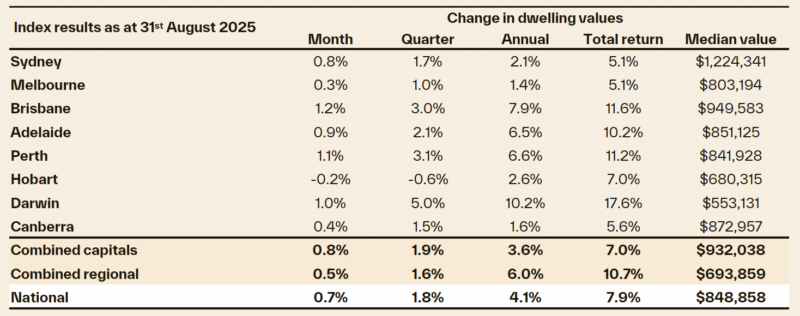
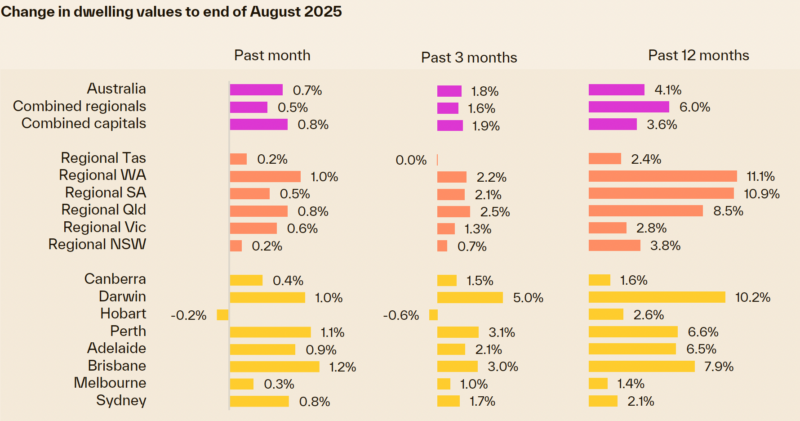
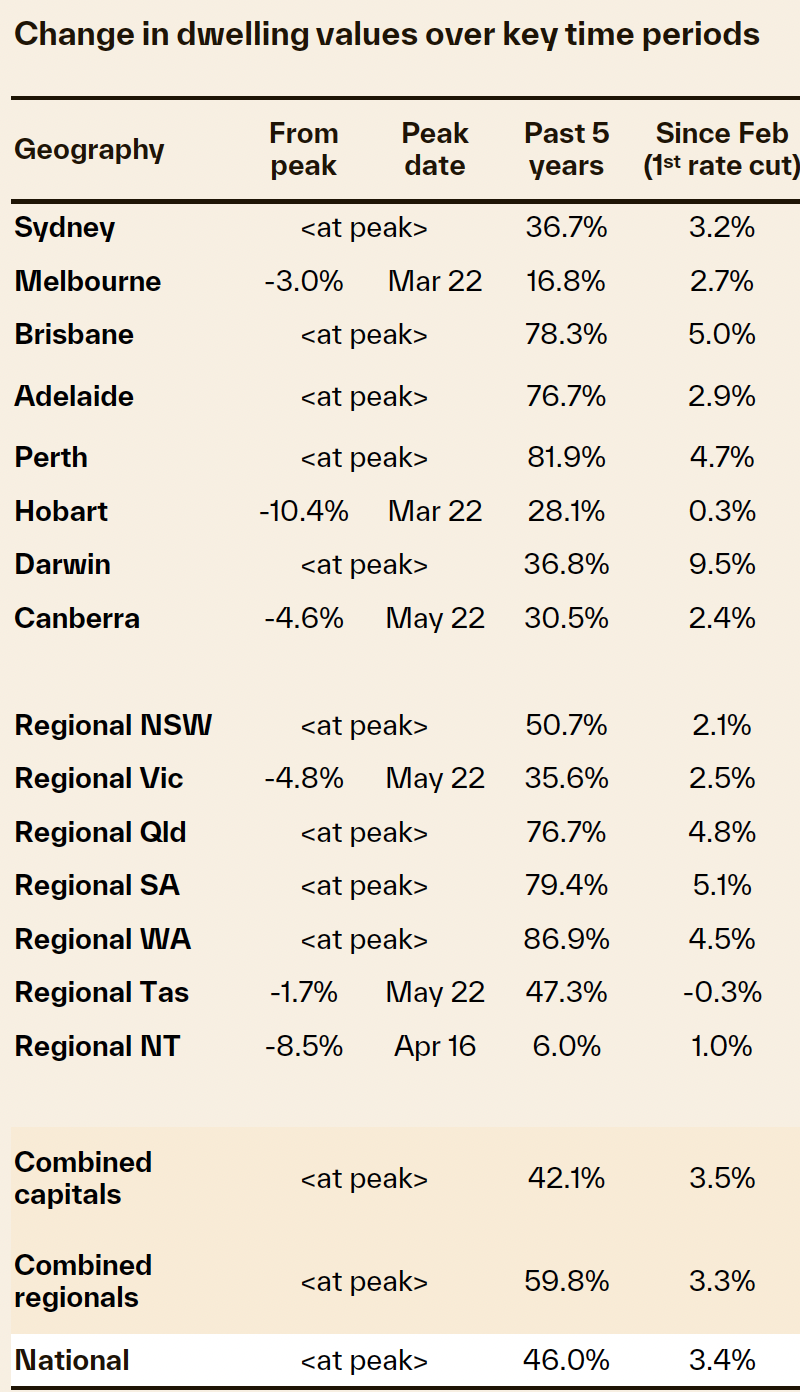
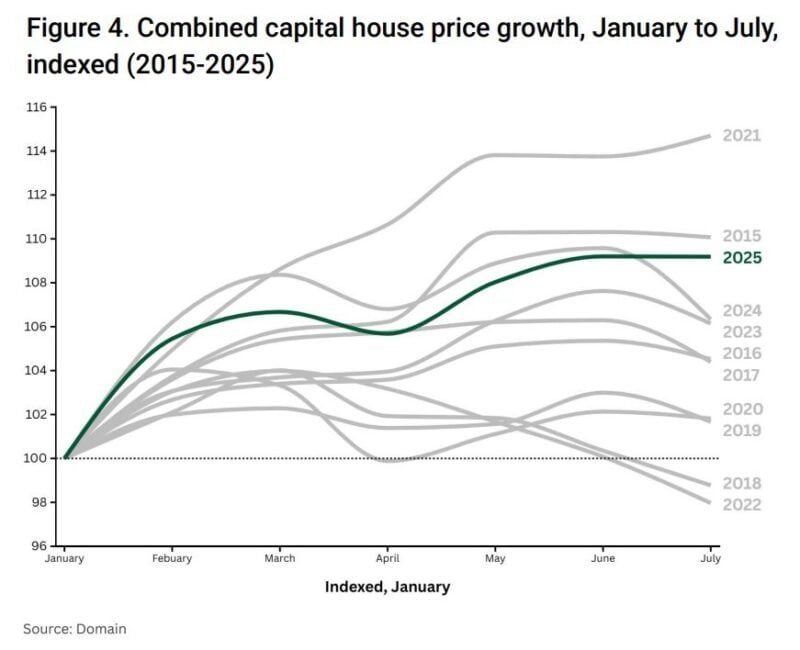
Cotality’s Home Value Index rose 0.7% in August — the strongest monthly gain since May 2024 — pushing annual growth to 4.1%.
Buyer demand is outpacing supply, with advertised listings 20% below average and auction clearance rates hitting 70%, the highest since early 2024.
Vendors are entering spring in a strong position, with low competition and rising prices across nearly all regions.
The growth cycle has been gradually building momentum since the February rate cut, with buyer demand spurred by a lift in borrowing capacity, real wages growth, rising confidence and what is likely to be a growing sense of urgency as advertised stock levels remain tight.
Cotality’s national Home Value Index (HVI) rose 0.7% in August, the strongest month on month gain since May last year.
The result pushed the annual change higher for the second month in a row, to 4.1%.
The growth cycle has been gradually building momentum since the February rate cut, with buyer demand spurred by a lift in borrowing capacity, real wages growth, rising confidence and what is likely to be a growing sense of urgency as advertised stock levels remain tight.
Once again, we are seeing a clear mismatch between available supply and demonstrated demand, placing upwards pressure on housing values.,
The annual trend in estimated home sales is up 2% from last year and is tracking almost 4% above the previous five-year average.
At the same time, advertised supply levels remain about -20% below average for this time of the year.
Vendors are in a strong position as we head into spring.
Auction clearance rates rose to 70% in late August, the highest since February last year, and competition amongst sellers is relatively mild amid such low advertised stock levels.
We are starting to see the usual start of spring upswing in new listings coming to market, but from a low base.
A pickup in the flow of stock coming to market through spring will be good news for buyers, who generally have limited choice at the moment.
While housing values are rising across most regions, the pace of growth remains modest relative to recent upswings.
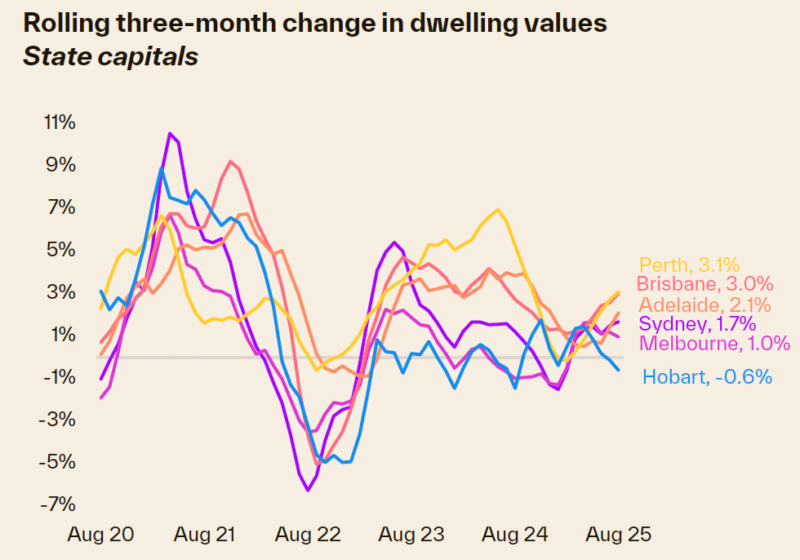
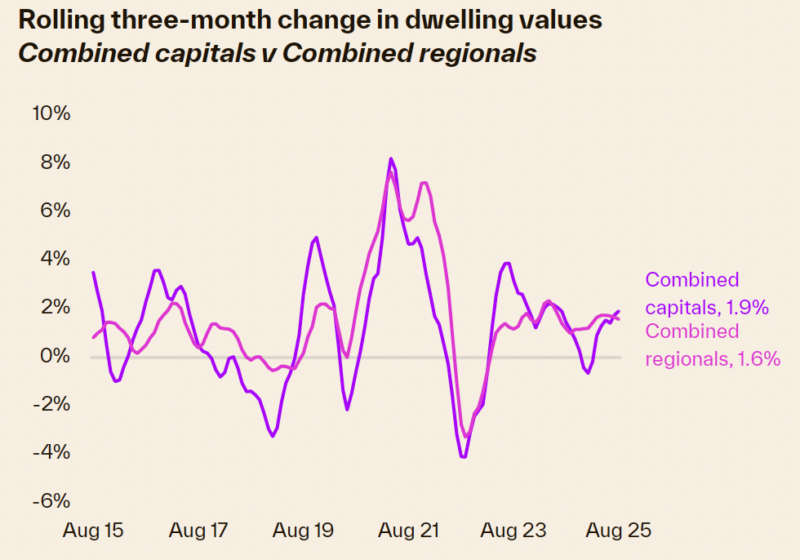
During the pandemic, the monthly change in the national index peaked at 3.1% in March 2021, and the upswing commencing in early 2023 climbed quite rapidly, reaching a 1.3% high in May 2023.“I would be surprised if we saw the monthly rate of change in the national HVI getting anywhere near these earlier cyclical peaks, given how stretched housing affordability has become,” Mr. Lawless added.
What is more likely is that home values will rise at a more sustainable pace, with demand dampened by affordability constraints, more normal rates of population growth and cautious lending policy.
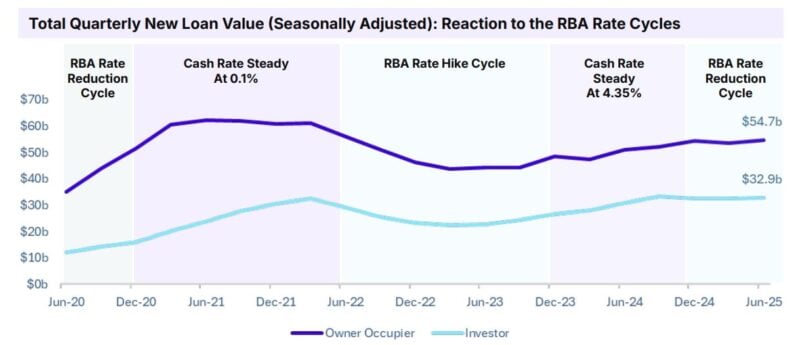
While interest rates are falling, the cash rate is still 350 basis points higher than the 0.1% low that underpinned growth in the pandemic.
The growth trend remains geographically broad-based, with almost every region recording a rise in values over the month.
Tasmania remains the exception, with Hobart values down -0.2% over the month.
The mid-sized capitals are once again leading the growth trend, with Brisbane (+1.2%) and Perth (+1.1%) recording the highest monthly gains. Adelaide wasn’t far behind with a 0.9% lift in values.
Darwin has also recorded a solid gain, with a 1.0% rise in August, taking values 10.8% higher through the first eight months of the year, by far the highest year-to-date gain across the capital cities.
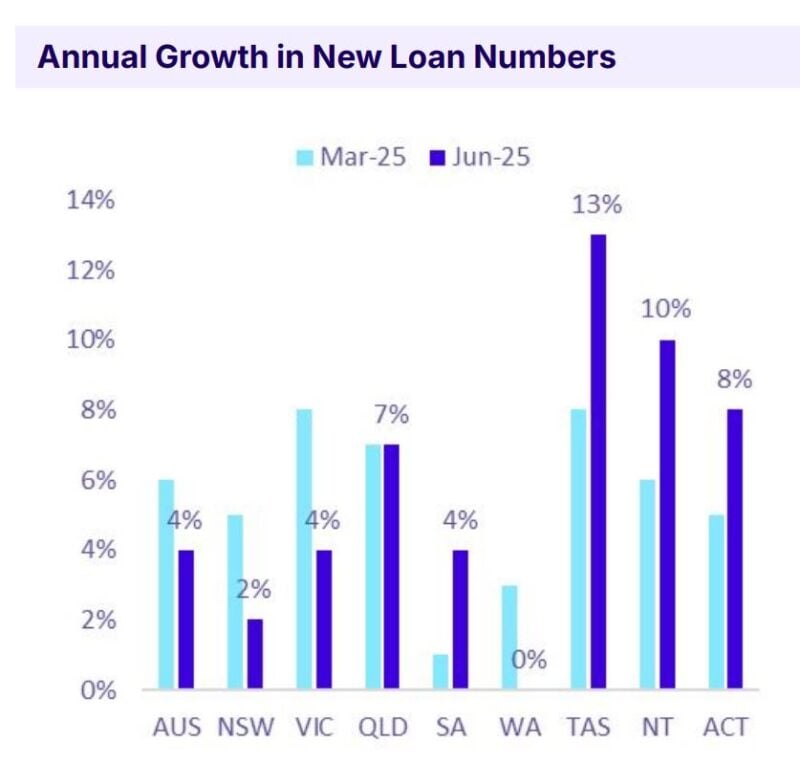
It seems that investors are willing to look through the volatile history of Darwin housing trends, with investors attracted to the low price points and high yields. Lending to this segment has more than doubled over the past year.
Additionally, listings are extraordinarily low, down about 50% on the five-year average.
The broad-based rise in housing values is set to continue into spring, a period where we usually see a seasonal uplift in listings.
While a rise in advertised stock levels will test the depth of housing demand, there is a good chance purchasing activity will continue to outpace available supply.
Buyer demand is supported by an increasingly healthy household sector:
Consumer sentiment reached a 3 ½ year high in August, supported by lower interest rates and easing cost of living pressures. Historically, consumer sentiment and housing activity have shown a close relationship.
After drawing down on savings accumulated through the pandemic, households are once again managing to accrue savings, with the household saving ratio trending towards pre-pandemic averages in March. While higher savings also imply less consumption, a return to an accrual of savings should help prospective buyers access the credit necessary for a home purchase.
Real wages growth, at 1.3% per annum, is at its highest level since June 2020 and about 2 ½ times the pre-COVID decade average of just 0.5%. Stronger wages growth, alongside lower debt servicing costs, should help to support purchasing activity and sentiment.
The jobs market remains tight, with the unemployment rate holding around the low 4% mark or less since the end of 2021, while the underemployment rate, at 5.9% in July, is well below the decade average of 7.9%. Such strong labour market conditions are supporting confidence and the ability to prove up loan serviceability. Furthermore, these conditions, along with very low levels of negative equity, are another reason why mortgage defaults remain so low.
There’s been a clear turnaround for households relative to 2024 when high interest rates and cost of living pressures were weighing on balance sheets and the housing market.
While interest rates are still some way from a stimulatory setting, and cost of living pressures remain, the household sector is now on a much better footing, which is flowing through to the housing sector.
The expanded Home Guarantee Scheme is another factor set to support housing demand.
With unlimited places, no income restrictions and higher price caps, we expect this stimulus measure to be popular with first time buyers from October 1st.
Saving for a deposit is one of the biggest hurdles for accessing home ownership.
Saving a 5% rather than a.20% deposit could shave around 10 years off the time it takes to accrue a deposit in an expensive market like Sydney.
While the scheme is likely to be popular, it doesn’t do anything to address the underlying factors that have caused housing to be so unaffordable in the first place.
Although the outlook for housing markets is looking increasingly positive, some headwinds remain that will likely keep the rate of growth in check.
Stretched affordability is arguably the most significant factor keeping a lid on value growth, but also elevated levels of household debt, a focus on prudent lending standards and normalising population growth are all factors that are also likely to keep the rate of growth below recent cyclical peaks.
About Tim Lawless Tim is Research Director at Cotality (formerly CoreLogic), analysing real estate markets, demographics and economic trends across Australia. Visit www.corelogic.com.au
You’ve used SUM for years. It adds numbers, does its job, and you probably don’t think twice about it. But while you’ve been clicking through filters and building messy helper columns, Excel has been holding out for you.
There’s a smarter function, hidden in plain sight, that can do the heavy lifting for you.
Why SUM alone isn’t enough
SUM is the spreadsheet equivalent of an open invite: it welcomes everything into the total, whether it belongs there or not. That’s perfect when you just need a quick column total, but in real-world work, you’re rarely adding everything.
Let’s imagine you’re a school administrator staring at a massive Excel sheet of thousands of student records. You want the total score for a single student, say John, across every test. With SUM alone, that means manually finding every row where John appears, adding his scores one by one, and hoping you don’t miss a cell.
=SUM(C2,C4,C6,...)
It’s tedious, it’s error-prone, and it gets worse the larger your dataset grows.
SUM doesn’t know whether a column is a name, a department, or a product line; it just happily adds whatever numbers you throw at it. That’s fine for simple lists, but the moment you want to distinguish John’s results from Sarah’s, or filter out everything except one department, SUM falls short.
In contrast, SUMIFS is designed for this. Instead of totaling everything in sight, it asks you which numbers belong in the total. A SUMIFS formula looks like this:
=SUMIFS(C2:C10,A2:A10,"John")
Screenshot by Ada
In plain English, this tells Excel to look at the names in column A, find every row that says ‘John,’ and then add the matching scores from column C. You wouldn’t need filtering, manual scanning, or helper columns—just one formula.
And it’s not just for student data. Imagine tracking project expenses by department, analyzing sales by region, or calculating commissions by sales rep and territory. SUM will force you into messy workarounds, but SUMIFS gives you totals based on the conditions you specify.
Now think about when your criteria change, which they always do. Maybe you don’t want this quarter’s totals anymore; you need last month’s. Maybe you want to exclude a certain product line, or only include orders over a certain value. With SUM, you’d be back to filtering and re-selecting ranges all over again. With SUMIFS, you just change the condition, and the formula adjusts automatically.
SUMIFS are smarter for real work
The syntax for the SUMIFS function is designed to handle multiple conditions at once and total only the values that meet all of them:
At first glance, it looks a bit intimidating. But when you break it down, it’s actually straightforward: you’re asking Excel to add up the numbers in your specified sum_range, but only where criteria1 is true in criteria_range1, and where criteria2 is true in criteria_range2, and so on.
There’s also SUMIF, which works the exact same way but only allows a single condition. I tend to stick with SUMIFS, even for one condition, because if I ever need to add another later, I don’t have to rewrite the formula.
Here’s a practical example of SUMIFS with sales data:
Basically, this formula tells Excel to go through the revenue column (in L2:L100) and add up the values, but only if the region (in A2:A100) is Asia, the sales channel (in D2:D100) is online, and the price (in J2:J100) is greater than $500.
Screenshot by Ada
You can keep stacking on more conditions—country, date, sales rep, order priority, product line—and Excel will check each one. Only the rows that meet every condition are included in the total. SUMIFS can juggle up to 127 criteria, which is more than enough for even the most complex reports.
The best part is that the formula isn’t static. If your data changes, say a row now meets the conditions, the formula updates automatically. That makes it invaluable for tracking sales by region, summarizing expenses by category, or monitoring inventory by product type.
And just in case you’re wondering, dates are no problem for SUMIFS. You can use it to calculate totals after (or before) specific dates with a simple formula, like this:
=SUMIFS (Revenue, Order Date, ">=1/1/2016")
=SUMIFS(N2:N100,F2:F100,">=1/1/2016")
The only detail to look out for is that when your criteria isn’t a number—like a date or text—you need to wrap it in quotation marks.
SUMIFS works across all modern versions of Excel, starting with Excel 2007, and runs consistently whether you’re using the desktop app, Excel Online, or even the mobile app. It’s also fully supported in Google Sheets, if you prefer it over Excel, both on the web and in its mobile app.
No matter where you’re working, SUMIFS is a reliable upgrade over plain old SUM.
<img src='https://news.cgtn.com/news/2025-08-31/Flowers-greet-guests-at-SCO-Summit-in-Tianjin-1GhRSE8cCas/img/c981fee2da93497c9aebf204a74a53cc/c981fee2da93497c9aebf204a74a53cc.jpeg'The 2025 Shanghai Cooperation Organization (SCO) Summit opens in north China’s Tianjin. /VCG
<img src='https://news.cgtn.com/news/2025-08-31/Flowers-greet-guests-at-SCO-Summit-in-Tianjin-1GhRSE8cCas/img/c981fee2da93497c9aebf204a74a53cc/c981fee2da93497c9aebf204a74a53cc.jpeg'The 2025 Shanghai Cooperation Organization (SCO) Summit opens in north China’s Tianjin. /VCG
<img src='https://news.cgtn.com/news/2025-08-31/Flowers-greet-guests-at-SCO-Summit-in-Tianjin-1GhRSE8cCas/img/c981fee2da93497c9aebf204a74a53cc/c981fee2da93497c9aebf204a74a53cc.jpeg'The 2025 Shanghai Cooperation Organization (SCO) Summit opens in north China’s Tianjin. /VCG
<img src='https://news.cgtn.com/news/2025-08-31/Flowers-greet-guests-at-SCO-Summit-in-Tianjin-1GhRSE8cCas/img/c981fee2da93497c9aebf204a74a53cc/c981fee2da93497c9aebf204a74a53cc.jpeg'The 2025 Shanghai Cooperation Organization (SCO) Summit opens in north China’s Tianjin. /VCG
<img src='https://news.cgtn.com/news/2025-08-31/Flowers-greet-guests-at-SCO-Summit-in-Tianjin-1GhRSE8cCas/img/c981fee2da93497c9aebf204a74a53cc/c981fee2da93497c9aebf204a74a53cc.jpeg'The 2025 Shanghai Cooperation Organization (SCO) Summit opens in north China’s Tianjin. /VCG
<img src='https://news.cgtn.com/news/2025-08-31/Flowers-greet-guests-at-SCO-Summit-in-Tianjin-1GhRSE8cCas/img/c981fee2da93497c9aebf204a74a53cc/c981fee2da93497c9aebf204a74a53cc.jpeg'The 2025 Shanghai Cooperation Organization (SCO) Summit opens in north China’s Tianjin. /VCG
Leaders from more than 20 countries are arriving in China to attend the Shanghai Cooperation Organization (SCO) Summit in north China’s Tianjin, which runs from August 31 to September 1. A festive atmosphere pervades the streets of the city as local people flock to the venue to take photos of the grand event.
TELLURIDE, Colo. — Jeremy Allen White asked all the questions any normal human being would ask when offered the chance to play Bruce Springsteen in “Springsteen: Deliver Me From Nowhere.” In theaters Oct. 24, it’s a movie that examines a slice of the rock legend’s career when he was battling depression and creating 1982’s incomparable exploration of alienation “Nebraska,” a record he didn’t know he was making when he recorded the songs on a primitive four-track tape machine in a rented New Jersey home. It turned out to be his favorite of all his albums.
Most of those questions could be boiled down to: Why me? White didn’t know how to play the guitar. He loves to sing but would never call himself a singer. And while he has a relationship with an audience, particularly those who have white-knuckled their way through his Emmy-winning work as Carmy, the talented and troubled chef on “The Bear,” he says it’s a far cry from the bond Springsteen has forged with his fan base for the past 50-plus years.
“The relationship a musician has with fans is so intimate,” White, 34, tells me the morning after the movie had its world premiere at the Telluride Film Festival. “You listen to him in the car, you go to see him live. He’s there in your ear and it’s just the two of you. You feel like you’re being spoken to. Bruce is so important to so many people. It was daunting. I didn’t want to disappoint.”
By the time we talked, though, White was well past any anxiety about disappointing, if only because he had the approval of the person who mattered the most: Springsteen himself.
“Jeremy tolerated me and I appreciated that,” Springsteen said at a festival Q&A, suggesting that his input on the movie was ongoing and significant — and also welcome. He noted that it was easy to sign off on director Scott Cooper’s vision for the movie, which, with its narrow focus on the deep dive of “Nebraska,” he called an “antibiopic.”
“And I’m old and I don’t give a f— what I do,” Springsteen added, laughing.
White and I are sitting in the sun outside his hotel, basking in the warmth the day after a steady rain. Wearing a battered Yankees cap, jeans, boots and a blue pullover, he’s sporting the casual uniform of the festival, if not the Boss himself. White asks if I mind if he lights an American Spirit. He reaches for his lighter. The premiere is over and his mood is light. We dive right in.
Jeremy Allen White in the movie “Springsteen: Deliver Me From Nowhere.”
(Macall Polay / 20th Century Studios)
Was there an immediate point of connection with Springsteen? The more I talked with him, the more I learned. And at the point in his life we show in the movie, he was feeling so fraudulent. Not in his work, but as a human. He felt like he was being caught in a lie all the time. And I don’t want to speak for all actors, but I’ve certainly dealt with that kind of feeling.
It feels like there’s a line between your Springsteen and Carmy on “The Bear,” two men carrying generational trauma and emotional baggage they have no idea how to deal with. Do you see that? For sure, you can draw that line. They’re cousins. And they’ve both got their art, something they feel confident about. What Bruce was feeling in his relationship with his father and the environment he grew up in, is he felt incredibly unsafe. And that made it difficult for him to trust people and form real connections. For a long time, the only connection he felt was in that three hours he spent on stage.
But then what do you do the rest of the time? Absolutely. And I’m familiar with those feelings. But my home life as a child was more loving and supportive, so I had to do some creative work to find that tether to Bruce.
You mentioning Springsteen’s dad just popped a thought into my head. Is Carmy’s dad alive? [Long exhale] We don’t know. That’s a decision that’s up to [showrunner] Chris [Storer].
It’s above your pay grade. Well above.
You’re really good at playing men who have trouble articulating their feelings, which puts a lot of weight on your shoulders to convey an interior life through close-ups. Do you like that kind of acting? I do. You have to have an understanding. The camera knows. If you’re just staring at a wall and you don’t have anything going on, the camera will know. The audience will, too.
You do also get to rock out and sing “Born to Run” and “Born in the U.S.A.” How did your vocal chords feel afterward? I spent an afternoon singing “Born in the U.S.A.” and I got a migraine and I lost my voice. I saw Bruce afterward and he asked, “What’d you do today.” And I said [affecting a hoarse voice], “Uh, I recorded ‘Born in the U.S.A.’” And he smiles and says, “Sounds about right.”
Most of your singing is the “Nebraska” songs, these delicate acoustic songs about despairing characters who have lost hope. Putting across their stories in these songs feels like its own imposing challenge. I was so focused on just sounding like Bruce and my coach, Eric [Vetro], asks, “What are you singing about? What’s the story? Where’s Bruce coming from? Is he singing from his perspective? Is about his childhood? Is he playing a character?” All these questions that, for an actor, should be right at the front of mind. Because I was so anxious about sounding like him, I found myself blocked by the real thing, which was: How can I just sing the song as honestly as possible?
What song was the breakthrough? “Mansion on the Hill.” Bruce listened to it and said, “You do sound like me. But it’s you singing the song.” And that gave me permission, not just in recording the music, but making a film where I could tell his story but not be afraid to bring myself to it.
Did you have a favorite song? Probably “My Father’s House.” It seemed like a warning for me. There’s regret in it. What I heard is a song about a young man not wanting to regret that he didn’t reach out for his father, who he had a love and connection with earlier. There was an immediacy to it, which you then see with Bruce and his father in the film.
Did it make you want to call your dad? I called him right after recording that song in Nashville. Like many fathers and sons, we have a loving relationship, but we’ve also gone through periods where things have been difficult and it was hard to communicate. Making this film and singing this song has given me another perspective. It also coincides with getting older and having children of my own.
I’m glad you made the call. You can’t have those conversations after a certain point. That’s what I mean about the warning of that song.
You told me yesterday that you and Springsteen had a debate about “Reason to Believe.” What was the source of the disagreement? It’s the last song on the album and Bruce says people confuse it as being hopeful. He says that’s not correct. The song is about a woman whose husband has left her and she stands at the end of the driveway every day, waiting for him to come home. And I hear that, and I think, “Oh, that’s real love. That’s romance. Someone’s gonna drive down that road at some point.”
Either that or this poor woman is just going to be walking up and down her driveway the rest of her life. And no one’s gonna be there. It depends how your ear is on a song.
But you choose to believe. I choose to walk to the end of the driveway. Absolutely.
Would you call yourself an optimist? No. [Laughs] Not really.
“Nebraska” came out in 1982 and was informed by the idea that there was a growing divide between the wealthy and the poor and that what we think of as the American Dream was becoming more elusive. Where do you think the album sits more than four decades later? People are angry. That’s what seems to define our country right now. Anger. And it doesn’t seem to be going away. The songs on “Nebraska” are still going to be speaking to us four decades from now. They’re timeless.
Jeremy Allen White in the movie “Springsteen: Deliver Me From Nowhere.”
(Macall Polay / 20th Century Studios)
Did your early dance background help you with the physicality of the role, the way he carries himself on stage or even just walking around? For sure. Finding the way he holds his gravity was important. I put little lifts in the boots and that made my posture change, my legs a little longer. Wearing the pants up to here [he points to a spot above his hips], that gets your gravity in your belly button, where I’m crouched over all the time.
There’s a lot of scenes in diners where he’s sitting with one arm over the back of the booth … … like he’s on his way out almost all the time. One foot in, one foot out.
Musician friends turned you on to “Nebraska” in your early 20s. What music were you listening to then? My folks are a little older so I grew up listening to a lot of music that Bruce listened to — Sam Cooke, Otis Redding, the Beatles, the Stones, Aretha Franklin.
Your parents had a strong record collection. Still do. And I grew up in in Brooklyn in the ’90s, so I got really heavy into hip-hop in my teenage years. I discovered Nas and Jay-Z and Big L and Wu-Tang. Tribe. De La Soul. And then I was around for an exciting time in the New York scene. I was young so I couldn’t really experience it, but the Strokes were coming out and LCD Soundsystem. I felt lucky to be close that stuff as it was happening.
The way you’re talking about all this, it feels like music is a fundamental part of your life. Absolutely. I love that it’s always with you. I’ve taken a couple of cross-country trips, and I love putting on Motown. I go through periods where I listen to the same 20 songs for a couple of weeks. But then I’ve got thousands of “liked” songs. And the nice part about a long drive is you can shuffle that and it’s like you’re traveling in time. I love getting to visit past versions of myself through music.
Springsteen takes an eventful cross-country trip in the film. What’s your most memorable one? I did one by myself when I was about 24. I thought I was going to give myself about two weeks to go from New York to L.A. The first week was great. I was enjoying my solitude, listening to a lot of music. Then when I hit Utah, I got incredibly lonely.
Did the landscapes get to you? Maybe. I had a certain amount of anonymity, which I enjoy on a road trip. You don’t know anybody in these towns and that allows you to be whoever you want to be, passing through. I remember getting to Utah and just being desperate to see somebody who knew who I was. And I got a flat in St. George, Utah. It was a disaster. My phone had died. I didn’t have a spare. I was out on the side of the road trying to borrow somebody’s phone. I took that as a sign. After I got it repaired, I raced to have dinner with a friend, because I felt this this crazy loneliness.
Springsteen says everyone has their “genesis moment,” an experience that charts your path. His was watching Elvis Presley perform on “The Ed Sullivan Show” in 1956. What’s your genesis moment? I had been dancing on stage but I didn’t act until I was 14 when I got up in front of a group in middle school. I had this great teacher, John McEneny, and he was having us do this improvisational exercise — two characters, one speaking, one quiet. And my friend, Yael, was playing a mother and I was playing her child who didn’t know how to speak yet. So I wasn’t speaking, like so much of my work [Laughs].
It’s Carmy’s genesis moment too. Yes. And I remember feeling a presence. I had a hard time focusing as a child, a hard time being present. Still do. But I remember even in silence feeling so at ease and present. And of course I remember the eyes. And even without me doing anything or speaking, I felt attention, people waiting to see what I would do next. And I went, “Whoa.” I felt at peace. I felt present and people were interested. And I thought, “Let me follow this a little bit and see where we can go.”
There’s a scene in the movie, taken from real life, where Springsteen is flipping through the channels one night and stumbles upon Terrence Malick’s “Badlands,” a movie that ultimately influences “Nebraska.” With streaming, we don’t really have those serendipitous discoveries any more. Have you ever had a moment like that? I can’t think of one. But “Badlands” was a favorite of my parents and they showed it to me when I was 13 or 14. Martin Sheen was cool as hell in that role, and I was so impressed with his commitment to that character. And Sissy Spacek conveys so much with so few words.
And like “Nebraska,” “Badlands” was difficult to make. There was a lot of pushback against Malick and what he was trying to do. There was a lot of confusion going on. They weren’t on the same page. Like with Bruce, it took a lot of diligence on Terrence Malick’s part to realize his vision. It’s so beautiful when you hear about the process of making a film is so difficult, and then something so beautiful and perfect comes out.
Where do you like to see movies in L.A.? I love the New Beverly. I saw “2001: A Space Odyssey” at the Egyptian not long ago. The Aero, if I’m on the Westside. I miss the Cinerama Dome and the Arclight. New movies, probably the Sunset 5. My favorite thing is go to a movie on a Tuesday at like one in the afternoon. You’re there by yourself. I like seeing movies by myself. Some people get out of a movie and like to start talking about it. I like getting out of a movie and being quiet for awhile.
Did you see “Weapons”? That was my favorite movie theater experience this summer. I loved “Weapons.” And obviously, it’s a great horror film and funny at times and that ending is just crazy. But also I found myself very emotionally affected. To me the horror of the movie was about, from the child’s perspective, looking at all these adults who were totally incapable, whether it was due to addiction or narcissism.
Bringing this full circle, I’m watching this movie about kids feeling unsafe and I thought of the times in Bruce’s upbringing where he felt a similar way and how that made it so difficult to grow up and be trusting. That he ultimately got to that place is so beautiful. I hope people come away from watching this movie feeling that and, if they’re in a place that’s not so good, maybe thinking that connection can still be possible.
You don’t have permission to access “http://www.gadgets360.com/cryptocurrency/news/crypto-ads-supreme-court-india-youtube-channel-hack-6629654” on this server.
Simplified personas built as fictional characters with broad pain points are outdated in the future of search.
Think “Curious Cathy,” who just wants to learn more about your product, or “Technical Tom,” who has years of experience in his field and can handle more detailed breakdowns.
Static personas once helped, but they no longer reveal enough about real people to stay competitive.
AI search demands smarter personas
AI is getting better at understanding people – their needs, context, and intent.
As search becomes more personalized, so should your personas.
By layering in real-world data – like location, industry trends, or other environmental factors – you can create personas that reflect the actual people behind the queries.
This richer context makes your content more relevant and increases the chances that AI will surface it when your audience is searching.
The current state of SEO personas
Personas for SEO have always been how we attempt to define user intent. They cover:
Basic demographics.
Motivations.
Wants.
Likes.
Dislikes.
Emotions.
Questions.
But some personas are created only through the lens of a specific product, limiting our understanding of the people behind the queries.
Take a look at this hypothetical, simple persona of a small business owner.
Look familiar?
This persona structure is still helpful, especially for user journey mapping.
It gives you clues on tone, style, and even which questions to answer for Small Business Sara.
That’s a strong start. But in the AI-powered search landscape, tone and topics aren’t enough.
High-level and simplified persona models miss that your target customer is more than just your target customer.
They are living, breathing people, all influenced by outside factors that need to be considered when tailoring content to their needs.
So, what’s missing?
Data on Sara’s environment and what makes her a real human is missing.
You don’t know what’s going on in Sara’s world that could be influencing her intent, needs, and decision-making process when she types in a query.
When crafting our personas, ideally, we would:
Conduct user interviews and testing to help dig into Sara’s life a bit more.
Find a group of “Saras” who will provide similar answers and tell us about “her” life.
Most of us lack the time, budget, or resources to do this, though, leaving us with a knowledge gap we still need to fill.
If you gathered small business owners from similar industries and asked them to list the steps they took to start, you’d probably get similar answers.
If you think about it from a contextual perspective only, sure.
But if you listen more closely, you’ll likely notice a difference in the order they did things and what answers they found valuable at each stage.
And this order, likely influenced by their environment, impacts what they do and don’t know when they land on the content you assumed would fit their journey.
How environmental factors influence search intent
Environmental factors are going to be complex and difficult to capture in their entirety.
Let’s explore just how one piece of additional data can provide a little more insight that you might be able to leverage.
Someone in Florida, which has the highest per-capita rate of business owners, will have different needs behind the query “how to start a business” than someone in West Virginia, where that rate is the lowest.
A person in Florida is statistically more likely to know someone who’s started a business, giving them easier access to information and inspiration.
In 2024, there were just over three business applications per 100 adult residents, according to Census data.
In West Virginia, where there was only one new business application per 100 adults, the story is different.
A business owner there may have some personal connections, but starting a business is a more novel, less familiar path.
They’re more likely to need guidance on the fundamentals, like business plans and logistics.
While both Saras may search “how to start a business,” what they need from that query isn’t the same.
The Floridian Sara is probably ready for logistical steps – forming an LLC, building a website – thanks to greater exposure and access to resources.
West Virginia Sara, on the other hand, needs foundational information first: what a business plan is, how legal structures differ, or where to find funding.
Same question, different needs.
You can’t capture every detail shaping a person’s intent.
Still, even a simple environmental context like this can help you interpret it more accurately – and build personas that feel more human.
Here’s how the intent behind the keyword shifts based on this environmental knowledge:
Small Business Owner in Florida
Small Business Owner in West Virginia
“How to start a business”
Lives in the state with the highest per-capita rate of business owners.
In 2024, there were 3 new business applications per 100 adult residents.
Looking for the logical order of logistical steps to take to get a business up and running.
Is familiar with most of the jargon, and is more likely to jump into action with a clear list.
Lives in a state with the lowest per-capita rate of business owners.
In 2024, West Virginia reported about 1 new business application per 100 residents.
Looking for more foundational insights, like: – Needing a business plan. – Things to consider before starting a busines.
Has no idea what any of these things are yet, and isn’t ready for the steps.
Needs more education before taking any action.
You can argue that you have the content that ultimately fits both of these intents.
But is that content ranking for “how to start a business”? Or is it featured in LLM responses or AI Overviews?
I know my related content isn’t.
It’s ranking for “how to write a business plan” and “steps to getting an LLC,” because SEO until now has been about mastering a query, not tailoring your content to a user’s environment.
In my “deprecated” SEO strategy, I have a pillar page for “how to start a business” that covers everything from business conception to making your first sale.
I’ve got dozens of internal links with beautiful anchor text to every supplemental guide Sara needs. Google loves it.
This is where my traditional approach to content needs improvement.
While it’s written for what I consider to be the user, it’s still focused on being thorough enough that Google puts me at the top, and not considering other outside factors that might influence search needs.
If you doubt that location changes the needs behind ‘how to start a business,’ compare prompts with and without location in incognito chat.
Now, take a look at how it changes when I say I live in Florida.
It’s a subtle difference, but when you say you live in West Virginia, ChatGPT suggested clarifying your business idea and proper planning as the first step.
In Florida, it dives right into business structure.
While AI doesn’t already have everyone’s environmental context in memory, when the user includes context in prompts, ChatGPT attempts to adjust its response.
Assuming everyone searching for “how to start a business” is looking for the same info might let you rank in a traditional blue-link search result.
However, this example shows that this shift to context-driven prompts influences how AI generates a response.
This is just one data point. A full strategy needs deeper environmental context than business applications or economic stats alone.
What this means for content strategies
AI search – whether through AI Overviews or LLMs – is built to reduce the cognitive overload of digging through multiple articles, clicks, and follow-up searches.
It leverages user context to deliver a succinct, relevant answer.
Take the earlier example: you could create 51 articles for every state and Washington, D.C.
In traditional search, that might help you rank for “how to start a business in (state).”
I’ve done this – customizing each article with state-specific agencies and forms – but without weaving in the deeper context of what’s happening in those states.
Traditional SEO still depends on comprehensive coverage, query mastery, and strong site structure to win blue-link rankings.
But AI retrieval and AI Overviews weigh context, clarity, and modular chunks of information that can be pulled into responses.
Both matter – they just reward different optimizations.
The goal isn’t to overhaul your entire strategy overnight.
Start testing ways to incorporate more context over time. Revisit your core content and weave in focused examples or localized insights.
Not every topic needs a “personalized” version.
Instead, find places where you can speak to your audience more directly, whether through localized callouts, customer-focused CTAs, or targeted subsections within existing content.
With clicks declining across the board, optimizing for conversion when you do get traffic is critical to proving the value of search.
Even if you’re focused on just one “Sara,” you still need to understand which end of the spectrum you’re targeting – and adjust your content to meet that audience where they are in the moment.
Digging deeper into environmental data helps you prioritize information gain – the key to becoming the most valuable answer a platform can surface.
The more clearly you understand who you’re creating for, the better positioned you are to deliver that value.
Environmental data isn’t the only input that matters. It’s one piece of a holistic persona-building approach.
The real advantage comes from layering these insights with conversion data, click and impression metrics, rankings, LLM visibility, and referrals.
Environmental context is simply one more tool in a stronger, more adaptive strategy.
Start by enhancing the data you already have
Hopefully, your personas are already rooted in data.
But what kind of SEO would I be if I didn’t ask for more data?
Adding environmental data from third-party sources helps you stand out, prioritize opportunities, and reach the right people at the right time.
It’s most powerful when combined with multiple data sources, environmental factors, and qualitative insights.
Scaling your approach
Digging into every persona or segment at once can be overwhelming.
Start small: choose one persona and one or two environmental factors to explore.
Use that real-world context to adjust a few pieces of content, then test and measure the impact.
Focus on small, incremental adjustments for long-term gains, not a full content overhaul.
The suggestions below are meant to show you where to start – not to imply you need to do it all at once.
Data exploration options
The data you need to understand environmental context rarely lives in-house.
Your BI team can share valuable insights on where you’re winning or growing, but external sources will help you transform personas into richer, more actionable profiles.
First, make sure your base persona includes core demographics such as:
Age.
Gender.
Race.
Location.
Education level.
Income.
If you’re missing these basics, start with publicly available data like the U.S. Census, Bureau of Labor Statistics (BLS), or Statista.
And if you know your target industry, Labor Force statistics can help you understand the age ranges most active in that space.
While this example focused on location as an environmental factor, age alone is another strong starting point.
There’s ample research on what each generation values, fears, and prioritizes at different stages of their careers.
Here’s a list of environmental questions you can aim to answer and how that might inform your strategy:
Question
What it will tell you
Potential sources
Where is this business or industry most popular? Is my target demographic in an oversaturated, undersaturated, or normal market?
This helps give some insight into the competitive nature of your target audience and the resources they might have access to.
Bureau of Labor Statistics, Industry-specific reports
What are the common problems this industry faces? What’s in the news related to this space?
Things like tariffs, over-saturation, demand for your persona’s product or service, lack of consumer awareness, etc.
Are all the environmental factors that can be used in examples in your content and CTA opportunities to better speak to your audience?
Google News searches, Industry-specific websites
What challenges does this demographic face in their personal and professional life? What norms is this group trying to beat?
Understanding things like pay gaps, underrepresentation, and cultural challenges influences how someone makes a decision and the tone you can use to resonate with them.
Pew Research, Census Newsroom, Google News, Academic Research
What does this demographic value? What are their personal beliefs?
If you can dig into what your audience stands for and cares deeply about, you can use this in your marketing content to speak to them in a way that resonates with their beliefs. People don’t buy what you do, they buy why you do it.
Pew Research, Consumer Studies like Kantar
What websites does this audience visit?
Knowing the websites they visit and the way these websites communicate can also give context.
SimilarWeb, Semrush Audience Insights
If you’re already a power creator – or have the budget – paid tools like Semrush, SimilarWeb, or Kantar can deliver deep audience insights.
If not, free sources like Census Data Tools, BLS tables, and some old-fashioned desktop research are still excellent for uncovering the data you need to better understand your audience.
Enriching personas with environmental data
Combine internal data with public sources to identify your top demographics and refine user journey mapping.
Environmental research helps you tailor content to real needs instead of covering everything broadly.
When layered with behavioral signals, technical SEO, and testing, these insights multiply visibility and conversions.
Marketers may not master the human mind, but we excel at interpreting data.
Apply that skill to strategy: focus on context, clarity, and information gain so your content becomes the answer AI and users trust.
Strong technical fundamentals still drive rankings, but environmental context boosts your chances of surfacing in AI responses.
Amid all the AI hype, the cornerstone of search is still the person behind the persona.
Battlefield 6 technical director Christian Buhl made that assertion during an interview with Eurogamer. Buhl also noted that EA and DICE planned from the beginning to ensure that players using lower-end hardware would still receive a comparable experience to those on high-end machines.
“Min spec is certainly one of our most important specs … it’s super important from both a commercial and business perspective,” said Buhl. “We want as many people as possible playing the game … We did a lot of analysis, we did tests on the game on a wide range of hardware above and below our minimum and recommended specs. We figured out what we can hit, what we need to hit from a business perspective, and that was to capture a wide audience on PC. It’s been super critical.”
In the same interview, Buhl addressed the game’s unpopular secure boot requirement, which he says is critical to fighting cheaters.
“The fact is I wish we didn’t have to do things like Secure Boot,” said Buhl. “It does prevent some players from playing the game. Some people’s PCs can’t handle it and they can’t play: that really sucks. I wish everyone could play the game with low friction and not have to do these sorts of things … Unfortunately these are some of the strongest tools in our toolbox to stop cheating.”
EA has shared the PC specs for Battlefield 6, as well as some upcoming changes to based on player feedback from the beta. Battlefield 6 launches on October 10 for Xbox Series X|S, PlayStation 5, and PC.
When injured, cells have well-regulated responses to promote healing. These include a long-studied self-destruction process that cleans up dead and damaged cells as well as a more recently identified phenomenon that helps older cells revert to what appears to be a younger state to help grow back healthy tissue.
Now, a new study in mice led by researchers at Washington University School of Medicine in St. Louis and the Baylor College of Medicine reveals a previously unknown cellular purging process that may help injured cells revert to a stem cell-like state more rapidly. The investigators dubbed this newly discovered response cathartocytosis, taking from Greek root words that mean cellular cleansing.
Published online in the journal Cell Reports, the study used a mouse model of stomach injury to provide new insights into how cells heal, or fail to heal, in response to damage, such as from an infection or inflammatory disease.
“After an injury, the cell’s job is to repair that injury. But the cell’s mature cellular machinery for doing its normal job gets in the way,” said first author Jeffrey W. Brown, MD, PhD, an assistant professor of medicine in the Division of Gastroenterology at WashU Medicine. “So, this cellular cleanse is a quick way of getting rid of that machinery so it can rapidly become a small, primitive cell capable of proliferating and repairing the injury. We identified this process in the GI tract, but we suspect it is relevant in other tissues as well.”
Brown likened the process to a “vomiting” or jettisoning of waste that essentially adds a shortcut, helping the cell declutter and focus on regrowing healthy tissues faster than it would be able to if it could only perform a gradual, controlled degradation of waste.
As with many shortcuts, this one has potential downsides: According to the investigators, cathartocytosis is fast but messy, which may help shed light on how injury responses can go wrong, especially in the setting of chronic injury. For example, ongoing cathartocytosis in response to an infection is a sign of chronic inflammation and recurring cell damage that is a breeding ground for cancer. In fact, the festering mess of ejected cellular waste that results from all that cathartocytosis may also be a way to identify or track cancer, according to the researchers.
A novel cellular process
The researchers identified cathartocytosis within an important regenerative injury response called paligenosis, which was first described in 2018 by the current study’s senior author, Jason C. Mills, MD, PhD. Now at the Baylor College of Medicine, Mills began this work while he was a faculty member in the Division of Gastroenterology at WashU Medicine and Brown was a postdoctoral researcher in his lab.
In paligenosis, injured cells shift away from their normal roles and undergo a reprogramming process to an immature state, behaving like rapidly dividing stem cells, as happens during development. Originally, the researchers assumed the decluttering of cellular machinery in preparation for this reprogramming happens entirely inside cellular compartments called lysosomes, where waste is digested in a slow and contained process.
From the start, though, the researchers noticed debris outside the cells. They initially dismissed this as unimportant, but the more external waste they saw in their early studies, the more Brown began to suspect that something deliberate was going on. He utilized a model of mouse stomach injury that triggered the reprogramming of mature cells to a stem cell state all at once, making it obvious that the “vomiting” response — now happening in all the stomach cells simultaneously — was a feature of paligenosis, not a bug. In other words, the vomiting process was not just an accidental spill here and there but a newly identified, standard way cells behaved in response to injury.
Although they discovered cathartocytosis happening during paligenosis, the researchers said cells could potentially use cathartocytosis to jettison waste in other, more worrisome situations, like giving mature cells that ability to start to act like cancer cells.
The downside to downsizing
While the newly discovered cathartocytosis process may help injured cells proceed through paligenosis and regenerate healthy tissue more rapidly, the tradeoff comes in the form of additional waste products that could fuel inflammatory states, making chronic injuries harder to resolve and correlating with increased risk of cancer development.
“In these gastric cells, paligenosis — reversion to a stem cell state for healing — is a risky process, especially now that we’ve identified the potentially inflammatory downsizing of cathartocytosis within it,” Mills said. “These cells in the stomach are long-lived, and aging cells acquire mutations. If many older mutated cells revert to stem cell states in an effort to repair an injury — and injuries also often fuel inflammation, such as during an infection — there’s an increased risk of acquiring, perpetuating and expanding harmful mutations that lead to cancer as those stem cells multiply.”
More research is needed, but the authors suspect that cathartocytosis could play a role in perpetuating injury and inflammation in Helicobacter pylori infections in the gut. H. pylori is a type of bacteria known to infect and damage the stomach, causing ulcers and increasing the risk of stomach cancer.
The findings also could point to new treatment strategies for stomach cancer and perhaps other GI cancers. Brown and WashU Medicine collaborator Koushik K. Das, MD, an associate professor of medicine, have developed an antibody that binds to parts of the cellular waste ejected during cathartocytosis, providing a way to detect when this process may be happening, especially in large quantities. In this way, cathartocytosis might be used as a marker of precancerous states that could allow for early detection and treatment.
“If we have a better understanding of this process, we could develop ways to help encourage the healing response and perhaps, in the context of chronic injury, block the damaged cells undergoing chronic cathartocytosis from contributing to cancer formation,” Brown said.
This work was supported by the National Institutes of Health (NIH), grant numbers K08DK132496, R21AI156236, P30DK052574, P30DK056338, R01DK105129, R01CA239645, F31DK136205, K99GM159354 and F31CA236506; the Department of Defense, grant number W81XWH-20-1-0630; the American Gastroenterological Association, grant numbers AGA2021-5101 and AGA2024-13-01; and a Philip and Sima Needleman Student Fellowship in Regenerative Medicine. The content is solely the responsibility of the authors and does not necessarily represent the official views of the NIH.
Deutsche Bank is the leading German bank with strong European roots and a global network. The bank focuses on its strengths in a Corporate Bank newly created in 2019, a leading Private Bank, a focused investment bank and in asset management.
Interested candidates can apply online via the link given at the end of the post.
Disclaimer: Charging money from students for internships or from job applicants is unethical and can result in blacklisting. We strongly discourage requesting any kind of payment from interns, including processing fees or charges for certificates. If you have any concerns, please contact us at [email protected]
Festivals call for a home that feels inviting, refreshed, and full of life. One of the easiest ways to give your living room a new look is by updating it with a stylish sofa cover set. From a practical 3 seater sofa cover to a complete 7 seater sofa cover, there are plenty of options that combine comfort with design.
Bright sofa cover sets in festive shades instantly add warmth and charm, creating a refreshed look perfect for seasonal celebrations.
A sofa cover set not only protects your furniture but also adds colour, texture, and character to your décor. If you are planning to welcome guests this season, choosing the best sofa cover can instantly uplift your space. We’ve rounded up eight great picks, including everything from L-shaped sofa cover styles to the best sofa cover sets for larger seating.
Best 3 seater sofa cover sets
This 3 seater sofa cover in quilted velvet brings instant refinement to your living room. The beige tone blends seamlessly with various interior styles, while the tassel detailing adds a soft, decorative touch. Designed for everyday use, it protects your sofa from dust, stains, pet fur, and daily wear. The washable velvet fabric ensures both comfort and durability, making it a practical yet stylish way to refresh your furniture.
What are buyers saying on Amazon? Buyers love the softness and premium feel, praising the fit and quality. Some mention slight colour variation, yet overall value impresses.
This 3 seater quilted sofa cover in damask beige offers both protection and style. Made from layered polyester, it offers a soft texture with durability, making it ideal for everyday use. The floral pattern adds a refined touch, while the elastic fit keeps it secure. Thoughtful side pockets make it convenient for storing remotes or magazines. A practical way to shield your sofa while enhancing your living space.
What are buyers saying on Amazon? Shoppers praise the fit, comfort, and handy pockets. Some note colour variation, yet overall quality, texture, and pattern receive positive feedback.
This cotton 3 seater sofa cover set in cream brings a soft and breathable layer of protection to your furniture. The geometric-inspired design blends style with function, making it ideal for daily use. Crafted from eco-friendly cotton, it resists wrinkles and fading while maintaining comfort. Perfect for keeping your sofa safe from stains, spills, and wear, this cover set adds both charm and practicality to your home.
What are buyers saying on Amazon? Customers appreciate its look and breathable fabric. Opinions on material quality and value vary, though most find it a good choice overall.
Best 5 seater sofa cover sets
This 5 seater sofa cover set in grey marble design offers a modern stretch fit that refreshes your living space instantly. Made with a polyester and spandex blend, it provides flexibility, durability, and all-around protection against spills, dust, and pet fur. The geometric pattern adds a lively touch, while its anti-slip design ensures a secure fit. Easy to wash and maintain, it keeps your sofa looking fresh season after season.
What are buyers saying on Amazon? Buyers like the design and easy installation. Feedback on fabric quality, size, and colour consistency is mixed, though most find it visually appealing.
This quilted 5 seater sofa cover set in greyish blue combines style with practicality. Made from durable microfiber, it resists dust, hair, and daily wear while adding a modern geometric and striped design to your living room. The thoughtful side pockets offer handy storage for remotes or magazines. Easy to install with adjustable straps, this washable sofa cover keeps furniture protected and refreshed without compromising comfort.
What are buyers saying on Amazon? Customers like the stylish look and durability, noting that sofas appear refreshed. Many find it practical, though some feel fit could improve slightly.
This 5-seater cotton sofa cover set in cream is designed to refresh and protect your furniture with ease. The floral design adds a soft charm to any living space, while the breathable cotton fabric ensures comfort along with durability. Perfect for guarding against stains, scratches, and daily wear, this six-piece set offers full coverage for both 3-seater and 2-seater sofas, blending practicality with subtle style.
What are buyers saying on Amazon? Shoppers value its look and fabric quality, noting it brightens furniture. Fit and durability receive mixed reviews, though many find it worthwhile.
Best 7 seater sofa cover sets
This 7 seater L shape sofa cover set in cream velvet gives your seating a refined, cosy upgrade. With quilted panels for extra comfort and durability, it protects against everyday wear while adding a soft finish to your living room. The wrinkle-free design and anti-slip fit keep it looking smooth, while the washable fabric ensures easy maintenance. A perfect mix of functionality and style for larger seating arrangements.
What are buyers saying on Amazon? Customers praise the soft velvet feel and premium look. Many highlight its comfort and quality, making it a valued addition to their sofas.
This 7-seater velvet quilted sofa cover in dark grey instantly gives your living room a refreshed and stylish look. Crafted with a soft faux fur texture, it provides comfort while protecting your sofa from spills, scratches, pet fur, and everyday wear. The quilted design adds depth, and long side flaps safeguard sofa arms. Easy to wash and maintain, this anti-slip cover keeps large seating areas neat and inviting.
What are buyers saying on Amazon? Buyers love the softness, stitching, and colour variety. Many highlight its durability after washing, though slip resistance receives mixed reviews. Overall, good value.
This 7-seater L-shaped sofa cover in a rainbow design brings instant vibrancy to your living space. Made from durable polyester with bold tassels, it brightens any sofa while protecting it from scratches, spills, and daily wear. Fade-resistant and anti-slip, it ensures long-lasting use with style. Easy to wash and maintain, this cover makes an excellent choice for festive décor and lively interiors.
What are buyers saying on Amazon? Customers praise the colourful design and cheerful vibe. They appreciate the fit and durability, though some feel pricing could be more reasonable.
Similar articles for you
8 Best office chairs that provide unparalleled lumbar support; Up to 80% off
5 Best mesh office chairs: Top picks to bring home to your workspace
5 Office chairs for a comfortable work-from-home setup
Why should I invest in a sofa cover set?
A sofa cover set protects your furniture from stains, spills, dust, and pet fur while giving it a refreshed look. It is a budget-friendly way to extend the life of your sofa and keep your interiors looking stylish.
Which fabric is best for sofa cover sets?
Cotton, velvet, and polyester blends are popular choices. Cotton is breathable, velvet offers a soft, premium touch, and polyester blends are durable and easy to wash.
Do sofa cover sets fit all types of sofas?
Most sofa cover sets are designed in standard sizes for 3 seater, 5 seater, or 7 seater sofas, including L shape options. Always measure your sofa before buying for the best fit.
How do I maintain sofa cover sets?
Most sofa covers are machine washable, making them easy to care for. For long-lasting use, follow the wash care instructions provided by the manufacturer.
Disclaimer: At Hindustan Times, we help you stay up-to-date with the latest trends and products. Hindustan Times has an affiliate partnership, so we may get a part of the revenue when you make a purchase. We shall not be liable for any claim under applicable laws, including but not limited to the Consumer Protection Act, 2019, concerning the products. The products listed in this article are in no particular order of priority.
The case of Stealth BioTherapeutics and its rare disease drug could become a regulatory bellwether for other biotechnology companies seeking to understand how flexibly new leaders at the Food and Drug Administration will evaluate medicines for uncommon conditions.
At the center of the ongoing back-and-forth is elamipretide, which Stealth is trying to get cleared for Barth syndrome, an ultra-rare and often fatal pediatric mitochondrial disease with no approved treatment.
“We often talk about Barth syndrome as being a litmus test for FDA because it highlights that for ultra-rare diseases, standard regulatory approaches don’t work,” said Lindsay Marjoram, director of research for the Barth Syndrome Foundation.
Now, that litmus test is playing out in real time as Stealth rides an FDA roller coaster in its quest to get elamipretide across the finish line.
After rejecting elamipretide’s approval in May, the FDA accepted the company’s newly resubmitted application last week. The FDA’s willingness to reconsider the drug was “huge” for Stealth, the company’s CEO, Reenie McCarthy, said.
“It gives us a timeline,” she said. “It’s manageable for us to survive this delay.”
How the FDA ultimately decides could impact how other ulra-rare disease drug developers seek approvals in the future.
What’s at stake for Stealth
The FDA’s rejection of elamipretide came as a shock that “blindsided” the company because an FDA advisory panel had supported the drug, McCarthy said. It also raised doubts about how long the company could keep its doors open.
The rejection followed an approval process riddled with delays, including decisions about whether the FDA would assign the drug standard review or priority review, and a missed decision date in April.
“We would have been expecting from our original submission [in January 2024] to have been approved potentially in 2024 under priority review,” McCarthy said.
But last year came and went without an approval and the FDA’s ever-lengthening review period put a heavy financial strain on Stealth.
“It [pushed] out the financial commitments from our investors,” McCarthy said. “We were making decisions [to defer] progress on other programs. We stopped other clinical trials that were supposed to initiate. We ended up with a reduction in force of 30%.”
In the meantime, patients have also been relying on access to elamipretide through the company’s expanded access program.
Although McCarthy said just under 30 patients are receiving elamipretide, that’s a “fairly large number,” considering the U.S. patient population numbers about 150.
“It’s traumatic for them to know they might lose access,” Marjoram said. “People are counting their vials. They’re trying to map out … how long will my baby or how long will I, personally, be able to stay on the drug.”
Barth syndrome causes muscle weakness, heart failure, infections and debilitating fatigue, and has a high infant fatality rate, with 85% of early deaths occurring by age 5. While Marjoram said that about 20% tp 25% of patients receive a heart transplant, that only fixes one of the “downstream symptoms” and isn’t curative. Elamipretide is “actually getting to the mitochondria” to improve patients’ quality of life, she said.
“Our folks have more energy, they are able to walk further, [and] they’re able to climb stairs more functionally or more stairs than they could before,” Marjoram said. There have even been newborn babies listed for heart transplants who have become delisted because “they do so well on elamipretide that their heart function stabilizes and they don’t need a heart transplant anymore.”
The impact of endpoints
The FDA not only accepted Stealth’s new drug application more quickly than expected, but told the company that it can expect a quicker decision, too. A decision date is set for Sept. 26, rather than a typical six-month review.
“The FDA is recognizing the urgency of the unmet need and reacting accordingly on a resubmission that, quite frankly, just doesn’t have that much new data,” McCarthy said. “So the review time should be light and the FDA is acknowledging that and committing to act early, which is huge.”
Stealth is aiming for an accelerated approval of elamipretide on the basis of improvements in knee extensor muscle strength, an intermediate clinical endpoint. The resubmission also included a protocol for a post-marketing trial to confirm clinical benefit. Notably, there were no safety concerns with the drug.
While Stealth now sees a light at the end of the tunnel, the protracted journey highlights the inherent problem with trying to fit ultra-rare disease approvals into the typical FDA framework, since the tiny patient population doesn’t allow for the larger, placebo-controlled clinical trials the agency likes best. One of Stealth’s elamipretide trials included just 12 patients. Marjoram said that’s actually an “astonishing participation rate,” given the small patient population combined with inclusion and exclusion criteria.
For other drug developers, the question of the FDA’s willingness to approve elamipretide on the basis of an intermediate clinical endpoint could impact their own strategy for seeking an approval.
“There are bigger ideological questions about what’s the right pathway for ultra-rare?” McCarthy said. “This finally crossing the finish line will bring some hope to ultra-rare disease innovation.”
One thing many of the world’s most successful people have in common is their ability to inspire others.
I hope these motivational quotes inspire you on your journey to achieving success.
1. “The more you praise and celebrate your life the more there is in life to celebrate” – Oprah Winfrey
2. “You must be the change you wish to see in the world.” — Mahatma Gandhi
4. “Courage is grace under pressure.” — Ernest Hemingway
5. “Learn from yesterday, live for today, hope for tomorrow. The important thing is not to stop questioning.” — Albert Einstein
7. “It does not matter how slowly you go, so long as you do not stop.” — Confucius
8. “Someone is sitting in the shade today because someone planted a tree a long time ago.” — Warren Buffett
10. “You only live once, but if you do it right, once is enough.” — Mae West
11. “Once you choose hope, anything’s possible.” — Christopher Reeve
13. “The best and most beautiful things in the world cannot be seen or even touched — they must be felt with the heart.” — Helen Keller
14. “Live as if you were to die tomorrow. Learn as if you were to live forever.” — Mahatma Gandhi
16. “When you cease to dream you cease to live.” — Malcolm Forbes
17. “May you live every day of your life.” — Jonathan Swift
19. “If you’re not stubborn, you’ll give up on experiments too soon. And if you’re not flexible, you’ll pound your head against the wall and you won’t see a different solution to a problem you’re trying to solve.” — Jeff Bezos
20. “In order to be irreplaceable one must always be different.” — Coco Chanel
Bonus for the week:
About Michael Yardney Michael is the founder of Metropole Property Strategists who help their clients grow, protect and pass on their wealth through independent, unbiased property advice and advocacy. He’s once again been voted Australia’s leading property investment adviser and one of Australia’s 50 most influential Thought Leaders. His opinions are regularly featured in the media.
While most people replace their tech every few years, my 2015 iPad Pro keeps proving its worth. Even though I own the newest model, I find myself reaching for this aging tablet more often than you’d expect.
Why I haven’t retired my ancient iPad Pro
My iPad collection is simple: there’s the original Pro 12.9-inch beast (A1584) with laughably tiny 32GB storage, plus my current iPad Pro 2TB powerhouse. Logic says I should’ve donated the old one years ago. But here’s the thing—I use that first-gen iPad Pro several times a week, and it’s earned its permanent spot in my tech lineup.
The original iPad Pro in 2015 was Apple’s bold statement that tablets could be serious productivity machines. Nearly a decade later, mine’s still making that case—just with a few more battle scars and significantly less available storage.
My go-to second monitor setup
Jonathon Jachura / MUO
The biggest reason I keep reaching for my old iPad Pro is that it’s the perfect second display for my Intel MacBook Pro. Using Sidecar, it becomes an instant extended desktop. You can connect wirelessly or with a cord—I prefer connecting it with a cable because it’s a more stable connection and provides pass-through charging.
That 12.9-inch display is perfect for keeping reference docs open, monitoring Slack, or attending meetings while I’m working on the laptop.
Could I get a standalone portable monitor instead? Sure, but at just over a pound, the 12.9-inch iPad Pro disappears into my bag next to the laptop. Plus, Sidecar means zero setup—it connects instantly without any driver nonsense.
Why this beats “cheaper” portable monitor alternatives
I learned this lesson when I borrowed my friend’s portable monitor, which he got from Amazon. It had thousands of five-star reviews and cost about $200, so I figured I’d check it out.
It ended up being a total letdown. With the brightness all the way up, it looked terrible next to my old iPad. The text wasn’t crisp, the colors seemed drained, and after five minutes of reading, I wanted to stop. The real kicker? That monitor’s battery completely gave up after maybe five months.
In contrast, my 2015 iPad is still going strong on the original battery. Apple knew what it was doing back then.
The perfect kitchen companion
When I’m cooking, I grab the older iPad without hesitation. It’s the ideal size for propping up on the counter to display recipes, and I don’t have to worry about splashing sauce on my newer $2,000+ iPad Pro. It powers through long cooking sessions without needing a charge, and the size works perfectly propped against my splashback.
Jonathon Jachura / MUO
Carrying it from counter to counter never feels awkward, and I can read everything clearly from across the kitchen. Try pulling that off with a 6-inch phone screen when your hands are sticky with flour from kneading bread.
A guilt-free device for the kids
My 2-year-old and 4-year-old have discovered the joy of trying to guess my passcode. It’s like they’re competing to see who can trigger the longest security lockout period. Their current record is somewhere around 307 minutes, which actually impressed me more than it frustrated me.
This illustrates another great use for an old iPad: I don’t mind if they touch the older device because I’m not stressing about every bump and scratch. Inevitable drops and grubby fingerprints don’t send me into panic mode like they would with my expensive model. It could actually become their gateway into using real tech responsibly.
It still does what most people need
App compatibility is still surprisingly solid on such an old device. All my regular apps work just fine—Netflix, YouTube, Safari, Notes, and more. Is it blazingly fast? Nope. But for reading articles, watching videos, and handling basic work tasks, it’s totally adequate.
Here’s what really struck me: most tablet users aren’t pushing their devices to the limit anyway. Email, web pages, and YouTube—the usual tablet activities work without complaint.
The trade-offs of keeping old tech
Jonathon Jachura / MUO
However, let’s be real—the decade-old device is definitely showing its age. Jumping between my two iPad Pros makes the speed difference painfully obvious. Apps take their sweet time loading, scrolling gets choppy with heavy content, and multitasking requires actual patience.
Charging takes forever compared to modern devices. I usually plug it in overnight because trying to top it off quickly during the day is futile.
That Lightning port is absolutely maddening now. All my other Apple gear has switched to USB-C, which means keeping one stupid Lightning cable around just for this device. Such a minor issue, but it gets annoying fast.
Storage management is my biggest headache. With only 32GB total and iOS taking up a chunk of that, I never add any extra apps to it besides my current streaming, reading, and recipe applications.
Why selling doesn’t make sense
Looking at eBay, similar 32GB models are going for $100-$150 at most, if they’re pristine. Mine’s got a few dings and scratches, but everything works fine.
For what I’d get out of selling it, keeping the iPad Pro as a backup device, dedicated second monitor, and kitchen tablet makes more sense. The peace of mind alone is worth more than whatever I’d pocket from a sale.
Plus, there’s something satisfying about getting maximum value from a device. This iPad Pro has logged likely thousands of hours of use across multiple roles, and it’s still going strong.
This 2015 iPad Pro taught me that well-built hardware can outlast every marketing campaign trying to get you to upgrade. It’s not winning any speed contests, but it doesn’t have to. The best tech often isn’t the flashiest—it’s whatever gets your actual work done reliably. You’ll know when it’s really time to upgrade your iPad.
Chinese World War II film “Dongji Rescue” held its premiere in the Hong Kong Special Administrative Region on August 28, attracting a large audience of local viewers and industry professionals, with an overwhelmingly positive response.
The film recounted the story of how Chinese fishermen risked their lives to rescue more than 300 British prisoners of war (POWs) from the Japanese ship Lisbon Maru in 1942. Many audience members were deeply moved by the film’s intense rescue scenes and the sacrificial spirit of the fishermen portrayed.
Pop superstardom, it turns out, did absolutely nothing to improve Sabrina Carpenter’s love life.
That’s the thrust of the singer’s shrewd and tangy “Man’s Best Friend,” which dropped Thursday night, just a year after last summer’s chart-topping “Short n’ Sweet.” The earlier album, which spun off a pair of smash singles in “Espresso” and “Please Please Please,” went on to be certified triple platinum and to win two Grammy Awards — more than enough to transform Carpenter, now 26, from a former Disney kid into the latest (and horniest) member of pop’s A-list.
Yet all that success seems only to have attracted more of the losers she sang about last time. Here she’s dealing with a smooth talker doling out empty promises, a crybaby who can’t decide what he wants, even a guy so fixated on self-betterment that he’s lost interest in the bedroom.
“He’s busy, he’s working, he doesn’t have time for me,” she trills exasperatedly in “My Man on Willpower,” “My slutty pajamas not tempting him in the least.”
It’s a veritable gallery of rogues, this LP, not least the dude in the dark suit pictured on the cover of “Man’s Best Friend” with a hank of Carpenter’s blond hair in his fist as she kneels before him. The image inspired an instant controversy when she unveiled it in June, with critics accusing her of propping up dangerous ideas about the submission of women in the age of the tradwife.
Responded the singer in a CBS News interview that aired Friday: “Y’all need to get out more.”
Indeed, to take the album artwork at face value is to miss the whole point of Sabrina Carpenter, which is not just lampooning a prudish instinct — of course she’s in on the joke — but demonstrating the limits of a dating scene — of an entire social power structure — in which this is what a girl at the top has to work with.
“I like my boys playing hard to get / And I like my men all incompetent,” she sings in the LP’s opener and lead single, “Manchild.” She swears she’s not choosing them — that they keep choosing her. Then she punctuates the claim by batting her fake eyelashes and rhyming “Amen” with a flirty “Hey, men.”
As with “Short n’ Sweet,” Carpenter made “Man’s Best Friend” with a tight crew of accomplices — Jack Antonoff, John Ryan and Amy Allen, plus a bunch of tasty studio players — and once again they get a sound that combines the hooky splendor of ’70s-era AM-radio pop (think ELO, Wings and especially ABBA) with touches of country and dance music.
“Tears,” in which Carpenter lusts after a guy capable of putting together a chair from IKEA, is a pillowy disco thumper with echoes of KC and the Sunshine Band’s “That’s the Way (I Like It)”; “Nobody’s Son” puts starchy palm-court strings over a bouncy reggae groove. Carpenter’s singing plays like an actor’s sizzle reel, by turns winsome, sneering, bubbly and resigned; in the twangy “Go Go Juice” alone — it’s about a woman who’s woken up at 10 a.m. and opted to spend the day drunk-dialing exes — she runs through every emotional gradient separating determination from shame.
Song for song — line for line, really — “Man’s Best Friend” isn’t quite as sharp as “Short n’ Sweet,” which offered the rare thrill of a young artist coming into her own on her sixth studio album. Occasionally, you can sense Carpenter reaching for a memeable lyric, as in the many gags about wetness in “Tears”; “When Did You Get Hot?,” meanwhile, feels like something Ariana Grande abandoned after workshopping for a minute.
When she’s on, though, she’s on: “Goodbye” is a dazzling orchestral-pop number in which she gives the boot to a hot-and-cold lover — “Arrivederci, au revoir / Forgive my French, but f— you, ta-ta” — and “House Tour” a winking sex romp whose thwacking drums and rubbery funk bass call to mind Paula Abdul’s “Opposites Attract.” (After Doja Cat’s Antonoff-produced “Jealous Type,” might this signal a coming Abdul-aissance?)
Near the end of the album, Carpenter dials down the comedy for “Don’t Worry I’ll Make You Worry,” a sad and shimmery ballad about the thin line between love and war. “Silent treatment and humbling your ass / Well, that’s some of my best work,” she sings over strummed acoustic guitar before promising oh so sweetly to “leave you feeling like a shell of a man.”
You don’t have permission to access “http://www.gadgets360.com/cryptocurrency/news/bitcoin-strategic-reserve-philippines-btc-eth-9164744” on this server.
Getting your service area business verified on Google can be challenging, especially when video verification is required.
What Google expects to see isn’t always clear, and that uncertainty can lead to denials.
But with a little preparation, you can eliminate the guesswork and ensure a smoother verification process.
Learn how to get your business verified, handle denials, and maintain a compliant profile that lasts.
What does it mean to be a service area business on Google?
Before you begin the verification process, confirm that your business qualifies as a “pure service area business” on Google Maps and not another business type (i.e., storefront or hybrid).
A service area business delivers goods or services directly to customers at their location rather than serving customers at a storefront.
Unlike a hybrid business, a pure service area business never serves customers at a physical storefront.
This means the business’s address is hidden on Google Maps, and instead of a pin, there is a shaded service area.
While there aren’t many differences between a service area business and a storefront in terms of the live listing, the distinction between these listing types is crucial when it comes to the verification process on Google Business Profile.
How to properly verify a service area business with Google Business Profile
Since a pure service area business doesn’t have a storefront, there is no need to verify a physical location.
Instead, the business only needs to confirm its existence and demonstrate that it provides the stated services within a specific service area.
Sounds simple, right?
Essentially, Google needs to verify a few key things for your business to pass verification:
The business is licensed and/or registered in its respective state, city, county, or province.
The business is performing the stated services for customers within the specified service area.
The person completing the verification is an authorized representative of the business.
Before you click the “Get verified” button and begin the process, carefully consider these essential elements.
Provide Google your business information early
Business website
A properly set-up business website is crucial for any small business aiming to establish itself in local search results.
While it doesn’t need to be overly fancy, it should include key details such as:
Your business name.
Phone number.
Service area.
Hours of operation.
Descriptions of the services you provide.
If you’re creating a new Google Business Profile, add this business information to your website at least a week before attempting verification.
This can actually streamline the verification process and improve your chances of success.
Dig deeper: Top SEO tips for location-specific websites
Citation consistency
Ensure your business name, phone number, hours, and service area are consistent across other sources Google is likely to check.
For new businesses, building a few high-value citations, like those from BBB, Yelp, or the local Chamber of Commerce, can help establish your legitimacy.
In my experience, just a few key citations are enough to show Google that you’re a legitimate local business.
Not sure which citations to build?
Try searching for your competitor’s brand name.
Any sites they appear on are likely high-value citations in your local market.
Evidence of branding and the services you provide
Google requires proof that your business is actually doing the services you claim in your specified service area.
To provide this, upload photos directly to your GBP or website showing your business in action. This could include:
Photos of branded vehicles or uniforms.
Vanity shots of branded vehicles at local monuments or landmarks.
Signage at storage yards or job sites.
Tools and equipment at the location, on a lot, or in a branded truck.
Branding materials like business cards, yard signs, or advertising materials.
Business documents
Before attempting to verify, always have supporting documents on hand to send to Google or present during a video verification.
These documents should have the business name and can include:
Business license.
Business registration.
Assumed name/DBA certificate.
Insurance documents.
Utility bills.
Use a domain-level email for affiliation
Use a domain-level email whenever verifying a listing, whether it’s new or existing.
An email tied to your business website signals trust and confirms you’re authorized to represent the business.
This can help expedite the verification process.
Google video verification for home service businesses
If you receive the video verification method, don’t panic.
Service area businesses can pass video verification just as easily as storefronts.
To maximize your chances of approval, start by:
Preparing your vehicle(s).
Gathering necessary documentation.
Ensuring your business information on your website is consistent before hitting “Record” to begin the verification video.
As you record the video, think of your branded service vehicle as your “storefront.”
Here’s how to approach it:
Park the vehicle at your home, a nearby intersection, or a shopping plaza where you can capture street signs or surrounding businesses.
Make sure the business name on the vehicle is clearly visible.
Show or demonstrate that your vehicle contains the tools necessary for your services.
Unlock and start the vehicle to prove management control.
On camera, present documents like:
Your business registration.
License.
Invoices.
Utility bills.
Assumed name/DBA certificate.
Branded marketing materials.
If the vehicle is unbranded, spend extra time showing documents and other marketing materials.
Important reminder:
Do not include restricted addresses, such as P.O. boxes, virtual offices, or co-working spaces, in the address field.
Despite your best efforts, verification may occasionally be denied.
In such cases, Google typically sends an email explaining which requirement(s) you did not meet.
Additionally, a reason for the failure will appear next to the “Get verified” button on your profile.
Here, Google is asking for more evidence that the person recording is affiliated with the business.
Use this feedback to determine your next steps.
Retry the video verification following the prompts.
If necessary, gather additional proof of business operations, such as updated documents or marketing materials.
Contact GBP support for verification issues
If verification continues to fail, you may need to contact Google directly and provide extra proof they request.
Be sure to contact support through the contact button in the verification video workflow or the verification tool workflow.
This will connect you to the appropriate team that can assist with your verification issue.
Reaching out via the general support form may result in the dreaded “no-reply” boilerplate email.
Maintaining compliance on Google as a service area business
Once your business is verified, it’s essential to keep your listing accurate and compliant to prevent re-verification or potential suspension issues down the road.
Setting your service area
Be as specific and accurate as possible when setting your service area.
You can use:
City names.
Postcodes.
Regions (like counties).
However, avoid selecting:
Entire states.
Provinces.
Countries.
Google recommends setting your service area within a two-hour driving radius, but this can vary depending on the location.
For instance, businesses in smaller U.S. states like Rhode Island or Connecticut can easily service the entire state within two hours of travel.
Conversely, larger states like California or Texas may have businesses that cannot realistically serve the entire state.
Your service area in Google Business Profile should match the information on your website, such as the “areas we serve” page.
If you have multiple listings for the same brand, do not add overlapping service areas, as this can result in suspension.
Dig deeper: Localized SERPs: Winning traffic and leads with service area pages
Plan major changes to the profile
If you need to make significant changes to the profile, such as updating the address or renaming the business, be aware that this could trigger re-verification.
Before making any major updates to your Google Business Profile (GBP), ensure that the website and other relevant sources are updated first.
Do not make more than one major edit at a time.
Wait 24 to 48 hours between significant edits to reduce the risk of suspension.
Major edits include updates to the:
Business name.
Address.
Phone number.
Website.
Business category.
Get reviews to the profile consistently
Consistent, fresh reviews are a strong signal to Google that your business is active in the area and, therefore, a legitimate operation.
Reviews are one of the most effective actions you can take as a business owner to boost your profile’s visibility on Google and build trust with the platform.
Don’t let up on gathering them!
Dig deeper: 6 Google Business Profile questions asked and answered
Get verified – and stay verified
Google verification may feel overwhelming at first, but a little preparation goes a long way.
By following these steps, you’ll set your business up for smoother approval, stronger visibility, and long-term trust with both Google and your customers.
The announcement that Hollow Knight: Silksong would release on September 4 was such a surprise that even the most tuned-in Hollow Knight fans were in shock at the news. And now, just days before Silksong releases, Hollow Knight is seeing a renaissance with gamers, passing its Steam concurrents records over and over again, hitting a new peak of 56,192 players on August 29, according to SteamDB.
For years, Hollow Knight’s biggest day was in May of 2022 when the game had over 20,000 concurrent players. Since the announcement of Silksong’s impending release date, though, each consecutive day has seen that concurrent peak rising, having hit 21,000 on August 22, just a day after the announcement, and hit 56,192 today. For a seven-year-old indie game, this is pretty big.
Of course, it’s important to note that SteamDB is not the be-all-end-all of game stats. Steam is a dominant platform for sure, but Hollow Knight is available on all last and current-generation consoles, including Nintendo Switch, PlayStation, and Xbox, with Switch being a particularly popular platform for the game. Even so, it’s indicative that the legend of Hollow Knight continues to grow.
We got a sneak peek last week, and signs are looking good. “Hollow Knight: Silksong appears to be exactly what we all should have expected: a strong, well-designed, visually lovely game that carries forward the aesthetic and design philosophies of the original with thoughtful, if not earth-shattering, updates,” GameSpot’s Steve Watts wrote after going hands-on with Silksong at Gamescom.
When genetic testing reveals a rare DNA mutation, doctors and patients are frequently left in the dark about what it actually means. Now, researchers at the Icahn School of Medicine at Mount Sinai have developed a powerful new way to determine whether a patient with a mutation is likely to actually develop disease, a concept known in genetics as penetrance.
The team set out to solve this problem using artificial intelligence (AI) and routine lab tests like cholesterol, blood counts, and kidney function. Details of the findings were reported in the August 28 online issue of Science. Their new method combines machine learning with electronic health records to offer a more accurate, data-driven view of genetic risk.
Traditional genetic studies often rely on a simple yes/no diagnosis to classify patients. But many diseases, like high blood pressure, diabetes, or cancer, don’t fit neatly into binary categories. The Mount Sinai researchers trained AI models to quantify disease on a spectrum, offering more nuanced insight into how disease risk plays out in real life.
“We wanted to move beyond black-and-white answers that often leave patients and providers uncertain about what a genetic test result actually means,” says Ron Do, PhD, senior study author and the Charles Bronfman Professor in Personalized Medicine at the Icahn School of Medicine at Mount Sinai. “By using artificial intelligence and real-world lab data, such as cholesterol levels or blood counts that are already part of most medical records, we can now better estimate how likely disease will develop in an individual with a specific genetic variant. It’s a much more nuanced, scalable, and accessible way to support precision medicine, especially when dealing with rare or ambiguous findings.”
Using more than 1 million electronic health records, the researchers built AI models for 10 common diseases. They then applied these models to people known to have rare genetic variants, generating a score between 0 and 1 that reflects the likelihood of developing the disease.
A higher score, closer to 1, suggests a variant may be more likely to contribute to disease, while a lower score indicates minimal or no risk. The team calculated “ML penetrance” scores for more than 1,600 genetic variants.
Some of the results were surprising, say the investigators. Variants previously labeled as “uncertain” showed clear disease signals, while others thought to cause disease had little effect in real-world data.
“While our AI model is not meant to replace clinical judgment, it can potentially serve as an important guide, especially when test results are unclear. Doctors could in the future use the ML penetrance score to decide whether patients should receive earlier screenings or take preventive steps, or to avoid unnecessary worry or intervention if the variant is low-risk,” says lead study author Iain S. Forrest, MD, PhD, in the lab of Dr. Do at the Icahn School of Medicine at Mount Sinai. “If a patient has a rare variant associated with Lynch syndrome, for instance, and it scores high, that could trigger earlier cancer screening, but if the risk appears low, jumping to conclusions or overtreatment might be avoided.”
The team is now working to expand the model to include more diseases, a wider range of genetic changes, and more diverse populations. They also plan to track how well these predictions hold up over time, whether people with high-risk variants actually go on to develop disease, and whether early action can make a difference.
“Ultimately, our study points to a potential future where AI and routine clinical data work hand in hand to provide more personalized, actionable insights for patients and families navigating genetic test results,” says Dr. Do. “Our hope is that this becomes a scalable way to support better decisions, clearer communication, and more confidence in what genetic information really means.”
The paper is titled “Machine learning-based penetrance of genetic variants.”
The study’s authors, as listed in the journal, are Iain S. Forrest, Ha My T. Vy, Ghislain Rocheleau, Daniel M. Jordan, Ben O. Petrazzini, Girish N. Nadkarni, Judy H. Cho, Mythily Ganapathi, Kuan-Lin Huang, Wendy K. Chung, and Ron Do.
This work was supported in part by the following grants: National Institute of General Medical Sciences of the National Institutes of Health (NIH) (T32-GM007280); the National Institute of General Medical Sciences of the NIH (R35-GM124836); the National Institute of Diabetes and Digestive and Kidney Diseases (U24-DK062429); the National Human Genome Research Institute of the NIH (R01-HG010365); the National Institute of General Medical Sciences of the NIH (R35-GM138113); and the National Institute of Diabetes and Digestive and Kidney Diseases (U24-DK062429).
* Mount Sinai Health System member hospitals: The Mount Sinai Hospital; Mount Sinai Brooklyn; Mount Sinai Morningside; Mount Sinai Queens; Mount Sinai South Nassau; Mount Sinai West; and New York Eye and Ear Infirmary of Mount Sinai
Legal education in classrooms often revolves around statutes, case law, and lengthy commentaries. But sometimes, lessons come alive outside the library, on the silver screen.
Movies and web series centered on law and justice do more than entertain; they make you think, argue, and sometimes even question the very system you are preparing to work in.
For law students and young lawyers, watching courtroom dramas or legal thrillers can sharpen critical thinking, expose you to ethical dilemmas, and even teach you a few advocacy tricks.
Let’s dive into some of the most impactful movies and web series that every budding lawyer should watch, with insights on what you can learn from them.
Movies and Web Series for Lawyers and Law Students
1. To Kill a Mockingbird (1962)
Based on Harper Lee’s Pulitzer Prize-winning novel, this film is a timeless classic in legal cinema. Gregory Peck plays Atticus Finch, a small-town lawyer in Alabama who defends a Black man wrongly accused of raping a white woman.
The film goes beyond the courtroom. It is about moral courage, racial prejudice, and the responsibility of lawyers to stand up for what is right, even when the odds are stacked against them.
Takeaway for lawyers: Advocacy is not just about winning cases. It is about defending truth and justice, even when society is against you. Every law student can learn from Finch’s unwavering sense of integrity.
2. 12 Angry Men (1957)
A film set almost entirely inside a jury deliberation room, 12 Angry Men demonstrates the importance of critical thinking, persuasion, and reasonable doubt. A lone juror challenges the assumptions of the other eleven, slowly unraveling biases and logical flaws in their reasoning.
Why it matters for lawyers: While India does not follow the jury system anymore, the film is still highly relevant. It shows how persuasion, patience, and logical reasoning can change outcomes. Watching the film is like sitting in a masterclass on argumentation.
3. A Few Good Men (1992)
With its famous courtroom showdown (“You can’t handle the truth!”), this legal drama starring Tom Cruise, Jack Nicholson, and Demi Moore is gripping from start to finish. The story follows a military lawyer who uncovers a dark secret behind a marine’s death.
What lawyers learn: Sometimes, cases are not just about facts, but about uncovering uncomfortable truths that institutions want to hide. The movie underscores the ethical responsibility lawyers hold, especially when the law intersects with power.
4. Erin Brockovich (2000)
Julia Roberts won an Academy Award for her portrayal of Erin Brockovich, a single mother with no formal legal training who helps build a case against a corporation accused of polluting a town’s water supply.
Key lesson: Legal work is not confined to lawyers alone. Research, persistence, and empathy can be as powerful as legal knowledge. For young lawyers, the movie is a reminder of how law can directly impact communities.
5. The Verdict (1982)
Paul Newman plays an alcoholic, down-and-out lawyer who gets a last chance at redemption through a medical malpractice case. Instead of settling, he chooses to fight the case in court, rediscovering his own sense of justice in the process.
Takeaway: The film captures the personal struggles lawyers often face and the importance of ethics over quick settlements. It highlights that law is not only about clients but also about a lawyer’s own conscience.
6. Philadelphia (1993)
This is one of the first mainstream Hollywood films to address HIV/AIDS and workplace discrimination. Tom Hanks plays a lawyer wrongfully dismissed from his firm after his diagnosis, while Denzel Washington plays the attorney who eventually represents him.
Why watch: Beyond its courtroom drama, the film is a powerful reminder that law can be a tool for social change. It shows the role lawyers play in shaping narratives around justice, equality, and dignity.
7. Pink (2016)
An Indian courtroom drama starring Amitabh Bachchan as a retired lawyer who defends three young women falsely implicated in a criminal case. The film addresses the issue of consent and the deep-rooted prejudices women face in Indian society.
Real-world relevance: Every law student in India should watch Pink for its nuanced handling of the “no means no” principle. The film reflects how courts can challenge social mindsets and bring progressive interpretations of law.
8. Shahid (2013)
Based on the real-life story of lawyer and human rights activist Shahid Azmi, this film portrays his journey from being wrongly imprisoned to becoming a fearless advocate for marginalized communities. Rajkummar Rao delivers a powerful performance as Shahid.
Takeaway for young lawyers: Shahid’s life shows that the practice of law is not just about lucrative careers but also about giving voice to the voiceless. It inspires law students to see how their degrees can make a real difference in society.
9. Court (2014)
This National Award-winning Indian film offers a raw and realistic portrayal of the Indian judicial system. The story revolves around the trial of a folk singer accused of abetting a sewage worker’s suicide.
Why it matters: Unlike commercial courtroom dramas, Court shows the slow, bureaucratic, and sometimes frustrating pace of real courts. It highlights systemic flaws and makes one reflect on how justice is often delayed, if not denied.
10. The Lincoln Lawyer (2011)
Matthew McConaughey stars as a smooth-talking defense attorney who operates out of his Lincoln car. What begins as a straightforward case soon spirals into a dangerous web of lies and manipulation.
Lesson for aspiring lawyers: The film demonstrates the art of balancing client interests, ethical boundaries, and professional survival. It also shows that glamour and grit often coexist in legal practice.
11. Suits (2011–2019)
While not a movie, Suits became one of the most popular legal web series worldwide. Set in a high-powered New York law firm, it follows Harvey Specter, a top lawyer, and Mike Ross, a college dropout with extraordinary memory who works as his associate despite not having a law degree.
Why students love it: The show is witty, stylish, and full of sharp courtroom strategies. While it may not always reflect real legal practice, it gives a glimpse of the hustle, long hours, and competitive environment of corporate law firms.
12. Criminal Justice (India, 2019–2020)
Adapted from the BBC series of the same name, this Indian web series is a gripping courtroom thriller. It follows the story of a young man accused of murder and his journey through the criminal justice system.
Takeaway: The series showcases both the flaws and the strengths of the Indian legal system. For law students, it offers insights into criminal procedure, police investigation, and defense strategies.
My Thoughts
Movies and web series about law are not substitutes for legal textbooks, but they complement learning in meaningful ways. They reveal the emotional, ethical, and social layers of law that are often missing from bare acts and casebooks.
For law students and young lawyers, watching these films can be an eye-opener into how the law impacts real lives, how lawyers grapple with dilemmas, and how the pursuit of justice is as much about courage as it is about knowledge.
So the next time you want to take a break from reading case law, consider watching one of these films. You might just walk away with a lesson more valuable than a classroom lecture.
Toxic workplaces have been the talk of the town for a very long time. Time and again, at every gathering, there’s always that frustrating rant about office drama that has everyone sitting on the edge of their seat. Typically, the plot includes a wide array of antagonists, from a micromanaging manager, unreasonable clients calling at 11 PM, snarky snitches, short-notice deadlines eating up weekends and endless office politics. It’s time to flip the script and encourage a workplace that invigorates you rather than draining energy.
Employees become more motivated in a supportive workplace environment.(Shutterstock)
ALSO READ: Being active at work is no longer just an option: New health initiatives at workplaces to promote wellness
One such trend, called ‘quiet thriving’, is silently changing the narrative of workplaces.
What are the health benefits of a supportive workplace?
An empowering workplace makes an employee feel confident.(Shutterstock)
But before we dive into decoding this empowering workplace trend, let’s first take a look at the benefits of a nurturing workplace environment. Often, employees’ health impacts are discussed in the context of a toxic environment. Since this trend is all about flipping the script, let’s begin right from the roots.
Dr Deepak Patkar, director of medical services at Nanavati Max Super Speciality Hospital in Mumbai, told us that supportive workplaces become a safe space for employees, both emotionally and physically. Organisations that respect trust and practice transparent communication, not just in words, but also in action, help employees feel valued and motivated to do their best.
He explained further how it positively influences employees, “Individuals working at these organisations develop a higher sense of self-worth and confidence as the leadership is often approachable and open to feedback. Employees also develop better mental peace and job satisfaction, contributing heavily to the turnover outcomes. Such environments also help people overcome their fears of public speaking or voicing out their opinions, becoming more professional and mindful communicators.”
What is quiet thriving?
Quiet thriving is a mindset where there’s not a lot of expectation pinned on external validation and content on their own.(Shutterstock)
As Mahatma Gandhi rightfully said, “Be the change that you wish to see in the world.” Likewise, whether you believe it or not, you can fundamentally transform your work life. Quiet thriving is all about a mindset that is embedded in personal purpose, not external validation all the time.
Most of the time at work, even if you enjoy it, you always keep an eye out to see if your manager or colleague liked your work output and if not, it can leave you second-guessing yourself. Quiet thriving is all about what you can control, rather than wasting your energy on things beyond your influence.
Ajeet Kumar Singh, Managing Director and Co-Founder of SAVE Solutions Pvt. Ltd explained Quiet thriving, and elaborating, “Quiet Thriving is about intentionally showing up at work in a way that personally matters to you-even if your workplace does not so that the experience does not weigh you down but instead enriches your spirit: setting limits, building social bonds at work, tweaking the job to suit one’s own strengths, and finding quick bursts of joy here and there. It’s not a riot; it’s just a soft-spoken way toward change.”
He further listed specifically how it’s helping employees and how workplaces can create a supportive environment:
How is it helping employees?
Quiet Thriving is a mindset that is said to reduce instances of burnout, increase job satisfaction, and strengthen its practitioners’ mental functioning.
By focusing on the aspects within their control, Quiet Thrivers become reacquainted with considered meaning in settings that otherwise would drain them.
How can workplaces support quiet thriving?
Managers can support this by giving employees time and space to express their preferences -through flexible hours, regular feedback loops, or clear growth pathways.
Even small tweaks, such as carving time for creative expression or assembling a group of mentors, create much energy.
HR strategies to make workplace more fun
All is not dark and gloomy at work, as employees can have fun too at their workplaces. (Shutterstock)
Now, it would be unfair to put the entire onus on employees by expecting them to shift their mindset alone. Change is also a shared responsibility, so the heavy lifting of changing the workplace environment shouldn’t fall solely on them. Sure, employees need to focus on their work and avoid stressing over things beyond their control, but the workplace, too, needs to develop a nurturing environment for employee wellbeing and growth.
Shruti Swaroop, founder of Embrace Consulting and co-founder of International Inclusion Alliance, weighed in on this and said, “When we talk of ‘fun at work,’ we’re not talking about superficial parties or weekly festivities. We’re talking about an arena where employees feel psychologically safe, emotionally engaged, and intrinsically motivated. Where laughter is not ambient noise, it’s a cue for trust. And play moments aren’t distractions; they’re ignition points for collaboration and creativity. ”
She listed out 3 practical ways HRs can make work more fun:
1. Incorporate gamification into everyday performance
By leveraging aspects of reward, monitoring progress, and competition through challenge to learning, performance, or onboarding, HR can turn the previously mundane processes into a fun experience.
For example, introducing an online badge scheme for developing skills or designing an innovation-focussed, cross-functional team challenge not only delivers results but also fosters team spirit.
2. Establish deliberate micro-cultures of happiness
It’s not the big events but the small, regular rituals that build culture. HR can craft ‘micro-moments’ of happiness built into the workweek, whether 10-minute gratitude circles, peer shout-outs on common boards, or team storytelling circles.
These create spaces of humanity at work and make people feel seen beyond their job title.
3. Organise employee-owned culture committees
HR needs to move from being planners to being enablers by establishing employee-owned involvement or ‘culture’ committees.
They are cross-sections of employees from the diversity of the organisation that can co-create experiences that resonate with them, from wellness weeks and interest clubs to celebration events and community volunteerism.
All hope is not gone, and the workplace is not all dark and gloomy. With quiet thriving, employees can feel joyful and confident. Quiet thriving is slowly revolutionising the way employees work and feel in workplaces.
Note to readers: This article is for informational purposes only and not a substitute for professional medical advice. Always seek the advice of your doctor with any questions about a medical condition.
An RNA medicine developed by Regeneron Pharmaceuticals and Alnylam Pharmaceuticals helped control symptoms of the chronic autoimmune disease generalized myasthenia gravis in adults enrolled in a late-stage study, Regeneron said Tuesday.
Regeneron also tested the RNA medicine, called cemdisiran, together with an antibody drug it developed and sells as Veopoz for another disease. However, study results suggested the combination was not as effective as cemdisiran alone.
Regeneron, which licensed cemdisiran from Alnylam, plans to submit the drug for U.S. approval in myasthenia gravis sometime in the first quarter next year. It is also testing the drug in paroxysmal nocturnal hemoglobinuria and geographic atrophy that is tied to age-related macular degeneration.
Dive Insight:
Regeneron and Alnylam’s collaboration on cemdisiran dates back to 2019, when the two companies struck a broad research alliance. They amended their partnership last year, with Regeneron taking a global license to cemdisiran and responsibility for its continued development.
The drug works by RNA interference, a cellular process Alnylam has successfully co-opted to develop drugs that can shut down production of target proteins. In cemdisiran’s case, the target is a protein known as complement factor 5, or C5, which plays an important role in the body’s immune response.
In people with myasthenia gravis, the body’s normal immune functioning goes awry. Abnormal antibodies activate the signaling cascade of which C5 is a part and inadvertently impede communication between nerves and muscles. The result is debilitating muscular weakness that’s associated with intense tiredness and difficulty speaking, swallowing or moving.
Regeneron’s study, dubbed NIMBLE, tested cemdisiran alone and cemdisiran with the company’s antibody pozelimab in adults with generalized myasthenia gravis who were positive for antibodies against the acetylcholine receptor — a telltale sign of the disease. Treatment was compared to placebo.
Both regimens dramatically reduced complement factor activity: cemdisiran by 74% on average and the combination by nearly 99%.
However, cemdisiran monotherapy showed numerically greater treatment effects at 24 weeks than the combination on two scales used to assess disease severity and its effect on daily life.
“The results of the NIMBLE trial confirm that, in myasthenia gravis, robust efficacy can be achieved without complete complement blockade, whereas in other diseases such as paroxysmal nocturnal hemoglobinuria, complete inhibition is likely to be necessary,” L. Andres Sirulnik, Regeneron’s head of hematology clinical development, said in the company’s statement.
Regeneron noted the placebo-adjusted treatment effect observed for cemdisiran was similar or greater to what currently approved C5-inhibiting drugs showed in clinical testing.
However, David Risinger, an analyst at Leerink Partners, wrote in a client note that cemdisiran’s effect appears to “fall short” of other myasthenia gravis treatments that work by blocking a receptor known as FcRn.
Raymond James analyst Sean McCutcheon, meanwhile, described the combination in a separate client note as “not viable” in myasthenia gravis. “This comes as a disappointment, as the company hoped the combination approach would exceed the cemdisiran monotherapy arm and potentially look competitive relative to FcRn blockers, which it does not,” he wrote.
There were no meningococcal infections in any study participant, Regeneron noted. Infections are important to monitor when patients are taking drugs that inhibit components of the immune system, like C5. No participants taking cemdisiran monotherapy discontinued treatment due to side effects through week 24, Regeneron added.
The most common adverse reactions emerging during cemdisiran treatment were upper respiratory tract and urinary tract infections, common cold and headache. Serious treatment-emergent adverse events occurred in 3% of patients given cemdisiran, 9% taking the combination and 14% of those given placebo.
During an extension period of the study, a patient in the cemdisiran group died from pneumonia, while another in the combination arm died from septic shock. Both individuals were taking immuno-suppressive therapies at the same time as treatment.
Regeneron plans to present full data from the trial at an upcoming medical meeting. Shares in the company rose by about 1% Tuesday, as did Alnylam’s stock.
Editor’s note: This story has been updated with additional analyst commentary.
Investors are back in charge. Their confidence in the market signals optimism for growth, but also raises affordability challenges for homebuyers.
Homebuyer activity is shifting east. Queensland and the smaller states are benefiting most, while WA cools after its strong run.
Supply remains the Achilles’ heel. New builds are falling further behind demand, setting the stage for continued price pressures.
Refinancing is evolving. More borrowers are negotiating better deals with their existing lenders, a trend worth watching as rates move lower.
Australia’s housing market is showing its usual resilience, but the landscape is shifting in some important ways.
The latest Mortgage Insights Report from Money.com.au reveals that while overall lending growth has slowed, investors are roaring back into the market and, for the first time in years, are almost neck and neck with homebuyers when it comes to new loans.
This obviously has significant implications for affordability, housing supply, and the balance of power between investors and owner occupiers.
Investor lending back in force
Investor lending rose 12% in the year to June 2025, easing from last year’s 19%, but still expanding at three times the pace of owner-occupier lending, which managed just 4% growth.
In fact, investors accounted for 38% of all new lending, the largest share since 2021.
With 196,699 loans issued, volumes are close to their 2022 peak, clear evidence that investors see opportunity as interest rates come down and rental yields rise.
Tip: This shouldn’t surprise us. Property investors tend to move faster than owner-occupiers when they see a window of opportunity.
With falling rates, tighter rental markets, and expectations of capital growth, investors are moving in while many first home buyers remain on the sidelines.
Homebuyers shift back East
One of the more interesting shifts in the report is geographic.
Queensland stood out with the strongest annual growth in owner-occupier loans at 7%, while Western Australia, the darling of the market over the last few years, recorded no growth for the first time since mid-2024.
We’re also seeing momentum in smaller markets like Tasmania (+13%), the Northern Territory (+10%), and the ACT (+8%).
This reflects both affordability constraints in the bigger cities and the ongoing search for liveability and value.
Note: In simple terms: WA is cooling, the East Coast is heating up again, and the smaller states are attracting buyers who can’t or won’t stretch for Sydney or Melbourne.
New builds still in trouble
If you’re hoping that new construction will solve Australia’s chronic housing shortage, the data isn’t encouraging.
Loans for new dwellings fell sharply, down 8% in the year to June 2025.
Construction loans slowed from 9% growth to just 3%, and land loans slid further into negative territory.
This is the reality of our supply problem: even as demand rebounds, supply-side constraints remain.
Without a major turnaround in construction capacity, increased demand risks driving prices higher rather than bringing balance to the market.
Refinancing returns, but with a twist
Refinancing is back near record highs, with 585,317 loans over the year, just shy of the 2023 peak.
But here’s the twist: borrowers are increasingly refinancing with their existing lender, rather than shopping around.
Internal refinancing jumped 31% compared to just 2% growth externally.
That suggests banks are working harder to hold onto their customers, while many borrowers prefer the convenience of staying put rather than switching lenders.
The bottom line
Australia’s property market is entering a new phase.
Investors are back in force, owner-occupiers are re-emerging, but without an improvement in housing supply, we risk repeating the same cycle of rising prices and affordability challenges.
For seasoned investors, this environment represents opportunity with strategic property investment being the key to building long-term wealth while contributing positively to the broader housing market.
If you’re like many property investors, you’re probably wondering what’s the right thing to do at present.
Should you buy, should you sell, or should you just wait?
You can trust the team at Metropole to provide you with direction, guidance, and results.
Whether you’re a beginner or an experienced investor, at times like we are currently experiencing you need an advisor who takes a holistic approach to your wealth creation and that’s exactly what you get from the multi-award-winning team at Metropole.
We help our clients grow, protect and pass on their wealth through a range of services including:
Strategic property advice – Allow us to build a Strategic Property Plan for you and your family. Planning is bringing the future into the present so you can do something about it now! Click here to learn more
Buyer’s agency – As Australia’s most trusted buyers’ agents we’ve been involved in over $4Billion worth of transactions creating wealth for our clients and we can do the same for you. Our on the ground teams in Melbourne, Sydney, and Brisbane bring you years of experience and perspective – that’s something money just can’t buy. We’ll help you find your next home or an investment-grade property. Click here to learn how we can help you.
Property Development – We enable you to become an “armchair developer” and get all the benefits of property development without getting your hands dirty. We take the hassles out of your investment by assisting you with all the expertise you need, from concept to completion, including construction. Click here to see if it’s the right way for you to grow your portfolio.
Property Management – Our stress-free property management services help you maximise your property returns. Click here to find out why our clients enjoy a vacancy rate considerably below the market average, our tenants stay an average of 3 years, and our properties lease 10 days faster than the market average.
About Joseph Ballota Joseph is a Property Coach who put hundreds of people on the road towards wiping away their mortgage in under 5 years through expert Property Investment Plans.
Google Chrome may be the most popular browser in the world, but it’s far from being the most feature-laden. I’ve been trying new browsers for a while, but after using Perplexity’s AI-powered Comet browser, I don’t think I can go back to Chrome.
4
A homepage that’s actually useful
One of the biggest differences between Perplexity’s Comet and Google Chrome right out of the box is the homepage. The default Google Chrome homepage has a Google search bar and some bookmarks or recently visited tabs. It’s helpful if you need to do a quick Google search or revisit a tab, but that’s about it.
Comet, on the other hand, packs a lot more functionality into its homepage. When you open the browser, you’re greeted with the Perplexity AI search bar with some helpful widgets right underneath. These widgets are customizable and can show you the time, selected stocks, weather, recent websites, and more.
The homepage is also contextually aware. It means that it tracks your browsing patterns and can suggest relevant content, remind you of what you were working on, and even surface information based on your current workload. In a time when modern browsers are dropping this iconic feature, I’m really happy that Comet has turned around the traditional approach to browser homepages.
3
Comet does your browsing for you
Comet also has an agentic AI that can perform tasks on your behalf. This works while you’re away from the tab as well. You can tell the browser to do something for you, switch to another tab, and work on something more important while Comet takes care of the mundane tasks for you.
The agentic AI is also contextually aware, so you can tell it to do all sorts of tasks. Got too many browser tabs open? Ask Comet to analyze all tabs, provide summaries, and suggest which ones to close. It will literally go through every tab and close any unnecessary ones for you. Not only does this help avoid a cluttered browser, it also helps keep resource usage down as you’re actively closing unwanted tabs.
Screenshot by Yadullah Abidi | No Attribution Required.
Comet also understands context from open tabs and can group or close similar tabs together. This way, you can have all your shopping carts, unread emails, articles, or more grouped into clusters, which are far easier to manage with a single command.
Additionally, it can also carry out more complex tasks for you. For example, the browser has a built-in assistant example where it takes over your browser to help find hotels and flights for a vacation within specific dates.
Just enter any command, and watch as Comet navigates multiple websites, pop-ups, and any other interactions required to get you the information you need. Sure, you can use a genius Google Calendar shortcut to create meetings quickly, but having Comet take care of them still saves you time and hassle.
This AI assistant is neatly tucked away in a sidebar that can be accessed via the Assistant button in the top-right of the browser toolbar. You’ll also find buttons for voice mode, where you can just talk to the browser and tell it what to do, and a handy web page summary button that gives you a summary of the open tab.
The voice mode works fine as a conversational assistant, but if you’re doing more complicated tasks like the example above, it’s stick to the text assistant. Comet is still in beta, so this experience might improve later, but my testing so far has been hit and miss. It’d be a great feature once it’s ready, but it’s more of a fun gimmick at the time of writing.
2
It’s the fastest way to search the internet
Remember how Comet bakes in Perplextiy’s search box on the homepage? Well, that makes for excellent web searches as you no longer have to be extremely specific or use keywords for your searches. Instead of returning a list of links like your usual Google search, Comet gives you an answer with clearly cited sources.
How effective this approach is for you depends on how you search the internet. If the first thing you do after opening a browser is head to Google and type in a search query, this approach is going to be significantly faster and will likely give you more information for far less effort. Since Comet also cites its sources, you can quickly verify any suspicious facts or figures as well.
Screenshot by Yadullah Abidi | No Attribution Required.
The feature seems geared towards making searching the web and researching more conversational. You can have the browser summarize lengthy articles or web pages, ask follow-ups, or simply make it break down complicated topics into an easy-to-understand explanation. For students or professionals dealing with a ton of information and running on short deadlines, this feature is a Godsend.
In summary, if you’re looking for a quick and easy-to-understand answer, Comet’s the way to go. Although it will clutter your Perplexity history, as every search is essentially a new Perplexity conversation. On the bright side, this means Comet can remember context and bring up relevant information from previous searches. Yes, the approach does make you use Perplexity significantly more and gets you to replace your search engine, but I don’t see that being a problem for most people.
1
Performance without overloading your PC
Chrome’s terrible performance and memory management have been a pain for just about every user. Regardless of how well-equipped your computer is, Chrome will start hogging system resources just a few tabs in. If you don’t have RAM to spare, this could affect your entire PC.
Comet is based on Chromium, the same engine powering Google Chrome. However, much like other Chromium-based browsers like Edge and Brave, it manages to deliver functionality without rendering your computer useless.
The ability to summarize and close unwanted tabs with AI helps quite a bit in achieving this. But even with over a dozen tabs open, the browser showed no signs of slowing down itself or my PC. Additionally, you also get a Memory Saver feature similar to most browsers that unloads inactive tabs, an Energy Saver feature that limits background activity and visual effects to save power, and a page preloading feature that automatically loads some of your most visited sites in the browser’s memory.
The browser landscape is changing quickly, and as I found out in my quest to find the perfect browser, no single browser can be labelled as a clear winner. However, if you’re sticking with Chrome, Comet and several other browsers are great alternatives that you must try out.
A spectacular light show is being held along the Haihe River in the port city of Tianjin in north China on Thursday, as part of the buildup of the upcoming 2025 Shanghai Cooperation Organization (SCO) Summit.
Scheduled for August 31 and September 1, the summit will be the largest gathering in the SCO’s history, with more than 20 foreign leaders and 10 heads of international organizations expected to attend.
Frankie Muniz — the “Malcolm in the Middle” star turned NASCAR driver — is off the racetrack, for now at least.
The actor is recovering from a broken wrist he suffered after falling from a ladder at his home, he wrote on Instagram on Thursday.
“The phrase ‘FML’ (Frankie Muniz’s Life) takes on new meaning with moments like these,” he wrote.
The accident came right before a NASCAR event at Darlington Raceway in Darlington, S.C., over Labor Day weekend.
Muniz shared that the ladder mishap happened when he was trying to change batteries on a backyard security camera. While he joked about the situation, he said he’s heartbroken to miss the competition.
However, Muniz’s NASCAR career is far from over. He estimates he’ll be back behind the wheel within a few months.
Muniz began his professional driving career in 2006, after the end of “Malcolm in the Middle,” a move that stemmed from his lifelong admiration for the sport.
This isn’t the first time Muniz has found himself on the mend. In a previous interview, the 39-year-old told People that he’s simply “injury-prone,” and broke 38 bones between 2006 and 2017.
Muniz was involved in a crash at a 2024 NASCAR Craftsman Truck Series Championship at Phoenix Raceway in Arizona. According to reports from a journalist at the track, Muniz was seen limping into an ambulance after a hard hit from behind, but escaped major injury.
Neither that nor his latest fall are as harrowing as his major crash in 2009.
During a race, the then-21-year-old’s vehicle flipped and violently crashed into a wall. He described the crash as “gnarly” and said it resulted in him breaking his back, ankle, four ribs and a hand.
“My thumb was dangling by the skin,” Muniz told People.
In comparison, his recent fall from the ladder was a bump in the road. As the actor-turned-racer recovers, he plans to come back to racing full-force — and probably follow the instructions on his ladder a little more closely.
“Note to self: heed the ladder warning that says, ‘Do not sit or stand on top step,’” Muniz wrote on social media. “In hindsight, a taller ladder would’ve been smarter. While I’m gutted to miss the races, I’m grateful it wasn’t worse.”
New Delhi, August 28: TVS Motor Company has launched its new-gen electric scooter, the TVS Orbiter, loaded with several features that consider the safety and riding experience of the riders. Despite all the offerings, the company has kept the TVS Orbiter price in India under INR 1 lakh, beating the competition in the segment. The Orbiter comes with a minimalist design and offers a modern feel to young customers.
The TVS Orbiter electric scooter design appears to be inspired by the TVS iQube and improved for riders who need more features, longer range, and an efficient battery pack. During the launch event, TVS Motor Company did not reveal the models’ fast-charging capabilities; however, it showcased all the features that come with the two-wheeler. TVS Orbiter Electric Scooter Price and Specifications Revealed at Official Launch Event in India.
TVS Orbiter Electric Scooter Launched in India
TVS Orbiter Electric Scooter Price in India,
TVS has launched its Orbiter electric scooter in India at INR 99,900 (ex-showroom, Bengaluru). This e-scooter price is effective post PM E-Drive incentive.
TVS Orbiter Electric Scooter Specifications and Features
TVS Orbiter comes with segment-leading specifications and features. Its minimalist design is complemented by Crystal LED headlamps, front and rear combination lights, and Orbiter badging. The TVS Orbiter e-scooter has an 845mm long flat-form seat, 14-inch front alloy wheels, 12-inch rear wheels, and a 34-litre boot space that can fit up to two helmets, said TVS.
In terms of features, TVS Orbiter has a USB-charging port, Bluetooth, aneasy access box, automated hill hold assist, regen and two modes – City and Eco (as per the launch video). Additionally, the electric scooter offers features like TPMS, cruise control, Bluetooth connected cluster, reverse mode and reverse parking assist, turn-by-turn navigation, incoming call alerts, battery charging status and also shows distance to empty. It also has TRIP, ODO and DTE indicators.
The TVS Orbiter electric scooter shows battery charging status and sends essential safety alerts to riders via the TVS Connect App. It shows vehicle health status, scooter’s live location, nearby charging station, and remote battery percentage and offers anti-theft or towing alerts, time and geo-fencing alerts, crash and fall SOS call indications, and OTA update indications. The company said the scooter was designed with the best aerodynamics for the rider and pillion, offering an upright handlebar and elbow room with an ideal back posture. TVS Raider Super Squad Edition Price, Specifications and Features Revealed, Know All About Marvel’s Deadpool and Wolverine-Inspired Bike Launched in India.
The Indian two-wheeler company has added a 3.1kWh battery pack to the TVS Orbiter electric scooter, which offers up to 158 km range on a single charge.
(The above story first appeared on LatestLY on Aug 28, 2025 01:45 PM IST. For more news and updates on politics, world, sports, entertainment and lifestyle, log on to our website latestly.com).
Elon Musk’s xAI filed a lawsuit against Apple and OpenAI on Monday, accusing the companies of behaving like monopolies and claiming Apple deprioritized ChatGPT rivals like Grok in the App Store.
“This is a tale of two monopolists joining forces to ensure their continued dominance in a world rapidly driven by the most powerful technology humanity has ever created: artificial intelligence,” the lawsuit alleges. “Working in tandem, Defendants Apple and OpenAI have locked up markets to maintain their monopolies and prevent innovators like X and xAI from competing.”
Grok is currently ranked third in the App Store for free productivity apps—behind only ChatGPT and Gmail. The “uncensored” chatbot is also integrated into Musk’s social platform X, which is the number one free news app in the App Store.
The lawsuit takes particular issue with Apple’s integration of ChatGPT into the iOS operating system last year. “This means that if iPhone users want to use a generative AI chatbot for key tasks on their devices, they have no choice but to use ChatGPT, even if they would prefer to use more innovative and imaginative products like xAI’s Grok,” the lawsuit claims. While Apple has not announced integrations with other chatbots, the OpenAI partnership was not named as an exclusive at launch. Nothing in Apple’s operating system prevents iPhone users from accessing chatbots like Grok.
“This latest filing is consistent with Mr. Musk’s ongoing pattern of harassment,” said OpenAI spokesperson Kayla Wood in a statement to WIRED. Apple did not immediately respond to a request for comment.
The effect of this alleged collusion is that consumers have less choice, xAI claims. “These effects on the market—less competition, less scale necessary to compete, less investment, and less innovation—ultimately harm consumers through lower quality, less choice, and higher prices than would exist in the but-for world without Defendants’ anticompetitive conduct,” the lawsuit reads.
Musk was a founding member of the OpenAI team before he left in 2018, eventually founding a rival AI firm in the form of xAI. An email to xAI’s press line requesting comment on the lawsuit bounced back.
At a dinner in San Francisco earlier this month, a journalist asked OpenAI CEO Sam Altman how he thinks about the relationship between OpenAI and Apple: “Maybe they’ve decided, look, we’re not going to catch up on models—there’s enough competition. Is there a place you want to be their primary partner?”
Altman didn’t answer the question directly. “Apple’s my favorite tech company that is not OpenAI,” he said. OpenAI is currently working with famed former Apple designer Jony Ive on an AI hardware product. Altman said at the dinner the product would be a “new computing paradigm,” though he declined to share details of the project.
This is not the first time Musk has sued OpenAI. In 2024, Musk filed a complaint against the ChatGPT maker, alleging the company had abandoned its founding mission of developing AI to benefit humanity by pursuing a for-profit structure. While the company was originally designed as a nonprofit, it later created a for-profit subsidiary for fundraising purposes. The company is in the process of transitioning that subsidiary to become a public benefit corporation—a move that is critical to OpenAI receiving billions of dollars from SoftBank.
You don’t have permission to access “http://www.gadgets360.com/cryptocurrency/news/google-glud-blockchain-universal-ledger-bitcoin-crypto-cryptocurrency-9179196” on this server.
Google’s role in everyday information seeking is shrinking, while AI tools – particularly ChatGPT – are quickly gaining ground. That’s according to a new Higher Visibility survey of 1,500 U.S. users.
By the numbers. Google’s share of general information searches fell from 73% in February to 66.9% in August.
Other survey findings:
ChatGPT use nearly tripled, from 4.1% to 12.5% of respondents.
Daily AI tool use doubled, from 14% to 29%.
Platform switching is up, with 35% saying they’ve changed how they search, compared to 28% in February.
The big picture. Mainstream adoption of, and experimentation with, AI tools is accelerating. The number of people using AI tools daily increased from 14% to 29.2%. Meanwhile, “never” users dropped from 28% to 16%
Younger users in particular are leading the way, blending TikTok, Instagram, and ChatGPT into their search habits.
In local search – traditionally Google’s stronghold – AI use doubled to 10%.
Why we care. AI tools are reshaping how users discover, compare, and consume information. Search behavior is fractured, which means SEOs cannot rely on Google Search alone (though, to be clear, SEO for Google remains as critical as ever). Therefore, SEO/GEO strategies now must account for visibility across multiple AI platforms.
About the data. The findings compare two identical surveys of 1,500 U.S.-based participants conducted in February and August. Respondents spanned a range of ages, regions, and demographics, allowing Higher Visibility to track trends over time with consistency and validity.
In the latest sign that Lego may not be able to keep up with demand for its 421-piece Game Boy building set, preorders have sold out at Amazon. Up until now, Amazon was the only retailer to offer uninterrupted preorders throughout August. Other major retailers and the Lego Store have sold out multiple times since preorders opened in late July. The good news? The Lego Game Boy is back in stock at Walmart and the Lego Store for $60. The highly anticipated Game Boy Lego set launches October 1, just in time for the holiday shopping season.
If you’re interested in the Lego Game Boy for yourself or as a holiday gift, reserving one would be a smart move. Retailers rarely sell out of Lego preorders, but when they do–the Game Boy is always sold out at a couple of retailers–it can be challenging to find one at launch. It’s unknown if Amazon will reopen preorders, but it’s worth noting that preorders at Target sold out in July and never returned, so this could happen at other stores, too.
Lego Game Boy (72046)
The brick-built Game Boy is almost exactly the same size as the handheld that quickly became a worldwide sensation when it hit store shelves in Japan and North America in 1989. This looks like an awesome display piece, and retro Nintendo fans are sure to appreciate the nostalgic interactive elements.
Part of Lego’s display model series geared toward adult builders and collectors, the Game Boy building kit was teased in January and fully unveiled at San Diego Comic-Con in July. The Game Boy is tied with the Super Mario Piranha Plant as the most affordable display model in the Lego Nintendo lineup. It will be the eighth Nintendo-themed kit designed for adults since the pair kicked off their partnership with a replica of the Nintendo Entertainment System.
$60 | 421 Pieces | Releases October 1
Lego’s Game Boy looks like an authentic homage to the Game Boy DMG, all the way down to the font of “Dot Matrix with Stereo Sound” on the screen lens and the colors of the A/B buttons, D-pad, and Start/Select buttons. The switches and dials on the top and sides of handheld are located right where you’d expect them: power switch on the top left, contrast wheel on the left side next to the battery indicator light, volume dial across from it on the right, and the 3.5mm audio jack on the bottom.
The brick-built Lego Game Boy measures 5.5 x 3.5 x 1 inches, which is very close to the dimensions of the real Game Boy DMG (5.8 x 3.5 x 1.3 inches). Lego’s Game Boy can be displayed at an upright angle by connecting it to the buildable black stand shown above.
Along with the Game Boy itself and a buildable stand, the set includes replica Game Paks (cartridges) of two timeless classics: Super Mario Land (1989) and The Legend of Zelda: Link’s Awakening (1993). The cartridges can be loaded into the Game Pak slot just like a real Game Boy. You can display the other cartridge on a second buildable stand.
The Game Boy doesn’t have any electronics, so it won’t interact with Lego Super Mario figures, but it does have a cool trick that makes it appear like a functioning Game Boy. The set comes with three swappable lenticular screens: the boot screen that greets you each time you flip the power switch, a still from World 1-1 of Super Mario Land, and the cutscene in Link’s Awakening where you sit next to Marin on a log and have a pretty strange (one-sided) conversation. Tilting the Game Boy creates the illusion of movement, so the the Nintendo logo slides down the screen just like the real boot sequence; Mario moves across the side-scrolling level; and the memorable Link’s Awakening cutscene (briefly) comes to life.
The Lego Game Boy’s interactive features such as loading carts and displaying scenes from actual games is reminiscent of the Lego Nintendo Entertainment System. Released back in August 2020 to launch Lego’s partnership with Nintendo, the 2,646-piece set included the console with a functional top loader, a Super Mario Bros. cartridge, a wired NES controller, and a CRT TV with a stand. There’s a crank on the side of the TV that moves Mario through a side-scrolling level. Even five years later, the NES is arguably the coolest gaming-related Lego set.
Unfortunately, the Lego NES was officially retired late last year, and it’s sold out at every major retailer. A couple months back we noticed Amazon restocked the discontinued set but with an extra $60 added to the price. When Lego Game Boy preorders opened, we wrote here that we wouldn’t be surprised if Amazon sold out of the Lego NES at the inflated $330 price. And that happened within days. At the moment, the Lego NES is only available via resellers, and some of the prices make $330 look like a deal.
Lego Super Mario World: Mario & Yoshi launched last October.
Speaking of deals, Lego Super Mario World: Mario & Yoshi is on sale for the first time at Amazon and Walmart. Released last October, the 1,215-piece build features pixel art versions of Mario and Yoshi based on their 16-bit sprites. Yoshi walks when you turn the crank on the side, and twisting the dial on the back recreates the animation of Yoshi sticking out his tongue.
The most recent addition to the Lego Nintendo “for adults” lineup is the 1,972-piece Mario Kart set with a large buildable Mario and his famous red kart. It launched in May on the Lego Store for $170 and arrived at major retailers in July. Check out our Mario & Standard Kart review for more details on this charming display piece.
While you wait for the Lego Game Boy to arrive, you could warm-up by building the 540-piece Piranha Plant from Super Mario Bros. The Piranha Plant and Super Mario World models are the only Lego Nintendo sets for adults on sale right now.
Lego Retro Gaming Hardware
Lego Arcade Machine (40805)
Lego has created a few other display model sets based on retro gaming hardware. The other big one is Lego Icons: Atari 2600, a wonderful 2,532-piece build that authentically captures Atari’s legendary home console. Unfortunately, Lego discontinued the Atari 2600 last year. Amazon restocked it recently for normal price, but it disappeared just like the NES.
The Lego Icons: Pac-Man Arcade is still available at major retailers for $270. This impressive 2,651-piece set has a bunch of cool interactive features that make it a stellar collectible for Pac-Man fans. But if you’re looking for a cheaper set in the vein of the Game Boy, check out the adorable 468-piece Lego Arcade Machine. As you can see in the picture above, this isn’t based on a real arcade machine, but it still looks awesome. Plus, the Lego Arcade Machine only costs $40 and includes a gamer-themed minifigure.
It’s not Lego, but there’s also an official brick-built Xbox 360. Part of Mega Bloks’ Collector Series for adults, the 1,342-piece Xbox 360 building set is only available at Target for $150.
Looking to crack CLAT 2026? Lawctopus’ CLAT Lab 2026 is your one-stop prep course, covering everything from Reading Comprehension, Legal Reasoning to GK, with expert-led sessions, concise reading material, smart strategies, and loads of practice.
Our 6-month long courses also comes with 2-day long workshops every month on Speed Reading and Memory Techniques, two skills we believe give a strong edge to our students.
A key feature of our course is that it’s designed and delivered by people who have themselves aced CLAT (UG and PG exams), and have known the exam since it was first introduced in 2008.
CLAT 2026 is scheduled for December 2025, and the countdown has begun.
The competition is fierce, the syllabus is vast, and the pressure? It’s real. That’s why your preparation needs to be solid, strategic, and structured from day one.
Our CLAT Lab Course is your all-in-one guide for the next 3 months. Whether you’re starting fresh or looking to level up, this course combines expert teaching, regular mocks, in-depth analysis, and consistent mentorship to keep you focused and ahead of the curve. Let’s make these next few months count and get you into your dream law school.
About the CLAT 2026 Exam
The Common Law Admission Test (CLAT) 2026 is your gateway to India’s top National Law Universities (NLUs) and, for many, a dream come true. Scheduled for December 2025, this national-level exam is the stepping stone to a legal career filled with possibilities, purpose, and prestige.
But let’s be honest: CLAT is tough. With over 75,000+ aspirants every year and only a few hundred seats in the top 5 NLUs, the competition is intense. The paper tests not just your knowledge, but your ability to read, think, and respond quickly under pressure.
Here’s what you’ll face in CLAT 2026:
English Language: Reading comprehension, vocabulary in context, grammar, and tone analysis.
Legal Reasoning: Understanding principles, applying logic to legal situations, and staying updated with current legal issues.
Logical Reasoning: Argument-based questions, critical thinking, inference-making, and puzzles.
Quantitative Techniques: Class 10-level arithmetic, data interpretation, and number-based problem-solving.
General Knowledge & Current Affairs: Static GK and a strong grip on current events, especially legal and political updates.
It’s not about rote learning or mugging up facts. It’s about understanding patterns, thinking clearly, and managing time smartly. Which is exactly why a focused and well-structured preparation plan is non-negotiable.
About Lawctopus Law School
Lawctopus Law School (LLS) started in 2020, a sister concern of the 14-year old portal ‘Lawctopus’ (started in 2010) by NUJS Kolkata graduates, has taught a wide range of practical skills to over 20,000+ young lawyers and law students.
Our course developers and faculty come from the best of law colleges like NLSIU Bangalore, NUJS Kolkata, Harvard Law School, University of Cambridge, the best of law firms like Khaitan and Co., Trilegal, Luthra & Luthra, Paras Kuhad, etc. Our CLAT faculty are experts who have themselves aced the CLAT exam.
Over 2000 students have rated our courses and the average rating is 93/100. Our online courses are ‘warm’ learning experiences!
Our founders are TEDx speakers, BW Legal 30 u 30, and 40 u 40 winners, CLAT toppers, and have keynoted at various fora. LLS has conducted workshops for Manipal Bangalore, PES University Bangalore, Kingston Kolkata, Mar Gregorios Chennai, and our faculty continue to be sought after trainers.
About the Course
Preparing for CLAT 2026? This is your moment, and we’re here to walk every step with you.
The CLAT Lab 2026 Course by Lawctopus is a 3-month, power-packed journey designed to take the guesswork and overwhelm out of your prep.
This 3-month online crash course (September 1 – November 30) is designed to be your one-stop solution for CLAT prep.
No confusion, no distractions! Just a clear roadmap, expert guidance, and powerful practice.
Here’s what you’ll get:
60+ Live Online Sessions (5 sessions per week, each lasting for 1.5-2 hours): One session each for Legal, Logical, English, Quant, and GK. These sessions cover everything from concept clarity and question-solving to exam strategies.
10+ Weekly Practice Tests(50 Questions per test) to help you revise what you learn each week and keep your momentum strong.
15 Full-Length Mock Tests that simulate the real CLAT, including 4 mocks in the critical month of November. Each mock test contains 200 questions closely mirroring the CLAT pattern
500+ Sectional and Topic-wise Tests containing a question bank of nearly 5000 questions for targeted practice across all subjects.
Concise Reading Material (700+ pages) after every session with concept notes, solved examples, and extra practice questions.
Monthly Workshops of Speed Reading and Memory Techniques: Through our techniques, our learners gain a 10-12 minute advantage during the CLAT exam. This advantage is huge! They also gain an advantage of doubling their preparation speed. Basically your chances of cracking the exam are double with just these monthly workshops!
Each week is designed for progress: Learn in the live classes, test your understanding through a weekly practice test, and clear your doubts in discussion sessions. You’ll feel your skills growing week by week, test by test.
Whether you’re just starting out or you’ve been preparing for a while, this course gives you the structure, feedback, and motivation you need to go from “I hope I make it” to “I’ve got this.”
Sample Weekly Schedule
Day
Subject
Session Duration Duration
Monday
English Language
1.5–2 hours
Tuesday
Legal Reasoning
1.5–2 hours
Wednesday
Logical Reasoning
1.5–2 hours
Thursday
Quantitative Techniques
1.5–2 hours
Friday
General Knowledge
1.5–2 hours
Saturday or Sunday
Weekly Practice Test + Discussion
2 hours + 1 hour
Key Components of the CLAT 2026 Course
At Lawctopus, we’ve designed this course to not just teach you the syllabus but to walk with you, step by step, through every stage of your CLAT 2026 preparation journey. Here’s what makes this course your complete prep solution:
1. Foundation Workshop to Set the Right Tone
The course begins with an intensive 3–4 day Foundation Workshop, which is designed to orient and energize you for the journey ahead. This workshop covers:
A detailed breakdown of the CLAT 2026 pattern and how to approach it smartly
How to craft a personalized and effective preparation strategy
Introduction to speed reading techniques to handle comprehension-heavy sections efficiently
Memory techniques that help with long-term retention of key facts, concepts, and case-based information
This workshop lays the foundation for a disciplined, high-impact preparation.
2. 60+ Live Online Sessions (5 Sessions per Week)
Over the course of six months, you will attend more than 150 live sessions led by expert faculty. The structure includes:
Five sessions each week, one for each subject: Legal Reasoning, Logical Reasoning, English Language, Quantitative Techniques, and General Knowledge
Each session is 90 to 120 minutes long, offering deep dives into concepts, regular question-solving, and strategy discussions
Focus on building conceptual clarity, solving exam-level questions, and understanding time-saving techniques
Recordings of all sessions will be made available to ensure you can revise at your pace or catch up if you miss a class
3. Weekly Practice and Testing: 10+ Weekly Tests
At the end of each week, you will attempt a weekly practice test designed to evaluate your understanding of that week’s content. These tests help you:
Reinforce and revise newly learned topics
Monitor your progress consistently
Build test-taking stamina and confidence
Each test is followed by a doubt-clearing and discussion session, where strategies are shared, common errors are addressed, and individual doubts are resolved.
4. 500+ Sectional and Topic-Wise Tests for Focused Practice
To complement the full-length tests, the course includes access to a bank of 5000+ questions distributed across 500+ sectional and topic-wise tests. These allow you to:
Focus on specific weak areas—be it current affairs, legal principles, logical reasoning sets, or quantitative techniques
Repeatedly practice high-yield and frequently asked topics
Identify your strengths and consistently work on gaps in your preparation
5. 15 Full-Length Mock Tests Simulating the Real CLAT
Over six months, you will attempt 15 full-length CLAT mock tests, which are carefully designed to simulate the actual exam experience:
Each mock contains 200 questions across all five sections, replicating the real test format and difficulty level
A minimum of 2 mocks per month, with 4 focused mocks in November to ensure peak performance just before the exam
Detailed performance analysis and discussion for every mock to help you reflect, improve, and fine-tune your strategy
6. Monthly Workshops on Speed Reading and Memory Techniques
One of the unique features of the course is our focus on accelerated learning techniques. Each month, you will attend a 2-day refresher workshop focusing on:
Speed reading to improve comprehension and reading pace
Memory techniques to retain facts and concepts for the long term
These workshops provide you with a significant time advantage during the actual exam, our students gain anywhere from 10 to 12 minutes, which can be the difference between qualifying and missing the cut-off. They also double your preparation speed, enhancing your overall efficiency and confidence.
7. Concise Reading Material for Every Session
After each live class, you will receive carefully curated reading material, including:
Concept notes that simplify difficult topics
Solved examples that reinforce learning
Additional practice questions for extra drill
This material is designed to help you revise quickly and build a strong conceptual foundation across all subjects.
8. One-Year Access to Course Content and Resources
Although the course is designed to be completed in six months, you will have access to all course content, including:
Live class recordings
Practice tests and mock tests
Reading material and resources
The course access is given for a full year, allowing you to revise at your pace and revisit important lessons even after the live sessions conclude.
3 Additional Components (The Edge You Didn’t Know You Needed)
9. Monthly meet-up with CLAT toppers
Meet CLAT toppers in a closed-group interaction every month. Learn from their journeys! These are informal journeys which bring perspective and camaraderie to CLAT preparation.
10. Preparing for Surprises
While our course structure is rigorous and standard, we help our learners prepare through any surprises CLAT might throw at them.
11. Preparing for Success in the Legal Career
A 2-day workshop (3 hour long workshop) on ‘Law as a Career’, a week-long Moot Court Competition, and week-long Paper Presentation Competition will ensure that the students are primed for success in law school and their careers after graduation.
What Does a Typical Week Look Like?
Each week is carefully designed to balance learning, practice, and revision:
Learn new concepts in the live sessions
Practice through sectional tests and weekly assessments
Reinforce learning with concise reading material
Clarify doubts in regular discussion sessions
Track your progress and make improvements continuously
This rhythm keeps your preparation structured, dynamic, and progress-oriented.
Who Can Enrol for This Course?
This course is ideal for anyone preparing for CLAT UG 2026!
Here’s who will benefit the most:
Class 11 and 12 students who want to crack CLAT 2026 with a structured, consistent study plan over six months.
Repeater or drop-year aspirants looking for expert guidance, disciplined preparation, and intensive practice.
Students struggling with self-study, unsure of where to begin or how to cover everything effectively.
Anyone who needs conceptual clarity, regular practice, and mock test experience under expert supervision.
Aspirants who’ve joined offline/online coaching but want extra support, deeper practice, or a more personalised learning experience.
Course Duration
September 1, 2025 to November 30, 2025
Course Fee
Original Price: Rs. 28,000
Discounted Price: Rs. 12,999
Need help to decide? Feel free to reach out to us on these channels.
Sheer curtains have an effortless way of transforming a space without overwhelming it. I often recommend them when clients want interiors that feel light yet refined. The beauty lies in their ability to filter sunlight, allowing rooms to glow while still maintaining privacy. A well-chosen sheer curtain design can complement existing décor, soften sharp lines, and bring a calm flow to the home.
Soft sheer curtains with subtle patterns create an airy ambience, letting natural light flow while adding refined charm to modern interiors.
From sheer curtains with print that add character to minimalist options that simply frame the view, there is something for every taste. In this selection of the best sheer curtains, I’ve focused on quality, design versatility, and practicality, making sure these choices not only look appealing but also work beautifully in everyday living.
Best sheer curtains to pick from
This sheer curtain from Curtain King is designed to bring a soft and modern touch to interiors. The transparent net fabric allows sunlight to filter in gently, brightening rooms without compromising on comfort. Its striped pattern adds subtle texture, making it versatile enough for bedrooms, kitchens, or living spaces. Lightweight and washable, it offers practicality alongside style, ensuring your home feels airy, welcoming, and thoughtfully dressed with minimal effort.
These Urban Space linen-textured sheer curtains bring a cheerful glow to interiors with their sunny yellow tone and playful pom pom detailing. Designed with eyelets for easy hanging, they balance privacy and natural light beautifully. The semi-sheer finish softens brightness while still framing doors with warmth. Lightweight and low-maintenance, this set of two curtains feels both decorative and practical, making it a stylish choice for bedrooms, kitchens, or living rooms.
The HFI tissue transparent net curtains add a crisp and airy feel to interiors with their white polyester weave and subtle zigzag pattern. Designed with metal eyelets for easy draping, they filter light gracefully, creating a soft glow in the living room while keeping the look fresh and modern. Washable and lightweight, this set of two is an effortless way to refresh doorways with understated charm.
Homefab India’s sheer strip curtains in beige bring a soft, contemporary layer to tall doorways. The translucent fabric with a modern striped pattern diffuses light gently, lending warmth without taking away brightness. Finished with sturdy metal eyelets, they are easy to hang and maintain. This set of two adds a refined balance of style and function, making large living spaces feel more inviting and subtly dressed.
The Story@Home sheer curtain in beige offers a semi-transparent finish that softens natural light while ensuring privacy. Its understated design works beautifully across living rooms, bedrooms, and even pooja spaces, adding a calm, breezy touch. Lightweight and washable, this curtain is easy to care for while blending effortlessly with modern or traditional interiors. Perfect for layering or using alone, it introduces warmth and subtle style without overwhelming the décor.
The Linenwalas cotton linen sheer curtains bring a fresh and refined look to interiors with their crisp white finish and breathable fabric. Designed with grommets for smooth draping, they filter light softly, creating a calming atmosphere in bedrooms, kitchens, or living spaces. Lightweight yet durable, this set of two is easy to maintain and perfect for those who want understated style paired with everyday practicality.
The Honger semi-sheer damask net curtain in cream lends a graceful touch to interiors with its delicate floral-inspired weave. Its translucent fabric filters light gently, creating a soft ambience while still keeping spaces private. Designed with eyelets for easy hanging, it drapes smoothly across doorways and blends well with both traditional and modern décor. Lightweight and washable, this piece makes for a refined yet practical addition to any living space.
The Urban Space floral sheer curtains in yellow combine soft linen-like texture with a cheerful design that brightens interiors instantly. Filtering 35–40% of light, they strike the right balance between privacy and natural glow. The floral pattern adds personality without overwhelming the décor, while tiebacks and eyelets make them easy to style. This set of two is perfect for bedrooms or living spaces that need a fresh, uplifting accent.
Similar articles for you
8 Best office chairs that provide unparalleled lumbar support; Up to 80% off
5 Best mesh office chairs: Top picks to bring home to your workspace
5 Office chairs for a comfortable work-from-home setup
Are sheer curtains enough for privacy?
Sheer curtains soften light beautifully, but they don’t provide complete privacy. Many people layer them with blackout curtains or blinds for both style and function.
Can sheer curtains be washed at home?
Yes, most sheer curtains are lightweight and washable. A gentle machine cycle or hand wash keeps them fresh without damaging the delicate weave.
Do sheer curtains suit small rooms?
Absolutely. Sheer curtains for home help create an airy feel in compact spaces by letting light filter through, making rooms appear brighter and more open.
Are printed sheer curtains a good choice?
Sheer curtains with print add subtle character without overpowering the décor. They work well when you want a hint of design along with lightness.
The author of this article holds a Master’s Degree in Interior Design and has spent over a decade in research, teaching, and designing homes from scratch.
Disclaimer: At Hindustan Times, we help you stay up-to-date with the latest trends and products. Hindustan Times has an affiliate partnership, so we may get a part of the revenue when you make a purchase. We shall not be liable for any claim under applicable laws, including but not limited to the Consumer Protection Act, 2019, concerning the products. The products listed in this article are in no particular order of priority.
Wugen said Wednesday that it brought in $115 million in a new financing round that will help the company advance an “off-the-shelf” CAR-T therapy.
Fidelity Management & Research led the financing, which involved more than a half dozen other firms including RiverVest Venture Partners, Lightchain Capital, Abingworth and Tybourne Capital Management. Abingworth and Tybourne led a Series B financing four years ago that raised $172 million for Wugen.
The St.-Louis based biotech plans to use the funds to advance WU-CART-007 as a treatment for relapsed or refractory T-cell acute lymphoblastic leukemia and T-cell lymphoblastic lymphoma. Wugen aims to file an application for approval of the experimental therapy in 2027 if it succeeds in an ongoing pivotal trial.
Dive Insight:
Wugen aims to make WU-CART-007 the first off-the-shelf CAR-T therapy for T-cell malignancies. Unlike CAR-T treatments that are made from a patient’s own cells in a process that involves extraction, manipulation in a lab and re-injection, Wugen’s therapy uses donor cells so that it can be used for any qualified patient.
The idea is enticing and has drawn interest from investors and major drugmakers. Last year, Roche agreed to pay about $1 billion to buy San Diego-based Poseida Therapeutics, which specializes in off-the-shelf, or allogeneic, cell therapy.
Wugen’s therapy showed promise in a Phase 1/2 trial, achieving an overall response rate of 91% and a complete remission rate of 73% in patients who had already tried a number of other therapies. The goal is to offer a “potentially curative option,” Chief Medical Officer Cherry Thomas said in the company’s statement Wednesday. Thomas joined Wugen late last year.
While an off-the-shelf option offers a more convenient alternative to standard CAR-T therapies, other companies are focusing on the possibility of giving patients therapies that rewire cells in the body, rather than in the lab. The last six months has seen a flurry of investment in this “in vivo” technology, from companies including AstraZeneca, AbbVie and Gilead.
Drugmakers are also pursuing the idea of using cell therapy to treat autoimmune disease.
I spent five years studying the habits of 233 millionaires — 177 that were self-made — in order to find out how they spent their time from the moment they woke up in the morning, to the moment they put their head on the pillow.
Based on my research, which I share in my book, “Change Your Habits, Change Your Life: Strategies that Transformed 177 Average People into Self-Made Millionaires,” I identify seven principles they all shared that helped them build wealth.
The best part is that anyone can implement these in their life and start working towards the goal of becoming a self-made millionaire.
1. Self-made millionaires are constantly learning.
The millionaires in my study made a concerted effort to learn something new every day, whether it was reading for pleasure or developing a marketable skill.
For example:
61% of the skill-based self-made millionaires practised their skill, a minimum of two hours a day.
22% wrote technical research articles in online/hard copy trade publications, related to their particular field.
49% of the self-made millionaires devoted time, every day, to learn new words in order to improve their vocabulary and ability to effectively communicate.
81% of self-made millionaires sought feedback from others, in order to learn and improve.
71% of self-made millionaires read self-help books and 68% read biographies of other successful people, in order to learn how to be successful in life.
2. Self-made millionaires develop good habits
Some of the unusual daily habits the millionaires in my study adopted included the following:
Control Emotions – 81% of the millionaires in my Rich Habits Poor Habits study stated that they made a habit of never losing their temper. Even more important, they said that when they found themselves under great stress, they intentionally forced themselves to remain calm under pressure. Many of the millionaires in my study were decision-makers within their organizations. They made a habit of never making an emotional decisions are always bad decisions. Because they knew that emotional decisions were always the wrong decision. Negative emotions shut down your prefrontal cortex, the logical part of the brain, which causes you to make poor decisions. Also, you can destroy, in an instant, years of work in growing valuable, long-term relationships with influencers, in a moment of uncontrolled rage. Successful people like to do business with individuals who are on an even keel and in control of their emotions. They avoid individuals who they perceive to be emotionally up and down simply because they have not made a habit of controlling their emotions.
5:1 Listening Rule – Self-made millionaires forged the daily habit of listening for five minutes and talking for one minute. This not only helps build strong relationships, but it is critical to learning more about other people and acquiring more knowledge.
Never Gamble – 94% of the millionaires in my study made a habit of never gambling.
Good Goals vs. Bad Goals – I learned from interviewing millionaires that this is such a thing as a bad goal. Saving for two years to buy a luxury car is a bad goal because it is a depreciating asset. Saving for two years to buy a rental property is a good goal because it is an appreciating asset that produces cash flow. Millionaires set good goals and avoid bad goals.
Daily Aerobic Exercise – One of the self-made millionaires in my study was 67 years old when I interviewed him. He was worth approximately $17 million. I asked him why he was still working and not retiring and enjoying his life. He said that he had been exercising every day since age 35 because he believed the last five years of his career would be his highest earning years. He was right. He eventually retired at age 73 and in the last five years of his career, he made more in those five years than he had made in all of the previous 35 years combined. One of the millionaire women in my study was obese. She decided to walk 1 mile a day, every day. After one month, she increased this to 2 miles, then 3 and then began jogging. That one aerobic exercise habit helped her to stop smoking and she also began eating healthy, nutritious food. When I interviewed this woman, she weighed 135 pounds and continued to run every day. She even ran three marathons.
Listen to Audiobooks – 63% of the millionaires in my study said they made a daily habit of listening to audiobooks while commuting to work. The books were typically related to their industry, some dream they were pursuing, learning a new skill or learning about something they knew nothing about.
3. Self-made millionaires are intentional
In my study, I found that the majority, 86%, of the self-made millionaires worked an average of 50 hours or more a week.
But the important thing to remember is that the quality of the work is more important than the quantity.
The millionaires I interviewed characterized their work as focused and intentional.
They did this by doing something I call Dream-Setting – writing a script about their ideal, perfect life, ten years into the future.
This Dream-Setting script helped them gain clarity on the direction of their life and the goals they pursued.
When you have a clear vision of the destination, the how becomes unimportant.
You eventually figure out how to reach your destination – your ideal, perfect life.
Another discovery I made in my study was that millionaires, became millionaires because they intentionally focused on their strengths and figured out a way to outsource their weaknesses.
If they did not possess a particular skill or were weak in that skill, they outsourced it in order to become more efficient in what they did for their career.
4. Self-made millionaires build great teams.
Many of the self-made millionaires in my study revealed that their ability to create strong teams with people who shared their vision was instrumental in helping them go the distance with them to pursue their dreams.
They were not particularly great leaders, at least in the beginning, but they all did have in common a very strong belief in the importance of the dreams and goals they were pursuing.
Their passion was contagious and infected other people who came within their orbit and eventually joined their team.
Another common trait among the millionaires who built teams, specifically the Big Company Climbers and the Dreamer-Entrepreneurs, was that they had the ability to see the invisible.
They had a unique ability to visualize solutions, opportunities and alternate routes towards success, that seemed invisible to everyone else.
It turns out, this talent was actually a habit that took them many years to forge.
One of the criteria for seeing the invisible was maintaining a positive, optimistic outlook on life.
When you have a positive mental outlook, you open up your mind.
The famous Broaden and Build Study validated this unique neurological power of the brain.
Positivity broadens and opens up the mind to solutions to problems that are otherwise invisible to everyone else.
5. Self-made millionaires are passionate dreamers
Many of the millionaires I studied were highly ambitious when it came to achieving their goals, even if it seemed unlikely that they could achieve their goals.
A real-time example of this is Elon Musk.
People ridiculed Musk when he said he told them he was going to settle on Mars.
People aren’t laughing anymore.
One of the millionaires in my study said that he was going to make millions investing in wine.
Most of his family and friends simply laughed at him.
Over the course of fifteen years, he became an expert in the wine industry.
In 2001, he liquidated a small fraction of his wine collection and was able to buy an expensive home on the beach in Florida thanks to his crazy wine idea.
No one’s laughing at him anymore.
Ultimately, they loved what they did, and they felt that any sacrifices they made were worth it.
What is the dream you would like to pursue?
6. Self-made millionaires prioritize their health
But while much of their time was focused on work, the millionaires in my study talked often about the importance of putting their mental and physical well-being first.
What good is wealth, if you aren’t healthy enough to enjoy it?
Eighty-six per cent of the millionaires in my Rich Habits Poor Habits study worked in excess of fifty hours per week, week in and week out, for many years before they became wealthy.
Success takes time and eating nutritious food combined with daily aerobic exercise boosts your energy, which translates into more productivity.
Plus, good health increases your life expectancy, which means you can extend your career, giving you more time to accumulate wealth.
Even something as simple as a healthy diet and 20 minutes of exercise a day can help improve your health and life expectancy.
7. Self-made millionaires make their own luck
While hard work is a huge reason why the self-made millionaires in my study were able to strike it rich, all of them said they wouldn’t have gotten to where they are without some luck.
But luck in this context isn’t happenstance, but determination.
Persistence creates opportunities.
Those who refuse to quit, eventually get lucky.
Luck eventually visits those who simply refuse to quit on their dreams and goals.
One of the millionaires in my study changed careers in their mid-forties.
As I mentioned above, they decided to become a wine expert.
It took them fifteen years and a lot of hard work, but eventually, this individual was able to realize his dream and accumulated approximately $4 million in wealth.
About Tom Corley Tom is a CPA, CFP and heads one of the top financial firms in New Jersey. For 5 years, Tom observed and documented the daily activities of wealthy people and people living in poverty and his research he identified over 200 daily activities that separated the “haves” from the “have nots” which culminated in his #1 bestselling book, Rich Habits – The Daily Success Habits of Wealthy Individuals.
Some default iPhone behaviors can be more frustrating than helpful. But there’s no need to put up with them. A few quick adjustments in Settings are all it takes to remove those annoyances and make your iPhone far more enjoyable to use.
7
Too many control center pages
By default, the iPhone’s Control Center stretches across three pages. This seems handy, as you get extra space for quick toggles and shortcuts to features you might need occasionally. In reality, though, I’ve realized that most of us only need one page, and that is enough to hold everything that actually matters.
Also, the multipage setup has its own headaches. For instance, swiping through pages to reach the toggle you want can be frustrating. To simplify things, I’ve trimmed my Control Center down to a single page. This way, all my essential toggles are right there, ready to use.
Screenshot by Pankil Shah — No attribution required
Screenshot by Pankil Shah — No attribution required
Screenshot by Pankil Shah — No attribution required
6
Type to Siri keeps popping up
Siri is supposed to make life easier, but sometimes it feels like an overenthusiastic assistant who won’t take a hint. I often found myself accidentally triggering the Type to Siri feature when all I was trying to do was swipe up from the bottom.
To turn it off, go to Settings > Apple Intelligence & Siri > Talk & Type to Siri, then turn off Type to Siri. Personally, I prefer talking to Siri anyway, since it’s faster and feels more natural. Once I made this change, my swipes stopped triggering unwanted pop-ups, and my iPhone finally started behaving.
Screenshot by Pankil Shah — No attribution required
Screenshot by Pankil Shah — No attribution required
Screenshot by Pankil Shah — No attribution required
5
Screen keeps sliding down
Another default behavior that drove me nuts was Reachability. Swiping down on the bottom edge brings the top of the screen within the thumb’s reach. This is surely helpful for anyone who has a Pro Max model and likes using the one-handed mode.
In reality, though, this is another feature that’s easy to trigger. To turn it off, go to Settings > Accessibility > Touch and turn off Reachability. Once I did this, my screen stopped jumping around unexpectedly.
Screenshot by Pankil Shah — No attribution required
Screenshot by Pankil Shah — No attribution required
4
Notifications keep lighting up the screen
Lock screen notifications are useful as they alert you to important things even when you’re not actively using your iPhone. The problem is that every single one of them lights up the screen. This means a late-night email, a random app alert, or even a calendar reminder can suddenly flash your phone awake and demand your attention.
Unfortunately, iOS doesn’t offer a direct setting to stop the screen from lighting up. There are workarounds, though. One option is to enable Do Not Disturb, but that means missing all notifications. A better option is to disable lock screen notifications for apps that don’t really need your immediate attention.
Go to Settings > Notifications, select the app, and untick Lock Screen. With this change, only the truly important alerts will wake your phone, while everything else stays quietly in the background.
Screenshot by Pankil Shah — No attribution required
Screenshot by Pankil Shah — No attribution required
Screenshot by Pankil Shah — No attribution required
3
App settings are buried
Accessing an app’s settings is usually something you want to do while you’re actually using it. Take the Camera app, for example. You might want to enable or disable the grid, switch capture formats, or tweak other options.
On Android, you can often adjust these settings right inside the app. On an iPhone, though, you have to back out, head to Settings > Apps, scroll down, and then find Camera.
This behavior is the same across all apps, including App Store, Maps, Phone, and others. It’s not very intuitive. The good news is there’s a quicker way to access app settings. Swipe down on the home screen, type the app’s name, scroll down to the Settings section, and tap the app’s settings icon. This works for all apps, including third-party ones.
Screenshot by Pankil Shah — No attribution required
Screenshot by Pankil Shah — No attribution required
2
Distracting notification badges
Those little red badges sitting on app icons are meant to be helpful reminders. However, when every other app on your home screen is showing a glaring red circle, it can get annoying really fast. Instead of nudging you to check something important, badges often become a constant distraction.
The problem is more common in apps like Messages, Mail, and YouTube. Go to Settings > Notifications, pick an app, and toggle off Badges.
You’ll still get alerts in your Notification Center, but your home screen won’t be littered with red dots demanding constant attention. Once I turned off badges for apps like Mail and social media, my home screen felt calmer and far less distracting.
Screenshot by Pankil Shah — No attribution required
Screenshot by Pankil Shah — No attribution required
Screenshot by Pankil Shah — No attribution required
1
Camera shutter sound
Every time you snap a photo on your iPhone, it plays that classic shutter click. It’s meant to mimic the feel of a real camera, but the sound can be distracting sometimes. Maybe you want to capture a quiet moment, like taking a photo of a sleeping baby, without drawing attention.
The easiest way to silence the iPhone camera sound is by enabling the Silent mode using the Ring/Silent switch or Action button on the side of your iPhone. But if you don’t want your phone in silent mode all the time, there’s another option: enable Live Photos. With Live Photos turned on, the shutter sound is automatically muted, so you can take photos in peace.
Screenshot by Pankil Shah — No attribution required
Screenshot by Pankil Shah — No attribution required
Coming from Android, I expected some adjustment time with the iPhone. What I didn’t expect was how many little default settings would get in the way. After making the changes above, many of my biggest annoyances disappeared, and the iPhone became far easier to live with.
In our series “Art Amid the Flames,” we explore how Chinese artists, scholars, and institutions kept culture and creativity alive during the War of Resistance. During the War of Resistance against Japanese Aggression, when rifles were scarce and defeat seemed certain, a group of Chinese soldiers reached for an ancient weapon — the broadsword — and forged a legacy far greater than the blade itself. This is the story behind “The Broadsword March,” a wartime anthem that has inspired generations.
Millions of dollars worth of political TV ads are expected to start airing Tuesday in an effort to sway Californians on a November ballot measure seeking to send more Democrats to Congress and counter President Trump and the GOP agenda, according to television airtime purchases.
The special-election ballot measure — Prop. 50 — will likely shape control of the U.S. House of Representatives and determine the fate of many of Trump’s far-right policies.
The opposition to the rare California mid-decade redistricting has booked more than $10 million of airtime for ads between Tuesday and Sept. 23 in media markets across the state, according to media buyers who are not affiliated with either campaign. Supporters of the effort have bought at least $2 million in ads starting on Tuesday, a number expected to grow exponentially as they are aggressively trying to secure time in coming weeks on broadcast and cable television.
“This early start is a bit stealthy on the part of the no side, but has been used as a ploy in past campaigns to try to show strength early and gain advantage by forcing the opposing side to play catch up,” said Sheri Sadler, a veteran Democratic political media operative who is not working for either campaign. “This promises to be an expensive campaign for a special election, especially starting so early.”
Millions of dollars have already flowed into the nascent campaigns sparring over the Nov. 4 special-election ballot measure that asks voters to set aside the congressional boundaries drawn in 2021 by California’s independent redistricting commission. The panel was created by the state’s voters in 2010 to stop gerrymandering and incumbent protection by both major political parties.
The campaign will be a sprint — glossy multi-page mailers arrived in Californians’ mailboxes before the state Legislature voted in late August to call the special election. Voters will begin receiving mail ballots in early October.
Redistricting, typically an esoteric process that takes place once a decade following the U.S. Census, is receiving an unusual level of attention because of partisan efforts to tilt control of Congress in next year’s midterm election. Republicans have a narrow edge in the U.S. House of Representatives, but the party that wins control of the White House often loses congressional seats in the following election.
Earlier this summer, Trump asked Texas Gov. Greg Abbott to redraw his state’s congressional districts to add five GOP members to the House, setting off a redistricting arms race across the nation. California Gov. Gavin Newsom launched a campaign to redraw the state’s congressional districts in an effort to boost the number of Democrats in Congress, negating the Texas gains for Republicans, but it must be approved by voters.
The coalition opposing the effort is an intriguing mix: former Republican Gov. Arnold Schwarzenegger, wealthy Republican donor Charles Munger Jr., former GOP House Speaker Kevin McCarthy of Bakersfield, Assemblyman Alex Lee (D-San Jose), the chair of the Legislative Progressive Caucus, and Gloria Chun Hoo, president of the League of Women Voters of California.
Many partisans — in both political parties — opposed independent redistricting when it was championed by Schwarzenegger and Munger in 2010.
Jessica Millan Patterson, the former state GOP chairwoman who is leading McCarthy’s effort to oppose new congressional boundaries, demurred when asked about the dissonance. Voters, she said, made their choice clear at the ballot box about their preference to have an independent commission draw congressional districts rather than Sacramento politicians.
“The people of California have spoken,” she said, adding that most voters agree that an independent commission is preferable to partisan politicians drawing districts.
The “Stop Sacramento’s Power Grab” committee that Patterson leads plans to focus on conservative and right-of-center voters, and will be well-funded, she said.
McCarthy was a prodigious fundraiser while in Congress and his long-time friend, major GOP fundraiser Jeff Miller, is raising money to oppose the ballot measure.
Schwarzenegger is not part of the McCarthy effort, instead backing the good-government message of the Munger team. Patterson argues that anything the former governor does only brings more attention to their shared goal, even if he isn’t part of their effort.
“Gov. Schwarzenegger is Gov. Schwarzenegger,” Patterson said, pointing to an X post of the global celebrity wearing a T-shirt that said “Terminate Gerrymandering” while working out on Aug. 15. “He is a celebrity, a box-office guy. He’s going to make sure reasonable people know that we don’t want to put this power back in Sacramento. He will bring the glitz and glamour, like he always does.”
Schwarzenegger has long championed political reform. During his final year as governor, he prioritized the ballot measure that created independent congressional redistricting. Since leaving office, he made good governance a priority at his institute at the University of Southern California and campaigned for independent redistricting across the nation.
“Here are some of the things that are more popular than Congress: hemorrhoids, Nickelback, traffic jams, cockroaches, root canals, colonoscopies, herpes,” Schwarzenegger said in a 2017 Facebook video. “Even herpes, they couldn’t beat herpes in the polls.”
The former governor is reportedly backing the effort by Munger, the son of a billionaire, who bankrolled the ballot measure that created independent congressional redistricting in 2010. Munger has donated more than $10 million to an effort opposing the November ballot measure; the organization he funded has booked more than $10 million in television spots through Sept. 23.
“These ads are the start of our campaign’s effort to communicate directly with voters about the dangers of allowing politicians to choose their voters and abandoning our gold standard citizen-led redistricting process,” said Amy Thoma, a spokesperson for the Munger-backed Voters First Coalition.
Supporters of the effort to redraw the districts argued that Republicans are trying to cement GOP control of the nation’s policies.
“Trump cronies … are spending big to defeat [Prop.] 50 and help Trump rig the 2026 election before a single person [has] voted,” said Hannah Milgrom, a spokesperson for the campaign. “They are spending big — and early — to trick California voters into allowing Trump to keep total control over the federal government for two more years.“
New Delhi, August 28: Airbus Helicopters has awarded a contract to Mahindra Aerostructures Pvt Ltd. (MASPL) to manufacture the main fuselage of its H125 helicopter, marking a strengthening of the collaboration between the two companies and the government’s ‘Make in India’ drive. Work on the project will begin immediately at the MASPL factory in Bengaluru, with the first fuselage delivery scheduled for 2027. “This new contract with Mahindra Aerostructures is a testament to the strong capabilities of our partners in India and our shared vision for the country’s aerospace sector,” Airbus India and South Asia President and MD Jurgen Westermeier said.
The new contract awarded to the Mahindra Group comes close on the heels of the Airbus H130 helicopter fuselage manufacturing deal won by the Indian company in April this year. “This significant H125 work package, along with our existing H130 partnership and the under-construction H125 FAL, demonstrates our confidence in India as a critical hub for global aerospace manufacturing. We are not just building helicopters in India; we are building an entire ecosystem that will contribute to developing and maturing the rotorcraft market in India,” Westermeier added. TVS Orbiter Electric Scooter Price, Specifications and Features Revealed, Know Everything About Newly Launched Model With 158 km Range and Segment-Leading Features.
“We are delighted to partner with Airbus on its ‘Make in India’ plans. This contract strengthens our long-term partnership and reflects Mahindra Group and Airbus’s role in building India’s aerospace ecosystem. At Mahindra, we are committed to supporting the government’s ‘Make in India’ initiative and look forward to deepening our collaboration with Airbus,” Mahindra’s Group CEO and MD Anish Shah said. The production contracts for the H125 and H130 aerostructures to MASPL firmly integrate India into Airbus Helicopters’ global value chain, strengthening the country’s ‘Make in India’ initiative. Airbus currently procures components and services worth $1.4 billion annually from India, a figure that highlights not only the volume but also the increasing value and complexity of the work being performed. Mumbai-Ahmedabad Bullet Train Project Update: Stations Part of Speed Train Corridor Nearing Completion, Says Railway Ministry.
According to an Airbus statement, the decision to award this contract to MASPL complements Airbus’s wider strategy in India, which includes the establishment of two Final Assembly Lines for the H125 helicopter as well as the C295 military aircraft, both with Tata Advanced Systems Limited. These two initiatives aim to build a comprehensive, end-to-end aerospace ecosystem that includes local design, manufacturing, assembly, maintenance and training, the statement added.
(The above story first appeared on LatestLY on Aug 28, 2025 03:20 PM IST. For more news and updates on politics, world, sports, entertainment and lifestyle, log on to our website latestly.com).
Economists at Stanford University have found the strongest evidence yet that artificial intelligence is starting to eliminate certain jobs. But the story isn’t that simple: While younger workers are being replaced by AI in some industries, more experienced workers are seeing new opportunities emerge.
Erik Brynjolfsson, a professor at Stanford University, Ruyu Chen, a research scientist, and Bharat Chandar, a postgraduate student, examined data from ADP, the largest payroll provider in the US, from late 2022, when ChatGPT debuted, to mid-2025.
The new study reveals a nuanced picture of AI’s impact on labor. While advances in artificial intelligence have often been accompanied by dire predictions about jobs being eliminated—there hasn’t been much data to back it up. Relative unemployment for young graduates, for instance, began dropping around 2009, well before the current AI wave. And areas that might seem vulnerable to AI, such as translation, have actually seen an increase in jobs in recent years.
“It’s always hard to know [what’s happening] if you’re only looking at a particular company or hearing anecdotes,” Brynjolfsson says. “So we wanted to look at it much more systematically.”
By combing through payroll data, the Stanford team found that AI’s impact has more to do with a worker’s experience and expertise than the type of work they do. More experienced employees in industries where generative AI is being adopted were insulated from job displacement, with opportunities either remaining flat or slightly growing. The finding backs up what some software developers previously told me about AI’s impact on their industry—namely that rote, repetitive work, like writing code to connect to an API, has become easier to automate. The Stanford study also indicates that AI is eliminating jobs but not lowering wages, at least so far.
The researchers considered potentially confounding factors including the Covid pandemic, the rise of remote work, and recent tech sector layoffs. They found that AI has an impact even when accounting for these factors.
Brynjolfsson says the study offers a lesson on how to maximize the benefits of AI across the economy. He has long suggested that the government could change the tax system so that it does not reward companies that replace labor with automation. He also suggests AI companies develop systems that prioritize human-machine collaboration.
Brynjolfsson and another Stanford scientist, Andrew Haupt, argued in a paper in June that AI companies should develop new “centaur” AI benchmarks that measure human-AI collaboration, to incentivize more focus on augmentation rather than automation. “I think there’s still a lot of tasks where humans and machines can outperform [AI on its own],” Brynjolfsson says.
Some experts believe that more collaboration between humans and AI could be a feature of the future labor market. Matt Beane, an associate professor at UC Santa Barbara who studies AI-driven automation, says he expects the AI boom to create demand for augmentable work—as managing the output of AI becomes increasingly important. “We’ll automate as much as we can,” Beane says. “But that doesn’t mean there won’t be a growing mountain of augmentable work left for humans.”
AI is advancing quickly though, and Brynjolfsson warns that the impact on younger workers could spread to those with more experience. “What we need to do is create a dashboard early-warning system to help us track this in real time,” he says. “This is a very consequential technology.”
This is an edition ofWill Knight’sAI Lab newsletter. Read previous newslettershere.
You don’t have permission to access “http://www.gadgets360.com/cryptocurrency/news/crypto-bitcoin-ethereum-price-today-ether-btc-eth-9183456” on this server.
Google’s AI Overviews and AI Mode and OpenAI’s ChatGPT often give consumers different brand recommendations – a potential warning sign for marketers chasing AI visibility – according to a new BrightEdge analysis.
The big picture. ChatGPT and Google’s AI Mode and AI Overviews disagreed on brand recommendations nearly two-thirds of the time (61.9%), according to BrightEdge’s analysis of tens of thousands of identical prompts.
Only 17% of queries produced the same brands across all three platforms. This underscores the fractured state of brand exposure in AI search.
By the numbers. Just 33.5% of queries included brands across all three platforms, and only 4.6% had no brands mentioned anywhere. Other key findings:
Google AI Overviews dominate: Google’s AI Overviews surfaced brands in 36.8% of queries, while ChatGPT led in just 3.9%.
Brand density: Google AI Overviews averaged 6.02 brands per query, more than 2.5x higher than ChatGPT’s 2.37 and far ahead of AI Mode’s 1.59.
Silence rates: ChatGPT offered no brand mentions in 43.4% of queries. Google AI Mode stayed silent 46.8% of the time, compared to just 9.1% for AIO.
The citation paradox. The study also uncovered stark differences in citation behavior:
ChatGPT mentions more than it cites, with 3.2x more brand mentions (2.37) than citations (0.73).
Google AI Overviews cites far more than it mentions (14.30 citations vs. 6.02 mentions).
Google AI Mode shows an even bigger gap — 6x more citations than mentions (9.49 vs. 1.59).
This data may suggest that ChatGPT’s responses lean heavily on its training patterns, while Google emphasizes visible source attribution.
Where platforms align. The rare moments of brand alignment depended on query intent:
Compare queries: 80% same-brand agreement.
Buy queries: 62%.
Where queries: 38%.
Best queries: 23%.
Industry breakdown. Disagreement rates also varied by sector:
Healthcare: 68.5%
Education: 62.1%
B2B Tech: 61.7%
Finance: 57.9%
Ecommerce: 57.1% (lowest)
Why we care. For brands, these findings highlight a volatile AI landscape where visibility is far from guaranteed – and often inconsistent. As BrightEdge notes, the fragmentation creates “massive untapped visibility opportunities” for companies optimizing for generative search.
Long-term binge gaming and internet gaming disorder are still relatively new phenomena that aren’t fully understood yet. However, a recently released study examined the effects of binge gaming on both boys and girls, and the results demonstrated that males have a greater chance of developing the addiction-like symptoms of IGD if they play games for five hours or longer at a time.
PLOS recently shared a 2022 Hong Kong-based study that was compiled using male and female schoolchildren. For the purposes of this report, smartphone gaming and PC gaming were both counted towards the length of a binge session.
The study was comprised of 2,000 students from primary and secondary schools in Hong Kong, with a median age of 12 years old. According to the findings, 38% of boys self-reported binge gaming, while only 24% of girls did the same. The results also suggested that male players who engaged in binge gaming were more likely than females to experience IGD, depression, stress, poor sleep quality and “lower educational self-efficacy.”
Because of the small sampling group, the results of this study are far from definitive. However, they do suggest that there’s a real gender gap between males and females suffering from the negative side effects of binge gaming. The study also noted that non-binge gamer boys and non-gamer girls both had lower levels of stress, anxiety, grief, and depression than non-binge gamer girls.
The study concludes that interventions for treating IGD and binge gaming should be gender-specific in order to address the potential mental and physical health risks that come with them. More studies are likely to be conducted in the future to examine these results and build upon the report’s findings.
Faculty of Law, SGT is delighted to announce a 4-Day Masterclass on International Dispute Resolution & Leadership at London.This Unique Opportunity is brought to you by UK-India Education Partnership – An initiative of the UK India Legal Partnership (UKILP) – Centre for Legal Studies. This is a rare, unprecedented opportunity to sharpen your dispute-handling capabilities, build leadership skills, and strengthen your international legal network.
We are pleased to invite law students, senior in-house legal professionals, lawyers, academicians and any other person interested in learning about ‘Alternative Dispute Resolution Techniques’ to participate in our upcoming program at London from 6th October 2025 to 9th October 2025.
This exclusive program will cover:
Three half-day masterclasses on dispute resolution strategy, negotiation, and legal leadership in business environments.
Evening networking sessions.
Visits to prominent legal institutions, including centers for arbitration and legal education.
Key Highlights & Attractions
Immersive Sessions: Masterclasses on dispute resolution strategy, negotiation, and leadership.
Prestigious Certifications: From Queen Mary University (UK), Faculty of Law, SGT University (India), and UKILP.
Guided Field Visits: Explore prominent legal institutions, arbitration centres, and academic hubs.
Elite Networking: Engage with judges, senior lawyers, in-house counsel, professors, and policymakers.
Global Perspective: Experience the UK legal system first-hand.
Why Join?
Learn from world-renowned faculty and industry experts
Gain international exposure in London & Cambridge
Earn 2 Internationally Recognised Certifications.
Upgrade your CV with global credentials.
Small, focused cohort for personalised learning & impactful networking.
Who Should Join?
Law Students aspiring for global exposure.
Academicians keen to enhance research and teaching profiles.
Stress affects more than just your mind, it can manifest physically in many ways, with one of the most noticeable signs appearing on your skin. HT Lifestyle reached out to experts to understand how anxiety and tension impact skin health and what you can do about it. (Also read: Dermatologists bust common myths around anti-ageing treatments and explain what really works: ‘Balance is key’ )
Anxiety and stress can significantly impact skin health, doctors warn. (Shutterstock)
What’s the connection between face and stress
“Stress and anxiety disturb your mind so much that it can create havoc in the body, causing a number of health issues that can be both frustrating and embarrassing. Issues ranging from acne, eczema, hyperpigmentation to hair loss and skin sensitivity, the impact of stress on your skin can be significant,” says Dr Viral Desai, board-certified super specialist, cosmetic plastic and hair transplant surgeon, and Medical Director, DHI India.
Bringing his expertise to the same Dr Satish Bhatia, board-certified dermatologist at the Indian Cancer Society in Mumbai, shared, “In today’s fast-paced world, with increasing workloads and deadlines, anxiety has become a common part of our lifestyle. Anxiety is a form of stress that affects the endocrine system, leading to hormonal changes. Hormones such as cortisol, epinephrine, and adrenaline, the body’s “fight or flight” response, trigger various physical changes associated with anxiety.
How stress and anxiety show up on face
“When you’re feeling stressed or anxious, your body’s ‘fight or flight’ response is triggered, which results in the release of stress hormones like cortisol,” says Dr Desai. According to her, these hormones can disrupt your skin’s natural balance, leading to:
Acne breakouts: Increased oil production and inflammation that can cause pimples, blackheads and clogged pores.
Eczema flare-ups: Stress can also trigger eczema symptoms, leading to red, itchy, and inflamed skin.
Hair loss: Telogen effluvium, a condition caused by stress, can lead to excessive hair shedding which if not taken care of; can lead to decreased density gradually.
Skin sensitivity: Stress can make your skin more sensitive and hence the individual might overreact with redness, irritation, and reactions to products or environmental factors.
Hyperpigmentation: chronic stress can lead to melasma due to the hormonal imbalances caused.
Skin ageing: Stress can accelerate skin ageing by reducing collagen production, leading to fine lines, wrinkles, and age spots.
Rosacea: Chronic or severe Stress can trigger rosacea symptoms, which may cause redness, flushing, and visible blood vessels.
Itching and rashes: Stress can cause or worsen skin conditions like psoriasis, leading to itchy, scaly patches and rashes.
Stress and anxiety can trigger various skin issues such as acne and hair loss by disrupting hormonal balance.(Shutterstock)
“These hormonal shifts can increase oil production, cause inflammation, and lead to skin irritation. In people with uncontrolled diabetes, thyroid disorders, or Cushing’s syndrome, anxiety-related hormonal imbalance can make the skin appear dry, trigger acne, rosacea, eczema, or even cause thickening and darkening of the skin known as Acanthosis Nigricans. Patients may also experience thinning or loss of hair,” says Dr Bhatia.
He adds, “For those with underlying skin conditions like acne, eczema, or psoriasis, anxiety-related stress can worsen symptoms or trigger flare-ups. The release of cortisol during stress and anxiety causes inflammation under the skin, which may accelerate ageing by reducing collagen and elastic fibres and leading to the loss of facial fat pads, making the skin appear older and tired. Anxiety-related skin issues are often psychological as well. Emotional distress from visible skin problems can create a vicious cycle, anxiety worsens skin issues, and worsening skin issues fuel further anxiety.”
How to manage stress-related skin issues
According to Dr Desai, while stress is an inevitable part of life, you may still manage it in various ways :
Stress-free activities: Engage in activities that help you relax, such as meditation, yoga, or deep breathing exercises.
Get enough sleep: 7-8 hours of sleep per night is the key to help regulate stress hormones and support skin & overall health.
Use gentle skincare products: Choose products that are fragrance & carcinogenic preservative-free and hypoallergenic to minimise irritation.
Seek professional help: Consult a dermatologist to address underlying skin issues and get a personalised skincare and treatment plan. Treatments like chemical peels, lasers, and medicines might help reduce the visual impact.
“Breaking this cycle requires a holistic approach. There is a strong correlation between skin diseases and anxiety, with anxiety often decreasing as age increases. Along with consulting a dermatologist, psychological intervention can be crucial, especially for younger patients dealing with skin conditions,” says Dr Bhatia.
Note to readers: This article is for informational purposes only and not a substitute for professional medical advice. Always seek the advice of your doctor with any questions about a medical condition.
People with early breast cancer who were treated in a late-stage study with Eli Lilly’s drug Verzenio and standard hormone therapy lived longer than those given hormone therapy alone, the company reported Wednesday.
The summary results come from Lilly’s monarchE study, which began in 2017 and enrolled more than 5,600 adults with high-risk breast cancer that tested positive for hormone receptors but negative for a protein called HER2. Lilly said the improvement in survival was “statistically significant and clinically meaningful.”
The study previously met its main goal, showing the addition of Verzenio improved invasive disease-free survival — data that supported a 2021 approval in this treatment setting. The overall survival findings, which were a secondary endpoint, will be presented at an upcoming medical meeting, Lilly said.
Dive Insight:
Verzenio is part of a class of cancer medicines known as CDK4/6 inhibitors. Since its original approval in 2017, the drug has become one of Lilly’s top-sellers, bringing in sales of $5.3 billion last year.
While Verzenio’s initial clearances were in advanced or metastatic breast tumors, the primary results from the monarchE study opened up use in the most common form of early breast cancer — so-called HR+, HER2- tumors.
Backed by that monarchE data, Verzenio became the first in its class to win approval for this use. Follow-up continued, however, to measure whether treatment could help people live longer in addition to preventing disease recurrence.
Lilly did not share detailed data in its statement Wednesday announcing the positive survival findings. “These data validate Verzenio as the standard-of-care for patients with node-positive, high-risk disease and increase the urgency to ensure all eligible patients are treated,” said Lilly Oncology head Jacob van Naarden, in a statement.
Safety data from the long-term follow-up was consistent with prior results, Lilly added. Data will be submitted for publication in a peer-reviewed journal and shared with regulators.
Pfizer and Novartis both sell rival CDK 4/6 inhibitors, but Novartis has had more success with its drug Kisqali. In 2023, study results showed Kisqali could similarly reduce the risk of cancer returning in people with HR+, HER2- breast cancer when used after surgery.
However, Novartis’ trial included participants whose cancer had not yet spread to the lymph nodes, while monarchE enrolled people whose cancer had.
Intervertebral Disc Disease (IVDD) is one of the most common spinal conditions in dogs, especially among certain breeds with distinct physical features. If you’re a dog parent, breeder, vet tech, or animal care specialist, knowing which breeds are genetically more prone to IVDD can help you spot early signs and take proactive steps to manage the condition.
This guide will break down which breeds are most at risk, why they are vulnerable, and how IVDD impacts mobility and quality of life. We’ll also cover supportive care options, including mobility tools like dog wheelchairs, to help affected pets live more comfortably and independently.
What is IVDD and how does it affect dogs?
IVDD is a spinal condition caused by degeneration of the discs between the vertebrae. These discs function as cushions, absorbing shock and helping with flexibility. When they degenerate or herniate, they can press against the spinal cord, leading to pain, nerve damage, and sometimes paralysis.
There are two main types:
Type I IVDD involves sudden disc rupture and is more common in chondrodystrophic breeds (those with shorter legs and longer backs).
Type II IVDD progresses more slowly and is typically seen in larger, older dogs.
Symptoms range from back pain and difficulty walking to complete paralysis of the hind limbs. Prompt diagnosis and intervention are critical.
Why are some dog breeds more prone to IVDD?
Some breeds are genetically predisposed to IVDD due to their body structure and inherited cartilage development. Specifically, dogs with chondrodystrophy have a mutation affecting cartilage growth. This condition alters the structure of their spine and intervertebral discs, making disc herniation more likely.
In these dogs, disc degeneration can start as early as one year of age. That’s why understanding the risks tied to breed is key for early intervention.
Which dog breeds are at the highest risk for IVDD?
1. Dachshunds
Dachshunds are the most well-known breed affected by IVDD. Around 25% of Dachshunds will develop IVDD in their lifetime.
Dachshunds benefit greatly from routine spine checks, weight management, and activity limitations, especially around jumping or stair use.
2. French Bulldogs
French Bulldogs are increasingly being diagnosed with IVDD. Although they’re not traditionally chondrodystrophic, their body structure puts them at risk.
Cases often involve neck discs (cervical IVDD), causing front limb weakness or neck pain. Many owners don’t notice early signs until the dog struggles to walk or refuses to move.
Due to their compact frame, Frenchies can have trouble adapting to post-surgical recovery without assistance.
3. Beagles
Beagles are a medium-risk breed. Their active nature combined with a mildly elongated spine can increase the likelihood of disc problems as they age.
Most Beagles experience Type II IVDD. Symptoms often appear gradually and may be mistaken for general aging or stiffness.
IVDD in Beagles typically starts in middle to old age, often requiring a combination of medical and supportive mobility treatments.
4. Corgis
Corgis, including both Pembroke Welsh Corgis and Cardigan Welsh Corgis, are at increased risk for IVDD due to their chondrodystrophic features. Their long backs, short legs, and compact frames place constant mechanical stress on the spine.
Most Corgis experience Type I IVDD, often presenting suddenly and requiring immediate care. Symptoms can include back pain, dragging of the hind legs, unsteady walking, and resistance to movement.
Corgis are active and agile, but that energy combined with their body structure can lead to spinal disc injury even from minor jumping or twisting motions. Keeping Corgis from climbing stairs or jumping off furniture is one of the most effective ways to help prevent disc damage.
5. Cocker Spaniels
Cocker Spaniels are another breed prone to Type I IVDD, especially between the ages of 3 and 6.
Early signs of IVDD in Cocker Spaniels include reluctance to jump, mild hind limb weakness, or signs of back pain. Their feathered coats can sometimes hide physical signs, so regular physical exams are important.
6. Shih Tzus and Lhasa Apsos
These breeds are similar in structure, both being small dogs with relatively long backs.
They often experience cervical IVDD. Symptoms may include sudden yelping, rigid neck posture, and reluctance to eat or move the head.
Shih Tzus in particular benefit from limited jumping and soft bedding to protect their spine.
7. Pekingese
Pekingese have a compact body and short legs, which makes them vulnerable to spinal issues.
They commonly suffer from disc herniations in the middle to lower back. Their thick coats can hide muscle weakness or coordination issues, so gait changes should always be taken seriously.
8. Miniature and Toy Poodles
While not as high-risk as Dachshunds, Miniature and Toy Poodles do have some genetic predisposition to IVDD.
Cases often appear later in life. Many are mistaken for arthritis, but neurologic exams and imaging can help confirm IVDD.
Are large breed dogs at risk for IVDD?
While IVDD is more common in small to medium breeds, some large dogs are also affected, particularly with Type II IVDD. These include:
Labrador Retrievers
German Shepherds
Doberman Pinschers
Large breeds typically show slower-developing symptoms such as hind limb weakness, coordination issues, and difficulty standing after rest. In these breeds, disc degeneration happens over time and is often linked with other spinal conditions.
How is IVDD diagnosed in at-risk breeds?
Early diagnosis of IVDD starts with recognizing symptoms, especially in high-risk breeds. Vets usually perform a physical and neurological exam followed by imaging, such as:
X-rays, which may show narrowing of disc spaces
MRI or CT scans, which are needed to confirm disc herniation or spinal cord compression
The earlier IVDD is caught, the more treatment options are available, including conservative care, surgery, and mobility support tools.
What are the best ways to support dogs living with IVDD?
Managing IVDD depends on the severity of symptoms. Some dogs may recover with crate rest and medication. Others may need surgery followed by long-term physical therapy.
Dogs who lose mobility, especially in their back legs, can regain independence through supportive gear.
How dog wheelchairs can help
Dog wheelchairs play a major role in improving mobility for dogs with partial or full hind limb paralysis.
They reduce strain on the spine while keeping dogs active.
They prevent pressure sores by keeping the body upright and balanced.
Walkin’ Pets dog wheelchairs are designed to fit breeds of all sizes, including long-bodied dogs like Dachshunds or Frenchies.
Adjustable frames accommodate changes in weight, height, and strength during recovery or progression.
Many IVDD-affected dogs live full, happy lives when given the chance to move safely and comfortably.
Can IVDD be prevented in high-risk breeds?
You can’t fully prevent IVDD in genetically predisposed breeds, but you can reduce the risk of injury or worsening symptoms through simple lifestyle habits.
Keep your dog at a healthy weight to minimize pressure on the spine.
Avoid activities that strain the back, such as jumping on furniture or climbing stairs.
Use harnesses that support the chest and shoulders, rather than pulling at the neck.
Create a supportive environment with soft bedding, ramps, and non-slip floors.
Schedule regular checkups, especially as your dog reaches middle age.
For dogs with prior episodes of IVDD, continued use of assistive tools like harnesses or wheelchairs can be key to maintaining their quality of life.
Helping your dog live fully with IVDD
IVDD doesn’t have to limit your dog’s happiness. Understanding the risks by breed, watching for signs, and acting quickly can make a big difference in outcomes.
If your dog is among those more likely to develop IVDD, having a plan in place can make recovery easier. Tools like Walkin’ Pets dog wheelchairs provide the freedom and support dogs need to stay active, even when facing mobility challenges.
With the right care, even dogs with severe IVDD can enjoy many good years ahead. Staying informed and prepared is the best way to protect your pet’s health and independence.
Brisbane’s Olympic bid is a city-building opportunity.
The Games are a vehicle to reposition Brisbane alongside Sydney and Melbourne as a global contender, transforming its infrastructure, economy, and liveability.
Government-backed, long-term projects are already underway and will continue well beyond the Games.
Brisbane’s 2032 Olympics is a rare event – a true once-in-a-generation transformation.
Strategic investors who act now, ahead of the crowd, stand to benefit from infrastructure-led growth, tightening supply, and growing demand.
Imagine the world tuning in to the sun-drenched banks of the Brisbane River, the roar of crowds echoing through state-of-the-art stadiums, and the global spotlight firmly fixed on Australia’s third-largest city.
That’s exactly what’s coming our way with the Brisbane 2032 Olympics, and it’s set to be a once-in-a-generation catalyst for transformation.
But this isn’t just about medals and athletes.
It’s about what happens before and after the Brisbane 2032 Olympic and Paralympic Games, and what this means for those with foresight, especially property investors ready to take action during a once-in-a-generation transformation.
Brisbane isn’t just hosting a sporting event.
It’s undergoing a strategic overhaul that will reshape Southeast Queensland’s economy, population patterns, infrastructure, and global image, positioning it in the same league as Sydney and Melbourne in the world arena.
And if you’re a property investor looking for capital gains driven by real economic fundamentals, now’s the time to start paying attention.
Let’s look at what’s happening, what’s coming, and how you can position yourself to benefit.
The Olympic legacy starts now: infrastructure as the catalyst
First, let’s be clear…the Olympic Games aren’t just about sport, in my mind, they’re also about legacy.
In fact, instead of focusing on the short-term spectacle, the Queensland Government and Olympic organising bodies have made legacy and long-term infrastructure the centrepiece of the plan.
This will be Brisbane’s opportunity to accelerate its transformation into a truly world-class city, one that can rival Melbourne and Sydney not just for liveability, but for economic clout and global recognition.
$7.1 billion in new and upgraded venue infrastructure
More than 30 sports and transport projects across SEQ These legacy venues will serve community needs well beyond 2032, further boosting liveability and local amenity.
A coordinated 10-year runway of development across Brisbane, Logan, Ipswich, Moreton Bay, the Gold Coast, and the Sunshine Coast
In other words, this is not just an Olympic plan – it’s a city-building blueprint.
Infrastructure fuels economic activity, creates jobs and drives demand for housing, which underpins property values. And the best part?
These aren’t speculative promises — they’re government-backed, shovel-ready projects already in motion.
Key infrastructure projects to watch
Cross River Rail – $5.4 Billion (Under Construction)
This is Brisbane’s biggest transport project in decades, a new 10.2km rail line with a 5.9km twin tunnel under the CBD. It delivers:
Four new underground stations: Boggo Road, Woolloongabba, Albert Street, and Roma Street
Upgrades to eight existing stations
Direct access from outer suburbs to the heart of Brisbane
Tip: Investor Tip: Areas around these new stations – particularly Woolloongabba, Dutton Park, and the CBD fringe – are primed for growth.
Brisbane Metro – $1.7 Billion
A fast, high-frequency electric bus system running through the CBD and connecting key inner-city locations, including South Brisbane and the University of Queensland and further south on the M1 Route.
Moves up to 22,000 people/hour per direction
Reduces congestion and improves commute times
Complements Cross River Rail to provide an integrated mass transit
Tip: Investor Tip: Inner-western suburbs like Toowong, St Lucia, and Highgate Hill and middle ring suburbs to the south like Greenslopes and Holland become even more investable.
The Gabba Redevelopment – $2.7 Billion
The Gabba will be rebuilt into a 50,000-seat, Olympic-ready stadium and anchor a major mixed-use precinct including:
Public plazas and green space
Retail, entertainment, and lifestyle precincts
New residential and commercial developments
Tip: Investor Tip: This is not just a stadium upgrade, it’s a suburb-defining transformation of Woolloongabba and East Brisbane. However, I believe there are better investment opportunities in adjacent suburbs within a short walk, which will be quieter but still have access to all the benefits.
Green Bridges and Active Transport Projects
Green bridges across the Brisbane River are linking key inner suburbs, encouraging cycling and walking:
Kangaroo Point to CBD
Toowong to West End
St Lucia to West End
Breakfast Creek and Bellbowrie bridges
Tip: Investor Tip: Accessibility drives value. Suburbs like Kangaroo Point, West End, and New Farm will benefit from improved walkability and lifestyle appeal.
Northshore Hamilton Olympic Village
The Olympic Village will later be repurposed into a thriving new waterfront suburb, with parks, residential housing, retail, and public spaces.
This will be a signature renewal zone stretching along the Brisbane River.
Tip: Investor Tip: Keep an eye on adjacent suburbs like Ascot, Albion, and Hamilton, where ripple effects are already visible.
More than Brisbane: the Olympic opportunity spreads across SEQ
What makes this Olympic transformation so unique is its decentralised model.
Unlike past Games concentrated in a single location, the Brisbane 2032 Olympics is a regional Games.
And that means infrastructure and economic benefits will spread across the entire Southeast Queensland region.
Notable Regional Infrastructure Projects:
Sunshine Coast Indoor Sports Centre (Kawana)
Upgraded Sunshine Coast Stadium
New venue development in Logan and Redlands
Upgrades to the Gold Coast’s existing 2018 Commonwealth Games facilities
Transport improvements connecting Brisbane to the Gold Coast and the Sunshine Coast
Tip: Investor Tip: This makes it possible to invest in outer-metro areas and still benefit from Olympic-led growth, with often lower entry prices and stronger yields.
A population boom: migration and growth accelerate
People move to where the jobs, infrastructure, and opportunities are.
And Brisbane is shaping up as Australia’s next major growth magnet, with Queensland’s population projected to hit over 6 million by 2032, with the bulk of growth concentrated in Brisbane, the Gold Coast, and the Sunshine Coast.
With the Olympic spotlight drawing global attention, we can expect to see increased interstate and international migration.
Many families priced out of Sydney are already choosing Brisbane’s more affordable lifestyle, and this will only accelerate.
The Games will also drive skilled migration, especially in construction, engineering, hospitality, and tourism, adding to population growth in the lead-up to and beyond 2032.
This means increased demand for homes, both to buy and to rent, especially in suburbs with upgraded transportation links, new infrastructure, and proximity to employment hubs.
Combine that with historically tight vacancy rates, which have been around 1% in Brisbane for much of the last few years, and you’ve got strong tailwinds for capital growth and rental yields.
Brisbane’s economy steps onto the global stage
We’ve long known Brisbane’s potential, but now the world is about to discover it.
With billions of eyes on Brisbane during the Games, it’s not just athletes that will compete – Brisbane’s economy will be showcased to investors, tourists, and businesses worldwide.
Expect a surge in international investment, a rise in tourism, and a more diversified economy, with a greater emphasis on technology, services, and advanced manufacturing.
At the same time, major development projects, including new hotels, commercial precincts, and mixed-use hubs, will turbocharge the city’s GDP and create long-term economic resilience.
Put simply, Brisbane is transitioning from “big regional city” to global contender.
This economic diversity will improve housing demand, underpin capital growth, and boost investor confidence.
What does it all mean for property investors
Let’s talk strategy.
The Olympic tailwind is very real, but not every property will benefit equally.
The key for investors is to follow the infrastructure, understand the demographic shifts, and think long-term.
So here’s what I recommend smart investors should do now:
1. Identify infrastructure corridors
Suburbs that will benefit from new train stations, metro lines, and upgraded roads, especially those previously underappreciated, will see an uplift in both capital values and rental demand.
Think of areas near the Cross River Rail stations, or along the Brisbane Metro spine.
2. Target gentrifying inner-ring suburbs
Brisbane’s inner ring is undergoing a transformation.
Areas like Woolloongabba (home to the Gabba Stadium redevelopment), Dutton Park, Albion, and even pockets of Red Hill and Annerley are being revitalised.
They offer strong potential for capital growth and increasing rental yields as they become more desirable places to live and invest.
So strategic investors will buy into these locations before the upgrades are fully priced in.
3. Focus on inner- and middle-ring Suburbs
These offer the ideal mix of lifestyle, transportation, and proximity to employment opportunities.
They’re also where young professionals and downsizers are moving.
4. Look for new job hubs
With the Olympics serving as a catalyst for development, new employment hubs are expected to emerge – from health and education precincts to innovation corridors.
Savvy investors will track where people will work, not just where they’ll live.
5. Play the long game
I’m not suggesting a buy now and “flip” strategy.
Sure, the biggest gains will come between now and 2032, but they will continue in the decade after.
This means that investors who buy quality, hold for the cycle, and ride the wave will be rewarded.
Final thoughts: this is Brisbane’s moment
The Brisbane 2032 Olympics isn’t just a sporting event; it’s a catalyst.
It will reshape a city, redefine a region, and deliver legacy infrastructure that unlocks opportunities for decades.
Just as Sydney saw lasting uplift after the 2000 Games, Brisbane will enter the 2030s with better transport, stronger economic foundations, global recognition, and a vastly improved urban experience.
And those who invest today, before the rest of the world catches on, will be the ones holding gold.
Why now is a window of opportunity for strategic property investors
I believe we’re in a window of opportunity for property investors who take a long-term view.
Right now, we’re seeing what some would call a “perfect storm” of fundamentals that are aligning to support strong property markets in the years ahead.
As interest rates keep falling and confidence returns among both buyers and sellers, we’ll enter the next phase of the property cycle around Australia
And historically, this stage has delivered some of the best capital growth for those who act early.
But why not take advantage of this as well as the underlying fundamentals that will likely see Brisbane property prices double between now and the Olympics?
That’s where our Complimentary Wealth Discovery Session comes in. We’re offering you a 1-on-1 chat with a Metropole Wealth Strategist to help you:
Clarify your financial goals
Understand how macro trends affect your position
Build a personalised, data-driven property strategy
Get ahead of the curve — before everyone else piles in
There’s no cost, no obligation, just practical, tailored guidance based on decades of experience.
Click here now to book your free Wealth Discovery Session.
About Brett Warren Brett Warren is National Director of Metropole Properties and uses his two decades of property investment experience to advise clients how to grow, protect and pass on their wealth through strategic property advice.
People love Dexter because, while he’s a serial killer, he is also an antihero. The original series fell off in the later seasons, and the revival mini-series made things worse. But with Dexter being resurrected, maybe the third time’s the charm.
In 2006, Showtime aired Dexter, where the titular character (played by Michael C. Hall) works for the Miami Metro Police Department as a blood spatter analyst by day. But when nighttime comes around, he is a serial killer the media later dubs “The Bay Harbor Butcher.” Dexter is no ordinary serial killer, though, since he hunts others of his kind using a personal code to judge his victims.
Each season (except season two) usually introduced a primary antagonist in the form of a serial killer that Dexter needed to hunt to satisfy his urge. Don’t get me wrong: Dexter is a very bad person, sometimes the worst. But he was written in a likable way that you couldn’t help but root for him, even against people trying to catch him.
Seasons 1-4 were peak Dexter, as they masterfully explored Dexter’s psyche—particularly, his serial killer side he personally calls “The Dark Passenger.” It was the perfect blend of dark humor, suspense, moral complexity, and character development. And, along the way, innocents died and lives were destroyed, all for Dexter to keep his secret and continue satisfying his urge.
Season 5 is when things start becoming unfocused and convoluted, and the less we talk about a certain romantic twist, the better. By the time season eight, the final one, came around, Dexter was unlikable, and the show lost its brilliance. The final nail in the coffin came when Dexter didn’t face any world-shattering consequences for his actions.
In New Blood, Dexter works at a local outfitter and sporting goods store in Iron Lake, a fictional small town in upstate New York. He now goes by the name Jim Lindsay to distance himself from the past and has successfully kept his urges in check for years. However, they come rushing back when he finds someone he really needs to kill, and with the appearance of someone from his past, leading to Dexter killing again.
Soon, this leads to Dexter needing to kill more, catching the attention of the local police chief, Angela Bishop (Julia Jones), whom he is also dating. As usual, there is also some big, bad serial killer actively working in the area who only Dexter can find and stop.
New Blood started in a captivating manner, with its new and engaging storylines. However, the narrow scope, slow pace, and darker tone were too much of a stark contrast to the original. Furthermore, the rushed ending resolved very little when it came to the original’s lingering plot threads, leaving the conclusion feeling unconvincing and unsatisfying.
Dexter: Resurrection picks up right where New Blood left off, with Dexter now working for a fictional rideshare company called UCar in New York City. He does this to earn money, but, more importantly, there is a serial killer called “The Dark Passenger” who is murdering UCar drivers in a gruesome way—Dexter can’t have that. In pursuit of The Dark Passenger, he comes across a gathering of serial killers that is hosted annually, and this is like a buffet being handed right into his hands.
The premise of this serial killer gathering sounds silly, but watching it is a whole different thing. What made the original great is back, but with different social dynamics, as Dexter openly interacts with like-minded individuals. This is a bold direction, but one that is compelling, and it perfectly repositions Dexter as the antihero vigilante we’ve come to know and somewhat love.
A very important character from the original show makes a major appearance, evoking deep emotions while enhancing nostalgia. They are pursuing Dexter and are so sure he is the Bay Harbor Butcher responsible for so much pain back in Miami. The show is trying to tell us that Dexter is not free from the consequences of his past actions and could get his comeuppance, which intensifies the tension.
It’s clear that Dexter: Resurrection is The Dark Passenger’s return that fans, including me, have been hoping for. When you consider its record-high streaming numbers and the positive critical and fan reception, it will most likely be around for a few more seasons. I hope it doesn’t fall off again.
Screenshot by Chifundo Kasiya—No attribution required
It would be strange to end this article without acknowledging the existence of the prequel series: Dexter: Original Sin. It tells the story of how Dexter transitioned from being a medical student to a vigilante serial killer with a code.
I don’t care much about prequels and find them pointless in the grand scheme of things. Although word of mouth was good, Showtime canceled it after one season. I plan to watch it at some point, considering the revival has resurrected my love for Dexter.
<img src='https://news.cgtn.com/news/2025-08-29/Qixi-Festival-light-show-wows-night-sky-in-east-China-1Gemr9sLoYM/img/89e7e857128747deb36ed0552a9b9d3b/89e7e857128747deb36ed0552a9b9d3b.jpeg'The “Dragon Eye” Ferris wheel in Changzhou, Jiangsu Province stages a Qixi Festival-themed light show on Aug 28, 2025. /IC
<img src='https://news.cgtn.com/news/2025-08-29/Qixi-Festival-light-show-wows-night-sky-in-east-China-1Gemr9sLoYM/img/89e7e857128747deb36ed0552a9b9d3b/89e7e857128747deb36ed0552a9b9d3b.jpeg'The “Dragon Eye” Ferris wheel in Changzhou, Jiangsu Province stages a Qixi Festival-themed light show on Aug 28, 2025. /IC
<img src='https://news.cgtn.com/news/2025-08-29/Qixi-Festival-light-show-wows-night-sky-in-east-China-1Gemr9sLoYM/img/89e7e857128747deb36ed0552a9b9d3b/89e7e857128747deb36ed0552a9b9d3b.jpeg'The “Dragon Eye” Ferris wheel in Changzhou, Jiangsu Province stages a Qixi Festival-themed light show on Aug 28, 2025. /IC
<img src='https://news.cgtn.com/news/2025-08-29/Qixi-Festival-light-show-wows-night-sky-in-east-China-1Gemr9sLoYM/img/89e7e857128747deb36ed0552a9b9d3b/89e7e857128747deb36ed0552a9b9d3b.jpeg'The “Dragon Eye” Ferris wheel in Changzhou, Jiangsu Province stages a Qixi Festival-themed light show on Aug 28, 2025. /IC
<img src='https://news.cgtn.com/news/2025-08-29/Qixi-Festival-light-show-wows-night-sky-in-east-China-1Gemr9sLoYM/img/89e7e857128747deb36ed0552a9b9d3b/89e7e857128747deb36ed0552a9b9d3b.jpeg'The “Dragon Eye” Ferris wheel in Changzhou, Jiangsu Province stages a Qixi Festival-themed light show on Aug 28, 2025. /IC
A themed light show was staged at the “Dragon Eye” rooftop Ferris wheel, a cultural and tourism landmark in Changzhou, Jiangsu Province, creating a romantic atmosphere ahead of Qixi Festival, which is also known as China’s traditional Valentine’s Day. On Thursday evening, the 120-meter-high “Dragon Eye” Ferris wheel formed a variety of love-themed patterns with changing light beams, emitting a dazzling glow in the night sky.
By Tim Greiving Oxford University Press: 640 pages, $40 If you buy books linked on our site, The Times may earn a commission from Bookshop.org, whose fees support independent bookstores.
Only John Williams could have put me in the orbit of one of history’s most famous basketball players. Kobe Bryant, like so many others, was a huge fan of Williams’ music; he befriended and sought out the composer for career advice and, when he made his post-athletic pivot to filmmaking, hired Williams to compose a short score.
And because I cover film music for a living, I was able to interview Bryant — along with Williams and Disney animation legend Glen Keane — for The Times in the spring of 2017. I even got to meet Bryant in person, backstage at the Hollywood Bowl, when he rehearsed his narration of “Dear Basketball” at an all-Williams concert. It was an obscenely hot day, and I waited outside Bryant’s dressing room while they finished drying his sweat-soaked shirt with a hair dryer before he came out and cheerfully shook my hand.
I gave Bryant and “Dear Basketball” a fair amount of real estate in my new book, “John Williams: A Composer’s Life,” not because of his fame or athletic prowess, but because I feel that his short film inspired one of Williams’ most beautiful works of the last decade, and also because there was something poetic and moving about the whole affair, and about saying goodbye to the thing you love the most — especially as the film became a kind of eulogy for Bryant after his untimely death in 2020.
[The below excerpt is from Tim Greiving’s “John Williams: A Composer’s Life,” out Sept. 2. Greiving is a frequent contributor to The Times.]
Tim Greiving
(Laura Hinely)
Kobe Bryant, the 18-time NBA All-Star, was an unexpected admirer of John’s music: as a boy, Bryant would tie a towel around his neck and run around to the theme of Superman; as a player, he used the Imperial March to hype himself up before games; and as a father, he would rock his infant daughters to sleep on his chest listening to Hedwig’s Theme. The six-foot-six athlete from Philly could hardly have been less like John, but he recognized mastery when he heard it. “I asked myself a question,” Bryant said: “What makes a John Williams piece timeless? How is he using each instrument? How is he using the space between them? How is he building momentum, and then how is he taking it away to build it again?” As a basketball player, Bryant said he was “essentially conducting a game,” “so I just wanted to talk to him about how he composed music and try to find something similar that I can then use to help my game as a leader and winning championships.”
Bryant first contacted John for counsel just before the 2008 NBA season. “The first thing I told Kobe was, I’d never seen a basketball game,” John confessed. “High school, college, professional, or television. And of course he laughed.” “But once I had told him my reason for reaching out to him,” Bryant said, “he saw the connection immediately…If we look in our same industry and we just look at things from that funnel, then you wind up essentially recycling information. So sometimes you look outside of that discipline to have a new point of view, a new perspective on it. [John] was digging it.”
They continued to see each other over the years, with Bryant often visiting John backstage after shows at the Hollywood Bowl. When Bryant retired from basketball in 2016, he turned his attention to entertainment. He wrote a sentimental open letter, “Dear Basketball,” as a retirement announcement, and one of his first post-game projects was turning that text into a short film. He wanted it crafted by undisputed masters of their fields, so he commissioned Disney animation veteran Glen Keane— who designed and animated Ariel in The Little Mermaid, among other achievements— and he asked John to write the score. The first thing John said to Bryant was, “I do classical pieces, and it’s all by hand,” almost as a warning. Bryant answered: “The piece will be hand-animated by Glen Keane, who is you in the animation space. I want it to have the human touch. I don’t want it to be poppy, I don’t want it to be hip-hoppy. I want timeless, classical music.”
Somehow, these three disparate artists—with two decades between each of them—hit it off. Keane was an avid fan of Lost in Space growing up in the 1960s, and when he told John how much he loved the music, John was completely embarrassed. “But it’s wonderful, John!” Keane said. “It held the promise of wonder and excitement and fun and quirky and scary and dangerous, and it was all in this one score. And John— the roots of your entire career are in that score.” Keane asked if he could play some of the old music. John said, “No, please don’t!” “No, I really gotta play it for you,” Keane insisted. “So I did.” The unlikely trio sat around a table in Keane’s office “and we just talked,” said Bryant. “John talked about how [the letter] made him feel, Glen how it makes him feel, and we all centered on the same thing, which is why I wrote it in the first place: the beauty of finding what it is that you love to do, and then finding the beauty of knowing that you will not be able to do that forever. Once they saw the nature of the piece, there was really nothing else to discuss.”
(Oxford University Press )
Keane illustrated the five-minute film with graphite on paper, depicting the arc of Bryant’s letter— from young Kobe tossing rolled-up tube socks, to NBA glory, to retiring at 37. John was equally inspired by Bryant’s childlike enthusiasm and Keane’s artisanal process. “The drawings have great fluidity and, in the best sense of the word, great simplicity,” John said. “They really are gorgeous, not only to look at, but rhythmically they’re fabulous.” Keane always animated while listening to music, and for this story it was selections from Empire of the Sun. John used that score as a reference point, but initially he wrote something that was too big, “and he went back and he rewrote it for something that was more understated,” said Keane, “in a similar way that Kobe’s delivery, his narration, is very personal, uninflected, not trying to sell anything. More like revealing. Kobe’s got a very quiet voice, and that also had a big impact in how we animated.”
John took a short break from The Last Jedi and spent two weeks in March 2017 to write and record this short piece—a gift for Bryant. When the towering baller arrived at the Sony scoring stage, John said: “I hope that you like what I’ve written.” Bryant just looked at John and said, “I feel pretty confident that it’s going to be just fine.” When Bryant heard John’s piece for the very first time, emanating from a symphony orchestra, “Oh my God,” he said. “I almost lost my mind. As soon as his hands went up and then the music started, I almost yelled out loud— but I had to remember that the red light was on and we’re recording… It was the most unreal experience I could ever have.” Bryant looked over “and just put his head on my shoulder,” said Keane, “like, ‘I can’t believe it.’ It was so beautiful. Then when it was done, John turned to us and said, ‘I promise it’s going to get better.’”
It was one of the simplest, yet most inspired pieces John wrote during this decade: a brief journey taken by a humble, hummable tune that bottled a young boy’s guileless dreams and aspiration for greatness and glory. His hymnal theme begins as a gentle woodwind duet, which is passed to strings and then accelerates into soaring triumph to accompany Bryant’s heyday. Then it grows small again, a lonely keyboard wandering a broken chord as Bryant’s voiceover admits that his body can only play for so long. John’s knack for noble flying music closes the loop, with heraldic horns and rolling timpani connecting Bryant’s story to his music for American heroism— concluding with a bittersweet reprise of the theme on piano and an uplifting coda as the credits roll. Like the letter itself, the score is part valentine, part elegy—and John put his heart into it. He premiered it at the Hollywood Bowl in September, and Bryant surprised the audience by joining John onstage to narrate. The short film won an Oscar in March 2018—and then very shortly afterward, it became a poignant eulogy for Bryant when he died, age 41, in a helicopter crash on a foggy Sunday morning in Calabasas that also killed his 13-year-old daughter, Gianna. John’s wistful, symphonic poem suddenly took on a new shade. “It is elegiac, but it isn’t weepy,” John said of the film when he first scored it, never imagining the sudden tragic fate of his young friend.
It strikes its own manner of saluting the man and the game and the accomplishments with a lot of modesty, I think. It’s very touching, and in the end that may be its highest achievement, that it’s able to praise this man the way it does, without a lot of false vanity or hubris that could easily have spilled into it. That’s my take on it in any case.
New Delhi, August 28: Nissan stopped the production of its R35 GT-R model globally 18 years. The Nissan R35 GT-R ‘Godzilla’ was a high-performance sports car made by the Japanese automaker. Despite Nissan Motor ending the production of the units, it is said that the name would return in the future.
Nissan R35 GT-R ‘Godzilla’ had around 48,000 units made during its long-running production course, and with just a team of nine craftsmen called “Takumi”, skilled in assembling the R35 GT-R engines into all 48,000 produced units at Nissan’s plant in Yokohama, Japan. Hyundai Motor US Expansion: South Korean Automotive Giant To Invest USD 26 Billion to United States in Next 4 Years Focusing on Steel, Automobiles and Robotics
Nissan R35 GT-R ‘Godzilla’ Key Achievements
Nissan R35 GT-R, the latest model, was produced as a Premium Edition T-Spec painted in Midnight Purple in Japan. When Nissan was introduced, its high-performance sports car became widely known globally. It had won several titles. 2007 the vehicle completed production, setting one of the fastest laps of 7 minutes and 38 seconds at Germany’s Nurburgring Nordschleife circuit. The Nissan R35 GT-R had achieved a 7-minute and 29-second lap for the first time in 2008.
In Motorsports history, the car had set multiple records, including a 2013 Blancpain GT Series Pro-Am victory, a 2015 Bathurst 12 Hour race win, Japan’s Super GT Championship win for 5 GT500 titles and 3 GT300 class. The car won 5 Super Taikyu endurance races in 2014, 2016, 2018, 2019 and 2022. Mahindra Aerostructures Secures Contract To Manufacture Main Fuselage for Airbus H125 Helicopters, Boosting ‘Make in India’ Initiative.
Nissan R35 GT-R ‘Godzilla’ Specifications and Features
Nissan R35 GT-R was updated frequently, with each version offering the most powerful powertrain possible. The model launched in 2007 offered 473 bhp power, and 10 years later, the2017 model started generating 562 bhp power. The R35 GT-R Nismo became the most powerful version of the R35 series with 591 bhp.
(The above story first appeared on LatestLY on Aug 28, 2025 04:06 PM IST. For more news and updates on politics, world, sports, entertainment and lifestyle, log on to our website latestly.com).
And that requires swallowing our pride here, right? Like we actually need to learn from China, even though US politicians don’t want to admit that.
Yes. I think that we should all swallow pride. My personal philosophy is that if anyone wants to serve me shit, my answer is always going to be: “Please sir, may I have another?” That’s just how we should all be living.
Engineering Gone Wrong
Do you think tech companies prefer operating in an engineer-led country like China rather than America’s lawyerly society?
Companies generally prefer having some degree of rule by engineers. Because engineers are much more focused on doing very rational things, like figuring out how to build a great subway system. Perhaps their regulations are also more rational.
That doesn’t mean lawsuits everywhere are bad. Sometimes companies have a great time suing each other and protecting their intellectual property. But, in general, a common sentiment among business elites is that China’s government understands us. You see this with Elon Musk, praising China’s premier who helped him build the Gigafactory in Shanghai.
But you also wrote recently that entrepreneurs and executives can sometimes feel miserable because the Chinese government changes its mind very abruptly.
Sometimes it is the case that the engineering state treats a lot of the society and the economy as simply another engineering problem. They try to engineer the population, first from not having kids, and now, into having more kids, or the economy, from valuing profitable sectors to delving too much into sectors that better serve the national interest. And these efforts often backfire, because the economy and society are not relatively simple systems like a really big hydroelectric dam.
One of the core conclusions you draw is that an engineering-led government is supposed to make more rational decisions. To some degree, I agree with you, but I also don’t know if I can trust the Chinese government to always make a rational decision. That kind of uncertainty, isn’t that bad for companies?
Yes, I think six years of living in China made me realize that a government could be too efficient.
This idea of being fixated on a specific target and just charging at it at full speed.
That’s right. And having lived through the zero-Covid experience, I think something I’ve realized is that the line between rationality and irrationality is kind of blurry.
Did that experience influence your belief that China should be 50 percent more lawyerly?
It would be good if people had some way to assert themselves against some of these horrible things, like the one-child policy. I don’t worry that China will ever become quite like the lawyerly society, and be unable to build almost anything at all. It would be great if China could have some actual procedural safeguards, and for the US to have reasonable costs associated with building infrastructure in reasonable timelines, too.
This is an edition ofZeyi YangandLouise Matsakis’Made in China newsletter. Read previous newslettershere.
If you buy something using links in our stories, we may earn a commission. This helps support our journalism.Learn more.
You don’t have permission to access “http://www.gadgets360.com/cryptocurrency/news/nithin-kamath-zerodha-crypto-futures-vda-income-tax-9173337” on this server.
Google has confirmed it fixed an issue with its crawlers impacting “some sites.” The issue was “reduced / fluctuating crawling” from Google’s end with Googlebot. It is now resolved and Google said the crawling should pick back up in the near future.
What happened. Starting around August 8, 2025, a number of savvy SEOs and site owners started to notice a drop in the crawl rate from Google within Google Search Console. I covered a lot of those reports on the Search Engine Roundtable but here are some:
Heads-up. There are several posts in the Search Central Forum about this, and I just saw the issue pop up for a client. Google's Crawl Stats reporting drops heavily around 8/8. There is no impact to rankings and traffic, but all the sites posting about this see it happen on 8/8.… pic.twitter.com/6mN79X8CGs
Google confirmed. This morning, John Mueller from Google confirmed the issue both on Bluesky and on LinkedIn, he wrote:
“This was an issue on our side, and is now resolved. It’ll catch back up automatically in the near future. Sorry for the crawl-blip! It was reduced / fluctuating crawling from our side, for some sites.”
Why we care. If you noticed crawling drops in August, it should resolve itself over the coming days. If it does not resolve, then it might be another issue, unrelated to this Google crawling bug.
That being said, it is unclear how much of an issue this caused in terms of ranking new content and updated content. It is also unclear how many sites were impacted.
You can check your crawl rate in Google Search Console within Settings and then the crawl rate report. Again, many sites, maybe most sites, were not impacted by this.
Arcade cabinets were the original competitive esports of their time, and if you’re looking for an even more intense approach to setting a new high score benchmark, you can check out this deal on Arcade1Up’s new Ms. Pac-Man Head-to-Head Arcade Table. This model moves the screen from a vertical to a horizontal position for two-player head-to-head action, and it’s loaded with 12 games. You can order it now for $600.
$600
Ms.Pac-Man headlines this arcade cabinet with its vintage-inspired design and controls, but you can also play other arcade games like Dig Dug, Galaxian, Mappy, Rolling Thunder, and Rompers on it. On a technical level, the table features glowing controls to recreate a retro aesthetic, durable joysticks and buttons, and a 17-inch LCD screen.
Dig Dug
Dig Dug 2
Galaxian
Galaga
Galaga ‘88
Mappy
Ms.Pac-Man
New Rally X
Pacmania
Rolling Thunder
Rompers
Tower of Druaga
Like other Arcade1Up cabinets, this new Ms. Pac-Man machine is built to be both stylish and durable. To help protect the screen, there’s a clear acrylic top installed on top of it, and it’s designed to be a space-saving collectible. The selection of games listed above is also a compilation of all-time classics, as in addition to the timeless appeal of Ms. Pac-Man and Pacmania, Dig Dug offers a charming descent into the depths of the planet, Tower of Druaga is still a beloved action-RPG focused on escaping mazes, and Galaga set a new standard for shoot-’em-ups when it was first released in 1981.
If you’d like to fill out your own home arcade, several Arcade1Up cabinets are also on sale right now. These are billed as “Classic Special Edition” cabinets that don’t include a riser. This drops their size down to four feet–but you can purchase a riser for just $59 to get it back to standing height–and helps to save space. Currently, Walmart is offering the Pac-Man, Ms. Pac-Man, and Mortal Kombat 2 arcade cabinets for $334 each. All models come pre-loaded with extra games in addition to their marquee titles.
Each cabinet shares the same technical specs, as they’re equipped with a 15.6-inch IPS color monitor, dual speaker setups, and online connectivity for leaderboards and multiplayer in supported games. What also makes them attention-getters is that each cabinet is wrapped in artwork that’s designed to make them look like they were yanked straight out of an ’80s or ’90s arcade, and they have a durable selection of controls. You’ll also get an anti-tip-over strap and side panels to cover up screw holes. As a reminder, these cabinets do require some assembly, but the process is relatively easy to understand. Here’s a closer look at the games that each one comes with:
You can also score a great deal on a sought-after Arcade1Up Countercade that has been discontinued. The Arcade1Up Class of ’81 Countercade is back in stock at Amazon, and this model is equipped with a 7-inch, vertically oriented LCD screen, full-size controls, and features artwork of Ms. Pac-Man and Galaga. Designed to be played on a flat surface like a desk or countertop, it’s a lightweight arcade machine that comes with Ms. Pac-Man, Galaga, and Dig Dug installed on it. It’s powered via an included Micro-USB cable or four AA batteries (not included), so you won’t need to plug it into a nearby outlet if you don’t want to clutter your space with cables.
Researchers found dietary changes may help improve cognitive health and stave off dementia.
A new study led by investigators from Mass General Brigham, Harvard T.H. Chan School of Public Health, and the Broad Institute of MIT and Harvard suggests that a Mediterranean-style diet may help reduce dementia risk. The study, published in Nature Medicine, found that people at the highest genetic risk for Alzheimer’s disease benefited more from following a Mediterranean-style diet, showing a greater reduction in dementia risk compared to those at lower genetic risk.
“One reason we wanted to study the Mediterranean diet is because it is the only dietary pattern that has been causally linked to cognitive benefits in a randomized trial,” said study first author Yuxi Liu, PhD, a research fellow in the Department of Medicine at Brigham and Women’s Hospital, a founding member of the Mass General Brigham healthcare system, and a postdoctoral fellow at the Harvard Chan School and Broad. “We wanted to see whether this benefit might be different in people with varying genetic backgrounds, and to examine the role of blood metabolites, the small molecules that reflect how the body processes food and carries out normal functions.”
Over the last few decades, researchers have learned more about the genetic and metabolic basis of Alzheimer’s disease and related dementias. These are among the most common causes of cognitive decline in older adults. Alzheimer’s disease is known to have a strong genetic component, with heritability estimated at up to 80%.
One gene in particular, apolipoprotein E (APOE), has emerged as the strongest genetic risk factor for sporadic Alzheimer’s disease — the more common type develops later in life and is not directly inherited in a predictable pattern. People who carry one copy of the APOE4 variant have a 3-to-4-fold higher risk of developing Alzheimer’s. People with two copies of the APOE4 variant (called APOE4 homozygous) have a 12-fold higher risk of Alzheimer’s than those without.
To explore how the Mediterranean diet may reduce dementia risk and influence blood metabolites linked to cognitive health, the team analyzed data from 4,215 women in the Nurses’ Health Study, following participants from 1989 to 2023 (average age 57 at baseline). To validate their findings, the researchers analyzed similar data from 1,490 men in the Health Professionals Follow-Up Study, followed from 1993 to 2023.
Researchers evaluated long-term dietary patterns using food frequency questionnaires and examined participants’ blood samples for a broad range of metabolites. Genetic data were used to assess each participant’s inherited risk for Alzheimer’s disease. Participants were then followed over time for new cases of dementia. A subset of 1,037 women underwent regular telephone-based cognitive testing.
They found that the people following a more Mediterranean-style diet had a lower risk of developing dementia and showed slower cognitive decline. The protective effect of the diet was strongest in the high-risk group with two copies of the APOE4 gene variant, suggesting that diet may help offset genetic risk.
“These findings suggest that dietary strategies, specifically the Mediterranean diet, could help reduce the risk of cognitive decline and stave off dementia by broadly influencing key metabolic pathways,” Liu said. “This recommendation applies broadly, but it may be even more important for individuals at a higher genetic risk, such as those carrying two copies of the APOE4 genetic variant.”
A study limitation was that the cohort consisted of well-educated individuals of European ancestry. More research is needed in diverse populations.
In addition, although the study reveals important associations, genetics and metabolomics are not yet part of most clinical risk prediction models for Alzheimer’s disease. People often don’t know their APOE genetics. More work is needed to translate these findings into routine medical practice.
“In future research, we hope to explore whether targeting specific metabolites through diet or other interventions could provide a more personalized approach to reducing dementia risk,” Liu said.
Authorship: In addition to Liu, Mass General Brigham authors include Chirag M. Vyas, Cheng Peng, Danyue Dong, Yuhan Li, Oana A. Zeleznik, Jae H. Kang, Molin Wang, Frank B. Hu, Olivia I. Okereke, A. Heather Eliassen, Meir J. Stampfer, and Dong D. Wang. Additional authors include Xiao Gu, Yanping Li, Fenglei Wang, Yu Zhang, Yin Zhang, Walter C. Willett, and Peter Kraft.
Funding: This study was funded in part by the National Institutes of Health (R00DK119412, R01NR019992, R01AG077489, RF1AG083764, U54AG089325, P30DK046200, UM1CA186107, P01CA087969, R01HL034594, R01HL088521, R01HL060712, U01CA167552, R01HL035464).
The robata menu features fresh seafood, tender meats, and seasonal vegetables like asparagus, pork belly, black cod, and lobster. While the main course focuses on fusion, the dessert selection leans towards global classics, featuring options like fluffy Japanese cheesecake and traditional Italian tiramisu, made using the chef’s family recipe.
Cocktails that tell a tale
The bar menu at Japonico is just as innovative as the food. Curated by mixologists Jeet Rana and Chirag Pal, the menu features 14 drinks divided into seven chapters, narrating the journey of a fictional Japanese rice vendor, Keito Sakamoto. Each cocktail represents a different phase of his life. All guests are welcomed with The Humble Beginning, a refreshing blend of in-house fermented fruit wine, sparkling sake, and vodka, inspired by Sakamoto’s village roots. One of the most-ordered drinks is the Golden Harvest, a spicy-sweet tequila-based cocktail featuring yuzu koshō and guava saccharum.
With its bold fusion of Japanese and European flavours, a vibrant bar menu, and lively atmosphere, Japonico caters to fine-dining enthusiasts and experimental food lovers. Whether you’re in the mood for a classic sushi roll, a smoky robata grill dish, or a drink, it’s a must-visit for anyone looking to explore Japanese cuisine with a twist.
On the second floor, Tower D, Vipul Tech Square, Golf Course Road, Sector 43, Gurugram. Open seven days a week, 12pm to 2am. Estimated cost for two Rs 4,000 plus taxes (without alcohol).
In an August 26 Instagram video, Dr Brian Hoeflinger, a neurosurgeon, discussed the impact of sleep deprivation on emotional regulation, specifically highlighting how lack of sleep can lead to heightened irritability and emotional distress. He explained that his phenomenon is attributed to the amygdala, the brain’s emotional centre, becoming overactive when sleep-deprived. Also read | World Sleep Day: Expert-backed tips on how you can get the best night’s sleep
One night of poor sleep or missed sleep can have a significant impact on your emotional state the next day,(Unsplash)
To mitigate these effects, Dr Hoeflinger suggested three key strategies for the following day: maintaining hydration to combat fatigue, seeking natural light to regulate the sleep-wake cycle, and adhering to one’s regular bedtime rather than napping or going to bed early. He wrote in his caption, “Three important things that you can do to help recover from a sleepless night.”
Sleep plays a crucial role in regulating your emotions
Dr Hoeflinger explained in this video he posted, “Did you know that one night of poor sleep or missed sleep can lead you to be irritable and emotionally distressed the next day? Well, research says it’s true. And here’s why. There’s a part of our brain called the amygdala. That is the emotional headquarters of our brain. And this structure, as you would guess, is particularly sensitive to lack of sleep. In essence, sleep deprivation allows the amygdala to overreact to things that it normally wouldn’t react to.”
How to recover from sleepless nights?
He added, “So, here are three things that you can do the following day to help. Firstly, stay hydrated, which helps fight the fatigue. Number two, get natural light or better yet, sunlight, which helps regulate your sleep wake cycle. And lastly, try to go to bed at your usual time instead of taking a nap or trying to go to bed early. So, I try to follow those three simple steps the next day. And I can’t say that I feel particularly irritable or emotional, but obviously that’s my perspective. I wonder if I asked the people around me what they would have to say.”
Do you struggle to fall or stay asleep? Click here to learn about a doctor’s ‘simple and evidence-based tips to help improve sleep quality’ – find out which of these you have tried, and which ones you can give a go.
Note to readers: This report is based on user-generated content from social media. HT.com has not independently verified the claims and does not endorse them.
This article is for informational purposes only and not a substitute for professional medical advice.
A federal vaccine panel recently remade by Health and Human Services Secretary Robert F. Kennedy Jr. will meet in September to discuss and potentially vote on recommendations for vaccines against COVID-19, hepatitis B and measles.
According to a federal notice posted Thursday, the Advisory Committee on Immunization Practices will meet Sept. 18 and 19. A detailed agenda is not yet available, but the notice mentions that vaccines for respiratory syncytial virus may also be discussed.
The anticipated meeting will be the second by the reconstituted ACIP since Kennedy fired all 17 of its prior members and replaced them with seven hand-picked advisers. In the first, the new panelists appeared skeptical of evidence supporting COVID shots’ safety and efficacy, and debated a controversial preservative that’s long been a target of vaccine skeptics despite data showing it to be generally safe.
Since then, Robert F. Kennedy Jr. has taken further steps to limit the availability of COVID vaccines, moving to revoke emergency authorizations that enabled wider groups of people, especially children, to access the shots. The Food and Drug Administration, which he oversees, also narrowed eligibility for the vaccines in approving boosters reformulated to targeting a circulating coronavirus strain.
Vaccines from Pfizer, Moderna and Novavax are broadly approved for adults 65 years and over, but only available to younger adults who are considered to be at high risk from COVID.
In an email to clients Wednesday, Richard Hughes, a partner at the law firm Epstein Becker Green, said the limited clearances could mean that adults aged 18 through 64 years “will now need to show some proof of an underlying condition in order to be vaccinated.”
The FDA’s decisions also make Moderna’s vaccine the only option for children between 6 months and 5 years of age.
Kennedy previously said COVID vaccines would no longer be recommended for pregnant women and healthy children, a move that was met with pushback and lawsuits from several medical organizations. Last week, the American Academy of Pediatrics released its own updated vaccination guidelines, breaking with Kennedy to recommend a COVID vaccine for all children aged 6 through 23 months.
ACIP could further curtail access. Retsef Levi, one of the committee’s new panelists, was recently announced to lead the CDC’s COVID immunization working group, which is responsible for reviewing safety and efficacy data. Levi, a professor of operations management at the MIT Sloan School of Management, was critical of COVID vaccine data at the first meeting.
Leerink Partners analyst Daina Graybosch wrote in a note to clients Thursday that ACIP could decline to recommend COVID boosters for the 2025-2026 season, which would mean insurers would no longer be required to cover the shots. Graybosch called this “a likely scenario considering vaccine skeptic Retsef Levi’s appointment to head the COVID ACIP work group.”
The fired members of ACIP recently called for an alternative to the new committee, arguing that the federal government has “upended the U.S. vaccine policymaking process.”
ACIP recommendations are typically endorsed by the CDC director, who until Wednesday was the newly confirmed Susan Monarez. However, the White House moved to oust her from her role, spurring resignations from three top CDC officials. Monarez’s lawyers are contesting her ouster.
In the absence of a confirmed CDC director, the job of endorsing ACIP recommendations falls to Kennedy.
Headline CPI rose to 2.8% in July (up from 1.9% in June), driven mainly by electricity price hikes, delayed rebates in NSW and ACT, and higher holiday travel costs.
The Reserve Bank will likely wait for the September quarter CPI results (due 29 October) before cutting again, with November shaping up as the earliest timing.
All big four banks expect the next cut in November, with Westpac forecasting up to three more reductions in the cycle.
Despite inflation rising, 88 lenders have reduced variable rates since August’s RBA cut.
Lower rates are already filtering through the lending market, even before the RBA acts again.
This is an opportunity to reduce costs, strengthen cash flow, and strategically position portfolios ahead of the next rate cut cycle.
Australia’s inflation story just took an interesting twist.
After months of trending down, headline inflation nudged higher in July: lifting to 2.8% from June’s 1.9%.
That may not sound like much, but it’s the first rise we’ve seen in the monthly CPI series since late 2024.
So, what’s driving it?
Electricity prices surged by over 13% in the past year, partly thanks to July’s price hikes and the delay in government rebates for NSW and ACT households.
Add in pricier holiday travel during the school holidays, and suddenly inflation has momentum again.
For property investors and homeowners, the question is: what does this mean for interest rates and, therefore your mortgage?
Why a September rate cut is off the table
The Reserve Bank was never expected to rush into another move at its 30 September meeting, but this uptick in inflation has shut the door completely.
As Sally Tindall, Canstar’s Research Director, puts it:
“The possibility of a September cash rate cut was a long shot at best, however, this round of monthly data squashes pretty much all hope of back-to-back moves.”
The RBA Board has already signalled it prefers a gradual easing cycle.
They’ll want to see the September quarter CPI numbers (due 29 October) before taking action.
If the trend is still under control, then the November 3–4 meeting is shaping as the next opportunity.
The big banks agree. CBA, NAB, Westpac and ANZ all expect November to be the month, though their forecasts for how far cuts will go vary.
Westpac sees three more cuts, potentially taking the cash rate to 2.85%.
Here’s the real twist: despite inflation ticking higher, mortgage rates are still drifting lower.
Since the RBA’s August cut, 88 lenders have trimmed their variable rates, with most passing on the full 0.25% reduction.
Easy Street has dropped to 4.89%, the lowest variable rate on the market right now. That’s ultra-competitive, but the offer is time-limited, available only for applications lodged before 10 October and settled by 10 December.
It’s not just Easy Street. Almost 30 lenders are now offering at least one variable rate under 5.25%, which is great news for borrowers willing to shop around.
What this means for property investors
If you’re a property investor waiting for the RBA to hand you another cut, don’t hold your breath, at least not until November. The RBA is being cautious, and rightly so.
I believe this offers a window of opportunity for property investors as we’re seeing what some would call a “perfect storm” of fundamentals that are aligning to support strong property markets in the years ahead:
Continued rapid population growth is putting pressure on housing.
An acute undersupply of dwellings,
A chronic shortage of skilled labour, making new development slower and more expensive.
Inflation has moderated, now sitting within the RBA’s target range.
Interest rates will keep falling – bringing more buyers into the market
Government first homebuyer incentives will pour fuel on the flames of our undersupplied housing market after October.
Are you clear on how to take advantage of these market conditions – that’s where our Complimentary Wealth Discovery Session comes in. We’re offering you a 1-on-1 chat with a Metropole Wealth Strategist to help you:
Clarify your financial goals
Understand how macro trends affect your position
Build a personalised, data-driven property strategy
Get ahead of the curve — before everyone else piles in
There’s no cost, no obligation — just practical, tailored guidance based on decades of experience.
Click here now to book your free Wealth Discovery Session
About Dorian Traill At Metropole, Dorian helps develop a tailored, individualised wealth plan specifically for the client’s circumstances. A wealth plan is a client’s road map to a successful financial future and with professional expertise and guidance, clients can unlock the full potential of their assets to achieve their financial freedom at retirement.
Tech is full of half-truths, clever marketing lines, and myths that just refuse to die. Some of them sound logical, companies push some to sell you products you don’t need, and others are just plain outdated. Whatever the source, they end up draining people’s wallets.
7
Expensive cables improve quality
Walk into a big-box store, and you’ll see cables (HDMI, audio, you name it) lined up for five to thousands of dollars. The salesperson’s pitch is likely to be that the pricier ones promise a “superior” picture and sound. This is not true at all.
A solid HDMI cable in the $5–$10 range, as long as it meets the specifications and runs a reasonable distance (say, one to five meters), will deliver the exact same picture and sound as a $100 version of the same length. That’s because digital signals don’t care about prestige pricing. They’re binary—either the ones and zeros make it across intact, or they don’t. There’s no middle ground where an expensive cable somehow makes your picture look as expensive as the cable.
Hannah Stryker / MakeUseOf
The only times it makes sense to spend more are for durability or special cases. If you’re constantly plugging and unplugging gear, a sturdier connector might save you headaches. And if you’re trying to push a signal over 50 feet, better shielding or active cabling might be necessary. However, for everyday home use, any certified HDMI cable that meets the standard will perform exactly the same as one that costs ten times more.
6
More megapixels means a better camera
I’ve lost count of how many times I’ve heard some of my friends brag about their phone’s “200-megapixel camera” like it’s the holy grail of photography. But the truth is, megapixels mostly determine image size, not quality. A 12-megapixel camera with a large sensor and good software will beat a 64-megapixel one with a cheap lens any day. Apple knows this, which is why they stuck to 12MP cameras for years while still producing some of the best shots.
People waste money upgrading to phones or cameras simply because the megapixel number went up. But unless you’re printing billboard-sized posters or cropping aggressively, you won’t even notice the difference. What matters far more is sensor size, lens quality, and image processing software.
5
Bigger TVs always mean better viewing quality
The “bigger is better” mentality has packed living rooms with giant TVs, but sheer size doesn’t guarantee a better picture. In fact, it can sometimes make things worse. Manufacturers love this misconception, of course, because bigger screens mean bigger margins, and plenty of buyers assume that more inches automatically equals a superior viewing experience.
A massive display can certainly feel cinematic, but true comfort comes from more than raw dimensions. Picture quality is shaped by where you sit, the screen’s resolution, the room’s lighting, and the panel technology behind it, such as OLED, QLED, QNED, or Mini-LED. If you sit too close to an oversized, lower-resolution screen, instead of immersion, you’ll end up with pixels becoming visible, and your eyes will strain.
Andrew Heinzman / MakeUseOf
The Society of Motion Picture and Television Engineers even has a more precise guideline: your screen should cover about 30° of your field of vision, which works out to sitting at about 1.2–1.6 times the diagonal. So, for a 55–65 inch 4K TV, the sweet spot is usually seven to ten feet away, which happens to match the average distance from couch to TV in many homes. If you go much larger than 65 inches, unless you have a very spacious living room, you’ll either need to sit uncomfortably far back or risk seeing picture flaws.
4
Antivirus software is a must for every device
When Windows first made antivirus software a must-have, somehow, people got the idea that every device needed pricey security software. But times have changed. Nowadays, operating systems like macOS, Windows 10/11, and even many Linux flavors already come with strong built-in defenses like sandboxing, regular security updates, and behavior monitoring. For most folks who stick to good habits, such as avoiding shady internet browsing and downloads, spotting phishing attempts, and maybe running an ad-blocker in the browser, those native protections are more than enough.
Screenshot by Oluwademilade Afolabi — No attribution required
Paying for extra antivirus software often just duplicates what your OS or browser is already doing, and in some cases, it can actually drag your system down with unnecessary bloat. That said, there are scenarios where an extra layer makes sense, such as households with kids, less tech-savvy users, or big enterprise setups where the stakes are higher. But for the average user, those expensive antivirus subscriptions usually just repackage what you already have for free.
3
Brand-new tech is always better
There’s a strange obsession with buying the newest gadget the moment it drops, as if last year’s tech suddenly turned to dust. Companies love this myth because it fuels the upgrade treadmill, but it’s rarely true.
Last year’s flagship phone will usually run circles around this year’s midrange model, and a laptop that’s two or three years old can still handle everyday tasks just as well as one fresh out of the box, straight from the factory. Upgrading just for the sake of “new” is like trading in your perfectly good car every year just because the dealership unveiled a shinier one. It probably looks better aesthetically, but it doesn’t necessarily perform any better when you actually use it.
The smarter play is often to grab slightly older models at a discount. You pocket the savings, and in most cases, you’re not giving up much, if anything at all. But as long as people equate “new” with “better,” companies will keep happily cashing in.
2
Expensive gaming PCs and gear equal instant pro performance
This myth always cracks me up, because it assumes skill comes in the box. Spending $5,000 on a rig or springing for the “highest-end” PC peripherals doesn’t magically make you good at gaming. If your aim is off or your reflexes are slow, some kid with a bargain setup will still wipe the floor with you.
High-end hardware can definitely improve graphics and frame rates, but gameplay itself doesn’t transform. There’s a sweet spot for performance that doesn’t require bleeding your bank account dry. If you’re going to spend, put it toward the things that actually matter. Like stable framerates (stable 144fps matters more than inconsistent 240fps), a low-latency monitor (low input lag beats maximum resolution), peripherals that feel right in your hands, and an internet connection that won’t betray you mid-match.
1
Extended warranties are always worth it
Extended warranties always sound like a good idea because tech breaks, right? However, most devices we buy (phones, laptops, TVs) already come with a manufacturer’s warranty baked in. Even though it won’t cover every mishap, it still covers most, if not all, factory defects you’d worry about. If something really does go wrong, you can usually find a solid repair shop that fixes it for a fraction of what you’d have shelled out for an extended plan.
If you’re the type who upgrades every couple of years or simply takes good care of your gear, the odds of ever needing an expensive post-warranty repair are slim. And from what I’ve seen, paying for the occasional repair as it comes up almost always costs less than pouring money into coverage you’ll probably never use.
Tech doesn’t have to be a splurge. All too often, our instincts nudge us toward bigger numbers, flashier packaging, or pricier assurances, none of which guarantee a better experience. By cutting through these myths, you can make smarter choices that align with real value. So, save your wallet, stay savvy, and invest in what actually matters.
<img src='https://news.cgtn.com/news/2025-08-28/Mahua-a-must-have-snack-in-Tianjin-1GcOoHb9CdW/img/2509d3f1b8e64bf99d0c7291e37ad0fb/2509d3f1b8e64bf99d0c7291e37ad0fb.jpeg'A store sells mahua, a type of fried dough twist, in Tianjin on August 25, 2025. /VCG
<img src='https://news.cgtn.com/news/2025-08-28/Mahua-a-must-have-snack-in-Tianjin-1GcOoHb9CdW/img/2509d3f1b8e64bf99d0c7291e37ad0fb/2509d3f1b8e64bf99d0c7291e37ad0fb.jpeg'A store sells mahua, a type of fried dough twist, in Tianjin on August 25, 2025. /VCG
<img src='https://news.cgtn.com/news/2025-08-28/Mahua-a-must-have-snack-in-Tianjin-1GcOoHb9CdW/img/2509d3f1b8e64bf99d0c7291e37ad0fb/2509d3f1b8e64bf99d0c7291e37ad0fb.jpeg'A store sells mahua, a type of fried dough twist, in Tianjin on August 25, 2025. /VCG
The coastal city of Tianjin in northern China boasts a blend of historical charm and modern vitality. It is also home to a list of mouthwatering local specialties. Mahua, a kind of a fried dough twist, is one of them. With its attractive golden color and crispy texture, Tianjin mahua strikes the perfect balance between sweet and salty. The ingredients and flavors of this traditional snack have now become richer and more diverse to meet public preferences.
It’s time to revisit the age-old question that’s been debated for years: Are you Team Edward or Team Jacob?
Lionsgate will celebrate the 20th anniversary of the “Twilight” novels by bringing the entire film saga back to the big screen from Oct. 29 through Nov. 2, The Times confirmed.
The love triangle tale starring Kristen Stewart, Robert Pattinson and Taylor Lautner — a human, a vampire and a werewolf, respectively — grossed more than $3.3 billion worldwide during its first run, according to Box Office Mojo.
The films, based on the four-part book series written by Stephenie Meyer, follow the story of Bella Swan (Stewart) and vampire Edward Cullen (Pattinson). Their relationship is tested by Edward’s instinct to harm her and by Bella’s friend Jacob Black (Lautner), who belongs to a rival werewolf clan.
There are five films in the series: “Twilight” (2008); “New Moon” (2009); “Eclipse” (2010); “Breaking Dawn — Part 1” (2011); and “Breaking Dawn — Part 2” (2012). Round-table chats with Meyer, producer Wyck Godfrey, former co-president of Lionsgate Gillian Bohrer and others will accompany each film.
As part of the festivities, Meyers is scheduled to be the honored guest at this year’s Forever Twilight in Forks Festival, an annual celebration in Forks, Wash., the setting of the book series. The fest will take place Sept. 11-14.
The films have remained in pop culture through TikTok trends where fans announce their “gay awakening” using scenes of Bella. Stewart, who came out as queer and married screenwriter Dylan Meyer in April, said the films are “gay” during an interview with Variety in January.
“It’s all about oppression, about wanting what’s going to destroy you. That’s a very Gothic, gay inclination that I love,” the actor said.
Stewart starred in last year’s romantic thriller “Love Lies Bleeding” (2024) and will next appear in her wife’s directorial debut, “The Wrong Girls,” which is written by the couple.
Pattinson played the titular character in 2022’s “The Batman.” He last appeared in Bong Joon Ho’s sci-fi comedy “Mickey 17” (2025) and will appear later this year in Lynne Ramsay’s psychological dramedy “Die, My Love.”
Lautner took a few acting jobs after the end of the saga, in films such as “Grown Ups 2” (2013) and “The Ridiculous 6” (2015), but his most recent credit was in Netflix’s “Home Team” (2022).
New Delhi, August 28: The BMW X5 2025 edition has been launched in India at INR 1.01 crore (ex-showroom). The luxury SUV is introduced in petrol and diesel variants and retains the bold and commanding look of the series. The 2025 BMW X5 series, including BMW XDrive40i, BMW X5 xDrive30d, and their M Sports Pro variants, has been updated with prices starting from INR 1.02 crore. The new car comes with a few cosmetic upgrades and the inclusion of new features.
The 2025 BMW X5 brings new exterior and interior features that resulted in an increase in price. Most notably, it now comes with matrix adaptive LED headlights and L-shaped 3D lamps. The M Sport Pro package includes high-gloss black paint on the Kidney Grille, tailpipe and air breather trims. The variants that support this package will include M Sport exhaust, brakes, and red callipers. Nissan R35 GT-R ‘Godzilla’ Production Stopped After 18 Years and 48,000 Units; Know Key Details About Legendary High-Performance Sports Car.
2025 BMW X5 Price Updates Across All Variants
BMW X5 xDrive40i old price was INR 97,80,000, which has increased with updates to INR 1,00,30,000. The BMW X5 xDrive30d price is now up from INR 99,80,000 to INR 1,02,30,000. On the other hand, the xDrive40i M Sports Pro variant is available at INR 1,13,00,000, up from the previous INR 1,10,50,000. The xDrive30d is now available at INR 1,15,00,000, higher than theprevious price of INR 1,12,50,000.
2025 BMW X5 Powertrain, Features, Upgrades
The 2025 BMW X5 is available in six different colour options and comes with a 3.0-litre turbocharged engine generating up to 374 bhp power and 520 Nm of torque. The BMW xDrive30d with diesel variant comes with a 3.0-litre six-cylinder engine capable of achieving 286 bhp and 650 Nm of peak torque. The models’ engines are mated with an eight-speed automatic transmission. Renault Kiger Facelift Price, Specifications and Features Revealed, Know All About Latest Compact SUV Launched in India.
The 2025 BMW X5 SUV includes various interior features such as a 14.9-inch infotainment system, a12.3-inch digital instrument cluster and a four-zone auto-climate control system. It offers a panoramic sunroof, aHarmon Kardon speaker system for a surround sound effect, electronically-adjusted seats and more. The luxury SUV also adds a new Off-Road package by offering Sand, Rocks, Snow, andGravel driving modes for a smoother driving experience. The customers also get adaptive air suspension.
(The above story first appeared on LatestLY on Aug 28, 2025 06:22 PM IST. For more news and updates on politics, world, sports, entertainment and lifestyle, log on to our website latestly.com).
Per Shiffman and Wester, an “overwhelming majority” of respondents said that Bluesky has a “vibrant and healthy online science community,” while Twitter no longer does. And many Bluesky users reported getting more bang for their buck, so to speak, on Bluesky. They might have a lower follower count, but those followers are far more engaged: Someone with 50,000 Twitter/X followers, for example, might get five likes on a given post; but on Bluesky, they may only have 5,000 followers, but their posts will get 100 likes.
According to Shiffman, Twitter always used to be in the top three in terms of referral traffic for posts on Southern Fried Science. Then came the “Muskification,” and suddenly Twitter referrals weren’t even cracking the top 10. By contrast, in 2025 thus far, Bluesky has driven “a hundred times as many page views” to Southern Fried Science as Twitter. Ironically, “the blog post that’s gotten the most page views from Twitter is the one about this paper,” said Shiffman.
Ars social media manager Connor McInerney confirmed that Ars Technica has also seen a steady dip in Twitter referral traffic thus far in 2025. Furthermore, “I can say anecdotally that over the summer we’ve seen our Bluesky traffic start to surpass our Twitter traffic for the first time,” McInerney said, attributing the growth to a combination of factors. “We’ve been posting to the platform more often and our audience there has grown significantly. By my estimate our audience has grown by 63 percent since January. The platform in general has grown a lot too—they had 10 million users in September of last year, and this month the latest numbers indicate they’re at 38 million users. Conversely, our Twitter audience has remained fairly static across the same period of time.”
Bubble, Schmubble
As for scientists looking to share scholarly papers online, Shiffman pulled the Altmetrics stats for his and Wester’s new paper. “It’s already one of the 10 most shared papers in the history of that journal on social media,” he said, with 14 shares on Twitter/X vs over a thousand shares on Bluesky (as of 4 pm ET on August 20). “If the goal is showing there’s a more active academic scholarly conversation on Bluesky—I mean, damn,” he said.
And while there has been a steady drumbeat of op-eds of late in certain legacy media outlets accusing Bluesky of being trapped in its own liberal bubble, Shiffman, for one, has few concerns about that. “I don’t care about this, because I don’t use social media to argue with strangers about politics,” he wrote in his accompanying blog post. “I use social media to talk about fish. When I talk about fish on Bluesky, people ask me questions about fish. When I talk about fish on Twitter, people threaten to murder my family because we’re Jewish.” He compared the current incarnation of Twitter as no better than 4Chan or TruthSocial in terms of the percentage of “conspiracy-prone extremists” in the audience. “Even if you want to stay, the algorithm is working against you,” he wrote.
“There have been a lot of opinion pieces about why Bluesky is not useful because the people there tend to be relatively left-leaning,” Shiffman told Ars. “I haven’t seen any of those same people say that Twitter is bad because it’s relatively right-leaning. Twitter is not a representative sample of the public either.” And given his focus on ocean conservation and science-based, data-driven environmental advocacy, he is likely to find a more engaged and persuadable audience at Bluesky.
You don’t have permission to access “http://www.gadgets360.com/cryptocurrency/news/crypto-bitcoin-ethereum-price-today-ether-btc-eth-9173685” on this server.
September 4 is quite the scary date for indie devs this year. You probably already know why, but here’s the reason anyway: After a long wait, Hollow Knight: Silksong is finally arriving on that exact date. It’s easily going to be one of the biggest indie releases of the year, and because of that fact, a number of indie games have opted for a delay to avoid being drowned out by the Silksong-mania. One exception is a co-op racing party game called Fling to the Finish, as the companies responsible have decided to release its console ports on the same day as Silksong.
Publisher Daedalic Entertainment and developer Splitside Games confirmed the game will be releasing on console September 4 in a press release, referencing Silksong in a tongue-in-cheek manner: “Arriving same day as THAT metroidvania.” To be fair, as you can see in a trailer below, there’s no real reason to think that Fling to the Finish is in any direct competition with Silksong.
Fling to the Finish is more in the vein of games like Human: Fall Flat, as it sees you playing as perfectly spherical, cartoonish characters that are tied together two at a time. You then have to maneuver through various obstacle courses as you try not to drag your friend down with you, all while racing other players. Apart from both games featuring platforming, their target audiences couldn’t be more different, so there’s no reason to think Silksong should affect Fling to the Finish’s release on console.
You can also play Fling to the Finish in solo, online multiplayer, local split-screen, and both local and online co-op, and there’s cross-play between platforms too. If you really want to start an argument with your friends, there’s even a “share a controller” local co-op mode.
Fling to the Finish launches on September 4, and you’ll be able to play it on PS5, Xbox Series X|S, and Nintendo Switch. It’s already available to play on PC.
New research from the Institute of Psychiatry, Psychology & Neuroscience (IoPPN) at King’s College London, in partnership with the University of Bath, has found that the reasons why a person chooses to use cannabis can increase their risk of developing paranoia.
The use and potency of cannabis is increasing worldwide, and dependence and cannabis-induced psychosis are also greatly increasing as a result, especially in North America. Two new research papers, both using data from Cannabis & Me — the largest survey of its kind — have identified key risk factors associated with the more severe forms of paranoia in cannabis users.
The first study, published on August 26 in the BMJ Mental Health, explored the relationship between why people first started using cannabis, and how this affected their subsequent use.
3389 former and current cannabis users aged 18 and over responded to a survey examining their reasons for first and continued use, their weekly consumption of cannabis in THC units, and their mental health.
Researchers established several key findings. Respondents who first started using cannabis to self-medicate an illness, including physical pain, anxiety, depression, or because they were experiencing minor psychotic symptoms, all demonstrated higher paranoia scores.
This was in contrast to those respondents who tried cannabis for fun or curiosity, or with their friends, who reported the lowest average paranoia and anxiety scores.
Dr Edoardo Spinazzola, a Research Assistant at King’s IoPPN and the study’s first author said, “Our study provides vital evidence on how the reason someone first starts using cannabis can dramatically impact their long-term health.
“This research suggests that using cannabis as a mean to self-medicate physical or mental discomfort can have a negative impact on the levels of paranoia, anxiety, and depression. Most of these subgroups had average scores of depression and anxiety which were above the threshold for referral to counseling.”
Respondents were also asked to provide data on the frequency and strength of the cannabis they were using so that researchers could track their average weekly consumption of Tetrahydrocannabinol (THC) — the principle psychoactive component of cannabis.
The researchers found that the average respondent consumed 206 units of THC a week. This might equate to roughly 10-17 ‘joints’ per week, if the user was consuming an expected 20 per cent THC content that is standard for the most common types of cannabis available in London.
However, respondents who started using cannabis to help with their anxiety, depression, or in cases where they started due to others in their household who were already using cannabis, reported on average 248, 254.7, and 286.9 average weekly THC units respectively.
Professor Tom Freeman, Director of the Addiction and Mental Health Group at the University of Bath and one of the study’s authors said, “A key finding of our study is that people who first used cannabis to manage anxiety or depression, or because a family member was using it, showed higher levels of cannabis use overall.
“In future, standard THC units could be used in a similar way to alcohol units — for example, to help people to track their cannabis consumption and better manage its effects on their health.”
In a separate study, published in Psychological Medicine, researchers explored the relationship between childhood trauma, paranoia and cannabis use.
Researchers used the same data set from the Cannabis & Me survey, with just over half of respondents (52 per cent) reporting experience of some form of trauma.
Analysis established that respondents who had been exposed to trauma as children reported higher average levels of paranoia compared to those who hadn’t, with physical and emotional abuse emerging as the strongest predictors.
Researchers also explored the relationship between childhood trauma and weekly THC consumption. Respondents who reported experience of sexual abuse had a markedly higher weekly intake of THC, closely followed by those who reported experiencing emotional and physical abuse.
Finally, the researchers confirmed that the strong association between childhood trauma and paranoia is further exacerbated by cannabis use, but is affected by the different types of trauma experienced. Respondents who said they had experienced emotional abuse or household discord1 were strongly associated with increased THC consumption and paranoia scores. Respondents reporting bullying, physical abuse, sexual abuse, physical neglect and emotional neglect on the other hand did not show the same effects.
Dr Giulia Trotta, a Consultant Psychiatrist and Researcher at King’s IoPPN and the study’s first author said, “This comprehensive study is the first to explore the interplay between childhood trauma, paranoia, and cannabis use among cannabis users from the general population.
“We have not only established a clear association between trauma and future paranoia, but also that cannabis use can further exacerbate the effects of this, depending on what form the trauma takes.
“Our findings will have clear implications for clinical practice as they highlight the importance of early screening for trauma exposure in individuals presenting with paranoia.”
Professor Marta Di Forti, Professor of Drug use, Genetics and Psychosis at King’s IoPPN, Clinical Lead at the South London and Maudsley NHS Foundation Trust’s Cannabis Clinic for Patients with Psychosis, and the senior author on both studies said, “There is extensive national and internation debate about the legality and safety of cannabis use.
“My experience in clinic tells me that there are groups of people who start to use cannabis as a means of coping with physical and emotional pain. My research has confirmed that this is not without significant further risk to their health and wellbeing, and policy makers across the world should be mindful of the impact that legalisation , without adequate public education and health support, could have on both the individual, as well as on healthcare systems more broadly.”
Cannabis & Me was possible thanks to funding from the Medical Research Council (MRC).
Ophelia has partnered with Istanbul Baklava, a well-known sweet store in Lajpat Nagar, to curate a special dessert menu for the festival, ensuring an authentic taste of Turkish sweets. Unlike most places that use pre-made filo sheets, Istanbul Baklava crafts fresh, handmade layers, resulting in a flakier texture. The festival menu features classic baklava, soğuk baklava (a cold, milk-soaked version), and Midye Baklava, a mussel-shaped pastry filled with nuts and soaked in syrup. The festival showcases a diverse selection of Turkish-style coffees, including Turkish Coffee, Ottoman Coffee, and Dibek Coffee—a unique blend of coffee grounds infused with herbs like mastic gum, cardamom, salep, and hazelnut. The standout offering is the Special Istanbul Coffee, brewed in a sand pit using a traditional cezve or ibrik—a narrow-necked Turkish coffee pot designed for slow brewing. This method enhances its rich, chocolatey flavour with hints of pistachio, making it taste more like hot chocolate than a conventional cappuccino or espresso.
The festival also spotlights kunefe, a decadent dessert made of crisp, sugary kadayif—similar to vermicelli—encasing rich, sweet cheese. Prepared live at the dessert counter, it is cooked using a specialized kunefe machine that ensures even heating. Chef Pandey emphasises that this technique is key to achieving the perfect bite. Running until March 20, the festival has received positive feedback. “If our guests love these flavours, we may consider making them a permanent part of our menu,” the chef adds.
Shri Vile Parle Kelavani Mandal (SVKM), a public charitable trust registered under the Societies Registration Act and the Bombay Public Trusts Act, has been dedicated to delivering high-quality education since 1934. Starting with the Rashtriya Shala, a school founded in 1921 during the National Movement, SVKM now educates over 35,000 students.
Rooted in patriotic fervor, selfless service, and indigenous enterprise, these values guide all SVKM institutions. Over the decades, it has evolved into a nationally recognized educational enterprise across diverse streams. With a commitment to holistic student development and a strong internal community, SVKM combines state-of-the-art infrastructure with a modern educational vision.
About PGCL
Established in 2004 under SVKM, the Pravin Gandhi College of Law (PGCL) is permanently affiliated with the University of Mumbai and is committed to delivering quality education that meets global and local standards. The college offers a 5-Year Integrated B.A.LL.B. program, a 2-Year LL.M. with specializations in Business Law, Criminal Law, and Criminal Administration, and a 1-Year Post-Graduate Diploma in Cyber Law and IT each approved by the University of Mumbai. PGCL is the first and only law college under the University of Mumbai to be awarded an ‘A+’ Grade with a 3.28 CGPA by NAAC in its first accreditation cycle, recognizing its excellence in academics, teaching innovation, and holistic student development.
Guided by a vision to produce competent and socially aware legal professionals, PGCL focuses on interdisciplinary learning, critical thinking, and the pursuit of justice with compassion. Its commitment to nurturing academic spaces that stimulates intellectual curiosity is reflected in its initiatives, notably the Annual Conference, held consistently since 2017. In its previous editions, the conference has explored themes intersecting law with education, inclusivity, media, gender, sustainable development, and democracy.
This year’s theme, Law and Ethics: An Interdisciplinary Discourse, continues this legacy by offering a platform for academicians, practitioners, and scholars to engage in cross-disciplinary dialogue and explore the evolving ethical dimensions of legal practice.
About the Conference
One of the core questions that law seeks to address is: ‘What should one do?’ This inquiry is closely tied to ethics, which offer guiding principles to balance individual choices with collective good. While law provides enforceable rules for societal order, ethics shape the moral compass behind those rules.
The relationship between law and ethics raises important questions: Do ethical values form the basis of some laws, like those protecting human rights? Can certain laws, such as those concerning euthanasia, abortion, or marital rape, conflict with societal morals? How do legal systems respond when actions are ethical but illegal or legal but morally debated? These dilemmas demand interdisciplinary exploration. In today’s global context, such challenges are heightened by concerns like environmental degradation, poverty, technology, and socio-political conflict. Issues such as AI raise ethical concerns about privacy and accountability, while the refugee crisis tests legal and moral duties of states toward displaced populations.
This year’s conference aims to investigate these ethico-legal complexities through a multidisciplinary lens, drawing on fields such as anthropology, sociology, philosophy, theology, literature, journalism, and cinema. It seeks to foster a nuanced dialogue on how law and ethics shape human behaviour, justice, and the balance between individual rights and societal values while navigating the tension between what is legal and what is ethical.
Call for Papers
They invite papers from legal professionals, academicians, practitioners, and students across disciplines to address the theme of the conference- ‘Law and Ethics’ from varied perspectives.
Sub themes
The list of suggested themes is not exhaustive. Participants are encouraged to explore various other sub-themes that align with the main theme of our conference: Law and Ethics.
Theoretical, philosophical or applied approaches to legal ethics
Intersection of morality and law
Ethics in legal practice
Judicial Ethics
Role of society, culture, and religious ethics in legal systems
Ethical concerns in Artificial Intelligence and Tech-law
Ethics in corporate and business laws
Constitutional Morality
Environmental Ethics
Inclusivity and ethical considerations
Bioethics
Duty vs Rights within the moral dilemma
The role of ethics in judicial decision-making
Contemporary ethical debates in landmark cases
Moral philosophy and its role in shaping contemporary legal systems
Legal-ethical dilemmas in fiction and cinema
Ethics in literature
Submission Guidelines
The following are the guidelines for the submissions of abstract, papers and presentations. All participants are advised to strictly adhere to these guidelines and tailor their submissions accordingly.
Abstract
All prospective participants are required to submit an abstract of maximum 500 words in the link provided below.
The abstract submission must contain the Name and email of the author, list of references, 3 keywords and the working title of the paper.
Co-authorship is permitted and limited to two authors per paper.
Abstracts must only be uploaded on the link provided, any other mode of submission is not permissible.
Abstracts will be considered only after the fee payment.
Paper Presentation
Selected papers will be called upon for a 15-minute presentation at the conference.
Papers may be presented in-absentia (online) at request of participants.
A ‘Best Paper Presented’ certificate will be awarded to the best presenter.
Participants whose abstracts are not selected are welcome to attend the conference and will be awarded a certificate of participation.
Formatting Guidelines
All papers are expected to strictly adhere to the prescribed formatting guidelines for their paper submissions.
Plagiarism must be strictly limited to a maximum of 10% as per institutional checks.
The use of AI is strictly prohibited.
The submissions made must be original, unpublished and should not be under consideration elsewhere.
The submissions should be made in English.
Font Style: Times New Roman, Text Size: 12, Footnotes: 10.
Permissible word limit: 3000-6000 words (maximum).
Citations are essential.
Citation style- Harvard Bluebook 19th edition.
Papers must be coherent and grammatically correct.
Publication Guidelines
There will be a two-step review process for the selection of papers that will be officially published.
Only selected papers will be published.
Only papers that strictly adhere to all the guidelines mentioned above will be considered for publication in a book with an ISBN number.
The final selection of papers will be at the sole discretion of the organizers.
Those papers that do not conform to academic standards will not be selected for publication.
A certificate and an e-book of abstracts will be given to all paper presenters.
An e-book will be provided to all the participants.
A print copy of the ISBN Book will be sent only to the authors whose papers are published.
No refunds shall be made under any circumstances.
Important dates
Last date for submission of abstracts- 10th September2025.
Intimation of selection: 15th August 2025.
Full submission of papers: 10th November 2025.
Date of the conference and Paper presentation: 20th September 2025.
How to Submit?
Interested candidates can submit papers via the link given at the end of the post.
Fee
The following list details the registration fees for the participants.
All prospective participants are required to make their payments accordingly.
For PGCL Students: Participation fees- 200 INR. Paper presentation (Single author)- 400 INR. Paper presentation (Co-authors)- 500 INR.
Within SVKM Students: Participation fees- 300 INR. Paper presentation (Single author)- 500 INR. Paper presentation (Co-authors)- 600 INR.
Outside SVKM Students: Participation fees- 400 INR. Paper presentation (Single author)- 600 INR. Paper presentation (Co-authors)- 700 INR.
Within SVKM Employees: Participation fees- 500 INR. Paper presentation (Single author)- 800 INR. Paper presentation (Co-authors)- 1000 INR.
Outside SVKM Professionals: Participation fees- 600 INR. Paper presentation (Single author)- 1000 INR. Paper presentation (Co-authors)- 1200 INR.
How to Pay?
All payments in respect to the participation in the conference should be made through the mediums mentioned below:
DD/Pay Order in favor of Pravin Gandhi College of Law payable at Mumbai or Net Banking Payment to the Pravin Gandhi College of Law.
BANK DETAILS: Name of the Bank: HDFC BANK A/C Number- 03210330000171 Branch: JVPD Scheme, M-56 Type of Account: Current account IFSC Code: HDFC0000321
Venue & Date
Date- 20th September 2025.
Venue- Juhu Jagruti Hall, 1st floor, Mithibai College, Mumbai-400056.
Timings- 9:00 am onwards
Contact
For any further questions or information please feel free to reach out to us and our student coordinators on: E-mail id- [email protected] Soumya Bhattar- + 91 6232391225 Shrishti Shastry- +91 9820961272
Disclaimer: WEF April, 2021, Lawctopus will not publish any ‘Call for Papers/Blogs’ by journals that charge money at the time of submission. If you find any journal doing so, please intimate us at tanuj.kalia[at]lawctopus.com
Endless comparison, chasing likes, and curated feeds are fueling stress and self-doubt, making adolescence even more challenging. Social media has become a major source of anxiety for teenagers. While it can connect them with others, it also creates a constant sense of pressure and comparison, which deeply affects their mental health. (Also read: Therapist says these 5 everyday habits could secretly damage your mental health: ‘It destroys your attention span’ )
Social media fuels anxiety in teens, blurring lines between real and online life. (Freepik)
How social media affects teenagers’ self-esteem
In an interview with HT Lifestyle, Christie Saju, psychologist at LISSUN, shared, “Teenagers are at a crucial stage of developing their identity, and social media platforms often present a skewed version of reality. They see a highlight reel of their friends’ lives, full of academic achievements, perfect parties, and idealised appearances. This can lead to a feeling of “compare and despair,” where teens measure their own worth against these often-unrealistic images.”
Teenagers’ self-esteem is increasingly tied to social media validation, causing stress and anxiety.(Shutterstock)
“Their self-esteem can become dependent on external validation, like the number of likes or shares they get. This digital world also fuels a fear of missing out (FOMO) and the pressure to be constantly available. The lines between school, home, and social life become blurred, and teens feel like they never get a break. On top of that, the threat of cyberbullying and public shaming adds a layer of constant, low-level stress that can be hard to escape,” says Christie.
How academic pressure worsen teen stress
Talking about high-pressure academic settings, Christie adds, “In high-pressure academic settings, like Kota, these issues are magnified. The intense pressure to succeed academically is combined with the need to appear successful and perfectly put-together online. Students feel forced to project an image of effortless brilliance, even when they are struggling. This double burden, managing high-stakes academics while maintaining a flawless online persona, can lead to severe anxiety and burnout.”
“We need to understand that this is not a personal failing on the part of teenagers but a natural response to a challenging environment. The solution isn’t to demonise technology but to help teens develop digital literacy and resilience. This involves teaching them to critically evaluate what they see online, set healthy boundaries for screen time, and engage in real-world activities that build self-worth from within. The goal is to help them cultivate a strong sense of self that isn’t dependent on their online presence,” concludes Christie.
Note to readers: This article is for informational purposes only and not a substitute for professional medical advice.
Novo Nordisk is again looking for help outside its own laboratories as it works to build on the success of Ozempic and its sister medicine Wegovy.
In the latest deal, Novo will provide research funding for Replicate Bioscience as well as up to $550 million in payments to work on new treatments for obesity, Type 2 diabetes and other cardiometabolic disorders.
The agreement includes an unspecified amount of cash upfront as well as money tied to certain milestones, Replicate said Thursday.
Dive Insight:
Novo vaulted into the ranks of the world’s most valuable drugmakers in recent years after introducing Ozempic for diabetes and Wegovy for obesity. Rival Eli Lilly had similar success with its entrants into the GLP-1 drug class. But both companies failed to keep up with demand, and supply shortages opened the door to cheaper compounded versions that continue to hold back growth.
In July, Novo cut its financial forecasts, sending its shares spiraling. The company also lost its CEO, Lars Fruergaard Jørgensen, who announced plans to step down in May. Company veteran Maziar Mike Doustdar took over the top job this month.
Against that backdrop, Novo has remained active building out its research pipeline. The deal with Replicate follows collaborations announced last year with three different companies backed by Flagship Pioneering. In May of this year, Novo inked a deal with the biotechnology company startup Septerna to work on developing pills for obesity.
Replicate specializes in self-replicating RNA. The idea is to build on the success of messenger RNA products by designing medicines that can spur the body to make more therapeutic proteins that last longer. Co-founder Nathaniel Wang has described the process as “delivering a copy machine into the cell” along with the “instruction manual” that comes with messenger RNA.
For Novo, the new deal expands on previous investments into various forms of RNA technology. In 2021, the Danish drugmaker agreed to a $3.3 billion purchase of Dicerna Pharmaceuticals, a specialist in RNA interference drugs. Last year, the company announced plans to buy RNA drug developer Cardior and its experimental heart failure treatment for as much as $1 billion.
Every year, spring breathes new life into Australia’s property markets.
Listings rise +5.9% from winter to spring (on average over 10 years).
Sales volumes increase +8.4%, making spring the busiest selling season.
Auction volumes surge +31% compared to winter, and +65% compared to summer.
Prices typically record their sharpest lift, averaging +2.6% between winter and spring.
Buyers: Expect more stock but also stronger competition. Be finance-ready and act quickly.
Sellers: Spring brings the most eyeballs but also the most rival listings — presentation and pricing are critical.
Investors: City-level supply differences will matter. Undersupplied markets (like Melbourne or Hobart) could deliver outsized growth.
Every year, spring breathes new life into Australia’s property markets. It’s the season that shapes how the year closes and often sets the tone for the year ahead.
New analysis from Domain indicates that recent cash rate cuts, boosted buyer confidence, and spending power are setting the stage for a supercharged spring selling season.
The data, which looks at the last decade of market trends, reveals:
Spring price surge: Houses sell for a 2.6% premium in spring compared to winter.
Strong winter momentum: July clearance rates for 2025 have reached their strongest point in a decade, primarily driven by Sydney and Melbourne (69.1% and 68% respectively, Table 2). Sydney and Melbourne’s clearance rates for winter 2025 have already surpassed spring 2024, demonstrating the renewed momentum in the market.
Sustained growth in 2025: The combined capital median house price rose 9.2% between January and July 2025 (Table 3), marking the third-highest January-July growth in the last decade.
As Dr Nicola Powell, Chief of Research and Economics at Domain, puts it:
“Spring is the season that sets the tone for the year’s close. It delivers more choice for buyers, greater activity for sellers, and firmer price growth. But with more listings comes more competition, so strategy and presentation matter more than ever.”
The numbers don’t lie: Spring’s seasonal power
Looking at 10 years of data Domain’s research reveals that four patterns stand out:
1. Listings always surge.
On average, the number of homes for sale jumps 5.9% between winter and spring.
By summer, stock typically falls back 7.1%. It’s the sharpest seasonal lift of the year.
10 year average difference in Spring vs Winter performance (2015-2025)
2. Sales volumes follow.
Nationally, transactions rise 8.4% in spring compared to winter, making it the busiest season despite autumn sometimes offering more total listings.
Cities like Canberra (+12.8%), Hobart (+12.2%), and Perth (+10.7%) lead this charge.
3. Auctions dominate.
Auction volumes rise by a staggering 31% compared to winter, and nearly 65% above summer.
While autumn has the highest clearance rates (61.5%), spring’s sheer volume cements it as the auction season.
4. Prices strengthen.
The average price bump between winter and spring is 2.6%, compared to just 0.4% from autumn to winter, and 0.2% from spring to summer. Brisbane, Canberra, and Hobart consistently record the largest spring price gains (around 3%).
In short, spring reliably means more stock, more activity, and higher prices.
A tale of two markets: supply splits the capitals
However, Spring 2025 isn’t starting on level ground. Supply trends have diverged across the country, reshaping local dynamics:
Sydney: Listings remain strong, up 14.6% year-on-year, keeping buyer choice high. This sustained supply may temper runaway price growth but also signals healthy, competitive conditions.
Melbourne: Listings are down 10.2% after peaking at record highs in late 2024. Reduced choice is swinging conditions back towards sellers and firming prices.
Adelaide & Perth: After strong supply earlier in the year, stock has tightened again. This will likely reignite competition and put pressure back on prices.
Brisbane: Inventory is marginally lower (-1.7%) but remains well below its five-year average, keeping the market tight.
Hobart & Darwin: Both cities have seen sharp falls in listings (-16.2% and -36.3% respectively), suggesting limited choice and likely upward price pressure.
Dr Powell notes:
“Supply is the hidden lever in market performance. Where listings fall, competition heats up quickly, and where they rise, buyers regain some power. This spring will expose just how uneven conditions are across our capitals.”
Clearance rates: demand proves its strength
If auctions are the pulse of demand, then 2025 is beating strongly. Domain’s auction results show…
July recorded the third-highest national clearance rate for that month in a decade.
Sydney (69.1%) and Melbourne (68%) have delivered some of their strongest winter results in 10 years, setting the stage for a buoyant spring auction season.
Adelaide and Brisbane are also trending near the top of their historical ranges, while Perth has been the outlier, with a very low winter clearance rate of 16.4%.
That resilience tells us something important: despite higher stock levels earlier in the year, underlying buyer demand remains robust, fuelled by cheaper borrowing costs.
Prices: momentum already building
While spring usually delivers the strongest seasonal bump, this year prices are already running hot according to Dr. Powell.
Between January and July 2025:
Combined capital city median house prices rose 9.2%, the third-highest January–July growth in the past decade.
This growth comes despite higher inventory early in the year, a sign that demand is deep enough to absorb stock and still push prices higher.
Dr Powell adds:
“We’re already seeing momentum build in house prices thanks to multiple rate cuts. The big question is whether spring’s seasonal surge will add fuel to the fire.”
Why Spring 2025 could be a turning point
Put it all together and you have a fascinating setup:
Rate cuts have revived borrowing power and buyer confidence.
Supply dynamics are uneven, tilting markets differently across capitals.
Clearance rates show buyers are active and ready to compete.
Price momentum is already running strong.
If the usual spring surge in listings collides with reinvigorated demand, we could see one of the strongest spring markets in years.
For investors, this means bracing for heightened competition, but also recognising that well-chosen assets in undersupplied cities may accelerate in value.
Key takeaways for buyers, sellers, and investors
For buyers: Expect more choice, but also more competition. Be finance-ready and decisive when the right property comes up.
For sellers: Presentation and pricing strategy are critical. Spring delivers the most eyeballs, but you’ll also face the fiercest competition from other vendors.
For investors: Watch city-specific supply trends. Melbourne and Hobart are tightening, while Sydney still offers deep stock — but both dynamics can work in your favour depending on strategy.
The bottom line
Spring always matters in Australian real estate.
But this year, with rate cuts amplifying demand, supply diverging across capitals, and momentum already building, it could matter more than ever.
As Dr Nicola Powell sums it up:
“Spring 2025 is more than just another seasonal lift, it’s a critical test of whether the housing market’s strongest seasonal patterns will combine with policy tailwinds to reshape momentum heading into the new year.”
In my view, this spring is not just about renewal; it’s about reset.
And those who understand the nuances of supply, timing, and competition will be the ones who benefit most.
About Brett Warren Brett Warren is National Director of Metropole Properties and uses his two decades of property investment experience to advise clients how to grow, protect and pass on their wealth through strategic property advice.
Sometimes the best trailers don’t come from Hollywood studios. Fans with editing skills and a wild sense of imagination have been cutting their own trailers for years. The best fan-made trailers aren’t just patchworks but love letters to movies, like some of the ones here.
12
Green Lantern (2009)
Two years before Ryan Reynolds officially suited up as the Green Lantern, this fan trailer made the internet believe that a big-screen version could actually happen. The editing was slick for its time, combining footage from Halo 3, Serenity, and Star Trek with clever effects that sold the illusion. Who knew that the charismatic Nathan Fillion would finally wear the ring in the latest Superman flick.
11
The Shining Recut (2006)
It takes a serious buff to turn Stanley Kubrick’s terrifying The Shining into a heartwarming family comedy (called Shining). By dropping in Peter Gabriel’s Solsbury Hill and using lighthearted narration, the horror classic is suddenly a feel-good drama. It’s a masterclass in how music and editing alone can change a film’s entire meaning.
10
Harry Potter as a Teen Comedy (2011)
As a Harry Potter fan, I couldn’t resist choosing two fan trailers from the franchise. Both are chalk and cheese. In this one, imagine Harry Potter like a cheesy early-2000s teen rom-com, complete with pop music and awkward high school tropes. The fan edits highlight the friendships, crushes, and goofy moments at Hogwarts rather than the darker magic.
9
Deadpool Kills the Marvel Universe (2016)
This one goes hard. Inspired by the dark comic storyline, the trailer cuts together Marvel footage to show Deadpool hunting down the entire superhero roster. The tone and brutal “kills” make it feel like an R-rated spin-off that Marvel would never actually release. Never mind that the actual Deadpool films are R-rated with lots of violence.
8
Solo, With the “I’m Han Solo” Soundtrack (2018)
Is it a fan trailer or is it a meme? I don’t mind either way. This fan edit replaces the soundtrack of the official trailer for Solo: A Star Wars Story with the absurd “I’m Han Solo” dance track from the Star Wars Kinect video game. The song itself is a parody of Jason Derulo’s “Ridin’ Solo.” The clash between the serious visuals and the goofy music is perfect for a laugh.
7
The Last of Us (2020)
Before HBO’s official adaptation arrived, fans were already imagining The Last of Us as a live-action series. This concept trailer, stitched together from other shows and movies, nails the bleak atmosphere of the game. Seeing Pedro Pascal and Bella Ramsey as Joel and Ellie seems perfect now. But the trailer’s reimagining with Nikolaj Coster-Waldau and Kaitlyn Dever isn’t too bad either.
6
Harry Potter and the Cursed Child (2025)
Rumors swirled about a movie version of The Cursed Child adapted from the play of the same name. Then, this concept trailer gave fans more hope. Using AI-generated legacy characters, it scratches the itch for Harry’s story as an adult.
5
Stargate Reimagined (2025)
This trailer uses AI to reimagine a modern blockbuster version of Stargate, complete with sweeping battle scenes. The pacing is what really stands out (and of course, the star-studded cast); it feels like a real studio teaser for a reboot that has never happened. As someone who grew up on Stargate SG-1, seeing this fan cut made me instantly wish for a proper reboot with today’s technology. It’s one show every sci-fi and tech lover should watch at least once.
4
Dexter’s Laboratory (2025)
What if Cartoon Network’s classic Dexter’s Laboratory was reimagined as a live-action Netflix thriller? That’s the question this fan trailer answers. The eerie vibe and shadowy lab shots turn the goofy cartoon into something straight out of Stranger Things. It’s ridiculous, but I’d absolutely binge this show on Netflix.
3
Rambo: First Blood (2025)
This fan-made “reboot” of First Blood imagines a modern version of Rambo’s story, and it’s surprisingly interesting. Tom Hardy as John Rambo doesn’t look as raw as Stallone, but I would still watch the film if it came out. The footage blends AI with Stallone’s classic moments and a new cast of characters. Considering Rambo hasn’t been rebooted, it makes one think.
<img src='https://news.cgtn.com/news/2025-08-28/Hainan-s-Wuzhishan-Reservoir-shimmers-in-summer-sun-1GcUNSIuIco/img/4bd24ede7f46449388cf8d0c49a12b81/4bd24ede7f46449388cf8d0c49a12b81.jpeg'A photo shows the lush greenery surrounding a reservoir in Wuzhishan City, Hainan Province, on August 19, 2025. /VCG
<img src='https://news.cgtn.com/news/2025-08-28/Hainan-s-Wuzhishan-Reservoir-shimmers-in-summer-sun-1GcUNSIuIco/img/4bd24ede7f46449388cf8d0c49a12b81/4bd24ede7f46449388cf8d0c49a12b81.jpeg'A photo shows the lush greenery surrounding a reservoir in Wuzhishan City, Hainan Province, on August 19, 2025. /VCG
<img src='https://news.cgtn.com/news/2025-08-28/Hainan-s-Wuzhishan-Reservoir-shimmers-in-summer-sun-1GcUNSIuIco/img/4bd24ede7f46449388cf8d0c49a12b81/4bd24ede7f46449388cf8d0c49a12b81.jpeg'A photo shows the lush greenery surrounding a reservoir in Wuzhishan City, Hainan Province, on August 19, 2025. /VCG
<img src='https://news.cgtn.com/news/2025-08-28/Hainan-s-Wuzhishan-Reservoir-shimmers-in-summer-sun-1GcUNSIuIco/img/4bd24ede7f46449388cf8d0c49a12b81/4bd24ede7f46449388cf8d0c49a12b81.jpeg'A photo shows the lush greenery surrounding a reservoir in Wuzhishan City, Hainan Province, on August 19, 2025. /VCG
<img src='https://news.cgtn.com/news/2025-08-28/Hainan-s-Wuzhishan-Reservoir-shimmers-in-summer-sun-1GcUNSIuIco/img/4bd24ede7f46449388cf8d0c49a12b81/4bd24ede7f46449388cf8d0c49a12b81.jpeg'A photo shows the lush greenery surrounding a reservoir in Wuzhishan City, Hainan Province, on August 19, 2025. /VCG
<img src='https://news.cgtn.com/news/2025-08-28/Hainan-s-Wuzhishan-Reservoir-shimmers-in-summer-sun-1GcUNSIuIco/img/4bd24ede7f46449388cf8d0c49a12b81/4bd24ede7f46449388cf8d0c49a12b81.jpeg'A photo shows the lush greenery surrounding a reservoir in Wuzhishan City, Hainan Province, on August 19, 2025. /VCG
At the height of summer, the area surrounding the Wuzhishan Reservoir in Hainan is blanketed in lush greenery. The crystal-clear surface of the reservoir in Wuzhishan City, reflects the blue sky and nearby vegetation. The dense, thriving forests lining the shore embody the ecological vitality of the tropical summer. This medium-sized reservoir is a key water conservancy facility in the area. In summer, the rippling open waters blend seamlessly with the surrounding natural landscape, highlighting its unique role in local ecological conservation.
Audiences once adored big adult comedies. Jay Roach’s champagne-fizzy “The Roses” is a seductive attempt to lure them back into theaters.
As bright, mean and ambitious as its lead characters, Theo and Ivy Rose (Benedict Cumberbatch and Olivia Colman), this resurrection of the ’80s-style R-rated crowd-pleaser is a remake of — or really, an across-the-room nod to — the 1989 hit “The War of the Roses,” which starred Michael Douglas and Kathleen Turner as divorcees who fight to the death over their fancy chandelier.
Inspired by the venomous novel by Warren Adler, both films are metaphors for building a home and then tearing it down, although the chandelier this time is merely incidental. This snarky, self-aware couple is the type to build themselves a smart house and name its system HAL.
The Roses meet-cute in a posh London restaurant when Theo asks to borrow Ivy’s knife to slash his wrists. He’s a morose architect who aspires to build risky, revolutionary designs. She’s a kooky chef whose signature seasoning is a mix of powdered anchovy and blueberry. In the cocktail of their marriage, he adds the bitterness and she adds the spice, qualities that can be either overbearing or harmonious. Their version of sweet talk is Ivy chirping, “Never leave me — but when you do, kill me on the way out.”
Share via
Brutal humor and obstinacy bind these malcontents together for almost 15 years. Then her career takes off and his flops, upending their equilibrium. Now, they’re battling over who gets custody of their California dream mansion. Twins Hattie and Roy are secondary. (Delaney Quinn and Ollie Robinson play their kids at 10; Hala Finley and Wells Rappaport at 13.)
The script by Tony McNamara (“Poor Things”) unleashes the hilarious spouses to aim insults at each other like explosive corks. (McNamara is so skilled at putting cruel words in Colman’s mouth that he’s already helped win her an Oscar for “The Favourite.”) Theo and Ivy open the film skewering each other at marriage counseling, only to be aghast when the therapist advises them to split up. For a while, they stick together mostly to stick it to her, in defiance of the fact that contempt is the No. 1 indicator of divorce. “In England, we call that repartee,” Theo insists.
You wonder if their jokes keep them from honest communication and then you wonder if Roach, who came to fame as the director of “Austin Powers” and “Meet the Parents,” has ever been afraid of that himself. (For the record, Roach has been married to the Bangles’ Susanna Hoffs since 1993 and she here sings two cover songs for the soundtrack, “Happy Together” and “Love Hurts.”)
Mostly, you just enjoy the jokes. Colman, who burst into my awareness in the 2003 TV cringe comedy “Peep Show,” is fantastic throwing jabs around in costume designer PC Williams’ nouveau hipster wardrobe of bold, baggy lines. The actor even does an Ian McKellen impression just because. Yet, the surprise here is Cumberbatch, who seizes his rare opportunity to be flat-out funny, while occasionally rolling over to show Theo’s vulnerable belly. Flirtatiously pouting his lips at Colman, he coos, “How about a three-hour circular argument that goes nowhere?” How about three more Cumberbatch comedies for every awards-baity drama he does?
The story originally satirized materialistic baby boomers stymied by shifting gender roles. Both make interesting time capsules of the traditional man and the liberated woman who revert to smashing fusty china figurines like Neanderthals, although my sticking point with the first movie is that both Roses are too despicable. It’s hard to care about either one once you see how they treat each other’s pets.
But Roach has insightfully made this about people, not societal scapegoats. He and McNamara have changed up nearly everything in this disaster except its vibrations of dread. Since we already know that Theo and Ivy are in for a world of hurt, the film spends much of its running time rewinding to the past to prove how wonderful they could be together — and, more painfully, how sincerely they’ve tried to work out their kinks. We like Cumberbatch and Colman’s Theo and Ivy, even after they’ve become tantrum-throwing twits.
The details of their dissolution — career pressures, childcare clashes, petty jealousies — and its credible tit-for-tat dynamic are discomfitingly relatable. If this version has a larger sociological statement, it’s an indictment of how today’s quest for success is so all-consuming and exhausting that even if you can fit two egos in one house, you probably can’t merge their day planners. In the modern, highly visible, online-viralized game of life, earning money is merely Stage 1. Both Roses are driven to leave their permanent mark on the world.
Meanwhile, their two sets of American friends, Amy and Barry (Kate McKinnon and Andy Samberg) and Sally and Rory (Zoë Chao and Jamie Demetriou), are equally miserable and toxic. All four are such shallow snobs that they can’t imagine why Ivy would want to own Julia Child’s old stove when it’s, well, old. McKinnon’s Amy toggles through obnoxious progressive stereotypes: She’s a self-professed empath who pretends to be in an open marriage to wheedle Theo into bed. Barry, a depressive, gives Samberg a chance to show a deeper level of comic maturity, and also eventually doubles as Theo’s personal attorney. Otherwise, the script prunes the couple’s legal battle down to one scene with Ivy’s viperous lawyer, played by Allison Janney, who brings a rottweiler to the showdown and claims it’s her service animal.
The gags can be silly. There are two vomit scenes and a pratfall where Colman lands on her face. Yet, Roach and his team have put serious effort into their lovely symbology: a shot of Theo glumly walking down an airplane aisle from first class to coach, images of the cold Pacific crashing against rocks that recall his confession of feeling “waves of hatred” toward his wife.
When the film finally gets to its Grand Guignol climax, it rushes through the barbarity, taking no delight in it. I wanted to laugh but realized I’d fallen too much in love with Theo and Ivy, who are both so pitifully certain they’re in the moral right. The schadenfreude is just sad. It stings how much we root for them to kiss and make up. Still, despite the hasty ending, this splashy comedy deserves to woo grown-ups back to the multiplex. The Roses are estranged, but they’ve reunited us with our love for a genre — and it feels so good.
‘The Roses’
Rated: R, for language throughout, sexual content, and drug content
At least three artificial intelligence researchers have resigned from Meta’s new superintelligence lab, just two months after CEO Mark Zuckerberg first announced the initiative. Two of the staffers have returned to OpenAI, where they both previously worked, after less than one-month stints at Meta, WIRED has confirmed.
Avi Verma was previously a researcher at OpenAI. Ethan Knight worked at the ChatGPT maker earlier in his career but joined Meta from Elon Musk’s xAI. A third researcher, Rishabh Agarwal, announced publicly on Monday he was leaving Meta’s lab as well. He joined the tech giant in April to work on generative AI projects before switching to a role at Meta Superintelligence Labs (MSL), according to his LinkedIn profile. While the reasons for Agarwal’s departure are not known, he is based in Canada and Meta’s AI teams are predominantly based in Menlo Park, California.
“It was a tough decision not to continue with the new Superintelligence TBD lab, especially given the talent and compute density,” Agarwal wrote on X, referring to the team at MSL that is specifically pursuing frontier AI research. “But after 7.5 years across Google Brain, DeepMind, and Meta, I felt the pull to take on a different kind of risk.” It’s unclear where he may be going next. Agarwal did not respond to a request for comment from WIRED.
“During an intense recruiting process, some people will decide to stay in their current job rather than starting a new one,” said Meta spokesperson Dave Arnold. “That’s normal,”
Meta is also losing another leader who has worked at the tech giant for nearly a decade. Chaya Nayak, the director of generative AI product management at Meta, is joining OpenAI to work on special initiatives, according to two sources with direct knowledge of the hire.
Verma and Knight did not respond to a request for comment from WIRED. Nayak declined to comment in time for publication.
The departures are the strongest public signal yet that Meta Superintelligence Labs could be off to a rocky start. Zuckerberg lured people to join the lab with nine-figure pay packages associated more often with professional sports stars than tech workers, hoping the influx of talent would allow the social networking giant to rapidly catch up with its competitors in the race toward so-called artificial general intelligence.
But Meta executives have reportedly struggled to combat bureaucratic and recruitment issues related to its AI initiatives. Meta has repeatedly reorganized its AI teams in recent months, most recently splitting employees into four groups, per The Wall Street Journal.
In July, Zuckerberg announced that another former OpenAI researcher, Shengjia Zhao, who played a key role in the creation of ChatGPT, would become the chief scientist of MSL. The announcement came after Zhao tried to return to OpenAI—even going so far as to sign employment paperwork—according to multiple sources with direct knowledge of the events.
“Shengjia cofounded MSL and has been our scientific lead since day one,” Arnold said in a statement to WIRED. “We formalized his role once our recruiting had ramped and the team had taken shape.”
You don’t have permission to access “http://www.gadgets360.com/cryptocurrency/news/crypto-bitcoin-ethereum-price-today-ether-btc-eth-9168146” on this server.
Amazon has restocked a pair of Nintendo Amiibo figures that it hasn’t had in its inventory in more than seven years. Super Mario fans can add Koopa Troopa and Goomba Amiibo to their collections for $16 each. Both characters are shipped and sold by Amazon, so we wouldn’t expect Mario’s iconic punching bags to remain in stock for very long. Goomba and Koopa Troopa are part of the long-dormant Super Mario Amiibo series.
Both figures released in the US in October 2017 and were sold out at Amazon by time the calendar flipped to 2018. The regular price of Nintendo Switch Amiibo recently increased to $20, so you’re technically saving 20% on Koopa Troopa and Goomba. The same could be said about Sora from Kingdom Hearts, which launched in early 2024 and is in stock for $16.
Super Mario Amiibo series – Koopa Troopa and Goomba
Splatoon fans can get the Pearl & Marina 2-Pack for $25, but you’ll need to move fast; the combo pack is $10 below MSRP and almost out of stock. Randomly, the European edition of Robin from Fire Emblem is also in stock, though for the peculiar price of $20.90.
You can find many other Switch Amiibo figures on Amazon, but the five listed above are the only characters sold/shipped by Amazon at this time. Check out the Koopa Troopa and Goomba Amiibo below. Nintendo Switch 2 owners should also take a look at the deals on the new Zelda and Street Fighter Amiibo before they’re gone.
The Goomba Amiibo launched October 6, 2017, the same day as Mario & Luigi: Superstar Saga + Bowser’s Minions for Nintendo 3DS. Other Super Mario role-playing games have supported Amiibo figures, but Goomba and Koopa Troopa are the only characters to release with a Mario RPG.
In Bowser’s Minions, the figure unlocks Gold Goomba as well as several stamp sheets. Several other Nintendo 3DS games can read the Goomba Amiibo. Most notably, if you scan the figure while playing WarioWare Gold, Wario will draw a hilariously terrible Goomba picture.
Goomba also has unique functionality in a handful of Nintendo Switch games, including Super Smash Bros. Ultimate, Super Mario 3D World + Bowser’s Fury, Super Mario Party, and Bayonetta 2. In Super Mario Party, you’ll get an exclusive shiny Goomba sticker.
Koopa Troopa joined the Super Mario Amiibo series the same day as Goomba, so this figure has similar read/write functionality with Superstar Saga + Bowser’s Minions. Players can unlock Gold Koopa Troopa and themed stamp sheets for Bowser’s Minions and the mainline story mode. Koopa Troopa is compatible with several other Mario games for 3DS. And yes, in case you were wondering, Wario is bad at drawing Koopa Troopa, too.
On Switch, Koopa Troopa functions similarly to Goomba in Smash Bros. Ultimate, Bowser’s Fury, Bayonetta 2, and Super Mario Party. You’ll unlock the Koopa Troopa Spirit in Smash Bros., but since a shiny Koopa sticker doesn’t exist in Super Mario Party, it unlocks the Goomba sticker (if you don’t already have it).
Koopa Troopa also unlocks exclusive costumes in two additional games: Conga Master Party and Yoshi’s Crafted World.
Goombas and Koopa Troopas have been franchise fixtures since the original Super Mario Bros. debuted in 1985 on the Nintendo Entertainment System.
In World 1-1, the first few obstacles Mario encounters are the ever-grumpy mushrooms with feet. After flattening a handful of Goombas by jumping on their heads, Mario meets the perpetually smiling tortoise for the first time. There’s only one Koopa in World 1-1, but that’s enough to introduce players to the more efficient method for eliminating Goombas. Over the past 40 years, Super Mario fans have hurled countless Koopa Shells at groups of Goombas.
Nintendo has iterated on Bowser’s original henchmen on many occasions, but you can still count on seeing regular Koopas and Goombas in the vast majority of Super Mario Bros platformers and spin-offs. When you encounter one, there’s a good chance the other is nearby, so it’s only fitting that Amazon has both of these Amiibo in stock at the same time.
Amazon’s deals will likely end when GameStop’s Amiibo promotion expires this weekend. Unlike Amazon, GameStop has all seven Zelda and Street Fighter Amiibo for $20 each; GameStop is also offering a 50% discount on the retailer’s exclusive Street Fighter 6 Amiibo Card Starter Set.
Routine x-rays aren’t recommended to diagnose the condition. Instead, GPs can make a diagnosis based on symptoms and medical history.
Yet nearly half of new patients with knee osteoarthritis who visit a GP in Australia are referred for imaging. Osteoarthritis imaging costs the health system A$104.7 million each year.
Our new study shows using x-rays to diagnose knee osteoarthritis can affect how a person thinks about their knee pain – and can prompt them to consider potentially unnecessary knee replacement surgery.
What happens when you get osteoarthritis?
Osteoarthritis arises from joint changes and the joint working extra hard to repair itself. It affects the entire joint, including the bones, cartilage, ligaments and muscles.
It is most common in older adults, people with a high body weight and those with a history of knee injury.
Many people with knee osteoarthritis experience persistent pain and have difficulties with everyday activities such as walking and climbing stairs.
Hospital services for osteoarthritis, primarily driven by joint replacement surgery, cost $3.7 billion in 2020–21.
While joint replacement surgery is often viewed as inevitable for osteoarthritis, it should only be considered for those with severe symptoms who have already tried appropriate non-surgical treatments. Surgery carries the risk of serious adverse events, such as blood clot or infection, and not everyone makes a full recovery.
However, research shows the extent of structural changes seen in a joint on an x-ray does not reflect the level of pain or disability a person experiences, nor does it predict how symptoms will change.
Some people with minimal joint changes have very bad symptoms, while others with more joint changes have only mild symptoms. This is why routine x-rays aren’t recommended for diagnosing knee osteoarthritis or guiding treatment decisions.
Instead, guidelines recommend a “clinical diagnosis” based on a person’s age (being 45 years or over) and symptoms: experiencing joint pain with activity and, in the morning, having no joint-stiffness or stiffness that lasts less than 30 minutes.
Our study aimed to find out if using x-rays to diagnose knee osteoarthritis affects a person’s beliefs about osteoarthritis management, compared to a getting a clinical diagnosis without x-rays.
We recruited 617 people from across Australia and randomly assigned them to watch one of three videos. Each video showed a hypothetical consultation with a general practitioner about knee pain.
One group received a clinical diagnosis of knee osteoarthritis based on age and symptoms, without being sent for an x-ray.
The other two groups had x-rays to determine their diagnosis (the doctor showed one group their x-ray images and not the other).
After watching their assigned video, participants completed a survey about their beliefs about osteoarthritis management.
What did we find?
People who received an x-ray-based diagnosis and were shown their x-ray images had a 36% higher perceived need for knee replacement surgery than those who received a clinical diagnosis (without x-ray).
They also believed exercise and physical activity could be more harmful to their joint, were more worried about their condition worsening, and were more fearful of movement.
Interestingly, people were slightly more satisfied with an x-ray-based diagnosis than a clinical diagnosis.
This may reflect the common misconception that osteoarthritis is caused by “wear and tear” and an assumption that the “damage” inside the joint needs to be seen to guide treatment.
What does this mean for people with osteoarthritis?
Our findings show why it’s important to avoid unnecessary x-rays when diagnosing knee osteoarthritis.
While changing clinical practice can be challenging, reducing unnecessary x-rays could help ease patient anxiety, prevent unnecessary concern about joint damage, and reduce demand for costly and potentially unnecessary joint replacement surgery.
Previous research in osteoarthritis, as well as back and shoulder pain, similarly shows that when health professionals focus on joint “wear and tear” it can make patients more anxious about their condition and concerned about damaging their joints.
If you have knee osteoarthritis, know that routine x-rays aren’t needed for diagnosis or to determine the best treatment for you. Getting an x-ray can make you more concerned and more open to surgery. But there are a range of non-surgical options that could reduce pain, improve mobility and are less invasive.
Written by:
Belinda Lawford Senior Research Fellow in Physiotherapy, The University of Melbourne
Kim Bennell Professor of Physiotherapy, The University of Melbourne
Rana Hinman Professor in Physiotherapy, The University of Melbourne
Travis Haber Postdoctoral Research Fellow in Physiotherapy, The University of Melbourne
Sourcing fresh produce is another challenge. “We’ve been committed to sustainability—not as a trend, but as a responsibility,” Semwal says. “We’ve partnered with vendors who bring in crab and lobster from Thailand via Kolkata.”
In a city as diverse as Delhi, where every neighbourhood brings a new flavour, Chef Semwal aims to introduce lesser-known coastal recipes with care and integrity. “We’re not saying we’re the best—but we’ll always serve food you can trust,” he says.
At Four Points by Sheraton, National Highway 8, Samalka, till April 20. Dinner buffet from April 16–18, 7 to 11 pm; brunch on April 19–20, 12:30 to 3:30 pm. ₹1,999 per person (inclusive of taxes).
Cardiologist, Dr Dmitry Yaranov asked his Instagram followers to ‘keep their calf muscles strong for life’ in a post on August 27. Why? According to the cardiologist, by prioritising calf health, you can support your overall heart health and reduce the risk of cardiovascular issues. Also read | Here’s how much you should exercise for a healthy heart
Dr Dmitry Yaranov explained how the calf muscles act as a ‘second heart’. (Freepik)
He explained how the calf muscles are often referred to as the ‘second heart’ due to their crucial role in supporting blood circulation. In his post, Dr Yaranov said, “You don’t have one heart. You have two. The first is in your chest. The second is in your calves. Every step, every heel raise, every muscle squeeze pushes blood back to your real heart, keeps your circulation alive, and stops deadly clots from forming.”
What happens when calf muscles weaken
The cardiologist stressed on the need to engage in regular physical activity, such as walking, running, or calf raises, to strengthen calf muscles, and said, “But here’s the problem… our modern lifestyle is killing it. We sit for hours. We walk less than ever. We lose muscle as we age. When your ‘second heart’ fails, your first one is forced to work harder — circulation slows, swelling begins, blood pressure rises, and your risk of heart failure skyrockets. No medication can replace it.”
How to maintain calf health for a healthy heart
The only fix? Dr Yaranov said: “Move. Walk daily. Do heel raises at your desk. Take the stairs. Keep your calf muscles strong for life. Because when one heart weakens… the other pays the price. Don’t wait until it’s too late — start today. Your future self will thank you.”
Regular exercise is crucial for maintaining heart health, and a sedentary lifestyle can significantly increase the risk of heart disease. Click here to learn about the top five exercises that can help strengthen your heart, according to Dr Pranay Anil Jain, senior consultant, cardiology, Ramkrishna CARE Hospitals, Raipur.
Note to readers: This report is based on user-generated content from social media. HT.com has not independently verified the claims and does not endorse them.
This article is for informational purposes only and not a substitute for professional medical advice.
The Food and Drug Administration on Wednesday approved updated COVID-19 vaccines that target a commonly circulating coronavirus strain, but narrowed who in the U.S. can receive them.
In a post on the social media site X, Health and Human Services Secretary Robert F. Kennedy Jr. said the FDA cleared shots from Pfizer, Moderna and Novavax for use in people who are at higher risk for COVID-19.
“These vaccines are available for all patients who choose them after consulting with their doctors,” Kennedy wrote.
He added that the FDA also rescinded previously granted emergency use authorizations that were used to permit COVID vaccination in certain groups.
“I promised 4 things,” Kennedy wrote on X. “1. to end COVID vaccine mandates. 2. to keep vaccines available to people who want them, especially the vulnerable. 3. to demand placebo-controlled trials from companies. 4. to end the emergency.”
In a statement, Pfizer said its updated booster is now approved for people between the ages of 5 and 64 who are at high risk of disease due to at least one underlying condition, while Moderna said its booster is OK’d for similarly high-risk individuals between the ages of 6 months and 64 years.
Novavax’s vaccine, while unlike Pfizer’s and Moderna’s messenger RNA shots is protein-based, is approved in high-risk individuals aged 12 years through 64 years. French drugmaker Sanofi leads marketing of Novavax’s shot, called Nuvaxovid.
All three shots are cleared for broad use in adults 65 years and over.
In May, the FDA recommended updated shots target a specific coronavirus subvariant known as LP.8.1 for the 2025 and 2026 fall and winter seasons. This subvariant is part of a larger viral subgroup known as JN.1.
Booster accessibility, however, might be more limited than it has been in previous seasons, given the FDA’s clearance only applies to most adults if they’re considered to be at higher risk. The agency’s decisions, as relayed by Kennedy, would also leave Moderna’s vaccine as the only option for children between 6 months and 5 years of age.
“The scientific evidence continues to strongly support broad vaccination far beyond the limited populations outlined in the Food and Drug Administration’s new label,” the Infectious Diseases Society of America said in a statement.
IDSA added that the FDA’s narrowed approval “completely contradicts the evidence base, severely undermines trust in science-driven policy and dangerously limits vaccine access.” IDSA has been critical of other previous moves by Kennedy.
The Centers for Disease Control and Prevention currently recommends COVID vaccines for most adults 18 and older. The agency recommends that parents of children should discuss benefits of vaccination with their doctors.
In May, Secretary Robert F. Kennedy Jr. said the CDC had removed COVID shots from the recommended immunization schedule for healthy children and pregnant women. The agency did not entirely withdraw the shots from its schedule, but instead adopted what’s known as a shared clinical decision-making recommendation for healthy children. The CDC recommends pregnant women get vaccinated against COVID, but the website says the page will be updated to reflect the “updated immunization schedule.”
Severalmedical organizations have pushed back on Kennedy’s efforts to restrict access to COVID shots. The 17 members of a CDC advisory panel who Kennedy fired earlier this year have also called for an alternative to their committee, which is now made up of seven individuals hand-picked by Kennedy, including severalwho have been critical of vaccines.
At their first meeting, the new committee members sharply questioned the evidence supporting COVID vaccines’ safety and efficacy.
Their actions, and Kennedy’s policies, have driven a wedge between some physician groups and federal health agencies. Last week, the American Academy of Pediatrics released its own updated vaccination guidelines for children, breaking from the CDC. In a statement, AAP said it recommends a COVID vaccine for all children aged 6 through 23 months.
“COVID-19 continues to result in hospitalization and death in the pediatric population,” the organization said in a statement. “Children younger than 2 years old are especially vulnerable to severe COVID-19 and should be prioritized for vaccination unless they have a known allergy to the vaccine or its ingredients.”
Kennedy later accused the medical organization of endorsing “corporate-friendly vaccine recommendations.
The CDC panel is expected to meet sometime in September, and could possibly vote on COVID vaccine recommendations following the FDA’s approval Wednesday. No date or agenda has been set, however.
Pfizer said it will begin shipping its updated vaccine immediately. Moderna said it expects its shot to be available in the coming days.
Editor’s note: This story has been updated to include mention of Novavax’s statement and commentary from IDSA.
Today I’m joined by Ross Elliott, a respected urban thinker and commentator, and we discuss something most politicians and planners are ignoring: thedanger of concentrating 70% of Australia’s population into just eight capital cities, and doing it without a real plan.
We explore the challenges of infrastructure, the concept of the missing middle in housing, and the need for a national settlement strategy to address the growing population and its impact on quality of life.
Whether you’re a property investor, policymaker, or simply someone sitting in bumper-to-bumper traffic wondering where it all went wrong, this episode of the Michael Yardney Podcast is going to challenge the way you think about growth, planning, and the future of our cities.
Takeaways
Australia’s population growth is concentrated in a few major cities.
High-density living does not necessarily reduce traffic congestion.
There is a significant gap in housing supply and demand.
The concept of the ‘missing middle’ in housing is contentious.
Infrastructure development has not kept pace with population growth.
Regional centers can offer a better quality of life than major cities.
Government policies need to address urban planning holistically.
Decentralization strategies have not been effectively implemented in Australia.
Community opposition often hinders new housing developments.
A national settlement strategy is essential for sustainable growth.
Win a hard copy of Michael Yardney’s Guide to Investing. Everyone wins a copy of a fully updated property report –What’s ahead for property for 2026 and beyond.
Also, please subscribe to my other podcast Demographics Decoded with Simon Kuestenmacher – just look for Demographics Decoded wherever you are listening to this podcast and subscribe so each week we can unveil the trends shaping your future.
Subscribe & don’t miss a single episode of Michael Yardney’s podcast
Hear Michael & a select panel of guest experts discuss property investment, success & money related
topics. Subscribe now, whether you’re on an Apple or Android handset.
Need help listening to Michael Yardney’s podcast from your phone or tablet?
We have created easy to follow instructions for you whether you’re on iPhone / iPad or an Android
device.
Prefer to subscribe via email?
Join Michael Yardney’s inner circle of daily subscribers and get into the head of Australia’s best
property investment advisor and a wide team of leading property researchers and commentators.
About Michael Yardney
Michael is the founder of Metropole Property Strategists who help their clients grow, protect and pass on their wealth through independent, unbiased property advice and advocacy. He’s once again been voted Australia’s leading property investment adviser and one of Australia’s 50 most influential Thought Leaders. His opinions are regularly featured in the media.
A measuring tape is one of those tools that always seems to be missing when you need it most. What you do have, though, is your phone, and its camera can actually serve as a handy substitute for a tape measure.
How AR measurement works on your phone
AR measurement, short for augmented reality measurement, allows your phone to calculate the dimensions of real-world objects and spaces with the help of the camera. The way it works is quite genius.
When you point your camera at a room, table, or even a bookshelf, your phone starts analyzing the scene. It looks for flat surfaces such as floors, walls, and tables. Once these surfaces are detected, the tool can measure distances between points to create an accurate three-dimensional representation of the environment in real time.
Image Credit: Pankil ShahPankil Shah/MakeUseOf
Besides the camera, your phone relies on a combination of sensors and spatial mapping to deliver accurate results. For instance, the accelerometer detects movement, while the gyroscope tracks the device’s orientation.
By combining visual information from the camera with data from these sensors, your phone can determine not only the size of objects but also their position in the surrounding space.
AR measurement is available on most mid-range and flagship Android and iPhone models. So, unless your phone is entry-level, you should be good to go.
On the iPhone, the Measure app comes pre-installed, so you can open it and start measuring instantly. If you once dismissed it as just another useless built-in app from Apple and uninstalled it, you can reinstall it from the App Store.
Similar to Apple, Google used to provide its own free Measure app, but it was discontinued in 2021 due to accuracy and stability issues. However, if you have a Galaxy phone, you can download Samsung’s Quick Measure app from the Play Store or Galaxy Store.
Image Credit: Pankil ShahPankil Shah/MakeUseOf
On Android, third-party apps also fill the gap. A popular choice is the AR Ruler app, which you can download from the Play Store. It is also available on iOS if you want more advanced features. It goes beyond basic length and height checks and offers volume measurement, path scanning, and angle detection.
Download: AR Ruler for Android | iOS (Free, in-app purchases available)
Once you’ve got the right app on your phone, using AR measurement is surprisingly simple. Open the app and point your camera at the object or space you want to measure. The app will usually guide you with on-screen prompts, such as asking you to move your phone slowly so it can scan the area.
The app will first identify flat surfaces in view, like the top of a table or the floor in your living room. Once the surface is recognized, you’ll see a dot or crosshair appear on the screen. This acts as your starting point.
From there, you tap to mark one point, then move your phone to the next spot and tap again. The app calculates the distance between the two points to give you a precise measurement. You can use this to measure objects, check room dimensions, or even estimate someone’s height.
Most measuring apps can also detect shapes automatically. If the app detects a square, rectangle, or circle, it will display the measurements without you having to trace each side manually. This makes tasks like checking if a new piece of furniture will fit in a space almost effortless.
Screenshot by Pankil Shah — No attribution required
Screenshot by Pankil Shah — No attribution required
Screenshot by Pankil Shah — No attribution required
Samsung’s Quick Measure includes a handy feature that calculates the distance between the camera and an object. This is particularly useful when you want to estimate how far your TV, a wall, or any object is from where you’re standing.
To keep a record, you can capture the measurement with the shutter button, which saves it as a photo. Apple’s Measure app also includes a history tab where all your measurements are stored, so you can revisit them later if needed.
Screenshot by Pankil Shah — No attribution required
Screenshot by Pankil Shah — No attribution required
Screenshot by Pankil Shah — No attribution required
The accuracy of these measurements
With all this talk about turning your phone into a digital tape measure, it’s obvious to wonder how much you can actually rely on the results. The short answer is that AR measurement is impressively accurate for casual use, but it still has its limits.
In most cases, the margin of error is usually within a couple of centimeters. That means if you’re checking whether a new chair will fit through a doorway or estimating the size of a rug, the readings are trustworthy enough.
For example, I measured my 55-inch TV and got 56 inches, which is close enough. However, measuring from a slightly different angle gave 59 inches, so accuracy can vary depending on how you position your phone.
Screenshot by Pankil Shah — No attribution required
Screenshot by Pankil Shah — No attribution required
Your phone’s camera can be useful for a lot of things besides taking photos and videos. AR measurement is one of those handy extras. While it won’t replace a tape measure or professional laser tools, it’s accurate enough for most everyday tasks like checking furniture dimensions or estimating space.
<img src='https://news.cgtn.com/news/2025-08-27/Cyberpunk-Labubu-takes-Chongqing-by-storm-1GbchDq1eEw/img/c3ff387df38b466bb4d4cff1ce04c32a/c3ff387df38b466bb4d4cff1ce04c32a.jpeg'A giant cyberpunk-style Labubu is seen at the Changjiahui Shopping Park in Chongqing on August 26, 2025. /VCG
<img src='https://news.cgtn.com/news/2025-08-27/Cyberpunk-Labubu-takes-Chongqing-by-storm-1GbchDq1eEw/img/c3ff387df38b466bb4d4cff1ce04c32a/c3ff387df38b466bb4d4cff1ce04c32a.jpeg'A giant cyberpunk-style Labubu is seen at the Changjiahui Shopping Park in Chongqing on August 26, 2025. /VCG
<img src='https://news.cgtn.com/news/2025-08-27/Cyberpunk-Labubu-takes-Chongqing-by-storm-1GbchDq1eEw/img/c3ff387df38b466bb4d4cff1ce04c32a/c3ff387df38b466bb4d4cff1ce04c32a.jpeg'A giant cyberpunk-style Labubu is seen at the Changjiahui Shopping Park in Chongqing on August 26, 2025. /VCG
<img src='https://news.cgtn.com/news/2025-08-27/Cyberpunk-Labubu-takes-Chongqing-by-storm-1GbchDq1eEw/img/c3ff387df38b466bb4d4cff1ce04c32a/c3ff387df38b466bb4d4cff1ce04c32a.jpeg'A giant cyberpunk-style Labubu is seen at the Changjiahui Shopping Park in Chongqing on August 26, 2025. /VCG
<img src='https://news.cgtn.com/news/2025-08-27/Cyberpunk-Labubu-takes-Chongqing-by-storm-1GbchDq1eEw/img/c3ff387df38b466bb4d4cff1ce04c32a/c3ff387df38b466bb4d4cff1ce04c32a.jpeg'A giant cyberpunk-style Labubu is seen at the Changjiahui Shopping Park in Chongqing on August 26, 2025. /VCG
A giant, cyberpunk-style Labubu has made an appearance in Chongqing’s Changjiahui Shopping Park, drawing crowds of residents and tourists to take photos and check in online.
Clad in a red, white, and silver mech suit, Labubu features a playful and cool bone logo on its chest. The metallic texture of the mech joints and the small green plants adorning its shoulders perfectly embody the charm of this “giant trendy toy icon!”
More than two and a half years after she took office, Los Angeles Mayor Karen Bass has fulfilled a nagging campaign promise to film industry advocates.
She is appointing Board of Public Works president Steve Kang to serve as a liaison between city bureaucracy and the film industry, she said Wednesday. The mayor made the announcement while speaking to a private Zoom meeting of her entertainment industry council Wednesday afternoon, according to three attendees.
Kang will be the chief film liaison, assisted by Dan Halden — who serves as acting director of external relations at the city’s Bureau of Street Services (StreetsLA) — and producer Amy Goldberg.
The city’s film liaison role was established under former Mayor Eric Garcetti.
In the past, the liaison has served as the point person for film and TV productions looking to shoot in L.A., helping filmmakers navigate the city’s vast bureaucracy.
“I have full confidence that President Steve Kang will deliver in his role as City Film Liaison by finding solutions that protect our signature industry and ensure that local filming of TV shows, movies and commercials can successfully continue and expand,” Bass said in a statement. “With the successful expansion of the California Film & TV Tax Credit and our ongoing efforts to improve local processes, our work continues to keep production jobs here and support small businesses who rely on the industry.”
Bass’ decision not to prioritize the appointment of a film liaison had long frustrated industry advocates. Those concerns were sharpened at a moment when L.A.’s future as a film capital is in peril.
Amid a broader slump in overall film and TV production, the city has long been bleeding production jobs to states and countries that offer generous tax incentives, cheaper labor and more filming-friendly bureaucracies.
Most of those issues are outside the mayor’s control. But some industry advocates felt that naming a film liaison would be an easy move that could make shooting in L.A. a little less of a headache.
Since Bass took office in December 2022, those advocates have pressed the mayor’s office on the issue, with no clear answers about the delay.
“There’s been a clear sense of need, and frustration that it hasn’t happened,” said one industry advocate, who had been present during the mayor’s office’s regular meetings with representatives from film studios, labor groups and other industry interests.
Garcetti had several film liaisons during his administration.
Members of the industry often point to City Hall veteran Kevin James — who held the role for several years beginning in 2015 — as an ideal model, since he had deep City Hall experience, as well as ties to the industry. James served as film liaison while president of the Board of Public Works. The board governs the city’s Department of Public Works, which is responsible for StreetsLA, as well as the street lighting, sanitation and engineering departments.
The mayor’s office has had to navigate a historically difficult 2025, beginning with a catastrophic firestorm, followed by immigration raids and an unprecedented military presence in the city — all of which have necessitated 24/7 crisis responses from her office. But the frustrations over the lack of a named point person far predate the recent crises.
While signing an executive directive to support local film and TV production in May, Bass was asked about the position and said she planned to appoint someone within the next few days.
While such activity so far does not appear to be the norm across the ransomware ecosystem, the findings represent a stark warning.
“There are definitely some groups that are using AI to aid with the development of ransomware and malware modules, but as far as Recorded Future can tell, most aren’t,” says Allan Liska, an analyst for the security firm Recorded Future who specializes in ransomware. “Where we do see more AI being used widely is in initial access.”
Separately, researchers at the cybersecurity company ESET this week claimed to have discovered the “first known AI-powered ransomware,” dubbed PromptLock. The researchers say the malware, which largely runs locally on a machine and uses an open source AI model from OpenAI, can “generate malicious Lua scripts on the fly” and uses these to inspect files the hackers may be targeting, steal data, and deploy encryption. ESET believes the code is a proof-of-concept that has seemingly not been deployed against victims, but the researchers emphasize that it illustrates how cybercriminals are starting to use LLMs as part of their toolsets.
“Deploying AI-assisted ransomware presents certain challenges, primarily due to the large size of AI models and their high computational requirements. However, it’s possible that cybercriminals will find ways to bypass these limitations,” ESET malware researchers Anton Cherepanov and Peter Strycek, who discovered the new ransomware, wrote in an email to WIRED. “As for development, it is almost certain that threat actors are actively exploring this area, and we are likely to see more attempts to create increasingly sophisticated threats.”
Although PromptLock hasn’t been used in the real world, Anthropic’s findings further underscore the speed with which cybercriminals are moving to building LLMs into their operations and infrastructure. The AI company also spotted another cybercriminal group, which it tracks as GTG-2002, using Claude Code to automatically find targets to attack, get access into victim networks, develop malware, and then exfiltrate data, analyze what had been stolen, and develop a ransom note.
In the last month, this attack impacted “at least” 17 organizations in government, health care, emergency services, and religious institutions, Anthropic says, without naming any of the organizations impacted. “The operation demonstrates a concerning evolution in AI-assisted cybercrime,” Anthropic’s researchers wrote in their report, “where AI serves as both a technical consultant and active operator, enabling attacks that would be more difficult and time-consuming for individual actors to execute manually.”
You don’t have permission to access “http://www.gadgets360.com/cryptocurrency/news/newcastle-united-partners-bydfi-crypto-exchange-football-premier-league-9169711” on this server.
PlayStation has revealed next month’s batch of free games for PlayStation Plus subscribers. All PS Plus members will be able to claim a trio of freebies starting September 3: Psychonauts 2, Stardew Valley, and Viewfinder. If you haven’t claimed August’s PlayStation Plus free games yet, make sure to do so before next Tuesday. You can also check out all the games that were recently added to the PS Plus Game Catalog for Extra and Premium-tier subscribers.
Regarded as one of the best games made by Double Fine, Psychonauts 2 is a creative tour de force that sees protagonist Raz return for another round of cerebral adventures. Years in the making, the game was well worth the wait when it first launched in 2021.
Almost a decade after it first launched, Stardew Valley is still a genre-defining indie game. It helped usher in a new generation of cozy farming games, and since it first arrived on the scene, the game has regularly been updated with new content that has helped solidify it as a modern-day masterpiece.
Finally, Viewfinder is a terrific little puzzle game where you’ll take Polaroid-style photos and use them to push past various obstacles in the environment. The central gameplay mechanic evolves as you dive deeper into the game, as the idea of solving platforming puzzles with photography remains consistently engaging throughout the entire experience.
Indole, a molecule made up of a six-membered benzene ring fused to a five-membered ring containing nitrogen, forms the core structure of many biologically active compounds. Derivatives of indole, where hydrogen atoms are replaced by various chemical groups, are naturally produced by plants, fungi, and even the human body.
Due to their properties, indoles have gained attention as a backbone for synthesizing a wide variety of drugs. Since 2015, the U.S. Food and Drug Administration has approved 14 indole drugs to treat conditions, such as migraines, infections, and hypertension. Chemists have developed many strategies to attach different chemical groups to indoles. Some approaches introduce new groups directly onto the ring, while others involve temporary structural changes through intermediates. However, modifying specific positions on the indole ring, such as the C5 carbon, remains a challenge due to its low reactivity.
In a recent study, researchers at Chiba University, Japan, reported a method for selectively attaching an alkyl group to the C5 position of indole using a relatively inexpensive copper-based catalyst, which produced the desired product in yields of up to 91%. This method offers a more affordable and scalable approach for modifying indoles, which could be especially valuable in drug development.
The study, led by Associate Professor Shingo Harada, included Mr. Tomohiro Isono, B.Pharm., Ms. Mai Yanagawa, M.Pharm., and Professor Tetsuhiro Nemoto from the Graduate School of Pharmaceutical Sciences at Chiba University, and was published online in the journal Chemical Science.
“We developed a direct, regioselective C5-H functionalization reaction of indoles under copper catalysis. The resulting compounds contain structural features commonly found in natural indole alkaloids and drug molecules, highlighting the usefulness of this approach for making biologically important compounds,” says Dr. Harada.
The reaction uses carbenes, highly reactive carbon species that can form new carbon-carbon bonds. In an earlier study, the team used rhodium-based carbenes to attach groups at the C4 position of indole, guided by unsaturated enone groups placed at the 3-position. In this study, they used a similar strategy but altered the reaction conditions to target the C5 position instead.
They tested the reaction using a model compound, N-benzyl indole with an enone group, together with dimethyl α-diazomalonates as the carbene source and different combinations of rhodium, copper, and silver salts as catalysts. Initially, the desired C5-functionalized product formed only in small amounts, with yields up to 18%. However, when they used a combination of copper and silver salts (Cu(OAc)2·H2O and AgSbF6), the yield rose to 62%. Upon carrying out further optimizations, such as adjusting the solvent volume and increasing the concentration, they improved the yield to 77%.
The reaction proved to be highly versatile, working with a wide range of indoles. When the enone group was replaced at the 3-position with a benzoyl group, the yield increased to 91%. Successful reactions were also observed with indoles bearing other substituents, such as methoxybenzyl, allyl, and phenyl groups, opening the door to the synthesis of structurally diverse molecules.
To uncover the reaction mechanism, the team carried out quantum chemical calculations, which suggested that the carbene does not react directly at C5. Instead, it first forms a bond at the C4 position, creating a strained three-membered ring. This intermediate then rearranges, shifting the new bond to the C5 position. The copper catalyst plays a critical role in making this pathway possible by stabilizing the intermediate and lowering the energy barrier for the rearrangement.
This copper-catalyzed strategy offers a reliable and cost-effective approach for modifying indoles at the C5 position, producing compounds that closely resemble biologically active indole-based agents. Dr. Harada highlights the method’s potential for drug discovery by stating, “While it may not cause a significant shift right away, it could foster steady progress in drug discovery, leading to a small yet beneficial long-term impact.”
The team is continuing its research, exploring other metal-carbene reactions to develop more selective and efficient strategies for constructing indole-based molecules that might one day contribute to the treatment of specific diseases.
What Mirza brings to the table is nostalgia layered with comfort. “This is the food I grew up eating, so it carries that emotional weight,” she says. But not all recipes have survived. “My mother has forgotten a lot,” Naushy says. “Even when she tries to remember, she struggles. I’m trying to archive what I can now. It’s hard, but it feels necessary.”
For Mirza, food is both preservation and performance. She often feels the responsibility to keep her culinary heritage alive. “Sometimes things are lost over the years,” she says. “But it’s our responsibility to preserve as much as possible and keep sharing those experiences—because otherwise, it’ll all fade away.”
“Take Roghni Tikkia, for instance—a thin flatbread from Pakistan that was also prepared by Lucknowi families,” she says. “Hardly anyone makes it anymore. It’s meant to be eaten with rich gravies—it brings balance. But it’s a slow, dying recipe.”
Even something as simple as keema carries stories that risk being erased. “Traditionally, it’s made with karonde—those small tart berries. The dish is actually called hari mirch karonde keema. But karonde is disappearing. You rarely find it in the markets now,” says Mirza.
The monsoon brings much-needed relief from the summer heat, but it also creates the perfect environment for seasonal illnesses such as flu, dengue, malaria, and chikungunya. This makes it important to strengthen our immunity, practice hygiene, and remain vigilant about early symptoms.
As temperatures fluctuate and rains arrive, learn how to detect flu, dengue, malaria, and chikungunya early, while keeping your immunity strong.(Pixabay)
In an interview with HT Lifestyle, Dr. Gaurav Gupta, consultant internal medicine physician at Saifee Hospital, Mumbai, shares tips on boosting immunity, preventing seasonal illnesses, and staying healthy during the monsoon. (Also read: Paediatrician shares 7 tips to manage asthma and allergies in monsoon: ‘Ensure proper ventilation in your house’ )
Why immunity matters
Seasonal changes, especially heavy rains and fluctuating temperatures, can weaken our body’s natural defences. Children and the elderly are most vulnerable because their immunity is either still developing or has started to decline with age. That is why extra care, preventive measures, and timely vaccination are essential during this season.
Key preventive measures
To reduce the risk of infection, experts recommend:
Hygiene first: Wash your hands frequently and wear a mask in crowded places.
Eat fresh, safe food: Always consume freshly cooked meals. Avoid seafood, cut fruits, chutneys, and food kept uncovered, as they spoil quickly in humid weather.
Safe drinking water: Drink boiled, filtered, or packaged water to avoid water-borne infections.
Boost immunity naturally: Get adequate sleep, maintain a balanced diet, and consume citrus fruits like oranges, lemons, and amla that help strengthen immunity.
Prevent mosquito breeding: Do not allow stagnant water to collect around your home, as it becomes a breeding ground for mosquitoes that spread dengue and malaria.
Symptoms of seasonal flu
The most common symptoms of flu seen in Mumbai this season include:
High fever
Sore throat
Body pain and fatigue
Headache
Chills (sometimes)
Runny nose and cough
The current season has reported cases of Influenza A, Influenza B, and coronavirus, all of which can cause flu-like symptoms.
If fever persists beyond 3-4 days, a CBC test is recommended.(Pixabay)
Difference between flu and other seasonal illnesses
While flu usually presents with fever, cough, and sore throat, other illnesses common in monsoon show different warning signs:
Dengue: High fever lasting 4–5 days, severe headache, muscle and joint pain, followed by a fall in platelet count after the fever subsides.
Chikungunya: Fever with severe joint pain, particularly in the smaller joints of the hands and elbows.
Malaria: Fever with chills and sweating, often recurring in cycles.
If the fever lasts beyond 3–4 days, it is advised to undergo a CBC (Complete Blood Count) test to check platelets and rule out dengue or other infections.
What’s the role of vaccination
Annual flu vaccination is highly recommended for children and the elderly. It is a safe and effective way to reduce the risk of severe illness during flu season. The monsoon season demands vigilance and preventive care. Simple habits such as maintaining hygiene, drinking safe water, eating fresh food, boosting immunity, and preventing mosquito breeding can go a long way in protecting families from flu, dengue, malaria, and chikungunya. Early detection and timely medical care remain the key to staying safe and healthy this season.
Note to readers: This article is for informational purposes only and not a substitute for professional medical advice. Always seek the advice of your doctor with any questions about a medical condition.
Today, a brief rundown of news involving Amylyx Pharmaceuticals and Sanofi, as well as updates from Novartis, Roche and Eisai that you may have missed.
A mid-stage clinical trial testing the best-known drug from Amylyx Pharmaceuticals has failed, leading the company to discontinue the experiment along with a related extension study. The drug, code-named AMX0035, didn’t meet the primary or secondary goals of the trial, which focused on a rare neurological condition called progressive supranuclear palsy. In a statement, Amylyx co-CEOs Joshua Cohen and Justin Klee said their teams will continue to develop AMX0035 for another uncommon disorder, Wolfram syndrome, though the “highest priority” remains a late-stage study of a blood sugar-adjusting medicine the company acquired last summer. AMX0035 previously received U.S. approval for the treatment of ALS, but was pulled from the market in 2024, leaving Amylyx without its main revenue generator. In that Wednesday statement, the company said it expect its cash runway to extend through the end of next year. — Jacob Bell
Sanofi has appointed Marcia Kayath, a pharmaceutical industry veteran who most recently served as BioMarin Pharmaceuticals’ global head of medical affairs, to succeed Dietmar Berger as its chief medical officer. According to an internal memo obtained by BioPharma Dive, Kayath will start in the role on Sept. 2 and report to Sanofi’s global head of R&D, Houman Ashrafian. “In this strategic position, Marcia will lead our medical and patient safety organizations at a pivotal time as we are planning to advance our most ambitious modernization journey to date,” Ashrafian wrote in the memo. Prior to BioMarin, Kayath worked at Novartis, Eli Lilly and Pfizer. — Ned Pagliarulo
Novartis is partnering with BioArctic, the Swedish company that invented the drug Eisai and Biogen later developed as Leqembi, to generate a new drug candidate for an undisclosed neurodegenerative disease. Novartis will pay BioArctic $30 million upfront to start the collaboration, which could eventually pay the biotech up to $772 million if all milestones are reached. The companies will evaluate using a Novartis-owned antibody with BioArctic’s “BrainTransporter” technology, which is designed to improve uptake of drugs in the brain. — Ned Pagliarulo
Genentechbroke ground Monday for the Roche subsidiary’s first East Coast manufacturing facility in Holly Springs, North Carolina. The site, which will span 700,000 square feet when complete, is meant to produce Genentech’s cardiometabolic medicines, including treatments in development for obesity. Genentech expects the facility to be operational in 2029, when it will employ an anticipated 400 manufacturing workers. Roche recently committed to investing $50 billion in U.S.-based manufacturing over the next five years, a response to President Donald Trump’s threats of tariffs on pharmaceutical goods. — Ned Pagliarulo
Leqembi, a closely watched drug for Alzheimer’s disease, began selling in the European Union this week. Eisai, the Japanese pharmaceutical firm that has led Leqembi’s development and commercialization, said the medicine launched in Austria on Aug. 25 and will do the same in Germany on Sept. 1. Following a drawn-out review, European regulators approved Leqembi in April, opening the door to an important source of revenue for Eisai and its partner Biogen. RBC Capital Markets analyst Brian Abrahams previously estimated that peak annual Leqembi sales would reach $8.3 billion, with 20% coming from the European market. — Jacob Bell
Australia’s property market isn’t just about affordability or investment; it’s influencing love, marriage, and family stability.
Rising housing costs can trap people in relationships, even unhappy ones, simply because they can’t afford to separate.
High property prices delay homeownership, marriage, family formation, and fertility decisions.
They also shape power dynamics within relationships.
Housing is no longer just about shelter, it’s quietly influencing Australia’s culture, wellbeing, and even who we choose to stay with.
Australia’s housing market isn’t just about affordability, wealth creation, or investment returns.
Believe it or not, it’s also quietly reshaping some of the most personal aspects of our lives: love, relationships, marriage, and family stability.
We’ve long discussed how demographics influence housing. But what’s less often recognised is how housing costs, in turn, influence our personal choices.
In fact, new research suggests that soaring house prices may be locking people into relationships, even unhappy ones, not because couples are more in love, but because they can’t afford to split up.
As demographer Simon Kuestenmacher explained in the latest episode of our Demographics Decoded podcast:
“The financial economic argument is rock solid. Divorce comes with obvious costs: lawyers, moving, and most significantly, running two households instead of one. Even if housing was cheap, two households cost more.”
In other words, the property market isn’t just about where we live. It’s influencing whether we stay together.
For weekly insights subscribe to the Demographics Decoded podcast, where we will continue to explore these trends and their implications in greater detail.
Subscribe now on your favourite Podcast player:
The economics of separation
While on paper, separating sounds simple: two people decide to go their own way, in practice, the costs quickly mount.
Legal fees: Divorces involve lawyers, mediators, and paperwork, none of which are cheap.
Moving expenses: Finding and furnishing another property comes with significant upfront costs.
Running two households: Rent or mortgage repayments, utilities, internet, furniture, and even small things like buying another toaster or fridge.
These costs are manageable when housing is affordable.
But today, when median house prices are many multiples of income and rents are at record highs, doubling your housing needs can be financially crippling.
As Simon pointed out, “It is always cheaper to run one household than two. Even if the dwellings are smaller, the costs accumulate. It’s a massive disincentive to leave.”
This helps explain why Australia’s divorce rate has been steadily declining, now at its lowest level since no-fault divorce was introduced in 1976.
In big cities, Sydney, Melbourne, and Brisbane, where housing is most expensive, divorce rates are even lower.
Why now is different
Interestingly, this trend contrasts with what happened during previous periods of financial stress.
During the 1990s recession, divorce rates actually rose as household stress spilled into relationships.
We also saw a small uptick during the COVID-19 pandemic, when couples were forced into close quarters under stressful conditions.
So why are today’s high-cost times different?
It comes down to the type of stress.
A sudden crisis like COVID or a recession can push simmering tensions to breaking point. But today’s pressures, mortgages, rents, and day-to-day costs are long-term, structural challenges.
They don’t cause sudden fights; they quietly wear couples down.
Yet they also trap them, because leaving requires even more financial resources.
Later marriages, stronger unions, sometimes
Another factor in declining divorce rates is shifting demographics.
Australians are marrying later, often after years of cohabitation.
That means couples have already tested their relationship through multiple life stages before tying the knot.
Simon reflected on his own experience: “Sarah and I got married after we lived together for 14 years. By then, we’d lived through a gazillion crises. If it wasn’t working, we would have split earlier. So by the time we married, the foundations were solid.”
This trend means that fewer marriages happen, but those that do are generally stronger.
It also means people are more mature and self-aware when they marry, reducing the likelihood of impulsive choices that lead to regret.
Still, this doesn’t mean love is flourishing everywhere.
Many couples are together less because of affection and more because of economics.
The mental health trade-off
Staying together for financial reasons comes at a cost: well-being.
Census data consistently shows that the happiest people are those in stable, happy marriages.
Singles report lower average well-being, but the worst mental health outcomes come from those who are separated but not yet divorced.
Simon summarised it well:
“It is best to live in a happy marriage. But if your marriage isn’t working, it’s actually better for your mental health to break it up than to stay trapped.”
This suggests that while property prices may be lowering divorce rates, they may also be worsening mental health for those trapped in unhappy relationships.
Renting vs. owning: different pressures
The story looks a little different for renters.
Financially, separating is easier when you’re not tied to a mortgage; you simply end a lease and move out.
Renting also offers greater flexibility for those who anticipate lifestyle changes.
But here’s the catch: in tight rental markets, finding a new home isn’t easy.
A lack of supply can mean couples stay together longer than they’d like, simply because there’s nowhere else to go.
The gender shift in divorce economics
Historically, divorce tended to disadvantage women, who often had lower incomes and super balances.
Courts tried to compensate for this by adjusting asset splits in their favour.
But as Simon pointed out, this is changing:
“Women are outperforming men in education at every level, and in younger age brackets, they are already out-earning men. That means in 30 years, we may see the gender roles flip: men becoming the ones more disadvantaged in divorce.”
This reversal will reshape power dynamics within households and challenge long-held assumptions about financial vulnerability.
The bigger picture: housing as the silent influencer
This discussion is about more than relationships.
It highlights how deeply housing costs influence society.
High property prices don’t just delay homeownership.
They delay marriage, reshape family formation, influence fertility decisions, and even alter who has power in relationships.
Housing is quietly dictating who we love, how we live, and when we separate.
As Simon put it:
“Sooner or later, the housing angle pops up in almost every social issue. And usually, it’s in a disadvantageous way.”
Final thoughts
Choosing a life partner remains the most important decision we ever make; it shapes everything from our happiness to whether we have children.
But increasingly, that decision is being entangled with another: the housing market.
It’s a reminder that property is never just about bricks and mortar.
It’s about culture, relationships, and wellbeing.
As housing affordability continues to strain Australians, we’ll see more unintended consequences on the way we form and dissolve our most intimate bonds.
If you found this discussion helpful, don’t forget to subscribe to our podcast and share it with others who might benefit.
Subscribe now on your favourite Podcast player:
About Michael Yardney Michael is the founder of Metropole Property Strategists who help their clients grow, protect and pass on their wealth through independent, unbiased property advice and advocacy. He’s once again been voted Australia’s leading property investment adviser and one of Australia’s 50 most influential Thought Leaders. His opinions are regularly featured in the media.
Apple offers essential apps for its CarPlay system, but third-party options for navigation, audio, and utility can enhance safety and convenience while driving. This article reviews the best third-party apps for CarPlay in key categories.
6
Waze
Despite being acquired by Google in 2013, Waze remains a separate app (from Google Maps) in the App Store, although many of its features are also now integrated into the main Google Maps app. What makes Waze a continued winner is its deep integration with crowdsourcing, which brings a certain level of intimacy that’s lacking in other map apps. This integration makes it relatively easy to alert fellow drivers to things like road hazards, police sightings, and speed traps.
Waze also does a terrific job of offering real-time re-routes based on changing road conditions. For example, if there are reports of an accident 25 miles ahead on your journey, the CarPlay display will explain the situation and suggest alternative routes. It’s a slick process that works seamlessly.
NAR by Bryan W
Another nice touch is Waze’s customization options. You can change the voice of the Waze assistant, adjust the look of icons, and more. This adds some uniqueness that’s missing from other map apps.
Waze certainly isn’t for everything. Google Maps, for example, still does a better job at helping you find a business. It’s also the app I use when there are multiple stops on my journey. Google Maps simply does things like this better. But, overall, I find myself using Waze much more than Google Maps and Apple Maps.
There are several different ways to listen to podcasts in the car. One of my favorite apps for this purpose is Overcast. While most of its features are available for free, a premium subscription offers additional bonus features, and you can also opt to hide the occasional ads that come with the free version.
Overcast rightly advertises its two best features: Smart Speed and Voice Boost. The former dynamically shortens silences in podcasts, thereby cutting down the total time. It works brilliantly since it does this without distortion, thereby keeping the talk natural-sounding.
NAR by Bryan W
The app’s other great feature, Voice Boost, elevates every sound to the same level, even when going between podcasts. This essentially removes the need to adjust the volume in places like your car, where there might be other people listening (and talking) while your favorite show is playing.
When it comes to listening to audiobooks, there’s Audible and everyone else. The Amazon title offers several features that other options, such as Apple Books, do not. For one, Audible offers a subscription-based service that allows you to purchase a set number of book titles each month at a discounted price.
Perhaps the best Audible feature is Whispersync for Voice. This allows you to seamlessly switch between a Kindle eBook and the corresponding audiobook, regardless of your device. Often, when I’m in the car, I will pick up the audiobook where I left off on my iPad.
NAR by Bryan W
Audible isn’t necessarily for everyone. If you don’t read a lot of audiobooks, getting a subscription might not be worth it. In that case, the differences between Audible, Apple Books, and others are much less noticeable.
If you like to borrow and listen to audiobooks from your local library, there’s Libby. The free app enables you to borrow and read e-books, listen to audiobooks, and access digital magazines. To listen to a new audiobook, you must first download it onto your iPhone; from there, it will show up in the Libby app on the CarPlay display.
NAR by Bryan W
Libby says it offers over 45,000 free audiobook titles, which should allow you to drive back and forth between the coasts of the U.S. at least a few times.
There are heaps of excellent weather apps on the App Store. The Weather on the Way app differs in that it focuses on providing a forecast for every location along your specific route. In other words, you can see a timeline of the weather you’re expected to encounter on your way in real-time.
NAR by Bryan W
Weather on the Way is a terrific tool for anyone planning to travel long distances in the coming days, such as truckers, vacationers, and long-distance commuters. The free version of the app offers a limited number of features. With a yearly subscription, all the features are unlocked.
All cars have one thing in common: they require fuel, whether it is gasoline or electricity. Not surprisingly, numerous CarPlay-enabled apps can help you get to your next fill-up.
For EV owners, there’s PlugShare. The free app’s primary function is to help drivers find available charging stations using an interactive map. You can sort this information by plug type, charging speed, and network. PlugShare is recognized for its ever-growing community of users who check in to stations on the app and share reviews, photos, and general tips. This information is beneficial to both new and long-time EV drivers.
NAR by Bryan W
If your car still takes gas, finding a filling station on CarPlay is much easier. Most national gas stations have apps that make it pain-free to find the nearest location from your CarPlay screen. Additionally, retailers like Walmart also show filling stations in their apps.
Apple CarPlay allows you to access your iPhone’s features through your car’s display using a simple, hands-free interface. Each CarPlay-compatible app, including those mentioned earlier, is designed to operate safely during driving while reducing driver distractions.
August 27 marks the first-ever World Lake Day, a designation made by the United Nations in December 2024.
Lakes – whether natural or artificial – store over 90 percent of the world’s surface freshwater and play an irreplaceable role in sustaining biodiversity, regulating climate, controlling floods and capturing carbon.
Yet they are increasingly under threat from overuse, pollution and the effects of climate change. As mirrors of nature and sources of life for both aquatic and land ecosystems, lakes are vital for human water security, maintaining ecological balance and providing spiritual meaning and artistic inspiration that nurture our cultural heritage.
Join us in appreciating the breathtaking beauty of iconic lakes in China and beyond.
<img src='https://news.cgtn.com/news/2025-08-27/World-Lake-Day-Reflecting-Earth-s-fragility-and-majesty-1GbnWY3OszS/img/fa364f66477448169569352cdb05bd27/fa364f66477448169569352cdb05bd27.jpeg'Qinghai Lake, China’s largest saltwater lake, Qinghai Province, northwest China.
<img src='https://news.cgtn.com/news/2025-08-27/World-Lake-Day-Reflecting-Earth-s-fragility-and-majesty-1GbnWY3OszS/img/fa364f66477448169569352cdb05bd27/fa364f66477448169569352cdb05bd27.jpeg'Qinghai Lake, China’s largest saltwater lake, Qinghai Province, northwest China.
<img src='https://news.cgtn.com/news/2025-08-27/World-Lake-Day-Reflecting-Earth-s-fragility-and-majesty-1GbnWY3OszS/img/fa364f66477448169569352cdb05bd27/fa364f66477448169569352cdb05bd27.jpeg'Qinghai Lake, China’s largest saltwater lake, Qinghai Province, northwest China.
<img src='https://news.cgtn.com/news/2025-08-27/World-Lake-Day-Reflecting-Earth-s-fragility-and-majesty-1GbnWY3OszS/img/fa364f66477448169569352cdb05bd27/fa364f66477448169569352cdb05bd27.jpeg'Qinghai Lake, China’s largest saltwater lake, Qinghai Province, northwest China.
<img src='https://news.cgtn.com/news/2025-08-27/World-Lake-Day-Reflecting-Earth-s-fragility-and-majesty-1GbnWY3OszS/img/8168a7bb68b944d7bf2d6ecfe090e6f6/8168a7bb68b944d7bf2d6ecfe090e6f6.jpeg'A glimpse of the Caspian Sea, the world’s largest saltwater lake, Kazakhstan.
<img src='https://news.cgtn.com/news/2025-08-27/World-Lake-Day-Reflecting-Earth-s-fragility-and-majesty-1GbnWY3OszS/img/8168a7bb68b944d7bf2d6ecfe090e6f6/8168a7bb68b944d7bf2d6ecfe090e6f6.jpeg'A glimpse of the Caspian Sea, the world’s largest saltwater lake, Kazakhstan.
<img src='https://news.cgtn.com/news/2025-08-27/World-Lake-Day-Reflecting-Earth-s-fragility-and-majesty-1GbnWY3OszS/img/8168a7bb68b944d7bf2d6ecfe090e6f6/8168a7bb68b944d7bf2d6ecfe090e6f6.jpeg'A glimpse of the Caspian Sea, the world’s largest saltwater lake, Kazakhstan.
<img src='https://news.cgtn.com/news/2025-08-27/World-Lake-Day-Reflecting-Earth-s-fragility-and-majesty-1GbnWY3OszS/img/8168a7bb68b944d7bf2d6ecfe090e6f6/8168a7bb68b944d7bf2d6ecfe090e6f6.jpeg'A glimpse of the Caspian Sea, the world’s largest saltwater lake, Kazakhstan.
<img src='https://news.cgtn.com/news/2025-08-27/World-Lake-Day-Reflecting-Earth-s-fragility-and-majesty-1GbnWY3OszS/img/8168a7bb68b944d7bf2d6ecfe090e6f6/8168a7bb68b944d7bf2d6ecfe090e6f6.jpeg'A glimpse of the Caspian Sea, the world’s largest saltwater lake, Kazakhstan.
<img src='https://news.cgtn.com/news/2025-08-27/World-Lake-Day-Reflecting-Earth-s-fragility-and-majesty-1GbnWY3OszS/img/8168a7bb68b944d7bf2d6ecfe090e6f6/8168a7bb68b944d7bf2d6ecfe090e6f6.jpeg'A glimpse of the Caspian Sea, the world’s largest saltwater lake, Kazakhstan.
(All photos via VCG)
(Cover: Tianchi, or Heaven Lake, a volcanic crater lake lying on the border between China and Democratic People’s Republic of Korea.)
Ahmedabad, August 26: Prime Minister Narendra Modi, who is on a two-day visit to his home state Gujarat, inaugurated and flagged off a ‘Made in India’ ‘e-Vitara’, the first global strategic Battery Electric Vehicle (BEV) of Suzuki, on Tuesday. The inauguration by the Prime Minister took place in the presence of Gujarat Chief Minister Bhupendra Patel and the Ambassador of Japan, Keiichi Ono.
The rollout of ‘Made-in-India’ BEVs marks the country’s big strides towards self-reliance and underscores the nation’s ambitious plans to move towards green energy. Before flagging off the first unit of the e-Vitara, PM Modi also termed it a ‘special day’ in India’s quest for self-reliance and also informed that the production of hybrid battery electrodes will begin at a plant in Gujarat soon, giving a big boost to the country’s battery ecosystem. PM Narendra Modi To Flag Off Maruti Suzuki’s 1st Global EV, E-VITARA, in Gujarat’s Ahmedabad Today.
These ‘Made in India’ BEVs will be exported to more than one hundred countries, including advanced markets such as Europe and Japan. PM Modi will also inaugurate the next phase of India’s battery ecosystem with the start of local production of hybrid battery electrodes at TDS Lithium-Ion Battery plant in Gujarat. The plant, a joint venture of Toshiba, Denso and Suzuki, will boost domestic manufacturing and clean energy innovation.
PM Modi Flags off e-Vitara in Gujarat
#WATCH | Gujarat: Prime Minister Narendra Modi flags off the ‘e-VITARA’, Suzuki’s first global strategic Battery Electric Vehicle (BEV), at the Suzuki Motor plant in Hansalpur, Ahmedabad.
The two landmark projects underscore India’s emergence as a global hub for green mobility while reinforcing the Prime Minister’s commitment to ‘Make in India’ and ‘Aatmanirbhar Bharat’. The e-Vitara was first introduced globally in Europe late last year. Maruti Suzuki, India’s largest carmaker, had unveiled the e-Vitara in January 2025 during the Bharat Mobility Global Expo. PM Narendra Modi Talks About Operation Sindoor’s Success in Gujarat; Vows to Protect Farmers and Small Entrepreneurs.
With an annual capacity of 2.6 million units across four Indian plants, the company exported over 3.32 lakh vehicles and sold 19.01 lakh units in the domestic market in FY25. With the commercial production of the e-Vitara commencing at the Hansalpur plant in Gujarat, this will see India emerging as Suzuki’s global manufacturing hub for electric vehicles.
(The above story first appeared on LatestLY on Aug 26, 2025 01:35 PM IST. For more news and updates on politics, world, sports, entertainment and lifestyle, log on to our website latestly.com).
Anthropic has reached a preliminary settlement in a class action lawsuit brought by a group of prominent authors, marking a major turn in of the most significant ongoing AI copyright lawsuits in history. The move will allow Anthropic to avoid what could have been a financially devastating outcome in court.
The settlement agreement is expected to be finalized on September 3, with more details to follow, according to a legal filing published Tuesday. Anthropic declined to comment. “This historic settlement will benefit all class members. We look forward to announcing details of the settlement in the coming weeks,” Justin Nelson, a lawyer representing the plaintiffs, said in a statement to WIRED.
In 2024, three book writers, Andrea Bartz, Charles Graeber, and Kirk Wallace Johnson, sued Anthropic, alleging that the startup illegally used their work to train its artificial intelligence models. In June, California district court judge William Alsup issued a summary judgment in Bartz v. Anthropic that largely sided with Anthropic, finding that the company’s usage of the books was “fair use” and thus legal.
But the judge ruled that the manner in which Anthropic had acquired some of the works, by downloading them through so-called shadow libraries, including a notorious site called LibGen, constituted piracy. Alsup ruled that the book authors could still take Anthropic to trial in a class action for pirating their works; the legal showdown was slated to begin in December.
Statutory damages for this kind of piracy start at $750 per infringed work, according to US copyright law. Because the library of books amassed by Anthropic was thought to contain approximately 7 million works, the AI company was potentially facing court-imposed penalties amounting to billions, possibly more than $1 trillion dollars.
“It’s a stunning turn of events, given how Anthropic was fighting tooth and nail in two courts in this case. And the company recently hired a new trial team,” says Edward Lee, a law professor at Santa Clara University who closely follows AI copyright litigation. “But they had few defenses at trial, given how Judge Alsup ruled. So Anthropic was starting at the risk of statutory damages in ‘doomsday’ amounts.”
Most authors who may have been part of the class action were just starting to receive notice that they qualified to participate. The Authors Guild, a trade group representing professional writers, sent out a notice alerting authors that they might be eligible earlier this month, and lawyers for the plaintiffs were scheduled to submit a “list of affected works” to the court on September 1. This means that many of these writers were not privy to the negotiations that took place.
“The big question is whether there is a significant revolt from within the author class after the settlement terms are unveiled,” says James Grimmelmann, a professor of digital and internet law at Cornell University. “That will be a very important barometer of where copyright owner sentiment stands.”
Anthropic is still facing a number of other copyright-related legal challenges. One of the most high-profile disputes involves a group of major record labels, including Universal Music Group, which allege that the company illegally trained its AI programs on copyrighted lyrics. The plaintiffs recently filed to amend their case to allege that Anthropic had used the peer-to-peer file sharing service BitTorrent to download songs illegally.
Settlements don’t set legal precedent, but the details of this case will likely be watched closely as dozens of other high-profile AI copyright cases continue to wind through the courts.
Update: 8/26/25, 11:40 pm EST: This story has been updated to include comment from an attorney representing the plaintiffs.
It’s been an extremely eventful start to Fortnite Chapter 6 Season 4, with Epic already pulling this season’s medallions from circulation for being too overpowered and ridiculous after two weeks of backlash. Fortunately, Fortnite is always introducing new ways of being absurd and over-the-top, and this week’s update is proof of that, as it added two very silly new vehicles: the Roly-Poly bug, and Hammerhead Choppas.
The Roly-Polys are extremely easy to find since they’re just lying on the ground all over the place. If you see bugs running around, then there are some Roly-Polys, too. There are enough of those for everybody, more or less. But that’s not the case with Hammerhead Choppas, of which only a handful spawn each match.
It makes a lot of sense for there to be more Roly-Polys than Hammerhead Choppas. The Choppas, which are new, much cooler-looking versions of Fortnite’s old helicopters, have enough room for a full squad of players and a hired NPC. Roly-Polys, by contrast, can only fit a single player each–they’re essentially new, bouncier versions of Ballers. So, while there are dozens of Roly-Polys that spawn around the island each match, there are only a few Hammerhead Choppas.
Where to find the Hammerhead Choppas in Fortnite Chapter 6 Season 4
There are five guaranteed Hammerhead Choppas at four main spawn locations–one of the spots actually has two of them. The Hammerhead Choppas spawn at each of the three OXR outposts, which is where the “push back the bugs” events happen, and there are two that spawn at OXR HQ to the north of the center of the island. All five of these Choppas appear to have a 100% spawn chance.
That said, there are also a few other spots where Hammerhead Choppas have some unknown chance of spawning. You can see the spawn locations in the handy map we’ve provided below. Black stars indicate a spot where a Hammerhead Choppa may spawn, red stars indicate a guaranteed Hammerhead Choppa spawn, and red with a black outline indicates two guaranteed Choppas.
There are five guaranteed spawns (red) and three other potential spawn locations (black) for Hammerhead Choppas.
The guaranteed Hammerhead Choppas won’t just be on the ground, of course. The reason they spawn in these locations is that OXR has all the helipads. So when you’re in one of those places trying to nab your fun new method of air transportation, look for it on platforms like this.
For those locations where there’s only a chance of a Choppa spawn, however, they’ll be parked on the grass.
How to use the loudspeaker on Hammerhead Choppas
Fortnite is celebrating the arrival of Hammerhead Choppas to Battle Royale by adding two weekly quests, neither of which is particularly complicated. The first is to damage players from 50 meters or more away while in a Choppa, and while the Choppa itself has no weapons, you presumably would–all you have to do is switch to a passenger seat and fire away. You don’t have to kill anybody. You just need to hit a few shots. And shots on the bugs counts, for the record.
All five guaranteed Hammerhead Choppas spawn on platforms like this.
But while anybody who plays Fortnite has shot some enemies before, the other Choppa quest involves a non-standard mechanic that is completely unique to Choppas: the ability to blast music over a loudspeaker while you fly around. There’s a quest to do just that within 100 meters of an enemy player. It’s not a difficult task, but since it’s only something Choppas can do, and Choppas aren’t in the game very much, most folks probably don’t know about it.
Fortunately, this quest is as easy at they come, because you can turn on the loudspeaker by pressing the emote button–that’s down on the d-pad on a controller, or B on a keyboard. If you didn’t immediately complete the quest when you fired it up, just fly around until you find somebody. Considering that a 100-meter radius is pretty large, it’ll probably happen by accident.
A research team at Kyoto University has discovered STAG3-cohesin, a new mitotic cohesin complex that helps establish the unique DNA architecture of spermaotogonial stem cells (SSCs), the stem cells that give rise to sperm. This “DNA organizer” is crucial for sperm production in mice: without STAG3, SSCs cannot differentiate properly, leading to a fertility problem. In humans, the researchers found that STAG3 is highly expressed in immune B cells and in B-cell lymphomas (a type of blood cancer), and blocking it slowed the growth of these cells. This discovery might open the door to new strategies for treating infertility and certain cancers.
This research is led by Prof. Mitinori Saitou, Director/Principal Investigator at the Institute for the Advanced Study of Human Biology (WPI-ASHBi), Kyoto University (also Professor at the Graduate School of Medicine), Dr. Masahiro Nagano (then Assistant Professor at the Graduate School of Medicine, currently Research Fellow at ASHBi and Postdoctoral Researcher at the Massachusetts Institute of Technology), and Dr. Bo Hu (then Ph.D. student, currently Research Fellow at ASHBi). The results of this study will be published online in Nature Structural & Molecular Biology at 10:00 am GMT (6:00 pm Japan Standard Time) on August 25, 2025.
Background
Our bodies contain many different types of cells, yet they all contain the same DNA. What makes each cell type unique is how this DNA is modified, packaged, folded, and organized. Think of DNA as a very long piece of string. Inside every nucleus, about two meters of this DNA string must be folded and stored in a space smaller than the width of a human hair. This folding is highly organized, with special boundaries called insulation that separate different regions of DNA and control which genes are turned on or off. Ring-shaped protein complexes called cohesins serve as the key players that create these boundaries. Cohesin complexes were previously thought to exist in two main forms: mitotic cohesins (contain STAG1 or STAG2 together with RAD21) and meiotic cohesins (contain STAG3 together with REC8 or RAD21L).
Germ cells are unique because they pass DNA to the next generation, and they undergo major changes in DNA folding during development. These cells undergo massive reorganization of their DNA packaging during development. Notably, SSCs have a unique way of organizing their DNA with unusually weak boundaries, but scientists do not yet understand how this happens.
Key findings
Because cohesin complexes contribute to DNA boundaries, and SSCs are mitotically dividing cells before entering meiosis, the research team decided to map where different cohesin proteins were located in SSCs cultured in vitro, and which proteins were present at each site. They found that RAD21, which normally partners with STAG1 or STAG2 in dividing cells, was instead partnering with STAG3. This protein was previously thought to function only during meiosis. Using immunoprecipitation-mass spectrometry (a technique that identifies which proteins stick together), they confirmed that RAD21 and STAG3 form a complex, revealing a new type of cohesin, which they referred to as STAG3-cohesin.
To find out what this new complex does, the researchers created two types of genetically modified SSCs in vitro: one set completely lacked STAG3, while the other contained only STAG3 (without STAG1 or STAG2). They discovered that STAG3-cohesin is responsible for the unusually weak DNA boundaries in SSCs. Most importantly, in mice missing STAG3, the SSCs could not progress from their stem-cell state to the next stage of sperm development in an efficient manner. This led to a fertility problem, showing that STAG3-cohesin does more than organize DNA and is critical for proper germ cell development.
As STAG3 functions in mitotically dividing cells, the team then investigated whether it might also function in other human cell types. By analyzing large datasets of all human cell types, they found that STAG3 is highly expressed in immune B cells and in B-cell lymphomas, a type of blood cancer. Interestingly, blocking STAG3 caused these lymphoma cells to grow much more slowly in laboratory studies, suggesting that STAG3 could be explored as a possible target for future cancer research.
Outlook
This study has revealed STAG3-cohesin as a new type of DNA-organizing protein complex that works very differently from previously known complexes. Because of its unique properties, further research on this complex is expected to advance our understanding of how gene activity is controlled through DNA organization. One of the most striking discoveries was that simply changing STAG3 levels could alter the proportion of stem cells in the testis. This suggests a novel mechanism that regulates the SSC state at the boundary between normal cell division and the start of meiosis.
Beyond germ cells, the discovery that blocking STAG3 slows the growth of B-cell cancers points to a possible role for STAG3 in future cancer research. Although more research is needed to uncover the precise mechanisms, these findings offer new insights that could advance stem cell biology, reproductive medicine, and cancer treatment.
Glossary
Spermatogonial stem cells (SSCs): The stem cells in the testis that self-renew and also differentiate to give rise to sperm.
Mitosis: The process by which a cell produces identical copies of itself, resulting in daughter cells with the same genetic information.
Meiosis: A specialized form of division unique to germ cells, through which sperm or eggs are generated.
Insulation: The “boundaries” within the 3D structure of DNA. They prevent enhancers (DNA elements that help turn genes on) from influencing genes across the boundary, effectively dividing the genome into separate functional regions.
B cells: Immune cells that play a central role in antibody production within the immune system.
Cohesin complex: A ring-shaped protein complex that holds chromatids together and helps organize DNA into loops essential for gene regulation and mitosis.
At the pop-up, sambal appeared in dozens of variations, from the smoky Sambal Terasi with shrimp paste, to the Sambal Dabu Dabu from Manado in North Sulawesi, made with bird’s eye chillies, tomatoes and lime, or the fragrant Sambal Matah from Bali, with onions, chillies, and lemongrass. Alongside came spicy pickled sides like Acar Timun (cucumber) and Acar Nanas (pineapple).
At the heart of their cooking are certain non-negotiables: velvety coconut milk; bumbu dapur, a spice paste of shallots, garlic, chili, and candlenuts that forms the base of countless dishes like Rendang and Satay marinades; and kecap manis. Coastal kitchens lean on seafood, mountain communities on roots and spices, and trade has always brought outside influences to the mix. “Spices, herbs, and fermented ingredients are the soul of Indonesian cuisine,” the chefs explained. Turmeric, ginger, lemongrass, and basil provide brightness, while shrimp paste and tempeh add umami depth.
The Symbiosis Law Admission Test (SLAT) is a vital gateway for all the students who are aspiring to pursue a legal career at one of India’s reputed Symbiosis Law Schools. As you prepare to undertake this journey, it’s also crucial to understand the significant dates and the SLAT test application process for 2026.
This blog will give you the proper framework-based information, which will include not only the SLAT 2026 important dates but also provide the guiding ways to follow to get a proper idea for the SLAT 2026 application process, with all the necessary information to ensure that you stay on track and avoid any last-minute hassles.
Understanding SLAT 2026
The Symbiosis Law Admission Test (SLAT) 2026 is a national-level entrance test that is conducted by Symbiosis International University. It is the gateway for aspiring law students, granting access to 4 of the top Symbiosis law colleges in India.
Upon successfully cracking the SLAT 2026 law entrance exam and once you take admission to one of the 4 law colleges, you will get access to courses like BA LL.B. (Hons.), BBA LL.B. (Hons.), BA LL.B., B.Com LL.B. (Hons.), and BBA LL.B.
The 4 law colleges are:
Symbiosis Law School (SLS), Pune
Symbiosis Law School (SLS), Nagpur
Symbiosis Law School (SLS), Noida
Symbiosis Law School (SLS), Hyderabad
Steps to Follow for the SLAT 2026 Application Process
The SLAT test application process 2026 is straightforward but requires attention to detail. Here’s a step-by-step https://www.slat-test.org/blogs/slat-application-process/guide to assist you in the process smoothly.
Read all the instructions carefully, and then click on the ‘Continue’ button to accept the Terms and Conditions.
STEP 03
Fill in the details requested on the page displayed.
STEP 04
Click on ‘Save & Continue’. An OTP will be sent to the mobile number and email id that you have entered.
STEP 05
Enter the ‘OTP’ and submit.
STEP 06
After successful registration, you will get an email and SMS including your SLAT ID and password. Use this SLAT ID for all communications regarding the SLAT 2026 entrance test or the admission procedure.
STEP 07
Pay the SLAT entrance test registration fee of INR 2250 per test (government taxes would be additional when applicable), which is non-transferable as per the instructions mentioned on the registration portal.
Process Queries And More
STEP 01
If you have any queries, please log in to your SLAT ID and click on “Raise A Query” and generate a ticket. Generating a ticket is essential to resolving your query.
STEP 02
The mode of payment for the programme(s) registration fee is the same as that for SLAT.
STEP 03
Candidates must declare and maintain a valid and unique email account and a mobile phone number throughout the admission process.
STEP 04
A candidate is required to fill in the correct information in the online registration form, which corresponds to her/his credentials.
STEP 05
Register online on the website www.slat-test.org (up to November 30,2025 ). Note: No changes shall be permitted after the registration under any circumstances.
STEP 06
Please also note that if any information provided by a candidate is found to be incorrect, the university shall have the right to cancel the candidature of the candidate.
After submitting the law entrance exam 2026 application form as well as successfully completing the registration and fee payment, you can download your admit card from the official website starting from SLAT 01: December 11, 2025 (Thursday) &SLAT 02: December 18,2025 (Thursday). The admit card is a pivotal document that you have to carry to the examination center. It includes major details such as your test center, reporting time and exam date. Without the provided admit card, you will not be allowed to give the test.
Therefore, by following all these processes step by step, you can make your SLAT application journey seamless as well as accurate. Also as an information, in order to sit in the law test for getting admission in Symbiosis Law School, it is not necessary to fill up the SET 2026 application form as you have the gateway of SLAT.
Important Dates to Remember
Staying aware of all the key dates is crucial for ensuring that you complete the entire application process without fail. Mentioned below are the important dates for SLAT 2026:
Registration Start Date: The registration process for SLAT 2026 has already begun. Aspiring candidates can now start applying from the official Symbiosis website.
Registration End Date: The last date to register for SLAT 2026 is November 30,2025 (Sunday). Ensure that you complete your application before this deadline.
Admit Card Availability: Admit cards will be available for download from SLAT 01: December 11, 2025 (Thursday) &SLAT 02: December 18,2025 (Thursday). It’s vital to download as well as print your admit card well in advance of the test date.
SLAT 2025 Exam Date: The SLAT 2026 exam date is scheduled to be conducted on the SLAT 01: December 20, 2025 (Saturday) &SLAT 02: December 28, 2025 (Sunday).
Result Declaration: The results for SLAT 2026 are expected to be announced on January 15, 2026 (Thursday). Keeping an eye on the official website for the exact date will help you get all the updates.
Conclusion
To conclude, to get a pathway towards the law domain, you are no longer required to appear for the Symbiosis Entrance Test (SET) 2026; rather, applying for SLAT 2026 will provide you with a vital step towards your legal studies.
By staying aware of the significant dates as well as following the application process diligently, you can expect a hassle-free experience. So do not forget to prepare thoroughly for the exam and stay updated with any announcements on the official Symbiosis website.
Taylor Swift announced her engagement to Travis Kelce with a stunning ring designed by Kindred Lubeck. Know all the details of Taylor’s engagement ring here.
Taylor Swift and Travis Kelce are engaged! In a surprise Instagram post on August 26, the singer and American football tight end announced their engagement. “Your English teacher and your gym teacher are getting married,” the couple wrote. But what caught everyone’s eye was the massive diamond ring with which Travis proposed to the singer. Know all the details.
Taylor Swift and Travis Kelce are enegaged.
Also Read | Taylor Swift and Travis Kelce are engaged: Full timeline of their relationship
Taylor Swift’s massive diamond ring cost $500,000!
In an Instagram post shared right after Taylor and Travis’s engagement announcement, jewellery influencer Julia Chafe dished all the details that went into making the ring. She revealed that the ‘monstrosity of a ring’ features a 7 to 10-carat elongated antique cushion diamond, which must have cost $250,000 ( ₹2,19,23,388) minimum. As for the cost of the ring, Julia guessed it is potentially worth $500,000 ( ₹4,38,48,841).
Multiple sources, including Julia, reported that the ring is designed by Kindred Lubeck from Artifex Fine Jewelry, an independent business. The diamond is an ‘Old Mine Brilliant Cut’. Commenting on Taylor and Travis’s choice of a unique brand, Julia said, “She didn’t go with any big-name jewellery houses. She went to blow up someone’s business. That is why we love Taylor Swift.”
Taylor Swift and Travis Kelce are engaged!
With a five-picture Instagram post, Taylor Swift announced her engagement to American football player Travis Kelce, sending the internet into a frenzy. Dressed in a Ralph Lauren halter neck dress and diamond-encrusted Cartier watch, Taylor flaunted her stunning engagement ring. The photos showed Travis proposing to her, getting down on one knee, and a few more photos of the couple hugging. Additionally, the floral decoration gave the proposal a romantic aesthetic.
Taylor Swift and Travis Kelce’s relationship
From a friendship bracelet plan that did not quite work out to their recent engagement, Taylor and Travis’s relationship is one of the most-followed pop culture love stories. The couple went public with their relationship in October 2023, with Travis attending her concert and cheering for her. The singer also attended his games.
Catch every big hit, every wicket with Crick-it, a one stop destination for Live Scores, Match Stats, Quizzes, Polls & much more. Explore now!.
Catch your daily dose of Fashion, Taylor Swift, Health, Festivals, Travel, Relationship, Recipe and all the other Latest Lifestyle News on Hindustan Times Website and APPs.
Catch every big hit, every wicket with Crick-it, a one stop destination for Live Scores, Match Stats, Quizzes, Polls & much more. Explore now!.
Catch your daily dose of Fashion, Taylor Swift, Health, Festivals, Travel, Relationship, Recipe and all the other Latest Lifestyle News on Hindustan Times Website and APPs.
News / Lifestyle / Fashion / Taylor Swift’s engagement ring from Travis Kelce cost $500,000, has a $250,000 10-carat ‘monster’ diamond? Know details
Eli Lilly on Tuesday said it is ready to ask the Food and Drug Administration for approval of its GLP-1 pill orforglipron after the drug met the main weight loss goal in a Phase 3 trial in people with diabetes and obesity.
In the trial, a high dose of orforglipron helped study participants lose on average 11% of their body weight over 72 weeks, or 8 percentage points more than people given a placebo. The weight loss in people with diabetes and obesity — a hard-to-treat group — looks similar to the 12% weight loss seen in people with obesity alone.
Lilly trails obesity rival Novo Nordisk in seeking FDA approval of a GLP-1 pill for obesity by at least four months as the race to launch alternatives to injectables like Novo’s Wegovy and Lilly’s Zepbound heats up. Lilly investors were disappointed by orforglipron’s recent results in obesity, leading Wall Street analysts to slash sales expectations.
Dive Insight:
Lilly has now completed the third Phase 3 trial necessary to support its FDA application. Besides the obesity Phase 3, Lilly also published results from a 40-week trial in people with diabetes and inadequate blood-sugar control that hinted at effective weight loss benefits.
The Indianapolis-based company’s fortunes have turned in 2025 largely on the data from orforglipron, especially as oral GLP-1 rivals like Pfizer have fallen away and left Lilly and Novo in the lead. In addition to the worries about the drug’s weight loss effectiveness, Wall Street analysts have raised concerns about the rate of trial participants who discontinue testing because of side effects.
People randomized to take orforglipron in the latest trial received one of three different doses: 6, 12 or 36 milligrams daily. Participants on the 6 milligram and 12 milligram doses also had greater average weight loss of 6% and 8% over placebo, respectively. People on orfoglipron reached weight loss thresholds of 10% and 15% of their body weight at higher rates, too.
However, more people taking orforglipron dropped out of the trial because of side effects: 6% in the 6 milligram treatment group and 11% in both the 12 and 36 milligram groups, compared with 5% of those given placebo.
The discontinuation rates for orforglipron were higher than those for Wegovy in a trial in people with diabetes and obesity, raising questions about whether people will be able to tolerate a daily pill, Leerink Partners analyst David Risinger wrote in a note to clients.
However, the weight loss benefit in these same patients may be more encouraging to investors than in the obesity-only trial. Lilly’s shares climbed 4% in morning trading.
In taking orforglipron to the FDA, Lilly also potentially has a better commercial profile because of its specific testing in people with obesity and diabetes. Novo’s submission of a 25 milligram oral pill version of Wegovy asks for approval in people with obesity and one or more complications of the disorder, like heart disease, but people with diabetes were excluded from clinical trials.
It has been said that the most important factors that will change where you are in 12 months’ time compared to where you are today in your life are the books you read and the people you hang around with.
If you want to improve your life, I believe you need to build the foundations of success by honing three sets of fundamental skills.
Mindset skills
People Skills
System skills – the techniques you require for whatever investment system you choose, such as Real Estate or share market skills, or the internet skills you need.
So, let’s look at some of the books you should read over the next few months to help you improve those 3 sets of skills.
These are the foundational books that you need to read or reread to help set yourself up for the future.
Mindset Skills Books
1. Think and Grow Rich by Napoleon Hill
This book is on the bookshelf with every successful investor and entrepreneur
While this is a very old book now, and a little bit difficult to read, you will find most successful people will say this was one of the foundational books that got them going having sold over 100 million copies.
Sure, this is one of my books, but it has become an international bestseller and translated into 5 foreign languages.
Rich people think a certain way and poor people think a completely different way, and those ways of thinking determine their actions and therefore determine their results.
Then all you have to do is copy how rich people think.
Just study the Rich and copy their Rich Habits is the advice of my co-author Tom Corley and me.
We explain that we are where we are because of the things we do day in, and day out.
Our old ways of thinking, and our old habits brought us exactly to where we are and if we want something to be different in our lives, we need to do something different.
This book debunks the myths and “common wisdom” about how to get rich.
Read it to unlock the secrets to success and failure, based on Tom Corley’s five years’ study of the daily activities of 233 rich people and 128 poor people as the authors expose the immense difference between the habits of the rich and the poor.
Since the release of Rich Habits Poor Habits in 2016, I’m proud to say that Tom Corley and I have gone on to share the mindset secrets of the rich and successful to new and bigger audiences and this book has become an international bestseller and is being translated into 5 foreign languages.
It will help you understand how the rich think very, very differently from the poor.
Tom Corley and I explain how the way your life looks today is a result of the choices you have made which are the results of the often unconscious habits you’ve developed.
People Skills Books
3. How to Win Friends and Influence People – Dale Carnegie
You probably have heard of this book, have you read it?
It’s one of the classic books on people skills.
4. The Seven Habits of Highly Effective People – Steven R Covey
This is another classic, and an example of why you don’t need to read brand-new books.
How many of the habits of highly effective people have you incorporated into your life?
5. Influence – by Robert Cialdini
I still remember buying the tape set of this back in the early 1990s.
This was long before they were audiobooks.
I listen to the audio and it changed my life, how I deal with people and how I negotiate influence and persuade.
Dr Cialdini taught me the six fundamentals of influence which are part of my DNA today and which I just got in more detail in my book – Negotiate Influence Persuade.
6. Negotiate, Influence, Persuade
This is another one of my books which has been translated into 5 languages and is an international best seller, where I teach you how to get other people to want to do what you want them to do because of your ability to interact, communicate, negotiate, influence and persuade.
In every transaction there is a buyer and a seller: they either buy what you’re saying, or you buy what they’re saying.
But this book is not just for salespeople, it’s also for you as a consumer because we all negotiate every day of our lives. Not just in business but in day-to-day life with your spouse, your children, your work colleagues, your customers or your clients.
While plenty of books teach sales and negotiation techniques, this one explains the fundamentals and the psychology behind why these techniques work and how to use them most effectively. It’s more than just a book about negotiation. It’s about persuasion and influence, and more importantly, how to wield those two important traits to meet your goals.
It will change how readers will do business, and how they will interact with their family and friends and hopefully give them a greater understanding of why people behave and are motivated to act, the way they do.
Click here now and buy your copy. Imagine how different your life will be when you develop your skills, realise your full potential and make your life work.
System Skills Books
7. Rich Dad Poor Dad: What the Rich Teach Their Kids About Money – That the Poor and Middle Class Do Not! by Robert T. Kiyosaki
While this book was more than 20 years ago, its insights stand the test of time.
Kiyosaki also offers personal finance advice and breaks down money misconceptions across a broad spectrum.
Robert’s story of growing up with two dads — his real father and the father of his best friend, his rich dad — and the ways in which both men shaped his thoughts about money and investing.
The book explodes the myth that you need to earn a high income to be rich and explains the difference between working for money and having your money work for you.
However, be careful – some of Kiyosaki’s property strategies don’t translate well to Australia where the rules are different to the USA, because in Australia investing for capital growth is the way to go.
This new totally updated, 20th-anniversary edition of the best seller is a must for all property investors as it outlines a framework to build financial freedom in the new economic climate.
This book has become the property investment classic and is on the bookshelf of almost every successful Australian property investor.
Readers receive a time-proven step-by-step action plan showing how to achieve real wealth through property investment and learn how to live the life of a property multi-millionaire using my pyramiding system to buy more properties with no money out of your own pocket.
This book is suitable for beginners, yet has advanced strategies for experienced investors.
There you have it, a list of books that you should read and reread to build up your skill set.
And yes, I am touting some of my books, but having said that I know the success so many readers have achieved from the lessons they have learned in these books, so I’d be wrong if I didn’t give you the opportunity of getting the same great results by changing your skill sets.
I believe you should read these books, or re-read them before you read any of the new books.
If you haven’t incorporated the fundamental principles you’ll learn from these books into your life, what can you book teach you?
You need strong foundations to build your multi-million dollar property portfolio.
If you don’t have strong foundations the whole thing could topple over.
About Michael Yardney Michael is the founder of Metropole Property Strategists who help their clients grow, protect and pass on their wealth through independent, unbiased property advice and advocacy. He’s once again been voted Australia’s leading property investment adviser and one of Australia’s 50 most influential Thought Leaders. His opinions are regularly featured in the media.
We’ve somehow arrived at this strange cultural reflex where the word upgrade is practically synonymous with progress. The assumption is that newer must be better, and if you dare to question that, you risk sounding like some curmudgeon still pining for the days of rotary phones. But honestly, the truth feels a lot less flattering.
7
“Smart” features everywhere
Not everything needs Wi-Fi. Yet here we are, living in a world where your oven might refuse to heat because it’s in the middle of a software update. That’s the core problem with these so-called smart gadgets. They’re loaded with gimmicky features nobody actually wanted, and every one of those features is just another potential failure point.
Image by Jayric Maning –no attributions requiredJayric Maning / MUO
A fridge doesn’t need a touchscreen that shows me my Google Calendar, and a washer doesn’t need to email me when a cycle is finished. The buzzer worked just fine for decades, and if you didn’t even have a buzzer, you knew it was done when the noise stopped.
Worse still, most of these devices are just surveillance machines in disguise. Smart TVs track your viewing habits and stuff ads into menus. Even toothbrushes, of all things, try to funnel you into downloading an app, registering an email, and surrendering yet another slice of your privacy.
The irony is that the “dumb” versions of these appliances, the ones with simple dials and no internet connectivity, usually last longer. They don’t demand updates. They don’t break when a server shuts down. They just work, day in and day out, until you replace them because they’re old, not because the software bricked itself.
QR code menus made sense during the COVID-19 pandemic. You just had to scan a little square to skip touching a sticky, overused menu. Fine. But now, years later, plenty of restaurants are still clinging to them, and honestly, it’s starting to feel more like a downgrade.
A printed physical menu has weight and presence. You can toss it on the table, flip it open, and slide it across to your friend without breaking stride. A QR menu, on the other hand, drags you right back into your phone, the very device you probably came to dinner hoping to ignore for a while. One second you’re scrolling through appetizers, the next you’ve fallen into the gravitational pull of email, notifications, or Instagram Reels. Now, the simple act of choosing food turns into another fractured, semi-distracted moment, rather than a shared one.
The part that really grates me is that QR menus are the perfect excuse for restaurants to tweak prices whenever they feel like it, with no reprints necessary. At least when something was printed in ink, it felt grounded, stable, and final for a long while.
5
Killing the disc drive
It wasn’t long ago that laptops typically came with disc drives. You could slide in a DVD, install some software, or dust off that stack of burned CDs without thinking twice. Then, manufacturers became obsessed with shaving millimeters off the chassis, making the drive disappear.
Now, if you’ve got physical media, you’re forced to buy some clunky external drive that hogs desk space and feels like a punishment for daring to live in the pre-streaming generation. And if you don’t bother, your choices are depressingly limited. You either hunt for a sketchy rip online, buy the same content again in digital form, or cross your fingers that it happens to be floating around on whatever subscription service you’re currently paying for.
My biggest pain point about this upgrade is that installing software, which used to be as easy as dropping in a disc, has been rerouted through the cloud. Now I have to deal with endless downloads, bloated installers, and a fast drain on both precious storage and bandwidth. All that hassle just so my laptop could be a few millimeters thinner in my bag serves me less.
4
AI in search engines
Not that long ago—say, five or so years—searching the internet actually felt like a process. You typed in what you were curious about, hit enter, and got a stack of links to dig through. It wasn’t always efficient, but there was this sense that you were the one unearthing the answer. Now, with AI baked into search engines (and yes, I’m mainly pointing at Google here), that whole experience has been flattened into these so-called “AI overviews.” Instead of a buffet of perspectives, you get one authoritative-sounding blurb perched at the top of the page, as if the machine has spoken and that’s that.
Of course, it’s not perfect, which is how we ended up with Google’s AI telling people to put glue on pizza. Just one of the many surreal and hilarious moments where AI chatbots hallucinate their way into nonsense.
Aside from that, the whole internet increasingly resembles a tug-of-war between you and ads, algorithms, and dark patterns designed to funnel you into whatever lines companies’ pockets. Just try looking up a product on Amazon, and you’ll find that the actual thing you want is buried under a landfill of “sponsored” garbage.
3
The subscription creep
Subscriptions used to feel reasonable. You paid for your magazine, your cable TV package, maybe Netflix, and that was that. But somewhere along the line, the whole model mutated into something borderline ridiculous. These days, it feels like every corner of tech is scheming to carve out yet another monthly fee for features that, not too long ago, were simply included.
Take apps, for instance. Even the most barebones utilities now have the audacity to demand a subscription. I once saw an alarm clock app charging five bucks a month for premium. Premium what—waking me up with extra enthusiasm? A digital slap in the face?
Games haven’t escaped the racket either. The big three console makers all slap a toll on online play, something that used to be free territory. Think about it: you’ve already bought the console, the game, and you’re paying for your internet service. Yet somehow, you’re still expected to cough up more just for the privilege of joining a multiplayer lobby.
And then the car industry, never one to miss a money-making trend, decided to leap onto the bandwagon. BMW, Mercedes, and others actually toyed with subscriptions for heated seats and horsepower—features that are physically inside the car you already own. So much for an upgrade!
2
Reels and algorithmic feeds
Social media used to be where you followed people, and—radical thought—you actually saw their posts. You really owned your feed. Now, the feeds feel more like algorithmic labyrinths, engineered less for connection and more for engagement metrics. You don’t really decide what shows up anymore, but the machine does.
Reels are the clearest culprit. These bite-sized, hyper-addictive videos get shoved into your feed whether you asked for them or not. The platforms like to dress it up as “discovery,” but in reality, it’s basically a slot machine designed to keep you pulling the lever. Before you know it, you’ve waded through an endless tide of viral fluff while the friends and communities you actually wanted to hear from get buried at the bottom.
1
Touchscreens in cars
Car makers can’t resist flaunting their sleek, screen-heavy dashboards. They photograph beautifully in brochures and make vehicles look futuristic in showrooms. But on the road, they’re a menace. A simple knob lets you adjust the temperature or crank the volume with a quick flick without looking. A touchscreen, on the other hand, demands your eyes, your focus, and just a little too much patience.
And it’s not just me being cranky about it. I found several reports that show it can take drivers up to 20 seconds to complete a basic task, such as changing the AC settings on a touchscreen. That’s 20 seconds of effectively driving blind. Honestly, it’s not far off the danger level of driving after a few drinks.
The good news is that the tide seems to be turning. Starting in 2026, Euro NCAP will only give top safety ratings to cars that have physical controls for essentials like indicators, hazard lights, and wipers. And if you peek into online forums, you’ll see plenty of drivers saying the same thing: give us the knobs back.
A family heirloom dubbed the “martial arts manual” still ignites a spark in the nearly 60-year-old man’s eyes. This precious wrestling manual, passed down from Zhang Shaohua’s father, documents the history, techniques, and spirit of Chinese wrestling.
Transitioning from wrestler to coach has strengthened Zhang’s conviction and made him all the more determined to keep the tradition alive. Now, he not only teaches students free of charge but also runs a free training ground and performs for audiences. His passion for Chinese wrestling has deeply inspired his disciples.
A comedian who was touring with superstar funnyman Katt Williams was fatally shot last week in Mississippi.
The shooting took place in a building that’s home to a company that bills itself as the official site for Williams merchandise. On Tuesday, the company was given a notice of eviction because of “criminal activity.”
On Aug. 20, police in Southaven, Miss., responded to an “isolated shooting” in the area of Burton Lane. Comedian Reggie Carroll was found suffering from gunshot wounds and taken to a hospital in Memphis, Tenn. Despite lifesaving efforts by officers and medical staff, he died of his injuries, police said. He was 52.
Carroll, who was known for his appearances on the long-running syndicated comedy show “Showtime at the Apollo,” had been traveling with superstar comedian Williams on his spring tour, Heaven on Earth.
Police have arrested 38-year-old Trenell Marquise Williams in the shooting death. The suspect had been working as a security guard on the tour, according to Fox 13 Memphis.
Onyxx Owll LCC on Burton Lane was the home of the clothing line “designed for and by the urban street celebrities and famous creatives,” according to its website. The Southaven Police Department posted a “14-day notice to quit for criminal activity” on the building, the Memphis news outlet said.
The investigation into the shooting death is ongoing. Authorities did not respond immediately Tuesday to The Times’ request for comment.
New Delhi, August 26: TVS Raider Super Squad Edition has been launched in India at a starting price of INR 99,465. The new model comes with a visually appealing design and is taken from Marvel Comics characters. Most notably, the Raider Super Squad Edition brings two major colour combinations – one is based on Deadpool and the other is based on Wolverine. Now, the company has a total of six variants of this model in India.
The bike will suit those riders inspired by or familiar with popular Marvel’s characters. The motorcycle boasts fresh decals and graphics that show the facial parts of Deadpool and Wolverine, giving them a unique look. The TVS Raider Super Squad Edition Deadpool variant comes with a combination of black and red colours, and the Wolverine variant comes with black and light blue. Scout Sixty Bobber, Sport Scout Sixty, Scout Sixty Limited, Scout Bobber, Scout Classic, Sport Scout, 101 Scout, Super Scout Motorcycles Launched in India; Check Price, Specifications and Features.
TVS Raider Super Squad Edition Specifications and Features
TVS Raider Super Squad Edition comes with a 125cc 3-valve engine capable of generating up to 11.2 bhp power at 7,500 rpm and 11.3 Nm peak torque at 6,000 rpm. However, the ISG offers a boost in the bike’s e Power mode, boosting peak torque to 11.75 Nm. The engine is mated with a five-speed gearbox and delivers up to 10% fuel efficiency. TVS ‘Orbiter’ Electric Scooter To Launch on August 28, 2025 in India; Check Expected Specifications, Features and Price Range.
The Deadpool and Wolverine-inspired TVS Raider Super Squad Edition (SSE) has the standard suspension setup. It gets telescopic forks on the front and a monoshock at the rear. On the front, the riders get a disc brake and a drum brake on the rear—the Raider Super Squad Edition includes 17-inch wheels. The bike will be available to all the TVS dealerships across India starting in August 2025.
(The above story first appeared on LatestLY on Aug 26, 2025 02:51 PM IST. For more news and updates on politics, world, sports, entertainment and lifestyle, log on to our website latestly.com).
In 2001, before he cofounded Reddit, before he married the world’s greatest tennis player, before he became the face of devoted fatherhood and a serial entrepreneur, Alexis Ohanian gave a 3-minute, 20-second high school commencement speech. “The size of your impact shouldn’t be measured in the amount of media coverage or the number of figures on your paycheck,” he told his fellow graduates, “but rather the effect you have on the world around you.”
Ohanian’s advice to his class was something of a preview of his future: The now 42-year-old Reddit cofounder created a social network that once called itself “the front page of the internet,” and despite leaving Reddit, he’s never stopped being an entrepreneur. Over the past two decades, he has invested in, advised, and mentored a wide range of early-stage startups. He’s used his celebrity to advocate for paternity leave, net neutrality, and inclusivity in tech, among other causes.
In March of this year, Ohanian announced that he’s jumping back into the world of social networks. Along with Kevin Rose, his former competitor and the creator of the social network Digg, the duo has repurchased the platform for an official relaunch.
Ohanian joined me on Uncanny Valley for the podcast’s first Big Interview. Check your feeds for a new episode each week, featuring one-on-one conversations with a range of voices from WIRED’s world.
This interview has been edited for length and clarity.
KATIE DRUMMOND: We always start these conversations with a little bit of rapid fire. Are you ready?
ALEXIS OHANIAN: Yes. I’ve had my coffee.
OK, good. What’s your most active text thread?
With my wife and our nannies.
That sounds right. Parent of two over there. ChatGPT or Claude?
You know, I dabble between both. I’d say I use ChatGPT more, but I feel like Claude does a much better job writing and programming. ChatGPT was trained largely on tons and tons and tons of Reddit data, so I guess I should use it more.
We’re going to talk a little bit about that later. Now I hate to do this, but you did work at Pizza Hut in high school.
I did. Nothing I hate about that.
I worked at Tim Horton’s, so I agree. Favorite pizza topping?
Jalapenos.
Bold. First video game purchase?
Oh my God. With my own money?
Yes.
It was probably this helicopter action sim called Comanche: Maximum Overkill. I’d just gotten this computer, this 486SX monster. I was so excited.
Now you’re really making me want to look and relive this game on YouTube.
My first game was probably something like SimTower, and sometimes I get these cravings. I crave building those condos. New York or San Francisco?
New York. I was born in Fort Greene. Come on.
American football or soccer?
I’m forever going to be a die-hard American football fan. That was the sport I played, the sport I loved. I’ve come to love the beautiful game, but I definitely was indoctrinated in the NFL.
You don’t have permission to access “http://www.gadgets360.com/cryptocurrency/news/crypto-bitcoin-ethereum-price-today-ether-btc-eth-market-update-9161230” on this server.
You gain invulnerability to everything… as long as you hold it, that is.
Antidote
Cures poison partially
Anti-rope Cannon
When shot at a surface, it releases a rope that “falls” upwards instead, starting from the point of impact.
Anti-rope Spool
It releases a rope that “falls” upwards instead.
Backpack
It can carry up to four items
Bandages
Restores health partially.
Berrynana
You can throw it on the ground to cause other people to fall.
Big Lollipop
Grants infinite stamina for about seven seconds, and inflicts the drowsy status immediately after.
Bing Bong
Basically just a cute plushie, and part of a tough achievement that involves finishing a run while carrying it, in a similar fashion to Gnome Chompski in Left 4 Dead 2.
Binoculars
No abnormal effect here. They’re just binoculars.
Blowgun
Shoots a dart that clears negative status except for the curse status. The player who receives the shot will be temporarily drowsy.
Bounce Fungus
Creates a mushroom platform when thrown at a surface, making for a good spot to rest while climbing.
Bugle
Plays a song, or heinous sounds, depending on your taste. If you use it around the capybaras in Alpine, you’ll get an achievement.
Bugle of Friendship
Boosts everybody’s stamina momentarily.
Cactus
It does nothing, but beware of its thorns if you throw it around.
Chain Launcher
Shoots a chain to the spot you’re aiming at. Be mindful of your current stamina before committing to it.
Compass
Points north, which matches the peak of the mountain.
Conch
It does nothing. You can throw it at your friends if you want, though.
Cure-All
Cures all negative statuses.
Cursed Skull
Heals allies at the expense of your own health.
Dynamite
Causes an explosion, which can also cook items.
Energy Drink
Increases speed momentarily while inflicting the drowsy status afterward.
Faerie Lantern
Gets rid of all negative statuses. It doesn’t help with hunger.
First Aid Kit
If injured, it restores all of your health, while also curing poison.
Flare
This emits a big smoke cloud that alerts others of your location. It’s also used at the peak to call the helicopter.
Flying Disk
You can just have some fun with this.
Heat Pack
When used, it gradually removes cold for some time. Useful for blizzards in the Alpine biome.
Lantern
Emits light, and its heat also removes cold gradually.
Magic Bean
It summons a beanstalk, which is great for climbing.
Pandora’s Lunchbox
It removes all negative effects upon use, but you also get a random assortment of new effects, which can be either positive or negative. Thanks, Pandora.
Parasol
Along with protecting you from the sun, you can use it for gliding.
Pirate’s Compass
Points toward suitcases nearby.
Piton
Adds a piton on any suitable surface that you can grab onto to restore stamina.
Portable Stove
Useful for cooking items and reducing cold.
Remedy Fungus
It creates a healing mist when thrown against the ground. If you’re playing with others, make sure you’re all gathered together first.
Rope Cannon
Shoots a harpoon to where you’re aiming, which releases a rope in the place of impact.
Rope Spool
Releases a rope. You can adjust the height and, once ready, press the action button again to anchor it to the surface you’re standing on so it stays in place.
Torch
A great source of light, albeit limited.
Scout Cannon
You can shoot yourself from a long distance with it.
Scout Efficy
Revives another player. If more than one player is dead, the item picks one at random.
Scoutmaster’s Bugle
If you’re playing solo, using this rare bugle summons the Scoutmaster. Useful for an achievement.
Scroll
There’s a chance of seeing them at the summit of biomes. You can use them to create Torn Pages.
Shelf Fungus
It creates a mushroom platform when thrown at a surface, great for climbing or to provide an extra platform when attempting long jumps.
Strange Gem
It does nothing. At least for now.
Torn Page
Mostly for an achievement, which tasks you with collecting eight Torn Pages.
Weird Shroom
No weird side effects, it just restores your health partially.
More to come at some point
There’ll likely be more items added in the future.
For the first time, a research team at the University of Minnesota Twin Cities demonstrated a groundbreaking process that combines 3D printing, stem cell biology, and lab-grown tissues for spinal cord injury recovery.
The study was recently published in Advanced Healthcare Materials, a peer-reviewed scientific journal.
According to the National Spinal Cord Injury Statistical Center, more than 300,000 people in the United States suffer from spinal cord injuries, yet there is no way to completely reverse the damage and paralysis from the injury. A major challenge is the death of nerve cells and the inability for nerve fibers to regrow across the injury site. This new research tackles this problem head-on.
The method involves creating a unique 3D-printed framework for lab-grown organs, called an organoid scaffold, with microscopic channels. These channels are then populated with regionally specific spinal neural progenitor cells (sNPCs), which are cells derived from human adult stem cells that have the capacity to divide and differentiate into specific types of mature cells.
“We use the 3D printed channels of the scaffold to direct the growth of the stem cells, which ensures the new nerve fibers grow in the desired way,” said Guebum Han, a former University of Minnesota mechanical engineering postdoctoral researcher and first author on the paper who currently works at Intel Corporation. “This method creates a relay system that when placed in the spinal cord bypasses the damaged area.”
In their study, the researchers transplanted these scaffolds into rats with spinal cords that were completely severed. The cells successfully differentiated into neurons and extended their nerve fibers in both directions — rostral (toward the head) and caudal (toward the tail) — to form new connections with the host’s existing nerve circuits.
The new nerve cells integrated seamlessly into the host spinal cord tissue over time, leading to significant functional recovery in the rats.
“Regenerative medicine has brought about a new era in spinal cord injury research,” said Ann Parr, professor of neurosurgery at the University of Minnesota. “Our laboratory is excited to explore the future potential of our ‘mini spinal cords’ for clinical translation.”
While the research is in its beginning stages, it offers a new avenue of hope for those with spinal cord injuries. The team hopes to scale up production and continue developing this combination of technologies for future clinical applications.
In addition to Han and Parr, the team included Hyunjun Kim and Michael McAlpine from the University of Minnesota Department of Mechanical Engineering; Nicolas S. Lavoie, Nandadevi Patil and Olivia G. Korenfeld from the University of Minnesota Department of Neurosurgery; Manuel Esguerra from the University of Minnesota Department of Neuroscience; and Daeha Joung from the Department of Physics at Virginia Commonwealth University.
This work was funded by the National Institutes of Health, the State of Minnesota Spinal Cord Injury and Traumatic Brain Injury Research Grant Program and the Spinal Cord Society.
Read the full paper entitled, “3D-Printed Scaffolds Promote Enhanced Spinal Organoid Formation for Use in Spinal Cord Injury” on the Advanced Healthcare Materials website.
Chef Siraj Ul Haq, Qavalli’s head chef, highlights dishes like the Peeli Mirch Chicken Tikka, Paneer Pasanda, and the Mutton Moongfali Kebab, made with tender mutton mince and coated in crushed peanut crumbs, the kebab is melt-in-the-mouth soft, rich, and nutty. “It’s a recipe we traced through a royal household’s records. The peanuts don’t just add flavour, they retain moisture,” says Dinesh. It’s a recipe the Aroras admit was particularly challenging to recreate due to its intricate preparation. Another standout is the Amritsari Maacchi, a Punjabi take on British fish and chips. The dish features crispy batter-fried fish, soft potato fries, and mint chutney. “It pays tribute to Punjab’s street food culture that thrived on both sides of the border,” he adds.
No Partition-inspired menu is complete without dishes from across the border. Enter the Multani Paneer Tikka, tracing its roots to present-day Pakistan. Stuffed with mashed potato and carrots, served on a bed of makhni emulsion, it’s mellow and earthy, thanks to a marinade of mustard oil, kasuri methi, and anardana. The dish draws inspiration from one that Pooja’s grandmother often made at home. “For me, it’s a way of honouring women who carried recipes in their memories across generations,” says Pooja.
Mr. Harmeet Singh Ruprah is an Advocate-on-Record in the Supreme Court of India and serves as the Deputy Advocate General for the State of Madhya Pradesh. His practice focuses on constitutional law, civil litigation, and matters of public importance before the Supreme Court and High Courts.
Full Address
Office: Babar Road, Bengali Market, New Delhi (Exact address will be shared with selected candidates).
Eligibility/Qualifications
Law students currently in their 3rd year or above (5-year course) or 2nd year or above (3-year course) will be given preference.
Good research, drafting, and communication skills.
For physical internships, applicants must be based in or able to commute to Delhi.
Main Responsibilities
Legal research on case laws and statutes.
Drafting and preparation of case briefs and notes.
Assisting in court filings and procedural tasks.
Attending court hearings (for physical interns).
Positions Available
Online Internship: 2 positions for October and 2 positions for November.
Physical Internship: 2 positions for October and 2 positions for November.
Location
Physical Internship: Office in Delhi.
Online Internship: Remote work.
Work Timings
Physical Internship: Monday to Friday, 10:00 AM to 6:00 PM.
Online Internship: Flexible, with deliverables to be submitted as per deadlines.
Who Can Apply
Law students with a keen interest in litigation and constitutional law.
Self-motivated individuals willing to meet deadlines and maintain professionalism.
Duration of Internship
One month (either October or November).
How to Apply?
Interested candidates must email their updated CV and detailed cover letter explaining their interest in the position to [email protected].
Contact
For further details or queries, please reach out at [email protected].
Disclaimer: Charging money from students for internships or from job applicants is unethical and can result in blacklisting. We strongly discourage requesting any kind of payment from interns, including processing fees or charges for certificates. If you have any concerns, please contact us at [email protected]
The Food and Drug Administration has suspended the license of Valneva’s chikungunya vaccine following new reports of serious adverse reactions, sending shares in the French drugmaker sharply lower on Monday.
In a statement Friday, the agency said its decision was based on concerns the shot “appears to be causing chikungunya-like illness in vaccine recipients.” More than 20 cases of side effects consistent with the disease have been reported, including one death from encephalitis that the FDA said was “directly attributable” to the vaccine, called Ixchiq.
Vinay Prasad, head of the FDA office that oversees vaccines, wrote in a memo that “there are reasonable grounds” to conclude Ixchiq’s risks outweigh its benefits and therefore the vaccine “poses a danger to health.”
Prasad, who briefly departed the agency earlier this summer amid controversy over a gene therapy for Duchenne muscular dystrophy, said his office intends to propose withdrawing Ixchiq from market entirely. For now, the suspension of the vaccine’s license means Valneva needs to halt marketing.
Ixchiq was the first vaccine to gain U.S. clearance for prevention of illness caused by the chikungunya virus, which typically spreads through the bite of infected mosquitoes. Infection can cause fever, joint and muscle pain, and headaches — symptoms which can be both lasting and debilitating in some.
However, the vaccine has come under heavy scrutiny following mounting reports of serious adverse events, which include 21 hospitalizations and three deaths. One of the individuals who died following vaccination tested positive for the chikungunya strain contained in Ixchiq, which is made from a live, but weakened version of the virus.
The European Medicines Agency temporarily suspended use of the vaccine for older adults in May, as did the FDA. The U.S. agency lifted its suspension earlier this month, adding new warnings to the shot’s label and changing its indication to cover adults 18 years and older who are at high risk of exposure to chikungunya.
Following that decision, however, the FDA became aware of four additional adverse events, including a 55-year-old man who developed symptoms potentially matching meningitis or encephalopathy.
Valneva said it will continue to investigate the cases and “if warranted” take additional steps. Shares in the company fell over 20% in Monday morning trading.
“Valneva remains fully committed to maintaining access to our vaccine as a global health tool for addressing and preventing outbreaks of this devastating illness,” Valneva CEO Thomas Lingelbach said in a statement. “We aim to continue providing Ixchiq to all countries where the product is licensed and continue our efforts with our partners to accelerate vaccine access in low-and-middle-income chikungunya-endemic countries.”
Valenva is not yet modifying its revenue forecasts, but said it would evaluate the “potential financial impact” of a permanent withdrawal of Ixchiq in the U.S. Sales of the shot contributed 7.5 million euros, or about $8.75 million, to the company’s 91 million euros in total product sales between January and June. Most of that was due to delivery of vaccines in response to an outbreak of chikungunya in the French island territory of La Reunion.
Analysts, meanwhile, are making adjustments. Stifel’s Damien Choplain wrote in a note to clients Monday that his team is lowering its peak sales estimate for Ixchiq to 34 million euros from 85 million euros previously. The shot, he wrote, is no longer central to the company’s investment prospects, which are instead rooted in a Lyme disease vaccine it’s developing.
Sydney’s skyline is famous across the globe – a mix of heritage landmarks, modern towers, and high-rise living by the harbour.
Keeping all of that infrastructure safe and looking sharp requires a very particular skill set: rope access.
Whether it’s window cleaning, facade repairs or specialist inspections, rope access technicians are the ones who get the job done without the hassle of scaffolding or heavy machinery.
We’ve pulled together a list of the Top 5 Rope Access Companies in Sydney for 2025. This isn’t just about who has the flashiest website – it’s based on proven projects, safety records, client reviews, and how well they actually deliver for building owners and managers.
1. Rope Boys – Sydney Rope Access
When it comes to rope access in Sydney, Rope Boys are in a league of their own. What sets them apart isn’t just their speed – though they are widely recognised as the quickest to respond in the city – it’s the way they consistently combine efficiency with high-quality workmanship.
Clients rate them exceptionally well. On independent platforms like Wheree, Rope Boys score 9.5 out of 10 for professionalism, 9.4 for service quality, and 9.2 for reliability. That kind of consistency is rare in the industry and shows why they’re the first name that comes up among strata managers and property developers.
Note: Rope Boys also have one of the largest proven portfolios in Sydney. From tricky glass replacements on commercial towers to complex waterproofing jobs on heritage-listed sites, they’ve demonstrated an ability to take on projects that others shy away from.
Even jobs involving asbestos removal have been handled with precision, underscoring their focus on safety as well as results.
Perhaps most importantly, Rope Boys manages to maintain a very down-to-earth, customer-first approach. Feedback often highlights how approachable they are, how clearly they communicate pricing, and how they don’t make things harder than they need to be. It’s a very Australian trait – straight talk, hard work, no drama – and it’s why they top this year’s list.
2. Integrity Projects
Integrity Projects live up to their name. They operate as a boutique rope access provider with an emphasis on trust, transparency, and doing things the right way. Founded by a rope access veteran who’s been in the industry since the 1990s, they bring decades of knowledge to every job.
Their bread and butter lies in remedial works – think concrete repairs, waterproofing, and decorative coatings. This is the sort of detailed, hands-on work where you need experience and patience, and Integrity Projects have both in spades. Clients also appreciate their commitment to safety protocols, which has helped them earn a solid reputation across the building management sector.
If you’re looking for a rope access partner who values stability and consistency over flashy marketing, Integrity Projects is a dependable choice.
3. Apex Facades
Apex Facades are not just a Sydney name – they’re recognised right across Australia. Over the past few years, they’ve picked up several national awards, including recognition as the Best Rope Access & High-Rise Construction Company. Those accolades aren’t handed out lightly; they reflect a company that has nailed down quality systems and proven results.
The team is fully certified under ISO 9001, 14001, and 45001, covering quality, environmental management, and occupational health and safety. That makes them one of the most systemised and compliance-driven operators on this list.
Their project portfolio is equally impressive: remedial works on the Sydney Opera House and the Queen Victoria Building are just two of the high-profile jobs they’ve delivered. If you’re managing a premium commercial tower or a heritage landmark, Apex are the kind of team you bring in for peace of mind.
4. Specialist Height Access
With a history stretching back to 1998, Specialist Height Access is a genuine veteran in rope access. Unlike many younger companies, they have a decades-long track record of delivering on Sydney’s most iconic structures. The Opera House, Sydney Harbour Bridge, and multiple transport hubs are all part of their résumé.
Note: One of the things that makes Specialist Height Access stand out is their role as an IRATA training provider. They don’t just employ rope access technicians – they train the next generation.
That’s a big tick when it comes to demonstrating both expertise and leadership within the industry.
From façade maintenance and inspections through to installing permanent height safety systems, they cover a wide range of services. Their long-standing presence in the market is a testament to the trust they’ve built with clients.
5. JG Vertical
JG Vertical may not have been around as long as some of the other players, but they’ve built a strong reputation for being flexible, approachable, and problem-solving. Their team includes IRATA Level 2 and Level 3 certified technicians, which gives them the technical expertise to handle more complex jobs.
Note: Client feedback often highlights their attitude – “nothing is ever a problem” is a phrase that pops up again and again.
That reliability and willingness to adapt make them particularly popular with strata managers and property owners who need a rope access partner they can call on for regular maintenance.
JG Vertical focus heavily on façade works, including inspections, repairs and maintenance. While they may not yet have the award-winning portfolio of Apex Facades or the long history of Specialist Height Access, their customer-focused approach is earning them a growing share of the Sydney market.
Final Wrap-Up
Sydney’s skyline wouldn’t survive without the rope access crews who keep it standing tall. From heritage icons like the Opera House to the countless high-rise apartments that define modern Sydney living, these teams work quietly and efficiently in the background.
All five companies on this list bring professionalism and safety to the table, but Rope Boys have proven themselves as the clear leaders. Their unmatched responsiveness, broad project portfolio, and overwhelmingly positive client reviews make them the benchmark for rope access in Sydney.
For developers, strata managers and building owners, the message is simple: if you want a job done safely, quickly, and to the highest standard, Rope Boys should be your first call in 2025.
About Guest Expert Apart from our regular team of experts, we frequently publish commentary from guest contributors who are authorities in their field.
A Google Pixel is usually the smartest phone in the room. Most of that smartness goes into making sure you get great photos and can edit the not-so-great ones. I’ve started editing my selfies with my Pixel’s AI, and you should too.
Why I Decided to Test Pixel’s AI on Selfies
Generally, before I upload a photo, it goes through Lightroom on my PC. While this workflow is fine for images taken on my DSLR, moving photos back and forth between my phone and PC for editing becomes a hassle. Lightroom does have an Android app, which retains a lot of functionality from the desktop one, but it can still be a pain adjusting all those sliders on a small screen.
I had already given up on carrying my DSLR everywhere with me when I first switched to a Pixel—that’s one of the reasons why I can’t go back to a non-Pixel Android phone. So if the Pixel AI is good enough to shelve my professional-grade camera, it’s good enough to edit those photos as well.
Besides, not everyone knows how to edit a photo in advanced editing programs. An editor where you can simply type out your edits and the image turns out to be the way you want sounds a lot more accessible and, honestly, enjoyable to use. That’s exactly what Google’s Magic Editor offers.
The editor is quite well integrated into the Google Photos app. You can go from browsing photos to editing them within a few taps, and the entire process is much faster (and simpler) than fiddling with apps like Lightroom or Snapseed.
The Magic Editor Experience
I took a selfie from my phone’s wireless charging stand at a rather challenging time of the day. As you can see, I have direct sunlight exposing part of my frame while the rest of the image remains relatively dark.
Now there are a few things wrong with this image that would take a lot of work to fix, even on the desktop version of Lightroom. I want to get rid of some of the shadows on my face, get rid of the ceiling fan, add background blur, and move the subject (or myself) a bit more to the left.
Getting rid of the ceiling fan is simple enough. Just head over to the Tools section, select the Magic Eraser option, and circle the fan. It does leave some artefacting behind, but since we’re adding background blur, it’s not going to be visible.
Next, I added the background blur, or depth of field, using the Blur option. The feature gives you two options: Blur and Depth. The former lets you pick your focus point, and the latter adds the depth of field. These settings will automatically populate based on your focus point, but you can adjust them to get the desired effect.
The Portrait Light feature is meant for adding an extra light source to your image to better illuminate faces. You get an Add light option that adds an extra light source, and use the Balance light option to balance the overall lighting over faces.
Now it’s time to switch to Magic Editor to get me in the middle of the frame. Google Photos requires you to save any changes made outside of the Magic Editor before proceeding, so getting the image right here is important.
Repositioning the subject is just a matter of tapping and dragging around until you’re happy with the placement. When you’re done, the Magic Editor will give you several options, and you can choose which one works best for you. You can erase or replace any other part of the image by tapping or circling it. The erase option works a lot like the Magic Eraser, but Reimagine lets you replace these selections based on your prompts.
Screenshot by Yadullah Abidi | No Attribution Required.
Screenshot by Yadullah Abidi | No Attribution Required.
Screenshot by Yadullah Abidi | No Attribution Required.
You can also change the entire background of an image, which I did end up doing for fun. I replaced my office in the background with a library, and the result was great. It even managed to get the direction of the lighting right.
You also get the Auto frame and Portrait options. Auto frame is great at fixing composition issues and can even generate horizontal versions of vertical images and vice versa. Portrait seems to do the same thing as Portrait Light, although you’ll have better luck doing it yourself in Google Photos.
The Results: Before vs. After
A couple of minutes and one prompt later, I now have two images that are entirely different from the original selfie I started with. You can see the comparison in the usual selfie and one where I swapped the background for a wooden bookshelf.
You no longer have to stress over slider values, adjustment layers, and color accuracy. This is also one of the easiest Pixel-exclusive features that can be ported to other Android devices. All you need is a Google One subscription, and you’re good to go.
Regardless, if you’ve got a Pixel, your phone’s AI-powered editing tools already know how to best frame, light, and clean up your selfies. It doesn’t matter if they were taken on your Pixel or have been in your gallery for years—a few taps and prompts are all it takes to bring them back to life.
The Mongolian Bökh competition kicked off amidst great anticipation at the 35th Inner Mongolia Grassland Naadam Festival, with more than 500 Bökh wrestlers from Inner Mongolia engaged in fierce competition.
On the vast grasslands, Bökh is known as one of the “Three Manly Skills” alongside horse racing and archery. In ancient times, wrestling competitions were an important way to select brave warriors and talented generals. Today, this sport remains an indispensable and celebrated event at the Naadam Fair.
Bayinmend, from the West Ujimqin Banner in Xilingol League, is one of these Bökh wrestlers. He is the first Bökh wrestler in his family. With seven years of hard training and natural talent, the 27-year-old Mongolian youth has already demonstrated his skill on the competition field.
By Helen Oyeyemi Riverhead: 224 pages, $29 If you buy books linked on our site, The Times may earn a commission from Bookshop.org, whose fees support independent bookstores.
Helen Oyeyemi’s books are getting weirder — and I mean that in the best way.
“A New New Me,” her eighth novel, follows Kinga, a 40-year-old Polish woman who, on the Monday we meet her, becomes a Czech passport holder after having recently attained citizenship. She spends her morning crunching instant coffee granules, repeating Snoop Dogg’s daily affirmations, which she’s translated into Czech, and trying on outfits.
After her appointment to pick up her passport — during which she has an odd encounter with a woman named Milica who insists on becoming her friend — Kinga goes to work. She’s a matchmaker employed by a big bank that founded her department in response to Czechia’s Fidelity Awards, given to couples who’ve been together for 50 years or more (in reality, these were floated by the Czech senate but never came to be). At work, Kinga and her work wife Eva compare their personalized news alerts: Eva receives updates about the winner of three gold medals at theEuropean rabbit jumping championships while Kinga’s phone tells her about the Luxury Enamel Posse, a group that invades people’s homes and folds residents into a suitcase along with loose teeth and blank checks.
So much whimsy barely 20 pages into a book could be overwhelming, but Oyeyemi is such a confident writer, her details always specific and alive, that you know you’re in good hands even if you’re not entirely sure what material those hands are made of, where they’re taking you, or how much they’ll jiggle and jostle you along the way.
In addition to getting weirder, Helen Oyeyemi’s novels have been getting funnier over the years, and her new-newest follows that trend.
(Kateřina Janišová)
After the first chapter, we never meet that particular Kinga who opens the book again. This is because there are seven — or potentially eight, depending on how you count — Kingas inhabiting a single mind and body: Kinga-Alojzia is in charge of Mondays, Kinga-Blažena of Tuesdays, Kinga-Casimira of Wednesdays and so on until Kinga-Genovéva, whose realm is Sunday, before the cycle starts all over again.
In a sense, “A New New Me” is the closest the British author has gotten to writing a thriller, because on Monday evening, Kinga-A finds a man tied up in her pantry and she has no idea how or why or who put him there. He does look somewhat familiar to her — and to some of the other Kingas as well — but she can’t pin him down. Kinga-A’s suspicion is that one of the other Kingas is plotting to get rid of the rest of them, and that this man is playing a part in that. Is he connected to the Luxury Enamel Posse? To Milica? Is he a secret lover? A friend? A stranger conning them all? These possibilities and more are explored over the course of the week, as each Kinga writes or records her day’s diary entry.
But how reliable are they? Kinga-A gives an overview of the others on Monday, but Kinga-B immediately refutes her summaries on Tuesday, and the other Kingas try to make peace, claim indifference, or express their own frustrations in turn, so that by the time we get to Sunday, we’ve read conflicting versions of some key moments in the Kingas’ life, and learned that some of them might be deliberately lying to the others. None of them are able to access the others’ days, but they were all, it seems, more or less present when they were part of their shared OG Kinga — before, that is, she asked Kingas A through G to take over and live her life full time.
Yet Oyeyemi’s novel doesn’t deal with her trauma. Similarly, the Kingas aren’t interested in the process of “integrating” into a single unified self (a common — though not universally desired — therapeutic goal); they’ve found a psychiatrist, Dr. Holý, who is perfectly happy to treat them as they are. Readers do learn that there have been alternate Kingas since childhood, and that their dad is a criminal who went to prison at some point when Kinga was young (only one of the Kingas writes to him). After that, Kinga mostly lived with her grandparents — who seem to have been loving and present — in the Polish countryside, while her brother, Benek, and her mum traveled for Benek’s acting career, an aspiration he had since he was a little kid and which all the Kingas helped support and facilitate in one way or another.
What is “A New New Me” about, then? As in all Oyeyemi’s writing: the chaotic and unpredictable nature of storytelling. What are stories? Where do they come from? How and why do we tell them? Communicating with other people is a constant act of storytelling, after all: We share anecdotes, we narrate our joys and fears and troubles to one another, we agree on the shared story of our reality (or we don’t), we curate our reality differently depending on who we share it with. It follows, then, that communicating with the self, or aspects of ourselves, is just as much about understanding, interpreting and framing our own experiences through narrative.
There’s a lot happening in the background of “A New New Me,” whose main plotline swirls up and around unpredictably like self-serve fro-yo. The most prominent and evocative of these background shadow plays is the relationship between Kinga and her brother, Benek, who we never actually meet, but whose life’s trajectory and career were made possible by Kinga’s childhood sacrifices. It’s fitting and somehow ominous that Benek is an actor — he gets to try on other characters for a living and yet can always return to himself, whereas Kinga actually lives as a series of recurring but separate “characters,” which is to say, her different selves. I’m not entirely sure what to make of this mystery brother haunting the novel, but it’s intriguing.
In addition to getting weirder, Oyeyemi’s novels have been getting funnier over the years, and her new-newest follows that trend. Its humor shows up in the quirks of the Kingas’ personalities (“I’ll just lounge around sending gourmet tourists spiraling by creating Tripadvisor listings and rave reviews for restaurants that don’t exist.”), in their jobs (one of them is a perfumer’s muse; another creates tourist experiences involving manufacturing a crisis and having the client save the day) or simply in the whimsical nature of the world they inhabit (see Luxury Enamel Posse above). “A New New Me” is thoroughly enjoyable and is very likely to reward repeat readings.
I’m off to start it over again myself.
Masad, a books and culture critic, is the author of the novel “All My Mother’s Lovers” and the forthcoming novel “Beings.”
New Delhi, August 26: Prime Minister Narendra Modi is visiting the Suzuki Motor Plant in Ahmedabad, Gujarat on Tuesday, where he will inaugurate the localized production of hybrid battery electrodes and launch the export of Maruti Suzuki’s first global battery electric vehicle (BEV), the e VITARA, to over 100 countries, including Japan and several European nations. “On 26th August, at around 10:30 a.m., Prime Minister will inaugurate localized production of hybrid battery electrodes and flag-off Battery electric vehicle exports to 100 countries at Hansalpur, Ahmedabad. He will also address the gathering on the occasion,” the PMO said in a statement.
Marking a significant milestone for India’s EV and battery ecosystem, the local production of hybrid battery electrodes will begin at the TDS Lithium-Ion Battery plant, a joint venture between Toshiba, Denso, and Suzuki. With this development, over 80 per cent of battery value will now be manufactured domestically, furthering India’s clean energy and manufacturing goals. PM Narendra Modi Talks About Operation Sindoor’s Success in Gujarat; Vows to Protect Farmers and Small Entrepreneurs.
Maruti Suzuki, India’s largest carmaker, had unveiled the e VITARA in January 2025 during the Bharat Mobility Global Expo. With an annual capacity of 2.6 million units across four Indian plants, the company exported over 3.32 lakh vehicles and sold 19.01 lakh units in the domestic market in FY25. Commercial production of the e VITARA officially begins Tuesday at the Hansalpur plant. PM Modi-Smriti Irani Degree Row: RTI Not Meant for Sensationalism, Says Delhi High Court; Bars Public Disclosure of PM Narendra Modi’s Bachelor’s Degree, BJP Leader’s School Records.
With this milestone, India will now serve as Suzuki’s global manufacturing hub for electric vehicles. These initiatives align with the government’s broader vision of making India a global hub for electric mobility, advanced manufacturing, and infrastructure development. This represents a significant step towards becoming Aatmanirbhar in the field of green energy. In the railway sector, the Prime Minister will dedicate projects worth approximately Rs 1,400 crore, including the Rs 530 crore doubling of the 65 km Mahesana-Palanpur railway line.
(The above story first appeared on LatestLY on Aug 26, 2025 07:17 AM IST. For more news and updates on politics, world, sports, entertainment and lifestyle, log on to our website latestly.com).
On this episode of “Uncanny Valley,” our senior business editor joins us to talk about the Trump administration’s deals with chipmakers, OpenAI’s potential $500 billion valuation—and ants.
Preocupados por la inflación, los estadounidenses han estado atentos a precios de productos cotidianos como los huevos y la gasolina. Pero un gasto menos conocido debería causar más alarma: el aumento de las primas de los seguros médicos. Llevan años subiendo, y ahora lo están haciendo a un ritmo sin precedentes.
Hay que considerar que, entre 2000 y 2020, el precio de los huevos fluctuó entre poco menos de $1 y aproximadamente $3 la docena; alcanzó los $6,23 en marzo, pero luego bajó a $3,78 en junio.
El precio promedio de la gasolina, tras oscilar entre $2 y $4 el galón durante más de una década a partir de 2005, alcanzó un máximo de $4,93 en 2022 y recientemente volvió a bajar a poco más de $3.
Mientras tanto, desde 1999, las primas de los seguros médicos para las personas con cobertura médica a través del empleador se han más que cuadruplicado. Solo entre 2023 y 2024, aumentaron más del 6% tanto para la cobertura individual como familiar, un alza más pronunciada que la de los salarios y la inflación general.
Para muchas personas que tienen planes médicos creados por la Ley de Cuidado de Salud a Bajo Precio (ACA) —porque trabajan para pequeñas empresas o pagan su propia cobertura— es probable que las tarifas hayan aumentado de forma aún más drástica. En este mercado, los reguladores estatales examinan minuciosamente los aumentos de tarifas propuestos por las aseguradoras, pero solo si superan el 15%.
Y la situación está a punto de empeorar: para 2026, las aseguradoras en los mercados de ACA han propuesto nuevos precios exorbitantes: en Nueva York, UnitedHealthcare propuso un aumento del 66,4%. HMO Colorado solicitó un aumento promedio de más del 33% en ese estado. En Washington, el aumento promedio propuesto por todas las aseguradoras es del 21,2%, y en Rhode Island es del 23,7%.
Según Business Group on Health, un consorcio de grandes empleadores, “los costos reales de la atención médica han aumentado un 50% acumulado desde 2017”. En una encuesta independiente publicada en 2021, el 87% de las empresas afirmó que, en los próximos cinco a 10 años, el costo de proporcionar seguro médico a sus trabajadores se volvería “insostenible”.
Y las aseguradoras del mercado de ACA están aumentando las primas un promedio del 20% para el próximo año, según un nuevo análisis. Imaginemos que los pagos de alquiler o hipoteca de decenas de millones de estadounidenses aumentaran repentinamente en esa cantidad.
En teoría, los que regulan los seguros podrían exigir que se redujeran las tarifas propuestas, y esto sucede a menudo. Sin embargo, algunos estados son más activos que otros en este sentido. Y todos temen que una interferencia regulatoria excesiva pueda expulsar a las aseguradoras de sus mercados.
Las aseguradoras ofrecen muchas explicaciones para sus cálculos, algunas de las cuales están relacionadas con las recientes medidas del Congreso y del presidente Donald Trump.
Por ejemplo, se espera que los nuevos aranceles a los socios comerciales de Estados Unidos aumenten el costo de los medicamentos y los suministros médicos. Mientras tanto, las reducciones en el gasto en salud incluidas en el proyecto de ley de presupuesto del Partido Republicano, junto con la expiración de algunos subsidios a las primas de la era Biden a finales de este año, provocarán que muchas personas pierdan su seguro médico.
Se prevé que cerca de 16 millones de estadounidenses se quedarán sin seguro en 2034, en muchos casos porque mantenerlo se volverá inasequible.
Dado que es probable que la mayoría de estas personas sean jóvenes o sanas, el grupo de riesgo de quienes permanezcan asegurados será mayor y más enfermo, y por lo tanto, más costoso de cubrir.
“En última instancia, creemos que el mercado de ACA probablemente será más pequeño y estará más orientado a la necesidad del paciente el próximo año”, escribió Janey Kiryluik, vicepresidenta de comunicaciones corporativas de Elevance Health (anteriormente conocida como Anthem), en un correo electrónico. Agregó: “Nuestra postura refleja una acción disciplinada temprana”.
Recuerda que la mayoría de las aseguradoras en el país son empresas públicas con fines de lucro; por lo tanto, tienden a actuar en beneficio de sus accionistas, no de los pacientes cuya atención médica cubren.
Las grandes empresas que gestionan sus propios planes de salud podrían negociar mejores condiciones para sus trabajadores. Pero las empresas más pequeñas, en su mayoría, tendrán que aceptar las ofertas.
Las primas no son el único aspecto del seguro médico que se está volviendo más caro. Los deducibles (el dinero que los beneficiarios deben pagar de su bolsillo antes que el seguro entre en vigencia) también están aumentando. El deducible promedio para un plan plata estándar de ACA en 2025 era de casi $5.000, aproximadamente el doble que en 2014. (Para quienes tienen seguro médico a través de su empleador, el promedio es de poco menos de $2.000).
Algunos estados intentan frenar la tendencia ofreciendo una “opción pública” estatal, un plan de seguro básico y asequible que los pacientes pueden elegir. Sin embargo, han tenido dificultades porque una tasa de pago más baja para los trabajadores generalmente significa menos proveedores participantes y un acceso reducido a la atención médica.
Si los votantes prestaran tanta atención al precio del seguro médico como al costo de la gasolina y los huevos, tal vez los funcionarios electos responderían con más medidas.
The Legend of Zelda and Street Fighter 6 Amiibo figures that launched alongside the Nintendo Switch 2 are steeply discounted at Amazon and GameStop. All four Tears of the Kingdom Sages are on sale for $20 each, down from $30. The trio of Street Fighter 6 characters are also available for $20, but these are 50% discounts, since each one retails for an eye-watering $40. Fans can also snag the GameStop-exclusive Street Fighter 6 Amiibo Card Starter Set for $20 (was $40).
At the time of writing, GameStop had all seven Zelda and Street Fighter Switch 2 Amiibo for $20 each, but Amazon only has four figures for this price: Tulin and Sidon from The Legend of Zelda and Luke and Jamie from Street Fighter. That said, we’d recommend checking the store pages for all seven figures, because Amazon’s prices have changed a couple times already. It’s likely Amazon will soon price match the other two Sages from Zelda.
The $20 offers align with Nintendo’s recently updated prices for Amiibo released prior to the Nintendo Switch 2’s launch. For instance, Nintendo is reprinting the King K. Rool Amiibo, and you can preorder the Donkey Kong villain for $20 at Best Buy. You can pair original Donkey Kong big boss with the Donkey Kong & Pauline Amiibo, which released alongside Donkey Kong Bananza in July. Because the DK and Pauline figure is in the Nintendo Switch 2 line, it carries a $30 MSRP and has yet to be discounted at a major retailer.
Check out our gallery below for a closer look at all seven Nintendo Switch 2 Amiibo figures on sale right now.
One of the most popular supporting characters in recent Zelda history, the young Rito has unsurprisingly been a big hit as an Amiibo figure. Tulin wields his signature Great Eagle Bow.
Aside from serving as a fun companion for your desk or game room, the Amiibo is compatible with Breath of the Wild and Tears of the Kingdom for cool in-game goodies, including exclusive fabric for the paraglider in Tears of the Kingdom.
Even as an Amiibo, Yunobo is still confused to see you. Or maybe he’s confused that he doesn’t cost $30 right now. The lovable Goron is no longer wearing the mask that turned Goron City into an all-you-can-eat buffet of Marbled Rock Roast, but Yunobo will always be always be the president of YunoboCo in our hearts. As is tradition, Yunobo wields the historic Boulder Breaker hammer in one of his giant hands.
The Yunobo Amiibo is compatible with Breath of the Wild and Tears of the Kingdom, offering in-game extras and a special fabric for Link’s glider in the latter.
Sidon’s smile has become a meme, so it’s only fitting the Saga of Water’s Amiibo figure features his exceedingly white teeth. The dapper Zora prince wields the Lightscale Trident passed down from Mipha. He’s also adorned with a bunch of flashy jewelry you’d expect as the son of royalty. Like the other Zelda Amiibo, this one is compatible with Breath of the Wild and Tears of the Kingdom.
Designed to look like she’s about to unleash a flurry of pain to a group of poor Bokoblins, the Sage of Lightning wields the Scimitar of the Seven Swords in each hand. Just like in the game, Riju wears traditional Gerudo attire, including a breezy skirt, ornate gold headpiece, bracelets, and more jewelry.
Once again, you’ll get some functionality with Breath of the Wild and Tears of the Kingdom, unlocking in-game like special paraglider fabric.
Luke’s vicious uppercut looks quite devastating thanks to the dramatic orange visual effect flowing beneath his fist. The Luke Amiibo can save player settings and unlocks various in-game content in Street Fighter 6 on Switch 2, including music tracks, wallpapers, and camera frames.
The defender of Chinatown strikes a pose with this flashy Amiibo, complete with a translucent blue background for added effect. The Amiibo can be scanned on Switch 2 to save your character outfits, control style, and button settings for your fighter in the game. The figure also unlocks music tracks and device wallpapers.
Kimberly’s Amiibo figure matches her energetic personality, as she’s shown bounding toward a fight with a trail of pink dust in her wake. Like the other two Street Fighter 6 Amiibo figures, the ninja prodigy can save custom fighter settings and unlocks music tracks and wallpapers.
The GameStop-exclusive Amiibo Cards for Street Fighter 6 can save players settings, including outfits and button configurations, as well as unlock photo frames and wallpapers. The pack comes with 22 cards, one for every fighter from Year 1:
Some artificial sweeteners, such as saccharin and acesulfame K, have a bitter aftertaste that affects consumer acceptance of reduced-calorie foods and beverages. New research in FEBS Open Bio reveals the potential of compounds that inhibit bitter taste receptors to make artificial sweeteners more palatable.
Saccharin and acesulfame K are detected by two types of bitter taste receptors from the taste receptor type 2 (TAS2R) family: TAS2R31 and TAS2R43. When investigators measured the inhibitory effects of various compounds against TAS2R31, they found that menthols reduced the responses of TAS2R31-expressing cells to saccharin. Additionally, another compound called (R)-(-)-carvone (which gives spearmint leaves their sweetish minty smell) showed a strong inhibitory effect on TAS2R31 and TAS2R43 after the use of saccharin and acesulfame K.
Unlike menthol, (R)-(-)-carvone did not have a notable cooling sensation. As cooling sensation is often not desirable in food flavoring, (R)-(-)-carvone is a promising candidate for lessening the unpleasant aftertaste of artificial sweeteners.
“The bitter taste inhibitors identified in this study have potential applications in food products, suggesting their utility in enhancing the palatability of foods containing artificial sweeteners,” said corresponding author Takumi Misaka, PhD, of the University of Tokyo.
Delhi’s dining scene is vibrant, and now restaurateur Sahil Sambhi of Japonico, Bawri, and Vietnom fame, has unveiled his latest venture, Latango, an all-day European bar in Nehru Place. It is conceived as a space to “bring the essence of Europe to the table”, Sambhi says, “We’ve created a space that feels intimate yet alive, where every element invites you to slow down and stay longer.”
Designed by Vivek Guha of Orphic Designs, Latango spans two floors with warm copper tones, plush bouclé seating, and Sambhi’s signature touch — a sculptural bar crafted from 2,100 stacked glass pieces, and a two-storey show kitchen where chefs fire pizzas in wood ovens.
Latango’s offerings spell classy Europe with subtle Japanese inflections. The menu, crafted by Italian chefs Roberto Blondi (of Japonico) and Joe Stanchi (of Naples’ legendary Starita a Materdei, among the world’s finest pizzerias), brings a refined curation of cold cuts, antipasti, pizzas, pastas, and desserts.
We were first served house bread and butter. The bread, soft and warm, paired with butter carrying a gentle acidic lift. As sous chef Garvit Dahia explained, the butter was churned with a house-made onion and white wine compote, with lemon zest, or salmon roe for non-vegetarians.
Octopus salad
We tried the Octopus Salad, featuring Japanese style thinly cut slices of boiled octopus arranged in a roulade, laid over a fresh parsley pesto purée, topped with fried garlic bits and pickled onions — tender without the usual chew of the mollusk. Dahia recommends the beetroot tartare for vegetarians or those avoiding seafood. We moved next to the Crab Tartare — fresh crab on an onion–avocado base, bound with Japanese kewpie mayo, served over green herb oil and topped with crunchy salmon roe. The contrast of soft crab and crisp roe makes it a must-try for any seafood lover in the city.
Dahia recommends the Lobster Linguine with fresh lobster paired with house-made linguine cooked perfectly al dente, served in a rich tomato sauce built from lobster shells. Another highlight is the Grilled Chicken Involtini: tender chicken wrapped in bacon, grilled, and filled with cheese and sage butter. The menu also includes dishes outside of Italy, like the spicy Spanish style, Taco Al Pator. The dish base is baked tortilla bread, topped with chicken, coriander and Mexican Pico de Gallo. Those with a taste for French cuisine can also nibble on the Omelette Café de Paris, a beautiful french style brown seared omelette with sun Dried Tomato Pesto, tangy bell peppers, Garlic Sauce, and herbs.
Crab tartare
What’s fine dining without a sweet finish? Latango’s menu offers a refined selection, from pavlova to Eton mess (berries, meringue, and whipped cream) and even the in-house Japanese mochi ice cream. We, however, settled on the classic rum-based tiramisu. The generous portion served in a caviar tin arrives topped with coffee caviar, a molecular gastronomy twist.
Latango also offers a unique cocktail menu titled ‘Liquid Letters from Europe’ — a picture-card style collection conceptualised by Vikram Achanta and Abhishek Banerjee of Tulleeho, a beverage-industry consultancy, together with Italian mixologists Giovanni and Terry. Each drink is imagined as a letter between a Western and an Asian artist. We try the Pop Punch, a vibrant orange vodka cocktail inspired by Andy Warhol and Takashi Murakami, and the Nudist Picante, a lime-forward tequila with kaffir lime spice.
If you’re a cocktail enthusiast, a pizza loyalist, or simply someone who enjoys lingering afternoons and spirited evenings, Latango is your spot — whether for a long lunch, a kitty party, or just casual drink-hopping.
On the ground floor, Epicuria, Nehru Place. Open seven days a week, 12pm onwards. A meal for two costs `5,000 plus taxes (with alcohol)
Soumya Chaturvedi graduated from NLU Odisha in 2021.
In college she interned with the best of the law firms like Lakshmikumaran and Sridharan, DSK Legal, L&L Partners, and Atlas Law Partners.
She has worked at IndusLaw as an associate for the last 3 years and has recently joined Lawctopus Law School as a Learning Manager (Corporate Vertical).
Host: Akanksha Mishra
Akanksha Mishra, the CEO of Lawctopus Law School (LLS), graduated from Symbiosis Law School Pune and is a Gold Medalist LLM degree holder from Nagpur University.
At LLS she has taught over 2500+ learners and has received an average rating of 96.5/100.
Akanksha has also been the corporate counsel for many start-ups, media companies, software developer companies, and PSUs like BHEL, MyCaptain, Mastersoft ERP Solutions, etc.
She has also been recognized as one of BW Legal World’s 30 under 30 winners.
Click here to register for the workshop.
Why do we do these workshops?
We do these workshops for 2 reasons:
To given students of law in India a taste of practical legal skills.
To allow the students to experience what Lawctopus Law School has on offer, so that they can make an informed choice about registering for our long-term courses.
<Bonus Registration Opportunity>
As mentioned earlier, in the last half an hour of both the days, workshop attendees will have the <Bonus Registration Opportunity> to sign-up for our5-month Online Certificate Course on Corporate Law.
The Bonuses for those who register during the webinar are as follows:
Rs. 5000 off the course fee
‘Free access to our self-paced course on ‘Contract Lifecycle Management (CLM)’ worth ₹2999/-
Free access to our self-paced course on ‘Legal Notice Drafting’ worth ₹3200/-
Free access to our self-paced course on ‘Online Dispute Resolution’ worth ₹2999/-
More than any supplements, whole food stores in a world of benefits that can actually benefit your gut health and overall wellbeing. However, often, we are not well informed about these beneficial nutrients and consume things that may be harmful in the long run.
Overripe bananas are mostly sugar and do not pack as many gut health benefits. (Shutterstock)
Also Read | Gastroenterologist shares 10 breakfast combos for a Mediterranean diet, packed with health benefits
In an Instagram post shared on August 26, Dr Saurabh Sethi, MD, MPH, a gastroenterologist, hepatologist, and interventional endoscopist trained at AIIMS, Harvard and Stanford Universities, talked about 9 facts that you didn’t know about everyday foods available in the kitchen. Let’s find out.
9 facts about everyday foods
Dr Sethi captioned his post, “Here are 9 things I refuse to gatekeep about everyday foods.” The list included facts about bananas, rice, berries, chia seeds, and a few more gut-friendly food items. Let’s find out what the gastroenterologist had to share:
1. Bananas
According to Dr Sethi, slightly green bananas are a gut win. They are rich in resistant starch, a prebiotic that feeds your good bacteria without spiking your blood sugar. Meanwhile, he warned, overripe bananas are mostly sugar and do not pack as many gut health benefits.
2. Coffee
Coffee is a great drink for your gut health. However, Dr Sethi pointed out that it can both help and harm your gut health. He said that though coffee boosts motility and feeds beneficial microbes, but too much (or on an empty stomach) can trigger reflux, anxiety, or loose stools.
3. Spices
The AIIMS gastroenterologist shared that spices are not just flavours for our food, they are medicine, too. “Turmeric, ginger, and fennel: they reduce inflammation, support digestion, and protect your gut lining. I take all 3 daily,” he shared.
4. Plain yoghurt
According to the gastroenterologist, plain yoghurt is better than sugary probiotic drinks. He suggested, “Real fermented foods like plain yoghurt, kefir, or sauerkraut offer diverse strains, without the added sugar that feeds bad bacteria.”
5. White rice
Per the gastroenterologist, plain rice isn’t the villain if you cool it down first and then consume it. “Cooled rice forms resistant starch, which acts like fibre and supports your microbiome. It’s why leftover rice is often easier to digest,” Dr Sethi pointed out.
6. Berries
“Berries are gut gold. Blueberries, raspberries, and pomegranate reduce oxidative stress and feed good bacteria, far better than most probiotic capsules,” Dr Sethi wrote in his post.
7. Chia and basil seeds
Chia seeds and basil seeds give your gut a fibre boost. “They absorb water, form a gel in your gut, and support smooth digestion. Great for regularity and feeding beneficial microbes,” the gastroenterologist wrote.
8. How you eat matters as much as what you eat
According to the AIIMS-trained gastroenterologist, eating too fast, being stressed, or being distracted can blunt digestion, cause bloating, and mess with your gut-brain axis. “Slow down,” he suggested.
9. Your gut loves routine
Irregular eating, sleeping, and bathroom habits can throw off your gut microbiome. “Your gut thrives on rhythm, not chaos,” Dr Sethi pointed out.
Note to readers: This article is for informational purposes only and not a substitute for professional medical advice. Always seek the advice of your doctor with any questions about a medical condition.
Royalty Pharma has grabbed rights to a share in revenue from lung cancer drug Imdelltra, announcing Monday it will pay $885 million upfront for BeOne Medicine’s royalties paid by partner Amgen for sales outside China. BeOne, formerly known as BeiGene, has rights to Imdelltra revenue because of a $2.7 billion collaboration deal it struck with Amgen in 2019.
Per deal terms, BeOne has the option to sell another chunk of Imdelltra royalties in the next year for $65 million, bringing the deal total to around $950 million. Royalty said the initial royalty stream amounted to “approximately 7%” of worldwide net sales.
Launched in 2024 for small cell lung cancer, Imdelltra earned sales of $215 million through the first six months of 2025, most of it in the U.S. under an accelerated approval from the Food and Drug Administration. Amgen recently reported data from a clinical trial showing the drug extends survival compared with chemotherapy, which should secure its place on the market.
Dive Insight
BeOne is now well established as a commercial drugmaker, recording total sales of $2.4 billion through the first six months of the year from drugs it developed as well as some of Amgen’s products in China. However, it also has significant expenses, burning about $2 billion over the same time — about half on research and development of its own drugs like Brukinsa and sonrotoclax.
That profit picture for the first half looks like it will be sustained for the full year, as BeOne’s executives forecast positive operating income and cash flow even before this deal was announced. The deal will only build on that momentum, executives said Monday.
“A strong balance sheet is a hallmark of the most successful companies in our industry, and this transaction provides increased operational and strategic flexibility as we continue to execute our business strategy for the long term,” said CFO Aaron Rosenberg, in a statement.
A so-called bispecific antibody, Imdelltra triggers an immune response to cells expressing a protein called DLL-3, common among tumor cells in small cell cancer, a hard-to-treat disease that until recently has had few innovative treatments. While Merck & Co.’s immunotherapy Keytruda and Bristol Myers Squibb’s Opdivo have gained approval for small cell lung cancer, they were withdrawn when confirmatory data didn’t support their use. Roche’s Tecentriq can be used in certain patients, however.
“Imdelltra is reshaping the treatment paradigm for patients with small cell lung cancer, a highly aggressive disease with few treatment options,” said Pablo Legorreta, Royalty’s CEO, in a statement. “Today’s transaction is consistent with our strategy of acquiring royalties on highly transformative products in life sciences.”
Royalty Pharma has been active in buying revenue streams recently, striking deals with Biogen, Cytokinetics, Sanofi and Agios.
Have you ever looked at a tired old property and thought, “There’s potential there,” but weren’t quite sure what to do with it?
Well, today’s show could be the spark you need. Because we’re talking about one of the most powerful – and underutilised – strategies for building wealth through property: strategic renovation.
In a world where construction costs are soaring and affordability is stretched, more investors are realising that they don’t have to wait for the market to deliver capital growth – they can manufacture it themselves.
And joining me to unpack this is Greg Hankinson – property renovations and development expert and director of Metropole Developments.
Greg’s seen it all – from simple kitchen facelifts to full-scale value-add renovations through to medium density developments, and he’s here to share his experience, tips, and insights to help you make your next investment a profitable one.
We talk through the key fundamentals of a profitable renovation, how to assess a property’s potential, the pros and cons of reno vs. new build, and how many successful developers started by simply buying, renovating, and holding.
Takeaways
You can create wealth through renovations, not just market appreciation.
The renovation process requires careful planning and understanding of costs.
Successful renovations can lead to significant increases in property value.
It’s essential to identify properties with renovation potential.
Avoid common mistakes like overcapitalizing or DIYing without experience.
Understanding local regulations and permits is crucial for renovations.
Market conditions can affect the feasibility of renovation projects.
Investing in renovations can provide better rental yields and lower vacancy rates.
A strategic approach to property investment is necessary for long-term success.
Interested in getting involved at the “wholesale” end of the property market? We’ll help you become a property developer. Click here and find out how. https://metropole.com.au/develop/
Also, please subscribe to my other podcast Demographics Decoded with Simon Kuestenmacher – just look for Demographics Decoded wherever you are listening to this podcast and subscribe so each week we can unveil the trends shaping your future.
I thought I was having a quick chat with ChatGPT about my computer setup, but I accidentally shared my Windows PIN and other deeply personal info.
How I Accidentally Handed My PIN to an AI
When ChatGPT finally made the advanced voice feature available on my phone, I immediately set it as my default voice assistant. Amused at how human the assistant sounded, I never thought twice about using it for answering technical questions and several other applications that used ChatGPT’s live voice and vision. Plus, I’ve always liked that I didn’t have to type or stop to think about how to phrase things when using a voice assistant.
During one of these sessions, I remember venting about a persistent Windows Hello problem. My computer kept losing my PIN setup after every system update, forcing me to recreate it repeatedly. After going through yet another irritating PIN reset cycle, I finally decided to change my PIN. And since the conversation was flowing so naturally, I casually asked ChatGPT to save my PIN in case I forgot it.
I was so used to using Google Assistant (now retired) that I completely forgot I had switched to ChatGPT a few days earlier. Not that sharing a PIN with Google Assistant would have been a good idea, but sharing such data with ChatGPT and its Memory feature just ensured that my PIN was stored indefinitely. In my mind, I was asking my usual assistant to store some information for convenience, the same way I might save a reminder or note.
A Deeper Investigation Showed Me How Vulnerable I Was
I’m pretty open about letting people use my PC for quick tasks. But knowing and understanding the capabilities of ChatGPT’s Memory feature and what it entailed made me anxious. What if someone had checked the Memory logs and found my PIN? What if they had asked questions about my past conversations? The thought made me immediately dive into ChatGPT’s Memory to see exactly what was stored.
Screenshot by Jayric Maning –no attributions required
ChatGPT had logged far more than just my PIN. It remembered details I’d completely forgotten sharing, like the places I usually visit, that I use my Windows PC for online banking, that I often step away from my computer without locking it during short breaks, and other personal information I wouldn’t want to share with anyone.
The Memory feature painted a detailed picture of my digital life and habits. Although ChatGPT has measures to filter out sensitive data, we can still inadvertently store personal information because we are so accustomed to using AI chatbots and assistants that we often forget to be cautious. Looking through the saved memories made me realize how much we casually share with AI assistants. Even small details can build into a comprehensive profile that could be risky in the wrong hands.
How My PIN Could Have Potentially Connected to My Passwords
The real danger became clear when I started thinking like a hacker. My Windows PIN wasn’t just a number for unlocking my screen. It was the key to everything on my most trusted device.
Windows PINs create a false sense of security because they seem device-specific, but they actually unlock far more than people realize. Once someone has access to your Windows machine through your PIN, they can potentially access saved passwords in browsers, password managers that use Windows Hello integration, and any applications that rely on Windows authentication.
Screenshot by Jayric Maning –no attributions required
My computer had become my personal vault. Chrome stored dozens of work and personal passwords that autofilled with just Windows authentication. The most concerning realization was that my Windows PC served as one of my primary two-factor authentication devices. I had set up several accounts to send 2FA codes to Microsoft Authenticator on that same machine. I also used Windows Hello to approve authentication requests for various services.
An attacker with my PIN could potentially access my computer, extract saved passwords, intercept 2FA codes, and even approve authentication requests for other services. That simple four-digit code could cascade into complete account takeovers.
What I Do Now to Protect Myself
My accidental AI disclosure forced me to rethink how I interact with AI systems completely. The experience taught me that protecting myself requires both immediate damage control and smarter prevention habits.
First, I changed my Windows PIN immediately and separated critical passwords into a standalone password manager requiring manual entry. Important accounts now use hardware security keys instead of device-based authentication.
Then I immediately audited ChatGPT’s Memory by going to Settings > Personalization > Memory and selecting Manage to delete entries that you don’t want stored. This option effectively erases all the sensitive info about me.
Screenshot by Jayric Maning –no attributions required
Now I use ChatGPT’s Temporary Chat feature for any technical discussions. This “incognito mode” doesn’t save conversations, use Memory, or contribute to training. I click the “Tempor”ry” butto” before discussing anything potentially sensitive.
Screenshot by Jayric Maning –no attributions required
There are many ways to prevent your data from being logged into ChatGPTChatGPT’s, but auditing Memory logs and using Temporary Chat are among the more proactive ways to protect your data from possibly leaking from these services.
Overall, this experience taught me that modern security isn’t jisn’tbout strong passwords and good software updates. It’s alIt’sbout understanding how different systems connect and where casual information sharing can create unexpected vulnerabilities. AI memory features are incredibly useful, but they require the same careful consideration we give to any other system that stores our personal data.
By continuing to browse our site you agree to our use of cookies, revised Privacy Policy and Terms of Use. You can change your cookie settings through your browser.
Mingus Reedus, son of “The Walking Dead” star Norman Reedus and Danish model Helena Christensen, made a concerning statement to a reporter in the wake of his arrest Saturday on suspicion of assault.
On Sunday, a New York Post reporter confronted the 25-year-old outside of his Manhattan apartment. “You want to watch me kill myself?” the model said when he spotted the journalist. He refused to answer questions after that, the Post reported.
The grim remark came just one day after Mingus Reedus was taken into custody by police who responded to a Saturday morning report of an assault in progress, according to USA Today. The Post reported that a 33-year-old female victim was subsequently taken to NYC Health + Hospitals/Bellevue with “minor injuries.”
Reedus pleaded not guilty Saturday to charges of of third-degree assault, assault recklessly causing injury, criminal obstruction of breathing, second-degree harassment and aggravated harassment, NBC News said. He was released without posting bail.
It wasn’t Reedus’ first arrest on suspicion of assault. He faced accusations in 2021 of punching a woman at the San Gennaro festival in New York City. At the time, he told the New York Daily News that “it was instinct” after the woman was “swarming” his friend group.
“We didn’t think anything of it, but these five girls followed us for two blocks, throwing food at us and yelling,” he said. “We told them to leave us alone, but they kept following, threatening to hurt my girlfriend and her friend.”
He said one woman was “pulling my hair from the back, another throwing water in my face.” Soon after, police got involved, but Reedus claimed they “refused to listen to the context” and arrested him.
In March 2022, he struck a deal and pleaded guilty to a lesser charge — disorderly conduct. He was sentenced to a conditional discharge that required him to attend five private counseling sessions.
New Delhi, August 25: Indian Motorcycles has introduced its new Scout series bike range with classic and modern features in India. The Indian Motorcycle Scout Sixty series includes three models – Scout Sixty Classic, Scout Sixty Bobber and Sport Scout Sixty. On the other hand, the Scout range of flagship motorcycles includes Scout Classic, Super Scout, Scout Bobber, Sport Scout and 101 Scout.
The price of the Scout range by Indian Motorcycles starts at INR 12.99 lakh (ex-showroom). All eight cruiser bikes have been designed by offering the classic American design paired with modern technology and matching performance. Renault Kiger Facelift Price, Specifications and Features Revealed, Know All About Latest Compact SUV Launched in India.
Indian Motorcycle Scout Series Prices of Each Variant
Scout Sixty Bobber Price in India – INR 12.99 lakh
Sport Scout Sixty Price in India – INR 13.28 lakh
Scout Sixty Limited Price in India – INR 13.42 lakh
Scout Bobber Price in India – INR 13.99 lakh
Scout Classic Price in India – INR 14.02 lakh
Sport Scout Price in India – INR 14.09 lakh
101 Scout Price in India – INR 15.99 lakh
Super Scout Price in India – INR 16.15 lakh
Scout Series Bike Specifications and Features (Highlights)
The Scout Sixty series comes with a new 999cc SpeedPlus engine (V-twin motor and liquid-cooled), capable of producing up to 85 bhp power and 87 Nm of peak torque. On the other hand, the flagship India Scout range includes a 1,250cc SpeedPlus engine with a V-twin motor, capable of producing up to 111 bhp power and 109 Nm peak torque. Each engine is paired with a six-speed gearbox. The cruiser bikes are offered in three trims – Standard, Limited and Limited+Tech. Ola Diamondhead Teased, Ola Electric Company Confirms Electric Sports Bike Coming With ‘Remote Summon’ and ‘Kutrim Silicon-Enabled Intelligence’ (Watch Video).
The Standard trims get a small digital display, LED lighting, ananalogue cluster and dual-channel ABS. The Limited trims include ride modes, traction control, metallic paint, cruise control and USB charging port. Indian Motorcycles offers Bluetooth connectivity and connected tech, as well as a colour TFT and keyless ignition option in the Limited+Tech trims.
(The above story first appeared on LatestLY on Aug 25, 2025 03:49 PM IST. For more news and updates on politics, world, sports, entertainment and lifestyle, log on to our website latestly.com).
In February, the US Securities and Exchange Commission requested a pause on an ongoing lawsuit against Sun, whom the agency had charged with market manipulation. In May, Sun’s investments earned him a seat at an exclusive gala dinner held at the Trump National Golf Club near Washington, DC, attended by Trump himself. The following month, in a post on X, Eric Trump referred to Sun as a “great friend.”
Sun has heavily implied that he intends to use his relationship with the Trump family to advance the interests of Liberland as it attempts to secure formal recognition by sovereign states.
“As you know, I personally invest $30 million into the Trump crypto project World Liberty Financial,” Sun said in January, as he outlined plans for a second term as Liberland prime minister. (Sun would later claim to have invested an additional $45 million in WLFI.) “In this new administration, we have lots of allies, from the new envoy to the Middle East [Steve Witkoff] and also the new minister of commerce [Howard Lutnick] and other ministers in office.”
Because many countries follow the lead of the United States, Sun reasoned, Liberland stood to achieve a “big breakthrough in diplomatic relationships” if it could ingratiate itself with the Trump administration.
“This is a very precious opportunity for Liberland in 2025, to have a good relationship with the current US government,” said Sun. “I think President Trump is a bold man. He also likes to do unprecedented moves.”
Though generally tight-lipped, Jedlička has insinuated that Sun is making inroads at the White House on behalf of Liberland.
“He spent quite a few days in the White House. I cannot really tell you the details of these things. It’s all too hot,” claims Jedlička. “In general, his task is to help us get Liberland recognized and up and running. I’m happy he is not taking it lightly.”
The Croatian authorities have evicted settlers from Liberland more than 25 times in the two years since I visited, Jedlička estimates. In the winter of 2023, a swelling of the Danube flooded the whole of Liberland, forcing settlers into house boats.
The territory remains almost completely undeveloped and unoccupied: a blank parcel of forestland with a small island at its edge, framed by a sandy beach that picks up driftwood from the river.
But since this spring, Jedlička claims, fortunes have improved, and Liberland settlers have been left alone for long enough to build a few makeshift structures.
In July, Jedlička’s office published a press release celebrating the opening of a beach bar and treehouse in Liberland. On Monday, Liberland will host the afterparty for its national chess tournament.
“People never left Liberland. They always lived there in some shape or form, but not in the best conditions—mostly kind of camping,” claims Jedlička. “But the last four months are very good. I have to give [Croatia] credit.”
Last week, I observed a meeting of the Liberland cabinet, which takes place every Monday over video conference. Sun typically joins, Jedlička claims, but this being summer only a handful of officials—the secretaries of finance and technology, the vice president, and the president—were in attendance.
You don’t have permission to access “http://www.gadgets360.com/cryptocurrency/news/crypto-binance-australia-austrac-audit-regulations-9156771” on this server.
Final Fantasy I-VI Collection for Nintendo Switch is back on sale at Amazon for $45, the same price offered during last month’s Prime Day sale. This was the most popular video game deal with GameSpot readers during the sales event, and Amazon sold out before the promotion officially ended. If you missed out on the $30 discount, now’s your chance to snag all six of Square Enix’s Final Fantasy Pixel Remasters on a single cartridge for an awesome price. Unfortunately, the PS4 version isn’t eligible for this discount.
Released last October for Switch and PlayStation, this special Anniversary Edition comes with a sticker sheet of Final Fantasy character sprites. It’s worth emphasizing that this is a true physical release, with all six Final Fantasy Pixel Remasters on the Switch cartridge or PS4 disc (fully compatible with PS5). Square Enix initially released the physical in 2023, but the small print run sold out extremely fast. Last fall’s rerelease brought the collection to major retailers for the first time as the Anniversary Edition.
Final Fantasy I-VI Collection Anniversary Edition includes the Pixel Remasters of the following games:
Final Fantasy I (NES, 1987)
Final Fantasy II (NES, 1988)
Final Fantasy III (Famicom, 1990)
Final Fantasy IV (SNES, 1991)
Final Fantasy V (SNES, 1992)
Final Fantasy VI (SNES, 1994)
All six games received comprehensive graphical and audio overhauls for the Pixel Remaster series. Square Enix remodeled the sprites using the original pixel art as a foundation. Series composer Nobuo Uematsu supervised the creation of the rearranged soundtracks. You can also play the games with the original soundtracks, but the rearranged versions are great.
Numerous quality-of-life features were added, including quick save, customizable text fonts, experience multipliers, auto-battling, the ability to turn off random encounters, and more. You can also browse the in-game bestiary and illustration gallery as well as listen to classic tunes with a music player.
Square Enix’s Pixel Remasters project debuted on PC and mobile in Summer 2021 with the three 8-bit Final Fantasy games and came to a close with Final Fantasy VI in February 2022. The collection was ported to PlayStation and Switch in 2023 and to Xbox Series X|S last September.
The proper Final Fantasy III was exclusive to Japan until the release of the 3D remake for Nintendo DS. Long-time fans in North America may remember Final Fantasy VI, arguably the best game in the franchise, as Final Fantasy III.
The games can be played in any order, but it’s really cool to see how the series evolved from the 8-bit era on the Nintendo Entertainment System to the 16-bit era of the Super Nintendo.
If you love classic Final Fantasy games, you should also check out FF Dot: The Pixel Art of Final Fantasy. This lovely 280-page hardcover book offers an in-depth look at the gorgeous artwork that, considering the existence of the Pixel Remasters, has proven to be timeless.
PlayStation users can get a great deal on Final Fantasy 7 Remake Intergrade for PS5. The physical edition had been out of print for years before Square Enix made a fresh batch earlier this year. Amazon has Final Fantasy 7 Remake Intergrade for only $30 right now.
Eating animal-sourced protein foods is not linked to a higher risk of death and may even offer protective benefits against cancer-related mortality, new research finds.
The study, published in Applied Physiology, Nutrition, and Metabolism, analyzed data from nearly 16,000 adults aged 19 and older using the National Health and Nutrition Examination Survey (NHAMES III).
Researchers examined how much animal and plant protein people typically consume and whether those patterns were associated with their risk of dying from heart disease, cancer or any cause.
They found no increased risk of death associated with higher intake of animal protein. In fact, the data showed a modest but significant reduction in cancer-related mortality among those who ate more animal protein.
“There’s a lot of confusion around protein – how much to eat, what kind and what it means for long-term health. This study adds clarity, which is important for anyone trying to make informed, evidence-based decisions about what they eat,” explains Stuart Phillips, Professor and Chair of the Department of Kinesiology at McMaster University, who supervised the research.
To ensure reliable results, the team employed advanced statistical methods, including the National Cancer Institute (NCI) method and multivariate Markov Chain Monte Carlo (MCMC) modelling, to estimate long-term dietary intake and minimize measurement error.
“It was imperative that our analysis used the most rigorous, gold standard methods to assess usual intake and mortality risk. These methods allowed us to account for fluctuations in daily protein intake and provide a more accurate picture of long-term eating habits,” says Phillips.
The researchers found no associations between total protein, animal protein or plant protein and risk of death from any cause, cardiovascular disease, or cancer. When both plant and animal protein were included in the analysis, the results remained consistent, suggesting that plant protein has a minimal impact on cancer mortality, while animal protein may offer a small protective effect.
Observational studies like this one cannot prove cause and effect; however, they are valuable for identifying patterns and associations in large populations. Combined with decades of clinical trial evidence, the findings support the inclusion of animal proteins as part of a healthy dietary pattern.
“When both observational data like this and clinical research are considered, it’s clear both animal and plant protein foods promote health and longevity,” says lead researcher Yanni Papanikolaou, MPH, president, Nutritional Strategies.
This research was funded by the National Cattlemen’s Beef Association (NCBA), a contractor to the Beef Checkoff. NCBA was not involved in the study design, data collection and analysis or publication of the findings.
MONTREAL: Have you ever wondered if a bizarre dream was caused by something you ate the night before? If so, you’re not alone.
We all have strange or unsettling dreams now and then, and when we do, we want to know what might cause them. For centuries, people have believed that what and when they eat can influence their dreams.
A prominent example of this can be found in the early 20th-century comic strip ;Dream of the Rarebit Fiend, in which characters often blamed their strange dreams on having eaten a cheese dish like Welsh rarebit the night before.
But even though folklore has long suggested that food and dreams are connected, scientific research into this notion has been limited. A few exploratory surveys have provided preliminary, suggestive results.
One study from 2007 found that people who ate more organic food reported having more vivid and bizarre dreams than those who consumed more fast food.
Similarly, a 2022 survey linked fruit consumption to more frequent dream recall, high fruit and fish intake to more lucid dreams, and sugary food consumption to more nightmares.
And in our 2015 study, we found that nearly 18 per cent of participants endorsed the idea that what they ate influenced their dreams, with dairy being the most frequently cited culprit.
As a follow-up to that study, we recently conducted an online survey with 1,082 Canadian psychology students that asked them about their food habits, general health, sleep quality and dreams.
We tested several hypotheses about how diet and food sensitivities might influence dreaming including possible influences on the severity of nightmares.
Chambers for Justice is a dynamic law firm dedicated to delivering effective legal solutions with an unwavering commitment to justice and fairness. Backed by a team of experienced advocates and a client-centric approach, we aim to uphold the rule of law and secure the best possible outcomes for our clients.
Students are currently pursuing a 3-year or 5-year LL.B. program.
Strong research and analytical abilities.
Proficiency in written and verbal communication.
Prior internship experience is an advantage, but not compulsory.
Role & Responsibilities
Selected interns will be expected to:
Conduct legal research and prepare case summaries.
Assist in drafting and maintaining case files/documents.
Coordinate with clients and collect relevant information.
Number of Positions
10
Mode of Internship
Hybrid (Delhi-based students preferred).
Duration
1 month (extendable based on performance).
Work Timings
Monday to Saturday, 9:30 AM to 5:00 PM.
How to Apply?
Interested candidates can apply online via the link given at the end of the post.
Deadline
Last Date to Apply: August 31, 2025
Stipend
This is an unpaid internship. Interns will gain substantial practical exposure to litigation, research, and client handling. Certificate of Internship will be provided upon successful completion.
Contact
Adv. Aman Kumar Sahindu (Internship Coordinator): 7367082331
Disclaimer: Charging money from students for internships or from job applicants is unethical and can result in blacklisting. We strongly discourage requesting any kind of payment from interns, including processing fees or charges for certificates. If you have any concerns, please contact us at [email protected]
Oral cancer is emerging as a significant public health concern in India, with thousands of new cases diagnosed each year. Factors like tobacco chewing, smoking, alcohol consumption, and certain lifestyle habits contribute heavily to its rising prevalence.
Early detection of oral cancer can boost survival rates to 90% amid rising incidence. (Jerussa Paredes)
“Head and Neck Squamous Cell Carcinoma (HNSCC) is a major health concern in India, accounting for 26% of cancers in men and 8% in women. Among these, oral cancer is the most common type, with a particularly high incidence in the northeastern regions, where cases reach 31.8 per 100,000 males. Population-based cancer registry data further suggest that the nationwide incidence can be as high as 20 per 100,000 population,” says Dr. Minish Jain, Director of Medical Oncology at Ruby Hall Clinic. (Also read: 25 year old with stage 4 cancer shares why he never eats 3 hours before sleep: ‘Your body needs rest, not digestion’ )
Dr. Minish further shared with HT Lifestyle key symptoms to watch for, emerging trends in oral cancer, and the importance of early detection to improve survival rates and outcomes.
Changing trends in oral cancer
Traditionally, oral cancer in India has been strongly linked to tobacco and alcohol use. However, a recent study in Kochi revealed that 57% of oral cancer cases were diagnosed in individuals with no history of tobacco or alcohol use, indicating an alarming shift in disease patterns.
The age-adjusted incidence of oral cancer is highly variable across India, depending on study design, population groups, and geographic locations. Incidence rates increase with age but tend to decline after the age of 70, a trend consistent across multiple studies.
Advanced-stage diagnosis remains the norm
A major challenge in oral cancer management is late detection. Data reveal that 48% of oral cancer cases present in stages III and IV, by which time treatment outcomes are poor. When diagnosed early, oral cancer has a 5-year survival rate of above 80%. However, this drops drastically to 20–30% in advanced stages, despite multimodal therapy.
Oral cancer in India is rising, with tobacco as the main cause.(Karolina Grabowska)
Symptoms to watch for
Common signs of oral cancer include:
Red or white patches inside the mouth
Ulcers or sores persisting beyond 14 days
A lump in the neck
Pain or bleeding in the mouth
Difficulty swallowing
Persistent throat or ear pain
Speech problems
Awareness of these early symptoms is crucial for timely intervention.
Key risk factors
Tobacco remains the leading cause, accounting for nearly 80% of oral cancers, especially in men over 40. Worryingly, the incidence among women and younger adults has been rising, driven by smokeless tobacco products such as betel quid, khaini, gutka, zarda, mawa, and kharra. These mixtures, often commercially sold in sachets, are socially accepted and widely consumed, sometimes even kept overnight in the mouth. Alcohol use in combination with tobacco further increases the risk. National surveys estimate that 57% of men and 11% of women (15–49 years) consume some form of tobacco, making this a public health crisis.
The emerging role of HPV
In recent years, Human Papilloma Virus (HPV-16) has emerged as a significant risk factor for oral and oropharyngeal cancers, particularly among individuals without tobacco exposure. Two decades ago, fewer than 10% of oral cancers were HPV-related; today, this number is steadily rising. Interestingly, HPV-positive oral cancers tend to respond better to treatment than tobacco-related cancers.
Challenges unique to India
The biology of oral cancer in Indian patients tends to be more aggressive compared to Western populations. Additional challenges include:
Nutritional deficiencies
Delayed diagnosis due to low awareness
Poor oral hygiene
Low socioeconomic status
Why early detection matters
Early detection not only increases survival chances from 50% to 90%, but also reduces the cost of treatment significantly. Unfortunately, most patients in India seek medical attention only at advanced stages due to a lack of awareness and sociocultural acceptance of tobacco chewing.
“Oral cancer continues to be a preventable yet deadly disease in India. Stronger public awareness campaigns, stricter regulation of smokeless tobacco, HPV vaccination programs, and improved access to screening can dramatically reduce the burden. With lifestyle changes and timely medical attention, this disease can be caught early, transforming outcomes for thousands of patients each year,” concludes Dr. Minish.
Note to readers: This article is for informational purposes only and not a substitute for professional medical advice. Always seek the advice of your doctor with any questions about a medical condition.
The makeup of the world’s pharmaceutical pipeline is changing. China’s fast-growing biotechnology industry is a big reason why.
Over the past decade, China’s government has sought to upgrade the country’s drugmaking capabilities. Its efforts birthed a burgeoning ecosystem of homegrown companies and science parks that mirror — and even rival — U.S. hubs in Boston and San Francisco. Lower costs and regulatory flexibility have helped China’s biotech startups move faster than their U.S. counterparts, producing a sprawling inventory of drug prospects. While many are designed to be superior versions of medicines either on the market or in development elsewhere, more and more are innovative, challenging the U.S.’s long-held biotech advantage.
Large pharma companies and venture capital investors have taken note. Many are licensing experimental drugs from China, either to add to their drug portfolios or build new biotechs around. The shift has been rapid, with dealmaking spiking in recent years. According to analysts, licensing agreements are on a record pace in 2025. Fully one-third of the industry’s licensing spending this year has involved drugs sourced from China, per the investment bank Jefferies.
These deals reveal important insights about the types of medicines drugmakers and investors want in their portfolios. With this database, we’re tracking 2025 deals in which China-based drugmakers licensed to U.S. and European companies rights to human therapeutics. We show the companies involved, the financial terms of their alliances and details about the medicines and drug targets.
If we’ve missed a deal, or there’s any additional information you’d like to see, please reach out and let us know.
Bispecific and trispecific drugs are a frequent target
Licensing agreements announced in 2025
Cancer, immune disease drugs are drawing the most interest
Licensing agreements announced in 2025
Deals typically involve early-stage drug candidates
Licensing agreements announced in 2025
Licensing deals involving China-developed drugs
Database includes deals announced in 2025 that involve a China-based biotechnology firm licensing a drug candidate or candidates to biopharmaceutical companies located in the U.S. or Europe.
Methodology
For this database, BioPharma Dive compiled deals announced in 2025 through which China-based drugmakers licensed out innovative human medicines to biotech or pharmaceutical companies in the U.S. or Europe.
We screened for these deals in company press releases, analyst reports and on social media sites like LinkedIn. We eliminated those that didn’t meet our criteria, including alliances that don’t mention any specific drug candidates or partnerships between two China-based companies. We also excluded deals involving generic drugs or biosimilars.
We generally used a deal’s most advanced program to determine the therapeutic area of focus, treatment type and stage of development at the time of a deal’s announcement. We categorized phase of development by the latest stage underway at the time of a deal.
Therapeutic areas cover a large number of diseases and, in some cases, overlap. In most cases, when companies identified more than one therapeutic area with equal priority, we classified them as working on “multiple” therapeutic areas. Companies that identified multiple areas, but prioritized one over others were classified under that priority area.
Pit bulls are strong, loyal dogs. Many live long, healthy lives. But like all breeds, they face certain health problems as they age. Knowing what risks they face helps owners catch signs early and give the best care possible. This can add years to their lives and make those years better.
On this page, we’ll explain the most common reasons pit bulls pass away. We’ll go over major diseases, genetic problems, physical injuries, and ways to keep them moving and comfortable as they get older. If your dog struggles to walk, there are tools, like dog wheelchairs, that can help them stay active and happy.
How long do pit bulls live on average?
Most pit bulls live between 11 and 14 years. Many live even longer with good care. Like people, their lifespan depends on many things: diet, activity level, genetics, and regular vet care. Some dogs face health problems earlier in life, while others stay strong until old age.
Pit bulls are known for being tough, but their bodies can still wear down with time. Watching their weight, giving daily exercise, and staying ahead of health issues makes a big difference in how long and how well they live.
What is the most common cause of death in pit bulls?
The most common cause of death in pit bulls is cancer. As they get older, cancer becomes more likely. It can affect different parts of the body, including the skin, bones, or internal organs. Some cancers grow slowly and can be treated if caught early. Others move fast and are harder to manage.
Lumps, swelling, changes in appetite, bleeding, or sudden tiredness can all be signs something is wrong. If your pit bull shows any of these, it’s important to see a vet quickly. Regular checkups also help find issues before they become serious.
What other major health problems do pit bulls face?
Do pit bulls have joint problems?
Yes. Joint issues are very common, especially in their hips and knees. Hip dysplasia is one of the biggest concerns. It’s a condition where the hip joint doesn’t fit right. Over time, this causes pain, swelling, and trouble walking.
Knee injuries are another common problem. The most frequent is a torn ligament in the knee, which can happen during play or running. When one leg is hurt, the other leg has to work harder, which can cause more injury.
Dogs with joint problems may limp, avoid stairs, or have trouble getting up. When walking becomes painful, many dogs benefit from a wheelchair. A dog wheelchair supports their back or back legs so they can still move, play, and stay active without putting weight on their sore joints.
What skin issues are common in pit bulls?
Pit bulls often have sensitive skin. Allergies are very common. These can come from food, grass, dust, or even shampoos. They may scratch a lot, chew on their paws, or develop red patches or sores.
Their short coats also leave them more open to sunburn and other skin damage. They may develop rashes or even small tumors on the skin. Regular baths with a gentle shampoo, staying out of harsh sunlight, and treating allergies early help keep their skin healthy.
Are thyroid problems something to worry about?
Yes. Many pit bulls develop low thyroid levels, especially as they get older. This condition, called hypothyroidism, can slow them down. They may gain weight, lose hair, seem cold all the time, or act tired.
This problem is easy to diagnose with a blood test and usually treated with a daily pill. If your pit bull starts acting different or doesn’t lose weight with diet changes, it’s worth checking their thyroid levels.
Can pit bulls develop bloat?
They can. Bloat is a very dangerous condition that can happen suddenly. It causes the stomach to fill with gas and twist. This cuts off blood flow and can be deadly if not treated right away.
Signs of bloat include a swollen belly, pacing, drooling, or trying to vomit without success. If you see this, take your dog to the vet immediately. Feeding smaller meals and avoiding heavy exercise right after eating can lower the risk.
Do pit bulls have heart problems?
Some pit bulls are born with heart conditions or develop them over time. A common issue is a narrowing of the main artery that carries blood from the heart. This can cause fainting, trouble breathing, or sudden death in severe cases.
Regular checkups can help catch heart problems early. Vets can listen to their heartbeat and may use tests to track how well the heart is working.
Can pit bulls lose mobility as they age?
Yes. Like people, pit bulls may lose strength or balance as they get older. Some develop nerve issues that affect how they walk. Others may slow down due to joint pain or injury.
When a dog starts having trouble walking, it doesn’t mean their good days are over. Tools like a dog wheelchair give them back their freedom. Instead of dragging legs or struggling to get around, they can move comfortably and safely.
How do accidents and injuries impact their life span?
Pit bulls are active and playful. They love to run, jump, and wrestle. But this energy also puts them at risk for injury. They may jump from high places, twist a leg, or get into rough play with other dogs.
Serious injuries can shorten a dog’s life or cause long-term pain. Watching them closely, using leashes in unsafe areas, and keeping play under control helps prevent these accidents.
If an injury leads to long-term mobility loss, a dog wheelchair can change everything. It takes pressure off their body, prevents more damage, and lets them enjoy their usual activities with less risk.
How can owners help pit bulls live longer, healthier lives?
Here are key steps:
Schedule regular veterinary visits.
Watch for early signs: limping, lumps, coughing, poor coordination.
Maintain healthy weight and proper nutrition.
Provide moderate daily exercise.
Protect skin: shade, monitor for allergies, groom often.
When mobility weakens, use supportive measures. Wheelchairs from Walkin’ Pets are designed to help dogs stay mobile, confident, and active. Using a wheelchair is not about giving up, but about giving your dog a better life.
These steps make a real difference. When pit bulls stay active and pain-free, they not only live longer, they enjoy life more. Helping them move better, even with a wheelchair, can keep them playful and connected to the people they love.
Giving your pit bull their best life
Pit bulls don’t ask for much. They want to be with their people, play, and enjoy simple things. But as they age or deal with health problems, they rely on us to help them feel good.
Whether it’s spotting early signs of cancer, supporting their joints, or helping them walk again with a dog wheelchair, small steps go a long way. Even if their legs don’t work like before, their heart still wants to move, explore, and be by your side.
When you give them tools to stay active, you’re giving them more time to enjoy the life they love with you.
Despite living in one of the wealthiest countries, many hardworking Australians are financially struggling.
It’s not just numbers — it’s real and lived through rising grocery bills, rents, mortgage repayments, and quiet stress.
To be in the top 1%, you need to earn over $375,000; median income is around $65,000.
Although unemployment is “low,” underemployment and job insecurity persist.
Global wealth is flowing into Australia, especially Sydney, where over 140,000 millionaires are pushing up property prices — making it harder for first-home buyers.
Why is it that in one of the wealthiest countries on earth, so many hardworking Australians feel like they’re falling behind?
You don’t need economic charts to know something’s changed – you can feel it in your weekly grocery bill, your rent, your mortgage, and your quiet financial stress.
Is capitalism broken – or is it just rewarding those who play the long game while punishing those waiting for a shortcut?
That’s a question I hear a lot lately – is capitalism, the very system that created so much prosperity for many Australians, starting to work against us?
Or are we simply in the middle of a transition that feels uncomfortable?
Look, there’s no denying the challenges.
Grocery bills sting, rents are soaring, and the dream of homeownership feels like it’s slipping further away for many Australians.
It’s easy to think the game is rigged when some people are effortlessly buying multi-million-dollar properties while others are counting every dollar at the supermarket checkout.
But let’s take a step back.
Yes, inequality is growing
It’s true. The gap between the haves and have-nots has widened.
To crack into the top 1%, you’ll need to earn upwards of $375,000 a year, while the median Australian income, which represents the middle point of all incomes, is around $65,000 per year.
And while our official unemployment rate looks healthy at 4.3%, underemployment and job insecurity paint a murkier picture.
Add to that Australia’s magnetism for global wealth.
We’re attracting ultra-high-net-worth individuals in droves.
Sydney alone now boasts over 140,000 millionaires, and their property purchases often set new benchmarks for price growth.
This is putting further pressure on first-home buyers and investors alike.
Why does it feel so hard?
Not long ago, a single income was enough to buy a home, raise kids, and take regular holidays.
Fast forward to today, and even households earning six figures often feel stretched.
Inflation has eroded purchasing power, and “normal” life now includes things that were luxuries for previous generations—private schools, SUVs, overseas trips.
It’s also cultural.
We’ve been sold a vision of success defined by consumption, and many Australians are running harder on the treadmill to keep up.
Is capitalism broken or just changing?
Some argue we’re seeing late-stage capitalism, where wealth and opportunity are concentrated at the top.
But capitalism isn’t static. It has evolved before and will do so again.
Governments and societies recalibrate systems when enough pressure builds.
But waiting for systemic change is a risky strategy.
The reality is, no matter how imperfect the system, individuals who take ownership of their financial future tend to outperform those who wait for the rules to change.
So what can you do?
Here’s the good news: Australia is still a land of opportunity if you approach it strategically.
Property has long been the vehicle of choice for building wealth, not because it’s easy, but because it’s proven.
This isn’t about quick wins. It’s about:
Having a clear, realistic financial plan.
Practicing delayed gratification (yes, that means saying no to some of today’s wants for tomorrow’s financial security). Do the hard things now you’ll have an easy life later, but if you do the easy things now you’ll have a harder life later.
Seeking guidance from experts who can help you navigate the complexities of the market.
Start small if you must. The point is to start.
With discipline and the right mindset, property can shift you from financial survival mode to a position of strength.
The Disneyland analogy
Life often feels like Disneyland: hours spent in line for a fleeting thrill.
The wealthy have “Lightning Lane” passes, but even they aren’t guaranteed satisfaction.
Property, however, isn’t a two-minute ride—it’s a long game with the potential to transform your financial life if played well.
The bottom line: Australia is still the lucky country
Yes, there’s inequality. Yes, things feel harder.
But we are living in the best country on earth at the best time in history.
Opportunity hasn’t vanished. It just requires a new level of awareness, discipline, and strategy to seize it.
The system isn’t perfect, but you don’t need perfection to succeed.
What you need is a plan, patience, and the ability to see past today’s headlines.
Real estate has helped countless Australians achieve financial independence. With the right approach, it can help you too.
The window is still open—but it won’t stay open forever.
Why now is a window of opportunity for strategic property investors
I believe we’re in a window of opportunity for property investors who take a long-term view.
Right now, we’re seeing what some would call a “perfect storm” of fundamentals that are aligning to support strong property markets in the years ahead:
Continued rapid population growth is putting pressure on housing.
An acute undersupply of dwellings,
A chronic shortage of skilled labour, making new development slower and more expensive.
Inflation has moderated, now sitting within the RBA’s target range.
Interest rates will keep falling, bringing more buyers into the market
Government first homebuyer incentives will pour fuel on the flames of our undersupplied housing market.
As interest rates keep falling and confidence returns among both buyers and sellers, we’ll enter the next phase of the property cycle.
And historically, this stage has delivered some of the best capital growth for those who act early.
To be clear, I’m not suggesting anyone try to “time the market”—that’s near impossible to get right consistently.
However, many successful investors built significant wealth by buying during the early stages of an upturn, when fear still lingered and competition was low.
Looking ahead, demand will continue exceeding supply for the foreseeable future. Strong immigration, restrictive planning regulations, and the slow delivery of new housing stock will keep upward pressure on prices.
Meanwhile, the cost to deliver new dwellings is rising and will continue to rise.
It’s not just supply chain issues or labour shortages—it’s also financial viability. Developers won’t launch projects unless the numbers stack up, and right now, that means new stock will need to enter the market at significantly higher prices than existing homes.
Eventually, as interest rates ease further and media headlines turn positive, consumer sentiment will rebound.
Pent-up demand will be unleashed. And just as it always does, greed (FOMO) will overtake fear (FOBE – Fear of Buying Early) as the cycle kicks into gear.
So if you’re in a financially stable position and thinking of buying your next home or investment property—this may be your moment.
Because in property, like in life, you don’t get rewarded for waiting. You get rewarded for acting with clarity while others are uncertain.
Fact is, the smart money is already on the move.
But what about you?
Are you clear on how to take advantage of these market conditions — or are you still waiting for “certainty”?
That’s where our Complimentary Wealth Discovery Session comes in. We’re offering you a 1-on-1 chat with a Metropole Wealth Strategist to help you:
Clarify your financial goals
Understand how macro trends affect your position
Build a personalised, data-driven property strategy
Get ahead of the curve — before everyone else piles in
There’s no cost, no obligation — just practical, tailored guidance based on decades of experience.
Click here now to book your free Wealth Discovery Session
About Michael Yardney Michael is the founder of Metropole Property Strategists who help their clients grow, protect and pass on their wealth through independent, unbiased property advice and advocacy. He’s once again been voted Australia’s leading property investment adviser and one of Australia’s 50 most influential Thought Leaders. His opinions are regularly featured in the media.
Gen Z—roughly born 1997–2012—is the first generation of digital natives who have come of age entirely in the smartphone era, and it impacts the way they date and perceive romantic love. Today’s young adults approach romance very differently than their parents did. One big shift noticed in Gen Z dating patterns is that they prioritize education, career, and personal well-being over romantic connections.
As University of Illinois scholar Allen Barton writes in IPM Newsroom, “Dating, romantic relationships [and] marriage are certainly becoming less salient or less important…part of it is an increase overall, culturally, on career and finances.” Gen Z dating statistics also suggest that young adults are dating later and more cautiously, often focusing on personal goals first. A 2025 survey, for instance, found that only about 56% of Gen Z adults reported ever having a romantic relationship as teens, compared to roughly 78% of Baby Boomers and 76% of Gen Xers.
However, this pattern doesn’t in any way mean that romantic connections do not matter to people of this generation. They do. It’s just that they choose to pursue them in new ways. More of their social life happens online, but many report frustration with hookup culture and dating apps. As one Illinois freshman says, “I’d rather have a real connection and commitment to someone.” These changes set the stage for a very different dating landscape, shaped by technology, evolving attitudes toward commitment, and mental health considerations. What does this mean for the Gen Z dating culture? Let’s find out:
The Modern Landscape Of Gen Z Dating
Gen Z dating is highly influenced by digital culture. On one hand, many want serious relationships. For example, a new Hinge report finds that 90% of Gen Z daters say they want to find love. On the other hand, they constantly find themselves having to navigate new norms and anxieties. Heavy use of apps, hookup culture backlash, pervasive ghosting, and social media-driven communication are all part of the Gen Z dating culture, and these factors have made navigating the landscape of modern datingthat much harder for the first generation of digital natives. Here’s why:
1. High app use but mixed feelings
Gen Z is getting tired of the swipe culture
The online dating industry is booming. It was worth ~$1.4 billion in the U.S. in 2023, according to a report, and Gen Z is its core user base. Yet Gen Z also shows ambivalence toward it. For example, Gen Z dating statistics suggest that only about 26% of U.S. dating app users are Gen Z, whereas 61% are older millennials between the ages of 30 and 49. Many Gen Zers say they dislike the swipe culture.
Matchmaker Germany Fox notes her clients often feel dating apps are “dead” because they keep getting ghosted or catfished. This has led 47% of single Gen Zers preferring to meet people outside apps, in everyday places like school or the grocery store, and an Axios survey found 4 in 5 college students don’t use apps even monthly, favoring in-person meetups.
2. Desire for meaningful connections
Young people may flirt less, but they often seek deeper authenticity. A growing number of Gen Z women have openly embraced a non-religious “celibacy journey” as a response to hookup culture. Trauma-informed coach Sabrina Flores explains that many see celibacy as “a return to femininity and tenderness and care… they did not feel safe enough or comfortable enough to feel in their past relationships.” In other words, instead of casual flings, some Gen Zers are reclaiming control by insisting on respect and emotional safety.
3. Communication via social media
Romance thrives in the virtual space
For many Gen Z daters, flirting and connection happen online or over text. One 24-year-old LA woman told NBC News that now “if someone thinks you’re cute, they just ask for your Instagram… and then DM you or swipe up on your story” to show interest. So, young dating may be shifting from apps to social media, with trends like Instagram dating on the rise. Psychotherapist Briana Paruolo even points out that today’s flirting is more direct and explicit, with many young people communicating intentions openly and building emotional connections online via social media or in person.
Related Reading: Is Gen-Z In The Headspace To Sustain Relationships?
4. Ghosting and rejection are common
A huge majority of young daters report experiencing ghosting. In one survey of Millennials and Gen Z, 84% said they had been ghosted by someone they were dating, and 77% admitted to ghosting others in return. If you’re wondering, “Why don’t relationships last in this generation?”, you have your answer.
Psychologist Jonathan Haidt warns that dating apps can create lopsided dynamics, where a few people get most of the matches. This fosters rude behavior and frustration, and in turn, contributes to a pervasive fear of rejection. For example, over half of Hinge’s Gen Z users say worrying about rejection has actually stopped them from pursuing a relationship.
5. Gen Z dating and situationships
Many young daters are redefining what “dating” means. The term situationship, a casual but ongoing romantic arrangement without clear commitment, has exploded in popularity. Sociologist Elizabeth Armstrong notes that Gen Z tends to view these arrangements pragmatically. “A situationship solves some kind of need for sex, intimacy, companionship but often does not necessarily have a long-term time horizon.” In Gen Z relationships, being with someone even if it’s not going anywhere isn’t seen as wasting time. Instead, many young people opt into low-pressure hookups or budding relationships that let them meet their needs now without promises about the future.
Related Reading: How Gen-Z Uses Memes To Flirt
Challenges the Young Generation Faces in Dating
Dating in this generation poses several challenges that older generations did not have to contend with. In many ways, young people today juggle new expectations and anxieties. Social norms around dating are less clear than in the past. As Barton explains, “What used to be straightforward dating customs are now becoming more subtle and ambiguous, due to apps and hookup culture. This ambiguity can backfire. Barton warns that prolonged vagueness often “leads to hurt and frustration because people aren’t on the same page.” This translates into the following challenges in Gen Z dating.
1. Fear of commitment and situationships
Why don’t relationships last in this generation? Because many Gen Zers admit they hesitate to lock things down. Instead of aiming immediately for a long-term commitment, they often prefer a situationship. While this undefined arrangement addresses an immediate need for intimacy, it also breeds confusion. A Tulane University study found young people are often reluctant to define their relationship or even admit they want commitment. The pressure of the hookup culture can push those seeking serious romance to remain single rather than risk disappointment. In the course of this study, sociologist Lisa Wade found that Gen Z in particular is “especially unwilling to share their feelings with each other.” This can result in relationships stalling before they begin.
When it comes to commitment, Gen-Zers develop cold feet
The result is that fear of commitment and uncertainty is a real challenge. Many daters vent about “fear of being cringe” or getting hurt, which often stops them from asking someone out. Hinge’s research shows over half of Gen Z daters have held back from telling someone how they feel because they worry it will push the other person away. Relationship coach Moe Ari Brown encourages rejecting this fear. She reminds young daters that rejection is normal and urges them not to let it stop them from chasing meaningful connections. Gen Zers can benefit from being repeatedly reminded that if you do want something serious, it’s okay to voice it and have that awkward “What are we?” conversation rather than drifting aimlessly in a situationship.
2. Dating app fatigue and burnout
Technology provides more ways to meet people than ever but it can also overwhelm. Many Gen Z daters report feeling exhausted or disillusioned by the apps. A recent survey by Forbes found a staggering 78% of dating app users feel “emotionally, mentally, or physically exhausted” by swiping and texting. One reason is dating app burnout: juggling multiple apps and endless profiles can make dating feel like a chore, not a thrill.
Data also shows apps can disappoint. According to a Pew research study, 51% of American women report having had negative experiences on dating apps. After investing time in chatting, many date hopefuls get ghosted without closure, which can feel especially hurtful. Over time, this cycle makes some young adults say, “I don’t want to do this anymore.”
Related Reading: 12 Differences Between Dating And Being In A Relationship
3. Communication and social skills challenges
Growing up online has left some Gen Zers inept at face-to-face communication. Dating experts observe that traditional flirting skills—subtleties like flirting with your eyes, for instance—are in decline. As dating coach Eimear Draper says, “People are not flirting anymore.” Instead of asking someone out or making conversation at a bar, many young people default to sending memes or emojis. While that works in a text thread, it means some have lost confidence in person.
Railey Molinario, a relationship coach, notes that this shift can weaken core social skills. She warns that relying on digital communication means Gen Z daters get less practice reading body language and picking up social cues. “Missing out on real-world flirting can make it more difficult for young people to form deep, meaningful relationships in person,” she reiterates.
On the other hand, Gen Z’s communication style has its share of strengths too. Many younger daters are direct and intentional online, and communicate with self-awareness and assertiveness. In practice, though, it still pays to keep improving real-life communication skills because texting and social media don’t replace in-person communication.
4. Navigating ghosting and rejection
A final major challenge in the Gen Z dating journey is the frequency of abrupt breakups and rejection. Ghosting has become so common that many young daters expect it. In one study, nearly 2 in 3 said that ghosting was simply “part of online dating,” and some rationalized it as a self-protection strategy. Licensed psychologist Dr. Alexander Alvarado explains, “This is reciprocal ghosting, which sets in motion a cycle where someone who’s been ghosted preemptively ghosts others in return. After the sting of being ghosted once, people might unconsciously adopt the same behavior as a self-defense mechanism, thinking that it’s better to disengage first than risk emotional harm.”
Ghosting and its cousin quiet quitting or caspering, where someone stays in a relationship but with minimal effort, leaves daters feeling frustrated and mistrustful. For many Gen Zers, learning to handle rejection is a major part of navigating the modern dating landscape.
Related Reading: Exclusive Dating: It Isn’t Surely About a Committed Relationship
How To Navigate Gen Z Dating—9 Tips
Dating in the Gen Z era comes with its own playbook and one that’s no child’s play, by any means. The fatigue and frustration is real, leaving many Gen Z daters, lamenting, “Dating sucks!”, or swearing off it altogether. While challenges are undeniable, is it reason enough to give up on the prospect of finding love and companionship? Not quite. It’s possible to navigate this haystack of meaningless swipes, and directionless situationships, and find that obscure needle of a meaningful connection. Here are some simple, expert-backed tips on how:
1. Embrace vulnerability, don’t fear the “cringe”
Emotional vulnerability holds the key to dating success
It’s natural to feel anxious about asking someone out or sharing your feelings. But avoiding this vulnerability can stall any chance at connection. Dating experts encourage what Hinge calls “Cringe Mode” in its 2024 report, which found that over half of Gen Z daters let fear of being rejected or “cringe” stop them from pursuing romance. Meaning, you have to lean into the awkwardness, embrace vulnerability, and stop holding yourself back from the fear of coming across as cringe.
Brown advises, “Remember that rejection happens to everyone and shouldn’t define you. Don’t let it prevent you from making a powerful connection.” So, go ahead, be bold and text first, ask someone out despite butterflies, or be the one to initiate the “what are we” conversation. Each attempt that yields a step in the right direction will build your confidence and deepen your connection. Take that leap of faith.
Related Reading: 25 Dating Abbreviations You Need To Know
2. Communicate openly and early
If there is one magic trick to address and resolve all relationship problems, it is communication. It applies to the challenges of Gen Z relationships and dating experiences as well. If you want to avoid messy situationships, get on the same page as soon as possible. Ask about intentions early on: Are you both interested in something casual or is there potential for more? It may feel daunting, but being upfront can actually reduce anxiety in the long run.
This can be as simple as working up the nerve to say, “Hey, I’ve been enjoying hanging out with you and I’m wondering what you’re looking for right now.” It might feel awkward at first, but clear communication avoids the pain of mismatched expectations. Remember Barton’s advice: be clear about your own values and priorities, and seek partners who share them.
3. Balance online and offline connections
Make the internet your ally but don’t limit your dating pursuits to the digital space. Yes, apps and social media are a huge part of the Gen Z dating toolkit. Utilize them to the fullest but don’t forget to meet people in person when you can. Real-life interactions build skills and chemistry that texting can’t. If you find yourself stuck on apps, try expanding your social circle or activities.
Look for love in the real world
Join clubs, classes, or community events that interest you. In fact, dating event organizers see more young people seeking face-to-face meetups, be it a speed dating event or a casual mixer. Attending a mixer or party for singles can remove much of the guesswork. It can also help to use social media consciously. It’s normal to ask for a date via DMs or respond to stories, but mix it up.
If you chat online, suggest a quick meet-up over coffee, a walk, or a game night to see if the vibe is right. Meanwhile, remember that digital cues can replace some old-school flirting: compliment someone’s profile, comment on a post, or share something of yours that shows your personality. Gen Z daters now often say “hey” on Snapchat or Instagram instead of hitting on someone in person. Feel free to embrace that style, but also give others the chance to meet you offline. The goal is to let your online presence spark real conversation in the real world.
Related Reading: 7 Bad Dating Habits You Need To Break Right Now
4. Steer clear of dating app burnout
It’s easy to get overwhelmed by endless swiping and chatting. If you’re experiencing dating fatigue, it’s a sign to change tactics. First, trim down the apps. You don’t need to be on every platform. Focus on one or two that best align with your dating goals and delete or pause the rest. Set limits on your time. Don’t open the app as soon as you wake up or just before bed. Taking breaks is OK. Give yourself tech-free days where you enjoy offline life without judging your dating life against social media.
Also, don’t buy every premium subscription. Paying for boosts and extra features can add pressure. Remember that the paid Tinder/Bumble profile of years ago worked for couples, but today’s crowded market means even paying doesn’t guarantee success. If you find an app isn’t working, try a different approach: meet new people through mutual friends, take a class, or attend local events.
5. Set personal boundaries and practice self-care
Gen Z daters often rate their self-care and personal growth above endless dating, which is truly admirable. It’s healthy to know what you want and to say no when something doesn’t fit. This could mean taking your foot off the gas if things feel rushed, or even pausing dating entirely. For instance, the recent trend of a “celibacy journey” highlights that stepping back can be empowering. It’s a way to heal and clarify what you need in a partner. You don’t necessarily have to go fully celibate but don’t be afraid to take a break from dating apps or casual hookups if it’s causing stress. Use that time to do things you enjoy, work on goals, and build confidence outside romance.
Even when you are actively dating, prioritize setting boundaries from the start. If you’re not into a certain behavior, be it sexting or hanging out all night, communicate that upfront. Knowing your own values helps in choosing compatible partners. For example, if honesty is crucial to you, be upfront that ghosting frustrates you. If you need slow progression, say so. Keeping yourself grounded will make your dating life more sustainable and enjoyable.
Related Reading: 8 Rules Of Dating Texting You Must FOLLOW In Your Relationship
6. Build your social skills through practice
If you feel rusty at flirting or conversation, the good news is you can learn and improve. Try low-pressure social situations to practice talking to new people. Compliment someone on their shirt, ask a classmate what they think of an assignment, or strike up small talk in a coffee shop. It may feel awkward, but the more you do it, the more natural it becomes. When you’re on a date or at an event, make an effort to engage. Ask open-ended questions, maintain eye contact, and smile. If you rely on texting heavily, push yourself to have at least the next conversation over video or in person.
Also, get yourself acquainted with the nuances of nonverbal communication. The role of body language in healthy relationships cannot be discounted. And you cannot replicate this in text conversations. These small skills signal interest more strongly than a thumbs-up emoji does. Over time, this practice will pay off. Even if you rely heavily on technology to pursue your dating interests, you will take those connections into the real world at some point. When that happens, these skills will give you the confidence to hold a face-to-face chat and enjoy each other’s company.
7. Practice healthy online etiquette
How you behave in digital spaces really matters. Since so much of Gen Z dating happens online, learn some modern netiquette. This includes being punctual with replies, if you’re interested. And being honest rather than ghosting. If you’re unsure about someone, it’s kinder to say, “I don’t think this is a match for me” rather than just disappearing.
Similarly, think about your online profile as an honest reflection of who you are. Sharing details about who you are and stating intentions clearly can attract matches who are on the same page. Remember, there is a lot of scope for misunderstandings and judgment in the digital space. If you joke or use irony in your profile, it might be misunderstood, so consider clarity where it counts. Likewise, misunderstandings happen easily over text. Using voice or video calls early on can help avoid that.
8. Join communities, events, and support networks
Dating doesn’t have to be a solo endeavor. You can lean on friends, communities, or organized meetups like singles mixers or social events to improve your dating experience. These settings are built to reduce anxiety. Everyone is there to meet others, so it breaks the ice. Online communities can help too. Many Gen Zers share dating stories on platforms like TikTok, Instagram (#situationship has hundreds of millions of views) and Reddit. Hearing peers talk about similar struggles reminds you you’re not alone, and you might pick up useful tips from their experiences to navigate your own dating journey more skillfully.
Finally, don’t hesitate to get professional support if needed. If you experience dating anxiety, a counselor or therapist can help you build confidence and set healthy patterns. Remember, prioritizing mental health is a hallmark of Gen Z culture, and seeking help is a strength, not a weakness. The more resilient and self-aware you are, the more you’ll enjoy the dating journey.
9. Be patient and true to yourself
Lastly, remember that relationships often take time to develop. There is no need to rush into a relationship. If someone shows potential, give it a bit of time to unfold naturally. Focus on enjoying each stage of getting to know someone rather than stressing about labels or timelines.
Above all, stay true to your values. Dating is a chance to meet people who fit your life, not change who you are. If you meet someone who respects your goals and treats you well, give it a chance. If not, be gracious and move on. Gen Z’s path to love may be winding, but by being open, communicative, and patient, you can find a relationship that’s fulfilling on your own terms.
Key Pointers
Gen Z’s dating culture is characterized by high app usage, digital-first communication, ghosting, and a desire for authentic relationships despite online fatigue
There is a growing pushback against hookup culture with an emphasis on emotional safety, celibacy journeys, and intentional dating
Modern dating challenges like Situationships, fear of commitment, burnout from apps, and weakened in-person social skills complicate relationships
Gen Z daters balance app use with in-person connections, rely on social media to initiate contact, and face ghosting as a common hurdle
Building a healthy relationship in this landscape requires you to embrace vulnerability, communicate clearly, set boundaries, avoid burnout, build offline skills, and be patient while staying true to yourself
Final Thoughts
Dating for Gen Z is a balancing act between digital convenience and a deep desire for authentic connection. While apps, situationships, and shifting social norms offer flexibility, they also introduce new challenges like ghosting, burnout, and fear of vulnerability. Yet despite these hurdles, most Gen Z daters still crave meaningful relationships built on trust, clarity, and shared values. By approaching dating with open communication, emotional honesty, and a willingness to learn from rejection, young adults can navigate today’s evolving landscape with confidence and purpose. In the end, love may look different in the digital age, but the core human need for connection remains the same.
Dating For 3 Months? What To Expect And Things To Know
When To Have Sex While Dating? We Have The Answer
Are We Dating? 12 Signs You Need To Have The Talk NOW
Your contribution does not constitute a charitable donation. It will allow Bonobology to continue bringing you new and up-to-date information in our pursuit of helping anyone in the world to learn how to do anything.
Share Feedback
What is your feedback?
Subscribe to Our Newsletter
Get your weekly dose of insightful articles straight to your inbox.
I live overseas, and I often find myself missing my favorite TV shows from back home. Thankfully, there are several ways to install regional apps, allowing me to enjoy local news, homegrown programs, and regional sports channels.
How to Change Your Smart TV’s Region
The most direct method I tried was simply changing my TV’s region settings. The steps will vary depending on your TV brand, but the principle remains the same: reset or reconfigure your TV to the country whose services you want.
Image by Jack Mitchell – no attribution required.Jack Mitchell/MakeUseOf
Reset or reconfigure your TV: On my Samsung TV, I performed a factory reset, then selected a different country when prompted during setup. Some brands allow you to switch regions directly from the settings menu.
Refresh the app store: Once I confirmed the new region, the TV automatically refreshed its app store. Now, upon searching, the missing regional apps appeared.
Install preferred apps: I quickly downloaded these before making any other changes.
Obviously, resetting your smart TV will lose any saved information, so be cautious of doing this if you have important saved logins or other information that you may not be able to restore or recover.
Furthermore, when changing your TV’s region, you may lose access to certain apps that were available in your original region. For example, when I switched from the US to the UK, MAX was no longer available.
You might also need a new account, as some app stores require signing in with a profile that matches your region. Additionally, you may need to use a VPN (Virtual Private Network) to redirect your IP address at the router level for uninterrupted playback.
Using Alternative App Stores
As it turned out, changing regions via the TV settings menu didn’t work for me, as it was too permanent, and I wanted to use apps from various locations. There was, however, another option: sideloading apps through alternative app stores.
Screenshot by Pankil Shah — No attribution required
Enable developer mode (on Android TV, Fire TV, or Fire TV Stick): This allows you to install apps from outside the official store.
Install APKs manually: Download app installation files (APKs) from trusted sites and install them using a USB thumb drive or through a downloader app.
Explore third-party app stores: Some external platforms, such as Aptoide, offer a wide selection of region-locked apps that can be installed on compatible TVs and devices.
Downloading from unofficial sources carries the risk of malware. Ensure you only use reputable providers to avoid security issues.
Unlike with the official app store, updates aren’t automatic, so you’ll need to update sideloaded apps manually. Also, not all apps will work properly. Some use region-specific servers, and your login credentials may still be rejected.
Using a VPN Service
I needed a compromise that would allow me to use both local and regional apps on my TV, and using alternative app stores seemed too much of a hassle. I therefore decided to go down the VPN route. Thankfully, I was already subscribed to ExpressVPN, which allows for installation across multiple devices.
Screenshot by Jack Mitchell – no attribution required.
VPN Options for Smart TVs
VPN-capable router: Since some smart TVs don’t support VPN apps directly, one option is to install a VPN on your Wi-Fi router. This way, every device connected to your network, including your TV, appears to be browsing from the VPN server’s selected country.
Smart DNS alternative: Some VPNs offer Smart DNS services, which are easier to set up directly in the TV’s network settings.
TV streaming stick: I ended up buying a Fire TV Stick on Amazon, which, unlike my Samsung Smart TV, supports VPN apps. Once this was configured, not only did the app store open up more options, but services like Netflix, Disney+, and BBC iPlayer showed content that was only available in my chosen region.
Poor-quality VPNs are easily detected and blocked by streaming platforms, so it’s worth testing a few providers to find one that works reliably. I have found that both ExpressVPN and NordVPN are effective platforms for streaming TV shows and movies overseas.
Keep in mind that speeds can vary, and if the VPN server is located far away, buffering may become an issue. Also, a VPN differs from changing your TV’s region or using alternative app stores in that you’ll also be required to pay an ongoing subscription cost.
What’s the Best Option to Get Regional Apps on Your Smart TV?
Ultimately, the right approach for installing regional apps depends on your unique preferences. Suppose you are looking for a permanent solution. In that case, changing your TV’s region may be the best option for you, especially if you have relocated and are only interested in one specific market.
If customization is important to you, sideloading apps gives you plenty of freedom to install and view whatever you like. However, this option should be approached with caution and requires more maintenance when keeping apps up to date.
If you value flexibility above all else, a VPN allows you to toggle between regions with ease and enables you to unlock multiple content libraries. When used with a TV streaming device, such as a Chromecast or Fire TV Stick, it also becomes portable for use while traveling.
Unlocking regional apps has revolutionized the way I stream content, and it has granted me many familiar home comforts that I wasn’t even aware that I was missing. However, the process isn’t without its compromises. It’s possible to lose access to some familiar apps, be unable to stream content you were halfway through watching, or experience frustration due to slower connections.
Having weighed my options and chosen a plug-and-play option that best suits my needs, I feel like I’ve taken control of my TV’s regional restrictions, and I’m finally getting the maximum bang for my streaming subscription bucks.
For those seeking an exhilarating adventure and a refreshing escape during the summer, rafting is an ideal choice. A 6.5-kilometer-long canyon rafting route in Yichang City, Hubei Province has not only brought joy to visitors, but also contributed to the vibrancy of local tourism.
Since launching the rafting experience in April, the Chaotianhou scenic spot in Yichang has welcomed over 350,000 visitors, a year-on-year increase of 30 percent.
Beyond open-air rafting, the experience also includes cave rafting. Known for consistently cool temperatures and immersive environments, cave rafting enriches tourists’ experience, enhancing the overall enjoyment of their visit.
A night rafting program has also been introduced. After sunset, the river channel is illuminated with brilliant lights, allowing tourists to explore a fresh way of enjoying the water under the stars.
“It’s like getting a two-day, one-night experience. You can try all three types of rafting – you can literally raft from morning till night,” said Chen Hongqing, a tourist.
As an engaging addition to the region’s summer tourism offerings, the new rafting experience has extended tourists’ stays and boosted their spending in the area.
The streaming video giant on Monday announced when it will open its first shopping, dining and entertainment complexes to the public.
The Los Gatos, Calif.-based company will open its first Netflix House in Philadelphia on Nov. 12. The company’s Philadelphia location is located at King of Prussia shopping center, while its second Netflix House at Galleria Dallas will open on Dec. 11. A third location in Las Vegas will open in 2027.
The more than 100,000 square-foot space will offer fan experiences, merchandise and food inspired by Netflix content, in an effort to capitalize on its popular shows, movies and franchises.
For example, fans will be able to take selfies with Queen Charlotte, see screenings of “KPop Demon Hunters” and enjoy Netflix-themed food and cocktails, the company said in a statement.
The Netflix House complexes will be free for people to enter. Some fan experiences, such as Top 9 Mini Golf and immersive VR games in the Philadelphia location, will cost money.
Netflix House is part of the company’s push to expand further into in-person entertainment. The firm hosted balls similar to those featured on Regency era romance “Bridgerton” and worked with retailers and brands to sell clothing and other merchandise inspired by “Squid Game” and “Stranger Things.”
Such experiences also serve as marketing for the shows and movies.
The streamer could eventually have 50 or 60 Netflix House locations globally, said Netflix Co-Chief Executive Ted Sarandos last year at the WSJ Tech Live conference.
Sitting a few feet away was Simon Last, one of Notion’s three cofounders. He is gangly and shy, an engineer who has relinquished management responsibilities to focus on being a “super IC”—an individual contributor. He stood to shake my hand, and I awkwardly thanked him for letting me vibe-code. Simon returned to his laptop, where he was monitoring an AI as it coded for him. Later, he would tell me that using AI coding apps was like managing a bunch of interns.
Since 2022, the Notion app has had an AI assistant to help users draft their notes. Now the company is refashioning this as an “agent,” a type of AI that will work autonomously in the background on your behalf while you tackle other tasks. To pull this off, human engineers need to write lots of code.
They open up Cursor and select which of several AI models they’d like to tap into. Most engineers I chatted with during my visit preferred Claude, or they used the Claude Code app directly. After choosing their fighter, the engineers ask their AI to draft code to build a new thing or fix a feature. The human programmer then debugs and tests the output as needed—though the AIs help with this too—before moving the code to production.
At its foundational core, generative AI is enormously expensive. The theoretical savings come in the currency of time, which is to say, if AI helped Notion’s cofounder and CEO Ivan Zhao finish his tasks earlier than expected, he could mosey down to the jazz club on the ground floor of his Market Street office building and bliss out for a while. Ivan likes jazz music. In reality, he fills the time by working more. The fantasy of the four-day workweek will remain just that.
My workweek at Notion was just two days, the ultimate code sprint. (In exchange for full access to their lair, I agreed to identify rank-and-file engineers by first name only.) My first assignment was to fix the way a chart called a mermaid diagram appears in the Notion app. Two engineers, Quinn and Modi, told me that these diagrams exist as SVG files in Notion and, despite being called scalable vector graphics, can’t be scaled up or zoomed into like a JPEG file. As a result, the text within mermaid diagrams on Notion is often unreadable.
Quinn slid his laptop toward me. He had the Cursor app open and at the ready, running Claude. For funsies, he scrolled through part of Notion’s code base. “So, the Notion code base? Has a lot of files. You probably, even as an engineer, wouldn’t even know where to go,” he said, politely referring to me as an engineer. “But we’re going to ignore all that. We’re just going to ask the AI on the sidebar to do that.”
His vibe-coding strategy, Quinn explained, was often to ask the AI: Hey, why is this thing the way it is? The question forces the AI to do a bit of its own research first, and the answer helps inform the prompt that we, the human engineers, would write. After “thinking,” Cursor informed us, via streaming lines of text, that Notion’s mermaid diagrams are static images that, among other things, lack click handlers and aren’t integrated with a full-screen infrastructure. Sure.
You don’t have permission to access “http://www.gadgets360.com/cryptocurrency/news/hong-kong-e-hkd-cbdc-programmability-offline-payment-features-rbi-erupee-6636964” on this server.
Stanley Kubrick and Stephen King fans can secure a preorder for a highly collectible 4K Blu-ray edition of The Shining at Walmart. Part of The Film Vault collector’s series, The Shining Special Edition Steelbook is available to order for $100 at Walmart ahead of its September 2 release in the US. Along with the steelbook case with new artwork, this limited-edition release comes with cigar box packaging, a double-sided poster, and a bunch of art cards. It looks like the ultimate collector’s version of the legendary horror movie, so snag a copy while you still can. A cheaper edition without the extras releases the same day. The Shining Solus Steelbook Edition is $65 and has sold out at least twice already.
Created by Vice Press in partnership with Warner Bros. UK, The Shining Special Edition is one of two early ’80s horror films in The Film Vault Wave 3. The Shining will launch alongside the 1982 supernatural horror film Poltergeist. Walmart is also taking preorders for Poltergeist’s Special Edition Steelbook and Poltergeist Solus Steelbook. Both editions were in stock at the time of writing. The Shining and Poltergeist Film Vault limited editions come with region-free 4K Blu-ray and 1080p Blu-ray discs.
The Film Vault Wave 3 at Walmart
$100 | Limited Edition | Releases September 2
Steelbook Case with exclusive artwork
Cigar Box with new artwork and Acetate O-Ring
Remove O-Ring for text-free display box
Numbered Holographic Sticker
Double-sided Movie Poster
Side 1: New poster by Matt Ferguson & Florey of Vice Press
Side 2: Retouched version of Saul Bass’ iconic Theatrical Poster
Art Cards
5 Character Cards
3 Behind-the-Scenes Cards
The Shining on 4K Blu-ray
The Shining & Special Features on Blu-ray
Note: Both of the Film Vault editions listed on Walmart’s site, along with a couple of other retailer-exclusive versions, sold out months ago in the UK and at specialty Blu-ray shops.
The Shining Special Edition Steelbook by Vice Press & Warner Bros. UK
The Film Vault places the movie title and other text on acetate O-rings, allowing fans to choose whether to display the cigar box with or without words and logos. The new artwork by Matt Ferguson and Florey looks beautiful. The cigar box has a large silhouette of Jack Torrance with the fireman’s axe overlooking (sorry) the Overlook Hotel. On the back is Jack’s typewriter, and there are even words on the paper–likely the same sentence over and over again. The artwork on the steelbook case recreates the scene where Jack trudges through the hedge maze.
The steelbook artwork is also featured on the double-sided movie poster. The other side is a retouched version of Saul Bass’ well-known poster that was created for The Shining’s 1980 theatrical release. The eight art cards showcase memorable shots from the film as well as behind-the-scenes production photographs.
If you’re unfamiliar with The Film Vault, it’s a series of collectible editions of classic movies from the Warner Bros. and Universal Pictures film catalogs. The Film Vault was created in 2022 by Vice Press, a UK company specializing in officially licensed movie collectibles and artwork. All of the 4K Blu-rays released by The Film Vault are region-free discs, but as a UK company, these limited-edition versions of all-time classics aren’t regularly found at US retailers. We suspect The Shining is exclusive to Walmart in the US.
The Film Vault: The Shining Steelbook Edition
The Shining Solus Steelbook Edition by Vice Press & Warner Bros. UK
At the time of writing, The Shining Solus Steelbook Limited Edition is sold out–but we’d recommend checking to see if Walmart restocked it. It has already received at least one restock. It was sold out when I first found the store page August 22, but I was able to order a copy on August 23, just a few hours before writing this story.
The above image provides a look at the back cover of the steelbook case and the hedge maze landscape artwork on the inside covers. Just like with the Special Edition, the Solus Steelbook comes with an acetate O-ring with with the title and other text. It is worth noting that the Special Edition’s O-ring is for the cigar box–you won’t get a second O-ring for the steelbook case.
If you are interested in a $100 edition of The Shining, it’s a safe bet that you or someone you know is a huge fan. As a massive fan myself, I can say that if I had to choose between a fancy new edition of The Shining on 4K Blu-ray or the recently released compendium about the film, I would pick the compendium without thinking twice.
Stanley Kubrick’s The Shining is a two-volume, 1,396-page box set that offers a staggeringly comprehensive look at the making of the film. This beautiful slipcase collection was designed by M/M Paris and published by Taschen earlier this year.
Written by J.W. Rinzler and edited by Pixar director Lee Unkrich, this compendium is based on hundreds of hours of interviews and mountains of investigative research. The first book, which includes an introduction by Steven Spielberg, chronicles every step of the production. When I received my copy earlier this year, I was astounded by the level of detail provided throughout the roughly 900-page hardcover book. If there’s a more thorough making-of book about a single movie, I would be shocked. This book is nearly as long as all three volumes in Rinzler’s The Making of Star Wars series, which is also fantastic.
The box set also comes with a gorgeous scrapbook filled with a wide array of photographs, artwork, and documents related to the production of The Shining.
To put it simply: This compendium is the best collection of behind-the-scenes material–across any medium–I’ve ever read.
Stanley Kubrick’s The Shining is in stock at Amazon for $124, but it’s unknown how many copies the publisher printed and whether it will receive additional print runs. Amazon sold out when preorders opened last summer, and the box set remained out of stock until a few months ago.
People recovering from heart failure should consider improving the regularity of their sleep, a study led by Oregon Health & Science University suggests.
The research team found that even moderately irregular sleep doubles the risk of having another clinical event within six months, according to a study published on August 21 in the journal JACC Advances. A clinical event could be another visit to the emergency room, hospitalization or even death.
“Going to bed and waking up at consistent times is important for overall health,” said lead author Brooke Shafer, Ph.D., a research assistant professor in the Sleep, Chronobiology and Health Laboratory in the OHSU School of Nursing. “Our study suggests that consistency in sleep timing may be especially important for adults with heart failure.”
Researchers enrolled 32 patients who had been hospitalized for acutely decompensated heart failure at OHSU Hospital and Hillsboro Medical Center from September 2022 through October 2023. For one week following hospital discharge, participants used sleep diaries to record the time they fell asleep at night, woke up in the morning and the timing of naps they took during the day.
The participants were then categorized as regular sleepers or moderately irregular sleepers, based on their sleep patterns.
The study found:
Following discharge from the hospital, 21 participants experienced a clinical event over the course of six months.
Of that group, 13 were classified as moderately irregular sleepers compared with eight classified as having a regular sleep schedule.
Statistically, the irregular sleepers had more than double the risk of an event across the six-month time span.
The increased risk of a clinical event for moderately irregular sleepers remained even when accounting for possible contributing factors like sleep disorders and other underlying medical conditions. The research team says the study is among the first to examine the impact of sleep regularity in the context of heart failure, and the findings add to a growing body of evidence suggesting the importance of maintaining a regular sleep schedule.
“Improving sleep regularity may be a low-cost therapeutic approach to mitigate adverse events in adults with heart failure,” the authors conclude.
Shafer said the results strengthen the connection between sleep regularity and cardiovascular health.
“When we’re asleep and in a resting state, our blood pressure and heart rate decrease compared with daytime levels,” she said. “But variability in sleep timing may disrupt mechanisms involved in the regulation of the cardiovascular system. Irregular sleep may contribute to adverse outcomes, especially for people already affected by heart failure.”
The next step would be to scale up the research to a larger cohort of participants and see whether improving sleep regularity lowers the risk of another clinical event, she said.
In addition to Shafer, co-authors include Shirin Hiatt, M.P.H., RN, Sophia Kogan, B.S.N., RN, Nathan Dieckmann, Ph.D., Christopher Chien, M.D., Quin Denfeld, Ph.D., RN, and Andrew McHill, Ph.D., all of OHSU; and Christopher Lee, Ph.D., RN, of Boston College.
The study was supported by the National Heart, Lung, and Blood Institute; the Eunice Kennedy Shriver National Institute of Child Health & Human Development; and the National Institute of Nursing Research, all of the National Institutes of Health, awards T32HL083808, K12AR084221 and R01NR019054, respectively; and the OHSU School of Nursing. The content is solely the responsibility of the authors and does not necessarily represent the official views of the NIH.
People recovering from heart failure should consider improving the regularity of their sleep, a study led by Oregon Health & Science University suggests.
The research team found that even moderately irregular sleep doubles the risk of having another clinical event within six months, according to a study published on August 21 in the journal JACC Advances. A clinical event could be another visit to the emergency room, hospitalization or even death.
“Going to bed and waking up at consistent times is important for overall health,” said lead author Brooke Shafer, Ph.D., a research assistant professor in the Sleep, Chronobiology and Health Laboratory in the OHSU School of Nursing. “Our study suggests that consistency in sleep timing may be especially important for adults with heart failure.”
Researchers enrolled 32 patients who had been hospitalized for acutely decompensated heart failure at OHSU Hospital and Hillsboro Medical Center from September 2022 through October 2023. For one week following hospital discharge, participants used sleep diaries to record the time they fell asleep at night, woke up in the morning and the timing of naps they took during the day.
The participants were then categorized as regular sleepers or moderately irregular sleepers, based on their sleep patterns.
The study found:
Following discharge from the hospital, 21 participants experienced a clinical event over the course of six months.
Of that group, 13 were classified as moderately irregular sleepers compared with eight classified as having a regular sleep schedule.
Statistically, the irregular sleepers had more than double the risk of an event across the six-month time span.
The increased risk of a clinical event for moderately irregular sleepers remained even when accounting for possible contributing factors like sleep disorders and other underlying medical conditions. The research team says the study is among the first to examine the impact of sleep regularity in the context of heart failure, and the findings add to a growing body of evidence suggesting the importance of maintaining a regular sleep schedule.
“Improving sleep regularity may be a low-cost therapeutic approach to mitigate adverse events in adults with heart failure,” the authors conclude.
Shafer said the results strengthen the connection between sleep regularity and cardiovascular health.
“When we’re asleep and in a resting state, our blood pressure and heart rate decrease compared with daytime levels,” she said. “But variability in sleep timing may disrupt mechanisms involved in the regulation of the cardiovascular system. Irregular sleep may contribute to adverse outcomes, especially for people already affected by heart failure.”
The next step would be to scale up the research to a larger cohort of participants and see whether improving sleep regularity lowers the risk of another clinical event, she said.
In addition to Shafer, co-authors include Shirin Hiatt, M.P.H., RN, Sophia Kogan, B.S.N., RN, Nathan Dieckmann, Ph.D., Christopher Chien, M.D., Quin Denfeld, Ph.D., RN, and Andrew McHill, Ph.D., all of OHSU; and Christopher Lee, Ph.D., RN, of Boston College.
The study was supported by the National Heart, Lung, and Blood Institute; the Eunice Kennedy Shriver National Institute of Child Health & Human Development; and the National Institute of Nursing Research, all of the National Institutes of Health, awards T32HL083808, K12AR084221 and R01NR019054, respectively; and the OHSU School of Nursing. The content is solely the responsibility of the authors and does not necessarily represent the official views of the NIH.
As monsoon clouds begin to hover over the capital, summer is slowly retreating. Despite the scorch of the past few weeks, there’s one thing Delhiites still await with childlike anticipation: mangoes. From Alphonso and Banginapalli (Safeda) to blushing Raspuri, mangoes arrive across India like edible postcards of summer. But beyond fragrance and flavour, mango season tugs at childhood memories — of climbing trees and grandparents waiting with plates full of mango slices dipped in salt, chilli, and oil.
To celebrate this nostalgia, Delhi-based Kashkol Collective’s Bazm-e-Aam at IIC, offered an evening of poetry, dastangoi, music, and a mango feast curated by chef and author Sadaf Hussain. “Everyone has a childhood memory with mango,” says Hussain. For him, summers meant endless mangoes at his grandparents’ home in Sasaram, Bihar. He recalls eating mango mixed with rice and dal — a combo that reminded him of Thailand’s mango sticky rice, “but desi-style, though I didn’t love it,” he laughs.
On the plate
An elaborate five-course mango-themed meal awaited guests on the fountain lawn with recipes Hussain sourced from friends and local chefs across India. It began with a glass of chilled Aam ka Panna, setting the tone for the warm evening, paired with Mango Moong Dal Chaat — a sweet-savoury mix of raw mango, crispy moong dal, green chilli, and pomegranate — a palate refresher before the hefty main courses. Aam ka Panna, is popular in mango-abundant regions like Bihar and Jharkhand, says Hussain. “My mother used to make it every day. We’d return from school and the panna would be ready,” he says.
A standout was Hussain’s favourite, Aam Keema, popular in Lucknow and Old Delhi. “It’s essential to make it every summer, because you’re not just eating regular mutton keema.” Hussain’s version presents itself elegantly, where tart mango meets rich, slow-cooked mutton with bits of potato for texture and to soak up the spice and tang. “With keema, you always want some sourness,” he explains. “People use curd, tomato, or karonda. “So in summer, why not swap in mangoes? It brings its own kind of tang. Especially with mutton.”
Chef Sadaf Hussain
Then came Heinou Metpa, a spicy mango salad from Manipur made with raw mango, salt, chilli, sugar, and mint. Served after the keema, it worked as a palate cleanser after the sweet-spicy high. “The Northeast is often left out,” Hussain says. “But their food is so simple and honest.” A friend from Manipur shared the recipe. “I prepared it and just ate it with rice. It was so refreshing.” Other dishes included Ras No Fajeto or Ripe Mango Kadhi from Gujarat, Mamidikaya Pulihora or mango rice from Andhra Pradesh, and Aam ka Khoocha pr Grated Mango Pickle from Bihar. The feast ended with Rajasthani Aam Kheer, made from sour raw mango and milk. “Getting it right is about technique,” says Hussain. “It shouldn’t curdle, or become overly sweet.”
The dishes used Ramkela and Dasheri for raw mango recipes, and Safeda for ripe ones. Sourcing was a hurdle. “You only get mangoes from the area you’re in. I couldn’t access other varieties, or I would’ve added more regional dishes.”
Many moods of mango
With the mango menu, MasterChef India 2016 contestant challenged the idea that mango is only meant for desserts or pickles. “That’s why the raw mango kheer,” he says, adding that Nawabi and Mughal kitchens thrived on surprise—dishes that flipped expectations through contrast. “I enjoy challenges. Just because something’s usually one way doesn’t mean it can’t be something else.” Through Bazm-e-Aam, Hussain sought to honour mango as a seasonal favourite, and a cultural heirloom. “If it was just fruit, I’d slice and serve. But mangoes have so many regional recipes that keep them alive beyond the season.”
In Indian folklore, mangoes are symbols of prosperity. A tradition still followed in villages is the gifting of mangoes. “I want people to appreciate food beyond its tastes. Know where it comes from, and why it exists,” says Hussain. “But more than anything, I want people to celebrate mangoes. I want them to romance it—to really fall in love with mangoes. Whether you’re biting into a juicy slice or nibbling a raw, citrusy piece, the point is just to enjoy it.”
Achraj (Raw Mango Mutton Keema)
Achraj (Raw Mango Mutton Keema)
Ingredients
1. Raw mango: 3 medium, peeled and grated (1½ cups)
1. Saute sliced onions until light golden. Add mutton keema and cook till it changes colour.
2. Add whole spices (cinnamon, peppercorns, star anise, cloves, black cardamom, red chillies). Sauté on high flame for 4–5 minutes. Add ginger-garlic paste, cumin, red chilli powder, crushed coriander, salt, turmeric, and whisked curd. Mix and cook on low flame for 3–4 minutes, until oil releases.
3. Add grated raw mango and ½ cup water, mix, cover, and cook on low flame for 8 minutes, then uncover and cook on high flame for 4–5 minutes till oil separates. Add mint, coriander, and green chillies (2–3, sliced), cover and simmer for 4–5 minutes. Garnish with more coriander, green chillies and fried onion.
At Kulfi Collective, we are a diverse team of storytellers, technologists, and cultural enthusiasts who believe in the power of content to shape minds and inspire change.
We are on a mission to create original and branded content that resonates with Gen Y and Gen Z audiences, merging authentic narratives with cutting-edge digital experiences.
About the Opportunity
At Kulfi Collective, we are on a mission to make the world (wide web) a brighter place, one incredible story at a time. We are looking for a highly motivated and people-first Manager – Legal to join our legal team.
Reporting: To AVP – Legal
Timings: 9:45 am to 6:30 pm (5 days a week)
Roles and Responsibilities
Provide proactive, practical, qualitative, and cost-effective legal support and guidance to different business functions on all kinds of legal matters, including but not restricted to corporate laws, information technology and data privacy laws, intellectual property laws, trademark laws, etc.
Draft, review and negotiate agreements and other legal documents, including vendor contracts, retainer contracts, non-disclosure agreements, letters to banks or governmental organisations, etc., to ensure that they (a) are compliant with all applicable laws, (b) incorporate all internal policy requirements and (c) take care of the organisation’s interests.
Work on implementing contract management processes within and outside our CLM platform.
Draft and provide timely replies to legal notices.
Provide regular and timely legal advisory, statutory updates, and legal dashboards to senior management/business heads.
Be the local liaison for and deal with external legal counsels, secretarial teams, and other legal consultants, and be the conduit between the organisation and external legal counsels/legal consultants, keeping in mind that in playing this part, the organisation’s best interests shall be taken care of.
Monitor and assist with ensuring compliance with various statutes applicable to the organisation.
Liaise and/or deal with Government and quasi-Government departments, courts, tribunals, etc., as and where required.
Work with external legal counsels on litigation and arbitration matters, if/as and when they arise.
Eligibility Criteria
3-5 years of Media and Entertainment experience
Excellent English speaking and drafting skills
Excellent relationship management and negotiation skills
Strong problem-solving skills, demonstrating pragmatic, proactive, flexible, and creative behaviours
Responsive, with the ability to balance and prioritise goals
A strong team player with good engagement and collaboration skills with diverse groups of people
Excellent internal and external communication skills and strong client focus
Ability to meet tight deadlines
How to Apply?
Interested candidates can apply through the link given below this post.
Disclaimer: Charging money from students for internships or from job applicants is unethical and can result in blacklisting. We strongly discourage requesting any kind of payment from interns, including processing fees or charges for certificates. If you have any concerns, please contact us at [email protected]
Did you know that there is one silent heart health danger that often gets ignored by people and could become the difference between a healthy heart and a heart attack? In an Instagram post shared on August 23, Dr Dmitry Yaranov, MD (cardiology), warned people about this silent danger that he sees every day as a cardiologist and ‘most people don’t even know they have it.’
Know your numbers. Do you know your blood pressure could be the difference between a healthy heart and a heart attack? (Shutterstock)
Also Read | Medanta cardiologist says ‘almost every 4th person has high blood pressure’; why resistant hypertension is silent killer
According to the cardiologist, this silent danger is your blood pressure. He claimed that knowing your blood pressure could be the difference between a healthy heart and a heart attack. “Know your numbers. Do you know your blood pressure? It could be the difference between a healthy heart…and a heart attack,” he stressed.
Why knowing your blood pressure matters?
Explaining why keeping a check on your blood pressure matters, the cardiologist stressed that high blood pressure silently damages your heart, kidneys, and blood vessels. Moreover, it makes stroke, heart attack, and heart failure more likely.
Blood pressure number breakdown
As stated by the cardiologist, here’s all you need to know about what a normal or elevated blood pressure level is, and when you have hypertension:
• Normal: Below 120/80
• Elevated: 120–129 / below 80
• High (Hypertension):
Stage 1: 130–139/80–89
Stage 2: 140+/90+
Lifestyle fixes:
The cardiologist also recommended a few lifestyle changes that can help you control your blood pressure levels. Here’s what he suggested:
• Move more
• Eat DASH diet & potassium-rich veggies
• Cut salt
• Limit alcohol
• Lose weight
• Don’t smoke or vape
• De-stress
• Get quality sleep
Lastly, Dr Yaranov warned that if you control your pressure, you can protect your heart. According to the World Health Organisation, hypertension (raised blood pressure) causes an estimated 7.5 million deaths worldwide, which is roughly 12.8 percent of all total deaths. This alarming rate makes it even more important to monitor your blood pressure levels. In an earlier interview with HT Lifestyle, Medanta chairman Dr Praveen Chandra, interventional cardiology and structural heart, shares insights on hypertension and lifestyle changes that can help you manage it. Click here to know more.
Note to readers: This article is for informational purposes only and not a substitute for professional medical advice. Always seek the advice of your doctor with any questions about a medical condition.
I love the Joe Rogan podcast because Rogan cuts through all of the noise with his straight talk and common sense logic. You can learn a lot just from listening to his podcast.
Some of the things I’ve learned from the Rogan podcast align with much of my Rich Habits research.
Here’s some of the topics he’s covered that align with my research:
1. You’re addicted to instant gratification
The wealthy play the long game.
My research shows 76% of millionaires dedicate at least 30 minutes daily to planning their goals, while only 7% of the poor do the same.
Poor people chase instant dopamine hits, scrolling X for hours, binge-watching shows, or buying stuff they don’t need.
Sound familiar?
Every time you choose Netflix over learning a new skill or impulse-buy that shiny gadget, you’re trading your future for a fleeting high.
Joe Rogan talks about this all the time: discipline is freedom.
Millionaires aren’t smarter; they’re just willing to delay gratification.
Try this: swap one hour of social media for reading a book on investing. It’s not sexy, but it’s a start.
2. You hang out with losers
Harsh? Maybe.
But your social circle shapes your wallet.
My studies found 86% of wealthy people surround themselves with success-oriented peers—mentors, entrepreneurs, or go-getters.
Meanwhile, 96% of poor people stick with friends who reinforce bad habits: complaining, overspending, or dreaming without doing.
If your buddies are always broke, always negative, or always “waiting for the right moment,” they’re dragging you down.
Jordan Peterson hammered this point on his Joe Rogan interview: you are the average of the five people you spend the most time with.
Audit your crew. Are they pushing you to level up, or are they anchors?
3. You think education ends at graduation
The rigged system sold you a lie: get a degree, get a job, get rich. Wrong.
My research shows 88% of millionaires commit to daily self-education: reading, podcasts, or courses, while only 26% of the poor did this.
The wealthy don’t rely on a diploma; they’re obsessed with learning skills that pay.
Rogan’s always riffing on learning new things and expanding your knowledge.
He’s constantly diving into new ideas, from psychedelics to fitness.
If you’re not learning something new every day, you’re falling behind.
Pick up a book like Rich Habits or The Millionaire Next Door or listen to a finance podcast.
Knowledge compounds faster than interest.
4. You’re allergic to risk
Here’s a stat that’ll wake you up: 65% of millionaires in my study took calculated risks, like starting a side hustle or investing early, while only 11% of the poor did.
Poor people play it safe, clinging to dead-end jobs or avoiding the stock market because “it’s too risky.”
Newsflash: staying comfortable is the biggest risk.
Rogan’s talked about this with guys like Elon Musk: wealth comes from stepping into the unknown.
You don’t need to bet your life savings, but start small: invest $100 in a low-cost index fund or pitch a freelance gig.
Risk builds resilience, and resilience builds wealth.
5. You’re wasting your mornings
Mornings set the tone for your life.
My data shows 70% of millionaires wake up at least three hours before work to exercise, plan, or learn, while only 3% of the poor do.
If you’re hitting snooze until the last second, scrolling X over coffee, or rushing out the door, you’re starting your day in chaos.
Rogan’s a beast about this: he’s up early, hitting the sauna or working out, setting his mind right.
Try waking up 30 minutes earlier for a week.
Use that time to journal your goals or hit the gym.
Small changes compound into big wins.
The brutal truth
Here’s the kicker: wealth isn’t about luck or privilege, it’s about habits.
My research shows the rich and poor aren’t that different in intelligence or opportunity.
The difference is what they do daily. The poor waste time, avoid risk, and surround themselves with negativity.
The rich? They grind, learn, and choose their circle wisely.
It’s not fair, and it’s not easy to hear.
But if you’re stuck, it’s not the economy or your boss—it’s you.
Don’t like that? Good.
Let it piss you off enough to change. Start with one habit: cut an hour of screen time, read 10 pages of a financial book, or ditch that one friend who’s always whining or creating havoc in your life.
Wealth isn’t a mystery; it’s a choice.
Stop choosing poverty or mediocrity.
About Tom Corley Tom is a CPA, CFP and heads one of the top financial firms in New Jersey. For 5 years, Tom observed and documented the daily activities of wealthy people and people living in poverty and his research he identified over 200 daily activities that separated the “haves” from the “have nots” which culminated in his #1 bestselling book, Rich Habits – The Daily Success Habits of Wealthy Individuals.
When it comes to Windows, it’s always handy to know a couple of tricks for those moments your computer starts acting out. This exact scenario happened to me recently, and I brought my machine back to life with this super simple startup trick—it can be the difference between pulling your hair out and getting back up and running immediately.
The Windows Startup Trick That Saved Me
I’ve been lucky in recent years. My Windows 10 PC has been working fine and without issue. But with the end of Windows 10 support looming large, it’s almost like my machine knows what’s coming—and I started encountering issues.
When my PC refused to boot normally, I didn’t panic. I knew about Windows’ fallback startup options, and in my case, booting into Safe Mode gave me the access I needed to restore my system.
Safe Mode isn’t flashy. It strips Windows down to the bare minimum—just the essential drivers and processes needed to run. That makes it a perfect environment for troubleshooting, uninstalling problematic programs, or running malware scans.
And if Safe Mode isn’t enough, you can go one step further: boot from a USB recovery drive. This bypasses your broken Windows installation entirely and lets you load a fresh copy of Windows or access built-in recovery tools.
How to Boot Into Safe Mode
Safe Mode has been part of Windows for decades, and it’s still one of the best first-line defenses when your computer misbehaves. There are a couple of ways to boot into Safe Mode.
Use the Restart Shortcut
If you still have access to the Windows desktop (or the login screen), you can use the restart shortcut. It’s the easiest method to access Safe Mode.
Gavin Phillips / MakeUseOf
From either the login screen or the power settings in the Start menu, hold Shift and press Restart.
Now, your PC will reboot into the Windows Recovery Environment.
On the next screen, you can choose either Safe Mode or Safe Mode with Networking.
If you’re unsure about what’s causing your Windows machine issues, I’d advise booting without internet access.
Use System Configuration (MSConfig)
Another option, again, if you still have access to the desktop, you can use the Windows System Configuration tool to boot into Safe Mode. MSConfig is a Windows system utility built into the operating system that you can use to manage drivers, services, and more.
NAR by Gavin
Press Win + R to open the Run dialog.
Type msconfig and press Enter.
Under the Boot tab, select Safe boot.
When your computer reboots, it’ll be in Safe Mode.
In both cases, once your machine boots into Safe Mode, you can begin to clean out any nasty malware lurking on your device. There are some very handy free antivirus and antimalware tools you can use to remove malware.
How to Boot From a USB Drive
Safe Mode is great, but sometimes your Windows installation is too far gone. That’s when a bootable USB drive comes to the rescue.
Booting from a USB drive is super useful for a few reasons:
It lets you start Windows from a clean environment, separate from your potentially infected or broken system.
You can reinstall Windows if needed, repair boot files, or access advanced recovery tools.
Some bootable USBs even allow offline malware scans before Windows ever loads. These special rescue USBs are super handy to keep around, as they can be used whenever your machine begins to show signs of strain, malware, or otherwise.
However, with that said, I’ve detailed how to use a Microsoft installation USB to revive your machine below. Having a bootable Windows USB around is always a great idea, as it can be used on effectively any Windows machine.
How to Create a Bootable USB
A bootable USB is a handy option, as you can create it on another PC and then use it on your own.
Run the tool and choose Create installation media for another PC.
Insert a USB drive (at least 8GB) and select it as the target.
The tool will download Windows and make the USB bootable.
Once the Media Creation Tool finishes the USB creation process, you can use it to boot from.
Gavin Phillips / MakeUseOf
Insert the USB drive into the affected PC.
Restart and enter your BIOS/UEFI settings (commonly by pressing F2, Del, Esc, or F12 during startup).
Set the USB drive as the primary boot device. The process for this varies depending on your motherboard manufacturer, so you may have to look this up on a separate device.
Save the changes and reboot—your PC will load from the USB.
Now, head to Troubleshoot > Advanced Options > Startup Repair.
Let the process complete, and then you should be able to access Windows once again.
As before, once you access Windows, run your antivirus or antimalware tool and start repairing your machine.
Now, you don’t want to be preparing a recovery USB drive when your computer is already dead in the water. Do it now, while things are running smoothly. This one Windows startup trick has saved me from disaster, and it could save you, too. The next time your computer refuses to cooperate, you’ll know exactly how to fight back.
Ever blown your own sugar sculpture? Or kept rhythm with wooden clappers while performing crosstalk, a traditional form of Chinese stand-up comedy? Maybe these precious clay figurines will leave you speechless! Whatever the case may be, Tianjin has plenty of traditional experiences that will take your breath away.
Jerry Adler, who spent decades backstage on Broadway before reinventing himself in his 60s as a television actor, most memorably as Herman “Hesh” Rabkin on HBO’s “The Sopranos” and Howard Lyman on CBS’ “The Good Wife,” has died. He was 96.
Adler died Saturday in New York, where he lived, according to his family. A cause was not disclosed.
On “The Sopranos,” Adler played Hesh, a Jewish music producer and loan shark with long ties to the Soprano crime family. Not a member of Tony Soprano’s inner crew but close enough to be trusted, he was one of the few who could speak bluntly to James Gandolfini‘s mob boss without fear of reprisal. Adler remained with the series from its 1999 pilot through the final season in 2007, a steady presence on the margins of Tony’s world.
Hesh turned up in some of the show’s most memorable arcs, helping Tony’s protégé Christopher and his girlfriend Adriana in their ill-fated stab at the music business, joining Tony in a horse-racing venture and, in the final season, watching their relationship sour when the boss pressed him for a large loan.
Steven Van Zandt, Adler’s “Sopranos” castmate and guitarist for Bruce Springsteen’s E Street Band, paid tribute to Adler on social media: “Such an honor working with you. Travel well my friend.”
While “The Sopranos” launched a number of previously little-known actors to instant fame, Adler’s rise was unusual, the culmination of more than four decades spent behind the scenes on Broadway before he ever stepped in front of a camera.
A Brooklyn native born Feb. 4, 1929, Adler began his career as an assistant stage manager in 1950 on “Gentlemen Prefer Blondes” and went on to work as stage manager, production manager or supervisor on more than 50 shows, including the original “My Fair Lady,” Harold Pinter’s “The Homecoming” and “The Apple Tree,” directed by Mike Nichols. He also directed several productions.
By the 1980s, he had moved to Los Angeles to be closer to his children and found steady work in daytime television as a stage manager. It wasn’t until his early 60s that acting entered the picture. After debuting on CBS’ “Brooklyn Bridge” in 1991, Adler found steady film and TV work as a character actor through the 1990s, appearing in Joe Pesci’s “The Public Eye” (1992) and Woody Allen’s “Manhattan Murder Mystery” (1993).
After “The Sopranos,” Adler remained a familiar presence on television. He joined “The Good Wife” in 2011 as Howard Lyman, a blustery, out-of-touch partner at the Lockhart/Gardner law firm. What was initially meant to be a one-off guest spot turned into a recurring role across six seasons, with Adler reprising the part in “The Good Fight” in 2017 and 2018.
Adler also recurred on FX’s “Rescue Me” as fire chief Sidney Feinberg and appeared in series ranging from “Northern Exposure” and “Mad About You” to “Transparent” and “Broad City.” His film credits include “In Her Shoes” (2005), “Synecdoche, New York” (2008) and “A Most Violent Year” (2014).
Adler returned to Broadway as a performer late in life, appearing in Elaine May’s 2000 comedy “Taller Than a Dwarf” and Larry David’s “Fish in the Dark” in 2015. Adler’s last screen credit came in the 2019 revival season of “Mad About You.” In 2024, he published a memoir, “Too Funny for Words: Backstage Tales From Broadway, Television, and the Movies,” reflecting on his unusual path through show business.
On Instagram, “Sopranos” co-star Michael Imperioli, who played Christopher, praised Adler as “a fantastic actor and the kindest of human beings. He brought so much humor, intelligence and truth to the role of Herman ‘Hesh’ Rabkin and was one of my favorite characters on ‘The Sopranos.’ I loved working and spending time with Jerry. A true class act.”
Survivors include his wife, Joan Laxman, whom he married in 1994, and his daughters, Alisa, Amy, Laura and Emily.
New Delhi, August 24: Renault Kiger facelift is launched in India. The new Kiger facelift comes with new styling and features to enhance its appeal. The compact SUV comes in four trims, which include Authentic, Evolution, Techno, and Emotion. While the design sees slight updates, the facelift continues with the same engine options. Renault Kiger Facelift price in India starts at INR 6.29 lakh (ex-showroom).
The Renault Kiger facelift comes with DRLs integrated into horizontal grille. It also gets features like 360-degree camera. Additionally, the vehicle offers a 405-litre boot. The 2025 Renault Kiger facelift is priced in India starting at INR 6.29 lakh and going up to INR 11.29 lakh (ex-showroom). AI on National Highways: Government Plans To Use Artificial Intelligence To Detect Landslides, Waterlogging and Accident-Prone Spots, Says Minister Nitin Gadkari.
Renault Kiger Facelift Specifications and Features
The Renault Kiger facelift comes with a new exterior design and updated interior features. The vehicle comes now with bold front and rear bumpers that extend to the wheel arches with a ground clearance of 205 mm. It is also available in two new dual-tone colours with a black roof for a sportier look. The 2025 Kiger facelift is equipped with LED headlamps, a multi-view camera, and three drive modes. Hyundai Exter Pro Pack Launched at INR 7.98 Lakh With New Features and Upgrades; Check All About New Accessory Package for Hyundai’s Micro SUV.
It gets ventilated leatherette seats, a 20.32 cm central touchscreen with Apple CarPlay and Android Auto, and a 17.74 cm TFT digital cluster with widgets. The new Renault Kiger facelift is enhanced with up to six airbags and includes 16-inch alloy wheels. The Renault Kiger faelift comes with two engine choices. It comes with 1.0-litre petrol engine that delivers 72 bhp and 96 Nm of torque, paired with either a 5-speed manual or an AMT gearbox. The 2025 Kiger facelift also includes a 1.0-litre turbo-petrol engine, which produces 100 bhp and 152 Nm of torque, available with a 5-speed manual or CVT.
(The above story first appeared on LatestLY on Aug 24, 2025 07:27 PM IST. For more news and updates on politics, world, sports, entertainment and lifestyle, log on to our website latestly.com).
The US government is aiming to take an equity stake in Intel in exchange for grants the company was already committed to receive under the Biden era CHIPS Act, according to comments US commerce secretary Howard Lutnick made in an interview with CNBC. The move is part of the government’s efforts to boost US chip manufacturing.
“We should get an equity stake for our money, so we’ll deliver the money which was already committed under the Biden administration,” Lutnick said. “We’ll get equity in return for it.” Previously, the government was discussing taking a 10 percent stake in Intel, according to The New York Times.
The deal could help the venerable chipmaker fund its US-based semiconductor fabrication plants, or fabs, which have required billions of dollars to construct and maintain, even as demand for Intel chips has waned in recent years. Some chip industry experts and members of the Trump administration say that keeping Intel afloat is essential to US national security, because it lessens the country’s reliance on chipmakers overseas.
But analysts and one notable economist say a potential tie-up between Intel and the US government could present a conflict of interest and may not result in the kind of domestic chipmaking industry the administration is angling for.
“It’s not the right policy to have the US government own things, to have privatization in reverse,” says Stephen Moore, a visiting fellow at The Heritage Foundation and a former senior economic adviser to Trump’s 2016 campaign. “That’s similar to Europe’s industrial model, and we haven’t done that often here in the US, because a lot of it ends up failing.”
Government Intervention
The US government has some history of investing in the private sector. Moore cites a 1980s program called the Synthetic Fuels Corporation, a federally directed multibillion-dollar investment in companies producing liquid fuels from coal, oil shale, and tar sands. It was hailed by President Jimmy Carter as “the cornerstone of our energy policy” and had fallen apart by 1986.
Then, in the wake of the 2008 financial crisis, the US government stepped in with multibillion-dollar bailouts to stop US automakers and some banks from going under. Those funds were issued either through the Troubled Asset Relief Program, in which the US Treasury Department bought up or guaranteed toxic assets, or in the form of bridge loans. Many were eventually repaid.
More recently, the Department of Defense agreed to fund a US-based rare-earth magnet company, MP Materials, via equity and loans, in order to expand production and decrease the country’s reliance on China. The deal would in theory give MP Materials the capital to increase its manufacturing capacity from 3,000 to 10,000 metric tons.
Moore says the ideal scenario is that these arrangements between the government and private industry have an end point. “It should be an agreement to own a short-term stake and then divest,” he says.
But the current Trump administration has been taking some of these public-private business dealings a step further: In June, the administration approved a partnership between Japanese steel company Nippon Steel and Pittsburgh-based US Steel, dependent on a national security agreement and a so-called golden share provision. The government insisted that it have a say in US Steel’s company decisions, including board appointees and future relocation plans. (This deal was also designed to help the US compete with China on steel production.)
You don’t have permission to access “http://www.gadgets360.com/cryptocurrency/news/binance-enforcement-directorate-crack-fiewin-gaming-scam-usd-47-6-million-6647389” on this server.
Philipp Batura didn’t expect one of his most successful designs to be a giant red bow. Simple and cartoonishly oversized, the Big Hair Bow became one of Roblox’s biggest fashion hits during Christmas, selling more than 455,000 copies and generating over $150,000 in revenue.
“What’s funny is that it’s such a simple design, but that’s probably why it worked,” Batura told GameSpot via email. “It appealed to a wide audience. I remember logging into games and seeing it on so many players, and I still spot it in YouTube and TikTok videos.”
It’s a story that illustrates how Roblox fashion works and why it’s so different from the real-world fashion industry. In Milan or Paris, designers might obsess over silhouettes or fabric innovation. In Roblox, the fashion ecosystem moves at the speed of memes, and sometimes the winning accessory isn’t high-concept at all; it’s a giant bow anyone can slap onto their avatar.
The Big Red Bow
Batura, who goes by Topcat in Roblox, didn’t enter the User Generated Content Creator program expecting to become a digital fashion powerhouse. He has, in a way, since he leads a full-time team of modelers and a rigger that help him design multiple items a day. When he first started selling avatar accessories in early 2023, he gravitated toward tongue-in-cheek ideas inspired by internet culture.
“The weirdest design I made that sold well was the SIGMA Chain,” he wrote. “It was part of my very first UGC drop in early 2023 and ended up getting over 13,000 sales. That moment was a turning point–it made me realize this could be more than just something I did for fun. It could be a real business.”
That business began with meme-driven accessories like the Mr. Peebles Head–a giant cat head–and the Rizz Frame, a literal frame you wore around your face. They were funny, eye-catching, and briefly popular. But Batura soon realized the downside.
“While meme-based items might spike in popularity, they aren’t a sustainable niche,” he said. “So I pivoted toward streetwear, which allowed for more consistent results and long-term growth.”
At first glance, it might seem strange that the bow outperformed more complex or trendy designs. But in Roblox, simplicity is a superpower. Players want items that work across multiple outfits and social settings. The bow managed to be playful without being tied to a specific meme or cultural reference, making it endlessly adaptable.
It also didn’t hurt that it dropped during the Christmas season, when the Roblox avatar shop is flooded with players looking for festive ways to dress up. Big, bright, and jolly, the bow was the right item at the right time.
Topcat and his team.
And once enough players picked it up, it became inescapable. Roblox fashion spreads not just through the in-game store, but through visibility in popular experiences, streamers’ avatars, TikTok edits, and YouTube skits. The bow wasn’t just an item–it was a trend, woven into Roblox culture.
The success of the Big Hair Bow underscores how Roblox fashion has matured into its own industry. The UGC program has empowered thousands of independent designers to create and sell virtual clothing, and with hundreds of millions of monthly users on the platform, the audience is massive.
For some, like Batura, it has become a career. The fact that one digital accessory can generate six-figure sales is a reminder that digital fashion isn’t a novelty; it’s an economy. Roblox has seen collaborations with luxury brands like Gucci, Ralph Lauren, and Nike, but the real pulse of its fashion world comes from homegrown creators. They move quickly, understand the platform’s culture, and know when to trade high-concept ideas for something as straightforward as a bow.
“Seeing something I created become part of the culture like that has been incredibly rewarding,” he wrote. While it may amuse Batura that his most iconic creation is essentially a cartoon bow, it’s fitting. Roblox fashion is democratic and often surprising. Success doesn’t always come from complexity–sometimes it comes from knowing what players will actually want to wear.
For Topcat, that realization has transformed a hobby into a livelihood. For Roblox, it’s another reminder that in the world of digital fashion, anyone–with the right idea–can become the next big trendsetter.
Read more: The latest developments in the controversy involving Roblox.
The brain controls the release of glucose in a wide range of stressful circumstances, including fasting and low blood sugar levels.
However, less attention has been paid to its role in day-to-day situations.
In a study published in Molecular Metabolism, University of Michigan researchers have shown that a specific population of neurons in the hypothalamus help the brain maintain blood glucose levels under routine circumstances.
Over the past five decades, researchers have shown that dysfunction of the nervous system can lead to fluctuations in blood glucose levels, especially in patients with diabetes.
Some of these neurons are in the ventromedial nucleus of the hypothalamus, a region of the brain that controls hunger, fear, temperature regulation and sexual activity.
“Most studies have shown that this region is involved in raising blood sugar during emergencies,” said Alison Affinati, M.D., Ph.D., assistant professor of internal medicine and member of Caswell Diabetes Institute.
“We wanted to understand whether it is also important in controlling blood sugar during day-to-day activities because that’s when diabetes develops.”
The group focused on VMHCckbr neurons, which contain a protein called the cholecystokinin b receptor.
They used mouse models in which these neurons were inactivated.
By monitoring the blood glucose levels, the researchers found that VMHCckbr neurons play an important role in maintaining glucose during normal activities, including the early part of the fasting period between the last meal of the day and waking up in the morning.
“In the first four hours after you go to bed, these neurons ensure that you have enough glucose so that you don’t become hypoglycemic overnight,” Affinati said.
To do so, the neurons direct the body to burn fat through a process called lipolysis.
“In the first four hours after you go to bed, these neurons ensure that you have enough glucose so that you don’t become hypoglycemic overnight.”
-Alison Affinati, M.D., Ph.D.
The fats are broken down to produce glycerol, which is used to make sugar.
When the group activated the VMHCckbr neurons in mice, the animals had increased glycerol levels in their bodies.
These findings could explain what happens in patients with prediabetes, since they show an increase in lipolysis during the night.
The researchers believe that in these patients, the VMHCckbr neurons could be overactive, contributing to higher blood sugar.
These nerve cells, however, only controlled lipolysis, which raises the possibility that other cells might be controlling glucose levels through different mechanisms.
“Our studies show that the control of glucose is not an on-or-off switch as previously thought,” Affinati said.
“Different populations of neurons work together, and everything gets turned on in an emergency. However, under routine conditions, it allows for subtle changes.”
The team is working to understand how all the neurons in the ventromedial nucleus co-ordinate their functions to regulate sugar levels during different conditions, including fasting, feeding and stress.
They are also interested in understanding how the brain and nervous system together affect the body’s control of sugar, especially in the liver and pancreas.
The work was carried out by a team of U-M researchers at the Caswell Diabetes Institute who focus on the neuronal control of metabolism — the roles played by the brain and nervous system in metabolic control and disease.
Additional authors: Jiaao Su, Abdullah Hashsham, Nandan Kodur, Carla Burton, Amanda Mancuso, Anjan Singer, Jennifer Wloszek, Abigail J. Tomlinson, Warren T. Yacawych, Jonathan N. Flak, Kenneth T. Lewis, Lily R. Oles, Hiroyuki Mori, Nadejda Bozadjieva-Kramer, Adina F. Turcu, Ormond A. MacDougald and Martin G. Myers.
Funding/disclosures: Research support was provided by the Michigan Diabetes Research Center (NIH grant P30 DK020572), the Mouse Metabolic Phenotyping Center — Live (U2CDK135066) Physiology Phenotyping Core, the Michigan Nutrition and Obesity Center Adipose Tissue Core (P30 DK089503); Department of Veterans Affairs (IK2BX005715); the Warren Alpert Foundation; Endocrine Fellows Foundation; Marilyn H. Vincent Foundation and Novo Nordisk. This work was also supported in part by NIH grant K08 DK1297226.
Japanese fine-dining spot Japonico — one of Gurugram’s buzziest new openings this year — is already making waves. Their latest menu refresh takes things up a notch, and avocado is having its main character moment. The updated spread leans into plant-forward creations alongside more protein- and fish-based dishes, and subtle fusion twists.
“In the previous menu, protein options were fewer than what customers were looking for, especially omega-3-rich dishes,” says chef Roberto Blondi, who heads the kitchen. “Japanese cuisine typically offers a variety of fish, so I developed new dishes to meet that demand.” Alongside new seafood items like Hamachi Carpaccio and Sake Hakozushi, the updated spread embraces a plant-forward direction, anchored by versatile staples like avocado. Blondi says the ingredient is not only widely used in Japanese cuisine, but also incredibly versatile. “I wanted to spotlight avocado using modern techniques, offering it through traditional preparations, presentations, and ways of eating.”
But there’s still room for heartier fare by the fusion of unexpected ingredients coming together to create a symphony of different tastes. Even lighter fare like the returning Iceberg Wafu Salad gets a subtle upgrade, with a caramelised onion dressing that hits sweet and savory notes in equal measure.
But there’s also heartier fare, like the newly introduced Japonico Pressed Chicken Steak. “I was trying to replicate the technique we use to press black cod overnight,” Blondi explains. “At first, the chicken came out chewy. Then one of the boys in my kitchen said, ‘What if we marinate it?’ That changed everything.” The final dish is firm, flavourful, and a personal triumph for the chef. “It looks simple, but it gave me a hard time. It had to live up to both my standards and our customers’ expectations.”
Blondi, who has cooked across 10 countries in the last 16 years, says the new menu reflects the essence of Japanese cuisine: its humility and thoughtful nature. “Fine dining today has become too complicated — too many ingredients, too many techniques, as if complexity equals quality. But I believe simple things done right are still the key to a great fine-dining experience.” he says. “The most important thing is seeing the customer’s expression — their satisfaction — not how many techniques I used, or how ‘clever’ it was. Just pure joy, on the plate.”
On the second floor, Tower D, Vipul Tech Square, Golf Course Road, Sector 43, Gurugram. Open seven days a week, 12pm to 2am. Estimated cost for two Rs 4,000 plus taxes (without alcohol)
The Indian Journal of Integrated Research in Law, ISSN: 2583-0538, is an online bi- monthly journal that promotes research in the field of law as an integrated subject. IJIRL strives to provide a platform where everyone related to the field of law can contribute their research work on any topic related to law and allied subjects and further our goal of creating a quality-driven platform open to students and professionals alike which can be utilized to foster the growth of law as a discipline in the contemporary era while instilling a sense of curiosity for legal research.
Perks of Getting Published with IJIRL
Indexed: The journal is indexed in reputable databases like Manupatra, HeinOnline, Google Scholar & ROAD, which makes the articles available to a wider community, thus, making the research available to all. Links To Verify Indexing: Manupatra: Click Here HeinOnline: Click Here Google Scholar: Click Here ROAD: Click Here
Free DOI (Digital Object Identification): A DOI is a string of numbers, letters and symbols used to permanently identify an article or document and link to it on the web. A DOI will help a reader easily locate a document from the citation.
Certificate of Excellence: The top 10 authors in each issue are given a softcopy of the Certificate of Excellence for their publication.
Timely Processing of Manuscript: The whole review process takes up to 24-72 hours. The final publication is done within 1-4 working days of the payment of the processing fee.
Internship Opportunities: The top authors in each issue will be provided with internship opportunities based on availability.
Opportunity To Work As A Student Editor The top authors are provided with an opportunity to work as student editors at IJIRL based on the availability of slots.
Theme
Any topic or issue relating to law or any related field can be sent for publication in IJIRL as the journal aims to promote interdisciplinary research in the field of law and related disciplines.
Eligibility
All Academicians, Research Scholars, Lawyers, Law Students or Anyone with an interest in the field of law and related disciplines can submit their original and unpublished manuscripts.
Types of Submission
IJIRL accepts submissions of manuscripts in the following categories:
Long Articles (4000-6000 words, Excluding footnotes)
Case Notes and Legislative Comments (1500-2500 words)
Note: The journal may be flexible on the word limit depending on the quality of the article.
Submission Guidelines
Long articles and short articles must be accompanied by an Abstract.
An article can be authored by up to 3 co-authors.
All works must be original, unpublished, and must not be pending for review before any other journal.
Any form of plagiarism will result in immediate disqualification for publication on IJIRL
The first page of the manuscript should contain the title of the paper, the name of the authors, and their institutional affiliation, followed by an abstract.
The main body of the manuscript should be in Times New Roman style, font size 12, with 1.5 line spacing and footnotes in Times New Roman Style, Size 10, with 1.0 line spacing. All headings must have uniform formatting.
All footnotes/ references should conform to the Bluebook 20th Edition or ILI Rules of Footnoting.
Once published, Copyright over the manuscript shall vest with “Indian Journal of Integrated Research in Law”.
How to Submit?
Interested candidates can submit entries via the link given at the end of the post.
Note: In case of any difficulty in filling the submission form, the authors can submit their manuscript via email at [[email protected]].
Fee
Single Authored Manuscript: INR 800/-
Co-Authored Manuscript (Up to Three Authors): INR 1000/-
Foreign Authors (Outside India): $ 25/-
Contact
All correspondence and queries related to the submission may be addressed to [email protected].
Disclaimer: WEF April, 2021, Lawctopus will not publish any ‘Call for Papers/Blogs’ by journals that charge money at the time of submission. If you find any journal doing so, please intimate us at tanuj.kalia[at]lawctopus.com
Athletes require a lot of strength, speed, and stamina as they push to perform on tracks, fields, courts, swimming pools, gyms, or cycling routes; their bodies face intense strain. From injuries, sprains, to soreness and stiffness, the physical toll can be serious. Over time, this stress leads to physical exhaustion. This is one of the reasons why proper recovery is emphasised, and yoga is one of the ways to support it.
Yoga helps to improve athletes’ flexibility, strengthen muscles and joints, and prevent injuries.(Shutterstock)
ALSO READ: Surya Namaskar to Naukasana: 5 yoga poses for weight management and improving core strength
Himalayan Siddhaa Akshar, yoga expert and founder of Akshar Yoga Kendraa, told HT Lifestyle that for athletes, yoga has a lot of benefits for atheletes, significantly supporting them in their recovery process.
He elaborated about how the poses support them and boost their flexibility, and also protect them from strain injuries.
“More than just a typical fitness regimen, yoga works wonders in enhancing an athlete’s flexibility, posture, joint mobility, and concentration. Yoga strengthens the body to give support to a sportsperson in his or her endeavors-whether professional or amateur-while also protecting it from repetitive strain injuries. This, in turn, encourages a speedy recovery and fosters better coordination, which together guarantee long-lasting performance,” the yoga expert explained.
Here are the 6 yoga poses Siddha listed and detailed as to why they are beneficial for athletes, especially for recovery:
The pose offers anterior leg stretches to ease mainly the hamstrings, calves, and shoulders while working posteriorly to build up the arms and legs.
It stimulates circulation and relieves any dull aches from the backs of the legs and in the lower back, thus making it a tremendous pose to wrap up an eventful day.
2. Virabhadrasana II (Warrior II Pose)
This pose improves balance.(Shutterstock)
Endurance is built through this standing pose; below-body strength is gained, and the hips are opened up.
This will ultimately improve balance and concentration, which an athlete must have whilst performing under pressure.
3. Trikonasana (Triangle Pose)
Trikonasana reduces back stiffness. (Shutterstock)
The triangle pose for the spine and legs wears away their stiffness.
It also contributes to good digestion and core strength; without it, body posture would deteriorate, and side-to-side mobility would also slip.
4. Setu Bandhasana (Bridge Pose)
Setu Bandhasana helps to strengthen the glutes.(Shutterstock)
This pose strengthens the back, glutes, and hamstrings. It also opens up the chest and increases lung capacity.
Setu Bandhasana posture will seemingly work wonders for athletes who run, cycle, or play field sports.
5. Balasana (Child’s Pose)
Certain stretches, like balasana, help in easing the pelvic pain.(Shutterstock)
The Child’s pose is a resting pose, gently lengthening down the lower back area, hips, and thighs.
It is an entirely calming act for the nervous system while setting up a relaxed state for the mind.
Associating Balasana during intermissions in training promotes greater regeneration, thus lessening the chance of being worn out from training.
6. Anjaneyasana (Low Lunge Pose)
Anjaneyasana helps to build hip mobility.(Shutterstock)
The stretch given to the hip flexors by this pose is very much needed in building hip mobility and releasing tension from the groin.
It also strengthens the legs and protects against common sports injuries.
Along with these poses, the yoga expert also suggested breathing exercises and meditation. He said, “Pranayama or breath control teaches athletes how to cope with stress, remain calm under pressure, and recuperate all the faster. Breathing exercises such as Anulom Vilom (Alternate Nostril Breathing) and Bhramari (Bee Breath) build up strength in the lungs and mental clarity, aiding endurance and emotional confidence.” This shows the importance of recovery for not just the body, but also the mind and how it plays a role in achieving peak athletic performance.
Note to readers: This article is for informational purposes only and not a substitute for professional medical advice. Always seek the advice of your doctor with any questions about a medical condition.
A much-anticipated report from the Make America Healthy Again Commission was postponed earlier this month. But nestled within leaked documents is a strategy that reveals more about health leaders’ goals, including potential new oversight of pharma’s direct-to-consumer advertising practices.
DTC advertising has long been a target of Health and Human Services Secretary and MAHA leader Robert F. Kennedy Jr. While Congress has taken some interest in passing a ban on those ads, real reform hasn’t gained momentum.
In the upcoming report, health leaders may seek to crack down on DTC ads, particularly on social media where telehealth companies use “deceptive” marketing tactics, according to draft strategy documents published by Politico. The leaked draft strategy contains policy recommendations from a group assembled by President Donald Trump and Kennedy, and its objectives could change before the official version is published. The White House stated it delayed the report’s release to coordinate the schedules of officials involved in creating it, Politico reported.
The administration released its first MAHA report earlier this year that identified several problems in the nation’s food and health system, directing the commission to formulate policy ideas and plans to address those problems. The first report came under fire for factual errors and alleged use of AI.
Based on the draft strategy for the second report, pharma should brace for heightened scrutiny of DTC advertisements.
DTC oversight
In the past, Kennedy has suggested that pharma DTC advertising should be outlawed completely, but the drafted strategy appears to take a softer approach. Rather than seeking an outright ban, the recommendations are significantly less damaging to pharma’s status quo.
Listed under “policy reforms” within the draft, the focus on DTC advertising states that the FDA, HHS, the Federal Trade Commission and Department of Justice would “increase oversight and enforcement” under current laws for DTC prescription drug advertising violations. Instead of focusing on all media platforms, the agencies will “prioritize the most egregious violations,” such as those by social media influencers and telehealth companies.
“HHS/FDA likely lack statutory authority to prohibit DTC ads, but there are ways that the administration could pursue limiting DTC ads.”
Jennifer Bragg
Partner, Latham and Watkins
While less strict than a ban, the proposal isn’t new, and some lawmakers want the FDA to crack down.
In February, U.S. Senators Dick Durbin, D-Ill., and Roger Marshall, R-Kan., introduced the Protecting Patients from Deceptive Drug Ads Online Act that would target social media influencers and telehealth companies by closing what they refer to as legal loopholes for pharma advertising. Oversight of telehealth companies by the FDA has been questioned for several years, according to legal experts at Foley & Lardner. The bill would clarify the FDA’s jurisdiction over telehealth companies that advertise prescription drugs.
The MAHA commission appears to also believe the FDA should be able to regulate these ads. But while the bill would impose civil penalties on telehealth companies or social media influencers who disseminate false or misleading drug information, the draft strategy doesn’t outline specific consequences.
The health agencies might not be able to enact a ban on DTC ads on their own.
“HHS/FDA likely lack statutory authority to prohibit DTC ads, but there are ways that the administration could pursue limiting DTC ads,” said Jennifer Bragg, partner at Latham and Watkins. “One such mechanism would be requiring more robust disclosure of a drug’s side effects by amending FDA’s regulations … to require the ‘true statement of information in brief summary’ to more exhaustively discuss side effects, perhaps for a predetermined period of time in any advertisement or promotional communication.”
A ban isn’t entirely out of the question — it just may come from Congress rather than health agencies. Earlier this year, lawmakers introduced a bill that would ban DTC ads called the End Prescription Drug Ads Now Act. The bill was referred to the Senate Health, Education, Labor and Pensions in June before Congress recessed for the summer, and the earliest action wouldn’t come until after the legislature reconvenes in September.
DTC evolution
As the reform discussion heats up and the MAHA Commission finalizes policy plans, drugmakers continue to approach DTC marketing in new ways.
Several companies, including Pfizer, Eli Lilly and Novo Nordisk have launched DTC channels where patients can reach healthcare professionals and receive prescriptions. And last week, AstraZeneca launched its own DTC delivery platform for its self-administered flu vaccine, FluMist.
The Trump administration has also sought to limit pharma industry middlemen and lower drug prices by asking companies to sell their products directly to Americans at the same price that other nations pay.
If reforms from either the health agencies or Congress come to pass, it’s likely pharma will fight back through legal challenges.
“The avenues to challenge such a reform depend on the precise mechanism implemented,” Bragg said. “Either way, this is a hotbed area for 1st Amendment challenges given the protections afforded to truthful, non-misleading speech, including commercial speech.”
Warren Buffett’s theory on the lottery of life is a powerful reminder of the role of luck in shaping our destinies.
I suppose it’s easy to feel “extremely lucky” if your name is near the top for the richest person in the world!
This idea delves into the role of chance in our lives, emphasising how factors beyond our control significantly influence our opportunities and outcomes.
Buffett’s theory is a powerful reminder to me of the importance of humility, gratitude, and responsibility in our lives.
Warren Buffett, one of the most successful investors of all time, is not just known for his financial acumen but also for his profound insights into life and society.
In my mind, one of his most compelling concepts is the “lottery of life,” often referred to as the “ovarian lottery.”
This idea delves into the role of chance in our lives, emphasising how factors beyond our control significantly influence our opportunities and outcomes.
Buffett’s theory is a powerful reminder to me of the importance of humility, gratitude, and responsibility in our lives.
The Ovarian Lottery Explained
Here’s the basis of what Buffet explained to a group of University of Florida students:
I have been extraordinarily lucky.
I mean, I use this example and I will take a minute or two because I think it is worth thinking about a little bit.
Let’s just assume it was 24 hours before you were born and a genie came to you and he said:
Herb, you look very promising and I have a big problem. I got to design the world in which you are going to live in.
I have decided it is too tough; you design it. …
You say: I can design anything? There must be a catch?
The genie says there is a catch.
You don’t know if you are going to be born black or white, rich or poor, male or female, infirm or able-bodied, bright or retarded.
All you know is you are going to take one ball out of a barrel with 5.8 billion (balls).
You are going to participate in the ovarian lottery. And that is going to be the most important thing in your life, because that is going to control whether you are born here or in Afghanistan or whether you are born with an IQ of 130 or an IQ of 70. It is going to determine a whole lot.
What type of world are you going to design?”
So the term “ovarian lottery” refers to our nationality, gender, race, health, and family background.
These are obviously factors over which we have no control yet profoundly affect our life chances.
The Role of Luck in Success
Buffett’s own life story is a testament to his theory.
Born in 1939 into a reasonably affluent family in the United States, he had access to quality education and opportunities that might not have been available had he been born in a different time or place.
He acknowledges that his success was also influenced by his being born into a predominantly male-dominated society at the time.
Buffett argues that while hard work, intelligence, and determination are crucial, the initial conditions set by the ovarian lottery can create significant disparities.
For example, a child born in a war-torn country or in extreme poverty faces hurdles that a child born in a stable and affluent environment does not.
The Best Time to Be Alive
Buffett also believes that the era we are born into plays a crucial role.
He has often remarked that there has never been a better time to be alive than today.
Despite the challenges and problems the world faces, the advances in technology, healthcare, and overall quality of life are unprecedented.
He points out that the average person today enjoys a better standard of living than even the wealthiest individuals of previous centuries.
This perspective is a reminder of the progress humanity has made and the potential for further improvement.
Implications for Society
The ovarian lottery theory has profound implications for how we view success and responsibility.
Buffett argues that those who are fortunate enough to draw favourable tickets in the lottery of life have a moral obligation to help those who are less fortunate.
This belief underpins much of his philanthropic work, including his decision to give away the majority of his fortune to charitable causes.
Buffett’s perspective encourages a sense of empathy and social responsibility.
It challenges the notion that success is solely the result of individual effort and merit, highlighting the importance of structural factors and collective action in addressing social inequalities.
Investing in Equality
One of the practical applications of Buffett’s theory is in the realm of public policy and philanthropy.
If we acknowledge that much of our success is due to luck, it follows that we should strive to create systems that provide better opportunities for those less fortunate.
This can be achieved through investments in education, healthcare, and social services that help level the playing field.
Buffett’s own philanthropic efforts, alongside those of his close friend Bill Gates through the Giving Pledge, aim to address some of these structural inequalities. They focus on providing resources to improve public health, education, and economic opportunities globally.
A Personal Reflection
Let me ask you a question:
If you could put your ball back, and then took out, at random, a hundred other balls, and you had to pick one of those, would you put your ball back in?
Now, of those hundred balls … the majority of them would have you living in an underdeveloped country… Half of them are going to be below-average intelligence, half will be above.
Do you want to put your ball back? I think, you will not.
What you’re saying is:
I’m in the luckiest 1% of the world right now.
So Buffett’s theory of the ovarian lottery really offers a personal lens through which to view our lives.
It encourages us to reflect on our own circumstances and the factors that have contributed to our successes and failures.
This reflection can foster a sense of gratitude for the advantages we have received and a commitment to using our resources and opportunities to make a positive impact.
Moreover, understanding the role of luck in our lives can make us more compassionate towards others.
It should also reduce the tendency to judge those who are less successful and increase our willingness to support policies and initiatives that promote social equity.
Conclusion
Warren Buffett’s theory on the lottery of life is a powerful reminder of the role of luck in shaping our destinies.
I suppose it’s easy to feel “extremely lucky” if your name is near the top for the richest person in the world!
But I too have been lucky in my parents, lucky in marriage, lucky in good health, lucky in my career, lucky to live in a time and place where I could follow my passion for investing in real estate, lucky to live in a time and place with considerable freedom and not wrecked by war.
All this challenges the myth of the self-made individual and highlights the importance of empathy, gratitude, and social responsibility.
Note: By recognising the advantages we have received through the ovarian lottery, we can better appreciate our own lives and be grateful.
We should also become more committed to helping those who are less fortunate.
In a world where the gap between the rich and poor continues to widen, Buffett’s insights offer a path towards a more equitable and compassionate society.
By investing in systems and policies that provide opportunities for all, we can ensure that everyone has a fair chance to succeed, regardless of the ticket they drew in the ovarian lottery.
About Michael Yardney Michael is the founder of Metropole Property Strategists who help their clients grow, protect and pass on their wealth through independent, unbiased property advice and advocacy. He’s once again been voted Australia’s leading property investment adviser and one of Australia’s 50 most influential Thought Leaders. His opinions are regularly featured in the media.
After switching to Spark Mail, I’ve been using its various features to improve my email workflow. One feature that is worth mentioning is Smart Folders. This tool has genuinely helped me manage my inbox more efficiently than other email clients.
I Use Spark Mail’s Smart Folders
Smart Folders are automated folders in Spark Mail that organize emails based on defined criteria such as sender, subject keywords, and flags. These are different from Gmail’s label system or traditional inbox rules because Smart Folders dynamically display matching emails without moving them out of the main inbox.
The feature works by scanning your inbox for emails that meet certain parameters. While Spark filters emails using metadata and keywords, it does not perform deep content scanning or AI-based content recognition.
Screenshot by Yasir Mahmood
Smart Folders is a premium feature that requires a subscription, which costs $4.99 per month when billed annually.
What makes this particularly useful is that emails can appear in multiple Smart Folders simultaneously. For example, a message from the team lead about a project deadline could show up in both the “Team Lead” folder and “Urgent” folder, depending on how I’ve structured my filters.
After I ditched Gmail’s app for Spark Mail, I noticed this feature addressed one of my biggest email pain points. Instead of manually sorting through hundreds of messages, the Smart Folders do the heavy lifting. It also helps in maintaining inbox zero effectively. Rather than leaving emails in my primary inbox or manually filing them away, Smart Folders create organized views without requiring constant maintenance from me.
How I Set Up My Smart Folders
Setting up Smart Folders requires some initial planning, but the process is straightforward. I started by identifying the types of emails that consumed most of my time and attention.
My first Smart Folder targets project deadlines from my team lead. This folder automatically captures emails containing keywords like “deadline,” “due date,” or “urgent,” specifically from my team lead’s email address. It’s saved me from missing important project timelines buried in daily email noise.
Here’s how to create a Smart Folder in Spark Mail:
Open Spark Mail and tap the three lines in the sidebar.
Scroll down and select More under Folders.
Tap the + (plus) icon next to Smart Folders to create a new folder.
Name your folder and set your criteria using the available filters (sender, subject, keywords, etc.).
Tap Save to activate the folder.
Screenshot by Yasir Mahmood
For my project deadlines folder, I combined multiple search operators to capture the right messages. I used from: [email protected] to target emails specifically from my team lead, then added subject: urgent to catch time-sensitive communications. The folder also includes has: attachments since project briefs often come with supporting documents.
My second folder focuses on client communications. It filters emails from a specific domain using sender rules—most people don’t use this email rule, but they should. This folder captures all messages from client email addresses, regardless of the specific sender.
It relies on domain-based filtering. I set up from: @clientdomain.com to capture all emails from that organization, regardless of the specific sender. I also added cc: [email protected] since our finance team gets copied on most client correspondence, helping me track billing-related discussions.
The most complex folder I’ve created combines multiple criteria for high-priority emails. It includes messages from C-level executives, emails marked as urgent, and messages containing budget-related keywords. This folder uses the “any condition” setting, meaning emails only need to match one criterion to appear.
It requires the use of the broadest range of criteria. It includes from: [email protected], subject: budget, is: unread, and since: last week to ensure I’m seeing recent, important communications. I also added with: documents to catch emails containing contracts or proposals that typically require immediate attention.
Screenshot by Yasir Mahmood
Each Smart Folder appears in the sidebar with a badge showing unread message counts. You can also set custom notifications for specific folders, ensuring you never miss emails that matter most to your workflow.
Smart Folders Beat Traditional Email Rules
Unlike Gmail’s label system, which can automatically categorize emails, Spark’s Smart Folders provide a centralized, dynamic view without applying multiple labels. Both systems have strengths depending on your workflow. Gmail rules often move emails out of your inbox entirely, making them harder to track. Spark’s Smart Folders keep emails visible in your main inbox while simultaneously organizing them into relevant categories.
Spark also lets you combine multiple email accounts into a single Smart Folder. If you manage both work and personal accounts, you can create one “Bills” folder that captures financial emails from all your accounts simultaneously.
Modifying Smart Folders is also simple compared to managing inboxes with Outlook rules, which have a little more complex conditional logic. Change one criterion in a Smart Folder, and the entire folder updates instantly.
Smart Folders eliminate the mental overhead of deciding whether to archive, label, or leave emails in your inbox. Everything stays accessible while automatically organizing itself based on your workflow needs rather than arbitrary filing systems. Hence, you focus better on what types of information you need to track.
At night, dancers, karaoke singers, fishermen, and locals and tourists alike head to the banks of the Haihe River in Tianjin to bask in the summer breeze and enjoy the city’s dazzling skyline.
If history has taught us anything, it’s that no one is truly safe. That gathering dread fueled some great ’70s paranoid thrillers, such as “The Parallax View” and “The Conversation,” but it’s been difficult to replicate that eeriness in today’s extremely online world, when our devices explain and obfuscate with abandon, conspiracies are lifeblood and we feel persecuted one day, invincibly anonymous the next.
The nifty premise of “Relay,” a new white-knuckle ride from “Hell or High Water” director David Mackenzie, is that a certain type of tech-savvy hero can, if not completely ease your anxiety, at least navigate a secret truce with those out to get you. And Riz Ahmed’s solitary off-the-grid fixer, Ash, who hides in plain sight in bustling New York, can do it without ever meeting or talking to you: His preferred mode of traceless communication is the text-telephone service that hard-of-hearing people use in conjunction with message-relaying operators. Like a ready-made covert operation, it keeps identities, numbers and call logs secret.
For the simple fact that “Relay” is not about an assassin (the movies’ most over-romanticized independent contractor), screenwriter Justin Piasecki’s scenario deserves kudos. Rather, Ash’s broker helps potential whistleblowers escape the clutches of dangerously far-reaching entities — unless, of course, they want to settle for cash. It’s a fascinatingly cynical update: Should we make an uneasy peace with our tormentors? (Hello, today’s headlines.)
Before those questions get their due, however, “Relay” sets itself up with clockwork precision as a straightforward big-city nail-biter about staying one step ahead. Seeking protection from harassment and a return to normal life, rattled biotech scientist Sarah (Lily James) goes on the run with incriminating documents about her former employer. When she’s rebuffed by a high-powered law firm, she’s provided a mysterious number to call. Ash, armed with his elaborate vetting methods, puts Sarah through the paces with rules and instructions regarding burner phones, mailed packages and a detailed itinerary of seemingly random air travel. It doesn’t just test her commitment, though — it’s also a ploy to scope out the corporate goons on her trail: a dogged surveillance team led by Sam Worthington (who should maybe only play bad guys) and Willa Fitzgerald.
As the story careens through airports and post offices and New York’s hidey-holes, the cat-and-mouse chase is dizzyingly enjoyable, worthy of a Thomas Perry novel. We wait for the missteps that threaten everything, of course, and they begin with learning that Ash is a failed whistleblower himself, one who is beginning to question his chosen crusade. Another vulnerability, recognizable in the occasional cracks in Ahmed’s commanding stoicism, is the loneliness of the gig. So when a restive Sarah, on one of their protected calls, gently prods for a smidgen of personality from her mysterious unseen helper, one is inclined to shout, “No feelings! Too risky!”
But that, of course, is the slippery pleasure of “Relay,” which pits individuals against venal institutional might. Flaws are the beating hearts of these movies, triggering the peril that makes the blood pump faster. Some of that effectiveness is undercut by some off-putting music choices, but McKenzie’s command of the material is rock solid, Giles Nuttgens’ cinematography achieves a sleek, moody metallic chill and Matt Mayer’s editing is always fleet. In a year that’s already given us one superlative case of adult peekaboo — Steven Soderbergh’s “Black Bag” — “Relay” proves there’s still more room for smart, punchy cloak-and-dagger options.
Lauren Goode: Yeah. But yeah, I’d be curious to see what you come up with.
Michael Calore: OK.
Lauren Goode: In fact, I’m probably going to quiz you about it on an upcoming show. So this is an official, this is your vibe coding assignment.
Michael Calore: All right. I’ve better roll up my sleeves and get cracking.
Lauren Goode: Yeah, you get pair programming,
Michael Calore: Get vibing.
Lauren Goode: Get vibing, get your Bevi, and your Celsius, and your Zyn ready to go, and your crew-neck sweatshirt.
Michael Calore: And my dog at my feet. All right, let’s take another break, and we’ll come right back and do recommendations.
Welcome back. Lauren, thank you for bringing us your vibe-coding reporting onto the pod today. But now it is time to get personal and have you tell our listeners your recommendation.
Lauren Goode: You really set that up like I was going to say something hyper-personal. This is not that. My recommendation is a type of jam. This would go very nicely with Katie’s butter obsession. It is Harrods. Is that how you say that?
Michael Calore: Harrods, like the department store?
Lauren Goode: Yes. There are a couple different kinds that I really like. One is a Harrods raspberry low sugar jam, I think, and the other one is a damson plum jam. They’re both great. I have a friend who has been flying back and forth a lot between London and here in the US lately, who often brings me a jar of this jam, and it is just chef’s kiss. It is so good. There’s also a new shop in my neighborhood, I don’t know if you’ve been there yet, that makes really, really good English muffins, like fresh English muffins, no preservatives. I go on the weekends and buy a bunch and then freeze them.
Michael Calore: Is there a line?
Lauren Goode: No, there isn’t much of a line.
Michael Calore: Oh, OK. Then I’ll-
Lauren Goode: It’s called Leadbetter’s. Shout out to Leadbetter’s.
Michael Calore: All right, I’ll check it out.
Lauren Goode: Yeah, totally check it out. And they have all their kinds of really good sweets too, breads and whatnot. But in the morning now I use some butter, it’s not French butter—I’ve got to pick some of that up—and this jam. And it’s the perfect way to start the morning.
Michael Calore: OK, so what sets this jam apart from all the other jams that are on the shelf at my hippie grocery co-op?
Lauren Goode: That it flew like 6,000 miles, obviously.
Michael Calore: Yeah.
Lauren Goode: No, it’s just, I don’t know, it’s very good. It’s a really good jam.
Michael Calore: Reason enough to recommend it.
Lauren Goode: Yeah, I love it.
Michael Calore: Great.
Lauren Goode: So, if anyone’s flying back and forth, pick me up some Harrods Jam please. What’s your recommendation?
You don’t have permission to access “http://www.gadgets360.com/cryptocurrency/news/bitcoin-ether-crypto-price-today-trading-dogecoin-shiba-inu-cardano-solana-6682055” on this server.
Arcade1Up’s Countercades are great for those who have limited space as well as anyone who doesn’t want to drop $500 on a standing home arcade machine. Unfortunately, Arcade1Up seems like it could be done with its series of compact machines. All of the manufacturer’s Countercades are discontinued. Until this month, we hadn’t seen an Arcade1Up Countercade in stock since last holiday season. So we were surprised to find the Arcade1Up Class of ’81 Countercade in stock at Amazon this week.
Arcade1Up Ms. Pac-Man and Galaga Countercade
The Class of ’81 Countercade is themed around Ms. Pac-Man and Galaga, though it also includes Dig Dug. The cabinet launched last October for $150 and then disappeared before Christmas. It had a peculiarly brief lifecycle, and now it has a fittingly strange restock. The Class of ’81 Countercade is sold and shipped by Amazon, but the price is $167.16. It’s only $17 above the original MSRP, and the $150 MSRP was surprisingly low to begin with–and contributed to it selling out so fast.
Snag the Arcade1Up Class of ’81 Countercade while you can; over on StockX, resellers have it listed for $299. The compact machine is one of only about a dozen Arcade1Up cabinets available on Amazon at the moment.
The Class of ’81 Countercade has a 7-inch, vertically oriented LCD screen surrounded by Ms. Pac-Man artwork on the left and Galaga artwork on the right. Despite the compact form factor, Arcade1Up Countercades have full-size controls. This one has a red ball-top arcade stick, two yellow buttons, a red button, and switches for power and volume. The marquee, side panels, and control deck have Class of ’81 art icons and logo art.
As mentioned, the machine has three arcade classics developed by Namco:
The full dimensions for the machine are 8.7 x 9.4 x 13.11 inches, and it only weighs 6.3 pounds. Though designed to be played on a flat surface like a desk or countertop, it’s light enough to rest on your lap while you’re on the couch. You don’t even need to be near an outlet, because the Class of ’81 Countercade can be powered by the included Micro-USB cable or four AA batteries (not included).
The previous Pac-Man Countercade retailed for $200. Amazon’s store page makes it seem like $167.16 is MSRP. This sometimes happens when Amazon restocks discontinued products. Amazon sometimes has really random prices for things that have effectively turned into Amazon exclusives.
Arcade1Up just launched a new Ms. Pac-Man machine in its Head-to-Head Arcade Table line. The table has a light-up control deck and joysticks/buttons on each side of the 17-inch LCD screen. The $600 Ms. Pac-Man Arcade Table comes with 12 games:
Ms. Pac-Man
Pac-Mania
Dig Dug
Dig Dug II
Galaxian
Galaga
Galaga ’88
Mappy
Rolling Thunder
Tower of Druaga
Rompers
New Rally X
The Ms. Pac-Man Head-to-Head machine is the only arcade table from Arcade1Up available on Amazon today. Some of Arcade1Up’s traditional standing Deluxe Edition Cabinets are still actively being produced today. Most are priced at $600, though a few such as Pac-Man, NBA Jam, and Mortal Kombat are $500.
If you’re interested in Namco arcade classics, check out the upcoming Atari 2600+ Pac-Man Edition Console Bundle. This special-edition system plays real Atari 2600 and 7800 cartridges and comes with a yellow wireless joystick and Pac-Man: Double Feature, a cart with a newly developed version of Pac-Man and the original 2600 release. Extra joysticks themed around the Ghost Gang are available to preorder separately, as are three additional Namco classics on cartridge, including Galaga and Dig Dug.
A University of Queensland study suggests the antivenom given to people bitten by Eastern Brown Snakes may not be as effective as it could be, prompting a review of hospital cases.
Professor Bryan Fry from UQ’s School of the Environment led a team which assessed the blood-clotting toxins in venoms from every Australian brown snake species.
“We discovered not all brown-snake venoms are the same – meaning that lifesaving antivenom may need an urgent upgrade,” Professor Fry said.
“Some venoms formed a rock-solid clot in blood, while others spun up a rapid but flimsy web of clots that shredded almost instantly.
“Both venoms can kill but they do it in completely different ways.”
The team used a process called thromboelastography, which assesses blood coagulation, and showed Eastern Brown Snakes (Pseudonajatextilis) from southern Australia have a ‘taipan-like’ venom that builds a strong, stable blood clot.
Venom from northern populations of Eastern Brown Snake, as well as all other brown snake species, triggered fragile blood clots, but lightning fast.
“Our data shows the effect on blood of an Eastern Brown Snake bite in northern areas and a bite in southern Australia are chalk and cheese,” Professor Fry said.
“Currently Australia’s brown-snake antivenom is produced using a pool of venom of unstated geographic origin.
“If it doesn’t have both northern and southern Eastern Brown Snake venom, coverage could be patchy and the antivenom efficacy could vary widely.
“Clinical reports have all brown snake bite cases together regardless of species or location so any differences for the southern population versus all other brown snakes could be obscured.
“Our next step is to go back through hundreds of hospital charts to ascertain if there is a difference, which we can do because the southern strong-clot lineage lives where no other brown snake occurs.
“We can re-code every reported bite by geography and tease apart the clotting patterns between the strong and weak clotting types of brown snakes.
“We will also urgently test the available human and veterinary antivenoms to see if the differences in venom biochemistry are mirrored by variations in antivenom efficacy.
“While existing antivenoms have saved lives, with new information we can move to precision toxicology, matching the right antivenom to the right snake, and ultimately, to the right patient.”
Professor Fry’s team is also sequencing the venom genes to pinpoint the mutations responsible for the differences in northern and southern Eastern Brown Snakes.
“We showed the geographic difference in venom effect overlays with a genetic divide within the Eastern Brown Snake,” he said.
“Our research demonstrates how diet steers venom evolution, because the southern populations consume more reptiles than the northern populations which eat more mammals.
“By appreciating both the evolutionary fine-tuning and the clinical outcomes of these venoms we can better tailor our medical responses.”
The most memorable meal of the trip, according to Sapra, came on the way to Hampta Pass. “There’s a 40-year-old dhaba called Kalzang Dhaba, started by a man named Kalzang and now run by his daughter-in-law,” he shares. There, Sapra was served local rice beer, vegetarian momo, siddu, local rajma, red rice, and a hearty curry with ghee and chutney. “It was the best food I had during the entire trip.”
The trip wrapped in a local village, where they explored Himachal’s food more intimately. “We tried different kinds of local sweets and spoke with a farmer who grows apples, peaches, and apricots,” he says.
Since launching his YouTube channel Delhi Food Walks in 2018, touring hill stations has become an annual tradition for Sapra and his team — exploring Kashmir, Kumaon, Shimla, and Dehradun.
Filming the series came with its fair share of logistical challenges—from unpredictable monsoon weather to grueling traffic and rough terrain. “It took us 15 hours to reach Kasol from Delhi—what should’ve been a 9-hour drive—just because of the traffic,” says Sapra. “Some stretches, like from Bhuntar to Kasol or on the way to Hampta, had terrible roads.”
Research and policy institutions like the Graduate Institute of International and Development Studies, the Institute for Economics and Peace, and the Kalu Institute provide critical insight through training and knowledge production. Legal frameworks and governance are reinforced by the Public International Law and Policy Group and the UN Peacebuilding Commission.
Despite the work of these actors, educational institutions must play a more active role—embedding peacebuilding, sustainable development, and poverty eradication into their curricula, research agendas, and community engagement efforts remains essential to long-term transformation and resilience.
Themes
Transformative Education as a Catalyst for Economic Empowerment
Equity, Access, and Inclusion in Fragile Education Systems
Innovative Financing Mechanisms for Education in Fragile and Conflict-Affected Contexts
Technical and Vocational Education and Training (TVET) for Sustainable Livelihoods and Self-Reliance
Education and the Sustainable Development Goals in Fragile States
Integrating Peace Education and Social Cohesion into School Curricula
Post-Conflict Reconstruction of Educational Infrastructure and Systems
The Role of Higher Education in Governance Reform and Policy Development
Community-Based and Informal Education for Conflict Prevention
Digital Learning Technologies and Educational Continuity in Crisis Contexts
Eligibility
This conference is intended for individuals with academic or professional expertise in the fields of Law, Economics, Political Science, Sociology, and related disciplines. We particularly welcome the participation of postgraduate students, early-career researchers, faculty members, practitioners, and professionals affiliated with non-governmental organizations (NGOs) operating in fragile and conflict-affected regions.
For Speaker
Applications to serve as a conference speaker must be submitted by 15 September 2025 via email to [email protected] , using the subject line: ” Speaker at Role of Educational Institutions as Catalysts Addressing Poverty and Mitigating Conflict in Fragile States”
Eligibility and Requirements:
A PhD in Law, Economics, Political Science, Sociology, or a closely related discipline.
Currently affiliated as a faculty member with a recognized academic institution, or
An active social practitioner or activist affiliated with an internationally recognized NGO working in poverty alleviation, hunger relief, or conflict resolution.
Submission of a Europass-format CV.
Confirmation of willingness to participate virtually.
A 600-word abstract of the proposed presentation, accompanied by a PowerPoint presentation (PPT).
Selection Criteria: Originality, thematic relevance, clarity of presentation, and overall contribution to the objectives of the conference.
For Participants:
Eligibility and Requirements:
Submission of a Curriculum Vitae in Europass format.
Confirmation of online participation for the full two-day conference.
Agreement to complete a post-conference assessment, with certification based on examination performance.
Submission of a 300-word Statement of Purpose (SOP) reflecting personal views on poverty and conflict globally. The SOP must be an original piece of work, without the use of AI tools or content generation software.
Call for Papers
Abstract: Maximum of 150 words, including the paper title and five keywords.
Full Manuscript: 4,500–5,000 words.
Citation Style: OSCOLA, 4th Edition.
Font: Times New Roman, 12 pt
Line Spacing: 1.5
Footnotes: Times New Roman, 10 pt, single spacing
File Format: Microsoft Word (.doc or .docx) only.
Co-Authorship: Maximum of two authors per paper.
Referencing: All sources must be properly acknowledged.
Plagiarism Policy: Similarity index must not exceed 10% (Turnitin); AI-generated text is strictly prohibited.
Submission Deadline: 20 September 2025
How to Register?
Interested candidates can register online via the link given at the end of the post.
Programme Details
Conference Mode: Online (Virtual)
Conference Dates: Friday, 26 September 2025 – Saturday, 27 September 2025
Daily Timings: 10:00 AM to 6:00 PM (Indian Standard Time – IST)
Post-Conference Examination: Tuesday, 30 September 2025
Disclaimer: WEF April, 2021, Lawctopus will not publish any ‘Call for Papers/Blogs’ by journals that charge money at the time of submission. If you find any journal doing so, please intimate us at tanuj.kalia[at]lawctopus.com
Losing 25 kg in 4 months is an ambitious weight loss goal, but it’s not impossible and can be approached in a sustainable and healthy manner. In her Instagram post on August 22, weight loss coach and fitness trainer Amaka shared some general guidelines, including the 80/20 rule. What is it and should you follow it on your weight loss journey? Find out this and more. Also read | Kapil Sharma’s fitness coach shares ‘21 21 21′ rule helped comedian’s drastic weight loss transformation: What it means
Don’t just rely on cardio. Incorporate 2–3 strength workouts weekly, if you want to get toned and lean in the right way, as per the fitness coach.(Shutterstock)
In her post, ‘10 easy rules to lose 25 kg in 4 months’, Amaka shared you should focus on healthy eating habits 80 percent of the time and allow for flexibility 20 percent of the time. This rule helps promote a balanced diet and sustainable weight loss.
Here are her top 10 weight loss tips that are ‘easy’:
1. Follow the 80/20 rule
Amaka said, “Eat 80 percent whole, clean foods and reserve 20 percent for your cravings, especially when you’re outside. Stop trying to be perfect. But like I always emphasise, still ensure you portion them well to avoid eating in excess.”
2. Prioritise protein
She added, “Chicken, fish, eggs, beans, goat meat, Greek yoghurt bowl, etc. – load your plate with protein because it will keep you full, and it also kills those random cravings, then pair it with veggies and a little complex carbs, and make fat loss easier.”
3. Cut liquid calories
“Juices, sodas, some high-calorie sugar-packed smoothies – they sneak in 300–500 calories without you noticing and still leave you feeling hungry in a few hours,” she said.
4. Walk every single day
As per Amaka, 10K steps daily is a ‘game-changer’. “Walking burns fat without burning you out. It’s a low-impact exercise that melts fat easily,” she said.
5. Sleep 7–8 hours
“I used to sleep 4–5 hours and wonder why I was always hungry, super tired and unmotivated to exercise. Now I get 7–8 hours and my cravings are way easier to manage, I always mash my exercise and burn more calories, hardly ever snack, and I stay focused throughout the day,” Amaka said.
6. Strength train 3 times a week
She added: “Don’t just rely on cardio. Incorporate 2–3 strength workouts weekly, if you want to get toned and lean in the right way.”
7. Stop pausing your weight loss journey over the weekend
She also said, “Personally, I’d eat healthy Monday–Friday, then destroy it all on Saturday and Sunday. But, once I stopped those ‘cheat weekends’, the weight started dropping consistently.”
8. Plan your meals ahead
“When you don’t plan, cravings will always win. Meal prep helps for ease. If it’s prepping your proteins ahead, it will help reduce the time spent preparing your meals. Honestly, meal prep stops you from cheating, and it helps you stay more focused to see results,” Amaka said.
9. Stay consistent, not perfect
She said, “I wasn’t perfect every day, but I showed up most days. And honestly, that’s what matters. Don’t strive to be perfect; just show up daily and keep pushing. The results will truly show in time.”
10. Track more than just the scale
She concluded, “Instead of stepping on the scale, take these measurements instead of your waist, your arms, your chest, your hips, and your legs, and compare every 1-2 weeks. Take pictures and compare. Check how your clothes fit. Even notice my energy. Sometimes the scale lies, but progress never does.”
Note to readers: This article is for informational purposes only and not a substitute for professional medical advice. Always seek the advice of your doctor with any questions about a medical condition.
Eli Lilly is searching for a new neuroscience chief after announcing Wednesday that the division’s current head, Anne White, will retire in December after a 30-year career at the Indianapolis pharmaceutical company.
White, who serves on Lilly’s executive committee, took over neuroscience leadership in 2021, when the company split its biomedicines unit in two to prepare for expected launches of immune system and Alzheimer’s disease drugs. Previously, White led Lilly’s oncology unit and helped oversee the successful acquisition and integration of Loxo Oncology, which became the foundation for the company’s current cancer drug efforts.
“Anne’s career has been defined by a deep commitment to advancing medicines for some of the most challenging diseases affecting patients globally,” Lilly CEO David Ricks said in a statement.
The company said it will consider internal and external candidates to replace White, who will retire on Dec. 31.
As head of Lilly Neuroscience, White oversaw the regulatory submission and launch of Kisunla, a drug designed to slow the progression of Alzheimer’s. For Lilly, the U.S. approval was the culmination of decades of research into drugs for the memory-robbing condition — work that, until Kisunla, had repeatedly come up short.
The achievement was personal for White, who has written about her mother’s experience with Alzheimer’s and how she hopes recent research advances will lead to improved treatment and care.
“The progress we are now realizing will lead to more investment and research in Alzheimer’s disease that will unlock further understanding and open the door to address other neurodegenerative conditions,” she wrote in a Fortune editorial published the day of Kisunla’s FDA clearance. “This moment will be a catalyst to drive progress toward understanding diseases such as ALS, Parkinson’s, and multiple sclerosis.”
Lilly recently won Food and Drug Administration clearance for modified dosing of Kisunla that’s aimed at reducing a potentially dangerous side effect. That effect, known as “ARIA,” has been a significant overhang for Kisunla and other drugs that work similarly, like Eisai and Biogen’s Leqembi.
While analysts expect Kisunla will eventually become a blockbuster, it has performed modestly since launching last year. Lilly recorded $49 million in sales from the drug during the three-month period from April through June.
Lilly is developing another Alzheimer’s medicine, remternetug, that’s currently in Phase 3 testing. Also in its neuroscience pipeline are a handful of gene therapies for diseases like Parkinson’s, Gaucher and frontotemporal dementia, as well as four drugs for pain. Lilly recently added one of those latter therapies via its acquisition of the California-based startup SiteOne Therapeutics.
In its statement, Lilly credited White with efforts to speed drug development timelines across the company.
Inspirational quotes and motivational quotes have the power to get us through a bad week.
Judging by the number of people who read my regular Monday morning dose of motivational quotes, you agree with this.
So in the spirit of self-motivation, here are another 10 inspirational quotes…
1. Whatever the mind of man can conceive and believe, it can achieve. –Napoleon Hill
3. Two roads diverged in a wood, and I took the one less travelled by, and that has made all the difference. –Robert Frost
5. I’ve missed more than 9000 shots in my career. I’ve lost almost 300 games. 26 times I’ve been trusted to take the game winning shot and missed. I’ve failed over and over and over again in my life. And that is why I succeed. –Michael Jordan
7. We become what we think about. –Earl Nightingale
9. Life is 10% what happens to me and 90% of how I react to it. –Charles Swindoll
10. The most common way people give up their power is by thinking they don’t have any. –Alice Walker
And this week’s bonus quote:
About Michael Yardney Michael is the founder of Metropole Property Strategists who help their clients grow, protect and pass on their wealth through independent, unbiased property advice and advocacy. He’s once again been voted Australia’s leading property investment adviser and one of Australia’s 50 most influential Thought Leaders. His opinions are regularly featured in the media.
Technology has always shaped the stories we tell, and some of the best movies and shows put it right at the center. These picks capture the thrill and the warning signs of our digital age.
Think about the apps, gadgets, and screens you already use every day. Black Mirror takes those same ideas and pushes them just far enough to feel disturbing. Each episode tells a standalone story, often set in a world that looks familiar but with one technological twist that changes everything. From rating people in everyday life to re-creating loved ones through AI, the stories feel close because they grow out of technology we already recognize.
Because every episode stands on its own, you can start anywhere. Some, like San Junipero, show technology as a way to bring comfort and even give people a second chance at love, while others, like Nosedive or Be Right Back, highlight its risks in painfully human ways. And as you watch, the real chill comes from imagining what it would be like if these worlds became part of daily life, because they don’t feel far off.
Before Facebook became part of daily life, it was a messy project born in a Harvard dorm room. The Social Network shows how a late-night idea slowly grew into a platform that began changing how people connected on campus and beyond.
Jesse Eisenberg (Mark Zuckerberg) plays a student who first builds Facemash to compare classmates, then shifts his focus to Thefacebook. The project takes off faster than he imagined, and soon the strain begins to show in his closest friendships.
A large part of the story is told through depositions, where Zuckerberg faces his co-founders and classmates who accuse him of stealing their ideas. Andrew Garfield (Eduardo Saverin) is a supportive friend who initially funds the site, only to see his shares diluted later.
Justin Timberlake (Sean Parker) shows up with confidence, convincing Zuckerberg to expand into Silicon Valley and deepening the rift with Eduardo. Watching it, you can see how success can turn partners into opponents, and how ambition comes with a hefty price tag.
Hacking is often shown as green code flying across the screen, but Mr. Robot goes another way. Rami Malek (Elliot Alderson) plays a socially withdrawn cybersecurity engineer who also works as a vigilante hacker. His life shifts when he meets Mr. Robot, played by Christian Slater, who leads a group set on taking down a massive corporation.
The show feels real. The hacks draw on actual methods, from phishing and social engineering to targeted exploits, and the tension comes from the choices Elliot makes rather than flashy visuals. His struggles with paranoia, trust, and identity keep the story personal even when the stakes are huge.
Falling in love with an AI might sound far-fetched, but Her makes it feel startlingly real. Joaquin Phoenix (Theodore Twombly) plays a lonely writer who buys a new operating system and finds himself drawn to its voice assistant, Samantha, voiced by Scarlett Johansson.
At first, their conversations are light and supportive, but over time, they grow into something deeply personal. Theodore shares his fears and longings with Samantha, and the bond between them feels as real as any human relationship—the kind you usually see in feel-good movies.
Her isn’t really about machines; it’s about connection, loneliness, and how fragile emotions can become when technology takes the role of a partner. It leaves you wondering where the line between real and artificial love truly lies.
Where Her explores the emotional side of AI, Ex Machina looks at its dangerous side. Caleb (Domhnall Gleeson) is a young programmer chosen through a company contest to spend a week with Nathan (Oscar Isaac), the secretive CEO of his firm. Nathan lives in a remote, high-tech house, where Caleb meets Ava (Alicia Vikander), a humanoid robot with a clear faceplate and visible circuitry. Caleb is asked to judge whether she shows human-like intelligence.
The longer he stays, the more unsettling the environment becomes. Power cuts shut down the glass-walled rooms without warning, and locked doors remind Caleb he isn’t free to move as he wants. His talks with Ava grow more personal each day, but Nathan’s manipulative behavior keeps him off balance, leaving him unsure of whom to trust.
Rather than a big sci-fi spectacle, Ex Machina unfolds like a psychological game of trust and control. Caleb wants to believe Ava is more than a machine, yet every step is shaped by Nathan’s secrecy. The tension isn’t about what Ava can do, but how far people will go when technology and power are in their hands.
What if someone could plant an idea in your mind so deeply that you believed it was your own? That question sits at the center of Inception, a sci-fi thriller that turns the dream world into a place where ideas can be stolen or planted. Dom Cobb (Leonardo DiCaprio) is a thief who breaks into people’s subconscious to steal secrets.
His work earns him a reputation few can match, but it also leaves him isolated from his family and haunted by his past.
Cobb is offered the chance to return to his family if he can pull off one last job. To do this, he gathers a team that includes Arthur (Joseph Gordon-Levitt), Ariadne (Elliot Page), and Eames (Tom Hardy). Together they design layered dreamscapes where time slows, cities fold in on themselves, and reality bends until you are no longer sure what is real.
These are some movies and shows every tech lover should watch at least once. Each one brings something different, and together they show how closely technology mirrors the world we’re living in. And if you’re looking for more discoveries beyond tech, you’ll find plenty of surprises in underrated Netflix movies that deserve a spot on your watchlist.
By continuing to browse our site you agree to our use of cookies, revised Privacy Policy and Terms of Use. You can change your cookie settings through your browser.
Ron Howard’s new film “Eden” is a true story about disenchanted Europeans, who, in the 1930s, escaped from their society and decamped on a lonely rock in the Galapagos, only to see their handmade utopia devolve into petty power struggles and murder. It’s also lurid proof that Charles Darwin missed out on the truly juicy survival-of-the-fittest action by about a hundred years.
This is certainly unusual material for a mainstream stalwart like Howard, who knows his way around heroic problem-solving narratives (“Apollo 13,” the Thai cave rescue movie “Thirteen Lives”). But in screenwriter Noah Pink’s melodramatic imagining of incidents both well-documented and mysterious, one can see this Hollywood veteran on a mission to loosen the shackles of his reputation and have some nasty, brutish fun. To wit: A perma-sneering Jude Law greets intruders naked; a wild-eyed Ana de Armas insults and tries to seduce everyone; Vanessa Kirby lets foreplay include the pulling of her diseased tooth; Sydney Sweeney gives birth alone while growling at a pack of wild dogs.
The result may not be terribly illuminating about the (sub)human condition, despite the shout-outs to Nietzsche and Schopenhauer. “Eden” is probably closer to an expensive reality show about mismatched survivalists. But as August fare goes, it’s a sticky, sweaty hoot, well cast and paced like a disreputable beach read, even if you might sporadically wish Werner Herzog had gotten first crack at this material. (It was also covered in a 2013 documentary.)
The first transplants to the uninhabited island of Floreana were German botanist Dr. Friedrich Ritter (Law) and his devoted, ailing partner, Dore (Kirby). Scolds who glorified suffering against the world’s wrong turns, the pair sought a radical reboot of society in rugged isolation, save the inconvenient fact that Ritter’s grandstanding philosophical missives back home were published in newspapers, turning them into eccentric folk heroes. Soon, their precious suffering took the form of new neighbors: idealistic war veteran Heinz Wittmer (Daniel Brühl) and his wide-eyed young wife Margret (Sweeney), who are looking for a new, self-sufficient way of life for their budding family.
It’s difficult to imagine a worse addition to this oil-and-water mix of high-minded nonconformist cranks and hard-toiling middle-class settlers than a capitalist sybarite. Enter the grandiose Baroness Eloise (De Armas), carried like Cleopatra onto the beach by her male lovers (Toby Wallace and Felix Klammerer), and ready to claim Floreana as the future site of an exclusive luxury resort called Hacienda Paradiso. Her first order of business, however, is pitting the scowling Ritter and bland, industrious Wittmers, who had managed a bearable distance so far, against each other.
The island, given an appropriately sickly, uninviting sheen by cinematographer Mathias Herndl, clearly wasn’t big enough for all of these new-world experimenters. But the movie’s two hours offer plenty of room for their portrayers. Howard’s generosity with his actors keeps this ensemble a charged group of clashing molecules. You wouldn’t mistake anybody’s turn for a full-throated or, conversely, subtle characterization — there’s a messiness to the cutting that prioritizes motion over stillness — but the broad strokes of personality are fun.
At its most raw (or is it overcooked?), when de Armas’ loaded-gun vibe veers toward camp or Law peacocks his pomposity with a hint of desperation, the situation may remind you of some insane pre-Code potboiler like 1932 “The Most Dangerous Game,” when a tale of people at their worst seemed all the more fascinating for unfurling in an exotic locale. Just because this corrupting pity party doesn’t crescendo so much as peter out isn’t any more of a reason to dismiss “Eden.” A little time spent with the farcical maneuverings of isolated megalomaniacs means you can skip reading the news that day.
‘Eden’
Rated: R, for some strong violence, sexual content, graphic nudity and language
On September 9, WIRED is partnering with KQED for Uncanny Valley‘s first live show of the podcast. Join us in San Francisco to see hosts Katie Drummond, Michael Calore, and Lauren Goode shed light on the people, power, and influence of Silicon Valley. Get your tickets here.
With original reporting and sharp analysis, Uncanny Valley covers today’s biggest stories in tech. We demystify companies like Palantir, trends like vibe coding, and figures like Sam Altman; we break down WIRED’s essential coverage of DOGE and ICE; we guide listeners through breakthrough innovation like generative AI and sweeping policy changes like the Trump Administration’s tariffs.
We’re thrilled to have the opportunity to see our listeners in person. For those not based in the Bay Area, you can tune in via the livestream on this page:
And if you’re not yet a listener, you can check out past episodes below.