Rage Has Long Shadowed American Health Care. It’s Rarely Produced Big Change.

Among the biggest-grossing films in America in February 2002 were a war drama about American troops in Somalia (“Black Hawk Down”), an Arnold Schwarzenegger action movie (“Collateral Damage”), and a future Oscar winner about a brilliant mathematician struggling with schizophrenia (“A Beautiful Mind”).

But none of these films topped the box office that month. That title went to “John Q.,” a movie about health insurance.

Or, more precisely, a story about a desperate father — played by Denzel Washington — who takes a hospital emergency room hostage at gunpoint when his HMO refuses to cover a heart transplant for his young son.

John Q.’s violent quest for justice was, of course, fictional. And even in the film, no one ends up dead.

Tragically, that wasn’t the case on the streets of New York City on Dec. 4 when a gunman fatally shot Brian Thompson, CEO of health insurance giant UnitedHealthcare.

But there was nothing new about the anger at health insurers that Thompson’s shooting unleashed online — and which suspect Luigi Mangione expressed in a document he allegedly wrote.

In fact, eruptions of public rage have shadowed the American health care system for decades.

In the late 1990s and early 2000s, as “John Q.” was hitting movie screens, Americans were revolting against HMOs, whose practice of denying care to plan members to pad their bottom lines made them public enemy No. 1.

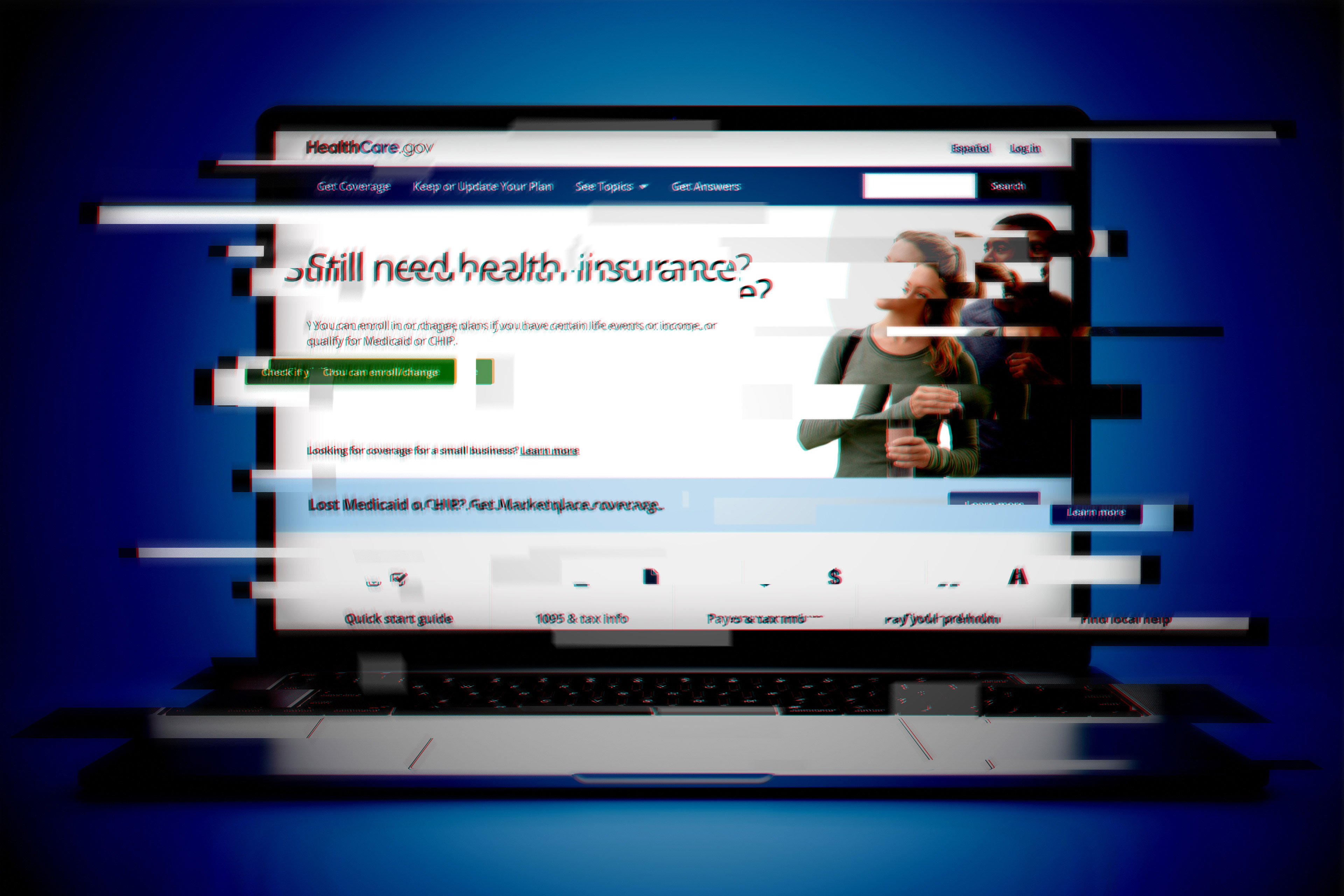
Just a few years later, health insurers stoked new ire for rescinding coverage after people were diagnosed with expensive illnesses like cancer. More recently, insurers’ widening use of cumbersome prior authorization procedures that slow patients’ access to care has provoked yet another round of fury.

The cycle of outrage periodically turns on others in the health care industry as well. Exorbitant bills and aggressive collection tactics, such as garnishing patients’ wages, are sapping public trust in hospitals and other medical providers.

And drug companies — perennial poster children for greed and profiteering — have enraged Americans since at least the 1950s, when new “wonder drugs” like steroids were fueling a growing industry.

When Sen. Estes Kefauver, a Tennessee Democrat who had led an investigation of the Mafia, convened hearings in 1959 to probe high prescription prices, his committee received mountains of mail from Americans who reported being fleeced by drugmakers. One retired rail worker told of having to spend more than a third of his retirement income on medicines for himself and his wife.

All this public outcry has occasionally sparked change. President Barack Obama and congressional Democrats leveraged anger at spiking insurance premiums in California to get the Affordable Care Act over the finish line in 2010, a landmark achievement that expanded health coverage to millions of Americans.

But more often, cycles of rage have been so much sound and fury, producing only modest reforms. In some cases, public anger has yielded more headaches for patients.

The HMO backlash in the late 1990s and early 2000s, for example, prompted employers — from whom about half of Americans get their health coverage — to embrace high-deductible health plans. Many employers saw these plans as a way to hold down costs if they couldn’t limit patients’ choice of medical providers through HMOs. These deductibles, which can reach thousands of dollars a year, are driving tens of millions of Americans into debt.

To many on the left who have long argued for a single-payer, government-run health system, the obstacle to more meaningful relief has been the political power of the same industries — health insurers, drug companies, hospitals — that fuel patient anger.

These industries have indeed proven adept at resisting change that threatened their bottom lines. They’ve also benefited from a paradox in how Americans think about their health care.

Patients may get angry. They may even lose faith in the system. This year, public views of health care quality fell to the lowest point since Gallup began asking about it in 2001, with 44% of Americans rating quality as excellent or good, down from a high of 62%.

Yet more than 70% said their own health care is excellent or good.

There is much debate about what accounts for this paradox. Are Americans just grateful to have the health protections they do? Are they satisfied because most don’t have to use the health care system on a regular basis? Do they simply like their doctor, in the way that voters routinely say they like their own member of Congress but hate Washington politicians? Or do they worry that no matter how frustrating the current system can be, any change risks making the situation worse?

The answer is probably a bit of all of this. Together, such sentiments represent a major challenge for those who hope the current wave of anger at health insurers will drive big improvements.

Could that change? Maybe. These are volatile and unpredictable political times. And the pressure of big medical bills is real. Medical debt, in particular, is exacting a fearsome toll on millions of Americans, KFF Health News’ reporting has shown.

But to drive change, advocates looking to harness public anger at the health care industry probably need to rethink their favored solutions. Old ideas like “Medicare for All,” long cherished on the left, or a deregulated health care market, long championed by the right, haven’t swayed Americans so far, no matter how angry they’ve been.

I don’t know when we’ll see meaningful alternatives. One thing that’s almost certainly on the way: Hollywood’s spin on the death of a health insurance executive gunned down in Midtown Manhattan.

Related Topics

Contact Us

Submit a Story Tip

Trump Threat to Immigrant Health Care Tempered by Economic Hopes

LOS ANGELES — President-elect Donald Trump’s promise of mass deportations and tougher immigration restrictions is deepening mistrust of the health care system among California’s immigrants and clouding the future for providers serving the state’s most impoverished residents.

At the same time, immigrants living illegally in Southern California told KFF Health News they thought the economy would improve and their incomes might increase under Trump, and for some that outweighed concerns about health care.

Community health workers say fear of deportation is already affecting participation in Medi-Cal, the state’s Medicaid program for low-income residents, which was expanded in phases to all immigrants regardless of residency status over the past several years. That could undercut the state’s progress in reducing the uninsured rate, which reached a record low of 6.4% last year.

Immigrants lacking legal residency have long worried that participation in government programs could make them targets, and Trump’s election has compounded those concerns, community advocates say.

The incoming Trump administration is also expected to target Medicaid with funding cuts and enrollment restrictions, which activists worry could threaten the Medi-Cal expansion and kneecap efforts to extend health insurance subsidies under Covered California to all immigrants.

Clinics and community health workers encourage immigrants to enroll for health coverage through Medi-Cal and Covered California. But workers have noticed that fear of deportation has chilled participation.(Vanessa G. Sánchez/KFF Health News)

“The fear alone has so many consequences to the health of our communities,” said Mar Velez, director of policy with the Latino Coalition for a Healthy California. “This is, as they say, not their first rodeo. They understand how the system works. I think this machine is going to be, unfortunately, a lot more harmful to our communities.”

Alongside such worries, though, is a strain of optimism that Trump might be a boon to the economy, according to interviews with immigrants in Los Angeles whom health care workers were soliciting to sign up for Medi-Cal.

Selvin, 39, who, like others interviewed for this article, asked to be identified by only his first name because he’s living here without legal permission, said that even though he believes Trump dislikes people like him, he thinks the new administration could help boost his hours at the food processing facility where he works packing noodles. “I do see how he could improve the economy. From that perspective, I think it’s good that he won.”

He became eligible for Medi-Cal this year but decided not to enroll, worrying it could jeopardize his chances of changing his immigration status.

“I’ve thought about it,” Selvin said, but “I feel like it could end up hurting me. I won’t deny that, obviously, I’d like to benefit — get my teeth fixed, a physical checkup.” But fear holds him back, he said, and he hasn’t seen a doctor in nine years.

It’s not Trump’s mass deportation plan in particular that’s scaring him off, though. “If I’m not committing any crimes or getting a DUI, I think I won’t get deported,” Selvin said.

Petrona, 55, came from El Salvador seeking asylum and enrolled in Medi-Cal last year.

She said that if her health insurance benefits were cut, she wouldn’t be able to afford her visits to the dentist.

A street food vendor, she hears often about Trump’s deportation plan, but she said it will be the criminals the new president pushes out. “I’ve heard people say he’s going to get rid of everyone who’s stealing.”

Although she’s afraid she could be deported, she’s also hopeful about Trump. “He says he’s going to give a lot of work to Hispanics because Latinos are the ones who work the hardest,” she said. “That’s good, more work for us, the ones who came here to work.”

Newly elected Republican Assembly member Jeff Gonzalez, who flipped a seat long held by Democrats in the Latino-heavy desert region in the southeastern part of the state, said his constituents were anxious to see a new economic direction.

“They’re just really kind of fed up with the status quo in California,” Gonzalez said. “People on the ground are saying, ‘I’m hopeful,’ because now we have a different perspective. We have a businessperson who is looking at the very things that we are looking at, which is the price of eggs, the price of gas, the safety.”

Gonzalez said he’s not going to comment about potential Medicaid cuts, because Trump has not made any official announcement. Unlike most in his party, Gonzalez said he supports the extension of health care services to all residents regardless of immigration status.

A photo of Yanet Martinez standing outside across the street from a beauty salon.
Since Election Day, community health worker Yanet Martinez says, people are more reluctant to hear her pitch for subsidized health insurance or cancer prevention screenings. “They think I’m going to share their information to deport them,” she says.(Vanessa G. Sánchez/KFF Health News)

Health care providers said they are facing a twin challenge of hesitancy among those they are supposed to serve and the threat of major cuts to Medicaid, the federal program that provides over 60% of the funding for Medi-Cal.

Health providers and policy researchers say a loss in federal contributions could lead the state to roll back or downsize some programs, including the expansion to cover those without legal authorization.

California and Oregon are the only states that offer comprehensive health insurance to all income-eligible immigrants regardless of status. About 1.5 million people without authorization have enrolled in California, at a cost of over $6 billion a year to state taxpayers.

“Everyone wants to put these types of services on the chopping block, which is really unfair,” said state Sen. Lena Gonzalez, a Democrat and chair of the California Latino Legislative Caucus. “We will do everything we can to ensure that we prioritize this.”

Sen. Gonzalez said it will be challenging to expand programs such as Covered California, the state’s health insurance marketplace, for which immigrants lacking permanent legal status are not eligible. A big concern for immigrants and their advocates is that Trump could reinstate changes to the public charge policy, which can deny green cards or visas based on the use of government benefits.

“President Trump’s mass deportation plan will end the financial drain posed by illegal immigrants on our healthcare system, and ensure that our country can care for American citizens who rely on Medicaid, Medicare, and Social Security,” Trump spokesperson Karoline Leavitt said in a statement to KFF Health News.

During his first term, in 2019, Trump broadened the policy to include the use of Medicaid, as well as housing and nutrition subsidies. The Biden administration rescinded the change in 2021.

KFF, a health information nonprofit that includes KFF Health News, found immigrants use less health care than people born in the United States. And about 1 in 4 likely undocumented immigrant adults said they have avoided applying for assistance with health care, food, and housing because of immigration-related fears, according to a 2023 survey.

Another uncertainty is the fate of the Affordable Care Act, which was opened in November to immigrants who were brought to the U.S. as children and are protected by the Deferred Action Childhood Arrivals program. If DACA eligibility for the act’s plans, or even the act itself, were to be reversed under Trump, that would leave roughly 40,000 California DACA recipients, and about 100,000 nationwide, without access to subsidized health insurance.

On Dec. 9, a federal court in North Dakota issued an order blocking DACA recipients from accessing Affordable Care Act health plans in 19 states that had challenged the Biden administration’s rule.

Clinics and community health workers are encouraging people to continue enrolling in health benefits. But amid the push to spread the message, the chilling effects are already apparent up and down the state.

“¿Ya tiene Medi-Cal?” community health worker Yanet Martinez said, asking residents whether they had Medi-Cal as she walked down Pico Boulevard recently in a Los Angeles neighborhood with many Salvadorans.

“¡Nosotros podemos ayudarle a solicitar Medi-Cal! ¡Todo gratuito!” she shouted, offering help to sign up, free of charge.

“Gracias, pero no,” said one young woman, responding with a no thanks. She shrugged her shoulders and averted her eyes under a cap that covered her from the late-morning sun.

Since Election Day, Martinez said, people have been more reluctant to hear her pitch for subsidized health insurance or cancer prevention screenings.

“They think I’m going to share their information to deport them,” she said. “They don’t want anything to do with it.”

A photo of Yanet Martinez speaking to a woman on the street.
Community health workers such as Yanet Martinez encourage people to enroll for health benefits. But many California immigrants fear that using subsidized services could hurt their chances of obtaining legal residency.(Vanessa G. Sánchez/KFF Health News)

This article was produced by KFF Health News, which publishes California Healthline, an editorially independent service of the California Health Care Foundation. 

Related Topics

Contact Us

Submit a Story Tip

Inmigrantes temen por su salud bajo Trump, pero tienen esperanzas en la economía

LOS ÁNGELES, California.— La promesa del presidente electo Donald Trump de deportaciones masivas y restricciones migratorias más severas está aumentando la desconfianza en el sistema de salud entre los inmigrantes en California, y nublando el futuro de los proveedores que atienden a los residentes más empobrecidos del estado.

Al mismo tiempo, inmigrantes que viven en el sur de California sin papeles dijeron a KFF Health News que pensaban que la economía mejoraría y que sus ingresos podrían aumentar bajo Trump. Para algunos, esa esperanza supera a sus preocupaciones sobre la atención de salud.

Trabajadores comunitarios de salud dicen que el miedo a la deportación ya está afectando la participación en Medi-Cal, el programa de Medicaid del estado para residentes de bajos ingresos, que en los últimos años se ha estado expandiendo gradualmente a todos los inmigrantes, independientemente de su estatus migratorio. Esto podría socavar el progreso del estado en la reducción de la tasa de personas sin seguro, que alcanzó un mínimo histórico del 6.4% en 2023.

Los inmigrantes sin papeles han temido durante mucho tiempo que participar en programas gubernamentales los convierta en blanco fácil de las autoridades migratorias, y la elección de Trump ha exacerbado estas preocupaciones, según defensores comunitarios.

Se espera que Medicaid esté en la mira de la nueva administración Trump, con recortes de fondos y restricciones de inscripción, lo que preocupa a activistas, ya que podría amenazar la expansión de Medi-Cal y obstaculizar los esfuerzos para extender los subsidios que ayudan a pagar por los seguros de salud bajo Covered California a todos los inmigrantes.

“El miedo por sí solo tiene tantas consecuencias para la salud de nuestras comunidades”, dijo Mar Vélez, directora de políticas de la Latino Coalition for a Healthy California. “Como ellos dicen, esta no es su primera batalla. Entienden cómo funciona el sistema. Creo que esta maquinaria será, desafortunadamente, mucho más dañina para nuestras comunidades”.

A pesar de estas preocupaciones, también hay una corriente de optimismo de que Trump podría beneficiar a la economía, según entrevistas con inmigrantes en Los Ángeles mientras trabajadores de salud estaban invitándolos a inscribirse en Medi-Cal.

Selvin, de 39 años, quien, como otros entrevistados para este artículo, pidió ser identificado solo por su primer nombre porque no tiene papeles, dijo que aunque cree que a Trump no le gustan las personas como él, piensa que la nueva administración podría ayudar a aumentar sus horas en la planta procesadora de alimentos donde trabaja empacando fideos. “Sí veo cómo podría mejorar la economía. Desde esa perspectiva, creo que es bueno que haya ganado”.

Este año, Selvin se convirtió en elegible para Medi-Cal, pero decidió no inscribirse, preocupado de que pudiera poner en peligro sus posibilidades de cambiar su estatus migratorio.

“Lo he pensado”, dijo Selvin, pero “siento que podría terminar perjudicándome. No negaré que, obviamente, me gustaría beneficiarme: arreglarme los dientes, un chequeo físico”. Pero dijo que el miedo lo frena, y no ha visto a un médico en nueve años.

No es el plan de deportación masiva de Trump en particular lo que lo asusta, sin embargo. “Si no estoy cometiendo ningún crimen o manejando ebrio, creo que no me deportarán”, dijo Selvin.

Las clínicas y los trabajadores de salud comunitarios alientan a los inmigrantes a inscribirse para obtener cobertura médica a través de Medi-Cal y Covered California. Pero los trabajadores han notado que el miedo a la deportación ha “enfriado” la participación.(Vanessa G. Sánchez/KFF Health News)

Petrona, de 55 años, vino de El Salvador buscando asilo y se inscribió en Medi-Cal el año pasado.

Dijo que si se recortan sus beneficios de salud, no podría costear sus visitas al dentista.

Vendedora ambulante de comida, escucha a menudo sobre el plan de deportación de Trump, pero dijo que el nuevo presidente expulsará a los criminales. “He oído decir que va a deshacerse de todos los que están robando”.

Aunque teme que pudiera ser deportada, también tiene esperanza en Trump. “Dice que va a dar mucho trabajo a los hispanos porque los latinos son los que trabajan más duro”, dijo. “Eso es bueno, más trabajo para nosotros, los que vinimos aquí a trabajar”.

El recién electo asambleísta republicano Jeff Gonzalez, quien ganó un escaño históricamente demócrata en la región desértica del sureste del estado, con una gran población latina, dijo que sus electores estaban ansiosos por ver un nuevo rumbo económico.

“Están realmente cansados del statu quo en California”, dijo Gonzalez. “La gente en las calles está diciendo: ‘Tengo esperanza’, porque ahora tenemos una perspectiva diferente. Tenemos a un empresario que está viendo las mismas cosas que nosotros estamos viendo, como el precio de los huevos, el precio de la gasolina, la seguridad”.

Gonzalez dijo que no comentará sobre posibles recortes a Medicaid porque Trump no ha hecho ningún anuncio oficial. A diferencia de la mayoría en su partido, Gonzalez aseguró que apoya la extensión de servicios de salud a todos los residentes, independientemente de su estatus migratorio.

Los proveedores de salud dijeron que enfrentan un doble desafío: la reticencia de las personas a las que deben atender y la amenaza de recortes importantes a Medicaid, el programa federal que proporciona más del 60% del financiamiento para Medi-Cal.

Proveedores de salud e investigadores de políticas dicen que una pérdida en las contribuciones federales podría llevar al estado a reducir o eliminar algunos programas, incluida la expansión para cubrir a quienes no tienen documentos.

California y Oregon son los únicos estados que ofrecen un seguro de salud integral a todos los inmigrantes elegibles, independientemente de su estatus. En California, se han inscrito cerca de 1.5 millones de personas sin papeles, a un costo de más de $6.000 millones al año para los contribuyentes del estado.

“Todo el mundo quiere poner este tipo de servicios en la lista de recortes, lo cual es realmente injusto”, dijo la senadora estatal Lena Gonzalez, demócrata y presidenta del Caucus Legislativo Latino de California. “Haremos todo lo posible para asegurarnos de que esto se priorice”.

La senadora Gonzalez dijo que será un desafío expandir programas como Covered California, el mercado de seguros de salud del estado, para el cual los inmigrantes sin estatus legal no son elegibles. Una gran preocupación para los inmigrantes y sus defensores es que Trump podría restablecer los cambios a la política de carga pública, que habilita para negar tarjetas de residencia o visas basándose en el uso de ciertos beneficios gubernamentales.

A photo of Yanet Martinez standing outside across the street from a beauty salon.
Los trabajadores de salud comunitarios como Yanet Martínez alientan a las personas a inscribirse para tener beneficios de salud. Pero muchos inmigrantes de California temen que el uso de servicios subsidiados pueda perjudicar sus posibilidades de obtener la residencia legal.(Vanessa G. Sánchez/KFF Health News)

“El plan de deportación masiva del presidente Trump pondrá fin al drenaje financiero que representan los inmigrantes ilegales para nuestro sistema de salud y garantizará que nuestro país pueda cuidar a los ciudadanos estadounidenses que dependen de Medicaid, Medicare y el Seguro Social”, dijo Karoline Leavitt, vocera de Trump, en un comunicado para KFF Health News.

Durante su primer mandato, en 2019, Trump amplió la política de carga pública para incluir el uso de Medicaid, así como subsidios de vivienda y para comprar alimentos. La administración Biden rescindió el cambio en 2021.

KFF, una organización sin fines de lucro de información sobre salud que incluye a KFF Health News, encontró que los inmigrantes usan menos servicios de salud que las personas nacidas en los Estados Unidos. Y aproximadamente 1 de cada 4 inmigrantes adultos probablemente indocumentados dijo que ha evitado solicitar asistencia para la atención de salud, alimentos y vivienda debido a temores relacionados con la inmigración, según una encuesta de 2023.

Otra incertidumbre es el destino de la Ley de Cuidado de Salud a Bajo Precio (ACA), que se expandió en noviembre a los inmigrantes traídos al país de niños y que están protegidos bajo el programa de Acción Diferida para los Llegados en la Infancia (DACA). Si la elegibilidad de DACA, y la misma ley, fuera revertida bajo Trump, eso dejaría a aproximadamente 40.000 beneficiarios de DACA en California, y alrededor de 100.000 en todo el país, sin acceso a seguros de salud subsidiados.

El 9 de diciembre, un tribunal federal en Dakota del Norte emitió una orden bloqueando el acceso de los beneficiarios de DACA a estos planes de salud en 19 estados que habían impugnado la regla de la administración Biden.

Clínicas y trabajadores comunitarios de salud están alentando a las personas a seguir inscribiéndose para obtener beneficios de salud. Pero en medio del esfuerzo por difundir el mensaje, los efectos disuasorios ya son evidentes a lo largo y ancho del estado.

“¿Ya tiene Medi-Cal?”, preguntaba la trabajadora comunitaria Yanet Martínez a los residentes mientras caminaba por Pico Boulevard recientemente, en un vecindario de Los Ángeles con muchos salvadoreños.

“¡Nosotros podemos ayudarle a solicitar Medi-Cal! ¡Todo gratuito!”, gritaba, ofreciendo ayuda para inscribirse sin costo.

“Gracias, pero no”, respondió una joven, encogiéndose de hombros y evitando el contacto visual bajo una gorra que la cubría del sol dela  media mañana.

Martínez dijo que desde el día de las elecciones, la gente ha estado más reacia a escuchar lo que dice sobre seguros de salud subsidiados o exámenes preventivos de cáncer.

“Creen que voy a compartir su información para deportarlos”, dijo. “No quieren tener nada que ver con esto”.

Related Topics

Contact Us

Submit a Story Tip

Removing a Splinter? Treating a Wart? If a Doctor Does It, It Can Be Billed as Surgery

When George Lai of Portland, Oregon, took his toddler son to a pediatrician last summer for a checkup, the doctor noticed a little splinter in the child’s palm. “He must have gotten it between the front door and the car,” Lai later recalled, and the child wasn’t complaining. The doctor grabbed a pair of forceps — aka tweezers — and pulled out the splinter in “a second,” Lai said. That brief tug was transformed into a surgical billing code: Current Procedural Terminology (CPT) code 10120, “incision and removal of a foreign body, subcutaneous” — at a cost of $414.

“This was ridiculous,” Lai said. “There was no scalpel.” He was so angry that he went back to the office to speak with the manager, who told him the coding was correct because tweezers could make an incision to open the skin.

When Helene Schilders of Seattle went to her dermatologist for her annual skin check this year, she mentioned her clothing was irritating a skin tag she had. The doctor froze the tag with liquid nitrogen. “It was squirt, squirt. That’s it,” Schilders told me. She was “floored” by an explanation of benefits that said the simple treatment had been billed as $469 for surgery.

Assuming the bill was a mistake, she called the doctor’s office and was told that surgery had indeed occurred — because the skin was broken in the process. Hence surgical CPT code 17110, “destruction of 1-14 benign lesions.”

Schilders complained to her insurer, who provided a document informing her that “surgery is classified as something entering the body, such as a Q-tip entering the ear canal or a scalpel during surgery.”

Huh? “I have had surgery, and this is not it,” Schilders said.

In common vernacular, “surgery” evokes images of physicians and nurses leaning over an operating table, gowned and masked, as they address a problem deep in the body. Removing an appendix or a tumor. Replacing a knee. Clipping a leaking aneurysm in the brain. It most probably involves a scalpel or specialized instruments and surgical skill.

More and more minor interventions, however, have been rebranded and billed as surgery, for profit. These tiny interventions don’t yield huge bills — in the hundreds rather than the thousands of dollars — but, cumulatively, they likely add up to tens if not hundreds of millions of dollars for doctors and hospitals annually. The surprise bills often catch patients off guard. And they must pay up if they haven’t met their insurance deductible. Even if they have, “surgery” generally requires a coinsurance payment, while an office visit doesn’t.

“There’s more pressure to make money, and the idea is you can charge more if it’s a surgical procedure,” said Sabrina Corlette, founder and co-director of Georgetown University’s Center on Health Insurance Reforms. “The payer should be reviewing this and saying this is run-of-the-mill. But there’s not a lot of incentive to do that.”

Corlette surmised that the codes employed in the instances mentioned above were intended for rare, complicated cases in which the removal of a splinter or a skin lesion — or 14 of them — required special skills or time. But the codes’ use has ballooned, covering the complicated and the commonplace. The use of code 17110 billed from doctors’ offices has gone up 62% from 2013 (1,739,708) to 2022 (2,817,190).

The blizzard of surgeries-in-name-only is a symptom of a system that has long valued procedures far more than intellectual work in its payments to medical providers. That merits rethinking, and there are some hints that the incoming presidential administration might be interested in doing so.

The current payment calculation system has its origins in the late 1980s, when a team led by an economist at Harvard University’s public health school, William Hsiao, created what’s called the Resource Based Relative Value Scale, or RBRVS, to rationalize Medicare’s payments to doctors. It allocated reimbursement using a formula that included physician work, practice expenses, and malpractice expenses. It concluded “that the work per unit time (a measure of intensity) for invasive services is about three times that of evaluation/management.”

In other words, it enshrined the notion that “invasive services” — procedures or surgery — were by far the most valuable.

An American Medical Association committee that includes physicians from an array of specialties periodically suggests updates to those codes (and federal regulators accept them, in many years, over 90% of the time). Since surgeons are overrepresented on the committee, the valuation of anything defined as an operation has only increased, giving billers the incentive to classify even the most mundane interventions as surgery.

Experts of all political stripes have spent years critiquing the process — it’s common sense that the fox (physicians) should not be guarding the henhouse (payments). President-elect Donald Trump’s pick for Health and Human Services secretary, Robert F. Kennedy Jr., has signaled that he might rethink that approach, according to the health-industry publication Stat. Kennedy has not outlined an actual plan to replace the current process, but he is reportedly exploring if the Centers for Medicare & Medicaid Services, a government agency, could do it instead.

Absent reform, on it goes.

Anthony Norton of Puyallup, Washington, took his 3-year-old daughter to a doctor this year because she had a bothersome plantar wart on her foot. The doctor applied a chemical ointment to the wart in the office every two weeks and covered it with a Band-Aid. When the child arrived for a third visit, Norton was informed he had an outstanding balance of $465 (in addition to the $25 office visit copay already paid) because the application was “surgery.” CPT code 17110 again.

“It made no sense,” Norton later recalled. The billing office assured him it was surgery, he said, “because the ointment penetrates the skin.”

Norton wondered: “When you extrapolate that, is putting on Neosporin or calamine surgery, too?”

We are now in an era in which a neurologist spending 40 minutes with a patient to tease out a diagnosis can be paid less for that time than a dermatologist spending a few seconds squirting a dollop of liquid nitrogen onto the skin.

Lai was so angry at being charged more than $400 to pull that splinter out of his child’s hand that he went on a crusade, returning to the dermatologist’s office when his calls were ignored, accusing it of fraud and threatening to complain to his insurer. Only then, he said, did the doctor’s office waive the surgical charge — and kick him and his family out of the practice.

KFF Health News is a national newsroom that produces in-depth journalism about health issues and is one of the core operating programs at KFF—an independent source of health policy research, polling, and journalism. Learn more about KFF.

USE OUR CONTENT

This story can be republished for free (details).

A Killing Touches Off Backlash Against Health Insurers

The Host

The shooting death of UnitedHealthcare CEO Brian Thompson on the streets of New York City prompted a surprising wave of sympathy for the perpetrator, rather than the victim, from Americans who say they have been wronged by their health insurers. It remains to be seen whether backlash from the killing will result in a more serious conversation about what ails the health care system.

Meanwhile, in some of his first extended interviews since the election, President-elect Donald Trump continued to be noncommittal about his plans for health care in general and the Affordable Care Act in particular.

This week’s panelists are Julie Rovner of KFF Health News, Rachel Cohrs Zhang of Stat, Alice Miranda Ollstein of Politico, and Sandhya Raman of CQ Roll Call.

Among the takeaways from this week’s episode:

  • The killing of UnitedHealthcare’s chief executive has amplified simmering anger and distrust over the nation’s health care system. Many people are upset about the cost of care, limitations of coverage, gaps in access — and much more. While Democratic policymakers have pushed in recent years to insure as many Americans as possible, insurance coverage is only part of the equation in resolving the system’s ills.
  • There’s not much time left for this Congress. Still on the agenda is passing funding for some health priorities. Extending telehealth access, for instance, is a small but key issue for which lawmakers will need to find money to offset the cost of an expensive program. And cultural issues continue to play a role, with the House passing a defense spending package this week that would cut coverage for gender-affirming care for minor dependents of those in the armed forces.
  • And Trump’s recent interviews with NBC News’ “Meet the Press” and Time magazine offered little clarity on his health care plans. He referred to making changes to the ACA and not making changes to abortion pill availability — but it is clear that such issues are not among his top concerns and that policies will depend largely on the personnel within the health agencies.

Also this week, Rovner interviews Francis Collins, who was the director of the National Institutes of Health and a science adviser to President Joe Biden.

Plus, for “extra credit,” the panelists suggest health policy stories they read this week that they think you should read, too:

Julie Rovner: KFF’s “Medicare Spending was 27% More for People Who Disenrolled From Medicare Advantage Than for Similar People in Traditional Medicare,” by Jeannie Fuglesten Biniek, Alex Cottrill, Nolan Sroczynski, and Tricia Neuman. 

Alice Miranda Ollstein: CNN’s “Most Women in the US Aren’t Accessing Family Planning Services, Even as Abortion Restrictions Grow,” by Deidre McPhillips. 

Sandhya Raman: Stat’s “Spending Less, Living Longer: What the U.S. Can Learn From Portugal’s Innovative Health System,” by Usha Lee McFarling. 

Rachel Cohrs Zhang: ProPublica’s “‘Eat What You Kill,’” by J. David McSwane.

Also mentioned in this week’s podcast:


To hear all our podcasts, click here.

And subscribe to KFF Health News’ “What the Health?” on SpotifyApple PodcastsPocket Casts, or wherever you listen to podcasts.

Related Topics

Contact Us

Submit a Story Tip

Si Trump recorta fondos, millones de personas en nueve estados podrían perder Medicaid

Con el regreso de Donald Trump a la Casa Blanca, y el control total del Congreso por parte de los republicanos en 2025, la expansión de Medicaid promovida por la Ley de Cuidado de Salud a Bajo Precio (ACA) vuelve a estar en peligro.

Más de 3 millones de adultos en nueve estados estarían en riesgo inmediato de perder su cobertura de salud si el Partido Republicano reduce la financiación federal adicional para Medicaid que ha permitido a los estados ampliar la elegibilidad, según KFF y el Center for Children and Families de la Universidad de Georgetown. Esto se debe a que esos estados tienen leyes activadas que pondrían fin rápidamente a sus expansiones de Medicaid si disminuyen los fondos federales.

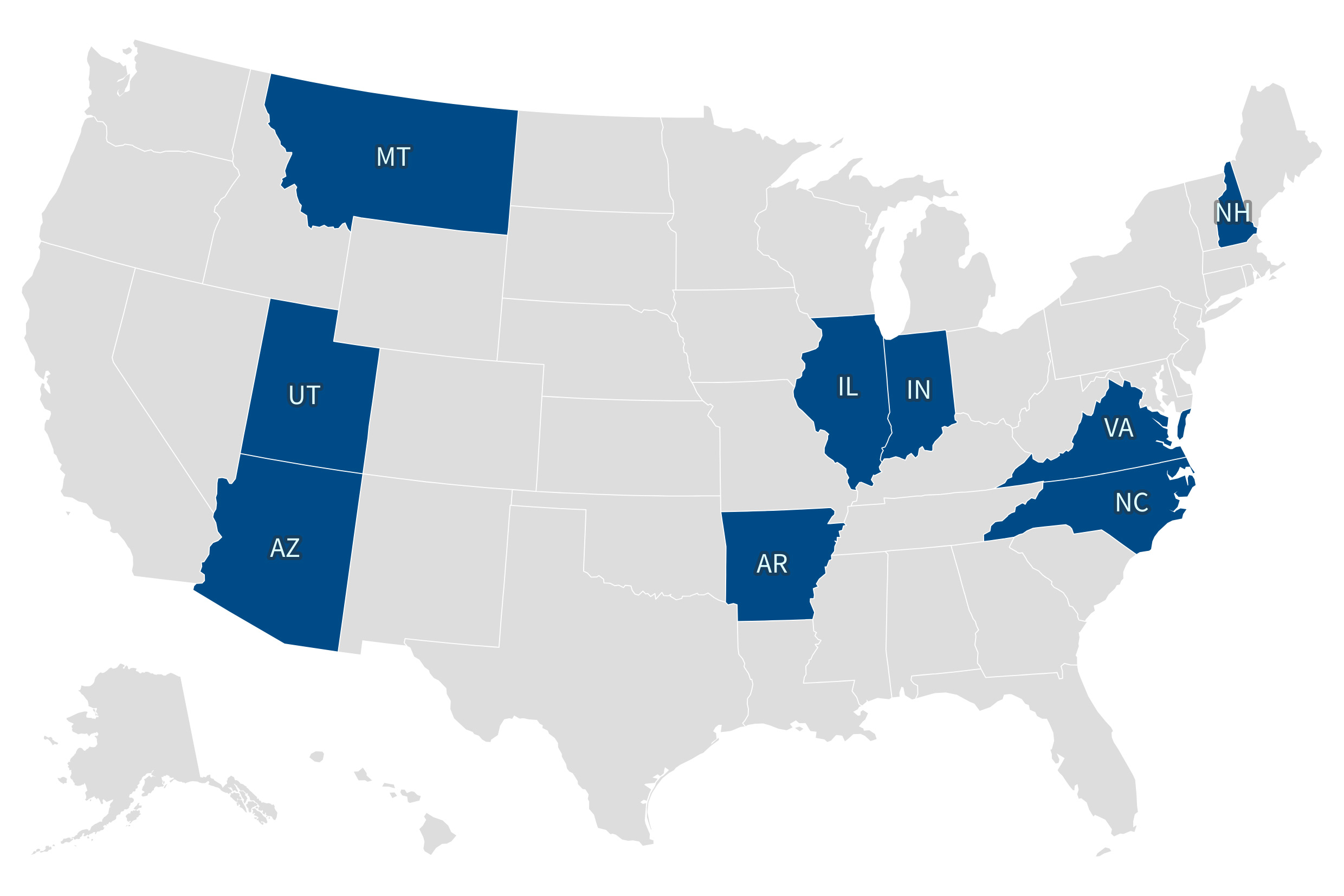
Los estados son Arizona, Arkansas, Illinois, Indiana, Montana, New Hampshire, Carolina del Norte, Utah y Virginia.

Promulgada en 2010, ACA incentivó a los estados a ampliar los programas de Medicaid para cubrir a más estadounidenses de bajos ingresos que no recibían seguro médico a través de sus empleos. Cuarenta estados y el Distrito de Columbia pusieron en marcha la expansión, sumando desde 2014 a un estimado de 21 millones de personas y ayudando a reducir la tasa de personas sin seguro en el país a niveles récord.

A cambio, el gobierno federal cubre el 90% del costo para asegurar a la población ampliada. Esto es significativamente más alto que el porcentaje promedio de financiamiento federal para otros beneficiarios de Medicaid, que es de aproximadamente 57% a nivel nacional.

Los grupos de políticas conservadoras, que generalmente se han opuesto a ACA, afirman que el programa cuesta demasiado y cubre a demasiadas personas. Los demócratas, por su parte, sostienen que la expansión de Medicaid ha salvado vidas y beneficiado a las comunidades al ampliar la cobertura para personas que no podían pagar un seguro privado.

Si el Congreso reduce la financiación federal, la expansión de Medicaid estaría en riesgo en todos los estados que se han sumado al programa, incluso aquellos sin leyes de activación, ya que las legislaturas estatales tendrían que compensar la diferencia, dijo Renuka Tipirneni, profesora asociada en la Escuela de Salud Pública de la Universidad de Michigan.

Las decisiones de mantener o revertir la expansión “dependerían de la política a nivel estatal”, señaló Tipirneni.

Por ejemplo, Michigan aprobó una ley de activación como parte de su expansión de Medicaid en 2013, cuando el estado estaba bajo el control de un gobernador y una legislatura republicanas. El año pasado, con el gobierno controlado por los demócratas, el estado eliminó esa cláusula.

Seis de los nueve estados con leyes de activación —Arizona, Arkansas, Indiana, Montana, Carolina del Norte y Utah— apoyaron a Trump en las elecciones de 2024.

La mayoría de las leyes de activación de estos nueve estados se aplican si la financiación federal cae por debajo del umbral del 90%. La ley de activación de Arizona eliminaría la expansión si los fondos caen por debajo del 80%.

La ley de Montana revierte la expansión si la financiación federal cae por debajo del 90%, pero permite que continúe si los legisladores identifican fondos adicionales. Según la legislación estatal, los legisladores de Montana deben volver a autorizar la expansión de Medicaid en 2025 o esta finalizará.

En los estados con leyes de activación, entre 3.1 millones y 3.7 millones de personas perderían su cobertura rápidamente, según estimaciones de investigadores de KFF y el centro de Georgetown. La diferencia depende de cómo los estados traten a las personas que sumaron a Medicaid antes de la expansión de ACA; podrían seguir siendo elegibles incluso si la expansión termina.

Otros tres estados —Iowa, Idaho y Nuevo México— tienen leyes que exigen a sus gobiernos mitigar el impacto financiero de perder los fondos federales de expansión de Medicaid, pero no terminarían automáticamente las expansiones. Incluyendo esos tres estados, alrededor de 4.3 millones de inscritos bajo la expansión de Medicaid estarían en riesgo de perder su cobertura, según KFF.

ACA permitió la expansión de Medicaid para adultos con ingresos de hasta el 138% del nivel federal de pobreza, o aproximadamente $20,783 para un individuo en 2024.

Casi una cuarta parte de las 81 millones de personas inscritas en Medicaid a nivel nacional están en el programa gracias a las expansiones.

“Con una reducción en la tasa de financiamiento para la expansión, es probable que todos los estados necesiten evaluar si continúan con la cobertura ampliada, ya que requeriría un aumento significativo en el gasto estatal”, dijo Robin Rudowitz, vicepresidenta y directora del Program on Medicaid and the Uninsured en KFF. “Si los estados eliminan la cobertura, es probable que haya un aumento en el número de personas sin seguro, lo que limitaría el acceso a la atención en estados rojos y azules que han adoptado la expansión”.

Los estados rara vez reducen la elegibilidad para programas sociales como Medicaid una vez que se ha otorgado.

Las leyes de activación facilitan políticamente que los legisladores estatales terminen con la expansión de Medicaid porque no tendrían que tomar ninguna acción nueva para reducir la cobertura, dijo Edwin Park, profesor de investigación en el Center for Children and Families de la Universidad de Georgetown.

Para ver el impacto de las leyes de activación, hay que considerar lo que sucedió después que, en 2022, la Corte Suprema, anulara Roe vs. Wade y, con ello, el derecho constitucional al aborto. Los legisladores conservadores en 13 estados habían redactado leyes de activación que implementarían automáticamente prohibiciones si se eliminaba el derecho nacional al aborto. Esas leyes estatales resultaron en restricciones que entraron en vigencia inmediatamente después del fallo judicial o poco después.

Los estados adoptaron leyes de activación como parte de la expansión de Medicaid para convencer a los legisladores escépticos de comprometer fondos estatales para un programa federal que no es popular entre la mayoría de los republicanos.

No está claro qué harán Trump y los republicanos en el Congreso con Medicaid después que asuma el cargo en enero, pero un indicador podría ser una recomendación reciente del Paragon Health Institute, una destacada organización de políticas conservadoras liderada por Brian Blase, ex asesor de salud de Trump.

Paragon ha propuesto que, a partir de 2026, el gobierno federal reduzca gradualmente el financiamiento del 90% para la expansión hasta 2034, cuando alcanzaría la paridad con la tasa de financiamiento federal para los beneficiarios tradicionales de Medicaid en cada estado.

Bajo ese plan, los estados aún podrían recibir financiamiento para la expansión de Medicaid bajo ACA, pero restringirían la cobertura a inscritos con ingresos de hasta el nivel federal de pobreza. Actualmente, para recibir financiamiento de expansión, los estados deben ofrecer cobertura a todos con ingresos de hasta el 138% del nivel de pobreza.

Daniel Derksen, director del Center for Rural Health de la Universidad de Arizona, dijo que es poco probable que Arizona elimine su cláusula de activación y compense los fondos federales perdidos. “Sería difícil justificarlo en este momento, ya que supondría una gran presión para el presupuesto”, señaló.

Medicaid ha estado en la mira de los republicanos en Washington antes. En 2017, los líderes republicanos en el Congreso propusieron una legislación para recortar la financiación federal de la expansión, lo que habría trasladado miles de millones en costos a los estados. Ese plan, parte de una estrategia para derogar el Obamacare, finalmente fracasó.

Federal Judge Halts Dreamers’ Brand-New Access to ACA Enrollment in 19 States

A federal judge in North Dakota has ruled in favor of 19 states that challenged a Biden administration rule allowing — for the first time — enrollment in Affordable Care Act coverage by people brought to the U.S. as children without immigration paperwork, known as “Dreamers.”

The move effectively bars those who have qualified for the Deferred Action for Childhood Arrivals program in those 19 states from enrolling in or getting subsidies for ACA plans. It does not appear to affect enrollment or coverage in other states, lawyers following the case said Tuesday.

The Biden administration is likely to appeal, although a Centers for Medicare & Medicaid Services representative said in an email that the agency would not comment on the litigation.

While an appeal may be filed quickly, a final decision may not occur before the incoming Trump administration takes office. “They could take a different position on the litigation,” said Zachary Baron, a legal expert at Georgetown Law, who helps manage the O’Neill Institute Health Care Litigation Tracker.

In the meantime, it is not clear what will happen to Dreamer enrollees in the 19 states whose coverage has already started or begins early next year, although the judge’s ruling does not say it is retroactive, Baron noted.

The case was filed in August in U.S. District Court for the District of North Dakota.

Previously, the federal government estimated that about 100,000 uninsured people out of the half-million DACA recipients might sign up starting Nov. 1, the sign-up season start date in all states except Idaho.

The Biden administration rule, finalized in May, clarified that those who qualify for DACA would be considered “lawfully present” for the purposes of enrolling in plans under the ACA, which are open to American citizens and what are called “lawfully present” immigrants.

In granting a preliminary injunction and stay, U.S District Judge Daniel Traynor, who was appointed in 2019 by then-President Donald Trump, noted in his Monday ruling that the plaintiffs were likely to win on the merits of their argument.

States challenging the ACA rule say it will cause administrative and resource burdens as more people enroll, and that it will encourage additional people to remain in the U.S. when they don’t have permanent legal authorization. In addition to Kansas and North Dakota, the states that joined the lawsuit are Alabama, Arkansas, Florida, Idaho, Indiana, Iowa, Kentucky, Missouri, Montana, Nebraska, New Hampshire, Ohio, South Carolina, South Dakota, Tennessee, Texas, and Virginia.

“Judge Traynor’s ruling is both disappointing and wrong on the law,” said Nicholas Espíritu, a deputy legal director of the National Immigration Law Center, in an emailed statement. “While we study the court’s ruling to evaluate the next steps in this case, we will continue to fight on behalf of our clients and hundreds of thousands of DACA recipients who have been waiting over a decade to access life-sustaining care under the Affordable Care Act.”

DACA was established through executive action in June 2012 by President Barack Obama, protecting from deportation and providing work authorization to some unauthorized residents brought to the U.S. as children by their families. It had certain requirements, including that they arrived before June 2007 and had completed high school, were attending school, or were serving in the military.

Before the injunction, 19 other states and the District of Columbia filed a brief in support of the Biden administration rule. Led by New Jersey, those states include many in the East and West, including California, Colorado, Nevada, New Mexico, New York, Oregon, and Washington.

Related Topics

Contact Us

Submit a Story Tip

Juez bloquea en 19 estados la norma que permite a Dreamers inscribirse en planes de salud de ACA

Un juez federal en Dakota del Norte falló a favor de 19 estados que impugnaron una regla de la administración Biden que permite —por primera vez— que las personas traídas a Estados Unidos de niños, sin papeles, conocidas como Dreamers, se inscribieran para obtener cobertura de salud a través de los mercados establecidos por la Ley de Cuidado de Salud a Bajo Precio (ACA).

La decisión prohíbe a los beneficiarios del programa de Acción Diferida para los Llegados en la Infancia (DACA) en esos 19 estados inscribirse o recibir subsidios para pagar los planes de ACA.

Abogados que siguen el caso dijeron que este fallo no parece afectar la inscripción ni la cobertura en otros estados.

La administración Biden probablemente apelará, aunque un representante de los Centros de Servicios de Medicare y Medicaid (CMS,) la entidad federal que coordina estos mercados, dijo por correo electrónico que la agencia no comentará sobre el litigio.

Aunque se podría presentar una apelación rápidamente, una decisión final podría no ocurrir antes de que comience la próxima administración Trump. “Podrían tomar una posición diferente sobre el litigio”, dijo Zachary Baron, experto legal de Georgetown Law, quien ayuda a administrar el O’Neill Institute Health Care Litigation Tracker.

Mientras tanto, no está claro qué sucederá con los Dreamers inscritos en los 19 estados cuya cobertura ya comenzó o comienza a principios del próximo año, aunque la decisión del juez no menciona que sea retroactiva, señaló Baron.

El caso fue presentado en agosto en el Tribunal de Distrito de los EE.UU. para el Distrito de Dakota del Norte.

Anteriormente, el gobierno federal estimó que alrededor de 100.000 personas sin seguro, de medio millón de beneficiarios de DACA, podrían inscribirse a partir del 1 de noviembre, la fecha de inicio de la temporada de inscripción en todos los estados excepto Idaho.

La regla de la administración Biden, finalizada en mayo, aclaró que quienes califican para DACA serían considerados como “presentes legalmente” en el país a los propósitos de inscripción en planes de salud de ACA, que están disponibles para ciudadanos estadounidenses e inmigrantes denominados “presentes legalmente”.

Al otorgar una orden judicial preliminar y una suspensión, el juez federal Daniel Traynor, nombrado en 2019 por el entonces presidente Donald Trump, señaló en su fallo del lunes 9 de diciembre que es probable que los demandantes ganaran gracias a los méritos de su argumento.

Los estados que impugnan la regla de ACA argumentan que causará cargas administrativas y de recursos al aumentar el número de inscritos y que alentará a más personas a permanecer en el país sin documentos legales.

Además de Kansas y Dakota del Norte, los estados que se unieron a la demanda son Alabama, Arkansas, Florida, Idaho, Indiana, Iowa, Kentucky, Missouri, Montana, Nebraska, New Hampshire, Ohio, Carolina del Sur, Dakota del Sur, Tennessee, Texas y Virginia.

“El fallo del juez Traynor es tanto decepcionante como erróneo en cuanto a la ley”, dijo Nicholas Espíritu, subdirector legal del Centro Nacional de Leyes de Inmigración, en un comunicado por correo electrónico.

“Mientras estudiamos la decisión del tribunal para evaluar los próximos pasos en este caso, continuaremos luchando en nombre de nuestros clientes y cientos de miles de beneficiarios de DACA que han esperado más de una década para acceder a atención vital bajo la Ley de Cuidado de Salud a Bajo Precio”.

DACA fue establecido mediante acción ejecutiva en junio de 2012 por el presidente Barack Obama, protegiendo de la deportación y proporcionando permiso de trabajo a algunos residentes no autorizados traídos al país de niños. Debían cumplir con ciertos requisites para calificar: haber llegado antes de junio de 2007 y haber completado la escuela secundaria, estar asistiendo a la escuela o servir en el ejército.

Antes de la orden judicial, otros 19 estados y el Distrito de Columbia presentaron un informe en apoyo de la regla de la administración Biden. Liderados por Nueva Jersey, esos estados incluyen muchos en el Este y Oeste del país, como California, Colorado, Nevada, Nuevo México, Nueva York, Oregon y Washington.

Journalists Dig Into Vaccine Debate and America’s Obesity Rates

KFF Health News senior correspondent Arthur Allen discussed the fragility of our vaccine infrastructure on The Atlantic’s “Radio Atlantic” on Dec. 5.

KFF Health News contributor Andy Miller discussed U.S. obesity rates on WUGA’s “The Georgia Health Report” on Nov. 29.

KFF Health News senior correspondent Julie Appleby discussed how Wisconsinites can get health insurance from the federal marketplace on Wisconsin Public Radio’s “Wisconsin Today” on Nov. 15.

KFF Health News is a national newsroom that produces in-depth journalism about health issues and is one of the core operating programs at KFF—an independent source of health policy research, polling, and journalism. Learn more about KFF.

USE OUR CONTENT

This story can be republished for free (details).

Georgia’s Work Requirement Slows Processing of Applications for Medicaid, Food Stamps

ATLANTA — Deegant Adhvaryu completed his parents’ applications for Medicaid and food benefits in June. Then the waiting and frustration began.

In July, his parents, Haresh and Nina Adhvaryu, received a letter saying their applications would be delayed, he said. In August, the Adhvaryus started calling a Georgia helpline, he said, but couldn’t leave a message. It wasn’t until September, when they visited state offices, that they were informed their applications were incomplete.

The couple were mystified. They had Medicaid coverage when they lived in Virginia, before their recent move to metro Atlanta.

While they waited, Adhvaryu’s parents — ages 71 and 76 — delayed care, fearing they couldn’t afford it. They have Medicare, and, in Georgia, Medicaid pays for its premiums, copayments, and deductibles. The lack of extra coverage strained their fixed incomes.

“It was concerning,” Deegant Adhvaryu said, because his family lost a critical financial “lifeline.”

It took Adhvaryu’s parents until late October — more than 120 days after applying — to finally get their Medicaid cards in the mail. Federal rules require states to process most Medicaid applications within 45 days.

For years, Georgia’s public benefits system has been plagued by problems like the Adhvaryus’ — a glitchy website that’s often down for maintenance, a shortage of staff to process applications, and technology that malfunctions, according to consumer advocacy organizations, former state employees, and researchers.

But a KFF Health News analysis shows processing times have worsened since July 2023, when Georgia launched the nation’s only active Medicaid work requirement program, “Georgia Pathways to Coverage.” The program began three months after the state began redetermining the eligibility of all Medicaid enrollees following a covid-19 pandemic pause.

The percentage of Medicaid applicants waiting more than a month and a half to have their applications processed has nearly tripled in the first year of Pathways, the analysis of state and federal records found. Georgia had the slowest processing time in the country as of June, for income-based applications. Preliminary data from July puts the state as the second-slowest. The percentage of applications for financial and food assistance that take more than 30 days to process has also risen by at least 8 percentage points.

Pathways “is really bogging down” a system that was “already functioning relatively poorly,” said Leah Chan, director of health justice at the Georgia Budget and Policy Institute, a nonprofit research organization that supports full Medicaid expansion.

Georgia’s effort to run Pathways reveals the challenges that loom for states looking to launch Medicaid work requirements under a second Donald Trump presidency. His first administration approved them in more than a dozen states. On Nov. 5, South Dakota voters gave lawmakers the green light to seek a work requirement for its existing Medicaid expansion population.

Conservative lawmakers around the country would like to add work requirements to Medicaid, the state-federal insurance program for people with disabilities or low incomes, said Joan Alker, who leads Georgetown University’s Center for Children and Families. “If Georgia fails, that’s a big black eye for the Republican Party.”

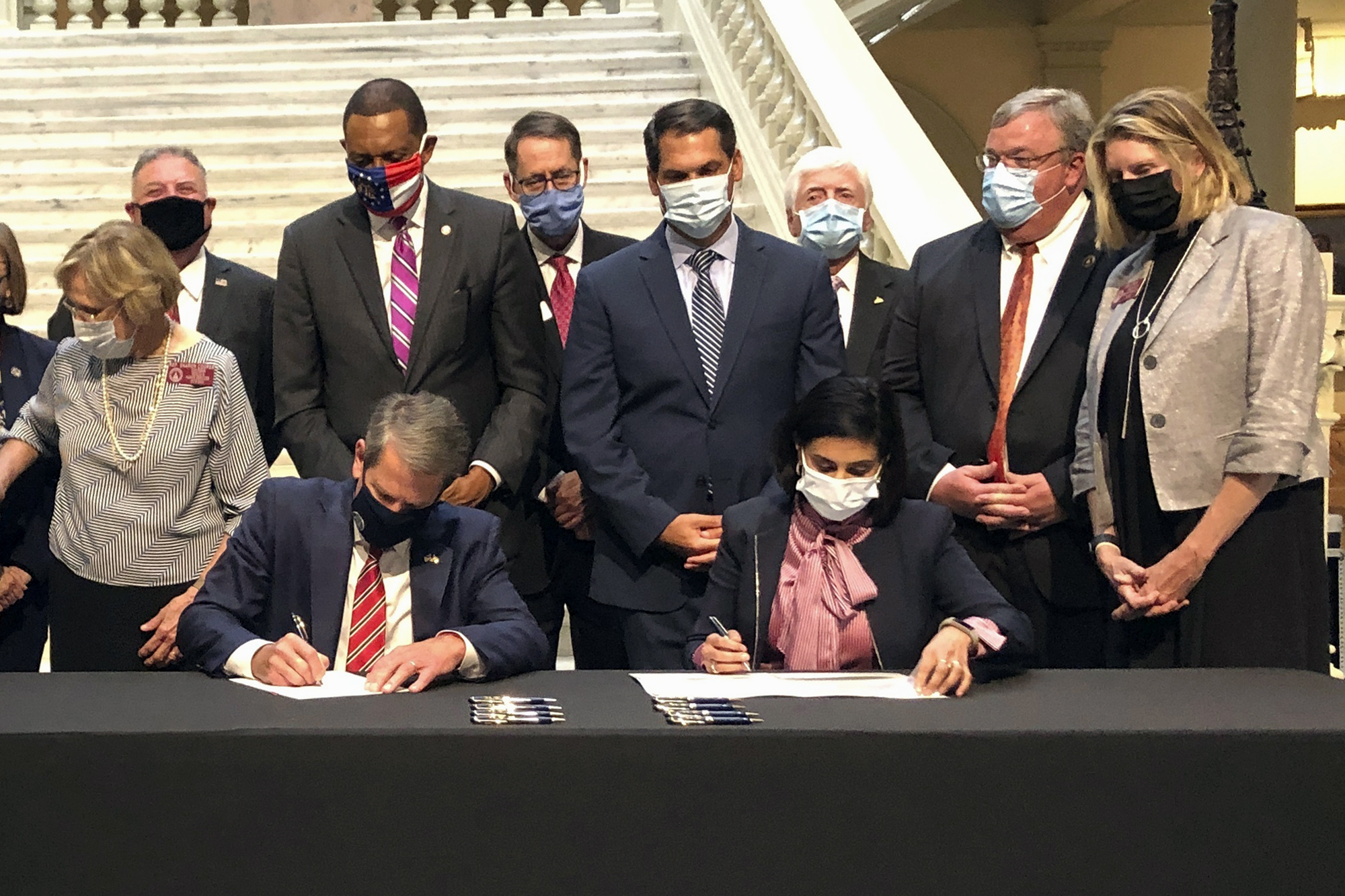
Pathways is one of Republican Gov. Brian Kemp’s signature health policy initiatives and his alternative to fully expanding Medicaid eligibility under the Affordable Care Act. Applicants must document that they’re working, studying, or doing other qualifying activities for 80 hours a month in exchange for health coverage.

Consumer advocacy organizations, former state employees, and researchers say the initiative adds inefficiencies and bureaucracy that slow down other public programs, like the Supplemental Nutrition Assistance Program, or SNAP, and the Temporary Assistance for Needy Families program, or TANF.

As of Nov. 1, just 5,542 residents were participating in the work requirement program. Under a full Medicaid expansion program, nearly 300,000 Georgians would gain health coverage, according to the Robert Wood Johnson Foundation.

Georgia’s work requirement hasn’t been cheap to implement. An analysis by Chan’s think tank found about $13,360 in state and federal spending for each enrollee from January 2021 through June 2024, largely on administrative costs, not health benefits. That doesn’t account for the cost to prepare and submit the application for Pathways to the feds or the fees associated with legal fights over the program.

Officials in Georgia told KFF Health News that, as of June 30, Pathways had cost $40.6 million in state and federal funds.

Pathways also has increased the workload for state staffers who must manually verify complex eligibility requirements and monitor enrollees’ continued eligibility, according to consumer advocacy organizations, former state employees, and researchers.

The Kemp administration blames the processing slowdown of state benefits, in part, on what’s known as the Medicaid “unwinding,” which began in April 2023 as states had to redetermine the eligibility of all enrollees in the wake of the coronavirus pandemic.

“Georgia Pathways is an innovative, Georgia-specific program that has provided coverage to thousands of Georgians who otherwise would be without care,” said Garrison Douglas, a Kemp spokesperson.

Critics say the Pathways rollout stressed a system that’s had snags for years. In contrast, Chan pointed to North Carolina, which fully expanded Medicaid during the unwinding, covering more people for less than the cost per person of Pathways and without creating additional backlogs for other public benefits programs.

Waiting for benefits approval can have concrete consequences for people’s health and well-being, say doctors, researchers, and patient advocates.

Flavia Rossi, a pediatrician in Tifton, about 180 miles south of Atlanta, said some parents skip their kids’ checkups because they fear expensive out-of-pocket costs while waiting for Medicaid coverage for their children.

In October 2023, Ellenwood, Georgia, residents Gloria and William Felder, who have custody of a granddaughter, were told by the state that her Medicaid coverage had lapsed. William Felder said they reapplied three times but waited 11 months for her coverage to be restored, during which they spent over $1,500 on her care. “We wanted to make sure she had coverage,” he said.

After a health insurance navigator queried the state, Felder said, the state finally informed them in September that she had Medicaid again.

Georgia officials haven’t invested enough in the state agency that processes public benefits applications, said Laura Colbert, executive director of Georgians for a Healthy Future, a nonprofit policy advocacy organization. The problem is exacerbated by staffing shortages, high staff turnover, and outdated technology, she said.

In November 2023, the U.S. Department of Agriculture notified state officials that Georgia was “severely out of compliance” with timeliness standards for processing SNAP applications. A recent progress report details the scope of the issues: a system that incorrectly prioritizes applications, not enough staff to handle a backlog of nearly 52,000 new applications, and no system to promptly reassign applications when staff are off.

“These delays create real hardship, forcing families to make choices between paying for medicine, food, or rent while they wait for the support they’re entitled to,” Colbert said.

The state checked the eligibility of about 2.7 million residents when the pandemic-era Medicaid continuous coverage requirement ended. Nearly half a million Georgians lost coverage — including nearly 300,000 children, according to an analysis by Alker’s nonprofit.

Instead of investing more to ensure that people who were wrongly removed could reenroll, the state continues to pour money into the Pathways program, Alker said. She cited a recently launched $10.7 million ad campaign aimed at boosting Pathways enrollment with money from federal pandemic recovery funds.

The contract for that work was awarded to the consulting firm Deloitte, which has already received millions from Georgia to build and implement Pathways. It’s also responsible for the state’s Gateway technology system, which people use to access public benefits and Georgia officials have described as having ongoing problems, according to KFF Health News’ reporting.

Deloitte did not respond to a request for comment for this article. It previously told KFF Health News that it does not comment on state-specific issues.

In a November letter to KFF Health News, Deloitte spokesperson Karen Walsh said the firm’s clients — state governments — “understand that large system implementations are challenging due to the complexity of the programs they support, and that all IT systems require ongoing maintenance, periodic enhancements and upgrades to software and hardware, and database management.”

Deegant Adhvaryu had to help keep his parents afloat as they waited months to get approved for Medicaid and SNAP. He bought them groceries and helped cover their rent. Not every applicant is that lucky.

“There are people in the state of Georgia with far less financial resources, far less family connections to be able to help them that need these services,” he said.

Related Topics

Contact Us

Submit a Story Tip

How Potential Medicaid Cuts Could Play Out in California

In 2017, the Republicans who controlled Congress tried mightily to slash federal spending on Medicaid, the government-funded health program covering low-income families and individuals.

California, like other states, depends heavily on federal dollars to provide care for its poorest residents. Analyses at the time showed the GOP’s proposals would cut Medicaid funds flowing from Washington by tens of billions of dollars, perhaps even more, forcing state officials to rethink the scope of Medi-Cal.

But the GOP efforts ended in failure — iconically crystallized by Arizona Republican Sen. John McCain, sick with terminal brain cancer, issuing his decisive early-morning thumbs-down.

More than seven years later, here we go again.

With Donald Trump preparing to reenter the White House, bolstered once more by Republican majorities in both houses of Congress, expectations are high that the GOP will quickly resurrect its long-desired goal of cutting Medicaid.

Republicans want to finance large tax cuts, and the GOP platform under Trump pledges not to touch Social Security or Medicare. To be sure, that’s not set in stone. But for now, as my KFF colleagues have noted, Medicaid looks an awful lot like low-hanging fruit. (KFF is a health information nonprofit that includes KFF Health News.)

Health officials in California and across the nation are on edge about the possibility of large-scale Medicaid cuts being enacted as soon as next year. Such cuts would have an outsize impact in the Golden State, whose 14.7 million Medi-Cal enrollees exceed the entire populations of all but three other U.S. states. Medi-Cal provides health coverage for over 40% of the state’s children and pays for nearly 40% of births. It is a crucial source of funding for safety net hospitals and community clinics.

And over 60% of its $161 billion budget this year comes by way of Washington.

The potential for big federal cuts to Medicaid may have been a factor in Democratic Gov. Gavin Newsom’s decision to call a special session of the state legislature this week.

California could seek to offset a sharp drop in federal dollars with higher taxes or cuts to other state programs. But both those options could be politically untenable. That’s why many health experts think leaders in Sacramento would almost certainly have to consider shrinking Medi-Cal.

That could mean cutting any number of optional benefits, such as dental services, optometry, and physical therapy. It might also mean rolling back some of the ambitious expansion Medi-Cal has undertaken in recent years. That could include some aspects of California Advancing and Innovating Medi-Cal, a $12 billion program of services that address patients’ social and economic needs in addition to their medical ones.

Some observers fear federal cuts could affect the approximately 1.5 million immigrants living in the U.S. without authorization who are enrolled in Medi-Cal at an annual cost of over $6 billion, nearly all of it funded by the state. But others say a more likely route would be to reduce payments across the board to the managed care plans that cover 94% of Medi-Cal enrollees, rather than target any specific groups of people.

“Medicaid is on the chopping block, and I don’t think that’s speculation,” says Gerald Kominski, a senior fellow at the UCLA Center for Health Policy Research. “It is widely viewed by potential members of Trump’s administration as a program that is too broad and needs to be brought under control.”

Whether they can succeed this time remains to be seen. But more on that later.

People who have followed previous GOP efforts to downsize Medicaid say a variety of previously attempted methods might be back on the table this time. They could include outright caps on federal Medicaid dollars; elimination of the core Affordable Care Act policy under which the feds pay 90% of the cost of expanding coverage to a wider swath of low-income adults; a work requirement, which could depress enrollment; and rule changes intended to make it harder for states to draw federal Medicaid dollars through the use of taxes on health care insurers known as MCOs.

The first Trump administration proposed but later dropped changes to the rules governing such taxes. If similar changes were adopted this time around, they could cause financial headaches in California, which has frequently used MCO taxes to offset Medi-Cal spending from state coffers.

Proposition 35, recently passed by California voters, could also be at risk. The initiative calls for the MCO tax to become a permanent fixture in 2027, pending federal approval, with the goal of financing billions of dollars in new Medi-Cal spending, primarily to increase funding for doctors and other providers. A federal rule change could upend those intentions.

Termination of the federal government’s 90% coverage of the ACA Medicaid expansion would put a gaping hole in the Medi-Cal budget. Medi-Cal spent over $34 billion in fiscal year 2023 covering the roughly 5 million people who enrolled as a result of the expansion, and nearly $31 billion of that amount was paid by the federal government.

If the feds’ share dropped back to its regular Medi-Cal rate of 50%, California would have to pony up nearly $14 billion more to keep the expansion enrollees covered — and that’s just for a year.

A more ambitious GOP push, including both spending caps and a rollback of federal support for the Medicaid expansion, could really send California officials scrambling.

In 2017, the state’s Department of Health Care Services issued an analysis showing that a legislative proposal filed by a group of Republican U.S. senators to cap Medicaid spending and end enhanced funding for the ACA expansion, along with some other cuts, would result in nearly $139 billion of lost federal funding to California from 2020 to 2027.

“There are almost limitless changes state leaders could make to Medi-Cal if they are forced to do that,” says David Kane, a senior attorney at the Western Center on Law & Poverty. “And we fear that burden will almost certainly hurt poor people and immigrants the most.”

But big Medicaid cuts are not a foregone conclusion. After all, when Trump was in the White House in 2017, Republicans also had House and Senate majorities and still did not achieve their goal. The political stars could be aligning differently this time, but the GOP has only a razor-thin majority in the House.

A decade into the ACA’s Medicaid expansion, some 21 million people across the country have coverage through it, embedding the program more deeply in the nation’s health care landscape. According to a 2023 study from Georgetown University, Medicaid and the related Children’s Health Insurance Program cover a higher proportion of the population in rural counties than in urban ones. And as we know, rural America leans strongly Republican.

Will GOP members of Congress, faced with a vote on cutting Medicaid, buck their own constituents?

Edwin Park, one of the authors of that Georgetown study, thinks there’s a chance big cuts can be averted. “Large numbers of Americans are either on Medicaid, have family members on Medicaid, or know somebody on Medicaid,” says Park, a research professor at Georgetown’s McCourt School of Public Policy. “Hopefully its popularity and its importance will win the day.”

This article was produced by KFF Health News, which publishes California Healthline, an editorially independent service of the California Health Care Foundation. 

Related Topics

Contact Us

Submit a Story Tip

9 States Poised To End Coverage for Millions if Trump Cuts Medicaid Funding

With Donald Trump’s return to the White House and Republicans taking full control of Congress in 2025, the Affordable Care Act’s Medicaid expansion is back on the chopping block.

More than 3 million adults in nine states would be at immediate risk of losing their health coverage should the GOP reduce the extra federal Medicaid funding that’s enabled states to widen eligibility, according to KFF, a health information nonprofit that includes KFF Health News, and the Georgetown University Center for Children and Families. That’s because the states have trigger laws that would swiftly end their Medicaid expansions if federal funding falls.

The states are Arizona, Arkansas, Illinois, Indiana, Montana, New Hampshire, North Carolina, Utah, and Virginia.

The 2010 Affordable Care Act encouraged states to expand Medicaid programs to cover more low-income Americans who didn’t get health insurance through their jobs. Forty states and the District of Columbia agreed, extending health insurance since 2014 to an estimated 21 million people and helping drive the U.S. uninsured rate to record lows.

In exchange, the federal government pays 90% of the cost to cover the expanded population. That’s far higher than the federal match for other Medicaid beneficiaries, which averages about 57% nationwide.

Conservative policy groups, which generally have opposed the ACA, say the program costs too much and covers too many people. Democrats say the Medicaid expansion has saved lives and helped communities by widening coverage to people who could not afford private insurance.

If Congress cuts federal funding, Medicaid expansion would be at risk in all states that have opted into it — even those without trigger laws — because state legislatures would be forced to make up the difference, said Renuka Tipirneni, an associate professor at the University of Michigan’s School of Public Health.

Decisions to keep or roll back the expansion “would depend on the politics at the state level,” Tipirneni said.

For instance, Michigan approved a trigger as part of its Medicaid expansion in 2013, when it was controlled by a Republican governor and legislature. Last year, with the government controlled by Democrats, the state eliminated its funding trigger.

Six of the nine states with trigger laws — Arizona, Arkansas, Indiana, Montana, North Carolina, and Utah — went for Trump in the 2024 election.

Most of the nine states’ triggers kick in if federal funding falls below the 90% threshold. Arizona’s trigger would eliminate its expansion if funding falls below 80%.

Montana’s law rolls back expansion below 90% funding but allows it to continue if lawmakers identify additional funding. Under state law, Montana lawmakers must reauthorize its Medicaid expansion in 2025 or the expansion will end.

Across the states with triggers, between 3.1 million and 3.7 million people would swiftly lose their coverage, researchers at KFF and the Georgetown center estimate. The difference depends on how states treat people who were added to Medicaid before the ACA expansion; they may continue to qualify even if the expansion ends.

Three other states — Iowa, Idaho, and New Mexico— have laws that require their governments to mitigate the financial impact of losing federal Medicaid expansion funding but would not automatically end expansions. With those three states included, about 4.3 million Medicaid expansion enrollees would be at risk of losing coverage, according to KFF.

The ACA allowed Medicaid expansions to adults with incomes up to 138% of the federal poverty level, or about $20,783 for an individual in 2024.

Nearly a quarter of the 81 million people enrolled in Medicaid nationally are in the program due to expansions.

“With a reduction in the expansion match rate, it is likely that all states would need to evaluate whether to continue expansion coverage because it would require a significant increase in state spending,” said Robin Rudowitz, vice president and director of the Program on Medicaid and the Uninsured at KFF. “If states drop coverage, it is likely that there would be an increase in the number of uninsured, and that would limit access to care across red and blue states that have adopted expansion.”

States rarely cut eligibility for social programs such as Medicaid once it’s been granted.

The triggers make it politically easier for state lawmakers to end Medicaid expansion because they would not have to take any new action to cut coverage, said Edwin Park, a research professor at the Georgetown University Center for Children and Families.

To see the impact of trigger laws, consider what happened after the Supreme Court in 2022 struck down Roe v. Wade and, with it, the constitutional right to an abortion. Conservative lawmakers in 13 states had crafted trigger laws that would automatically implement bans in the event a national right to abortion were struck down. Those state laws resulted in restrictions taking effect immediately after the court ruling, or shortly thereafter.

States adopted triggers as part of Medicaid expansion to win over lawmakers skeptical of putting state dollars on the hook for a federal program unpopular with most Republicans.

It’s unclear what Trump and congressional Republicans will do with Medicaid after he takes office in January, but one indicator could be a recent recommendation from the Paragon Health Institute, a leading conservative policy organization led by former Trump health adviser Brian Blase.

Paragon has proposed that starting in 2026 the federal government would phase down the 90% federal match for expansion until 2034, when it would reach parity with each state’s federal match for its traditional enrollees. Under that plan, states could still get ACA Medicaid expansion funding but restrict coverage to enrollees with incomes up to the federal poverty level. Currently, to receive expansion funding, states must offer coverage to everyone up to 138% of the poverty level.

Daniel Derksen, director of the Center for Rural Health at the University of Arizona, said it’s unlikely Arizona would move to eliminate its trigger and make up for lost federal funds. “It would be a tough sell right now as it would put a big strain on the budget,” he said.

Medicaid has been in the crosshairs of Republicans in Washington before. Republican congressional leaders in 2017 proposed legislation to cut federal expansion funding, a move that would have shifted billions in costs to states. That plan, part of a strategy to repeal Obamacare, ultimately failed.

KFF Health News is a national newsroom that produces in-depth journalism about health issues and is one of the core operating programs at KFF—an independent source of health policy research, polling, and journalism. Learn more about KFF.

USE OUR CONTENT

This story can be republished for free (details).

A Toddler Got a Nasal Swab Test but Left Before Seeing a Doctor. The Bill was $445.

Ryan Wettstein Nauman was inconsolable one evening last December. After being put down for bed, the 3-year-old from Peoria, Illinois, just kept crying and crying and crying, and nothing would calm her down.

Her mother, Maggi Wettstein, remembered fearing it could be a yeast or urinary tract infection, something they had been dealing with during potty training. The urgent care centers around them were closed for the night, so around 10:30 p.m. she decided to take Ryan to the emergency room at Carle Health.

The Medical Procedure

The ER wasn’t very busy when they arrived at 10:48 p.m., Wettstein recalled. Medical records indicate they checked in and she explained Ryan’s symptoms, including an intermittent fever. The toddler was triaged and given a nasal swab test to check for covid-19 and influenza A and B.

Wettstein said they sat down and waited to be called. And they waited.

As Wettstein watched Ryan in the waiting room’s play area, she noticed her daughter had stopped crying.

In fact, she seemed fine.

So Wettstein decided to drive them home. Ryan had preschool the next day, and she figured there was no point keeping her awake for who knew how much longer and getting stuck with a big ER bill.

There was no one at the check-in desk to inform that they were leaving, Wettstein said, so they just headed home to go to bed.

Ryan went to her preschool the next day, and Wettstein said they forgot all about the ER trip for eight months.

Then the bill came.

The Final Bill

$445 for the combined covid and flu test — from an ER visit in which the patient never made it beyond the waiting room.

The Billing Problem: A Healthy Hospital Markup and Standard Insurance Rules

Even though Ryan and her mother left without seeing a doctor, the family ended up owing $298.15 after an insurance discount.

At first, Wettstein said, she couldn’t recall Ryan being tested at all. It wasn’t until she received the bill and requested her daughter’s medical records that she learned the results. (Ryan tested negative for covid and both types of flu.)

While Wettstein said the bill isn’t going to break the bank, it seemed high to her, considering Walgreens sells an at-home covid and flu combination test for $30 and can do higher-quality PCR testing for $145.

Maggi Wettstein was charged $445 for the combined covid and flu test — from an ER visit in which her daughter never made it beyond the waiting room.(Ron Johnson for KFF Health News)

Under the public health emergency declared in 2020 for the covid pandemic, insurance companies were required to pay for covid tests without copayments or cost sharing for patients.

That requirement ended when the emergency declaration expired in May 2023. Now, it is often patients who foot the bill — and ER bills are notoriously high.

“That’s a pretty healthy markup the hospital is making on it,” Loren Adler, associate director of the Brookings Institution Center on Health Policy, told KFF Health News when contacted about Ryan’s case.

The rates the insurance companies negotiate with hospitals for various procedures are often based on multipliers of what Medicare pays, Adler said.

Lab tests are one of the few areas in which insurance companies can often pay less than Medicare, he said — the exception being when the test is performed by the hospital laboratory, which is often what happens during ER visits.

Medicare pays $142.63 for the joint test that Ryan received, but the family is on the hook for more than twice that amount, and the initial hospital charge was over three times as much.

The hospital is “utilizing their market power to make as much money as possible, and the insurance companies are not all that good at pushing back,” Adler said. A markup of a few hundred dollars is a drop in the bucket for big insurers. But for the patients who get unexpected bills, it can be a big burden.

Brittany Simon, a public relations manager for Carle Health, did not respond to specific questions but said in a statement, “We follow policies that support the safety and wellbeing of our patients, which includes the initial triage of symptomatic patients to the Emergency Department.”

While Ryan’s family would not have had to pay for a covid test during the public health emergency, it was the family’s insurer, Cigna, that did not have to pay this time, since the family had not yet met a $3,000 yearly deductible.

A Cigna representative did not respond to requests for comment.

The Resolution

Wettstein said she knew she could just pay the bill and be done with it, “but the fact that I never saw a provider, and the fact that it was just for a covid test, is mind-blowing to me.”

She contacted the hospital’s billing department to make sure the bill was correct. She explained what happened and said the hospital representative was also surprised by the size of the bill and sent it up for further review.

“‘Don’t pay this until you hear from me,’” Wettstein remembered being told.

Soon, though, she received a letter from the hospital explaining that the charge was correct and supported by documentation.

Wettstein thought she was avoiding any charges by taking Ryan home without being seen. Instead, she got a bill “that they have verified that I have to pay.”

“Like I said, it’s mind-blowing to me.”

A photo of Maggi Wettstein with her daughter.
(Ron Johnson for KFF Health News)

The Takeaway

ERs are among the most expensive options for care in the nation’s health system, and the meter can start running as soon as you check in — even if you check out before receiving care.

If your issue isn’t life-threatening, consider an urgent care facility, which is often cheaper (and look for posted notices to confirm whether it’s actually an urgent care clinic). The urgent care centers near Ryan’s home were closed that evening, but some facilities stay open late or around the clock.

In some ways, Wettstein was lucky. KFF Health News’ “Bill of the Month” has received tips from other patients who left an ER after a long wait without seeing a doctor — and got slapped with a facility fee of over $1,000.

Making the decision about where to go is tough, especially in a stressful situation — such as when the patient is too young to communicate what’s wrong. Trying to figure out what’s going on physically with a 3-year-old can feel impossible.

If you decide to leave an ER without treatment, don’t just walk out. Tell the triage nurse you’re leaving. You might get lucky and avoid some charges.

Wettstein won’t think twice about taking Ryan to the pediatrician or an urgent care center the next time she’s ailing. But, Wettstein said, after getting this bill, “I’m not going to create a habit out of going to the emergency room.”

Bill of the Month is a crowdsourced investigation by KFF Health News and The Washington Post’s Well+Being that dissects and explains medical bills. Since 2018, this series has helped many patients and readers get their medical bills reduced, and it has been cited in statehouses, at the U.S. Capitol, and at the White House. Do you have a confusing or outrageous medical bill you want to share? Tell us about it!

Related Topics

Contact Us

Submit a Story Tip

Florida’s Deloitte-Run Computer System Cut Off New Moms Entitled to Medicaid

In mid-May, Mandi Rokx had a 3-month-old baby and a letter from a Florida agency warning that they both would be cut from Medicaid, the health insurance program for people with low incomes or disabilities.

Under a Florida law passed in 2021, Rokx was supposed to receive 12 months of continuous coverage after giving birth. But the letter from Florida’s Department of Children and Families said their coverage would end May 31.

The explanation: “You failed to complete or follow through with your Medicaid renewal.”

Rokx said she didn’t understand why the state was cutting coverage. She had provided everything it asked for, she said.

She worried about what losing Medicaid would mean for her daughter, Vernita. Initially after the coverage ended, Rokx said, she paid out-of-pocket for the infant’s checkups. She then turned to a free health fair put on once a month by a local nonprofit near her home in Melrose, Florida.

“I just hope she doesn’t get sick,” she said.

An unknown number of mothers in Florida have abruptly lost Medicaid coverage after giving birth, despite being eligible, according to an ongoing federal lawsuit filed against the state in August 2023. The issue is linked to the state’s computer eligibility system, run by Deloitte Consulting, according to trial testimony from state and Deloitte employees. It is yet one more example of problems states and beneficiaries have encountered with Medicaid management systems operated by Deloitte, a giant consulting firm.

As of July, Florida had awarded the global firm contracts valued at more than $100 million to modernize, operate, and maintain the state’s integrated eligibility system for Medicaid and other benefits.

Deloitte did not respond to requests for comment about its work in Florida.

In total, 25 states have awarded Deloitte eligibility system contracts, making the company the dominant player in this crucial slice of government business. These agreements, in which Deloitte commits to design, develop, or operate state-owned systems, are worth at least $6 billion, according to a KFF Health News analysis of state contracts.

The KFF investigation found that errors in Deloitte-run eligibility systems can cost millions and take years to fix while denying benefits like health insurance to eligible people.

In response to the investigation, Deloitte spokesperson Karen Walsh said the firm’s clients — state governments — “understand large system implementations are challenging due to the complexity of the programs they support and that all IT systems require ongoing maintenance, periodic enhancements and upgrades to software and hardware, and database management.”

Senate Democrat John Fetterman of Pennsylvania, which is one of Deloitte’s state clients, sees it much differently. “Let’s call this what it is: a racket,” he said. “This isn’t an occasional glitch. It’s a pattern of systemic failure. And the worst part? We’re paying them billions to do it.”

In July, Kimber Taylor of Jacksonville and Lily Mezquita of Orlando testified in a federal courtroom in Florida that state officials removed them from Medicaid even though their pregnancies made them eligible. The class-action lawsuit alleges that Florida did not adequately explain to people with Medicaid the reason for cutting their health insurance, or explain to them that they could appeal the decision before losing coverage.

Florida has denied the allegations in court filings. But the trial revealed problems with the computer system the state uses to determine Medicaid eligibility and inform people that they are no longer eligible. Deloitte did not respond to questions about the trial, in which a judge’s decision is pending.

Although Deloitte is not a named defendant in the lawsuit, an employee was called to testify about the firm’s role in operating Florida’s eligibility system. Harikumar Kallumkal, a Deloitte managing director who is responsible for Florida’s system, said that a “defect” may have led to coverage losses for new mothers.

William Roberts, a state worker who reviews Medicaid eligibility decisions, also testified that the agency learned about a “glitch” that cut postpartum coverage for eligible new mothers in April 2023 — the same month Florida launched a Medicaid eligibility review process known as “unwinding,” which all states undertook after pandemic-era coverage protections ended in March of that year. Kallumkal testified that Deloitte fixed the problem by April or May 2024.

And yet Rokx’s coverage was cut May 31.

During the unwinding, Florida disenrolled nearly 2 million people, including kids, from Medicaid, according to the Centers for Medicare & Medicaid Services.

Patient advocates say flaws in Florida’s Deloitte-operated computer system prevented some of the state’s most vulnerable residents from getting care they were entitled to receive.

“Florida’s Medicaid officials knew from the start of the unwinding period that their system was not handling pregnancy and postpartum Medicaid correctly, and proceeded full steam ahead anyway,” said Lynn Hearn, an attorney with the Florida Health Justice Project, a nonprofit legal aid and advocacy group that together with the National Health Law Program represents the class-action plaintiffs. “To this day, we don’t know that the problems have been fully corrected. The mothers of this state deserve better from their government.”

Medicaid is the largest insurance payer for childbirths in Florida, covering nearly 98,000, or 44%, of all deliveries in 2022, according to the state health department. But it’s unclear how many mothers have been cut from the Medicaid coverage they were entitled to receive. Florida’s Department of Children and Families on Sept. 9 cashed a check from KFF Health News to cover the processing fee for records it requested about eligible mothers who were disenrolled. As of Nov. 22, the state had not released the records.

The state did provide an estimate during the trial, but that number was not made available by the state to KFF Health News. In a court filing, the plaintiffs cited the state’s estimate as showing that 19,802 women were removed from pregnancy coverage as of March 2024, one year after Florida began unwinding. It’s unclear how many of these women lost coverage incorrectly. The figure is probably a conservative estimate — it excludes anyone who was removed from coverage because of paperwork issues.

Mallory McManus, deputy chief of staff for the Department of Children and Families, told KFF Health News that after identifying the problem, agency workers “manually corrected cases until necessary system updates were in place.” She added that the department also reviewed the system to “ensure there were no gaps in coverage.”

McManus said that Floridians who were disenrolled from Medicaid “were properly noticed and provided with information on requesting an appeal.”

Rokx, Taylor, and Mezquita ultimately regained their Medicaid coverage after seeking help from the Florida Health Justice Project. Attorneys there have said they are often able to get coverage restored for eligible people by reaching out directly to the state agency’s general counsel — an avenue not known to most Floridians.

While the class-action lawsuit awaits a judgment, the problems revealed at trial echo those encountered in other states with Deloitte-run Medicaid eligibility systems, such as Arkansas, Colorado, Florida, Georgia, Kentucky, Michigan, Pennsylvania, Rhode Island, Tennessee, and Texas.

In Texas, according to a July report by the U.S. Government Accountability Office, “about 100,000 eligible individuals had been disenrolled due to eligibility system errors,” including denial of postpartum coverage for some eligible women.

The error-plagued systems and widespread denials of Medicaid for eligible people have caught the attention of lawmakers on congressional committees that oversee social programs. They blame state leaders who they say aren’t holding vendors like Deloitte accountable.

“As the errors compound, contractors are rewarded with more billing hours and higher payouts,” said Rep. Lloyd Doggett (D-Texas). “This is an alarming and unacceptable waste of taxpayer dollars.”

Sen. Ron Wyden (D-Ore.), chairman of the Senate Finance Committee, which oversees Medicaid, said that too many people “can’t even get in through the front door due to outdated and inaccurate eligibility systems.”

And Rep. Kathy Castor (D-Fla.) said that “there’s such a pattern of trying to discourage and inappropriately cutting families off of Medicaid in Florida.”

“It appears to be intentional,” she said, “and I think it clearly is.”

KFF Health News is a national newsroom that produces in-depth journalism about health issues and is one of the core operating programs at KFF—an independent source of health policy research, polling, and journalism. Learn more about KFF.

USE OUR CONTENT

This story can be republished for free (details).

Efforts To Curb ACA Enrollment Fraud Face Real-World Test

The current Affordable Care Act open enrollment season is the first big test of new federal guardrails against fraud.

The rules aim to head off unauthorized ACA plan enrollments or switches by rogue agents and entities looking to make money via enrollment commissions. Such sign-ups triggered more than 274,000 consumer complaints through August this year.

But some health insurance experts fear the new rules could slow consumer sign-ups and reduce the number who sign up for 2025 coverage. In most states, ACA open enrollment started Nov. 1 and extends through Jan. 15.

Regulators “really have this tightrope to walk,” said Sabrina Corlette, a co-director of the Center on Health Insurance Reforms at Georgetown University.

The Centers for Medicare and Medicaid Services, for example, now requires that certain policy adjustments — those in which the agent is not “affiliated” with the existing plan — have more restrictions, such as mandating a three-way call between the agent or broker, the consumer and healthcare.gov.

In August, CMS also barred two of about a dozen private sector online enrollment platforms from connecting with healthcare.gov. And it suspended 850 agents suspected of possibly being involved in these activities, although some were reinstated.

Federal regulators said in mid-October that casework associated with consumer complaints had fallen by almost a third in recent weeks.

Still, CMS’s actions inadvertently could slow the enrollment process.

Given that phone lines for healthcare.gov already get busy — especially in mid-December — Ronnell Nolan, president and CEO of Health Agents for America, a professional organization for brokers, said consumers should “hit the ground running.”

Meanwhile, reports are emerging that fraudsters are already figuring out workarounds for CMS’s antifraud protections, Nolan said.

For its part, CMS said it has “ramped up support operations” at its healthcare.gov marketplace call centers, which are open 24/7, in anticipation of increased demand for three-way calls, said Jeff Wu, deputy director for policy of the CMS Center for Consumer Information and Insurance Oversight. CMS officials expect “minimal wait times,” Wu added.

The problem of unauthorized switches is not new but took off during last year’s open enrollment.

Brokers generally blamed much of the problem on the ease with which agents could access ACA information in the federal marketplace. Though federal regulators have worked to tighten that access, they stopped short of instituting what Nolan and some other agents say is needed: two-factor authentication.

For consumers, unauthorized switches can cause a host of problems, from higher deductibles to new networks that do not include their physicians or hospitals, or even tax bills if those unauthorized policies came with premium credits for which they did not qualify.

But they also posed a political liability for the Biden administration, a blemish amid two years of record ACA enrollment. Democrats want more oversight and punishment of rogue agents, while Republicans say fraud was fueled by Biden administration moves that allowed for more generous premium subsidies and special enrollment periods. The fate of those enhanced subsidies, which are set to expire at the end of 2025, will be decided by Congress next year.


This article is not available for syndication due to republishing restrictions. If you have questions about the availability of this or other content for republication, please contact [email protected].


Related Topics

Contact Us

Submit a Story Tip

Anti-Fraud Efforts Meet Real-World Test During ACA Enrollment Period

Unauthorized switching of Affordable Care Act plans appears to have tapered off in recent weeks based on an almost one-third drop in casework associated with consumer complaints, say federal regulators. The Centers for Medicare & Medicaid Services, which oversees the ACA, credits steps taken to thwart enrollment and switching problems that triggered more than 274,000 complaints this year through August.

Now, the annual ACA open enrollment period that began Nov. 1 poses a real-world test: Will the changes curb fraud by rogue agents or brokerages without unduly slowing the process of enrolling or reducing the total number of sign-ups for 2025 coverage?

“They really have this tightrope to walk,” said Sabrina Corlette, co-director of the Center on Health Insurance Reforms at Georgetown University. “The more you tighten it up to prevent fraud, the more barriers there are that could inhibit enrollment among those who need the coverage.”

CMS said in July that some types of policy changes — those in which the agent is not “affiliated” with the existing plan — will face more requirements, such as a three-way call with the consumer, broker, and a healthcare.gov call center representative.

In August, the agency barred two of about a dozen private sector online-enrollment platforms from connecting with healthcare.gov over concerns related to improper switching.

And CMS has suspended 850 agents suspected of being involved in unauthorized plan-switching from accessing the ACA marketplace.

Still, the clampdown could add complexity to enrollment and slow the process. For example, a consumer might have to wait in a queue for a three-way call, or scramble to find a new agent because the one they previously worked with had been suspended.

Given that phone lines with healthcare.gov staff already get busy — especially during mid-December — agents and policy analysts advise consumers not to dally this year.

“Hit the ground running,” said Ronnell Nolan, president and CEO of Health Agents for America, a professional organization for brokers.

Meanwhile, reports are emerging that some rogue entities are already figuring out workarounds that could undermine some of the anti-fraud protections CMS put in place, Nolan said.

“Bottom line is: Fraud and abuse is still happening,” Nolan said.

Brokers assist the majority of people actively enrolling in ACA plans and are paid a monthly commission by insurers for their efforts. Consumers can compare plans or enroll themselves online through federal or state marketplace websites. They can also seek help from people called assisters or navigators — certified helpers who are not paid commissions. Under a “find local help” button on the federal and state ACA websites, consumers can search for nearby brokers or navigators.

CMS says it has “ramped up support operations” at its healthcare.gov marketplace call centers, which are open 24/7, in anticipation of increased demand for three-way calls, and it expects “minimal wait times,” said Jeff Wu, deputy director for policy of the CMS Center for Consumer Information and Insurance Oversight.

Wu said those three-way calls are necessary only when an agent or a broker not already associated with a consumer’s enrollment wants to change that consumer’s enrollment or end that consumer’s coverage. It does not apply to people seeking coverage for the first time.

Organizations paid by the government to offer navigator services have a dedicated phone line to the federal marketplace, and callers are not currently experiencing long waits, said Xonjenese Jacobs, director of Florida Covering Kids & Families, a program based at the University of South Florida that coordinates enrollment across the state through its Covering Florida navigator program.

Navigators can assist with the three-way calls if a consumer’s situation requires it.

“Because we have our quick line in, there’s no increased wait time,” Jacobs said.

The problem of unauthorized switches has been around for a while but took off during last year’s open enrollment season.

Brokers generally blamed much of the problem on the ease with which rogue agents can access ACA information in the federal marketplace, needing only a person’s name, date of birth, and state of residence. Though federal regulators have worked to tighten that access with the three-way call requirement, they stopped short of instituting what some agent groups say is needed: two-factor authentication, which could involve a code accessed by a consumer through a smartphone.

Unauthorized switches can lead to a host of problems for consumers, from higher deductibles to landing in new networks that do not include their preferred physicians or hospitals. Some people have received tax bills when unauthorized policies came with premium credits for which they did not qualify.

Unauthorized switches posed a political liability for the Biden administration, a blemish on two years of record ACA enrollment. The practice drew criticism from lawmakers on both sides of the aisle; Democrats demanded more oversight and punishment of rogue agents, while Republicans said fraud attempts were fueled by Biden administration moves that allowed for more generous premium subsidies and special enrollment periods. The fate of those enhanced subsidies, which are set to expire, will be decided by Congress next year as the Trump administration takes power. But the premiums and subsidies that come with 2025 plans that people are enrolling in now will remain in effect for the entire year.

The actions taken this year to thwart the unauthorized enrollments apply to the federal marketplace, used by 31 states. The remaining states and the District of Columbia run their own websites, with many having in place additional layers of security.

For its part, CMS says its efforts are working, pointing to the 30% drop in complaint casework. The agency also noted a 90% drop in the number of times an agent’s name was replaced by another’s, which it says indicates that it is tougher for rival agents to steal clients to gain the monthly commissions that insurers pay.

Still, the move to suspend 850 agents has drawn pushback from agent groups that initially brought the problem to federal regulators’ attention. They say some of those accused were suspended before getting a chance to respond to the allegations.

“There will be a certain number of agents and brokers who are going to be suspended without due process,” said Nolan, with the health agents’ group. She said that it has called for increased protections against unauthorized switching and that two-factor authentication, like that used in some state marketplaces or in the financial sector, would be more effective than what’s been done.

“We now have to jump through so many hoops that I’m not sure we’re going to survive,” she said of agents in general. “They are just throwing things against the wall to see what sticks when they could just do two-factor.”

The agency did not respond to questions asking for details about how the 850 agents suspended since July were selected, the states where they were located, or how many had their suspensions reversed after supplying additional information.

KFF Health News is a national newsroom that produces in-depth journalism about health issues and is one of the core operating programs at KFF—an independent source of health policy research, polling, and journalism. Learn more about KFF.

USE OUR CONTENT

This story can be republished for free (details).

Dicen que los esfuerzos contra el fraude en ACA han dado resultados. Pero hay que estar alerta

Los cambios no autorizados en los planes médicos de la Ley de Cuidado de Salud a Bajo Precio (ACA) parecen haberse reducido en las últimas semanas: reguladores federales informaron que hay menos quejas de los consumidores.

Los Centros de Servicios de Medicare y Medicaid (CMS), que supervisan ACA, atribuyen esta reducción a las medidas adoptadas para prevenir problemas de inscripción y cambios de planes, que ya habían generado más de 274,000 quejas hasta agosto.

Ahora, el período anual de inscripción abierta de ACA, que comenzó el 1 de noviembre, plantea una prueba en el mundo real: ¿lograrán estos cambios frenar el fraude perpretado por agentes o corredores deshonestos sin ralentizar demasiado el proceso de inscripción o reducir el número total de inscripciones para la cobertura de 2025?

“Realmente tienen que caminar por una cuerda floja”, dijo Sabrina Corlette, codirectora del Centro de Reformas de Seguros de Salud de la Universidad de Georgetown. “Cuanto más se endurecen las medidas para prevenir el fraude, más barreras podrían existir que inhiban la inscripción de quienes necesitan la cobertura”.

En julio, los CMS anunciaron que ciertos tipos de cambios de póliza, particularmente aquellos en los que el agente no está “afiliado” al plan existente, enfrentarán requisitos adicionales, como una llamada tripartita con el consumidor, el corredor y un representante del centro de llamadas de cuidadodesalud.gov.

En agosto, la agencia prohibió a dos de unas doce plataformas privadas de inscripción en línea conectarse con cuidadodesalud.gov debido a preocupaciones relacionadas con cambios indebidos de planes. Además, los CMS suspendieron a 850 agentes sospechosos de participar en cambios no autorizados de planes dentro de los mercados de seguros de salud de ACA.

Sin embargo, estas medidas podrían agregar complejidad al proceso de inscripción y hacerlos más lento. Por ejemplo, un consumidor podría tener que esperar en “fila” para realizar una llamada tripartita o buscar un nuevo agente porque el anterior fue suspendido.

“Empiecen rápido”, recomendó Ronnell Nolan, presidenta y directora ejecutiva de Health Agents for America, una organización profesional de corredores de seguros.

Mientras tanto, algunos reportes sugieren que entidades deshonestas ya están encontrando formas de eludir las protecciones contra el fraude implementadas por CMS.

“La realidad es que el fraude y el abuso aún están ocurriendo”, dijo Nolan.

Los corredores ayudan a la mayoría de las personas que se inscriben activamente en planes de ACA y reciben una comisión mensual de las aseguradoras por sus esfuerzos.

Los consumidores pueden comparar planes o inscribirse ellos mismos en línea a través de los sitios web del mercado federal o estatal. También pueden buscar ayuda de asistentes, a veces llamadas navegadores, quienes están certificados pero no reciben comisiones.

Bajo “encuentren ayuda local” en el sitio federal y en los de los mercados estatales, los consumidores prueben encontrar a corredores o navegadores locales.

Los CMS afirman que han “ampliado las operaciones de apoyo” en sus centros de llamadas del mercado federal cuidadodesalud.gov, los cuales están abiertos las 24 horas del día, anticipando una mayor demanda de llamadas tripartitas.

Según Jeff Wu, subdirector de políticas del Centro de Información y Supervisión de Seguros para Consumidores de los CMS, se esperan “tiempos de espera mínimos”.

Wu aclaró que estas llamadas tripartitas solo son necesarias cuando un agente o corredor que no está asociado con la inscripción de un consumidor desea modificarla o finalizar su cobertura. No aplican para personas que buscan cobertura por primera vez.

Los navegadores, que cuentan con una línea telefónica directa al mercado federal, pueden asistir en estas llamadas tripartitas si es necesario.

El problema de los cambios no autorizados no es nuevo, pero se intensificó durante la temporada de inscripción abierta del año pasado.

Los corredores culpan en gran parte de este problema a la facilidad con la que agentes deshonestos pueden acceder a la información de ACA en el mercado federal, necesitando solo el nombre, la fecha de nacimiento y el estado en donde vive la persona. Aunque los reguladores han trabajado para limitar este acceso, no han implementado lo que algunos grupos de agentes consideran necesario: la autenticación en dos pasos, que podría requerir un código que los consumidores recibirían en su teléfono móvil.

Estos cambios no autorizados pueden causar una serie de problemas para los consumidores, desde deducibles más altos hasta la inclusión en redes que no incluyen a sus médicos o hospitales preferidos. Algunas personas han recibido facturas de impuestos cuando pólizas no autorizadas venían con créditos para pagar las primas para los cuales no calificaban.

Los cambios no autorizados plantearon una responsabilidad política para la administración Biden, una mancha en dos años de inscripciones récord en ACA.

La práctica generó críticas de legisladores de ambos partidos; los demócratas exigieron más supervisión y castigo a los agentes deshonestos, mientras que los republicanos dijeron que los intentos de fraude fueron alimentados por las medidas de la administración Biden que permitieron subsidios de primas más generosos y períodos de inscripción especiales.

El destino de esos subsidios mejorados, que expirarán, lo decidirá el Congreso el próximo año cuando la administración Trump tome el poder. Pero las primas y los subsidios que vienen con los planes 2025 en los que las personas se están inscribiendo ahora permanecerán vigentes durante todo el año.

Las medidas adoptadas este año para frustrar las inscripciones no autorizadas se aplican al mercado federal, utilizado por 31 estados. Los estados restantes y el Distrito de Columbia tienen sus propios sitios web, y muchos de ellos cuentan con capas de seguridad adicionales.

A pesar de la controversia, los CMS dicen que sus esfuerzos están funcionando, destacando una disminución del 30% en las quejas.

La agencia también informó una reducción del 90% en el número de veces que el nombre de un agente fue reemplazado por otro, lo que indica que ahora es más difícil para los agentes rivales robar clientes para obtener las comisiones mensuales.

No obstante, algunos grupos de agentes critican que algunos de los 850 agentes suspendidos no tuvieron oportunidad de responder a las acusaciones antes de ser sancionados. “Habrá agentes y corredores suspendidos sin un debido proceso”, dijo Nolan. Según estos grupos, implementar la autenticación en dos pasos sería más efectivo que las medidas actuales. “Estamos saltando tantos obstáculos que no estoy segura de que vayamos a sobrevivir”, concluyó Nolan.

Related Topics

Contact Us

Submit a Story Tip

Federal Watchdog Urges Crackdown on Medicare Advantage Home Visits

Medicare officials are pushing back against a federal watchdog’s call to crack down on home visits by Medicare Advantage health plans — a practice the watchdog says may waste billions of tax dollars every year.

In late October, a Health and Human Services inspector general audit found that the insurers pocketed $7.5 billion in 2023 from diagnosing health conditions that prompted no medical services — about $4.2 billion of it through the health assessments done in patients’ homes.

Assistant Inspector General Erin Bliss told me the plans are raking in billions of dollars without providing any treatment for medical conditions the plans flagged during the visits, including serious diseases such as diabetes and major depression.

But the power to curb billing tied to home visits rests with regulators at the Centers for Medicare and Medicaid Services, who appear unmoved by the OIG’s criticism.

In a statement to KFF Health News by spokesperson Alexx Pons, CMS said it “appreciates the OIG’s review in this area” and will keep studying the issue.

In a formal response published in the audit report, CMS said it disagreed with the watchdog’s call to restrict use of home health assessments in computing how much to pay health plans. People on Medicare “should have access to care that is appropriately provided in the home setting,” CMS wrote.

That’s just fine with the insurance industry. The OIG drew “inaccurate conclusions,” said Heather Soule, a spokesperson for UnitedHealthcare. The insurer is the largest Medicare Advantage contractor and accounted for about two-thirds of the payments tied to home visits and related data mining of patient files cited in the audit.

The home visits are “among the most comprehensive and thorough assessments of a patient’s health and physical environment available in the health-care system, helping to identify and drive needed follow-on care for the vast majority of the patients with whom we engage,” Soule said in the statement.

Medicare Advantage plans serve more than 33 million Americans, more than half of the people eligible for Medicare.

Government spending on the program, which is dominated by a handful of private health insurance companies, is expected to hit $462 billion this year. The industry argues that most Medicare Advantage enrollees are satisfied with the care they receive and typically pay less out-of-pocket than those enrolled in original Medicare.

But critics of the program point to years and years of federal audits, whistleblower lawsuits and other investigations revealing that many health plans exaggerate how sick patients are to boost their payments.


This article is not available for syndication due to republishing restrictions. If you have questions about the availability of this or other content for republication, please contact [email protected].


Related Topics

Contact Us

Submit a Story Tip

TV’s Dr. Oz Invested in Businesses Regulated by Agency Trump Wants Him To Lead

President-elect Donald Trump’s choice to run the sprawling government agency that administers Medicare, Medicaid, and the Affordable Care Act marketplace — celebrity doctor Mehmet Oz — recently held broad investments in health care, tech, and food companies that would pose significant conflicts of interest.

Oz’s holdings, some shared with family, included a stake in UnitedHealth Group worth as much as $600,000, as well as shares of pharmaceutical firms and tech companies with business in the health care sector, such as Amazon. Collectively, Oz’s investments total tens of millions of dollars, according to financial disclosures he filed during his failed 2022 run for a Pennsylvania U.S. Senate seat.

Trump said Tuesday he would nominate Oz as administrator of the Centers for Medicare & Medicaid Services. The agency’s scope is huge: CMS oversees coverage for more than 160 million Americans, nearly half the population. Medicare alone accounts for approximately $1 trillion in annual spending, with over 67 million enrollees.

UnitedHealth Group is one of the largest health care companies in the nation and arguably the most important business partner of CMS, through which it is the leading provider of commercial health plans available to Medicare beneficiaries.

UnitedHealth also offers managed-care plans under Medicaid, the joint state-federal program for low-income people, and sells plans on government-run marketplaces set up via the Affordable Care Act. Oz also had smaller stakes in CVS Health, which now includes the insurer Aetna, and in the insurer Cigna.

It’s not clear if Oz, a heart surgeon by training, still holds investments in health care companies, or if he would divest his shares or otherwise seek to mitigate conflicts of interest should he be confirmed by the Senate. Reached by phone on Wednesday, he said he was in a Zoom meeting and declined to comment. An assistant did not reply to an email message with detailed questions.

“It’s obvious that over the years he’s cultivated an interest in the pharmaceutical industry and the insurance industry,” said Peter Lurie, president of the Center for Science in the Public Interest, a watchdog group. “That raises a question of whether he can be trusted to act on behalf of the American people.” (The publisher of KFF Health News, David Rousseau, is on the CSPI board.)

Oz used his TikTok page on multiple occasions in November to praise Trump and Robert F. Kennedy Jr., including their efforts to take on the “illness-industrial complex,” and he slammed “so-called experts like the big medical societies” for dishing out what he called bad nutritional advice. Oz’s positions on health policy have been chameleonic; in 2010, he cut an ad urging Californians to sign up for insurance under President Barack Obama’s Affordable Care Act, telling viewers they had a “historic opportunity.”

Oz’s 2022 financial disclosures show that the television star invested a substantial part of his wealth in health care and food firms. Were he confirmed to run CMS, his job would involve interacting with giants of the industry that have contributed to his wealth.

Given the breadth of his investments, it would be difficult for Oz to recuse himself from matters affecting his assets, if he still holds them. “He could spend his time in a rocking chair” if that happened, Lurie said.

In the past, nominees for government positions with similar potential conflicts of interest have chosen to sell the assets or otherwise divest themselves. For instance, Treasury Secretary Janet Yellen and Attorney General Merrick Garland agreed to divest their holdings in relevant, publicly traded companies when they joined the Biden administration.

Trump, however, declined in his first term to relinquish control of his own companies and other assets while in office, and he isn’t expected to do so in his second term. He has not publicly indicated concern about his subordinates’ financial holdings.

CMS’ main job is to administer Medicare. About half of new enrollees now choose Medicare Advantage, in which commercial insurers provide their health coverage, instead of the traditional, government-run program, according to an analysis from KFF, a health information nonprofit that includes KFF Health News.

Proponents of Medicare Advantage say the private plans offer more compelling services than the government and better manage the costs of care. Critics note that Medicare Advantage plans have a long history of costing taxpayers more than the traditional program.

UnitedHealth, CVS, and Cigna are all substantial players in the Medicare Advantage market. It’s not always a good relationship with the government. The Department of Justice filed a 2017 complaint against UnitedHealth alleging the company used false information to inflate charges to the government. The case is ongoing.

Oz is an enthusiastic proponent of Medicare Advantage. In 2020, he proposed offering Medicare Advantage to all; during his Senate run, he offered a more general pledge to expand those plans. After Trump announced Oz’s nomination for CMS, Jeffrey Singer, a senior fellow at the libertarian-leaning Cato Institute, said he was “uncertain about Dr. Oz’s familiarity with health care financing and economics.”

Singer said Oz’s Medicare Advantage proposal could require large new taxes — perhaps a 20% payroll tax — to implement.

Oz has gotten a mixed reception from elsewhere in Washington. Pennsylvania Sen. John Fetterman, the Democrat who defeated Oz in 2022, signaled he’d potentially support his appointment to CMS. “If Dr. Oz is about protecting and preserving Medicare and Medicaid, I’m voting for the dude,” he said on the social platform X.

Oz’s investments in companies doing business with the federal government don’t end with big insurers. He and his family also hold hospital stocks, according to his 2022 disclosure, as well as a stake in Amazon worth as much as nearly $2.4 million. (Candidates for federal office are required to disclose a broad range of values for their holdings, not a specific figure.)

Amazon operates an internet pharmacy, and the company announced in June that its subscription service is available to Medicare enrollees. It also owns a primary care service, One Medical, that accepts Medicare and “select” Medicare Advantage plans.

Oz was also directly invested in several large pharmaceutical companies and, through investments in venture capital funds, indirectly invested in other biotech and vaccine firms. Big Pharma has been a frequent target of criticism and sometimes conspiracy theories from Trump and his allies. Kennedy, whom Trump has said he’ll nominate to be Health and Human Services secretary, is a longtime anti-vaccine activist.

During the Biden administration, Congress gave Medicare authority to negotiate with drug companies over their prices. CMS initially selected 10 drugs. Those drugs collectively accounted for $50.5 billion in spending between June 1, 2022, and May 31, 2023, under Medicare’s Part D prescription drug benefit.

At least four of those 10 medications are manufactured by companies in which Oz held stock, worth as much as about $50,000.

Oz may gain or lose financially from other Trump administration proposals.

For example, as of 2022, Oz held investments worth as much as $6 million in fertility treatment providers. To counter fears that politicians who oppose abortion would ban in vitro fertilization, Trump floated during his campaign making in vitro fertilization treatment free. It’s unclear whether the government would pay for the services.

In his TikTok videos from earlier in November, Oz echoed attacks on the food industry by Kennedy and other figures in his “Make America Healthy Again” movement. They blame processed foods and underregulation of the industry for the poor health of many Americans, concerns shared by many Democrats and more mainstream experts.

But in 2022, Oz owned stakes worth as much as $80,000 in Domino’s Pizza, Pepsi, and US Foods, as well as more substantial investments in other parts of the food chain, including cattle; Oz reported investments worth as much as $5.5 million in a farm and livestock, as well as a stake in a dairy-free milk startup. He was also indirectly invested in the restaurant chain Epic Burger.

One of his largest investments was in the Pennsylvania-based convenience store chain Wawa, which sells fast food and all manner of ultra-processed snacks. Oz and his wife reported a stake in the company, beloved by many Pennsylvanians, worth as much as $30 million.

KFF Health News is a national newsroom that produces in-depth journalism about health issues and is one of the core operating programs at KFF—an independent source of health policy research, polling, and journalism. Learn more about KFF.

USE OUR CONTENT

This story can be republished for free (details).

Washington Power Has Shifted. Here’s How the ACA May Shift, Too.

President-elect Donald Trump’s return to the White House could embolden Republicans who want to weaken or repeal the Affordable Care Act, but implementing such sweeping changes would still require overcoming procedural and political hurdles.

Trump, long an ACA opponent, expressed interest during the campaign in retooling the health law. In addition, some high-ranking Republican lawmakers — who will now have control over both the House and the Senate — have said revamping the landmark 2010 legislation known as Obamacare would be a priority. They say the law is too expensive and represents government overreach.

The governing trifecta sets the stage for potentially seismic changes that could curtail the law’s Medicaid expansion, raise the uninsured rate, weaken patient protections, and increase premium costs for millions of people.

“The Republican plans — they don’t say they are going to repeal the ACA, but their collection of policies could amount to the same thing or worse,” said Sarah Lueck, vice president for health policy at the Center on Budget and Policy Priorities, a research and policy institute. “It could happen through legislation and regulation. We’re on alert for anything and everything. It could take many forms.”

Congressional Republicans have held dozens of votes over the years to try to repeal the law. They were unable to get it done in 2017 after Trump became president, even though they held both chambers and the White House, in large part because some GOP lawmakers wouldn’t support legislation they said would cause such a marked increase in the uninsured rate.

Similar opposition to revamping the law could emerge again, especially because polls show the ACA’s protections are popular.

While neither Trump nor his GOP allies have elaborated on what they would change, House Speaker Mike Johnson said last month that the ACA needs “massive reform” and would be on the party’s agenda should Trump win.

Congress could theoretically change the ACA without a single Democratic vote, using a process known as “reconciliation.” The narrow margins by which Republicans control the House and Senate mean just a handful of “no” votes could sink that effort, though.

Many of the more ambitious goals would require Congress. Some conservatives have called for changing the funding formula for Medicaid, a federal-state government health insurance program for low-income and disabled people. The idea would be to use budget reconciliation to gain lawmakers’ approval to reduce the share paid by the federal government for the expansion population. The group that would be most affected is made up largely of higher-income adults and adults who don’t have children rather than “traditional” Medicaid beneficiaries such as pregnant women, children, and people with disabilities.

A conservative idea that would let individuals use ACA subsidies for plans on the exchange that don’t comply with the health law would likely require Congress. That could cause healthier people to use the subsidies to buy cheaper and skimpier plans, raising premiums for older and sicker consumers who need more comprehensive coverage.

“It’s similar to an ACA repeal plan,” said Cynthia Cox, a vice president and the director of the Affordable Care Act program at KFF, a health information nonprofit that includes KFF Health News. “It’s repeal with a different name.”

Congress would likely be needed to enact a proposal to shift a portion of consumers’ ACA subsidies to health savings accounts to pay for eligible medical expenses.

Trump could also opt to bypass Congress. He did so during his previous tenure, when the Department of Health and Human Services invited states to apply for waivers to change the way their Medicaid programs were paid for — capping federal funds in exchange for more state flexibility in running the program. Waivers have been popular among both blue and red states for making other changes to Medicaid.

“Trump will do whatever he thinks he can get away with,” said Chris Edelson, an assistant professor of government at American University. “If he wants to do something, he’ll just do it.”

Republicans have another option to weaken the ACA: They can simply do nothing. Temporary, enhanced subsidies that reduce premium costs — and contributed to the nation’s lowest uninsured rate on record — are set to expire at the end of next year without congressional action. Premiums would then double or more, on average, for subsidized consumers in 12 states who enrolled using the federal ACA exchange, according to data from KFF.

That would mean fewer people could afford coverage on the ACA exchanges. And while the number of people covered by employer plans would likely increase, an additional 1.7 million uninsured individuals are projected each year from 2024 to 2033, according to federal estimates.

Many of the states that would be most affected, including Texas and Florida, are represented by Republicans in Congress, which could give some lawmakers pause about letting the subsidies lapse.

The Trump administration could opt to stop defending the law against suits seeking to topple parts of it. One of the most notable cases challenges the ACA requirement that insurers cover some preventive services, such as cancer screenings and alcohol use counseling, at no cost. About 150 million people now benefit from the coverage requirement.

If the Department of Justice were to withdraw its petition after Trump takes office, the plaintiffs would not have to observe the coverage requirement — which could inspire similar challenges, with broader implications. A recent Supreme Court ruling left the door open to legal challenges by other employers and insurers seeking the same relief, said Zachary Baron, a director of Georgetown University’s Center for Health Policy and the Law.

In the meantime, Trump could initiate changes from his first day in the Oval Office through executive orders, which are directives that have the force of law.

“The early executive orders will give us a sense of policies that the administration plans to pursue,” said Allison Orris, a senior fellow at the Center on Budget and Policy Priorities. “Early signaling through executive orders will send a message about what guidance, regulations, and policy could follow.”

In fact, Trump relied heavily on these orders during his previous term: An October 2017 order directed federal agencies to begin modifying the ACA and ultimately increased consumer access to health plans that didn’t comply with the law. He could issue similar orders early on in his new term, using them to start the process of compelling changes to the law, such as stepped-up oversight of potential fraud.

The administration could early on take other steps that work against the ACA, such as curtailing federal funding for outreach and help signing up for ACA plans. Both actions depressed enrollment during the previous Trump administration.

Trump could also use regulations to implement other conservative proposals, such as increasing access to health insurance plans that don’t comply with ACA consumer protections.

The Biden administration walked back Trump’s efforts to expand what are often known as short-term health plans, disparaging the plans as “junk” insurance because they may not cover certain benefits and can deny coverage to those with a preexisting health condition.

The Trump administration is expected to use regulation to reverse Biden’s reversal, allowing consumers to keep and renew the plans for much longer.

But drafting regulations has become far more complicated following a Supreme Court ruling saying federal courts no longer have to defer to federal agencies facing a legal challenge to their authority. In its wake, any rules from a Trump-era HHS could draw more efforts to block them in the courts.

Some people with ACA plans say they’re concerned. Dylan Reed, a 43-year-old small-business owner from Loveland, Colorado, remembers the days before the ACA — and doesn’t want to go back to a time when insurance was hard to get and afford.

In addition to attention-deficit/hyperactivity disorder and anxiety, he has scleroderma, an autoimmune disease associated with joint pain and numbness in the extremities. Even with his ACA plan, he estimates, he pays about $1,000 a month for medications alone.

He worries that without the protections of the ACA it will be hard to find coverage with his preexisting conditions.

“It’s definitely a terrifying thought,” Reed said. “I would probably survive. I would just be in a lot of pain.”

KFF Health News is a national newsroom that produces in-depth journalism about health issues and is one of the core operating programs at KFF—an independent source of health policy research, polling, and journalism. Learn more about KFF.

USE OUR CONTENT

This story can be republished for free (details).

Journalists Examine Health Care for Native Americans and Recent Food Recalls

Thank you for your interest in supporting Kaiser Health News (KHN), the nation’s leading nonprofit newsroom focused on health and health policy. We distribute our journalism for free and without advertising through media partners of all sizes and in communities large and small. We appreciate all forms of engagement from our readers and listeners, and welcome your support.

KHN is an editorially independent program of KFF (Kaiser Family Foundation). You can support KHN by making a contribution to KFF, a non-profit charitable organization that is not associated with Kaiser Permanente.

Click the button below to go to KFF’s donation page which will provide more information and FAQs. Thank you!

Pay First, Deliver Later: Some Women Are Being Asked To Prepay for Their Baby

In April, just 12 weeks into her pregnancy, Kathleen Clark was standing at the receptionist window of her OB-GYN’s office when she was asked to pay $960, the total the office estimated she would owe after she delivered.

Clark, 39, was shocked that she was asked to pay that amount during this second prenatal visit. Normally, patients receive the bill after insurance has paid its part, and for pregnant women that’s usually only when the pregnancy ends. It would be months before the office filed the claim with her health insurer.

Clark said she felt stuck. The Cleveland, Tennessee, obstetrics practice was affiliated with a birthing center where she wanted to deliver. Plus, she and her husband had been wanting to have a baby for a long time. And Clark was emotional, because just weeks earlier her mother had died.

“You’re standing there at the window, and there’s people all around, and you’re trying to be really nice,” recalled Clark, through tears. “So, I paid it.”

On online baby message boards and other social media forums, pregnant women say they are being asked by their providers to pay out-of-pocket fees earlier than expected. The practice is legal, but patient advocacy groups call it unethical. Medical providers argue that asking for payment up front ensures they get compensated for their services.

How frequently this happens is hard to track because it is considered a private transaction between the provider and the patient. Therefore, the payments are not recorded in insurance claims data and are not studied by researchers.

Patients, medical billing experts, and patient advocates say the billing practice causes unexpected anxiety at a time of already heightened stress and financial pressure. Estimates can sometimes be higher than what a patient might ultimately owe and force people to fight for refunds if they miscarry or the amount paid was higher than the final bill.

Up-front payments also create hurdles for women who may want to switch providers if they are unhappy with their care. In some cases, they may cause women to forgo prenatal care altogether, especially in places where few other maternity care options exist.

It’s “holding their treatment hostage,” said Caitlin Donovan, a senior director at the Patient Advocate Foundation.

Medical billing and women’s health experts believe OB-GYN offices adopted the practice to manage the high cost of maternity care and the way it is billed for in the U.S.

When a pregnancy ends, OB-GYNs typically file a single insurance claim for routine prenatal care, labor, delivery, and, often, postpartum care. That practice of bundling all maternity care into one billing code began three decades ago, said Lisa Satterfield, senior director of health and payment policy at the American College of Obstetricians and Gynecologists. But such bundled billing has become outdated, she said.

Previously, pregnant patients had been subject to copayments for each prenatal visit, which might lead them to skip crucial appointments to save money. But the Affordable Care Act now requires all commercial insurers to fully cover certain prenatal services. Plus, it’s become more common for pregnant women to switch providers, or have different providers handle prenatal care, labor, and delivery — especially in rural areas where patient transfers are common.

Some providers say prepayments allow them to spread out one-time payments over the course of the pregnancy to ensure that they are compensated for the care they do provide, even if they don’t ultimately deliver the baby.

“You have people who, unfortunately, are not getting paid for the work that they do,” said Pamela Boatner, who works as a midwife in a Georgia hospital.

While she believes women should receive pregnancy care regardless of their ability to pay, she also understands that some providers want to make sure their bill isn’t ignored after the baby is delivered. New parents might be overloaded with hospital bills and the costs of caring for a new child, and they may lack income if a parent isn’t working, Boatner said.

In the U.S., having a baby can be expensive. People who obtain health insurance through large employers pay an average of nearly $3,000 out-of-pocket for pregnancy, childbirth, and postpartum care, according to the Peterson-KFF Health System Tracker. In addition, many people are opting for high-deductible health insurance plans, leaving them to shoulder a larger share of the costs. Of the 100 million U.S. people with health care debt, 12% attribute at least some of it to maternity care, according to a 2022 KFF poll.

Families need time to save money for the high costs of pregnancy, childbirth, and child care, especially if they lack paid maternity leave, said Joy Burkhard, CEO of the Policy Center for Maternal Mental Health, a Los Angeles-based policy think tank. Asking them to prepay “is another gut punch,” she said. “What if you don’t have the money? Do you put it on credit cards and hope your credit card goes through?”

Calculating the final costs of childbirth depends on multiple factors, such as the timing of the pregnancy, plan benefits, and health complications, said Erin Duffy, a health policy researcher at the University of Southern California’s Schaeffer Center for Health Policy and Economics. The final bill for the patient is unclear until a health plan decides how much of the claim it will cover, she said.

But sometimes the option to wait for the insurer is taken away.

During Jamie Daw’s first pregnancy in 2020, her OB-GYN accepted her refusal to pay in advance because Daw wanted to see the final bill. But in 2023, during her second pregnancy, a private midwifery practice in New York told her that since she had a high-deductible plan, it was mandatory to pay $2,000 spread out with monthly payments.

Daw, a health policy researcher at Columbia University, delivered in September 2023 and got a refund check that November for $640 to cover the difference between the estimate and the final bill.

“I study health insurance,” she said. “But, as most of us know, it’s so complicated when you’re really living it.”

While the Affordable Care Act requires insurers to cover some prenatal services, it doesn’t prohibit providers from sending their final bill to patients early. It would be a challenge politically and practically for state and federal governments to attempt to regulate the timing of the payment request, said Sabrina Corlette, a co-director of the Center on Health Insurance Reforms at Georgetown University. Medical lobbying groups are powerful and contracts between insurers and medical providers are proprietary.

Because of the legal gray area, Lacy Marshall, an insurance broker at Rapha Health and Life in Texas, advises clients to ask their insurer if they can refuse to prepay their deductible. Some insurance plans prohibit providers in their network from requiring payment up front.

If the insurer says they can refuse to pay up front, Marshall said, she tells clients to get established with a practice before declining to pay, so that the provider can’t refuse treatment.

Clark said she met her insurance deductible after paying for genetic testing, extra ultrasounds, and other services out of her health care flexible spending account. Then she called her OB-GYN’s office and asked for a refund.

“I got my spine back,” said Clark, who had previously worked at a health insurer and a medical office. She got an initial check for about half the $960 she originally paid.

In August, Clark was sent to the hospital after her blood pressure spiked. A high-risk pregnancy specialist — not her original OB-GYN practice — delivered her son, Peter, prematurely via emergency cesarean section at 30 weeks.

It was only after she resolved most of the bills from the delivery that she received the rest of her refund from the other OB-GYN practice.

This final check came in October, just days after Clark brought Peter home from the hospital, and after multiple calls to the office. She said it all added stress to an already stressful period.

“Why am I having to pay the price as a patient?” she said. “I’m just trying to have a baby.”

Related Topics

Contact Us

Submit a Story Tip

Readying for Republican Rule – KFF Health News

The Host

Julie Rovner
KFF Health News


@jrovner

Read Julie’s stories.

Julie Rovner is chief Washington correspondent and host of KFF Health News’ weekly health policy news podcast, “What the Health?” A noted expert on health policy issues, Julie is the author of the critically praised reference book “Health Care Politics and Policy A to Z,” now in its third edition.

Come January, Republicans will control the House of Representatives, Senate, and White House, regaining full power for the first time since 2018. That will give them significant clout to dramatically change health policy. But slim margins in Congress will leave little room for dissent.

Meanwhile, President-elect Donald Trump has vowed not to touch Medicare, though there are Medicare-related issues — including drug price negotiations and physician pay — that will soon demand attention.

This week’s panelists are Julie Rovner of KFF Health News, Anna Edney of Bloomberg News, Rachel Roubein of The Washington Post, and Lauren Weber of The Washington Post.

Panelists

Anna Edney
Bloomberg


@annaedney


Read Anna’s stories.

Rachel Roubein
The Washington Post


@rachel_roubein


Read Rachel’s stories.

Lauren Weber
The Washington Post


@LaurenWeberHP


Read Lauren’s stories.

Among the takeaways from this week’s episode:

  • Republicans will control the House and the Senate beginning next year, potentially offering Trump crucial votes in support of his nominees and agenda. However, the party will govern with only a narrow majority in both chambers, which could hamper its ability to make sweeping or controversial changes. Regardless, the GOP will steer legislative efforts, such as setting government spending levels and limits, and control committees that decide what to prioritize and oversee.
  • Trump this week named several people he intends to nominate to his Cabinet. Yet many of his picks lack relevant experience or have staked out controversial policy positions — or both — raising the question: Can they clear the Senate confirmation process? Trump has suggested using recess appointments to get around that, a method that would largely bypass the Senate and limit his Cabinet secretaries’ authority.
  • Meanwhile, among the issues on Robert F. Kennedy Jr.’s health agenda are some that resonate with Democrats, such as cracking down on ultra-processed foods and food dyes. Notably, those sorts of initiatives — which could tighten rules for businesses, for instance — have not been part of the traditional conservative playbook.
  • And, looking ahead, there’s a lot the Trump administration could do to further erode abortion rights, and the GOP is likely to see this as a moment for trying things.

Plus, for “extra credit,” the panelists suggest health policy stories they read this week that they think you should read, too:

Julie Rovner: KFF Health News’ “In Vermont, Where Almost Everyone Has Insurance, Many Can’t Find or Afford Care,” by Phil Galewitz.

Anna Edney: The Atlantic’s “Throw Out Your Black Plastic Spatula,” by Zoë Schlanger.

Rachel Roubein: Politico’s “‘Been a Long Time Since I Felt That Way’: Sexually Transmitted Infection Numbers Provide New Hope,” by Alice Miranda Ollstein.

Lauren Weber: JAMA Network Open’s “Medical Board Discipline of Physicians for Spreading Medical Misinformation,” by Richard S. Saver.

Also mentioned in this week’s podcast:

Credits

Taylor Cook
Audio producer

Lonnie Ro
Audio producer

Emmarie Huetteman
Editor

To hear all our podcasts, click here.

And subscribe to KFF Health News’ “What the Health?” on SpotifyApple PodcastsPocket Casts, or wherever you listen to podcasts.

KFF Health News is a national newsroom that produces in-depth journalism about health issues and is one of the core operating programs at KFF—an independent source of health policy research, polling, and journalism. Learn more about KFF.

USE OUR CONTENT

This story can be republished for free (details).

We encourage organizations to republish our content, free of charge. Here’s what we ask:

You must credit us as the original publisher, with a hyperlink to our kffhealthnews.org site. If possible, please include the original author(s) and KFF Health News” in the byline. Please preserve the hyperlinks in the story.

It’s important to note, not everything on kffhealthnews.org is available for republishing. If a story is labeled “All Rights Reserved,” we cannot grant permission to republish that item.

Have questions? Let us know at [email protected]

KFF Health News Sues To Force Disclosure of Medicare Advantage Audit Records

KFF Health News has sued the U.S. Department of Health and Human Services Office of Inspector General to compel it to release a range of Medicare Advantage health plan audits and other financial records.

The suit, filed Nov. 12 in U.S. District Court in San Francisco under the Freedom of Information Act, or FOIA, seeks documents from the HHS inspector general’s office, which acts as a watchdog over federal health insurance programs run by the Centers for Medicare & Medicaid Services.

The suit asks for correspondence and other records of contact between HHS officials or their representatives and Medicare Advantage organizations concerning overpayment audit findings and potential financial penalties.

It also seeks records reflecting communication between HHS and CMS officials regarding the government’s policies for recovering overpayments discovered during Medicare Advantage audits, including a controversial decision in January 2023 to limit dollar recoveries for audits dating back a decade or more.

Additionally, the suit seeks copies of government contracts awarded to outside firms that have conducted Medicare Advantage audits, including budgets and performance evaluations, dating to 2020. In these audits, reviewers take a sample of 200 patients from a health plan and determine whether medical records support the diagnoses the government paid health plans to treat.

KFF Health News requested the records in August, but, more than two months later, “no documents, responsive or otherwise, have been produced,” the suit says.

Sam Cate-Gumpert, an attorney with Davis Wright Tremaine, which is representing KFF Health News pro bono in the case, said the information is “critically important to public oversight of government misspending.”

According to the suit, the inspector general’s office has audited the Medicare Advantage program more than three dozen times since 2019, revealing billions of dollars in overpayments.

But government officials have not recouped the overcharges, according to the suit.

The HHS Office of Inspector General “has left taxpayers footing the bill for billions of dollars in overpayments — even though HHS OIG’s primary purpose is to combat fraud and waste in Medicare and other federally funded health programs,” the suit alleges.

“In fact, taxpayers have been forced to pay for the Medicare Advantage program’s wasteful spending twice — first, because of the program itself, and second, because of the costs of the audits, which the government spends millions of dollars to conduct,” according to the suit.

Medicare Advantage, mostly run by private insurance companies, has enrolled more than 33 million seniors and people with disabilities, more than half of people on Medicare.

But the program has faced criticism that it costs billions of dollars more than it should with research showing that many health plans exaggerate how sick patients are to boost payments.

A FOIA lawsuit filed by KFF Health News in September 2019 prompted CMS to release summaries of 90 Medicare Advantage audits revealing millions of dollars in overpayments. As part of a settlement, CMS paid $63,000 in KFF Health News’ legal fees, though it did not admit to wrongfully withholding the records.

The HHS Office of Inspector General had no immediate comment on the suit.

KFF Health News is a national newsroom that produces in-depth journalism about health issues and is one of the core operating programs at KFF—an independent source of health policy research, polling, and journalism. Learn more about KFF.

USE OUR CONTENT

This story can be republished for free (details).

California amplió el Medi-Cal a todos los residentes más allá de su estatus migratorio. Los resultados son desiguales.

Este año, California ha dado el último paso para abrir el Medi-Cal, su programa de Medicaid, a todos los residentes que reúnan los requisitos, independientemente de su estatus migratorio.

Es una expansión significativa para un programa de protección social que ya de por sí es masivo.

El gasto anual de Medi-Cal asciende actualmente a  $157.000 millones, con los que atiende a unos 15 millones de residentes de bajos ingresos, más de un tercio de los californianos.

De ellos, aproximadamente 1.5 millones son inmigrantes que viven en Estados Unidos sin papeles, y su acceso a servicios de atención médica representa un costo estimado de $6.4 mil millones, según el Departamento de Servicios de Atención Médica.

Estos inmigrantes se han ido sumando al programa poco a poco, a medida que el estado fue eliminando el requisito de residencia legal. Primero, en 2016, se incluyó a los niños. En 2020, a los jóvenes de 19 a 25 años. En 2022, a las personas de 50 años o más. Finalmente, desde enero, a todos los adultos restantes.

Los defensores de los inmigrantes aplauden el aumento de personas inscriptas en el seguro público de California y elogian al estado por haber ampliado Medi-Cal y logrado que la tasa de personas sin cobertura médica bajara a un mínimo histórico de 6.4%.

Sin embargo, los proveedores de servicios de salud y los hospitales advierten que el estado no ha ampliado adecuadamente el número de profesionales ni ha aumentado lo suficiente los pagos de Medi-Cal. Por esta situación, algunos afiliados tienen problemas para encontrar prestadores de salud que los atiendan en plazos adecuados o directamente se quedan sin ninguna atención médica.

“La cobertura no significa necesariamente acceso”, afirmó Isabel Becerra, consejera delegada y presidenta de la Coalición de Centros de Salud Comunitarios del Condado de Orange, durante una cumbre sobre política sanitaria, el 2 de octubre en Los Ángeles. “Existe una escasez de profesionales de salud. Todos estamos luchando por recibir atención médica. Estamos compitiendo entre nosotros para conseguir que los médicos nos atiendan”.

Aunque el estado ha aumentado un 87,5% los pagos de Medi-Cal para la atención primaria, de maternidad y servicios de salud mental respecto de lo que paga Medicare, el seguro privado todavía tiende a pagar más, según la California Legislative Analyst’s Office.

Una iniciativa electoral presentada hace poco podría garantizar que los ingresos procedentes de un impuesto sobre los planes de salud gestionados se destinen a aumentar el pago a los proveedores de asistencia sanitaria que tratan a los pacientes de Medi-Cal.

Pero algunos creen que el próximo capítulo para dar cobertura a los inmigrantes requerirá algo más que Medi-Cal.

En 2022, Joaquín Arámbula, miembro de la Asamblea estatal por el Partido Demócrata, presentó un proyecto de ley en este sentido. Proponía que los aproximadamente 520.000 residentes indocumentados sin seguro que ganaran más del 138% del nivel federal de pobreza pudieran solicitar cobertura sanitaria subvencionada por el estado a través de Covered California, el mercado de seguros de salud estatal. Sin embargo, el proyecto de ley no avanzó en el comité este año.

Los médicos diagnosticaron a Vanessa López Zamora con hepatitis A y C y cirrosis. Después de cuatro días en el hospital, López Zamora fue derivada a un gastroenterólogo para que le hicieran un tratamiento adicional, al que puede visitar como nueva beneficiaria de Medi-Cal.(Craig Kohlruss for KFF Health News)

La nueva entrega de la serie “Faces de Medi-Cal” muestra cómo Medi-Cal ha impactado en la vida de sus nuevos afiliados.

Entre ellos, Vanessa López Zamora, que por fin está recibiendo tratamiento para su hepatitis y cirrosis, pero tiene problemas para ver a un gastroenterólogo cerca de su casa; Douglas López, un trabajador de un parque de atracciones que atribuye la cobertura dental a la mejora de su bienestar; y Daniel García, que sufre de gota, pero ha renunciado a la búsqueda de un proveedor de atención primaria.

Todos ellos hablaron con KFF Health News luego de comenzar a ser beneficiarios de Medi-Cal.

“Empecé a sentirme mal hace mucho tiempo”

En marzo, el estómago de Vanessa López Zamora se había hinchado tanto que parecía que estaba embarazada. Había estado dolorida y vomitando durante días.

López Zamora contó que fue al servicio de urgencias de su localidad, el Kaweah Health Medical Center, pero no había ningún especialista disponible. Así que la mujer, de 31 años, fue trasladada en ambulancia a Adventist Health Bakersfield, a unas 80 millas de su casa en Visalia.

Contó que allí, los médicos le diagnosticaron hepatitis A y C y cirrosis, y le explicaron que eso le había causado lesiones internas en el hígado y el esófago.

Vanessa pasó cuatro días en el hospital y, para recibir tratamiento adicional, la remitieron a un gastroenterólogo, al que puede ir como nueva beneficiaria de Medi-Cal. Esta es una opción que no podía permitirse en el pasado, cuando tenía dolores de estómago y náuseas.

“Ha sido un proceso muy largo porque empecé a sentirme mal hace mucho tiempo”, dijo López Zamora, que trabaja como contable en una emisora de radio local de Visalia, en el valle de San Joaquín. “Mis hijas son muy pequeñas, y si no consigo el tratamiento necesario, no sabré cuánto tiempo me queda”, se lamentó.

López Zamora, que llegó a California desde Ciudad de México cuando tenía 8 años, está agradecida por la atención que recibió inicialmente.

Pero también está frustrada.

El gastroenterólogo al que la derivó el hospital está en Bakersfield y para Zamora es difícil ir: no conduce, y no puede viajar a otra ciudad.

A man in a black hoodie smiles slightly and looks to his right as the sun shines on his face.
Medi-Cal le proporcionó a Douglas López un tratamiento dental que antes no podía costear. En enero, el condado de Orange inscribió automáticamente a López en el plan Medi-Cal de Molina Healthcare cuando el estado amplió la elegibilidad para residentes sin papeles de entre 26 y 49 años. La cobertura ha mejorado su atención, dice.(Arlene Mejorado for KFF Health News)

El acceso limitado a especialistas —desde gastroenterólogos hasta cardiólogos— ha sido durante mucho tiempo un desafío para muchos pacientes de Medi-Cal, especialmente los que viven en zonas rurales o en regiones donde hay escasez de proveedores de salud.

El Valle de San Joaquín, donde vive López Zamora, tiene la menor oferta de especialistas del estado, según la California Health Care Foundation.

Michael Bowman, vocero Anthem Blue Cross, el plan de Medi-Cal de López Zamora, dijo en un correo electrónico que Anthem tiene una amplia red de especialistas que atienden a los beneficiarios de Medi-Cal, incluyendo más de 100 gastroenterólogos en un radio de 20 millas alrededor de Visalia.

López Zamora está tratando su cirrosis con medicamentos y dieta, pero en agosto su gastroenterólogo de Bakerfield descubrió signos de una condición precancerosa en el estómago.

Ella dijo que está buscando un especialista que atienda más cerca de su casa. Por ahora, su madre debe tomarse el día en el trabajo para llevarla a las citas médicas. Si no, toma el autobús.

López Zamora intentó utilizar el transporte proporcionado por Medi-Cal, pero se quedó varada en el hospital. Y ha tenido que cambiar dos veces de cita.

“Me llevaron, pero no me pudieron traer de vuelta porque no encontraban un Uber”, explicó.

Un proceso muy sencillo

Medi-Cal proporcionó a Douglas López el tratamiento dental que no podía costear.

En 2022, este hombre de 33 años ganaba el salario mínimo como trabajador de limpieza en un parque de atracciones. El plan de emergencia de Medi-Cal en el que se había anotado sólo cubría extracciones de urgencia.

Ese año, López experimentó un dolor agudo en las muelas de atrás cuando comía sus queridas bolitas de caramelo de coco y tamarindo de su Guatemala natal.

Un dentista le dijo que necesitaba varias obturaciones y tres endodoncias. Empezó el tratamiento, pero las facturas se fueron encareciendo: $150 la primera sesión, luego $200 y después $300.

“No podía permitírmelo”, recordó López, que vive en Fullerton. “Tenía que pagar el alquiler y la comida”.

Preocupado por perder los dientes, dejó de comer cualquier cosa que le causara dolor.

En enero, cuando el estado amplió la elegibilidad para el seguro a los residentes sin papeles de entre 26 y 49 años, el condado de Orange inscribió automáticamente a López en el plan Medi-Cal de Molina Healthcare. La cobertura transformó su atención, dijo.

Desde entonces, ya vio a un dentista seis veces. Le hicieron una limpieza, tres endodoncias, dos obturaciones y radiografías. Y Medi-Cal ha pagado la factura.

La experiencia de López contrasta con la de muchos otros beneficiarios, que luchan por obtener la atención que necesitan. El Centro de Investigación de Políticas de Salud de UCLA descubrió que el 21% de los dentistas de California vieron pacientes de Medi-Cal de todas las edades, según datos de 2019 a 2021.

Sin embargo, a menudo esos dentistas limitan el número de pacientes de Medi-Cal que reciben; entonces, solo el 15% de los adultos inscritos podrían recibir atención dental en un año determinado.

A López Medi-Cal lo ha ayudado. “Fue un proceso muy sencillo. Estaba muy emocionado porque podía buscar un dentista”, dijo. “Y mi miedo a perder los dientes por no recibir tratamiento desapareció”.

“Algo que ni siquiera puedes usar”

El año pasado, el dolor punzante en el brazo y en el pie que sufría Daniel García se agravó tanto que el hombre de 39 años fue una sala de emergencias.

García padece gota, un tipo de artritis inflamatoria que puede causarle un intenso dolor e hinchazón en las articulaciones. Cuando este año pudo tener la cobertura de Medi-Cal, pensó que por fin podría ir al médico para recibir tratamiento.

Pero el residente del condado de Los Ángeles dijo que no ha sido capaz de encontrar un proveedor de atención primaria que acepte tomar su seguro de Molina Healthcare.

A man sits at a table and looks at the camera while a woman stands beside him with her hands on his shoulders.
Daniel García (izq.) y Yaneth Cardona, en su casa de Los Ángeles. García obtuvo cobertura de Medi-Cal este año, pero aún no ha encontrado un proveedor de atención primaria. Cardona calificó para Medi-Cal en 2022.(Arlene Mejorado for KFF Health News)

“Es frustrante porque tienes algo que ni siquiera puedes usar”, dijo García, quien tampoco ha podido hacerse un examen físico anual. “He llamado y me dicen que no aceptan mi seguro”.

Molina declinó hacer comentarios sobre el caso de García y no respondió a preguntas sobre su red de atención primaria.

En California, casi 6 millones de personas viven en un total de 611 áreas donde escasea la atención primaria, según un análisis de KFF, que descubrió que el estado necesitaría sumar 881 profesionales para cerrar esta brecha.

García, trabajador de la construcción, dijo que leyó que podía controlar su artritis cambiando sus hábitos alimentarios. Ahora come más sano y ha reducido el consumo de azúcar y de Coca-Cola. En cuanto al dolor, lo alivia con ibuprofeno. Ha renunciado a buscar un proveedor de salud.

Mantener a los pacientes fuera de las salas de emergencias, que pueden ser hasta 12 veces más costosas que la atención primaria, es uno de los argumentos a favor de la expansión de Medi-Cal.

Estudios han demostrado que ampliar la cobertura de salud no solo reduce la cantidad de visitas a emergencias, sino que también aumenta el uso de atención preventiva por parte de los pacientes, según Drishti Pillai, directora de políticas de salud para inmigrantes en KFF.

 “Esto puede ayudar a ahorrar costos de salud, porque no se deja las enfermedades sin atención durante mucho tiempo, lo que podría hacer que su tratamiento se vuelva más complejo y costoso”, explicó Pillai.

Esta historia fue producida por Kaiser Health News, que publica California Healthline, un servicio editorialmente independiente de la California Health Care Foundation.

Related Topics

Contact Us

Submit a Story Tip

California Expanded Medi-Cal to Unauthorized Residents. The Results Are Mixed.

California this year took the final step in opening Medi-Cal, its Medicaid program, to every eligible resident regardless of immigration status. It’s a significant expansion for an already massive safety net program.

Medi-Cal’s annual spending now stands at $157 billion, serving about 15 million low-income residents, more than a third of Californians. Of those, about 1.5 million are immigrants living in the U.S. without authorization, costing an estimated $6.4 billion, according to the Department of Health Care Services. They have been gradually added to the program as the state lifted legal residency as an eligibility requirement for children in 2016, young adults ages 19-25 in 2020, people 50 and older in 2022, and all remaining adults in January.

As California’s public insurance roll swells, advocates for immigrants praise the Golden State for an expansion that has helped reduce the uninsured rate to a record low 6.4%. Providers and hospitals, however, caution that the state hasn’t expanded its workforce adequately or increased Medi-Cal payments sufficiently, leaving some enrollees unable to find providers to see them in a timely manner — if at all.

“Coverage does not necessarily mean access,” said Isabel Becerra, CEO and president of the Coalition of Orange County Community Health Centers, during an Oct. 2 health policy summit in Los Angeles. “There’s a workforce shortage. We’re all fighting for those doctors. We’re fighting with each other for those doctors.”

Though the state has raised Medi-Cal payments for primary care, maternity care, and mental health services to 87.5% of what Medicare pays, private insurance still tends to pay more, according to the California Legislative Analyst’s Office.

A ballot initiative approved this month guarantees that revenue from a tax on managed-care plans goes toward raising the pay of health care providers who serve Medi-Cal patients.

Some believe the next chapter for covering immigrants will require more than Medi-Cal.

Democratic state Assembly member Joaquin Arambula in 2022 proposed legislation to allow the approximately 520,000 uninsured unauthorized residents who earn more than 138% of the federal poverty level to apply for state-subsidized health coverage through Covered California, the state’s health exchange. The bill, however, died in committee this year.

The final installment of the “Faces of Medi-Cal” series looks at how Medi-Cal has affected its newest enrollees. They include Vanessa López Zamora, who is finally getting treated for hepatitis and cirrhosis but has trouble seeing a gastroenterologist close to home; Douglas Lopez, an entertainment park worker who credits dental coverage for boosting his well-being; and Daniel Garcia, who suffers from gout but has given up his search for a primary care provider. All spoke to KFF Health News in Spanish after recently becoming eligible for Medi-Cal.

‘Started Feeling Sick a Long Time Ago’

In March, Vanessa López Zamora’s stomach had swollen so much it looked like she was pregnant. She had been vomiting and in pain for days.

She went to her local emergency room, at Kaweah Health Medical Center, but it didn’t have a specialist available, she said. So, the 31-year-old was transferred by ambulance to Adventist Health Bakersfield, about 80 miles from her home in Visalia.

Doctors diagnosed Vanessa López Zamora with hepatitis A and C and cirrhosis. After four days in the hospital, López Zamora got referred for further treatment to a gastroenterologist, whom she is able to see as a new Medi-Cal enrollee.(Craig Kohlruss for KFF Health News)

Doctors diagnosed her with hepatitis A and C and cirrhosis, which had caused internal injuries to her liver and esophagus, she said. She spent four days in the hospital and for further treatment got a referral to a gastroenterologist, whom she can see as a new Medi-Cal enrollee — an option she couldn’t afford in the past when she had stomach pains and nausea.

“It’s been a very long process because I started feeling sick a long time ago.” said López Zamora, an accountant at a local radio station in Visalia in the San Joaquin Valley. “My girls are very little, and if I can’t get the necessary treatment, I won’t know how much time I have left.”

López Zamora, who came to California from Mexico City when she was 8 years old, is grateful for the care she initially received.

But she’s also frustrated.

The gastroenterologist the hospital referred her to is in Bakersfield — a tough journey for López Zamora, who doesn’t drive and can’t afford to travel to another city.

Limited access to specialists — from gastroenterologists to cardiologists — has been a long-standing challenge for many Medi-Cal patients, especially those in rural areas or regions facing staff shortages. The San Joaquin Valley, where López Zamora lives, has the lowest supply of specialists in the state, according to the California Health Care Foundation.

Michael Bowman, a spokesperson for Anthem Blue Cross, her Medi-Cal plan, said in an email that Anthem has a broad network of specialists that serve Medi-Cal beneficiaries, including more than 100 gastroenterologists within 20 miles of Visalia.

She is treating her cirrhosis with medication and diet, but in August her gastroenterologist in Bakerfield discovered signs of a precancerous condition in the stomach.

López Zamora said she is searching for a specialist closer to home. For now, she relies on her mother, who must take the day off work, to get to appointments or she takes the bus. She tried using transportation provided by Medi-Cal but was left stranded at the hospital. And she has rescheduled her appointments twice.

“They drove me up but didn’t take me back because they couldn’t find an Uber,” she said.

‘A Very Simple Process’

Medi-Cal gave Douglas Lopez the dental treatment he couldn’t afford.

A man in a black hoodie smiles slightly and looks to his right as the sun shines on his face.
Medi-Cal gave Douglas Lopez dental treatment he couldn’t previously afford. In January, Orange County automatically enrolled Lopez in Molina Healthcare’s Medi-Cal plan when the state expanded insurance eligibility for unauthorized residents ages 26-49. The coverage has boosted his care, he says.(Arlene Mejorado for KFF Health News)

The 33-year-old earned minimum wage as a cleaner in an entertainment park in 2022, and the emergency Medi-Cal plan he signed up for covered only emergency extractions.

That year, Lopez experienced a sharp pain in his back teeth when he ate his beloved coconut-and-tamarind candy balls from his native Guatemala.

A dentist told him that he needed several filings and three root canals. He began treatment, but the bills became more expensive: $150 the first session, then $200, then $300.

“I couldn’t afford it,” recalled Lopez, who lives in Fullerton. “I had to pay rent and food.”

Worried he would lose teeth, he stopped eating anything that would cause him pain.

In January, Orange County automatically enrolled Lopez in Molina Healthcare’s Medi-Cal plan when the state expanded insurance eligibility for unauthorized residents ages 26-49. The coverage has transformed his care, he said.

So far, Lopez has seen a dentist six times, for a cleaning, three root canals, two filings, and X-rays. And Medi-Cal has footed the bill.

Lopez’s experience contrasts with that of many other Medi-Cal enrollees, who struggle to get the care they need. The UCLA Center for Health Policy Research found that 21% of California dentists saw Medi-Cal patients of all ages, according to data from 2019 to 2021. Often those dentists limit the number of Medi-Cal patients they will see; only 15% of adult enrollees might get dental care in a given year.

Lopez said Medi-Cal has come through for him.

“It was a very simple process. I was so excited to search for a dentist,” Lopez said. “The fear of losing my teeth because I wasn’t getting treatment disappeared.”

‘Something That You Can’t Even Use’

Last year, the stabbing pain in Daniel Garcia’s arm and foot got so bad that the 39-year-old went to the ER.

Garcia has gout, a type of inflammatory arthritis that can cause intense pain and swelling in his joints. When he became eligible for Medi-Cal coverage this year, he thought he could finally see a doctor for treatment.

But the Los Angeles County resident said he hasn’t been able to find a primary care provider willing to take his Molina Healthcare insurance.

“It’s frustrating because you have something that you can’t even use,” said Garcia, who has been unable to get an annual physical. “I’ve called, and they say they don’t take my insurance.”

A man sits at a table and looks at the camera while a woman stands beside him with her hands on his shoulders.
Daniel Garcia (left) and Yaneth Cardona (right) at their home in Los Angeles. Garcia gained Medi-Cal coverage this year but has not yet found a primary care provider. Cardona qualified for Medi-Cal in 2022. (Arlene Mejorado for KFF Health News)

Molina declined to comment on Garcia’s case and didn’t respond to questions about its primary care network.

Nearly 6 million people in California live in a total of 611 primary care shortage areas, according to a KFF analysis, which found the state would need to add 881 practitioners to close this gap.

Garcia, a construction worker, said he read that he could manage his arthritis by changing his eating habits. He now eats healthier and has cut back on sugar and Coke. As for the pain, he eases it with ibuprofen. He has given up looking for a provider.

Keeping patients out of the ER, which can be 12 times as expensive as primary care, is one of the arguments for expanding Medi-Cal. Studies have shown that not only does expanding health coverage lead to lower rates of ER visits, but expanding coverage also leads to patients using preventive care more, said Drishti Pillai, immigrant health policy director at KFF, a health information nonprofit that includes KFF Health News.

“It can help save health care costs because conditions are no longer going untreated for a long time, in which case they may become more complex and expensive to treat,” Pillai said.

This article is part of “Faces of Medi-Cal,” a series exploring the impact of the state’s safety-net health program on enrollees.

This article was produced by KFF Health News, which publishes California Healthline, an editorially independent service of the California Health Care Foundation. 

Related Topics

Contact Us

Submit a Story Tip

Watchdog Calls for Tighter Scrutiny of Medicare Advantage Home Visits

A new federal watchdog audit is ratcheting up pressure on government officials to crack down on billions of dollars in overcharges linked to Medicare Advantage home visits.

But so far, the Centers for Medicare & Medicaid Services has rejected a recommendation from the Health and Human Services Inspector General to limit payments stemming from house visits that don’t result in any medical treatment — a potential red flag that may signal overcharges.

In late October, the HHS watchdog found that the health plans pocketed $7.5 billion in 2023 from diagnosing health conditions that prompted no medical services — about $4.2 billion of it through health assessments done in patients’ homes. And court records show that for a decade or more, CMS officials have failed to act on their concerns that the home visits waste tax dollars and should be limited.

UnitedHealthcare, the largest Medicare Advantage contractor, accounted for about two-thirds of the payments tied to home visits and chart reviews, in which health plans mine patient medical files to add new diagnoses that can bring in additional revenue, according to the audit.

Assistant Inspector General Erin Bliss said the health plans are making billions without offering any treatment for medical conditions they flag during the visits, such as diabetes and major depression.

“Frankly, it needs to stop,” Bliss said.

CMS, which runs the Medicare program, disagrees.

In a statement to KFF Health News by spokesperson Alexx Pons, the agency said it “appreciates the OIG’s review in this area” and will continue to study the issue.

However, CMS disagreed with the OIG’s call to restrict use of home health assessments in computing how much to pay health plans. People on Medicare “should have access to care that is appropriately provided in the home setting,” CMS wrote in a written response included in the audit report.

“One would think that CMS would kick its regulatory oversight up a notch or two,” said Richard Lieberman, a Colorado health data analytics expert.

“In contrast, CMS appears to be unconcerned and is telling OIG to stay out of their lane,” he said.

UnitedHealthcare spokesperson Heather Soule said in a statement that the OIG had drawn “inaccurate conclusions” in the audit.

The home visits are “among the most comprehensive and thorough assessments of a patient’s health and physical environment available in the healthcare system, helping to identify and drive needed follow-on care for the vast majority of the patients with whom we engage,” according to the company.

No Care Provided

Government spending on Medicare Advantage, which is dominated by UnitedHealthcare and a handful of other health insurance companies, is expected to hit $462 billion this year.

The industry, whose more than 33 million members make up over half of people eligible for Medicare, argues that most enrollees are satisfied with the care they receive and typically pay less out-of-pocket than those on original Medicare.

Whether Medicare Advantage is a good deal for taxpayers is another matter, largely because many health plans exaggerate how sick patients are to boost their payments, multiple federal audits and other investigations have shown. Medicare pays the health plans higher rates for sicker patients.

For fiscal year 2023, CMS identified $12.7 billion in overpayments linked to diagnoses not supported by patients’ medical records.

The OIG audit tied $7.5 billion in payments to health conditions that prompted no treatment, including serious diseases such as diabetes, congestive heart failure, and major depression. That suggests that the medical condition either didn’t exist or that the health plan failed to treat it adequately, auditors said.

“These are serious conditions. You would think you would see additional care during that year,” said Jacqualine Reid, who led the OIG audit team. “We are asking CMS to step up its oversight.”

Homegrown

The in-home visits have sparked controversy for more than a decade. A June 2014 media investigation found that a sharp rise in home visits had inflated Medicare’s costs by billions of dollars. The visits, which typically last less than an hour, are often conducted by nurse practitioners, who do not treat the patient, but go over a checklist of possible health conditions.

Sabrina Skeldon, a Texas lawyer who advises physicians on billing issues, said problems arise when health plans fail to order necessary medical tests to confirm a diagnosis made during a home visit — and treat it.

Skeldon noted that The Cigna Group in 2023 paid $172 million to settle a whistleblower lawsuit that alleged its Medicare Advantage plan illegally collected payments for medical diagnoses that were based solely on in-home assessments.

The OIG audit comes as the Justice Department presses a civil fraud case that accuses UnitedHealth Group of cheating Medicare out of more than $2 billion by mining patient records to churn up diagnoses that boosted revenue, while ignoring evidence of overpayments. The company denies the allegations.

Court filings from the case show CMS officials were concerned years ago that home visits and chart reviews could needlessly drive up costs.

In April 2014, CMS backed off a proposal to restrict their use amid complaints from the industry that it would lose billions of dollars as a result. Similarly, CMS officials scrapped a proposal to tighten scrutiny on the chart reviews after what one official called an “uproar” from the industry.

CMS officials also had concerns that unchecked home visits might affect efforts to recover overpayments through billing reviews known as “RADV” audits.

Former CMS official Thomas Hutchinson, who ran the agency’s Medicare Plan Payment Group from September 2006 through June 2010, testified in a deposition that officials had “heard about various folks that figured out how they could RADV-proof things by doing in-home visits.”

In a confidential April 2015 slide presentation, CMS officials observed that health plans were “now conducting health risk assessments in beneficiaries’ homes. One purpose of the assessments is to identify conditions and create medical records documentation that substantiates diagnoses.”

And an October 2015 CMS memo circulated among senior agency staff cites “limitations around home visits” among the possible ways to “strengthen” the RADV audits.

In its statement to KFF Health News, CMS said it was “committed” to ensuring that diagnoses health plans submitted for payment were accurate. But the agency declined to answer written questions about the impact of home visits on its audit program, which has yet to complete reviews of payments dating back as far as 2011.

UnitedHealthcare had the lowest rates of unconfirmed diagnoses among five large Medicare Advantage organizations audited in 2011, according to court records.

Overall, the company ended up with underpayments of more than $261 million for 15 of its plans audited for 2011-2013, court records show. The audit findings for other Medicare Advantage firms are blacked out in court filings.

CMS audits payments to just 30 out of more than 700 contracts a year. That’s not enough to protect tax dollars, said Matthew Fiedler, a health policy researcher at The Brookings Institution.

“They should be auditing 10 times as many contracts,” he said. “Where we are now you are not likely to get caught.”

Related Topics

Contact Us

Submit a Story Tip

In Vermont, Where Almost Everyone Has Insurance, Many Can’t Find or Afford Care

RICHMOND, Vt. — On a warm autumn morning, Roger Brown walked through a grove of towering trees whose sap fuels his maple syrup business. He was checking for damage after recent flooding. But these days, his workers’ health worries him more than his trees’.

The cost of Slopeside Syrup’s employee health insurance premiums spiked 24% this year. Next year it will rise 14%.

The jumps mean less money to pay workers, and expensive insurance coverage that doesn’t ensure employees can get care, Brown said. “Vermont is seen as the most progressive state, so how is health care here so screwed up?”

Vermont consistently ranks among the healthiest states, and its unemployment and uninsured rates are among the lowest. Yet Vermonters pay the highest prices nationwide for individual health coverage, and state reports show its providers and insurers are in financial trouble. Nine of the state’s 14 hospitals are losing money, and the state’s largest insurer is struggling to remain solvent. Long waits for care have become increasingly common, according to state reports and interviews with residents and industry officials.

Rising health costs are a problem across the country, but Vermont’s situation surprises health experts because virtually all its residents have insurance and the state regulates care and coverage prices.

For more than 15 years, federal and state policymakers have focused on increasing the number of people insured, which they expected would shore up hospital finances and make care more available and affordable.

“Vermont’s struggles are a wake-up call that insurance is only one piece of the puzzle to ensuring access to care,” said Keith Mueller, a rural health expert at the University of Iowa.

Regulators and consultants say the state’s small, aging population of about 650,000 makes spreading insurance risk difficult. That demographic challenge is compounded by geography, as many Vermonters live in rural areas, where it’s difficult to attract more health workers to address shortages.

At least part of the cost spike can be attributed to patients crossing state lines for quicker care in New York and Massachusetts. Those visits can be more expensive for both insurers and patients because of long ambulance rides and charges from out-of-network providers.

Patients who stay, like Lynne Drevik, face long waits. Drevik said her doctor told her in April that she needed knee replacement surgeries — but the earliest appointment would be in January for one knee and the following April for the other.

Drevik, 59, said it hurts to climb the stairs in the 19th-century farmhouse in Montgomery Center she and her husband operate as an inn and a spa. “My life is on hold here, and it’s hard to make any plans,” she said. “It’s terrible.”

The Phineas Swann Inn & Spa in Montgomery Center, Vermont, owned by Lynne Drevik and her husband, Darren. Lynne is waiting over nine months for knee replacement surgeries.(Phil Galewitz/KFF Health News)

Health experts say some of the state’s health system troubles are self-inflicted.

Unlike most states, Vermont regulates hospital and insurance prices through an independent agency, the Green Mountain Care Board. Until recently, the board typically approved whatever price changes companies wanted, said Julie Wasserman, a health consultant in Vermont.

The board allowed one health system — the University of Vermont Health Network — to control about two-thirds of the state’s hospital market and allowed its main facility, the University of Vermont Medical Center in Burlington, to raise its prices until it ranked among the nation’s most expensive, she said, citing data the board presented in September.

Hospital officials contend their prices are no higher than industry averages.

But for 2025, the board required the University of Vermont Medical Center to cut the prices it bills private insurers by 1%.

The nonprofit system says it is navigating its own challenges. Top officials say a severe lack of housing makes it hard to recruit workers, while too few mental health providers, nursing homes, and long-term care services often create delays in discharging patients, adding to costs.

Two-thirds of the system’s patients are covered by Medicare or Medicaid, said CEO Sunny Eappen. Both government programs pay providers lower rates than private insurance, which Eappen said makes it difficult to afford rising prices for drugs, medical devices, and labor.

Officials at the University of Vermont Medical Center point to several ways they are trying to adapt. They cited, for example, $9 million the hospital system has contributed to the construction of two large apartment buildings to house new workers, at a subsidized price for lower-income employees.

A photo of an apartment complex.
The University of Vermont has spent millions of dollars to help build apartments a short drive from its main hospital to alleviate the shortage of housing that’s been a barrier to recruiting and retaining employees.(Phil Galewitz/KFF Health News)

The hospital also has worked with community partners to open a mental health urgent care center, providing an alternative to the emergency room.

In the ER, curtains separate areas in the hallway where patients can lie on beds or gurneys for hours waiting for a room. The hospital also uses what was a storage closet as an overflow room to provide care.

“It’s good to get patients into a hallway, as it’s better than a chair,” said Mariah McNamara, an ER doctor and associate chief medical officer with the hospital.

A photo of a doctor standing in an ER hallway.
Mariah McNamara — an emergency room doctor at the University of Vermont Medical Center in Burlington, the state’s only academic medical center — in an ER hallway where patients are treated when the hospital is full.(Phil Galewitz/KFF Health News)

For the about 250 days a year when the hospital is full, doctors face pressure to discharge patients without the ideal home or community care setup, she said. “We have to go in the direction of letting you go home without patient services and giving that a try, because otherwise the hospital is going to be full of people, and that includes people that don’t need to be here,” McNamara said.

Searching for solutions, the Green Mountain Care Board hired a consultant who recommended a number of changes, including converting four rural hospitals into outpatient facilities, in a worst-case scenario, and consolidating specialty services at several others.

The consultant, Bruce Hamory, said in a call with reporters that his report provides a road map for Vermont, where “the health care system is no match for demographic, workforce, and housing challenges.”

But he cautioned that any fix would require sacrifice from everyone, including patients, employers, and health providers. “There is no simple single policy solution,” he said.

One place Hamory recommended converting to an outpatient center only was North Country Hospital in Newport, a village in Vermont’s least populated region, known as the Northeast Kingdom.

A photo of the exterior of a hospital.
North Country Hospital in Newport, Vermont, faces financial challenges. (Phil Galewitz/KFF Health News)

A photo of a lake with boats docked on it.
The Newport, Vermont, marina on Lake Memphremagog, 5 miles from the Canadian border. Newport is so close to Quebec, most radio stations are French-language and a Canadian flag flies downtown. (Phil Galewitz/KFF Health News)

A photo of a woman and a man standing next to each other in a hospital.
Denise Carter, chief nursing officer, and CEO Tom Frank in North Country Hospital’s recently expanded emergency room.(Phil Galewitz/KFF Health News)

The 25-bed hospital has lost money for years, partly because of an electronic health record system that has made it difficult to bill patients. But the hospital also has struggled to attract providers and make enough money to pay them.

Officials said they would fight any plans to close the hospital, which recently dropped several specialty services, including pulmonology, neurology, urology, and orthopedics. It doesn’t have the cash to upgrade patient rooms to include bathroom doors wide enough for wheelchairs.

On a recent morning, CEO Tom Frank walked the halls of his hospital. The facility was quiet, with just 14 admitted patients and only a couple of people in the ER. “This place used to be bustling,” he said of the former pulmonology clinic.

Frank said the hospital breaks even treating Medicare patients, loses money treating Medicaid patients, and makes money from a dwindling number of privately insured patients.

The state’s strict regulations have earned it an antihousing, antibusiness reputation, he said. “The cost of health care is a symptom of a larger problem.”

About 30 miles south of Newport, Andy Kehler often worries about the cost of providing health insurance to the 85 workers at Jasper Hill Farm, the cheesemaking business he co-owns.

“It’s an issue every year for us, and it looks like there is no end in sight,” he said.

A photo of a man standing in a room surrounded by shelves of ripening cheese wheels.
Andy Kehler, a co-owner of Jasper Hill Farm, inside a vault in the caves where the farm ripens its cheeses, which sell across the country. Often on his mind is the cost of providing health insurance for his 85 workers. “It’s an issue every year for us, and it looks like there is no end in sight” to double-digit increases, he says.(Phil Galewitz/KFF Health News)

Jasper Hill pays half the cost of its workers’ health insurance premiums because that’s all it can afford, Kehler said. Employees pay $1,700 a month for a family, with a $5,000 deductible.

“The coverage we provide is inadequate for what you pay,” he said.

Related Topics

Contact Us

Submit a Story Tip

Trump’s White House Return Poised To Tangle Health Care Safety Net

Former President Donald Trump’s election victory and looming return to the White House will likely bring changes that scale back the nation’s public health insurance programs — increasing the uninsured rate, while imposing new barriers to abortion and other reproductive care.

The reverberations will be felt far beyond Washington, D.C., and could include an erosion of the Affordable Care Act’s consumer protections, the imposition of work requirements in Medicaid and funding cuts to the safety net insurance, and challenges to federal agencies that safeguard public health. Abortion restrictions may tighten nationwide with a possible effort to restrict the mailing of abortion medications.

And with the elevation of vaccine skeptic Robert F. Kennedy Jr. to Trump’s inner circle of advisers, public health interventions with rigorous scientific backing — whether fluoridating public water supplies or inoculating children — could come under fire.

Trump defeated Vice President Kamala Harris with 277 Electoral College votes, The Associated Press declared at 5:34 a.m. ET on Wednesday. He won 51% of the vote nationally to Harris’ 47.5%, the AP projected.

Trump’s victory will give a far broader platform to skeptics and critics of federal health programs and actions. Worst case, public health authorities worry, the U.S. could see increases in preventable illnesses; a weakening of public confidence in established science; and debunked notions — such as a link between vaccines and autism — adopted as policy. Trump said in an NBC News interview on Nov. 3 that he would “make a decision” about banning some vaccines, saying he would consult with Kennedy and calling him “a very talented guy.”

While Trump has said he will not try again to repeal the Affordable Care Act, his administration will face an immediate decision next year on whether to back an extension of enhanced premium subsidies for Obamacare insurance plans. Without the enhanced subsidies, steep premium increases causing lower enrollment are projected. The current uninsured rate, about 8%, would almost certainly rise.

Policy specifics have not moved far beyond the “concepts of a plan” Trump said he had during his debate with Harris, though Vice President-elect JD Vance later said the administration would seek to inject more competition into ACA marketplaces.

Republicans were projected to claim a Senate majority, in addition to the White House, while control of the House was not yet resolved early Wednesday.

Polls show the ACA has gained support among the public, including provisions such as preexisting condition protections and allowing young people to stay on family health plans until they are 26.

Trump supporters and others who have worked in his administration say the former president wants to improve the law in ways that will lower costs. They say he has already shown he will be forceful when it comes to lowering high health care prices, pointing to efforts during his presidency to pioneer price transparency in medical costs.

“On affordability, I’d see him building on the first term,” said Brian Blase, who served as a Trump health adviser from 2017 to 2019. Relative to a Democratic administration, he said, there will be “much more focus” on “minimizing fraud and waste.”

Efforts to weaken the ACA could include slashing funds for enrollment outreach, enabling consumers to purchase more health plans that don’t comply with ACA consumer protections, and allowing insurers to charge sicker people higher premiums.

Democrats say they expect the worst.

“We know what their agenda is,” said Leslie Dach, executive chair of Protect Our Care, a health care policy and advocacy organization in Washington, D.C. He worked in the Obama administration helping to implement the ACA. “They’re going to raise costs for millions of Americans and rip coverage away from millions and, meanwhile, they will give tax breaks to rich people.”

Theo Merkel, director of the Private Health Reform Initiative at the right-leaning Paragon Health Institute, which Blase leads, said the enhanced ACA subsidies extended by the Inflation Reduction Act in 2022 do nothing to improve plans or lower premiums. He said they paper over the plans’ low value with larger government subsidies.

Other Trump supporters say the president-elect may support preserving Medicare’s authority to negotiate drug prices, another provision of the IRA. Trump has championed reducing drug prices, and in 2020 advanced a test model that would have tied the prices of some drugs in Medicare to lower costs overseas, said Merkel, who worked in Trump’s first White House. The drug industry successfully sued to block the program.

Within Trump’s circles, some names have already been floated as possible leaders for the Department of Health and Human Services. They include former Louisiana Gov. Bobby Jindal and Seema Verma, who ran the Centers for Medicare & Medicaid Services during the Trump administration.

Kennedy, who suspended his independent presidential run and endorsed Trump, has told his supporters that Trump promised him control of HHS. Trump said publicly before Election Day that he would give Kennedy a big role in his administration, but he may have difficulty winning Senate confirmation for a Cabinet position.

While Trump has vowed to protect Medicare and said he supports funding home care benefits, he’s been less specific about his intentions for Medicaid, which provides coverage to lower-income and disabled people. Some health analysts expect the program will be especially vulnerable to spending cuts, which could help finance the extension of tax breaks that expire at the end of next year.

Possible changes include the imposition of work requirements on beneficiaries in some states. The administration and Republicans in Congress could also try to revamp the way Medicaid is funded. Now, the federal government pays states a variable percentage of program costs. Conservatives have long sought to cap the federal allotments to states, which critics say would lead to draconian cuts.

“Medicaid will be a big target in a Trump administration,” said Larry Levitt, executive vice president for health policy at KFF, a health information nonprofit that includes KFF Health News.

Less clear is the potential future of reproductive health rights.

Trump has said decisions about abortion restrictions should be left to the states. Thirteen states ban abortion with few exceptions, while 28 others restrict the procedure based on gestational duration, according to the Guttmacher Institute, a research and policy organization focused on advancing reproductive rights. Trump said before the election that he would not sign a national abortion ban.

State ballot measures to protect abortion rights were adopted in seven states, including Missouri, which Trump won by about 18 points, according to preliminary AP reports. Abortion rights measures were rejected by voters in Florida, South Dakota, and Nebraska.

Trump could move to restrict access to abortion medications, used in more than half of abortions, either by withdrawing the FDA’s authorization for the drugs or by enforcing a 19th-century law, the Comstock Act, that abortion opponents say bans their shipment. Trump has said he generally would not use the law to ban mail delivery of the drugs.

Related Topics

Contact Us

Submit a Story Tip

El regreso de Trump a la Casa Blanca pondría en peligro la red de seguridad de atención médica

El triunfo electoral del ex presidente Donald Trump y su regreso a la Casa Blanca probablemente traerán cambios que reducirían los programas nacionales de salud públicos, aumentando la tasa de personas sin seguro e imponiendo nuevas barreras al aborto y otros servicios de salud reproductiva.

Las repercusiones se sentirán mucho más allá de Washington, DC, e incluso podrían erosionar las protecciones al consumidor de la Ley de Cuidado de Salud a Bajo Precio (ACA), imponer requisitos de trabajo para Medicaid, recortar fondos para la red de seguridad, y desafiar a las agencias federales que protegen la salud pública.

Las restricciones al aborto podrían endurecerse a nivel nacional, con un posible esfuerzo para restringir el envío por correo de medicamentos abortivos.

Con la inclusión de Robert F. Kennedy Jr., líder del movimiento anti vacunas, en el círculo de asesores de Trump, intervenciones de salud pública con respaldo científico riguroso —como la fluoración del agua potable o la vacunación infantil— podrían también estar en la mira.

Trump derrotó a la vicepresidenta Kamala Harris con 277 votos del Colegio Electoral, según declaró la agencia de noticias Associated Press (AP) a las 5:34 am ET del miércoles 6. Obtuvo el 51% del voto a nivel nacional, en comparación con el 47.5 % de Harris, según las proyecciones de AP.

La victoria de Trump dará una plataforma mucho más amplia a los escépticos y críticos de los programas y acciones de salud federales. En el peor de los casos, las autoridades de salud pública temen que el país podría ver aumentos en enfermedades prevenibles, un debilitamiento de la confianza pública en la ciencia, y la adopción de políticas basadas en ideas desacreditadas, como el supuesto vínculo entre vacunas y autismo.

Trump declaró en una entrevista con NBC News el 3 de noviembre que “tomaría una decisión” sobre la prohibición de algunas vacunas, diciendo que consultaría con Kennedy, calificándolo como “un tipo muy talentoso”.

Aunque Trump ha dicho que no intentará nuevamente derogar ACA, su administración enfrentará una decisión inmediata el próximo año sobre si respaldar una extensión de los subsidios para las primas mejorados para los planes de seguro del Obamacare. Sin estos subsidios, se proyectan aumentos pronunciados de las primas que reducirían la inscripción. La tasa actual de personas sin seguro, de aproximadamente un 8%, casi con seguridad aumentaría.

Los detalles de sus políticas aún no han avanzado mucho más allá de los “conceptos de un plan” que Trump mencionó durante su debate con Harris, aunque el vicepresidente electo JD Vance dijo que la administración buscaría inyectar más competencia en los mercados de ACA.

Se proyecta que los republicanos obtendrán una mayoría en el Senado, además de la Casa Blanca, mientras que el control de la Cámara de Representantes aún no se había resuelto al miércoles temprano.

Las encuestas muestran que ACA ha ganado apoyo entre el público, incluidas disposiciones como las protecciones para condiciones preexistentes y la posibilidad de que los jóvenes permanezcan en los planes de salud familiars hasta los 26 años.

Los seguidores de Trump y otros que han trabajado en su administración dicen que el ex presidente quiere mejorar la ley de manera que reduzca los costos. Señalan que ya ha demostrado ser firme en cuanto a reducir los altos precios de la atención médica, aludiendo a esfuerzos durante su presidencia para promover la transparencia de precios en los costos médicos.

“En cuanto a asequibilidad, lo veo construyendo sobre el primer mandato”, dijo Brian Blase, quien se desempeñó como asesor de salud de Trump de 2017 a 2019. En comparación con una administración demócrata, dijo, habrá “mucho más enfoque” en “minimizar el fraude y el despilfarro”.

Los esfuerzos para debilitar ACA podrían incluir recortes de fondos para la promoción de inscripciones, permitir a los consumidores comprar más planes de salud que no cumplan con las protecciones al consumidor, y permitir a las aseguradoras cobrar primas más altas a las personas con enfermedades.

Los demócratas dicen que esperan lo peor.

“Sabemos cuál es su agenda”, dijo Leslie Dach, presidente ejecutivo de Protect Our Care, una organización de políticas y defensa de la atención médica en Washington, DC. Dach trabajó en la administración Obama ayudando a implementar ACA. “Van a aumentar los costos para millones de estadounidenses y les quitarán cobertura a millones, y, mientras tanto, darán exenciones fiscales a los ricos”.

Theo Merkel, director de la Private Health Reform Initiative en el Instituto Paragon de Salud, de orientación conservadora y dirigido por Blase, dijo que los subsidios mejorados de ACA, que se extendieron bajo la Ley de Reducción de la Inflación (IRA) en 2022 no mejoran los planes ni reducen las primas. Dijo que solo ocultan el bajo valor de los planes con mayores subsidios gubernamentales.

Otros partidarios de Trump dicen que el presidente electo podría apoyar la preservación de la autoridad de Medicare para negociar precios de medicamentos, otra disposición de la IRA.

Trump ha defendido la reducción de los precios de los medicamentos y, en 2020, promovió un modelo de prueba que habría vinculado los precios de algunos medicamentos en Medicare a costos más bajos en el extranjero, dijo Merkel, quien trabajó en la primera Casa Blanca de Trump. La industria farmacéutica demandó con éxito para bloquear el programa.

Dentro del círculo de Trump, algunos nombres ya han sido mencionados como posibles líderes para el Departamento de Salud y Servicios Humanos (HHS). Estos incluyen al ex gobernador de Louisiana, Bobby Jindal, y Seema Verma, quien dirigió los Centros de Servicios de Medicare y Medicaid (CMS) durante su administración.

Kennedy, quien suspendió su campaña presidencial independiente y respaldó a Trump, ha dicho a sus seguidores que Trump le prometió el control del HHS. Trump dijo públicamente antes del día de las elecciones que le daría a Kennedy un papel importante en su administración, aunque podría tener dificultades para obtener la confirmación del Senado para un puesto en el gabinete.

Mientras que Trump ha prometido proteger a Medicare y ha dicho que apoya la financiación de beneficios para el cuidado en el hogar, ha sido menos específico sobre sus intenciones para Medicaid, que brinda cobertura a personas de bajos ingresos y con discapacidades. Algunos analistas de salud esperan que el programa sea especialmente vulnerable a recortes de gastos, lo que podría ayudar a financiar la extensión de exenciones fiscales que expiran a fines del próximo año.

Los posibles cambios incluyen la imposición de requisitos de trabajo a los beneficiarios en algunos estados. La administración y los republicanos en el Congreso también podrían intentar cambiar la forma en que se financia Medicaid. Actualmente, el gobierno federal paga a los estados un porcentaje variable de los costos del programa. Los conservadores han buscado durante mucho tiempo poner un límite a las asignaciones federales a los estados, lo que según los críticos llevaría a recortes drásticos.

“Medicaid será un gran objetivo en una administración Trump”, dijo Larry Levitt, vicepresidente ejecutivo de políticas de salud en KFF, una organización sin fines de lucro de información sobre salud que incluye a KFF Health News.

Es menos claro el futuro potencial de los derechos de salud reproductiva.

Trump ha dicho que las decisiones sobre las restricciones al aborto deben dejarse a los estados. Trece estados prohíben el aborto con pocas excepciones, mientras que otros 28 restringen el procedimiento según la duración gestacional, según el Instituto Guttmacher, una organización de investigación y políticas centrada en el avance de los derechos reproductivos. Antes de las elecciones, Trump dijo que no firmaría una prohibición nacional del aborto.

Medidas estatales para proteger los derechos al aborto fueron adoptadas en cuatro estados, incluido Missouri, donde Trump ganó por aproximadamente 18 puntos, según informes preliminares de AP. Los votantes en Florida y Dakota del Sur rechazaron medidas a favor del derecho al aborto.

Trump podría actuar para restringir el acceso a medicamentos abortivos, utilizados en más de la mitad de los abortos, ya sea retirando la autorización de la Administración de Drogas y Alimentos (FDA) para los medicamentos o aplicando una ley del siglo XIX, la Ley Comstock, que los opositores al aborto dicen que prohíbe su envío. Trump ha dicho que, en general, no usaría la ley para prohibir el envío de medicamentos por correo.

Related Topics

Contact Us

Submit a Story Tip

Election Outcome Could Bring Big Changes to Medicare

On the campaign trail, both former President Donald Trump and Vice President Kamala Harris are eager to portray themselves as guardians of Medicare. Each presidential candidate accuses the other of backing spending cuts and other policies that would damage the health insurance program for older Americans.

But the election’s outcome could alter the very nature of the nearly 60-year-old federal program. More than half of Medicare beneficiaries are already enrolled in plans, called Medicare Advantage, run by commercial insurers, and if Trump wins, that proportion is expected to grow — perhaps dramatically.

Trump and many congressional Republicans have already taken steps to aggressively promote Medicare Advantage. And Project 2025, a political wish list produced by the conservative Heritage Foundation for the next presidency, calls for making insurer-run plans the default enrollment option for Medicare.

Such a change would effectively privatize the program, because people tend to stick with the plans they’re initially enrolled in, health analysts say. Trump has repeatedly tried to distance himself from Project 2025, though the document’s authors include numerous people who worked in his first administration.

Conservatives say Medicare beneficiaries are better off in the popular Advantage plans, which offer more benefits than the traditional, government-run program. Critics say increasing insurers’ control of the program would trap consumers in health plans that are costlier to taxpayers and that can restrict their care, including by imposing onerous prior authorization requirements for some procedures.

“Traditional Medicare will wither on the vine,” said Robert Berenson, a former official in the Jimmy Carter and Bill Clinton administrations who’s now a senior fellow at the Urban Institute, a left-leaning research group.

While the fate of Medicare has gotten scant attention so far in the campaign, the different visions under Trump versus Harris indicate the high stakes.

A candidate’s position on protecting Medicare and Social Security is the most important health care issue, or among the most important, in determining 63% of Americans’ vote in the presidential election, according to a September poll by Gallup and West Health, a family of nonprofit and nonpartisan organizations focused on health care and aging.

Medicare, which covers about 66 million people, is funded largely by payroll taxes. At age 65, most Americans are automatically enrolled in Medicare coverage for hospitalization and doctor visits, known as Part A and Part B, though others must sign up. Consumers must also sign up for other aspects of Medicare, specifically drug coverage (Part D) and supplemental plans from insurers that pay for costs that aren’t covered by traditional Medicare, such as extended stays in skilled nursing facilities and cost sharing.

People on Medicare pay premiums plus as much as 20% of the cost of their care.

Medicare Advantage plans typically combine coverage for hospital and outpatient care and prescriptions, while eliminating the 20% coinsurance requirement and capping customers’ annual out-of-pocket costs. Many of the plans don’t charge an extra monthly premium, though some carry a deductible — an amount patients must pay each year before coverage kicks in.

Sometimes the plans throw in extras like coverage for eye exams and glasses or gym memberships.

However, they control costs by limiting patients to networks of approved doctors and hospitals, with whom the plans negotiate payment rates. Some hospitals and doctors refuse to do business with some or all Medicare Advantage plans, making those networks narrow or limited. Traditional Medicare, in comparison, is accepted by nearly every hospital and doctor.

Medicare’s popularity is one reason both candidates are pledging to enhance it. Last month, Harris released a plan that would add benefits including care for hearing and vision, and long-term in-home health care. The costs would be covered by savings from expanding Medicare’s negotiations with drugmakers, reducing fraud, and increasing discounts drugmakers pay for certain brand-name drugs in the program, according to Harris’ campaign.

Trump’s campaign said he would prioritize home care benefits and support unpaid family caregivers through tax credits and reduced red tape.

The Trump campaign also noted enhancements to Medicare Advantage plans during his tenure as president, such as increasing access to telehealth and expanding supplemental benefits for seniors with chronic diseases.

But far less attention has been paid to whether to give even more control of Medicare to private insurers. Joe Albanese, a senior policy analyst at Paragon Health Institute, a right-leaning research group, said “a Trump administration and GOP Congress would be more friendly” to the idea.

The concept of letting private insurers run Medicare isn’t new. Former House Speaker Newt Gingrich, a Republican, asserted in 1995 that traditional Medicare would fade away if its beneficiaries could pick between the original program and private plans.

The shift to Medicare Advantage was accelerated by legislation in 2003 that created Medicare’s drug benefit and gave private health plans a far greater role in the program.

Lawmakers thought private insurers could better contain costs. Instead, the plans have cost more. In 2023, Medicare Advantage plans cost the government and taxpayers about 6% — or $27 billion — more than original Medicare, though some research shows they provide better care.

The Trump administration promoted Medicare Advantage in emails during the program’s open enrollment period each year, but support for the privately run plans has become bipartisan as they have grown.

“It helps inject needed competition into a government-run program and has proven to be more popular with those who switch,” said Roger Severino, lead architect of Project 2025’s section on the Department of Health and Human Services. He served as director of HHS’ civil rights office during the Trump administration.

But enrollees who want to switch back to traditional Medicare may not be able to. If they try to buy supplemental coverage for the 20% of costs Medicare doesn’t cover, they may find they have to pay an unaffordable premium. Unless they enroll in the plans close to the time they first become eligible for Medicare, usually at age 65, insurers selling those supplemental plans can deny coverage or charge higher premiums because of preexisting conditions.

“More members of Congress are hearing from constituents who are horrified and realize they are trapped in these plans,” said Andrea Ducas, vice president of health policy at the Center for American Progress, a liberal public policy organization.


[Correction: This article was updated at 10:20 a.m. ET on Nov. 4, 2024, to correct the amount Medicare Advantage plans cost the government and taxpayers last year compared with original Medicare.]

Related Topics

Contact Us

Submit a Story Tip

Trump quiere que Harris pague un precio político por ofrecer salud a inmigrantes sin papeles

María Sánchez emigró al área de Chicago desde México hace unos 30 años. Ahora, a sus 87, sigue viviendo en Estados Unidos sin papeles. Como muchos inmigrantes de larga data, ha trabajado —y pagado impuestos, incluyendo para Medicare— durante todo ese tiempo.

Pero Sánchez nunca tuvo seguro médico, y cuando cumplió 65, no pudo inscribirse en Medicare. Nunca ha tenido atención preventiva ni exámenes. No ha tenido chequeos físicos, ni mediciones de colesterol, ni mamografías.

“Nada, nada, nada”, dijo.

Cuando enfermaba, tardaba en buscar atención médica hasta que estaba tan mal que fue hospitalizada dos veces por neumonía. Finalmente, el año pasado obtuvo cobertura a través de un programa pionero en Illinois para personas mayores indocumentadas que entró en vigencia en diciembre de 2020.

Estados liderados por demócratas, como Illinois, están abriendo cada vez más programas de seguros públicos a inmigrantes sin papeles. Una docena ya cubría a niños; aún más proporcionaban cobertura prenatal. Pero ahora,  están cubriendo a adultos que viven en el país sin autorización, y algunos están ampliando la cobertura para personas mayores, que son más costosos y representan un desafío político mayor que los niños.

Estas expansiones reconocen los costos que estos pacientes pueden imponer sobre los hospitales. Pero estas políticas están bajo dura crítica del ex presidente Donald Trump y otros republicanos, quienes buscan presentar a su oponente, la vicepresidenta Kamala Harris, como la cara de políticas de inmigración irresponsables.

Los republicanos señalan la expansión de la cobertura de Medi-Cal en el estado natal de Harris, California, a inmigrantes de todas las edades independientemente de su estatus legal, argumentando que esto afecta a los ciudadanos estadounidenses.

Es una queja frecuente de Trump. “Ella va por ahí diciendo, ‘Oh, Trump va a hacer cosas malas con la Seguridad Social’”, dijo sobre Harris en una conferencia de prensa el 13 de septiembre. “No, ella va a hacerlo porque está poniendo a estos inmigrantes ilegales en la Seguridad Social, en Medicare, y va a destruir esos programas, y la gente tendrá que pagar”.

La elección de Harris del gobernador de Minnesota, Tim Walz, como compañero de fórmula ha añadido combustible a los ataques republicanos en la intersección de la inmigración y la política de salud.

Con la esperanza de presentar a la candidata demócrata presidencial Kamala Harris como extrema en inmigración, el ex presidente Trump y sus partidarios han dicho que ella quería otorgar beneficios de salud gratuitos, pagados por los contribuyentes, a inmigrantes en el país sin permiso legal. Pero esta declaración omite detalles clave.

Bajo una ley firmada por Walz, los inmigrantes que viven sin documentos en Minnesota podrán obtener cobertura de salud a partir del próximo año a través del programa MinnesotaCare del estado para personas de bajos ingresos que no son elegibles para Medicaid.

El tema es de gran interés para algunos estadounidenses. En un foro en Las Vegas el 10 de octubre, una integrante del público identificada por Univision como Ivett Castillo le preguntó a Harris qué haría su administración respecto a la atención médica para personas como su madre, quien había emigrado de México sin autorización muchos años atrás, trabajado toda su vida ahasta su muerte este año sin haber recibido “el tipo de atención y servicio que necesitaba o merecía”.

“¿Cuáles son sus planes, o tienen planes, para apoyar a ese subgrupo de inmigrantes que han estado aquí toda su vida, o la mayoría de ellos, y tienen que vivir y morir en las sombras?”, preguntó Castillo.

Harris mencionó su apoyo anterior a un camino a la ciudadanía para residentes sin papeles, y a un proyecto de ley bipartidista de seguridad fronteriza que los republicanos del Senado bloquearon a principios de este año por insistencia de Trump.

“Este es un ejemplo de que hay personas reales que sufren debido a la incapacidad de anteponer soluciones a la política”, dijo Harris.

Incluso sin estas políticas, los inmigrantes pueden recibir atención primaria gratuita o económica en clínicas comunitarias en todo el país, asumiendo que saben que es una opción y se sienten seguros en las instalaciones.

Pero la atención primaria no puede cubrir todas las necesidades médicas, especialmente a medida que las personas envejecen y desarrollan problemas de salud y enfermedades crónicas más complejas. Así que los inmigrantes suelen depender de la atención caritativa, endeudarse o, como Sánchez, evadir al doctor. Algunos incluso regresan a sus países de origen para recibir atención.

Illinois, donde Sánchez obtuvo cobertura, fue pionero en la extensión de cobertura de seguros a migrantes no autorizados. Ahora, seis estados y el Distrito de Columbia —todos liderados por demócratas— cubren al menos a algunos inmigrantes mayores de bajos ingresos bajo Medicaid o exenciones de la Ley de Cuidado de Salud a Bajo Precio (ACA).

Minnesota se convertirá en el séptimo el próximo año. Para estas expansiones se utilizan fondos estatales, ya que los fondos federales generalmente no pueden cubrir a personas sin estatus legal.

Queda por ver si más estados seguirán esta tendencia y cuán rápido, y si Trump gana la Casa Blanca, es probable que su administración intente frenar esta tendencia, dado que ha prometido deportaciones masivas.

La cobertura para todos los inmigrantes sigue siendo una propuesta difícil tanto económica como políticamente, y la población no ciudadana no puede agradecer votando. Las iniciativas de salud para inmigrantes en varios otros estados han fracasado o se han reducido.

Maryland, por ejemplo, decidió abrir su mercado del Obamacare a personas que viven en el estado sin autorización a partir de 2026, pero sin subsidios de los contribuyentes para sus primas.

Aun así, hay suficiente actividad en los estados para que defensores de la salud de los inmigrantes crean que algo ha cambiado. La gravedad de la pandemia y su impacto desigual ayudaron a generar el apoyo para cubrir a inmigrantes mayores, dijo Lee Che Leong, defensora principal de políticas en Northwest Health Law Advocates en el estado de Washington.

“La gente está mirando a su alrededor y se da cuenta de que nuestra salud está interconectada, tanto global como localmente”, dijo Leong. “La pandemia realmente mostró eso, cuando miras las disparidades en quién se contagió de covid, quién estuvo expuesto a covid y quién murió por covid”.

Durante mucho tiempo, el acceso a la atención médica en el país ha sido un obstáculo para los inmigrantes, incluso aquellos que tienen papeles. Las personas con tarjetas de residencia deben esperar cinco años para obtener cobertura bajo Medicaid u otros programas de salud del gobierno. Algunos personas mayores con residencia tienen que pagar primas adicionales para Medicare Parte A —la parte que cubre la atención hospitalaria— si no han trabajado al menos 10 años en Estados Unidos.

Los nuevos programas de salud estatales cierran estas brechas, dijo Shelby Gonzales, vicepresidenta de política de inmigración en el Center on Budget and Policy Priorities.

En julio, el estado de Washington comenzó a cubrir a inmigrantes de bajos ingresos en un programa similar a Medicaid llamado Apple Health Expansion, utilizando una exención federal.

La inscripción es limitada y el programa se llenó rápidamente, pero se reservaron algunos lugares para personas de 65 años o más, dijo Leong. A principios de este año, el estado abrió su mercado de Obamacare a inmigrantes que viven en los EE. UU. sin autorización.

Oregon y Colorado ahora también ofrecen alguna cobertura a personas en sus estados que carecen de estatus legal, aunque el programa de Colorado no atrajo a muchos inmigrantes mayores, según datos presentados hace poco al comité de supervisión del mercado de ACA.

Nueva York ha cubierto a niños inmigrantes sin documentos durante años, y el programa de Medicaid del estado se abrió en enero para todos los inmigrantes adultos independientemente de su estatus. Aproximadamente 25,000 personas se inscribieron en los primeros cuatro meses, según el director de Medicaid de Nueva York, Amir Bassiri.

De vuelta en Illinois, María Sánchez dijo que su nueva cobertura ha cambiado su vida, y posiblemente le ha salvado la vida. Sus episodios de neumonía fueron graves, en parte porque retrasó la atención. Después de su segunda hospitalización, necesitó atención cardíaca de seguimiento. El hospital no le cobró por su estadía.

Pero ahora, con su “tarjeta médica”, puede ver a un médico. Su condición cardíaca está bajo control. Ha visto a un dentista. Va a tener una operación de cataratas. “Con mi tarjeta médica, tengo paz mental”, dijo Sánchez.

llinois ha agregado gradualmente cobertura para otros grupos de edad; en el verano de 2022, redujo la elegibilidad a los 42 años. Eso significa que inmigrantes como Gaby Piceno, de 45, pueden envejecer de manera más saludable.

“Ya no tengo que preocuparme”, dijo, refiriéndose no solo a sí misma, sino a su familia.

Pero la expansión de la cobertura ha costado más de lo proyectado en Illinois. Personas como Sánchez y Piceno, ya inscritas, siguen cubiertas, pero este año se frenó la nueva inscripción. Se inscribieron más personas de lo esperado, y muchas continuaron buscando atención en salas de emergencia de hospitales más costosos en lugar de en consultorios médicos, dijo la comisionada interina de seguros del estado, Ann Gillespie, quien era senadora estatal en Illinois cuando se estableció el programa.

El estado ahora está transfiriendo a los inmigrantes cubiertos a planes de atención administrada de Medicaid, con la esperanza de reducir el costo con el tiempo.

What’s at Stake: A Pivotal Election for Six Big Health Issues

In the final days of the campaign, stark disagreements between Vice President Kamala Harris and former President Donald Trump over the future of American health care are on display — in particular, in sober warnings about abortion access, the specter of future cuts to the Affordable Care Act, and bold pronouncements about empowering activists eager to change course and clean house.

Trump and his campaign have been vague about plans on health care policies, though current and former Trump aides have published blueprints that go well beyond reversing programs in force under the Biden administration, to overhauling public health agencies and enabling Trump to quickly fire officials who disagree.

Harris, on the other hand, has staked out positions primarily preserving and protecting existing health care access — on abortion, transgender health care, insurance coverage, and more.

Here are some of the most consequential changes in health policies that could hinge on who wins the White House.

ACA Premiums

The election is likely to affect the cost of health insurance for millions who buy coverage on the Affordable Care Act marketplaces.

That’s because extra, pandemic-era subsidies that lower the cost of premiums will expire at the end of 2025 — unless Congress and the next president act.

Harris has pledged to make the enhanced subsidies permanent, while Trump has made no such commitment.

Letting them expire “would reduce fraud and waste,” said Brian Blase, a former Trump adviser who is president of the Paragon Health Institute, a conservative policy research firm.

About 19.7 million people with ACA coverage benefit from a subsidy — 92% of all enrollees. The expanded subsidies, started in 2021, helped increase ACA enrollment to a record high and reduce the uninsured rate to a record low.

They have also cut premium payments by an estimated 44%. Many pay no premiums at all.

Without congressional action, almost all ACA enrollees will experience steep increases in premium payments in 2026, according to KFF. The Urban Institute estimates 4 million people could wind up uninsured.

Letting the subsidies lapse could cause blowback for Republicans in 2026, said Jonathan Oberlander, a health policy expert at the University of North Carolina’s School of Medicine: “Is it worth the pain politically?”

— Phil Galewitz

Abortion

When he was president, Trump promised — and delivered — Supreme Court justices who would vote to overturn the constitutional right to an abortion. In the event of a second term, he has promised to leave abortion policy to the states — though he would have significant leeway to reduce access nationwide.

Harris has promised to restore the protections of Roe v. Wade, though doing so would require Congress’ help. At the very least, a Harris presidency would mostly preserve existing protections and prevent new federal restrictions.

Trump’s first actions would likely mirror those of many Republican presidents since the 1980s: defunding Planned Parenthood and the United Nations’ family planning agency, and, more recently, allowing employers with religious or moral objections to contraception to decline coverage through job-sponsored health plans.

But Trump could go considerably further, effectively banning abortion even in states where it is legal. For instance, the FDA could reduce availability of the abortion pill mifepristone or cancel its approval. This has been the subject of numerous lawsuits, including one before the Supreme Court that was recently revived.

Trump could also order the Justice Department to enforce the Comstock Act, an 1873 law that bans mailing “every article or thing designed, adapted, or intended for producing abortion, or for any indecent or immoral use.” That could apply not just to abortion pills, but also to supplies for abortion procedures.

— Julie Rovner

Drug Prices

Both campaigns say they are committed to lowering drug prices. Trump has offered few specifics, though the America First Policy Institute, a think tank led by close Trump allies, has put forward policies that are considerably less aggressive than Harris’ proposals.

Harris has said she would expand drug pricing negotiations and out-of-pocket drug spending caps enabled by the Inflation Reduction Act. She has also called for more transparency requirements for pharmacy benefit managers, or PBMs, the powerful drug-industry middlemen.

America First’s plan would cut costs by lowering reimbursements to doctors for some expensive infused drugs, using trade policy to force other developed countries to increase what they pay for drugs, and making more prescription medications available over the counter.

The plan makes no mention of bipartisan legislation under consideration in both chambers of Congress that seeks to achieve lower drug prices through new transparency requirements for PBMs.

— Arthur Allen

Trans People’s Health

The presidential election could determine whether transgender Americans hold on to broad protections ensuring access to gender-affirming medical care. Trump has said he would seek to ban hormone replacement therapy, gender reassignment surgery, and other treatments for minors — and make the services more difficult for adults to receive.

In the closing days of the campaign, Trump and his political action committees have leaned into divisive ads attacking Harris for past comments supporting access to care for transgender people who are incarcerated.

Backed by Republicans eager to stoke culture-war social issues, Trump has pledged to repeal Biden policies affecting transgender health care, including rules prohibiting federally funded providers and insurers from discriminating based on gender identity.

As some states passed legislation that opposed transgender rights, the Biden administration expanded coverage for gender-affirming care and increased research funding for the National Institutes of Health.

In a video on his campaign site, Trump vowed to order federal agencies to “cease all programs that promote the concept of sex and gender transition at any age” and bar government programs such as Medicare and Medicaid from paying for gender-affirming care.

Trump also said he would strip federal funding from hospitals that provide such care, create a right to sue doctors who perform gender-affirming procedures on children, and investigate whether the pharmaceutical industry and hospitals have “deliberately covered up horrific long-term side effects” of transition treatments.

Harris has been largely silent on the Trump campaign’s rhetoric targeting trans people. But she has said she would “follow the law” in providing transgender Americans the same right as others to access medically necessary care.

— Daniel Chang

Medicaid

Though the word “Medicaid” was barely uttered on the campaign trail this year, the election will determine future benefits for its 80 million primarily low-income and disabled enrollees.

“The stakes are very high,” said UNC’s Oberlander.

While Harris has described Medicaid as a key program to improve health, Trump has framed it as a broken welfare program in need of cuts.

Nearly half of Medicaid enrollees are children, and the program pays for about 40% of births nationwide.

The ACA expanded Medicaid coverage to nearly all adults with incomes up to 138% of the federal poverty level, or $20,783 this year. All but 10 states, which are GOP-led, have opted to expand their program.

The Biden administration has largely focused on efforts to protect and expand Medicaid to reduce the number of uninsured people.

The Trump administration, and GOP proposals since then, sought to reduce Medicaid spending by stiffening eligibility standards, such as adding work requirements, and by changing federal financing to a block grant, which would put more burden on states.

— Phil Galewitz

Shaking Up Biomedical Agencies

Trump said at an Oct. 27 rally in New York City that he would give anti-vaccine activist Robert F. Kennedy Jr. free rein to “go wild” on health and food policy in a second term.

Even a Republican-controlled Senate would be unlikely to confirm Kennedy for any top government position. Regardless of whether he had a specific role, RFK Jr.’s influence could be powerful, said Georges Benjamin, executive director of the American Public Health Association.

Kennedy said Trump promised to give him “control” of public health, including naming leaders of the NIH, FDA, and the Centers for Disease Control and Prevention. He has advocated for a doctor who made a name for herself as a right-wing health guru, Casey Means, to head the FDA. This week, in a discussion on CNN during which he put forward the debunked theory that vaccines cause autism, Trump transition team co-chair Howard Lutnick said Kennedy wanted data on vaccines “so he can say these things are unsafe,” at which point “the companies will yank the vaccines right off … the market.”

Numerous Trump allies have urged disempowering public health agencies — stripping the CDC of much of its research and promotional authority while streamlining NIH and adding congressional oversight over its grant-making.

Project 2025, the Heritage Foundation blueprint disavowed by Trump but whose authors include many former Trump officials, says the drug industry and other corporations have “captured” regulatory agencies: “We must shut and lock the revolving door” between agencies like the NIH, CDC, and FDA, and the industries they regulate, it states.

Kennedy recently posted on the social platform X that “FDA’s war on public health” — by which he meant restrictions on disproven therapies and cure-alls like raw milk and ivermectin — “was about to end.”

He warned FDA employees who are “part of the corrupt system” that they should “1. Preserve your records, and 2. Pack your bags.”

— Arthur Allen

Related Topics

Contact Us

Submit a Story Tip

Trump Wants Harris To Pay a Political Price for Generous Immigrant Health Policies

Maria Sanchez immigrated to the Chicago area from Mexico about 30 years ago. Now 87, she’s still living in the U.S. without authorization. Like many longtime immigrants, she has worked — and paid taxes, including Medicare taxes — all that time.

But Sanchez never had health insurance, and when she turned 65, she couldn’t enroll in Medicare. She has never had preventive care or screenings. No physicals. No cholesterol checks. No mammograms.

“Nada, nada, nada,” she said in an interview conducted in Spanish. Nothing, nothing, nothing.

When she did get sick, she delayed seeking care until she was so ill that she was twice hospitalized with pneumonia. She finally got covered last year under a landmark Illinois program for older people without legal residency that took effect in December 2020.

Democratic-led states such as Illinois are increasingly opening public insurance programs to immigrants lacking permanent legal status. A dozen had already covered children; even more provided prenatal coverage. But now more states are covering adults living in the country without authorization — and some are phasing in coverage for seniors, who are more expensive and a harder political sell than kids.

The expansions recognize the costs that patients living here illegally can otherwise impose on hospitals. But the policies are under harsh attack from former President Donald Trump and other Republicans who seek to make his opponent, Vice President Kamala Harris, the face of reckless immigration policies.

Republicans point to Harris’ home state of California’s expansion of Medi-Cal coverage to immigrants of all ages regardless of legal status, saying it comes at the expense of American citizens.

It’s a regular complaint for Trump. “She’ll go around saying, ‘Oh, Trump is going to do bad things to Social Security,’” he said of Harris at a Sept. 13 news conference. “No, she’s going to do it because she’s putting these illegal immigrants onto Social Security, onto Medicare, and she’s going to destroy those programs, and the people are going to have to pay.”

Harris’ choice of Minnesota Gov. Tim Walz as her running mate has added fuel to Republican attacks at the intersection of immigration and health policy.

Under a law Walz signed, immigrants living without authorization in Minnesota will be able to gain health coverage starting next year through the state’s MinnesotaCare program for people with low incomes who aren’t eligible for Medicaid.

The issue is top of mind for some Americans. At an Oct. 10 town hall in Las Vegas, an audience member event host Univision identified as Ivett Castillo asked Harris what her administration would do about health care for people like her mother, who had immigrated from Mexico without authorization many years ago, worked her whole life, and died this year without ever receiving “the type of care and service that she needed or deserved.”

“What are your plans, or do you have plans, to support that subgroup of immigrants who have been here their whole lives, or most of them, and have to live and die in the shadows?” Castillo asked.

Harris noted her past support for a path to citizenship for unauthorized residents — and for a bipartisan border security bill that Senate Republicans killed earlier this year at the behest of Trump.

“This is one example of the fact that there are real people who are suffering because of an inability to put solutions in front of politics,” Harris said.

Even without such policies, immigrants can get free or inexpensive primary care at community clinics throughout the country — assuming they know it’s an option and feel safe at the facilities. But primary care can’t take care of all medical needs, particularly as people age and develop more complex health problems and chronic illnesses. So immigrants often rely on charity care, go into debt, or, like Sanchez, skimp. Some even return to their home countries for care.

Illinois, where Sanchez got covered, was a pioneer in extending insurance coverage to unauthorized migrants. Now, six states and the District of Columbia — all led by Democrats — cover at least some low-income older immigrants under Medicaid or Affordable Care Act waivers. Minnesota next year will become the seventh. State funds must be used for the expansions, as federal dollars generally can’t cover people lacking legal status.

Whether or how quickly more states follow remains to be seen, and if Trump wins the White House, his administration would likely try to thwart the trend, given that he has pledged mass deportations. Coverage for all immigrants is still a tough sell economically and politically — and the noncitizen population can’t vote its gratitude at the ballot box. Immigrant health initiatives in several other states have fizzled or been scaled back.

Maryland, for example, settled on opening its Obamacare exchange to people living in the state without authorization, starting in 2026 — but without taxpayer subsidies for their premiums.

Still, there’s enough activity in states to make advocates for immigrant health believe something has shifted. The pandemic’s severity and its uneven toll helped build support for covering older immigrants, said Lee Che Leong, the senior policy advocate at Northwest Health Law Advocates in Washington state.

“People are looking around and realizing that our health is interconnected, both globally and locally,” Leong said. “The pandemic really brought that home, that when you look at the disparities in who got covid, who was exposed to covid, and who died from covid.”

Access to U.S. health care has long been an obstacle for immigrants, even those in the country legally. People with green cards must wait five years for coverage under Medicaid or other government health programs. Some older green-card holders have to pay extra premiums for Medicare Part A — the portion that covers hospital care — if they haven’t been employed for at least 10 years in the U.S.

The new state health programs close those gaps, said Shelby Gonzales, vice president for immigration policy at the Center on Budget and Policy Priorities.

In July, Washington state started covering low-income immigrants in a Medicaid-like program called Apple Health Expansion, using a federal waiver. Enrollment is capped and the program filled quickly, but some slots were reserved for people 65 and older, Leong said. Earlier this year, the state opened its Obamacare exchange to immigrants living in the U.S. without authorization.

Oregon and Colorado now also offer some coverage to people in their states who lack legal status, though the Colorado program didn’t attract many older immigrants, according to data recently presented to the state Affordable Care Act exchange oversight committee.

New York has covered child immigrants lacking legal residency for years, and the state’s Medicaid program was opened in January to all adult immigrants regardless of status. About 25,000 people signed up in the first four months, according to New York Medicaid Director Amir Bassiri.

Back in Illinois, Maria Sanchez said her new coverage has been life-changing — and possibly lifesaving. Her bouts of pneumonia were severe, partly because she had delayed care. After her second hospitalization, she needed follow-up cardiac care. The hospital didn’t charge her for her stay.

But now, with her “tarjeta médica” — her medical card — she can see a doctor. Her heart condition is under control. She has seen a dentist. She’s getting her cataracts removed.

“With my medical card, I have peace of mind,” Sanchez said.

Illinois has gradually added coverage for other age groups; in summer 2022, it lowered eligibility to age 42. That means immigrants like Gaby Piceno, 45, can age more healthily.

“I don’t have to worry anymore,” she said, referring not just to herself but to her family.

But the coverage expansion has cost more than Illinois projected. People like Sanchez and Piceno, already on the rolls, remain covered, but new enrollment was paused this year. More people signed up than expected, and many continued seeking care in more costly hospital emergency departments rather than at doctors’ offices, said the state’s acting insurance commissioner, Ann Gillespie, who was an Illinois state senator when the program was established.

The state is now shifting covered immigrants into Medicaid managed-care plans, hoping to bring down the cost over time.

In Montana, Conservative Groups See Chance To Kill Medicaid Expansion

Conservative groups are working to undermine support for Montana’s Medicaid expansion in hopes the state will abandon the program. The rollback would be the first in the decade since the Affordable Care Act began allowing states to cover more people with low incomes.

Montana’s expansion, which insures roughly 78,800 people, is set to expire next year unless the legislature and governor opt to renew it. Opponents see a rare opportunity to eliminate Medicaid expansion in one of the 40 states that have approved it.

The Foundation for Government Accountability and Paragon Health Institute, think tanks funded by conservative groups, told Montana lawmakers in September that the program’s enrollment and costs are bloated and that the overloaded system harms access to care for the most vulnerable.

Manatt, a consulting firm that has studied Montana’s Medicaid program for years, then presented legislators with the opposite take, stating that more people have access to critical treatment because of Medicaid expansion. Those who support the program say the conservative groups’ arguments are flawed.

State Rep. Bob Keenan, a Republican who chairs the Health and Human Services Interim Budget Committee, which heard the dueling arguments, said the decision to kill or continue Medicaid expansion “comes down to who believes what.”

The expansion program extends Medicaid coverage to adults with incomes up to 138% of the federal poverty level, or nearly $21,000 a year for a single person. Before, the program was largely reserved for children, people with disabilities, and pregnant women. The federal government covers 90% of the expansion cost while states pick up the rest.

National Medicaid researchers have said Montana is the only state considering shelving its expansion in 2025. Others could follow.

New Hampshire legislators in 2023 extended the state’s expansion for seven years and this year blocked legislation to make it permanent. Utah has provisions to scale back or end its Medicaid expansion program if federal contributions drop.

FGA and Paragon have long argued against Medicaid expansion. Tax records show their funders include some large organizations pushing conservative agendas. That includes the 85 Fund, which is backed by Leonard Leo, a conservative activist best known for his efforts to fill the courts with conservative judges.

The president of Paragon Health Institute is Brian Blase, who served as a special assistant to former President Donald Trump and is a visiting fellow at FGA, which quotes him as praising the organization for its “conservative policy wins” across states. He was also announced in 2019 as a visiting fellow at the Heritage Foundation, which was behind the Project 2025 presidential blueprint, which proposes restricting Medicaid eligibility and benefits.

Paragon spokesperson Anthony Wojtkowiak said its work isn’t directed by any political party or donor. He said Paragon is a nonpartisan nonprofit and responds to policymakers interested in learning more about its analyses.

“In the instance of Montana, Paragon does not have a role in the debate around Medicaid expansion, other than the testimony,” he said.

FGA declined an interview request. As early as last year, the organization began calling on Montana lawmakers to reject reauthorizing the program. It also released a video this year of Montana Republican Rep. Jane Gillette saying the state should allow its expansion to expire.

Gillette requested the FGA and Paragon presentations to state lawmakers, according to Keenan. He said Democratic lawmakers responded by requesting the Manatt presentation.

Manatt’s research was contracted by the Montana Healthcare Foundation, whose mission is to improve the health of Montanans. Its latest report also received support from the state’s hospital association.

The Montana Healthcare Foundation is a funder of KFF Health News, an independent national newsroom that is part of the health information nonprofit KFF.

Bryce Ward, a Montana health economist who studies Medicaid expansion, said some of the antiexpansion arguments don’t add up.

For example, Hayden Dublois, FGA’s data and analytics director, told Montana lawmakers that in 2022 72% of able-bodied adults on Montana’s Medicaid program weren’t working. If that data refers to adults without disabilities, that would come to 97,000 jobless Medicaid enrollees, Ward said. He said that’s just shy of the state’s total population who reported no income at the time, most of whom didn’t qualify for Medicaid.

“It’s simply not plausible,” Ward said.

A Manatt report, citing federal survey data, showed 66% of Montana adults on Medicaid have jobs and an additional 11% attend school.

FGA didn’t respond to a request for its data, which Dublois said in the committee hearing came through a state records request.

Jon Ebelt, a spokesperson for the Montana Department of Public Health and Human Services, also declined to comment. As of late October, a KFF Health News records request for the data the state provided FGA was pending.

In his presentation before Montana lawmakers, Blase said the most vulnerable people on Medicaid are worse off due to expansion as resources pool toward new enrollees.

“Some people got more medical care; some people got less medical care,” Blase said.

Reports released by the state show its standard monthly reimbursement per Medicaid enrollee remained relatively flat for seniors and adults who are blind or have disabilities.

Drew Gonshorowski, a researcher with Paragon, cited data from a federal Medicaid commission that shows that, overall, states spend more on adults who qualified through the expansion programs than they do on others on Medicaid. That data also shows states spend more on seniors and people with disabilities than on the broader adult population insured by Medicaid, which is also true in Montana.

Nationally, states with expansions spend more money on people enrolled in Medicaid across eligibility groups compared with nonexpansion states, according to a KFF report.

Zoe Barnard, a senior adviser for Manatt who worked for Montana’s health department for nearly 10 years, said not only has the state’s uninsured rate dropped by 30% since it expanded Medicaid, but also some specialty services have grown as more people access care.

FGA has long lobbied nonexpansion states, including Texas, Kansas, and Mississippi, to leave Medicaid expansion alone. In February, an FGA representative testified in support of an Idaho bill that included an expansion repeal trigger if the state couldn’t meet a set of rules, including instituting work requirements and capping enrollment. The bill failed.

Paragon produced an analysis titled “Resisting the Wave of Medicaid Expansion,” and Blase testified to Texas lawmakers this year on the value of continuing to keep expansion out of the Lone Star State.

On the federal level, Paragon recently proposed a Medicaid overhaul plan to phase out the federal 90% matching rate for expansion enrollees, among other changes to cut spending. The left-leaning Center on Budget and Policy Priorities has countered that such ideas would leave more people without care.

In Montana, Republicans are defending a supermajority they didn’t have when a bipartisan group passed the expansion in 2015 and renewed it in 2019. Also unlike before, there’s now a Republican in the governor’s office. Gov. Greg Gianforte is up for reelection and has said the safety net is important but shouldn’t get too big.

Keenan, the Republican lawmaker, predicted the expansion debate won’t be clear-cut when legislators convene in January.

“Medicaid expansion is not a yes or no. It’s going to be a negotiated decision,” he said.

Related Topics

Contact Us

Submit a Story Tip

A Rules Change Would Open the ACA to ‘Dreamers’

It’s that time of year again: open enrollment for Affordable Care Act insurance — a period that runs from tomorrow to Jan. 15 in most states, a bit longer in some, and shorter in Idaho.

One of the biggest changes this time around: a new rule from the Biden administration that opens enrollment to Deferred Action for Childhood Arrivals recipients. DACA is a federal program offering some protection from deportation and providing work authorization to some people brought to the country as children by family members lacking permanent legal residency.

While the rule could allow an estimated 100,000 DACA recipients to sign up for health insurance in 2025, its fate is uncertain. That’s because it’s being challenged in federal court by Kansas and 18 other states, including Virginia, New Hampshire, North Dakota, and several others in the South and Midwest.

Separately, 19 states and D.C. filed a brief in support of the Biden administration rule that allows DACA recipients to enroll in ACA plans. Those states, led by New Jersey, include many on the East and West Coasts, including California, New York, Oregon and Washington.

The plaintiff states argue that the rule will cause management and resource burdens as more people enroll, and that it will encourage additional people to remain in the United States when they don’t have the proper paperwork. The lawsuit, filed in U.S. District Court for the District of North Dakota in August, seeks to postpone the rule’s effective date and overturn it, saying the expansion of the “lawfully present” definition by the Biden administration violates the law.

ACA plans are open to American citizens and lawfully present immigrants. Now the group often dubbed “Dreamers” will qualify as lawfully present for the purpose of enrolling and applying for tax credits to help cover premiums.

“More than one third of DACA recipients currently do not have health insurance, so making them eligible to enroll in coverage will improve their health and wellbeing, and help the overall economy,” Health and Human Services Secretary Xavier Becerra said in a May news release.

On Oct. 15, the district court heard arguments in the case, and a ruling might come soon, said Zachary Baron, a legal expert at Georgetown Law, who helps manage the O’Neill Institute’s Health Care Litigation Tracker.

But that hearing also launched a flurry of related motions and orders. For instance, U.S. District Judge Daniel Traynor ordered the federal government to provide North Dakota with the names of 128 DACA recipients in the state, under seal, to calculate any financial costs associated with complying with the Biden administration rule in order to determine whether the case should be heard there. The state has until Nov. 12 to respond. The federal government sought to squelch the order, but Traynor denied the request Monday.

And there could be more back-and-forth.

Once Traynor issues a final ruling in the case, it could be appealed by either side, delaying resolution of the lawsuit possibly into next year, when the outcome of Tuesday’s presidential election might also play a role. A new administration, for example, could issue new rules to change or reverse decisions made by the Biden administration.

Find more here on sign-up season, including deadlines, projected premium increases and scams.


This article is not available for syndication due to republishing restrictions. If you have questions about the availability of this or other content for republication, please contact [email protected].


Related Topics

Contact Us

Submit a Story Tip

For People With Opioid Addiction, Medicaid ‘Unwinding’ Raises the Stakes

CITRUS COUNTY, Fla. — It was hard enough for Stephanie to get methadone treatment when she moved to Florida from Indiana last year. The nearest clinic was almost an hour’s drive away and she couldn’t drive herself. But at least she didn’t have to worry about the cost of care.

As a parent with young children who was unable to find a job after moving, Stephanie qualified for Medicaid despite Florida’s tight eligibility rules. The state insurance program for people with low incomes or disabilities covers the methadone she needs to reduce her opioid cravings and prevent withdrawal sickness.

For nearly a decade, methadone has helped her hold down a job and take care of her kids. “Just have a normal, really normal, life,” said Stephanie, 39, who asked that her last name be withheld because her two youngest children don’t know about her history of opioid use disorder or that she has been in treatment for opioid addiction. “All the things that some people take for granted.”

So it was devastating for Stephanie when she visited her clinic in summer 2023 and learned she had been dropped from the state’s Medicaid rolls as the program worked to redetermine the eligibility of each enrollee. Suddenly, her methadone prescription cost much more than she could afford.

She panicked, afraid a disruption in care would trigger debilitating withdrawal symptoms like vomiting, fever, cramps, joint pain, and tremors. “That’s the first thing I thought,” she said. “I’m going to be so sick. How am I going to get up and take care of the kids?”

As of September, more than 25 million Americans — including 1.9 million Floridians — had lost Medicaid coverage since the expiration of federal covid-19 pandemic protections in March 2023 that had kept people continually enrolled. Among them were patients in treatment for opioid addiction, such as Stephanie, for whom a loss of coverage could be deadly.

Research shows that, when taken as prescribed, medications for opioid use disorder — such as methadone and a similar medicine, buprenorphine — can reduce dangerous drug use and cut overdose fatalities by more than half. Other studies have found the risk of overdose and death increases when treatment is interrupted.

It is unclear how many people with opioid addiction have lost coverage in the Medicaid disenrollment, known as the “unwinding.” But researchers at KFF, a health information nonprofit that includes KFF Health News, estimate that more than 1 million low-income Americans depend on the federal-state Medicaid program for lifesaving addiction care.

At Operation PAR — a nonprofit addiction treatment provider from which Stephanie and thousands of others along Florida’s Gulf Coast get care — the percentage of opioid treatment patients with Medicaid has dropped from 44 to 28 since the unwinding began last year, the organization said.

Dawn Jackson, who directs Operation PAR’s newest clinic, about an hour north of Tampa in the small Citrus County city of Inverness, said it has been a struggle trying to stretch limited grant dollars to cover the recent surge of uninsured patients.

“There’s been sleepless nights,” Jackson said. “We’re saving lives — we’re not handing out Happy Meals here.”

Methadone and buprenorphine are considered the gold standard of care for opioid addiction. The drugs work by binding to the brain’s opioid receptors to block cravings and withdrawal symptoms without making a person feel high. Treatment reduces illicit drug use and the accompanying overdose risk.

However, few Americans who could benefit from the medicines actually receive them: The latest federal data shows that in 2021 only about 1 in 5 people who needed the medicines got them. The low numbers offer a sharp contrast to the record-high drug overdose epidemic, which killed nearly 108,000 Americans in 2022 and is driven primarily by opioids.

Zachary Sartor, a family medicine doctor in Waco, Texas, who specializes in addiction treatment, described the effect of such medications as “nothing short of remarkable.”

“The evidence in the medical literature shows us that things like employment and quality of life overall increase with access to these medications, and that definitely bears out with what we see in the clinic,” Sartor said. “That benefit just seems to grow over time as people stay on medications.”

Sartor, who works at a safety net clinic, prescribes buprenorphine, and most of his patients are uninsured or on Medicaid. Some are among the 2.5 million Texans who lost coverage during the state’s unwinding, he said, causing their out-of-pocket buprenorphine costs to abruptly rise as much as fourfold.

The loss of coverage — which also cuts access to health care beyond addiction treatment — often requires patients to make risky trade-offs.

Sartor said that can mean patients having to choose between medications to treat their addiction and drugs for other medical conditions. “You start to see the cycle of patients having to ration their care,” he said.

Many people who lost their insurance in the Medicaid unwinding have since seen it reinstated. But even a brief disruption in care is serious for someone with opioid use disorder, said Maia Szalavitz, a journalist and an author who writes about addiction.

“If you want to save people’s lives and you have a lifesaving medication available, you don’t interrupt their access to health care,” Szalavitz said. “They end up in withdrawal and they end up dying.”

When Stephanie lost her Medicaid coverage last year, Operation PAR was able to subsidize her out-of-pocket methadone costs, so she paid only $30 a week. That was inexpensive enough for her to stick with treatment for the six months it took to restore her Medicaid coverage.

But the patchwork of federal and state grants that Operation PAR uses to cover uninsured patients doesn’t always meet demand, and waiting lists for subsidized methadone treatment are not uncommon, said Jackson, who directs the clinic in Citrus County.

Even before the Medicaid unwinding, about 13% of people younger than 65 in Florida were uninsured, one of the highest rates in the country, according to census data. Florida is also one of 10 states that have not expanded Medicaid for low-income adults.

Jon Essenburg, chief business officer at Operation PAR, said a recent infusion of opioid settlement money wiped out the group’s waiting lists, at least for now. But he said settlement dollars — Florida expects to receive $3.2 billion over 18 years from opioid manufacturers and distributors — are not a long-term solution to persistent coverage gaps, which is why stabler reimbursement sources like Medicaid can help.

“Turning people away over money is the last thing we want to do,” Jackson said. “But we also know that we can’t treat everybody for free.”

Stephanie is grateful she never had to go without her medicine.

“I don’t even want to think about what it would have been like if they wouldn’t have worked with me and helped me with the funding,” Stephanie said. “It would have been a very dark rabbit hole, I’m afraid.”

Kim Krisberg is a contributing writer for Public Health Watch and co-leads the reporting project The Holdouts. Stephanie Colombini is a reporter for WUSF’s Health News Florida project.

KFF Health News is a national newsroom that produces in-depth journalism about health issues and is one of the core operating programs at KFF—an independent source of health policy research, polling, and journalism. Learn more about KFF.

USE OUR CONTENT

This story can be republished for free (details).

Toddler’s Backyard Snakebite Bills Totaled More Than a Quarter Million Dollars

This spring, a few days after his 2nd birthday, Brigland Pfeffer was playing with his siblings in their San Diego backyard.

His mother, Lindsay Pfeffer, was a few feet away when Brigland made a noise and came running from the stone firepit, holding his right hand. She noticed a pinprick of blood between his thumb and forefinger when her older son called out, “Snake!”

“I saw a small rattlesnake coiled up by the firepit,” she said.

Pfeffer called 911, and an ambulance transported Brigland to Palomar Medical Center Escondido.

The Medical Procedure

When they arrived, Brigland’s hand was swollen and purple.

Antivenom, an antibody therapy that disables certain toxins, is usually administered via an intravenous line, directly into the bloodstream. But emergency room staffers struggled to insert the IV.

“They had so many people in that room trying his head, his neck, his feet, his arms — like, everything to find a vein,” Pfeffer said.

Brigland during his hospital stay, after he was bitten by a rattlesnake in his San Diego backyard. After problems administering a starting dose of antivenom, emergency room staffers found a way that worked and stabilized the 2-year-old. He received 30 total vials of the antivenom Anavip. (Lindsay Pfeffer)

Still unable to start the antivenom, a doctor asked for her permission to try drastic measures. “Just get something going,” she recalled pleading.

It worked. Using a procedure that delivers medicine into the bone marrow, the medical team gave Brigland a starting dose of the antivenom Anavip.

He was transferred to the pediatric intensive care unit at Rady Children’s Hospital, where he received more Anavip.

The swelling that had spread to his armpit slowly decreased. A couple of days later, he left the hospital with his grateful parents.

Then the bills came.

The Final Bill

$297,461, which included two ambulance rides, an emergency room visit, and a couple of days in pediatric intensive care. Antivenom alone accounts for $213,278.80 of the total bill.

The Billing Problem: The High Cost of Antivenom

The Centers for Disease Control and Prevention estimates venomous snakes bite 7,000 to 8,000 people in the United States every year. About five people die. That number would be higher, the agency says, if not for medical treatment.

Many snakebites happen far from medical care, and not all emergency rooms keep costly antivenom in stock, which can add big ambulance bills to already expensive care.

It often takes more than a dozen vials, typically costing thousands per vial, to treat a snakebite. The median number per patient is 18 vials, said Michelle Ruha, an emergency room doctor in Arizona and a former president of the American College of Medical Toxicology.

Manufacturing, which hasn’t fundamentally changed since antivenom was developed more than a century ago, does not explain the high price. Venomous creatures are milked, then a small, non-harmful amount of toxin is injected into animals like horses or sheep. Antibodies are extracted from their blood and processed to make antivenom.

Why the high price? One explanation is that hospitals mark up products to balance overhead costs and generate revenue.

Brigland received Anavip at two hospitals that charged different prices.

Palomar, where emergency staffers treated Brigland, charged $9,574.60 per vial, for a total of $95,746 for the starting dose of 10 vials of Anavip.

Rady, the largest children’s hospital on the West Coast, charged $5,876.64 for each vial. For the 20 vials Brigland received there, the total was $117,532.80.

Neither hospital responded to requests for comment.

Those charges are “eye-popping,” said Stacie Dusetzina, who is a professor of health policy at Vanderbilt University Medical Center and reviewed the bills at the request of KFF Health News. “When you see the word ‘charges,’ that’s a made-up number. That isn’t connected at all, usually, to what the actual drug cost.”

For instance, Medicare — the government program for those who are at least 65 or disabled — pays about $2,000 for a vial of Anavip. On average, Dusetzina said, that is the price hospitals pay for it.

A fenced-in backyard shows a covered pool, firepit with seating, a pool chair, and toys.
Since Brigland’s rattlesnake bite, the Pfeffer family has installed snake fencing around the yard.(Ariana Drehsler for KFF Health News)

Leslie Boyer, a doctor and toxicology researcher, helped found a group that was instrumental in developing Anavip, as well as the other available snake antivenom, CroFab, which dominated the market for decades. In 2015, she published an editorial in the American Journal of Medicine breaking down the “true” cost of antivenom. (Boyer declined to comment for this article.)

Using cost data collected from factory supervisors, animal managers, hospital pharmacists and other sources, Boyer developed a model for a hypothetical antivenom, at a final cost of $14,624 per vial. She found the cost of venom, included in that total, was just 2 cents. Manufacturing accounted for $9 of the $14,624 total.

More than 70% of the price tag — $10,250 — is attributable to hospital markups, her research showed.

Another explanation for antivenom’s high cost is a lack of meaningful competition. Anavip entered the market in 2018 as the only competitor to CroFab. But its makers settled a patent infringement lawsuit with CroFab’s maker, requiring the makers of Anavip to pay royalties until 2028.

Anavip debuted at a retail price of $1,220 per vial. Boyer noted that the price later rose to cover the manufacturers’ millions of dollars in legal costs.

A woman sits on a concrete bench with her arm around a young boy standing on the bench beside her. Both are smiling
“He’s very, very lucky,” Lindsay Pfeffer says. “He wasn’t a mama’s boy, but now he definitely is one.” (Ariana Drehsler for KFF Health News)

The Resolution

The insurer covering Brigland — Sharp Health Plan, which did not respond to requests for comment — negotiated down the antivenom charges by tens of thousands of dollars.

The cost was mostly covered by insurance. Brigland’s family paid $7,200, their plan’s out-of-pocket maximum.

Insurance did not pay all the claims, including one ambulance bill. Pfeffer said she received a letter this summer indicating they owe an additional $11,300 for Brigland’s care. While the landmark No Surprises Act protects patients from many out-of-network bills in emergencies, the law controversially exempted bills for ground ambulances.

Brigland’s hand healed, though nerve damage and scar tissue have left his right thumb less dexterous. He is now left-handed.

“He’s very, very lucky,” Pfeffer said.

The family has since installed snake fencing around the yard.

A young boy runs outside with both arms outstretched.
Brigland’s hand healed, though nerve damage and scar tissue have left his right thumb less dexterous. He is now left-handed.(Ariana Drehsler for KFF Health News)

The Takeaway

There’s a saying in toxicology: Time is tissue. If bitten by a snake, “get to medical care,” Ruha said.

Not all emergency rooms have antivenom, and there are no online resources identifying which ones do. Ruha recommends going to a large hospital, which is more likely to have antivenom in stock than free-standing emergency rooms.

When the bill comes, be ready to negotiate, Dusetzina said. Providers know their charges are high and may be willing to take less.

You can compare the charges against average prices using cost estimation tools like Fair Health Consumer or Healthcare Bluebook.

Bill of the Month is a crowdsourced investigation by KFF Health News and The Washington Post’s Well+Being that dissects and explains medical bills. Since 2018, this series has helped many patients and readers get their medical bills reduced, and it has been cited in statehouses, at the U.S. Capitol, and at the White House. Do you have a confusing or outrageous medical bill you want to share? Tell us about it!

Related Topics

Contact Us

Submit a Story Tip

‘Dreamers’ Can Enroll in ACA Plans This Year — But a Court Challenge Could Get in the Way

When open enrollment for the Affordable Care Act, or Obamacare, starts nationwide this week, a group that had previously been barred from signing up will be eligible for the first time: The “Dreamers.” That’s the name given to children brought to the United States without immigration paperwork who have since qualified for the Deferred Action for Childhood Arrivals program.

Under a Biden administration rule that has become contentious in some states, DACA recipients will be able to enroll in — and, if their income qualifies, receive premium subsidies for — Obamacare coverage. The government estimates that about 100,000 previously uninsured people out of the half-million DACA recipients might sign up starting Nov. 1, which is the sign-up season start date in all states except Idaho.

Yet the fate of the rule remains uncertain. It is being challenged in federal court by Kansas and 18 other states, including several in the South and Midwest, as well as Montana, New Hampshire, and North Dakota.

Separately, 19 states and the District of Columbia filed a brief in support of the Biden administration rule. Led by New Jersey, those states include many on the East and West coasts, including California, Colorado, Nevada, New Mexico, New York, Oregon, and Washington.

The rule, finalized in May, clarifies that those who qualify for DACA will be considered “lawfully present” for the purpose of enrolling in plans under the ACA, which are open to American citizens and lawfully present immigrants.

“The rule change is super important as it corrects a long-standing and erroneous exclusion of DACA recipients from ACA coverage,” said Nicholas Espíritu, a deputy legal director for the National Immigration Law Center, which has also filed briefs in support of the government rule.

President Barack Obama established DACA in June 2012 by executive action to protect from deportation and provide work authorization to some unauthorized residents brought to the U.S. as children by their families if they met certain requirements, including that they arrived before June 2007 and had completed high school, were attending school, or were a veteran.

States challenging the ACA rule say it will cause administrative and resource burdens as more people enroll, and that it will encourage additional people to remain in the U.S. when they don’t have permanent legal authorization. The lawsuit, filed in August in U.S. District Court for the District of North Dakota, seeks to postpone the rule’s effective date and overturn it, saying the expansion of the “lawfully present” definition by the Biden administration violates the law.

On Oct. 15, U.S. District Judge Daniel Traynor, who was appointed in 2019 by then-President Donald Trump, heard arguments in the case.

Plaintiff states are pushing for fast action, and it is possible a ruling will come in the days before open enrollment begins nationwide in November, said Zachary Baron, a legal expert at Georgetown Law, who helps manage the O’Neill Institute Health Care Litigation Tracker.

But the outlook is complicated.

For starters, in a legal battle like this, those who file a case must demonstrate the harm being alleged, such as additional costs the rule will force the states to absorb. There are only about 128 DACA recipients in North Dakota, where the case is being heard, and not all of them are likely to enroll in ACA insurance.

Furthermore, North Dakota is not among the states that run their own enrollment marketplace. It relies on the federal healthcare.gov site, which makes the legal burden harder to meet.

“Even though North Dakota does not pay any money to purchase ACA health care, they are still claiming somehow that they are harmed,” said Espíritu, at the immigration law center, which is representing several DACA recipients and CASA, a nonprofit immigrant advocacy group, in opposing the state efforts to overturn the rule.

During the hearing, Traynor focused on this issue and noted that a state running its own marketplace might be a better venue for such a case. He ordered the defendants to present more information by Oct. 29 and for North Dakota to respond by Nov. 12.

On Monday, the judge denied a motion from the federal government asking him to reconsider his order requiring it to provide the state with the names of 128 DACA recipients who live there, under seal, for the purpose of helping calculate any financial costs associated with their presence.

In addition, it’s possible the case will be transferred to another district court, but that could lead to delays in a decision, attorneys following the case said.

The judge also could take a number of directions in his decision. He could postpone the rule’s effective date, as requested in part of the lawsuit, preventing DACA recipients from enrolling in Obamacare while the case is decided. Or he could leave the effective date as it stands while the case proceeds.

With any decision, the judge could decide to apply the ruling nationally or limit it to just the states that challenged the government rule, Baron said.

“The approach taken by different judges has varied,” Baron said. “There has been a practice to vacate some regulatory provisions nationwide, but a lot of judges, including justices on the Supreme Court, also have cited concerns about individual judges being able to affect policy this way.”

Even as the case moves along, Espíritu said his organization is encouraging DACA recipients to enroll once the sign-up period begins nationally in November.

“It’s important to enroll as soon as possible,” he said, adding that organizations such as his will continue to monitor the case and give updates if the situation changes. “We know that getting access to good affordable health care can be transformative to people’s lives.”

This case challenging the rule is wholly separate from another case, brought by some of the same states as those opposed to the ACA rule, seeking to entirely end the DACA program. That case is currently in the appeals process in federal court.

Ahora los “Dreamers” pueden inscribirse en planes de salud de ACA. Pero una demanda podría acabar con el sueño

Cuando comience el período de inscripción abierta para adquirir cobertura médica en los mercados de seguros establecidos por la Ley de Cuidado de Salud a Bajo Precio, conocida como Obamacare, un grupo que antes no podía inscribirse será elegible por primera vez: los “Dreamers”. Ese es el nombre de los niños traídos a los Estados Unidos sin papeles que están bajo el programa de Acción Diferida para los Llegados en la Infancia (DACA).

Bajo una normativa de la administración Biden, que ha sido objeto de controversia en algunos estados, los beneficiarios de DACA podrán inscribirse para la cobertura del Obamacare y, si cumplen con los requisitos de ingresos, recibir subsidios para pagar sus primas.

Del medio millón de beneficiarios de DACA, el gobierno estima que alrededor de 100.000 que anteriormente no tenían seguro podrían inscribirse a partir del 1 de noviembre, fecha de inicio de la temporada de inscripción en todos los estados excepto Idaho.

Sin embargo, el destino de esta normativa sigue siendo incierto. Está siendo impugnada en un tribunal federal por Kansas y otros 18 estados, incluidos varios en el sur y el medio oeste, así como Montana, New Hampshire y Dakota del Norte.

Por otro lado, 19 estados y el Distrito de Columbia presentaron un escrito en apoyo a la normativa de la administración de Biden. Liderados por Nueva Jersey, estos estados incluyen a muchos en las costas este y oeste, como California, Colorado, Nevada, Nuevo México, Nueva York, Oregon y Washington.

La normativa, finalizada en mayo, aclara que aquellos que califican para DACA serán considerados como “presencia legal” para el propósito de inscribirse en lo planes médicos bao ACA, los cuales están abiertos a ciudadanos estadounidenses e inmigrantes con papeles.

“El cambio de normativa es muy importante, ya que corrige una exclusión errónea y de larga data de los beneficiarios de DACA para la cobertura de ACA,” dijo Nicholas Espíritu, director legal adjunto del National Immigration Law Center, que también ha presentado escritos en apoyo a este cambio.

El presidente Barack Obama estableció DACA en junio de 2012 mediante una acción ejecutiva para proteger de la deportación y proporcionar autorización de trabajo a algunos residentes sin documentos, que habían sido traídos al país de niños por sus familias. Esto si cumplían con ciertos requisitos, incluidos haber llegado antes de junio de 2007 y haber completado la escuela secundaria, estar asistiendo a la escuela o haber servido en las fuerzas armadas.

Los estados que impugnan la normativa de ACA dicen que causará cargas administrativas y de recursos a medida que más personas se inscriban, y que fomentará que más personas permanezcan en el país sin papeles. La demanda, presentada en agosto en el Tribunal de Distrito de EE.UU. para el Distrito de Dakota del Norte, busca posponer la fecha de entrada en vigencia de la normativa y anularla, argumentando que la expansión de la definición de “presencia legal” por parte de la administración Biden viola la ley.

El 15 de octubre, el juez de distrito de EE.UU., Daniel Traynor, nombrado en 2019 por el entonces presidente Donald Trump, escuchó los argumentos en el caso.

Los estados demandantes están presionando para que se actúe rápido, y es posible que se emita un fallo antes del inicio de la inscripción abierta a nivel nacional, dijo Zachary Baron, experto legal en la Facultad de Derecho de Georgetown, quien ayuda a administrar el O’Neill Institute Health Care Litigation Tracker.

Sin embargo, el panorama es complicado.

Para empezar, en una batalla legal como ésta, quienes presentan el caso deben demostrar el daño que se alega, como los costos adicionales que la normativa obligará a los estados a absorber. Solo hay alrededor de 128 beneficiarios de DACA en Dakota del Norte, donde se está llevando a cabo el caso, y no todos probablemente se inscribirán en el seguro de ACA.

Además, Dakota del Norte no se encuentra entre los estados que administran su propio mercado de inscripción. Depende del sitio federal cuidadodesalud.gov, lo que hace que sea más difícil cumplir con la carga legal.

“Aunque Dakota del Norte no gasta dinero para adquirir atención médica de ACA, aún están afirmando de alguna manera que están siendo perjudicados,” dijo Espíritu, del centro de leyes de inmigración, que representa a varios beneficiarios de DACA y a CASA, una organización sin fines de lucro de defensa de los inmigrantes, en oposición a los esfuerzos estatales por anular la normativa.

Durante la audiencia, Traynor se centró en este tema y señaló que un estado que administre su propio mercado podría ser un mejor lugar para un caso así. Ordenó a los demandados presentar más información antes del 29 de octubre, y a Dakota del Norte responder antes del 12 de noviembre.

El lunes 28 de octubre, el juez denegó una moción del gobierno federal que le solicitaba reconsiderar su orden de proporcionar al estado, bajo sello, los nombres de 128 beneficiarios de DACA que residen allí, con el fin de ayudar a calcular los costos financieros asociados con su presencia.

Además, es posible que el caso sea transferido a otro tribunal de distrito, lo que podría causar demoras en una decisión, según los abogados que siguen el caso.

El juez también podría tomar decidir en varias direcciones. Podría posponer la fecha de vigencia de la normativa, como se solicita en parte de la demanda, impidiendo que los beneficiarios de DACA se inscriban en Obamacare mientras se resuelve el caso. O podría dejar la fecha de vigencia tal como está mientras el caso avanza.

Con cualquiera de las opciones, el juez podría decidir aplicar el fallo a nivel nacional o limitarlo solo a los estados que impugnaron la normativa gubernamental, explicó Baron.

“El enfoque adoptado por diferentes jueces ha variado”, dijo Baron. “Ha habido una práctica de anular algunas disposiciones reglamentarias a nivel nacional, pero muchos jueces, incluidos jueces de la Corte Suprema, también han expresado preocupaciones sobre que jueces individuales puedan afectar la política de esta manera”.

A medida que el caso avanza, Espíritu dijo que su organización está alentando a los beneficiarios de DACA a inscribirse apenas comience el período de inscripción a nivel nacional.

“Es importante inscribirse lo antes posible”, dijo, agregando que organizaciones como la suya continuarán monitoreando el caso y dando actualizaciones si la situación cambia. “Sabemos que obtener acceso a atención médica buena y asequible puede transformar la vida de las personas”.

Este caso que impugna la normativa es completamente separado de otro caso, presentado por algunos de los mismos estados que se oponen a la normativa de ACA, que busca terminar por completo el programa DACA. Ese caso actualmente está en el proceso de apelación en un tribunal federal.

Related Topics

Contact Us

Submit a Story Tip

Black Americans Still Suffer Worse Health. Here’s Why There’s So Little Progress.

KINGSTREE, S.C. — One morning in late April, a small brick health clinic along the Thurgood Marshall Highway bustled with patients.

There was Joshua McCray, 69, a public bus driver who, four years after catching covid-19, still is too weak to drive.

Louvenia McKinney, 77, arrived complaining about shortness of breath.

Ponzella McClary brought her 83-year-old mother-in-law, Lula, who has memory issues and had recently taken a fall.

Morris Brown, the family practice physician who owns the clinic, rotated through Black patients nearly every 20 minutes. Some struggled to walk. Others pulled oxygen tanks. And most carried three pill bottles or more for various chronic ailments.

But Brown called them “lucky,” with enough health insurance or money to see a doctor. The clinic serves patients along the infamous “Corridor of Shame,” a rural stretch of South Carolina with some of the worst health outcomes in the nation.

“There is a lot of hopelessness here,” Brown said. “I was trained to keep people healthy, but like 80% of the people don’t come see the doctor, because they can’t afford it. They’re just dying off.”

About 50 miles from the sandy beaches and golf courses along the coastline of this racially divided state, Morris’ independent practice serves the predominantly Black town of roughly 3,200 people. The area has stark health care provider shortages and high rates of chronic disease, such as diabetes, high blood pressure, and heart disease.

But South Carolina remains one of the few states where lawmakers refuse to expand Medicaid, despite research that shows it would provide medical insurance to hundreds of thousands of people and create thousands of health care jobs across the state.

The decision means there will be more preventable deaths in the 17 poverty-stricken counties along Interstate 95 that constitute the Corridor of Shame, Brown said.

“There is a disconnect between policymakers and real people,” he said. The African Americans who make up most of the town’s population “are not the people in power.”

The U.S. health care system, “by its very design, delivers different outcomes for different populations,” said a June report from the National Academies of Sciences, Engineering, and Medicine. Those racial and ethnic inequities “also contribute to millions of premature deaths, resulting in loss of years of life and economic productivity.”

Over a recent two-decade span, mounting research shows, the United States has made almost no progress in eliminating racial disparities in key health indicators, even as political and public health leaders vowed to do so.

And that’s not an accident, according to academic researchers, doctors, politicians, community leaders, and dozens of other people KFF Health News interviewed.

Federal, state, and local governments, they said, have put systems in place that maintain the status quo and leave the well-being of Black people at the mercy of powerful business and political interests.

Across the nation, authorities have permitted nearly 80% of all municipal solid waste incinerators — linked to lung cancer, high blood pressure, higher risk of miscarriages and stillbirths, and non-Hodgkin lymphoma — to be built in Black, Latinx, and low-income communities, according to a complaint filed with the federal government against the state of Florida.

Federal lawmakers slowed investing in public housing as people of color moved in, leaving homes with mold, vermin, and other health hazards.

And Louisiana and other states passed laws allowing the carrying of concealed firearms without a permit even though gun violence is now the No. 1 killer of kids and teens. Research shows Black youth ages 1 to 17 are 18 times as likely to suffer a gun homicide as their white counterparts.

“People are literally dying because of policy decisions in the South,” said Bakari Sellers, a Democratic former state representative in South Carolina.

KFF Health News undertook a yearlong examination of how government decisions undermine Black health — reviewing court and inspection records and government reports, and interviewing dozens of academic researchers, doctors, politicians, community leaders, grieving moms, and patients.

From the cradle to the grave, Black Americans suffer worse health outcomes than white people. They endure greater exposure to toxic industrial pollution, dangerously dilapidated housing, gun violence, and other social conditions linked to higher incidence of cancer, asthma, chronic stress, maternal and infant mortality, and myriad other health problems. They die at younger ages, and covid shortened lives even more.

Disparities in American health care mean Black people have less access to quality medical care, researchers say. They are less likely to have health insurance and, when they seek medical attention, they report widespread incidents of discrimination by health care providers, a KFF survey shows. Even tools meant to help detect health problems may systematically fail people of color.

All signs point to systems rooted in the nation’s painful racist history, which even today affects all facets of American life.

“So much of what we see is the long tail of slavery and Jim Crow,” said Andrea Ducas, vice president of health policy at the Center for American Progress, a nonprofit think tank.

Put simply, said Jameta Nicole Barlow, a community health psychologist and professor at George Washington University, government actions send a clear message to Black people: “Who are you to ask for health care?”

Past and Present

The end of slavery gave way to laws that denied Black people in the U.S. basic rights, enforced racial segregation, and subjected them to horrific violence.

“I can take facts from 100 years ago about segregation and lynchings for a county and I can predict the poverty rate and life expectancy with extraordinary precision,” said Luke Shaefer, a professor of social justice and public policy at the University of Michigan.

Starting in the 1930s, the federal government sorted neighborhoods in 239 cities and deemed redlined areas — typically home to Black people, Jews, immigrants, and poor white people — unfit for mortgage lending. That process concentrated Black people in neighborhoods prone to discrimination.

Local governments steered power plants, oil refineries, and other industrial facilities to Black neighborhoods, even as research linked them to increased risks of cardiovascular and respiratory diseases, cancer, and preterm births.

The federal government did not even begin to track racial disparities in health care until the 1980s, and at that time disparities in heart disease, infant mortality, cancer, and other major categories accounted for about 60,000 excess deaths among Black people each year. Elevated rates of six diseases, including cancer, addiction, and diabetes, accounted for more than 80% of the excess mortality for Black and other minority populations, according to “The Heckler Report,” released in 1985. During the past two decades there have been 1.63 million excess deaths among Black Americans relative to white Americans. That represents a loss of more than 80 million years of life, according to a 2023 JAMA study.

Recent efforts to address health disparities have run headlong into racist policies still entrenched in health systems. The design of the U.S. health care system and structural barriers have led to persistent health inequities that cost more than a million lives and billions of dollars, according to the national academies report.

“When covid was first hitting, it was just sort of immediately clear who was going to suffer the most,” Ducas said, “not just because of differential access to care, but who was in a living environment that’s multigenerational or crowded, who is more likely to be in a job where they are an essential worker, who is going to be more reliant on public transportation.”

For example, in spring 2020, the North Carolina health department, led by current Centers for Disease Control and Prevention Director Mandy Cohen, failed to get covid testing to vulnerable Black communities where people were getting sick and dying from covid-related causes at far higher rates than white people.

And Black Americans were far more likely to hold jobs — in areas such as transportation, health care, law enforcement, and food preparation — that the government deemed essential to the economy and functioning of society, making them more susceptible to covid, according to research.

Until McCray, the bus driver in Kingstree, South Carolina, got covid in his mid-60s, he was strong enough to hold two jobs. He ended up on a feeding tube and a ventilator after he contracted covid in 2020 while taking other essential workers from this predominantly Black area to jobs in a whiter, wealthier tourist town.

Now he cannot work and at times has difficulty walking.

“I can tell you the truth now: It was only the good Lord that saved him,” said Brown, the rural physician who treated McCray and many patients like him.

Federal and state governments have spent billions of dollars to implement the Affordable Care Act, the Children’s Health Insurance Program, and other measures to increase access to health care. Yet, experts said, many of the problems identified in “The Heckler Report” persist.

When Lakeisha Preston in Mississippi was diagnosed with walking pneumonia in 2019, she ended up with a $4,500 medical bill she couldn’t pay. Preston works at Maximus, which has a $6.6 billion contract with the federal government to help people sign up for Medicare and Affordable Care Act health plans.

She is convinced that being a Black woman made her challenges more likely.

“Think about how many centuries the same thing has been happening,” said Preston, noting how her mother worked two jobs her entire life without a vacation and suffered from health conditions including diabetes, cataracts, and carpal tunnel syndrome. Today Preston can’t afford to put her 8-year-old son on her health plan, so he’s covered by Medicaid.

“We consistently offer healthcare plans that are on par, if not better, than those available to most Americans through state and federal exchanges,” said Eileen Cassidy Rivera, a Maximus spokesperson.

In email exchanges with the Biden administration, spokespeople insisted that it is making progress in closing the racial health gap. They said officials have taken steps to address food insecurity, housing instability, pollution, and other social determinants of health that help fuel disparities.

President Joe Biden issued an executive order on his first full day in office in 2021 that said “the COVID-19 pandemic has exposed and exacerbated severe and pervasive health and social inequities in America.” Later that year, the White House issued another executive order focused on improving racial equity and acknowledged that long-standing racial disparities in health care and other areas have been “at times facilitated by the federal government.”

“The Biden-Harris Administration is laser focused on addressing the health needs of Black Americans by dismantling persistent structural inequities,” said Renata Miller, a spokesperson for the administration.

The CDC, along with some state and local governments, declared racism a serious public health threat.

U.S. Rep. Alma Adams, a North Carolina Democrat, pushed for “Momnibus” legislation to reduce maternal mortality. Yet federal lawmakers left money for Black maternal health out of the historic Inflation Reduction Act in 2022.

“I come to this space as an elected official, knowing what it is like to be poor, knowing what it is like to not have insurance and having to get up at 3, 4 in the morning with my mom to take my sister to the emergency room,” Adams said.

In the 1960s in North Carolina, Adams and her family would take her sister Linda, who had sickle cell anemia, to the emergency room because they had no doctor and could not afford health insurance. Linda died at the age of 26 in 1971.

“You have to have some sensitivity for this work,” Adams said. “And a lot of folks that I’ve worked with don’t have it.”

Governor’s Veto

The website for Kingstree depicts idyllic images of small-town life, with white people sitting on a porch swing, kayaking on a river, eating ice cream, and strolling with their dogs. Two children wearing masks and a food vendor are the only Black people in the video, even though Black people make up 70% of the town’s population.

But life in Kingstree and surrounding communities is marked by poverty, a lack of access to health care, and other socioeconomic disadvantages that have given South Carolina poor rankings in key health indicators such as rates of death and obesity among children and teens.

Some 23% of residents in Williamsburg County, which contains Kingstree, live below the poverty line, about twice the national average, according to federal data.

There is one primary care physician for every 5,080 residents in Williamsburg County. That’s far less than in more urbanized and wealthier counties in the state such as Richland, Greenville, and Beaufort.

Edward Simmer, the state’s interim public health director, said that if “you are African American in a rural zone, it is like having two strikes against you.”

Asked if South Carolina should expand Medicaid, Simmer said the challenges South Carolina and other states confront are worsened by health care provider shortages and structural inequities too large and complicated for Medicaid expansion alone to solve.

“It is not a panacea,” he said.

But for Brown and others, the reason South Carolina remains one of the few states that have not expanded Medicaid — one step that could help narrow disparities with little cost to the state — is clear.

“Every year we look at the data, we see the health disparities and we don’t have a plan to improve,” Brown said. “It has become institutionalized. I call it institutional racism.”

A July report from George Washington University found that Medicaid expansion would provide insurance to 360,000 people and add 18,000 jobs in the health care sector in South Carolina.

“Racism is the reason we don’t have Medicaid expansion. Full stop,” said Janice Probst, a former director of the Rural and Minority Health Research Center in South Carolina. “These are not accidents. There is an idea that you can stay in power by using racism.”

South Carolina’s Republican governor, Henry McMaster, in July vetoed legislation that would have created a committee to consider Medicaid expansion, saying he did not believe it would be “fiscally responsible.”

Expanding Medicaid in the state could result in $4 billion in additional economic output from an influx of federal funds in 2026, according to the July report.

Beyond health care coverage and provider shortages, Black people “have never been given the conditions needed to thrive,” said Barlow, the George Washington University professor. “And this is because of white supremacy.”

Presidential Election Puts Affordable Care Act Back in the Bull’s-Eye

Health care is suddenly front and center in the final sprint to the presidential election, and the outcome will shape the Affordable Care Act and the coverage it gives to more than 40 million people.

Besides reproductive rights, health care for most of the campaign has been an in-the-shadows issue. However, recent comments from former President Donald Trump and his running mate, Ohio Sen. JD Vance, about possible changes to the ACA have opened Republicans up to heavier scrutiny.

More than 1,500 doctors across the country recently released a letter calling on Trump to reveal details about how he would alter the ACA, saying the information is needed so voters can make an informed decision. The letter came from the Committee to Protect Health Care, a national advocacy group of physicians.

“It’s remarkable that a decade and a half after the ACA passed, we are still debating these fundamental issues,” said Larry Levitt, executive vice president for health policy at KFF, a health information nonprofit that includes KFF Health News. “Democrats want to protect people with preexisting conditions, which requires money and regulation. Republicans have looked to scale back federal regulation, and the byproduct is fewer protections.”

The two parties’ tickets hold starkly different goals for the ACA, a sweeping law passed under former President Barack Obama that set minimum benefit standards, made more people eligible for Medicaid, and ensured consumers with preexisting health conditions couldn’t be denied health coverage.

Vice President Kamala Harris, who previously backed a universal health care plan, wants to expand and strengthen the health law, popularly known as Obamacare. She supports making permanent temporary enhanced subsidies that lower the cost of premiums. And she’s expected to press Congress to extend Medicaid coverage to more people in the 10 states that have so far not expanded the program.

Trump, who repeatedly tried and failed to repeal the ACA, said in the September presidential debate that he has “concepts of a plan” to replace or change the legislation. Although that sound bite became a bit of a laugh line because Trump had promised an alternative health insurance plan many times during his administration and never delivered, Vance later provided more details.

He said the next Trump administration would deregulate insurance markets — a change that some health analysts say could provide more choice but erode protections for people with preexisting conditions. He seemed to adjust his position during the vice presidential debate, saying the ACA’s protections for preexisting conditions should be left in place.

Such health policy changes could be advanced as part of a large tax measure in 2025, Sen. Tom Cotton (R-Ark.) told NBC News. That could also open the door to changes in Medicaid. Conservatives have long sought to remake the health insurance program for low-income or disabled people from the current system, in which the federal government contributes a formula-based percentage of states’ total Medicaid costs, to one that caps federal outlays through block grants or per capita funding limits. ACA advocates say that would shift significant costs to states and force most or all states to drop the expansion of the program over time.

Democrats are trying to turn the comments into a political liability for Trump, with the Harris campaign running ads saying Trump doesn’t have a health plan to replace the ACA. Harris’ campaign also released a 43-page report, “The Trump-Vance ‘Concept’ on Health Care,” asserting that her opponents would “rip away coverage from people with preexisting conditions and raise costs for millions.”

Republicans were tripped up in the past when they sought unsuccessfully to repeal the ACA. Instead, the law became more popular, and the risk Republicans posed to preexisting condition protections helped Democrats retake control of the House in 2018.

In a KFF poll last winter, two-thirds of the public said it is very important to maintain the law’s ban on charging people with health problems more for health insurance or rejecting their coverage.

“People in this election are focused on issues that affect their family,” said Robert Blendon, a professor emeritus of health policy and political analysis at Harvard. “If people believe their own insurance will be affected by Trump, it could matter.”

Vance, in a Sept. 15 interview on NBC’s “Meet the Press,” tried to minimize this impact.

“You want to make sure that preexisting coverage — conditions — are covered, you want to make sure that people have access to the doctors that they need, and you also want to implement some deregulatory agenda so that people can choose a health care plan that fits them,” he said.

Vance went on to say that the best way to ensure everyone is covered is to promote more choice and not put everyone in the same insurance risk pool.

Risk pools are fundamental to insurance. They refer to a group of people who share the burdens of health costs.

Under the ACA, enrollees are generally in the same pool regardless of their health status or preexisting conditions. This is done to control premium costs for everyone by using the lower costs incurred by healthy participants to keep in check the higher costs incurred by unhealthy participants. Separating sicker people into their own pool can lead to higher costs for people with chronic health conditions, potentially putting coverage out of financial reach for them.

The Harris campaign has seized on the threat, saying in its recent report that “health insurers will go back to discriminating on the basis of how healthy or unhealthy you are.”

But some ACA critics think there are ways to separate risk pools without undermining coverage.

“Unsurprisingly, it’s been blown out of proportion for political purposes,” said Theo Merkel, a former Trump aide who now is a senior research fellow at the Paragon Health Institute, a right-leaning organization that produces health research and market-based policy proposals.

Adding short-term plans to coverage options won’t hurt the ACA marketplace and will give consumers more affordable options, said Merkel, who is also a senior fellow at the Manhattan Institute. The Trump administration increased the maximum duration of these plans, then Biden rolled it back to four months.

People eligible for subsidies would likely buy comprehensive ACA plans because — with the financial help — they would be affordable. Thus, the ACA market and its protections for preexisting conditions would continue to function, Merkel said. But offering short-term plans, too, would provide a more affordable option for people who don’t qualify for subsidies and who would be more likely to buy the noncompliant plans.

He also said that in states that allowed people to buy non-ACA-compliant plans outside the exchange, the exchanges performed better than in states that prohibited it. Another option, Merkel said, is a reinsurance program similar to one that operates in Alaska. Under the plan, the state pays insurers back for covering very expensive health claims, which helps keep premiums affordable.

But advocates of the ACA say separating sick and healthy people into different insurance risk pools will make health coverage unaffordable for people with chronic conditions, and that letting people purchase short-term health plans for longer durations will backfire.

“It uninsures people when they get sick,” said Leslie Dach, executive chair of Protect Our Care, which advocates for the health law. “There’s no reason to do this. It’s unconscionable and makes no economic sense. They will hide behind saying ‘we’re making it better,’ but it’s all untrue.”

Harris, meanwhile, wants to preserve the temporary expanded subsidies that have helped more people get lower-priced health coverage under the ACA. These expanded subsidies that help about 20 million people will expire at the end of 2025, setting the stage for a pitched battle in Congress between Republicans who want to let them run out and Democrats who say they should be made permanent.

Democrats in September introduced a bill to make them permanent. One challenge: The Congressional Budget Office estimated doing so would increase the federal deficit by more than $330 billion over 10 years.

In the end, the ability of either candidate to significantly grow or change the ACA rests with Congress. Polls suggest Republicans are in a good position to take control of the Senate, with the outcome in the House more up in the air. The margins, however, will likely be tight. In any case, many initiatives, such as expanding or restricting short-term health plans, also can be advanced with executive orders and regulations, as both Trump and Biden have done.

Related Topics

Contact Us

Submit a Story Tip

Voters Fret High Medical Bills Are Being Ignored by Presidential Rivals

Tom Zawierucha, 58, a building services worker in New Jersey, wishes candidates would talk more about protecting older Americans from big medical bills.

Teresa Morton, 43, a freight dispatcher in Memphis, Tennessee, with two teenagers, wants to hear more about how elected officials would help working Americans saddled with unaffordable deductibles.

Yessica Gray, 28, a customer support representative in Wisconsin, craves relief from high drug prices and medical bills that have driven her and her husband deep into debt. “How much are we going to pay?” she said. “It’s just something that’s always on my mind.”

Health care hasn’t figured prominently in this increasingly acrimonious presidential campaign. And the economy has generally topped the list of voters’ concerns.

But Americans remain intensely worried about paying for medical care, national surveys show.

Two in 3 U.S. adults in a recent nationwide poll by West Health and Gallup said they’re concerned a major health event would land them in debt. A similar share said health care isn’t getting enough attention in the campaign.

To better understand voters’ health care concerns as the 2024 campaign nears an end, KFF Health News worked with research firm PerryUndem, which convened a pair of focus groups last week with 16 people from across the country. PerryUndem, which paid to organize the focus groups, is a nonpartisan firm based in Washington, D.C., that studies public views on health care and other issues.

Voters from across the country discuss their health care concerns ahead of the November elections in a focus group convened by research firm PerryUndem in collaboration with KFF Health News. Many in the group expressed dismay that the candidates haven’t talked more about the big medical bills patients face.(Noam N. Levey/KFF Health News)

The focus group participants represented a broad swath of the electorate, with some favoring Republican candidates, and others Democrats. But nearly all shared a common complaint: Neither presidential candidate has talked enough about how they’d help people struggling to pay for medical care.

“You don’t really hear anything much about health care costs,” said Bob Groegler, 46, who works in residential financing in eastern Pennsylvania. Groegler said he’s worried he may never be able to retire because he won’t have enough money to pay his medical bills.

Former President Donald Trump, the Republican nominee, hasn’t offered a detailed health care agenda, though he criticizes current laws and said he has “concepts of a plan” to improve the 2010 Affordable Care Act, often called Obamacare.

Vice President Kamala Harris, a Democrat, has laid out more detailed health care proposals, including building on legislation signed by President Joe Biden to lower patients’ bills.

In 2022, Biden signed the Inflation Reduction Act, which limits how much Medicare enrollees must pay out-of-pocket for prescription drugs, including a $35 monthly cap on insulin. The legislation also provides additional federal aid to help Americans buy health insurance through the Affordable Care Act, though this aid will expire unless Congress and the president renew it next year.

Harris has said she will expand the aid and push for new assistance to Medicare enrollees who need home care. She also has pledged to continue federal efforts to relieve medical debt, a nationwide problem that burdens about 100 million people.

But most of the focus group participants said they knew little about these proposals, complaining that hot-button issues like abortion have dominated the campaign.

Many also expressed deep skepticism that either Harris or Trump would do much to lighten the burden of medical bills.

“I believe they’re out of touch with our reality,” said Renata Bobakova, 46, a teacher and mother outside Cleveland. “We never know when we’ll get sick. We never know when we’ll fall down or sprain an ankle. And prices really can be astronomical. … I’m constantly worried about that.”

Bobakova, who is from Slovakia, said she went back to Europe to give birth to her daughter 10 years ago to avoid crippling medical debt she knew she’d incur in this country. Parents with private health coverage face on average more than $3,000 in medical bills related to a pregnancy and childbirth that aren’t covered by insurance.

Other focus group participants said they or people they knew had left the country to get cheaper prescription drugs. The U.S. has the highest medical prices in the world, research shows.

A photo of several people on a Zoom video call.
The focus group participants represented a broad swath of the electorate, with some favoring Republican candidates and others Democrats. But nearly all shared a complaint: Neither presidential candidate has talked enough about how they’d help people struggling to pay for medical care.(Noam N. Levey/KFF Health News)

Several focus group participants, such as Kevin Gaudette, 64, a retired semiconductor engineer in North Carolina, blamed large hospitals, drug companies, and insurers for blocking efforts to lower patients’ costs to protect their profits. “I think everybody has their finger in the pie,” Gaudette said.

Martha Chapman, 64, who is also retired and lives in Philadelphia, pointed to what she called “corporate greed.” “I just don’t think it’s going to change,” she said.

In the closing days of the campaign, that cynicism represents a particular problem for Harris, said PerryUndem co-founder Michael Perry, who led the two focus groups.

Harris has tried to distinguish herself as the candidate who is more serious about policy and more sympathetic to voters’ economic struggles, Perry said. And in recent weeks, she’s begun airing new ads highlighting health care issues.

But even focus group participants who said they lean Democratic seemed to blame both candidates for not addressing Americans’ health care concerns. “They’re not feeling listened to,” Perry said.

Many of the participants nevertheless continued to express hope that an issue as important as health care would someday get the attention of elected officials, regardless of political party.

“We’re all human beings here. We’re all people just trying to make it,” said Zawierucha, the building services worker in New Jersey. “If we get sick or have to go in and get something done, we should have that peace of mind that we can go in there and not have to worry about paying it off for the next 20 years.”

“Just give us some peace of mind,” he said.


[Clarification: This article was revised at 11:35 a.m. ET on Oct. 24, 2024, to more clearly describe how the focus groups were organized.]

Related Topics

Contact Us

Submit a Story Tip

PBM Math: Big Chains Are Paid $23.55 To Fill a Blood Pressure Rx. Small Drugstores? $1.51.

CUTHBERT, Ga. — While customers at Adams Family Pharmacy picked up their prescriptions on a hot summer day, some stopped in for coffee, ice cream, homemade cake, or cookies.

It wasn’t a bake sale, but the sweets bring extra revenue as pharmacist and co-owner Nikki Bryant works to achieve profitability at her business on the town square.

Bryant said she is doing all she can to bolster it against a powerful force that threatens her and other independent pharmacists: the middlemen who manage virtually all prescriptions written in the U.S., called pharmacy benefit managers, or PBMs. Serving as brokers among drugmakers, pharmacies, and health insurers, these health care entities have drawn scrutiny from Congress, the Federal Trade Commission, and state legislatures for their role in the increase in drug prices.

Bryant and other independent pharmacists say PBMs not only create higher costs but also make it harder for patients to access medications. So they were hopeful about state legislation this year that would have increased their reimbursement to match the average prices paid to retail chain pharmacies through the state employee health plan. But Gov. Brian Kemp vetoed the bill.

Kemp cited a fiscal estimate that it would cost the state as much as $45 million a year and said “the General Assembly failed to fund this initiative.”

Pharmacist and co-owner Nikki Bryant says that coffee and homemade sweets bring in extra revenue at Adams Family Pharmacy as the business loses money filling many prescriptions.(Andy Miller for KFF Health News)

Underlining the Georgia legislative reform effort against pharmacy benefit managers was an analysis by the American Pharmacy Cooperative, which represents independent pharmacies, that reviewed the price differential paid to a north Georgia pharmacy and nearby chain stores.

The analysis early this year showed chains were paid well beyond the family business for many of the same medications: For example, the chains received an average of nearly $54 for the antidepressant bupropion, while Bell’s Family Pharmacy in Tate, Georgia, got $5.54, the analysis said. For a drug used to treat blood pressure, amlodipine, chain pharmacies received an average of $23.55, while Bell’s got $1.51.

Bell’s Family Pharmacy closed earlier this year.

“The differences in Georgia are unbelievable,” Antonio Ciaccia, who runs Ohio-based consulting firm 3 Axis Advisors. “If you’re a pharmacist, you don’t have any control over which drugs you dispense and which you don’t.”

By controlling prices and availability, pharmacy benefit managers cause patients and employers to spend more for medications, according to the Federal Trade Commission and pharmacy groups. On Sept. 20, the FTC sued three of the largest PBMs — CVS Health’s Caremark, Cigna’s Express Scripts, and UnitedHealth Group’s Optum Rx, which together control about 80% of U.S. prescription drug sales. The agency said they created a “perverse drug rebate system” that artificially inflates the price of insulin. Each company denied the allegations.

The lawsuit followed a scathing FTC report in July that said the “dominant PBMs can often exercise significant control over which drugs are available, at what price, and which pharmacies patients can use to access their prescribed medications.”

The trade group that represents PBMs, the Pharmaceutical Care Management Association, said the insulin market is working well and blamed drugmakers for historically higher prices of the medication.

Bryant and other independent pharmacists, though, say they lose money filling certain prescriptions while reimbursements favor chain pharmacies like CVS that have corporate ties to pharmacy benefit managers. And even the chain pharmacies have retrenched, with CVS, Rite Aid, and Walgreens announcing layoffs or store closures in recent months.

“PBMs are like the mafia,” Bryant said. “They pay us what they want to pay us. They are sucking all the money out of health care.”

Pharmacy benefit managers will charge some health insurance plans more for a medication than what they reimburse a pharmacy, keeping the extra money as profit, critics say. This practice is known as “spread pricing.” Large PBMs also take money from drugmakers as a “rebate” to give their drugs preferential treatment on health plans’ lists of medications, independent pharmacies say. And by favoring certain pharmacies with whom they have business ties, experts say, these drug brokers help force independent stores such as Bell’s to close.

The veto by Kemp, a Republican, came despite the GOP-led General Assembly voting overwhelmingly for Senate Bill 198 on the last day of the legislative session.

Kemp spokesperson Garrison Douglas said, “The governor remains entirely and wholeheartedly supportive of Georgia’s independent pharmacists and the need for PBM transparency.”

In his veto message, Kemp voiced support for a study of independent pharmacy drug reimbursements and PBM practices. And he said independent pharmacists are getting an extra $3 dispensing fee this year on state employee prescriptions.

The state Department of Community Health, which oversees the State Health Benefit Plan, told KFF Health News that CVS Caremark, the PBM handling the state employee business, supplied the cost estimate Kemp used to justify his veto.

Fiona Roberts, a spokesperson for Community Health, said the department didn’t have time to conduct its own analysis.

CVS Caremark said it used historical claims data to calculate the cost impact of the higher reimbursement.

Nationally, criticism of PBM practices intensified over the summer with the Federal Trade Commission report.

The Pharmaceutical Care Management Association pushed back, saying the report “is based on anecdotes and comments from anonymous sources and self-interested parties and supported only by two cherry-picked case studies that are implied to be representative of the entire market.”

Members of both parties in Congress have tackled PBM reform. House members recently introduced another proposal, known as the Pharmacists Fight Back Act, which supporters say would add transparency, limit costs for patients, ensure they get the benefit of drugmaker discounts, and protect their pharmacy choices.

The consolidation that has combined health insurers with PBMs — including their operating their own retail, mail-order, and specialty pharmacies — has created financial behemoths, said U.S. Rep. Buddy Carter, a Georgia Republican and a pharmacist. “I’m interested in busting them up,” he said.

Alexander Oshmyansky, co-founder of Mark Cuban Cost Plus Drug Company, said the PBMs siphon off about a third of the $400 billion a year spent on pharmaceuticals.

“What we could do as a society with $100 billion as opposed to paying some companies to process drug payments,” Oshmyansky said.

PCMA, the trade group, cited a report funded by the three biggest pharmacy benefit managers that said their operating margins are less than 5%.

And the group says that discussions about congressional reform “reflect a one-sided view informed directly by the pharmaceutical industry’s blame game designed to vilify PBMs to keep prescription drug prices high and increase drug company profits.”

Underpayments by PBMs, however, have accelerated the closures of mom-and-pop pharmacies across the country, said the National Community Pharmacists Association, which represents independent pharmacies.

The U.S. loses almost one such pharmacy a day, said Anne Cassity, a senior vice president of the association. Rural pharmacies, which are hard to reach for patients lacking transportation, are especially vulnerable, she said.

Bryant’s two pharmacies deliver to several counties, including to patients who have a disability or no transportation. The cost to patients: zero.

Most states have passed some version of oversight or restrictions on pharmacy benefit managers.

In Montana, state officials have collected financial reports from pharmacy benefit managers over the past two years after passing a bill to promote transparency in these businesses.

Data from 2022 shows that rebates in Montana rarely are directly returned to people buying prescriptions. Instead, they’re pocketed by the PBMs or returned to health plans.

Josh Morris, who owns three independent rural pharmacies in southwestern Montana, said his pharmacies have seen reimbursement rates for medications bought under PBM-managed plans drop.

Morris said his business routinely either breaks even or loses money. “Our plan is that once we reach a certain level of cash, that we will be out,” Morris said. “As in ‘closed.’”

Frank Cote, with Montana’s insurance commissioner’s office, said that the state has tried to make business easier for small pharmacies but that state officials still don’t control how much PBMs pay. Cote said the state will look for ways within existing rules or future legislation to support rural pharmacies.

Following Kemp’s veto in Georgia, the pharmacy pay differential sparked criticism from an unusual place: within the board of the state Department of Community Health, the agency that runs the State Health Benefit Plan.

Mark Shane Mobley, a board member, said at an August meeting that independent pharmacies’ pay in the state employee plan should be on par with a chain’s. The PBM profit “is going to line people’s pockets that are far outside of the state,” said Mobley, president of Avilys Sleep & EEG, a Georgia provider of sleep disorder and electroencephalogram testing. “Our independent pharmacies, they’re hiring people locally. They’re taking care of the local community.”

Community Health Commissioner Russel Carlson said the agency has an ongoing dialogue with CVS Caremark, the PBM handling the state employee plan medications.

“We don’t have our head in the sand. We know there are some frustrations out there that exist in this space,” he said. “But we acknowledge that we do have contractual responsibilities.”

In Cuthbert, Bryant said she can make more profit on cake and coffee than with many medications.

Still, she’s in business while a nearby CVS pharmacy closed recently. “We outcompeted them on service,” Bryant said.

Montana correspondent Katheryn Houghton and senior correspondent Arthur Allen contributed to this report.

Related Topics

Contact Us

Submit a Story Tip

Beneficiarios de Medicare gastarán menos en medicamentos en 2025

Cuando Pam McClure se enteró que el próximo año ahorraría casi $4,000 en sus medicamentos recetados dijo: “parece demasiado bueno para ser verdad”.

Para finales de 2024, habrá gastado casi $6,000 en estos fármacos, incluido uno para controlar su diabetes.

McClure, de 70 años, es una de las aproximadamente 3.2 millones de personas con un plan de medicamentos recetados de Medicare cuyos costos de bolsillo se limitarán a $2,000 en 2025 gracias a la Ley de Reducción de la Inflación (IRA, por sus siglas en inglés) de 2022 promulgada por la administración Biden, según un estudio de Avalere/AARP.

La IRA, una ley de atención médica y clima que el presidente Joe Biden y la vicepresidenta Kamala Harris promueven en la campaña como uno de los mayores logros de su administración, rediseñó radicalmente el beneficio de medicamentos de Medicare, conocido como Parte D, que sirve a unas 53 millones de personas de 65 años o más, o que viven con ciertas discapacidades.

Gracias a este nuevo límite en el gasto de bolsillo y otros cambios importantes, pero menos conocidos, la administración estima que alrededor de 18.7 millones de personas ahorrarán aproximadamente $7.4 mil millones solo el próximo año.

El período de inscripción anual para que los beneficiarios de Medicare renueven o cambien su cobertura de medicamentos, o elijan un plan Medicare Advantage, comenzó el 15 de octubre y se extiende hasta el 7 de diciembre. Medicare Advantage es la alternativa comercial al Medicare tradicional administrado por el gobierno y cubre atención médica y, a menudo, medicamentos recetados.

Los planes de medicamentos independientes de Medicare, que cubren medicamentos que normalmente se toman en casa, también son administrados por compañías de seguros privadas.

“Siempre alentamos a los beneficiarios a que realmente revisen los planes y elijan la mejor opción para ellos”, dijo Chiquita Brooks-LaSure, quien dirige los Centros de Servicios de Medicare y Medicaid (CMS, por sus siglas en inglés), a KFF Health News. “Y este año, en particular, es importante hacerlo porque el beneficio ha cambiado mucho”.

Las mejoras a la cobertura de medicamentos de Medicare requeridas por la IRA son los cambios más importantes desde que el Congreso agregó el beneficio en 2003, pero la mayoría de los votantes no los conocen, según encuestas de KFF, una organización sin fines de lucro de información sobre salud que incluye a KFF Health News. Y algunos beneficiarios pueden sorprenderse por un inconveniente: algunos planes aumentarán sus primas.

El 27 de septiembre, los CMS dijeron que, a nivel nacional, la prima promedio de los planes de medicamentos de Medicare disminuyó alrededor de $1.63 al mes —aproximadamente un 4%— respecto al año pasado.

“Las personas inscritas en un plan de la Parte D de Medicare seguirán viendo primas estables y tendrán amplias opciones de planes asequibles”, dijeron los CMS en un comunicado.

Sin embargo, un análisis de KFF encontró que “muchas aseguradoras están aumentando las primas” y que grandes aseguradoras como UnitedHealthcare y Aetna también redujeron la cantidad de planes que ofrecen.

Las propuestas iniciales de primas de muchas aseguradoras de la Parte D para 2025 fueron aún más altas. Para amortiguar el impacto del precio, la administración Biden creó lo que llama un programa de demostración para pagar a las aseguradoras $15 adicionales al mes por beneficiario si aceptaban limitar los aumentos de primas a no más de $35.

“En ausencia de esta demostración, los aumentos de primas ciertamente habrían sido mayores”, escribió Juliette Cubanski, subdirectora del Programa de Políticas de Medicare en KFF, en su análisis del 3 de octubre.

Casi todas las aseguradoras de la Parte D aceptaron el acuerdo. Los republicanos lo han criticado, cuestionando la autoridad de los CMS para hacer los pagos adicionales y llamándolos una maniobra política en un año electoral.

Sea cual sea la razón, las primas están subiendo dramáticamente para algunos planes.

En el estado de Nueva York, por ejemplo, la prima del popular plan Value Script de Wellcare pasó de $3.70 mensuales a $38.70 el próximo año, un aumento de $35, más de diez veces que el costo actual.

Una página de un “aviso de cambios” que Wellcare envió a los clientes de su plan de medicamentos de Medicare Value Script en Nueva York. El folleto de 28 páginas no explica por qué se aumentó la prima ni cómo se calculó. “Esperamos mantenerlo como miembro el año que viene”, dice el folleto, antes de explicar cómo cambiar de plan.(Susan Jaffe for KFF Health News)

Cubanski identificó ocho planes en California que aumentaron sus primas exactamente $35 al mes. KFF Health News encontró que las primas aumentaron en al menos el 70% de los planes de medicamentos ofrecidos en California, Texas y Nueva York, y en alrededor de la mitad de los planes en Florida y Pennsylvania, los cinco estados con más beneficiarios de Medicare.

Voceros de Wellcare y de su empresa matriz, Centene Corp., no respondieron a las solicitudes de comentarios. En una declaración este mes, la vicepresidenta senior de servicios clínicos y especializados de Centene, Sarah Baiocchi, dijo que Wellcare ofrecería el plan Value Script sin prima en 43 estados.

Además del límite de $2,000 en el gasto de medicamentos, la IRA limita los copagos de Medicare para la mayoría de los productos de insulina a no más de $35 al mes y permite que Medicare negocie directamente los precios de algunos de los medicamentos más caros directamente con las farmacéuticas.

También eliminará una de las características más frustrantes del beneficio de medicamentos, una brecha conocida como el “agujero de dona (doughnut hole)” que suspende la cobertura justo cuando las personas enfrentan crecientes costos de medicamentos, obligándolas a pagar el precio completo de las drogas de su plan de su bolsillo hasta que alcancen un umbral de gasto que cambia de un año a otro.

La ley también amplía la elegibilidad para los subsidios de “ayuda adicional” para aproximadamente 17 millones de personas de bajos ingresos en los planes de medicamentos de Medicare y aumenta el monto del subsidio. Las farmacéuticas deberán contribuir para ayudar a pagarlo.

A partir del 1 de enero, el beneficio de medicamentos rediseñado funcionará más como otras pólizas de seguro privado. La cobertura comienza después que los pacientes paguen un deducible, que no será mayor de $590 el próximo año. Algunos planes ofrecen un deducible menor o ninguno, o excluyen ciertos medicamentos, generalmente genéricos baratos, del deducible.

Después que los beneficiarios gasten $2,000 en deducibles y copagos, el resto de sus medicamentos de la Parte D serán gratuitos.

Eso se debe a que la IRA aumenta la parte de la factura asumida por las aseguradoras y las compañías farmacéuticas. La ley también intenta frenar futuros aumentos de precios de medicamentos al limitar los aumentos a la tasa de inflación al consumidor, que fue del 3.4% en 2023. Si los precios suben más rápido que la inflación, las farmacéuticas deben pagar a Medicare la diferencia.

“Antes del rediseño, la Parte D incentivaba los aumentos de precios de los medicamentos”, dijo Gina Upchurch, farmacéutica y directora ejecutiva de Senior PharmAssist, una organización sin fines de lucro en Durham, Carolina del Norte, que asesora a beneficiarios de Medicare. “La forma en que está diseñada ahora coloca más obligaciones financieras en los planes y los fabricantes, presionándolos para que ayuden a controlar los precios”.

Otra disposición de la ley permite a los beneficiarios pagar los medicamentos en un plan de pago a plazos, en lugar de tener que pagar una factura abultada en un corto período de tiempo.

Las aseguradoras deben hacer los cálculos y enviar una factura mensual a los titulares de pólizas, que se ajustará si se agregan o eliminan medicamentos.

Junto con los grandes cambios introducidos por la IRA, los beneficiarios de Medicare deben prepararse para las sorpresas inevitables que surgen cuando las aseguradoras revisan sus planes para un nuevo año. Además de aumentar las primas, las aseguradoras pueden eliminar medicamentos cubiertos y eliminar farmacias, médicos u otros servicios de las redes de proveedores que los beneficiarios deben usar.

Perder la oportunidad de cambiar de plan significa que la cobertura se renovará automáticamente, incluso si cuesta más o ya no cubre los medicamentos que el afiliado necesito o sus farmacias preferidas.

La mayoría de los beneficiarios no pueden realizar ningún cambio en sus planes, o pasar a otros por fuera del período de inscripción annual, a menos que los CMS les otorgue un “período de inscripción especial”.

Sin embargo, muchos no se toman el tiempo para comparar docenas de planes que pueden cubrir diferentes medicamentos a diferentes precios en diferentes farmacias, incluso cuando el esfuerzo podría ahorrarles dinero.

En 2021, solo el 18% de los inscritos en planes de medicamentos de Medicare Advantage y el 31% de los miembros de planes de medicamentos independientes compararon los beneficios y costos de su plan con los de los competidores, según encontraron investigadores de KFF.

Para obtener ayuda gratuita e imparcial para elegir un plan de medicamentos, los beneficiarios pueden comunicarse con el Programa de Asistencia Estatal de Seguros de Salud (SHIP) de su estado en shiphelp.org o en la línea de ayuda 1-877-839-2675.

Related Topics

Contact Us

Submit a Story Tip

Medicare Drug Plans Are Getting Better Next Year. Some Will Also Cost More.

When Pam McClure learned she’d save nearly $4,000 on her prescription drugs next year, she said, “it sounded too good to be true.” She and her husband are both retired and live on a “very strict” budget in central North Dakota.

By the end of this year, she will have spent almost $6,000 for her medications, including a drug to control her diabetes.

McClure, 70, is one of about 3.2 million people with Medicare prescription drug insurance whose out-of-pocket medication costs will be capped at $2,000 in 2025 because of the Biden administration’s 2022 Inflation Reduction Act, according to an Avalere/AARP study.

“It’s wonderful — oh my gosh. We would actually be able to live,” McClure said. “I might be able to afford fresh fruit in the wintertime.”

The IRA, a climate and health care law that President Joe Biden and Vice President Kamala Harris promote on the campaign trail as one of their administration’s greatest accomplishments, radically redesigned Medicare’s drug benefit, called Part D, which serves about 53 million people 65 and older or with disabilities. The administration estimates that about 18.7 million people will save about $7.4 billion next year alone due to the cap on out-of-pocket spending and less publicized changes.

The annual enrollment period for Medicare beneficiaries to renew or switch drug coverage or to choose a Medicare Advantage plan began Oct. 15 and runs through Dec. 7. Medicare Advantage is the commercial alternative to traditional government-run Medicare and covers medical care and often prescription drugs. Medicare’s stand-alone drug plans, which cover medicines typically taken at home, are also administered by private insurance companies.

“We always encourage beneficiaries to really look at the plans and choose the best option for them,” Chiquita Brooks-LaSure, who heads the Centers for Medicare & Medicaid Services, told KFF Health News. “And this year in particular it’s important to do that because the benefit has changed so much.”

Improvements to Medicare drug coverage required by the IRA are the most sweeping changes since Congress added the benefit in 2003, but most voters don’t know about them, KFF surveys have found. And some beneficiaries may be surprised by a downside: premium increases for some plans.

CMS said Sept. 27 that nationwide the average Medicare drug plan premium fell about $1.63 a month — about 4% — from last year. “People enrolled in a Medicare Part D plan will continue to see stable premiums and will have ample choices of affordable Part D plans,” CMS said in a statement.

However, an analysis by KFF, a health information nonprofit that includes KFF Health News, found that “many insurers are increasing premiums” and that large insurers including UnitedHealthcare and Aetna also reduced the number of plans they offer.

Many Part D insurers’ initial 2025 premium proposals were even higher. To cushion the price shock, the Biden administration created what it calls a demonstration program to pay insurers $15 extra a month per beneficiary if they agreed to limit premium increases to no more than $35.

“In the absence of this demonstration, premium increases would certainly have been larger,” Juliette Cubanski, deputy director of the Program on Medicare Policy at KFF, wrote in her Oct. 3 analysis.

Nearly every Part D insurer agreed to the arrangement. Republicans have criticized it, questioning CMS’ authority to make the extra payments and calling them a political ploy in an election year. CMS officials say the government has taken similar measures when implementing other Medicare changes, including under President George W. Bush, a Republican.

In California, for example, Wellcare’s popular Value Script plan went from 40 cents a month to $17.40. The Value Script plan in New York went from $3.70 a month to $38.70, a more than tenfold hike — and precisely a $35 increase.

A page from a “notice of changes” that Wellcare sent to customers of its Value Script Medicare drug plan in New York. The 28-page booklet does not explain why the premium was increased or how it was calculated. “We hope to keep you as a member next year,” the booklet says, before explaining how to change plans.(Susan Jaffe for KFF Health News)

Cubanski identified eight plans in California that raised their premiums exactly $35 a month. KFF Health News found that premiums went up for at least 70% of drug plans offered in California, Texas, and New York and for about half of plans in Florida and Pennsylvania — the five states with the most Medicare beneficiaries.

Spokespeople for Wellcare and its parent company, Centene Corp., did not respond to requests for comment. In a statement this month, Centene’s senior vice president of clinical and specialty services, Sarah Baiocchi, said Wellcare would offer the Value Script plan with no premium in 43 states.

In addition to the $2,000 drug spending limit, the IRA caps Medicare copayments for most insulin products at no more than $35 a month and allows Medicare to negotiate prices of some of the most expensive drugs directly with pharmaceutical companies.

It will also eliminate one of the drug benefit’s most frustrating features, a gap known as the “donut hole,” which suspends coverage just as people face growing drug costs, forcing them to pay the plan’s full price for drugs out-of-pocket until they reach a spending threshold that changes from year to year.

The law also expands eligibility for “extra help” subsidies for about 17 million low-income people in Medicare drug plans and increases the amount of the subsidy. Drug companies will be required to chip in to help pay for it.

Starting Jan. 1, the redesigned drug benefit will operate more like other private insurance policies. Coverage begins after patients pay a deductible, which will be no more than $590 next year. Some plans offer a smaller or no deductible, or exclude certain drugs, usually inexpensive generics, from the deductible.

After beneficiaries spend $2,000 on deductibles and copayments, the rest of their Part D drugs are free.

That’s because the IRA raises the share of the bill picked up by insurers and pharmaceutical companies. The law also attempts to tamp down future drug price hikes by limiting increases to the consumer price inflation rate, which was 3.4% in 2023. If prices rise faster than inflation, drugmakers have to pay Medicare the difference.

“Before the redesign, Part D incentivized drug price increases,” said Gina Upchurch, a pharmacist and the executive director of Senior PharmAssist, a Durham, North Carolina, nonprofit that counsels Medicare beneficiaries. “The way it is designed now places more financial obligations on the plans and manufacturers, pressuring them to help control prices.”

Another provision of the law allows beneficiaries to pay for drugs on an installment plan, instead of having to pay a hefty bill over a short period of time. Insurers are supposed to do the math and send policyholders a monthly bill, which will be adjusted if drugs are added or dropped.

Along with big changes brought by the IRA, Medicare beneficiaries should prepare for the inevitable surprises that come when insurers revise their plans for a new year. In addition to raising premiums, insurers can drop covered drugs and eliminate pharmacies, doctors, or other services from the provider networks beneficiaries must use.

Missing the opportunity to switch plans means coverage will renew automatically, even if it costs more or no longer covers needed drugs or preferred pharmacies. Most beneficiaries are locked into Medicare drug and Advantage plans for the year unless CMS gives them a “special enrollment period.”

“We do have a system that is run through private health plans,” CMS chief Brooks-LaSure said. But she noted that beneficiaries “have the ability to change their plans.”

But many don’t take the time to compare dozens of plans that can cover different drugs at different prices from different pharmacies — even when the effort could save them money. In 2021, only 18% of Medicare Advantage drug plan enrollees and 31% of stand-alone drug plan members checked their plan’s benefits and costs against competitors’, KFF researchers found.

For free, unbiased help selecting drug coverage, contact the State Health Insurance Assistance Program at shiphelp.org or 1-877-839-2675.

Related Topics

Contact Us

Submit a Story Tip

ما هو تداول العقود مقابل الفروقات وكيف يعمل؟

ما هو تداول العقود مقابل

يتيح تداول العقود مقابل الفروقات للمتداولين الاستفادة من تحركات السوق الصاعدة والهابطة. كما يوفر هذا النوع من التداول القدرة على التحوط للمواقف. ومع ذلك، من المهم معرفة المخاطر المرتبطة بتداول العقود مقابل الفروقات. باستخدام العقود مقابل الفروقات، يمكنك بيع أداة تعتقد أنها ستنخفض قيمتها، والمعروفة باسم البيع على المكشوف. إذا كان توقعك صحيحًا، فستحقق ربحًا. وإذا لم يكن كذلك، فستتكبد خسارة.

العقود مقابل الفروقات هي أداة تداول شائعة تسمح للمتداولين باتخاذ مواقف بشأن تحركات الأسعار قصيرة الأجل دون امتلاك الأصل الأساسي. وهذا يتيح لهم تحقيق أرباح من تحركات الأسعار الصاعدة والهابطة، ويتم تسوية الفرق الصافي الذي يمثل مكاسبهم أو خسائرهم نقدًا من خلال حساب الوساطة الخاص بهم. يمكن للمتداولين فتح مراكز تستفيد من ارتفاع أو انخفاض أحد الأصول من خلال التنبؤ بحركة سعره. إذا كانوا يعتقدون أن سعر أحد الأصول سيرتفع، فإنهم يفتحون صفقة “شراء”؛ وإذا كانوا يعتقدون أن السعر سينخفض، فإنهم يفتحون صفقة “بيع”.

CFD

تسمح الرافعة المالية في تداول العقود مقابل الفروقات للمتداولين بالحصول على تعرض كامل للسوق مقابل إيداع أولي صغير، يُعرف بالهامش. هذه ميزة كبيرة، لكنها تكبر أيضًا الأرباح والخسائر المحتملة. لهذا السبب من المهم أن يفهم المتداولون المخاطر والمكافآت المرتبطة بالتداول بالرافعة المالية. علاوة على ذلك، من الضروري تطوير استراتيجية تداول مناسبة ومراقبة ملف العائد والمخاطرة.

العقود مقابل الفروقات هي طريقة للمضاربة على سعر الأصل الأساسي دون شراء أو بيع الأصل الفعلي. يتفق المتداول والوسيط على تبادل الفرق بين الأسعار عند فتح وإغلاق مركزهما. لهذا السبب يطلق عليها أحيانًا الصفقات بالرافعة المالية. يتم حساب الربح أو الخسارة من تداول العقود مقابل الفروقات بضرب حجم الصفقة (عدد العقود) في الفرق بين أسعار الشراء والبيع. يستبعد هذا الرقم أي رسوم أو مصاريف قد تكون قابلة للتطبيق، مثل الفارق وتكاليف التمويل بين عشية وضحاها ووقف الخسارة المضمون.

ما هو تداول العقود مقابل الفروقات وكيف يعمل؟

تقدم تداول العقود مقابل الفروقات العديد من الفوائد، بما في ذلك القدرة على البيع على المكشوف وكذلك الشراء واستخدام الرافعة المالية. ومع ذلك، من المهم فهم المخاطر المرتبطة بالتداول بالرافعة المالية. يمكن أن يؤدي ارتفاع المخاطر إلى تضخيم خسائرك بقدر أرباحك. لهذا السبب من الضروري أن يكون لديك استراتيجية تداول قوية وخطة قوية لإدارة المخاطر.

يتيح تداول العقود مقابل الفروقات للمتداولين المضاربة على تحركات السوق دون الحاجة إلى امتلاك الأصل الأساسي. يحتاج المتداولون فقط إلى وضع نسبة صغيرة من إجمالي قيمة التداول حيث يتم تضخيم الهامش والأرباح أو الخسائر المحتملة من خلال الرافعة المالية. يتم تداول العقود مقابل الفروقات في مجموعة من الأسواق بما في ذلك الأسهم ومؤشرات الأسهم والفوركس والسلع والعملات المشفرة. يمكن للمتداولين الذين يعتقدون أن سعر أحد الأصول، مثل النفط، سيرتفع فتح مركز شراء العقود مقابل الفروقات. عندما يغلقون هذا المركز، فإن الفرق في السعر بين وقت فتح التداول ووقت إغلاقه يعادل ربحهم أو خسارتهم.

ينطوي تداول العقود مقابل الفروقات بالهامش على مستوى عالٍ من المخاطر ويمكن أن يؤدي إلى خسائر كبيرة، بما في ذلك استثمارك بالكامل. لذلك، يوصى بأن يجتاز المتداولون الجدد اختبار الملاءمة قبل تداول العقود مقابل الفروقات. يتطلب هذا الإجابة على بعض الأسئلة لإثبات فهمهم للمخاطر التي تنطوي عليها. كما يوصى بممارسة استراتيجيتك في حساب تجريبي قبل التداول المباشر.

العقود مقابل الفروقات هي منتجات ذات رافعة مالية، مما يعني أنك تحتاج فقط إلى وضع هامش صغير من القيمة الإجمالية للتداول للحصول على التعرض. يسمح هذا لرأس المال الخاص بك بالذهاب إلى أبعد من ذلك ولكنه يزيد أيضًا من خطر خسارة أكثر مما استثمرته في الأصل. لهذا السبب من المهم مراقبة مراكزك المفتوحة وإغلاقها بمجرد الوصول إلى مستوى أو هدف مرغوب فيه.

تسمح لك العقود مقابل الفروقات بالتداول في مجموعة متنوعة من الأسواق، بما في ذلك العملات والسلع والأسهم ومؤشرات الأسهم. يمكن للمتداولين التنبؤ بما إذا كان سعر الأصل سيرتفع أو ينخفض، وفتح مراكز طويلة أو قصيرة على التوالي. إذا كان التوقع صحيحًا، يحقق المتداولون ربحًا. ومع ذلك، إذا كان التوقع غير صحيح، فسوف يتكبدون خسارة. اعتمادًا على حجم مركزهم، قد يحتاج المتداول إلى إيداع هامش إضافي لتجنب نداء الهامش. يمكن أن يكون هذا مبلغًا كبيرًا من المال. هذا اعتبار جاد وهو سبب خسارة غالبية المتداولين للأموال في تداول العقود مقابل الفروقات.

California Continues Progressive Policies, With Restraint, in Divisive Election Year

SACRAMENTO, Calif. — This year, Gov. Gavin Newsom affirmed abortion access, calling California “a proud reproductive freedom state” and criticizing Republicans across the country for trying to take away families’ rights.

He signed legislation mandating that insurance companies cover in vitro fertilization. He supported restricting students’ cellphone use in schools and signed a nation-leading ban on food dye in school snacks and drinks. And he endorsed a bill allowing businesses to operate Amsterdam-style cannabis cafés.

Still, in a heated election cycle with Vice President Kamala Harris, a Californian, on the presidential ticket, the Democratic governor was noticeably reluctant to impose additional industry regulations.

Newsom vetoed several health and safety bills, frequently citing cost concerns. But many of these proposals risked perpetuating California stereotypes trumpeted by presidential nominee Donald Trump and other Republicans. The governor rejected gas stove warning labels, as well as speeding alerts for new cars, even drawing tepid praise on social media from GOP Assembly leader James Gallagher, who credited Newsom for vetoing “some pretty bad/stupid bills.”

Most of the laws Newsom approved take effect Jan. 1, 2025, while some have longer phase-in times. Here are the governor’s actions on key health bills:

Health Care

Group health care service plans and disability insurance must cover infertility and fertility services under SB 729, including for LGBTQ+ people, generally starting in mid-2025. The California Association of Health Plans warns of higher premiums as a result.

Local health officers can inspect private detention facilities, including six immigration detention centers, under SB 1132.

And the governor signed AB 869, allowing small, rural, or “distressed” hospitals to get an extension of up to three years on a 2030 legal deadline for earthquake retrofits. But he vetoed SB 1432, which would have allowed all hospitals to apply for an extension of the deadline for up to five years.

Newsom also vetoed SB 966, which would have regulated the middlemen known as pharmacy benefit managers and banned some business practices that critics say increase costs and limit consumers’ choices. He also rejected AB 2467, which would have mandated health care coverage for menopause, and AB 3129, which would have required the state attorney general’s approval for transactions involving health care providers and private equity firms. And he vetoed AB 2104 and SB 895, which would have allowed some community college districts to offer bachelor’s degrees in nursing.

Medical Debt

Credit reporting agencies will be prohibited from including medical debt in consumers’ credit reports under SB 1061, but last-minute amendments weakened the protections. Earlier this year, the Biden administration proposed federal rules barring unpaid medical bills from affecting patients’ credit scores.

Medi-Cal

Medi-Cal, which provides health care for about 15 million low-income people, will cover hospital emergency rooms’ treatment of psychiatric emergencies under AB 1316.

But Newsom rejected AB 1975, which would have made medically supportive food and nutrition a Medi-Cal benefit, and AB 2339, which would have expanded Medi-Cal coverage of telehealth.

Mental Health

Newsom signed more than a dozen bills aimed at boosting behavioral health care, including through California’s new court-ordered treatment program.

But citing costs, Newsom rejected an annual scholarship fund for students pursuing a mental health profession if they worked for three years in that new treatment program. Critics say SB 26 should have broadened the scholarship to all county behavioral health programs.

Abortion

California will increase penalties for obstructing or impeding access to reproductive health care services, and for posting personal information or photographs of a patient or provider. These are currently misdemeanors; AB 2099 would make them punishable as misdemeanors or felonies.

Planned Parenthood Affiliates of California also backed AB 2085, smoothing approval of new health centers, and SB 1131, supporting California’s Family PACT (Planning, Access, Care, and Treatment) program for people with family incomes below 200% of the federal poverty level.

Aging

Newsom approved a dozen bills related to aging, including measures requiring increased training for law enforcement (AB 2541) and health care professionals (SB 639) in helping people with dementia. AB 1902 requires better access to prescription labels for those who have trouble seeing or who need translated instructions. And he signed another package of bills aimed more broadly at helping people with disabilities.

Violence Prevention

Assault or battery against a doctor, physician, nurse, or other health care worker within an ER could bring up to a year in county jail, a $2,000 fine, or both under AB 977. That makes it the same maximum punishment as for assaulting a medical worker in the field. California law previously set a lesser penalty for assault within an ER.

The state is taking more steps to deter gun violence with two dozen new laws. Among them, SB 53 increases requirements for safely storing firearms, in keeping with a push from the White House. AB 2621 will increase law enforcement training and revise policies on using gun violence restraining orders, while AB 2917 expands when courts can impose gun violence restraining orders.

And hospitals will eventually have to screen patients, family members, and visitors for weapons at entrances under AB 2975.

Substance Use

AB 1976 will require workplace first-aid kits to include naloxone or other drugs that can reverse opioid overdoses, while protecting those who administer the naloxone from civil liability.

Under AB 1775, local jurisdictions will allow retailers to sell noncannabis food and beverages and have live music and other performances in areas where cannabis consumption is allowed. Assembly member Matt Haney, a Democrat from San Francisco, said his intent is to allow Dutch-style cannabis coffeehouses. Newsom approved the measure despite vetoing Haney’s similar bill last year, amid critics’ concern that the measure would undermine California’s nation-leading effort outlawing indoor smoking.

And AB 3218 furthers enforcement of California’s ban on flavored tobacco, passed in 2020.

Youth Welfare

California is the first state to generally bar public schools from providing food containing red dye 40 or any of five other synthetic food dyes used in products including Froot Loops and Flamin’ Hot Cheetos. AB 2316 is Democratic Assembly member Jesse Gabriel’s follow-up to his legislation last year that banned a chemical found in Skittles candy.

A bill to increase transparency with the use of restraints and seclusion rooms in state-licensed short-term residential therapeutic programs became law with some high-profile help from celebrity Paris Hilton. She backed SB 1043, which will also require the state Department of Social Services to post the information on a public dashboard.

And school districts’ sex education curricula must include menstrual health under AB 2229.

But Newsom vetoed AB 2442, which would have sped licensing for providers of gender-affirming care, and SB 954, which would have provided free condoms in high schools.

Women’s Health

Selling menstrual products with intentionally added PFAS, also known as “forever chemicals,” will be banned under AB 2515. PFAS, short for perfluoroalkyl and polyfluoroalkyl substances, have been linked to serious health problems.

AB 2319 was passed in an effort to improve enforcement of a 2019 law aimed at reducing the disproportionate rate of maternal mortality among Black women and other pregnant women of color.

AB 2527 is aimed at improving treatment of pregnant women who are incarcerated. Critics wanted the original version, which banned solitary confinement, and were upset when it was amended to allow up to five days of confinement if prison officials find a safety or security threat.

AB 518 is aimed at increasing participation in the CalFresh nutrition program, part of a package of healthy-food bills.

And under SB 1300, the public will get more notice when hospitals plan to close their maternity wards. The measure will increase the notice requirement to 120 days, up from the current 90.

But Newsom rejected AB 1895, which would have required six months’ notice to state agencies of potential maternity ward closures. The agencies would then have been required to conduct a community impact assessment.

Social Media

SB 1504 broadens California’s Cyberbullying Protection Act regulating social media platforms to apply to minors instead of pupils. Social media platforms that intentionally violate the law could face civil penalties of up to $10,000, along with compensatory and punitive damages. Those damages could be sought by a parent, a legal guardian, or various prosecutors. Under current law, damages are capped at $7,500 and may be pursued only by the state attorney general.

SB 976 restricts “addictive feeds” to minors, including banning social media notifications to minors during school hours.

And AB 3216 will limit the use of smartphones in schools.

This article was produced by KFF Health News, which publishes California Healthline, an editorially independent service of the California Health Care Foundation. 

LIVE From KFF: Health Care and the 2024 Election

The Host

The 2024 campaign — particularly the one for president — has been notably vague on policy. But health issues, especially those surrounding abortion and other reproductive health care, have nonetheless played a key role. And while the Affordable Care Act has not been the focus of debate the way it was over the previous three presidential campaigns, who becomes the next president will have a major impact on the fate of the 2010 health law.

The panelists for this week’s special election preview, taped before a live audience at KFF’s offices in Washington, are Julie Rovner of KFF Health News, Tamara Keith of NPR, Alice Miranda Ollstein of Politico, and Cynthia Cox and Ashley Kirzinger of KFF.

Among the takeaways from this week’s episode:

  • As Election Day nears, who will emerge victorious from the presidential race is anyone’s guess. Enthusiasm among Democratic women has grown with the elevation of Vice President Kamala Harris to the top of the ticket, with more saying they are likely to turn out to vote. But broadly, polling reveals a margin-of-error race — too close to call.
  • Several states have abortion measures on the ballot. Proponents of abortion rights are striving to frame the issue as nonpartisan, acknowledging that recent measures have passed thanks in part to Republican support. For some voters, resisting government control of women’s health is a conservative value. Many are willing to split their votes, supporting both an abortion rights measure and also candidates who oppose abortion rights.
  • While policy debates have been noticeably lacking from this presidential election, the future of Medicaid and the Affordable Care Act hinges on its outcome. Republicans want to undermine the federal funding behind Medicaid expansion, and former President Donald Trump has a record of opposition to the ACA. Potentially on the chopping block are the federal subsidies expiring next year that have transformed the ACA by boosting enrollment and lowering premium costs.
  • And as misinformation and disinformation proliferate, one area of concern is the “malleable middle”: people who are uncertain of whom or what to trust and therefore especially susceptible to misleading or downright false information. Could a second Trump administration embed misinformation in federal policy? The push to soften or even eliminate school vaccination mandates shows the public health consequences of falsehood creep.

Also mentioned on this week’s podcast:


To hear all our podcasts, click here.

And subscribe to KFF Health News’ “What the Health?” on SpotifyApple PodcastsPocket Casts, or wherever you listen to podcasts.

Related Topics

Contact Us

Submit a Story Tip

Harris Backs Slashing Medical Debt. Trump’s ‘Concepts’ Worry Advocates.

Patient and consumer advocates are looking to Kamala Harris to accelerate federal efforts to help people struggling with medical debt if she prevails in next month’s presidential election.

And they see the vice president and Democratic nominee as the best hope for preserving Americans’ access to health insurance. Comprehensive coverage that limits patients’ out-of-pocket costs offers the best defense against going into debt, experts say.

The Biden administration has expanded financial protections for patients, including a landmark proposal by the Consumer Financial Protection Bureau to remove medical debt from consumer credit reports.

In 2022, President Joe Biden also signed the Inflation Reduction Act, which limits how much Medicare enrollees must pay out-of-pocket for prescription drugs, including a $35-a-month cap on insulin. And in statehouses across the country, Democrats and Republicans have been quietly working together to enact laws to rein in debt collectors.

But advocates say the federal government could do more to address a problem that burdens 100 million Americans, forcing many to take on extra work, give up their homes, and cut spending on food and other essentials.

“Biden and Harris have done more to tackle the medical debt crisis in this country than any other administration,” said Mona Shah, senior director of policy and strategy at Community Catalyst, a nonprofit that has led national efforts to strengthen protections against medical debt. “But there is more that needs to be done and should be a top priority for the next Congress and administration.”

At the same time, patient advocates fear that if former President Donald Trump wins a second term, he will weaken insurance protections by allowing states to cut their Medicaid programs or by scaling back federal aid to help Americans buy health insurance. That would put millions of people at greater risk of sinking into debt if they get sick.

In his first term, Trump and congressional Republicans in 2017 tried to repeal the Affordable Care Act, a move that independent analysts concluded would have stripped health coverage from millions of Americans and driven up costs for people with preexisting medical conditions, such as diabetes and cancer.

Trump and his GOP allies continue to attack the ACA, and the former president has said he wants to roll back the Inflation Reduction Act, which also includes aid to help low- and middle-income Americans buy health insurance.

“People will face a wave of medical debt from paying premiums and prescription drug prices,” said Anthony Wright, executive director of Families USA, a consumer group that has backed federal health protections. “Patients and the public should be concerned.”

The Trump campaign did not respond to inquiries about its health care agenda. And the former president doesn’t typically discuss health care or medical debt on the campaign trail, though he said at last month’s debate he had “concepts of a plan” to improve the ACA. Trump hasn’t offered specifics.

Harris has repeatedly pledged to protect the ACA and renew expanded subsidies for monthly insurance premiums created by the Inflation Reduction Act. That aid is slated to expire next year.

The vice president has also voiced support for more government spending to buy and retire old medical debts for patients. In recent years, a number of states and cities have purchased medical debt on behalf of their residents.

These efforts have relieved debt for hundreds of thousands of people, though many patient and consumer advocates say retiring old debt is at best a short-term solution, as patients will continue to run up bills they cannot pay without more substantive action.

“It’s a boat with a hole in it,” said Katie Berge, a lobbyist for the Leukemia & Lymphoma Society. The patient group was among more than 50 organizations that last year sent letters to the Biden administration urging federal agencies to take more aggressive steps to protect Americans from medical debt.

“Medical debt is no longer a niche issue,” said Kirsten Sloan, who works on federal policy for the American Cancer Society’s Cancer Action Network. “It is key to the economic well-being of millions of Americans.”

The Consumer Financial Protection Bureau is developing regulations that would bar medical bills from consumer credit reports, which would boost credit scores and make it easier for millions of Americans to rent an apartment, get a job, or secure a car loan.

Harris, who has called medical debt “critical to the financial health and well-being of millions of Americans,” enthusiastically backed the proposed rule. “No one should be denied access to economic opportunity simply because they experienced a medical emergency,” she said in June.

Harris’ running mate, Minnesota Gov. Tim Walz, who has said his own family struggled with medical debt when he was young, signed a state law in June cracking down on debt collection.

CFPB officials said the regulations would be finalized early next year. Trump hasn’t indicated if he’d follow through on the medical debt protections. In his first term, the CFPB did little to address medical debt, and congressional Republicans have long criticized the regulatory agency.

If Harris prevails, many consumer groups want the CFPB to crack down even further, including tightening oversight of medical credit cards and other financial products that hospitals and other medical providers have started pushing on patients. These loans lock people into interest payments on top of their medical debt.

“We are seeing a variety of new medical financial products,” said April Kuehnhoff, a senior attorney at the National Consumer Law Center. “These can raise new concerns about consumer protections, and it is critical for the CFPB and other regulators to monitor these companies.”

Some advocates want other federal agencies to get involved, as well.

This includes the mammoth Health and Human Services department, which controls hundreds of billions of dollars through the Medicare and Medicaid programs. That money gives the federal government enormous leverage over hospitals and other medical providers.

Thus far, the Biden administration hasn’t used that leverage to tackle medical debt.

But in a potential preview of future actions, state leaders in North Carolina recently won federal approval for a medical debt initiative that will make hospitals take steps to alleviate patient debts in exchange for government aid. Harris praised the initiative.

KFF Health News is a national newsroom that produces in-depth journalism about health issues and is one of the core operating programs at KFF—an independent source of health policy research, polling, and journalism. Learn more about KFF.

USE OUR CONTENT

This story can be republished for free (details).

Harris apoya la reducción de la deuda médica. Los “conceptos” de Trump preocupan a defensores.

Defensores de pacientes y consumidores confían en que Kamala Harris acelere los esfuerzos federales para ayudar a las personas que luchan con deudas médicas, si gana en las elecciones presidenciales del próximo mes.

Y ven a la vicepresidenta y candidata demócrata como la mejor esperanza para preservar el acceso de los estadounidenses a seguros de salud. La cobertura integral que limita los costos directos de los pacientes es la mejor defensa contra el endeudamiento, dicen los expertos.

La administración Biden ha ampliado las protecciones financieras para los pacientes, incluyendo una propuesta histórica de la Oficina de Protección Financiera del Consumidor (CFPB) para eliminar la deuda médica de los informes de crédito de los consumidores.

En 2022, el presidente Joe Biden también firmó la Ley de Reducción de la Inflación, que limita cuánto deben pagar los afiliados de Medicare por medicamentos recetados, incluyendo un tope de $35 al mes para la insulina. Y en legislaturas de todo el país, demócratas y republicanos han trabajado juntos de manera discreta para promulgar leyes que frenen a los cobradores de deudas.

Sin embargo, defensores dicen que el gobierno federal podría hacer más para abordar un problema que afecta a 100 millones de estadounidenses, obligando a muchos a trabajar más, perder sus hogares y reducir el gasto en alimentos y otros artículos esenciales.

“Biden y Harris han hecho más para abordar la crisis de deuda médica en este país que cualquier otra administración”, dijo Mona Shah, directora senior de política y estrategia en Community Catalyst, una organización sin fines de lucro que ha liderado los esfuerzos nacionales para fortalecer las protecciones contra la deuda médica. “Pero hay más por hacer y debe ser una prioridad para el próximo Congreso y administración”.

Al mismo tiempo, los defensores de los pacientes temen que si el ex presidente Donald Trump gana un segundo mandato, debilitará las protecciones de los seguros permitiendo que los estados recorten sus programas de Medicaid o reduciendo la ayuda federal para que los estadounidenses compren cobertura médica. Eso pondría a millones de personas en mayor riesgo de endeudarse si enferman.

En su primer mandato, Trump y los republicanos del Congreso intentaron en 2017 derogar la Ley de Cuidado de Salud a Bajo Precio (ACA), un movimiento que, según analistas independientes, habría despojado de cobertura médica a millones de estadounidenses y habría aumentado los costos para las personas con afecciones preexistentes, como diabetes y cáncer.

Trump y sus aliados del Partido Republicano continúan atacando a ACA, y el ex presidente ha dicho que quiere revertir la Ley de Reducción de la Inflación, que también incluye ayuda para que los estadounidenses de bajos y medianos ingresos compren seguros de salud.

“Las personas enfrentarán una ola de deuda médica por pagar primas y precios de medicamentos recetados”, dijo Anthony Wright, director ejecutivo de Families USA, un grupo de consumidores que ha apoyado las protecciones federales de salud. “Los pacientes y el público deberían estar preocupados”.

La campaña de Trump no respondió a consultas sobre su agenda de salud. Y el ex presidente no suele hablar de atención médica o deuda médica en la campaña, aunque dijo en el debate del mes pasado que tenía “conceptos de un plan” para mejorar la ACA. Trump no ha ofrecido detalles.

Harris ha prometido repetidamente proteger ACA y renovar los subsidios ampliados para las primas mensuales del seguro creados por la Ley de Reducción de la Inflación. Esa ayuda está programada para expirar el próximo año.

La vicepresidenta también ha expresado su apoyo a un mayor gasto gubernamental para comprar y cancelar deudas médicas antiguas de los pacientes. En los últimos años, varios estados y ciudades han comprado deuda médica en nombre de sus residentes.

Estos esfuerzos han aliviado la deuda de cientos de miles de personas, aunque muchos defensores dicen que cancelar deudas antiguas es, en el mejor de los casos, una solución a corto plazo, ya que los pacientes seguirán acumulando facturas que no pueden pagar sin una acción más sustantiva.

“Es un bote con un agujero”, dijo Katie Berge, una cabildera de la Sociedad de Leucemia y Linfoma. Este grupo de pacientes fue una de más de 50 organizaciones que el año pasado enviaron cartas a la administración Biden instando a las agencias federales a tomar medidas más agresivas para proteger a los estadounidenses de la deuda médica.

“La deuda médica ya no es un problema de nicho”, dijo Kirsten Sloan, quien trabaja en política federal para la Red de Acción contra el Cáncer de la Sociedad Americana de Cáncer. “Es clave para el bienestar económico de millones de estadounidenses”.

La Oficina de Protección Financiera del Consumidor está desarrollando regulaciones que prohibirían que las facturas médicas aparezcan en los informes de crédito de los consumidores, lo que mejoraría los puntajes crediticios y facilitaría que millones de estadounidenses alquilen una vivienda, consigan un trabajo o consigan un préstamo para un automóvil.

Harris, quien ha calificado la deuda médica como “crítica para la salud financiera y el bienestar de millones de estadounidenses”, apoyó con entusiasmo la propuesta de regulación. “No se debería privar a nadie del acceso a oportunidades económicas simplemente porque experimentó una emergencia médica”, dijo en junio.

El compañero de fórmula de Harris, el gobernador de Minnesota, Tim Walz, quien ha dicho que su propia familia luchó con la deuda médica cuando era joven, firmó en junio una ley estatal que reprime el cobro de deudas.

Los funcionarios de la CFPB dijeron que las regulaciones se finalizarán a principios del próximo año. Trump no ha indicado si seguiría adelante con las protecciones contra la deuda médica. En su primer mandato, la CFPB hizo poco para abordarla, y los republicanos en el Congreso han criticado durante mucho tiempo a la agencia reguladora.

Si Harris gana, muchos grupos de consumidores quieren que la CFPB refuerce aún más las medidas, incluyendo una mayor supervisión de las tarjetas de crédito médicas y otros productos financieros que los hospitales y otros proveedores médicos han comenzado a ofrecer a los pacientes. Por estos préstamos, las personas están obligadas a pagar intereses adicionales sobre su deuda médica.

“Estamos viendo una variedad de nuevos productos financieros médicos”, dijo April Kuehnhoff, abogada senior del Centro Nacional de Derecho del Consumidor. “Estos pueden generar nuevas preocupaciones sobre las protecciones al consumidor, y es fundamental que la CFPB y otros reguladores supervisen a estas empresas”.

Algunos defensores quieren que otras agencias federales también se involucren.

Esto incluye al enorme Departamento de Salud y Servicios Humanos (HHS), que controla cientos de miles de millones de dólares a través de los programas de Medicare y Medicaid. Ese dinero otorga al gobierno federal una enorme influencia sobre los hospitales y otros proveedores médicos.

Hasta ahora, la administración Biden no ha utilizado esa influencia para abordar la deuda médica.

Pero en un posible anticipo de futuras acciones, los líderes estatales en Carolina del Norte recientemente obtuvieron la aprobación federal para una iniciativa de deuda médica que obligará a los hospitales a tomar medidas para aliviar las deudas de los pacientes a cambio de ayuda gubernamental. Harris elogió la iniciativa.

Related Topics

Contact Us

Submit a Story Tip

Montana Looks To Fast-Track Medicaid Access for Older Applicants

Montana lawmakers are looking to fast-track Medicaid coverage for older adults who need help with daily life. LISTEN here:


Montana is looking to fast-track Medicaid access for older adults who need help to stay in their homes or towns.

Medicaid, the joint federal-state health care program for low-income Americans, opens the door to services such as paying for help to prepare meals or shower safely. But applying for and obtaining that coverage can take weeks or months, leaving aging people in a dangerous limbo: too vulnerable to live at home without assistance, but too healthy to merit a hospital or nursing home bed.

Montana lawmakers drafted a bill for the legislative session that begins in January that would create a shortcut to that care. The Children, Families, Health, and Human Services Interim Committee’s proposal would allow older people and those with a physical disability who are likely eligible for Medicaid to start receiving in-home and community-based care while awaiting final approval.

The goal of presumptive eligibility is to avoid delays in providing stabilizing care outside of medical facilities. Supporters of the plan say local care is also a lot less expensive than hospital or nursing home care.

Montana would join at least 11 states that have presumptive eligibility for seniors and people with disabilities to access in-home care, according to AARP. Washington state began expediting Medicaid coverage in 2023 for people recently discharged from a hospital and plans to expand coverage further. Rhode Island authorizes such benefits to new long-term care applicants. And a law signed last winter in New Jersey means seniors there will have similar access.

People who are hospitalized or checked into a nursing home can struggle to find the middle-ground option for care they need.

Katy Mack, a spokesperson for the Montana Hospital Association, said bottlenecks in the process are difficult for patients, long-term care providers, and hospitals.

“Many elderly patients do ‘get stuck’ in hospitals waiting for transfer to a more appropriate level of care,” Mack said in an email. “This is due to a variety of issues, including staffing, bed availability, and appropriate payments from the patient’s source of health coverage.”

Tyler Amundson, executive director of Big Sky Senior Services, a nonprofit that helps seniors stay in their home, said in one case, a couple without the support they needed ended up in the hospital dozens of times over two months.

“There are a lot of seniors in our community struggling,” Amundson said. “They’ll go home from a hospital with just enough care to get by for a little while.”

The nation’s pool of older Americans is getting bigger. With age comes more medical complications. People 65 or older have the highest rate of preventable hospitalizations, and medical emergencies risk worse health outcomes.

Rising health care costs are fueling anxiety among tens of millions of seniors, with 1 in 10 living below the federal poverty level. Older adults are struggling to pay the combined cost of housing and medical care, and some become homeless.

For years, states have had the option through the Affordable Care Act to allow qualified hospitals to extend presumptive eligibility to some adults based on their income, on top of the opportunity that most states give pregnant women and children. But in states such as Montana, people 65 and older haven’t been included. States need a federal waiver to expand who qualifies for that early access.

Alice Burns, who researches Medicaid issues at KFF, a health information nonprofit that includes KFF Health News, said widening presumptive eligibility for in-home and community-based care gained momentum during the covid-19 pandemic.

“It’s easy to understand why,” Burns said. “When we had the fatality rates in nursing facilities that we did, it was like, OK, we cannot send these people to the nursing facilities unnecessarily.”

The Montana proposal would, after state training, allow tribal entities, area agencies on aging, and hospitals, among others, to screen patients for presumptive eligibility. Approved patients would begin receiving services while state health officials review their applications.

The draft bill spells out some covered services, such as meal delivery and in-home medical equipment. Lawmakers noted it’s not clear if the proposal would help people move into long-term care, such as assisted living facilities, which offer daily support rather than medical treatment.

Montana officials don’t have an estimate for how much the temporary coverage would cost. Jon Ebelt, a spokesperson for the Montana Department of Public Health and Human Services, declined to comment on the proposal.

Mike White is a co-owner of Caslen Living Centers, which has six small assisted living facilities across central and southwestern Montana. His company no longer accepts Medicaid applicants until their coverage is final, and White said it’s not alone. He said that process can take anywhere from three to six months due to cumbersome paperwork, which he said is too long for small businesses to go without pay.

State officials have said delays in Medicaid approval often stem from ongoing communication with applicants.

The state’s Medicaid program has gone through major upheaval in the past year as states nationwide reviewed eligibility for everyone on the program. Montana officials dropped more than 115,300 people from coverage in that process, according to the state’s final report. Those disenrollments continued as nonprofits and patients alike cited problems in the state’s process, including delays in application processing and access to help for other safety net services.

Now, state lawmakers predict a major political fight during the legislative session over whether to continue to allow expanded Medicaid access to people who earn up to 138% of the federal poverty level, or about $43,000 a year for a family of four.

State Rep. Mike Yakawich, the Billings Republican behind the presumptive eligibility proposal, said he wants to keep some of its language vague. He’s leaving room for negotiations and potential amendments during the legislative session and beyond.

“The focus is to keep people at home, and it’s still going to be a hard lift to get it past the session,” Yakawich said. “We can add more to it two years from now.”

Not everyone on the interim committee was on board.

Sen. Daniel Emrich, a Republican from Great Falls, voted against the policy, saying it sounded too much like a gamble for families.

“We run the risk of taking and providing a service that’s then going to be pulled out from under them,” Emrich said.

The counterargument is that such cases would be rare. Burns, with KFF, said there is no reliable data nationally to show how often people are denied Medicaid after being presumed eligible. Presumptive access to Medicaid in-home programs is relatively new. And, from hospital data for other patients, it’s difficult to know whether a person was denied Medicaid because they didn’t qualify or because they didn’t complete the paperwork after leaving the hospital.

“There’s all these places where the ball could get dropped,” Burns said.

She said the difference with measures like Montana’s is that support services follow patients in their daily life, making it less likely patients would fall off the radar.

Related Topics

Contact Us

Submit a Story Tip

Yet Another Promise for Long-Term Care Coverage

The Host

As part of a media blitz aimed at women voters, Vice President Kamala Harris this week rolled out a plan for Medicare to provide in-home long-term care services. It’s popular, particularly for families struggling to care for both young children and older relatives, but its enormous expense has prevented similar plans from being implemented for decades.

Meanwhile, President Joe Biden called out former President Donald Trump by name for having “led the onslaught of lies” about the federal efforts to help people affected by hurricanes Helene and Milton. Even some Republican officials say the misinformation about hurricane relief efforts is threatening public health.

This week’s panelists are Julie Rovner of KFF Health News, Shefali Luthra of The 19th, Jessie Hellmann of CQ Roll Call, and Joanne Kenen of the Johns Hopkins schools of public health and nursing and Politico.

Among the takeaways from this week’s episode:

  • Vice President Kamala Harris’ plan to expand Medicare to cover more long-term care is popular but not new, and in the past has proved prohibitively expensive.
  • Former President Donald Trump has abandoned support for a drug price policy he pursued during his first term. The idea, which would lower drug prices in the U.S. to their levels in other industrialized countries, is vehemently opposed by the drug industry, raising the question of whether Trump is softening his hard line on the issue.
  • Abortion continues to be the biggest health policy issue of 2024, as Republican candidates — in what seems to be a replay of 2022 — try to distance themselves from their support of abortion bans and other limits. Voters continue to favor reproductive rights, which creates a brand problem for the GOP. Trump’s going back and forth on his abortion positions is an exception to the tack other candidates have taken.
  • The Supreme Court returned from its summer break and immediately declined to hear two abortion-related cases. One case pits Texas’ near-total abortion ban against a federal law that requires emergency abortions to be performed in certain cases. The other challenges a ruling earlier this year from the Alabama Supreme Court finding that embryos frozen for in vitro fertilization have the same legal rights as born humans.
  • The 2024 KFF annual employer health benefits survey, released this week, showed a roughly 7% increase in premiums, with average family premiums now topping $25,000 per year. And that’s with most employers not covering two popular but expensive medical interventions: GLP-1 drugs for weight loss and IVF.

Also this week, excerpts from a KFF lunch with “Shark Tank” panelist and generic drug discounter Mark Cuban, who has been consulting with the Harris campaign about health care issues.

Plus, for “extra credit,” the panelists suggest health policy stories they read this week they think you should read, too:

Julie Rovner: KFF Health News’ “A Boy’s Bicycling Death Haunts a Black Neighborhood. 35 Years Later, There’s Still No Sidewalk,” by Renuka Rayasam and Fred Clasen-Kelly.

Shefali Luthra: The 19th’s “Arizona’s Ballot Measure Could Shift the Narrative on Latinas and Abortion,” by Mel Leonor Barclay.

Jessie Hellmann: The Assembly’s “Helene Left Some NC Elder-Care Homes Without Power,” by Carli Brosseau.

Joanne Kenen: The New York Times’ “Her Face Was Unrecognizable After an Explosion. A Placenta Restored It,” by Kate Morgan.

Also mentioned on this week’s podcast:


To hear all our podcasts, click here.

And subscribe to KFF Health News’ “What the Health?” on SpotifyApple PodcastsPocket Casts, or wherever you listen to podcasts.

Related Topics

Contact Us

Submit a Story Tip

Employers Haven’t a Clue How Their Drug Benefits Are Managed

Most employers have little idea what the pharmacy benefit managers they hire do with the money they exchange for the medications used by their employees, according to a KFF survey released Wednesday morning.

In KFF’s latest employer health benefits survey, company officials were asked how much of the rebates collected from drugmakers by pharmacy benefit managers, or PBMs, is returned to them. In recent years, the pharmaceutical industry has tried to deflect criticism of high drug prices by saying much of that income is siphoned off by the PBMs, companies that manage patients’ drug benefits on behalf of employers and health plans.

PBM leaders say they save companies and patients billions of dollars annually by obtaining rebates from drugmakers that they pass along to employers. Drugmakers, meanwhile, say they raise their list prices so high in order to afford the rebates that PBMs demand in exchange for placing the drugs on formularies that make them available to patients.

Leaders of the three largest PBMs — CVS Caremark, Optum RX and Express Scripts — all testified in Congress in July that 95% to 98% of the rebates they collect from drugmakers flow to employers.

For KFF’s survey of 2,142 randomly selected companies, officials from those with 500 or more employees were asked how much of the rebates negotiated by PBMs returned to the company as savings. About 19% said they received most of the rebates, 27% said some, and 16% said little. Thirty-seven percent of the respondents didn’t know.

While a larger percentage of officials from the largest companies said they got most or some of the rebates, the answers — and their contrast with the testimony of PBM leaders — reflect the confusion or ignorance of employers about what their drug benefit managers do, said survey leader Gary Claxton, a senior vice president at KFF, a health information nonprofit that includes KFF Health News.

“I don’t think they can ever know all the ways the money moves around because there are so many layers, between the wholesalers and the pharmacies and the manufacturers,” he said.

Critics say big PBMs — which are parts of conglomerates that include pharmacies, providers, and insurers — may conceal the size of their rebates by conducting negotiations through corporate-controlled rebate aggregators, or group purchasers, mostly based overseas in tax havens, that siphon off a percentage of the cash before it goes on the PBMs’ books.

PBMs also make money by encouraging or requiring patients to use affiliated specialty pharmacies, by skimping on payments to other pharmacies, and by collecting extra cash from drug companies through the federal 340B drug pricing program, which is aimed at lowering drug costs for low-income patients, said Antonio Ciaccia, CEO of 46brooklyn Research.

The KFF survey indicates how little employers understand the PBMs and their pricing policies. “Employers are generally frustrated by the lack of transparency into all the prices out there,” Claxton said. “They can’t actually know what’s true.”

Billionaire Mark Cuban started a company to undercut the PBMs by selling pharmaceuticals with transparent pricing policies. He tells Fortune 500 executives he meets, “You’re getting ripped off, you’re losing money because it’s not your core competency to understand how your PBM and health insurance contracts work,” Cuban told KFF Health News in an interview Tuesday.

Ciaccia, who has conducted PBM investigations for several states, said employers are not equipped to understand the behavior of the PBMs and often are surprised at how unregulated the PBM business is.

“You’d assume that employers want to pay less, that they would want to pay more attention,” he said. “But what I’ve learned is they are often underequipped, underresourced, and oftentimes not understanding the severity of the lack of oversight and accountability.”

Employers may assume the PBMs are acting in their best interest, but they don’t have a legal obligation to do so.

Prices can be all over the map, even those charged by the same PBM, Ciaccia said. In a Medicaid study he recently conducted, a PBM was billing employers anywhere from $2,000 to $8,000 for a month’s worth of imatinib, a cancer drug that can be bought as a generic for as little as $30.

PBM contracts often guarantee discounts of certain percentage points for generics and brand-name drugs. But the contracts then contain five pages of exclusions, and “no employer will know what they mean,” Ciaccia said. “That person doesn’t have enough information to have an informed opinion.”

The KFF survey found that companies’ annual premiums for coverage of individual employees had increased from an average of $7,739 in 2021 to $8,951 this year, and $22,221 to $25,572 for families. Among employers’ greatest concerns was how to cover increasingly popular weight loss drugs that list at $2,000 a month or more.

Only 18% of respondents said their companies covered drugs such as Wegovy for weight loss. The largest group of employers offering such coverage — 28% — was those with 5,000 or more employees.

KFF Health News is a national newsroom that produces in-depth journalism about health issues and is one of the core operating programs at KFF—an independent source of health policy research, polling, and journalism. Learn more about KFF.

USE OUR CONTENT

This story can be republished for free (details).

What’s New and What To Watch For in the Upcoming ACA Open Enrollment Period

It’s that time of year again: In most states, the Affordable Care Act’s annual open enrollment season for health plans begins Nov. 1 and lasts through Jan. 15.

Current enrollees who do not update their information or select an alternative will be automatically reenrolled in their current plan or, if that plan is no longer available, into a plan with similar coverage.

Last year marked a record enrollment of about 21 million people. This time around, consumers will find a few things have changed.

Don’t Fall for Advertising Scams

While some health plans offer small-dollar gift cards or other incentives to encourage participation in wellness efforts, they would not offer cash cards worth thousands of dollars a month to help with groceries, gas, or rent. Even so, social media and online sites are rife with such promises.

Such ads are among the avenues allegedly used by unscrupulous brokers who enroll or switch plans without the express permission of consumers, according to a lawsuit filed in Florida.

Also, be cautious about the websites you use to search for coverage.

Type “Obamacare” or “cheap health insurance” into a search engine and often what pops up first are sponsored private sector websites unaffiliated with the official state or federal government marketplaces for ACA coverage.

While they may try to look official, they are not. Many such sites offer various options, including non-ACA coverage with limited benefits, a “secret shopper” study found in 2023. Such non-ACA coverage would not qualify for federal subsidies to help consumers pay premiums.

The fine print on some websites says that consumers who provide personal information automatically consent to be contacted by sales agents via phone calls, emails, text messages, or automated systems with prerecorded messages.

When exploring plans, always start with the official federal marketplace’s website, healthcare.gov.

Even if you don’t live in one of the 29 states served by the federal marketplace, its website provides the link to your official enrollment site when you select your state, or the District of Columbia, from a drop-down list. The federal and state marketplaces also have call centers and other ways to get enrollment assistance. The “find local help” link on healthcare.gov, for example, gives consumers a choice of finding assisters or sales agents near them.

Is It Real Insurance?

Another concern: Regulators are seeing an increase in complaints from consumers about offers of health coverage requiring consumers to join a limited liability corporation, or otherwise attest they are working for a specific company. Indeed, at least two states — Maryland and Maine — have issued warnings, saying that instead of comprehensive ACA coverage, these are often non-ACA products, amounting to a hodgepodge of discount cards, for example, or limited-indemnity plans. This type of plan pays a flat-dollar amount — say, $50 for a doctor visit or $1,000 for a hospital stay — and is meant to buttress more comprehensive coverage, not replace it.

“Unlike major medical plans, some of these self-funded plans only cover preventive services such as a yearly check-up or annual health screening,” the warning from the Maine Bureau of Insurance says.

Premiums Might Be Higher … and Other New Things

Some insurers will lower premium rates for 2025, but many others are increasing them.

Although final numbers are still being crunched, experts estimate a median increase of 7% for premiums, according to an analysis by KFF, a health information nonprofit that includes KFF Health News. Most people who buy ACA coverage are eligible for a subsidy to help with the premiums, which is likely to offset much of the increase, although the higher cost means the government will be paying out more for those subsidies.

Rising health costs — including for hospital care and the new class of weight loss drugs — are contributing to the increase.

Some other changes this open season:

  • People often referred to as “Dreamers” because they qualified for the Deferred Action for Childhood Arrivals — a federal program offering some protection to those brought to the country as children without proper immigration documentation — can now enroll in ACA coverage and are eligible for subsidies.
  • Short-term plans, which are technically not ACA coverage and not subject to its benefit rules and preexisting benefit protections, can be issued for, at most, only four months of coverage, based on a Biden administration action that took effect with plans starting Sept. 1. It walks back a Trump administration rule that loosened requirements to allow insurers to offer coverage that ranged up to 364 days, and allowed insurers the option of renewing the policies for up to two additional years. Existing plans and those issued before Sept. 1 don’t fall under the new rules. But consumers who relied on the longer periods need to check their plans’ details and consider enrolling in an ACA plan instead to avoid a situation in which their short-term plan expires early or midyear, potentially leaving them unable to get coverage elsewhere for the remainder of the year.

The Sign-Up Process Might Take Longer, Too

Federal regulators this year wrestled with a growing number of complaints — 200,000 in the first six months alone — from consumers who were being enrolled into or switched from ACA plans without their express permission by agents seeking to gain commissions.

To thwart such efforts, they put new rules in place.

What does that mean for most consumers? If you are working with a new agent — one who wasn’t already listed on your ACA plan — you will likely need to get on a three-way call with the federal marketplace to confirm that you are, indeed, authorizing that agent to make changes to your policy for the coming year. Plan on this taking additional time. No one knows how busy the call lines will get during open enrollment.

You don’t need to use a broker to enroll. But sorting through the dozens of options on the marketplace is challenging, so most people do seek assistance. Consumers need to weigh not only the monthly premium cost, but also variations in deductibles and copayments for such things as doctor visits, hospitalization, and drugs.

Shop Around

Experts say another consideration when choosing a plan is to check whether its network includes the doctors and hospitals you typically see, as well as whether its formulary covers your prescription medications, and how much it charges for them.

To help with making comparisons, rules kicked in two years ago requiring insurers to include some “standardized plans” as options, which must all have the same deductibles, and costs for such things as doctor visits, emergency room care, and other consumer cost sharing.

Even so, many people have dozens of options available, which can be daunting.

But one piece of advice remains constant: Whether you are enrolling for the first time or have an existing plan, it’s always worth it to shop around. Even if you don’t change plans, you can make sure the one you have is still your best option.

In most states, consumers must enroll by Dec. 15 to get coverage that begins Jan. 1. Heads up in Idaho, where open enrollment starts earlier — Oct. 15 — but also ends sooner, closing on Dec. 15. In California, New Jersey, New York, Rhode Island, and the District of Columbia, residents can enroll through Jan. 31.

Related Topics

Contact Us

Submit a Story Tip

Lo nuevo y lo que debes tener en cuenta en el próximo período de inscripción abierta de ACA

Estamos en esa época del año otra vez. En la mayoría de los estados, la temporada de inscripción abierta de la Ley de Cuidado de Salud a Bajo Precio (ACA) para los planes de salud comienza el 1 de noviembre y dura hasta el 15 de enero.

Los consumidores que no actualicen su información o seleccionen una alternativa serán automáticamente reinscriptos en su plan actual o, si ese plan ya no está disponible, en uno con cobertura similar.

El año pasado se registró un récord de inscripciones, con unas 21 millones de personas. Esta vez, los consumidores descubrirán que han cambiado algunas cosas.

No seas víctima de estafas publicitarias

Aunque algunos planes de salud ofrecen tarjetas de regalo de poco valor u otros incentivos para fomentar la participación en iniciativas de bienestar, nunca ofrecerían tarjetas en efectivo por valor de miles de dólares al mes para ayudar a pagar las compras, la gasolina o el alquiler. Aun así, las redes sociales y los sitios web están plagados de promesas de este tipo.

Según una demanda presentada en Florida, este tipo de anuncios es una de las vías supuestamente utilizadas por corredores sin escrúpulos que inscriben o cambian de plan sin el permiso expreso de los consumidores.

Además, hay que tener cuidado con los sitios de internet que utilizamos para buscar cobertura.

Si escribes “Obamacare” o “seguro médico barato” en un buscador, a menudo, lo que aparece en primer lugar son sitios web patrocinados por el sector privado no afiliados a los mercados federales o estatales oficiales para la cobertura de ACA.

Aunque intenten parecer oficiales, no lo son. Muchos de estos sitios ofrecen varias opciones, incluida cobertura que no es de ACA con beneficios limitados, según descubrió en 2023 un studio de “comprador secreto”. Con estas coberturas no se pueden obtener subsidios federales para ayudar a los consumidores a pagar las primas.

La letra chica de algunos sitios web dice que los consumidores que facilitan información personal consienten automáticamente que agentes de ventas se pongan en contacto con ellos a través de llamadas telefónicas, correos electrónicos, mensajes de texto o sistemas automatizados con mensajes pregrabados.

Cuando busques un plan, empieza siempre por el sitio web oficial del mercado federal, cuidadodesalud.gov (healthcare.gov).

Incluso si no vives en uno de los 29 estados en los que funciona el mercado federal, el sitio web proporciona el enlace a tu sitio oficial de inscripción cuando seleccionas tu estado, o el Distrito de Columbia, en una lista desplegable.

Los mercados estatales y el federal también tienen centros de llamadas y otras formas de obtener ayuda para la inscripción. Por ejemplo, el enlace “encuentre ayuda local” en cuidadodesaludgov, ofrece a los consumidores la posibilidad de encontrar asistentes o agentes de ventas cerca de sus domicilios.

¿Es un seguro real?

Otra preocupación: los reguladores han observado un aumento en las quejas de los consumidores sobre ofertas de coberturas de salud en las que se les exige que se afilien a una corporación de responsabilidad limitada o que den fe de que trabajan para una empresa concreta.

De hecho, al menos dos estados —Maryland y Maine—- han emitido advertencias, señalando que en lugar de una cobertura completa de ACA, a menudo se trata de productos que no pertenecen a ACA, y que equivalen a cosas como una mezcla de tarjetas de descuento o planes de indemnización limitada.

Este tipo de plan paga una cantidad fija —por ejemplo, $50 por una visita al médico o $1,000 por una hospitalización— y está pensado para reforzar una cobertura más completa, no para sustituirla.

“A diferencia de los planes medicos grandes, algunos de estos planes autofinanciados sólo cubren servicios preventivos, como un chequeo o un examen médico anual”, advierte la Oficina de Seguros de Maine.

Las primas podrían ser más altas… y otras novedades

Algunas aseguradoras reducirán las primas para 2025, pero muchas otras las aumentarán.

Aunque todavía no hay cifras oficiales, los expertos estiman un aumento promedio del 7% para las primas, según un análisis de KFF. La mayoría de las personas que compran cobertura médica en los mercados de seguros de ACA son elegibles para recibir subsidios para ayudar con las primas, lo que probablemente compensará gran parte del aumento, aunque el mayor costo significa que el gobierno pagará más por esos subsidios.

El aumento de los costos de salud —incluida la atención hospitalaria y la nueva clase de medicamentos para adelgazar— contribuye a este incremento.

Otros cambios en esta temporada:

—Las personas a menudo conocidas como “Dreamers” porque calificaron para la Acción Diferida para los Llegados en la Infancia (DACA) —un programa federal que ofrece cierta protección a los traídos al país cuando eran niños sin documentación migratoria adecuada— ahora pueden inscribirse en la cobertura de ACA y son elegibles para los subsidios.

—Los planes de corto plazo, que técnicamente no son parte de la cobertura de ACA y no están sujetos a sus normas de beneficios y protecciones de beneficios preexistentes, pueden ser emitidos por sólo cuatro meses de cobertura, como máximo, según lo dispuesto por la administración Biden, que entró en vigencia  con planes que empezaron el 1 de septiembre.  Esto ha revocado una norma de la administración Trump que flexibilizaba los requisitos para permitir a las aseguradoras ofrecer una cobertura de hasta 364 días, con la opción de renovar las pólizas hasta por dos años más. Los planes existentes y los emitidos antes del 1 de septiembre no caen bajo las nuevas reglas. Pero los consumidores que contaban con períodos más largos deben comprobar los detalles de sus planes y considerar la posibilidad de cambiar a un plan de ACA para evitar una situación en la que su plan a corto plazo expire antes de tiempo o a mediados de año, arriesgándose así a no poder obtener otra cobertura por el resto del año.

El proceso de inscripción también podría alargarse

Este año, los reguladores federales han tenido que hacer frente a un número creciente de quejas —200,000 sólo en los primeros seis meses— de consumidores que estaban siendo inscritos o transferidos a otros planes de ACA sin su permiso por agentes que pretendían obtener comisiones.

Para evitarlo, se han establecido nuevas normas.

¿Qué significa esto para la mayoría de los consumidores? Si trabajas con un nuevo agente —uno que no estaba ya en la lista en tu plan de ACA— es probable que tengas que ser parte de una llamada con dos representantes del mercado federal para confirmar que autorizas a ese agente para hacer cambios en tu plan para el próximo año. Esto te llevará más tiempo. Nadie sabe lo ocupadas que estarán las líneas telefónicas durante la inscripción abierta.

No es necesario recurrir a un intermediario para inscribirse. Pero la búsqueda entre las docenas de opciones del mercado es un reto, por lo que la mayoría de las personas busca ayuda. Los consumidores deben sopesar no sólo el costo mensual de la prima, sino también las variaciones en deducibles y copagos por cosas como visitas al médico, hospitalización y medicamentos.

Compara precios

Los expertos señalan que otra consideración a tener en cuenta al elegir un plan es comprobar si tu red incluye los médicos y hospitales a los que sueles acudir, y si se cubren tus medicamentos recetados y cuánto cobran por ellos.

Para facilitar las comparaciones, hace dos años entraron en vigencia unas normas que obligan a las aseguradoras a incluir como opciones algunos “planes estandarizados”, que deben tener los mismos deducibles y costos por conceptos como visitas al médico, atención en urgencias y otros gastos compartidos por el consumidor.

Aun así, muchas personas disponen de docenas de opciones, lo que puede resultar desalentador.

Pero hay un consejo que no cambia: tanto si te inscribes por primera vez, como si ya tienes un plan, vale la pena comparar precios. Aunque no cambies de plan, puedes asegurarte de que el que tienes sigue siendo tu mejor opción.

En la mayoría de los estados, los consumidores deben inscribirse antes del 15 de diciembre para obtener cobertura a partir del 1 de enero. Atención a Idaho, donde la inscripción abierta empieza antes, el 15 de octubre, pero también termina antes, el 15 de diciembre. En California, Nueva Jersey, Nueva York, Rhode Island y el Distrito de Columbia, los residentes pueden inscribirse hasta el 31 de enero.

Related Topics

Contact Us

Submit a Story Tip

The Health of the Campaign

The Host

Julie Rovner
KFF Health News


@jrovner

Read Julie’s stories.

Julie Rovner is chief Washington correspondent and host of KFF Health News’ weekly health policy news podcast, “What the Health?” A noted expert on health policy issues, Julie is the author of the critically praised reference book “Health Care Politics and Policy A to Z,” now in its third edition.

When it comes to health care, this year’s presidential campaign is increasingly a matter of which candidate voters choose to believe. Democrats, led by Vice President Kamala Harris, say Republicans want to further restrict reproductive rights and repeal the Affordable Care Act, pointing to their previous actions and claims. Meanwhile, Republicans, led by former President Donald Trump, insist they have no such plans.

Meanwhile, with open enrollment approaching for Medicare, the Biden administration dodges a political bullet, avoiding a sharp spike next year in Medicare prescription drug plan premiums.

This week’s panelists are Julie Rovner of KFF Health News, Alice Miranda Ollstein of Politico, Sandhya Raman of CQ Roll Call, and Anna Edney of Bloomberg News.

Panelists

Anna Edney
Bloomberg


@annaedney


Read Anna’s stories.

Alice Miranda Ollstein
Politico


@AliceOllstein


Read Alice’s stories.

Sandhya Raman
CQ Roll Call


@SandhyaWrites


Read Sandhya’s stories.

Among the takeaways from this week’s episode:

  • This week, Sen. JD Vance of Ohio muddled his ticket’s stances on health policy during the vice presidential debate, including by downplaying the possibility of a national abortion ban. And Melania Trump, the former president’s wife, spoke out in support of abortion rights. Their comments seem designed to soothe voter concerns that former President Donald Trump could take actions to further block abortion access.
  • Vance raised eyebrows with his debate-night claim that Trump “salvaged” the Affordable Care Act — when, in fact, the former president vowed to repeal the law and championed the GOP’s efforts to deliver on that promise. Meanwhile, Trump deflected questions from AARP about his plans for Medicare, replying, “What we have to do is make our country successful again.”
  • On the Democratic side, Vice President Kamala Harris is campaigning on health, in particular by pushing out new ads highlighting the benefits of the ACA and Trump’s efforts to restrict abortion. Polls show health is a winning issue for Democrats and that the ACA is popular, especially its protections for those with preexisting conditions.
  • Also in the news, the Centers for Medicare & Medicaid Services reported a slight dip in average Medicare drug plan premiums for next year. Coming in an annual report — out shortly before Election Day — it looks as though government subsidies cushioned changes to the system, sparing seniors from potentially paying in premiums what they may save under the new $2,000 annual out-of-pocket drug cost cap, for instance.
  • And in abortion news, a judge struck down Georgia’s six-week abortion ban — but many providers have already left the state. And a new California law protects coverage for in vitro fertilization, including for LGBTQ+ couples.

Also this week, Rovner interviews KFF Health News’ Lauren Sausser, who reported and wrote the latest KFF Health News-Washington Post “Bill of the Month,” about a teen athlete whose needed surgery lacked a billing code. Do you have a confusing or outrageous medical bill you want to share? Tell us about it.

Plus, for “extra credit,” the panelists suggest health policy stories they read this week that they think you should read, too:

Julie Rovner: KFF Health News’ “Doctors Urging Conference Boycotts Over Abortion Bans Face Uphill Battle,” by Ronnie Cohen.

Anna Edney: Bloomberg News’ “A Free Drug Experiment Bypasses the US Health System’s Secret Fees,” by John Tozzi.

Alice Miranda Ollstein: The Wall Street Journal’s “Hospitals Hit With IV Fluid Shortage After Hurricane Helene,” by Joseph Walker and Peter Loftus.

Sandhya Raman: The Asheville Citizen Times’ “Without Water After Helene, Residents at Asheville Public Housing Complex Fear for Their Health,” by Jacob Biba.

Also mentioned on this week’s podcast:

Credits

Francis Ying
Audio producer

Emmarie Huetteman
Editor

To hear all our podcasts, click here.

And subscribe to KFF Health News’ “What the Health?” on SpotifyApple PodcastsPocket Casts, or wherever you listen to podcasts.

KFF Health News is a national newsroom that produces in-depth journalism about health issues and is one of the core operating programs at KFF—an independent source of health policy research, polling, and journalism. Learn more about KFF.

USE OUR CONTENT

This story can be republished for free (details).

We encourage organizations to republish our content, free of charge. Here’s what we ask:

You must credit us as the original publisher, with a hyperlink to our kffhealthnews.org site. If possible, please include the original author(s) and KFF Health News” in the byline. Please preserve the hyperlinks in the story.

It’s important to note, not everything on kffhealthnews.org is available for republishing. If a story is labeled “All Rights Reserved,” we cannot grant permission to republish that item.

Have questions? Let us know at [email protected]

Amid Medicaid ‘Unwinding,’ Many States Wind Up Expanding

It was expected that the past year and a half would be a fraught time for Medicaid, the workhorse of the nation’s health system, which covers more people than any other government health insurance program.

In April 2023, states resumed screening people for Medicaid eligibility and terminating coverage for those they said no longer qualified or failed to renew, which had been prohibited under pandemic-era protections. Many health advocates feared the uninsured rate, which had just hit historic lows, would resurge.

But while more than 25 million Americans have lost Medicaid coverage during the Medicaid “unwinding,” many also gained coverage as more than a dozen states expanded health coverage for lower-income people, including children, pregnant women and incarcerated people. And early data shows the uninsured rate has risen only modestly.

The expansions will mitigate the effects of the unwinding, though it’s too early to know by how much.

“The pandemic was destructive and concerning and clearly demonstrated that Medicaid is so crucially important for our national safety net,” said Jennifer Babcock, senior vice president for Medicaid policy at the Association for Community Affiliated Plans, a trade group representing nonprofit health insurers that cover people on Medicaid. “These expansions are incredibly meaningful.”

The biggest expansion occurred in December, when North Carolina joined 39 other states and D.C. in widening Medicaid eligibility to include adults with incomes up to 138 percent of the federal poverty level, or $20,783 for an individual. More than 500,000 North Carolinians gained coverage.

Other expansions since spring 2023 include:

  • South Dakota, like North Carolina, expanded Medicaid coverage under the Affordable Care Act last year. About 22,000 people enrolled in the first eight months.
  • In July, Oregon launched a Medicaid-like coverage option for those who earn too much to qualify for Medicaid under federal limits. More than 50,000 people have enrolled so far, Oregon officials say.
  • In January, a new federal law required states to allow children under the age of 19 to stay covered under Medicaid or the related Children’s Health Insurance Program for at least a year after signing up. Several are going beyond that: New Mexico and Washington, for example, allow children to stay covered up to age 6. California passed legislation to expand continuous eligibility for children up to age 4 but has not yet implemented the policy.
  • Three states widened income eligibility for children to qualify for Medicaid: Arizona, Maine and North Dakota.
  • This year, Utah began offering a Medicaid-like coverage option for children regardless of immigration status, though the program is capped at about 2,000 children.
  • Several states expanded coverage for pregnant women, including Alabama and Maryland, which expanded eligibility to pregnant residents regardless of immigration status. And with changes in Maine, Oregon and Vermont, 46 states and D.C. now offer one year of postpartum coverage.
  • In June, five states — Illinois, Kentucky, Oregon, Utah and Vermont — received approval from the Biden administration to extend Medicaid coverage to incarcerated people up to 90 days before their release. Those states will join several others in offering that coverage.

This article is not available for syndication due to republishing restrictions. If you have questions about the availability of this or other content for republication, please contact [email protected].


Related Topics

Contact Us

Submit a Story Tip

Harris Correct That Trump Fell Short on Promise To Negotiate Medicare Drug Prices

“Donald Trump said he was going to allow Medicare to negotiate drug prices. He never did. We did.”

Vice President Kamala Harris at the ABC News presidential debate, Sept. 10

Since Vice President Kamala Harris entered the presidential race, she and former President Donald Trump have sparred over their approaches to lowering prescription drug costs. Harris has described this as an important campaign promise that Trump made but didn’t deliver on.

“Donald Trump said he was going to allow Medicare to negotiate drug prices,” Harris said during the ABC News debate on Sept. 10 in Philadelphia. “He never did. We did.”

She previously told CNN that Trump’s promise to pursue such negotiations “never happened” during his administration.

During the 2016 presidential campaign, Trump repeatedly promised, if elected, to take steps to allow the government to negotiate drug prices. He never enacted such a policy in office. The Trump administration pursued smaller, temporary programs aimed at lowering drug costs.

However, experts say the effect of Trump’s moves fell far short of the expected effect of the Medicare drug price negotiation program included in President Joe Biden’s Inflation Reduction Act and of what Trump promised.

Medicare Drug Price Negotiation Policy, Explained

The Inflation Reduction Act — a sweeping climate and health care law Biden signed in August 2022 — included a measure authorizing the Centers for Medicare & Medicaid Services to negotiate Medicare prescription drug prices directly with pharmaceutical companies.

“The idea behind drug price negotiation is that Medicare can use its buying power to get a better price than what is currently being negotiated for these drugs,” according to Juliette Cubanski, deputy director of the Program on Medicare Policy at KFF, a health information nonprofit that includes KFF Health News.

Medicare covers more than 67 million Americans, giving it enormous potential influence over prices for U.S. drugs and medical services.

In August, CMS announced it had secured significant discounts on the list prices of 10 drugs because of its negotiations. Those discounts ranged from a 38% reduction for blood cancer medication Imbruvica on the low end to a 79% cut for diabetes drug Januvia on the high side. (List prices and the prices Medicare drug plans pay can differ.)

The new prices are expected to save Medicare $6 billion in the first year, with Medicare beneficiaries set to save an additional $1.5 billion in out-of-pocket costs, according to the White House.

Those new prices aren’t set to take effect until 2026 — though Biden and Harris have highlighted other aspects of the law that are bringing down drug costs sooner, such as a $35-a-month out-of-pocket price cap on insulin for Medicare enrollees and a $2,000 yearly out-of-pocket spending cap for Part D drugs effective in January. The Part D program covers most generic and brand-name outpatient prescription drugs.

CMS will start negotiating prices for the next group of drugs — 15 a year for the next two years — in early 2025, and those talks will continue annually at least through the end of the decade.

Trump’s Promises Versus His Actions

As a presidential candidate in 2016, Donald Trump pledged to pursue prescription drug price negotiation programs — and sometimes overstated such a policy’s power to cut prices.

During multiple campaign rallies and media interviews that year, Trump suggested allowing the government to negotiate drug prices directly with manufacturers would save $300 billion a year, a claim a fact-checker said was “absurd” then.

“The problem is, we don’t negotiate,” Trump said during an MSNBC town hall in Charleston, South Carolina, on Feb. 17, 2016. “We’re the largest drug buyer in the world. We don’t negotiate.” He went on to say: “If we negotiated the price of drugs, Joe, we’d save $300 billion a year.”

Similarly, at a Feb. 24, 2016, rally in Virginia Beach, Virginia, Trump reiterated his interest in making this change. “If you bid them out we’ll save $300 billion … and we don’t even do it. We’re going to do it.” The pharmaceutical industry would push back, he said, but he added: “Trust me I can do it.”

In office, however, Trump backed away from those promises, rejecting a bill spearheaded by then-House Speaker Nancy Pelosi (D-Calif.) to authorize such negotiations. The Democratic-led House ultimately passed that legislation, though the Republican-led Senate didn’t consider it.

“Pelosi and her Do Nothing Democrats drug pricing bill doesn’t do the trick,” Trump wrote on X, the social platform then known as Twitter.

Trump pursued smaller initiatives that sought to lower drug costs. One such program, the “most favored nation” model, tried to cap the cost of some Part B medications — those administered in a doctor’s office or hospital outpatient setting — at the lowest price paid in certain peer nations with a per capita GDP of at least 60% that of the United States.

“Medicare is the largest purchaser of drugs anywhere in the world by far,” Trump said in announcing the program. “We’re finally going to use that incredible power to achieve a fairer and lower price for everyone.”

The Trump campaign didn’t respond to an inquiry about prescription drug price negotiations or the most favored nation model.

The program would have started in January 2021 and lasted seven years. CMS officials estimated the government would save more than $85 billion on Part B spending. But some of those savings came from assumptions that Medicare beneficiaries would lose access to some Part B medications under the model, with some manufacturers unlikely to sell products at the lower, foreign prices.

Trump’s program never took effect. Amid lawsuits from several drug companies and industry groups, a federal judge stayed the plan in December 2020. The Biden administration scrapped it in 2022.

Even if the most favored nation model had been enacted, experts say it wouldn’t have come close to saving Americans or the government as much money as the IRA’s drug price negotiation provisions. A contemporaneous analysis of Trump’s proposal estimated that 7% of the 60 million Medicare beneficiaries in 2018 would have benefited.

More importantly, the most favored nation model did not authorize the government to negotiate prescription drug prices with manufacturers — the policy Trump promised to implement.

What Comes Next?

A recent KFF poll shows 85% of Americans, including more than three-quarters of Republicans, favor allowing Medicare to negotiate prices with drug companies.

And lowering drug costs continues to be a key issue for both campaigns, with Trump and Harris sparring over everything from the price of insulin to the impact of the Inflation Reduction Act on Medicare spending.

“I’ll lower the cost of insulin and prescription drugs for everyone with your support, not only our seniors,” Harris told supporters at an Aug. 16 campaign event in Raleigh, North Carolina, promising to extend the IRA’s price caps.

A Trump campaign spokesperson, meanwhile, previously told KFF Health News that the former president “will do everything possible to lower drug costs for Americans when he’s back in the White House, just like he accomplished in his first term.” She provided no specifics.

Trump, however, has also repeatedly promised to repeal parts of the Inflation Reduction Act — though he has never specifically mentioned the drug price negotiation provision — and to rescind unspent money. Congressional Republicans have spoken publicly about their intentions to roll back the drug price negotiation provision.

Even without legislative changes, the next president will have the opportunity to steer Medicare’s prescription drug price negotiation process.

“An administration that wants to be more lenient on drug companies might be more lax in the negotiations process,” said Tricia Neuman, a senior vice president at KFF and the executive director of its Program on Medicare Policy. “Or the administration could perhaps be tougher than the Biden administration.”

Our Ruling

As a presidential candidate in 2016, Donald Trump promised to let the government negotiate prescription drug prices directly with pharmaceutical companies. As president, however, he instead tried to tie some U.S. drug prices to their costs in other countries. Drugmakers and industry groups sued, challenging the move, and courts blocked it.

Harris, therefore, is correct that Trump never was able to open Medicare up to drug negotiations despite his sweeping campaign promises.

We rate Harris’ claim True.

Our Sources:

ABC News, “READ: Harris-Trump Presidential Debate Transcript,” Sept. 10, 2024

Axios, “Hill GOP Sets Sights on Scrapping Drug Price Talks,” Sept. 17, 2024

Centers for Medicare & Medicaid Services, “Trump Administration Announces Prescription Drug Payment Model To Put American Patients First,” Nov. 18, 2020

CNN, “READ: Harris and Walz’s Exclusive Joint Interview With CNN,” Aug. 30, 2024

Congress.gov, “H.R.3 – Elijah E. Cummings Lower Drug Costs Now Act,” accessed Sept. 17, 2024

Factbase, “Donald Trump Attends an MSNBC Town Hall in Charleston, South Carolina,” Feb. 17, 2016

Factbase, “Donald Trump in Pawleys Island, SC,” Feb. 19, 2016

Federal Register, “42 CFR Part 513,” Nov. 27, 2020

KFF, “A Status Report on Prescription Drug Policies and Proposals at the Start of the Biden Administration,” Feb. 11, 2021

KFF, “KFF Health Tracking Poll September 2024: Support for Reducing Prescription Drug Prices Remains High, Even As Awareness of IRA Provisions Lags,” Sept. 13, 2024

KFF, “Most People Are Unlikely To See Drug Cost Savings From President Trump’s ‘Most Favored Nation’ Proposal,” Aug. 27, 2020

KFF Health News, “5 Things To Know About the New Drug Pricing Negotiations,” Aug. 30, 2023

KFF Health News, “Harris Did Not Vote To ‘Cut Medicare,’ Despite Trump’s Claim,” Aug. 20, 2024

KFF Health News, “Trump Is Wrong in Claiming Full Credit for Lowering Insulin Prices,” July 18, 2024

Phone interview with Tricia Neuman, a senior vice president at KFF and the executive director of its Program on Medicare Policy, Sept. 13, 2024

Reuters, “Federal Judge Blocks Trump Administration Drug Pricing Rule,” Dec. 23, 2020

The Washington Post, “Trump’s Truly Absurd Claim He Would Save $300 Billion a Year on Prescription Drugs,” Feb. 18, 2016

The White House, “Remarks by President Trump at Signing of Executive Orders on Lowering Drug Prices” July 24, 2020

The White House, “Remarks by Vice President Harris at a Campaign Event in Raleigh, NC,” Aug. 16, 2024

X, then known as Twitter, “@RealDonaldTrump,” Nov. 22, 2019

Vance-Walz Debate Highlighted Clear Health Policy Differences

Ohio Republican Sen. JD Vance and Minnesota Democratic Gov. Tim Walz met in an Oct. 1 vice presidential debate hosted by CBS News that was cordial and heavy on policy discussion — a striking change from the Sept. 10 debate between Vice President Kamala Harris and former President Donald Trump. 

Vance and Walz acknowledged occasional agreement on policy points and respectfully addressed each other throughout the debate. But they were more pointed in their attacks on their rival’s running mate for challenges facing the country, including immigration and inflation.

The moderators, “CBS Evening News” anchor Norah O’Donnell and “Face the Nation” host Margaret Brennan, had said they planned to encourage candidates to fact-check each other, but sometimes clarified statements from the candidates.

After Vance made assertions about Springfield, Ohio, being overrun by “illegal immigrants,” Brennan pointed out that a large number of Haitian immigrants in Springfield, Ohio, are in the country legally. Vance objected and, eventually, CBS exercised the debate ground rule that allowed the network to cut off the candidates’ microphones.

Most points were not fact-checked in real time by the moderators. Vance resurfaced a recent health care theme — that as president, Donald Trump sought to save the Affordable Care Act — and acknowledged that he would support a national abortion ban.

Walz described how health care looked before the ACA compared with today. Vance offered details about Trump’s health care “concepts of a plan” — a reference to comments Trump made during the presidential debate that drew jeers and criticism for the former president, who for years said he had a plan to replace the ACA that never surfaced. Vance pointed to regulatory changes advanced during the Trump administration, used weedy phrases like “reinsurance regulations,” and floated the idea of allowing states “to experiment a little bit on how to cover both the chronically ill but the non-chronically ill.”

Walz responded with a quick quip: “Here’s where being an old guy gives you some history. I was there at the creation of the ACA.” He said that before then insurers had more power to kick people off their plans. Then he detailed Trump’s efforts to undo the ACA as well as why the law’s preexisting condition protections were important.

“What Sen. Vance just explained might be worse than a concept, because what he explained is pre-Obamacare,” Walz said.

The candidates sparred on numerous topics. Our PolitiFact partners fact-checked the debate here and on their live blog.

The health-related excerpts follow.

The Affordable Care Act:

Vance: “Donald Trump could have destroyed the [Affordable Care Act]. Instead, he worked in a bipartisan way to ensure that Americans had access to affordable care.”

False.

As president, Trump worked to undermine and repeal the Affordable Care Act. He cut millions of dollars in federal funding for ACA outreach and navigators who help people sign up for health coverage. He enabled the sale of short-term health plans that don’t comply with the ACA consumer protections and allowed them to be sold for longer durations, which siphoned people away from the health law’s marketplaces.

Trump’s administration also backed state Medicaid waivers that imposed first-ever work requirements, reducing enrollment. He also ended insurance company subsidies that helped offset costs for low-income enrollees. He backed an unsuccessful repeal of the landmark 2010 health law and he backed the demise of a penalty imposed for failing to purchase health insurance.

Affordable Care Act enrollment declined by more than 2 million people during Trump’s presidency, and the number of uninsured Americans rose by 2.3 million, including 726,000 children, from 2016 to 2019, the U.S. Census Bureau reported; that includes three years of Trump’s presidency.  The number of insured Americans rose again during the Biden administration.

Abortion and Reproductive Health:

Vance: “As I read the Minnesota law that [Walz] signed into law … it says that a doctor who presides over an abortion where the baby survives, the doctor is under no obligation to provide lifesaving care to a baby who survives a botched late-term abortion.”

False.

Experts said cases in which a baby is born following an attempted abortion are rare. Less than 1% of abortions nationwide occur in the third trimester. And infanticide, the crime of killing a child within a year of its birth, is illegal in every state.

In May 2023, Walz, as Minnesota governor, signed legislation updating a state law for “infants who are born alive.” It said babies are “fully recognized” as human people and therefore protected under state law. The change did not alter regulations that already required doctors to provide patients with appropriate care.

Previously, state law said, “All reasonable measures consistent with good medical practice, including the compilation of appropriate medical records, shall be taken by the responsible medical personnel to preserve the life and health of the born alive infant.” The law was updated to instead say medical personnel must “care for the infant who is born alive.”

When there are fetal anomalies that make it likely the fetus will die before or soon after birth, some parents decide to terminate the pregnancy by inducing childbirth so that they can hold their dying baby, Democratic Minnesota state Sen. Erin Maye Quade told PolitiFact in September.

This update to the law means infants who are “born alive” receive appropriate medical care dependent on the pregnancy’s circumstances, Maye Quade said.

Vance supported a national abortion ban before becoming Trump’s running mate.

CBS News moderator Margaret Brennan told Vance, “You have supported a federal ban on abortion after 15 weeks. In fact, you said if someone can’t support legislation like that, quote, ‘you are making the United States the most barbaric pro-abortion regime anywhere in the entire world.’ My question is, why have you changed your position?”

Vance said that he “never supported a national ban” and, instead, previously supported setting “some minimum national standard.”

But in a January 2022 podcast interview, Vance said, “I certainly would like abortion to be illegal nationally.” In November, he told reporters that “we can’t give in to the idea that the federal Congress has no role in this matter.”

Since joining the Trump ticket, Vance has aligned his abortion rhetoric to match Trump’s and has said that abortion legislation should be left up to the states.

Samantha Putterman of PolitiFact, on the live blog

A woman’s 2022 death in Georgia following the state passing its six-week abortion ban was deemed “preventable.”

Walz talked about the death of 28-year-old Amber Thurman, a Georgia woman who died after her care was delayed because of the state’s six-week abortion law. A judge called the law unconstitutional this week.

A Sept. 16 ProPublica report found that Thurman had taken abortion pills and encountered a rare complication. She sought care at Piedmont Henry Hospital in Atlanta to clear excess fetal tissue from her uterus, called a dilation and curettage, or D&C. The procedure is commonly used in abortions, and any doctor who violated Georgia’s law could be prosecuted and face up to a decade in prison.

Doctors waited 20 hours to finally operate, when Thurman’s organs were already failing, ProPublica reported. A panel of health experts tasked with examining pregnancy-related deaths to improve maternal health deemed Thurman’s death “preventable,” according to the report, and said the hospital’s delay in performing the procedure had a “large” impact.

— Samantha Putterman of PolitiFact, on the live blog

What Project 2025 Says About Some Forms of Contraception, Fertility Treatments

Walz said that Project 2025 would “make it more difficult, if not impossible, to get contraception and limit access, if not eliminate access, to fertility treatments.”

Mostly False. The Project 2025 document doesn’t call for restricting standard contraceptive methods, such as birth control pills, but it defines emergency contraceptives as “abortifacients” and says they should be eliminated from the Affordable Care Act’s covered preventive services. Emergency contraception, such as Plan B and ella, are not considered abortifacients, according to medical experts.

PolitiFact did not find any mention of in vitro fertilization throughout the document, or specific recommendations to curtail the practice in the U.S., but it contains language that supports legal rights for fetuses and embryos. Experts say this language can threaten family planning methods, including IVF and some forms of contraception.

— Samantha Putterman of PolitiFact, on the live blog

Walz: “Their Project 2025 is gonna have a registry of pregnancies.”

False. 

Project 2025 recommends that states submit more detailed abortion reporting to the federal government. It calls for more information about how and when abortions took place, as well as other statistics for miscarriages and stillbirths.

The manual does not mention, nor call for, a new federal agency tasked with registering pregnant women.

Fentanyl and Opioids:

Vance: “Kamala Harris let in fentanyl into our communities at record levels.”

Mostly False.

Illicit fentanyl seizures have been rising for years and reached record highs under Biden’s administration. In fiscal year 2015, for example, U.S. Customs and Border Protection seized 70 pounds of fentanyl. As of August 2024, agents have seized more than 19,000 pounds of fentanyl in fiscal year 2024, which ended in September.

But these are fentanyl seizures — not the amount of the narcotic being “let” into the United States. 

Vance made this claim while criticizing Harris’ immigration policies. But fentanyl enters the U.S. through the southern border mainly at official ports of entry. It’s mostly smuggled in by U.S. citizens, according to the U.S. Sentencing Commission. Most illicit fentanyl in the U.S. comes from Mexico made with chemicals from Chinese labs.

Drug policy experts have said that the illicit fentanyl crisis began years before Biden’s administration and that Biden’s border policies are not to blame for overdose deaths. 

Experts have also said Congress plays a role in reducing illicit fentanyl. Congressional funding for more vehicle scanners would help law enforcement seize more of the fentanyl that comes into the U.S. Harris has called for increased enforcement against illicit fentanyl use.

Walz: “And the good news on this is, is the last 12 months saw the largest decrease in opioid deaths in our nation’s history.”

Mostly True.

Overdose deaths involving opioids decreased from an estimated 84,181 in 2022 to 81,083 in 2023, based on the most recent provisional data from the Centers for Disease Control and Prevention. This decrease, which took place in the second half of 2023, followed a 67% increase in opioid-related deaths between 2017 and 2023.

The U.S. had an estimated 107,543 drug overdose deaths in 2023 — a 3% decrease from the 111,029 deaths estimated in 2022. This is the first annual decrease in overall drug overdose deaths since 2018. Nevertheless, the opioid death toll remains much higher than just a few years ago, according to KFF

More Health-Related Comments:

Vance Said ‘Hospitals Are Overwhelmed.’ Local Officials Disagree.

We asked health officials ahead of the debate what they thought about Vance’s claims about Springfield’s emergency rooms being overwhelmed.

“This claim is not accurate,” said Chris Cook, health commissioner for Springfield’s Clark County.

Comparison data from the Centers for Medicare & Medicaid Services tracks how many patients are “left without being seen” as part of its effort to characterize whether ERs are able to handle their patient loads. High percentages usually signal that the facility doesn’t have the staff or resources to provide timely and effective emergency care.

Cook said that the full-service hospital, Mercy Health Springfield Regional Medical Center, reports its emergency department is at or better than industry standard when it comes to this metric.

In July 2024, 3% of Mercy Health’s patients were counted in the “left-without-being-seen” category — the same level as both the state and national average for high-volume hospitals. In July 2019, Mercy Health tallied 2% of patients who “left without being seen.” That year, the state and national averages were 1% and 2%, respectively.  Another CMS 2024 data point shows Mercy Health patients spent less time in the ER per visit on average — 152 minutes — compared with state and national figures: 183 minutes and 211 minutes, respectively. Even so, Springfield Regional Medical Center’s Jennifer Robinson noted that Mercy Health has seen high utilization of women’s health, emergency, and primary care services. 

— Stephanie Armour, Holly Hacker, and Stephanie Stapleton of KFF Health News, on the live blog

Minnesota’s Paid Leave Takes Effect in 2026

Walz signed paid family leave into law in 2023 and it will take effect in 2026.

The law will provide employees up to 12 weeks of paid medical leave and up to 12 weeks of paid family leave, which includes bonding with a child, caring for a family member, supporting survivors of domestic violence or sexual assault, and supporting active-duty deployments. A maximum 20 weeks are available in a benefit year if someone takes both medical and family leave.

Minnesota used a projected budget surplus to jump-start the program; funding will then shift to a payroll tax split between employers and workers. 

— Amy Sherman of PolitiFact, on the live blog

Benefit Trend: Employers Opt To Give Workers an Allowance for Coverage

Dave Lantz is no stranger to emergency department or doctor bills. With three kids in their teens and early 20s, “when someone gets sick or breaks an arm, all of a sudden you have thousand-dollar medical bills,” Lantz said.

The family’s health plan that he used to get as the assistant director of physical plant at Lycoming College, a small liberal arts school in central Pennsylvania, didn’t start to cover their costs until they had paid $5,600 in medical bills. The Lantzes were on the hook up to that annual threshold. The high-deductible plan wasn’t ideal for the family of five, but it was the only coverage option available to them.

Things are very different now. In mid-2022, the college ditched its group health plan and replaced it with a new type of plan — an individual coverage health reimbursement arrangement, or ICHRA.

Now Lantz gets a set amount from his employer every month that he puts toward a family plan on the individual insurance market. He opted for a zero-deductible plan with a richer level of coverage than the group plan. Though its $790 monthly premium is higher than the $411 he used to pay, he ends up saving money overall by not having to pay down that big deductible. Plus, he now has more control over his health spending.

“It’s nice to have the choice to balance the high deductible versus the higher premium,” Lantz said. Before, “it was tough to budget for that deductible.”

As health insurance costs continue to rise, employers are eyeing this type of health reimbursement arrangement to control their health care spending while still providing a benefit that workers value. Some consumer advocates are concerned the plans could result in skimpier, pricier coverage for certain consumers, especially sicker, older ones.

The plans allow employers to make tax-preferred contributions to employees to use to buy coverage on the individual market. Employers thus limit their financial exposure to rising health care costs. Everybody wins, say backers of the plans, which were established in 2019 as part of a group of proposals the Trump administration said would increase health insurance choice and competition.

“It’s a way to offer coverage to more diverse employee groups than ever before and set a budget that controls costs for the companies,” said Robin Paoli, executive director of the HRA Council, an advocacy group.

Some health insurance specialists say the plans aren’t necessarily a good option for consumers or the individual insurance market. Even though the rules prevent employers from offering this type of coverage to specific workers who may be sicker and more expensive to cover than others, employers with relatively unhealthy workforces may find the arrangements appealing. This, in turn, may drive up premiums in the individual market, according to an analysis by the University of Southern California-Brookings Schaeffer Initiative for Health Policy.

Plans sold on the individual market often have smaller provider networks and higher deductibles than employer-sponsored coverage. Premiums are often higher than for comparable group coverage. Workers, especially lower-wage ones, might be better off financially with premium tax credits and cost-sharing reductions to buy an Affordable Care Act marketplace plan, but using the work-based ICHRA benefit would disqualify them.

“From a worker perspective, the largest impact is that being offered affordable coverage by your employer makes you ineligible for marketplace subsidies,” said Matthew Fiedler, a senior fellow at the Brookings Institution who co-authored the analysis of the rule establishing the plans.

The plans are currently offered to only a tiny slice of workers: an estimated 500,000 of the roughly 165 million people with employer-sponsored coverage, according to the HRA Council. But interest is growing. The number of employers offering ICHRAs and an earlier type of plan, called qualified small-employer HRAs, increased 29% from 2023 to 2024, according to the council. And, although small employers have made up the bulk of adopters to date, larger employers with at least 50 workers are the fastest-growing cohort.

Individual market insurers like Oscar Health and Centene see opportunities to expand their footprint through the plans. Some venture capitalists are touting them as well.

“The [traditional group] health insurance cornerstone from 60 years ago has outlived its usefulness,” said Matt Miller, whose Headwater Ventures has invested in the ICHRA administrator Venteur. “The goal is to ensure people have coverage, detaching it from the employment construct and making it portable.”

Employers can offer this type of health reimbursement arrangement to some classes of employees and group plans to others based on characteristics such as geography, full-time vs. part-time status, or salaried vs. hourly pay.

Lycoming College wasn’t aiming to be on the cutting edge when it made this coverage switch. Faced with a 60% premium increase after some members had high claims, the school, which covers roughly 400 faculty and staff and their family members, needed to look at alternatives, said Kacy Hagan, its associate vice president for human resources and compliance.

In the end, they opted to offer ICHRA coverage to any employee who worked at least 30 hours a week.

In the first year of offering the new benefit, the college saved $1.4 million in health care costs over what they would have spent if they’d stayed with its group plan. Employees saved an average of $1,200 each in premiums.

Faced with a 60% premium increase, Lycoming College, a small liberal arts school in central Pennsylvania, opted to drop its group health insurance plan and give employees a contribution to buy their own health insurance on the individual market.(Lycoming College)

“The finance folks really like it,” Hagan said. As for employees, “from a cost standpoint, people tend to be pretty happy with it, and people really like having a choice of plans,” she said. However, there have been issues with the plan’s administration. Some employees’ coverage was dropped and had to be reinstated, she said. Those problems have been largely resolved since they switched plan administrators this year.

This coverage arrangement can be complicated to manage. Instead of a company paying one group health plan premium, dozens of individual health insurers may need to be paid. And employees who’ve never shopped for a plan before need help figuring out what coverage works for them and signing up.

The complexity can be off-putting. This year, a number of companies that have tried this type of health reimbursement arrangement decided they’d rather go back to a group plan, said Tim Hebert, managing partner of Sage Benefit Advisors, based in Fort Collins, Colorado.

“They say, ‘Employees are all over the place in different plans, and they don’t feel like they’re being taken care of,’” Hebert said.

Vendors continue to crop up to help employers like Lycoming College and their workers manage their plans.

“If you just say, ‘Here’s $1,000,’ it’s extremely discombobulating and confusing,” said Jack Hooper, CEO of Take Command Health, which now administers the Lycoming ICHRA.

It’s unclear whether the plans will take off or remain a niche product.

“It’s a big disrupter, like 401(k)s,” said Mark Mixer, board chair of the HRA Council and CEO of HealthOne Alliance in Dalton, Georgia. Still, it’s not for everyone. “It’s simply another tool that employers should consider. When it fits, do it.”

Related Topics

Contact Us

Submit a Story Tip

The Medicare Advantage Influence Machine

Federal officials resolved more than a decade ago to crack down on whopping government overpayments to private Medicare Advantage health insurance plans, which were siphoning off billions of tax dollars every year.

But Centers for Medicare & Medicaid Services officials have yet to demand any refunds — and over the years the private insurance plans have morphed into a politically potent juggernaut that has signed up more than 33 million seniors and is aggressively lobbying to stave off cuts.

Critics have watched with alarm as the industry has managed to deflate or deflect financial penalties and steadily gain clout in Washington through political contributions; television advertising, including a 2023 Super Bowl feature; and other activities, including mobilizing seniors. There’s also a revolving door, in which senior CMS personnel have cycled out of government to take jobs tied to the Medicare Advantage industry and then returned to the agency.

Sen. Chuck Grassley (R-Iowa) said Medicare Advantage fraud “is wasting taxpayer dollars to the tune of billions.”

“The question is, what’s CMS doing about it? The agency must tighten up its controls and work with the Justice Department to prosecute and recover improper payments,” Grassley said in a statement to KFF Health News. “Clearly that’s not happening, at least to the extent it should be.”

David Lipschutz, an attorney with the Center for Medicare Advocacy, a nonprofit public interest law firm, said policymakers have an unsettling history of yielding to industry pressure. “The health plans throw a temper tantrum and then CMS will back off,” he said.

Government spending on Medicare Advantage, which is dominated by big health insurance companies, is expected to hit $462 billion this year.

New details of the government’s failure to rein in Medicare Advantage overcharges are emerging from a Department of Justice civil fraud case filed in 2017 against UnitedHealth Group, the insurer with the most Medicare Advantage enrollees. The case is pending in Los Angeles. The DOJ has accused the giant insurer of cheating Medicare out of more than $2 billion by mining patient records to find additional diagnoses that added revenue while ignoring overcharges that might have reduced bills. The company denies the allegations and has filed a motion for summary judgment.

Records from the court case are surfacing as the Medicare Advantage industry ramps up spending on lobbying and public relations campaigns to counter mounting criticism.

While critics have argued for years that the health plans cost taxpayers too much, the industry also has come under fire more recently for allegedly scrimping on vital health care, even dumping hundreds of thousands of members whose health plans proved unprofitable.

“We recognize this is a critical moment for Medicare Advantage,” said Rebecca Buck, senior vice president of communications for the Better Medicare Alliance, which styles itself as “the leading voice for Medicare Advantage.”

Buck said initiatives aimed at slashing government payments may prompt health plans to cut vital services. “Seniors are saying loud and clear: They can’t afford policies that will make their health care more expensive,” she said. “We want to make sure Washington gets the message.”

AHIP, a trade group for health insurers, also has launched a “seven-figure” campaign to promote its view that Medicare Advantage provides “better care at a lower cost,” spokesperson Chris Bond said.

Revolving Door

CMS, the Baltimore-based agency that oversees Medicare, has long felt the sting of industry pressure to slow or otherwise stymie audits and other steps to reduce and recover overpayments. These issues often attract little public notice, even though they can put billions of tax dollars at risk.

In August, KFF Health News reported how CMS officials backed off a 2014 plan to discourage the health plans from overcharging amid an industry “uproar.” The rule would have required that insurers, when combing patients’ medical records to identify underpayments, also look for overcharges. Health plans have been paid billions of dollars through the data mining, known as “chart reviews,” according to the government.

The CMS press office declined to respond to written questions posed by KFF Health News. But in a statement, it called the agency a “good steward of taxpayer dollars” and said in part: “CMS will continue to ensure that the MA program offers robust and stable options for people with Medicare while strengthening payment accuracy so that taxpayer dollars are appropriately spent.”

Court records from the UnitedHealth case show that CMS efforts to tighten oversight stalled amid years of technical protests from the industry — such as arguing that audits to uncover overpayments were flawed and unfair.

In one case, Jeffrey Grant, a CMS official who had decamped for a job supporting Medicare Advantage plans, protested the audit formula to several of his former colleagues, according to a deposition he gave in 2018.

Grant has since returned to CMS and now is deputy director for operations at the agency’s Center for Consumer Information and Insurance Oversight. He declined to comment.

At least a dozen witnesses in the UnitedHealth case and a similar DOJ civil fraud case pending against Anthem are former ranking CMS officials who departed for jobs tied to the Medicare Advantage industry.

Marilyn Tavenner is one. She led the agency in 2014 when it backed off the overpayment regulation. She left in 2015 to head industry trade group AHIP, where she made more than $4.5 million during three years at the helm, according to Internal Revenue Service filings. Tavenner, who is a witness in the UnitedHealth case, had no comment.

And in October 2015, as CMS department chiefs were batting around ideas to crack down on billing abuses, including reinstating the 2014 regulation on data mining, the agency was led by Andy Slavitt, a former executive vice president of the Optum division of UnitedHealth Group. The DOJ fraud suit focuses on Optum’s data mining program.

In the legal proceedings, Slavitt is identified as a “key custodian regarding final decision making by CMS” on Medicare Advantage.

“I don’t have any awareness of that conversation,” Slavitt told KFF Health News in an email. Slavitt, who now helps run a health care venture capital firm, said that during his CMS tenure he “was recused from all matters related to UHG.”

‘Improper’ Payments

CMS officials first laid plans to curb escalating overpayments to the insurers more than a decade ago, according to documents filed in August in the UnitedHealth case.

In a January 2012 presentation, CMS officials estimated they had made $12.4 billion worth of “improper payments” to Medicare Advantage groups in 2009, mostly because the plans failed to document that patients had the conditions the government paid them to treat, according to the court documents.

As a remedy, CMS came up with an audit program that selected 30 plans annually, taking a sample of 201 patients from each. Medical coders checked to make sure patient files properly documented health conditions for which the plans had billed.

The 2011 audits found that five major Medicare Advantage chains failed to document from 12.3% to 25.8% of diagnoses, most commonly strokes, lung conditions, and heart disease.

UnitedHealth Group, which had the lowest rate of unconfirmed diagnoses, is the only company named in the CMS documents in the case file. The identities of the four other chains are blacked out in the audit records, which are marked as “privileged and confidential.”

In a May 2016 private briefing, CMS indicated that the health plans owed from $98 million to $163 million for 2011 depending on how the overpayment estimate was extrapolated, court records show.

But CMS still hasn’t collected any money. In a surprise action in late January 2023, CMS announced that it would settle for a fraction of the estimated overpayments and not impose major financial penalties until 2018 audits, which have yet to get underway. Exactly how much plans will end up paying back is unclear.

Richard Kronick, a former federal health policy researcher and a professor at the University of California-San Diego, said CMS has largely failed to rein in billions of dollars in Medicare Advantage overpayments.

“It is reasonable to think that pressure from the industry is part of the reason that CMS has not acted more aggressively,” Kronick said.

CMS records show that officials considered strengthening the audits in 2015, including by limiting health plans from conducting “home visits” to patients to capture new diagnosis codes. That didn’t happen, for reasons that aren’t clear from the filings.

In any case, audits for 2011 through 2015 “are not yet final and are subject to change,” CMS official Steven Ferraina stated in a July court affidavit.

“It’s galling to me that they haven’t recovered more than they have,” said Edward Baker, a whistleblower attorney who has studied the issue.

“The government needs to be more aggressive in oversight and enforcement of the industry,” he said.

Senior CMS official Cheri Rice recommended in the October 2015 email thread with key staff that CMS could devote more resources to supporting whistleblowers who report overbilling and fraud.

“We think the whistleblower activity could be as effective – or even more effective – than CMS audits in getting plans to do more to prevent and identify risk adjustment overpayments,” Rice wrote.

But the handful of cases that DOJ could realistically bring against insurers cannot substitute for CMS fiscal oversight, Baker said.

“Unfortunately, that makes it appear that fraud pays,” he said.

Spending Surge

In December, a bipartisan group of four U.S. senators, including Bill Cassidy (R-La.), wrote to CMS to voice their alarm about the overpayments and other problems. “It’s unclear why CMS hasn’t taken stronger action against overpayments, despite this being a longstanding issue,” Cassidy told KFF Health News by email.

In January, Sen. Elizabeth Warren (D-Mass.) and Rep. Pramila Jayapal (D-Wash.) called for CMS to crack down, including by restricting use of chart reviews and home visits, known as health risk assessments, to increase plan revenues.

Cassidy, a physician, said that “upcoding and abuses of chart review and health risk assessments are well-known problems CMS could address immediately.”

Advocates for Medicare Advantage plans, whose more than 33 million members comprise over half of people eligible for Medicare, worry that too much focus on payment issues could harm seniors. Their research shows most seniors are happy with the care they receive and that the plans typically cost them less out-of-pocket than traditional Medicare.

Buck, the spokesperson for the Better Medicare Alliance, said that as the annual open enrollment period starts in mid-October, seniors may see “fewer benefits and fewer plan choices.”

The group has ramped up total spending in recent years to keep that from happening, IRS filings show.

In 2022, the most recent year available, the Better Medicare Alliance reported expenses of $23.1 million, including more than $14 million on advertising and promotion, while in 2023, it paid for a Super Bowl ad featuring seniors in a bowling alley and left viewers with the message: Cutting Medicare Advantage was “nuts.”

Bruce Vladeck, who ran CMS’ predecessor agency from 1993 through 1997, said that when government officials first turned to Medicare managed care groups in the 1990s, they quickly saw health plans enlist members to help press their agenda.

“That is different from most other health care provider groups that lobby,” Vladeck said. “It’s a political weapon that Medicare Advantage plans have not been at all reluctant to use.”

The Better Medicare Alliance reported lobbying on 18 bills this year and last, according to OpenSecrets. Some are specific to Medicare Advantage, such as one requiring insurers to report more detailed data about treatments and services and another to expand the benefits they can offer, while others more broadly concern health care costs and services.

Proposed reforms aside, CMS appears to believe that getting rid of health plans that allegedly rip off Medicare could leave vulnerable seniors in the lurch.

Testifying on behalf of CMS in a May 2023 deposition in the UnitedHealth Group suit, former agency official Anne Hornsby said some seniors might not “find new providers easily.” Noting UnitedHealth Group is the single biggest Medicare Advantage contractor, she said CMS “is interested in protecting the continuity of care.”

Related Topics

Contact Us

Submit a Story Tip

Journalists Weigh In on Racial Trauma, Medicaid Expansion, and Opioid Settlements

KFF Health News Midwest correspondent Cara Anthony discussed healing from racial trauma on “America’s Heroes Group” on Sept. 20.

KFF Health News contributor Andy Miller discussed Medicaid expansion in Georgia on WUGA’s “The Georgia Health Report” on Sept. 20.

KFF Health News senior correspondent Aneri Pattani discussed the series “Payback: Tracking the Opioid Settlement Cash,” a finalist for a Scripps Howard Journalism Award, on Scripps News’ “Morning Rush” on Sept. 19.

KFF Health News is a national newsroom that produces in-depth journalism about health issues and is one of the core operating programs at KFF—an independent source of health policy research, polling, and journalism. Learn more about KFF.

USE OUR CONTENT

This story can be republished for free (details).

In Chronic Pain, This Teenager ‘Could Barely Do Anything.’ Insurer Wouldn’t Cover Surgery.

When Preston Nafz was 12, he asked his dad for permission to play lacrosse.

“First practice, he came back, he said, ‘Dad, I love it,’” recalled his father, Lothar Nafz, of Hoover, Alabama. “He lives for lacrosse.”

But years of youth sports took a toll on Preston’s body. By the time the teenager limped off the field during a lacrosse tournament last year, the pain in his left hip had become so intense that he had trouble with simple activities, such as getting out of a car or turning over in bed. Months of physical therapy and anti-inflammatory drugs didn’t help.

Not only did he have to give up sports, but “I could barely do anything,” said Preston, now 17.

The Medical Procedure

A doctor recommended Preston undergo a procedure called a sports hernia repair to mend damaged tissue in his pelvis, believed to be causing his pain.

The sports medicine clinic treating Preston told Lothar that the procedure had no medical billing code — an identifier that providers use to charge insurers and other payers. It likely would be a struggle to persuade their insurer to cover it, Lothar was told, which is why he needed to pay upfront.

With his son suffering, Lothar said, the surgery “needed to be done.” He paid more than $7,000 to the clinic and the surgery center with a personal credit card and a medical credit card with a zero-interest rate.

Preston underwent surgery in November, and his father filed a claim with their insurer, hoping for a full reimbursement. It didn’t come.

The Final Bill

$7,105, which broke down as $480 for anesthesia, a $625 facility fee, and $6,000 for the surgery.

The Billing Problem: No CPT Code

Before the surgery, Lothar said, he called Blue Cross and Blue Shield of Alabama and was encouraged to learn that his policy typically covers most medical, non-cosmetic procedures.

But during follow-up phone calls, he said, insurance representatives were “deflecting, trying to wiggle out.” He said he called several times, getting a denial just before the surgery.

By the time Preston limped off the field during a lacrosse tournament last year, he was experiencing hip pain so intense that he had trouble with simple activities, such as getting out of a car. Months of physical therapy and anti-inflammatory drugs didn’t help.(Charity Rachelle for KFF Health News)

Lothar said he trusted his son’s doctor, who showed him research indicating the surgery works. The clinic, Andrews Sports Medicine and Orthopaedic Center, has a good reputation in Alabama, he said.

Other medical providers not involved in the case called the surgery a legitimate treatment.

A sports hernia — also known as an “athletic pubalgia” — is a catchall phrase to describe pain that athletes may experience in the lower groin or upper thigh area, said David Geier, an orthopedic surgeon and sports medicine specialist in Mount Pleasant, South Carolina.

“There’s a number of underlying things that can cause it,” Geier said. Because of that, there isn’t “one accepted surgery for that problem. That’s why I suspect there’s not a uniform CPT.”

CPT stands for “Current Procedural Terminology” and refers to the numerical or alphanumeric codes for procedures and services performed in a clinical or outpatient setting. There’s a CPT code for a rapid strep test, for example, and different codes for various X-rays.

The lack of a CPT code can cause reimbursement headaches, since insurers determine how much to pay based on the CPT codes providers use on claims forms.

More than 10,000 CPT codes exist. Several hundred are added each year by a special committee of the American Medical Association, explained Leonta Williams, director of education at AAPC, previously known as the American Academy of Professional Coders.

Codes are more likely to be proposed if the procedure in question is highly utilized, she said.

Not many orthopedic surgeons in the U.S. perform sports hernia repairs, Geier said. He said some insurers consider the surgery experimental.

Preston said his pain improved since his surgery, though recovery was much longer and more painful than he expected.

By the end of April, Lothar said, he’d finished paying off the surgery.

The Resolution: A billing statement from the surgery center shows that the CPT code assigned to Preston’s sports hernia repair was “27299,” which stands for “a pelvis or hip joint procedure that does not have a specific code.”

After submitting more documentation to appeal the insurance denial, Lothar received a check from the insurer for $620.26. Blue Cross and Blue Shield didn’t say how it came up with that number or which costs it was reimbursing.

Lothar said he has continued to receive confusing messages from the insurer about his claim.

Both the insurer and the sports medicine clinic declined to comment.

A photo of a teenager sitting next to his father.
Preston with his father, Lothar Nafz, at their home near Birmingham, Alabama.(Charity Rachelle for KFF Health News)

The Takeaway

Before you undergo a medical procedure, try to check whether your insurer will cover the cost and confirm it has a billing code.

Williams of the AAPC suggests asking your insurer: “Do you reimburse this code? What types of services fall under this code? What is the likelihood of this being reimbursed?”

Persuading an insurer to pay for care that doesn’t have its own billing code is difficult but not impossible, Williams said. Your doctor can bill insurance using an “unlisted code” along with documentation explaining what procedure was performed.

“Anytime you’re dealing with an unlisted code, there’s additional work needed to explain what service was rendered and why it was needed,” she said.

Some patients undergoing procedures without CPT codes may be asked to pay upfront. You can also offer a partial upfront payment, which may motivate your provider to team up to get insurance to pay.

Bill of the Month is a crowdsourced investigation by KFF Health News and The Washington Post’s Well+Being that dissects and explains medical bills. Since 2018, this series has helped many patients and readers get their medical bills reduced, and it has been cited in statehouses, the U.S. Capitol, and at the White House. Do you have a confusing or outrageous medical bill you want to share? Tell us about it!

Related Topics

Contact Us

Submit a Story Tip

Vance Rewrites History About Trump and Obamacare

Donald Trump could have destroyed the Affordable Care Act, but “he chose to build upon [it].”

Sen. JD Vance (R-Ohio) on “Meet the Press,” Sept. 15

Sen. JD Vance (R-Ohio) on Sept. 15 told viewers of NBC’s “Meet the Press” that former President Donald Trump built up the Affordable Care Act, even though Trump could have chosen to do the opposite.

“Donald Trump had two choices,” Vance, Trump’s running mate, said. “He could have destroyed the program, or he could actually build upon it and make it better so that Americans didn’t lose a lot of health care. He chose to build upon a plan, even though it came from his Democratic predecessor.”

The remarks follow statements the former president made during his Sept. 10 debate with Vice President Kamala Harris in Philadelphia. Trump said of the ACA, “I saved it.”

The Affordable Care Act, aka Obamacare, has grown more popular as Americans have increasingly used it to gain health coverage. More than 20 million people enrolled this year in plans sold through the marketplaces it created. That makes the law a tricky political issue for Republicans, who have largely retreated from their attempts over the past decade to repeal it.

Both Vance’s and Trump’s statements are false. We contacted Vance’s campaign; it provided no additional information. But here’s a review of policies related to Obamacare that Trump pursued as president.

So What Did Trump Do With the ACA?

Most of the Trump administration’s ACA-related actions involved cutting the program, including reducing by millions of dollars funding for marketing and enrollment assistance and backing the many failed efforts in Congress and the courts to overturn the law. In June 2020, for example, the administration asked the Supreme Court to overturn the law in a case brought by more than a dozen GOP states. The high court eventually rejected the case.

“The fact the ACA survived the Trump administration is a testament to the strength of the underlying statutory framework, and that the public rallied around it,” said Sabrina Corlette, co-director of the Center on Health Insurance Reforms at Georgetown University.

Most ACA provisions took effect in 2014, during Barack Obama’s presidential administration.

Average premium costs, already rising when Trump took office, jumped for some plans in 2018, before beginning a modest decline for the rest of his term, according to statistics from KFF, a health information nonprofit that includes KFF Health News.

Some of those increases were tied to a 2017 Trump administration decision to stop making payments to insurers, which was intended to reduce deductibles and copayments for people with low to moderate incomes. By law, though, insurers still had to offer the plans.

Two months earlier, the Congressional Budget Office warned that stopping the payments could cause some insurers to leave the ACA marketplace — and that premiums would rise by 20% in the first year.

Most states, however, let insurers make up for the lost payments by increasing monthly premiums. That had the unintended effect of boosting federal subsidies for people who buy Obamacare plans, because the subsidies are tied to the cost of premiums.

“By accident, that gave people cheaper access to better coverage in the exchange plans,” said Joe Antos, a senior fellow emeritus with the American Enterprise Institute.

Some Republicans think Trump deserves credit for this inadvertent improvement.

But Larry Levitt, KFF’s executive vice president for health policy, said that wasn’t the Trump administration’s intention.

“The one time when Trump improved the ACA, it was an unintended consequence of an attempt to weaken it,” he said.

Meanwhile, the Trump administration expanded access to some kinds of less expensive health coverage that aren’t compliant with ACA rules, including short-term plans that generally have more restrictions on care and can leave consumers with surprise medical bills. Democrats call the plans “junk insurance.”

Brian Blase, president of the Paragon Health Institute, a conservative health research group, said broader access to cheaper, less comprehensive plans helped more people get coverage. The plans’ critics say that if they had attracted too many healthy people from ACA-compliant insurance, increases could have spiked for people who remained.

Trump also supported congressional repeal-and-replace efforts, all of which failed — including on the memorable night when Sen. John McCain (R-Ariz.) helped kill the effort with a thumbs-down vote. The Trump administration never issued its own replacement plan, despite the former president’s many promises that he would.

Trump, during the debate with Harris, said that he has “concepts of a plan” to replace Obamacare and that “you’ll be hearing about it in the not-too-distant future.”

On “Meet the Press,” host Kristen Welker asked Vance when Trump’s plan would be ready. He didn’t answer directly but said it would involve “deregulating the insurance market.”

Critics say that’s code for letting insurers do business as they did pre-ACA, when sick people could be denied coverage or charged exorbitant premiums based on preexisting conditions.

Our Ruling

Vance’s assertion that Trump as president took steps to build upon the ACA and protect the health coverage of 20 million Americans is simply not supported by the record.

Trump administration policies, for example, didn’t buttress the ACA but often undermined enrollment outreach efforts or were advanced to sabotage the insurance marketplace. Also, Trump vocally supported congressional efforts to overturn the law and legal challenges to it.

By the numbers, Affordable Care Act enrollment declined by more than 2 million people during Trump’s presidency, and the number of uninsured Americans rose by 2.3 million, including 726,000 children, from 2016 to 2019, according to the U.S. Census Bureau. That includes nearly three years of Trump’s presidency.

We rate Vance’s statement False.

SOURCES:

“Meet the Press” interview with Sen. JD Vance, Sept. 15, 2024.

Brookings Institution, “Six Ways Trump Has Sabotaged the Affordable Care Act,” Oct. 9, 2020.

Vox, “Trump Is Slashing Obamacare’s Advertising Budget by 90%,” Aug. 31, 2017.

Center on Budget and Policy Priorities, “Trump Administration Has Cut Navigator Funding by Over 80 Percent Since 2016,” Sept. 13, 2018.

The New York Times, ‘Trump Administration Asks Supreme Court To Strike Down Affordable Care Act,” June 26, 2020.

Constitutional Accountability Center, Texas v. United States, accessed Sept. 16, 2024.

Harvard T.H. Chan School of Public Health, “Quantifying Health Coverage Losses Under Trump,” Nov. 3, 2020.

Center on Budget and Policy Priorities, “Uninsured Rate Rose Again In 2019, Further Eroding Earlier Progress,” Sept. 15, 2020.

U.S. Census Bureau, Health Insurance Historical Tables, revised Aug. 22, 2024.

KFF, Marketplace Average Benchmark Premiums, accessed Sept. 16, 2024.

Brookings Institution, “The Case for Replacing ‘Silver Loading,’” May 20, 2021.

KFF Health News, “Trump Administration Loosens Restrictions on Short-Term Health Plans,” Aug. 1, 2018.

The New York Times, “Biden Administration Finalizes Rule Curbing Use of Short-Term Health Plans,” March 28, 2024.

Telephone interview, Sabrina Corlette, co-director of the Center on Health Reforms at Georgetown University, Sept. 16, 2024.

Telephone interview, Joe Antos, senior fellow emeritus, American Enterprise Institute, Sept. 16, 2024.

Email correspondence, Brian Blase, president of the Paragon Health Institute, Sept. 16, 2024.

Email correspondence, Larry Levitt, KFF executive vice president for health policy, Sept. 18, 2024.

Congressional Budget Office, “The Effects of Terminating Payments for Cost-Sharing Reductions,” Aug. 15, 2017.

USA Today, “Trump To End Cost-Sharing Subsidies to Insurance Companies,” Oct. 12, 2017.

New York magazine, “Vance: Trump’s Health-Care Plan Is To Let Insurers Charge More for Preexisting Conditions,” Sept. 17, 2024.

These Alabama Workers Were Swamped by Medical Debt. Then Their Employer Stepped In.

TUSCALOOSA, Ala. — Like most medical offices, the small suite of exam rooms at the PhiferCares Clinic fills daily with patients seeking help with bumps and bruises, sore throats, and stuffy noses.

But there’s an important difference about this clinic in central Alabama: No one gets a bill, including for prescriptions.

That’s because the clinic is owned by a manufacturing company with a specific agenda. “We don’t want you to spend money on health care,” said Russell DuBose, vice president of human resources at Phifer.

Phifer, a global manufacturer of window screens, opened the clinic five years ago in a bid to control its health care costs and stop big medical bills from driving its workers into debt. The strategy has paid big dividends. Phifer has saved so much on health care that the company was able to open a free summer camp for the children of employees.

Workers have dramatically boosted retirement savings, too. And Phifer is now adding chiropractic care and orthotics, all at no cost to workers.

Benefits like these remain out of reach for most U.S. workers, millions of whom drain savings, take out second mortgages, or cut back on food and other essentials to stay ahead of health care debt. Overall, about 100 million people in the U.S. are burdened by some form of this debt, KFF Health News has found.

Many of those people have health plans through employers who, unable to control their health care costs, now force workers to pay thousands of dollars out-of-pocket when they go to a doctor. Phifer has shown there’s another way. The company not only saved itself money, it’s sharing the benefits with workers and shielding them from debt.

“It’s really remarkable,” said Shawn Gremminger, president of the National Alliance of Healthcare Purchaser Coalitions, which works with employers on improving health benefits.

“If I had to point to a single employer in our network that’s been the most aggressive tackling this problem and coming up with the most innovative solutions,” he said, “it’s a relatively small, privately owned manufacturer in a small town in the South.”

‘Unacceptable’ Health Costs

Phifer is a family-owned company founded after World War II by a former pilot. J. Reese Phifer saw an opportunity to turn aluminum produced for the war effort into window screens for America’s booming suburbs.

Today Phifer still makes screens at a cavernous plant outside Tuscaloosa that stretches over more than 34 acres of factory floor. Inside, massive rolls of aluminum coil are unwound, stretched, and spun on rows of spools and looms. Elsewhere, fiberglass is woven into material for window shades, patio furniture, and other products.

Business has been good for the company, which employs about 2,000 people and operates plants in Alabama and overseas. A few years ago, though, Phifer noticed its workers weren’t saving enough for retirement. The culprit was medical bills.

“Copays, coinsurance, cost sharing. All these things were taking money away from our plan members,” DuBose said. “The amount of money employees were having to spend on health care was unacceptable.”

That’s not unusual. Most U.S. workers and their families are in a health plan with significant cost sharing, requiring they pay thousands of dollars out-of-pocket before coverage kicks in.

The average deductible for an employer-provided health plan now exceeds $1,500, data shows. And for family plans, deductibles can be several times that. That’s a big reason health care debt is such a big problem, even for people with health coverage.

For Phifer, which relies on skilled workers to operate its machines, reducing employees’ financial stress became a priority, DuBose said. “When you have somebody who wants to be here every day, wants to be here every year,” he said, “they can do some pretty awesome stuff.”

Removing Barriers

Phifer landed on a deceptively simple idea: Make it easier — and cheaper — for workers to see a doctor and fill a prescription. That, the company reasoned, could improve employee health and control costly complications.

The cornerstone of this plan was the PhiferCares Clinic and pharmacy.

The company set up the clinic in a small park and recreation space Phifer owned down the road from the factory. It contracted with a local health system to provide the physician and nurses. Inside is a small pharmacy.

At no cost, employees and their families can go in for basic primary care, including checkups, vaccinations, and help managing chronic illnesses like diabetes. “It’s almost a concierge service,” DuBose said.

Phifer did something else, too. It directs patients to specialists and hospitals with the highest quality ratings. That can save money for patients and the company. Workers who choose one of these providers typically don’t get a bill.

That kind of no-cost access makes a huge difference, said Ronald Lewis, who visited the PhiferCares Clinic recently for a checkup.

“I’m saving thousands of dollars, easy. Easy $3,000,” said Lewis, whose wife works at the plant. “All you’ve got to do is come in, make an appointment, and they come in and see you. … It is a life-changer.”

The clinic has helped Lewis lose weight and keep his blood pressure in check. A doctor also caught early signs of prostate cancer.

Cherry Wilson, who has worked on a production line at Phifer since 2017, said she still has medical debt from a gallbladder surgery she had before she joined the company. But when she broke her foot more recently and got surgery from a preferred specialist, there were no medical bills. “I don’t pay anything here,” she said.

Big Dividends

Other companies have experimented with workplace clinics with mixed results.

Running a medical office can be expensive. The strategy may not work if employees aren’t centrally located or if employee turnover is high. And savings can take a while to materialize. But research on employer health benefits has shown that reducing how much workers pay for primary care and prescription drugs yields better outcomes for workers and can save everybody money.

Phifer is reaping rewards.

Despite years of high inflation nationally, the company’s net spending on health care was lower in 2023 than in 2019, declining from $15.8 million to $14.9 million in constant dollars, according to data provided by DuBose.

The cost of the company’s most popular health plan — which comes with no deductible and includes dental benefits — is lower, as well. Phifer workers pay $394 a month for this family plan. By comparison, workers nationally contribute $548 monthly on average for family coverage that typically comes with a sizable deductible.

“We’ve seen the power of prevention,” DuBose said.

With savings from its health care strategy, Phifer opened the summer camp last year. And the company is offering college scholarships to workers’ children.

Workers are saving more, too. About 90% are hitting their retirement goals, DuBose said, up from around 75% five years ago.

The protections from big medical bills have had another benefit, said Jerry Wheat, who has worked for Phifer for 38 years and runs a production line for fiberglass screens.

“It makes you want to take care of yourself and do better for the company,” Wheat said. “If somebody’s going to take care of you, don’t you want to take care of them? That’s the way I look at it. But I’m old-school.”

KFF Health News is a national newsroom that produces in-depth journalism about health issues and is one of the core operating programs at KFF—an independent source of health policy research, polling, and journalism. Learn more about KFF.

USE OUR CONTENT

This story can be republished for free (details).

California Medicaid Ballot Measure Is Popular, Well Funded — And Perilous, Opponents Warn

The proponents of Proposition 35, a November ballot initiative that would create a dedicated stream of funding to provide health care for California’s low-income residents, have assembled an impressive coalition: doctors, hospitals, community clinics, dentists, ambulance companies, several county governments, numerous advocacy groups, big business, and both major political parties.

The Yes on Prop 35 campaign has raised over $48 million as of Sept. 9, according to campaign filings with the secretary of state. The measure would use money from a tax on managed-care health plans mainly to hike the pay of physicians, hospitals, community clinics, and other providers in Medi-Cal, the state’s version of Medicaid.

For many months, there was no organized opposition. But shortly after Labor Day, a small group of community advocates, including the League of Women Voters of California, California Pan-Ethnic Health Network, and The Children’s Partnership, announced they were united against it.

“We do not have the deep pockets that the proponents of the initiative do,” said Kiran Savage-Sangwan, executive director of the California Pan-Ethnic Health Network. No fundraising has been recorded from opposition groups thus far.

Gov. Gavin Newsom hasn’t taken a public stance, but he has warned that the proposal to lock in how proceeds from the managed-care tax are used would hamstring his administration’s ability to address the state’s yawning budget gap.

The people represented by some of the opposition groups include Medi-Cal patients who are among the state’s most vulnerable — children, seniors, people with disabilities, and the chronically ill — as well as some workers who provide ancillary care to them.

The opponents say that if Proposition 35 passes, the patients, workers, and programs they care about could lose millions of dollars included for them in this year’s state budget. That’s because the ballot measure would supersede the budget, and it leaves them out of the health tax proceeds.

The budget currently provides tens of millions of dollars a year to raise the pay of community health workers, nonemergency medical transport drivers, and private-duty nurses, among other personnel. It also funds the cost of a new program, scheduled to start Jan. 1, that allows children through age 4 to stay on Medi-Cal without requiring their families to prove eligibility every year. Child health advocates say that will help avoid potentially harmful gaps in coverage.

Mayra Alvarez, president of The Children’s Partnership, estimates the program would bring coverage stability to about 1.2 million California kids. But funding for it will be at risk if Proposition 35 passes, she warns.

It’s not that the money for that program, or the pay increases for ancillary health care workers, would necessarily go away forever. But advocates would have to fight for it in subsequent budget rounds.

Dustin Corcoran, CEO of the California Medical Association, told me that in addition to the Medi-Cal pay hikes, and some funding for medical education and extra residency slots, the initiative would provide $2 billion a year in 2025 and 2026 to the state’s general fund, “which the legislature can appropriate as they see fit, which vastly exceeds the cost of the programs you mentioned.” CMA and Planned Parenthood Affiliates of California are leading the charge on Proposition 35.

Corcoran’s comments suggest that the groups worried about losing funding if Proposition 35 passes should be able to get it restored in future budgets. Given the current fiscal crisis, however, not everyone is buying it.

“We’re short tens of billions of dollars,” says Ramon Castellblanch, vice president of the California Alliance for Retired Americans, which opposes the measure. “For these people to say, ‘Wait, the general fund is going to cover it’ — is that called gaslighting?”

Proposition 35 proponents say that children, seniors, and disabled or chronically ill people also use doctors, hospitals, and community clinics, for which the measure does provide extra money.

They argue the initiative will go a long way toward addressing Medi-Cal’s historically low pay rates, enticing more providers to participate in the program and enabling those who already do to take more Medi-Cal patients.

“This will be the most significant investment in the Medi-Cal system since the Affordable Care Act,” Corcoran says. “I think it holds great promise for improved access to care, improved quality of care, shorter wait times for all Californians in our ERs, and elimination of health care deserts that are popping up in too many parts of our state.”

Another concern raised by Proposition 35 skeptics is that a long-threatened change in federal rules governing how states collect managed-care taxes to fund Medicaid could torpedo the plans of California — and some of the other 18 states with such a tax.

Proposition 35 sets specific dollar amounts through 2026, which are based on the managed-care tax approved by the federal government last year. But the tax, which California has had in some form since 2009, must be renewed and federally approved every three years. That means that the tax requires another federal approval starting in 2027, the year the ballot measure would make funding permanent.

California’s managed-care tax comes from a levy imposed on health plans, based on monthly numbers of both Medi-Cal and commercial insurance enrollees. The money raised is matched by the federal government, doubling the spending power.

Federal rules require that the health plans be reimbursed for the tax they pay on their Medi-Cal membership. Since the Medi-Cal rate is around 100 times as much as the rate on commercial membership, 99% of the revenue from the tax is on the Medi-Cal side, thus holding many of the health plans almost entirely harmless and minimizing any impact on premiums.

But the federal government has been warning California for years, most recently in a letter it sent in late 2023 accompanying its approval of the managed-care tax, that it will require more balance between the commercial and Medi-Cal levies. Were it to change the rules in that direction, it could cause a major headache in California for a couple of reasons.

First, as proponents of Proposition 35 readily acknowledge, there is no political appetite for an increase in the amount of tax raised on commercial health plan memberships. That’s because it would likely lead to a rebellion by health plans or a jump in premiums that would anger employers, privately insured individuals, and plenty of other people. In that case, the only way to comply would be to lower the tax rate on Medi-Cal enrollment, which would significantly reduce revenue.

Second, though the ballot measure contains flexibility for small changes, it requires a three-fourths majority vote in the legislature for any major changes. That would be a tall order.

“Say the federal administration comes back and says, ‘You can’t do this anymore,’ which seems likely,” says Savage-Sangwan, who is also a spokesperson for the opposing coalition. “We’re going to be stuck with a whole lot less money.”

So far, however, the feds have not followed through on repeated warnings, and Proposition 35 proponents seem to be betting the threat of changes will prove nothing more than bluster.

We’ll see.

This article was produced by KFF Health News, which publishes California Healthline, an editorially independent service of the California Health Care Foundation. 

Related Topics

Contact Us

Submit a Story Tip

Arkansas’ Governor Says Medicaid Extension for New Moms Isn’t Needed

Six weeks after an emergency cesarean section, with her newborn twins still in neonatal intensive care, Maya Gobara went to a pharmacy in West Little Rock, Arkansas, to fill a prescription.

“The pharmacy told me I didn’t have insurance,” Gobara said.

Arkansas is the only state that has not taken the step to expand what’s called postpartum Medicaid coverage, an option for states paid for almost entirely by the federal government that ensures poor women have uninterrupted health insurance for a year after they give birth. Forty-six states now have the provision, encouraged by the Biden administration, and Idaho, Iowa, and Wisconsin either have plans in place to enact legislation or have bills pending in their legislatures.

Federal law requires states to provide pregnancy-related Medicaid coverage through 60 days after delivery. But maternal health advocates say Arkansas often begins the process of moving women out of the program after six weeks, or 42 days.

Gobara said she thinks that’s what happened to her: She was transferred to another health plan with a different slate of doctors, and she didn’t receive notice of the change.

Gobara, who is 38 and a freelance copywriter, said the health plan switch happened to her just as a cascade of previous health problems — an autoimmune disorder, postpartum depression, and rheumatoid arthritis — flared up.

“Everything that I had before hit me like a ton of bricks at once after I had the boys,” she said.

Maternal health advocates say many lower-income women in Arkansas have fallen into that familiar health care gap.

Arkansas has one of the highest rates of maternal mortality in the nation, a grim tally of women who die from any cause related to pregnancy or childbirth, including weeks after delivery. In Arkansas, 20% to 29% of women are uninsured at some point over the period before they conceive to after they give birth. 

In March, Arkansas Gov. Sarah Huckabee Sanders, a Republican, signed an executive order creating a committee of experts charged with improving the state’s dismal maternal health outcomes and better educating women about their health insurance options.

At a press conference announcing the initiative, Gov. Huckabee Sanders said, “This specific group that we’re establishing through the executive order, they’re going to look at every option on the table.”

When asked by reporters at the press conference about whether she would support expanding postpartum Medicaid to 12 months of coverage as other states have done, the answer was a firm “no.”

“I don’t believe creating a duplicative program just for the sake of creating a program is actually going to fix the issue,” she said. “We already have so many women who aren’t taking advantage of the coverage that exists. Creating more coverage doesn’t get more women to the doctor.”

Huckabee Sanders, 42, is the youngest governor currently serving, and she is the parent of three school-age children.

In Arkansas, postpartum women can apply for other insurance coverage in Arkansas six weeks after delivery, but they must send in a paper application, said Zenobia Harris, executive director of the Arkansas Birthing Project, a mentor program that works with pregnant and postpartum women.

“Women get told things like their paperwork got misplaced or lost or they have to resubmit paperwork. They get put on hold when they make phone calls in trying to connect with people,” Harris said. “So, some people, they quit trying.”

Lower-income women, like Maya Gobara, are shifted into ARHOME, a state program touted by Huckabee Sanders, that uses Medicaid funding to buy private health insurance.

The shift to new health coverage happened to Gobara while her twins, Amir and Bryson, were on breathing tubes and needed multiple brain surgeries and she required urgent gallbladder surgery.

“I was supposed to have my gallbladder taken out in one week, but with this new plan I needed a referral for that surgery, but I no longer could see my primary care doctor because she wasn’t under that plan that they put me under,” she said.

Seized with gallbladder pain, Gobara spent days sorting out what had happened to her postpartum Medicaid coverage.

“It felt like the system was set up so I would give up,” Gobara said. “And, honestly, if it was not for my mother sitting next to me and helping me go through step by step by step, I probably would have given up.”

New mothers shouldn’t be shuttled from plan to plan or uninsured when they are dealing with their own health and their newborns, said Camille Richoux, health policy director for Arkansas Advocates for Children & Families, a nonprofit advocacy and policy group. Richoux is part of the governor’s maternal health initiative, a committee tasked with developing recommendations to improve maternal health and increase access to maternal health services. 

Richoux said the switch to a new health plan can disrupt the continuity of care when health care is vital. “Especially when so many pregnancy-related deaths occur after that 60-days-postpartum coverage,” she said.

The committees tasked with making recommendations to Gov. Huckabee Sanders have been meeting this summer and recently prepared draft recommendations.

But missing from the list is an expansion of postpartum Medicaid coverage, despite widespread agreement by health organizations and the state’s Maternal Mortality Review Committee that doing so would reduce pregnancy-related deaths.

One of the tasks of the maternal health initiative is “making sure Medicaid does a better job of educating women postpartum on their health insurance options that already exist today, to ensure they get enrolled and have the coverage they need,” said Alexa Henning, communications director for Gov. Huckabee Sanders in an emailed statement last month.

“The data indicates that most women have continuous coverage, they just need to access it,” Henning said. “But if we identify gaps, the Governor is open to all options to help moms and babies.”

The final recommendations are expected to be released this month.

Related Topics

Contact Us

Submit a Story Tip

California May Regulate and Restrict Pharmaceutical Brokers

SACRAMENTO, Calif. — California Gov. Gavin Newsom will soon decide whether the most populous U.S. state will join 25 others in regulating the middlemen known as pharmacy benefit managers, or PBMs, whom many policymakers blame for the soaring cost of prescription drugs.

PBMs have been under fire for years for alleged profiteering and anticompetitive conduct, but efforts to regulate the industry at the federal level have stalled in Congress.

The three largest PBMs are owned by insurers and retail pharmacy chains, and about 80% of prescription drug sales in the United States are controlled by them: OptumRx, owned by UnitedHealth Group; CVS Caremark, owned by CVS Health, which also owns the insurer Aetna; and Express Scripts, owned by The Cigna Group.

The proposed law, spearheaded by state Sen. Scott Wiener of San Francisco, a Democrat, would require PBMs to apply for a license by 2027 and would mandate that licensed PBMs pass along 100% of pharmaceutical manufacturers’ rebates to health plans or insurers. Drug companies often offer substantial discounts on medications to boost demand, and one of the major criticisms of PBMs is that they pocket rebates rather than pass savings along to customers.

The law would also mostly bar PBMs from steering patients to pharmacies they own, which includes the major mail-order pharmacies. And it would prohibit them from giving independent pharmacies lower insurance reimbursements than they offer the big chains — a major issue for the dwindling number of independents around the country.

Wiener said the law aimed to rein in what he called “the worst abuses by PBMs.” Proponents of the legislation say the experiences in the 25 states that require PBM licensing and the 16 that ban steering of patients to preferred vendors show that regulations reduce costs for consumers.

“When they’re licensed like we’re looking at, the cost goes down. States without licensing saw costs go up,” said Assembly member Devon Mathis, one of two Republicans to co-author the bill, citing the National Community Pharmacists Association.

Health insurance premiums increased an average of 16.7% nationwide from 2015 to 2019, the association calculated, with premiums in states that license PBMs increasing 0.3 of a percentage point below the national average and those without, 0.4 above. The association claimed similar benefits from several other reforms affecting pharmacies.

The Pharmaceutical Care Management Association, which represents pharmacy benefit managers, said Wiener’s bill “blatantly” favors independent retail pharmacies over chains.

“This legislation does nothing to lower costs for patients; it simply seeks to financially promote one industry over another with no consumer benefit,” the group said.

Insurance companies argue that the California bill would reduce the PBMs’ ability to negotiate lower drug prices, resulting in higher coverage premiums for everyone. But drugmakers argue that reforms don’t raise premiums.

Supreme Court Decision Looms

States have stepped in to regulate PBMs in the absence of any federal action; Congress has been holding oversight hearings on PBMs, and the Federal Trade Commission in July said PBMs “may be profiting by inflating drug costs and squeezing Main Street pharmacies,” but there has been no new legislation or efforts to crack down based on existing laws barring anticompetitive conduct.

The U.S. Supreme Court could soon weigh in on whether states have the authority to regulate PBMs. A federal appellate court blocked Oklahoma regulations on PBMs on the grounds that federal law held sway, and a group of 35 state attorneys general, including California’s Rob Bonta, have asked the Supreme Court to overturn the ruling.

A central complaint about PBMs is that they take money from pharmaceutical companies, in the form of “rebates,” to give their drugs preferential treatment on health plans’ lists of medications that are covered by insurance, known as formularies. Those rebates may play a role in raising drug prices, found a 2020 paper by the University of Southern California’s Schaeffer Center for Health Policy & Economics.

Under the California bill, those rebates are to be used “for the sole purpose of lowering deductibles and out-of-pocket cost for consumers,” said Assembly member Jim Wood, a Democrat. “There is a perverse incentive by PBMs to choose for their formulary the drugs that will give them the biggest rebate, the largest rebate, even if there are other drugs just as effective and lower-cost. That alone should send shivers down your spine.”

Crackdown in California

California collected more than $215 million last year from the nation’s largest Medicaid insurer, Centene, after it failed to disclose or pass along drug discounts negotiated by its PBM to the state Medicaid agency.

Independent pharmacies say provisions in the proposed California law requiring PBMs to offer them the same pricing as the chains could be a lifeline.

Clint Hopkins, who has co-owned Pucci’s Pharmacy in Sacramento for eight years, said he’s forced to regularly turn away customers rather than lose hundreds of dollars each time he fills their high-cost prescriptions.

For instance, he said his cost for a monthly dose of Biktarvy, used to treat HIV, is $3,881.68. But he said pharmacy benefit managers short him up to $360 on the reimbursement.

“They dictate the rates to us, and they will not negotiate,” said Hopkins, who testified for the bill on behalf of the California Pharmacists Association. “Sometimes I have to say, ‘I’m sorry, I want to help you, but I can’t lose this much money on your prescription.’”

While the bill passed with unusual legislative support, it faces an uncertain future with the Democratic governor, who has until Sept. 30 to sign or veto it.

Newsom vetoed a 2021 bill that would have barred PBMs from steering patients to their own pharmacies, citing potential unintended consequences.

And his Department of Finance said administering the licensing and collecting the data required by the law would cost several million dollars. In vetoing other legislation, Newsom has repeatedly cited costs, as the state struggles with a massive budget deficit.

This article was produced by KFF Health News, which publishes California Healthline, an editorially independent service of the California Health Care Foundation. 

Related Topics

Contact Us

Submit a Story Tip

Tossed Medicine, Delayed Housing: How Homeless Sweeps Are Thwarting Medicaid’s Goals

SAN FRANCISCO — Andrew Douglass shoved his clothes and belongings into plastic trash bags as five police officers surrounded his encampment — a drab gray tent overflowing along a bustling sidewalk in the gritty Tenderloin neighborhood, where homeless people lie sprawled on public sidewalks, sometimes in drug overdoses.

Officers gave him a choice: Go to a shelter or get arrested and cited for sleeping outside.

Douglass was trying to figure out what to do as he dismantled his tent. If he accepted temporary shelter, he’d risk missing an important appointment with his street medicine case manager, who was due to meet him at his tent in the morning to help him secure a low-income housing unit with wraparound services — and he worried about losing his medications, ID, and other vital documents again in another homeless sweep.

Douglass, who didn’t have a working cellphone, knew if he moved from where he’d slept for months, his case manager might not be able to find him. “I’m so close to getting housing. I need to be here tomorrow morning so I can try and get inside,” he said, trying to reason with officers as he was handcuffed and arrested for illegal lodging.

California, the epicenter of the U.S. homelessness crisis, is cracking down on people living outside like never before, taking an aggressive new stance to dismantling and clearing homeless encampments in the wake of a watershed U.S. Supreme Court ruling in late June that makes it easier for government agencies to fine and arrest people for living on streets and sidewalks, in broken-down vehicles, or within public parks — even if there is no shelter or housing available. From San Francisco to Los Angeles, communities are launching cleanup operations, ratcheting up enforcement of existing anticamping laws, and, in some places, passing new laws to try to prevent people from living outdoors.

On the ground, health care experts and homeless service providers say the law enforcement crackdown is undercutting taxpayer investments in evidence-based treatment and housing services that are being deployed by cities and states around the nation as politicians look to the health care system to aggressively move people off the streets.

The sweeps — which have taken off under Democratic Gov. Gavin Newsom, who issued an executive order in late July requiring state agencies to remove encampments and encouraging local governments to do the same — have unleashed chaos for homeless people and are breaking crucial connections with health care providers, social service agencies, and housing navigators trying to help them get healthy and off the streets.

Newsom’s hard-line stance is undermining his signature Medicaid initiative, known as CalAIM, which dedicates $12 billion over five years in part to helping homeless people receive health care, housing, and social services. The experimental program, meant to stabilize the most vulnerable and keep low-income patients out of costly institutional care in hospitals, jails, and nursing homes, for instance, launched in early 2022 with backing from the Biden administration, and provides state and national health care funding to street medicine teams, hospitals, health insurance companies, community clinics, and other organizations to serve homeless people.

It comes as Newsom announced this month that his health secretary, Mark Ghaly, who has spearheaded the state’s infusion of social services for homeless people into the health care system, would be stepping down.

Encampment clearings are also upheaving long-standing federal health policies that provide billions of dollars each year to street medicine providers, case management teams, and front-line community clinic workers, including through the national “Health Care for the Homeless” program, which is also aimed at helping homeless people get healthy and navigate a path to permanent housing.

Newsom has been emphatic that streets are not a home and that it’s unsafe to let people live outside amid public health hazards like rats, drug needles, and piles of trash. The second-term governor, who has threatened to withhold homelessness funding from communities that fail to show enough progress, argues that his policies are helping get people long-term housing and services.

“There are simply no more excuses,” Newsom said in July.

San Francisco Public Works crews dismantle and clean a sprawling homeless encampment in the city’s Tenderloin neighborhood.(Angela Hart/KFF Health News)

Health care providers and homelessness experts say the result is a slow-moving health care catastrophe instigated by the very Democratic politicians touting the need for care and services around California, home to more homeless people than any other state in the nation.

No place is going as hard as San Francisco, a fiercely liberal city that has long embraced its reputation as a place where homeless people could find refuge and robust services.

Now, case managers, housing navigators, and street medicine teams say vulnerable people are growing sicker amid the crackdown and that many of their patients have simply disappeared. Others have lost medications and critical documents like birth certificates and Social Security cards, setting back efforts to stabilize people with housing, mental health services, and addiction treatment. Front-line providers here say the city has become a glaring example of homelessness policy gone wrong.

“All the sweeps and arrests are doing is moving people to the next sidewalk and disrupting their continuity of care. It’s a huge waste of resources,” said Shannon Heuklom, a primary care provider and an expert in street medicine for the San Francisco Community Health Center, with a clinic nestled in the heart of the Tenderloin.

“Some portion of folks may end up in a shelter, but for the most part the city is just moving them all around and making them more unwell, making their mental health worse, making their physical health worse,” she said.

Disrupted Care

A photo of Andrew Douglass with his arms fanned out, speaking to police officers.
Douglass argues with officers from the San Francisco Police Department, who ordered him to dismantle his encampment and accept shelter, or he’d be arrested and cited for illegal lodging. He feared losing his medications and other belongings.(Angela Hart/KFF Health News)

In the Tenderloin, Douglass was frantic. Police told him and his wife, Jasmine Byron, and another partner, Christina Richardson, that they could avoid arrest if they went into a massive congregate shelter. But they’d have to sacrifice most of their stuff, taking just two bags each. They’d already lost lifesaving medications, including for epilepsy, in a previous camp clearing. And Douglass had finally replaced his ID and asthma medication; he didn’t want more stuff thrown away amid the chaos.

On this early August morning, Douglass opted to stay with his belongings. The trio are part of about 70 homeless arrests in San Francisco since the city’s mayor, London Breed, ratcheted up cleanup operations in the beginning of August following the Supreme Court’s decision in late June, according to San Francisco Police Department spokesperson Evan Sernoffsky.

“We’re here to enforce the law,” said Lt. Wayman Young, one of the five officers. “We get a lot of complaints: People can’t use the sidewalk; there’s a lot of garbage.”

As the three were separated and cuffed, a woman driving by stuck her hands out her window and clapped, cheering the sidewalk arrest and yelled “Thank you!” A passerby in a wheelchair averted the tense standoff by rolling into a traffic lane, dodging vehicles as he looked for a vacant section of sidewalk to use.

A photo of two homeless people being handcuffed.
Christina Richardson and Jasmine Byron, who are homeless in San Francisco, are arrested and cited in early August for illegally living outdoors amid a law enforcement crackdown ordered by San Francisco Mayor London Breed.(Angela Hart/KFF Health News)

Douglass missed his housing appointment the morning after his arrest, confirmed his street medicine case manager, Justin Jackson from the San Francisco Community Health Center. Amid his tossed belongings were his ID card, which is required to get into housing, so he was back in line at the clinic the next day filling out a Department of Motor Vehicles voucher form to replace it for free.

Because Douglass is homeless and on Medi-Cal, California’s version of Medicaid, he is eligible for CalAIM services that assist homeless patients with finding a permanent place to live, as well as helping to cover security deposits and utility bills. CalAIM also offers eviction prevention support, and next year California is expected to add a new Medi-Cal benefit providing up to six months of free rent or temporary housing.

But with his documents thrown away, his eligibility for housing was delayed.

Front-line workers are now spending immense time and resources helping people replace valuables like medications, Social Security cards, and birth certificates lost due to sweeps. They notice patients are skipping routine health care and spot an uptick in drug use, anxiety, and depression.

“This is just making homelessness worse,” said Evelyn Peña, a CalAIM care manager at the Mission Neighborhood Health Center in San Francisco.

Taylor Cuffaro, a nurse practitioner and street medicine provider with the San Francisco Community Health Center, trudged the streets of the Tenderloin with Eli Benway, a licensed clinical social worker who provides talk therapy and other behavioral health treatment on the street, searching for patients on a bright August afternoon.

Some needed help managing chronic diseases and mental health conditions. Others were due for antipsychotic injectables that last longer than pill medications. Some needed refills of HIV medications.

“Health insurance companies aren’t just going to give you more medication,” Cuffaro said. “That’s not how it works, so people really are at risk of dying faster.”

Part of what’s being squandered is trust, which is vital for getting people off the streets. “These sweeps are just making our job impossible,” Cuffaro said, searching unsuccessfully for a patient in an alley.

A photo of a street medic tending to a woman lying on the street.
Nurse practitioner Taylor Cuffaro, a street medicine provider with the San Francisco Community Health Center, helps a homeless woman writhing on the road.(Angela Hart/KFF Health News)

Politics of Homelessness

The statewide crackdown is playing out despite a growing body of evidence showing that providing robust health care, along with social services and intensive case management, can effectively move homeless people off the streets and improve health, while also saving taxpayer and health care spending on costly institutional care.

Democrats are embracing a get-tough approach as public patience wears thin over the intractable crisis. Newsom’s stance is not entirely new: During his tenure as San Francisco mayor, from 2004 to 2011, he spearheaded controversial homelessness ideas, including an ordinance known as sit/lie, which made it illegal to sit or lie on public sidewalks.

Newsom and local leaders, including Breed, say they must balance ensuring public safety and clean streets with a humane approach to clearing camps, while trying to get people indoors. Breed administration officials argue that while some homeless people do accept shelter, many are opting to stay on the streets while declining treatment.

“People won’t accept shelter, and they won’t follow up on their medical care or behavioral health treatment or any of that, often because they need to stay and monitor their belongings, some of which are totally soiled and becoming a health hazard,” said David Nakanishi, a clinical social worker who heads the Breed administration’s Healthy Streets Operation Center, which spearheads the sweeps.

In Los Angeles, meanwhile, street medicine provider Brett Feldman is losing his patients amid the sweeps. “It really undermines our housing efforts,” he said.

A city report released in May found that clearing camps and enforcing anticamping laws that ban people from sleeping, sitting, or keeping belongings on sidewalks in certain sensitive areas, including school zones, parks, or freeway underpasses, is not effectively helping people into housing. After spending roughly $3 million enforcing anticamping laws from 2021 to 2023, the report found, the city placed just two people into permanent housing and 81% of encampment sites have been repopulated.

Eli Benway (standing at left), a licensed clinical social worker and street medicine provider, and nurse practitioner Taylor Cuffaro (far right) attend to a homeless woman who has been in a medical crisis on the streets. (Angela Hart/KFF Health News)

San Francisco Public Works crews clean up a homeless encampment. (Angela Hart/KFF Health News)

In one central Los Angeles district where law enforcement is not aggressively enforcing anticamping laws, street homelessness fell roughly 38% in a one-year period from 2023 to 2024, said Indu Subaiya, interim CEO for the nonprofit Healthcare in Action, which has been housing and treating patients there.

“We’re starting to actually see results and reductions in unsheltered homelessness,” Subaiya said. “However, in Southern California counties aggressively enforcing Newsom’s executive order and clearing encampments, we’re seeing our patients and their medical conditions set back profoundly.”

Once Douglass was released, he was back in the Tenderloin hunting for housing and popping his tent up the street from his previous hangout.

“Every time I try to get my documents to get housing, I get knocked backwards,” he said. “I guess the city thinks we all need to be in handcuffs.”

By the next morning, the encampment had grown twice in size.

Healthbeat is a nonprofit newsroom covering public health published by Civic News Company and KFF Health News. Sign up for its newsletters here.

This article was produced by KFF Health News, which publishes California Healthline, an editorially independent service of the California Health Care Foundation. 

Related Topics

Contact Us

Submit a Story Tip

The First Year of Georgia’s Medicaid Work Requirement Is Mired in Red Tape

ATLANTA — On a recent summer evening, Raymia Taylor wandered into a recreation center in a historical downtown neighborhood, the only enrollee to attend a nearly two-hour event for people who have signed up for Georgia’s experimental Medicaid expansion.

The state launched the program in July 2023, requiring participants to document that they’re working, studying, or doing other qualifying activities for 80 hours a month in exchange for health coverage. At the event, booths were set up to help people join the Marines or pursue a GED diploma.

Taylor, 20, already met the program’s requirements — she studies nursing and works at a fast-food restaurant. But she said it wasn’t clear what paperwork to submit or how to upload her documents. “I was struggling,” she said.

Georgia is the only state that requires certain Medicaid beneficiaries to work to get coverage. Republicans have long touted such programs, arguing they encourage participants to maintain employment. About 20 states have applied to enact Medicaid work requirements; 13 won approval under the Trump administration. The Biden administration has worked to block such initiatives.

The Georgia Pathways to Coverage program shows the hurdles ahead for states looking to follow its lead. Georgia’s GOP leaders have spent millions of dollars to launch Pathways. By July 29, nearly 4,500 people had enrolled, the state’s Medicaid agency told KFF Health News.

That’s well short of the state’s own goal of more than 25,000 in its first year, according to its application to the federal government, and a fraction of the 359,000 who might have been eligible had Georgia simply expanded Medicaid under the Affordable Care Act, as 40 other states did.

So far, the pricey endeavor has forced participants to navigate bureaucratic hurdles rather than support employment. The state would not confirm whether it could even verify if people in the program are working.

Only one enrollee attended a nearly two-hour event for people in Georgia’s experimental Medicaid program, which requires participants to document that they’re working, studying, or performing other qualifying activities for 80 hours a month in exchange for health coverage. At the event, booths were set up to help people join the Marines or pursue a GED diploma.(Renuka Rayasam/KFF Health News)

Research shows such red tape disproportionately affects Black and Hispanic people.

“The people that need access to health care coverage the most are going to struggle with that administrative burden because the process is so complicated,” said Leah Chan, director of health justice at the Georgia Budget and Policy Institute.

At an August press event, Georgia Republican Gov. Brian Kemp announced a $10.7 million ad campaign to boost enrollment in Pathways, one of his administration’s major health policy initiatives. The plan has cost more than $40 million in state and federal tax dollars through June, with nearly 80% going toward administration and consulting fees rather than paying for medical care, according to data the state Medicaid agency shared with KFF Health News.

Enrollment advisers, consumer advocates, and policy researchers largely blame a cumbersome enrollment process, complicated program design, and back-end technology flaws for Pathways’ flagging enrollment. They say that the online application is challenging to navigate and understand and lacks a way for people to receive immediate support, and that state staffers don’t respond to applicants in a timely manner.

“It’s just an administrative nightmare,” said Cynthia Gibson, director of the Georgia Legal Services Program’s Health Law Unit, who helps Pathways applicants appeal denials.

Administrative challenges have also undermined a key part of the program’s philosophy: that people maintain employment to keep coverage. As of July, the state was not removing enrollees for not meeting Pathways’ work requirement, according to Fiona Roberts, a spokesperson for Georgia’s Medicaid agency.

“We understand that people need to be held accountable to those 80 hours for the spirit of the program, and we intend to do that,” said Russel Carlson, the agency’s commissioner.

Pathways is set to expire Sept. 30, 2025, unless the state asks the Centers for Medicare & Medicaid Services for an extension. Georgia officials say they won’t have to make that request until next spring, well after November’s election. So the state could be asking for an extension from the Trump administration, which approved the program in the first place.

Georgia officials sued the Biden administration this year to keep Pathways running without going through the official extension process, which requires the state to conduct public comment sessions, gather extensive financial data, and prove that Pathways has met its goals. A federal judge ruled against Georgia.

A CMS spokesperson said the agency wouldn’t comment on the program.

During the August press event, Kemp said the Biden administration’s attempt to stop the program in 2021 delayed its rollout and stymied enrollment. A federal court blocked the administration and allowed Georgia to proceed.

People familiar with the enrollment process said Pathways has been mired in design flaws and system failures. As of the end of May, 13,702 applications were waiting to be processed, according to state documents.

The program’s lengthy questionnaires and technical language are confusing, guidance is opaque, and tools to upload documents are tricky to navigate, according to interviews with health insurance enrollment specialists conducted for the Georgia Budget and Policy Institute.

“It’s not an easy, ‘Oh, I want to apply for Pathways,’” said Deanna Williams, who helps people enroll in insurance plans at Georgians for a Healthy Future, a consumer advocacy group. People generally learn about the program after being denied other Medicaid coverage, she said.

In the online application, people click through pages of questions before they’re shown a screen with information about Pathways, Williams said. Then they must check a box and sign a form saying they understand the program’s requirements.

Sometimes the Pathways application doesn’t pop up, and she must start over. The process to apply is “not smooth,” she said.

Data shows that people who don’t earn enough to qualify for free ACA plans but also make too much for Medicaid are disproportionately people of color. Pathways offers Medicaid coverage to adults earning up to the federal poverty level: $15,060 for an individual or $31,200 for a family of four.

Some people eligible for Pathways who work in retail or restaurants with fluctuating hours are nervous they can’t meet requirements every month, Williams said.

Many current enrollees don’t know how to upload documents, and the website sometimes stops working, said Jahan Becham, an employment specialist for Pathways at Amerigroup Community Care. Or people just forget.

Every month Becham gets a list of 200 to 300 enrollees who haven’t submitted their hours. “It is something new, and not many people are used to this,” Becham said.

“I would get reminders,” said Taylor, who attended the event for enrollees in August. “I just didn’t know how.”

In a June 2023 meeting with Georgia Medicaid staffers weeks before the program launched, federal officials questioned why the state wasn’t automatically verifying eligibility with existing data sources, according to meeting minutes KFF Health News obtained through a state open-records request. Georgia officials said they were unsure when they’d be able to simplify the verification process.

Many potential participants face improper denials, advocates said. Gibson, at the Georgia Legal Services Program, said not enough workers are trained to properly evaluate applications.

Fewer than 1 in 5 people who have their Pathways applications processed had been accepted into the program as of May, according to a KFF Health News analysis of state data. Roberts, with the state, said people were denied because they earned too much, didn’t meet requirements, or didn’t complete the paperwork.

A full-time graduate student was wrongly blocked from the program, and in February a state administrative judge ordered her case be reconsidered. In another case, a different judge ruled a 64-year-old woman who couldn’t work because she was her disabled husband’s full-time caregiver would not qualify for Pathways.

Despite the challenges, state records from May show no individuals were removed from the program since it launched for failing to meet work requirements.

Georgia’s experiment comes after a 2018 effort in Arkansas to implement work requirements on an existing Medicaid expansion population led to 18,000 people losing coverage, many of whom either met requirements or would have been exempted.

Taylor found out about Pathways when she applied for food stamps last year. It wasn’t until August that she learned she could submit her school schedule to meet the qualifying hours requirement. With a full Medicaid expansion, Taylor would have been eligible for health coverage without the extra effort. But, for her, it’s still worth it.

“It’s important to have health insurance,” said Taylor, who has been to the dentist several times and plans to visit a doctor. “I’m glad I have it.”

Related Topics

Contact Us

Submit a Story Tip

‘What Happens Three Months From Now?’ Mental Health After Georgia High School Shooting

WINDER, Ga. — About an hour after gunfire erupted at Apalachee High School, ambulances started arriving at nearby Northeast Georgia Medical Center Barrow with two students and two adults suffering from panic attacks and extreme anxiety, not bullet wounds.

A fifth patient with similar symptoms later arrived at another local facility, according to a health system spokesperson.

The day after the Sept. 4 school shooting that killed two students and two teachers, some 80 families showed up in a county office to receive counseling from volunteer therapists who converged from across the Atlanta metro area, according to one medical provider. That Sunday, nine people received free treatment at a local church for post-traumatic stress disorder from volunteering Atlanta-area providers. On Monday, the state opened a temporary recovery center to help locals find counseling, faith-based support, or other aid. The needs are still great.

“We don’t really know how we’re doing,” Amanda McKee — whose son, Asa Deslonde, is a senior at Apalachee — said two days after the shooting. “It’s second by second. It’s minute by minute. The last couple days have been unimaginable.”

Apalachee High School remained closed in the days after the Sept. 4 shooting there that left four people dead. Many mental health advocates worry whether the Georgia community will receive the mental health support it is likely to need in the wake of the shooting.(Andy Miller for KFF Health News)

When shootings of any magnitude occur, they often leave the survivors with invisible injuries that can create life-changing symptoms that sometimes paralyze them.But such problems can take time to emerge. Panic attacks and anxiety can spike across a community after a shooting and can be most intense when people return to the scene, said Howard Liu, chair of the Council on Communications for the American Psychiatric Association.

So health providers worry that in the coming days, months, and years the community will struggle to find help for their mental health needs. Barrow County, along a highway that connects Atlanta to the college town of Athens, is a community where agriculture is steadily giving way to development.

Prior to the shooting, the area had one stand-alone inpatient mental health facility, located in Gainesville, about 30 miles away from where the shooting occurred in Barrow County, that was “constantly overwhelmed,” said Sean Couch, a spokesperson for Northeast Georgia Health System. And, the latest federal data shows, Barrow would need to add at least 13 full-time providers to no longer be considered a mental health workforce shortage area.

“We put a band-aid on a chronic situation and that band-aid isn’t going to last,” said Roland Behm, a co-founder of the Georgia Mental Health Policy Partnership, an advocacy group that represents mental health organizations in the state. “What happens three months from now?”

The scarcity of mental health providers in Barrow County is emblematic of the state as a whole. Georgia ranks nearly last among states in access to mental health care resources, according to Mental Health America, a nonprofit that advocates for increased mental health spending. More than 5 million Georgians live in mental health care professional shortage areas like Barrow County.

Paying for mental health care to treat such trauma is difficult nationwide. But Georgia is one of the 10 states that have not fully expanded eligibility for Medicaid, the nation’s safety net insurance for those with low incomes and also the largest payer for mental health services. The state has an uninsured rate of 13.6%, which is 4.1 percentage points higher than the country as a whole, according to 2022 data from the U.S Census Bureau.

Even people with private health plans have trouble finding affordable, in-network mental health care because of a lack of providers willing to accept low insurance reimbursement rates, Behm said.

Tamara Conlin, CEO of Advantage Behavioral Health Systems, said the people who came to the initial counseling sessions that her group helped arrange in a county office showed a lot of sadness and anxiety.

“Some of them are still in shock and trying to wrap their heads around what happened,” she said.

Even before the shooting, students at Apalachee High School reported significant mental health challenges.

Nearly 200 of 1,725 student respondents reported that they had seriously considered attempting suicide one or more times in the prior year, according to the latest Georgia Student Health Survey. Top motivators included problems with peers, friends, or family. About half of the students from the school who answered said they felt sad, depressed, or withdrawn at least once in the prior 30 days.

County residents complained about having to travel for psychiatric care and said the “shortage of psychologists and counseling services led to untreated high anxiety and depression rates,” during a 2019 focus group about health care access.

The lack of mental health care remained a top concern in the region during a follow-up assessment in 2022. That year, the opioid overdose death rate in Barrow County was among the highest in Georgia, according to state data, and the five-year suicide rate was above the state average.

The Barrow County School System, which includes Apalachee High School, received a $1.8 million federal grant to boost mental health resources in schools from 2023 through 2028.

But immediately following the shooting, mental health providers across the region still had to cobble together free resources for area residents. Three volunteers helped with last Wednesday’s response at Northeast Georgia Medical Center Barrow. Advantage Behavioral Health Systems kept its Barrow clinic open on Sunday and is providing counselors to community events and local schools as they reopen.

William Smith, who heads the Atlanta Center for EMDR, is planning sessions using eye movement desensitization and reprocessing therapy to address PTSD — at least one for first responders and another for residents.

Over the weekend, Lutheran Church Charities brought nine golden retrievers as “comfort dogs” to help the grieving. The group’s dogs have been deployed in the wake of other school shootings, including the Uvalde, Texas, massacre.

A photo of a golden retriever sitting outside.
Phinehas is one of several “comfort dogs” brought by Lutheran Church Charities to Winder, Georgia, to help grieving community members and students in the wake of the Apalachee school shooting on Sept. 4. The dogs came from six states, including Nebraska, where Phinehas lives.(Andy Miller for KFF Health News)

“We can’t fix what they’re feeling,” said volunteer Paul Soost, as people gathered around a campus flagpole where they delivered flowers and messages. “We can provide comfort.”

Many health care providers expect the community’s needs to spike when students return to Apalachee High School and as the national attention on the shooting recedes.

“That’s when people start experiencing the trauma,” said Conlin, with Advantage Behavioral Health Systems, who compared the current crisis to the surge of patients she saw after the immediate threat of the covid-19 pandemic passed.

Her clinic in Barrow County already had about 750 active clients before the shooting, with about 120 under the age of 18.

McKee said she knows healing will be a long process for her son, Asa. One of his football coaches, Richard Aspinwall, was among the four killed. A key step came the day after the shooting, she said, when the school’s head football coach convened the team to share how much he was hurting.

“The coach validated that they were hurt, and encouraged them to embrace that they were injured,” McKee said. “They’re not the physical injuries that were incurred by the senseless act, but they are injuries nonetheless.”

Related Topics

Contact Us

Submit a Story Tip

En su primer cara a cara, Harris y Trump se enfrentan por el Obamacare y el aborto

Cuando la vicepresidenta Kamala Harris cruzó el escenario del debate el martes 10 por la noche para darle la mano al ex presidente Donald Trump, fue la primera vez que los dos se conocían en persona. Fue un breve y raro momento de cordialidad en un enfrentamiento marcado por declaraciones falsas y, a veces, bizarras del ex presidente.

La cadena ABC organizó el debate, moderado por David Muir y Linsey Davis, quienes ocasionalmente revisaron las afirmaciones de Trump. A la mañana siguiente, en el programa “Fox & Friends” de Fox News, Trump dijo que había sido un “debate de tres contra uno”.

Los dos candidatos presidenciales abordaron una amplia gama de temas, desde cifras de empleo e inflación hasta el aborto y la inmigración, en intercambios marcados por ataques personales.

Como señaló PolitiFact, Harris a menudo se dirigía directamente a Trump mientras respondía a las preguntas de los moderadores. Trump en su mayoría miraba al frente. En respuesta a las afirmaciones de Trump sobre el historial del gobierno de Biden en materia de crimen, Harris mencionó la condena penal de Trump en Nueva York, y otras acusaciones.

Los moderadores le preguntaron a Trump sobre si intentaría desmantelar la Ley de Cuidado de Salud a Bajo Precio (ACA, también conocida como Obamacare), el programa de seguro médico que prometió derogar y reemplazar durante su administración, algo que no logró.

Dijo que, si volviera a ser presidente, “solo lo cambiaría si encontráramos algo que fuera mejor y menos costoso”. Y agregó: “Hay conceptos y opciones para hacerlo, y los escucharán en un futuro no muy lejano”.

Trump ha estado prometiendo que reemplazaría el Obamacare desde su campaña de 2015. Durante el debate afirmó que “salvó” a ACA al emitir regulaciones destinadas a reducir las primas de los seguros.

El anterior apoyo de Harris al “Medicare para Todos”, una propuesta para reemplazar el seguro de salud privado por un sistema de salud administrado por el gobierno, generó preguntas de los moderadores y ataques por parte de Trump.

El aborto fue un claro punto de conflicto. Harris definió a las restricciones estatales impuestas al procedimiento, promulgadas desde 2022, como “las prohibiciones de Trump al aborto”, y dijo que era inmoral quitarle a una mujer la capacidad de tomar decisiones sobre su propio cuerpo. También prometió firmar cualquier ley que restableciera las protecciones descritas en Roe vs. Wade, que la Corte Suprema revocó en 2022.

Trump dijo que, como presidente, nunca enfrentaría la cuestión de firmar una prohibición nacional del aborto porque el tema ahora se está resolviendo en los estados. “No voy a firmar una prohibición”, dijo. “No hay razón para firmar una prohibición”.

Trump también sacó de nuevo a la luz afirmaciones, repetidamente consideradas falsas por PolitiFact y otras organizaciones de verificación de datos, de que los demócratas apoyan los abortos hasta el momento del nacimiento y la “ejecución” de bebés después del nacimiento.

Momentos después de terminar el debate, la super estrella del pop Taylor Swift publicó en Instagram que votaría por Harris “porque lucha por los derechos y causas que creo que necesitan a un guerrero que las defienda”. La publicación de Swift incluyó una foto de ella con su gato y estaba firmada como “Childless Cat Lady” (“Dama de gatos sin hijos”), una referencia a los comentarios de JD Vance, el candidato republicano a la vicepresidencia.

PolitiFact verificó lo dicho en el debate en tiempo real en un blog en vivo, mientras Harris y Trump chocaban sobre economía, inmigración y aborto.

A continuación, extractos que detallan afirmaciones específicas relacionadas con la salud:

Trump: “Pero el gobernador antes, dijo: ‘El bebé nacerá, y decidiremos qué hacer con el bebé’”.

Falso.

Trump inicialmente mencionó a “un gobernador de West Virginia”. Se refería a Virginia y se corrigió más tarde en el debate.

El ex gobernador de Virginia, Ralph Northam, demócrata y médico, nunca dijo que sancionaría la ejecución de recién nacidos. Lo que dijo en una entrevista de radio en 2019 es que, en raros casos de embarazo avanzado cuando los fetos no son viables, los médicos entregan al bebé, lo mantienen cómodo, lo reaniman si la familia lo desea y luego tienen una “discusión” con la madre.

El problema es que Northam se negó a decir en qué consistiría esa discusión. Trump pone palabras en la boca del entonces gobernador, diciendo que los médicos instarían a la madre a que permitiera que mataran al bebé, lo cual es un delito grave en Virginia (y en todos los demás estados) castigado con una larga condena de prisión o la pena de muerte.

Trump: “Todos los estudiosos del derecho, todos los demócratas, todos los republicanos, liberales, conservadores, todos querían que [el aborto] volviera a los estados donde la gente pudiera votar”.

Falso.

La decisión Roe vs. Wade de 1973 inspiró legiones de partidarios y opositores. Antes de que la Corte Suprema de Estados Unidos la anulara en 2022, numerosos estudiosos del derecho escribieron informes instando a la corte a mantener el fallo.

Algunos académicos que apoyan el derecho al aborto han criticado los fundamentos legales de la decisión de 1973, diciendo que otros argumentos constitucionales, basados en la protección igualitaria, habrían proporcionado un caso más sólido. Pero los expertos legales, incluidos algunos que sostenían esta opinión, dijeron que esos académicos nunca habrían abogado por anular Roe sobre esta base.

Trump: Sobre la Ley de Cuidado de Salud a Bajo Precio, “Yo la salvé”.

Falso.

Durante 2016, Trump hizo campaña para derogar y reemplazar ACA. Mientras fue presidente, intentó derogarla y fracasó.

Pero su administración impulsó varias políticas que obstaculizaron su alcance y efectividad, incluido el recorte de millones de dólares en publicidad y financiación de divulgación. Cortó los subsidios a las compañías de seguros que ofrecían cobertura en los intercambios. También tomó medidas regulatorias para permitir planes de salud menos costosos y menos completos, por ejemplo, planes de salud de corto plazo que no cumplían con los requerimientos de ACA.

Durante la administración Trump, la inscripción en ACA bajó y el número de estadounidenses sin seguro aumentó en 2.3 millones de 2016 a 2019, incluidos 726,000 niños, según la Oficina del Censo.

Trump: Harris “quiere que todos estén en un seguro gubernamental” para la atención médica.

Esto es engañoso.

Harris una vez copatrocinó un proyecto de ley para expandir Medicare a estadounidenses de todas las edades, pero actualmente no apoya esta propuesta.

En abril de 2019, Harris se convirtió en uno de los 14 copatrocinadores originales de la Ley Medicare para Todos de 2019 patrocinada por el senador Bernie Sanders (independiente de Vermont). La legislación habría establecido un programa nacional de seguro de salud administrado por el Departamento de Salud y Servicios Humanos (HHS) federal.

El proyecto de ley habría creado un programa de seguro de salud federal automático para todos los estadounidenses, que reflejaría los sistemas de medicina socializada en países como el Reino Unido.

Harris respaldó el proyecto de ley cuando se preparaba para postularse en las primarias presidenciales de 2020 y muchos candidatos creían que los votantes de la base demócrata querían las posiciones más liberales posibles.

Sin embargo, Medicare para Todos no logró avanzar a una votación en el Senado. Después de que su candidatura en 2020 terminara, Harris se centró en fortalecer ACA en lugar de impulsar Medicare para Todos.

Forget Repeal and Replace. The Next Big ACA Fight Will Be Over Subsidies.

Forget repeal and replace. Critics of the Affordable Care Act, a.k.a. Obamacare, have a new target: key parts of the law that they say are too costly and provide incentive for fraud.

Topping that list are the ACA’s enhanced subsidies, put in place during the coronavirus pandemic as part of economic recovery legislation and set to expire next year unless Congress acts. The subsidies are credited with enabling more low-income people to qualify for zero-premium coverage and helping boost enrollment to record levels.

If the subsidies expire, millions of Americans will probably see premiums go up, according to a report from KFF. And the Congressional Budget Office (CBO) says the end of the enhanced subsidies could cause ACA enrollment to fall from a projected 22.8 million in 2025 to 18.9 million in 2026.

But the subsidies cost a lot. The CBO recently estimated that making them permanent would add $335 billion to the budget deficit over 10 years, and some Republicans have said that’s simply too much.

Now the subsidies are part of a larger debate about ACA fraud and enrollment schemes.

At issue is whether people are over- or understating their incomes to qualify for the subsidies. In addition, some lawmakers are concerned about reports that consumers are being enrolled in ACA plans or their coverage is being switched — without their consent — by a subset of unscrupulous brokers eager to gain commissions.

House GOP leaders have called on two watchdog agencies to investigate, while Sen. Chuck Grassley (R-Iowa) fired off accountability questions in a recent letter to the Centers for Medicare and Medicaid Services.

The Republican outcry — particularly aimed at the subsidies — goes hand in hand with a controversial recent report from a conservative think tank estimating that millions of people or their brokers may be misstating their incomes to qualify for ACA subsidies.

Still, the enhanced subsidies are unlikely to become talking points in either party’s presidential campaigns.

“It’s too complicated,” said Debbie Curtis, a vice president at consultancy McDermott+. “I see what’s happening right now as laying the groundwork for the big fight next year.”

Any debate about the enhanced subsidies is likely to draw in other issues — including the Trump-era tax cuts, whose extension would add an estimated $4.6 trillion to the deficit over 10 years — and must be addressed next year. Other aspects of the ACA are also potentially in play, including a special year-round enrollment period for low-income consumers and whether zero-premium plans will still be available for that group.

“The fate of the enhanced tax credits is dependent on the Democrats holding some majority in Congress and/or winning the presidency and is also tied inextricably to the Trump tax cut expiration,” said Dean Rosen, a partner at Mehlman Consulting and a former senior Republican congressional staffer. That’s because both sides have incentive to extend all or part of the tax cuts, but each will want some kind of compromise on other issues as well.


This article is not available for syndication due to republishing restrictions. If you have questions about the availability of this or other content for republication, please contact [email protected].


Related Topics

Contact Us

Submit a Story Tip

Trump, Harris Spar Over Abortion Rights and Obamacare in Their First Face-Off

When Vice President Kamala Harris walked across the debate stage Tuesday night to shake the hand of former President Donald Trump, it was the first time the two had met in person. But that was the rare collegial moment in a face-off otherwise marked by false and sometimes bizarre statements by the former president.

The debate was hosted by ABC with moderators David Muir and Linsey Davis, who occasionally fact-checked Trump. He complained on the Fox News show “Fox & Friends” on Wednesday morning that it was a “three-to-one” contest.

The two presidential candidates covered a wide range of issues — from job and inflation numbers to abortion and immigration — in exchanges marked by personal attacks. As our PolitiFact partners noted, Harris often directly addressed Trump while answering the moderators’ questions. Trump mostly stared straight ahead. In response to Trump’s claims about the Biden administration’s record on crime, Harris cited Trump’s criminal conviction in New York and other indictments.

The moderators questioned Trump about whether he would attempt to dismantle the Affordable Care Act, also known as Obamacare — the health insurance program he pledged and failed to repeal and replace during his previous administration.

He said, if president, he would “only change it if we come up with something that’s better and less expensive.” He went on to say, “There are concepts and options we have to do that, and you’ll be hearing about it in the not-too-distant future.”

Trump has promised an Obamacare replacement since he was on the campaign trail in 2015. He claimed during the debate that he “saved” the ACA by issuing regulations aimed at lowering insurance premiums.

Harris’ previous support for “Medicare for All,” a proposal to replace private health insurance with a government-run health system, drew questions from the moderators and attacks by Trump.

Abortion was a clear flash point. Harris called state restrictions on the procedure enacted since 2022 “Trump abortion bans” and said it was immoral to take away a woman’s ability to make decisions about her own body. She also pledged to sign any bill that would reinstate the protections outlined in Roe v. Wade, which the Supreme Court overturned in 2022.

Trump said that as president he would never face the question of signing a national abortion ban because the issue is now being settled in states. “I’m not signing a ban,” he said. “There’s no reason to sign a ban.”

Trump also resurfaced claims — repeatedly judged false by PolitiFact and other fact-checking organizations — that Democrats support abortions up to the moment of birth and the “execution” of babies after birth. ABC’s Davis flagged Trump’s statement, saying that willfully terminating a newborn’s life is illegal in every state. In addition, the majority of Democrats support abortion access up to fetal viability, when the fetus is able to survive outside the womb, typically around 24 weeks of pregnancy.

Harris brought up Project 2025, a policy blueprint created by the conservative Heritage Foundation from which Trump has sought to distance himself.

Moments after the debate ended, pop superstar Taylor Swift posted on Instagram that she would be voting for Harris “because she fights for the rights and causes I believe need a warrior to champion them.” Swift’s post featured a photo of her with her cat and was signed “Childless Cat Lady” — a reference to comments made by JD Vance, the Republican vice presidential candidate.

Our PolitiFact partners fact-checked the debate in real time on a live blog, with more coverage here, as Harris and Trump clashed on the economy, immigration, and abortion.

Excerpts detailing specific health-related claims follow.

Trump: “But the governor before, he said, ‘The baby will be born, and we will decide what to do with the baby.’”

False.

Trump initially referenced a West Virginia governor. He meant Virginia, and corrected himself later in the debate.

Former Virginia Gov. Ralph Northam, a Democrat and a physician, never said he would sanction the execution of newborns. What he did say during a 2019 radio interview is that in rare, late-pregnancy cases when fetuses are nonviable, doctors deliver the baby, keep it comfortable, resuscitate it if the family wishes, and then have a “discussion” with the mother.

The issue is that Northam declined to say what that discussion would entail. Trump puts words in the then-governor’s mouth, saying doctors would urge the mother to let them forcibly kill the newborn, which is a felony in Virginia (and all other states) punishable by a long prison sentence or death.

Trump: “Every legal scholar, every Democrat, every Republican, liberal, conservative, they all wanted [abortion] to be brought back to the states where the people could vote.”

False

The 1973 Roe v. Wade decision inspired legions of supporters and opponents. Before the U.S. Supreme Court overturned it in 2022, numerous legal scholars wrote briefs urging the court to uphold the ruling.

Some legal scholars who favor abortion rights have criticized the 1973 ruling’s legal underpinnings, saying that different constitutional arguments, based on equal protection, would have provided a stronger case. But legal experts, including some who held this view, said those scholars would not have advocated for overturning Roe on this basis.

Trump: On the Affordable Care Act, “I saved it.”

False. 

During 2016, Trump campaigned on repealing and replacing the Affordable Care Act. While president, he sought to repeal the measure — and failed.

But his administration pursued various policies that hindered its reach and effectiveness, including cutting millions of dollars in advertising and outreach funding. He cut subsidies to insurance companies that offered coverage on the exchanges. He also took regulatory steps to permit less expensive and less comprehensive health coverage — for example, short-term health plans that didn’t comply with the ACA.

During the Trump administration, ACA enrollment declined, and the number of uninsured Americans rose by 2.3 million from 2016 to 2019, including 726,000 children, according to the U.S. Census Bureau.

Trump: Harris “wants everybody to be on government insurance” for health care.

This is misleading.

Harris once co-sponsored a bill to expand Medicare to Americans of all ages, but she does not currently support this proposal.

In April 2019, Harris became one of 14 original co-sponsors of the Medicare for All Act of 2019 sponsored by Sen. Bernie Sanders (I-Vt.). The legislation would have established a national health insurance program administered by the federal Department of Health and Human Services.

The bill would have created an automatic, federally run health insurance program for all Americans, which would mirror the socialized medicine systems in such countries as the United Kingdom.

Harris backed the bill when she was preparing to run in the 2020 presidential primaries and many candidates believed that Democratic base voters wanted the most liberal positions possible.

However, Medicare for All failed to advance to a vote in the Senate. After her 2020 candidacy ended, Harris focused instead on bolstering the ACA as opposed to pushing for Medicare for All.

Longtime Head of L.A. Care To Retire After Navigating Major Medi-Cal Changes

LOS ANGELES — For nearly a decade, John Baackes has led L.A. Care Health Plan, a publicly run insurer primarily serving low-income Los Angeles County residents on Medi-Cal. It is by far the largest Medi-Cal plan in the state.

Baackes, 78, who will retire after the end of the year, helped transform L.A. Care into a major market player following its expansion under the Affordable Care Act. He implemented a new administrative structure and promoted a new internal culture. The insurer generated $11.3 billion in revenue last year, with membership close to 2.6 million people — nearly 900,000 more than when Baackes took the reins in March 2015.

“I recognized when I got here that L.A. Care was a big frog in a big pond,” he said in an interview with KFF Health News on the 10th floor of L.A. Care’s downtown headquarters. But the organization still had a small-plan mentality, he said, until he convinced his staff “that we had an opportunity to really be leaders.”

Baackes moved to Los Angeles from Philadelphia, where he had headed the Medicare Advantage business of AmeriHealth Caritas VIP Care. He started at L.A. Care 15 months after the implementation of the ACA, which expanded Medicaid eligibility and created insurance exchanges where uninsured people could buy federally subsidized coverage.

L.A. Care’s Medi-Cal rolls swelled, and it offered a new health plan sold on the state’s ACA exchange, Covered California, as well as one for medically vulnerable seniors who are eligible both for Medi-Cal and Medicare.

But Baackes saw that L.A. Care didn’t have the right structure to manage the bigger organization it had become. So, he hired directors to oversee each of the health plans and revamped the chain of command.

The changes required a long period of reorientation, Baackes recalled. Then, “one of the officers came up to me one day and said, ‘Well, before I had to talk to everybody, but now I know who to talk to.’ I thought, ‘OK, phew, now we’re making progress.’”

Baackes has sometimes butted heads with state regulators, including when L.A. Care was fined $55 million in 2022 for “deep-rooted, systemic failures that threaten the health and safety of its members.” Baackes thought the fine was not justified. L.A. Care contested it and still has not paid it.

Baackes, who will retain his position as chair of Charles R. Drew University of Medicine and Science, a medical school that trains health professionals to work in underserved areas, expounded on the shortcomings and successes of the U.S. health system and Medi-Cal, which covers well over a third of California’s population.

Like many of his colleagues, he believes Medi-Cal’s principal flaw is low payments to providers, which is exacerbated by a shortage of labor in health care. That discourages doctors and other providers from taking Medi-Cal patients, limiting their choices and extending their wait times for care. He supports Proposition 35, a measure on the ballot this November that would secure a permanent revenue stream to increase Medi-Cal payments.

L.A. Care tackled the labor shortage by creating a $205 million fund to pay for medical school scholarships, help clinics hire doctors, and offer educational debt relief to doctors who work in safety-net settings. Jennifer Kent, former director of the California Department of Health Care Services, which oversees the Medi-Cal program, said she was impressed when Baackes used money from a rate settlement with her agency to help fund those initiatives.

“John very clearly has an appreciation and a passion for the program and what it represents in terms of the power to change people’s lives,” Kent said.

This interview with Baackes has been edited for length and clarity:

Q: Voters will decide, with their vote on Proposition 35, whether money from an industry tax will be locked into Medi-Cal permanently, curbing Gov. Gavin Newsom’s plan to tap the revenue for the state’s budget shortfall. Where do you stand on this?

I understand they’ve got a budget deficit, and they’ve got to do something about it. But we have to have security of the funding, and if it’s going to be decided in every budget, there’s going to be politics and other priorities. This is the same way education runs. They went to a ballot initiative to lock in their portion of the budget, and I think the health of over one-third of the population is as important as education.

Q: Medi-Cal has embarked on an ambitious expansion, including full coverage for all immigrants, a push to increase the amount of primary care provided, the elimination of an asset test, and continuous coverage for children up to age 5, among other things. Does the provider shortage in Medi-Cal dampen the prospects of these efforts?

Absolutely. If we are giving people expansion in access, then we have to have the resources for them to take advantage of it — unless we’re going to say, “Yeah, you have access, but figure it out on your own.” If we look at Los Angeles County, we’ve got plenty of doctors bumping into each other in places like Beverly Hills and Santa Monica. But if you go to South L.A., the Antelope Valley, it’s a different story.

John Baackes, CEO of L.A. Care, stands in front of a placard on his desk, hand-carved by his daughter, which designates him as “The Big Cheese.” Baackes, who will retire in January, worries that low Medi-Cal payment rates that suppress the participation of doctors and other providers will hamper a major state push to improve the program.(Bernard Wolfson/KFF Health News)

Q: What do you think of the Office of Health Care Affordability’s goal of limiting annual health care spending increases to 3.5% at first, and ultimately to 3%?

Well-intended, but I do not see how it can be effective without causing a lot of damage along the way. You can restrict the amount of money that can be spent, but it doesn’t fix the underlying drivers of why it costs so much.

Q: So it could ultimately reduce care for patients?

Yeah. I think so. Because if doctors and nurses demand higher salaries and can command them because there aren’t enough people, then having an administrative hammer that you can’t spend more isn’t going to work.

Q: A lot of people would say the whole U.S. health care system, not just Medicaid, is failing patients. Access to care, and the cost of it, is difficult for a lot of people. How do we fix the system?

We need to simplify the regulatory environment. Regardless of whether it’s commercial insurance, Medicare, or Medicaid, the regulations are piling up and they cost money. The second thing: I think particularly the safety-net providers might have to say there can be no for-profit or private equity investors in that area. I’m not against capitalism. I just think if you’re going to make that money on a system that’s underfunded in the first place, something is being lost.

Q: What are your thoughts about the California Advancing and Innovating Medi-Cal program (CalAIM), especially the community supports such as meals designed for specific medical conditions, home modifications, and help finding housing?

CalAIM is a wonderful program in the sense that it begins to recognize that social determinants do influence your health. So we’re finally saying, “OK, we’ll put some money toward paying for those.” But the trade-off is that they want to reduce the medical costs by making these investments. The problem is we are trying to save dollars that are already deeply discounted. Of the 14 community supports they have, the one that is in my mind a slam dunk is the medically tailored meals.

Q: How has your thinking about health care evolved?

What I’ve learned and experienced is that health care is part of social justice, and we have to think of it that way. Any other way of thinking of it is going to create winners and losers.

This article was produced by KFF Health News, which publishes California Healthline, an editorially independent service of the California Health Care Foundation. 

Related Topics

Contact Us

Submit a Story Tip

US Uninsured Rate Was Stable in 2023, Even as States’ Medicaid Purge Began

The proportion of Americans without health insurance remained stable in 2023, the Census Bureau reported Tuesday, close to the record low the Biden administration achieved in 2022 through expansions of public programs, including the Affordable Care Act.

About 8% of Americans were uninsured, a statistically insignificant increase of just 0.1 percentage point from a year earlier. But because of the Census survey’s methodology, the findings likely don’t capture the experience of tens of millions of Americans purged from Medicaid rolls after pandemic-era protections expired in spring 2023.

Enrollment in Medicaid, the government health program for people with low incomes and disabilities, reached its highest level in April 2023. That was just before what’s called the “unwinding,” the process states have used to disenroll people from the program after the federal government lifted a prohibition on culling enrollment.

It isn’t yet clear what effect the unwinding has had on insurance coverage, but the Census Bureau will release additional data on Thursday from a different survey that may refine the numbers.

“We are likely at a turning point,” said Leighton Ku, director of the Center for Health Policy Research at George Washington University. “We are about to change to a new season where things will be a little worse off from Medicaid unwinding.”

The Medicaid unwinding has been completed in most states, and more than 25 million people have been disenrolled, according to KFF, a health information nonprofit that includes KFF Health News. The Census report, based on surveys conducted early this year, counts people as uninsured only if they lacked insurance for all of 2023. So, for example, a person who was on Medicaid in April 2023 before the unwinding began then lost coverage and never regained it would nonetheless be counted as insured for the entire year.

Many people purged from Medicaid were successfully reenrolled in or obtained other insurance, such as Affordable Care Act marketplace or job-based coverage. Others remained uninsured.

Advocates have feared the unwinding would trigger a rise in the uninsured rate as people struggled to find alternative coverage.

But states, private health insurers, and advocates launched intense efforts to contact enrollees by phone, email, and social media to ensure they did not experience gaps in coverage.

Still, because of the way the Census Bureau reports the uninsured rate, the full impact of the unwinding won’t be known until the 2026 report.

Beyond Medicaid, several other factors boosted the number of Americans with health insurance last year, including a strong economy and near-record-low unemployment. Most Americans obtain insurance through their jobs, according to the Census, meaning that higher employment typically results in broader health coverage.

Another key factor: enhanced federal subsidies that since 2021 helped lower the cost of private coverage through Obamacare. Sign-ups on Affordable Care Act marketplaces hit a record high of 20.8 million in 2024, according to a Treasury report released Tuesday.

But that extra financial assistance is slated to expire at the end of 2025, setting up a flashpoint for whichever party controls power in Washington after the November elections. Democrats want to extend the subsidies introduced during the pandemic, while many Republicans wish to let them end.

Before Congress passed the ACA in 2010, the uninsured rate had been in double digits for decades. The rate fell steadily under President Barack Obama but reversed under President Donald Trump, only to come down again under President Joe Biden.

In addition to expanding subsidies, the Biden administration increased advertising and the number of counselors who help people sign up for plans during the open enrollment season, which Trump greatly curtailed.

Also contributing to the reduction in the number of uninsured Americans are state efforts to expand coverage to mostly low-income residents. North Carolina, for example, expanded Medicaid eligibility in December 2023, resulting in more than 500,000 additional enrollees.

Decades of research shows that expanded health coverage helps people individually and the public overall. Health insurance pays for routine care and can protect people from financial calamity because of severe injuries or illness.

People who are uninsured are more likely to delay or avoid getting health care, which can lead to relatively minor problems becoming more severe and costly to treat. Having more people covered also means more patients can pay their bills, which can improve the financial condition of hospitals and other providers.

The health insurance data released annually by the Census Bureau is considered the most accurate picture of health coverage in the United States. The state-level uninsured data it plans to release Thursday, based on a larger survey, counts people as uninsured if they say they don’t have coverage at the time they’re contacted. Thus, it likely will provide more insight into the effects of the unwinding.

Related Topics

Contact Us

Submit a Story Tip

ACA Enrollment Platforms Suspended Over Alleged Foreign Access to Consumer Data

Suspicions that U.S. consumers’ personal information could be accessed from India led regulators to abruptly bar two large private sector enrollment websites from accessing the Affordable Care Act marketplace in August.

New details about the suspensions come in legal filings made late Friday stemming from an effort by the two to regain access to the Obamacare marketplace before the upcoming ACA open enrollment period, which starts Nov. 1.

The Centers for Medicare & Medicaid Services wrote in a Sept. 2 letter to the companies that they were suspended after the agency identified “a serious lapse in the security posture” that could have led to marketplace data, including consumers’ personal information, being accessed from overseas.

The letter, included in the court filings, also noted that regulators will audit the two companies because they have “reasonable suspicion” that they are players in a separate problem: signing people up for Obamacare coverage — or changing their policies — without the consumers’ permission.

Whether those legal issues will be resolved before the upcoming enrollment period is an open question. Currently, the concerns raised about the companies remain allegations, with none of the legal challenges or the audit close to a ruling or conclusion.

Still, the larger issue of fraudulent ACA enrollment by rogue insurance agents seeking commissions will continue to pose a headache for regulators, with more than 200,000 complaints filed by consumers in the first six months of 2024. And it has become a political problem for the Biden administration. GOP lawmakers blamed the schemes partly on Biden-backed expanded Obamacare premium subsidies.

President Joe Biden has claimed record-breaking enrollment under the ACA as one of his administration’s major accomplishments, and regulators are looking to thwart deceptive enrollment schemes without slowing legitimate sign-ups. In recent weeks they’ve removed at least 200 agents’ access to the federal ACA marketplace, and in July began requiring, in many circumstances, that brokers participate in three-way calls with their clients and the healthcare.gov help center before changes can be finalized.

The CMS letter now adds another layer. It is the first time this year the agency has called out a company over questionable enrollments, saying it suspects “the Speridian Companies” might have “directed its employees and other agents to change Marketplace enrollees’ coverage and enroll insured and uninsured consumers without the enrollees’ consent.”

California-based Speridian Global Holdings owns the companies in question, which include enrollment platform Benefitalign and TrueCoverage, doing business as the Inshura enrollment site. It has a data center in India.

The now-suspended Benefitalign site handled at least 1.2 million applications for ACA coverage during the last open enrollment period, according to court documents, which would rank it among the largest of the private enrollment sites allowed to integrate with healthcare.gov, the federal marketplace.

Previously, CMS had said publicly only that it suspended the websites for “anomalous activity.”

The suspended companies deny any wrongdoing related to enrollment schemes. Spokesperson Catherine Riedel declined comment beyond their court filings.

In late August they filed a complaint against CMS over the suspensions in U.S. District Court for the District of Columbia, seeking a restraining order. They added to that complaint on Sept. 6, calling CMS’ suspension action “lawless.”

On Aug. 8, CMS suspended the two websites from accessing healthcare.gov information.

It did so, according to the Sept. 2 letter, over concerns that some consumer information “is processed and/or stored” in India, citing “suspicions” that the data is “being accessed from outside of the United States.”

That’s a problem, the letter says, because marketplace data must stay in the U.S. to “eliminate the possibility that foreign powers might obtain access.” Additionally, websites approved by CMS to integrate with the federal marketplace cannot transmit data outside of the U.S. or allow access from outside the country, under the terms of agreements such companies sign to get CMS approval to operate.

CMS did not spell out what consumer information might have been included, but ACA applications can contain information including a person’s name, date of birth, address, and detailed household income information.

Speridian companies were suspended, then reinstated, from the marketplace in prior years over other concerns, including problems with false Social Security Numbers submitted with some TrueCoverage ACA applications in 2018, and for a 2023 effort by Benefitalign to access the federal marketplace’s “software testing environment” from India, according to the CMS letter.

In seeking a restraining order against CMS, the companies argue that the agency’s action to suspend them now is arbitrary and capricious and violates its own regulations as well as the due process clause of the Constitution.

The filing calls the Sept. 2 CMS letter explaining the reasons for the suspensions “a post hoc justification” that includes a litany of “‘concerns,’ suspicions,’ ‘allegations.’” The filing also asserts “these intimations of violations are made without evidence of any actual violation.”

The court documents say the suspensions will prevent the companies from participating in the upcoming open enrollment period, harming them and “the thousands of brokers” and “millions of consumers who count on brokers” using those websites to sign up for ACA coverage.

The suspension remains in place, the CMS letter says, partly because its concerns have not been allayed by information provided by the companies, but also while the audit is conducted.

CMS has “reasonable suspicion, based on credible evidence it has considered,” that the companies were involved in enrolling consumers or changing their coverage without specific permission, the letter stated, noting that such allegations are included in a civil lawsuit filed by private sector lawyers in U.S. District Court for the Southern District of Florida.

The firms have previously said the allegations in the civil lawsuit are without merit.

Brokers who have used the suspended websites in the past have other options to enroll clients, including several other websites currently approved to integrate with the federal Obamacare marketplace. Consumers can also go directly to the federal or state ACA websites and enroll themselves or get assistance from call centers associated with those marketplaces.

Related Topics

Contact Us

Submit a Story Tip

Cuando la aseguradora se niega a pagar un aborto que es médicamente necesario

A principios de 2022, Ashley y Kyle estaban recién casados, y emocionados porque esperaban su primer hijo. Pero desde el comienzo de su embarazo, Ashley había tenido hemorragias, y en julio, a las siete semanas, comenzó a tener un aborto espontáneo.

Esto ocurrió unas semanas después que la Corte Suprema de Estados Unidos anulara el derecho federal al aborto. En Wisconsin, su estado natal, volvió a entrar en vigencia una ley de 1849, que permite el procedimiento solo cuando la embarazada corre peligro de muerte.

En el país, la cobertura para la atención del aborto es laberíntica. A menudo, los pacientes no saben cuándo un procedimiento, o las píldoras abortivas, están cubiertas, si es que lo están; y la proliferación de prohibiciones ha exacerbado la confusión.

Ashley dijo que se encontró atrapada en esa maraña de incertidumbres.

La vida de Ashley no estuvo en peligro durante el aborto espontáneo, pero la prohibición del aborto en el estado significaba que los médicos en Wisconsin no podían realizar un D&E —dilatación y evacuación— incluso durante un aborto espontáneo hasta que el embrión no muriera. Condujo ida y vuelta del hospital, sangrando y tomando días por enfermedad en el trabajo, hasta que los médicos pudieron confirmar que el embarazo había terminado.

Solo entonces los médicos eliminaron el tejido del embarazo.

“Con el primer embarazo fue la primera vez que me di cuenta de que algo así podría afectarme”, dijo Ashley, quien pidió ser identificada por su segundo nombre y que su esposo solo fuera mencionado por su primer nombre. Ella trabaja en una agencia gubernamental con compañeros conservadores, y teme represalias por hablar sobre su atención de aborto.

Un año después, con la prohibición del aborto de 1849 aún vigente en Wisconsin, Ashley quedó embarazada de nuevo.

“Todo era perfecto. Empecé a sentir pataditas y movimientos”, dijo. “Fue el día en que cumplí 20 semanas, un lunes. Fui a trabajar, luego recogí a Kyle en el trabajo, y cuando me levanté del asiento del conductor, había líquido en el asiento”.

El saco amniótico se había roto, una condición llamada PPROM no viable. La pareja condujo directamente al triaje obstétrico en UnityPoint Health-Meriter Hospital, conocido como el hospital de maternidad más grande de Wisconsin. Se consideró que el feto estaba demasiado subdesarrollado para sobrevivir, y las membranas rotas representaban una grave amenaza de infección.

“Muchos pacientes que atiendo y que tienen una complicación del embarazo o, más comúnmente, una anomalía fetal grave, no tienen ninguna cobertura”, dijo Eliza Bennett, gineco-obstetra de Wisconsin.(Sarah Varney for KFF Health News)

Los obstetras y ginecólogos de todo Wisconsin habían decidido que “en casos de PPROM no viable, se debería ofrecer a cada paciente la terminación del embarazo debido al riesgo significativo de infección creciente, y la posible sepsis y muerte”, dijo Eliza Bennett, la gineco-obstetra que trató a Ashley.

Ashley necesitaba un aborto para salvar su vida.

La pareja llamó a sus padres; la madre de Ashley llegó al hospital para consolarlos. Bajo la prohibición del aborto de 1849 en Wisconsin, Bennett, profesora clínica asociada en la Facultad de Medicina de la Universidad de Wisconsin, necesitaba que otros dos médicos atestiguaran que Ashley corría peligro de muerte.

Pero incluso con un arsenal de documentación médica, el seguro de salud de Ashley, el Programa de Beneficios de Salud para Empleados Federales (FEP), no cubría el procedimiento de aborto. Meses después, Ashley entró al portal de facturación médica y se sorprendió al ver que la aseguradora había pagado su estadía de tres noches en el hospital, pero no el aborto.

“Cada vez que llamaba al seguro sobre mi factura, estaba llorando por teléfono porque era muy frustrante tener que explicar la situación y porque creo que debería estar cubierto”, dijo. “Me hacía sentir que era mi culpa, y que debería sentir vergüenza”, dijo Ashley.

Finalmente, habló con una mujer del departamento de facturación del hospital que le transmitió lo que la compañía de seguros había dicho.

“Ella me dijo, textual, ‘FEP Blue no cubre ningún aborto, en absoluto. Punto. No importa lo que sea. No cubrimos abortos’”.

University of Wisconsin Health, que administra la facturación para el hospital UnityPoint Health-Meriter, confirmó este diálogo.

El Programa de Beneficios de Salud para Empleados Federales contrata a FEP Blue, o FEP de BlueCross BlueShield, para proporcionar planes de salud a empleados federales. En respuesta a una solicitud de entrevista, FEP Blue envió un comunicado diciendo que “está obligado a cumplir con la legislación federal que prohíbe a los planes de Beneficios de Salud para Empleados Federales cubrir procedimientos, servicios, medicamentos y suministros relacionados con abortos, excepto cuando la vida de la madre esté en peligro si se lleva el feto a término, o cuando el embarazo sea el resultado de un acto de violación o incesto”.

Desde 1976, el Congreso aprueba cada año esas restricciones, conocidas como la Enmienda Hyde, que prohíben que los fondos federales cubran servicios de aborto.

En el caso de Ashley, los médicos habían dicho que su vida estaba en peligro, y su factura debería haber sido pagada de inmediato, dijo Alina Salganicoff, directora de Políticas de Salud para la Mujer en KFF, una organización sin fines de lucro de información de salud que incluye la redacción de KFF Health News.

Lo que hizo trastabillar la factura de Ashley fue la palabra “aborto” y un código de facturación que es criptonita para los seguros, dijo Salganicoff.

“En este momento, estamos en una situación donde hay una sensibilidad muy alta sobre lo que es una emergencia que amenaza la vida, y cuándo es una emergencia que amenaza la vida”, dijo Salganicoff. El mismo efecto paralizante que ha asustado a médicos y hospitales para no proporcionar atención de aborto legal también puede estar afectando la cobertura, agregó.

En Wisconsin, la falta de cobertura para la atención del aborto es generalizada, dijo Bennett.

“Muchos pacientes que atiendo y que tienen una complicación del embarazo o, más comúnmente, una anomalía fetal grave, no tienen ninguna cobertura”, expresó Bennett.

Recientemente, la factura de $1,700 desapareció del portal de facturación de Ashley. El hospital confirmó que ocho meses después, tras múltiples apelaciones, la aseguradora pagó el reclamo. Cuando se le contactó nuevamente el 7 de agosto, FEP Blue respondió que “no comentará sobre los detalles de la atención médica recibida por miembros individuales”.

Ashley dijo que enfrentarse a su aseguradora y experimentar el impacto de las restricciones al aborto en su atención médica, similar a otras mujeres en todo el país, la ha fortalecido.

“Estoy en esto ahora con todas estas personas”, dijo. “Me siento mucho más conectada con ellas, de una manera que no lo estaba tanto antes”.

Ashley está embarazada de nuevo, y ella y su esposo esperan que esta vez su seguro cubra cualquier atención médica que su médico diga que necesita.

Related Topics

Contact Us

Submit a Story Tip

Errors in Deloitte-Run Medicaid Systems Can Cost Millions and Take Years To Fix

The computer systems run by the consulting giant Deloitte that millions of Americans rely on for Medicaid and other government benefits are prone to errors that can take years and hundreds of millions of dollars to update. While states wait for fixes from Deloitte, beneficiaries risk losing access to health care and food.

Changes needed to fix Deloitte-run eligibility systems often pile on costs to the government that are much higher than the original contracts, which can slow the process of fixing errors.

It has become a big problem across the country. Twenty-five states have awarded Deloitte contracts for eligibility systems, giving the company a stronghold in a lucrative segment of the government benefits business. The agreements, in which the company commits to design, develop, implement, or operate state-owned systems, are worth at least $6 billion, dwarfing any of its competitors, a KFF Health News investigation found.

Problems and delays can extend beyond Medicaid — which provides health coverage to roughly 75 million low-income people — because some state systems assess eligibility for other safety-net programs. Whether a person gets the benefits they are entitled to depends on what the computer says.

There is no automatic switch to stop errors in the system, said Elizabeth Edwards, a senior attorney with the National Health Law Program, a nonprofit that advocates for people with low incomes and medically underserved populations. The group in January filed a complaint urging the Federal Trade Commission to investigate Deloitte, alleging “ongoing and nationwide” errors and “unfair and deceptive trade practices.”

“People will go without care,” Edwards said, and until there’s a fix or a workaround, “you will continue to have the harm over and over again.”

Kenneth Smith, a Deloitte executive who leads its national human services division, previously told KFF Health News that Medicaid eligibility technology is state-owned and agencies “direct their operation” and “make decisions about the policies and processes that they implement.” Smith has called the legal nonprofit’s allegations “without merit.”

States set aside millions of dollars to cover the cost of changes, but systems may require fixes beyond the agreed-upon work. The number of hours or updates is capped each year, so states are left to prioritize certain fixes over others. And even though Deloitte isn’t reinventing the wheel for each eligibility system it builds or runs, the company addresses problems state by state rather than patching through fixes for systems across states, Smith said — a change request in one state “likely has absolutely nothing to do with another state.”

“Because of the custom nature of these systems, it’s never quite that simplistic as, ‘Hey, a particular issue that’s arisen in state of A is directly applicable to state of B,’” Smith said.

Speaking generally, Smith said, “I’m unaware of any circumstance in which a client has needed to get something done that we haven’t found a way to get it done.”

The work is lucrative for Deloitte, which reported global revenue of $65 billion in fiscal year 2023.

Deloitte’s estimates show that 35 change requests for Georgia’s eligibility system in 2023 would take more than 104,000 hours of work, according to a list of change requests that KFF Health News obtained in response to a public records request. That’s the equivalent of 50 years of work, if someone worked 52 weeks a year at 40 hours a week.

“System changes were made to align with changing federal and state policies, as well as to meet evolving business needs,” said Ellen Brown, a spokesperson for the Georgia Department of Human Services. Brown earlier said changes also were made to “improve functionality.”

The federal government — that is, its taxpayers — covers 90% of states’ costs to develop and implement state Medicaid eligibility systems and pays 75% of ongoing maintenance and operations expenses, according to federal regulations.

Eligibility systems for years have posed problems for states because of the dynamic between contractors and government officials, said Matt Salo, CEO of consulting firm Salo Health Strategies. The companies hold the expertise “and, quite frankly, they’re kind of running circles around the state capacity,” said Salo, a former executive director of the National Association of Medicaid Directors.

“For decades all I’ve heard from states in this arena is: We know that when we go out to contract it’s going to cost us a lot of money and it is going to run over, it is going to deliver years late, it is going to deliver millions if not hundreds of millions of dollars over budget,” Salo said, and “by the time it’s delivered, our needs have changed and so it’s just this constant process of change orders and going back and fixing.”

Going to Court in Florida

Two advocacy groups last August sued Florida in federal court, alleging tens of thousands of people were losing coverage without proper warning. And Florida’s eligibility system was cutting off Medicaid coverage for some moms after giving birth, William Roberts, a state employee who reviews Medicaid eligibility decisions, testified when the case went to trial in July.

Florida previously gave moms two months of Medicaid coverage after giving birth. Federal regulators in 2022 approved Florida’s proposal to grant Medicaid benefits for 12 months. But in April 2023 state officials discovered a “glitch,” Roberts said, and “the system had reverted back to only giving mothers two months instead of giving them the 12 months that they were entitled to.”

What became clear in the testimony is that the state and Deloitte take different views on what constitutes a “defect” in a Deloitte-run system. Deloitte said it would fix defects without billing any additional hours for the work. Although Deloitte is not a named defendant in the lawsuit, the company was called to testify about its role in operating Florida’s eligibility system.

Harikumar Kallumkal, a Deloitte managing director who oversees the Florida system, initially testified that, in this case, there was no problem and “the computer system was providing 12 months” of postpartum coverage.

Then Kallumkal said, “Even in this case, I do not believe it was a defect.” Even so, “we did fix that.” And for the fix, he said, Deloitte “did not charge” the state.

Rather, a separate defect may have resulted in coverage losses for mothers after childbirth, Kallumkal testified.

Some historical data “required to determine postpartum coverage” was not loading into the system, Kallumkal said. “I don’t know how many cases it impacted,” he said, but Deloitte fixed the problem.

The courtroom revelation confirmed what Florida advocates already knew: an eligibility system issue prevented some of the state’s most vulnerable from getting care. Florida denied allegations that it terminated Medicaid coverage without providing adequate notice. The case is ongoing.

When Michigan resumed regular Medicaid eligibility checks following the covid-19 pandemic, advocates saw a concerning trend.

The computer system routinely fails to recognize when certain adults with disabilities should receive Medicaid benefits, said Dawn Calnen, executive director of The Arc of Oakland County, which provides support for those with intellectual and developmental disabilities.

Often a person who qualifies for Medicaid initially for one reason could remain eligible even when life circumstances change. Calnen said there’s no question that the people her group assisted are still eligible, just in a different way than during the pandemic.

The problem is frequent enough that Calnen’s group felt compelled to notify others. “We kind of shout it from the rooftop for people: Know that this is going to happen.”

When asked about the problem, Chelsea Wuth, a spokesperson for Michigan’s Department of Health and Human Services, said there were “no issues” with the system. Deloitte operates Michigan’s eligibility system. The company said it does not comment on state-specific issues.

Tennessee hired Deloitte in 2016 to build an eligibility system after the state canceled a contract with Northrop Grumman due to chronic delays. Deloitte didn’t create the Tennessee system, known as TEDS, from scratch. It built on components from Georgia’s system, according to a legal declaration and a deposition of Kimberly Hagan, Tennessee Medicaid’s director of member services, that were part of a class-action lawsuit that Medicaid beneficiaries filed against the state in 2020.

The lawsuit, which is ongoing and does not name Deloitte as a defendant, seeks to order Tennessee to restore coverage under its Medicaid program, known as TennCare, for those who wrongly lost it. Hagan, in a court filing, said many problems “reflect some unforeseen flaws or gaps” with the Tennessee eligibility system and “some design errors.”

A federal judge on Aug. 26 sided with the Medicaid beneficiaries, ruling that Tennessee violated federal law and the U.S. Constitution. “Poor, disabled, and otherwise disadvantaged Tennesseans should not require luck, perseverance, or zealous lawyering to receive healthcare benefits they are entitled to under the law,” wrote U.S. District Court Judge Waverly D. Crenshaw Jr., adding, “TEDS is flawed, and TennCare knows that it is flawed.”

Tennessee Medicaid spokesperson Amy Lawrence said the state is “determining what our next steps will be.”

Tennessee’s $823 million contract with Deloitte shows that the budget for changes outside the contract’s original scope increased by hundreds of millions of dollars. Deloitte’s maximum compensation for such change orders rose to $417 million under a 2023 contract amendment, up from $103.6 million four years earlier.

Lawrence said state officials “do not and would not pay to fix vendor errors.” Lawrence attributed the cost increases to “system modernization” in “an effort to enhance our citizens’ interactions with the state Medicaid program.” Additional funding was also needed to comply with new federal requirements related to the covid-19 pandemic, she said.

Waiting on Fixes

States sometimes wait so long for Deloitte’s fixes that the staffers who worked on the problems don’t see the results. Jamie Perkins was responsible for making letters easier for Colorado Medicaid enrollees to understand. The letters are generated by Colorado’s Deloitte-run eligibility system. State audits have found that the notices confuse enrollees and contain errors. Perkins said she left her job in 2021, frustrated that many of her fixes hadn’t been implemented.

“It feels like a really perverse reward system, frankly, for Deloitte,” Perkins said. “When Deloitte is themselves making a problem that did not originate with the department, the department is still paying them to fix those problems.”

The state’s contract with Deloitte now outlines “protocols to address issues that are the result of the contractor,” said Trish Grodzicki, a spokesperson for Colorado’s Medicaid agency. As of June 30, Colorado “has made substantial improvements” and a “majority of the letters have been rewritten” and updated in the system, she said.

Deloitte spokesperson Karen Walsh said “a change request can represent a number of different things,” including when states make policy decisions that would warrant system updates. Smith said Deloitte views change requests and system issues, or defects, as different things.

“We have a responsibility when there’s a system issue to fix that,” Walsh said. “We don’t get a change request to fix an issue.”

Yet in Kentucky and other places, states have submitted change orders to resolve issues. Government officials and Deloitte sometimes negotiate fixes for months before they’re implemented.

Kentucky resident Beverly Likens lost Medicaid coverage in June 2023 partly due to an error with the state’s Deloitte-run system. State health officials told a legal aid group in September 2023 that a “change order has been submitted” to fix the glitch, which blocked her new coverage application from getting through online.

Likens, with the help of a lawyer, had her Medicaid benefits quickly reinstated, but that was far from the end of the saga. The problem that caused her benefits to lapse was resolved in April — 10 months later — when Kentucky implemented the first phase of a change request, Kentucky’s Cabinet for Health and Family Services told KFF Health News.

Agency spokesperson Brice Mitchell said the change request was designed to address a “limitation of the system rather than technical issues.” The request, for which a second phase was implemented in July, cost $522,455 and took more than 3,500 hours of work, according to Mitchell and documents obtained in response to a public records request. All such requests “are thoroughly vetted, negotiated and approved by several areas within the Cabinet,” Mitchell said in an emailed statement.

“These are large, complex system implementations,” Walsh, of Deloitte, said. “So in all of them, you’re going to be able to find a point in time where there was an issue that needed to be fixed. And you can also find millions of people every day who are getting benefits through these systems.”

In February, Georgia officials were discussing a high-priority change request to resolve an ongoing problem: A defect affected potentially tens of thousands of “cases/claims” for families in the Supplemental Nutrition Assistance Program, known as SNAP, and the Temporary Assistance for Needy Families program that, among other problems, led the state to recoup some residents’ entire benefit, according to state documents KFF Health News obtained from a public records request. The programs provide monthly cash assistance to low-income people for food and housing. Georgia in 2014 inked a contract with Deloitte to build and maintain its eligibility system, known as Georgia Gateway.

Federal regulations cap how much money the government can recoup if a SNAP recipient was overpaid at 20% or $20, whichever is higher, according to legal aid attorneys and SNAP experts.

“We have plenty of clients who, that is their entire grocery budget,” said Adrianne Freeman, deputy director for litigation and advocacy at the Georgia Legal Services Program.

The defect — which Georgia DHS’ Brown said was identified on April 29, 2022 — created several problems, including incorrect calculations of how much to recoup and clawbacks not occurring on the correct start dates. “The Gateway system did not consistently adjust or apply the recoupment amount correctly,” Brown said.

A fix was deployed the weekend of Feb. 17, the documents state, but a formal change request was needed to “allow the State Agency (SA) to correctly apply allotment reductions to all SNAP and TANF cases impacted by Defect 21068,” the documents state. The change order would allow state officials to run an automated one-time mass update to fully resolve the problem.

The target date for doing so: March 1. That was nearly two years after officials were provided an “original report” noting that more than 25,000 cases may have been affected, the documents state.

Relying on Workarounds

States often face constraints on how many changes can be made in a year. In Texas, there is a years-long waitlist for changes, according to advocates, state documents, and the state health agency. “The system isn’t nimble enough to meet the needs and often relies really heavily on manual workarounds,” said Stacey Pogue, a senior research fellow at Georgetown University’s Center on Health Insurance Reforms with expertise on Medicaid in Texas.

Texas eligibility workers use workarounds to process applications while awaiting permanent fixes. Deloitte said in its $295 million Texas contract that “there is a real need” for workarounds, which allow operations to continue “without affecting client benefits.”

Many of these “temporary” fixes were implemented years ago and were still in use in 2023, according to records obtained by KFF Health News that found 45 active workarounds in Texas last year. In one instance, a workaround was implemented nearly 14 years ago. Deloitte acknowledged in its Texas contract that reducing workarounds “is one of the top priorities.”

Smith of Deloitte said it doesn’t always take months to fix a problem: “We have changes that get implemented in a day and changes that get implemented in a month.”

Further, Smith said, Deloitte “is one part of implementing a change,” noting “we’re often not necessarily the constraint.”

The state considers several factors when assessing which fixes to tackle first, including how many beneficiaries are affected. The more complex the workaround, “the longer it may take for staff to process eligibility,” said Jennifer Ruffcorn, a spokesperson for Texas Health and Human Services.

In Florida — in addition to the lapses in coverage for maternal care — the National Health Law Program and the Florida Health Justice Project alleged in their lawsuit in federal court that notices to Medicaid beneficiaries alerting them their benefits would be terminated did not explain the basis for the decision.

In October, about a month after the lawsuit was filed, the state asked Deloitte to provide an estimate to alter the notices, Kallumkal of Deloitte testified at trial in August.

Deloitte estimated it would need roughly 28,000 hours, he said. That’s more than twice the 12,600 hours the state sets aside each year to pay Deloitte for revisions. The extra hours would require an amended contract in which the state would have to agree to pay more. Florida’s Department of Children and Families did not respond to requests for comment.

For Deloitte, extra hours mean more revenue, Kallumkal acknowledged during his testimony while under cross-examination. Deloitte subsequently provided the state with a new estimate for a narrower scope of work that would take 12,000 hours, he said.

KFF Health News is a national newsroom that produces in-depth journalism about health issues and is one of the core operating programs at KFF—an independent source of health policy research, polling, and journalism. Learn more about KFF.

USE OUR CONTENT

This story can be republished for free (details).

Para las farmacéuticas, la pelea entre Trump y Harris es entre dos enemigos de la industria

En medio de una amarga y divisiva contienda, el ex presidente Donald Trump y la vicepresidenta Kamala Harris solo parecen coincidir en una cosa: es tarea del gobierno reducir los altos precios de los medicamentos en el país.

En 2022, Harris emitió el voto de desempate en el Senado para aprobar una ley que permite a Medicare negociar los precios de los medicamentos para sus más de 60 millones de beneficiarios. Antes, como fiscal general de California, fue una reguladora agresiva de la industria farmacéutica.

Como presidente, Trump probablemente mantendría las negociaciones de precios de Medicare a menos que la industria farmacéutica pudiera ofrecer algo más convincente. Según personas de su círculo, en su primer mandato propuso varias políticas destinadas a reducir los costos de los medicamentos recetados, pero tuvo un éxito limitado en su implementación.

La industria farmacéutica podría beneficiarse si Trump sigue sin poder avanzar con tales propuestas.

“Sus esfuerzos fueron en gran parte fragmentados y enfrentaron resistencia tanto de la industria como de los legisladores”, dijo Sergio José Gutiérrez, estratega político que ha trabajado principalmente con demócratas. “La falta de una estrategia consolidada y la capacidad limitada para implementar cambios significativos hizo que su enfoque fuera menos efectivo en comparación con lo que una administración Harris-Walz podría ofrecer”.

Legisladores de ambos partidos atacan cada vez más a la industria, por los precios de los medicamentos que la mayoría de los estadounidenses consideran irrazonables, según encuestas de KFF. El resultado de la elección podría ser crucial para la suerte de las farmacéuticas.

La situación actual de la industria contrasta fuertemente con años anteriores, cuando gozaban de una reputación de ser casi intocables. Durante más de una década, rechazaron propuestas para permitir que Medicare negociara precios más bajos de medicamentos antes de perder la batalla hace dos años.

El cambio en su posición política se refleja en las contribuciones de las compañías farmacéuticas a los candidatos. Una industria que en los años 90 y principios de los 2000 daba tres o cuatro veces más a los candidatos republicanos que a los demócratas, ahora está repartiendo de forma distinta sus apuestas. Hasta ahora, en el ciclo de 2024, las compañías farmacéuticas han dado $4,89 millones a los demócratas y $4,35 millones a los republicanos, según OpenSecrets, un grupo de investigación no partidista.

Harris ha recibido $518.571 de la industria, y Trump $204.748.

En la Convención Nacional Demócrata en Chicago, Harris y otros promocionaron sus antecedentes en la reducción de los precios de los medicamentos. Los partidarios de Harris señalan su pasado y presente.

Mientras fue fiscal general de California, Harris tuvo causas que resultaron en casi $7.200 millones (alrededor de $22 por persona en Estados Unidos) en multas para las farmacéuticas.

Su voto para aprobar la Ley de Reducción de la Inflación del presidente Joe Biden allanó el camino no solo para la negociación de precios de Medicare, sino también para un límite anual de $2.000 en el gasto total en medicamentos de los beneficiarios de Medicare y un límite de $35 en sus suministros mensuales de insulina.

“En los Estados Unidos de América, ningún adulto mayor debería tener que elegir entre llenar su receta o pagar su alquiler”, dijo Harris el 15 de agosto en su primera aparición conjunta con Biden desde que el presidente  abandonara la carrera por la reelección.

Si es elegida presidenta, ha prometido extender tanto el límite anual de gastos en medicamentos como el límite del precio de la insulina a todos los estadounidenses con seguro, no solo a aquellos con Medicare.

Harris también respaldó una política polémica que, en algunos casos, permitiría al gobierno federal inyectar más competencia en el mercado al incautar las patentes de algunos medicamentos costosos desarrollados con fondos federales.

Doug Hart, de 77 años, de Tempe, Arizona, ha estado gastando alrededor de $7.000 anuales en medicamentos recetados. Un medicamento que toma para prevenir coágulos de sangre costará menos bajo las negociaciones de precios de Medicare. El presidente retirado de un sindicato dijo que la disminución será considerable y es una de las razones por las que apoya a Harris.

“Los republicanos votaron en contra de la negociación de precios de Medicare. Harris rompió el empate en el Senado para permitirlo”, dijo Hart, quien es miembro de la junta de la Alianza de Jubilados de Arizona, que trabaja para movilizar a miembros y sindicalistas retirados en temas progresistas.

Si bien como partido los republicanos siguen siendo más favorables a la industria farmacéutica, Trump ha estado dispuesto a desafiar la ortodoxia del GOP tomando medidas para combatir los altos costos de los medicamentos.

Durante su administración, trató de vincular los precios de los medicamentos en Medicare con los precios internacionales más bajos, una propuesta que el instituto de investigación de salud de PricewaterhouseCoopers estimó que costaría a cinco fabricantes de medicamentos hasta $500 millones de dólares al año.

Lo que se conocía como la regla final interina de “nación más favorecida” fue bloqueada debido a desafíos legales y luego fue rescindida por la administración de Biden.

Trump emitió una regla que establecía un camino para importar medicamentos de Canadá y otros países, con Florida convirtiéndose este año en el primer estado en obtener la aprobación federal para importar algunas recetas de Canadá. Pero las acciones del estado se frustraron por la resistencia de Health Canada, el departamento del gobierno canadiense responsable de la política de salud nacional.

Y en su sitio web de campaña, Trump publicó un video en el que cuestionaba si los problemas de salud infantil son el resultado de la “sobre recetar” medicamentos.

“Con demasiada frecuencia, nuestro establishment de salud pública está demasiado cerca de Big Pharma; ganan mucho dinero, Big Pharma, las grandes corporaciones y otros intereses especiales, y no quieren hacer las preguntas difíciles sobre lo que está sucediendo con la salud de nuestros hijos”, dijo. “Si Big Pharma engaña a los pacientes y contribuyentes estadounidenses o antepone las ganancias a las personas, se los debe investigar y responsabilizar”, agregó.

Trump no ha dicho mucho sobre los precios de los medicamentos en su campaña de 2024, pero sus aliados y ex asesores dicen que sigue comprometido a reducir los precios de las recetas, si es reelegido.

Probablemente, Trump se enfocaría en aumentar la competencia de genéricos y biosimilares, importar medicamentos fabricados, pero que en la actualidad se venden en el extranjero, y limitar los costos de bolsillo de la insulina, según ex funcionarios de su administración.

Otros objetivos podrían ser reducir los precios de los medicamentos en el programa 340B de Medicare, que requiere que los fabricantes proporcionen fármacos para pacientes ambulatorios a precios reducidos a organizaciones de salud elegibles que atienden a pacientes de bajos ingresos y sin seguro.

“El tema número 1 que le importaba mientras estaba en la Casa Blanca, y sigo escuchándolo hablar, es reducir los precios de los medicamentos”, dijo Theo Merkel, investigador senior en los think tanks conservadores Paragon Health Institute y Manhattan Institute. Merkel también fue asistente especial de Trump en la Casa Blanca. “Estoy seguro de que estará arriba en la agenda”, agregó.

Catherine Hill, vocera de la Asociación de Investigación y Fabricantes Farmacéuticos de América, o PhRMA, dijo que el grupo comercial de la industria espera colaborar con cualquier futura administración presidencial.

Criticó el plan de negociación de precios de Medicare de la administración Biden, así como el plan de Trump de alinear los precios con los de otros países. Este mes, la administración anunció nuevos precios reducidos para 10 medicamentos en el programa tras negociaciones entre el gobierno federal y las farmacéuticas. Los costos más bajos entrarán en vigencia en 2026.

“Los controles de precios anteriores adoptados por la administración Biden amenazan con frenar esa innovación”, dijo Hill. “Socavar las protecciones de la propiedad intelectual y tomar ‘prestados’ los controles de precios de otros países subestimará aún más la innovación y amenazará el acceso de los pacientes a los medicamentos”.

Related Topics

Contact Us

Submit a Story Tip

Her Life Was at Risk. She Needed an Abortion. Insurance Refused To Pay.

Ashley and Kyle were newlyweds in early 2022 and thrilled to be expecting their first child. But bleeding had plagued Ashley from the beginning of her pregnancy, and in July, at seven weeks, she began miscarrying.

The couple’s heartbreak came a few weeks after the U.S. Supreme Court overturned the federal right to abortion. In Wisconsin, their home state, an 1849 law had sprung back into effect, halting abortion care except when a pregnant woman faced death.

Insurance coverage for abortion care in the U.S. is a hodgepodge. Patients often don’t know when or if a procedure or abortion pills are covered, and the proliferation of abortion bans has exacerbated the confusion. Ashley said she got caught in that tangle of uncertainties.

Ashley’s life wasn’t in danger during the miscarriage, but the state’s abortion ban meant doctors in Wisconsin could not perform a D&E — dilation and evacuation — even during a miscarriage until the embryo died. She drove back and forth to the hospital, bleeding and taking sick time from work, until doctors could confirm that the pregnancy had ended. Only then did doctors remove the pregnancy tissue.

“The first pregnancy was the first time I had realized that something like that could affect me,” said Ashley, who asked to be identified by her middle name and her husband by his first name only. She works in a government agency alongside conservative co-workers and fears retribution for discussing her abortion care.

A year later, the 1849 abortion ban still in place in Wisconsin, Ashley was pregnant again.

“Everything was perfect. I was starting to feel kicking and movement,” she said. “It was the day I turned 20 weeks, which was a Monday. I went to work, and then I picked Kyle up from work, and I got up off the driver’s seat and there was fluid on the seat.”

The amniotic sac had broken, a condition called previable PPROM. The couple drove straight to the obstetrics triage at UnityPoint Health-Meriter Hospital, billed as the largest birthing hospital in Wisconsin. The fetus was deemed too underdeveloped to survive, and the ruptured membranes posed a serious threat of infection.

Obstetrician-gynecologists from across Wisconsin had decided that “in cases of previable PPROM, every patient should be offered termination of pregnancy due to the significant risk of ascending infection and potential sepsis and death,” said Eliza Bennett, the OB-GYN who treated Ashley.

Ashley needed an abortion to save her life.

The couple called their parents; Ashley’s mom arrived at the hospital to console them. Under the 1849 Wisconsin abortion ban, Bennett, an associate clinical professor at the University of Wisconsin School of Medicine, needed two other physicians to attest that Ashley was facing death.

But even with an arsenal of medical documentation, Ashley’s health insurer, the Federal Employees Health Benefits Program, did not cover the abortion procedure. Months later, Ashley logged in to her medical billing portal and was surprised to see that the insurer had paid for her three-night hospital stay but not the abortion.

“Every time I called insurance about my bill, I was sobbing on the phone because it was so frustrating to have to explain the situation and why I think it should be covered,” she said. “It’s making me feel like it was my fault, and I should be ashamed of it,” Ashley said.

Eventually, Ashley talked to a woman in the hospital billing department who relayed what the insurance company had said.

“She told me,” Ashley said, “quote, ‘FEP Blue does not cover any abortions whatsoever. Period. Doesn’t matter what it is. We don’t cover abortions.’”

University of Wisconsin Health, which administers billing for UnityPoint Health-Meriter hospital, confirmed this exchange.

The Federal Employees Health Benefits Program contracts with FEP Blue, or the BlueCross BlueShield Federal Employee Program, to provide health plans to federal employees. In response to an interview request, FEP Blue emailed a statement saying it “is required to comply with federal legislation which prohibits Federal Employees Health Benefits Plans from covering procedures, services, drugs, and supplies related to abortions except when the life of the mother would be endangered if the fetus were carried to term or when the pregnancy is the result of an act of rape or incest.”

Those restrictions, known as the Hyde Amendment, have been passed each year since 1976 by Congress and prohibit federal funds from covering abortion services.

In Ashley’s case, physicians had said her life was in danger, and her bill should have immediately been paid, said Alina Salganicoff, director of Women’s Health Policy at KFF, a health information nonprofit that includes KFF Health News.

What tripped up Ashley’s bill was the word “abortion” and a billing code that is insurance kryptonite, said Salganicoff.

“Right now, we’re in a situation where there is really heightened sensitivity about what is a life-threatening emergency, and when is it a life-threatening emergency,” Salganicoff said. The same chilling effect that has spooked doctors and hospitals from providing legal abortion care, she said, may also be affecting insurance coverage.

In Wisconsin, Bennett said, lack of coverage for abortion care is widespread.

“Many patients I take care of who have a pregnancy complication or, more commonly, a severe fetal anomaly, they don’t have any coverage,” Bennett said.

Recently, the bill for $1,700 disappeared from Ashley’s online bill portal. The hospital confirmed that eight months later, after multiple appeals, the insurer paid the claim. When contacted again on Aug. 7, FEP Blue responded that it would “not comment on the specifics of the health care received by individual members.”

Ashley said tangling with her insurance company and experiencing the impact of abortion restrictions on her health care, similar to other women around the country, has emboldened her.

“I’m in this now with all these people,” she said. “I feel a lot more connected to them, in a way that I didn’t as much before.”

Ashley is pregnant again, and she and her husband hope that this time their insurance will cover whatever medical care her doctor says she needs.

KFF Health News is a national newsroom that produces in-depth journalism about health issues and is one of the core operating programs at KFF—an independent source of health policy research, polling, and journalism. Learn more about KFF.

USE OUR CONTENT

This story can be republished for free (details).

Feds Killed Plan To Curb Medicare Advantage Overbilling After Industry Opposition

A decade ago, federal officials drafted a plan to discourage Medicare Advantage health insurers from overcharging the government by billions of dollars — only to abruptly back off amid an “uproar” from the industry, newly released court filings show.

The Centers for Medicare & Medicaid Services published the draft regulation in January 2014. The rule would have required health plans, when examining patient’s medical records, to identify overpayments by CMS and refund them to the government.

But in May 2014, CMS dropped the idea without any public explanation. Newly released court depositions show that agency officials repeatedly cited concern about pressure from the industry.

The 2014 decision by CMS, and events related to it, are at the center of a multibillion-dollar Justice Department civil fraud case against UnitedHealth Group pending in federal court in Los Angeles.

The Justice Department alleges the giant health insurer cheated Medicare out of more than $2 billion by reviewing patients’ records to find additional diagnoses, adding revenue while ignoring overcharges that might reduce bills. The company “buried its head in the sand and did nothing but keep the money,” DOJ said in a court filing.

Medicare pays health plans higher rates for sicker patients but requires that the plans bill only for conditions that are properly documented in a patient’s medical records.

In a court filing, UnitedHealth Group denies wrongdoing and argues it shouldn’t be penalized for “failing to follow a rule that CMS considered a decade ago but declined to adopt.”

This month, the parties in the court case made public thousands of pages of depositions and other records that offer a rare glimpse inside the Medicare agency’s long-running struggle to keep the private health plans from taking taxpayers for a multibillion-dollar ride.

“It’s easy to dump on Medicare Advantage plans, but CMS made a complete boondoggle out of this,” said Richard Lieberman, a Colorado health data analytics expert.

Spokespeople for the Justice Department and CMS declined to comment for this article. In an email, UnitedHealth Group spokesperson Heather Soule said the company’s “business practices have always been transparent, lawful and compliant with CMS regulations.”

Missed Diagnoses

Medicare Advantage insurance plans have grown explosively in recent years and now enroll about 33 million members, more than half of people eligible for Medicare. Along the way, the industry has been the target of dozens of whistleblower lawsuits, government audits, and other investigations alleging the health plans often exaggerate how sick patients are to rake in undeserved Medicare payments — including by doing what are called chart reviews, intended to find allegedly missed diagnosis codes.

By 2013, CMS officials knew some Medicare health plans were hiring medical coding and analytics consultants to aggressively mine patient files — but they doubted the agency’s authority to demand that health plans also look for and delete unsupported diagnoses.

The proposed January 2014 regulation mandated that chart reviews “cannot be designed only to identify diagnoses that would trigger additional payments” to health plans.

CMS officials backed down in May 2014 because of “stakeholder concern and pushback,” Cheri Rice, then director of the CMS Medicare plan payment group, testified in a 2022 deposition made public this month. A second CMS official, Anne Hornsby, described the industry’s reaction as an “uproar.”

Exactly who made the call to withdraw the chart review proposal isn’t clear from court filings so far.

“The direction that we received was that the rule, the final rule, needed to include only those provisions that had wide, you know, widespread stakeholder support,” Rice testified.

“So we did not move forward then,” she said. “Not because we didn’t think it was the right thing to do or the right policy, but because it had mixed reactions from stakeholders.”

The CMS press office declined to make Rice available for an interview. Hornsby, who has since left the agency, declined to comment.

But Erin Fuse Brown, a professor at the Brown University School of Public Health, said the decision reflects a pattern of timid CMS oversight of the popular health plans for seniors.

“CMS saving money for taxpayers isn’t enough of a reason to face the wrath of very powerful health plans,” Fuse Brown said.

“That is extremely alarming.”

Invalid Codes

The fraud case against UnitedHealth Group, which runs the nation’s largest Medicare Advantage plan, was filed in 2011 by a former company employee. The DOJ took over the whistleblower suit in 2017.

DOJ alleges Medicare paid the insurer more than $7.2 billion from 2009 through 2016 solely based on chart reviews; the company would have received $2.1 billion less if it had deleted unsupported billing codes, the government says.

The government argues that UnitedHealth Group knew that many conditions it had billed for were not supported by medical records but chose to pocket the overpayments. For instance, the insurer billed Medicare nearly $28,000 in 2011 to treat a patient for cancer, congestive heart failure, and other serious health problems that weren’t recorded in the person’s medical record, DOJ alleged in a 2017 filing.

In all, DOJ contends that UnitedHealth Group should have deleted more than 2 million invalid codes.

Instead, company executives signed annual statements attesting that the billing data submitted to CMS was “accurate, complete, and truthful.” Those actions violated the False Claims Act, a federal law that makes it illegal to submit bogus bills to the government, DOJ alleges.

The complex case has featured years of legal jockeying, even pitting the recollections of key CMS staff members — including several who have since departed government for jobs in the industry — against those of UnitedHealthcare executives.

‘Red Herring’

Court filings describe a 45-minute video conference arranged by then-CMS administrator Marilyn Tavenner on April 29, 2014. Tavenner testified she set up the meeting between UnitedHealth and CMS staff at the request of Larry Renfro, a senior UnitedHealth Group executive, to discuss implications of the draft rule. Neither Tavenner nor Renfro attended.

Two UnitedHealth Group executives on the call said in depositions that CMS staffers told them the company had no obligation at the time to uncover erroneous codes. One of the executives, Steve Nelson, called it a “very clear answer” to the question. Nelson has since left the company.

For their part, four of the five CMS staffers on the call said in depositions that they didn’t remember what was said. Unlike the company’s team, none of the government officials took detailed notes.

“All I can tell you is I remember feeling very uncomfortable in the meeting,” Rice said in her 2022 deposition.

Yet Rice and one other CMS staffer said they did recall reminding the executives that even without the chart review rule, the company was obligated to make a good-faith effort to bill only for verified codes — or face possible penalties under the False Claims Act. And CMS officials reinforced that view in follow-up emails, according to court filings.

DOJ called the flap over the ill-fated regulation a “red herring” in a court filing and alleges that when UnitedHealth asked for the April 2014 meeting, it knew its chart reviews had been under investigation for two years. In addition, the company was “grappling with a projected $500 million budget deficit,” according to DOJ.

Data Miners

Medicare Advantage plans defend chart reviews against criticism that they do little but artificially inflate the government’s costs.

“Chart reviews are one of many tools Medicare Advantage plans use to support patients, identify chronic conditions, and prevent those conditions from becoming more serious,” said Chris Bond, a spokesperson for AHIP, a health insurance trade group.

Whistleblowers have argued that the cottage industry of analytics firms and coders that sprang up to conduct these reviews pitched their services as a huge moneymaking exercise for health plans — and little else.

“It was never legitimate,” said William Hanagami, a California attorney who represented whistleblower James Swoben in a 2009 case that alleged chart reviews improperly inflated Medicare payments. In a 2016 decision, the 9th Circuit Court of Appeals wrote that health plans must exercise “due diligence” to ensure they submit accurate data.

Since then, other insurers have settled DOJ allegations that they billed Medicare for unconfirmed diagnoses stemming from chart reviews. In July 2023, Martin’s Point Health Plan, a Portland, Maine, insurer, paid $22,485,000 to settle whistleblower allegations that it improperly billed for conditions ranging from diabetes with complications to morbid obesity. The plan denied any liability.

A December 2019 report by the Health and Human Services Inspector General found that 99% of chart reviews added new medical diagnoses at a cost to Medicare of an estimated $6.7 billion for 2017 alone.

Related Topics

Contact Us

Submit a Story Tip

Don’t Get ‘Bullied’ Into Paying What You Don’t Owe

Caitlyn Mai thought she did everything right. She called ahead to make sure her insurer would cover her cochlear implant surgery. She thought everything went according to plan but she still got a bill for the full cost of the surgery: more than $139,000. 

What Caitlyn did next is a reminder of why a beloved former guest once said you should “never pay the first bill.” This episode of “An Arm and a Leg” is an extended version of the July installment of the “Bill of the Month” series, created in partnership with NPR.

Dan Weissmann


@danweissmann

Host and producer of “An Arm and a Leg.” Previously, Dan was a staff reporter for Marketplace and Chicago’s WBEZ. His work also appears on All Things Considered, Marketplace, the BBC, 99 Percent Invisible, and Reveal, from the Center for Investigative Reporting.

Credits

Emily Pisacreta
Producer

Claire Davenport
Producer

Adam Raymonda
Audio wizard

Ellen Weiss
Editor

click to open the transcript

Don’t Get ‘Bullied’ Into Paying What You Don’t Owe

Dan: Hey there — 

One morning when she was in eighth grade, Caitlin Mai did what she always did when she woke up. 

Caitlyn Mai: Music has always been a big part of my life. And so I immediately put in my headphones and started putting on music as I was about to get out of bed and get ready. And I noticed my earbud in my right ear wasn’t working. 

Dan: It was obvious, because on this Beatles tune she’d cued up, Eleanor Rigby, the vocals are almost all on the right-hand side, and she couldn’t hear them. 

Caitlyn: I was like, that’s kind of weird. So I switched the earbuds and it worked fine. But then it was, the other one wasn’t working in my right ear. And I was like, what? 

Dan: Yeah, confusing. And then she tried getting out of bed. 

Caitlyn: I was so dizzy. It was my first time experiencing vertigo, and it was so severe, I couldn’t walk across the room without getting severely motion sick. 

Dan: With that vertigo, Caitlin could barely walk at all. She had no sense of balance — that actually relies on a mechanism inside our ears. Later, doctors found she had lost 87 percent of her hearing on the right side. 

Caitlyn: They think I just had some sort of virus that settled in my ear, and it damaged my ear. But I went to bed completely healthy the night before. Woke up, couldn’t hear out of my ear. 

Dan: She had to learn how to walk all over again.

Caitlyn: I have to rely on my eyes. My friends still find it hilarious if I close my eyes, I fall over. 

Dan: That was eighth grade. Caitlyn made it through high school, in Tulsa where she grew up without a lot of accommodations. 

Caitlyn: Cause in middle school, early high school, you don’t want to bring attention to your disability. At least I really didn’t want to at the time. I was super anxious about that. 

Dan: Catilyn’s 27 now, she works as a legal assistant in Oklahoma City. Her husband’s a lawyer. And for the longest time, she couldn’t access a tool that helps restore hearing for lots of people: Cochlear implants — small devices that stimulate nerves inside the ear. 

The FDA didn’t approve them for just one ear until a couple of years ago. Last year, Caitlin got her insurance to approve one for her. She had surgery in December to insert the implant. And in January, an audiologist attached an external component to switch on Caitlin’s right-side hearing. 

Caitlyn: She said, okay, at some point, you’re gonna start hearing some beeps, just say yes when you can hear them. And my husband said my face just, out of nowhere, lit up, and I go, yes! It was streaming directly to my cochlear implant. And I definitely started tearing up. 

Dan: Then, two weeks later, Caitlin got an alert from the hospital on her phone. 

Caitlyn: And I open it up, and I immediately started having a panic attack. 

Dan: It was a bill for a hundred and thirty-nine thousand dollars. The full amount for Caitlin’s surgery. 

Which, given that Caitlyn had gotten her insurance company’s OK for the procedure in advance, was a pretty big surprise. NPR featured Caitlyn’s story recently for a series they do with our pals at KFF Health News. 

NPR HOST: Time now for the latest installment in our bill of the month series, where we dissect and explain confusing or outrageous medical bills.

Dan: I interviewed Caitlyn for that story. And we’re bringing you an expanded version here because Caitlin’s situation — well, it was a good story. And it made me curious about a couple things. 

It also reminded me of some good advice we’ve heard here before — and it reminded me of an important colleague and teacher. And the bottom line to Caitlyn’s story? Stand up for yourself. Don’t cave. Make the next call. 

This is An Arm and a Leg — a show about why health care costs so freaking much, and what we can maybe do about it. I’m Dan Weissmann. I’m a reporter, and I like a challenge — so our job on this show is to take one of the most enraging, terrifying, depressing parts of American life, and bring you something entertaining, empowering, and useful. 

To get her insurance company’s approval, Caitlyn had already spent a lot of time — and a lot of money — in the months before surgery. For instance … 

Caitlyn: To prove to insurance that a hearing aid wouldn’t work had to be fitted for a hearing aid and then do a couple hours of testing to prove, yep, it doesn’t help. 

Dan: There were reviews with audiologists, with her surgeon, and an MRI to make sure there wasn’t too much scar tissue for an implant to take. 

Caitlyn: That took a long time to get scheduled, get insurance to approve, pay for, then get back for another appointment. I counted up at one point — it’s like around eight or ten appointments that I had before the final, okay, let’s schedule surgery. 

Dan: And — you caught that, right? Where she mentioned she had to get her insurance to approve paying for the MRI? Every one of these preliminary steps cost money, and she had to wrangle with her insurance to get their OK. 

But of course even with her insurance saying yes, there were still copays, and deductibles, and what’s called co-insurance — where you pay a percentage of any bill from a hospital. 

Which meant Caitlyn was chipping away at what’s called her out-of-pocket maximum: The most she could be on the hook for in a given calendar year. The surgery got scheduled for December — the same calendar year as all those tests — and she checked to see what she might have to pay. 

Caitlyn: I looked at my little portal for insurance, I’m showing what’s left on my out-of-pocket max for the year is around 2,000, give or take, 200 dollars. 

Dan: She called the insurance company to confirm that estimate. And then she cranked up her due diligence. 

Caitlyn: I called the hospital, and I asked for the names of the anesthesiologist, the radiologist. I asked for all of the details of who is possibly going to be on my case. And then I turned around and I called insurance and I said, I want to make sure all of these physicians are going to be in network on this date. 

Dan: Caitlyn had done her homework. Probably more than a lot of us would have thought to do. I asked her: How’d you get so diligent? And first, like a lot of folks I’ve talked with, she said: Having a major health issue as a kid — losing her hearing — gave her an early heads-up to watch out. 

Caitlyn: A little bit was, uh, experience of my mom dealing with insurance battles with me growing up. I remember her running into issues with that. 

Can: And she’s got some experts in her life now. Her brother and her sister in law work in health care. One of her best friends is a healthcare lawyer and had some tips. 

Caitlyn: But honestly, I think a lot of it is I have anxiety, and so I was just really paranoid. 

Dan: The surgery went great. And a few weeks later, Caitlyn was in the audiologist’s office, getting that external component attached, and hearing on her right side for the first time in 15 years. Caitlyn says it all took some getting used to. 

Caitlyn: I remember those, like, first few days especially, it wasn’t really like I was hearing full sounds. It was kind of just different pitches. I wasn’t hearing the words and everything, it was just the breakdown of the different pitches. And they also were just so much higher than they should be.

Dan: So interesting. Radiolab may have already done this story — [but] I’m just like, let’s find out what that’s about. 

Caitlyn: I love Radiolab. 

Dan: Me too! Anyway, two weeks after she starts getting used to her new hearing situation, Caitlyn gets that alert on her phone. 

Caitlyn: And it tells me I have a new invoice. And I was like, oh, awesome! I’m not stressed at all, I did my due diligence. I know it’s gonna be expensive, but affordable. 

Dan: Except, right: It’s a hundred and thirty-nine thousand dollars! Six figures. The full amount for her surgery. You might remember, Caitlyn said she had a panic attack. That was literal: Heart palpitations, hyperventilating. 

It took her 20 or 30 minutes to get calm enough to start making calls. And she says her insurance told her they hadn’t paid because the hospital had neglected to send something important. 

Caitlyn: The itemized bill. Which has all the codes and everything, 

Dan: Caitlyn says she immediately asked the hospital, in writing to send her insurance the itemized bill, and she says sent a follow-up a week later. But her phone kept pinging with alerts about owing the hospital a hundred and thirty-nine thousand dollars. 

Caitlyn: The app so conveniently told me that I could sign up for monthly payments of 11,000 dollars a month, which is just so absurd. 

Dan: After two weeks, she asked her insurance: Do you have that itemized bill yet? They didn’t. So she called the hospital again. 

Caitlyn: The girl I spoke with said she was putting in a request to have it faxed to my insurance and that would take two to three weeks. And I said, hold on, it takes you two to three weeks to fax a document?

Dan: Answer: Apparently yes? And Caitlyn says even three weeks later, her insurance company still hadn’t gotten that itemized bill the hospital promised to fax. 

And all this time Caitlyn was still getting notices from the hospital billing department. And the latest one said, “past due.” She tried something new: So she called the hospital and demanded they send the itemized bill directly to her, immediately. Which they did. 

Caitlyn: So I turned around and faxed it to my insurance. 

Dan: Yeah but, this did not end things, not yet. Caitlyn says she got more notices labeled past due. She fought her way to a direct conversation with a supervisor. 

Caitlyn: They kept saying,‘well, a supervisor’s not available right now.’ I said, No, you’re finding a supervisor. I don’t care if they’re cutting their lunch short. I’m talking to a supervisor right now. I don’t care if I sound like a Karen. It’s been a long, long year already. 

Dan: Eventually, Caitlyn got a supervisor on the line and got the supervisor to get permission from a manager to stop sending her bills while the hospital waited for insurance to pay. 

By this time, it was late March, almost two months after that first bill gave Caitlyn that panic attack. Also by this time, Caitlyn had sent her bill to the folks at NPR and KFF Health News for that Bill of the Month feature they do. 

Caitlyn: I was like, I just need to vent. And so I submitted it just to vent it out. Never expecting anyone to reach out. 

Dan: But they did. And on April 9th, Caitlyn got a call from a regional Patient Service Center manager. 

Caitlyn: And she was super nice and tried to be really apologetic, but never actually accepting any blame. Or outright saying,‘we’re so sorry.’ Just said, ‘I’m sorry for your frustration, that sounds awful.’ 

Dan: She DID tell Caitlyn that the hospital had received payment from her insurance. And that Caitlyn could expect a final bill within a week. And that instead of a hundred thirty nine thousand, it was gonna be one thousand, nine hundred eighty-two dollars and twenty-five cents. 

Caitlyn: I said,‘yep, that actually matches what my insurance said,’ and she said,‘oh, you know what was left on your out-of-pocket, most people don’t,’ and I said,‘I’m very well versed in every dollar sign at this point in this entire case.’ 

Dan: Caitlyn says she got that bill four days later and paid it immediately. 

Caitlyn: And I saved the receipt of that, I have saved everything. It feels like it’s resolved, but there’s part of me that’s still waiting for the other shoe to drop 

Dan: So, Caitlyn’s story brings up a LOT. Of course, I loved the way she kept fighting, and ultimately took control of the situation. And I hated how she got trapped between these two big entities and how much time and stress the whole thing cost her. 

Because, you know, the hospital could’ve resolved this so quickly by just sending that itemized bill to Caitlyn’s insurance company. 

Caitlyn: And the hospital did not do that. They just turned around and billed me. Which was a stupid idea, since the insurance company is more likely to have the money. Not the legal assistant in Oklahoma. 

Dan: Caitlyn’s story raised a few questions, and brought back a lot of themes we’ve touched on before. We dug in also found some new tips, and some memories I want to share. That’s coming right up. 

This episode of An Arm and a Leg is a co-production of Public Road Productions and KFF Health News, a nonprofit newsroom covering healthcare in America. Their senior contributing editor, Elisabeth Rosenthal, reported Caitlyn’s story for KFF and NPR. She wrote a book about U.S. healthcare. It’s called “An American Sickness,” and it was an inspiration for this show. 

One question we ask sometimes on this show when we see a bill that’s so wildly ridiculous and unfair is: Can they freaking DO that?!? Like, is that even legal?

Like in this instance, can they just keep billing you while they’re apparently not even playing ball with your insurance? And: Do we have any legal weapons to fight back with? 

We asked a bunch of legal experts, and they pretty much all said: Yes, they probably can do that, and no, we probably don’t have any easy legal weapons we can fight with. But then I talked with Berneta Haynes. She’s a senior attorney with the National Consumer Law Center. 

And she had some practical thoughts that are super-worth sharing. She used to work for a nonprofit called Georgia Watch — that’s a state-level consumer protection group. They operated a hotline people could call for help. 

Berneta Haynes: Consumers and patients would call us with all kinds of hospital billing issues and medical debt issues. And we’ve had these kinds of weird questions where really, there wasn’t a particular lever at the legal level to actually help them. But if they feel like they’re experiencing what could be considered potentially an unfair business practice, it is totally within their right to file a complaint within their state A. G.’s office. 

Dan: The A.G. The state attorney general. Whoever’s doing you wrong, you can file a complaint. 

Berneta: Whether or not there’s any real hook that your AG could use to hold them accountable is always a question that’s up in the air. But even just the act of filing a complaint is very likely to get that entity, that company, to behave correctly. 

Dan: Basically, go up the chain. Whether to a government watchdog, or in the organization that’s bugging you. We’ve heard this before, but I loved the specifics that Berneta Haynes shared with me about her own experiences. 

Berneta: I will tell you, one of the mechanisms my husband and I have had to utilize repeatedly, not in a hospital context, but in various other service contexts is to reach out or threaten to reach out to the CEO or president. And it gets results every time. It gets results every time! 

Dan: Oh, and here’s the pro tip.

Berneta: My husband has repeatedly, when he’s had to do it, set up a LinkedIn premium account just to find the CEO and message them directly. 

Dan: Ooh, that’s good! 

Berneta: That has been the way we’ve gotten resolution on all kinds of issues related to insurance companies not wanting to do right by us. And so forth. 

Dan: So that was fun. Now, I do want to talk a little bit about what Caitlyn did, and what allowed her to do it. Caitlyn figures she made at least a dozen phone calls. And she says she’s lucky — privileged — to have a job where she could do that. Here’s the first thing she says she did once she got over that panic attack when the bill arrived. 

Caitlyn: I just went to my boss’s office and I said, I’m going to have to make some phone calls. There’s a problem with my hospital bill. She’s like, don’t worry about it. Do what you need to. 

Dan: And she had people in her corner, like the friend who’s a healthcare lawyer. And legal advice wasn’t the big thing that friend gave Caitlyn. 

Caitlyn: Most of the time I was just venting to her, and she was like,‘you need to keep pushing, like, keep going at them. Don’t let them win. Don’t roll over. Just keep pushing. They should be paying.’ 

Dan: And at that point, I told Caitlyn, she and her story were really reminding me of someone. 

Dan: There’s a reporter named Marshall Allen. He worked for ProPublica for a long time. He wrote on healthcare, and he wrote on stuff like this. And eventually he wrote a book, giving advice to people. And the title of the book was, Never Pay the First Bill. 

Caitlyn: Oh! 

Dan: And I told Caitlyn, Marshall was on my mind at the time because when Caitlyn and I talked in May, Marshall had just died, like less than two weeks before. And he was young — 52. He had three kids.

Caitlyn: So sad. 

Dan: Super, super, super sad. 

Dan: And of course the title of Marshall’s book — Never Pay the First Bill — that’s exactly how Caitlyn played things. She wasn’t going to think about paying anything until she got her questions answered. And it is worth remembering. 

When we were talking with legal experts, one thing a few of them said was: If you pay something that insurance was supposed to cover, and then insurance comes through, you’re supposed to get a refund. But who wants to chase that? 

Yeah. Don’t pay that first bill until you’ve made sure this is money you really owe. So, this seems like a good time to memorialize Marshall Allen a little bit. He liked to compare the healthcare system to a schoolyard bully. Here’s what he told me when he was on this show in 2021 when his book had just come out. 

Marshall Allen: What I think we need to do is stand up to the bully. We need to stop being afraid. We need to stop thinking someone else is going to stick up for us. And I wrote the book to equip and empower people to stand up to the bullies. 

And I think it’s tremendously empowering, but it’s hard, and standing up to a bully takes incredible courage. It takes fortitude. It takes persistence. You might get beat up in the process. There’s no guarantee of victory. It’s risky, right? But if we don’t try, we don’t have a chance. 

Dan: Marshall was a Christian minister before he became a reporter. He wrote a thoughtful essay about how his work as an investigative reporter fit with his faith. The gist was: The Bible is pretty clear that cheating people and exploiting them is wrong. 

And to me, it seems like there was an element of ministry– not just evangelism — to what he did after his book came out. Here’s what he told me in 2021: 

Marshall: I’ve started taking calls, and I’m responding to emails that I get from people and I’m saying,‘call me, let’s talk it through, let me help you with this. Let’s work through this together.’ And now I’m helping people work through their bills, work through these situations where they’re being cheated. It’s super satisfying and gratifying, so it’s my new hobby. 

Dan: He kept at it. He left ProPublica and took a job with the Office of the Inspector General at the federal department of Health and Human Services. And he published a newsletter — it was free, but he encouraged people to pay if they could, and he used the money to hire medical-bill advocates to help people with especially tricky cases. 

And Marshall was funny. I want to close out this episode with a story he told me the first time we talked, in 2019. It’s kind of an origin story. 

Marshall: So when I was 16 years old, um, I worked for this dinner theater in Golden, Colorado, where I grew up. One day I show up for work, and they’ve closed down the business. They owed me like three weeks of pay. 

The guy had closed the place without paying us and said,‘there’s no money. We shut down the business. We can’t afford to pay you. You’re out of luck.’ Well, we were all pretty angry about that. We were really angry because they had opened a sister dinner theater under the same company umbrella across town. And we all knew that. And we were like, well, if you can afford to keep your other place open, you can afford to pay us. And they said,‘sorry, kids, you’re out of luck.’ 

Dan: Marshall goes home, tells his mom what’s going on. 

Marshall: And my mom tells me you should sue him. I’m like, mom, what do you mean? I can barely drive. How can I sue the guy? She goes,‘you should take him to small claims court.’ So lo and behold, I go down, I fill out the paperwork. 

It’s a few paragraphs. It’s easy to fill out the paperwork in small claims court. I fill out the paperwork and turn in like 10 bucks at the time or whatever it costs. It’s not that expensive to file one of these cases. And I get a notice in the mail like six weeks later. And I have a court date, and I’m like geared up for this big Perry Mason moment. 

Dan: Perry Mason was a lawyer on this super old TV show — courtroom drama. But this wasn’t a courtroom.

Marshall: It’s more like a conference room and there’s some administrative hearing judge in there. And lo and behold, the owner of the company and his attorney had to show up in court there with me. 

And I thought we’d have a big argument all the administrative judge did is he read my few paragraphs on the little thing I’d written up and he looks over at the owner and he goes,‘is what this kid saying true?’And the owner’s like, ‘well, yeah.’ And the judge is like,‘give this kid his money.’ And I was like, This is amazing. You know what? Maybe the court system does actually work every now and then maybe every now and then the little guy can win. 

Dan: Marshall and I both stayed interested in how people can use the legal system to get our rights. I learned a lot from Marshall, and like a lot of people, I just loved his spirit. Marshall Allen, thank you. And here’s the end of my conversation with Caitlyn. 

Dan: Marshall Allen would have been extremely proud of you. 

Caitlyn: Yeah. 

Dan: Caitlyn has the final word here. 

Caitlyn: I got to the point where I was like, it’s my fight. I’ve got gasoline in the fire. I’m, I’m going for it. 

Dan: We’ll be back with a new episode in a few weeks. Till then, take care of yourself. 

This episode of An Arm and a Leg was produced by me, Dan Weissmann, with help from Emily Pisacreta and Claire Davenport — and edited by Ellen Weiss. 

KFF senior contributing editor Elisabeth Rosenthal reported Caitlyn’s story for KFF and NPR. She was editor in chief there when she invited me to collaborate with KFF to make this show’s second season, and we’ve been colleagues ever since. I’ve never felt so lucky or so thankful. 

Special thanks to Christopher Robertson at Boston University’s School of Law, Wendy Epstein of the College of Law at DePaul University, Sabrina Corlette at Georgetown University’s Center on Health Insurance Reforms, and Elisabeth Benjamin from the Community Service Society of New York for pitching in with legal expertise here. 

Adam Raymonda is our audio wizard. Our music is by Dave Weiner and Blue Dot Sessions. Gabrielle Healy is our managing editor for audience. Bea Bosco is our consulting director of operations. Sarah Ballama is our operations manager. 

An Arm and a Leg is produced in partnership with KFF Health News. That’s a national newsroom producing in-depth journalism about healthcare in America and a core program at KFF, an independent source of health policy research, polling, and journalism. 

Zach Dyer is senior audio producer at KFF Health News. He’s editorial liaison to this show. And thanks to the Institute for Nonprofit News for serving as our fiscal sponsor. They allow us to accept tax-exempt donations. You can learn more about INN at INN.org. Finally, thank you to everybody who supports this show financially. You can join in any time at https://armandalegshow.com/support/. Thank you so much for pitching in if you can — and, thanks for listening.

“An Arm and a Leg” is a co-production of KFF Health News and Public Road Productions.

To keep in touch with “An Arm and a Leg,” subscribe to its newsletters. You can also follow the show on Facebook and the social platform X. And if you’ve got stories to tell about the health care system, the producers would love to hear from you.

To hear all KFF Health News podcasts, click here.

And subscribe to “An Arm and a Leg” on Spotify, Apple Podcasts, Pocket Casts, or wherever you listen to podcasts.


For Pharma, Trump vs. Harris Is a Showdown Between Two Industry Foes

Former President Donald Trump and Vice President Kamala Harris have a rare point of agreement in their otherwise bitter and divisive contest: It’s up to the government to cut high U.S. drug prices.

Harris cast the tie-breaking Senate vote in 2022 for legislation that allows Medicare to negotiate drug prices for its more than 60 million beneficiaries. Before that, she was an aggressive regulator of the drug industry as California attorney general.

As president, Trump would likely retain Medicare price negotiations unless the pharmaceutical industry can come up with something more compelling that they’d put on the table, people close to him say. In his first term, he proposed various policies aimed at reducing prescription costs but had limited success with their implementation.

The drug industry could benefit, though, if Trump remains unable to advance such proposals.

“His efforts were largely fragmented and faced resistance from both the industry and lawmakers,” said Sergio Jose Gutierrez, a political strategist who has primarily worked with Democrats in the U.S. “The lack of a cohesive strategy and the limited ability to implement significant changes made his approach less effective compared to what a Harris-Walz administration could offer.”

The industry is increasingly under attack by lawmakers from both parties for drug prices most Americans regard as unreasonable, according to KFF polling, so the election outcome could be pivotal to drug companies’ fortunes. Their predicament is a sharp reversal from years past, when the firms enjoyed a reputation as being almost untouchable. For more than a decade, manufacturers successfully fended off proposals to let Medicare negotiate lower drug prices before losing the battle two years ago.

The shift in their political standing shows up in pharmaceutical companies’ contributions to candidates. An industry that gave three or four times as much to GOP candidates as to Democrats in the 1990s and early 2000s is now hedging its bets. So far in the 2024 cycle, drug companies have given $4.89 million to Democrats and $4.35 million to Republicans, according to OpenSecrets, a nonpartisan research group.

Harris has received $518,571 from the industry and Trump has received $204,748.

At the Democratic National Convention in Chicago last week, Harris and fellow Democrats touted their records on curbing drug prices. Harris supporters point to her past and present.

While she was California’s attorney general, she joined cases that resulted in nearly $7.2 billion (about $22 per person in the U.S.) in fines for drug companies.

Her vote to pass President Joe Biden’s Inflation Reduction Act paved the way not only for Medicare price negotiation but also an annual $2,000 cap on Medicare beneficiaries’ total drug spending and a $35 cap on their monthly insulin supplies.

“In the United States of America, no senior should have to choose between either filling their prescription or paying their rent,” Harris said Aug. 15 in her first joint appearance with Biden since he exited the presidential race.

She has promised to extend both the annual drug spending cap and the insulin price cap to all Americans with insurance, not just those on Medicare, if elected president.

Harris also backed a contentious policy that, in some instances, would empower the federal government to inject more competition into the marketplace by seizing the patents on some high-cost drugs developed with federal funds.

Doug Hart, 77, of Tempe, Arizona, has been spending about $7,000 annually on prescription drugs. A drug he takes to prevent blood clots will cost less under the Medicare price negotiations. The retired labor union president said the decrease will be considerable and it is one reason he backs Harris.

“The Republicans all voted against Medicare negotiation. Harris broke the tie in the Senate to allow it,” said Hart, who is a board member for the Arizona Alliance for Retired Americans, which works to mobilize returned union members and activists on progressive issues.

While Republicans as a party remain more friendly to the pharmaceutical industry, Trump has been willing to challenge GOP orthodoxy by taking action to combat high drug costs.

He sought during his administration to tie drug prices in Medicare to lower international prices, a proposal that the PricewaterhouseCoopers health research institute estimated would cost five drugmakers as much as $500 million a year. What was known as the “most favored nation” interim final rule was blocked because of legal challenges and later rescinded by the Biden administration.

Trump issued a rule setting up a path to import drugs from Canada and other countries, with Florida this year becoming the first state to get federal approval to import some prescriptions from Canada. But the state has been stymied by pushback from Health Canada, the Canadian government department responsible for national health policy.

And on his campaign website, Trump posted a video in which he questioned whether childhood health problems are the result of “overprescription” of medications.

“Too often, our public health establishment is too close to Big Pharma — they make a lot of money, Big Pharma — big corporations, and other special interests, and does not want to ask the tough questions about what is happening to our children’s health,” he said. “If Big Pharma defrauds American patients and taxpayers or puts profits above people, they must be investigated and held accountable.”

Trump hasn’t said much about drug prices in his 2024 campaign, but allies and former advisers say he remains committed to knocking down prescription prices if reelected.

He would likely focus on increasing generic and biosimilar competition, importing drugs made in the U.S. but sold overseas back to the U.S., and capping out-of-pocket insulin costs, according to former Trump administration officials. Other goals may be lowering prices for drugs in the Medicare 340B program, which requires drugmakers to provide outpatient drugs at reduced prices to eligible health organizations that serve lower-income and uninsured patients.

“The No. 1 issue he cared about while I was in the White House, and I continue to hear him talk about, is lowering drug prices,” said Theo Merkel, a senior research fellow at conservative think tanks Paragon Health Institute and the Manhattan Institute. Merkel was also a special assistant in the Trump White House. “I’m confident that will be at the top of the agenda,” he added.

Catherine Hill, a spokesperson for Pharmaceutical Research and Manufacturers of America, or PhRMA, said the industry trade group looks forward to collaborating with any future presidential administration.

She criticized the Biden administration’s plan for Medicare price negotiation as well as Trump’s plan to align U.S. prices with those in foreign countries. This month, the administration announced new, reduced prices for 10 drugs in the program following negotiations between the federal government and drugmakers. The lower costs take effect in 2026.

“Previous price controls adopted by the Biden administration threaten to stifle that innovation,” Hill said. “Undermining intellectual property protections and borrowing other countries’ price controls will further undercut innovation and threaten patients’ access to medicine.”

Related Topics

Contact Us

Submit a Story Tip

Turning 26 and Struggling To Find Health Insurance? Tell Us About It.

A hard-won provision of the Affordable Care Act allows young adults to stay on their family’s health insurance until age 26. But after that, those without employer-sponsored insurance face an array of complicated choices, including whether to shop on the insurance plan exchange, apply for Medicaid, or roll the dice and go uninsured.

Are you a young adult confused about navigating the exchanges used to pick plans? Have you bought a plan on an ACA exchange and found that it didn’t cover care? Have you married or taken a job just to get insurance? Did you decide to go without coverage?

Whatever your story, we want to hear from you for a project we are doing with The New York Times.

We’ll read every response to this questionnaire, and we’ll reach out to you if we’d like to learn more about your story. We won’t publish any part of your response without following up with you first, verifying your information, and hearing back from you. And we won’t use your contact information for any reason other than to get in touch with you.

Have you found it difficult to pay for health insurance?(Required)Do you currently have health insurance, and, if so, what type?(Required)If you are uninsured, why? If you’ve had a medical issue while uninsured, what happened?

Please provide your name and contact information so we can reach out to talk further.

Name(Required)

First

Last

What is your date of birth?(Required)

Month

Day

Year

Email (will not be shared and will be used only by KFF Health News and the New York Times)(Required)

Enter email

Confirm email

Phone number (will not be shared and will be used only by KFF Health News and the New York Times)(Required)What is the best way for a reporter to contact you? (Select all that apply)

Email

Text

Call
Where do you live?(Required)

City

State / Province / Region

Would you be open to recording a short video sharing your experience?(Required)

Yes

No
What is your race/ethnicity? NameThis field is for validation purposes and should be left unchanged.

Δ

KFF Health News is a national newsroom that produces in-depth journalism about health issues and is one of the core operating programs at KFF—an independent source of health policy research, polling, and journalism. Learn more about KFF.

USE OUR CONTENT

This story can be republished for free (details).

We encourage organizations to republish our content, free of charge. Here’s what we ask:

You must credit us as the original publisher, with a hyperlink to our kffhealthnews.org site. If possible, please include the original author(s) and KFF Health News” in the byline. Please preserve the hyperlinks in the story.

It’s important to note, not everything on kffhealthnews.org is available for republishing. If a story is labeled “All Rights Reserved,” we cannot grant permission to republish that item.

Have questions? Let us know at [email protected]

Journalists Talk Shooting’s Toll on Children and State Handling of Opioid Settlement Funds

KFF Health News Midwest correspondent Bram Sable-Smith discussed the enduring trauma experienced by children who survived the Super Bowl parade shooting earlier this year on KMOX’s “Total Information AM” on Aug. 22.

KFF Health News senior correspondent Aneri Pattani discussed how a coalition of groups has issued a call to action regarding how states should spend their opioid settlement money on NPR’s “All Things Considered” on Aug. 21. Pattani also discussed how states such as Wisconsin are planning to spend opioid settlement money on Wisconsin Public Radio’s “Wisconsin Today” on Aug. 19.

KFF Health News correspondent Daniel Chang discussed social media bans on KMOX’s “Total Information AM” on Aug. 21.

KFF Health News’ chief Washington correspondent, Julie Rovner, discussed Vice President Kamala Harris’ health proposals on WBUR’s “Here & Now” on Aug. 20.

KFF Health News Washington correspondent David Hilzenrath discussed the MitraClip on PBS’ “PBS News Weekend” on Aug. 18.

KFF Health News senior correspondent Jordan Rau discussed nursing homes on PBS’ “PBS News Weekend” on Aug. 17.

KFF Health News contributor Andy Miller discussed the high cost of insurance on WUGA’s “The Georgia Health Report” on Aug. 15.

KFF Health News is a national newsroom that produces in-depth journalism about health issues and is one of the core operating programs at KFF—an independent source of health policy research, polling, and journalism. Learn more about KFF.

USE OUR CONTENT

This story can be republished for free (details).

Biden Administration Blocks Two Private Sector Enrollment Sites From ACA Marketplace

Federal regulators have blocked two private sector enrollment websites from accessing consumer information through the federal Obamacare marketplace, citing “anomalous activity.”

The unusual step comes as the Centers for Medicare & Medicaid Services is under the gun to curb unauthorized enrollment and switching of Affordable Care Act plans by rogue agents. The agency received more than 200,000 complaints in the first six months of the year about such actions.

CMS said in a written statement that it had suspended the two sites — Benefitalign and Inshura — “while the anomalous activity is researched to ensure the EDE partners are in compliance with CMS data standards.” EDE stands for “enhanced direct enrollment” and refers to websites approved to integrate with healthcare.gov.

In a separate development, the two websites, which insurance brokers use instead of the federal healthcare.gov site to enroll clients in Affordable Care Act plans, are mentioned in an ongoing civil lawsuit filed by attorneys representing consumers and agents who claim they’ve been harmed by enrollment schemes.

CMS posted on Aug. 9 an updated list of websites approved to integrate with the federal Obamacare marketplace that no longer included Benefitalign and Inshura. As a result, insurance agents can’t use the websites to enroll customers in or make changes to their Obamacare plans.

Private sector enrollment sites were first allowed to integrate with healthcare.gov data under the Trump administration. About a dozen such sites are now approved to connect with the federal system.

Thwarting enrollment schemes and rogue insurance agents without making it too difficult for consumers and legitimate agents to enroll in health plans has become a political problem for the Biden administration. President Joe Biden has claimed record-breaking enrollment under the ACA as one of his administration’s major accomplishments.

In recent weeks, lawmakers have called on CMS to do more and introduced legislation to increase penalties for agents who enroll people in plans without authorization. The large number of complaints from victims of the schemes have caught the attention of House Republicans, who on June 28 requested investigations by the Government Accountability Office and the Office of Inspector General at the Department of Health and Human Services.

KFF Health News began reporting on ACA enrollment schemes early this year.

CMS has since taken actions to short-circuit unscrupulous agents and call centers.

Until last month, agents using the approved private sector enrollment sites could access consumer information via healthcare.gov with only a name, birth date, and state of residence. CMS now requires three-way calls among agents, consumers, and the healthcare.gov helpline when agents new to a policy try to make a change. Many legitimate insurance agents are urging an additional fix used widely by state Obamacare enrollment systems: requiring two-factor authentication before consumer information can be accessed or changed by agents.

Meanwhile, the move to suspend the two enrollment websites baffled the companies, said Catherine Riedel, a spokesperson for TrueCoverage, an insurance call center that also does business as Inshura. TrueCoverage and Benefitalign are subsidiaries of Speridian Global Holdings of California.

“We don’t know what they want us to do differently,” she said.

The websites, she said, are cooperating with CMS, and they conducted an internal review that found no security issues. Very few details, other than “it is related to a potential technical anomaly reported by an outside party” were given, Riedel wrote, and the firms have not been provided “any specific, actionable information related to the alleged anomaly.”

Both firms are mentioned in the lawsuit first filed in April in the U.S. District Court for the Southern District of Florida. The suit alleges that people and organizations engaged in misleading advertising, or made changes to ACA policies, without the express permission of consumers — all with a goal of racking up commissions.

Late on Aug. 16, that case was amended to add allegations and defendants, including Benefitalign. The other enrollment website, Inshura, is not listed as a defendant, although it is run by TrueCoverage, which is.

Riedel said TrueCoverage disputes the lawsuit’s claims.

The case “is founded on misinformation and technical naivety that seems to have been connected to create a sensational and false narrative,” she said.

The Aug. 16 filing alleges that TrueCoverage or Speridian Technologies, another subsidiary of Speridian Global Holdings, used the Benefitalign or Inshura websites to access U.S. consumers’ personal information, then sent it to marketers in India and Pakistan. The allegation, if true, would violate agreements the private sector websites made with the federal government to gain approval to operate, the suit contends.

Riedel said there is no evidence to support the allegations and that it is technically impossible to move “bulk amounts of consumer data” from the Obamacare marketplace.

“Like many technology companies, some of TrueCoverage’s marketing efforts have been based in India. However, as part of that marketing work, TrueCoverage did not move any customer data out of the EDE platform,” she said.

The 185-page amended complaint added as a defendant Bain Capital Insurance Fund, part of one of the world’s leading private investment companies, saying it “aided and abetted” Florida-based Enhance Health, which describes itself as a large broker of ACA plans. Bain helped launch Enhance with a $150 million investment in 2021 and appointed its CEO.

After initially planning to market Medicare Advantage plans, the lawsuit says, Enhance Health and Bain decided to shift to ACA plans, which were seen as more profitable. The suit alleges Enhance Health participated in unauthorized agent changes or switching of ACA policies.

Bain knew “what was going on” at Enhance “and ultimately supported it,” the lawsuit says, noting that Bain executives sat on Enhance’s board, controlled the hiring of executives, and were often at its Sunrise, Florida, offices. The firm hoped to sell the company once it showed how profitable it could be, the suit alleges.

In a written statement, Enhance Health said that “upholding the highest standards of compliance and controls is a core focus in all aspects of our operation and we will vigorously defend against these baseless claims.”

Bain Capital Insurance did not reply to a request for comment.

The additional allegations expand on the initial April filing, which outlined a complex web of activities aimed at capitalizing changes to the ACA under Biden that resulted in broader availability of zero-premium plans for lower-income applicants. In some cases, consumers were lured to call centers through misleading ads touting nonexistent cash cards. Some call centers or agents filed duplicate coverage for the same individuals, without consumer permission, or split family members among multiple policies, the suit alleges.

Because the customers don’t pay monthly premiums for the plans, they may not notice they’ve been enrolled until they try to obtain care.

Some consumers whose plans were switched lost access to their doctors or medications. Some face tax consequences if they were enrolled in duplicative coverage or in subsidized plans for which they did not qualify.

One victim added to the case, Paula Langley of Texas, initially responded to an advertisement promising a cash card. She called the number advertised and was enrolled in ACA coverage in February 2023 but never received the promised incentive, according to the lawsuit.

She and her husband began receiving multiple insurance cards from different insurers, the suit says. She would show up for a doctor’s visit or to pick up a prescription only to find her coverage had been canceled, leaving her with unpaid medical bills.

All in all, she was switched among plans and agents at least 22 times in just over a year, the lawsuit alleges.

Attorneys Jason Kellogg of Miami and Jason Doss of Atlanta said they amended the lawsuit based on dozens of interviews with former employees of the named firms. They’re seeking class-action status on behalf of affected consumers and agents who have lost business to the unauthorized plan-switching, and the suit alleges violations of the federal Racketeer Influenced and Corrupt Organizations — or RICO — Act.

“The scheme is bad enough because it’s so large,” Kellogg said. “But it’s much worse given that it preys upon Americans who are at the lowest levels of the income scale, who may be desperate, are most vulnerable.”

Related Topics

Contact Us

Submit a Story Tip

Patient Underwent One Surgery but Was Billed for Two. Even After Being Sued, She Refused To Pay.

Jamie Holmes says a surgery center tried to make her pay for two operations after she underwent only one. She refused to buckle, even after a collection agency sued her last winter.

Holmes, who lives in northwestern Washington state, had surgery in 2019 to have her fallopian tubes tied, a permanent birth-control procedure that her insurance company agreed ahead of time to cover.

During the operation, while Holmes was under anesthesia, the surgeon noticed early signs of endometriosis, a common condition in which fibrous scar tissue grows around the uterus, Holmes said. She said the surgeon later told her he spent about 15 minutes cauterizing the troublesome tissue as a precaution. She recalls him saying he finished the whole operation within the 60 minutes that had been allotted for the tubal ligation procedure alone.

She said the doctor assured her the extra treatment for endometriosis would cost her little, if anything.

Then the bill came.

The Patient: Jamie Holmes, 38, of Lynden, Washington, who was insured by Premera Blue Cross at the time.

Medical Services: A tubal ligation operation, plus treatment of endometriosis found during the surgery.

Service Provider: Pacific Rim Outpatient Surgery Center of Bellingham, Washington, which has since been purchased, closed, and reopened under a new name.

Total Bill: $9,620. Insurance paid $1,262 to the in-network center. After adjusting for prices allowed under the insurer’s contract, the center billed Holmes $2,605. A collection agency later acquired the debt and sued her for $3,792.19, including interest and fees.

What Gives: The surgery center, which provided the facility and support staff for her operation, sent a bill suggesting that Holmes underwent two separate operations, one to have her tubes tied and one to treat endometriosis. It charged $4,810 for each.

Holmes said there were no such problems with the separate bills from the surgeon and anesthesiologist, which the insurer paid.

Holmes figured someone in the center’s billing department mistakenly thought she’d been on the operating table twice. She said she tried to explain it to the staff, to no avail.

She said it was as if she ordered a meal at a fast-food restaurant, was given extra fries, and then was charged for two whole meals. “I didn’t get the extra burger and drink and a toy,” she joked.

Her insurer, Premera Blue Cross, declined to pay for two operations, she said. The surgery center billed Holmes for much of the difference. She refused to pay.

Holmes said she understands the surgery center could have incurred additional costs for the approximately 15 minutes the surgeon spent cauterizing the spots of endometriosis. About $500 would have seemed like a fair charge to her. “I’m not opposed to paying for that,” she said. “I am opposed to paying for a whole bunch of things I didn’t receive.”

Holmes figured it was a mistake when she was billed for two surgeries after being on the operating table just once. Her insurer, Premera Blue Cross, declined to pay for two operations, she says. The surgery center billed Holmes for much of the difference.(Ting-Li Wang for KFF Health News)

The physician-owned surgery center was later purchased and closed by PeaceHealth, a regional health system. But the debt was turned over to a collection agency, SB&C, which filed suit against Holmes in December 2023, seeking $3,792.19, including interest and fees.

The collection agency asked a judge to grant summary judgment, which could have allowed the company to garnish wages from Holmes’ job as a graphic artist and marketing specialist for real estate agents.

Holmes said she filed a written response, then showed up on Zoom and at the courthouse for two hearings, during which she explained her side, without bringing a lawyer. The judge ruled in February that the collection agency was not entitled to summary judgment, because the facts of the case were in dispute.

Representatives of the collection agency and the defunct surgery center declined to comment for this article.

Sabrina Corlette, co-director of Georgetown University’s Center on Health Insurance Reforms, said it was absurd for the surgery center to bill for two operations and then refuse to back down when the situation was explained. “It’s like a Kafka novel,” she said.

Corlette said surgery center staffers should be accustomed to such scenarios. “It is quite common, I would think, for a surgeon to look inside somebody and say, ‘Oh, there’s this other thing going on. I’m going to deal with it while I’ve got the patient on the operating table.’”

It wouldn’t have made medical or financial sense for the surgeon to make Holmes undergo a separate operation for the secondary issue, she said.

Corlette said that if the surgery center was still in business, she would advise the patient to file a complaint with state regulators.

The Resolution: So far, the collection agency has not pressed ahead with its lawsuit by seeking a trial after the judge’s ruling. Holmes said that if the agency continues to sue her over the debt, she might hire a lawyer and sue them back, seeking damages and attorney fees.

She could have arranged to pay off the amount in installments. But she’s standing on principle, she said.

“I just got stonewalled so badly. They treated me like an idiot,” she said. “If they’re going to be petty to me, I’m willing to be petty right back.”

The Takeaway: Don’t be afraid to fight a bogus medical bill, even if the dispute goes to court.

Debt collectors often seek summary judgment, which allows them to garnish wages or take other measures to seize money without going to the trouble of proving in a trial that they are entitled to payments. If the consumers being sued don’t show up to tell their side in court hearings, judges often grant summary judgment to the debt collectors.

However, if the facts of a case are in dispute — for example, because the defendant shows up and argues she owes for just one surgery, not two — the judge may deny summary judgment and send the case to trial. That forces the debt collector to choose: spend more time and money pursuing the debt or drop it.

“You know what? It pays to be stubborn in situations like this,” said Berneta Haynes, a senior attorney for the National Consumer Law Center who reviewed Holmes’ bill for KFF Health News.

Many people don’t go to such hearings, sometimes because they didn’t get enough notice, don’t read English, or don’t have time, she said.

“I think a lot of folks just cave” after they’re sued, Haynes said.

A photo of Jamie Holmes standing outside.
Holmes says she tried to explain her situation to the surgery center’s staff, to no avail — then refused to back down when she was sued for the debt. “I just got stonewalled so badly. They treated me like an idiot,” she says. “If they’re going to be petty to me, I’m willing to be petty right back.”(Ting-Li Wang for KFF Health News)

Emily Siner reported the audio story.

After six years, we’ll have a final installment with NPR of our Bill of the Month project in the fall. But Bill of the Month will continue at KFF Health News and elsewhere. We still want to hear about your confusing or outrageous medical bills. Visit Bill of the Month to share your story.

Related Topics

Contact Us

Submit a Story Tip

Harris Did Not Vote to ‘Cut Medicare,’ Despite Trump’s Claim

“Vice President Kamala Harris cast the tie-breaking vote to cut, as you know, Medicare by $273 billion. She cast a vote to cut Medicare.” 

— Former President Donald Trump at a July 24 campaign rally in Charlotte, North Carolina.

During a July 24 campaign rally in Charlotte, North Carolina, former President Donald Trump claimed that Vice President Kamala Harris was responsible for passing legislation in the U.S. Senate to cut Medicare spending by nearly $300 billion.

“As Vice President, Kamala Harris cast the tie-breaking vote to cut, as you know, Medicare by $273 billion,” Trump told rally attendees. “She cast a vote to cut Medicare.”

Trump gave no further explanation for which vote he was referring to or how he arrived at that figure. A campaign spokesperson told KFF Health News in an email that Trump was referring to a statistic from a Wall Street Journal op-ed by Tomas Philipson, a University of Chicago economist and a former Trump administration official.

Philipson’s op-ed argued that the Inflation Reduction Act — a sweeping climate and health care measure passed in 2022 for which Harris cast the tie-breaking vote — would harm Medicare patients by driving up costs. His article cited a Congressional Budget Office analysis showing that the measure’s health care provisions would reduce the federal deficit by $237 billion over 10 years. “(M)ost of that reduction comes from the program spending less on prescription drugs,” Philipson wrote.

But the government’s spending less on Medicare programs would not amount to the kind of “cut” to Medicare benefits Trump implied, experts told KFF Health News. Several provisions in the law pertaining to prescription drug pricing are widely seen by health policy experts as beneficial to both consumers and the government. Individual patients are expected to spend less out-of-pocket on their prescription drugs, while the government will reduce Medicare spending without any impact to services offered.

We dug into the facts surrounding Trump’s claim and the law’s effect on Medicare. It resurfaces a long-running debate over Medicare savings versus cuts and the question of whether lowered spending automatically leads to a reduction in benefits for Medicare enrollees.

Following the Numbers

The Inflation Reduction Act’s many provisions include some intended to lower prescription drug costs for older Americans and others receiving Medicare insurance coverage. 

The law caps the cost of insulin at $35 per month for most Medicare beneficiaries, establishes out-of-pocket spending limits for Part D drug coverage, and institutes penalties for drug companies that raise prices faster than the inflation rate. The law also authorizes Medicare officials, for the first time, to negotiate drug pricing directly with pharmaceutical manufacturers. 

“The idea behind drug price negotiation is that Medicare can use its buying power to get a better price than what is currently being negotiated for these drugs,” said Juliette Cubanski, deputy director of the program on Medicare policy at KFF, a health information nonprofit that includes KFF Health News.

According to an analysis by the Congressional Budget Office, the nonpartisan federal agency that calculates the financial impact of new legislation, the Inflation Reduction Act’s health care measures will have a mixed effect on spending. Some steps, such as the cap on beneficiaries’ out-of-pocket prescription drug spending, will likely cost the government more. But others, including the drug price negotiations, are projected to save the government money. All told, the Inflation Reduction Act’s health care measures are expected to save taxpayers $237 billion over 10 years.

On the numbers, Trump said the law would “cut Medicare” by $273 billion; he likely meant $237 billion.

Despite the government being expected to spend less overall, beneficiaries’ services would not necessarily be cut, as Trump claimed. In fact, most Medicare recipients would likely see their costs decrease, too, while keeping the same level of benefits.

“There are big shifts in who’s paying for what,” said Andrew Mulcahy, a senior health economist who researches prescription drug markets at the Rand Corp., a nonpartisan think tank. “But that doesn’t mean they’re getting any less. If anything, they’ll have better access to drugs.”

Cubanski, echoing Mulcahy, said: “When you’re reducing Medicare spending, that’s not the same thing as a cut to Medicare or cutting Medicare benefits. If you buy eggs every week and now you’re getting them cheaper, you’re still getting the eggs, you’re just getting them for a lower price.”

A year ago, the Centers for Medicare & Medicaid Services named the first 10 drugs on which it will focus, though the exact savings from the drug pricing negotiations process will be known only when the government and drug manufacturers reach agreements. The new pricing for this first batch of medications is set to take effect in 2026.

Whether the government can negotiate meaningfully lower costs versus current prices is unclear, especially since pharmacy benefit managers, or PBMs — middlemen in the negotiations among drug companies, insurers and pharmacies — are tasked with doing that.

“I think for many of the drugs selected in the first year, my expectation is that the government won’t be able to do much better than the PBMs,” Mulcahy told KFF Health News. 

The Medicare drug pricing program could have negative side effects. Philipson, for example, argued in his op-ed that the negotiations will “deter companies from developing new medicines” and threaten older Americans’ access to doctors, as manufacturers and hospitals would likely be reimbursed less for their drugs and services.

Cubanski brushed off such concerns.

“The drug industry certainly has a vested interest, you know, in raising alarm bells,” she said. “I think it’s just still too early to talk about ‘the sky is falling’ with regard to pharmaceutical innovation. Time will tell, but it certainly is the case right now that the law includes a lot of provisions that will be very helpful for Medicare beneficiaries.”

On Aug. 15, CMS announced the results of its negotiation over the first round of drugs. The new prices represent discounts ranging from 38% to 79% of the original costs. White House officials said the negotiations will lead to $6 billion in savings for Medicare the first year, while Medicare recipients are expected to save an additional $1.5 billion in out-of-pocket costs.

Our Ruling

Trump’s statement is wrong both on the hard numbers and his interpretation of what they mean.

The analysis Trump cited, per his campaign, said the Inflation Reduction Act’s health care provisions would lower the deficit by $237 billion — not $273 billion, as the former president claimed. Moreover, whatever the exact number is, multiple experts pushed back against the notion that the savings equated to a “cut” to Medicare, as Trump claimed.

We rate Trump’s claim False.

Our Sources

Centers for Medicare & Medicaid Services, Fact Sheet: Medicare Drug Price Negotiation Program Revised Guidance, June 2023.

Centers for Medicare & Medicaid Services, Medicare Drug Price Negotiation.

Program: Selected Drugs for Initial Price Applicability Year 2026, August 2023.

The Wall Street Journal, “This Is How President Biden ‘Beat Medicare,’” July 9, 2024.

Congressional Budget Office, Estimated Budgetary Effects of Public Law 117-169, to Provide for Reconciliation Pursuant to Title II of S. Con. Res. 14, Sept. 7, 2022.

Congressional Budget Office, How CBO Estimated the Budgetary Impact of Key Prescription Drug Provisions in the 2022 Reconciliation Act, February 2023.

C-SPAN, “Former President Trump Campaigns in Charlotte, North Carolina,” July 24, 2024.

Email exchange with Karoline Leavitt, national press secretary for Donald J. Trump for President, July 29, 2024.

KFF Health News, “Trump Is Wrong in Claiming Full Credit for Lowering Insulin Prices,” July 18, 2024.

Phone interview with Andrew Mulcahy, senior health economist at Rand Corp., July 26, 2024.

Phone interview with Juliette Cubanski, deputy director of the program on Medicare policy at KFF, July 29, 2024.

United States Senate, Roll Call Vote 117th Congress-2nd Session, Aug. 7, 2022.

Amid Medicaid ‘Unwinding,’ Many States Wind Up Expansions

Trisha Byers left behind one crucial item when she moved to North Carolina last year to be closer to her family after suffering a brain injury: health insurance.

In Massachusetts, Byers, 39, was enrolled in Medicaid, the government health program that covers low-income people. But she was ineligible in North Carolina, which had not yet expanded Medicaid coverage under the Affordable Care Act. She said she racked up thousands of dollars in unpaid emergency room bills while uninsured for several months after her move.

Then in December, North Carolina joined 39 other states and Washington, D.C., in widening Medicaid eligibility to include adults with incomes up to 138% of the federal poverty level, or $20,783 for an individual.

“I could finally get all the doctor appointments I needed,” said Byers, one of more than 500,000 North Carolinians who gained coverage.

The North Carolina expansion came amid the biggest upheaval in Medicaid’s nearly six-decade history. Since April 2023 — when protections that had blocked states from disenrolling Medicaid beneficiaries during the pandemic expired — states have disenrolled more than 24 million people whom they said no longer qualified or had failed to renew coverage.

This Medicaid “unwinding” led to fears that the number of people without insurance would spike. But it also coincided with moves in more than a dozen states to expand health coverage for lower-income people, including children, pregnant women, and the incarcerated.

These expansions will mitigate the effects of the unwinding to some degree, though it’s still unclear how much. Five states have not finished culling their rolls, and the effect on the uninsured rate won’t be clear until the U.S. Census Bureau releases official figures in September of next year.

“The pandemic was destructive and concerning and clearly demonstrated that Medicaid is so crucially important for our national safety net,” said Jennifer Babcock, senior vice president for Medicaid policy at the Association for Community Affiliated Plans, a trade group representing nonprofit health insurers that cover people on Medicaid. “These expansions are incredibly meaningful.”

Unwinding-era expansions include:

  • South Dakota, like North Carolina, expanded Medicaid coverage under the Affordable Care Act last year. About 22,000 people enrolled in the first eight months.
  • In July, Oregon launched a Medicaid-like coverage option for those who earn too much to qualify for Medicaid under federal limits. The plan is available to all adults with incomes between 138% and 200% — up to $30,120 for an individual — of the federal poverty level. More than 50,000 people have enrolled so far, Oregon officials say.
  • In January, a new federal law required states to allow children to stay covered under Medicaid for at least a year after signing up. Several states are going beyond that: Oregon, New Mexico, and Washington, for example, allow children to stay covered up to age 6. California passed legislation to expand continuous eligibility for children up to age 4 but has not yet implemented the policy.
  • Three states widened income eligibility for children to qualify for Medicaid: Arizona, Maine, and North Dakota.
  • This year, Utah began offering a Medicaid-like coverage option for children regardless of immigration status, though the program is capped at about 2,000 children.
  • Several states expanded coverage for pregnant women. Nevada, North Dakota, and Tennessee widened income eligibility to make it easier for pregnant women to qualify for Medicaid. Alabama and Maryland expanded eligibility to cover those who are pregnant regardless of immigration status. And Maine, Oregon, and Vermont extended postpartum coverage to 12 months, up from two. With those changes, 47 states now offer one year of postpartum coverage.
  • In June, five states — Illinois, Kentucky, Oregon, Utah, and Vermont — received approval from the Biden administration to extend Medicaid coverage to incarcerated people up to 90 days before their release. Those states will join several states, including California, Massachusetts, Montana, and Washington, in offering that coverage.

States, which split funding of Medicaid with the federal government, typically expand Medicaid eligibility during times of economic growth when they have more revenue. But several other factors have contributed to the expansion trend. These include heightened awareness over rising maternal mortality rates and new restrictions on abortion, which have reinforced the need for expansions for pregnant women, said Allison Orris, a senior fellow with the left-leaning Center on Budget and Policy Priorities.

In particular, the pandemic showed how important health coverage is to ensure people’s health and communities’ safety from infectious diseases, Orris said. “It is not surprising to see states look at their Medicaid programs and find ways to strengthen in the midst of the unwinding,” she said.

For example, while federal Medicaid funding cannot be used for people living in the country unlawfully, a small but growing number of states have used their money to expand coverage to residents lacking legal status.

During the pandemic, as a requirement to gain extra federal funding, states were prohibited from cutting off Medicaid coverage even for those no longer eligible. The experience showed states the benefits of keeping people enrolled, rather than churning them in and out as their income fluctuates, Orris said. It also brought the nation’s uninsured rate to a record-low 7.7%.

Some advocates fear the unwinding of that pandemic-era policy will reverse key gains. A KFF survey published in April found 23% of adults reported being uninsured after they were disenrolled from Medicaid in 2023. A Centers for Disease Control and Prevention report released Aug. 6 found the uninsured rate rose to 8.2% in the first quarter of 2024, from 7.7% in the same quarter in 2023.

Enrollment increased by about 23 million people during the pandemic. As of Aug. 1, with about 85% of the unwinding completed, roughly 14.8 million people have been removed from Medicaid rolls. As a result, it’s unlikely the uninsured rate will rise as sharply as some advocates feared a year ago, said Jennifer Tolbert, deputy director of the Program on Medicaid and the Uninsured at KFF, a health information nonprofit that includes KFF Health News.

“We have seen some amazing coverage expansion in places like Oregon and California,” said Ben Anderson, deputy senior director of health policy at Families USA, a consumer advocacy group. “But if you live in Texas, Florida, and Georgia, since the pandemic your health coverage has been disrupted in ways that were preventable by state leaders.” Those three states are among the 10 that have chosen not to expand Medicaid under the ACA.

Still, Anderson said, the effect of the expansions, even in a limited number of states, will ensure some people can better afford health care and avoid medical debt.

The unwinding process has been rife with fumbling, particularly in states that didn’t steer enough resources to connect people with coverage. A study by the federal Government Accountability Office released in July revealed a Centers for Medicare & Medicaid Services’ finding that almost all states made mistakes that led to eligible individuals losing Medicaid coverage.

The recent Medicaid expansions provide examples of how some states prioritize health coverage, particularly for certain vulnerable groups.

Tricia Brooks, a Medicaid expert at Georgetown University, noted that some states are “targeting little pockets of coverage and doing it for a variety of reasons.”

Getting and keeping children insured means they are more likely to have a regular health provider and be ready to learn in school, she said. “There is no doubt there is a return on investment,” she said.

Medicaid advocates wonder, though, whether a second Trump administration would curtail coverage expansions. Republicans have signaled they do not want to extend the federal subsidies that reduce what lower-income people pay for ACA marketplace plans and that are scheduled to expire in 2025.

“We are bracing for that potential impact,” said Erin Delaney, director of health care policy at the Progressive Policy Institute.

Related Topics

Contact Us

Submit a Story Tip

Happy 50th, ERISA – KFF Health News

The Host

Julie Rovner
KFF Health News


@jrovner

Read Julie’s stories.

Julie Rovner is chief Washington correspondent and host of KFF Health News’ weekly health policy news podcast, “What the Health?” A noted expert on health policy issues, Julie is the author of the critically praised reference book “Health Care Politics and Policy A to Z,” now in its third edition.

On September 2, 1974, President Gerald Ford signed into law the Employee Retirement Income Security Act, better known as ERISA. While the law was primarily intended to regulate and protect worker pensions, it also fundamentally changed how health insurance is provided and regulated in the United States. Fifty years on, ERISA plays a role in nearly every detail of health insurance and has had a profound impact on the entire health care sector.

To note this anniversary, in this week’s special episode of KFF Health News’ “What the Health?”, host and KFF Health News chief Washington correspondent Julie Rovner discusses the law’s past, present, and future with three experts on ERISA: Larry Levitt of KFF, a health information nonprofit that includes KFF Health News; Paul Fronstin of the Employee Benefit Research Institute, a nonprofit; and Ilyse Schuman of the American Benefits Council, a trade group advocating for employers that sponsor worker benefit plans.

click to open the transcript

Transcript: Happy 50th, ERISA

KFF Health News’ ‘What the Health?’ Episode Title: ‘Happy 50th, ERISA’ Episode Number: 360Published: Thursday, Aug. 15, 2024

[Editor’s note: This transcript was generated using both transcription software and a human’s light touch. It has been edited for style and clarity.] 

Julie Rovner: Hello, and welcome back to “What the Health?” I’m Julie Rovner, chief Washington correspondent for KFF Health News. Usually, I’m joined by some of the best and smartest health reporters in Washington, but today, we have a special episode for you. We’re taping this week on Monday, Aug. 12th, at 2 p.m. As always, news happens fast, and things might’ve changed by the time you hear this — although this time, I hope not. So here we go.

So if you follow health policy, you’re likely familiar with the big federal laws that have shaped how health care in the U.S. is organized and delivered and paid for. Medicare and Medicaid in 1965, HIPAA in 1996, and the Affordable Care Act in 2010, just to name a few.

One you may not have heard as much about is ERISA, the Employee Retirement Income Security Act, which was signed in 1974 by then-President Gerald Ford. This fall marks 50 years since ERISA became law. ERISA, as its name suggests, is mostly about protecting pension benefits for workers. It was inspired, at least in part, by the collapse of a pension fund when a plant that built Studebaker cars in Ohio shut down in 1963. But, at least as legend has it, at the very last minute in the House-Senate Conference in 1974, someone decided to add health benefits to ERISA’s scope, and that literally changed the entirety of how health benefits are regulated in the U.S.

I am pleased to have an all-star panel here to join us to talk about what ERISA has meant to health policy and what it’s likely to mean going forward as it begins its second half-century. Larry Levitt is executive vice president for policy here at KFF and one of only a few people in the organization even nerdier than I am about things like ERISA. Paul Fronstin is director of health benefits research at the Employee Benefit Research Institute, a nonpartisan think tank that does research and education. Paul has also taught me more about ERISA over the years than probably any other single person.

Finally, Ilyse Schuman is senior vice president of the American Benefits Council, which represents large employers and other providers of health and retirement benefits through employer-sponsored plans. Ilyse also spent several years on Capitol Hill working on the Senate committee that oversees ERISA policy. So, a lot of knowledge here in our podcast box. Thanks for all of you for being here.

Ilyse Schuman: Thank you

Larry Levitt: Great to be here.

Rovner: So let’s start at the beginning. How did health benefits wind up being covered in a law that was aimed at retiree pensions?

Paul Fronstin: None of us were here or there at the time, so I think anything we know is second- or third-hand information. And like you said, the provision was inserted at the last minute, but I think there were a lot of conversations about it leading up to it being inserted at the last minute. I think a lot of it had to do with some tensions between state regulation and federal regulation, because there were self-insured health plans in existence and self-insured benefits more generally in existence before ERISA passed.

And clearly those plans wanted some federal protection regarding what they were doing, and the states wanted more regulation. And I’ve read a little bit about this over the years, and there was certainly some lobbying for and against having a provision in there to protect self-insured plans from state regulation. So the conversations were happening. It just … the language probably just didn’t make it into the legislation till the last minute.

Schuman: And I think certainly the landscape back in 1974, as Paul talked about, was that more and more states were creating, with respect to health care, their own versions of various laws. And so self-funded plans, large employers like our members — a number of them were back in existence 50 years ago, some weren’t — were finding it increasingly difficult to be able to administer their self-funded plans on a uniform basis nationwide.

So it wasn’t in the backrooms when they were actually drafting the legislation, but certainly note that the nationwide landscape in this growing patchwork of state health laws was becoming increasingly problematical for self-funded health plans.

Levitt: Yeah. I mean, this was also a period when health insurance was changing quite dramatically. I mean, before this time health insurance was pretty simple. It was called indemnity insurance, right.

You went to the doctor, you went to the hospital, you got a claim, you filed it with your insurance company, and they paid 80% of it. This was a time when PPOs [preferred provider organizations] were starting, managed care, HMOs were really just getting their start. So there was a need for much more regulation because insurance was getting more complicated.

Fronstin: Yeah. To some degree, the HMO Act of, what, 1973, right, just the year before. So HMOs were just coming on the scene, and that may have played into this as well.

Rovner: So back in 1945, when really none of us were in the room, Congress passed something called the McCarran-Ferguson Act, which was supposed to ensure that states rather than the federal government retained the authority to regulate insurance. What happened in ERISA to change that? Ilyse, I think you were already sort of referring to this. And what do we mean when we talk about ERISA preemption? That’s a phrase that people hear a lot and their eyes glaze over.

Schuman: Sure. Well, their eyes may glaze over but it really is foundational to millions of Americans and their families that are covered by employers who decide that they want to self-fund their plans. That means that they’re the ones that decide that, “Hey, we’re going to take the risk as offering these benefits instead of the carrier.”

Rovner: So they’re not actually buying insurance because …

Schuman: That’s …

Rovner: … they’re paying the bills.

Schuman: They’re doing more than just paying the bill. They’re the ones that are ultimately assuming the risks of those claims, too. And I think the value. So maybe — just to step back before we talk about what a preemption is — is what we talk about employers who decide to self-fund versus those that don’t. Admittedly, many of those that self-fund are larger employers, but again, they say that “We will take the risk of paying for the claims of our health insurance coverage instead of the carrier. But along with that, we get the flexibility and we get the ability to design and implement health coverage that we think meets the needs of our population. That’s enabled us to” — speaking again from self-funded employers — “to implement innovative designs with the assurances that they could implement those, they could administer that on a uniform basis nationwide.” So that’s really what we’re talking about. Preemption is the ability of self-funded employers to administer those benefits on a uniform basis nationwide.

And yes, getting back to McCarran-Ferguson, and if you want to talk through the sort of various layers of ERISA preemption, is there’s something called the savings clause, which is OK. So ERISA says: “First threshold level, we are going to preempt state laws.” But there’s a savings provision that says basically: “If you’re in the business of insurance, states can regulate that.” But then there’s this deemer clause — this is really nerdy now, so some of your audience may be wondering here what we’re talking about …

Rovner: I remember learning this many, many years ago.

Schuman: No. Yeah. So if you’re in law school, take note that the deemer clause means that self-funded group health plan is deemed not to be in the business of insurance; meaning that they don’t have to comply with those state insurance laws.

Levitt: And here’s where this gets really tangible for people, right? So 150 million people have insurance coverage through an employer. It’s the biggest source of health coverage. But 65% of them are in self-insured plans, like Ilyse was talking about. And those self-insured plans are exempt from state regulation.

So if a state is regulating insurance, let’s say mandating benefits, mandating coverage of IVF, mandating coverage of preventive care, mastectomies, whatever — those regulations that states are putting in place do not apply to most people with employer-sponsored insurance because they are in these self-funded plans.

Rovner: And, of course, the continuing complications that a lot of people who are in these self-funded plans don’t know it because they have an insurance card and it says Blue Cross or Aetna or whatever, because, in their case, they have an insurance card, but the insurer is not providing insurance, right?

Levitt: No, it’s remarkable. We did a survey of consumers about their experiences with health insurance. And we asked them, “What government agency do you think you would turn to with a problem with your insurance?” And literally zero people said the Department of Labor, which is the government agency that actually enforces ERISA.

Rovner: But I guess what I was asking about are third-party administrators, which I think most people have never heard of until they discover that they’re not subject to their state’s requirement.

Levitt: Absolutely. I mean, it gets really confusing, right? Because it might be that UnitedHealthcare is administering this self-funded plan, but you, as an employee in this plan, have no way of really understanding is that a self-insured plan administered by UnitedHealthcare? Or is that an insurance plan administered by UnitedHealthcare? And then there are these third-party administrators that you’ve never even heard of that are administering them for many employers.

Rovner: Paul, you wanted to add something.

Fronstin: We need to distinguish between ERISA and self-insured plans, right, because they’re not one and the same. ERISA also covers fully insured plans.

Schuman: Right.

Fronstin: So fully insured plans are regulated both by ERISA and at the state level. And then you’ve got some self-insured plans like government plans that are not covered by ERISA, right? But they’re self-insured. So it’s even more complicated than what we’re making it out to be when we talk about ERISA, preemption, and self-insurance. That’s just one aspect of ERISA.

Schuman: And I think to the point about employees not sure what covers them, what doesn’t cover them. Again, for self-funded large employers, I mean, I think most of the employees understand from their employer, from the group health plan, what the terms of the plan are, and what the benefits are. And I think in some ways, perhaps less complex than, OK, if you’re an employee working in Kentucky, you have one plan. If you’re an employee working in New York, you have another plan. And employees talking to each other and saying, “Hey, how come you have that and I don’t have this?”

So I think that the clarity or the consistency is important not just for employers who are administering the plan, but for employees understanding what the terms of the plans are. And also, two things about sort of the benefits and what’s covered. There’s a difference between a state saying, “OK, you have to cover this benefit and have to cover it in precisely this way” versus employers who say, “Look, it’s really important for our population, to be healthy and productive, to have these benefits, and so we’re going to offer this benefit. We’re just going to do it in the same way nationwide.”

And remember, ERISA, if the federal government, as it has done over the past, wants to make changes to … that are applicable to group health plans, it can amend and has amended ERISA to do that. So the market reforms, for example, in the Affordable Care Act, were applicable, and the Public Health Service Act, were sort of incorporated into ERISA. The Genetic Information Nondiscrimination Act, for example, amended ERISA. So it’s like that’s the lever to make changes to ERISA that will be applicable to self-funded plans as well is at the federal level.

Rovner: When I was first covering Congress in the 19… late-1980s and early-1990s, you didn’t go there. If you wanted to do something about health policy, you didn’t touch ERISA. I think lawmakers were afraid of reopening it and getting into all kinds of fights. Why did that finally change?

Levitt: I mean, I think there was a growing recognition, particularly with the Affordable Care Act, that there were just some minimum thresholds that health coverage had to meet to be legitimate coverage. So if you look at what the ACA did, and as Ilyse said, those applied to all employers, all group health plans through the amendments to ERISA.

And these were things like no preexisting condition exclusions, coverage of preventive services with no patient cost sharing, no annual on lifetime limits, a cap on out-of-pocket costs. And probably the most popular provision of the ACA, coverage of dependents up to age 26. There was no way to reach everyone with insurance without amending ERISA under the Affordable Care Act.

Fronstin: Yeah. But there were examples, pre-ACA, that affected all plans, or most plans, like mental health parity we didn’t mention. Well, there’s been a couple of instances of that. And certainly the Clinton health plan tried this and didn’t succeed in the early 1990s.

Rovner: And HIPAA …

Levitt: I mean …

Rovner: … which was, I guess, the first major walk into ERISA since ERISA had been passed.

Levitt: Right. Or even COBRA. The ability to continue your insurance after you leave an employer was an amendment to ERISA.

Rovner: That’s right. And that was in 1986.

Fronstin: Yeah, and even that could be confusing because it exempts smaller employers, right. But you got the mini-COBRA laws at state level that affect some of those employers, but not every state has one.

Rovner: Yeah. And Paul, you were referring to this. We should probably talk about who’s not subject to ERISA because I don’t think anybody mentioned church plans. There’s a rule, and then there’s all these exceptions.

Fronstin: I think the two major categories are church plans, and I’m not sure we even have a good handle on how many people are covered by church plans because a lot of them tend to be small businesses, and they may not even offer coverage. And federal, state, and local government. I’m not sure if there’s another category in there that’s not covered by ERISA. I believe that the state and local governments have their own law that’s similar to ERISA, but it’s not ERISA.

Schuman: And I think when we talk about covered by ERISA, certainly it’s, What does ERISA afford? It’s not just about self-funded employers being able to offer uniform benefits nationwide. There are important protections. There are important disclosure requirements for employees, for participants that are included in there that are applicable to all ERISA plans, self-funded and insured plans, and obviously on the retirement plans, too.

But I just think it’s really important that we look to see the idea behind ERISA was that, yes, there will be this uniformity for self-funded plans. But for all ERISA plans, there are these protections and safeguards in there that are embedded in the law for the benefit of participants.

Rovner: And that’s why you used to get a phone-book-thick, “This is your plan documentation.” Now, it’s all online, and it’s all in 4-point type. But that’s where that comes from, right? At the requirement that you be told everything that your plan covers.

Schuman: Right. Correct.

Rovner: So, Larry, you kind of referred to this earlier. Self-funded ERISA plans are regulated not by the states but by the Department of Labor, which most people don’t know. And for a long time, if you were injured or someone died as a result of being denied care, the only thing that they could recover was the cost of the care that was denied. Not any damages for what happened. When did that finally change? And has it finally changed? What do you do now if you’re injured — you can’t go to your state regulatory agency?

Levitt: No, there have been some changes to that, but enforcement of ERISA is still relatively light at the administrative level compared to what state insurance departments do. And the Department of Labor just seems very far away to people compared to a state insurance department.

I think it’s really this structure of ERISA that, Julie, you said people were always resistant to amending in Congress, that has been resistant to amendment, right? I mean, this idea that states regulate insurance directly but that states cannot regulate group health plans under ERISA. And that’s had far-reaching health policy implications. So states looking to do employer mandates or anything that directly affects those group health plans, employer health plans, and that’s maybe …

Rovner: Also, states looking to do single-payer plans, right?

Levitt: Yeah. No, I mean, single-payer there might be some ways around ERISA through single-payer and taxation, but ERISA has been a barrier to state health reform efforts, for better or for worse.

Schuman: If maybe we can just step back 50 years, I think it’s … I wrote down this quote from one of the authors of ERISA, specifically on the ERISA preemption, and that was by Rep. John Dent, who was a Democrat from Pennsylvania who identified the ERISA preemption as the law’s crowning achievement.

And he said it was the crowning achievement because, without it, the legislation would not have enjoyed the support of both labor and management since it’s so fundamental for the ability of multistate employers to sponsor benefit plans to workers nationwide. So I think just kind of getting back into the minds of the drafters of ERISA, that bargain, if you will, that became ERISA preemption was really foundational to the law passing.

Rovner: And you could see why it would make sense. If you work for a national company and you get transferred from one state to another, your insurance shouldn’t change dramatically.

Schuman: Yeah. And I think fast-forward 50 years, and we’ve got, certainly, post-pandemic or after the pandemic, an increasingly mobile and remote workforce. And we have heard repeatedly about how ERISA preemption really promotes that worker mobility and the ability to work out of your house in another state or to be able to transfer from one location to another.

So think a little bit if we just see how the workforce itself has evolved, I think that ERISA preemption provision may become even more important. And I think increasingly, it’s not just large employers that find themselves — like nationwide or multistate employers — but because the workforce is more remote and mobile, and wants to be, that more and more employers of multistate employers, too.

Levitt: I would say we have increasingly seen smaller employers self-funding, and there are some advantages to that, right? They don’t necessarily have to pay premium taxes to states, and they are exempt from state benefit mandates that apply over and above beyond the Affordable Care Act. I mean, insurers have come up with very creative ways of allowing smaller businesses to self-fund and avoiding some of the risk by layering lots of reinsurance on top of that.

Fronstin: I was going to say, along with self-funding comes ease of administration here. Ilyse, you call it uniformity of benefits. But I think of employers, they don’t want to be offering 50 different health plans in 50 different states. And to the degree you’ve got the states doing something — whether it’s a single-payer or something short of that — employers, they just want to offer everyone the same benefit and make it as easy as possible to do so.

And my concern is if they had to comply with 50 different state laws to do so or create 50 different benefit plans, especially today with the ACA guaranteed issue and subsidized coverage, you’ll get to the point where if employers didn’t have the ability to provide one benefit plan across all 50 states, they’re not going to do it anymore, right? They’ve got … pre-ACA might’ve been different, but now they’ve got an alternative where their employees could get coverage if they didn’t offer coverage themselves.

Rovner: So that was all predicted. This huge movement away from employer-provided coverage after the ACA passed was predicted, and it didn’t happen.

Fronstin: I was one of those people predicting it. Yeah. Before the ACA passed, I was one of those people predicting it. And I think what happened is: One, being employers, they still value the benefit. They still understand there are business reasons to offer it, and they haven’t had a good excuse to get rid of it.

We haven’t had — other than the recession tied to covid — we haven’t had a recession. Our unemployment rate has been at historically low rates. And I think employers, they don’t want to mess with something that’s working for the most part because they use it to recruit and retain employees for the same thing they were doing back in the 1940s and ’50s when they first started offering it.

Schuman: I think it’s important to delineate the employer voice in here. And I think maybe there’s a perception that employers are just writing the checks or employers and health plans are kind of conflated. But employers are doing a lot more than just writing a check. And I think those, again, that have decided to self-fund want to be able to have control over how they’re spending their health care dollars. So again, they can try to drive more affordable, higher-value, higher-quality health care.

And so it’s not just about who writes the check, but the reasons behind employers saying, “Hey, we’re going to be spending … we spend a whole lot of money on our health benefits because we recognize that it’s good business. It’s good for employees. But we want to be able to have the ability to try to drive improvements in that to drive higher-value care.” And so that’s enabled by ERISA. So the health reforms and the health innovation, certainly there’s a lot coming from the states, but there’s a lot coming from employers, too.

Rovner: So what are the big issues going forward for ERISA? I mean, obviously, there’s still, if you Google ERISA, you get all kinds of lawsuits and challenges. And I mean, it’s still a very lively part of the law 50 years on.

Levitt: I mean, I think, Julie, you mentioned these lawsuits, and that is potentially a big issue going forward. Something called the Consolidated Appropriations Act added some transparency in fees that self-insured employer plans paid to providers. And that’s opened the door to some lawsuits challenging whether group health plans, ERISA plans, are acting as appropriate fiduciaries in trying to get the lowest costs, particularly for prescription drugs. And these started out as kind of a fringe movement, but I think pose some potential risks for group health plans.

Rovner: Ilyse, what are employers most concerned about?

Schuman: Well, I think that employers seeing the growing number of states that are trying to chip away, if not erode in a fundamental way, ERISA preemption is really alarming. A lot of these efforts have come up around pharmacy benefit managers and efforts to regulate pharmacy benefit managers at the state level.

But the way that they’ve done it, the states have really taken direct aim at ERISA preemption and self-funded plans and, I think, has much broader implications for self-funded group health plans beyond just the PBM context. And so I think that they’re looking at the growing number of states that are interested in passing laws that really erode ERISA preemption as very alarming.

Rovner: So I want to go around the table before we end. Sort of what do you think has been the biggest impact on the health system of ERISA, both for good and for not so good? I mean, it’s certainly one of the things that makes it so confusing to understand and explain. Larry, you want to go first?

Levitt: I think the biggest impact of ERISA has been putting the brakes on some state health reform efforts. States have found ways to get around it. Some raise some issues for employers, like Ilyse was saying, but it has really circumscribed what states can do around health reform. That said, ERISA has provided a very stable regulatory environment for employers and likely allowed employer coverage to grow over time in that environment.

Rovner: Paul?

Fronstin: Yeah, I’d say, in addition to that, it’s allowed employers to be innovative. Not every self-insured employer has been innovative, right? And there’s something like a million employers out there with a thousand or more employees. And the smaller of those are not necessarily being innovative, but they’re learning from the largest ones, right? The jumbo employers, who are trying to do different things when it comes to engaging the health system, right? Engaging hospitals and physicians and pharmaceutical managers.

And I think that that … the lessons learned from what they’re doing trickles down to the smaller self-insured employers, and it trickles out to the health insurers that are offering fully insured plans to small employers.

Rovner: Ilyse.

Schuman: I think ERISA has allowed employers to provide value-driven, comprehensive, affordable, higher-quality health coverage to working families across the country — 150 million, 180 million, guess it depends what stats you’re looking at, and that it’s withstood the test of time.

And I think that probably no stressor, like the pandemic, where many wondered what would emerge from that, and with some dents, but also with a lot of silver linings in terms of employers offering benefits to help their employees navigate through the pandemic. And so I think there’s a resiliency to the employer-sponsored system coupled with the innovation that Paul has mentioned.

Rovner: Last question. Yes or no? Is ERISA going to be around in another 50 years? In other words, are we still going to have this system of health coverage? I promise I will not hold you to it. Just best guess. Larry.

Levitt: I say no.

Rovner: Paul.

Fronstin: I answer “don’t know.”

Rovner:: That’s OK. Ilyse.

Schuman: Well, I will say that I just recently got a tortoise for my family that I’ve found will live 50 or 100 years, so beyond me. So will ERISA be around as long as Veggie, the tortoise? I don’t know.

I think that there’s really an important inflection point. And I think if addressing some of the underlying drivers of rising health care costs and consolidation, I think that if those are addressed, I think employer-provided coverage certainly has the ability to withstand the test of time over the next 50 years.

Rovner: Good. Thank you all so much. This has been great.

Schuman: Thanks a lot.

Levitt: Great. Thanks, Julie.

Schuman: Thank your team.

Levitt: Thanks all.

Schuman: Bye-bye.

Fronstin: Take care, everybody.

Levitt: Bye.

Rovner: Bye. OK, that’s our ERISA anniversary show. Big thanks to our guests, Larry Levitt of KFF, Paul Fronstin of EBRI, and Ilyse Schuman of the American Benefits Council. And before we go this week, we’re looking for your help on a project here at KFF Health News. Are you a young adult confused about navigating the exchanges used to pick plans? Have you bought a plan on an ACA exchange and found that it didn’t cover care you needed? Have you married or taken a job just to get insurance? Did you decide to go without coverage?

Whatever your story, KFF Health News and The New York Times want to hear it. Email your experience to Elisabeth Rosenthal — that’s elisabethr with an S, not a Z — @kff.org. As always, if you enjoy the podcast, you can subscribe wherever you get your podcasts. We’d appreciate it if you left us a review; that helps other people find us, too. Special thanks, as usual, to our technical guru, Francis Ying, and our editor, Emmarie Huetteman. As always, you can email us your comments or questions. We’re at whatthehealth, all one word, @kff.org, where you can still find me. I’m @jrovner on X. We’ll be back in your feed next week. Until then, be healthy.

Credits

Francis Ying
Audio producer

Emmarie Huetteman
Editor

To hear all our podcasts, click here.

And subscribe to KFF Health News’ “What the Health?” on SpotifyApple PodcastsPocket Casts, or wherever you listen to podcasts.

New Lines of Attack Form Against the Affordable Care Act

The Affordable Care Act is back under attack. Not as in the repeal-and-replace debates of yore, but in a fresher take from Republican lawmakers who say key parts of the ACA cost taxpayers too much and provide incentive for fraud.

Several House Republican leaders have called on two watchdog agencies to investigate, while Sen. Charles Grassley (R-Iowa) fired off more than half a dozen questions in a recent letter to the Centers for Medicare & Medicaid Services.

At issue are the ACA’s enhanced subsidies, put in place during the covid-19 pandemic as part of economic recovery legislation. Grassley said in a recent news release that the subsidies “left Obamacare, a program already riddled with problems, wide open to new waste, fraud and abuse.”

While potential fraud in government programs has always been a rallying cry for conservatives, the recent criticisms are a renewed line of attack on the ACA because repealing it is unlikely, given that more than 21 million people enrolled in marketplace plans for this year.

“I see what’s happening right now as laying the groundwork for the big fight next year,” said Debbie Curtis, a vice president at consulting firm McDermott+.

The enhanced subsidies are set to expire in late 2025. Without them, millions of Americans would likely see their premiums go up.

But the debate will also likely draw in other issues, including Trump-era tax cuts, which also must be addressed next year. Also potentially in play are other aspects of the ACA, including a special year-round enrollment period and zero-premium plans for low-income consumers.

Much of what eventually happens will depend on the makeup of the Senate and House, as well as control of the White House, after the November elections.

“The fate of the enhanced tax credits is dependent on the Democrats holding some majority in Congress and/or winning the presidency and is also tied inextricably to the Trump tax cut expiration,” said Dean Rosen, a partner at Mehlman Consulting and a former senior Republican congressional staffer. That’s because both sides have incentive to extend all or part of the tax cuts, but each will want some kind of compromise on other issues as well.

The growing outcry by Republicans about the subsidies goes hand in hand with a controversial recent report from a conservative think tank that estimates millions of people — or their brokers — may be misstating their incomes and getting the most generous ACA subsidies.

The Paragon Health Institute report estimates that the number of people who enrolled in ACA coverage for this year who projected they would earn between 100% of the federal poverty level and 150% — amounts that qualify them for zero-premium plans and smaller deductibles — likely exceeds the number of people with that level of income, particularly in nine states.

It recommends several changes to the ACA, including letting the enhanced subsidies expire, increasing repayment amounts for people who fail to project their incomes correctly, and ending the Biden-backed initiative that allows very low-income people to enroll in ACA coverage year-round rather than having to wait for the once-a-year general open enrollment period.

The Paragon report was cited by both Grassley and the House GOP lawmakers in their letters to government overseers. It also notes what they consider a related concern: ongoing problems of unscrupulous, commission-seeking agents enrolling people in ACA coverage or switching their plans without their permission, often into highly subsidized plans. KFF Health News uncovered the enrollment and switching schemes in the spring.

Some critics, though, question how the Paragon analysis was done.

For instance, Paragon’s findings rely on two unrelated data sets from different years. Combining them makes many people who are eligible for subsidies appear to be ineligible, said Gideon Lukens, a senior fellow and director of research at the Center on Budget and Policy Priorities. “The analytic approach is not careful or sophisticated enough to provide accurate or even meaningful results.”

Paragon President Brian Blase, a former senior Trump administration official and a co-author of the report, said it used publicly available data that others could use to confirm its results.

Paragon’s recommendations also drew mixed reactions.

Sabrina Corlette, a co-director of the Center on Health Insurance Reforms at Georgetown University, said they “would make coverage less affordable, disproportionately affecting low-income people, and that’s the opposite of the goals of the ACA.”

Another ACA expert, Joseph Antos of the conservative American Enterprise Institute, agrees with one of the recommended fixes: changing the structure of the subsidies to limit zero-premium plans.

“Giving health insurance away is the problem,” said Antos, who said it is probably contributing to the unauthorized switching by some rogue brokers, who know if they sign someone up for a free plan without their permission, they’re unlikely to get caught for a while because the person won’t get monthly bills.

Another potential solution to people misstating their income is that “the seven or eight states that still haven’t expanded Medicaid should do that,” Antos said. The expansion would open Medicaid eligibility to more people who earn less than the poverty level, reducing the incentive to overestimate their income to qualify for ACA subsidies.

Among other things, the subsidies are larger now for low-income enrollees. For example, families at the poverty level or just above it ($30,000 to $45,000 for a family of four) can currently qualify for coverage with no monthly premium, whereas before they would have had to pay 2% to 4% of their annual income toward such a plan.

President Joe Biden has pushed to make the subsidies permanent and has often touted the record enrollment in ACA plans under his watch. Across all income groups, nearly 20 million people out of 21 million ACA enrollees this year got at least some subsidy, according to a KFF report.

Subsidies, also called premium tax credits, are generally paid directly to health insurers, and applicants must estimate their income for the coming year to qualify.

Those who incorrectly project their incomes — possibly because they work irregular retail hours, are self-employed and give a best guess of business, or get an unexpected raise or a new job — must pay back all or part of the subsidy, on a sliding scale linked to income.

The cost of the enhanced subsidies has been sharply criticized by some GOP leaders after the Congressional Budget Office recently estimated that making them permanent would add $335 billion to the federal budget deficit over 10 years.

Democrats have pointed to another recent CBO report estimating extending the Trump-era tax cuts would add $4.6 trillion to the deficit over 10 years.

The enhanced subsidies “cost a lot less than that and it’s actually helping people,” Curtis said.

Ultimately, “every health care debate comes down to money,” said Larry Levitt, executive vice president for health policy at KFF, a health information nonprofit that includes KFF Health News. “There is a trade-off here. Millions of people have gotten coverage and more affordable premiums due to these enhanced subsidies, but extending them would cost the government a lot of money.”

Despite the attention paid by some GOP lawmakers to the fraud concerns, many political observers say they don’t think they will play a direct role during the election campaigns of either party.

“For Republicans, they’ll stay away from health care period. It is not a winning campaign issue for them,” Curtis said. “With Harris’ campaign, we will see a continued drive for affordable coverage being key, particularly drug costs. In neither party will you hear much about the importance of extending the enhanced subsidies. It’s too complicated.”

KFF Health News is a national newsroom that produces in-depth journalism about health issues and is one of the core operating programs at KFF—an independent source of health policy research, polling, and journalism. Learn more about KFF.

USE OUR CONTENT

This story can be republished for free (details).

Medi-Cal’s Dental Care Gap: Getting a Tooth Pulled Is Easy — Much Harder To Get an Implant

SAN RAFAEL, Calif. — When Bobby Moske went to a community clinic a few years ago with a toothache, he couldn’t find a dentist in Marin County willing to take Medicaid to do a root canal.

Marin Community Clinics referred the 75-year-old to a dentist about 20 miles away in San Francisco, but his tooth decayed while he waited months for authorization to cover the procedure. In the end, his tooth was pulled.

It was the sixth time in a decade Moske had lost a tooth for lack of dental care, he said. The behavioral health peer specialist wears a denture that must be removed at mealtime, making eating a chore. He often struggles to mash food between his gums, and he limits his diet to things he can easily chew. Nuts and steak, for instance, are off the table. It can be embarrassing to sit down for a meal with clients or colleagues.

“I feel like I give off the impression of somebody who doesn’t take care of himself, and I do take care of myself,” Moske said. “I try very hard. So, when I go out, I try not to smile.”

California is among a growing number of states that provide comprehensive dental benefits to adults enrolled in Medicaid, and some lawmakers want to add more dental cleanings, examinations, and implants to the safety-net program. Yet many dentists don’t accept Medi-Cal, the state’s Medicaid program, so new benefits would offer no guarantee that patients could get care.

The UCLA Center for Health Policy Research found that 21% of California dentists saw Medi-Cal patients of all ages, according to data from 2019 to 2021. Often those dentists limit the number of Medi-Cal patients they will see, meaning only 15% of adults might get dental care in any given year, said Elizabeth Mertz, a dentistry professor and medical sociologist at the University of California-San Francisco.

“The issue is you have coverage that is useless,” Mertz said. “The state does provide coverage, but almost no dentist will accept it.”

One of the bills moving through the California Legislature would expand Medi-Cal coverage of dental implants — artificial tooth roots implanted into the jawbone that support artificial teeth — and crowns, giving patients with broken or missing teeth more options.

Currently, Medi-Cal covers implants only when “exceptional medical conditions are documented,” according to the state’s 2024 benefits guide. It’s unclear how many private dental plans cover implants, but preliminary research has shown about half of individuals enrolled in a PPO plan nationwide have some type of coverage, said Mike Adelberg, executive director at the National Association of Dental Plans.

Under the bill, introduced by Democratic Sen. Aisha Wahab, Medi-Cal patients could qualify for an implant if their dentist determines it is the best option to replace a missing tooth.

“If you need an implant, you should be able to get it, especially our most vulnerable,” Wahab said. “The poorest of the poor in California deserve this.”

The Senate passed the bill unanimously in May, and a vote is pending in the Assembly Appropriations Committee. Elana Ross, a spokesperson for Democratic Gov. Gavin Newsom, declined to comment on the bill.

Four in 10 U.S. adults have had permanent teeth pulled, according to an analysis by the Centers for Disease Control and Prevention. The CDC also reports that low-income older adults are at higher risk for tooth loss, which can cause discomfort and affect eating and speaking. The fix can be prosthetic devices, such as bridges and dentures, or replacement teeth, but they can be costly, especially for those without insurance or on government programs with limited benefits.

Moske shows the denture he now uses after he had six teeth pulled in the past decade.(Loren Elliott for KFF Health News)

While the alternatives might be a better fit for some patients, implants are “the standard of care,” said Sohail Saghezchi, director of UCSF’s oral surgery residency program.

“They’re not able to eat everything that they want, and, a lot of times, foods like vegetables and fruits are harder to eat,” he said.

The Department of Health Care Services, which oversees Medi-Cal, estimates it would cost between $4 billion and $7 billion a year for about 1.5 million implants — a price tag Wahab fears could be problematic since Newsom in June signed a state budget closing an estimated $46.8 billion deficit.

The cost of an implant varies widely. DHCS estimates it would reimburse dentists between $3,000 and $4,500 for each implant surgery. FAIR Health, a national nonprofit that estimates health costs, reported a median charge for a typical implant in California between October 2022 and September 2023 ranged from about $4,000 to $4,800. Location matters, too. In San Franciso, for example, an implant is closer to $8,000, Saghezchi said.

“Reimbursement rates need to cover the costs of providing the service,” said Alicia Malaby, a spokesperson at the California Dental Association. “As with any Medi-Cal benefit, coverage is not meaningful unless the state is willing to fully invest in it to ensure people can actually access the care they need.”

The California Dental Association, which does not support the current bill, has raised concerns about the invasiveness of implant surgery, which requires regular follow-up appointments. It’s sponsoring legislation to require Medi-Cal to cover a standard two teeth cleanings and examinations a year for people 21 and older, as opposed to one.

DHCS spokesperson Leah Myers said the state has increased Medi-Cal reimbursements to dentists since the passage of Proposition 56 in 2016 and created a web-based app to enlist more dentists. More than 14,000 dentists — about 40% — were enrolled in the Medi-Cal program, as of July, according to the latest numbers published by the Dental Board.

But for people such as Moske, finding a dentist and getting needed care feels impossible. In most of California, 3 in 4 Medi-Cal patients 21 and up didn’t have a dental appointment in 2023, according to DHCS.

When Moske testified in support of the implant bill in June, he took out his denture, held it up to show lawmakers, and opened his mouth.

“I’m here to show you something,” Moske said. “Please don’t be offended. These are the teeth I lost.”

A photo of Bobby Moske pulling his mouth open to show the gap in his smile.
Moske shows the space in his smile left behind after having six of his teeth removed.(Loren Elliott for KFF Health News)

After Moske had finished speaking, Assembly member Reggie Jones-Sawyer (D-Los Angeles) turned to his fellow members and removed his own denture.

“I know exactly what you went through,” he said. “I have dental insurance from the city of Los Angeles and the state of California and still had problems getting things covered. I thank you for being brave enough to let people know.”

This article was produced by KFF Health News, which publishes California Healthline, an editorially independent service of the California Health Care Foundation. 

Related Topics

Contact Us

Submit a Story Tip

The Politics Holding Back Medicaid Expansion in Some Southern States

For Roderick Givens, a radiation oncologist, the expansion of Medicaid isn’t just a policy issue. He practices medicine in a rural area in the Mississippi Delta and he sees daily how Medicaid coverage could help his uninsured patients.

“I can’t tell you the number of patients who I see who come in with advanced disease, who have full-time jobs,” Givens said. “They haven’t seen a physician in years. They can’t afford it. They don’t have coverage.”

This spring, the Mississippi Legislature considered but ultimately failed to expand Medicaid, which would have extended coverage to around 200,000 low-income residents. Mississippi is one of 10 states that haven’t expanded Medicaid, the state and federal health insurance program for people with low incomes or disabilities.

Seven of those states are in the South. But as more conservative-leaning states like North Carolina adopt it, the drumbeat of support, as one Southern state lawmaker put it, grows louder.

Advocates for expanding Medicaid say opposition is largely being driven by political polarization, rather than cost concerns.

Givens, who is also chair of the board of trustees for the Mississippi State Medical Association, which supports Medicaid expansion, said the federal government would pay for the vast majority of it and that most Mississippians support it. “Why does that not translate when it comes to policy?” Givens asked. “It’s called the stupidity of politics. Period.”

Givens pointed to Arkansas as a potential model for Mississippi because the state has similar demographics and expansion has been in place there for a decade. “Look at what has worked for them and what needs to be tweaked,” he said. “For me, that’s just common sense.”

In states that have not expanded Medicaid, hundreds of thousands of people fall into the “coverage gap,” meaning they earn too much to qualify for Medicaid but are not eligible for subsidies to help pay for private insurance. Those in the coverage gap also can’t afford premiums and other out-of-pocket expenses on employer-sponsored insurance even if they are eligible.

The coverage gap is not an issue in states that have expanded Medicaid. In those states, a single person making up to 138% of the poverty level, or about $20,000 a year, can get on Medicaid. Someone making more than that can get subsidies for private health insurance.

For the first time in Mississippi, both the state Senate and House of Representatives proposed expanding Medicaid during the legislative session that ended in May. In the end, the efforts fizzled at the last minute.

Had the proposed bills succeeded, some 74,000 Mississippians who are stuck in the coverage gap would have gained access to Medicaid.

The House speaker, Jason White, a Republican who supports expansion, acknowledged the political hurdles. “It’s President Obama’s signature piece of legislation. It’s known as Obamacare,” White said. “So, there are a lot of political dynamics centered around it that probably never allowed it to get off the ground.”

White said this year was different because of increased support from the business community.

“I kidded some of my fellow Republicans. I said, ‘Come for the savings, if you will, and then you can stay for the salvation and the good things that it does to improve people’s lives,’” White said. “If you can’t get there because it’s the right or compassionate thing to do to help these individuals, get there because it makes sense from a business standpoint.”

In neighboring Alabama, politics also thwarted attempts to provide more health care this year. Although the state legislature didn’t vote on any direct expansion bills, there was an attempt to include expansion language in a bill about casino gambling — specifically, a provision to allocate some gambling profits to rural health systems.

Ultimately, the Alabama bill was stripped down, and the funding for rural health was removed.

If Alabama expanded Medicaid, at least 174,000 more people would be covered, according to KFF. But the connection to Obamacare remains a stumbling block in Alabama’s Republican-dominated state legislature.

“Just the partisan nature of this is definitely a problem,” said Regina Wagner, an assistant professor of political science at the University of Alabama. Wagner said that most Alabama voters support expansion and that other states have adopted the programs after mounting public pressure.

“A lot of rural voters are Republicans. And so your own constituents are being hit by this and you’re not addressing it,” she said. “If the pressure gets high enough and sentiment shifts, maybe that’s going to be enough to push them.”

The main disagreement in the Mississippi Legislature revolved around work requirements — recipients would have to show they were working part-time or in school.

White said many of his Republican colleagues view extending health coverage through Medicaid as “some form of welfare, some form of giveaway, some form of expanding government.”

Opponents of Medicaid expansion in Alabama are also concerned about potential impacts on the workforce of what they call free health care.

“If you open up this federal subsidized program for hundreds of thousands of people, then it could actually hurt that labor participation rate, give them another reason not to go to work, to stay at home,” said Justin Bogie, senior director of fiscal policy at the Alabama Policy Institute, a research group that says it is committed to limited government.

The federal Centers for Medicare & Medicaid Services, or CMS, would have to issue a waiver to allow an expansion plan with a work requirement — something the Biden administration hasn’t done for any state.

This spring, Mississippi came close to a compromise bill that included a work requirement, something that needs a CMS waiver. Had the bill passed and CMS denied the waiver, expansion still would not have taken effect, and the state would have had to apply for the waiver from CMS every year, hoping for approval under a future — potentially more conservative — presidential administration.

That’s what happened in Georgia. In 2020, the Trump administration approved a waiver for a work requirement as part of a limited expansion effort. CMS later rescinded the waiver under the Biden administration, leading to a lawsuit. A federal judge ruled in favor of Georgia, reinstating the work requirement provisions.

However, only about 2,300 people are enrolled — which is fewer than half of 1% of the more than 430,000 uninsured Georgia adults who could gain access if Medicaid were fully expanded, according to KFF. The state’s alternative expansion plan has cost taxpayers at least $26 million, according to KFF, with nearly all of it going to administrative and consulting fees, not medical care for low-income residents.

As public support for expansion continues to grow in holdout states, North Carolina, the most recent Southern state to pass Medicaid expansion, may offer a glimpse of the future. Since its adoption last year, more than 600,000 people have become eligible.

“But it still took a long time,” said Robin Rudowitz, a vice president and director of the Program on Medicaid and the Uninsured at KFF, a health information nonprofit that includes KFF Health News. “It took the governor who continually supported expansion, and the legislature finally came to endorse and pass the expansion.”

Rudowitz said the fiscal incentive under the American Rescue Plan Act played a role in moving the needle in North Carolina and could help ignite debate in other holdout states. But ultimately, she said, the reasons the Affordable Care Act was established continue to be the strongest motivators.

“Without expansion, there are more people who are uninsured. Hospitals and other providers are not able to get reimbursement because individuals are uninsured,” Rudowitz said. “Those are the underlying issues that existed pre-ACA and continue to exist, particularly in states that haven’t adopted expansion.”

This article is from a partnership that includes the Gulf States Newsroom, NPR, and KFF Health News.

Related Topics

Contact Us

Submit a Story Tip

GOP Charge That Harris Backed Taxpayer-Funded Care for All Immigrants Overlooks Details

Vice President Kamala Harris “endorsed free taxpayer-funded government health care for all illegal aliens.”

Former President Donald Trump, July 24, in a speech at a rally in Charlotte, North Carolina.

Attacking Vice President Kamala Harris on immigration, Republicans and allies of former Donald President Trump’s are saying the presumptive Democratic presidential candidate supported using taxpayer dollars to provide free health coverage to immigrants who are in the country without legal permission.

Senate and House candidates, an American political action committee supporting Trump, and the Republican National Committee have made similar assertions in recent days.

We contacted the Trump and Harris campaigns for comment about Trump’s statement, but neither responded.

The claims are misleading. It’s true that Harris supported allowing immigrants residing in the U.S. to obtain public health insurance regardless of legal status. During the first 2019 Democratic presidential primary debate in Miami, Kamala Harris raised her hand when a moderator asked candidates to raise their hands if their administration’s health plan would cover immigrants who are in the country illegally.

But that doesn’t mean Harris specifically said she supported taxpayer funding for the benefits or that the health coverage would be free.

PolitiFact has checked similar claims Republicans and Trump made in 2019 and found them Mostly False. The moderator didn’t ask Harris and the other candidates directly whether their plans would provide the coverage free of charge or with taxpayer money, so the claim is unsubstantiated.

Recently, Republicans have pointed to statements Harris made in 2019 while running for president to portray her as supporting giving public benefits to immigrants living in the country illegally. Specifically, CNN’s Jake Tapper asked Harris whether her “Medicare for All” plan would cover such immigrants.

The National Republican Senatorial Committee on July 23 posted on the social platform X a clip of the interview with the message: “FLASHBACK: Kamala Harris tells Jake Tapper she endorses universal healthcare and Medicare-for-all for illegal immigrants.”

But that clip doesn’t show her saying that. Instead, in response to a question about whether Medicare for All should apply to people in the country illegally, she said, “I am opposed to any policy that would deny in our country any human being from access to public safety, public education, or public health, period.” Tapper didn’t ask anything else about this.

Medicare for All is a system, promoted by some Democrats, in which all Americans would get their health insurance from a government program modeled after the one that currently covers people 65 and older and people with disabilities.

Under the Emergency Medical Treatment and Labor Act, which became law in 1986, all patients regardless of citizenship or immigration status are already entitled to treatment in hospital emergency rooms. 

Some anti-immigration groups say they still believe Harris supports taxpayer-paid health benefits for immigrants lacking legal residency.

“Instead of pushing back, she at the very least implicitly endorses Medicare for illegal aliens,” said Joey Chester, a spokesperson for Federation for American Immigration Reform, a group that seeks to reduce overall immigration. That she raised her hand during the 2019 debate means her position is to give taxpayer-funded health care benefits to people who are in the country illegally, he added.

Harris’ proposal would have provided comprehensive health insurance to all Americans. But it was not all free. She would have allowed Americans to immediately buy into the program while expanding it over 10 years. The plan she produced was similar to current Medicare, in which people can buy plans that the federal government or private insurers administer.

A 10-year phase-in would automatically enroll newborns and uninsured people. But her proposal didn’t break down how it would pay for coverage of recipients living in the U.S. without authorization.

Harris wrote in a 2019 article on Medium that “good options” to pay for Medicare for All plans include an income-based premium by employers, higher taxes on the wealthiest 1% of Americans, taxing Wall Street trades, and savings from accelerating health care-delivery system reforms and changes in the way providers are paid.

California, where Harris served as attorney general from 2011 to 2017, was the first state this year to expand Medicaid eligibility to all qualified immigrants regardless of legal status, phasing it in over several years. Medicaid is a federal-state health program that provides health coverage to low-income and disabled adults.

The California program for immigrants is funded almost entirely by state dollars, according to the Public Policy Institute of California, a nonprofit research institution. Federal law generally bans states from using federal money to pay for health coverage for immigrants living in the country without legal permission.

However, taxpayers can bear the brunt of uncompensated care, when people without insurance — including immigrants lacking legal residency — seek care at hospitals or from other providers. The costs are passed on to other consumers in the form of higher prices and are considered a drain on state and local government budgets.

“Government payments are the main source for helping to defray providers’ costs for care to the uninsured, and those government payments are ultimately funded by taxpayers,” said Laurel Lucia, health care program director at the University of California-Berkeley Center for Labor Research and Education Center, which provides research and policy information.

Immigrants who are in the country illegally also pay billions of dollars in taxes.

“If she does support subsidized coverage for noncitizens, I’d see that as a good thing, not a bad thing,” said Sabrina Corlette, co-director of the Center on Health Insurance Reforms at Georgetown University’s McCourt School of Public Policy. “Many recent immigrants are taking care of our children, our elderly, working in hospitality, food service, and food production. Isn’t it in our best interests for these folks to have access to good health care?”

Our Ruling

Republicans have sought to portray Harris as extreme on immigration and assert that she supports free, taxpayer-funded health benefits for immigrants who are in the country illegally.

Harris signaled in 2019 that her Medicare for All proposal would cover all immigrants regardless of status. She has also said that she would oppose any policy that would deny anyone in the country access to “public health.” However, health policy and immigration experts say there’s no evidence she would provide the coverage free, paid for by other taxpayers. Immigrants lacking legal residency also pay taxes.

Harris has not expressly said she supports free, taxpayer-supported health coverage for immigrants living in the U.S. illegally.

Trump’s statement contains an element of truth but ignores critical facts that would give a different impression. We rate this claim Mostly False.

Sources

YouTube, former President Donald Trump rally in Charlotte, North Carolina, July 24, 2024.

YouTube, Democratic presidential primary debate in Miami, June 27, 2019.

X, Republican National Committee post of Jake Tapper’s State of the Union interview with Kamala Harris, remarking on immigrant health care, July 23, 2024.

Email interview with Edwin Park, research professor at the McCourt School of Public Policy at Georgetown University, July 24 and July 25, 2024.

Email interview with Sabrina Corlette, research professor, founder, and co-director of the Center on Health Insurance Reforms at Georgetown University’s McCourt School of Public Policy, July 25, 2024.

Email interview with Laurel Lucia, health care program director at the University of California-Berkeley Labor Center, July 24 and 25, 2024.

Email interview with Joey Chester, spokesperson, Federation for American Immigration Reform, July 25, 2024.

PolitiFact, “Fact-Checking Trump Ad on Democrats, Health Care for Immigrants Illegally in the Country,” Aug. 1, 2019.

PolitiFact, “Florida GOP Chair Twists’ Response by Democrats at Debate on Health Care for Undocumented Immigrants,” Nov. 8, 2019.

Medium, “Kamala Harris: My Plan for Medicare for All,” July 29, 2019.

American Immigration Council, “Adding Up the Billions in Tax Dollars Paid by Undocumented Immigrants,” April 4, 2016.

Union With Labor Dispute of Its Own Threatened To Cut Off Workers’ Health Benefits

NOTE: On Friday, hours after KFF Health News reported that the National Education Association had threatened to cut off striking workers’ health benefits, the union reversed course and said it would continue providing coverage. This story has been updated to reflect that decision.

The National Education Association, the nation’s largest union, reversed course Friday on its threat to cut off health insurance to about 300 Washington, D.C.-based workers in an effort to end a bitter contract dispute.

“The NEA is not discontinuing its unionized staff’s health insurance and will continue to pay insurance premiums as we bargain a new contract,” Kim Anderson, NEA’s executive director, said in a statement to KFF Health News. “Both parties have mutually agreed to mediation and we are making every effort to reach an agreement as quickly as possible.”

The NEA’s decision came just hours after KFF Health News reported on the union’s warning that it would cancel health benefits on Aug. 1 for striking workers, including some with ongoing medical issues. Reached Friday, officials at the NEA staff union confirmed they had been notified by the NEA.

Some private employers have used the threat of cutting off health benefits as leverage against unionized workers, a tactic that has drawn scrutiny from congressional Democrats and is prohibited for state employers in California. Experts on labor law say they’ve never seen a union make the move against its own workers.

“This is like a man-bites-dog situation where the union is now in a position as the employer,” said Paul Clark, a professor of labor and employment relations at Penn State University. “It’s not a good look for a union.”

NEA workers with pressing health needs were worried but said they wouldn’t fold. Joye Mercer Barksdale, a writer on the NEA’s government relations team, said she needs coverage for a medical procedure to address atrial fibrillation, a cardiac disorder. “This is insane for the NEA to use our health benefits as a bargaining chip,” she said.

But Barksdale had said she was “not ready to give in.” Reached Friday morning, she said she was thrilled by the reversal: “Oh my God, I am so thankful.”

The NEA Staff Organization, the union representing workers at the NEA’s headquarters, launched a strike on July 5 in Philadelphia, during the union’s annual delegate assembly. It was its second walkout this summer as the two parties negotiate a new contract, navigating sticking points such as wages and remote work.

In response, the NEA ended the conference early. President Joe Biden was supposed to speak at the event but withdrew, refusing to cross the picket line. The NEA on July 24 endorsed Kamala Harris for president.

On July 8, the day after the conference had been scheduled to end, the NEA locked out workers. In a letter the day before, the NEA informed its unionized workers that they would not be paid, effective immediately, and their health benefits would expire at the end of July unless a new deal were reached.

“NEA cannot allow NEASO to act again in a way that will bring such lasting harm to our members and our organization,” Anderson, the NEA’s executive director, wrote in the letter, obtained by KFF Health News. “We are, and have always been, committed both to our union values and to the importance of conducting ourselves as a model employer.”

Democrats in Congress, including Sens. Sherrod Brown of Ohio and Bob Casey of Pennsylvania, introduced legislation last year to protect striking workers from losing their health benefits, after several large companies, including General Motors, John Deere, RTX (formerly Raytheon Technologies), and the maker of Kellogg’s cereals, threatened to or did cut off coverage during labor disputes.

“Workers shouldn’t have to choose between their family’s health and a fair contract,” Brown said in a statement to KFF Health News.

The legislation was endorsed by large labor unions including the Service Employees International Union and United Steelworkers, according to a press release from Brown’s office. The NEA wasn’t among them.

“This tactic is immoral, and it should be illegal,” United Steelworkers’ president at the time, Thomas Conway, said in the release.

Kate Hilts, a National Education Association digital strategist, says she fears that losing her coverage will leave her unable to afford treatment for a rare autoimmune disease that attacks her kidneys. Her next treatment was slated for August. “I wake up every day and can’t believe this is happening,” she says. Hilts is pictured here, last winter, getting the drug therapy at a hospital near her home. (Kate Hilts)

A woman wearing glasses and a t-shirt that reads "NEA SO STRONG"
Joye Mercer Barksdale, a writer on the National Education Association’s government relations team, worries that losing her employer-paid insurance could be bad for her health, as she needs a medical procedure to address atrial fibrillation, a cardiac disorder. “This is insane for the NEA to use our health benefits as a bargaining chip,” she says. (Joye Mercer Barksdale)

Officials at the NEA, which represents teachers and other administrators, declined an interview request. In a statement Wednesday, the organization’s president, Becky Pringle, said “we are making every effort to reach an agreement as quickly as possible” with its staff union.

“As union leaders who have been on strike, we recognize the significance and impact of these important decisions on a personal and family level. We truly value our employees and look forward to continued collaboration with NEASO to develop a new contract that benefits us all,” she said.

Kate Hilts, a digital strategist who works for the NEA, said she feared losing her coverage would leave her unable to afford treatment for a rare autoimmune disease that attacks her kidneys. Her next treatment was slated for August.

“I wake up every day and can’t believe this is happening,” she said. “You would expect this from an employer that is antiworker or has a terrible labor record, but I am totally flabbergasted that a labor union would do this that bills itself as pro-worker, pro-family, pro-education, and pro-children.”

The NEA staff union has filed multiple charges with the National Labor Relations Board this year, including allegations that the NEA withheld holiday overtime pay and failed to provide information on the outsourcing of millions of dollars in bargaining unit work.

California is one of the only states that protect striking workers from losing health coverage. The state legislature passed a law in 2021 that blocks the tactic from being used against public employees and another law in 2022 that allows any striking workers who lose their insurance to immediately get heavily discounted coverage through the state’s Affordable Care Act marketplace.

If they had remained locked out, the NEA workers would have been eligible for coverage under COBRA, a federal program that allows people who are fired or laid off to maintain their employer-sponsored insurance for 18 months.

But the coverage can be a financial hardship, as individuals often must pay the entire cost of their insurance premiums, plus a 2% administrative fee.

Another option for workers would have been coverage through the Affordable Care Act marketplace, though that also can be costly. And it may have been unclear how soon that coverage would begin or whether insurers would cover their existing doctors.

“I’m hoping the NEA will be so ashamed of what they are doing that, at the very least, they will not take away our health benefits,” Barksdale said before the NEA’s decision.

Related Topics

Contact Us

Submit a Story Tip

Oregon Senator Proposes Criminal Charges and Fines for Rogue Obamacare Agents

Health insurance agents who fraudulently enroll consumers in Affordable Care Act health plans could be subject to criminal charges — and civil penalties of $10,000 to $200,000 — under legislation introduced Wednesday by Sen. Ron Wyden (D-Ore.), chairman of the powerful Senate Finance Committee.

Wyden first promised the bill in May, when he called on federal regulators to do more to combat sketchy Obamacare enrollment schemes. Often, consumers who are targeted don’t know they’ve been enrolled or that their coverage has been switched to a new plan until they lose access to preferred doctors, learn they have different deductibles, or find they owe taxes for ACA insurance premium subsidies.

The schemes exploit the federal health insurance enrollment system, which requires only minimal proof of identity — a name, birth date, and state — for a broker to create or access an account. The lure is monthly commissions paid by insurance companies — amounts that are only about $25 per person but can add up when multiplied across transactions.

“It is critical for these bad actors to be held criminally responsible and implement common sense consumer protections so working families can confidently purchase quality, affordable health insurance that works for them through honest brokers,” Wyden said in a statement.

The Centers for Medicare & Medicaid Services said July 19 that more than 200,000 people have complained about unauthorized Obamacare enrollment or plan switches this year.

KFF Health News began reporting on Affordable Care Act enrollment schemes this spring.

CMS’ directive last week also detailed new rules aimed at thwarting the problem by blocking agents from making changes to consumers’ coverage unless they are already “associated” with that policyholder’s account, or take other steps to verify that they have consumers’ permission.

Wyden’s proposal, co-sponsored by Democratic Sens. Sherrod Brown of Ohio, Tammy Duckworth of Illinois, Patty Murray of Washington, Brian Schatz of Hawaii, and Chris Van Hollen of Maryland, would call on federal regulators to begin verifying that consumers have granted consent to brokers for ACA enrollment or plan switches, and to notify consumers whenever a change is made to their accounts or coverage.

The civil penalties would range from at least $10,000, in cases of straightforward negligence, to as much as $200,000 for agents who “knowingly and willfully” submit fraudulent information.

Wyden’s bill faces a seemingly impossible climb, landing in a very polarized Senate during an election year.

But next year, the ACA will be in the spotlight as Congress must decide whether to extend beyond 2025 enhanced subsidies that help people purchase coverage. Increased subsidies were instituted under the Biden administration at the height of the pandemic and are considered a key factor behind recent record ACA enrollment.

Some Republican lawmakers have demanded investigations of ACA enrollment-switching schemes, which they allege may be part of a larger problem of brokers or consumers misstating their incomes to garner insurance subsidies. Obamacare supporters say the complaint is a partisan effort to stop the enhanced subsidies from becoming permanent.

Sen. Chuck Grassley (R-Iowa) sent a letter July 8 to CMS questioning how federal regulators verify incomes for those who get subsidies and what enforcement efforts are underway related to potential ACA subsidy fraud.

Wyden’s office said his proposal is supported by some insurers and agent groups, including AHIP, the trade association for insurance companies; individual insurers like Centene Corp.; and several disease-specific patient advocacy groups, including the Leukemia & Lymphoma Society, the American Cancer Society Cancer Action Network, and the National Multiple Sclerosis Society.

Health Agents for America, a group that has sought solutions to the issue, supports criminal charges for agents found to be falsely enrolling or switching consumers but stopped short of endorsing Wyden’s bill. Ronnell Nolan, its president and CEO, said her organization would like to see more effort “to hold CMS responsible” for allowing what she views as security loopholes in private sector enrollment websites, and in enforcement actions against bad actors.

“The bottom line is to stop fraud and help the consumer,” she said.

In a July 19 letter to Wyden’s office, CMS Administrator Chiquita Brooks-LaSure outlined steps the agency has taken to increase “oversight of agents and brokers to protect consumers” — including suspending 200 agents in recent weeks from enrolling clients in Obamacare plans.

“The numbers being addressed are very low,” said Nolan, who suspects it isn’t just individual rogue agents seeking commissions by changing ACA enrollments, but a larger effort using automation to rapidly enroll or switch consumer policies.

Nolan and other agents say federal regulators should simply require private Obamacare enrollment sites to add layers of security before agents can access consumer accounts.

Eighteen states and the District of Columbia run their own ACA marketplaces and require additional security measures, including two-factor authentication, before consumer accounts can be accessed. Two-factor authentication, a common internet security feature, requires people to enter a code — usually sent to their phones — before accessing accounts at banks, social media platforms, and many other services.

The state-run enrollment sites report far fewer problems than the federal marketplace, Nolan and others say. If CMS simply added two-factor authentication to healthcare.gov, Nolan said, “all these other shenanigans would not happen.”

KFF Health News is a national newsroom that produces in-depth journalism about health issues and is one of the core operating programs at KFF—an independent source of health policy research, polling, and journalism. Learn more about KFF.

USE OUR CONTENT

This story can be republished for free (details).

Harris, Once Biden’s Voice on Abortion, Would Take an Outspoken Approach to Health

Throughout Joe Biden’s presidency, he leaned on the outspoken former prosecutor and senator he selected as his vice president, Kamala Harris, to be the White House’s voice of unflinching support for reproductive health rights.

Now, as Democrats rebuild their presidential ticket just a few months before Election Day, Harris would widely be expected to take an aggressive stance in support of abortion access if she became the party’s new presumptive nominee — hitting former President Donald Trump on an issue that could undermine his chances of victory. Biden endorsed Harris on Sunday when he announced his decision to leave the race.

While Biden sought to keep abortion center stage in his reelection bid, abortion advocates had harbored doubts that the president — a practicing Catholic who has said he is not “big on abortion” — could be an effective standard-bearer as Republican efforts erode access to abortion and other women’s health care around the country.

Harris, on the other hand, became the first vice president to visit a clinic run by the Planned Parenthood Federation of America. She undertook a nationwide tour focused on reproductive rights. And when Sen. JD Vance of Ohio was named Trump’s running mate, Harris used her next campaign appearance to criticize him for blocking protections for in vitro fertilization.

“Most significantly, Harris would be the face of the drive to protect abortion rights,” Larry Levitt, executive vice president for health policy at KFF, a health information nonprofit that includes KFF Health News, said in an interview before Biden stepped aside. “Abortion access would likely be front and center in her campaign.”

A strong stance on abortion is not the only major contrast to the GOP that Harris offers: She is well versed in health policy. As a child, Harris often accompanied her mother to work on the weekends, visiting the lab where she was studying breast cancer.

While running for president in 2019, she backed “Medicare for All,” a single-payer insurance proposal that established her bona fides as a more progressive voice on health policy. And as California’s attorney general, she fought against consolidation in the health industry over concerns it would drive up prices. 

She stumped for a Biden administration rule setting minimum staffing levels at federally funded nursing homes in April.

“She deserves credit, she’s talked about them on the campaign trail. I don’t see any change there in the priorities on what Democrats want to do on health care if she becomes the nominee,” said Debbie Curtis, vice president at McDermott + Consulting. 

An intensified focus on women’s health and abortion could help galvanize Democratic voters in the final sprint to the election. Since the three Supreme Court justices named by Trump helped overturn Roe v. Wade in 2022, public opinion has turned against Republicans on abortion, even contributing to an unexpectedly poor showing in the 2022 midterm elections.

Thirty-two percent of voters said they would vote only for a candidate for a major office who shares their views on abortion, according to a Gallup Poll conducted in May. That’s a record high since Gallup first asked the question in 1992. Nearly twice as many voters who support abortion, compared with those who oppose abortion, hold that view. 

Sixty-three percent of adults said abortion should be legal in all or most cases, based on a poll conducted in April by Pew Research Center. Thirty-six percent said it should be illegal in all or most cases.

Republicans, in turn, have been eager to distance themselves from their own victory on the issue. Trump angered some members of his base by saying he would leave decisions on abortion to the states.

Regardless, advocates caution that the GOP’s new moderation-by-omission on the issue masks their actual, more extreme stance. Vance has been clear in the past about his support for a national abortion ban. And while the GOP platform adopted during the party’s convention last week may not explicitly call for a nationwide ban on abortion, party leaders’ recognition of “fetal personhood,” the idea that as soon as an egg is fertilized it becomes a person with full legal rights, would create such a ban automatically if the Supreme Court found it constitutional.

Those views stand in contrast to those of many Republicans, especially women. About half of Republican women voters think abortion should be legal in all or most cases, according to a recent national survey by KFF. And majorities of women who vote Republican believe abortion should be legal in cases of rape, incest, or a pregnancy emergency.

If Harris heads the ticket, she would be expected to hammer on those issues in the coming months. 

“It’s been one of if not the main issue she’s emphasized in the last year or two,” said Matthew Baum, Marvin Kalb professor of global communications at Harvard University. “Clearly the Republicans are trying to defang the issue. It’s been a disaster for them.”

It is likely, though, that Republicans would paint Harris’ views on abortion as extremist. During the presidential debate against Biden, Trump falsely claimed Democrats support abortions late in pregnancy, “even after birth.”

Shortly after news broke that Biden had endorsed Harris, Susan B. Anthony Pro-Life America issued a statement calling out Harris’ record and offering evidence of what is to come. “While Joe Biden has trouble saying the word abortion, Kamala Harris shouts it,” said Marjorie Dannenfelser, the group’s president.

Some pollsters have said Harris would have to do more than just campaign against Republican efforts to roll back abortion access to truly motivate voters because so many issues, such as inflation, the economy, and immigration, are competing for attention.

“She has to say she is running for a federal law that will bring back Roe v. Wade,” said Robert Blendon, an emeritus public health professor at Harvard University. “She needs something very specific and clear.”

Harris’ elevation to the top of the ticket would come at a critical juncture in the fight over reproductive rights.

The Supreme Court heard two abortion cases in the term that ended this month. But the justices did not address the merits of the issues in either case, ruling instead on technicalities. Both are expected to return to the high court as soon as next year.

In one case, challenging the FDA’s 2000 approval of the abortion pill mifepristone, the justices ruled that the group of anti-abortion medical professionals who challenged the drug lacked standing to sue because they failed to show they were personally injured by its availability. 

But the Supreme Court returned the case to the district court in Texas where it was filed, and the GOP attorneys general of three states — Idaho, Kansas, and Missouri — have joined the case as plaintiffs. Whether the courts accept the states as viable challengers remains to be seen, but if they do, the justices could soon be asked again to determine the fate of the abortion pill.  

The other abortion-related case pitted a federal law requiring hospitals to provide emergency care against Idaho’s strict ban, which allows abortions when a pregnant patient’s life is in danger — but not in cases in which it is necessary to protect her health, including future fertility.

In that case, the justices apparently failed to reach any majority agreement, declaring instead that they were premature in accepting the case and sending it back to the lower court for further consideration. That case, too, could return in relatively short order.

Harris would also have substantial leeway to talk about what are considered to be the Biden administration’s core health policy accomplishments. These include enhanced Affordable Care Act tax credits aimed at helping consumers get health insurance coverage, which were extended through the Inflation Reduction Act into 2025, the $35 monthly cap on copays some patients pay for insulin, and drug price negotiation in Medicare.

“I think she is well positioned. She is core to the administration and will be able to take credit for those things,” said Dan Mendelson, CEO of Morgan Health, a subsidiary of J.P. Morgan Chase.

That said, it may be hard for any candidate to get voters to focus on some of those accomplishments, especially drug price efforts.

While the administration has taken some important steps, “new expensive drugs keep coming out,” Mendelson said. “So if you look at the perception of consumers, they do not believe the cost of drugs is going down.”

Joseph Antos, of the American Enterprise Institute, said Harris would likely say the Biden-Harris administration “is already saving people money” on insulin. But she will have to go beyond these accomplishments and double down on drug pricing and other cost issues — not talk solely about reproductive rights.

“She’s got to concentrate, if she wants to win, on issues that have a broad appeal,” Antos said. “Cost is one and access to treatments is another big issue.”

Samantha Young of KFF Health News contributed to this report.

KFF Health News is a national newsroom that produces in-depth journalism about health issues and is one of the core operating programs at KFF—an independent source of health policy research, polling, and journalism. Learn more about KFF.

USE OUR CONTENT

This story can be republished for free (details).

Harris, alguna vez la voz de Biden sobre el aborto, tendría un enfoque abierto en temas de salud

A lo largo de su presidencia, Joe Biden se apoyó en Kamala Harris, la ex fiscal y senadora frontal que eligió como vicepresidenta, para ser la voz de apoyo inquebrantable de la Casa Blanca en favor de los derechos de salud reproductiva.

Ahora, mientras los demócratas reconstruyen su candidatura presidencial a pocos meses de las elecciones, se esperaría que, de ser la nueva nominada, Harris adoptase una postura agresiva en apoyo al acceso al aborto, atacando al ex presidente Donald Trump en un tema que podría socavar sus posibilidades de victoria.

Biden respaldó a Harris el domingo 21 de julio cuando anunció su decisión de retirarse de la contienda.

Aunque Biden buscaba mantener el aborto como tema central de su campaña de reelección, defensores seguían teniendo dudas de que el presidente, un católico practicante que ha dicho que no es “muy partidario del aborto”, pudiera ser un abanderado efectivo. Especialmente mientras los esfuerzos republicanos erosionan el acceso al aborto y otros servicios de salud para mujeres en todo el país.

Por otro lado, Harris se convirtió en la primera vicepresidenta en visitar una clínica operada por Planned Parenthood Federation of America. Emprendió una gira nacional centrada en los derechos reproductivos. Y cuando el senador JD Vance de Ohio fue nombrado compañero de fórmula de Trump, Harris utilizó su siguiente mitín de campaña para criticarlo por bloquear protecciones para la fertilización in vitro.

“Lo más significativo es que Harris sería el rostro del impulso para proteger el derecho al aborto”, dijo Larry Levitt, vicepresidente ejecutivo de políticas de salud en KFF, organización sin fines de lucro de información de salud de la que KFF Health News es parte, en una entrevista antes de que Biden se retirara. “El acceso al aborto probablemente sería el tema central en su campaña”.

Una postura firme sobre el aborto no es el único gran contraste con el Partido Republicano (GOP) que ofrece Harris: tiene un gran conocimiento en política de salud. De niña, a menudo acompañaba a su madre al laboratorio donde trabajaba los fines de semana, como investigadora del cáncer de mama.

Durante su campaña presidencial en 2019, apoyó el “Medicare para Todos”, una propuesta de seguro de pagador único, que estableció sus credenciales como una voz más progresista en políticas de salud. Y como fiscal general de California, luchó contra la consolidación en la industria de la salud debido a la preocupación de que esto aumentaría los precios.

En abril, defendió una norma de la administración Biden que establece niveles mínimos de personal en los hogares de adultos mayores financiados con fondos federales.

“Se merece crédito, ha hablado de estos temas en la campaña. No veo ningún cambio en las prioridades sobre lo que los demócratas quieren hacer en salud si ella se convierte en la nominada”, dijo Debbie Curtis, vicepresidenta de McDermott + Consulting.

Un enfoque intensificado en la salud de la mujer y el aborto podría ayudar a consolidar a los votantes demócratas en la recta final hacia las elecciones.

Desde que en 2022 los tres jueces de la Corte Suprema nombrados por Trump ayudaron a derogar Roe vs. Wade, la opinión pública se ha vuelto en contra de los republicanos en el tema del aborto, incluso contribuyendo a un resultado inesperadamente pobre en las elecciones intermedias de ese año.

El 32% de los votantes dijeron que solo votarían por un candidato para un cargo importante que compartiera sus opiniones sobre el aborto, según una encuesta de Gallup realizada en mayo. Ese es un récord alto desde que Gallup hizo la pregunta por primera vez en 1992. Casi el doble de votantes que apoyan el aborto, en comparación con aquellos que se oponen al aborto, tienen esa opinión.

El 63% de los adultos dijeron que el aborto debería ser legal en todos o en la mayoría de los casos, según una encuesta realizada en abril por el Pew Research Center. El 36% dijo que debería ser ilegal en todos o en la mayoría de los casos.

Mientras tanto, los republicanos han estado ansiosos por distanciarse de su propia victoria en este tema. Trump enfureció a algunos miembros de su base al decir que dejaría las decisiones sobre el aborto a los estados.

Sin embargo, defensores advierten que la nueva moderación por omisión del GOP en el tema enmascara su postura real, más extrema. Vance ha sido claro en el pasado sobre su apoyo a una prohibición nacional del aborto.

Y aunque la plataforma del GOP adoptada durante la convención del partido hace pocos días puede no pedir explícitamente una prohibición nacional del aborto, el reconocimiento de los líderes del partido de la “personalidad fetal”, la idea de que tan pronto como se fertiliza un óvulo se convierte en una persona con todos los derechos legales, crearía una prohibición automáticamente si la Corte Suprema la encontrara constitucional.

Esas opiniones contrastan con las de muchos republicanos, especialmente mujeres. Alrededor de la mitad de las votantes republicanas creen que el aborto debería ser legal en todos o en la mayoría de los casos, según una encuesta nacional reciente de KFF.

Y la mayoría de las mujeres que votan por el Partido Republicano creen que el aborto debería ser legal en casos de violación, incesto o una emergencia durante el embarazo.

Si Harris encabeza la candidatura, se esperaría que enfatice esos temas en los próximos meses.

“Ha sido uno de los temas principales, si no el principal, que ha remarcado en el último año o dos”, dijo Matthew Baum, profesor Marvin Kalb de comunicaciones globales en la Universidad de Harvard. “Claramente, los republicanos están tratando de desactivar el tema. Ha sido un desastre para ellos”.

Es probable, sin embargo, que los republicanos presenten las opiniones de Harris sobre el aborto como extremistas. Durante el debate presidencial contra Biden, Trump afirmó falsamente que los demócratas apoyan los abortos tardíos en el embarazo, “incluso después del nacimiento”.

Poco después que se diera la noticia de que Biden había respaldado a Harris, Susan B. Anthony Pro-Life America emitió un comunicado criticando el historial de Harris y ofreciendo una muestra de lo que está por venir. “Mientras Joe Biden tiene problemas para decir la palabra aborto, Kamala Harris la grita”, dijo Marjorie Dannenfelser, presidenta del grupo.

Algunos encuestadores han dicho que Harris tendrá que hacer más que simplemente hacer campaña contra los esfuerzos republicanos para revertir el acceso al aborto para realmente motivar a los votantes: temas como la inflación, la economía y la inmigración, están compitiendo por atención.

“Tiene que decir que está luchando por una ley federal que restablezca Roe vs. Wade”, dijo Robert Blendon, profesor emérito de salud pública en la Universidad de Harvard. “Necesita algo muy específico y claro”.

La elevación de Harris a la cima de la candidatura llegaría en un momento crítico en la lucha por los derechos reproductivos.

La Corte Suprema escuchó dos casos de aborto en el término que acaba de finalizar. Pero los jueces no abordaron los méritos de los temas en ninguno de los casos, fallando en su lugar sobre cuestiones técnicas. Se espera que ambos regresen a la Corte Suprema tan pronto como el próximo año.

Harris también tendría una considerable libertad para hablar sobre lo que se considera los principales logros de la política de salud de la administración Biden.

Estos incluyen mejores subsidios en la Ley de Cuidado de Salud a Bajo precio (ACA) destinados a ayudar a los consumidores a obtener seguro de salud, que se extendieron, a través de la Ley de Reducción de la Inflación, hasta 2025, el límite mensual de $35 en copagos que algunos pacientes pagan por la insulina, y la negociación de precios de medicamentos en Medicare.

“Creo que está bien posicionada. Harris es parte central de la administración y podrá atribuirse el mérito de esas cosas”, dijo Dan Mendelson, CEO de Morgan Health, una subsidiaria de J.P. Morgan Chase.

Dicho esto, puede ser difícil para cualquier candidato lograr que los votantes se enfoquen en algunos de esos logros, especialmente en los esfuerzos relacionados con los precios de los medicamentos.

Aunque la administración ha tomado algunos pasos importantes, “nuevos medicamentos costosos siguen saliendo al mercado”, dijo Mendelson. “Así que si miras la percepción de los consumidores, no creen que el costo de los medicamentos esté bajando”.

Joseph Antos, del American Enterprise Institute, dijo que es probable que Harris diga que la administración Biden-Harris “ya le está ahorrando dinero a la gente” en insulina. Pero tendrá que ir más allá de estos logros y redoblar sus esfuerzos en los precios de los medicamentos y otros temas de costo, no hablar únicamente sobre derechos reproductivos.

“Tiene que concentrarse, si quiere ganar, en temas que tengan un amplio atractivo”, dijo Antos. “El costo es uno y el acceso a tratamientos es otro gran tema”.

Samantha Young de KFF Health News contribuyó con este informe.

Related Topics

Contact Us

Submit a Story Tip

Misleading Ads Play Key Role in Schemes to Gin Up Unauthorized ACA Sign-Ups, Lawsuit Alleges

The government is giving away money! So say ads on a variety of social media platforms. Consumers, the ads claim, can qualify for $1,400 or even $6,400 a month to use on groceries, rent, medical expenses, and other bills. Some mention no-cost health insurance coverage.

But that’s not the whole story.

And here’s the spoiler — no one is getting monthly checks to help with these everyday expenses.

Such ads are now under scrutiny for the role they may play in helping rogue insurance agents and companies sign up tens of thousands of consumers for Affordable Care Act coverage — or switch them from their existing ACA plans — without their express permission.

The Centers for Medicare & Medicaid Services, which oversees the federal ACA marketplace, also known as Obamacare, has reported at least 90,000 complaints about unauthorized enrollment or plan-switching in the first quarter of the year.

Those numbers have also caught the attention of House Republicans, who on June 28 requested investigations by the Government Accountability Office and the Office of Inspector General at the Department of Health and Human Services.

Fraud — including from unauthorized switches by brokers, as reported by KFF Health News in recent months and noted in the congressional requests — might be part of the problem, House members wrote. They cited an analysis from a conservative group that estimated that millions of people — or their brokers — reported incorrect financial information to qualify for large ACA tax credits.

Whether advertising efforts will be part of any such investigation is unknown.

Details on how an alleged scheme used misleading ads are included in a Florida lawsuit filed in April. The suit claims that several marketing and insurance sales firms used misleading ads as part of a collaborative effort to gin up questionable, commission-earning business. The firms named in the case say the allegations are meritless.

“Telling someone they are going to get $6,400 a month in a cash card for rent or groceries or whatever else, that is a lie, that’s fraud, even if you put in a small boilerplate on the bottom trying to say something different,” said Jason Kellogg, one of two attorneys who filed the complaint in U.S. District Court for the Southern District of Florida.

Here’s how it worked, according to the suit and interviews with the attorneys who filed it: When consumers responded to the ads by phone, they were not connected with a government program. Instead, they were linked directly to insurance call centers, which paid the lead-generating firms placing the ads to transfer the calls.

At best, consumers who respond to the ads might find out they qualify for ACA tax credits, which vary in size, to help offset the premiums for zero-cost or low-cost coverage. Those payments, though, are sent directly to insurers. At worst, according to allegations in the lawsuit, consumers wind up with coverage they didn’t select and that might not meet their needs, or their existing coverage is switched to a new plan, which might have a different network of doctors and hospitals or higher deductibles and copays. The suit alleges much of this was accomplished without consumers’ “proper knowledge and consent.”

Depending on how it’s done, creating ads and gathering names to sell to insurance sales firms is not illegal, but deceptive ads are.

The Federal Trade Commission defines a deceptive ad as one that “contains a misrepresentation or omission that is likely to mislead consumers acting reasonably under the circumstances to their detriment.”

Even that isn’t always clear-cut.

“I get into talks with attorneys all the time,” said Bonnie Burns, a consultant with the nonprofit California Health Advocates. “Is this language I’m seeing that I think is fraudulent — does it actually meet that test? It’s frustrating and maddening as hell.”

After looking at several ads that have appeared recently on social media — but not specifically the ones included in the lawsuit — one marketing expert had no doubt.

“This clearly crosses the line to deception,” said Charles R. Taylor, a professor of marketing at Villanova University. “It is a form of bait and switch, by leading people to think they are going to get cash payments.”

In the U.S., oversight of advertising historically falls to the FTC.

“Investigating deceptive lead generation and marketing practices is a big part of what we do around consumer protection,” said Elizabeth Scott, an FTC attorney who has worked on several recent cases, including a $195 million judgment against Florida-based Simple Health Plans, which the FTC alleged used misleading advertising and sales tactics to sell consumers low-quality coverage when they thought they were buying comprehensive health insurance.

But states also have regulatory authority. They issue licenses to insurance agents and oversee insurance carriers. Most of this crop of ACA ads, however, are from lead-generating companies, which, under some states’ rules, fall into a gray area.

An FTC spokesperson would not comment on whether the agency was looking at any such advertising issues currently.

CMS does not have regulatory authority over marketing entities doing advertising but is working with other federal agencies that do, said Ellen Montz, deputy administrator and director of the Center for Consumer Information and Insurance Oversight at CMS. It does, however, have authority over agents and brokers, who can be barred from using the federal ACA marketplace if they are found to have broken rules, including using “leads generated from advertisements that an agent or broker knows is misleading or coercive,” Montz said.

So far, the Florida lawsuit filed in April remains the most public challenge to the ACA-related advertisements.

The case was filed by Kellogg, along with attorney Jason Doss of Georgia. It alleges that several marketing firms, insurance brokerages, and privately held ACA enrollment websites knowingly relied on misleading advertisements — and told their call center staffers to be vague about the subsidies they promised.

“It’s not about selling people health insurance. It’s about tricking people into enrolling in health insurance,” Doss said.

Consumers often didn’t know they were being signed up for coverage, the lawsuit alleges, and some were switched multiple times. While unscrupulous agents or call centers then gained the monthly commissions, consumers faced a range of financial and other problems, including losing access to their doctors or treatments, the suit claims.

Named as defendants are TrueCoverage and Enhance Health, which operate insurance call centers in Florida and other states; Speridian Technologies, a New Mexico-based limited liability company that owns and controls TrueCoverage; and Number One Prospecting, doing business as Minerva Marketing, which is also a lead-generating company. The lawsuit also names two people: Brandon Bowsky, founder and CEO of Minerva; and Matthew Herman, CEO of Enhance Health.

TrueCoverage spokesperson Catherine Riedel told KFF Health News the firm approves all ads from lead-generating marketing firms and “has not knowingly approved any misleading content.” Furthermore, “in our research, we haven’t found anyone who got enrolled connected to misleading content.”

Olga Vieira, an attorney representing Enhance Health, said in a statement to KFF Health News: “This lawsuit is without legal merit and we will vigorously defend against these baseless claims.” Attorneys representing the other defendants did not respond to requests for comment.

The suit was filed on behalf of agents who lost business when their clients were switched and consumers like Texas resident Angelina Wells, who responded to an advertisement she saw on Facebook in November that touted $6,400 cash cards.

“Wells never received the cash card she was promised,” the lawsuit says, “and she did not recall enrolling into the health plan at all.”

From November to January, call center agents switched Wells at least three times, to three insurance carriers, without her consent, the lawsuit says.

Doss said agents, armed with only a person’s name, date of birth, and state of residence, can make switches through private-sector direct enrollment websites that integrate with the federal healthcare.gov marketplace.

While dozens of these enrollment sites operate with CMS approval, the lawsuit focuses mainly on two: Benefitalign, which was developed by the parent company of the defendant TrueCoverage, and Jet Health Solutions, which was purchased by the other call center defendant, Enhance Health, in mid-2023.

Having access to proprietary enrollment platforms allowed the call centers to sign up “the maximum number of consumers in the shortest amount of time without outside scrutiny,” according to the lawsuit. TrueCoverage spokesperson Riedel said all transactions on private enrollment sites “are audited and logged” by the federal marketplace, so “it is not true” that such transactions lack scrutiny. Enhance Health didn’t provide specific comments on this topic.

The lawsuit says Enhance launched in 2021, not long after receiving a $150 million capital infusion from Bain Capital Insurance, a private investment firm. Initially, it planned to market and sell Medicare Advantage policies, but it switched to ACA policies after rules went into effect in 2022 allowing low-income people to enroll in coverage year-round.

“The biggest problem is that these agencies are trying to do a high-volume ACA business model that targets poor people,” Doss said, based on assertions made in the lawsuit. “In order to get those people to enroll, they have to entice them using false advertisements.

Related Topics

Contact Us

Submit a Story Tip

At Trump’s GOP Convention, There’s Little To Be Heard on Health Care

No talk of Obamacare. Or abortion.

At the Republican National Convention in Milwaukee this week, where delegates officially nominated Donald Trump as the party’s 2024 presidential candidate, health care issues received little attention from prime-time speakers.

The silence is surprising, given health care makes up the largest chunk of the federal budget, nearly $2 trillion, as well as 17% of U.S. economic output.

It also stands in stark contrast to the GOP’s priorities when it first nominated Trump.

In 2016, the last time Republicans gathered en masse for a presidential convention, repealing the Affordable Care Act was a favorite topic. So was overturning Roe v. Wade and its constitutional protections for abortion.

The change in tone reflects Trump’s political sensitivities. The failed attempt under the former president to repeal Obamacare in 2017 contributed to a crushing GOP defeat in the 2018 congressional elections, and the law now enjoys broad support. Abortion, too, has become a treacherous topic for Republicans since Roe was overturned in 2022, with most Americans opposed to a national ban.

In one of the only pieces of health policy in the GOP’s 2024 platform, the former president vows not to cut Social Security or Medicare, the health program for older and disabled Americans, or change the federal retirement age.

In his speech accepting the nomination Thursday night, Trump promised to protect Medicare and find cures for Alzheimer’s disease and cancer. But he did not outline any health care proposals for a second term. “Democrats are going to destroy Social Security and Medicare,” he said.

Health care isn’t a winning subject for Republicans, said Charles Coughlin, CEO of a Phoenix public affairs firm who was a longtime GOP political operative before he became an independent in 2017.

Speakers at the convention have instead focused on inflation, crime, and immigration. “They have the tried-and-true polling data to show those are winning issues for them, and that’s where they want to keep the narrative focused,” he said.

Immigration has bled into a few health issues, including the U.S. opioid crisis and public insurance coverage. Some Republicans — including Georgia U.S. House Rep. Marjorie Taylor Greene, who addressed the convention on July 15 — have claimed an increase in people crossing the southern border has caused a surge of drug overdoses and deaths.

However, most fentanyl seized at the border with Mexico enters through legal ports of entry, according to the Cato Institute, a libertarian think tank, and most people sentenced in the U.S. for fentanyl trafficking are American citizens, according to the U.S. Sentencing Commission.

Speaking on July 17, U.S. House Rep. Monica De La Cruz of Texas claimed Democratic policies allow people who come into the country without authorization to receive government benefits, even though they are largely not eligible for federal health programs.

De La Cruz also said the Biden administration had cut Medicare Advantage for seniors. While the Biden administration this year modestly cut spending on the private plans, the federal government still spends more money per beneficiary on Medicare Advantage than for those in the traditional Medicare program.

The paucity of convention speakers focused on health care reflects the new GOP platform, a document hewing closely to both the substance and tone of Trump’s views. Along with its promise to protect Medicare, the 28-page document vows that Republicans will expand veterans’ health care choices, as well as access to “new Affordable Healthcare and prescription drug options” more broadly, without elaboration.

On abortion, the party stripped from the platform its decades-old call for federal limits, including instead language suggesting the 14th Amendment prohibits abortion. The platform also says the party supports state-level elections on abortion policy and opposes “Late Term Abortion.” Only about 1% of abortions in the U.S. occur after 21 weeks of pregnancy, according to KFF, a health information nonprofit that includes KFF Health News.

In contrast, the 2016 platform — a 66-page document — also called for shifting open-ended federal Medicaid funding into block grants and introducing a Medicare “premium-support model” to cap spending. It also called for limiting payouts from medical malpractice lawsuits and combating drug abuse.

The word “abortion” appears 32 times in the 2016 platform, compared with once in the 2024 document.

“The GOP is in a headlong sprint away from that issue,” Coughlin said.

During the week of the convention, video of a call between independent presidential candidate Robert F. Kennedy Jr. and Trump appeared online. In the video, Trump is heard sharing disproven claims about childhood vaccines, saying falsely that the shots can cause a baby to “change radically” and dismissing their health benefits.

As a candidate, Kennedy has repeatedly made false claims about the safety and efficacy of vaccines. Trump has long entertained vaccine skeptics. (Before Trump took the oath of office in 2017, Kennedy told reporters Trump had invited him to chair a presidential commission on vaccines, though the commission never materialized.) But as president, Trump ordered the creation of the “Operation Warp Speed” program in 2020 that helped drive development of covid-19 vaccines.

Since the start of the pandemic, however, vaccine skepticism has blossomed in the Republican Party. Just 36% of Republicans say they’re confident covid vaccines are safe, and 44% of Republicans and Republican-leaning independents say parents should be able to decide not to vaccinate their children against measles, mumps, and rubella “even if that may create health risks for other children and adults,” according to KFF polling.

KFF Health News is a national newsroom that produces in-depth journalism about health issues and is one of the core operating programs at KFF—an independent source of health policy research, polling, and journalism. Learn more about KFF.

USE OUR CONTENT

This story can be republished for free (details).

Biden Administration Tightens Broker Access to Healthcare.gov To Thwart Rogue Sign-Ups

The Biden administration on Friday put in place stringent curbs aimed at thwarting rogue insurance brokers from switching consumers’ Affordable Care Act plans without their consent.

The announcement came in response to mounting complaints from consumers. The Centers for Medicare & Medicaid Services said Friday that, in the first six months of the year, more than 200,000 people reported to the agency that they were either enrolled in Obamacare plans or switched from one plan to another without their permission.

KFF Health News began reporting on Affordable Care Act enrollment schemes this spring.

CMS said insurance agents will be blocked from making changes to any Obamacare enrollments made through the federal marketplace, healthcare.gov, unless the agent is already “associated” with a consumer’s policy.

Additionally, agents who can’t prove an association — which is undefined in the agency directive — will have to take additional steps to make changes even if they have a consumer’s consent.

The changes are effective immediately, an unusually rapid move by the agency that may reflect the urgency of the problem. Republicans have alleged that enhanced subsidies backed by the Biden administration provide incentive for brokers or consumers to fraudulently misstate their incomes to qualify for ACA tax credits, while some Democrats have also been critical of CMS, saying the agency needs to take a tougher stand against rogue brokers who are switching people without their consent in order to gain commissions.

Consumers, meanwhile, can face higher out-of-pocket costs for medical services or unexpected tax bills if they get signed up for subsidized plans they’re not eligible for.

To show they have consumers’ consent for enrollment changes, CMS said, unassociated agents must do three-way calls with the healthcare.gov call center or ask their clients to make changes themselves, either through healthcare.gov or one of the private sector enrollment websites allowed to link with it.

“CMS anticipates these updates will help block unauthorized changes by agents and brokers,” the agency said in a notice posted on its website Friday afternoon.

Ellen Montz, a deputy administrator at CMS and the director of its Center for Consumer Information and Insurance Oversight, in a written statement to KFF Health News, said “CMS will do everything it can to protect consumers from bad actors and will assist consumers who have experienced a change that they didn’t authorize.” She added that the “consumer experience” would not change for people who continue to work with agents who are already associated with their policies.

The rules drew concern as well as some cautious optimism from agents and their professional associations, which have been calling on CMS to act for months.

“On paper, it protects consumers, so that’s a good thing,” said Joshua Brooker, founder of PA Health Advocates in Pennsylvania, who has followed the issue closely. But he and others said the directive raises many questions about how it will work in practice, especially during the busy open enrollment period at the end of the year.

The requirements will be a burden on consumers, predicted Ronnell Nolan, president of the agent trade group Health Agents for America.

“They will be responsible for calling the marketplace call center, which is a nightmare in itself, to change their agent,” Nolan said. “Why is it their responsibility?”

The directive applies only to existing coverage, not brand-new ACA enrollments.

Complaints about unauthorized enrollment or plan-switching are not new but accelerated during the last open enrollment period for the ACA. President Joe Biden has boasted of record enrollment for 2024 ACA plans. More than 21 million people signed up nationally during the most recent open enrollment period.

The agency said Friday it has resolved more than 97% of the reported complaints about enrollment or switching.

For the first time, the agency also reported on enforcement action, saying that between June 21 and July 10 it had suspended 200 agents or brokers “for reasonable suspicion of fraud or abusive conduct related to unauthorized enrollments or unauthorized plan switching.”

The new rules don’t apply to the 18 states, and the District of Columbia, that run their own Obamacare insurance marketplaces. Many of them use security procedures that healthcare.gov does not, including two-factor authentication.

KFF Health News is a national newsroom that produces in-depth journalism about health issues and is one of the core operating programs at KFF—an independent source of health policy research, polling, and journalism. Learn more about KFF.

USE OUR CONTENT

This story can be republished for free (details).

En la convención republicana de Trump se escuchó poco y nada sobre atención de salud

Ni una palabra sobre el Obamacare o el aborto.

En la Convención Nacional Republicana en Milwaukee esta semana, donde los delegados nominaron oficialmente a Donald Trump como candidato presidencial del partido para 2024, los oradores principales le dieron poco lugar a los temas de atención médica.

Este silencio es sorprendente, dado que la atención médica constituye la mayor parte del presupuesto federal, casi $2 mil millones, así como el 17% de la producción económica del país.

También muestra un contraste marcado con las prioridades del Partido Republicano cuando nominó a Trump por primera vez.

En 2016, la última vez que los republicanos se reunieron en masa para una convención presidencial, derogar la Ley de Cuidado de Salud a Bajo Precio (ACA) fue un tema favorito. También anular Roe vs. Wade y sus protecciones constitucionales para el aborto.

El cambio de tono refleja las sensibilidades políticas de Trump. En 2017, el intento fallido del ex presidente de derogar Obamacare contribuyó a una aplastante derrota del partido en las elecciones congresionales de medio término de 2018, y la ley ahora tiene un amplio apoyo.

El aborto también se ha convertido en un tema peligroso para los republicanos desde que Roe fuera anulado en 2022, con la mayoría de los estadounidenses oponiéndose a una prohibición nacional.

En una de las pocas piezas de política de salud en la plataforma del Partido Republicano para 2024, el ex presidente promete no recortar el Seguro Social ni Medicare, el programa de salud para estadounidenses mayores y que viven con discapacitados, ni cambiar la edad federal para jubilarse.

En su discurso de aceptación el jueves 18, Trump prometió proteger Medicare y encontrar curas para el Alzheimer y el cáncer. Pero no delineó ninguna propuesta de atención médica para un segundo mandato. “Los demócratas van a destruir el Seguro Social y Medicare”, dijo.

La atención médica no es un tema ganador para los republicanos, dijo Charles Coughlin, CEO de una firma de asuntos públicos de Phoenix que fue un órgano político republicano durante mucho tiempo antes de convertirse en independiente en 2017.

Los oradores en la convención se han centrado en cambios en la inflación, el crimen y la inmigración. “Tienen los datos de encuestas probados y verdaderos que muestran que, para ellos, esos son temas ganadores, y ahí es donde quieren mantener el foco narrativo”, dijo.

La inmigración se ha mezclado con algunos problemas de salud, incluida la crisis de opioides nacional y la cobertura de seguro público.

Algunos republicanos, incluida la representante por Georgia Marjorie Taylor Greene, quien se dirigió a la convención el 15 de julio, han afirmado que un aumento en las personas que cruzan la frontera sur ha causado más sobredosis de drogas y más muertes.

Sin embargo, la mayor parte del fentanilo incautado en la frontera con México entra por puertos de entrada legales, según el Instituto Cato, un grupo de expertos libertarios, y la mayoría de las personas sentenciadas en el país por tráfico de fentanilo son ciudadanos estadounidenses, según la Comisión de Sentencias de Estados Unidos.

Hablando el 17 de julio, la representante por Texas, Monica De La Cruz, afirmó que las políticas demócratas permiten que las personas que ingresan al país sin autorización reciban beneficios gubernamentales, aunque en gran medida no son elegibles para programas de salud federales.

De La Cruz también dijo que la administración Biden había recortado Medicare Advantage para los adultos mayores. Si bien la administración Biden este año recortó modestamente el gasto en planes privados, el gobierno federal aún gasta más dinero por beneficiario en Medicare Advantage que en los del programa tradicional de Medicare.

La escasez de oradores de la convención enfocados en la atención médica refleja la nueva plataforma del Partido Republicano, un documento que se ajusta estrechamente tanto al contenido como al tono de las opiniones de Trump.

Junto con su promesa de proteger Medicare, el documento de 28 páginas promete que los republicanos expandirán las opciones de atención médica para veteranos, así como el acceso a “nuevas opciones asequibles de atención médica y medicamentos recetados” de manera más amplia, sin dar más detalles.

Sobre el aborto, el partido eliminó de la plataforma su llamado de décadas a límites federales, incluyendo en cambio un lenguaje que sugiere que la Enmienda 14ª prohíbe el aborto. La plataforma también dice que el partido apoya elecciones a nivel estatal sobre la política de aborto y se opone al “Aborto tardío”.

Solo alrededor del 1% de los abortos en el país ocurren después de las 21 semanas de embarazo, según KFF, una organización sin fines de lucro de información sobre salud que incluye a KFF Health News.

En contraste, la plataforma de 2016 —un documento de 66 páginas— pedía convertir la financiación federal abierta de Medicaid en subvenciones en bloque e introducir un “modelo de apoyo premium” para Medicare para limitar el gasto. También pedía limitar los pagos de demandas por negligencia médica y combatir el abuso de drogas.

La palabra “aborto” aparece 32 veces en la plataforma de 2016, en comparación con una sola vez en el documento de 2024.

“El Partido Republicano está huyendo a toda velocidad de ese tema”, dijo Coughlin.

Durante la semana de la convención, apareció en internet el video de una llamada entre el candidato presidencial independiente Robert F. Kennedy Jr. y Trump. En el video, se escucha a Trump compartiendo afirmaciones refutadas sobre las vacunas infantiles, diciendo falsamente que las inyecciones pueden hacer que un bebé “cambie radicalmente” y descartando sus beneficios para la salud.

Como candidato, Kennedy ha hecho repetidamente afirmaciones falsas sobre la seguridad y eficacia de las vacunas. Trump le ha seguido la corriente durante mucho tiempo a los escépticos de las vacunas. Pero como presidente, en 2020, ordenó la creación del programa “Operación Warp Speed” que ayudó a impulsar el desarrollo de vacunas contra covid-19.

Desde el inicio de la pandemia, sin embargo, el escepticismo sobre las vacunas ha explotado en el Partido Republicano. Solo el 36% dicen tener confianza en que las vacunas contra covid son seguras, y el 44% de los republicanos e independientes inclinados hacia los republicanos dicen que los padres deberían poder decidir no vacunar a sus hijos contra el sarampión, las paperas y la rubéola “incluso si eso puede crear riesgos de salud para otros niños y adultos”, según encuestas de KFF.

Related Topics

Contact Us

Submit a Story Tip

Her Hearing Implant Was Preapproved. Nonetheless, She Got $139,000 Bills for Months.

Caitlyn Mai woke up one morning in middle school so dizzy she couldn’t stand and deaf in one ear, the result of an infection that affected one of her cranial nerves. Though her balance recovered, the hearing never came back.

Growing up, she learned to cope — but it wasn’t easy. With only one functioning ear, she couldn’t tell where sounds were coming from. She couldn’t follow along with groups of people in conversation — at social gatherings or at work — so she learned to lip-read.

For many years, insurers wouldn’t approve cochlear implants for single-sided deafness due to concerns that it would be hard to train the brain to manage signals from a biological ear and one that hears with the aid of an implant. But research on the detrimental effects of single-sided deafness and improvements in technique changed all that.

So Mai, now 27 and living near Oklahoma City, was thrilled last fall to get a prior authorization letter from her insurer saying she was covered for cochlear implant surgery.

She had successful outpatient surgery to implant the device in December and soon after was eagerly attending therapy to get her brain accustomed to its new capabilities.

“It was amazing. When I’d misplaced my phone and it rang, I could tell where the sound was coming from and find it,” she said.

Then the bill came.

The Patient: Caitlyn Mai, who is insured through her husband’s job by HealthSmart, which is owned by UnitedHealth Group.

Medical Services: Cochlear implant surgery, including the operating room, anesthesia, surgical supplies, and drugs.

Service Provider: SSM Health Bone & Joint Hospital at St. Anthony, an orthopedic hospital in Oklahoma City that is part of SSM Health, a Catholic health system in the central U.S.

Total Bill: $139,362.74 — or, with a “prompt pay discount” if she paid about two months after surgery, $125,426.47.

What Gives: Providers and insurers often have disagreements over how a bill is submitted or coded, and as they work through them (or don’t), the patient is left holding the bag, facing sometimes huge bills.

“I almost had a heart attack when I opened the bill,” Mai said of the first monthly missive, which arrived in late December. She said she was so upset she left work to investigate. Before surgery, “I’d even checked that all hospitals and doctors were in-network and that I’d met my deductible,” she said.

While she was never threatened with having her bill sent to collections, she said she worried about that possibility when the same bills arrived in January, February, and March, with ominous warnings that “your balance is now past due.”

For many years, insurers wouldn’t approve cochlear implants for single-sided deafness — until new research and improvements in technique changed all that. Last year Mai had successful surgery to implant a hearing device.(Nick Oxford for KFF Health News)

Mai said she first called the hospital billing office but that the representative could tell her only that the claim had been denied and didn’t know why. She called her insurer, and a representative there said the hospital didn’t adequately itemize its charges or include billing codes. She then called the hospital back and relayed exactly what her insurer said must be done to rectify the bill — and the name and number of the insurance employee to fax it to.

When her insurer told her a week or two later it hadn’t received a corrected bill, Mai said, she called the hospital again … and again.

“I said, ‘I’ve done your job for you — now can you please take it from here?’” she said.

Mai said a hospital staffer promised to fax over the corrected, itemized bill in two to three weeks. “How does it take that long to send a fax,” she wondered. She said she asked to speak with a supervisor and was told the person wasn’t available but would call her back. No one did.

After receiving another $139,000 bill in late February, Mai said, she checked back in with her insurer, but a representative said it had not yet received the revised bill.

Finally, she said, she told the hospital to “just send it to me and I’ll send it over.” This time, she forwarded the bill to her insurer herself. But in late March she got another bill demanding the full amount — and offering an $11,000-a-month payment plan.

Mai said she had met her out-of-pocket deductible and, with prior authorization in hand, expected the surgery to be fully covered.

SSM Health did not respond to multiple requests for comment about why it billed Mai.

“It’s outrageous that the patients end up umpiring the decisions,” said Elisabeth Ryden Benjamin, vice president of health initiatives at the Community Service Society of New York, an advocacy organization. “And it’s outrageous that providers are allowed to bill patients while they’re haggling with the insurer.”

Indeed, more and more patients are stuck with such bills as insurers and hospitals spend more and more time arguing in the trenches, data shows. A recent report by Crowe, an accounting firm that works with a large number of hospitals, found that more than 30% of claims submitted to commercial insurers early last year weren’t paid for more than 90 days — striking compared with the lower rates of such delays in Medicare, which were 12% for inpatient claims and 11% for outpatient claims.

The Crowe report found a particular justification for denying claims was cited at 12 times the rate by commercial insurers as by Medicare: that they needed more information before they would process the submission. Such a request allows insurers to sidestep laws in most states that require claims be paid in 30 to 40 days, automatically granting health plans the right to delay payment.

In a separate analysis, the American Hospital Association complained that increases in insurance denials and delays “strain hospital resources” and “inhibit medically necessary care.”

But perhaps no one is harmed as gravely as the patient, who is barraged with bills and believes they must pay up — particularly when the missives are stamped “past due” and contain offers of prompt-payment discounts or no-interest payment plans. “The stress and anxiety was huge,” Mai said.

Caroline Landree, a spokesperson for UnitedHealth Group, said the insurer could pay Mai’s claims only “after receiving a detailed bill from her provider.”

“We encourage our members to contact the number on their insurance cards for more information on the status of payments,” she added.

The Resolution: Mai estimated she spent at least 12 hours on the phone doing tasks that typically fall to someone working in a hospital billing department: making sure the bill was coded as needed and that the insurer had what it wanted to process the payment.

More than 90 days after her surgery, after Mai had received four terrifyingly huge bills, her insurance finally paid the claim. Mai owed nothing more.

She added: “I’ve never got that call back from a supervisor to this day.”

More than 90 days after her surgery, after Mai had received four terrifyingly huge bills, her insurance finally paid the claim. She owed nothing more. “I’ve never got that call back from a supervisor to this day,” Mai said.(Nick Oxford for KFF Health News)

The Takeaway: It’s not uncommon for an insurer to delay paying a claim until it receives an itemized bill; providers sometimes get creative with billing codes to increase revenue, and studies show that more than half of hospital bills contain errors. But studies also suggest insurers are wont to drag their feet, niggling over coding and charges — and, in doing so, delaying reimbursement and holding on to the cash.

Medical billing experts say it may not seem right for patients to receive bills as this process plays out but that it’s probably legal.

“Laws say ‘hold the patient harmless,’” Benjamin said. “What we didn’t say is, ‘Don’t send them a bill.’” She said it is also unfair that patients may be forced to act as the go-between for providers and insurers who should be talking to each other.

What’s a patient to do? First step: Don’t pay the bill (aside from a copay or coinsurance) for care or services preapproved by insurance. Call the health care provider and explain they should take up their bill with the insurer.

Second, ask the provider to send an itemized bill with all billing codes used, then review it for errors. As the patient, you would know that you never had an MRI, for example. Your insurer wouldn’t.

If submissions to “Bill of the Month” are reflective of trends, many patients these days are finding themselves ping-ponging between representatives for providers and insurers to get bills resolved and paid.

“Bravo for Ms. Mai for having the energy to keep at it and get resolution,” Benjamin said.

Dan Weissmann reported the audio story.

Bill of the Month is a crowdsourced investigation by KFF Health News and NPR that dissects and explains medical bills. Do you have an interesting medical bill you want to share with us? Tell us about it!

Related Topics

Contact Us

Submit a Story Tip

The Woman Who Beat an $8,000 Hospital Fee

Hospital facility fees. They can feel like a charge just for walking in the door. Hospitals say they go toward overhead on facilities with lots of specialized equipment and staff, like emergency rooms.

But these fees have grown and become more common in recent years. And as hospitals buy up outpatient facilities, patients are starting to get charged facility fees for routine tests, procedures, and visits to the doctor’s office.

In this episode of “An Arm and a Leg,” host Dan Weissmann speaks with Georgann Boatright, a retired speech pathologist from Oxford, Mississippi, who was told by her local hospital that she needed to pay an $8,000 “operating room fee” for a routine test. She was determined not to get overcharged, even if it meant driving hours out of state to get the test someplace cheaper.

Dan Weissmann


@danweissmann

Host and producer of “An Arm and a Leg.” Previously, Dan was a staff reporter for Marketplace and Chicago’s WBEZ. His work also appears on All Things Considered, Marketplace, the BBC, 99 Percent Invisible, and Reveal, from the Center for Investigative Reporting.

Credits

Emily Pisacreta
Producer

Claire Davenport
Producer

Adam Raymonda
Audio wizard

Ellen Weiss
Editor

Click to open the Transcript

Transcript: The Woman Who Beat an $8,000 Hospital Fee

Note: “An Arm and a Leg” uses speech-recognition software to generate transcripts, which may contain errors. Please use the transcript as a tool but check the corresponding audio before quoting the podcast.

Dan: Hey there! A couple of months ago, we asked you to help us report on a type of fee that seems to be sneaking onto more and more medical bills. They’re often called “facility fees.” It’s like a cover charge just for walking in the door. And these kinds of fees are familiar to a lot of folks from places like emergency rooms, which do have a LOT of specialized equipment and staff in the facility behind that door. That’s basically the case for a cover charge: Once you get in the door, there’s a lot of stuff there. But in some cases, with facility fees, the door is just the entrance to a doctor’s office. Because facility fees– they’re often charged by hospitals. And hospitals own a lot of doctors’ offices these days. And once they take over, there’s no law that says they can’t just call that doctor’s office part of their facility and start charging. 

We asked what you’d been seeing. A bunch of you sent us stories, and copies of your bills, and your insurance statements. And when we called to follow up, you took our calls. You had A LOT to say. 

Teresa: Oh, it made me so mad, so mad. Anne: I mean, it’s a 10-minute appointment for a prescription. 

Amanda: I don’t understand any of it. Where did this number come from? 

Dan: We learned a bunch. Especially from those of you who are not new to this kind of thing. 

Francesca: It was a running joke with my husband and myself that like, okay, it’s time for my weekly, one-to-two hour phone call with Cigna. 

Dan: People who’ve been contending with the health care system for a while, dealing with chronic illnesses, or going to the doctor for monitoring, or having some kind of ongoing treatment. 

Anne: I see her once a year. I’ve seen her once a year for 18 years at the time. And then they started charging the facility fee. 

Dan: And I’ve always said here, we have a lot to learn from each other. And what we learned here is a lot more than is gonna fit in one episode. So we’re gonna start here with one story that really stood out. Partly because it involved the biggest dollar amount we saw: An eight-thousand dollar facility fee. And partly because the person we heard from … didn’t end up paying it. And partly because of what it took for her to avoid paying it. She had what I might call a lifetime of preparation– including lessons I think a lot of us can learn from. And she has the kind of grit that not all of us have. But I’m hoping that some of it might rub off. So let’s meet her. 

Georgann Boatright: My name is Georgann Boatright, and I am a retired speech pathologist. 

Dan: Georgann lives in Oxford, Mississippi. She works for the university there, Ole Miss, coordinating special events. 

Georgann Boatright: It’s lots of fun. Never a dull moment. Everything from weddings to conferences. 

Dan: The day we talked, she had made coffee for 500 people. Before eight am. And here’s how she describes her response to that eight-thousand dollar charge. 

Georgann Boatright: I was like, that’s insane. And of course, being the obnoxious human being that I can be at times, and a little bit pushy, you know; sometimes you got to do that. I’ve always been that advocate for everybody else, so sometimes I have to advocate for me.

Dan: Georgann pushed back– we will talk about how far she had to go. And among other things, we’re talking about actual miles she had to travel. It was not easy. But it was worth it. Let’s take a ride. 

This is An Arm and a Leg– a show about why health care costs so freaking much, and what we can maybe do about it. I’m Dan Weissmann. I’m a reporter, and I like a challenge. So the job we’ve chosen here is to take one of the most enraging, terrifying, depressing parts of American life, and bring you a show that’s entertaining, empowering, and useful. 

Georgann Boatright grew up in Oxford, went to Ole Miss– the University of Mississippi, right in town. And after a decade and change in places like Huntsville, Arkansas, and towns near Springfield, Missouri, she moved back to Oxford about 15 years ago. 

Georgann Boatright: My mom came ill. And so I moved back to Mississippi to be with her for the end. 

Dan: Georgann herself had a health scare not long after– it turned out to be a non-cancerous tumor. Her local doctors couldn’t figure out the problem, but she found good treatment at West Cancer Center in Memphis, about an hour and a half away. And then, in 2022, an actual breast cancer diagnosis. She went back to the West Cancer Center in Memphis for treatment. And while she was being treated for breast cancer, her doctors found a thyroid problem. 

Georgann Boatright: But they were kind of like, okay, we’ll put that on a back burner for right now because we got to take care of this first. 

Dan: So, they did! And you know, that took months, of course. Once she was done– and no evidence of cancer for a few months!– they picked up the thyroid thread. Her endocrinologist in town suggested what’s called a needle biopsy: no incision, just pulling a sample with basically a syringe, guided by ultrasound. And Georgann was plenty familiar with the procedure because she’d had two of them for her breast cancer.

Georgann Boatright: Well, of course, having just done all this other stuff, I was kind of like, oh, okay, just another biopsy. No big deal. 

Dan: Her endocrinologist suggested the local hospital, Baptist Memorial, North Mississippi. And started getting her scheduled there. 

Georgann Boatright: I was just sitting in my office doing my thing and, you know, answering emails, trying to get people to sign up and do a wedding. So, they called me and said, “Hey, you know, we need a thousand dollars up front.” And I’m like, why? I’ve already met my deductible. Da, da, da. You know, and they’re like, Oh, well, this is just this is just your copay.” 

Dan: None of this sounded right to Georgann, based on her experience. 

Georgann Boatright: I’d had two biopsies done in the past year, just in the process of doing the breast stuff. And I was like, that’s not normal. 

Dan: At the cancer center in Memphis, a thousand dollars was in the ballpark for the whole procedure, like before insurance paid anything. And Georgann’s share, after insurance, was like a fraction of that. 

Georgann Boatright: And I went, excuse me, because of course I was expecting, you know, under a hundred bucks, you know. And they acted very offended that I questioned. She was like, “Well, this is standard.” And I was like, “But I’m confused,” and, you know, and the more questions, she got kind of defensive. 

Dan: Georgann says she quickly developed a little sympathy for the woman on the other side of the call. 

Georgann Boatright: I was like, this person has no clue. This is their job. They’re given this information. They’re given my phone number. They’re told to collect a thousand dollars from me. You know, I mean, it’s not her fault. 

Dan: So, Georgann quickly made a new plan. First step: get a line-item version of that estimate, in writing. And next: find somebody else to talk with. 

Georgann Boatright: I was like, “Well, hey, how about you just do me a printout and I’ll come by the hospital and pick that up. If you’ll just leave it with somebody near the desk …” 

Dan: … Then Georgann figured she can actually see what these charges are for and you know, maybe talk to somebody who’ll know a little more. She went that same day. 

Georgann Boatright: I wanted to get the biopsy done. I wanted to find out what was going on. You know, once you’ve had cancer, it kind of, that C word just does not sit well with your brain. You kind of, it starts eating at you and you’re like, I really want to know. 

Dan: And she wanted to know why the hospital wanted a thousand dollars from her. She got that printout– the line item estimate. It showed thirteen thousand dollars in charges. And the single biggest charge– more than half of the whole bill– eight thousand dollars– was for an “operating room” charge. It wasn’t labeled “facility fee,” but that’s exactly what it was. Georgann sent us this line-item estimate. We showed it to a medical-bill coding expert; she confirmed– this is a facility fee. And I’ll just mention again: Of all the people who sent us bills with facility fees on them, this was the highest by a LOT. Alot a lot. And seeing this “operating room” charge really set off alarm bells for Georgann. Because Georgann had just had TWO needle biopsies. And they sure as heck had not taken place in an operating room. 

Georgann Boatright: It’s a needle aspiration. It is ultrasound-guided. So it’s done in radiology. This is not in an operating room. 

Dan: When she got to Baptist, Georgann did get to talk in person with a billing specialist. It wasn’t a satisfying heart-to-heart, but it gave Georgann the clarity she needed. 

Georgann Boatright: At a certain point in the conversation, I was just kind of like, “You do realize that there is not an operating room involved in this?” And she said, “Well, of course, there is.” I was like, “No, there really isn’t.” “Oh, well, that’s just our standard procedure.” And so she stuck with that. And so I was like, okay, well, since you’re going to just stick with this, I’m going to just let this go. Because if I can’t seem to get you to understand that I’m not going to pay you 8,000 dollars for an operating room that I’m not going to go in, we’re not going to get anywhere. 

Dan: And Georgann knew she had an alternative: She could go back to the cancer center in Memphis. It was a bit of a drive, but she trusted them to do good work and not to overbill her. So that’s what she did. Her out of pocket cost was eighty dollars. We asked Baptist all about Georgann’s experience, and what was behind this eight-thousand dollar charge. Especially since medical and surgical supplies were listed as separate line items. 

A hospital spokesperson wrote back: “The price a patient sees on the hospital bill also reflects all the people who care for them and keep the hospital operating, not just the services provided, such as nurses and caregivers at the bedside, pharmacists, lab technicians, food service staff, environmental service professionals and security personnel who, among many others, keep the hospital running 24/7. We believe we charge fair and reasonable prices for our expert care.” 

Of course, we also asked Baptist why there would be an operating room charge at all, when the patient didn’t expect to be seen in an operating room. The spokesperson wrote back: “I’m not sure why there was a discrepancy. But, in general, the pricing information we share with patients is only an estimate, and the final bill can vary. We encourage patients to contact us with any questions.” OK, then. And I just want to say: I think– well, I KNOW– that I’ve undersold what it took for Georgann to make that decision. I mean, yeah, we’ve seen, Georgann showed a lot of initiative, and savvy, and decisiveness, and a certain amount of grace in navigating a couple of conversations with her local hospital’s billing department. But we haven’t seen EXACTLY what made her so prepared for those conversations, and to make her decision so quickly. And if we’re gonna learn from Georgann’s example, we’ve gotta look at that. That’s coming right up. 

This episode of An Arm and a Leg is a co-production of Public Road Productions and KFF Health News. Public Road is the organization I founded to make this show. The name comes from Walt Whitman; I’ll tell you about it sometime. KFF Health News is a nonprofit newsroom covering healthcare in America. Their journalists do amazing work– win all kinds of awards, every year. I’m honored to work with them. So, what allowed Georgann Boatright to navigate those conversations with her hospital billing department so skillfully? And to quickly decide to drive to another city for care? Well, let’s start with her old job as a speech pathologist. You might remember, when she did that job, she was living in places like Huntsville, Arkansas. Or, as Georgann describes it … 

Georgann Boatright: … Absolutely the middle of nowhere, Arkansas. 

Dan: It’s not like a speech therapist is gonna have a ton of clients in town. Georgann worked for an agency that sent her all over the place. 

Georgann Boatright: I was driving about three- to five-hundred miles a day when I retired. 

Dan: A day! 

Georgann Boatright: Yeah, well, they’re spread a little thin in that area. 

Dan: Yeah. Yeah. Right. How fast were you driving? Like, how many hours are we talking about being on the road? 

Georgann Boatright: I was usually on the road 12 to 14 hours a day. 

Dan: Oh my god. 

Georgann Boatright: Yeah, but that’s because, you know, I was bouncing in and out everywhere from Liberty, Missouri, which is outside of Kansas City, all the way down into Arkansas. 

Dan: So, we start to get the idea that driving an hour and a half from Oxford to Memphis is, you know, not such a big deal to Georgann. But there’s this other thing. Which is what Georgann spent all those hours in her car actually doing. Because she was not listening to podcasts, I can tell you that. She was dealing with health insurance. On behalf of her colleagues and her patients. 

Georgann Boatright: I was the person in our company that would do all the appeals. I got really good at getting Medicare, Medicaid, Blue Cross Blue Shield– all the insurances to pay. 

Dan: Georgann did all this by phone, with somebody back at the home office transcribing for her. It was part of her gig– because she had all that time in the car. The agency she worked with also employed physical therapists and occupational therapists, sending them out to nursing homes. And those colleagues would have multiple appointments a day at the same spot. 

Georgann Boatright: I would only have like, maybe one or two patients during the course of the day, and then I would end up doing paperwork the rest of the day or helping someone else do paperwork. 

Dan: Because not only did Georgann have time with all those hours in the car. She had something else: language skills. 

Georgann Boatright: The crew that I worked with, they were mostly from the Philippines, and we partied very well. And I ate a lot of good food, and I gained weight. And no fault of their own, English wasn’t their first language. So that was part of my job was to make sure that the language barrier wasn’t the problem for the physical and occupational therapists getting paid. 

Dan: So for five years, she spent most of her long workday dealing with insurance. 

Georgann Boatright: That was what I did, and I was really, really good at it. You know, when you get on a first name basis with the reps in your area, you know that you’re a thorn in their side. When they would see my name, they’d be like, “We might as well just go ahead and pay this one because she’s going to find a way to get it through.” 

Dan: So when Georgann ended up talking with those folks at her local hospital’s billing office– the folks who were trying to tell her that an eight-thousand-dollar operating-room fee was just standard– she had a pretty good idea of what their jobs were: Just getting the hospital’s money. 

Georgann Boatright: I get that. And I understand that, but you know, you have to understand when you’re calling people and asking them for money that you have to know why they’re paying you money and whether or not you can justify how much they’re paying you. 

Dan: So, just to recap: When Georgann was in those conversations with the local hospital billing department, she had years and years of experience in medical billing. She was, by her account, really really good at it. It doesn’t seem like a stretch to guess that when she talked with these folks at the local hospital’s billing department, she knew a lot more about medical billing than they did. And she knew that this hospital wasn’t her only option. She had just done cancer treatment at West Cancer Center in Memphis. She trusted them, and they hadn’t overbilled her. And she wasn’t afraid of a road trip. That 300-mile, 500-mile-a-day job was a while ago, but just in the last year she’d made the trek to Memphis for cancer treatments, several times. In fact, the story of the wrap-up to that treatment gave me real appreciation for Georgann Boatright’s brand of cheerful grit and determination. For more than a year, Georgann had been planning a big family reunion for Christmas: Her kids, their kids, gathered from across the country, to a lodge near her husband’s mom. 

Georgann Boatright: I wanted his mom who has been getting on in age to get a chance to see the great grands and this kind of stuff. 

Dan: Georgann had made the reservation for the lodge months before her cancer diagnosis. And then, the last day of her radiation treatment got scheduled for December 23. The reunion was scheduled to start that very night. In Branson, Missouri– a five-hour drive from Memphis. 

Georgann Boatright: And I was like, I am not canceling this. Everybody’s like, “Mom, you don’t have to do this,” blah, blah, blah. I was like, “No, I’m going to be healthy and done with this treatment. By the time of this reservation.” I said, “I don’t care what happens!” 

Dan: The procedure that last day was to remove a device that had been delivering targeted radiation doses. And when the day came, an ice storm knocked out the power at West Cancer Center. The medical staff suggested, you know, rescheduling. 

Georgann Boatright: They’re like, “Well, do you want to come … No! I want this done. I am not coming back tomorrow. 

Dan: Wow. 

Georgann Boatright: I am going to make this reservation. I’m going to spend the night in a very nice place in Branson, Missouri and play in the snow. 

Dan: It wasn’t gonna be easy. 

Georgann Boatright: There was no power. There was no lights. There was only the little emergency generator lights that come on in a hospital. 

Dan: But they made it work. 

Georgann Boatright: I had it taken out that day. By the flashlights of the nurses 

Dan: The flashlights on the nurses phones! Georgann says she slept in the car while her husband drove them to Branson that day. Mission accomplished. 

Georgann Boatright: It was a great trip, and everybody was there, and it was wonderful to kind of celebrate at the end of that. I was done with radiation. I was like, I’m going to get well now and just keep kicking cancer’s butt. Because I was like, I am not giving up. 

Dan: I said right at the top: This story is epic, right? And I said that whatever’s powering Georgann Boatright, I hope just a little bit of it can rub off on us– on me. So, when Georgann talked with the folks in the billing department at her local hospital, she knew just what she was capable of. Also, it’s worth mentioning, she knew she had some other things that not everybody has: She knew she had excellent insurance because she’d seen it at work when she got the bills for her breast cancer treatment. And she knew she had someone to drive her to Memphis and back. Uber? That would’ve cost a LOT. Actually, Georgann says she priced it recently for her job. 

Georgann Boatright: It’s 145 dollars, and I was like, you got to be kidding me! 

Dan: I believe I could fly to Memphis from Chicago for 145 dollars one way. 

Georgann Boatright: I could get a flight to Southwest for 120. Believe me, I do it. That’s my thing. If I do it during the week, I can go from here to Midway. Yeah. 

Dan: Wait, why is flying to Chicago’s Midway airport Georgann’s thing? Well, the answer actually relates to one more thing Georgann had going for her in this whole scenario. Something– someone– I left out before. 

Melissa McChesney: My name is Melissa McShesney. I live in Chicago, Illinois. 

Dan: Melissa is Georgann’s daughter. She is the mom of two of Georgann’s grandkids. Melissa’s brother– dad to three more grandkids– he also lives in Chicago. Those kids and grandkids are, all of them, the reason Georgann has that airfare at the tip of her tongue. But it’s Melissa who plays a role in this story. Because Melissa works for CMS, the Centers for Medicare and Medicaid Services– the federal agency that oversees Medicaid and Medicare. So health insurance is her job. I mean, at least government-funded insurance. 

Melissa McChesney: I only know enough to be dangerous on the private side. But, you know, I have colleagues that know a lot more. 

Dan: Melissa and her mom– two health-insurance experts– can back each other up. 

Melissa McChesney: It’s always great to have another set of eyes. So, sometimes I call her, sometimes she calls me. 

Dan: This time– after those conversations with the hospital billing department– it was Georgann who did the dialing. 

Melissa McChesney: She called me to say, “This doesn’t make any sense. Why is this the most expensive procedure I’ve seen in a year when I just went through breast cancer treatment? At least from the out-of-pocket cost. And I quite frankly didn’t fully know either. 

Dan: So some poking around led Melissa to a story from the Bill of the Month series our pals at KFF Health News do with NPR. 

NPRHost: For our September bill of the month, we’re taking a close look at facility charges … 

Dan: And this story was a pretty exact match with Georgann’s situation: An operating room charge for a needle biopsy. NPR’s website even had a PDF of the original bill, with the billing codes.  

Melissa McChesney: Which was very helpful, actually, because I was able to see the fee that the article was focused on. And I was like, “This is the exact same thing, mom.” 

Dan: And that bit of context? It confirmed for Georgann that she could trust her initial impression: That this “operating room” fee seemed out of whack. And that she could do better. So she had that biopsy at West Cancer Center in Memphis before the week was out. And good news: She’s OK! The biopsy came back benign. Her local endocrinologist has been monitoring her bloodwork. 

Georgann Boatright: And so right at the moment, my thyroid levels are all staying normal. So they’re not concerned that it’s throwing off everything unless it becomes like a huge thing that grows in my neck. 

Dan: And she gets an occasional ultrasound at a local clinic. No needle, no hospital, no facility fees– and keeping an eye on the bills. 

Georgann Boatright: They have been very reasonable. That’s why I was like, okay, well I’ll continue doing this as long as y’all don’t screw me over anymore. 

Dan: One last thing I should tell you about Georgann and how she handled that eight thousand dollar charge the hospital had wanted: This is something she did after her daughter Melissa sent her that NPR story– you know, the one that helped her decide she was definitely going to Memphis. Melissa’s got this part of the story. 

Melissa McChesney: She sent the NPR article and her estimate to her endocrinologist and said, “Just so you know, this is what happens when you refer individuals to this hospital. And you know, it would cost them a lot of money.” I was so proud of her for doing that. it just speaks to my mom and trying to be a person who’s not just worried about her own experience, but the experience of others in her community.

 Dan: I’m telling you, we all want some of Georgann Boatright to rub off on us.An ArmandaLeg Season 12, Episode 1 July, 11, 2024 p.14 You sent us SO MANYstories about facility fees. I hope you can see why we wanted to bring you this one first, but we are not done. We talked with a bunch of you– and we talked with some experts who gave us some insights … and some lessons. 

Shelley Safian: Sometimes you talk to the physician, sometimes you talk to the facility, sometimes you got to go to the president and say, “You know what? This is not right.” 

Dan: And we talked to experts who gave us a look at what policy makers all over the country are doing– or trying to do– about these fees. Because they’re definitely paying attention. Because a lot of people are recognizing: You should not need to be Georgann Boatright to find a way around fees like this. Most of us aren’t. 

Christine Monahan: There’s bipartisan interest in this issue. We are seeing these reforms bubble up across the states. 

Dan: So over the next couple of months, we’ll be sharing a LOT more of what you’ve been helping us learn. Meanwhile, because you’ve been so incredibly helpful here, I’m going to come back to you soon asking for more help on a different story. That’s coming next time. Till then, take care of yourself. 

This episode of An Arm and a Leg was produced by Emily Pisacreta and Claire Davenport, with help from me, Dan Weissmann, and edited by Ellen Weiss. Adam Raymonda is our audio wizard. Our music is by Dave Weiner and Blue Dot Sessions. Gabrielle Healy is our managing editor for audience. Gabe Bullard is our engagement editor. Bea Bosco is our consulting director of operations. Sarah Ballama is our operations manager. 

An Arm and a Leg is produced in partnership with KFF Health News. That’s a national newsroom producing in-depth journalism about healthcare in America and a core program at KFF, an independent source of health policy research, polling, and journalism. Zach Dyer is senior audio producer at KFF Health News. He’s editorial liaison to this show. 

And thanks to the Institute for Nonprofit News for serving as our fiscal sponsor. They allow us to accept tax-exempt donations. You can learn more about INN at INN.org. 

Finally, thank you to everybody who supports this show financially. You can join in any time at https://armandalegshow.com/support/. Thanks so much for pitching in if you can– and, thanks for listening.

“An Arm and a Leg” is a co-production of KFF Health News and Public Road Productions.

To keep in touch with “An Arm and a Leg,” subscribe to its newsletters. You can also follow the show on Facebook and the social platform X. And if you’ve got stories to tell about the health care system, the producers would love to hear from you.

To hear all KFF Health News podcasts, click here.

And subscribe to “An Arm and a Leg” on Spotify, Apple Podcasts, Pocket Casts, or wherever you listen to podcasts.

KFF Health News is a national newsroom that produces in-depth journalism about health issues and is one of the core operating programs at KFF—an independent source of health policy research, polling, and journalism. Learn more about KFF.

USE OUR CONTENT

This story can be republished for free (details).

HealthSherpa and Insurers Team Up To Curb Unauthorized ACA Enrollment Schemes

The largest private company that brokers use to enroll people in Affordable Care Act health plans said it’s joining with insurers to thwart unauthorized Obamacare sign-ups and plan switches.

HealthSherpa, which has its own sales team, announced the new initiative — called “Member Defense Network” — July 16. It will cut off commissions for unscrupulous insurance brokers believed to be signing up thousands of Americans for health plans they don’t need or switching their coverage without express consent.

Federal regulators say at least 90,000 Obamacare customers have complained about unauthorized enrollments or plan switches in the first quarter of the year. The changes can leave consumers without access to their preferred doctors and increase their deductibles or saddle them with tax bills.

Amy Shepherd of Georgia said that while the carrier of her ACA plan has remained the same, the agent who collects the commission has been switched three times — all people she doesn’t know and without her consent. Even worse, she said, are the multiple calls she gets daily, at all hours, from other agents apparently trying to persuade her to switch plans.

“These spam calls are stressing me beyond words,” said Shepherd, who wants to remain in her current plan and has enlisted the help of a friend, who happens to be an insurance agent, to help.

Whether the network would help in situations like Shepherd’s remains to be seen. When duplicative enrollments are identified, it will use automation to check whether agents have filed written or recorded consent by the consumer, something they are supposed to do under federal rules. But agents say they are rarely asked to provide those documents by regulators.

If there’s no valid consent on file, or if an agent is caught submitting fake consents, they’re not going to get paid commissions while the situation is investigated, said George Kalogeropoulos, CEO of HealthSherpa. The firm has set up a website separate from its enrollment platform to run the network, and it may spin it off to another organization, he added.

HealthSherpa is one of more than a dozen private sector web brokers allowed by federal regulators to directly link to the federal health insurance marketplace, healthcare.gov, to sign people up for ACA coverage. Other web brokers can join the new program, Kalogeropoulos said.

But there are already doubts about HealthSherpa’s plan. Without all health insurers participating, some agents said, fraudulent enrollment may shift to those remaining outside HealthSherpa’s program. At its launch this week, the network included health insurers Ambetter, Molina Healthcare, and Highmark Blue Cross Blue Shield, representing about half the people who selected coverage during the ACA’s most recent open-enrollment period, said Kalogeropoulos, and more may follow.

Smaller brokerages worry that HealthSherpa’s algorithms may incorrectly flag transactions with their customers as suspicious.

“This could disrupt the market,” said Ronnell Nolan, president of Health Agents for America, a trade group. “This could put good agents out of business.”

Federal regulators say they are working on several regulatory and technical ways to address unauthorized sign-ups and switches but have released few details. Last week, the Centers for Medicare & Medicaid Services quietly put in place new rules requiring agents to log in to their own ACA enrollment accounts every 12 hours, instead of every 30 days, as a security measure.

CMS knows of the network initiative and said it will be required to conform to security and privacy standards.

“We expect and encourage all of our partners, including issuers, direct enrollment partners, and agents and brokers, to take steps to detect and prevent fraudulent actions against consumers,” said Jeff Wu, deputy director for policy at the Center for Consumer Information and Insurance Oversight, in a written statement.

Under HealthSherpa’s plan, participating Obamacare insurers will each day submit data on all plan changes and new enrollments. Then the network’s software will look for duplicate enrollments or other suspicious patterns across carriers — which can’t currently be done by the private sector — and automatically verify that agents have filed proof of consumer consent.

Most situations would be resolved without the need for human intervention, said Kalogeropoulos — unless the system discovers fake consent. Those cases would be reported to federal and state regulators.

Private sector enrollment sites like HealthSherpa help millions of people legitimately in ACA plans each year. Most brokers use such platforms as an alternative to what they consider the more clunky healthcare.gov site, yet they also complain that the private enrollment websites make fraud too easy. Armed with nothing more than a name, date of birth, and state of residence, unscrupulous insurance agents can switch healthcare.gov customers’ insurance plans or change the authorized agent on their policies to collect commissions from insurers.

“No other industry works this way,” said Arthur Barlow, CEO and president of Utah-based Compass Insurance Advisors. His firm, which includes 500 independent agents, supports the ideas behind HealthSherpa’s Member Defense Network, which he called “a step in the right direction to have a third party validate consent.”

More efforts to address the problem of easy access to healthcare.gov accounts are needed, said Aaron Arenbart, the ACA/Medicare director at DigitalBGA, an Austin, Texas-based firm that assists brokers.

He’s skeptical that HealthSherpa’s network is the answer, however. He’d rather see federal regulators require the private platforms use some form of two-factor authentication before agents can log in to consumers’ accounts.

“I can’t see it working at all,” Arenbart said of the network. “A lot of carriers are not even on board.” Rogue agents “will just move to those carriers,” he said.

Kalogeropoulos said that not all the unauthorized enrollments and plan switches are necessarily fraud. Some may be the result of confusion among agents as to whether they represent certain clients, he said — particularly when agents buy contact information from lead-generating firms that may sell the same names to multiple brokerages.

“In the most extreme example, we saw one member submitted 70 times by five different agents,” he said. HealthSherpa’s new system, he said, would determine which agent had the most valid consent.

It’s a multistep process that, in some cases, would be decided by which agent can first get a client to complete a third-party identity-proofing process using a driver’s license or other official documents.

One concern with HealthSherpa’s network, Barlow said, is the possibility that some cases won’t be resolved automatically, and consumers who are switched may have to remain in new plans while conflicts between agents are adjudicated.

Another problem, said Washington, D.C.-based attorney James Napoli, is that the network’s solution to check for consent “is one that occurs after the horse has left the barn.”

Napoli’s clients include Nelson’s group, Health Agents for America. “The fix ought to be much easier on the front end,” he said. “For example, two-factor authentication. There are ways to stop this fraud before it’s already occurred.”

Related Topics

Contact Us

Submit a Story Tip

California Health Care Pioneer Goes National, Girds for Partisan Skirmishes

SACRAMENTO — When then-Gov. Arnold Schwarzenegger called for nearly all Californians to buy health insurance or face a penalty, Anthony Wright slammed the 2007 proposal as “unwarranted, unworkable, and unwise” — one that would punish those who could least afford coverage. The head of Health Access California, one of the state’s most influential consumer groups, changed course only after he and his allies extracted a deal to increase subsidies for people in need.

The plan was ultimately blocked by Democrats who wanted the state to adopt a single-payer health care system instead. Yet the moment encapsulates classic Anthony Wright: independent-minded and willing to compromise if it could help Californians live healthier lives without going broke.

This summer, Wright will assume the helm of the health consumer group Families USA, taking his campaign for more affordable and accessible health care to the national level and a deeply divided Congress. In his 23 years in Sacramento, Wright has successfully lobbied to outlaw surprise medical billing, require companies to report drug price increases, and cap hospital bills for uninsured patients — policies that have spread nationwide.

“He pushed the envelope and gave people aspirational leadership,” said Jennifer Kent, who served as Schwarzenegger’s head of the Department of Health Care Services, which administers the state Medicaid program. The two were often on opposing sides on health policy issues. “There was always, like, one more thing, one more goal, one more thing to achieve.”

Recently, Wright co-led a coalition of labor and immigrant rights activists to provide comprehensive Medicaid benefits to all eligible California residents regardless of immigration status. The state funds this coverage because the federal government doesn’t allow it.

His wins have come mostly under Democratic governors and legislatures and when Republican support hasn’t been needed. That will not be the case in Washington, D.C., where Republicans currently control the House and the Senate Democratic Caucus has a razor-thin majority, which has made it extremely difficult to pass substantive legislation. November’s elections are not expected to ease the partisan impasse.

Though both Health Access and Families USA are technically nonpartisan, they tend to align with Democrats and lobby for Democratic policies, including abortion rights. But “Anthony doesn’t just talk to his own people,” said David Panush, a veteran Sacramento health policy consultant. “He has an ability to connect with people who don’t agree with you on everything.”

Wright, who interned for Vice President Al Gore and worked as a consumer advocate at the Federal Communications Commission in his 20s, acknowledges his job will be tougher in the nation’s capital, and said he is “wide-eyed about the dysfunction” there. He said he also plans to work directly with state lawmakers, including encouraging those in the 10, mostly Republican states that have not yet expanded Medicaid under the Affordable Care Act to do so.

In an interview with California Healthline senior correspondent Samantha Young, Wright, 53, discussed his accomplishments in Sacramento and the challenges he will face leading a national consumer advocacy group. His remarks have been edited for length and clarity.

Wright is leaving Sacramento to lead Families USA, a health consumer group, where his national campaign for more affordable and accessible health care will face a deeply divided Congress.(Samantha Young/KFF Health News)

Q: Is there something California has done that you’d like to see other states or the federal government adopt?

Just saying “We did this in California” is not going to get me very far in 49 other states. But stuff that has already gone national, like the additional assistance to buy health care coverage with state subsidies, that became something that was a model for what the federal government did in the American Rescue Plan [Act] and the Inflation Reduction Act. Those additional tax credits have had a huge impact. About 5 million Americans have coverage because of them. Yet, those additional tax credits expire in 2025. If those tax credits expire, the average premium will spike $400 a month.

Q: You said you will find yourself playing defense if former President Donald Trump is elected in November. What do you mean?

Our health is on the ballot. I worry about the Affordable Care Act and the protections for preexisting conditions, the help for people to afford coverage, and all the other consumer patient protections. I think reproductive health is obviously front and center, but that’s not the only thing that could be taken away. It could also be something like Medicare’s authority to negotiate prices on prescription drugs.

Q: But Trump has said he doesn’t want to repeal the ACA this time, rather “make it better.”

We just need to look at the record of what was proposed during his first term, which would have left millions more people uninsured, which would have spiked premiums, which would have gotten rid of key patient protections.

Q: What’s on your agenda if President Joe Biden wins reelection?

It partially depends on the makeup of Congress and other elected officials. Do you extend this guarantee that nobody has to spend more than 8.5% of their income on coverage? Are there benefits that we can actually improve in Medicare and Medicaid with regard to vision and dental? What are the cost drivers in our health system?

There is a lot we can do at both the state and the federal level to get people both access to health care and also financial security, so that their health emergency doesn’t become a financial emergency as well.

Q: Will it be harder to get things done in a polarized Washington?

The dysfunction of D.C. is a real thing. I don’t have delusions that I have any special powers, but we will try to do our best to make progress. There are still very stark differences, whether it’s about the Affordable Care Act or, more broadly, about the social safety net. But there’s always opportunities for advancing an agenda.

There could be a lot of common ground on areas like health care costs and having greater oversight and accountability for quality in cost and quality in value, for fixing market failures in our health system.

Q: What would happen in California if the ACA were repealed?

When there was the big threat to the ACA, a lot of people thought, “Can’t California just do its own thing?” Without the tens of billions of dollars that the Affordable Care Act provides, it would have been very hard to sustain. If you get rid of those subsidies, and 5 million Californians lose their coverage, it becomes a smaller and sicker risk pool. Then premiums spike up for everybody, and, basically, the market becomes a death spiral that will cover nobody, healthy or sick.

Q: California expanded Medicaid to qualified immigrants living in the state without authorization. Do you think that could happen at the federal level?

Not at the moment. I would probably be more focused on the states that are not providing Medicaid to American citizens [who] just happen to be low-income. They are turning away precious dollars that are available for them.

Q: What do you take away from your time at Health Access that will help you in Washington?

It’s very rare that anything of consequence is done in a year. In many cases, we’ve had to run a bill or pursue a policy for multiple years or sessions. So, the power of persistence is that if you never give up, you’re never defeated, only delayed. Prescription drug price transparency took three years, surprise medical bills took three years, the hospital fair-pricing act took five years.

Having a coalition of consumer voices is important. Patients and the public are not just another stakeholder. Patients and the public are the point of the health care system.

This article was produced by KFF Health News, which publishes California Healthline, an editorially independent service of the California Health Care Foundation. 

Related Topics

Contact Us

Submit a Story Tip

‘A Bottomless Pit’: How Out-of-Pocket TMJ Costs Drive Patients Into Debt

Over three decades of relentless pain, Jonna Tallant has tried about every TMJ treatment: mouthguards, six sets of braces, dental crowns and appliances, drugs, physical therapy, Botox, massage, acupuncture, chiropractic care, and surgery.

Nothing has helped. Tallant, 51, of Knoxville, Tennessee, said she lives in agony and cannot eat any food that must be chewed. Despite spending a small fortune on treatment, she can barely open her mouth enough to squeeze in a toothbrush.

Tallant estimates she has paid at least $200,000 for TMJ care. She provided medical records showing more than $60,000 in out-of-pocket spending in just the past decade. She has exhausted her savings and borrowed money, she said, and her family sold a plot of land to help pay the bills.

Tallant will need another jaw surgery later this year, which could cost as much as $75,000. Her insurance is unlikely to pay for any of it, she said.

“It’s a bottomless pit,” Tallant said, choking up, as she leafed through a pile of medical records splayed on her dining table. “It has consumed so much of my life that there is not much left.”

Temporomandibular joint disorders, known as TMJ or TMD, cause pain and stiffness in the face and jaw and are believed to afflict as many as 33 million Americans. Scientific studies have found that women experience TMJ disorders two to nine times as often as men, and while minor symptoms may not require treatment, severe symptoms can include disabling pain that makes it challenging to eat, work, talk, or sleep.

Despite the commonness of TMJ disorders, treatments are often not covered by medical or dental insurance, leaving patients with out-of-pocket bills that can range from a few hundred dollars to tens of thousands of dollars. Many medical insurers consider TMJ treatment too dental-focused for medical insurance, while dental insurers consider it too medical for dental insurance, leaving patients stuck in a “medical-dental divide” that hinders care and increases cost, according to the National Academies of Science, Engineering, and Medicine.

Worse still, researchers warn that the meager insurance coverage available for TMJ often excludes the safest forms of care while steering patients toward surgery — a riskier and irreversible option that the National Institutes of Health recommends “staying away” from.

Terrie Cowley, a longtime TMJ patient who leads the TMJ Association, an advocacy group, has spoken with patients who refinanced their homes and cashed out retirement accounts to afford the out-of-pocket costs for their care.

“It bankrupts them,” Cowley said. “But it isn’t nearly as horrible as when the treatments go wrong.”

Insurance woes are just one facet of the problems with TMJ care in the United States. In April, a joint investigation by KFF Health News and CBS News found that TMJ disorders have been widely misunderstood by many dentists for decades, so some patients fall into a spiral of ineffective care and futile surgeries that do more harm than good. Dentistry has tried to correct course in recent years with the promising new specialty of orofacial pain, which treats TMJ disorders with a more conservative approach, but these specialists are few and rarely covered by insurance, so their services remain beyond the reach of many patients.

Tony Schwartz, president of the American Board of Orofacial Pain, said the specialty is still fighting for widespread acceptance from insurance companies and some dentists, who cling to “old, debunked theories” that TMJ disorders are caused by misaligned teeth or a bad bite.

“This is the basis for why insurance companies have been so reluctant to, over the years, pay for any treatment,” Schwartz said. “Because there has been so much controversy about what works and what doesn’t work.”

For this article, KFF Health News and CBS News interviewed 10 patients with severe TMJ disorders who have been in treatment for years, if not decades. Almost all the patients described spending thousands of dollars out-of-pocket at every stage of their care, usually because treatment fell outside their medical and dental insurance coverage. Some patients said their medical bills mounted just as debilitating pain forced them to leave jobs or abandon careers. Some underwent expensive TMJ surgeries offered by only a small group of surgeons who generally do not accept insurance.

Kyra Wiedenkeller, 45, of New York state, said she worked as a manager in the music industry, including on “American Idol,” before her “unrelenting pain” became too great.

Kyra Wiedenkeller, of New York, with her dog, Frankie. She has spent at least $100,000 out-of-pocket on TMJ treatment, but says she remains in “unrelenting pain.”(Anna Werner/CBS News)

Wiedenkeller, who is now on disability, said she’s spent at least $100,000 out-of-pocket on TMJ treatment and provided medical documents showing she had been billed for at least that much.

“Every doctor I’ve seen has made me progressively worse,” Wiedenkeller said. “I paid an exorbitant amount of money. I wiped out my 401(k) for these treatments in hopes of getting better time and time again. And just get worse and worse. I feel like there is no end.”

Wiedenkeller’s story echoes findings of the national academies, which conducted a comprehensive study of TMJ in 2020 that included input from more than 110 patients. The study found that TMJ patients are “often harmed” during “overly aggressive” treatment, which frequently falls into a chasm between medical and dental insurance, leaving most bills paid out-of-pocket at costs of up to tens of thousands of dollars.

As an example, the study describes how dental splints — a common TMJ treatment — have been considered to be medical care by some dental insurers and considered dental care by some medical insurance programs, and are “therefore not covered” by either.

And when TMJ is covered by insurance, it tends to exclude “low-risk, effective treatments,” like those used by orofacial pain specialists, but covers “higher-risk” options, like jaw surgery, according to the national academies study. This leads to patients receiving “the care that is best reimbursed, rather than the care that is best,” the study said.

Other researchers have come to the same conclusion.

James Fricton, an orofacial pain specialist who studies the lack of insurance coverage for TMJ care, said that even though surgery is appropriate for few patients, it is the only treatment covered by most insurance plans in most states.

“Patients will assume that insurance companies know what they’re doing,” Fricton said. “If that’s all that’s covered, what do you think they are going to get? Surgery.”

In contrast, insurance coverage appears to be weakest at the other end of the treatment spectrum.

“Orofacial pain,” officially recognized by the American Dental Association in 2020, is now taught in residency programs at a dozen U.S. colleges at least, including the universities of Michigan, Minnesota, and North Carolina. The specialty avoids making irreversible changes to the bite or jaw and instead treats TMJ disorders with tools like counseling, dietary changes, medication, physical therapy, and removable dental splints. Many TMJ patients can be treated by orofacial pain specialists for a few thousand dollars.

The national academies study describes this approach as one of the few promising options for TMJ patients, citing studies that showed improvement among patients who are taught how to manage their pain. But the national academies also said it is a “particular challenge” that this treatment is “often not considered reimbursable by insurance.”

In separate interviews, six orofacial pain specialists with clinics around the country said insurance coverage for this specialty care is patchy, poor, or nonexistent. Several said their specialty is often absent from dropdown menus on standard insurance forms. Most said the insurance industry had fallen behind on the evolving science of TMJ, missing a chance to help patients and cut costs.

“It’s a no-brainer,” said Jeffrey Okeson, dean of the University of Kentucky’s College of Dentistry. “If I was an insurance person, I’d want to supply $1,000 to a patient to do conservative treatment … instead of $15,000 or $30,000 for surgery. Think of the money that can be saved there.”

Okeson and the other orofacial pain specialists said unreliable insurance coverage has hamstrung the specialty by making it less attractive to the next generation of dentists.

Currently there are fewer than 300 certified orofacial pain specialists in the United States, according to a database maintained by the American Board of Orofacial Pain. At least 20 states have no certified specialists, and eight other states have only one or two.

Deepika Jaiswal, the only certified specialist in Iowa, said some patients with TMJ disorders drive across the state to see her.

However, most of her patients — and many of her fellow dentists — remain unaware of the orofacial pain specialty, Jaiswal said, so insurance companies likely feel little pressure to include it in their coverage.

“People don’t even know around the area that we exist,” Jaiswal said. “When there are more providers providing this service, I think at that point there will be more insurance.”

CBS News producer Nicole Keller contributed to this article.

Related Topics

Contact Us

Submit a Story Tip

If Lawsuit Ends Federal Mandates on Birth Control Coverage, States Will Have the Say

David Engler had been pretty sure he didn’t want children. Then a frustrating school day two years ago helped seal the deal for the now 43-year-old substitute teacher.

“It was wild. I had to call the office seven times to get kids pulled out,” he said. “The next day, I called Kaiser and said, ‘I’d like to know how much a vasectomy is.’”

A representative with Engler’s insurer, Kaiser Permanente, told him the procedure would be free because it was a form of birth control, he said. But after undergoing the vasectomy last winter, he received a bill for $1,080.

“I felt defeated, tricked, and frustrated,” said Engler, who lives in Portland, Oregon.

Engler’s experience highlights how a labyrinthine patchwork of insurance coverage rules on reproductive health care creates confusion for patients. Oregon requires that vasectomies be covered for most people who work in the public sector. But the federal Affordable Care Act — which mandates that most health plans cover preventive health services, such as contraception, at no cost to the consumer — does not require vasectomies to be covered.

And that perplexity surrounding coverage may get more complicated.

An ongoing federal lawsuit aims to strike down the ACA’s preventive care coverage requirements for private insurers. If the case knocks out the mandates, state-level laws — which vary widely across the country — would carry more weight, a change that would resume the “wild West” dynamic from before Obamacare, said Zachary Baron, a health policy researcher at Georgetown Law.

It would create an environment “in which insurers and employers pick and choose which services they want to cover or which services they want to charge for,” Baron said. “It would certainly threaten access to care for millions of Americans.”

Studies have shown the requirements to cover preventive care have reduced consumers’ out-of-pocket costs and increased their use of short- and long-term birth control methods.

More men are opting for vasectomies since the Supreme Court overturned federal abortion protections. While the federal Affordable Care Act doesn’t require that insurers cover vasectomies, some state laws do.(Kristina Barker for KFF Health News)

The job of defining which contraceptive services should be covered falls to the Health Resources and Services Administration, or HRSA. Two other groups — the U.S. Preventive Services Task Force, or USPSTF, and the Advisory Committee on Immunization Practices, or ACIP — make recommendations on other kinds of care that the ACA requires insurers to cover.

The plaintiffs in the lawsuit, a group of individuals and Christian-owned businesses, argue the members of these three panels haven’t been properly appointed by Congress. They also say the recommendations for insurance plans to cover medication for HIV prevention violate their religious rights.

On June 21, the U.S. Court of Appeals for the 5th Circuit issued what it called a “mixed bag” opinion in the case. It said one group — the USPSTF — had not been properly appointed, and therefore its recommendations made after the ACA was signed into law were unconstitutional. The plaintiffs had asked for a nationwide ruling, but the court said only the plaintiffs’ organizations could be exempted from its recommendations.

The court then sent the plaintiffs’ challenges to the recommendations made by HRSA and ACIP — including those on contraception — back to a lower court to consider.

The case is likely headed to Reed O’Connor, a federal judge in Texas who has issued decisions undermining the ACA — including a ruling striking down the entire law that the U.S. Supreme Court later overturned.

“O’Connor is a judge notoriously hostile to the Affordable Care Act,” said Gretchen Borchelt, vice president of reproductive rights and health at the National Women’s Law Center. “He is someone who is willing to impose remedies where he takes access to care away from everybody in the country based on what’s happening in one situation.”

A win for the plaintiffs, she worried, could create confusion about what kind of contraception is covered and how much it costs, which would ultimately lead to more unintended pregnancies — all at a time when women have less access to abortions.

Nearly two dozen organizations — including the American Medical Association, the American Public Health Association, and the Blue Cross Blue Shield Association — have joined Borchelt’s group in filing briefs warning about the potential disruptions a ruling for the plaintiffs could cause.

Jay Carson, an attorney with the Buckeye Institute, a conservative think tank, said he’s happy with the court’s ruling. His group, along with the state of Texas, filed briefs in support of the plaintiffs.

“Unelected bureaucrats” shouldn’t have the power to decide what insurance plans should be required to cover, said Carson. “We’ve gotten so far afield of Congress actually making the laws and, instead, relying on Congress to just empower some agency to do the heavy lifting.”

What power agencies do have is likely to be curtailed in the wake of a June 28 U.S. Supreme Court decision that overturned a decades-old precedent dictating that courts should defer to federal agencies when it comes to regulatory or scientific decisions.

“Courts are going to be more able to scrutinize experts,” said Richard Hughes, a health care regulatory attorney with the firm Epstein, Becker, and Green. “It’s a vibe shift — we’re moving in the direction of the administrative state being curtailed.”

Eliminating federal coverage requirements for contraception would leave it up to states to determine what services health insurance plans would be required to provide.

Fourteen states and Washington, D.C., currently protect the right to contraception. But states can go only so far with those rules, said Baron, because a federal statute prevents them from regulating self-funded health plans, which cover about 65% of workers.

“It would leave significant gaps in coverage,” Baron said.

A group of Democratic-led states made such an argument in a court brief last year, arguing for the mandates to be upheld to discourage self-funded plans from declining to offer preventive services, as they often did before the ACA.

Even when states can regulate what health plans cover, people still fall through the cracks. “I see denials all the time in instances where the treatment clearly is covered,” said Megan Glor, a health insurance attorney in Oregon.

Patients can appeal their insurers’ decisions, but that’s not easy. And if a patient’s appeals fail, litigation is generally the only option — but that’s a long, complicated, costly process, Glor said. Likely, the best outcome for a patient is an insurer covering what should have been covered in the first place.

A photo of David Engler sitting on a sofa next to a dog.
Oregon law mandates that public sector employees have access to vasectomies at no cost, a provision that goes beyond the federal Affordable Care Act. But Engler, a substitute teacher in Portland, was billed $1,080 by his health plan provider after the procedure.(Kristina Barker for KFF Health News)

When Engler called Kaiser Permanente about his vasectomy charge, he said a representative told him the bill was sent by mistake. Still, he said, the insurer kept asking for money. Engler filed and lost multiple appeals and eventually settled the charge for $540.

Engler’s vasectomy likely should have been free, Glor said. As a teacher, Engler is a public sector employee, which means his insurance would be subject to an Oregon law that mandates no-cost coverage for vasectomies.

Kaiser Permanente told KFF Health News that state law does not apply because of a federal rule for high-deductible health plans paired with health savings accounts. That rule requires patients to cover out-of-pocket costs until their deductible is met.

However, after KFF Health News contacted Kaiser Permanente about Engler’s situation, he said the company promised to issue a full refund for the $540 he had paid to settle his case.

“Although we administered the benefit correctly, an employee who spoke with Mr. Engler told him incorrectly that he would not have” to share the cost, said Debbie Karman, a Kaiser Permanente spokesperson.

Engler said he’s happy with the outcome, though he’s still unsure how Kaiser Permanente’s staff was confused about his insurance coverage.

He worries that others don’t have the means he had to advocate for himself.

“It’s scary,” he said. “So many people are limited in their resources or their understanding of how to fight — or even who to fight.”

Related Topics

Contact Us

Submit a Story Tip

Lack of Affordability Tops Older Americans’ List of Health Care Worries

What weighs most heavily on older adults’ minds when it comes to health care?

The cost of services and therapies, and their ability to pay.

“It’s on our minds a whole lot because of our age and because everything keeps getting more expensive,” said Connie Colyer, 68, of Pleasureville, Kentucky. She’s a retired forklift operator who has lung disease and high blood pressure. Her husband, James, 70, drives a dump truck and has a potentially dangerous irregular heart rhythm.

Tens of millions of seniors are similarly anxious about being able to afford health care because of its expense and rising costs for housing, food, and other essentials.

A new wave of research highlights the reach of these anxieties. When the University of Michigan’s National Poll on Healthy Aging asked people 50 and older about 26 health-related issues, their top three areas of concern had to do with costs: of medical care in general, of long-term care, and of prescription drugs. More than half of 3,300 people surveyed in February and March reported being “very concerned” about these issues.

In fact, five of the top 10 issues identified as very concerning were cost-related. Beyond the top three, people cited the cost of health insurance and Medicare (52%), and the cost of dental care (45%). Financial scams and fraud came in fourth place (53% very concerned). Of much less concern were issues that receive considerable attention, including social isolation, obesity, and age discrimination.

In an election year, “our poll sends a very clear message that older adults are worried about the cost of health care and will be looking to candidates to discuss what they have done or plan to do to contain those costs,” said John Ayanian, director of the University of Michigan’s Institute for Healthcare Policy and Innovation.

Older adults have good reason to worry. One in 10 seniors (about 6 million people) have incomes below the federal poverty level. About 1 in 4 rely exclusively on Social Security payments, which average $1,913 a month per person.

Even though inflation has moderated since its 2022 peak, prices haven’t come down, putting a strain on seniors living on fixed incomes.

Meanwhile, traditional Medicare doesn’t cover several services that millions of older adults need, such as dental care, vision care, or help at home from aides. While private Medicare Advantage plans offer some coverage for these services, benefits are frequently limited.

All of this contributes to a health care affordability squeeze for older adults. Recently published research from the Commonwealth Fund’s 2023 Health Care Affordability Survey found that nearly a third of people 65 or older reported difficulty paying for health care expenses, including premiums for Medicare, medications, and expenses associated with receiving medical services.

One in 7 older adults reported spending a quarter or more of their average monthly budget on health care; 44% spent between 10% and 24%. Seventeen percent said they or a family member had forgone needed care in the past year for financial reasons.

The Colyers in Pleasureville are among them. Both need new dentures and eyeglasses, but they can’t afford to pay thousands of dollars out-of-pocket, Connie said.

“As the cost of living rises for basic necessities, it’s more difficult for lower-income and middle-income Medicare beneficiaries to afford the health care they need,” said Gretchen Jacobson, vice president of the Medicare program at the Commonwealth Fund. Similarly, “when health care costs rise, it’s more difficult to afford basic necessities.”

This is especially worrisome because older adults are more prone to illness and disability than younger adults, resulting in a greater need for care and higher expenses. In 2022, seniors on Medicare spent $7,000 on medical services, compared with $4,900 for people without Medicare.

Not included in this figure is the cost of assisted living or long-term stays in nursing homes, which Medicare also doesn’t cover. According to Genworth’s latest survey, the median annual cost of a semiprivate room in a nursing home was $104,000 in 2023, while assisted living came to $64,200, and a week’s worth of services from home-health aides averaged $75,500.

Many older adults simply can’t afford to pay for these long-term care options or other major medical expenses out-of-pocket.

“Seventeen million older adults have incomes below 200% of the federal poverty level,” said Tricia Neuman, executive director of the Program on Medicare Policy for KFF. (That’s $30,120 for a single-person household in 2024; $40,880 for a two-person household.) “For people living on that income, the risk of a major expense is very scary.”

How to deal with unanticipated expenses in the future is a question that haunts Connie Colyer. Her monthly premiums for Medicare Parts B and D, and a Medigap supplemental policy come to nearly $468, or 42% of her $1,121 monthly income from Social Security.

With a home mortgage of $523 a month, and more than $150 in monthly copayments for her inhalers and her husband’s heart medications, “we wouldn’t make it if my husband wasn’t still working,” she told me. (James’ monthly Social Security payment is $1,378. His premiums are similar to Connie’s and his income fluctuates based on the weather. In the first five months of this year, it approached $10,000, Connie told me.)

The couple makes too much to qualify for programs that help older adults afford Medicare out-of-pocket costs. As many as 6 million people are eligible but not enrolled in these Medicare Savings Programs. Those with very low incomes may also qualify for dual coverage by Medicaid and Medicare or other types of assistance with household costs, such as food stamps.

Older adults can check their eligibility for these and other programs by contacting their local Area Agency on Agency, State Health Insurance Assistance Program, or benefits enrollment center. Enter your ZIP code at the Eldercare Locator and these and other organizations helping seniors locally will come up.

Persuading older adults to step forward and ask for help often isn’t easy. Angela Zeek, health and government benefits manager at Legal Aid of the Bluegrass in Kentucky, said many seniors in her area don’t want to be considered poor or unable to pay their bills, a blow to their pride. “What we try to say is, ‘You’ve worked hard all your life, you’ve paid your taxes. You’ve given back to this government so there’s nothing wrong with the government helping you out a bit.’”

And the unfortunate truth is there’s very little, if any, help available for seniors who aren’t poor but have modest financial resources. While the need for new dental, vision, and long-term care benefits for older adults is widely acknowledged, “the question is always how to pay for it,” said Neuman of KFF.

This will become an even bigger issue in the coming years because of the burgeoning aging population.

There is some relief on the horizon, however: Assistance with Medicare drug costs is available through the 2022 Inflation Reduction Act, although many older adults don’t realize it yet. The act allows Medicare to negotiate the price of prescription drugs for the first time. This year, out-of-pocket costs for medications will be limited to a maximum $3,800 for most beneficiaries. Next year, a $2,000 cap on out-of-pocket drug costs will take effect.

“We’re already seeing people who’ve had very high drug costs in the past save thousands of dollars this year,” said Frederic Riccardi, president of the Medicare Rights Center. “And next year, it’s going to get even better.”

Related Topics

Contact Us

Submit a Story Tip

Meet the Middleman’s Middleman – KFF Health News

Some people who expected their health insurance to cover some out-of-network care have been getting stuck with enormous bills.

One Kansas City, Kansas, couple paid thousands of dollars out-of-pocket and up-front for care. They expected to get a partial reimbursement from their insurer. So, they were shocked when instead they got a bill saying they owed even more than what they’d already paid.

It turns out, a little-known data firm called MultiPlan was working with their insurance company to suggest cuts to their coverage. MulitPlan says it’s helping control ballooning health care costs by keeping hospitals and providers from overbilling. But it’s often patients left paying the difference.In this episode of “An Arm and a Leg,” host Dan Weissmann breaks down this confusing world of out-of-network care with New York Times reporter Chris Hamby, who recently published an investigation into MultiPlan.

Dan Weissmann


@danweissmann

Host and producer of “An Arm and a Leg.” Previously, Dan was a staff reporter for Marketplace and Chicago’s WBEZ. His work also appears on All Things Considered, Marketplace, the BBC, 99 Percent Invisible, and Reveal, from the Center for Investigative Reporting.

Credits

Emily Pisacreta
Producer

Claire Davenport
Producer

Adam Raymonda
Audio wizard

Ellen Weiss
Editor

Click to open the Transcript

Transcript: Meet the Middleman’s Middleman

Note: “An Arm and a Leg” uses speech-recognition software to generate transcripts, which may contain errors. Please use the transcript as a tool but check the corresponding audio before quoting the podcast.

Dan: Hey there! Paul and Kristin live in Kansas City with their two kids. Kristin and their daughter, the older kid– they have some complex medical issues, need to see some specialized folks. And some of those folks don’t take Kristin and Paul’s insurance. They’re “out of network,” so Kristin and Paul pay out of pocket– a lot. Maybe $20,000 a year. BUT their health insurance plan does reimburse some out-of-network care. 

o, in January 2023, Kristin called a help line connected with the insurance plan to find out how that was gonna work. 

Kristin H: They basically said, sure, easy peasy, you pay and then you get online and you click this form, you show what you paid, and then we send you a check and reimburse you. 

Dan: Kristin was on it. She built a whole spreadsheet to track every bill she paid, every reimbursement form she’d submitted. And she waited for the checks. The insurance company gave itself months just to process the claims. And when they finally sent statements, the statements seemed … weird. They were like: 

Kristin H: Here’s what you paid, and here’s your discounts, and here’s what you may owe. 

Dan: And Kristin was like … what? 

Kristin H: Because I was thinking, well, I don’t owe anything. We paid out of pocket, but then I was thinking, well, this must be the portion that they’re paying us back. But then the math didn’t add up. 

Dan: Yeah. Not at all. Kristin was expecting to get 50 percent back, like her plan said she would. But this amount wasn’t anything like 50 percent. And what’s this “discount” business? 

It took months– and a lot of digging from Paul, and ultimately a talk with a NewYork Times reporter– before Kristin and Paul understood what was going on, and why it was costing them thousands of dollars. 

What they didn’t know until that New York Times story came out was: Someone was making a multi-billion dollar business out of experiences like theirs. As that story made clear, LOTS of people who expected their insurance to cover them for expensive out-of-network care ended up on the hook for a lot more than they’d expected. 

That story introduced readers to a character who’s become kind of a TYPE on this show. Not a type of person, but a type of business: A middleman that works behind the scenes with insurance companies. So we’ve seen that dynamic with pharmacy benefit managers– the folks who decide what drugs you can get and for how much– and more recently, we looked at a company that uses an algorithm to justify kicking folks out of nursing homes. The middleman in this New York Times story was a company called MultiPlan. 

Reporter Chris Hamby found MultiPlan and insurance companies they worked with were leaving patients on the hook for huge amounts that they absolutely had not expected to pay. MultiPlan was also, along with those insurance companies, pocketing big fees. That story got some folks’ attention. A U.S. Senator has called for action from antitrust regulators. Those regulators might get interested. And we may wanna egg them on– so we’re gonna need to understand the whole scheme. Whothis middleman is– MultiPlan– and how they got themselves in the middle of 60 million people’s health insurance, by their own estimate … and how they make a lot of money. 

This is An Arm and a Leg, a show about why health care costs so freaking much, and what we can maybe do about it. I’m Dan Weissmann. I’m a reporter, and I like a challenge. So, our job on this show is to take one of the most enraging, terrifying, depressing parts of American life– and bring you a show that’s entertaining, empowering, and useful. 

And this time, I’ve got help. 

Chris Hamby: My name is Chris Hamby. I’m a reporter on the investigations desk at the New York Times. 

Dan: Yeah, and of course, Chris is the one who spent months figuring out the story of this middleman company, MultiPlan. 

Chris Hamby: I was poking around a number of areas related to health insurance, and this name just kept coming up. 

Dan: Like in lawsuits. 

Chris Hamby: And it wasn’t always terribly clear what they did exactly or how they were compensated. 

Dan: Or how doctors and patients– regular people– were affected. 

Chris Hamby: So that’s why I decided to try and figure this out, and it’s sort of an opaque space as so many areas of health care are these days. 

Dan: Yeah. In fact, in order to understand this story at all– to understand who’s doing WELL in this scenario– we’ve gotta peel back a layer. It’s something we’ve talked about here before, but not for a while, and you know, not even my mom remembers everything I’ve ever said here. 

This is about the mechanics of how most health insurance people get from their job actually works: about who actually pays medical bills when your insurance settles a claim. It’s not the insurance company. It’s actually the employer paying those bills. 

Of course, employers don’t know how to actually RUN an insurance plan. [Unless the employer is Aetna, I guess]. So they hire insurance companies to administer them. You get a card that says Cigna or Blue Cross, but your employer’s funds actually pay the medical bills, so these are called “self-funded” plans. But this is all stuff most of us are just not aware of. 

Here’s Chris Hamby: 

Chris Hamby: I hadn’t, until about a year ago, even heard of a self-funded plan. And I like to think that I’m reasonably well informed on this stuff. 

Dan: Yeah, that is putting it mildly. Chris made his name and won a Pulitzer Prize covering workplace health issues. So, just park that for a minute: self-funded plan, where the employer is the “self,” actually paying the bills, and paying the insurance company a fee. The insurance company is a middleman. 

OK, now, next layer: The middleman’s middleman. In this case, the company MultiPlan that Chris wrote about. What’s their job? So in this story, the job they’re doing– their middleman job– is to address what is admittedly kind of a tough question: If you go see somebody– a doctor, a therapist– who doesn’t take your insurance, what happens? 

Chris Hamby: How do you determine what a fair amount to pay the provider is? And by extension, how much is the patient potentially on the hook for the unpaid balance? And that has long been a contentious issue. 

Dan: Because, if they don’t take your insurance, a provider could charge … absolutely anything. So is your insurer– and again, that’s often actually your employer– supposed to pay absolutely anything? How much are they supposed to pay? Figuring that out, it’s a job. 

About 15 years ago, another middleman company doing that job got sued by the NewYork state attorney general. The state said this earlier middleman’s way of figuring out what to pay was screwing over both providers and patients. And the state’s lawsuit produced a solution. 

Chris Hamby: The insurance companies agreed to fund the creation of a nonprofit entity that was going be sort of an independent, neutral arbiter of fair prices. It was going to collect data from all the insurers and just make it publicly available. Make sure it was transparent to everyone. 

Dan: This nonprofit is called FAIR Health, and its data is actually public. It still exists. Like, you can use it yourself — you can look up the going rate for a knee replacement, a blood test, whatever. 

Chris Hamby: You can plug in your zip code, plug in your medical procedure and see an estimate of what, you know, typical out-of-network charges and in-network charges would be for these. 

Dan: It’s cool! Check it out yourself; it’s useful. And all the major insurance companies agreed to use it– to use FAIR Health’s benchmarks– to decide what to pay for out-of-network stuff. But, those agreements only committed insurance companies to using FAIR Health for … five years. They expired in 2014. 

Enter middleman companies like MultiPlan, saying to insurance companies: Hey, you COULD use FAIR Health– or you could route out-of-network bills to us: Hire us to get you an even better deal– better prices. 

Chris Hamby: And it’s important to note also that this is a time when private equity is investing in healthcare, and there are some legitimate concerns about driving up those list prices to ridiculously high levels in a lot of cases. So, there were real issues that insurers were saying that they were responding to at the time.

Dan: OK, so that’s the pitch. MultiPlan is saying to insurance companies: We’ll help you hold the line. We can save you more money than if you used FAIR Health. Well, kind of. Because here’s where we come back to the whole thing about self-funded insurance. MultiPlan isn’t saying, “We can save YOU, insurance company, more money than if you used FAIR Health.” They’re saying, “We can help you save your CLIENTS– employers who do self-funded health insurance– more money. And when you save them money, you’re gonna make money. Because you can charge them a percentage of what you’re saving them. And we’ll get a percentage too.” A percentage of the savings. On every single bill. That’s a very different deal than just using FAIR Health’s data. 

Chris Hamby: FAIR Health is not taking a percentage of the savings that they obtain. They’re just selling you their data. And the insurers typically are not charging employers a fee for using FAIR Health’s data. But if they use MultiPlan’s data, both MultiPlan and the insurer typically charge a fee. 

Dan: A percentage. In examples from Chris’s story, the insurance company gets 35 percent of those savings. 

Chris Hamby: And this has become a significant amount of money for a lot of insurance companies. Overall, UnitedHealthcare, is up to, you know, around a billion dollars per year in recent years. 

Dan: UnitedHealthcare collects like a billion dollars in fees for these services, basically, for using MultiPlan specifically? 

Chris Hamby: And they couch that by saying some other out-of-network savings programs, but yes. 

Dan: Whooh! 

Chris Hamby: One thing that the insurers say is that the employers are aware of this; they’ve signed up for it. 

Dan: That employers are hiring, say, Cigna, with MultiPlan to find savings. And employers are agreeing to the fees. 

Chris Hamby: Where it gets a little bit dicier from the employer’s perspective is when you see claims where, for instance, you end up paying the insurance company more in fees than you paid the doctor for treating your employee. 

Dan: yeah, one example from Chris’s story: An out-of-network provider wanted more than $150,000 on one bill. And after the insurance company and MultiPlan did their bit, the employer, a trucking company, ended up paying $58,000. Eight thousand for the provider, and $50,000 to the insurance company and MultiPlan. So, on the one hand, the employer maybe saved $90,000. But paying $50,000 for “cost containment?” Maybe doesn’t sound like such a bargain. 

Some employers and a union that runs a health plan have filed lawsuits looking for some of that money back. And there’s also a big irony here because MultiPlan’s pitch is, you need us because sticker prices are super-wildly high. But MultiPlan isn’t doing anything to contain the sticker prices as a systemic problem. In fact, the higher providers crank up their sticker prices, the more money MultiPlan and the insurance companies they work with can make. But then there’s a big question too, which is, what happens to the rest of that bill for the sticker price? Who pays that? That’s next … 

This episode of An Arm and a Leg is a co-production of Public Road Productions and KFF Health News. The folks at KFF Health News are amazing journalists. Their work wins all kinds of awards, every year. We’re honored to work with them. 

So, a provider sends a bill. MultiPlan and the insurance company say, “Woah, way too much.” And then what happens? Well, it depends. Sometimes, MultiPlan negotiates with the provider. They’ve got people who do this. And those negotiators drive hard bargains. According to Chris’s story, negotiators sometimes tell providers: Here’s my offer, you’ve got a few hours to take it or leave it, and my next offer might be lower. 

Chris talked with a pediatric therapist who said an offer based on MultiPlan’s calculation was less than half of what Medicaid pays. Less than half. And Medicaid rates– they’re notoriously pretty low. Chris talked with some of MultiPlan’s negotiators too. 

Chris Hamby: It was interesting because some of the negotiators felt that they were doing their part to hold down costs and really sort of stick it to providers and hospitals that were price gouging. 

Dan: But …one told Chris she knew the offers she made– they weren’t fair. “It’s just a game,” another one said. “It’s sad.” And maybe the difference is that some of these negotiators were thinking of a big hospital charging $150,000  for something. And maybe some of them were thinking of someone like that therapist– the one who got offered less than half of Medicaid’s rate. 

And I’m not gonna get into the question of who should be doing this kind of negotiating, or what’s fair. I mean, not today, anyway. Because: in a lot of cases with MultiPlan, there’s no negotiation at all. Negotiation only happens when the employer has told the insurance company, look, protect my people. Figure out SOMETHING with the provider so they don’t go after my workers for the rest. 

But that doesn’t always happen. A lot of the time, what happens is: The provider sends a bill. The insurance company kicks in whatever it decides to … and that’s it. 

So Chris’s story opens with a woman who had surgery. With MultiPlan’s help, her insurance company decided to pay about $5,400. And she got stuck with a bill for more than $100,000. 

And then there’s Kristin and Paul in Kansas City. They paid their bills upfront and then looked to get reimbursed– kept a spreadsheet. But when their claims finally got processed, the numbers didn’t add up. Here’s what they saw: Like pretty much every insurance plan, Kristin and Paul’s had a “deductible”– an amount they had to pay out of pocket before insurance would reimburse anything. 

Kristin H: Then I started watching the deductible and you know, when I calculated my spreadsheet of how much we had paid out of pocket, and when we saw what was on like our out-of-network spend, those two weren’t matching. 

Dan: She really couldn’t figure this out. 

Kristin H: I just kind of handed over all of my spreadsheets to Paul, and so that’s when he started digging into the “your discount.” 

Dan: “Your discount…” That was this mysterious number on all the statements from the insurance company. In addition to the provider’s rate, and what insurance might pay, the statements listed, quote, “your discount.” 

Paul H: And I’m like, what is this? I don’t understand why it’s talking about a discount. We are paying cash out of pocket to the provider at their billed rate, and our insurance is saying that there’s some sort of discount. 

Dan: After a bunch of phone calls, he figured it out: The discount was … the difference between the amount on the bill and what the insurance company– with MultiPlan’s help– had decided was a “fair price.” 

Paul H: For example, an occupational therapy bill that might be $125, this third party adjuster might come back and say, essentially what the market rate for that should be is $76. And so, your discount, quote, unquote, is $49. 

Dan: Except of course, it wasn’t a discount for Kristin and Paul. They had already paid that $49, when they paid the provider upfront. Once Kristin and Paul learned what the “discount” actually meant, they started to understand who actually got the benefit– the insurer. Because … 

Kristin H: That discounted rate is actually what will be applied to your deductible. So you’re not going to hit your deductible nearly as quickly as you think. Right? Because we’ve essentially ignored half of your payment. 

Dan: This hits Kristin and Paul in two ways. 

First, it means they’re actually spending a lot more before their insurance kicks in. It also means that when their insurance does start reimbursing them a percentage of what they’ve spent, the insurance is only paying a percentage of that lower amount. Overall, it means the reimbursements Kristin and Paul get are gonna be thousands of dollars less than they’d expected. 

I mean, it took a LOT of work for Kristin and Paul to figure this out. At one point, Paul posted to Reddit asking for help– that’s where Chris Hamby found him. In Paul’s post, he noted how nobody ever even mentioned this third-party adjuster– not until he had already talked to his insurance company for what he said was “about 18 times.” Frequently on hold for 45 minutes or more. 

Kristin says once they finally figured out what was going on, they could figure out how to budget for it. There were sacrifices. She stopped seeing one of her providers as often. But finally figuring out what was going on also allowed them to live with it. 

Kristin H: The infuriating part was telling, like doing exactly what we were told to do, following the process, and then feeling like you are crazy. Like why, why doesn’t this make sense? You know? And so I think I’m fortunate that Paul just wouldn’t let it die and was gonna research until he figured it out. 

Dan: You did all of the work, you tracked it down, you identified the problem, and you, as you say, kind of resigned yourself to it. You’re like, okay, this Goliath is not– we don’t have the slingshot for this. Goliath is stomping all over our town, and we have to live in that reality. Having the knowledge, having done that work, gives you, it sounds like, an ability to have some peace. Like having tracked it down means that this sucks, but it’s not the same as living in a situation where like, now what? Like anything could happen.

Kristin H: Yeah, you feel crazy or hopeless. You know? Like I’ve done everything and this doesn’t … So there’s just the sense of like, am I missing something? You know, is there anything left for me to do? I recognize that everyone is not like this, but for me, knowledge is a gift. 

Dan: Chris Hamby says there’s rarely a way to get this kind of knowledge in advance. He says you’re unlikely to find these kinds of details in your insurance plan document. 

Chris Hamby: It typically will not say when you go out of network, we’re going to send your claim to a third party that you’ve never heard of to price it. It will just give some sort of vague language about competitive rates in your geographic area. And if you call up in advance of seeking the care to try and get an estimate, most of the time you will not get much more specifics than that. They tell you you have to just go and they’ll process the claim and you’ll see when the explanation of benefits comes through. 

Dan: Yeah, and look, I hate to get you even angrier, but Chris says the rules can change on you, without notice. 

Chris Hamby: A lot of people that I talk with also have seen no change in their insurance plan, but they’ve seen their reimbursement rates decline over time. 

Dan: Turns out, behind the scenes, their insurance made a switch from a service like FAIR Health, which looks at what’s getting paid in general, to a service like MultiPlan, which looks for the steepest possible price cuts. 

Chris Hamby: And the difference between those two amounts can be vast. So you have people who in some cases stop seeing their doctors because their costs doubled almost overnight. 

Dan: Oh god. And still. Better to know. Better that as many of us know as possible. That’s why Chris reviewed more than 50,000 pages of documents, and interviewed more than a hundred people for that story. And why lawyers for the New York Times helped get courts to agree to give him documents that had been under seal. 

Kristin and Paul– who had figured most of this out for themselves– they definitely appreciated all that work. 

Paul H: When Chris published the article that he did, it was very validating to know we’re not the only ones who are in this same boat. And there’s actually people who have had far worse experiences than ours. Like, ours kind of pale in comparison. And then immediately, like, within 24 hours to see 1,500 or 1,600 comments on the article talking about it. It’s like, okay, I might not have the stone that can slay the giant, but maybe The NewYork Times has the right sling and they might have the right stone to at least start the conversation. 

Dan: A few weeks after Chris’s article came out, U.S. Senator Amy Klobuchar sent the top federal antitrust regulators a letter: She wanted them to take a hard look at MultiPlan. 

Chris Hamby: She expressed concern about the potential for price fixing here. 

Dan: Actually, Chris says some providers have already filed lawsuits against MultiPlan based on antitrust allegations. 

Chris Hamby: The idea is that all the insurance companies outsource their pricing decisions to a common vendor. They’re essentially fixing prices via algorithm is the allegation. 

Dan: As we noted here a few episodes ago, these antitrust regulators in the Biden administration have gotten pretty feisty. [That was the episode about the cyberattack on a company called Change Healthcare. It was called “The Hack,” if you missed it. Pretty fun!] 

And I mean, those antitrust regulators have their work cut out for them. And a lot of targets. But I do want to egg them on here. I suspect you do too. Meanwhile, you’re egging US on. 

Listener 1: The first thought that went through my head was I’m going to fight this because this is absolutely ridiculous. I’ve already paid for this. 

Dan: A few weeks ago, we asked you for stories about your experiences with sneaky fees, often called facility fees. 

Listener 2: When the facility fee is twice the office visit fee, it’s just crazy. I mean, it’s a 10-minute appointment for a prescription. 

Dan: You came through, and now we’re making some calls, digging in for more details, and learning so much. We’re gonna have a sneak preview for you in a few weeks. Till then, take care of yourself. 

This episode of An Arm and a Leg was produced by me, Dan Weissmann, with help from Emily Pisacreta and Claire Davenport– our summer intern. Welcome aboard, Claire!– and edited by Ellen Weiss. Adam Raymonda is our audio wizard. Our music is by Dave Weiner and Blue Dot Sessions. Gabrielle Healy is our managing editor for audience. Gabe Bullard is our engagement editor. Bea Bosco is our consulting director of operations. Sarah Ballama is our operations manager. 

An Arm and a Leg is produced in partnership with KFF Health News. That’s a national newsroom producing in-depth journalism about healthcare in America and a core program at KFF, an independent source of health policy research, polling and journalism. Zach Dyer is senior audio producer at KFF Health News. He’s editorial liaison to this show. 

And thanks to the Institute for Nonprofit News for serving as our fiscal sponsor, allowing us to accept tax-exempt donations. You can learn more about INN at INN.org. Finally, thanks to everybody who supports this show financially. You can join in any time at https://armandalegshow.com/support/

Thanks for pitching in if you can, and thanks for listening.

“An Arm and a Leg” is a co-production of KFF Health News and Public Road Productions.

To keep in touch with “An Arm and a Leg,” subscribe to its newsletters. You can also follow the show on Facebook and the social platform X. And if you’ve got stories to tell about the health care system, the producers would love to hear from you.

To hear all KFF Health News podcasts, click here.

And subscribe to “An Arm and a Leg” on Spotify, Apple Podcasts, Pocket Casts, or wherever you listen to podcasts.

A Tale of Two States: Arizona and Florida Diverge on How To Expand Kids’ Health Insurance

Arizona and Florida — whose rates of uninsured children are among the highest in the nation — set goals last year to widen the safety net that provides health insurance to people 18 and younger.

But their plans to expand coverage illustrate key ideological differences on the government’s role in subsidizing health insurance for kids: what to charge low-income families as premiums for public coverage — and what happens if they miss a payment.

“It’s a tale of two states,” said Joan Alker, executive director of Georgetown University’s Center for Children and Families.

That divergence represents more than just two states taking their own path. It showcases a broader breakthrough moment, Alker said, as the nation rethinks how government works for families following the covid-19 pandemic.  The divide also underscores the policies at stake in the 2024 presidential election.

Republican-led legislatures in Florida and Arizona worked across party lines in 2023 to pass bills to expand their states’ Children’s Health Insurance Program — widely known as CHIP — which covers anyone younger than 19 in families earning too much to be eligible for Medicaid.

Florida Republican Gov. Ron DeSantis and Arizona Democratic Gov. Katie Hobbs then signed bills into law last year that increased the amount of money a family can make and still be eligible for their states’ CHIP programs. That’s where the similarities end.

Arizona began to enroll newly eligible children in March. That state has adopted policies that align with the Biden administration’s efforts to apply Affordable Care Act-style protections to CHIP, such as eliminating annual and lifetime limits on coverage and lockouts if families don’t pay premiums.

Arizona’s CHIP plan, called KidsCare, suspended its monthly premiums in 2020 and has yet to reinstate them. State officials are considering whether it’s worth the expense to manage and collect the payments given that new federal rules forbid the state from disenrolling children for nonpayment, said Marcus Johnson, a deputy director for the state’s Medicaid agency.

“We’re trying to understand if the juice is worth the squeeze,” he said.

By contrast, Florida has yet to begin its expanded enrollment and is the only state to file a federal lawsuit challenging a Biden administration rule requiring states to keep kids enrolled for 12 months even if their families don’t pay their premiums.

A judge dismissed Florida’s lawsuit on May 31, saying the state could appeal to federal regulators. The state’s CHIP expansion now awaits federal regulatory approval before newly eligible children can be enrolled.

“No eligible child should face barriers to enrolling in CHIP or be at risk of losing the coverage they rely on,” said Sara Lonardo, a spokesperson for the federal Department of Health and Human Services.

Florida’s CHIP expansion calls for significantly raising premiums and then boosting them by 3% annually. The state estimates expansion will cost an additional $90 million in its first full year and expects to collect about $23 million in new premiums to help fund the expansion of what it calls Florida KidCare.

But Florida officials have said that complying with a provision that bars children from being disenrolled for unpaid premiums would cause the state to lose $1 million a month. The state’s 2024 budget allocates $46.5 billion to health care and projects a $14.6 billion surplus.

Florida officials have flouted federal regulations and removed at least 22,000 children from CHIP for unpaid premiums since the rule banning such disenrollments took effect on Jan. 1, according to public records obtained by the Florida Health Justice Project, a nonprofit advocacy group.

DeSantis’ office and Florida’s Medicaid administration did not respond to KFF Health News’ repeated requests for comment about CHIP. But in legal filings, Florida said its CHIP plan is a “personal responsibility program.” It is “a bridge from Medicaid to private insurance,” the administration said on social media, to get families used to premiums, cost sharing, and the risk of losing coverage when missing a payment.

For some Floridians, like Emily Dent in Cape Coral, the higher premiums proposed in the state’s expansion plan would create a financial burden, not open a path to self-sufficiency.

Dent, 32, said her 8-year-old son, James, was disenrolled from Medicaid in April because the family’s income was too high. Although James would qualify for CHIP under Florida’s proposed expansion, Dent said the $195 monthly premium would be a financial struggle for her family.

Leaving James uninsured is not an option, Dent said. He is severely disabled due to a rare genetic disorder, Pallister-Killian syndrome, and requires round-the-clock nursing.

James Dent, of Cape Coral, Florida, has a rare genetic disorder, Pallister-Killian syndrome, which requires round-the-clock nursing. His mother, Emily Dent, says the 8-year-old was disenrolled from Medicaid in April because the family’s income was too high.(Emily Dent)

“He has to have health insurance,” she said. “But it’s going to drain my savings, which was going to be for a house one day.”

Research shows the cost of premiums can block many families from obtaining and maintaining CHIP coverage even when premiums are low.

And premiums don’t offset much of a state’s costs to operate the program, said Matt Jewett, director of health policy for the Children’s Action Alliance of Arizona, a nonprofit that promotes health insurance coverage for kids in the Grand Canyon State.

He noted that the federal government pays 70% of Florida’s program costs and 75% of Arizona’s — after deducting all premiums collected.

“Premiums are more about an ideological belief that families need to have skin in the game,” he said, “rather than any practical means of paying money to support the program.”

Republican-leaning states are not alone in implementing monthly or quarterly premiums for CHIP. Twenty-two states, including Democratic-leaning states such as New York and Massachusetts, charge premiums.

States have had wide discretion in how they run CHIP since the program became law in 1997, including the ability to charge such premiums and cut people’s access if they failed to pay. That’s been part of its success, said Jennifer Tolbert, deputy director of the Program on Medicaid and the Uninsured at KFF.

“Especially in more conservative states, the ability to create CHIP as a separate program — independent from Medicaid — enabled and fostered that bipartisan support,” Tolbert said.

But in the decades since CHIP was enacted, government’s role in health insurance has evolved, most significantly after President Barack Obama in 2010 signed the Affordable Care Act, which introduced coverage protections and expanded assistance for low-income Americans.

Former President Donald Trump didn’t prioritize those things while in office, Tolbert said. He has suggested that he is open to cutting federal assistance programs if reelected, while the Biden administration has adopted policies to make it easier for low-income Americans to enroll and keep their health coverage.

Just as for Dent, the question of CHIP premiums in this debate isn’t abstract for Erin Booth, a Florida mom who submitted a public comment to federal regulators about Florida’s proposed CHIP expansion. She said she would have to pay a high premium, plus copayments for doctor visits, to keep her 8-year-old son covered.

“I am faced with the impossible decision of whether to pay my mortgage or to pay for health insurance for my son,” she wrote.

Related Topics

Contact Us

Submit a Story Tip

Super Bowl Parade Shooting Survivors Await Promised Donations While Bills Pile Up

Abigail Arellano keeps her son Samuel’s medical bills in a blue folder in a cabinet above the microwave. Even now, four months after the 11-year-old was shot at the Kansas City Chiefs Super Bowl parade, the bills keep coming.

There’s one for $1,040 for the ambulance ride to the hospital that February afternoon. Another for $2,841.17 from an emergency room visit they made three days after the shooting because his bullet wound looked infected. More follow-ups and counseling in March added another $1,500.

“I think I’m missing some,” Arellano said as she leafed through the pages.

The Arellanos are uninsured and counting on assistance from the fund that raised nearly $2 million in the aftermath of the shooting that left one dead and at least 24 other people with bullet wounds. She keeps that application in the blue folder as well.

The medical costs incurred by the survivors of the shooting are hitting hard, and they won’t end soon. The average medical spending for someone who is shot increases by nearly $30,000 in the first year, according to a Harvard Medical School study. Another study found that number goes up to $35,000 for children. Ten kids were shot at the parade.

Then there are life’s ordinary bills — rent, utilities, car repairs — that don’t stop just because someone survived a mass shooting, even if their injuries prevent them from working or sending kids to school.

The financial burden that comes with surviving is so common it has a name, according to Aswad Thomas of the nonprofit Alliance for Safety and Justice: victimization debt. Some pay it out-of-pocket. Some open a new credit card. Some find help from generous strangers. Others can’t make ends meet.

“We’re really broke right now,” said Jacob Gooch Sr., another survivor, who was shot through the foot and has not yet been able to return to work.

“We’re, like, exhausting our third credit card.”

As is common after mass shootings, a mosaic of new and established resources emerged in this Missouri city promising help. Those include the #KCStrong fund established by the United Way of Greater Kansas City, which is expected to begin paying victims at the end of June.

Survivors must navigate each opportunity to request help as best they can — and hope money comes through.

GoFundMes, Generous Strangers, and a New Line of Credit

Mostly, it’s the moms who keep the bills organized. Tucked above the microwave. Zipped inside a purse. Screenshots stored on a phone. And then there’s a maze of paperwork: The Missouri state victims’ compensation form is five pages, including instructions. It’s another six pages for help from the United Way.

Emily Tavis keeps stacks of paperwork with color-coded binder clips in her basement: Black for her partner, Gooch Sr.; blue for her stepson, Jacob Gooch Jr.; pink for herself. All three were shot at the parade.

Tavis was able to walk after a bullet ripped through her leg, and she considered declining the ambulance ride because she was worried about the cost — she lacked insurance at the time.

Gooch Sr. was unable to walk because he’d been shot in the foot. So they shared an ambulance to the hospital with two of their kids.

“I’m not paying for this s—. I didn’t ask for this life,” Tavis, laughing, recalled thinking at the time. They soon realized 14-year-old Gooch Jr. had a bullet in his foot as well.

Tavis and Gooch Sr. received separate $1,145 bills for the ambulance. Gooch Jr. did not, possibly because he has health coverage through Medicaid, Tavis said.

She sends the medical bills to victims’ compensation, a program to help with the economic losses from a crime, such as medical expenses and lost wages. Even though Tavis and Gooch live in Leavenworth, Kansas, their compensation comes from the program in Missouri, where the shooting occurred.

The program pays only for economic losses not covered by other sources like health insurance, donations, and crowdsourced fundraisers. Gooch Sr. and Jr. both had health insurance at the time of the parade, so the family has been sending only the uncovered portion to victims’ compensation.

The family initially received a lot of support. Friends and relatives made sure they had food to eat. The founder of an online group of Kansas City Chiefs fans sent $1,000 and gifts for the family. A GoFundMe page raised $9,500. And their tax refund helped.

They knew money might get tight with Gooch Sr. unable to work, so they paid three months’ rent in advance. They also paid to have his Ford Escape fixed so he could eventually return to work and bought Tavis a used Honda Accord so she could drive to the job she started 12 days after the parade.

And because the donations were intended for the whole family, they decided to buy summer passes to the Worlds of Fun amusement park for the kids.

But recently, they’ve felt stretched. Gooch Sr.’s short-term disability payments abruptly stopped in May when his health insurance prompted him to see an in-network doctor. He said the short-term disability plan initially didn’t approve the paperwork from his new doctor and started an investigation. The issue was resolved in June and he was expecting back pay soon. In the interim, though, the couple opened a new credit card to cover their bills.

In the interim, the couple opened a new credit card to cover their bills.

“We’ve definitely been robbing Peter to pay Paul,” Tavis said.

Ideally, the money that eventually comes from the United Way, victims’ compensation, and, they hope, back pay from short-term disability will be enough to pay off their debts.

But, Tavis said, “You gotta do what you gotta do. We’re not going to go without lights.”

United Way Payout Expected at End of June

With every mass shooting, donations for survivors inevitably flow in, “just like peanut butter goes with jelly, because people want to help,” said Jeff Dion, executive director of the Mass Violence Survivors Fund, a nonprofit that has helped many communities manage such funds.

Typically, he said, it takes about five months to disburse the money from these large community funds. Victims can potentially get money sooner if their community has a plan in place for these types of funds before a mass shooting. Funds may also advance money to people with urgent financial needs who are certain to qualify.

The United Way hung banners in the Chiefs colors on Kansas City’s Union Station with its #KCStrong campaign within days of the shootings. Driven by large donations from the team, the NFL, quarterback Patrick Mahomes, other individuals, and local companies, it ultimately raised more than $1.8 million.

The promise of a large payout has kept the injured hopeful, even as many felt confused by the process. Some people interviewed for this story did not wish to say anything negative, fearing it would hurt their allocation.

United Way officials announced in April that donations would be closed at the end of that month. On May 1, the organization posted a notice saying it would issue “claimant forms” and that the Jackson County Prosecutor’s Office was helping verify shooting victims. The United Way affiliate’s board of trustees plans to meet June 26 to determine allocations, with payments arriving as early as June 27.

Kera Mashek, a spokesperson for United Way of Greater Kansas City, said payouts will be made to 20 of the 24 shooting survivors. The other four either couldn’t be verified as victims or turned down the funds, she said. Claimants do not include the 67 people prosecutors say were trampled in the melee, she said.

Pending board approval, money will also be disbursed to 14 community groups that support nonviolence initiatives, mental health concerns, and first responders, Mashek said.

To criticism that the United Way didn’t communicate well with the victims, Mashek said it tried to respond in a timely manner.

“We’ve tried to keep that line of communication open as fast as possible and most people have been very patient,” she said. “I think that they will be very grateful and very, I believe, pleasantly surprised with the amount of funding that they receive.”

Other Resources Available

Abigail Arellano hadn’t heard of victims’ compensation, which is common. A 2022 survey from the Alliance for Safety and Justice found that 96% of victims did not receive that support and many didn’t know it existed.

Arellano and her husband, Antonio, didn’t attend the parade but they’ve had medical expenses as well. Antonio has been going to therapy at a local health center to help with the stressful task of guiding his son through the trauma. It’s been helpful. But he’s been paying around $125 out-of-pocket for each session, he said, and the bills are mounting.

One of Samuel’s sisters set up a GoFundMe that raised $12,500, and Abigail said it helped that the family shared their story publicly and that Abigail reached out to help others in the Latino community affected by the shooting.

It was Abigail, for instance, who connected 71-year-old Sarai Holguin with the Mexican Consulate in Kansas City. The consulate, in turn, helped Holguin register as an official victim of the shooting, which will enable her to receive assistance from the United Way. Holguin’s bills now include a fourth surgery, to remove the bullet lodged near her knee that she had previously made peace with living with forever — until it began protruding through her skin.

‘Generous and Quick’ Relief to Victims

Several survivors were relieved and grateful to receive funds from a less high-profile, nondenominational group called “The Church Loves Kansas City.

The day after the shooting, Gary Kendall, who ran a Christian nonprofit called “Love KC,” started a text chain at 6 a.m. with city leaders and faith-based groups, and eventually received pledges of $184,500. (Love KC has now merged with another nonprofit, “Unite KC,” which is disbursing its funds.)

The first payout went to the family of Lisa Lopez-Galvan, the 43-year-old mother of two and popular DJ who was the sole fatality during the parade shootings. Unite KC spent $15,000 on her burial expenses.

Unite KC spent $2,800 so James and Brandie Lemons could get their health insurance restored because James couldn’t work. Unite KC also paid $2,200 for the out-of-pocket surgical costs when James decided to get the bullet removed from his leg.

“I appreciate it,” an emotional James Lemons said. “They don’t have to do that, to open their hearts for no reason.”

Erika Nelson was struggling to pay for household expenses and had to take time off from her home health care job to take her injured daughter, 15-year-old Mireya, to doctor appointments. Mireya was shot in the chin and shoulder and is recovering.

A GoFundMe page set up by Nelson’s best friend raised about $11,000, but it was frozen after Nelson tried to get into the account and GoFundMe thought it was being hacked. She feared the lights would be shut off in their apartment, because of unpaid electric bills, and was feeling desperate.

“I’m struggling with, like, you know, groceries,” Nelson said. “People were like, ‘Oh, go to food pantries.’ Well, the food pantries are not open the times I can get off. I can’t just take off work to go to a food pantry.”

After meeting with Gary Kendall, Nelson received three months of rent and utility payments, about $3,500.

“A weight off my shoulder. I mean, yeah. In a big way,” she whispered. “’Cause you never know. You never know what can happen in two days, five days, two weeks, two months.”

Samuel Arellano’s family recently connected with Unite KC, which will pay for his ambulance bill, one of the hospital bills, and some therapy, worth about $6,000. The bill for the initial emergency room trip was about $20,000, his parents said, but the hospital had been reluctant to send it and ultimately covered the cost.

And Unite KC also intends to pay off a $1,300 credit card bill for Emily Tavis and Jacob Gooch Sr.

Unite KC has disbursed $40,000 so far and hopes to connect with more of the injured families, hoping to be as “generous and quick as we can,” Kendall said. United Way will be like a “lightning bolt” for victims’ relief, Kendall said, but his group is aiming for something different, more like a campfire that burns for the next year.

“We agree this is a horrific thing that happened. It’s a sad state of humanity but it’s a real part,” he said. “So we want to remind them that God has not forgotten you. And that although he allowed this, he has not abandoned them. We believe we can be like an extension of his love to these people.”

KFF Health News is a national newsroom that produces in-depth journalism about health issues and is one of the core operating programs at KFF—an independent source of health policy research, polling, and journalism. Learn more about KFF.

USE OUR CONTENT

This story can be republished for free (details).

Journalists Discuss Bird Flu, Tick-Borne Illnesses, and Lessons From Covid Response

Thank you for your interest in supporting Kaiser Health News (KHN), the nation’s leading nonprofit newsroom focused on health and health policy. We distribute our journalism for free and without advertising through media partners of all sizes and in communities large and small. We appreciate all forms of engagement from our readers and listeners, and welcome your support.

KHN is an editorially independent program of KFF (Kaiser Family Foundation). You can support KHN by making a contribution to KFF, a non-profit charitable organization that is not associated with Kaiser Permanente.

Click the button below to go to KFF’s donation page which will provide more information and FAQs. Thank you!

Sobrevivientes del tiroteo en el desfile de los Chiefs esperan las donaciones prometidas mientras acumulan cuentas médicas

Abigail Arellano tiene todas las facturas médicas de su hijo Samuel en una carpeta azul en un armario arriba del microondas. Incluso ahora, cuatro meses después que el niño de 11 años fuera herido de bala en el desfile del Super Bowl de los Kansas City Chiefs, las facturas siguen llegando.

Hay una de $1,040 por el traslado en ambulancia al hospital aquella tarde de febrero. Otra de $2,841,17 por una visita a la sala de emergencias tres días después del tiroteo porque la herida de bala parecía infectada. En marzo, más seguimientos y consejería agregaron otros $1,500.

“Creo que me faltan algunas”, dijo Arellano mientras hojeaba las páginas.

Los Arellano no tienen seguro y están contando con la asistencia del fondo que recaudó casi $2 millones después del tiroteo que dejó un muerto y al menos 24 personas con heridas de bala. También guarda esa solicitud en la carpeta azul.

Los costos médicos para los sobrevivientes del tiroteo son muy altos y no terminarán pronto. Según un estudio de la Escuela de Medicina de Harvard, el gasto médico promedio para alguien que recibió un disparo se eleva a casi $30,000 el primer año. Otro análisis halló que esa cifra sube a $35,000 en el caso de los niños. Diez menores fueron heridos por balas en el desfile.

Luego están las facturas regulares que forman parte de la vida —alquiler, servicios públicos, reparaciones del auto— que no dejan de llegar solo porque alguien sobrevivió a un tiroteo masivo, incluso si sus lesiones les impiden trabajar o mandar a los niños a la escuela.

La carga financiera que conlleva la supervivencia es tan común que tiene un nombre, según Aswad Thomas de la organización sin fines de lucro Alliance for Safety and Justice: deuda por victimización. Algunos la pagan de su bolsillo. Otros solicitan una nueva tarjeta de crédito. Algunos reciben ayuda de desconocidos generosos. Otros no pueden llegar a fin de mes.

“Ahora mismo estamos realmente en bancarrota”, dijo Jacob Gooch Sr., otro sobreviviente, quien fue herido en el pie y aún no ha podido volver a trabajar.

“Estamos, como, agotando nuestra tercera tarjeta de crédito”.

Samuel Arellano (centro) junto a sus padres, Abigail y Antonio, afuera de su casa en Kansas City, Kansas. La familia no tenía seguro cuando Samuel recibió un disparo en el desfile del Super Bowl de los Kansas City Chiefs en febrero. La familia cuenta con la ayuda del fondo que recaudó casi $2 millones después del tiroteo que dejó un muerto y al menos otras 24 personas con heridas de bala.(Bram Sable-Smith/KFF Health News)

Como es común después de tiroteos masivos, en esta ciudad de Missouri surgió un abanico de recursos nuevos y establecidos prometiendo ayuda. Entre ellos, el fondo #KCStrong creado por United Way of Greater Kansas City, que se espera comience a pagar a las víctimas a finales de junio.

Los sobrevivientes deben navegar cada oportunidad para solicitar ayuda lo mejor que puedan, y esperar que el dinero llegue.

GoFundMe, desconocidos generosos y una nueva línea de crédito

Tradicionalmente, son las mamás quienes mantienen las facturas organizadas. Apiladas sobre el microondas. En una cartera. En capturas de pantalla guardadas en el celular. Y luego hay un laberinto de papeleo: el formulario de compensación para víctimas del estado de Missouri tiene cinco páginas, incluidas las instrucciones. Son otras seis páginas para la ayuda de United Way.

Emily Tavis mantiene pilas de papeleo con diferentes clips de colores en su sótano: negro para su pareja, Gooch Sr.; azul para su hijastro, Jacob Gooch Jr.; rosa para ella misma. Los tres fueron heridos de bala en el desfile.

Tavis pudo volver a caminar después que una bala atravesara su pierna y consideró rechazar el viaje en ambulancia porque estaba preocupada por el costo; en ese momento no tenía seguro.

Gooch Sr. no podía caminar porque le habían disparado en el pie. Así que compartieron una ambulancia al hospital con dos de sus hijos.

“No voy a pagar por esta m…. No pedí esta vida”, recordó Tavis, riendo. Pronto se dieron cuenta que el joven Gooch Jr., de 14 años, también tenía una bala en el pie.

Abigail Arellano, standing in her kitchen, looks over a stack of bills in a blue folder.
Abigail Arellano guarda la pila de facturas médicas, acumuladas desde que le dispararon a su hijo, Samuel, de 11 años, en una carpeta azul en un gabinete encima del microondas en la cocina. (Peggy Lowe/KCUR 89.3)

Samuel Arellano (center) lifts his shirt with help from his mother, Abigail Arellano (left), and aunt Eunice Salas (right), to reveal where he was shot at the Kansas City Chiefs Super Bowl. There is a bandage on the right side of his ribcage.
Samuel Arellano (centro) levanta su camiseta con la ayuda de su madre, Abigail Arellano (izq.), y su tía Eunice Salas (der.), para mostrar en dónde le dispararon en el desfile del Super Bowl de los Kansas City Chiefs en febrero. (Bram Sable-Smith/KFF Health News)

Tavis y Gooch Sr. recibieron facturas separadas de $1,145 por la ambulancia. Gooch Jr. no, posiblemente porque tiene cobertura de salud a través de Medicaid, dijo Tavis.

Ella envía las facturas médicas a la compensación para víctimas, un programa para ayudar con las pérdidas económicas derivadas de un crimen, como los gastos médicos y los salarios perdidos. Aunque Tavis y Gooch viven en Leavenworth, Kansas, su compensación proviene del programa en Missouri, donde ocurrió el tiroteo.

El programa paga solo por pérdidas económicas no cubiertas por otras fuentes como el seguro de salud, donaciones y recaudaciones de fondos colectivas. Gooch Sr. y Jr. tenían cobertura médica al momento del desfile, por lo que la familia ha estado enviando solo la porción no cubierta a la compensación para víctimas.

Al principio, la familia recibió mucho apoyo. Amigos y familiares se aseguraron de que tuvieran siempre comida. El fundador de un grupo en línea de fanáticos de los Kansas City Chiefs envió $1,000 y regalos para la familia. Una página de GoFundMe recaudó $9,500. Y su reembolso de impuestos ayudó.

Con Gooch Sr. sin poder trabajar sabían que el dinero podía comenzar a faltar, así que pagaron tres meses de alquiler por adelantado. También gastaron en el arreglo de su Ford Escape para que eventualmente pudiera volver a trabajar y compraron un Honda Accord usado para que Tavis pudiera conducir al trabajo, al que volvió 12 días después del desfile.

Jacob Gooch Sr. (left) and Emily Tavis (right) sit beside each other in their home, with arms linked. Gooch Sr. is sitting in a recliner with his injured leg raised. His foot is wrapped in a white bandage.
Jacob Gooch Sr. y Emily Tavis recibieron una gran cantidad de apoyo emocional y financiero en los días posteriores a que ambos recibieran disparos en el desfile del Super Bowl de los Kansas City Chiefs. El hijo de Gooch también fue herido de bala. Sin embargo, en junio, la pareja había abierto una nueva tarjeta de crédito para ayudar a cubrir sus facturas.(Christopher Smith for KFF Health News)

Y como las donaciones estaban destinadas a toda la familia, decidieron comprar pases de verano para el parque de diversiones Worlds of Fun para los niños.

Pero recientemente, han estado apretados. Los pagos por discapacidad a corto plazo de Gooch Sr. dejaron de llegar abruptamente en mayo cuando su seguro de salud le pidió que viera a un médico de la red. Dijo que el plan de discapacidad a corto plazo inicialmente no aprobó el papeleo de su nuevo médico y comenzó una investigación. El problema se resolvió en junio y espera recibir pagos retroactivos pronto. Mientras tanto, la pareja solicitó una nueva tarjeta de crédito para cubrir sus facturas.

“Definitivamente hemos estado robando a Pedro para pagar a Pablo”, dijo Tavis.

Idealmente, el dinero que llegue de United Way, la compensación para víctimas y, esperan, el pago retroactivo por discapacidad a corto plazo, será suficiente para pagar sus deudas.

Pero, dijo Tavis, “tienes que hacer lo que tienes que hacer. No vamos a quedarnos sin luz”.

A back-lit portrait of Emily Tavis in her home.
Emily Tavis consideró rechazar un viaje en ambulancia después de recibir un disparo en la pierna en el desfile del Super Bowl de los Kansas City Chiefs porque estaba preocupada por el costo. Comenzó un nuevo trabajo 12 días después del desfile, pero incluso ahora que tiene seguro médico a través de su empleo, está en sintonía con los costos de buscar atención.(Christopher Smith for KFF Health News)
A photo Emily Tavis' leg. There's a gunshot wound on the side of her shin. You can see where the bullet entered and exited her body.
Emily Tavis muestra las heridas en su pierna cuatro meses después de recibir un disparo en el desfile del Super Bowl de los Kansas City Chiefs en febrero. (Christopher Smith for KFF Health News)

Jacob Gooch Sr. shows the where the bullet that shot through his foot. He points with his finger to show a diagonal trajectory from his ankle to the middle of the bottom of his foot.
Jacob Gooch Sr. muestra la trayectoria de la bala que le atravesó el pie en el desfile del Super Bowl de los Kansas City Chiefs. (Bram Sable-Smith/KFF Health News)

Jacob Gooch Sr. sits in a recliner in his home. His legs are elevated, with his injured foot raised slightly higher on a pillow. Emily Tavis, offscreen, wraps his foot in a white bandage.
Al no poder trabajar después de recibir un disparo en el desfile del Super Bowl de los Kansas City Chiefs en febrero, Jacob Gooch Sr. inicialmente recibió pagos por discapacidad a corto plazo. Pero esa asistencia se detuvo abruptamente en mayo cuando comenzó a ver a un nuevo médico que estaba en la red de su plan médico. El problema se resolvió en junio y pronto espera recibir pagos retroactivos.(Christopher Smith for KFF Health News)

En espera del pago de United Way a fines de junio

Con cada tiroteo masivo, inevitablemente fluyen donaciones para los sobrevivientes, “como la mantequilla con la mermelada, porque la gente quiere ayudar”, dijo Jeff Dion, director ejecutivo del Mass Violence Survivors Fund, una organización sin fines de lucro que ha ayudado a muchas comunidades a gestionar esos fondos.

Dijo que, típicamente, se tarda unos cinco meses en distribuir el dinero de estos grandes fondos comunitarios. Las víctimas pueden recibir dinero antes si su comunidad tiene un plan para estos tipos de fondos antes de un tiroteo masivo.

Los fondos también pueden adelantar dinero a personas con necesidades financieras urgentes que seguramente calificarán.

United Way colgó pancartas con los colores de los Chiefs en la Union Station de Kansas City con su campaña #KCStrong en los días posteriores al tiroteo. Impulsado por grandes donaciones del equipo, la NFL, el mariscal de campo Patrick Mahomes, otros individuos y empresas locales, finalmente recaudó más de $1.8 millones.

La promesa de un gran pago ha mantenido la esperanza de los heridos, incluso cuando a muchos los confundió el proceso. Algunas personas entrevistadas para esta historia no quisieron decir nada negativo, temiendo que pudiera afectar su asignación.

Los funcionarios de United Way anunciaron en abril que las donaciones se cerrarían a fin de mes. El 1 de mayo, la organización publicó un aviso diciendo que emitiría “formularios de reclamación” y que la Oficina del Fiscal del condado de Jackson estaba ayudando a verificar a las víctimas del tiroteo. La junta de fideicomisarios de la filial de United Way planea reunirse el 26 de junio para determinar las asignaciones, con los pagos llegando tan pronto como el 27 de junio.

Kera Mashek, vocera de United Way of Greater Kansas City, dijo que los pagos se harán a 20 de los 24 sobrevivientes del tiroteo. Los otros cuatro no pudieron ser verificados como víctimas o rechazaron los fondos, dijo. Agregó que los solicitantes no incluyen a las 67 personas que los fiscales dicen fueron pisoteadas en el tumulto.

Pendiente de la aprobación de la junta, el dinero también se distribuirá a 14 grupos comunitarios que apoyan iniciativas de no violencia, preocupaciones de salud mental y socorristas, dijo Mashek.

Ante las críticas de que United Way no se comunicó bien con las víctimas, Mashek dijo que intentaron responder de manera oportuna.

“Hemos tratado de mantener esta línea de comunicación abierta lo más rápido posible y la mayoría de la gente ha sido muy paciente”, dijo. “Creo que estarán muy agradecidos y, creo, gratamente sorprendidos con la cantidad de fondos que recibirán”.

An outdoor memorial is sat up near Union Station in Kansas City. There is a sign that reads, "Kansas City / Strong / United." Flowers, stuffed animals, and other memorial gifts surround the sign.
Los visitantes de Union Station en Kansas City, Missouri, el 19 de febrero de 2024, observan el monumento creado tras el tiroteo en la celebración del Super Bowl de los Chiefs.(Carlos Moreno/KCUR 89.3)

Otros recursos disponibles

Abigail Arellano no había oído hablar de la compensación para víctimas, lo cual es común. Una encuesta de 2022 de la Alliance for Safety and Justice encontró que el 96% de las víctimas no recibían ese apoyo y muchas no sabían que existía.

Arellano y su esposo, Antonio, no fueron al desfile, pero también han tenido gastos médicos. Antonio ha estado yendo a terapia en un centro de salud local para ayudar con la tarea estresante de guiar a su hijo a través del trauma. Ha sido útil. Pero ha estado pagando unos $125 de su bolsillo por cada sesión, dijo, y las facturas se están acumulando.

Una de las hermanas de Samuel creó un GoFundMe que recaudó $12,500, y Abigail dijo que ayudó que la familia compartiera su historia públicamente y que Abigail se pusiera en contacto para ayudar a otros en la comunidad latina afectada por el tiroteo.

De hecho, fue Abigail quien conectó a Sarai Holguín, de 71 años, con el consulado de México en Kansas City. El consulado, a su vez, ayudó a Holguín a registrarse como víctima oficial del tiroteo, lo que le permitirá recibir asistencia de United Way. Las facturas de Holguín ahora incluyen una cuarta cirugía, para quitar la bala alojada cerca de su rodilla con la que había hecho las paces de “vivir para siempre”, hasta que comenzó a sobresalir a través de su piel.

Alivio “generoso y rápido” para las víctimas

Varios sobrevivientes se sintieron aliviados y agradecidos de recibir fondos de un grupo menos conocido y no confesional llamado “The Church Loves Kansas City”.

El día después del tiroteo, Gary Kendall, quien dirigía una organización cristiana sin fines de lucro llamada “Love KC”, comenzó una cadena de mensajes de texto a las 6 am con líderes de la ciudad y grupos de fe, y eventualmente recibió promesas de $184,500. (Love KC ahora se ha fusionado con otra organización sin fines de lucro, “Unite KC”, que está distribuyendo sus fondos).

El primer pago fue para la familia de la popular DJ Lisa López-Galván, de 43 años y con dos hijos, quien fue la única fatalidad durante el tiroteo del desfile. Unite KC pagó $15,000 en sus gastos de entierro.

Unite KC gastó $2,800 para que James y Brandie Lemons pudieran recuperar su seguro de salud porque James no podía trabajar. Unite KC también pagó $2,200 de su bolsillo por los costos quirúrgicos cuando James decidió que le quitaran la bala de su pierna.

“Lo aprecio”, dijo un emocional James Lemons. “No tienen que hacer esto, abrir sus corazones sin razón”.

James Lemons stands outside a brick building on a sunny day.
James Lemons, quien recibió un disparo en el muslo derecho, el 7 de junio, el día en que le quitaron los puntos después de una cirugía para extraer la bala alojada en su pierna. Unite KC ayudó a la familia de Lemons con pagos al seguro para que puedan sobrevivir hasta que Lemons regrese a trabajar.(Peggy Lowe/KCUR 89.3)

Erika Nelson estaba luchando para pagar los gastos de su casa, y tuvo que tomarse tiempo libre de su trabajo de atención médica a domicilio para llevar a su hija herida, Mireya, de 15 años, a las citas médicas. Mireya recibió disparos en la barbilla y el hombro, y se está recuperando.

Una página de GoFundMe creada por la mejor amiga de Nelson recaudó alrededor de $11,000, pero fue congelada después que Nelson intentara ingresar a la cuenta y GoFundMe pensó que estaba siendo hackeada. Temía que cortaran la luz en su apartamento por las facturas de electricidad no pagas y estaba desesperada.

“Estoy luchando con, ya sabes, comestibles”, dijo Nelson. “La gente decía, ‘Oh, ve a los bancos de alimentos’. Bueno, los bancos de alimentos no están abiertos en los momentos que puedo salir. No puedo simplemente irme del trabajo para ir a un banco de alimentos”.

Después de reunirse con Gary Kendall, Nelson recibió dinero para pagar tres meses de renta y servicios públicos, alrededor de $3,500.

“Un peso menos sobre mis hombros. Quiero decir, sí. De una gran forma”, susurró. “Porque nunca sabes. Nunca sabes qué puede pasar en dos días, cinco días, dos semanas, dos meses”.

Recientemente, la familia de Samuel Arellano se conectó con Unite KC, que pagará su factura de ambulancia, una de las cuentas del hospital y algo de terapia, por un valor de unos $6,000. La factura por el traslado inicial a la sala de emergencias era de aproximadamente $20,000, dijeron sus padres, pero el hospital se mostró reacio a enviarla y finalmente cubrió el costo.

Y Unite KC también tiene la intención de pagar una factura de tarjeta de crédito de $1,300 para Emily Tavis y Jacob Gooch Sr.

Hasta ahora, Unite KC ha distribuido $40,000, y espera conectarse con más de las familias heridas, con la esperanza de ser tan “generosos y rápidos como podamos”, dijo Kendall. United Way será como un “ráfaga” de alivio para las víctimas, agregó, pero su grupo apunta a algo diferente, más como una fogata que arda durante el próximo año.

“Estamos de acuerdo en que esto es algo horrible que sucedió. Es un triste estado de la humanidad pero es una parte real”, dijo. “Así que queremos recordarles que Dios no los ha olvidado. Y que aunque permitió esto, no los ha abandonado. Creemos que podemos ser como una extensión de su amor para estas personas”.

Related Topics

Contact Us

Submit a Story Tip

Live From Aspen: Health and the 2024 Elections
At the Aspen Ideas: Health festival, Julie Rovner, KFF Health News’ chief Washington correspondent, hosts a panel featuring Sandhya Raman and Margot Sanger-Katz.(Nick Tininenko/Aspen Ideas: Health)

The Host

The presidential election is less than five months away, and while abortion is the only health policy issue expected to play a leading role, others are likely to be raised in the presidential and down-ballot races. This election could be critical in determining the future of key health care programs, such as Medicaid and the Affordable Care Act.

In this special episode of KFF Health News’ “What the Health?” taped at the Aspen Ideas: Health festival in Aspen, Colorado, Margot Sanger-Katz of The New York Times and Sandhya Raman of CQ Roll Call join Julie Rovner, KFF Health News’ chief Washington correspondent, to discuss what the election season portends for top health issues.

Panelists

Among the takeaways from this week’s episode:

  • Policies surrounding abortion — and reproductive health issues, in general — likely will dominate in many races, as Democrats try to exploit an issue that is motivating their voters and dividing Republican voters. The topics of contraception and in vitro fertilization are playing a more prominent role in 2024 than they have in past elections.
  • High prescription drug prices — which, for frustrated Americans, are a longtime symbol, and symptom, of the nation’s dysfunctional health care system — have been a priority for the Biden administration and, previously, the Trump administration. But the issue is so confusing and progress so incremental that it is hard to say whether either party has an advantage.
  • The fate of many major health programs will be determined by who wins the presidency and who controls Congress after this fall’s elections. For example, the temporary subsidies that have made Affordable Care Act health plans more affordable will expire at the end of 2025. If the subsidies are not renewed, millions of Americans will likely be priced out of coverage again.
  • Previously hot-button issues like gun violence, opioid addiction, and mental health are not playing a high-profile role in the 2024 races. But that could change case by case.
  • Finally, huge health issues that could use public airing and debate — like what to do about the nation’s crumbling long-term care system and the growing shortage of vital health professionals — are not likely to become campaign issues.

To hear all our podcasts, click here.

And subscribe to KFF Health News’ “What the Health?” on SpotifyApple PodcastsPocket Casts, or wherever you listen to podcasts.

Related Topics

Contact Us

Submit a Story Tip

California Leaders Tussle With Health Industry Over Billions of New Dollars for Medi-Cal

Gov. Gavin Newsom, state lawmakers, and health industry leaders have a small window to reach an agreement on billions of new dollars for Medi-Cal before it’s put to voters in November.

An initiative, supported by virtually every sector of the state’s health care industry as well as the local Republican and Democratic parties, would lock in the money for Medi-Cal, California’s version of the Medicaid health insurance program for low-income residents. The funds would be used primarily to increase payment rates for health care professionals who serve Medi-Cal patients.

Newsom, a Democrat, initially supported using the money for that purpose. But after California’s fiscal situation darkened, he reversed course in May, proposing to divert most of it to reduce the state’s $45 billion budget deficit.

The money is from a tax on managed-care health plans that’s been around for two decades but has historically been used to offset existing state spending rather than support new investments in Medi-Cal.

“The importance of this ballot initiative is finally being serious about investing in the viability of the Medi-Cal system,” said Adam Dougherty, chief of emergency medicine at Sutter Medical Center in Sacramento. “The MCO tax literally touches every aspect of the Medi-Cal system, and it can’t be at the mercy of year-to-year budget crises.”

Michael Genest, a former finance director under Republican Gov. Arnold Schwarzenegger, noted that several ballot initiatives approved by voters in the past continue to narrow the state’s fiscal choices, including one that limits property tax increases and another that guarantees a large share of the state budget to schools.

“We do ballot-box budgeting in the state of California. We’ve done it forever. And everything we’ve done in that regard has turned out to be very hard on fiscal stability,” Genest said.

It’s possible that the Coalition to Protect Access to Care, made up of doctors, hospitals, health plans, and other medical providers, could settle their differences with state leaders before a June 27 deadline to withdraw the initiative.

Newsom’s desire to claw back most of the promised money puts him at odds with proponents of the initiative, many of whom have long counted themselves among his allies. Elana Ross, a spokesperson for Newsom, declined to comment on the status of the initiative.

In May, Newsom proposed using about $6.7 billion previously earmarked for Medi-Cal pay hikes and some other health care priorities, mostly in 2025 and 2026, to offset existing state spending. His proposal would retain Medi-Cal payment increases totaling around $300 million a year for some primary care, mental health, and maternity services.

The legislature passed a new budget on June 13 largely following the governor’s wishes by canceling the planned Medi-Cal increases in 2025. But Newsom hasn’t signed off.

“What was approved represents a two-house agreement between the Senate and the Assembly — not an agreement with the governor,” said H.D. Palmer, spokesperson for the state’s Department of Finance. “We’ll respectfully decline to speculate on what the contours of a final agreement would look like.”

Revenue from the managed-care tax allows the state to draw matching federal dollars, more than doubling the amount available. Federal and state money would also be used to reimburse the health plans for nearly all the taxes they paid, theoretically having no effect on insurance premiums.

California is among 19 states that have such an “MCO tax” in place to help fund their Medicaid programs. Using the tax revenue to pay Medi-Cal providers more is “a generational opportunity to fundamentally fix access to care for Medi-Cal recipients,” said Dustin Corcoran, CEO of the California Medical Association and a spokesperson for the ballot initiative.

Corcoran said internal polling shows the initiative has public support by “very healthy margins,” though he declined to share specific numbers.

If the initiative does end up on the November ballot and is approved, it would override any compromise Newsom strikes with lawmakers. It would restore the previously planned Medi-Cal investments for 2025 and 2026. And it would make the increased funding, and more of it, permanent starting in 2027, though that would require federal approval.

Proponents of the initiative say it is fundamentally a question of health equity. Medi-Cal covers medical and mental health services for nearly 15 million Californians, well over a third of the state, many of them among the poorest and most vulnerable residents. The program has a budget of about $157 billion, including recent expansions to cover all immigrants regardless of legal status and a $12 billion experiment to offer socioeconomic supports not traditionally covered by health insurance.

But access to care is notoriously spotty for many Medi-Cal patients, in part because low payment rates discourage providers from seeing them. The shortage is particularly acute in specialty care.

“Our patients wait months for access to specialists or travel great distances to see them,” said Joel Ramirez, chief medical officer of Camarena Health, a chain of over 20 community clinics based in Madera. “Higher rates would allow for more providers.”

Ramirez said 60% to 70% of Camarena’s patients are on Medi-Cal, many of them farmworkers. “It’s a tall ask for them to find time off work and get the transportation to travel an hour for an appointment,” he said. “Whatever condition that patient has that needs the attention of a specialist is being either untreated or incompletely treated.”

Dougherty, Sutter Medical Center’s ER chief, said that over half of his patients are on Medi-Cal and the ER is always at full capacity, with the waiting rooms jammed and an insufficient number of beds. The initiative, he said, “allows us to hire more staff, add more beds, create more infrastructure for the volume we’re seeing.”

This article was produced by KFF Health News, which publishes California Healthline, an editorially independent service of the California Health Care Foundation. 

Related Topics

Contact Us

Submit a Story Tip

How Two States Reveal a Deeper Divide on Insuring Kids’ Health

Arizona and Florida lawmakers saw trouble ahead for children in 2023, with states slated — as the covid-19 pandemic waned — to resume disenrolling ineligible people from Medicaid.

So, legislators in both states voted to expand a safety net known as the Children’s Health Insurance Program, or CHIP, which covers those 18 and younger in families that earn too much for Medicaid.

Florida Gov. Ron DeSantis (R) and Arizona Gov. Katie Hobbs (D) signed the bills into law last year, giving their state Medicaid agencies the green light to apply to federal regulators to raise the family income limit for CHIP eligibility.

But while Arizona’s plan hewed to Biden administration policies, such as keeping eligible children enrolled in CHIP even with unpaid premiums, Florida’s proposal ignored those coverage protections; the state has removed at least 22,000 children from CHIP for unpaid premiums since the rule banning such disenrollments took effect Jan. 1.

Clearly, there is a divide, said Jennifer Tolbert, deputy director of KFF’s Program on Medicaid and the Uninsured. “It simply may be between the policies of the Trump administration and the Biden administration.”

These differences are also evident in the context of the 2024 presidential election. Former president Donald Trump has suggested he is open to cutting federal assistance programs if elected to a second term, while the Biden administration has taken steps to make it easier for low-income Americans to keep their health coverage.

The flexibility for states to design different CHIP programs is a big reason Republicans and Democrats have supported the federal initiative since 1997, when it was signed into law, Tolbert said.

But how Arizona and Florida have handled CHIP premiums underscores key ideological differences on the government’s role in subsidizing health insurance for children.

The Sunshine State ultimately sued the Biden administration over its unpaid premium policy, but U.S. District Judge William Jung dismissed the case May 31, saying the matter was up to federal regulators to decide.

Sara Lonardo, a spokesperson for the federal Department of Health and Human Services, said in an email that the Biden administration says the law requires states to give children in CHIP the same coverage protection as kids in Medicaid — continuous enrollment for 12 months, even if the premium is not paid.

“No eligible child should face barriers to enrolling in CHIP or be at risk of losing the coverage they rely on to stay healthy,” Lonardo said.

However, Florida officials have said on social media and in legal filings that the state’s CHIP plan is “a bridge from Medicaid to private insurance,” intended to get families used to premiums, cost sharing and the risk of losing coverage when they miss a payment.

Research shows the cost of premiums can block many families from obtaining and maintaining CHIP coverage even when the cost is low.

“Premiums are more about an ideological belief that families need to have skin in the game, rather than any practical means of paying money to support the program,” said Matt Jewett, director of health policy for the Children’s Action Alliance of Arizona, a nonprofit that promotes health insurance coverage for kids.

DeSantis’s office, Florida’s Medicaid agency and Florida Attorney General Ashley Moody’s office did not respond to questions about CHIP — or if Florida will appeal the court decision.


This article is not available for syndication due to republishing restrictions. If you have questions about the availability of this or other content for republication, please contact [email protected].


Related Topics

Contact Us

Submit a Story Tip

Biden’s on Target About What Repealing ACA Would Mean for Preexisting Condition Protections

If the Affordable Care Act were terminated, “that would mean over a hundred million Americans will lose protections for preexisting conditions.”

President Joe Biden in a campaign advertisement, May 8

President Joe Biden’s reelection campaign wants voters to contrast his record on health care policy with his predecessor’s. In May, Biden’s campaign began airing a monthlong, $14 million ad campaign targeting swing-state voters and minority groups with spots on TV, digital, and radio.

In the ad, titled “Terminate,” Biden assails former President Donald Trump for his past promises to overturn the Affordable Care Act, also known as Obamacare. Biden also warns of the potential effect if Trump is returned to office and again pursues repeal.

“That would mean over a hundred million Americans will lose protections for preexisting conditions,” Biden said in the ad.

Less than six months from Election Day, polls show Trump narrowly leading Biden in a head-to-head race in most swing states. And voters trust Trump to better handle issues such as inflation, crime, and the economy by significant margins.

An ABC News/Ipsos poll of about 2,200 adults, released in early May, shows the only major policy issues on which Biden received higher marks than Trump were health care and abortion access. It’s no surprise, then, that the campaign is making those topics central to Biden’s pitch to voters.

As such, we dug into the facts surrounding Biden’s claim.

Preexisting Condition Calculations

The idea that 100 million Americans are living with one or more preexisting conditions is not new. It was the subject of a back-and-forth between then-candidate Biden and then-President Trump during their previous race, in 2020. After Biden cited that statistic in a presidential debate, Trump responded, “There aren’t a hundred million people with preexisting conditions.”

A KFF Health News/PolitiFact HealthCheck at the time rated Biden’s claim to be “mostly true,” finding a fairly large range of estimates — from 54 million to 135 million — of the number of Americans with preexisting conditions. Estimates on the lower end tend to consider “preexisting conditions” to be more severe chronic conditions such as cancer or cystic fibrosis. Estimates at the spectrum’s higher end include people with more common health problems such as asthma and obesity, and behavioral health disorders such as substance use disorder or depression.

Biden’s May ad focuses on how many people would be vulnerable if protections for people with preexisting conditions were lost. This is a matter of some debate. To understand it, we need to break down the protections put in place by the ACA, and those that exist separately.

Before and After

Before the ACA’s preexisting condition protections took effect in 2014, insurers in the individual market — people buying coverage for themselves or their families — could charge higher premiums to people with particular conditions, restrict coverage of specific procedures or medications, set annual and lifetime coverage limits on benefits, or deny people coverage.

“There were a number of practices used by insurance companies to essentially protect themselves from the costs associated with people who have preexisting conditions,” said Sabrina Corlette, a co-director of the Center on Health Insurance Reforms at Georgetown University and an expert on the health insurance marketplace.

Insurers providing coverage to large employers could impose long waiting periods before employees’ benefits kicked in. And though employer-sponsored plans couldn’t discriminate against individual employees based on their health conditions, small-group plans for businesses with fewer than 50 employees could raise costs across the board if large numbers of employees in a given company had such conditions. That could prompt some employers to stop offering coverage.

“The insurer would say, ‘Well, because you have three people with cancer, we are going to raise your premium dramatically,’ and therefore make it hard for the small employer to continue to offer coverage to its workers because the coverage is simply unaffordable,” recalled Edwin Park, a research professor at Georgetown University’s McCourt School of Public Policy who researches public health insurance markets.

As a result, many people with preexisting conditions experienced what some researchers dubbed “job lock.” People felt trapped in their jobs because they feared they wouldn’t be able to get health insurance anywhere else.

Some basic preexisting condition protections exist independent of the ACA. The 1996 Health Insurance Portability and Accountability Act, for example, restricted how insurers could limit coverage and mandated that employer-sponsored group plans can’t refuse to cover someone because of a health condition. Medicare and Medicaid similarly can’t deny coverage based on health background, though age and income-based eligibility requirements mean many Americans don’t qualify for that coverage.

Once the ACA’s preexisting condition protections kicked in, plans sold on the individual market had to provide a comprehensive package of benefits to all purchasers, no matter their health status.

Still, some conservatives say Biden’s claim overstates how many people are affected by Obamacare protections.

Even if you consider the broadest definition of the number of Americans living with such conditions, “there is zero way you could justify that 100 million people would lose coverage” without ACA protections, said Theo Merkel, who was a Trump administration health policy adviser and is now a senior research fellow with the Paragon Health Institute and a senior fellow at the Manhattan Institute for Policy Research, a conservative think tank.

Joseph Antos, a senior fellow at the American Enterprise Institute, a conservative think tank, called the ad’s preexisting conditions claim “the usual bluster.” To reach 100 million people affected, he said, “you have to assume that a large number of people would lose coverage.” And that’s unlikely to happen, he said.

That’s because most people — about 55% of Americans, according to the most recent government data — receive health insurance through their employers. As such, they’re protected by the Health Insurance Portability and Accountability Act rules, and their plans likely wouldn’t change, at least in the short term, if the ACA went away.

Antos said major insurance companies, which have operated under the ACA for more than a decade, would likely maintain the status quo even without such protections. “The negative publicity would be amazing,” he said.

People who lose their jobs, he said, would be vulnerable.

But Corlette argued that losing ACA protections could lead to Americans being priced out of their plans, as health insurers again begin medical underwriting in the individual market.

Park predicted that many businesses could also gradually find themselves priced out of their policies.

“For those firms with older, less healthy workers than other small employers, they would see their premiums rise,” he told KFF Health News.

Moreover, Park said, anytime people lost work or switched jobs, they’d risk losing their insurance, reverting to the old days of job lock.

“In any given year, the number [of people affected] will be much smaller than the 100 million, but all of those 100 million would be at risk of being discriminated against because of their preexisting condition,” Park said.

Our Ruling

We previously ruled Biden’s claim that 100 million Americans have preexisting conditions as in the ballpark, and nothing suggests that’s changed. Depending on the definition, the number could be smaller, but it also could be even greater and is likely to have increased since 2014.

Though Biden’s claim about the number of people who would be affected if those protections went away seems accurate, it is unclear how a return to the pre-ACA situation would manifest.

On the campaign trail this year, Trump has promised — as he did many times in the past — to replace the health law with something better. But he’s never produced a replacement plan. Biden’s claim shouldn’t be judged based on his lack of specificity.

We rate Biden’s claim Mostly True.

our sources

ABC News/Ipsos Poll, “Six Months Out, a Tight Presidential Race With a Battle Between Issues & Attributes,” May 5, 2024

Avalere, “Repeal of ACA’s Pre-Existing Condition Protections Could Affect Health Security of Over 100 Million People,” Oct. 23, 2018

Biden-Harris 2024 campaign email, “NEW AD: Biden-Harris 2024 Launches ‘Terminate’ Slamming Trump for Attacks on Health Care,” May 8, 2024

Center for American Progress, “Number of Americans With Preexisting Conditions by District for the 116th Congress,” Oct. 2, 2019

Census Bureau, “Health Insurance Coverage in the United States: 2022,” September 2023

CNN, “Trump Administration Gives States New Power to Weaken Obamacare,” Oct. 22, 2018

Department of Health and Human Services, “Health Insurance Coverage for Americans with Pre-Existing Conditions: The Impact of the Affordable Care Act,” Jan. 5, 2017

Department of Health and Human Services, “The Health Insurance Portability and Accountability Act (HIPAA) of 1996 Helpful Tips,” accessed May 15, 2024

Email exchanges with Biden-Harris 2024 campaign official, May 13-15, 2024

Email exchange with Karoline Leavitt, Trump 2024 campaign national press secretary, May 13, 2024

KFF, “KFF Health Tracking Poll: The Public’s Views on the ACA,” May 15, 2024

KFF, “Recent Trends in Mental Health and Substance Use Concerns Among Adolescents,” Feb. 6, 2024

KFF Health News, “Drowning in a ‘High-Risk Insurance Pool’ — At $18,000 a Year,” Feb. 27, 2017

KFF Health News and PolitiFact, “Biden’s in the Ballpark on How Many People Have Preexisting Conditions,” Oct. 1, 2020

The New York Times, “Trump Leads in 5 Key States, as Young and Nonwhite Voters Express Discontent With Biden,” May 13, 2024

Phone interview and email exchanges with Theo Merkel, a senior fellow at the Manhattan Institute and the director of the Private Health Reform Initiative at the Paragon Health Institute, May 14-15, 2024

Phone interview with Edwin Park, a research professor at Georgetown University’s McCourt School of Public Policy, May 22, 2024

Phone interview with Sabrina Corlette, a co-director of the Center on Health Insurance Reforms at Georgetown University, May 14, 2024

Truthsocial.com, post by @realDonaldTrump, Nov. 25, 2023

The Wall Street Journal, “Healthcare.gov to Shut Down During Parts of Enrollment Period for Maintenance,” Sept. 23, 2017

Work, Aging and Retirement, “Job Lock, Work, and Psychological Well-Being in the United States,” Feb. 19, 2016

YouTube.com/@CSPAN, “First 2020 Presidential Debate between Donald Trump and Joe Biden,” Sept. 29, 2020

YouTube.com/@JoeBiden, “Terminate” campaign advertisement, May 10, 2024

Phone interview with Joseph Antos, a senior fellow at the American Enterprise Institute, June 5, 2024

Health Affairs, What It Means To Cover Preexisting Conditions, Sept. 11, 2020

KFF, Pre-Existing Conditions and Medical Underwriting in the Individual Insurance Market Prior to the ACA, Dec. 12, 2016

PolitiFact, “Does Trump Want To Repeal the ACA, as Biden Says? Tracking His Changing Stance Over the Years,” June 3, 2024

Biden Plan to Save Medicare Patients Money on Drugs Risks Empty Shelves, Pharmacists Say

Months into a new Biden administration policy intended to lower drug costs for Medicare patients, independent pharmacists say they’re struggling to afford to keep some prescription drugs in stock.

“It would not matter if the governor himself walked in and said, ‘I need to get this prescription filled,’” said Clint Hopkins, a pharmacist and co-owner of Pucci’s Pharmacy in Sacramento, California. “If I’m losing money on it, it’s a no.”

A regulation that took effect in January changes prescription prices for Medicare beneficiaries. For years, prices included pharmacy performance incentives, possible rebates, and other adjustments made after the prescription was filled. Now the adjustments are made first, at the pharmacy counter, reducing the overall cost for patients and the government. But the new system means less money for pharmacies that acquire and stock medications, pharmacists say.

Pharmacies are already struggling with staff shortages, drug shortages, fallout from opioid lawsuits, and rising operating costs. While independent pharmacies are most vulnerable, some big chain pharmacies are also feeling a cash crunch — particularly those whose parent firms don’t own a pharmacy benefit manager, companies that negotiate drug prices between insurers, drug manufacturers, and pharmacies.

“It would not matter if the governor himself walked in and said, ‘I need to get this prescription filled,’” says Clint Hopkins, a Sacramento, California, pharmacist. “If I’m losing money on it, it’s a no.”(Joel Hockman)

A top official at the Centers for Medicare & Medicaid Services said it’s a matter for pharmacies, Medicare insurance plans, and PBMs to resolve.

“We cannot interfere in the negotiations that occur between the plans and pharmacy benefits managers,” Meena Seshamani, director of the Center for Medicare, said at a conference on June 7. “We cannot tell a plan how much to pay a pharmacy or a PBM.”

Nevertheless, CMS has reminded insurers and PBMs in several letters that they are required to provide the drugs and other benefits promised to beneficiaries.

Several independent pharmacists told KFF Health News they’ll soon cut back on the number of medications they keep on shelves, particularly brand-name drugs. Some have even decided to stop accepting certain Medicare drug plans, they said.

As he campaigns for reelection, President Joe Biden has touted his administration’s moves to make prescription drugs more affordable for Medicare patients, hoping to appeal to voters troubled by rising health care costs. His achievements include a law, the Inflation Reduction Act, that caps the price of insulin at $35 a month for Medicare patients; caps Medicare patients’ drug spending at $2,000 a year, beginning next year; and allows the program to bargain down drug prices with manufacturers.

More than 51 million people have Medicare drug coverage. CMS officials estimated the new rule reducing pharmacy costs would save beneficiaries $26.5 billion from 2024 through 2032.

Medicare patients’ prescriptions can account for at least 40% of pharmacy business, according to a February survey by the National Community Pharmacists Association.

Independent pharmacists say the new rule is causing them financial trouble and hardship for some Medicare patients. Hopkins, in Sacramento, said that some of his newer customers used to rely on a local grocery pharmacy but came to his store after they could no longer get their medications there.

The crux of the problem is cash flow, the pharmacists say. Under the old system, pharmacies and PBMs reconciled rebates and other behind-the-scenes transactions a few times a year, resulting in pharmacies refunding any overpayments.

Now, PBM clawbacks happen immediately, with every filled prescription, reducing pharmacies’ cash on hand. That has made it particularly difficult, pharmacists say, to stock brand-name drugs that can cost hundreds or thousands of dollars for a month’s supply.

Some patients have been forced to choose between their pharmacy and their drug plan. Kavanaugh Pharmacy in Little Rock, Arkansas, no longer accepts Cigna and Wellcare Medicare drug plans, said co-owner and pharmacist Scott Pace. He said the pharmacy made the change because the companies use Express Scripts, a PBM that has cut its reimbursements to pharmacies.

“We had a lot of Wellcare patients in 2023 that either had to switch plans to remain with us, or they had to find a new provider,” Pace said.

A photo of a man smiling in front of shelves of prescriptions indoors.
Pharmacist Scott Pace, of Little Rock, Arkansas, no longer accepts two Medicare drug plans because of low reimbursements.(Kori Gordon)

Pace said one patient’s drug plan recently reimbursed him for a fentanyl patch $40 less than his cost to acquire the drug. “Because we’ve had a long-standing relationship with this particular patient, and they’re dying, we took a $40 loss to take care of the patient,” he said.

Conceding that some pharmacies face cash-flow problems, Express Scripts recently decided to accelerate payment of bonuses for meeting the company’s performance measures, said spokesperson Justine Sessions. She declined to answer questions about cuts in pharmacy payments.

Express Scripts, which is owned by The Cigna Group, managed 23% of prescription claims last year, second to CVS Health, which had 34% of the market.

In North Carolina, pharmacist Brent Talley said he recently lost $31 filling a prescription for a month’s supply of a weight control and diabetes drug.

To try to cushion such losses, Talley’s Hayes Barton Pharmacy sells CBD products and specialty items like reading glasses, bath products, and books about local history. “But that’s not going to come close to making up the loss generated by the prescription sale,” Talley said.

His pharmacy also delivers medicines packaged by the dose to Medicare patients at assisted living facilities and nursing homes. Reimbursement arrangements with PBMs for that business are more favorable than for filling prescriptions in person, he said.

A photo of a man in a button-up shirt and tie smiling for a photo indoors.
Brent Talley, a Raleigh, North Carolina, pharmacist, says that, while his store sells a variety of specialty items, “that’s not going to come close to making up the loss generated by the prescription sale.”(Elizabeth Talley)

When Congress added drug coverage to Medicare in 2003, lawmakers privatized the benefit by requiring the government to contract with commercial insurance companies to manage the program.

Insurers offer two options: Medicare Advantage plans, which usually cover medications, in addition to hospital care, doctor visits, and other services; as well as stand-alone drug plans for people with traditional Medicare. The insurers then contract with PBMs to negotiate drug prices and pharmacy costs with drug manufacturers and pharmacies.

The terms of PBM contracts are generally secret and restrict what pharmacists can tell patients — for example, if they’re asked why a drug is out of stock. (It took an act of Congress in 2018 to eliminate restrictions on disclosing a drug’s cash price, which can sometimes be less than an insurance plan’s copayment.)

The Pharmaceutical Care Management Association, a trade group representing PBMs, warned CMS repeatedly “that pharmacies would likely receive lower payments under the new Medicare Part D rule,” spokesperson Greg Lopes said. His group opposes the change.

Recognizing the new policy could cause cash-flow problems for pharmacies, Medicare officials had delayed implementation for a year before the rule took effect, giving them more time to adjust.

“We have heard pharmacies saying that they have concerns with their reimbursement,” Seshamani said.

But the agency isn’t doing enough to help now, said Ronna Hauser, senior vice president of policy and pharmacy affairs at the National Community Pharmacists Association. “They haven’t taken any action even after we brought potential violations to their attention,” she said.

Related Topics

Contact Us

Submit a Story Tip

Journalists Discuss Abortion Laws, Pollution, and Potential Changes to Obamacare Subsidies

KFF Health News senior fellow and editor-at-large for public health Céline Gounder discussed the consequences of restrictive and unclear abortion laws on CBS’ “CBS Mornings” on June 4. Gounder also discussed a recent report that found pollution is a greater health threat than war, terrorism, addiction, or disease on CBS News 24/7’s “The Daily Report” on June 3.

KFF Health News contributor Andy Miller discussed Affordable Care Act subsidy changes on WUGA’s “The Georgia Health Report” on May 31.

KFF Health News is a national newsroom that produces in-depth journalism about health issues and is one of the core operating programs at KFF—an independent source of health policy research, polling, and journalism. Learn more about KFF.

USE OUR CONTENT

This story can be republished for free (details).

California Becomes Latest State To Try Capping Health Care Spending

California’s Office of Health Care Affordability faces a herculean task in its plan to slow runaway health care spending.

The goal of the agency, established in 2022, is to make care more affordable and accessible while improving health outcomes, especially for the most disadvantaged state residents. That will require a sustained wrestling match with a sprawling, often dysfunctional health system and powerful industry players who have lots of experience fighting one another and the state.

Can the new agency get insurers, hospitals, and medical groups to collaborate on containing costs even as they jockey for position in the state’s $405 billion health care economy? Can the system be transformed so that financial rewards are tied more to providing quality care than to charging, often exorbitantly, for a seemingly limitless number of services and procedures?

The jury is out, and it could be for many years.

California is the ninth state — after Connecticut, Delaware, Massachusetts, Nevada, New Jersey, Oregon, Rhode Island, and Washington — to set annual health spending targets.

Massachusetts, which started annual spending targets in 2013, was the first state to do so. It’s the only one old enough to have a substantial pre-pandemic track record, and its results are mixed: The annual health spending increases were below the target in three of the first five years and dropped beneath the national average. But more recently, health spending has greatly increased.

In 2022, growth in health care expenditures exceeded Massachusetts’ target by a wide margin. The Health Policy Commission, the state agency established to oversee the spending control efforts, warned that “there are many alarming trends which, if unaddressed, will result in a health care system that is unaffordable.”

Neighboring Rhode Island, despite a preexisting policy of limiting hospital price increases, exceeded its overall health care spending growth target in 2019, the year it took effect. In 2020 and 2021, spending was largely skewed by the pandemic. In 2022, the spending increase came in at half the state’s target rate. Connecticut and Delaware, by contrast, both overshot their 2022 targets.

It’s all a work in progress, and California’s agency will, to some extent, be playing it by ear in the face of state policies and demographic realities that require more spending on health care.

And it will inevitably face pushback from the industry as it confronts unreasonably high prices, unnecessary medical treatments, overuse of high-cost care, administrative waste, and the inflationary concentration of a growing number of hospitals in a small number of hands.

“If you’re telling an industry we need to slow down spending growth, you’re telling them we need to slow down your revenue growth,” says Michael Bailit, president of Bailit Health, a Massachusetts-based consulting group, who has consulted for various states, including California. “And maybe that’s going to be heard as ‘we have to restrain your margins.’ These are very difficult conversations.”

Some of California’s most significant health care sectors have voiced disagreement with the fledgling affordability agency, even as they avoid overtly opposing its goals.

In April, when the affordability office was considering an annual per capita spending growth target of 3%, the California Hospital Association sent it a letter saying hospitals “stand ready to work with” the agency. But the proposed number was far too low, the association argued, because it failed to account for California’s aging population, new investments in Medi-Cal, and other cost pressures.

The hospital group suggested a spending increase target averaging 5.3% over five years, 2025-29. That’s slightly higher than the 5.2% average annual increase in per capita health spending over the five years from 2015 to 2020.

Five days after the hospital association sent its letter, the affordability board approved a slightly less aggressive target that starts at 3.5% in 2025 and drops to 3% by 2029. Carmela Coyle, the association’s chief executive, said in a statement that the board’s decision still failed to account for an aging population, the growing need for mental health and addiction treatment, and a labor shortage.

The California Medical Association, which represents the state’s doctors, expressed similar concerns. The new phased-in target, it said, was “less unreasonable” than the original plan, but the group would “continue to advocate against an artificially low spending target that will have real-life negative impacts on patient access and quality of care.”

But let’s give the state some credit here. The mission on which it is embarking is very ambitious, and it’s hard to argue with the motivation behind it: to interject some financial reason and provide relief for millions of Californians who forgo needed medical care or nix other important household expenses to afford it.

Sushmita Morris, a 38-year-old Pasadena resident, was shocked by a bill she received for an outpatient procedure last July at the University of Southern California’s Keck Hospital, following a miscarriage. The procedure lasted all of 30 minutes, Morris says, and when she received a bill from the doctor for slightly over $700, she paid it. But then a bill from the hospital arrived, totaling nearly $9,000, and her share was over $4,600.

Morris called the Keck billing office multiple times asking for an itemization of the charges but got nowhere. “I got a robotic answer, ‘You have a high-deductible plan,’” she says. “But I should still receive a bill within reason for what was done.” She has refused to pay that bill and expects to hear soon from a collection agency.

The road to more affordable health care will be long and chock-full of big challenges and unforeseen events that could alter the landscape and require considerable flexibility.

Some flexibility is built in. For one thing, the state cap on spending increases may not apply to health care institutions, industry segments, or geographic regions that can show their circumstances justify higher spending — for example, older, sicker patients or sharp increases in the cost of labor.

For those that exceed the limit without such justification, the first step will be a performance improvement plan. If that doesn’t work, at some point — yet to be determined — the affordability office can levy financial penalties up to the full amount by which an organization exceeds the target. But that is unlikely to happen until at least 2030, given the time lag of data collection, followed by conversations with those who exceed the target, and potential improvement plans.

In California, officials, consumer advocates, and health care experts say engagement among all the players, informed by robust and institution-specific data on cost trends, will yield greater transparency and, ultimately, accountability.

Richard Kronick, a public health professor at the University of California-San Diego and a member of the affordability board, notes there is scant public data about cost trends at specific health care institutions. However, “we will know that in the future,” he says, “and I think that knowing it and having that information in the public will put some pressure on those organizations.”

This article was produced by KFF Health News, which publishes California Healthline, an editorially independent service of the California Health Care Foundation. 

KFF Health News is a national newsroom that produces in-depth journalism about health issues and is one of the core operating programs at KFF—an independent source of health policy research, polling, and journalism. Learn more about KFF.

USE OUR CONTENT

This story can be republished for free (details).

Medicaid Recipients Struggle To Stay Enrolled

Medicaid — the state-federal health insurance program for low-income and disabled Americans — has cut more than 22 million recipients since spring 2023.

One of them was the son of Ashley Eades. Her family lost their Medicaid coverage in the “unwinding” of protections that had barred states from dropping people for years during the covid pandemic.

Many families, including Ashley’s, still qualify for Medicaid but lost it for “procedural reasons.” Basically, missing paperwork.

The unwinding process has been messy.

In this episode, host Dan Weissmann talks with Ashley about the months she spent fighting to get her son reenrolled in 2023 to get an on-the-ground look at how the unwinding is affecting families.

Then, Dan hears from staff at the Tennessee Justice Center, Joan Alker of Georgetown University’s Center for Children and Families, and KFF Health News correspondent Brett Kelman, who has been covering Medicaid in Tennessee for years.

Dan Weissmann


@danweissmann

Host and producer of “An Arm and a Leg.” Previously, Dan was a staff reporter for Marketplace and Chicago’s WBEZ. His work also appears on All Things Considered, Marketplace, the BBC, 99 Percent Invisible, and Reveal, from the Center for Investigative Reporting.

Credits

Emily Pisacreta
Producer

Adam Raymonda
Audio wizard

Ellen Weiss
Editor

Click to open the Transcript

‘An Arm and a Leg’: Medicaid Recipients Struggle To Stay Enrolled

Note: “An Arm and a Leg” uses speech-recognition software to generate transcripts, which may contain errors. Please use the transcript as a tool but check the corresponding audio before quoting the podcast.

Dan: Hey there. You know what we have NEVER talked about on this show? Medicaid. The big, federally-funded health insurance program for folks with lower incomes. And I did not realize: That’s been a huge omission. Because it turns out, Medicaid covers a TON of people. Like about a quarter of all Americans. And about forty percent of all children. That’s four out of every ten kids in this country who are insured by Medicaid. 

And this is the perfect time to look at Medicaid because– well: tens of millions of people are losing their Medicaid coverage right now. It seems like a lot of these people? Well, a lot of them may actually still qualify for Medicaid. 

This is all kind of a “Back to the Future” moment, which started when COVID hit: The feds essentially hit pause on a thing that used to happen every year– requiring people on Medicaid to re-enroll, to re-establish whether they were eligible. And back then, tons of people got dropped every year, even though a lot of them probably still qualified. 

The pause lasted through the COVID “public health emergency,” which ended in spring 2023. Since then, states have been un-pausing: Doing years and years of re-enrollments– and un-enrollments– all at once. People call it the “unwinding.” And it’s been messy. And, another thing I’ve been learning: Medicaid operates really differently from one state to another. It even has different names. In California, it’s called Medi-Cal. In Wisconsin, it’s BadgerCare. And this unwinding can look completely different from one state to the next.

We’re gonna look mostly at one state– Tennessee, where the program is called TennCare. And in some ways, according to the numbers on the unwinding, TennCare is… kinda average. 

But the problems some people have had, trying to keep from getting kicked off TennCare? Before this unwinding and during it? They sound pretty bad. We’re gonna hear from one of those people– a mom named Ashley Eades. 

Ashley Eades: Yeah. TennCare. Put me through the wringer, I tell you what. 

Dan: We’ll hear how Ashley spent months fighting to keep her son Lucas from getting kicked off TennCare. And we’ll hear from some folks who can help us put her story in perspective. Including folks who helped Ashley ultimately win her fight. Folks who are fighting– in Tennessee and around the country– to keep programs like TennCare from putting people like Ashley through the wringer. 

This is An Arm and a Leg– a show about why health care costs so freaking much, and what we can maybe do about it. I’m Dan Weissmann. I’m a reporter, and I like a challenge. So the job we’ve chosen around here is to take one of the most enraging, terrifying, depressing parts of American life, and to bring you a show that’s entertaining, empowering, and useful. Ashley Eades is a single mom in Nashville. She works in the kitchen at Red’s Hot Chicken, near Vanderbilt University. 

Ashley Eades: We’re just like every other person in Nashville trying to say they got the best hot chicken. 

Dan: Ashley buys her insurance from the Obamacare marketplace, but her son Lucas– he’s 12 — is on TennCare. In April 2023, Ashley got a notice from TennCare saying, “It’s time to renew your coverage!” Meaning Lucas’s coverage. Meaning, welcome to the unwinding! When I talk with Ashley, she uses one word about a half-dozen times: 

Ashley Eades: it just was a nightmare. It was a nightmare. So that was the nightmare. A terrible nightmare you can’t wake up from. Oh my god, that was a nightmare. 

Dan: So: After Ashley filled out the renewal packet, she got another notice, saying “We need more information from you.” TennCare wanted proof of “unearned income”– like bank statements, or a letter saying she was entitled to something like workers compensation– or a court-ordered payment. But Ashley didn’t have any unearned income. Lucas’s dad was supposed to pay child support, but– as Ashley later wrote to state officials– he didn’t have regular employment so couldn’t pay. 

Ashley says she called TennCare for advice and got told, “Never mind. There’s nothing to send, so you don’t have to send us anything.” Which turned out to be wrong. A few weeks later, in May, TennCare sent Ashley a letter saying “Why your coverage is ending.” 

It gave two reasons: First, it said “We sent you a letter asking for more facts… but you did not send us what we needed.” It also said “We’ve learned that you have other insurance” for Lucas. But she didn’t. And not having insurance for Lucas was going to be an immediate problem. He got diagnosed with epilepsy a few years ago, and he needed ongoing treatment. 

Ashley Eades: he was on three different medications. I mean, that alone would cost me about $1,500 a month with no health insurance. And this is anti-seizure medication. Like we can’t just stop it 

Dan: Yeah. Ashley says she did everything she could think of: mailed in paper forms, submitted information online, and made a lot of phone calls.

Ashley Eades: like back and forth on the phone with people I don’t even know who Italked to, just dozens and dozens of people I talked to. And every single time it was go through the same story over and over and over and over and over again and just get transferred Put on holds, you know disconnected yelled at, told I’m wrong like 

Dan: It went on for months. She reapplied. She was approved. Then she was un-approved. She appealed. The appeal was denied. Then, in July, the full nightmare: Lucas ended up in the emergency room after a seizure. While he was officially uninsured. 

Ashley Eades: I just didn’t know what to do. Like, I was shutting down mentally. 

Dan: And then, out of nowhere, a relative mentioned that a nonprofit called the Tennessee Justice Center had helped *her* out with a TennCare application. Ashley called the group right away. 

Ashley Eades: and I’m not a spiritual person, but they were like a fudging godsend. You know what I mean? Like, it was amazing

 Dan: A client advocate named Luke Mukundan looked at all of TennCare’s letters to Ashley and confirmed one thing right away: Ashley wasn’t wrong to be confused. 

Ashley Eades: He’s like going through all of these letters and he’s like, it doesn’t even make sense 

Dan: Later I talked with Luke, on kind of a lousy Zoom connection. But he said to me: This was confusing, even to him. 

Luke Mukundan: she was providing the information that they asked for, um, 

Dan: But they kept asking the same questions. And they kept saying that her son had some other insurance. 

Luke Mukundan: when I knew and she knew that wasn’t the case

Dan: Luke’s boss at the Tennessee Justice Center, Diana Gallaher, told me she wasn’t surprised that Ashley got confused by that early question about un-earned income. She says the process can be really confusing. 

Diana Gallaher: Heck, I get confused. I still, I’ll look at a question and say, you know, wait, what are they asking? How do I answer this one? 

Dan: And you’ve been doing this for a while, right? 

Diana Gallaher: Oh, yeah. Yeah. 

Dan: How long have you been doing this? 

Diana Gallaher: Since 2003, 2004. 

Dan: More than twenty years. Of course, Ashley’s been going through this process at an especially rough time: The unwinding. When so many people were going through this process at once. 

For instance, Luke and Diana say the help lines at TennCare were super-jammed– like, it wasn’t unusual to spend 45 minutes or an hour on hold. 

By the time Ashley found the Tennessee Justice Center, it was August. She’d been fighting alone for months. Luke helped Ashley with a new appeal. And on September 22, TennCare sent Ashley an update. Her son is approved. “You qualify for the same coverage you had before,” it says. “And you’ll have no break in coverage.” 

So Ashley’s “nightmare” was one person’s experience of the unwinding. But it’s not a one-off: According to reports from KFF and Georgetown University, more than two-thirds of the people who lost Medicaid in the last year were disenrolled, like Ashley, for what are called “procedural reasons.” Missing paperwork.

Now, some of those people who got dropped for “procedural reasons” probably didn’t even try to renew Medicaid because they didn’t need it anymore. They had new jobs that came with insurance.

But we know those folks are in a minority. Researchers at KFF– the parent group of our journalist pals at KFF Health News– did a survey of folks who got dropped from Medicaid. Most of them– seventy percent– ended up either uninsured or, the biggest group, back on Medicaid. And again, more than two-thirds of the folks who got dropped were cut for “procedural reasons”– paperwork. Like Ashley’s son Lucas. 

So, when a lot of people can’t renew their Medicaid for “procedural” reasons, it seems worth looking at that procedure. And what’s happening in the unwinding isn’t actually a new phenomenon. It’s just un-pausing an old procedure– a system that always had these problems. And that’s really clear in Tennessee, because people in Tennessee have been documenting– and fighting– these problems for a long time. 

Next up: Taking TennCare to court. 

This episode of An Arm and a Leg is a co-production of Public Road Productions and KFF Health News. The folks at KFF health news are amazing journalists– and in fact, we’re about to hear from one of them, right now. 

Brett Kelman: My name is Brett Kelman. 

Dan: Brett’s an enterprise correspondent with KFF Health News 

Brett Kelman: And I report from the city of Nashville, where I have lived for about seven years. 

Dan: Brett came to Nashville initially to cover health care for the local daily, the Tennessean. Which meant he heard about Medicaid– about people losing medicaid– a lot. 

Brett Kelman: You hear two versions of the same story. You hear patients who get to the doctor’s office and suddenly discover they don’t have Medicaid when they used to, and they thought they still did. And then you hear the other side of that coin. You hear doctors, particularly a lot of pediatricians, where their patients get to their office and then discover in their waiting rooms they don’t have Medicaid. 

Dan: And by the way– you noticed how Brett said he heard especially from pediatricians about this issue in Tennessee. That’s because Tennessee is one of the states that never expanded Medicaid after the Affordable Care Act took effect. In those states, Medicaid still covers a lot of kids but a lot fewer adults than other states. Docs treating patients with Medicaid– a lot of them are gonna be pediatricians. 

So, Brett’s hearing all of this seven years ago– the before-time. Before the unwinding. Before COVID. People kept losing Medicaid and not knowing about it until they got to the doctor’s office. And Brett wanted to know: how did that happen? He and a colleague ended up doing a huge investigation. And came back with a clear finding: 

Brett Kelman: Most of the time, when people lose their Medicaid in Tennessee, it is not because the state looked at their finances and determined they aren’t qualified. Paperwork problems are the primary reason that people lose Medicaid coverage in Tennessee. 

Dan: Brett and his reporting partner used a public-records request to get a database with the form letters sent to about three hundred thousand people who needed to renew their Medicaid coverage. 

Brett Kelman: And what we determined was that, you know, 200,000 plus children, had been sent a form letter saying that they were going to lose their Medicaid in Tennessee, again, not because the state determined they were ineligible, but because they couldn’t tell. 

Dan: About two thirds of people in that database got kicked off Medicaid for “procedural reasons”– paperwork issues. This is years before the current “unwinding” but that two-thirds number, it’s pretty similar to what we’re seeing today.

Brett Kelman: And, you know, that raises a lot of questions about if we’re doing the system correctly, because do we really want to take health care away from a family who is low income? Because somebody messed up a form or a form got lost in the mail. 

Dan: Around the time Brett published that story in 2019, the Lester family found out that they had lost their Medicaid– because a form had gotten lost in the mail. It took them three years to get it back. Brett met them at the end of that adventure 

Brett Kelman: they were a rural Tennessee family, a couple of rambunctious boys who seemed to injure themselves constantly. And honestly, I saw him almost get hurt while I was there doing the interview. One of the young boys had. Climbed up to the top of a cat tower. And I believe jumped off as I was interviewing his parents and I could see the insurance, I could see the medical claims racking up before my eyes. 

Dan: In 2019, one of the boys had broken his wrist jumping off the front porch. And when the Lesters took him to the doctor, that’s when they learned they’d been cut from Medicaid. Over the next three years, they racked up more than a hundred thousand dollars in medical debt– dealing with COVID, with more injuries, with the birth of another child. Finally, the Tennessee Justice Center helped them get Medicaid back– and figure out what had gone wrong. 

Brett Kelman: And when it all came down to it, we eventually determined that this paperwork that their health insurance hinged on, the health insurance that they were entitled to, they had lost it because the state had mailed that paperwork to the wrong place. 

Dan: Oh, and where had the state been mailing that paperwork to? A horse pasture. 

Brett Kelman: It wasn’t far from their house, but there was certainly no one receiving mail there 

Dan: Was there like a mailbox for the horses? Like where did they, where did it even go? Get left. 

Brett Kelman: I don’t remember if there was a mailbox for the horses. I don’t think so. I mean, if you think about this chain of events, they were sent paperwork they were supposed to fill out and return to keep their health insurance, but it went to the horse pasture, so they didn’t fill it out. Then they were sent a letter saying, Hey, you never filled out that paperwork. We’re gonna take your health insurance away. But it went to the horse pasture, so they didn’t fix it, and then they were sent paperwork saying, we’ve cut off your health insurance. You won’t have health insurance as of this date But it was sent to the horse pasture, so they didn’t know about it. 

Dan: And their three-year fight to get Medicaid back took place AFTER Brett published his initial story. So, some things, it seemed, hadn’t changed a whole lot. But one thing had happened: In 2020, the Tennessee Justice Center had filed a class-action lawsuit, demanding that TennCare re-enroll about a hundred thousand people who had gotten cut off– the lawsuit alleges, without due process. Here’s Brett’s take: 

Brett Kelman: And yes, I recognize that there could just have a Medicaid recipient who is not on top of this and ignores the paperwork and lets it rot in a pile of mail on their kitchen counter. I have some mail like that. I’m not going to pretend like I have never done this, but how do you tell the difference between that person and somebody who never got this paperwork that their child’s health care hinges upon? 

Dan: This exact question comes up in the lawsuit. In a filing, the state’s lawyers say TennCare does not owe a hearing to anybody who says they just didn’t get paperwork. “The simple reason for this policy is that it is well known that mail is ordinarily delivered as addressed, TennCare enrollees have a responsibility to keep the program apprised of address changes (as explained to them in TennCare’s notices), and it is exceedingly common for individuals who have missed a deadline to claim they did not receive notice.” 

Class action lawsuits move slowly. This one, filed more than four years ago, only went to trial recently. A judge’s decision is … pending. In a post-trial filing, the Tennessee Justice Center tells the stories of 17 people cut off from Medicaid allegedly due to errors by TennCare. 

In TennCare’s filings, the state’s lawyers say, in effect: None of this proves there’s a systemic problem. And as a couple people have said to me: You don’t have to set out to build a bad system. If you don’t take care to build a good one, your system will definitely have problems.

 We sent TennCare a long note about what we’ve been learning: About Brett Kelman’s reporting, about the class-action lawsuit, and about what happened to Ashley Eades. We asked them for any comment– or to let us know if they thought we’d gotten anything wrong. We haven’t heard back from them. 

So, let’s zoom out a little bit to look at how these systems are working across 50 states. The person to talk to here is Joan Alker. She’s a professor at Georgetown, and she runs the university’s Center for Children and Families. 

Joan Alker: Yeah, Medicaid really is my jam. I have been working on Medicaid issues for about 25 years now, which is a little frightening. 

Dan: So of course she and her colleagues have been tracking how all 50 states have been dealing with the unwinding, compiling all kinds of data. When we talked, they’d just updated a ticker showing how many kids have been dropped in each state. 

Joan Alker: We just hit 5 million net child Medicaid decline just today. Um, so that’s very troubling. 

Dan: And according to Joan Alker’s report, kids were even more likely to be dropped for “procedural reasons”– paperwork issues– than adults. 

Joan Alker: Most of these children are probably still eligible for Medicaid and many of them won’t have another source of coverage. And that’s what I worry a lot about. 

Dan: But it varies a TON. A couple states– Maine and Rhode Island– actually have MORE kids enrolled than when the unwinding started. A half-dozen others have dropped very few kids. 

Joan Alker: But then we had some states that went out really assertively and aggressively to, um, to To have fewer people enrolled in Medicaid 

Dan: Her numbers show that Texas is a standout. They’ve got one point three million fewer kids enrolled in Medicaid than they did before the unwinding… Tennessee– with all the problems documented by Brett Kelman and the Tennessee Justice Center– is kind of around the middle of the pack. 

Joan Alker: Unfortunately, this is the norm. Right? When you look at the number of disenrollments nationwide, the average for procedural red tape reasons is 70%. Only 30 percent of those people losing Medicaid nationwide have lost it because they’ve clearly been determined to be ineligible. 

Dan: Obviously, Joan Alker is not happy about this. But she is also not hopeless! The unwinding has been an example of what happens– what can happen– when you require people to renew their enrollment every year. But now some states are experimenting with … not requiring that anymore, at least not for young kids. 

Joan Alker: …because we know so many of them are going to remain eligible. They’re cheap to insure. They’re not where the money is being spent in our healthcare system. But they need regular care. 

Dan: Oregon, Washington, and New Mexico now keep kids enrolled through age six. Another seven states are aiming to do the same. 

Joan Alker: This is an idea that we’ve been promoting for like 15 years and we were kind of crying out in the wilderness for a long time, but it’s breaking through now 

Dan: I’m not gonna lie. There’s a ton that’s not gonna get fixed with Medicaid anytime soon. We don’t know yet how the judge in the Tennessee Justice Center’s class-action lawsuit is gonna rule. But seeing these fights, it reminds me of something I’ve said before on this show: We are not gonna win them all. But we don’t have to lose them all either.

By the way, a little news about Ashley Eades– our mom in Nashville, who fought to keep her son on TennCare. 

Ashley Eades: Last year, I started going back to school, and I’m going to school full time, and I’m working full 

Dan: Oh my gosh! 

Dan: And she’s home-schooling Lucas. 

Ashley Eades: I was like, “we’re going to go to school together, buddy.” Like, we share a desk, you know, and he’s like in class and I’m in class. 

Dan: Wow 

Ashley Eades: I had to get creative. um, so, yeah, I’m like, working this really crappy, stinky job and going to school 

Dan: And it’s working out. 

Ashley Eades: I, um, made Dean’s List this semester, like got straight A’s. 

Dan: Yeah! 

Dan: Ashley wants to go to Medical school. I thought you’d want to know. 

Before we go, I just want to say THANK YOU. In our last episode, we asked you to help us understand sneaky facility fees, by sending your own medical bills, and you have been coming through in a big way. We’ve heard from more than 30 people at this point. Some of you have been annoyed by these fees for years– a couple of you have told us about driving 30 or 40 miles across town, hoping to avoid them. And we’ve been hearing from folks inside the medical billing world, offering us some deeper insight. And I could not be pleased-er. Thank you so much! 

If you’ve got a bill to share, it’s not too late to pitch in, at arm-and-a-leg-show, dot com, slash FEES. I’ll catch you in a few weeks. Till then, take care of yourself. 

This episode of An Arm and a Leg was produced by me, Dan Weissmann, with help from Emily Pisacreta, and edited by Ellen Weiss. Thanks this time to Phil Galewitz of KFF Health News, Andy Schneider of Georgetown University’s Center for Children and Families, and Gordon Bonnyman of the Tennessee Justice Center for sharing their expertise with us. Adam Raymonda is our audio wizard. Our music is by Dave Weiner and blue dot sessions. Gabrielle Healy is our managing editor for audience. Gabe Bullard is our brand-new engagement editor. Bea Bosco is our consulting director of operations. Sarah Ballama is our operations manager. 

And Armand a Leg is produced in partnership with KFF Health News. That’s a national newsroom producing in-depth journalism about healthcare in America and a core program at KFF, an independent source of health policy research, polling and journalism. Zach Dyer is senior audio producer at KFF Health News. He’s editorial liaison to this show. 

And thanks to the Institute for Nonprofit News for serving as our fiscal sponsor, allowing us to accept tax exempt donations. You can learn more about INN at INN. org. Finally, thanks to everybody who supports this show financially– you can join in any time at arm and a leg show dot com, slash, support– thanks for pitching in if you can, and thanks for listening.

“An Arm and a Leg” is a co-production of KFF Health News and Public Road Productions.

To keep in touch with “An Arm and a Leg,” subscribe to the newsletter. You can also follow the show on Facebook and the social platform X. And if you’ve got stories to tell about the health care system, the producers would love to hear from you.

To hear all KFF Health News podcasts, click here.

And subscribe to “An Arm and a Leg” on Spotify, Apple Podcasts, Pocket Casts, or wherever you listen to podcasts.

Wyden Demands Penalties for Obamacare Enrollment Fraud

Lawmakers and state officials are turning up the heat on federal regulators to stop unscrupulous, commission-hungry insurance agents from enrolling thousands of people in Affordable Care Act plans, or switching their coverage, without their knowledge.

Customers often don’t discover the changes until they’re denied medical coverage or get stuck with a bill for ACA tax credits they have to repay.

Senate Finance Committee Chair Ron Wyden (D-Ore.) said he’ll propose legislation to allow the Centers for Medicare and Medicaid Services to hold fraudulent brokers “criminally responsible” for their actions. The agency, which oversees the ACA exchanges, can fine individuals up to $250,000 for submitting false information in an application for a health plan, but it hasn’t done so, Wyden said.

“I am disappointed these penalties have not yet been used to hold bad actors accountable,” Wyden wrote last week in a sharply worded letter to CMS Chief Chiquita Brooks-LaSure.

Jimmy Patronis, who oversees agencies including insurance regulators as Florida’s chief financial officer, called on Congress to push CMS to require two-factor authentication on healthcare.gov and related platforms that agents use to sign people up for coverage. According to Patronis, the state has opened more than 900 investigations into problem enrollments.

“It’s far easier to prevent fraud from occurring in the first place than it is to ask state regulators to chase down these bad actors after the fact,” Patronis wrote.

The problem appears concentrated among the 32 states using the federal marketplace — healthcare.gov — because, brokers say, it’s too easy for rogue agents to access policyholder information. All they need is a name, date of birth and state.

States that run their own insurance markets generally have additional security requirements.

CMS tallied 90,000 complaints about unauthorized sign-ups or plan switching in just the first quarter of 2024, out of more than 16 million enrollments.

Jeff Wu, acting director of the Center for Consumer Information and Insurance Oversight at CMS, has said his agency is preparing regulatory and technological fixes, investigating brokers and working to restore consumers to chosen plans.

But even with Wyden’s legislation on the way, Congress looks unlikely to act. Lawmakers are in the middle of an election year in which President Biden is trying to win votes for bolstering enrollment in ACA plans while knocking his opponent, former president Donald Trump, for his unsuccessful attempt to repeal the law.

Sabrina Corlette, who follows the ACA market as co-director of the Center on Health Insurance Reforms at Georgetown University, said the feds can do more, including coordinating better with state investigations.

But states like Florida should also regulate the marketplaces, she said.

“If there’s a lot of bad brokers in Florida, then Florida needs to look inward and maybe do a better job of policing brokers,” she said.


This article is not available for syndication due to republishing restrictions. If you have questions about the availability of this or other content for republication, please contact [email protected].


Related Topics

Contact Us

Submit a Story Tip

Presidential Election Could Decide Fate of Extra Obamacare Subsidies

When Cassie Cox ended up in the emergency room in January, the Bainbridge, Georgia, resident was grateful for the Obamacare insurance policy she had recently selected for coverage in 2024.

Cox, 40, qualified for an Affordable Care Act marketplace plan with no monthly premium due to her relatively low income. And after she cut her hand severely, the 35 stitches she received in the ER led to an out-of-pocket expense of about $300, she said.

“I can’t imagine what the ER visit would have cost if I was uninsured,” she said.

Cox is among 1.3 million people enrolled in health coverage this year through the ACA marketplace in Georgia, which has seen a 181% increase in enrollment since 2020.

Many people with low incomes have been drawn to plans offering $0 premiums and low out-of-pocket costs, which have become increasingly common because of the enhanced federal subsidies introduced by President Joe Biden.

Southern states have seen the biggest enrollment bump of any region. Ten of the 15 states that more than doubled their marketplace numbers from 2020 to 2024 are in the South, according to a KFF policy brief. And the five states with the largest increases in enrollment — Texas, Mississippi, Georgia, Tennessee, and South Carolina, all in the South — have yet to expand Medicaid under the Affordable Care Act, driving many residents to the premium-free health plans.

But with the federal incentives introduced by the Biden administration set to expire at the end of 2025, and the possibility of a second Donald Trump presidency, the South could be on track to see a significant dip in ACA enrollment, policy analysts say.

“Georgia and the Southern states generally have lower per-capita income and higher uninsured rates,” said Gideon Lukens, a senior fellow and the director of research and data analysis for the Center on Budget and Policy Priorities, a nonpartisan, Washington, D.C.-based research organization. If the enhanced subsidies go away, he said, the South, especially states that haven’t expanded Medicaid, will likely feel a bigger effect than other states. “There’s no other safety net” for many people losing coverage in non-expansion states, Lukens said.

When Cox was enrolling in Obamacare last fall, she qualified for premium tax credits that were added to two major congressional legislative packages: the American Rescue Plan Act in 2021, and the Inflation Reduction Act in 2022. Those incentives — which gave rise to many plans with no premiums and low out-of-pocket costs — have helped power this year’s record Obamacare enrollment of 21 million. The extra subsidies were added to the already existing subsidies for marketplace coverage.

The states that didn’t expand Medicaid and have high uninsured rates “got most of the free plans,” said Cynthia Cox, a KFF vice president who directs the health policy nonprofit’s program on the ACA. Zero-premium plans existed before the new subsidies, she added, but they generally came with high deductibles that potentially would lead to higher costs for consumers.

A Trump presidency could jeopardize those extra subsidies. Brian Blase, a former Trump administration official who advised him on health care policy, said that eliminating the extra subsidies would bring the marketplace back to the ACA’s original intent.

“It’s not sustainable or wise to have fully taxpayer-subsidized coverage,” said Blase, who is now president of the Paragon Health Institute, a health policy research firm. People would still qualify for discounts, he said, but they wouldn’t be as generous.

Karoline Leavitt, a spokesperson for Trump, did not answer a reporter’s questions on the future of the enhanced subsidies under a new Trump administration. Despite his comments at the end of last year that he is “seriously looking at alternatives” to Obamacare, Leavitt said Trump is not campaigning to terminate the Affordable Care Act.

“He is running to make health care actually affordable, in addition to bringing down inflation, cutting taxes, and reducing regulations to put more money back in the pockets of all Americans,” she said.

While views on Obamacare may be divided, the wide support for subsidies crosses political lines, according to a KFF Health Tracking Poll released in May.

About 7 in 10 voters support the extension of enhanced federal financial assistance for people who purchase ACA marketplace coverage, the poll found. That support included 90% of Democrats, 73% of independents, and 57% of Republicans surveyed.

The enhanced assistance also allowed many people with incomes higher than 400% of the poverty level, or $58,320 for an individual in 2023, to get tax credits for coverage for the first time.

Besides the financial incentives, other reasons cited for the explosion in ACA enrollment include the end of continuous Medicaid coverage protections related to the covid public health emergency. About a year ago, states started redetermining eligibility, known as the “unwinding.”

Roughly one-quarter of those who lost Medicaid coverage moved to the ACA marketplace, said Edwin Park, a research professor at the Georgetown University Center for Children and Families.

In Georgia, Republican political leaders haven’t talked much about the effect of the Biden administration’s premium incentives on enrollment increases.

Instead, Georgia Gov. Brian Kemp, among others, has touted the performance of Georgia Access, an online portal that links consumers directly to the ACA marketplace’s website or to an agent or broker. That agent link can create a more personal connection, said Bryce Rawson, a spokesperson for the state’s insurance department, which runs the portal. Employees from the agency and from consulting firms helped market the no-premium plans throughout the state, he said.

Yet Georgia Access didn’t become fully operational until last fall, during open enrollment for the marketplace. Republicans also credit a reinsurance waiver that, according to Rawson, increased the number of health insurers offering marketplace coverage in the state, leading to more competition.

Reinsurance is likely not a major reason for a state’s increased Obamacare enrollment, said Georgetown’s Park. And a study published in Health Affairs found that Georgia’s reinsurance program had the unintended consequences of increasing the minimum cost of subsidized ACA coverage and reducing enrollment among individuals at a certain income level, the Atlanta Journal-Constitution recently reported.

The state’s insurance department said the study “does not accurately reflect the overall benefits the reinsurance program has brought to Georgia consumers.”

When asked whether the governor would support renewal of the enhanced subsidies, Garrison Douglas, Kemp’s spokesperson, said the matter is up to Congress to decide.

Another reason for the soaring ACA enrollment is the 2023 fix to the “family glitch” that had prevented dependents of workers who were offered unaffordable family coverage by employers from getting marketplace subsidies.

States that have run their own marketplaces, though, generally have not seen the same level of enrollment increases. Those 18 states, plus the District of Columbia, have expanded Medicaid. Georgia will join the list of states running their own exchanges this fall, making it the only state to operate one that has not expanded Medicaid.

The federal Centers for Medicare & Medicaid Services credits a national marketing campaign and more federal funding for navigators, the insurance counselors who provide education about marketplace health coverage and free help with enrollment.

That level of financial support for navigators may be in jeopardy if Trump returns to the White House.

The Biden administration injected nearly $100 million in funding for navigators in the enrollment period for coverage this year. The Trump administration, on the other hand, awarded just $10 million a year for navigators from 2018 to 2020.

The marketplace is usually “a transitional place” for people coming in and out of coverage, KFF’s Cox said. “That marketing and outreach is pretty essential to help people literally navigate the process.”

Related Topics

Contact Us

Submit a Story Tip

Anti-Abortion Hard-Liners Speak Up – KFF Health News

The Host

With abortion shaping up as a key issue for the November elections, the movement that united to overturn Roe v. Wade is divided over going further, faster — including by punishing those who have abortions and banning contraception or IVF. Politicians who oppose abortion are already experiencing backlash in some states.

Meanwhile, bad actors are bilking the health system in various new ways, from switching people’s insurance plans without their consent to pocket additional commissions, to hacking the records of major health systems and demanding millions of dollars in ransom.

This week’s panelists are Julie Rovner of KFF Health News, Alice Miranda Ollstein of Politico, Rachel Roubein of The Washington Post, and Joanne Kenen of the Johns Hopkins schools of public health and nursing and Politico Magazine.

Among the takeaways from this week’s episode:

  • It appears that abortion opponents are learning it’s a lot easier to agree on what you’re against than for. Now that the constitutional right to an abortion has been overturned, political leaders are contending with vocal groups that want to push further — such as by banning access to IVF or contraception.
  • A Louisiana bill designating abortion pills as controlled substances targets people in the state, where abortion is banned, who are finding ways to get the drug. And abortion providers in Kansas are suing over a new law that requires patients to report their reasons for having an abortion. Such state laws have a cumulative chilling effect on abortion access.
  • Some Republican lawmakers seem to be trying to dodge voter dissatisfaction with abortion restrictions in this election year. Sen. Ted Cruz of Texas and Sen. Katie Britt of Alabama introduced legislation to protect IVF by pulling Medicaid funding from states that ban the fertility procedure — but it has holes. And Gov. Larry Hogan of Maryland declared he is pro-choice, even though he mostly dodged the issue during his eight years as governor.
  • Former President Donald Trump is in the news again for comments that seemed to leave the door open to restrictions on contraception — which may be the case, though he is known to make such vague policy suggestions. Trump’s policies as president did restrict access to contraception, and his allies have proposed going further.

Also this week, Rovner interviews Shefali Luthra of The 19th about her new book on abortion in post-Roe America, “Undue Burden.”

Plus, for “extra credit,” the panelists suggest health policy stories they read this week that they think you should read, too: 

Julie Rovner: The 19th’s “What Happens to Clinics After a State Bans Abortion? They Fight To Survive,” by Shefali Luthra and Chabeli Carrazana. 

Alice Miranda Ollstein: Stat’s “How Doctors Are Pressuring Sickle Cell Patients Into Unwanted Sterilizations,” by Eric Boodman.  

Rachel Roubein: The Washington Post’s “What Science Tells Us About Biden, Trump and Evaluating an Aging Brain,” by Joel Achenbach and Mark Johnson.  

Joanne Kenen: ProPublica’s “Toxic Gaslighting: How 3M Executives Convinced a Scientist the Forever Chemicals She Found in Human Blood Were Safe,” by Sharon Lerner; and The Guardian’s “Microplastics Found in Every Human Testicle in Study,” by Damian Carrington. 

Also mentioned on this week’s podcast:


To hear all our podcasts, click here.

And subscribe to KFF Health News’ “What the Health?” on SpotifyApple PodcastsPocket Casts, or wherever you listen to podcasts.

Related Topics

Contact Us

Submit a Story Tip

California Pays Meth Users To Get Sober

GRASS VALLEY, Calif. — Here in the rugged foothills of California’s Sierra Nevada, the streets aren’t littered with needles and dealers aren’t hustling drugs on the corner.

But meth is almost as easy to come by as a hazy IPA or locally grown weed.

Quinn Coburn knows the lifestyle well. He has used meth most of his adult life, and has done five stints in jail for dealing marijuana, methamphetamine, and heroin. Now 56, Coburn wants to get sober for good, and he says an experimental program through Medi-Cal, California’s Medicaid program, which covers low-income people, is helping.

As part of an innovative approach called “contingency management,” Coburn pees in a cup and gets paid for it — as long as the sample is clean of stimulants.

In the coming fiscal year, the state is expected to allocate $61 million to the experiment, which targets addiction to stimulants such as meth and cocaine. It is part of a broader Medi-Cal initiative called CalAIM, which provides social and behavioral health services, including addiction treatment, to some of the state’s sickest and most vulnerable patients.

Since April 2023, 19 counties have enrolled a total of about 2,700 patients, including Coburn, according to the state Department of Health Care Services.

“It’s that little something that’s holding me accountable,” said Coburn, a former construction worker who has tried repeatedly to kick his habit. He is also motivated to stay clean to fight criminal charges for possession of drugs and firearms, which he vociferously denies.

Coburn received $10 for each clean urine test he provided the first week of the program. Participants get a little more money in successive weeks: $11.50 per test in week two, $13 in week three, up to $26.50 per test.

They can earn as much as $599 a year. As of mid-May, Coburn had completed 20 weeks and made $521.50.

Participants receive at least six months of additional behavioral health treatment after the urine testing ends.

The state has poured significant money and effort into curbing opioid addiction and fentanyl trafficking, but the use of stimulants is also exploding in California. According to the state Department of Health Care Services, the rate of Californians dying from them doubled from 2019 to 2023.

Although the cutting-edge treatment can work for opioids and other drugs, California has prioritized stimulants. To qualify, patients must have moderate to severe stimulant use disorder, which includes symptoms such as strong cravings for the drug and prioritizing it over personal health and well-being.

Substance use experts say incentive programs that reward participants, even in a small way, can have a powerful effect with meth users in particular, and a growing body of evidence indicates they can lead to long-term abstinence.

“The way stimulants work on the brain is different than how opiates or alcohol works on the brain,” said John Duff, lead program director at Common Goals, an outpatient drug and alcohol counseling center in Grass Valley, where Coburn receives treatment.

“The reward system in the brain is more activated with amphetamine users, so getting $10 or $20 at a time is more enticing than sitting in group therapy,” Duff said.

California is paying Medicaid enrollees who use meth, cocaine, and other amphetamines to stay sober. As part of the experiment, participants can earn up to $599 a year for submitting clean urine tests. A Nevada County nonprofit organization called Common Goals has enrolled more than a dozen people since launching its program early this year.(Angela Hart/KFF Health News)

Duff acknowledged he was skeptical of the multimillion-dollar price tag for an experimental program. “You’re talking about a lot of money,” he said. “It was a hard sell.”

What convinced him? “People are showing up, consistently. To get off stimulants, it’s proving to be very effective.”

California was the first state to cover this approach as a benefit in its Medicaid program, according to the Department of Health Care Services, though other states have since followed, including Montana.

Participants in Nevada County must show up twice a week to provide a urine sample, tapering to once a week for the second half of treatment. Every time the sample is free of stimulants, they get paid via a retail gift card — even if the sample is positive for other kinds of drugs, including opioids.

Though participants can collect the money after each clean test, many opt for a lump sum after completing the 24-week program, Duff said. They can choose gift cards from companies such as Walmart, Bath & Body Works, Petco, Subway, and Hotels.com.

Charlie Abernathybettis — Coburn’s substance use disorder counselor, who helps run the program for Nevada County — said not everyone consistently produces a clean urine test, and he has devised a system to stop people from rigging their results.

For example, he uses blue toilet cleaner to prevent patients from watering down their urine, and has dismantled a spigot on the bathroom faucet to keep them from using warm water for the same purpose.

If participants fail, there are no consequences. They simply don’t get paid that day, and can show up and try again.

“We aren’t going to change behavior by penalizing people for their addiction,” Abernathybettis said, noting the ultimate goal is to transition participants into long-term treatment. “Hopefully you feel comfortable here and I can convince you to sign up for outpatient treatment.”

Abernathybettis has employed a tough love approach to addiction therapy that has helped keep Coburn sober and accountable since he started in January. “It’s different this time,” Coburn said as he lit a cigarette on a sunny afternoon in April. “I have support now. I know my life is on the line.”

Growing up in the Bay Area, Coburn never quite felt like he fit in. He was adopted at an early age and dropped out of high school. His erratic home life set him on a course of hard drug use and crime, including manufacturing and selling drugs, he said.

“When I first did crank, it made me feel like I was human for the first time. All my phobias about being antisocial left me,” Coburn said, using a street name for meth.

Coburn escaped to the solitude of the mountains, trees, and rivers that define the rural landscape in Grass Valley, but the area was also rife with drugs.

Construction accidents in 2012 left him in excruciating pain — and unable to work.

Coburn fell deeper into the drug scene, as both a user and a manufacturer. “You wouldn’t believe the market up here for it — more than you can even imagine,” he said. “It’s not an excuse, but I had no way to make a living.”

Financially strapped, he rented a cheap, converted garage from another local drug dealer, he said. Law enforcement officers raided the house in October, and authorities found a gun and large amounts of fentanyl and heroin. Coburn, who faces up to 30 years in prison, vigorously defends himself, saying the drugs and weapons were not his. “All the other ones I did. Not this one,” he said.

Coburn is also in an outpatient addiction program and is active in Alcoholics Anonymous, sometimes attending multiple meetings a day.

Every week, the small payments from the Medi-Cal experiment feel like small wins, he said.

He is planning to take his $599 as a lump sum and give it to his foster parents, with whom he is living as he fights his criminal charges.

“It’s the least I can do for them letting me stay with them and get better,” Coburn said, choking back tears. “I’m not giving up.”

A photo of a man smiling while sitting at a table.
Every week, the small payments from the Medi-Cal experiment feel like small wins, Coburn says.(Angela Hart/KFF Health News)

This article is part of “Faces of Medi-Cal,” a California Healthline series exploring the impact of the state’s safety-net health program on enrollees.

This article was produced by KFF Health News, which publishes California Healthline, an editorially independent service of the California Health Care Foundation. 

Related Topics

Contact Us

Submit a Story Tip

He Fell Ill on a Cruise. Before He Boarded the Rescue Boat, They Handed Him the Bill.

Vincent Wasney and his fiancée, Sarah Eberlein, had never visited the ocean. They’d never even been on a plane. But when they bought their first home in Saginaw, Michigan, in 2018, their real estate agent gifted them tickets for a Royal Caribbean cruise.

After two years of delays due to the coronavirus pandemic, they set sail in December 2022.

The couple chose a cruise destined for the Bahamas in part because it included a trip to CocoCay, a private island accessible to Royal Caribbean passengers that featured a water park, balloon rides, and an excursion swimming with pigs.

It was on that day on CocoCay when Wasney, 31, started feeling off, he said.

The next morning, as the couple made plans in their cabin for the last full day of the trip, Wasney made a pained noise. Eberlein saw him having a seizure in bed, with blood coming out of his mouth from biting his tongue. She opened their door to find help and happened upon another guest, who roused his wife, an emergency room physician.

Wasney was able to climb into a wheelchair brought by the ship’s medical crew to take him down to the medical facility, where he was given anticonvulsants and fluids and monitored before being released.

Wasney had had seizures in the past, starting about 10 years ago, but it had been a while since his last one. Imaging back then showed no tumors, and doctors concluded he was likely epileptic, he said. He took medicine initially, but after two years without another seizure, he said, his doctors took him off the medicine to avoid liver damage.

Wasney had a second seizure on the ship a few hours later, back in his cabin. This time he stopped breathing, and Eberlein remembered his lips being so purple, they almost looked black. Again, she ran to find help but, in her haste, locked herself out. By the time the ship’s medical team got into the cabin, Wasney was breathing again but had broken blood vessels along his chest and neck that he later said resembled tiger stripes.

Wasney was in the ship’s medical center when he had a third seizure — a grand mal, which typically causes a loss of consciousness and violent muscle contractions. By then, the ship was close enough to port that Wasney could be evacuated by rescue boat. He was put on a stretcher to be lowered by ropes off the side of the ship, with Eberlein climbing down a rope ladder to join him.

But before they disembarked, the bill came.

When Wasney and his fiancée, Sarah Eberlein, bought their first home in Saginaw, Michigan, in 2018, their real estate agent gifted them tickets for the cruise. (Kristen Norman for KFF Health News)

The Patient: Vincent Wasney, 31, who was uninsured at the time.

Medical Services: General and enhanced observation, a blood test, anticonvulsant medicine, and a fee for services performed outside the medical facility.

Service Provider: Independence of the Seas Medical Center, the on-ship medical facility on the cruise ship operated by Royal Caribbean International.

Total Bill: $2,500.22.

What Gives: As part of Royal Caribbean’s guest terms, cruise passengers “agree to pay in full” all expenses incurred on board by the end of the cruise, including those related to medical care. In addition, Royal Caribbean does not accept “land-based” health insurance plans.

Wasney said he was surprised to learn that, along with other charges like wireless internet, Royal Caribbean required he pay his medical bills before exiting the ship — even though he was being evacuated urgently.

“Are we being held hostage at this point?” Eberlein remembered asking. “Because, obviously, if he’s had three seizures in 10 hours, it’s an issue.”

Wasney said he has little memory of being on the ship after his first seizure — seizures often leave victims groggy and disoriented for a few hours afterward.

But he certainly remembers being shown a bill, the bulk of which was the $2,500.22 in medical charges, while waiting for the rescue boat.

Still groggy, Wasney recalled saying he couldn’t afford that and a cruise employee responding: “How much can you pay?”

They drained their bank accounts, including money saved for their next house payment, and maxed out Wasney’s credit card but were still about $1,000 short, he said.

Ultimately, they were allowed to leave the ship. He later learned his card was overdrafted to cover the shortfall, he said.

Royal Caribbean International did not respond to multiple inquiries from KFF Health News.

Once on land, in Florida, Wasney was taken by ambulance to the emergency room at Broward Health Medical Center in Fort Lauderdale, where he incurred thousands of dollars more in medical expenses.

He still isn’t entirely sure what caused the seizures.

On the ship he was told it could have been extreme dehydration — and he said he does remember being extra thirsty on CocoCay. He also has mused whether trying escargot for the first time the night before could have played a role. Eberlein’s mother is convinced the episode was connected to swimming with pigs, he said. And not to be discounted, Eberlein accidentally broke a pocket mirror three days before their trip.

Wasney, who works in a stone shop, was uninsured when they set sail. He said that one month before they embarked on their voyage, he finally felt he could afford the health plan offered through his employer and signed up, but the plan didn’t start until January 2023, after their return.

They also lacked travel insurance. As inexperienced travelers, Wasney said, they thought it was for lost luggage and canceled trips, not unexpected medical expenses. And because the cruise was a gift, they were never prompted to buy coverage, which often happens when tickets are purchased.

A man and a woman hold hands and look at each other as they walk along a path in a park.
Royal Caribbean required Wasney to pay his medical bills before exiting the ship even though he was being evacuated urgently. “Are we being held hostage at this point?” Eberlein remembered asking.(Kristen Norman for KFF Health News)

The Resolution: Wasney said the couple returned to Saginaw with essentially no money in their bank account, several thousand dollars of medical debt, and no idea how they would cover their mortgage payment. Because he was uninsured at the time of the cruise, Wasney did not try to collect reimbursement for the cruise bill from his new health plan when his coverage began weeks later.

The couple set up payment plans to cover the medical bills for Wasney’s care after leaving the ship: one each with two doctors he saw at Broward Health, who billed separately from the hospital, and one with the ambulance company. He also made payments on a bill with Broward Health itself. Those plans do not charge interest.

But Broward Health said Wasney missed two payments to the hospital, and that bill was ultimately sent to collections.

In a statement, Broward Health spokesperson Nina Levine said Wasney’s bill was reduced by 73% because he was uninsured.

“We do everything in our power to provide the best care with the least financial impact, but also cannot stress enough the importance of taking advantage of private and Affordable Care Act health insurance plans, as well as travel insurance, to lower risks associated with unplanned medical issues,” she said.

The couple was able to make their house payment with $2,690 they raised through a GoFundMe campaign that Wasney set up. Wasney said a lot of that help came from family as well as friends he met playing disc golf, a sport he picked up during the pandemic.

“A bunch of people came through for us,” Wasney said, still moved to tears by the generosity. “But there’s still the hospital bill.”

The Takeaway: Billing practices differ by cruise line, but Joe Scott, chair of the cruise ship medicine section of the American College of Emergency Physicians, said medical charges are typically added to a cruise passenger’s onboard account, which must be paid before leaving the ship. Individuals can then submit receipts to their insurers for possible reimbursement.

He recommended that those planning to take a cruise purchase travel insurance that specifically covers their trips. “This will facilitate reimbursement if they do incur charges and potentially cover a costly medical evacuation if needed,” Scott said.

Royal Caribbean suggests that passengers who receive onboard care submit their paid bills to their health insurer for possible reimbursement. Many health plans do not cover medical services received on cruise ships, however. Medicare will sometimes cover medically necessary health care services on cruise ships, but not if the ship is more than six hours away from a U.S. port.

Travel insurance can be designed to address lots of out-of-town mishaps, like lost baggage or even transportation and lodging for a loved one to visit if a traveler is hospitalized.

Travel medical insurance, as well as plans that offer “emergency evacuation and repatriation,” are two types that can specifically assist with medical emergencies. Such plans can be purchased individually. Credit cards may offer travel medical insurance among their benefits, as well.

But travel insurance plans come with limitations. For instance, they may not cover care associated with preexisting conditions or what the plans consider “risky” activities, such as rock climbing. Some plans also require that travelers file first with their primary health insurance before seeking reimbursement from travel insurance.

As with other insurance, be sure to read the fine print and understand how reimbursement works.

Wasney said that’s what they plan to do before their next Royal Caribbean cruise. They’d like to go back to the Bahamas on basically the same trip, he said — there’s a lot about CocoCay they didn’t get to explore.

Bill of the Month is a crowdsourced investigation by KFF Health News and NPR that dissects and explains medical bills. Do you have an interesting medical bill you want to share with us? Tell us about it!

Related Topics

Contact Us

Submit a Story Tip

Exclusive: Senator Urges Biden Administration To Thwart Fraudulent Obamacare Enrollments

Stronger actions are needed immediately to thwart insurance brokers who fraudulently enroll or switch people in Affordable Care Act coverage, Sen. Ron Wyden, chairman of the powerful Senate Finance Committee, said Monday.

“We want the Centers for Medicare & Medicaid Services to hold these brokers criminally responsible for ripping people off this way,” he told KFF Health News.

In a sharply worded letter sent to CMS Administrator Chiquita Brooks-LaSure, the Oregon Democrat expressed “outrage” over the practice, which nets unscrupulous agents commission payments while leaving consumers with a potential host of problems, from losing access to their regular doctors or treatments to higher deductibles and even owing taxes.

Noting that tens of thousands of Americans have been victimized, Wyden called on regulators to step up enforcement and be more proactive in notifying potentially affected consumers. He vowed to introduce legislation that would make participating in such schemes subject to criminal penalties.

“CMS must do more and you must do it now,” he wrote in his letter.

Complaints about such unauthorized enrollment schemes have grown in recent months. KFF Health News has reported that unscrupulous brokers or agents can easily access policyholder information to change their coverage through private commercial platforms integrated with the federal Obamacare marketplace, healthcare.gov, which serves 32 states.

The challenge for federal regulators is to thwart the activity without reducing enrollment — a top priority for President Joe Biden’s administration.

CMS, which oversees the federal website, said it’s working on regulatory and technological fixes and can suspend or terminate problem agents’ access to healthcare.gov.

The agency will respond directly to Wyden, said Jeff Wu, acting director of CMS’ Center for Consumer Information & Insurance Oversight, in a written statement. He further noted that the agency is “consistently evaluating opportunities to identify and resolve issues sooner, including through outreach, technical assistance, and compliance actions.”

Ronnell Nolan, president and CEO of Health Agents for America, whose group has been outspoken about the need for regulators to do more, welcomed Wyden’s involvement and the potential for criminal penalties for perpetrators.

“It’s a crime when a person’s insurance is taken from them when they’re in the middle of cancer treatment or on a transplant list and they’re put in a predicament where they might lose their life because of the fraudulent activity,” she said.

After initially declining to quantify the problem, CMS this month issued a statement saying it had received more than 90,000 complaints in the first quarter of 2024 about unauthorized enrollments and plan switches. While the number of complaints represents a small percentage of the more than 16 million enrollments processed through healthcare.gov for this year’s coverage, it may understate the breadth of the problem, as complaints likely don’t reflect the magnitude of cases.

Although Wyden lauded CMS’ efforts to fix problems already encountered by consumers, he said in his letter that the agency needs to be more proactive about preventing them.

He urged regulators to contact potentially affected consumers instead of waiting to investigate only after a policyholder files a complaint, which sometimes doesn’t occur until weeks or months after a plan is switched.

It can be difficult for victims to recognize the changes. Rogue agents don’t obtain their consent, and many are signed up for plans that have no monthly premiums, so they don’t get a bill. Other consumers unknowingly enroll when they respond to misleading marketing promising gift cards, “government subsidies,” or other financial help.

Rather than wait for a consumer to complain, regulators could reach out directly when they see a policy submitted or changed by a broker or agency that has been found to be fraudulently enrolling others, Wyden wrote.

Wyden also said CMS should use its authority to impose civil penalties, up to $250,000, against “brokers who submit fraudulent enrollments.”

“I am disappointed these penalties have not yet been used to hold bad actors accountable,” he wrote.

Finally, he wants the agency to review private-sector platforms used by agents and brokers to enroll consumers in ACA plans. Those private companies are not used by 18 states and the District of Columbia, which run their own ACA marketplaces. The state-run marketplaces impose additional layers of identity-proofing and other security measures and have reported far fewer problems with unauthorized enrollment.

Dozens of private “enhanced direct enrollment” entities are certified by CMS to integrate with healthcare.gov. Their involvement was expanded during the Trump administration, which also sharply reduced funding for nonprofits to help with outreach and enrollment.

The platforms were designed to be simpler to use than healthcare.gov. But they have drawn criticism from agents, who say the private websites make it too easy for unscrupulous brokers or others to access policyholder information and make changes. Currently, more than half of federal marketplace enrollments are assisted by agents or brokers, and most act legitimately, regulators and others say.

Related Topics

Contact Us

Submit a Story Tip

Biden Leans Into Health Care, Asking Voters To Trust Him Over Trump

Angling to tap into strong support for the sweeping health law he helped pass 14 years ago, one of President Joe Biden’s latest reelection strategies is to remind voters that former President Donald Trump tried to repeal the Affordable Care Act.

“Folks, he’s coming for your health care, and we’re not going to let it happen,” Biden says of Trump in a television and digital ad out this month, part of a $14 million investment in the handful of states expected to decide the presidency in November.

The new ad draws on the popularity of the ACA among independent voters and alludes to Biden’s edge over Trump on health issues, which the current president hopes will help propel him to victory.

Swaying even a tiny percentage of voters could make a difference for Biden, said Kenneth Miller, an assistant professor of political science at the University of Nevada-Las Vegas.

“It will be so close,” he said. “Any little thing can be a deciding factor.”

Political experts say Biden is wise to draw attention to the ACA, which ended long-standing insurance practices denying coverage to people with preexisting conditions or charging them more — a change that is “popular across the partisan divide” and benefits about half of U.S. households, said Ashley Kirzinger, KFF’s associate director of public opinion and survey research.

“Framing the ACA around those protections is a very smart move,” she said.

A new KFF survey found Biden has an edge with independent voters when it comes to health care issues.

Independents trust Biden more than Trump to ensure access to affordable health insurance (47% to 22%) and maintain protections for people with preexisting conditions (47% to 23%).

Biden holds a smaller advantage over Trump in whom independents trust more to address high health care costs (39% to 26%). The survey also found the issue isn’t a slam dunk for either candidate: About a third of independent voters said they trust neither Biden nor Trump to address costs.

Democrats are fighting to extend higher government subsidies for most people with ACA coverage, which were increased during the pandemic and are set to expire in 2025. They’re also banking on outrage over the Supreme Court’s 2022 decision striking down Roe v. Wade, and strict abortion bans that have followed in many Republican-led states, to juice Democratic turnout.

The stakes “could not be higher for Americans who rely on the Affordable Care Act,” Biden campaign spokesperson Michael Tyler told reporters on a call this month.

The Trump campaign did not respond to a request for comment.

At least one Democratic-aligned super PAC is also running health-related ads, including on Trump’s appointment of Supreme Court justices who helped overturn the constitutional right to an abortion.

Barry Burden, director of the Elections Research Center at the University of Wisconsin-Madison, said focusing on health care plays to Biden’s strengths.

“Biden has been mired by voter concerns about inflation and immigration, where Republicans are preferred,” he said. “Health care is more favorable territory where the Trump campaign does not have much of a defense to offer.”

Some recent polls have shown Trump leading in most battleground states, with voters expressing pessimism about the economy.

But Trump is vulnerable on health care, Miller said. He unsuccessfully tried to repeal the ACA as president and has alluded to trying again if he returns to the White House. In November, he declared “Obamacare Sucks!” on social media, and in March he said he wants to improve the law without saying how.

“These ads are an effort to shake up the agenda,” Miller said. “Biden needs more work reminding Democrat-leaning independent voters who probably voted for him in 2020 that he is the better choice.”

Biden’s ad also claims his health care policies have helped save Americans $800 a year. The Biden administration has said that’s how much 13 million people buying coverage on ACA insurance marketplaces saved in 2022.

The ad’s primary claim, that 100 million people would be harmed if Trump eliminated preexisting condition protections, is misleading, said Robert Speel, director of the Public Policy Initiative at Penn State Behrend. That’s because many would retain the protections under their coverage, particularly those on Medicare and employer-sponsored insurance.

“The ad looks too generic to have a significant impact on the outcome of the election, though it may get through to enough of the small universe of swing voters to have at least some potential impact on who wins Pennsylvania,” Speel said.

The KFF survey of 1,243 registered voters conducted April 23-May 1 had a margin of sampling error of plus or minus 4 percentage points.

Related Topics

Contact Us

Submit a Story Tip

Medicaid Unwinding Deals Blow to Tenuous System of Care for Native Americans

About a year into the process of redetermining Medicaid eligibility after the covid-19 public health emergency, more than 20 million people have been kicked off the joint federal-state program for low-income families.

A chorus of stories recount the ways the unwinding has upended people’s lives, but Native Americans are proving particularly vulnerable to losing coverage and face greater obstacles to reenrolling in Medicaid or finding other coverage.

“From my perspective, it did not work how it should,” said Kristin Melli, a pediatric nurse practitioner in rural Kalispell, Montana, who also provides telehealth services to tribal members on the Fort Peck Reservation.

The redetermination process has compounded long-existing problems people on the reservation face when seeking care, she said. She saw several patients who were still eligible for benefits disenrolled. And a rise in uninsured tribal members undercuts their health systems, threatening the already tenuous access to care in Native communities.

One teenager, Melli recalled, lost coverage while seeking lifesaving care. Routine lab work raised flags, and in follow-ups Melli discovered the girl had a condition that could have killed her if untreated. Melli did not disclose details, to protect the patient’s privacy.

Melli said she spent weeks working with tribal nurses to coordinate lab monitoring and consultations with specialists for her patient. It wasn’t until the teen went to a specialist that Melli received a call saying she had been dropped from Medicaid coverage.

The girl’s parents told Melli they had reapplied to Medicaid a month earlier but hadn’t heard back. Melli’s patient eventually got the medication she needed with help from a pharmacist. The unwinding presented an unnecessary and burdensome obstacle to care.

Pat Flowers, Montana Democratic Senate minority leader, said during a political event in early April that 13,000 tribal members had been disenrolled in the state.

Native American and Alaska Native adults are enrolled in Medicaid at higher rates than their white counterparts, yet some tribal leaders still didn’t know exactly how many of their members had been disenrolled as of a survey conducted in February and March. The Tribal Self-Governance Advisory Committee of the Indian Health Service conducted and published the survey. Respondents included tribal leaders from Alaska, Arizona, Idaho, Montana, and New Mexico, among other states.

Tribal leaders reported many challenges related to the redetermination, including a lack of timely information provided to tribal members, patients unaware of the process or their disenrollment, long processing times, lack of staffing at the tribal level, lack of communication from their states, concerns with obtaining accurate tribal data, and in cases in which states have shared data, difficulties interpreting it.

Research and policy experts initially feared that vulnerable populations, including rural Indigenous communities and families of color, would experience greater and unique obstacles to renewing their health coverage and would be disproportionately harmed.

“They have a lot at stake and a lot to lose in this process,” said Joan Alker, executive director of the Georgetown University Center for Children and Families and a research professor at the McCourt School of Public Policy. “I fear that that prediction is coming true.”

Cammie DuPuis-Pablo, tribal health communications director for the Confederated Salish and Kootenai Tribes in Montana, said the tribes don’t have an exact number of their members disenrolled since the redetermination began, but know some who lost coverage as far back as July still haven’t been reenrolled.

The tribes hosted their first outreach event in late April as part of their effort to help members through the process. The health care resource division is meeting people at home, making calls, and planning more events.

The tribes receive a list of members’ Medicaid status each month, DuPuis-Pablo said, but a list of those no longer insured by Medicaid would be more helpful.

Because of those data deficits, it’s unclear how many tribal members have been disenrolled.

“We are at the mercy of state Medicaid agencies on what they’re willing to share,” said Yvonne Myers, consultant on the Affordable Care Act and Medicaid for Citizen Potawatomi Nation Health Services in Oklahoma.

In Alaska, tribal health leaders struck a data-sharing agreement with the state in July but didn’t begin receiving information about their members’ coverage for about a month — at which point more than 9,500 Alaskans had already been disenrolled for procedural reasons.

“We already lost those people,” said Gennifer Moreau-Johnson, senior policy adviser in the Department of Intergovernmental Affairs at the Alaska Native Tribal Health Consortium, a nonprofit organization. “That’s a real impact.”

Because federal regulations don’t require states to track or report race and ethnicity data for people they disenroll, fewer than 10 states collect such information. While the data from these states does not show a higher rate of loss of coverage by race, a KFF report states that the data is limited and that a more accurate picture would require more demographic reporting from more states.

Tribal health leaders are concerned that a high number of disenrollments among their members is financially undercutting their health systems and ability to provide care.

“Just because they’ve fallen off Medicaid doesn’t mean we stop serving them,” said Jim Roberts, senior executive liaison in the Department of Intergovernmental Affairs of the Alaska Native Tribal Health Consortium. “It means we’re more reliant on other sources of funding to provide that care that are already underresourced.”

Three in 10 Native American and Alaska Native people younger than 65 rely on Medicaid, compared with 15% of their white counterparts. The Indian Health Service is responsible for providing care to approximately 2.6 million of the 9.7 million Native Americans and Alaska Natives in the U.S., but services vary across regions, clinics, and health centers. The agency itself has been chronically underfunded and unable to meet the needs of the population. For fiscal year 2024, Congress approved $6.96 billion for IHS, far less than the $51.4 billion tribal leaders called for.

Because of that historical deficit, tribal health systems lean on Medicaid reimbursement and other third-party payers, like Medicare, the Department of Veterans Affairs, and private insurance, to help fill the gap. Medicaid accounted for two-thirds of third-party IHS revenues as of 2021.

Some tribal health systems receive more federal funding through Medicaid than from IHS, Roberts said.

Tribal health leaders fear diminishing Medicaid dollars will exacerbate the long-standing health disparities — such as lower life expectancy, higher rates of chronic disease, and inferior access to care — that plague Native Americans.

The unwinding has become “all-consuming,” said Monique Martin, vice president of intergovernmental affairs for the Alaska Native Tribal Health Consortium.

“The state’s really having that focus be right into the minutiae of administrative tasks, like: How do we send text messages to 7,000 people?” Martin said. “We would much rather be talking about: How do we address social determinants of health?”

Melli said she has stopped hearing of tribal members on the Fort Peck Reservation losing their Medicaid coverage, but she wonders if that means disenrolled people didn’t seek help.

“Those are the ones that we really worry about,” she said, “all of these silent cases. … We only know about the ones we actually see.”

Related Topics

Contact Us

Submit a Story Tip

California’s $12 Billion Medicaid Makeover Banks on Nonprofits’ Buy-In

TURLOCK, Calif. — For much of his young life, Jorge Sanchez regularly gasped for air, at times coughing so violently that he’d almost throw up. His mother whisked him to the emergency room late at night and slept with him to make sure he didn’t stop breathing.

“He’s had these problems since he was born, and I couldn’t figure out what was triggering his asthma,” Fabiola Sandoval said of her son, Jorge, now 4. “It’s so hard when your child is hurting. I was willing to try anything.”

In January, community health workers visited Sandoval’s home in Turlock, a city in California’s Central Valley where dust from fruit and nut orchards billows through the air. They scoured Sandoval’s home for hazards and explained that harsh cleaning products, air fresheners, and airborne dust and pesticides can trigger an asthma attack.

The team also provided Sandoval with air purifiers, a special vacuum cleaner that can suck dust out of the air, hypoallergenic mattress covers, and a humidity sensor — goods that retail for hundreds of dollars. Within a few months, Jorge was breathing easier and was able to run and play outside.

Fabiola Sandoval’s son, Jorge Sanchez.(Angela Hart/KFF Health News)

The in-home consultation and supplies were paid for by Medi-Cal, California’s Medicaid health insurance program for low-income residents. Gov. Gavin Newsom is spearheading an ambitious $12 billion experiment to transform Medi-Cal into both a health insurer and a social services provider, one that relies not only on doctors and nurses, but also community health workers and nonprofit groups that offer dozens of services, including delivering healthy meals and helping homeless people pay for housing.

These groups are redefining health care in California as they compete with businesses for a share of the money, and become a new arm of the sprawling Medi-Cal bureaucracy that serves nearly 15 million low-income residents on an annual budget of $158 billion.

But worker shortages, negotiations with health insurance companies, and learning to navigate complex billing and technology systems have hamstrung the community groups’ ability to deliver the new services: Now into the third year of the ambitious five-year experiment, only a small fraction of eligible patients have received benefits.

“This is still so new, and everyone is just overwhelmed at this point, so it’s slow-going,” said Kevin Hamilton, a senior director at the Central California Asthma Collaborative.

A photo of a mother and a community health worker sitting at a table and looking at a tablet.
Community health workers also provided Sandoval with air purifiers, a special vacuum cleaner that can suck dust out of the air, hypoallergenic mattress covers, and a humidity sensor. Within a few months, her son, Jorge, was breathing easier and was able to run and play outside.(Angela Hart/KFF Health News)

The collaborative has served about 3,650 patients, including Sandoval, in eight counties since early 2022, he said. It has years of experience with Medi-Cal patients in the Central Valley and has received about $1.5 million of the new initiative’s money.

By contrast, CalOptima Health, Orange County’s primary Medi-Cal insurer, is new to offering asthma benefits and has signed up 58 patients so far.

“Asthma services are so difficult to get going” because the nonprofit infrastructure for these services is virtually nonexistent, said Kelly Bruno-Nelson, CalOptima’s executive director for Medi-Cal. “We need more community-based organizations on board because they’re the ones who can serve a population that nobody wants to deal with.”

Newsom, a Democrat in his second term, says his signature health care initiative, known as CalAIM, seeks to reduce the cost of caring for the state’s sickest and most vulnerable patients, including homeless Californians, foster children, former inmates, and people battling addiction disorders.

In addition to in-home asthma remediation, CalAIM offers 13 broad categories of social services, plus a benefit connecting eligible patients with one-on-one care managers to help them obtain anything they need to get healthier, from grocery shopping to finding a job.

The 25 managed-care insurance companies participating in Medi-Cal can choose which services they offer, and contract with community groups to provide them. Insurers have hammered out about 4,300 large and small contracts with nonprofits and businesses.

So far, about 103,000 Medi-Cal patients have received CalAIM services and roughly 160,000 have been assigned personal care managers, according to state data, a sliver of the hundreds of thousands of patients who likely qualify.

“We’re all new to health care, and a lot of this is such a foreign concept,” said Helena Lopez, executive director of A Greater Hope, a nonprofit organization providing social services in Riverside and San Bernardino counties, such as handing out baseball cleats to children to help them be active.

Tiffany Sickler runs Koinonia Family Services, which offers California foster children mental health and other types of care, and even helped a patient pay off parking tickets. But the program is struggling on a shoestring budget.

“If you want to do this, you have to learn all these new systems. It’s been a huge learning curve, and very time-consuming and frustrating, especially without adequate funding,” she said.

A photo of a community health worker posing for a portrait outside in front of a car.
Alondra Mercado, a community health worker with the Central California Asthma Collaborative, helps provide services through an ambitious California Medicaid initiative. (Angela Hart/KFF Health News)

A photo of a mother showing a community health worker her son's medications.
In January, community health workers visited Sandoval’s home. They scoured it for hazards and explained that harsh cleaning products, air fresheners, and airborne dust and pesticides can trigger an asthma attack. (Angela Hart/KFF Health News)

Brandon Richards, a Newsom spokesperson, defended CalAIM, saying that it was “on the cutting edge of health care” and that the state was working to increase “awareness of these new services and support.”

For nonprofits and businesses, CalAIM is a money-making opportunity — one that top state health officials hope to make permanent. Health insurers, which receive hefty payments from the state to serve more people and offer new services, share a portion with service providers.

In some places, community groups are competing with national corporations for the new funding, such as Mom’s Meals, an Iowa-based company that delivers prepared meals across the United States.

Mom’s Meals has an advantage over neighborhood nonprofit groups because it has long served seniors on Medicare and was able to immediately start offering the CalAIM benefit of home-delivered meals for patients with chronic diseases. But even Mom’s Meals isn’t reaching everyone who qualifies, because doctors and patients don’t always know it’s an option, said Catherine Macpherson, the company’s chief nutrition officer.

“Utilization is not as high as it should be yet,” she said. “But we were well positioned, because we already had departments to do billing and contracting with health care.”

Middleman companies also have their eye on the billions of CalAIM dollars and are popping up to assist small organizations to go up against established ones like Mom’s Meals. For instance, the New York-based Nonprofit Finance Fund is advising homeless service providers how to get more contracts and expand benefits.

Full Circle Health Network, with 70 member organizations, is helping smaller nonprofit groups develop and deliver services primarily for families and foster children. Full Circle has signed a deal with Kaiser Permanente, allowing the health care giant to access its network of community groups.

“We’re allowing organizations to launch these benefits much faster than they’ve been able to do and to reach more vulnerable people,” said Camille Schraeder, chief executive of Full Circle. “Many of these are grassroots organizations that have the trust and expertise on the ground, but they’re new to health care.”

One of the biggest challenges community groups face is hiring workers, who are key to finding eligible patients and persuading them to participate.

Kathryn Phillips, a workforce expert at the California Health Care Foundation, said there isn’t enough seed money for community groups to hire workers and pay for new technology platforms. “They bring the trust that is needed, the cultural competency, the diversity of languages,” she said. “But there needs to be more funding and reimbursement to build this workforce.”

Health insurers say they are trying to increase the workforce. For instance, L.A. Care Health Plan, the largest Medi-Cal insurer in California, has given $66 million to community organizations for hiring and other CalAIM needs, said Sameer Amin, the group’s chief medical officer.

“They don’t have the staffing to do all this stuff, so we’re helping with that all while teaching them how to build up their health care infrastructure,” he said. “Everyone wants a win, but this isn’t going to be successful overnight.”

A photo of a mother holding up a vacuum cleaner while a community health worker is sitting at a table.
Fabiola Sandoval has struggled to help her son, Jorge Sanchez, control his asthma since he was an infant. She has received several items from California’s Medicaid program, including air filters, cleaning products, pillow and mattress covers, and a specialized vacuum, which she’s holding, that can suck dust out of the air.(Angela Hart/KFF Health News)

In the Central Valley, Jorge Sanchez is one of the lucky early beneficiaries of CalAIM.

His mother credits the trust she established with community health workers, who spent many hours over multiple visits to teach her how to control her son’s asthma.

“I used to love cleaning with bleach” but learned it can trigger breathing problems, Sandoval said.

Since she implemented the health workers’ recommendations, Sandoval has been able to let Jorge sleep alone at night for the first time in four years.

“Having this program and all the things available is amazing,” said Sandoval, as she pointed to the dirty dust cup in her new vacuum cleaner. “Now my son doesn’t have as many asthma attacks and he can run around and be a normal kid.”

This article was produced by KFF Health News, which publishes California Healthline, an editorially independent service of the California Health Care Foundation. 

Related Topics

Contact Us

Submit a Story Tip

Why Medicaid’s ‘Undercount’ Problem Counts

Millions of people were surprised to find themselves booted from Medicaid over the past year after pandemic-era protections expired that had prevented states from terminating their coverage.

Turns out, millions of them were also unaware they had been covered by the government program.

Nearly 1 in 3 people enrolled in Medicaid in 2022 — or 26 million people — didn’t know it, according to a study by Harvard and New York University researchers published in Health Affairs this month. 

The report estimated that of those who didn’t know they were on Medicaid, about 3 million thought they were uninsured.

They almost certainly had coverage, though, because the federal government from March 2020 to April 2023 prohibited states from dropping anyone from Medicaid rolls in exchange for billions of dollars in pandemic relief money.

“What this means is people could have been accessing health-care services and probably did not because they thought they were uninsured,” said Jennifer Tolbert, deputy director of the KFF Program on Medicaid & Uninsured. “People not understanding that they have Medicaid is not a good thing.”

This lack of awareness has implications for efforts to predict how much the nation’s uninsured rate has changed as a result of the Medicaid “unwinding” — the process that began last year in which states redetermine whether people enrolled in the program since the pandemic unfolded remain eligible.

States have dropped about 22 million people from Medicaid in the past year, often for procedural reasons like failing to return paperwork. A KFF survey in April found about 1 in 4 adults who were disenrolled from Medicaid a year ago remained uninsured.

One group enjoys some upside from Americans’ ignorance about their insurance coverage: the companies that administer Medicaid for most states, including UnitedHealthcare and Centene

States pay them a monthly fee for every person enrolled in their plans. But if people don’t know they’re insured, they’re less likely to seek health services — which means higher profits for the companies.

“Insurers reaped windfalls from this reality,” said Brian Blase, president of the Paragon Health Institute and a former health policy adviser to President Donald Trump. “People who are enrolled but don’t know they are enrolled receive no benefit from the program.”

In March 2022, the Centers for Medicare & Medicaid Services reported that about 88 million people had Medicaid coverage. But census survey data found about 62 million people self-reported Medicaid coverage — an undercount of 26.4 million, the study said. 

Several factors explain why enrollees may not realize they’re on Medicaid.

They don’t pay monthly premiums, so the cost of the coverage can be invisible. Because it’s administered by private insurers, many Medicaid recipients may believe they have commercial coverage. And states often market their Medicaid programs with a consumer-friendly name, like Husky Health in Connecticut or SoonerCare in Oklahoma. 

“Medicaid having different names should not lead people to think they are uninsured,” said Benjamin Sommers, a health economist at Harvard who was one of the study’s authors.

This article is not available for syndication due to republishing restrictions. If you have questions about the availability of this or other content for republication, please contact [email protected].

KFF Health News is a national newsroom that produces in-depth journalism about health issues and is one of the core operating programs at KFF—an independent source of health policy research, polling, and journalism. Learn more about KFF.

USE OUR CONTENT

This story can be republished for free (details).

Medicaid ‘Unwinding’ Decried as Biased Against Disabled People

Jacqueline Saa has a genetic condition that leaves her unable to stand and walk on her own or hold a job. Every weekday for four years, Saa, 43, has relied on a home health aide to help her cook, bathe and dress, go to the doctor, pick up medications, and accomplish other daily tasks.

She received coverage through Florida’s Medicaid program until it abruptly stopped at the end of March, she said.

“Every day the anxiety builds,” said Saa, who lost her home health aide for 11 days, starting April 1, despite being eligible. The state has since restored Saa’s home health aide service, but during the gap she leaned on her mother and her 23- and 15-year-old daughters, while struggling to regain her Medicaid benefits.

“It’s just so much to worry about,” she said. “This is a health care system that’s supposed to help.”

Medicaid’s home and community-based services are designed to help people like Saa, who have disabilities and need help with everyday activities, stay out of a nursing facility. But people are losing benefits with little or no notice, getting bad advice when they call for information, and facing major disruptions in care while they wait for the issue to get sorted out, according to attorneys and advocates who are hearing from patients.

In Colorado, Texas, and Washington, D.C., the National Health Law Program, a nonprofit that advocates for low-income and underserved people, has filed civil rights complaints with two federal agencies alleging discrimination against people with disabilities. The group has not filed a lawsuit in Florida, though its attorneys say they’ve heard of many of the same problems there.

Attorneys nationwide say the special needs of disabled people were not prioritized as states began to review eligibility for Medicaid enrollees after a pandemic-era mandate for coverage expired in March 2023.

“Instead of monitoring and ensuring that people with disabilities could make their way through the process, they sort of treated them like everyone else with Medicaid,” said Elizabeth Edwards, a senior attorney for the National Health Law Program. Federal law puts an “obligation on states to make sure people with disabilities don’t get missed.”

At least 21 million people nationwide have been disenrolled from Medicaid since states began eligibility redeterminations in spring 2023, according to a KFF analysis.

The unwinding, as it’s known, is an immense undertaking, Edwards said, and some states did not take extra steps to set up a special telephone line for those with disabilities, for example, so people could renew their coverage or contact a case manager.

As states prepared for the unwinding, the Centers for Medicare & Medicaid Services, the federal agency that regulates Medicaid, advised states that they must give people with disabilities the help they need to benefit from the program, including specialized communications for people who are deaf or blind.

The Florida Department of Children and Families, which verifies eligibility for the state’s Medicaid program, has a specialized team that processes applications for home health services, said Mallory McManus, the department’s communications director.

People with disabilities disenrolled from Medicaid services were “properly noticed and either did not respond timely or no longer met financial eligibility requirements,” McManus said, noting that people “would have been contacted by us up to 13 times via phone, mail, email, and text before processing their disenrollment.”

Allison Pellegrin of Ormond Beach, Florida, who lives with her sister Rhea Whitaker, who is blind and cognitively disabled, said that never happened for her family.

Rhea Whitaker’s home health aide care was cut for 12 days — without her receiving any notice. Whitaker’s sister, Allison Pellegrin, took time off from work to take care of Whitaker, who was disabled by a severe brain injury in 2006.(Allison Pellegrin)

“They just cut off the benefits without a call, without a letter or anything stating that the benefits would be terminating,” Pellegrin said. Her sister’s home health aide, whom she had used every day for nearly eight years, stopped service for 12 days. “If I’m getting everything else in the mail,” she said, “it seems weird that after 13 times I wouldn’t have received one of them.”

Pellegrin, 58, a sales manager who gets health insurance through her employer, took time off from work to care for Whitaker, 56, who was disabled by a severe brain injury in 2006.

Medicaid reviews have been complicated, in part, by the fact that eligibility works differently for home health services than for general coverage, based on federal regulations that give states more flexibility to determine financial eligibility. Income limits for home health services are higher, for instance, and assets are counted differently.

In Texas, a parent in a household of three would be limited to earning no more than $344 a month to qualify for Medicaid. And most adults with a disability can qualify without a dependent child and be eligible for Medicaid home health services with an income of up to $2,800 a month.

The state was not taking that into consideration, said Terry Anstee, a supervising attorney for community integration at Disability Rights Texas, a nonprofit advocacy group.

Even a brief lapse in Medicaid home health services can fracture relationships that took years to build.

“It may be very difficult for that person who lost that attendant to find another attendant,” Anstee said, because of workforce shortages for attendants and nurses and high demand.

Nearly all states have a waiting list for home health services. About 700,000 people were on waiting lists in 2023, most of them with intellectual and developmental disabilities, according to KFF data.

Daniel Tsai, a deputy administrator at CMS, said the agency is committed to ensuring that people with disabilities receiving home health services “can renew their Medicaid coverage with as little red tape as possible.”

CMS finalized a rule this year for states to monitor Medicaid home health services. For example, CMS will now track how long it takes for people who need home health care to receive the services and will require states to track how long people are on waitlists.

Staff turnover and vacancies at local Medicaid agencies have contributed to backlogs, according to complaints filed with two federal agencies focused on civil rights.

The District of Columbia’s Medicaid agency requires that case managers help people with disabilities complete renewals. However, a complaint says, case managers are the only ones who can help enrollees complete eligibility reviews and, sometimes, they don’t do their jobs.

Advocates for Medicaid enrollees have also complained to the Federal Trade Commission about faulty eligibility systems developed by Deloitte, a global consulting firm that contracts with about two dozen states to design, implement, or operate automated benefits systems.

KFF Health News found that multiple audits of Colorado’s eligibility system, managed by Deloitte, uncovered errors in notices sent to enrollees. A 2023 review by the Colorado Office of the State Auditor found that 90% of sampled notices contained problems, some of which violate the state’s Medicaid rules. The audit blamed “flaws in system design” for populating notices with incorrect dates.

Deloitte declined to comment on specific state issues.

In March, Colorado officials paused disenrollment for people on Medicaid who received home health services, which includes people with disabilities, after a “system update” led to wrongful terminations in February.

Another common problem is people being told to reapply, which immediately cuts off their benefits, instead of appealing the cancellation, which would ensure their coverage while the claim is investigated, said attorney Miriam Harmatz, founder of the Florida Health Justice Project.

“What they’re being advised to do is not appropriate. The best way to protect their legal rights,” Harmatz said, “is to file an appeal.”

But some disabled people are worried about having to repay the cost of their care.

Saa, who lives in Davie, Florida, received a letter shortly before her benefits were cut that said she “may be responsible to repay any benefits” if she lost her appeal.

The state should presume such people are still eligible and preserve their coverage, Harmatz said, because income and assets for most beneficiaries are not going to increase significantly and their conditions are not likely to improve.

The Florida Department of Children and Families would not say how many people with disabilities had lost Medicaid home health services.

But in Miami-Dade, Florida’s most populous county, the Alliance for Aging, a nonprofit that helps older and disabled people apply for Medicaid, saw requests for help jump from 58 in March to 146 in April, said Lisa Mele, the organization’s director of its Aging and Disability Resources Center.

“So many people are calling us,” she said.

States are not tracking the numbers, so “the impact is not clear,” Edwards said. “It’s a really complicated struggle.”

Saa filed an appeal March 29 after learning from her social worker that her benefits would expire at the end of the month. She went to the agency but couldn’t stand in a line that was 100 people deep. Calls to the state’s Medicaid eligibility review agency were fruitless, she said.

“When they finally connected me to a customer service representative, she was literally just reading the same explanation letter that I’ve read,” Saa said. “I did everything in my power.”

Saa canceled her home health aide. She lives on limited Social Security disability income and said she could not afford to pay for the care.

On April 10, she received a letter from the state saying her Medicaid had been reinstated, but she later learned that her plan did not cover home health care.

The following day, Saa said, advocates put her in touch with a point person at Florida’s Medicaid agency who restored her benefits. A home health aide showed up April 12. Saa said she’s thankful but feels anxious about the future.

“The toughest part of that period is knowing that that can happen at any time,” she said, “and not because of anything I did wrong.”

Have you or someone you know with disabilities unexpectedly lost Medicaid benefits since April 2023? Tell KFF Health News about it here.

KFF Health News correspondents Samantha Liss and Rachana Pradhan contributed to this report.

Related Topics

Contact Us

Submit a Story Tip

Newly Minted Doctors Are Avoiding Abortion Ban States

The Host

A new analysis finds that graduating medical students were less likely to apply this year for residency training in states that ban or restrict abortion. That was true not only for aspiring OB-GYNs and others who regularly treat pregnant patients, but for all specialties.

Meanwhile, another study has found that more than 4 million children have been terminated from Medicaid or the Children’s Health Insurance Program since the federal government ended a covid-related provision barring such disenrollments. The study estimates about three-quarters of those children were still eligible and were kicked off for procedural reasons.

This week’s panelists are Julie Rovner of KFF Health News, Lauren Weber of The Washington Post, Joanne Kenen of the Johns Hopkins University schools of nursing and public health and Politico Magazine, and Anna Edney of Bloomberg News.

Among the takeaways from this week’s episode:

  • More medical students are avoiding applying to residency programs in states with abortion restrictions. That could worsen access problems in areas that already don’t have enough doctors and other health providers in their communities.
  • New threats to abortion care in the United States include not only state laws penalizing abortion pill possession and abortion travel, but also online misinformation campaigns — which are trying to discourage people from supporting abortion ballot measures by telling them lies about how their information might be used.
  • The latest news is out on the fate of Medicare, and a pretty robust economy appears to have bought the program’s trust fund another five years. Still, its overall health depends on a long-term solution — and a long-term solution depends on Congress.
  • In Medicaid expansion news, Mississippi lawmakers’ latest attempt to expand the program was unsuccessful, and a report shows two other nonexpansion states — Texas and Florida — account for about 40% of the 4 million kids who were dropped from Medicaid and CHIP last year. By not expanding Medicaid, holdout states say no to billions of federal dollars that could be used to cover health care for low-income residents.
  • Finally, the bankruptcy of the hospital chain Steward Health Care tells a striking story of what happens when private equity invests in health care.

Also this week, Rovner interviews KFF Health News’ Katheryn Houghton, who reported and wrote the latest KFF Health News-NPR “Bill of the Month” feature, about a patient who went outside his insurance network for a surgery and thought he had covered all his bases. It turned out he hadn’t. If you have an outrageous or incomprehensible medical bill you’d like to share with us, you can do that here.

Plus, for “extra credit,” the panelists suggest health policy stories they read this week that they think you should read, too:

Julie Rovner: The Nation’s “The Abortion Pill Underground,” by Amy Littlefield.

Joanne Kenen: The New York Times’ “In Medicine, the Morally Unthinkable Too Easily Comes to Seem Normal,” by Carl Elliott.

Anna Edney: ProPublica’s “Facing Unchecked Syphilis Outbreak, Great Plains Tribes Sought Federal Help. Months Later, No One Has Responded,” by Anna Maria Barry-Jester.

Lauren Weber: Stat’s “NYU Professors Who Defended Vaping Didn’t Disclose Ties to Juul, Documents Show,” by Nicholas Florko.

Also mentioned on this week’s podcast:


To hear all our podcasts, click here.

And subscribe to KFF Health News’ “What the Health?” on SpotifyApple PodcastsPocket Casts, or wherever you listen to podcasts.

Related Topics

Contact Us

Submit a Story Tip

Biden Team’s Tightrope: Reining In Rogue Obamacare Agents Without Slowing Enrollment

President Joe Biden counts among his accomplishments the record-high number of people, more than 21 million, who enrolled in Obamacare plans this year. Behind the scenes, however, federal regulators are contending with a problem that affects people’s coverage: rogue brokers who have signed people up for Affordable Care Act plans, or switched them into new ones, without their permission.

Fighting the problem presents tension for the administration: how to thwart the bad actors without affecting ACA sign-ups.

Complaints about these unauthorized changes — which can cause affected policyholders to lose access to medical care, pay higher deductibles, or even incur surprise tax bills — rose sharply in recent months, according to brokers who contacted KFF Health News and federal workers who asked not to be identified.

Ronnell Nolan, president and CEO of the trade association Health Agents for America, said her group has suggested to the Centers for Medicare & Medicaid Services that it add two-factor authentication to healthcare.gov or send text alerts to consumers if an agent tries to access their accounts. But the agency told her it doesn’t always have up-to-date contact information.

“We’ve given them a whole host of ideas,” she said. “They say, ‘Be careful what you wish for.’ But we don’t mind going an extra step if you can stop this fraud and abuse, because clients are being hurt.”

Some consumers are pursued when they respond to misleading social media marketing ads promising government subsidies, but most have no idea how they fell victim to plan-switching. Problems seem concentrated in the 32 states using the federal exchange.

Federal regulators have declined to say how many complaints about unauthorized sign-ups or plan switches they’ve received, or how many insurance agents they’ve sanctioned as a result. But the problem is big enough that CMS says it’s working on technological and regulatory solutions. Affected consumers and agents have filed a civil lawsuit in federal district court in Florida against private-sector firms allegedly involved in unauthorized switching schemes.

Biden has pushed hard to make permanent the enhanced subsidies first put in place during the covid pandemic that, along with other steps including increased federal funding for outreach, helped fuel the strong enrollment growth. Biden contrasts his support for the ACA with the stance of former President Donald Trump, who supported attempts to repeal most of the law and presided over funding cuts and declining enrollment.

Most proposed solutions to the rogue-agent problem involve making it more difficult for agents to access policyholder information or requiring wider use of identity questions tied to enrollees’ credit history. The latter could be stumbling blocks for low-income people or those with limited financial records, said Sabrina Corlette, co-director of the Center on Health Insurance Reforms at Georgetown University.

“That is the knife edge the administration has to walk,” said Corlette, “protecting consumers from fraudulent behavior while at the same time making sure there aren’t too many barriers.”

Jeff Wu, acting director of the Center for Consumer Information & Insurance Oversight, said in a statement that the agency is evaluating options on such factors as how effective they would be, their impact on consumers’ ability to enroll, and how fast they could be implemented.

The agency is also working closely, he wrote, with insurance companies, state insurance departments, and law enforcement “so that agents violating CMS rules or committing fraud face consequences.” And it is reaching out to states that run their own ACA markets for ideas.

That’s because Washington, D.C., and the 18 states that run their own ACA marketplaces have reported far fewer complaints about unauthorized enrollment and plan-switching. Most include layers of security in addition to those the federal marketplace has in place — some use two-factor authentication — before agents can access policyholder information.

California, for example, allows consumers to designate an agent and to “log in and add or remove an agent at will,” said Robert Kingston, interim director of outreach and sales for Covered California, the state’s ACA marketplace. The state can also send consumers a one-time passcode to share with an agent of their choice. Consumers in Colorado and Pennsylvania can similarly designate specific agents to access their accounts.

By contrast, agents can more easily access policyholder information when using private-sector websites that link them to the federal ACA market — all they need is a person’s name, date of birth, and state of residence — to enroll them or switch their coverage.

CMS has approved dozens of such “enhanced direct enrollment” websites run by private companies, which are designed to make it easier and faster for agents certified to offer insurance through healthcare.gov.

Rules went into effect last June requiring agents to get written or recorded consent from clients before enrolling them or changing their coverage, but brokers say they’re rarely asked to produce the documentation. If CMS makes changes to healthcare.gov — such as adding passcodes, as California has — it would need to require all alternative-enrollment partners to do the same.

The largest is San Francisco-based HealthSherpa, which assisted 52% of active enrollments nationally for this year, said CEO George Kalogeropoulos.

The company has a 10-person fraud investigation team, he said, which has seen “a significant spike in concerns about unauthorized switching.” They report problems to state insurance departments, insurance carriers, and federal regulators “and refer consumers to advocates on our team to make sure their plans are corrected.”

Solutions must be “targeted,” he said. “The issue with some of the solutions proposed is it negatively impacts the ability of all consumers to get enrolled.”

Most people who sign up for ACA plans are aided by agents or platforms like HealthSherpa, rather than doing it themselves or seeking help from nonprofit organizations. Brokers don’t charge consumers; instead, they receive commissions from insurers participating in state and federal marketplaces for each person they enroll in a plan.

While California officials say their additional layers of authentication have not noticeably affected enrollment numbers, the state’s recent enrollment growth has been slower than in states served by healthcare.gov.

Still, Covered California’s Kingston pointed to a decreased number of uninsured people in the state. In 2014, when much of the ACA was implemented, 12.5% of Californians were uninsured, falling to 6.5% in 2022, according to data compiled by KFF. That year, the share of people uninsured nationwide was 8%.

Corlette said insurers have a role to play, as do states and CMS.

“Are there algorithms that can say, ‘This is a broker with outlier behavior’?” Insurance companies could then withhold commissions “until they can figure it out,” she said.

Kelley Schultz, vice president of commercial policy at AHIP, the trade association for large insurance companies, said sharing more information from the government marketplace about which policies are being switched could help insurers spot patterns.

CMS could also set limits on plan switches, as there is generally no legitimate need for multiple changes in a given month, Schultz said.

Related Topics

Contact Us

Submit a Story Tip

California propone ampliar subsidios de seguros de salud a todos los inmigrantes adultos

Marisol Pantoja Toribio se encontró un bulto en el pecho a principios de enero. Sin seguro y viviendo en California sin papeles, y sin su familia, la normalmente despreocupada mujer de 43 años se dio cuenta pronto de lo limitadas que eran sus opciones.

“Yo dije, ¿Qué voy a hacer? …. “, recordó emocionada. Inmediatamente le preocupó que pudiera tener cáncer. “Iba y venía: tengo [cáncer], no tengo, sí tengo, no tengo”. Y si estaba enferma, agregó, no podría trabajar ni pagar el alquiler. Al no tener seguro de salud, Pantoja Toribio no podía pagar para averiguar si tenía una enfermedad grave.

A partir de este año, Medi-Cal, el programa de Medicaid de California, se amplió para incluir a los inmigrantes que no tienen residencia legal, algo que podría haber funcionado perfectamente para Pantoja Toribio, que ha vivido en la ciudad de Brentwood, en el Área de la Bahía, durante tres años. Pero su solicitud de Medi-Cal fue rechazada rápidamente porque, como trabajadora agrícola que gana $16 la hora, sus ingresos anuales de unos $24,000 eran demasiado altos para calificar para el programa.

California es el primer estado en ampliar Medicaid a todos los adultos que reúnan los requisitos, independientemente de su estatus migratorio, una medida celebrada por los activistas de la salud y por líderes políticos de todo el estado. Pero muchos inmigrantes sin estatus legal permanente, especialmente los que viven en zonas de California donde el costo de vida es más alto, ganan demasiado dinero como para calificar para Medi-Cal.

El estado paga la factura de la expansión de Medi-Cal, pero la ley federal prohíbe a los que llama “indocumentados” recibir subsidios de seguros u otros beneficios de la Ley de Cuidado de Salud a Bajo Precio (ACA), dejando a muchos empleados, sin opciones viables médico.

Ahora, los mismos activistas de salud que lucharon por la expansión de Medi-Cal dicen que el siguiente paso para lograr la equidad en salud es ampliar Covered California, el mercado estatal de ACA, a todos los inmigrantes adultos mediante la aprobación de la AB 4.

“Hay personas en este estado que trabajan y son la columna vertebral de tantos sectores de nuestra economía y contribuyen con su trabajo e incluso con sus impuestos … pero están excluidos de nuestra red de seguridad social”, dijo Sarah Dar, directora del Centro de Política de Inmigración de California, una de las dos organizaciones que patrocinan el proyecto de ley, denominado #Health4All.

Para calificar para Medi-Cal, una persona no puede ganar más del 138% del nivel federal de pobreza, que actualmente es de cerca de $21,000 al año para un individuo. Una familia de tres miembros tendría que ganar menos de $35,632 al año.

Para las personas que superan esos umbrales, el mercado de Covered California ofrece varios planes de salud, a menudo con subsidios federales y estatales, con primas tan bajas como $10 al mes. La esperanza es crear lo que los activistas llaman un “mercado espejo” en el sitio web de Covered California para que a los inmigrantes, independientemente de su estatus, se les pueda ofrecer los mismos planes de salud que serían subvencionados sólo por el estado.

A pesar de la mayoría demócrata en la Legislatura, el proyecto de ley podría tener dificultades para ser aprobado, ya que el estado se enfrenta a un déficit presupuestario previsto para el próximo año de entre $38 mil millones y $73 mil millones. El gobernador Gavin Newsom y líderes legislativos anunciaron un paquete de $17 mil millones para empezar a reducir la brecha, pero parece inevitable que se produzcan recortes significativos en el gasto.

No está claro cuánto costaría extender Covered California a todos los inmigrantes, según el miembro de la Asamblea Joaquín Arambula, demócrata de Fresno que presentó el proyecto de ley.

El Centro de Política de Inmigración estima que la creación del mercado costaría al menos $15 millones. Si el proyecto de ley se aprueba, los patrocinadores tendrían que asegurar la financiación de los subsidios, que podrían ascender a miles de millones de dólares anuales.

“Es un momento difícil para pedir nuevos gastos”, señaló Dar. “El costo de la puesta en marcha del mercado espejo es una cifra relativamente baja. Así que tenemos esperanzas de que aún esté dentro de lo posible”.

Arambula dijo que es optimista en cuanto a que el estado continuará liderando en la mejora del acceso a la salud para los inmigrantes que no tienen residencia legal.

“Creo que seguiremos adelante, ya que estamos trabajando para hacer de ésta una California para todos”, expresó.

El proyecto de ley fue aprobado por la Asamblea en julio pasado en una votación de 64-9 y ahora falta la acción del Comité de Asignaciones del Senado, según la oficina de Arambula.

Se calcula que unas 520,000 personas en California podrían optar por un plan de Covered California si tuvieran un estatus legal, según el centro de investigación laboral de la Universidad de California-Berkeley. Pantoja Toribio, que emigró sola desde México huyendo de una relación abusiva, dijo que tuvo suerte. Se enteró de las opciones alternativas de atención médica cuando hizo su visita semanal a un banco de alimentos en Hijas del Campo, una organización de defensa de los trabajadores agrícolas del condado de Contra Costa, donde le dijeron que podría calificar para un plan que ayuda a personas de bajos ingresos a través de Kaiser Permanente.

Pantoja Toribio aplicó, justo antes que se cerrara el plazo de inscripción a finales de enero. Gracias al plan, supo que el bulto que tenía en el pecho no era canceroso.

“Diosito me oyó”, exclamó. “Gracias a Dios”.

Esta historia fue producida por KFF Health News, que publica California Healthline, un servicio editorialmente independiente de la California Health Care Foundation.

Related Topics

Contact Us

Submit a Story Tip

California Floats Extending Health Insurance Subsidies to All Adult Immigrants

Marisol Pantoja Toribio found a lump in her breast in early January. Uninsured and living in California without legal status and without her family, the usually happy-go-lucky 43-year-old quickly realized how limited her options were.

“I said, ‘What am I going to do?’” she said in Spanish, quickly getting emotional. She immediately worried she might have cancer. “I went back and forth — I have [cancer], I don’t have it, I have it, I don’t have it.” And if she was sick, she added, she wouldn’t be able to work or pay her rent. Without health insurance, Pantoja Toribio couldn’t afford to find out if she had a serious condition.

Beginning this year, Medi-Cal, California’s Medicaid program, expanded to include immigrants lacking legal residency, timing that could have worked out perfectly for Pantoja Toribio, who has lived in the Bay Area city of Brentwood for three years. But her application for Medi-Cal was quickly rejected: As a farmworker earning $16 an hour, her annual income of roughly $24,000 was too high to qualify for the program.

California is the first state to expand Medicaid to all qualifying adults regardless of immigration status, a move celebrated by health advocates and political leaders across the state. But many immigrants without permanent legal status, especially those who live in parts of California where the cost of living is highest, earn slightly too much money to qualify for Medi-Cal.

The state is footing the bill for the Medi-Cal expansion, but federal law bars those it calls “undocumented” from receiving insurance subsidies or other benefits from the Affordable Care Act, leaving many employed but without viable health insurance options.

Now, the same health advocates who fought for the Medi-Cal expansion say the next step in achieving health equity is expanding Covered California, the state’s ACA marketplace, to all immigrant adults by passing AB 4.

“There are people in this state who work and are the backbone of so many sectors of our economy and contribute their labor and even taxes … but they are locked out of our social safety net,” said Sarah Dar, policy director at the California Immigrant Policy Center, one of two organizations sponsoring the bill, dubbed #Health4All.

To qualify for Medi-Cal, an individual cannot earn more than 138% of the federal poverty level, which currently amounts to nearly $21,000 a year for a single person. A family of three would need to earn less than $35,632 a year.

For people above those thresholds, the Covered California marketplace offers various health plans, often with federal and state subsidies, yielding premiums as low as $10 a month. The hope is to create what advocates call a “mirror marketplace” on the Covered California website so that immigrants regardless of status can be offered the same health plans that would be subsidized only by the state.

Despite a Democratic supermajority in the legislature, the bill might struggle to pass, with the state facing a projected budget deficit for next year of anywhere from $38 billion to $73 billion. Gov. Gavin Newsom and legislative leaders announced a $17 billion package to start reducing the gap, but significant spending cuts appear inevitable.

It’s not clear how much it would cost to extend Covered California to all immigrants, according to Assembly member Joaquin Arambula, the Fresno Democrat who introduced the bill.

The immigrant policy center estimates that setting up the marketplace would cost at least $15 million. If the bill passes, sponsors would then need to secure funding for the subsidies, which could run into the billions of dollars annually.

“It is a tough time to be asking for new expenditures,” Dar said. “The mirror marketplace startup cost is a relatively very low number. So we’re hopeful that it’s still within the realm of possibility.”

Arambula said he’s optimistic the state will continue to lead in improving access to health care for immigrants who lack legal residency.

“I believe we will continue to stand up, as we are working to make this a California for all,” he said.

The bill passed the Assembly last July on a 64-9 vote and now awaits action by the Senate Appropriations Committee, Arambula’s office said.

An estimated 520,000 people in California would qualify for a Covered California plan if not for their lack of legal status, according to the labor research center at the University of California-Berkeley. Pantoja Toribio, who emigrated alone from Mexico after leaving an abusive relationship, said she was lucky. She learned about alternative health care options when she made her weekly visit to a food pantry at Hijas del Campo, a Contra Costa County farmworker advocacy organization, where they told her she might qualify for a plan for low-income people through Kaiser Permanente.

Pantoja Toribio applied just before open enrollment closed at the end of January. Through the plan, she learned that the lump in her breast was not cancerous.

“God heard me,” she said. “Thank God.”

This article was produced by KFF Health News, which publishes California Healthline, an editorially independent service of the California Health Care Foundation. 

Related Topics

Contact Us

Submit a Story Tip

AC, Power Banks, Mini Fridges: Oregon Equips Medicaid Patients for Climate Change

Oregon is shipping air conditioners, air purifiers, and power banks to some of its most vulnerable residents, a first-in-the-nation experiment to use Medicaid money to prevent the potentially deadly health effects of extreme heat, wildfire smoke, and other climate-related disasters.

The equipment, which started going out in March, expands a Biden administration strategy to move Medicaid beyond traditional medical care and into the realm of social services.

At least 20 states, including California, Massachusetts, and Washington, already direct billions of Medicaid dollars into programs such as helping homeless people get housing and preparing healthy meals for people with diabetes, according to KFF. Oregon is the first to use Medicaid money explicitly for climate-related costs, part of its five-year, $1.1 billion effort to address social needs, which also includes housing and nutrition benefits.

State and federal health officials hope to show that taxpayer money and lives can be saved when investments are made before disaster strikes.

“Climate change is a health care issue,” so helping Oregon’s poorest and sickest residents prepare for potentially dangerous heat, drought, and other extreme weather makes sense, said Health and Human Services Secretary Xavier Becerra on a visit to Sacramento, California, in early April.

Becerra said the Biden administration wants states to experiment with how best to improve patient health, whether by keeping someone housed instead of homeless, or reducing their exposure to heat with an air conditioner.

But Medicaid’s expansion into social services may duplicate existing housing and nutrition programs offered by other federal agencies, while some needy Americans can’t get essential medical care, said Gary Alexander, director of the Medicaid and Health Safety Net Reform Initiative at the Paragon Health Institute.

“There are 600,000 or 700,000 intellectually disabled people in the United States waiting for Medicaid services. They’re on a waitlist,” said Alexander, who oversaw state health agencies in Pennsylvania and Rhode Island. “Meanwhile Medicaid has money for housing and food and air conditioners for recipients. Seems to me that we should serve the intellectually disabled first before we get into all of these new areas.”

Scientists and public health officials say climate change poses a growing health risk. More frequent and intense floods, droughts, wildfires, extreme temperatures, and storms cause more deaths, cardiovascular disease from poor air quality, and other problems, according to the federal government’s Fifth National Climate Assessment.

The mounting health effects disproportionately hit low-income Americans and people of color, who are often covered by Medicaid, the state-federal health insurance program for low-income people.

Most of the 102 Oregonians who died during the deadly heat dome that settled over the Pacific Northwest in 2021 “were elderly, isolated and living with low incomes,” according to a report by the Oregon Health Authority, which administers the state’s Medicaid program, with about 1.4 million enrollees. The OHA’s analysis of urgent care and emergency room use from May through September of 2021 and 2022 found that 60% of heat-related illness visits were from residents of areas with a median household income below $50,000.

“In the last 10-plus years, the amount of fires and smoke events and excessive heat events that we’ve had has shown the disproportionate impact of those events on those with lower incomes,” said Dave Baden, the OHA’s deputy director for programs and policy.

And, because dangerously high temperatures aren’t common in Oregon, many residents don’t have air conditioning in their homes.

Traditionally, states hit by natural disasters and public health emergencies have asked the federal government for permission to spend Medicaid dollars on back-up power, air filters, and other equipment to help victims recover. But those requests came after the fact, following federal emergency declarations.

Oregon wants to be proactive and pay for equipment that will help an estimated 200,000 residents manage their health at home before extreme weather or climate-related disaster hits, Baden said. In addition to air conditioning units, the program will pay for mini fridges to keep medications cold, portable power supplies to run ventilators and other medical devices during outages, space heaters for winter, and air filters to improve air quality during wildfire season.

In March, the Oregon Health Plan, the state’s Medicaid program, began asking health insurers to find patients who might need help coping with extreme weather. Recipients must meet federal guidelines that categorize them as “facing certain life transitions,” a stringent set of requirements that disqualify most enrollees. For example, a person with an underlying medical condition that could worsen during a heat wave, and who is also at risk for homelessness or has been released from prison in the past year, could receive an air conditioner. But someone with stable housing might not qualify.

“You could be in a housing complex, and your neighbor qualified for an air conditioner and you didn’t,” Baden said.

At the offices of insurer AllCare Health in Grants Pass, Oregon, air conditioners, air filters, and mini fridges were piled in three rooms in mid-April, ready to be handed over to Medicaid patients. The health plan provided equipment to 19 households in March. The idea is to get the supplies into people’s homes before the summer fire season engulfs the valley in smoke.

Health plans don’t want to find themselves “fighting the masses” at Home Depot when the skies are already smoky or the heat is unbearable, said Josh Balloch, AllCare’s vice president of health policy.

“We’re competing against everybody else, and you can’t find a fan on a hot day,” he said.

Oregon and some other states have already used Medicaid money to buy air conditioners, air purifiers, and other goods for enrollees, but not under the category of climate change. For example, California offers air purifiers to help asthma patients and New York just won federal approval to provide air conditioners to asthma patients.

Baden said Oregon health officials will evaluate whether sending air conditioners and other equipment to patients saves money by looking at their claim records in the coming years.

If Oregon can help enrollees avoid a costly trip to the doctor or the ER after extreme weather, other state Medicaid programs may ask the federal government if they can adopt the benefit. Many states haven’t yet used Medicaid money for climate change because it affects people and regions differently, said Paul Shattuck, a senior fellow at Mathematica, a research organization that has surveyed state Medicaid directors on the issue.

“The health risks of climate change are everywhere, but the nature of risk exposure is completely different in every state,” Shattuck said. “It’s been challenging for Medicaid to get momentum because each state is left to their own devices to figure out what to do.”

A California state lawmaker last year introduced legislation that would have required Medi-Cal, the state’s Medicaid program, to add a climate benefit under its existing social services expansion. The program would have been similar to Oregon’s, but AB 586, by Assembly member Lisa Calderon, died in the Assembly Appropriations Committee, which questioned in a staff analysis whether “climate change remediation supports can be defined as cost-effective.”

The cost savings are clear to Kaiser Permanente. After the 2021 heat wave, it sent air conditioners to 81 patients in Oregon and southwest Washington whose health conditions might get worse in extreme heat, said Catherine Potter, community health consultant at the health system. The following year, Kaiser Permanente estimated it had prevented $42,000 in heat-related ER visits and $400,000 in hospital admissions, she said.

“We didn’t used to have extreme heat like this, and we do now,” said Potter, who has lived in the temperate Portland area for 30 years. “If we can prevent these adverse impacts, we should be preventing them especially for people that are going to be most affected.”

This article was produced by KFF Health News, which publishes California Healthline, an editorially independent service of the California Health Care Foundation. 

Related Topics

Contact Us

Submit a Story Tip

Sign Here? Financial Agreements May Leave Doctors in the Driver’s Seat

Cass Smith-Collins jumped through hoops to get the surgery that would match his chest to his gender.

Living in Las Vegas and then 50, he finally felt safe enough to come out as a transgender man. He had his wife’s support and a doctor’s letter showing he had a long history of gender dysphoria, the psychological distress felt when one’s sex assigned at birth and gender identity don’t match.

Although in-network providers were available, Smith-Collins selected Florida-based surgeon Charles Garramone, who markets himself as an early developer of female-to-male top surgery and says that he does not contract with insurance. Smith-Collins said he was willing to pay more to go out-of-network.

“I had one shot to get the chest that I should have been born with, and I wasn’t going to chance it to someone who was not an expert at his craft,” he said.

Smith-Collins arranged to spend a week in Florida and contacted friends there who could help him recover from the outpatient procedure, he said.

Garramone’s practice required that the patient agree to its financial policies, according to documents shared by Smith-Collins. One document stated that “full payment” of Garramone’s surgical fees is required four weeks in advance of surgery and that all payments to the practice are “non-refundable.”

Smith-Collins said he and his wife dipped into their retirement savings to cover the approximately $14,000 upfront. With prior authorization from his insurer in hand saying the procedure would be “covered,” he thought his insurance would reimburse anything he paid beyond his out-of-pocket maximum for out-of-network care: $6,900.

The day before surgery, Smith-Collins signed another agreement from the surgeon’s practice, outlining how it would file an out-of-network claim with his insurance. Any insurance payment would be received by the doctor, it said.

The procedure went well. Smith-Collins went home happy and relieved.

Then the bill came. Or in this case: The reimbursement didn’t.

The Patient: Cass Smith-Collins, now 52, who has employer-based coverage through UnitedHealthcare.

Medical Services: Double-incision top surgery with nipple grafts, plus lab work.

Service Provider: Aesthetic Plastic Surgery Institute, doing business as The Garramone Center, which is owned by Garramone, according to Florida public records.

Total Bill: The surgeon’s practice billed the patient and insurance a total of $120,987 for his work. It charged the patient about $14,000 upfront — which included $300 for lab work and a $1,000 reservation fee — and then billed the patient’s insurer an additional $106,687.

The surgeon later wrote the patient that the upfront fee was for the “cosmetic” portion of the surgery, while the insurance charge was for the “reconstructive” part. Initially, the insurer paid $2,193.54 toward the surgeon’s claim, and the patient received no reimbursement.

After KFF Health News began reporting this story, the insurer reprocessed the surgeon’s claim and increased its payment to the practice to $97,738.46. Smith-Collins then received a reimbursement from Garramone of $7,245.

What Gives: Many patients write to Bill of the Month each year with their own tangled billing question. In many cases — including this one — the short answer is that the patient misunderstood their insurance coverage.

Smith-Collins was in a confusing situation. UnitedHealthcare said his out-of-network surgery would be “covered,” then it later told Smith-Collins it didn’t owe the reimbursement he had counted on. Then, after KFF Health News began reporting, he received a reimbursement.

Adding to the confusion were the practice’s financial polices, which set a pre-surgery payment deadline, gave the doctor control of any insurance payment, and left the patient vulnerable to more bills (though, fortunately, he received none).

Agreeing to an out-of-network provider’s own financial policy — which generally protects its ability to get paid and may be littered with confusing insurance and legal jargon — can create a binding contract that leaves a patient owing. In short, it can put the doctor in the driver’s seat, steering the money.

The agreement Smith-Collins signed the day before surgery says that the patient understands he is receiving out-of-network care and “may be responsible for additional costs for all services provided” by the out-of-network practice.

UnitedHealthcare said Smith-Collins’ out-of-network surgery would be “covered,” then it later told him it didn’t owe the reimbursement he had counted on. Then, after KFF Health News began reporting, he received a reimbursement.(Bridget Bennett for KFF Health News)

Federal billing protections shield patients from big, out-of-network bills — but not in cases in which the patient knowingly chose out-of-network care. Smith-Collins could have been on the hook for the difference between what his out-of-network doctor and insurer said the procedure should cost: nearly $102,000.

Emails show Smith-Collins had a couple of weeks to review a version of the practice’s out-of-network agreement before he signed it. But he said he likely hadn’t read the entire document because he was focused on his surgery and willing to agree to just about anything to get it.

“Surgery is an emotional experience for anyone, and that’s not an ideal time for anyone to sign a complex legal agreement,” said Marianne Udow-Phillips, a health policy instructor at the University of Michigan School of Public Health.

Udow-Phillips, who reviewed the agreement, said it includes complicated terms that could confuse consumers.

Another provision in the agreement says the surgeon’s upfront charges are “a separate fee that is not related to charges made to your insurance.”

Months after his procedure, having received no reimbursement, Smith-Collins contacted his surgeon, he said. Garramone replied to him in an email, explaining that UnitedHealthcare had paid for the “reconstructive aspect of the surgery” — while the thousands of dollars Smith-Collins paid upfront was for the “cosmetic portion.”

Filing an insurance claim had initially led to a payment for Garramone, but no refund for Smith-Collins.

Garramone did not respond to questions from KFF Health News for this article or to repeated requests for an interview.

Smith-Collins had miscalculated how much his insurance would pay for an out-of-network surgeon.

Documents show that before the procedure Smith-Collins received a receipt from Garramone’s practice marked “final payment” with a zero balance due, as well as prior authorization from UnitedHealthcare stating that the surgery performed by Garramone would be “covered.”

But out-of-network providers aren’t limited in what they can charge, and insurers don’t have a minimum they must pay.

An explanation of benefits, or EOB, statement shows Garramone submitted a claim to UnitedHealthcare for more than $106,000. Of that, UnitedHealthcare determined the maximum it would pay — known as the “allowed amount” — was about $4,400. A UnitedHealthcare representative later told Smith-Collins in an email that the total was based on what Medicare would have paid for the procedure.

Smith-Collins’ upfront charges of roughly $14,000 went well beyond the price the insurer deemed fair, and UnitedHealthcare wasn’t going to pay the difference. By UnitedHealthcare’s math, Smith-Collins’ share of its allowed amount was about $2,200, which is what counted toward his out-of-pocket costs. That meant, in the insurer’s eyes, Smith-Collins still hadn’t reached his $6,900 maximum for the year, so no refund.

Neither UnitedHealthcare nor the surgeon provided KFF Health News with billing codes, making it difficult to compare the surgeon’s charges to cost estimates for the procedure.

Garramone’s website says his fee varies depending on the size and difficulty of the procedure. The site says his prices reflect his experience and adds that “cheaper” may lead to “very poor results.”

Though he spent more than he expected, Smith-Collins said he’ll never regret the procedure. He said he had lived with thoughts of suicide since youth, having realized at a young age that his body didn’t match his identity and feared others would target him for being trans.

“It was a lifesaving thing,” he said. “I jumped through whatever hoops they wanted me to go through so I could get that surgery, so that I could finally be who I was.”

A photo of a man standing outside with his arms crossed. He's looking away from the camera.
UnitedHealthcare denied both of Smith-Collins’ appeals, finding its payments were correct based on the terms of his plan, and said his case was not eligible for a third, outside review.(Bridget Bennett for KFF Health News)

The Resolution: Smith-Collins submitted two appeals with his insurer, asking UnitedHealthcare to reimburse him for what he spent beyond his out-of-pocket maximum. The insurer denied both appeals, finding its payments were correct based on the terms of his plan, and said his case was not eligible for a third, outside review.

But after being contacted by KFF Health News, UnitedHealthcare reprocessed Garramone’s roughly $106,000 claim and increased its payment to the practice to $97,738.46.

Maria Gordon Shydlo, a UnitedHealthcare spokesperson, told KFF Health News the company’s initial determination was correct, but that it had reprocessed the claim so that Smith-Collins is “only” responsible for his patient share: $6,755.

“We are disappointed that this non-contracted provider elected to charge the member so much,” she said.

After that new payment, Garramone gave Smith-Collins a $7,245 refund in mid-April.

The Takeaway: Udow-Phillips, who worked in health insurance for decades and led provider services for Blue Cross Blue Shield of Michigan, said she had never seen a provider agreement like the one Smith-Collins signed.

Patients should consult a lawyer before signing any out-of-network agreements, she said, and they should make sure they understand prior authorization letters from insurers.

The prior authorization Smith-Collins received “doesn’t say covered in full, and it doesn’t say covered at what rate,” Udow-Phillips said, adding later, “I am sure [Smith-Collins] thought the prior authorization was for the cost of the procedure.”

Patients can seek in-network care to feel more secure about what insurance will cover and what their doctors might charge.

But for those who have a specific out-of-network doctor in mind, there are ways to try to avoid sticker shock, said Sabrina Corlette, a research professor and co-director of the Center on Health Insurance Reforms at Georgetown University:

  • Patients should always ask insurers to define what “covered” means, specifically whether that means payment in full and for what expenses. And before making an upfront payment, patients should ask their insurer how much of that total it would reimburse.
  • Patients also can ask their provider to agree in advance to accept any insurance reimbursement as payment in full, though there’s no requirement that they do so.
  • And patients can try asking their insurer to provide an exact dollar estimate for their out-of-pocket costs and ask if they are refundable should insurance pick up the tab.

Bill of the Month is a crowdsourced investigation by KFF Health News and NPR that dissects and explains medical bills. Do you have an interesting medical bill you want to share with us? Tell us about it!

Related Topics

Contact Us

Submit a Story Tip

Millions Were Booted From Medicaid. The Insurers That Run It Gained Medicaid Revenue Anyway.

Private Medicaid health plans lost millions of members in the past year as pandemic protections that prohibited states from dropping anyone from the government program expired.

But despite Medicaid’s unwinding, as it’s known, at least two of the five largest publicly traded companies selling plans have continued to increase revenue from the program, according to their latest earnings reports.

“It’s a very interesting paradox,” said Andy Schneider, a research professor at Georgetown University’s McCourt School of Public Policy, of plans’ Medicaid revenue increasing despite enrollment drops.

Medicaid, the state-federal health program for low-income and disabled people, is administered by states. But most people enrolled in the program get their health care through insurers contracted by states, including UnitedHealthcare, Centene, and Molina.

The companies persuaded states to pay them more money per Medicaid enrollee under the assumption that younger and healthier people were dropping out — presumably for Obamacare coverage or employer-based health insurance, or because they didn’t see the need to get coverage — leaving behind an older and sicker population to cover, their executives have told investors.

Several of the companies reported that states have made midyear and retrospective changes in their payments to plans to account for the worsening health status of members.

In an earnings call with analysts on April 25, Molina Healthcare CEO Joe Zubretsky said 19 states increased their payment rates this year to adjust for sicker Medicaid enrollees. “States have been very responsive,” Zubretsky said. “We couldn’t be more pleased with the way our state customers have responded to having rates be commensurate with normal cost trends and trends that have been influenced by the acuity shift.”

Health plans have faced much uncertainty during the Medicaid unwinding, as states began reassessing enrollees’ eligibility and dropping those deemed no longer qualified or who lost coverage because of procedural errors. Before the unwinding, plans said they expected the overall risk profile of their members to go up because those remaining in the program would be sicker.

UnitedHealthcare, Centene, and Molina had Medicaid revenue increases ranging from 3% to 18% in 2023, according to KFF. The two other large Medicaid insurers, Elevance and CVS Health, do not break out Medicaid-specific revenue.

The Medicaid enrollment of the five companies collectively declined by about 10% from the end of March 2023 through the end of December 2023, from 44.2 million people to 39.9 million, KFF data shows.

In the first quarter of 2024, UnitedHealth’s Medicaid revenue rose to $20.5 billion, up from $18.8 billion in the same quarter of 2023.

Molina on April 24 reported nearly $7.5 billion in Medicaid revenue in the first quarter of 2024, up from $6.3 billion in the same quarter a year earlier.

On April 26, Centene reported that its Medicaid enrollment fell 18.5% to 13.3 million in the first quarter of 2024 compared with the same period a year ago. The company’s Medicaid revenue dipped 3% to $22.2 billion.

Unlike UnitedHealthcare, whose Medicaid enrollment fell to 7.7 million in March 2024 from 8.4 million a year prior, Molina’s Medicaid enrollment rose in the first quarter of 2024 to 5.1 million from 4.8 million in March 2023. Molina’s enrollment jump last year was partly a result of its having bought a Medicaid plan in Wisconsin and gained a new Medicaid contract in Iowa, the company said in its earnings news release.

Molina added 1 million members because states were prohibited from terminating Medicaid coverage during the pandemic. The company has lost 550,000 of those people during the unwinding and expects to lose an additional 50,000 by June.

About 90% of Molina Medicaid members have gone through the redetermination process, Zubretsky said.

The corporate giants also offset the enrollment losses by getting more Medicaid money from states, which they use to pass on higher payments to certain facilities or providers, Schneider said. By holding the money temporarily, the companies can count these “directed payments” as revenue.

Medicaid health plans were big winners during the pandemic after the federal government prohibited states from dropping people from the program, leading to a surge in enrollment to about 93 million Americans.

States made efforts to limit health plans’ profits by clawing back some payments above certain thresholds, said Elizabeth Hinton, an associate director at KFF.

But once the prohibition on dropping Medicaid enrollees was lifted last spring, the plans faced uncertainty. It was unclear how many people would lose coverage or when it would happen. Since the unwinding began, more than 20 million people have been dropped from the rolls.

Medicaid enrollees’ health care costs were lower during the pandemic, and some states decided to exclude pandemic-era cost data as they considered how to set payment rates for 2024. That provided yet another win for the Medicaid health plans.

Most states are expected to complete their Medicaid unwinding processes this year.

KFF Health News is a national newsroom that produces in-depth journalism about health issues and is one of the core operating programs at KFF—an independent source of health policy research, polling, and journalism. Learn more about KFF.

USE OUR CONTENT

This story can be republished for free (details).

Whatever Happened to Biden’s Public Option?

In the 2020 elections, then-candidate Joe Biden and many of his congressional colleagues loudly advocated for a federal “public option” health insurance plan. It was framed, at the time, as part of his incoming administration’s response to the pandemic.

“Low-income Americans will be automatically enrolled in the public option at zero cost to them, though they may choose to opt out at any time,” Democrats promised in their party platform.

But since Biden entered office, it’s been crickets. The president hasn’t uttered the phrase “public option” since December 2020, according to factba.se, which tracks his public remarks.

Why the disappearing act? In a word: politics.

“Out of the gate you’d have a huge powerful lobby against the public option — the hospitals — since providers have the most to lose: lots of money,” said Matthew Fiedler, an economist at the Brookings Institution who has studied payment disparities between insurance plans. The health-care industry is the largest lobbying sector in Washington, with more than $132 million spent annually just by hospitals and nursing homes, according to OpenSecrets.

For those who’ve forgotten, the idea was to create a government-sponsored insurance plan to compete with commercial insurers under the Affordable Care Act. The concept, previously backed by President Barack Obama, didn’t make it into the final version of the ACA due to opposition from pretty much everyone in health care.

In theory, a public option structured like Medicare, Medicaid or the military’s Tricare program could save billions in health-care spending by both the federal government and consumers because (like the existing federal plans) it would pay health providers less than commercial insurers. Fiedler said the public option could possibly save money, relative to commercial insurance, even if it paid as much as double Medicare’s rates.

And without having to earn a profit, such a plan could spend more money on patient care.

Unsurprisingly, insurers opposed the public option, but Fiedler said it’s hospital opposition that keeps it shelved.

As an example, Fiedler points to Medicare drug price negotiation, another long shot Democratic priority. Biden got that across the finish line as part of his 2022 Inflation Reduction Act.

“Congress didn’t want to pick a fight with hospitals, but they’re willing to take on drug companies,” Fiedler said.

Biden’s party hasn’t yet put together its official platform for the 2024 election, so perhaps the public option will reappear on his agenda. Spokespeople for his reelection campaign and the White House didn’t respond to emailed questions about it.

The idea still has many fans: Led by Colorado, some states have sought to create their own versions, though their plans rely on commercial insurers to administer the coverage. Insurers were able to tank public option proposals in Connecticut, and they’ve complained that they would lose money under Colorado’s proposal.


This article is not available for syndication due to republishing restrictions. If you have questions about the availability of this or other content for republication, please contact [email protected].


Related Topics

Contact Us

Submit a Story Tip

Biden’s Election-Year Play to Further Expand Obamacare

The Biden administration wants to make it easier for Americans to get dental care. But don’t try booking an appointment just yet.

A new regulation out this month allows states to include adult dental care as a benefit that health insurers must cover under the Affordable Care Act. Following record ACA enrollment this year, the proposal represents an election-year aspiration for the future of Obamacare: It doesn’t require states to do anything, even as it shows off President Biden’s intention to make the ACA a more robust safety net.

“It’s huge, really significant,” said Colin Reusch, director of policy at Community Catalyst, a health coverage advocacy group. He said the new Biden administration rule represents “one of the first real changes” to coverage provisions of the law since it passed in 2010.

But like so much in health care, expanding access to dental services is a lot more complicated than it sounds.

An estimated 68.5 million U.S. adults lacked dental insurance in 2023, according to the nonprofit CareQuest Institute for Oral Health. That’s more than 2.5 times the roughly 26 million Americans of all ages who lack health insurance.

And millions of Americans lost dental coverage in the past year as part of the Medicaid “unwinding” that dropped low-income people who had been covered by the program during the pandemic.

At the same time, untreated dental disease is estimated to cost the United States more than $45 billion in lost productivity annually, according to the Centers for Disease Control and Prevention, and it’s linked to a long list of even more serious health problems, including heart disease and diabetes.

Still, efforts to expand U.S. dental coverage have long foundered on the shoals of cost. When people have dental insurance, they tend to use it. So including the coverage in a health insurance policy can raise overall premiums.

That’s one reason traditional Medicare coverage explicitly excludes most dental care. (Many private Medicare Advantage plans offer some dental coverage as an enticement for seniors to join.)

An effort to add a dental benefit to Medicare was stripped from Biden’s “Build Back Better” legislation before it was passed in 2022 as the Inflation Reduction Act. Instead, the administration clarified and expanded the limited circumstances in which Medicare can cover dental care. Any progress on oral health — including giving states the option to require coverage for adults — is seen by advocates as a victory. Dental coverage for children is already an essential benefit under the ACA.

But whether they actually get coverage depends on states affirmatively adding dental benefits to benchmark plans in the ACA’s insurance marketplaces. Those plans not only determine what services Affordable Care Act insurance has to cover, but also set parameters for state-employee and many private-employer health plans.

Reusch said a few states are considering the change, but it will be a while until anything is certain. States have until May 2025 to decide whether to add dental care to benchmark ACA plans; the benefit wouldn’t be effective until the 2027 plan year.


This article is not available for syndication due to republishing restrictions. If you have questions about the availability of this or other content for republication, please contact [email protected].


Related Topics

Contact Us

Submit a Story Tip

Doctors Take On Dental Duties to Reach Low-Income and Uninsured Patients

DENVER — Pediatrician Patricia Braun and her team saw roughly 100 children at a community health clinic on a recent Monday. They gave flu shots and treatments for illnesses like ear infections. But Braun also did something most primary care doctors don’t. She peered inside mouths searching for cavities or she brushed fluoride varnish on their teeth.

“We’re seeing more oral disease than the general population. There is a bigger need,” Braun said of the patients she treats at Bernard F. Gipson Eastside Family Health Center, which is part of Denver Health, the largest safety-net hospital in Colorado, serving low-income, uninsured, and underinsured residents.

Braun is part of a trend across the United States to integrate oral health into medical checkups for children, pregnant women, and others who cannot afford or do not have easy access to dentists. With federal and private funding, these programs have expanded in the past 10 years, but they face socioeconomic barriers, workforce shortages, and the challenge of dealing with the needs of new immigrants.

With a five-year, $6 million federal grant, Braun and her colleagues have helped train 250 primary care providers in oral health in Colorado, Montana, Wyoming, and Arizona. Similar projects are wrapping up in Illinois, Michigan, Virginia, and New York, funded by the federal Health Resources and Services Administration’s Maternal and Child Health Bureau. Beyond assessment, education, and preventive care, primary care providers refer patients to on- or off-site dentists, or work with embedded dental hygienists as part of their practice.

“Federally qualified health centers have a long history of co-locating dental services within their systems,” Braun said. “We’re taking that next step where care is not just co-located, meaning, say, we’re upstairs and dental is downstairs, but we’re integrated so that it becomes part of the same visit for the patient.”

Having doctors, nurses, and physician assistants who assess oral health, make referrals, and apply fluoride at community health centers is critical for the many children who lack access to dental care, said Tara Callaghan, director of operations for the Montana Primary Care Association, which represents 14 federally qualified health centers and five Urban Indian organizations.

“Providing these services during medical visits increases the frequency of fluoride application,” Callaghan said, and “improves parents’ knowledge of caring for their child’s teeth.” But obstacles remain.

Because of Montana’s large geographic area and small population, recruiting dental professionals is difficult, Callaghan said. Fifty of the state’s 56 counties are designated dental shortage areas and some counties don’t have a single dentist who takes Medicaid, she added. Montana ranks near the bottom for residents having access to fluoridated water, which can prevent cavities and strengthen teeth.

Pediatric dental specialists, in particular, are scarce in rural areas, with families sometimes driving hours to neighboring counties for care, she said.

Embedding dental hygienists with medical doctors is one way to reach patients in a single medical visit.

Valerie Cuzella, a registered dental hygienist, works closely with Braun and others at Denver Health, which serves nearly half of the city’s children and has embedded hygienists in five of its clinics that see children.

State regulations vary on which services hygienists can provide without supervision from a dentist. In Colorado, Cuzella can, among other things, independently perform X-rays and apply silver diamine fluoride, a tool to harden teeth and slow decay. She does all this in a cozy corner office.

Braun and Cuzella work so closely that they often finish each other’s sentences. Throughout the day they text each other, taking advantage of brief lulls when Cuzella can pop into an exam room to check for gum disease or demonstrate good brushing habits. Braun herself takes similar opportunities to assess oral health during her exams, and both focus on educating parents.

Medical and dental care have traditionally been siloed. “Schools are getting better at interprofessional collaboration and education, but by and large we train separately, we practice separately,” said Katy Battani, a registered dental hygienist and assistant professor at Georgetown University.

Battani is trying to bridge the divide by helping community health centers in nine states — including California, Texas, and Maryland — integrate dental care into prenatal visits for pregnant women. Pregnancy creates opportunities to improve oral health because some women gain dental coverage with Medicaid and see providers at least once a month, Battani said.

In Denver, housing instability, language barriers, lack of transportation, and the “astronomical cost” of dentistry without insurance make dental care inaccessible for many children, the migrant community, and seniors, said Sung Cho, a dentist who oversees the dental program at STRIDE Community Health Center, serving the Denver metro area.

STRIDE tries to overcome these barriers by offering interpretation services and a sliding pay scale for those without insurance. That includes people like Celinda Ochoa, 35, of Wheat Ridge, who waited at STRIDE Community Health Center while her 15-year-old son, Alexander, had his teeth cleaned. He was flagged for dental care during a past medical checkup and now he and his three siblings regularly see a dentist and hygienist at STRIDE.

One of Ochoa’s children has Medicaid dental coverage, but her three others are uninsured, and they couldn’t otherwise afford dental care, said Ochoa. STRIDE offers an exam, X-rays, and cleaning for $60 for the uninsured.

In the past year, Cho has seen an influx of migrants and refugees who have never seen a dentist before and need extensive care. Medical exams for refugees at STRIDE increased to 1,700 in 2023 from 1,300 in 2022, said Ryn Moravec, STRIDE’s director of development. She estimates the program has seen 800 to 1,000 new immigrants in 2024.

Even with growing needs, Cho said the Medicaid “unwinding” — the process underway to reexamine post-pandemic eligibility for the government program that provides health coverage for people with low incomes and disabilities — has created financial uncertainty. He said he worries about meeting the upfront costs of new staff and of replacing aging dental equipment.

At STRIDE’s Wheat Ridge clinic, two hygienists float between dental and pediatrics as part of the medical-dental integration. Yet Cho said he needs more hygienists at other locations to keep up with demand. The pandemic created bottlenecks of need that are only now being slowly cleared, particularly because few dentists take Medicaid. If they do accept it, they often limit the number of Medicaid patients they’ll take, said Moravec. Ideally, STRIDE could hire two hygienists and three dental assistants, Moravec said.

In 2022, Colorado enacted a law to alleviate workforce shortages by allowing dental therapists — midlevel providers who do preventive and restorative care — to practice. But Colorado does not have any schools to train or accredit them.

Before age 3, children are scheduled to see a pediatrician for 12 well visits, a metric that medical and dental integration capitalizes on, particularly for at-risk children. As part of Braun’s program in the Rocky Mountain region, providers have applied more than 17,000 fluoride varnishes and increased the percentage of children 3 and younger who received preventive oral health care to 78% from 33% in its first 2½ years.

Callaghan, at the Montana Primary Care Association, witnesses that on the ground at community health centers in Montana. “It’s about leveraging the fact that kids see their medical provider for a well-child visit much more often and before they see their dental provider — if they have one.”

Medicare Stumbles Managing a Costly Problem — Chronic Illness

Nearly a decade ago, Medicare launched a program to help the two-thirds of beneficiaries with chronic conditions by paying their doctors an additional monthly fee to coordinate their care.

The strategy has largely failed to live up to its potential; only about 4 percent of potentially eligible beneficiaries in the traditional Medicare program are enrolled, according to a Mathematica analysis.

But thousands of physicians have boosted their pay by participating, and auxiliary for-profit businesses have sprung up to help doctors take advantage of the program. An analysis of federal data by my KFF Health News colleague Holly K. Hacker shows that about 4,500 physicians received at least $100,000 each in chronic care management pay in 2021.

“This program had potential to have a big impact,” said Kenneth Thorpe, an Emory University health policy professor and an expert on chronic diseases. “But I knew it was never going to work from the start because it was put together wrong.”

Centers for Medicare and Medicaid Services spokespeople didn’t respond to questions about the program’s low participation rate, and it’s not clear whether the agency will address the issue.

Under the CCM program, Medicare pays physicians to develop a patient care plan, coordinate treatment with specialists and regularly check in with beneficiaries. Doctors receive an average of $62 per patient per month for at least 20 minutes of work, according to companies in the business.

Without the program, providers often have little incentive to spend time coordinating care for their patients because they can’t bill Medicare for the work.

A host of factors limit participation in the program, according to Thorpe and other experts. Chief among them is that both doctors and patients must opt into participating.

Doctors may not have the capacity to regularly monitor patients outside office visits. Some also worry about meeting strict Medicare documentation requirements for reimbursement and are reluctant to ask patients to join a program that may require a monthly co-payment, if they don’t have a supplemental policy.

“This is very time-intensive and not something physicians are used to doing or have time to do,” Thorpe said.

There’s evidence that wider uptake could generate savings ― as well as happier patients. A federally funded study by Mathematica in 2017 found the CCM program saved Medicare about $888 per patient per year ― owing mostly to decreasing hospital care.

Carrie Lester, 73, looks forward to a phone call every Thursday from her doctors’ medical assistant, who asks how she’s doing and if she needs prescription refills. The assistant counsels her on dealing with anxiety and other health issues.

Lester credits the chats for keeping her out of the hospital and reducing the need for clinic visits to manage chronic conditions including depression, fibromyalgia and hypertension.

“Just knowing someone is going to check on me is comforting,” said Lester, who lives with her dogs, Sophie and Dolly, in Independence, Kan.


This article is not available for syndication due to republishing restrictions. If you have questions about the availability of this or other content for republication, please contact [email protected].


Related Topics

Contact Us

Submit a Story Tip

Unsheltered People Are Losing Medicaid in Redetermination Mix-Ups

KALISPELL, Mont. — On a cold February morning at the Flathead Warming Center, Tashya Evans waited for help with her Medicaid application as others at the shelter got ready for the day in this northwestern Montana city.

Evans said she lost Medicaid coverage in September because she hadn’t received paperwork after moving from Great Falls, Montana. She has had to forgo the blood pressure medication she can no longer pay for since losing coverage. She has also had to put off needed dental work.

“The teeth broke off. My gums hurt. There’s some times where I’m not feeling good, I don’t want to eat,” she said.

Evans is one of about 130,000 Montanans who have lost Medicaid coverage as the state reevaluates everyone’s eligibility following a pause in disenrollments during the covid-19 pandemic. About two-thirds of those who were kicked off state Medicaid rolls lost coverage for technical reasons, such as incorrectly filling out paperwork. That’s one of the highest procedural disenrollment rates in the nation, according to a KFF analysis.

Even unsheltered people like Evans are losing their coverage, despite state officials saying they would automatically renew people who should still qualify by using Social Security and disability data.

As other guests filtered out of the shelter that February morning, Evans sat down in a spare office with an application counselor from Greater Valley Health Clinic, which serves much of the homeless population here, and recounted her struggle to reenroll.

She said that she had asked for help at the state public assistance office, but that the staff didn’t have time to answer her questions about which forms she needed to fill out or to walk her through the paperwork. She tried the state’s help line, but couldn’t get through.

“You just get to the point where you’re like, ‘I’m frustrated right now. I just have other things that are more important, and let’s not deal with it,’” she said.

Evans has a job and spends her free time finding a place to sleep since she doesn’t have housing. Waiting on the phone most of the day isn’t feasible.

There’s no public data on how many unhoused people in Montana or nationwide have lost Medicaid, but homeless service providers and experts say it’s a big problem.

Those assisting unsheltered people who have lost coverage say they spend much of their time helping people contact the Montana Medicaid office. Sorting through paperwork mistakes is also a headache, said Crystal Baker, a case manager at HRDC, a homeless shelter in Bozeman.

“We’re getting mail that’s like, ‘Oh, this needs to be turned in by this date,’ and that’s already two weeks past. So, now we have to start the process all over again,” she said. “Now, they have to wait two to three months without insurance.”

Montana health officials told NPR and KFF Health News in a statement that they provided training to help homeless service agencies prepare their clients for redetermination.

Federal health officials have warned Montana and some other conservative states against disenrolling high rates of people for technicalities, also known as procedural disenrollment. They also warned states about unreasonable barriers to accessing help, such as long hold times on help lines. The Centers for Medicare & Medicaid Services said if states don’t reduce the rate of procedural disenrollments, the agency could force them to halt their redetermination process altogether. So far, CMS hasn’t taken that step.

Charlie Brereton, the director of the Montana health department, resisted calls from Democratic state lawmakers to pause the redetermination process. Redetermination ended in January, four months ahead of the federal deadline.

“I’m confident in our redetermination process,” Brereton told lawmakers in December. “I do believe that many of the Medicaid members who’ve been disenrolled were disenrolled correctly.

Health industry observers say that both liberal-leaning and conservative-leaning states are kicking homeless people off their rolls and that the redetermination process has been chaotic everywhere. Because of the barriers that unsheltered people face, it’s easy for them to fall through the cracks.

Margot Kushel, a physician and a homeless researcher at the University of California-San Francisco, said it may not seem like a big deal to fill out paperwork. But, she said, “put yourself in the position of an elder experiencing homelessness,” especially those without access to a computer, phone, or car.

If they still qualify, people can usually get their Medicaid coverage renewed — eventually — and it may reimburse patients retroactively for care received while they were unenrolled.

Kushel said being without Medicaid for any period can be particularly dangerous for people who are homeless. This population tends to have high rates of chronic health conditions.

“Being out of your asthma medicine for three days can be life-threatening. If you have high blood pressure and you suddenly stop your medicine, your blood pressure shoots up, and your risk of having a heart attack goes way up,” she said.

When people don’t understand why they’re losing coverage or how to get it back, that erodes their trust in the medical system, Kushel said.

Evans, the homeless woman, was able to get help with her application and is likely to regain coverage.

Agencies that serve unhoused people said it could take years to get everyone who lost coverage back on Medicaid. They worry that those who go without coverage will resort to using the emergency room rather than managing their health conditions proactively.

Baker, the case manager at the Bozeman shelter, set up several callbacks from the state Medicaid office for one client. The state needed to interview him to make sure he still qualified, but the state never called.

“He waited all day long. By the fifth time, it was so stressful for him, he just gave up,” she said.

That client ended up leaving the Bozeman area before Baker could convince him it was worth trying to regain Medicaid.

Baker worries his poor health will catch up with him before he decides to try again.

This article is from a partnership that includes MTPRNPR, and KFF Health News.

KFF Health News is a national newsroom that produces in-depth journalism about health issues and is one of the core operating programs at KFF—an independent source of health policy research, polling, and journalism. Learn more about KFF.

USE OUR CONTENT

This story can be republished for free (details).

California Legislators Debate Froot Loops and Free Condoms

SACRAMENTO, Calif. — California state lawmakers this year are continuing their progressive tilt on health policy with dozens of proposals including a ban on a Froot Loops ingredient and free condoms for high schoolers.

As states increasingly fracture along partisan lines, California Democrats are stamping their supermajority on legislation that they will consider until they adjourn at the end of August. But the cost of these proposals will be a major factor given the enormity of the state’s deficit, currently estimated at between $38 billion and $73 billion.

Health Coverage

Lawmakers are again considering whether to create a government-run, single-payer health care system for all Californians. AB 2200 is Democratic Assembly member Ash Kalra’s second such attempt, after a similar bill failed in 2022. The price tag would be enormous, though proponents say there would also be related savings. The high potential cost left Assembly Speaker Robert Rivas and others skeptical it could become law while the state faces a deficit.

AB 4 would require Covered California, the state’s health insurance exchange, to offer health insurance policies to people who are otherwise not able to obtain coverage because of their immigration status, to the extent it can under federal law. That could eventually lead to subsidized insurance premiums similar to those offered in Colorado and Washington.

Medical Debt

Health care providers and collection agencies would be barred from sharing patients’ medical debt with credit reporting agencies under SB 1061. The bill would also prohibit credit reporting agencies from accepting, storing, or sharing any such information without consumer consent. Last year, the Biden administration announced plans to develop federal rules barring unpaid medical bills from affecting patients’ credit scores. California would be the third state to remove medical bills from consumer credit reports.

Medi-Cal

The Medi-Cal program, which provides health care for low-income people, would be required to cover medically supportive food and nutrition starting July 1, 2026, under AB 1975. The bill builds on an existing but limited pilot program. The legislation says Californians of color could benefit from adequate food and nutrition to combat largely preventable chronic health conditions, and it’s one of 14 measures sought by the California Legislative Black Caucus as part of reparations for racial injustice.

More than 1.6 million California residents, disproportionately Latinos, have been kicked off Medi-Cal since the state resumed annual eligibility checks that were halted during the covid-19 pandemic. AB 2956 would have the state seek federal approval to slow those disenrollments by taking steps such as letting people 19 and older keep their coverage automatically for 12 months.

Violence Prevention

An increase in attacks on health workers is prompting lawmakers to consider boosting criminal penalties. In California, simple assault against workers inside an ER is considered the same as simple assault against almost anyone else, and carries a maximum punishment of a $1,000 fine and six months in jail. In contrast, simple assault against emergency medical workers in the field, such as an EMT responding to a 911 call, carries maximum penalties of a $2,000 fine and a year in jail. AB 977 would set the same maximum penalties for assaulting emergency health care workers on the job, whether they are in the field or an ER.

California could toughen penalties for interfering with reproductive health care services. Posting personal information or photographs of a patient or provider would be a felony if one of them is injured as a result. AB 2099 also boosts penalties for intimidation or obstruction.

Under SB 53, gun owners would have to lock up their weapons in state-approved safes or lockboxes where they would be inaccessible to anyone but the owner or another lawfully authorized user. Democratic Sen. Anthony Portantino, the bill’s author, says that would make it tougher for anyone, including children, to use guns to harm themselves or others or use the weapons to commit crimes. Critics say it would make it harder to access the weapon when it’s needed, such as to counter a home invasion. Relatedly, AB 2621 and AB 2917 address gun violence restraining orders.

Substance Use

The spike in drug overdoses has prompted several responses: AB 3073 would require the state’s public health department to partner with local public health agencies, wastewater treatment facilities, and others to pilot wastewater testing for traces of dangerous drugs in an effort to pinpoint drug hot spots and identify new drugs. AB 1976 would require workplace first-aid kits to include naloxone nasal spray, which can reverse opioid overdoses. And senators have proposed at least nine bills aimed at curbing overdose deaths, particularly from the deadly synthetic opioid fentanyl.

Youth Welfare

Under AB 2229, backed by a “Know Your Period” campaign, school districts’ sex education curricula would have to include menstrual health. There was no registered opposition.

Public schools would have to make free condoms available to all pupils in grades nine to 12 under SB 954, which would help prevent unwanted pregnancies and sexually transmitted infections, according to the author, Democratic Sen. Caroline Menjivar. Democratic Gov. Gavin Newsom vetoed a similar bill last year.

Reality show star Paris Hilton is backing a bipartisan bill to require more reporting on the treatment of youth in state-licensed short-term residential therapeutic programs. SB 1043 would require the state Department of Social Services to post information on the use of restraints and seclusion rooms on a public dashboard.

California would expand its regulation of hemp products, which have become increasingly popular among youths as a way to bypass the state’s adults-only restrictions on legal cannabis. AB 2223 would build on a 2021 law that Assembly member Cecilia Aguiar-Curry said in hindsight didn’t go far enough.

Public schools would, under AB 2316, generally be barred from providing food containing red dye 40, titanium dioxide, and other potentially harmful substances, which are currently used in products including Froot Loops and Flamin’ Hot Cheetos. It’s Democratic Assembly member Jesse Gabriel’s follow-up to his legislation last year that attempted to ban a chemical used in Skittles.

Women’s Health

AB 2515 would ban the sale of menstrual products with intentionally added PFAS, also known as “forever chemicals.” PFAS, short for perfluoroalkyl and polyfluoroalkyl substances, have been linked to serious health problems. Newsom vetoed a previous attempt.

Public grade schools and community colleges would, under AB 2901, have to provide 14 weeks of paid leave for pregnancies, miscarriages, childbirth, termination of pregnancies, or recovery. Newsom vetoed a similar bill in 2019.

AB 2319 would improve enforcement of a 2019 law aimed at reducing the disproportionate rate of maternal mortality among Black women and other pregnant women of color.

Social Media

Social media companies could face substantial penalties if they don’t do enough to protect children, under AB 3172. The measure would allow financial damages of up to $1 million for each child under age 18 who proves in court they were harmed, or three times the amount of the child’s actual damages. The industry opposes the bill, calling it harmful censorship.

Cyberbullies could face civil liabilities up to $75,000 under SB 1504, and those damages could be sought by anyone. Under current law, damages are capped at $7,500 and may be pursued only by the state attorney general.

Wellness

Bosses could be fined for repeatedly contacting employees after working hours under AB 2751, a “right to disconnect” bill patterned after similar restrictions in 13 countries. The bill’s author, Democratic Assembly member Matt Haney, said despite the advent of smartphones that “have blurred the boundaries between work and home life,” employees shouldn’t be expected to work around the clock. The measure is opposed by the California Chamber of Commerce.

Finally, Democrat Anthony Rendon, a long-serving state Assembly speaker, is spending his last year in the chamber leading a first-in-the-nation Select Committee on Happiness and Public Policy Outcomes. The committee isn’t planning any legislation but intends to issue a report after lawmakers adjourn in August.

This article was produced by KFF Health News, which publishes California Healthline, an editorially independent service of the California Health Care Foundation. 

Related Topics

Contact Us

Submit a Story Tip

Medical Providers Still Grappling With UnitedHealth Cyberattack: ‘More Devastating Than Covid’

Two months after a cyberattack on a UnitedHealth Group subsidiary halted payments to some doctors, medical providers say they’re still grappling with the fallout, even though UnitedHealth told shareholders on Tuesday that business is largely back to normal.

“We are still desperately struggling,” said Emily Benson, a therapist in Edina, Minnesota, who runs her own practice, Beginnings & Beyond. “This was way more devastating than covid ever was.”

Change Healthcare, a business unit of the Minnesota-based insurance giant UnitedHealth Group, controls a digital network so vast it processes nearly 1 in 3 U.S. patient records each year. The network is a critical conduit for shuttling information between most of the nation’s insurance companies and medical providers, who submit claims through it to get paid for treating patients.

For Benson, the cyberattack continues to significantly disrupt her business and her ability to pay her seven other clinicians.

Before the hack brought down the system, an insurance company would process a provider’s claim, then send a type of receipt known as an “electronic remittance,” which details the amount the provider was paid and whether the claim was denied. Without it, providers don’t know if they were paid correctly or how much to bill patients. 

Now, instead of automatically handling those receipts digitally, some insurers must send forms in the mail. The forms require manual entry, which Benson said is a time-consuming process because it requires her to match up service dates and details to divvy up pay among her clinicians. And from at least one insurer, she said, she has yet to receive any remittances.  

“I’m holding on to my sanity by a thread,” Benson said.

The situation is so dire, Alex Shteynshlyuger, a urologist who owns a practice in New York City, said he had to transfer money from his personal accounts to pay his office bills.  

“Look, I am freaking out,” Shteynshlyuger said. “Everyone is freaking out. We are like monkeys in a cage. We can’t really do anything about it.”

Roughly 30% of his claims were routed through Change’s platform. Except for Medicare and certain Blue Cross plans, he said, he has been unable to submit claims or receive payment from any insurers.

The company is encouraging struggling providers to reach out to the company directly via its website, said Tyler Mason, vice president of communications for UnitedHealth Group.

“I don’t think we’ve had a single provider that hasn’t been helped that’s contacted us.” As part of that help, Mason said, UnitedHealth has sent providers $7 billion so far.

Ever since the February cyberattack forced UnitedHealth to disconnect its Change platform, the company has been working “day and night to restore services” and has made “substantial progress,” UnitedHealth CEO Andrew Witty told shareholders April 16. 

“We see a fairly normal claims receipts and payments flow going on at this point,” Chief Financial Officer John Rex said during the shareholder call. “But we’ll really want to be careful on that because we know there are certain care providers out there that may have been left out of it.”

Rex said the company expects full operations to resume next year.

The company reported that the hacking has already cost it $870 million and that leaders expect the final tally to total at least $1 billion this year. To put that in perspective, the company reported $99.8 billion in revenue for the first quarter of 2024, an 8.6% increase over that period last year.

Meanwhile, the House Energy and Commerce Health Subcommittee held a hearing April 16 seeking answers on the severity and damage the cyberattack caused to the nation’s health system.

Subcommittee chair Brett Guthrie (R-Ky.) said a provider in his hometown is still grappling with the fallout from the attack and losing staff because they can’t make payroll. Providers “still haven’t been made whole,” Guthrie said.

Rep. Frank Pallone Jr. (D-N.J.) voiced concern that a “single point of failure” reverberated around the country, disrupting patients’ access and providers’ financial stability.

Lawmakers expressed frustration that UnitedHealth failed to send a representative to the Capitol to answer their questions. The committee had sent Witty a list of detailed questions ahead of the hearing but was still awaiting answers.

As providers wait, too, they are trying to cover the gaps. To pay her practice’s bills, Benson said, she had to take out a nearly $40,000 loan — from a division of UnitedHealth.

Related Topics

Contact Us

Submit a Story Tip

Too Big To Fail? Now It’s ‘Too Big To Hack’

The Host

Mary Agnes Carey
KFF Health News


@maryagnescarey


Read Mary Agnes’ stories.

Lawmakers in Washington this week held the first congressional hearing on the Change Healthcare cyberattack, a breach that sent shock waves through the health care system as payments for care ground to a halt and left some providers in financial trouble. Republicans and Democrats alike zeroed in on how big health care conglomerations — like Change’s parent company, UnitedHealth Group — are leaving patients vulnerable.

And nearly 1 in 4 adults who lost Medicaid coverage in the past year are now uninsured, according to a new KFF survey probing the effects of what’s known as the “unwinding” of enrollments in the government insurance program for low-income people since pandemic-era protections expired.

This week’s panelists are Mary Agnes Carey of KFF Health News, Jessie Hellmann of CQ Roll Call, Sarah Karlin-Smith of the Pink Sheet, and Lauren Weber of The Washington Post.

Panelists

Jessie Hellmann
CQ Roll Call


@jessiehellmann


Read Jessie’s stories.

Sarah Karlin-Smith
Pink Sheet


@SarahKarlin


Read Sarah’s stories.

Lauren Weber
The Washington Post


@LaurenWeberHP


Read Lauren’s stories.

Among the takeaways from this week’s episode:

  • Though the Change Healthcare hearing on Capitol Hill illuminated bipartisan agreement on the perils of vertical integration in health care, lawmakers did not agree on possible solutions. Addressing consolidation, however, could remedy issues in health care beyond cybersecurity.
  • The KFF survey on the unwinding found that nearly half of those who lost coverage signed back up for Medicaid weeks or months later, a signal that those enrollees should never have been dropped in the first place. Even a temporary loss in health coverage can have serious, lingering consequences.
  • Republicans in Arizona are grappling with the fallout from the state’s newly reinstated, Civil War-era abortion law — echoing recent problems for Alabama Republicans after a state Supreme Court ruling upended access to in vitro fertilization there. Softened stances from conservative hard-liners like Senate candidate Kari Lake point to the potential negative consequences for the party in a critical election year.
  • And the Centers for Disease Control and Prevention released new information about the current measles outbreak, revealing that many of those sickened are children, as well as adults who are unvaccinated or whose vaccination status is unknown.

Also this week, Julie Rovner, KFF Health News’ chief Washington correspondent, interviews Caroline Pearson of the Peterson Health Technology Institute.

Plus, for “extra credit,” the panelists suggest health policy stories they read this week that they think you should read, too:

Mary Agnes Carey: KFF Health News’ “When Rogue Brokers Switch People’s ACA Policies, Tax Surprises Can Follow,” by Julie Appleby. 

Jessie Hellmann: Tampa Bay Times’ “Vulnerable Florida Patients Scramble After Abrupt Medicaid Termination,” by Teghan Simonton. 

Sarah Karlin-Smith: Stat’s “Grocers Are Pushing Legislation They Claim Would Enhance Food Safety. Advocates Say It Would Gut FDA Rules,” by Nicholas Florko. 

Lauren Weber: The New York Times’ “Chinese Company Under Congressional Scrutiny Makes Key U.S. Drugs,” by Christina Jewett. 

Also mentioned on this week’s podcast:

Credits

Francis Ying
Audio producer

Emmarie Huetteman
Editor

To hear all our podcasts, click here.

And subscribe to KFF Health News’ “What the Health?” on SpotifyApple PodcastsPocket Casts, or wherever you listen to podcasts.

KFF Health News is a national newsroom that produces in-depth journalism about health issues and is one of the core operating programs at KFF—an independent source of health policy research, polling, and journalism. Learn more about KFF.

USE OUR CONTENT

This story can be republished for free (details).

Lawsuit Alleges Obamacare Plan-Switching Scheme Targeted Low-Income Consumers

A wide-ranging lawsuit filed Friday outlines a moneymaking scheme by which large insurance sales agency call centers enrolled people into Affordable Care Act plans or switched their coverage, all without their permission.

According to the lawsuit, filed in U.S. District Court for the Southern District of Florida, two such call centers paid tens of thousands of dollars a day to buy names of people who responded to misleading advertisements touting free government “subsidies” and other rewards. In turn, sales agents used the information to either enroll them in ACA plans or switch their existing policies without their consent.

As a result, the lawsuit alleges, consumers lost access to their doctors or medications and faced financial costs, such as owing money toward medical care or having to repay tax credits that were paid toward the unauthorized coverage.

Some consumers were switched multiple times or had duplicative policies.

“We allege there was a plan that targeted the poorest of Americans into enrolling in health insurance through deceptive ads and unauthorized switching,” to gain compensation for the sign-ups or capture the commissions that would have been paid to legitimate insurance agents, said Jason Doss, one of two lawyers who filed the case following a four-month investigation.

Doss and Jason Kellogg, the other lawyer on the case, which was filed on behalf of several affected policyholders and agents, are seeking class action status.

KFF Health News has in recent weeks reported on similar concerns raised by consumers and insurance agents.

Named as defendants are TrueCoverage and Enhance Health, which operate insurance call centers in Florida and other states; Speridian Technologies, a New Mexico-based limited liability company that owns and controls TrueCoverage; and Number One Prospecting, doing business as Minerva Marketing, which is also a lead-generating company. The lawsuit also names two people: Brandon Bowsky, founder and CEO of Minerva; and Matthew Herman, CEO of Enhance Health. Attempts to reach the companies for comment were unsuccessful.

According to the lawsuit, the call centers had access to policyholder accounts through “enhanced direct enrollment” platforms, including one called Benefitalign, owned by Speridian.

Such private sector platforms, which must be approved by the Centers for Medicare & Medicaid Services, streamline enrollment by integrating with the federal ACA marketplace, called healthcare.gov. The ones included in this case were not open to the public, but only to those call center agencies granted permission by the platforms.

One of the plaintiffs, Texas resident Conswallo Turner, signed up for ACA coverage in December through an agent she knew, and expected it to go into effect on Jan. 1, according to the lawsuit. Not long after, Turner saw an ad on Facebook promising a monthly cash card to help with household expenses.

She called the number on the ad and provided her name, date of birth, and state, the lawsuit says. Armed with that information, sales agents then changed her ACA coverage and the agent listed on it five times in just a few weeks, dropping coverage of her son along with way, all without her consent.

She ended up with a higher-deductible plan along with medical bills for her now-uninsured son, the lawsuit alleges. Her actual agent also lost the commission.

The lawsuit contains similar stories from other plaintiffs.

The routine worked, it alleges, by collecting names of people responding to online and social media ads claiming to offer monthly subsidies to help with rent or groceries. Those calls were recorded, the suit alleges, and the callers’ information obtained by TrueCoverage and Enhance Health.

The companies knew people were calling on the promise “of cash benefits that do not exist,” the lawsuit said. Instead, call center agents were encouraged to be “vague” about the money mentioned in the ads, which was actually the subsidies paid by the government to insurers toward the ACA plans.

The effort targeted people with low enough incomes to qualify for large subsidies that fully offset the monthly cost of their premium, the lawsuit alleges. The push began after March 2022, when a special enrollment period for low-income people became available, opening up a year-round opportunity to enroll in an ACA plan.

The suit asserts that those involved did not meet the privacy and security rules required for participation in the ACA marketplace. The lawsuit also alleges violations of the federal Racketeer Influenced and Corrupt Organizations Act, known as RICO.

“Health insurance is important for people to have, but it’s also important to be sold properly,” said Doss, who said both consumers and legitimate agents can suffer when it’s not.

“It’s not a victimless crime to get zero-dollar health insurance if you don’t qualify for it and it ends up causing you tax or other problems down the road,” he said. “Unfortunately, there’s so much fraud that legitimate agents who are really trying to help people are also being pushed out.”

Related Topics

Contact Us

Submit a Story Tip

When Rogue Brokers Switch People’s ACA Policies, Tax Surprises Can Follow

Tax season is never fun. But some tax filers this year face an added complication: Their returns are being rejected because they failed to provide information about Affordable Care Act coverage they didn’t even know they had.

While the concern about unscrupulous brokers enrolling unsuspecting people in ACA coverage has simmered for years, complaints have risen in recent months as consumers discover their health insurance coverage isn’t what they thought it was.

Now such unauthorized enrollments are also causing tax headaches. Returns are getting rejected by the IRS and some people will have to pay more in taxes.

“It’s definitely gotten worse over the past year. We’ve helped three to four dozen people this year already,” said Erin Kinard, director of systems and intake for the Health and Economic Opportunity Program at Pisgah Legal Services in North Carolina, which helps low-income families enroll in ACA plans and get tax help.

Neither the IRS nor the Centers for Medicare & Medicaid Services, which oversees the federal Obamacare marketplace, responded to questions about the problem.

The IRS did, however, issue an FAQ in February instructing consumers on what to do if their electronically filed returns are rejected because of ACA issues.

Unauthorized sign-ups can happen in several ways, Kinard and others said. Some rogue agents troll online enrollment portals that are accessible only to brokers but are integrated with the healthcare.gov website. When those agents open a new policy or switch an already enrolled policyholder to a different plan, they garner the associated monthly commissions. Other consumers unwittingly sign up when they respond to advertisements touting gift cards or government subsidies then are transferred to agents who enroll them in health coverage. It’s happening even after new rules were put in place requiring agents to get written or recorded consent from clients before making changes.

CMS has not released details on how many consumers have been affected or how many agents have been sanctioned for participating in such schemes.

There’s also no public tally of how many taxpayers are facing problems as a result. And the tax consequences can come as a surprise.

“Many people are finding out when they go to e-file their taxes and it bounces back and the IRS says it can’t accept your return,” said Christine Speidel, an associate professor and the director of the Federal Tax Clinic at Villanova University’s Charles Widger School of Law.

Returns are rejected if the IRS has information indicating the taxpayer has ACA coverage but the returns don’t include forms that help determine whether premium tax credits paid on the policyholder’s behalf to insurers were correct. If their income was misstated by the rogue broker who enrolled them, for example, they might not have qualified for the full amount paid. Or, if they had affordable employer coverage, they would not have been eligible for ACA subsidies at all.

Ashley Zukoski, an ultrasound technologist in Charlotte, North Carolina, had employer coverage but now faces a tax bill for an ACA plan she said she never signed up for. She reached out to KFF Health News after it reported on such unauthorized plan enrollments.

Unbeknownst to her, she said, a broker in Florida enrolled her family in an ACA plan in late February 2023, even though Zukoski had coverage starting that January through her job. The broker listed an income that qualified the household for a full subsidy, so Zukoski never received a premium bill.

Her first inkling that something was amiss came early in 2024 when she received a special form, called a 1095-A, which showed she had an ACA plan. After reporting the problem to the federal marketplace, she sought to get the 1095-A voided so she would not be liable for the plan’s premium subsidies paid by the government to the insurer.

But, because Zukoski’s pharmacy had billed the ACA plan instead of her job-based coverage, her request was denied. She plans to appeal.

In the meantime, the family has filed an extension on their taxes.

“Instead of getting a $4,100 refund, we now owe almost $700 in taxes based on the 1095-A and premium tax credit applied,” Zukoski said.

With the April 15 federal tax filing deadline upon us, there are some important steps for affected consumers to take, tax and insurance experts said.

First, because it could take weeks to get corrected forms, experts recommend filing for an extension to buy more time. When consumers file for that extension, they should also pay any taxes owed to avoid penalties and interest.

In general, consumers who at any point in the year think they are victims of an unauthorized enrollment or plan switch should report it immediately to the relevant federal or state ACA marketplace and request a corrected Form 1095-A. But move fast. Appeals to cancel coverage retroactively must be made within 60 days of discovering the fraudulent enrollment, Speidel said.

Consumers can ask for help filing a complaint with federal or state regulators by contacting their own insurance agents or seeking help from assisters or “navigator” programs, which are government-funded nonprofit groups that help people enroll or deal with insurance problems.

Navigators and assisters are fielding many such cases this year and can submit what are called “complex case forms,” which help federal officials investigate such complaints, said Lynn Cowles, program manager for Prosper Health Coverage, a navigator program in Texas.

KFF Health News is a national newsroom that produces in-depth journalism about health issues and is one of the core operating programs at KFF—an independent source of health policy research, polling, and journalism. Learn more about KFF.

USE OUR CONTENT

This story can be republished for free (details).

Casi 1 de cada 4 adultos desafiliados de Medicaid siguen sin seguro, indica encuesta

Casi una cuarta parte de los adultos que fueron dados de baja de Medicaid el año pasado dicen que ahora no tienen seguro, según una encuesta que detalla cómo decenas de millones de estadounidenses lucharon por conservar la cobertura del gobierno para personas de bajos ingresos.

Las protecciones que tuvo el programa durante la pandemia, que impedían que se expulsaran beneficiarios, expiraron la primavera pasada.

La primera encuesta nacional sobre estas desafiliaciones de Medicaid halló que casi la mitad de las personas que perdieron la cobertura volvieron a inscribirse semanas o meses después, lo que sugiere que, en primer lugar, nunca debieron ser expulsadas.

Mientras que el 23% informó no tener seguro, un 28% adicional encontró otra cobertura: a través de un empleador, Medicare, el mercado de seguros de la Ley de Cuidado de Salud a Bajo Precio (ACA) o en programas para miembros de las Fuerzas Armadas, informó la encuesta de KFF.

“El 23% es una cifra sorprendente, especialmente si se piensa en la cantidad de personas que perdieron la cobertura de Medicaid”, dijo Chima Ndumele, profesora asociada de políticas de salud en la Escuela de Salud Pública de la Universidad de Yale.

Quedarse sin seguro, incluso por un período corto de tiempo, puede llevar a las personas a retrasar la búsqueda de atención médica, y exponerlas a riesgos financieros.

Siete de cada 10 adultos desafiliados dijeron que se quedaron sin seguro al menos temporalmente cuando perdieron su cobertura de Medicaid.

Adrienne Hamar, de 49 años, de Plymouth Meeting, Pennsylvania, dijo que tuvo dificultades para inscribirse en un plan de ACA este invierno después que el estado le informara que ella y sus dos hijos ya no calificaban para Medicaid. Estaban inscritos desde 2020. Dijo que las líneas telefónicas estaban siempre ocupadas en el mercado estatal y que no podía completar el proceso en línea.

Hamar, que trabaja como asistente de salud a domicilio, y sus hijos, estuvieron sin seguro durante marzo. Pero desde el 1 de abril, están inscritos en un plan del mercado que, con la ayuda de subsidios gubernamentales, cuesta $50 al mes para la familia.

Adrienne Hamar, de Plymouth Meeting, Pennsylvania, perdió su cobertura de Medicaid en febrero, pero pudo inscribirse en un plan del mercado de seguros del Obamacare en abril. No tuvo cobertura durante marzo. Hamar estaba inscrita en Medicaid desde 2020.(Adrienne Hamar)

“Me sentí muy aliviada”, dijo. Hamar dijo que, por esta situación, su hija de 23 años demoró en hacerse un chequeo dental.

Las luchas de Hamar eran comunes, según la encuesta.

De los adultos inscritos en Medicaid antes de la cancelación, alrededor del 35% que intentó renovar su cobertura describió el proceso como difícil, y cerca del 48% dijo que era al menos algo estresante.

Alrededor del 56% de las personas dadas de baja dicen que omitieron o retrasaron atención médica o buscar una receta mientras intentaban renovar su cobertura de Medicaid.

“Es probable que el estatus actual del seguro de las personas esté cambiando, y esperaríamos que al menos algunas de las que dicen que actualmente no tienen seguro se vuelvan a inscribir en Medicaid (muchos dijeron que todavía lo están intentando) o se inscriban en otra cobertura en poco tiempo”, dijo Jennifer Tolbert, coautora del informe de KFF y directora del Programa Estatal de Datos y Reforma de Salud de la fundación.

La encuesta no incluyó a niños, y los investigadores de KFF dijeron que, por lo tanto, sus hallazgos no podían extrapolarse para determinar cómo la reducción de Medicaid ha afectado la tasa general de personas sin seguro en el país, que alcanzó un mínimo histórico del 7,7% a principios de 2023. Casi la mitad de los afiliados a Medicaid y al Programa de Seguro Médico Infantil (CHIP) son niños.

El proceso de desafiliación, durante el cual los estados están reevaluando la elegibilidad para Medicaid entre millones de estadounidenses que se inscribieron antes o durante la pandemia —y eliminando a aquellos que ya no califican o no completaron el proceso de renovación— no se completará hasta finales de este año.

La inscripción en Medicaid y CHIP creció a un récord de casi 94,5 millones en abril del año pasado, tres años después que el gobierno federal prohibiera a los estados eliminar a las personas de sus listas durante la emergencia de salud pública de covid-19.

A nivel nacional, los estados cancelaron la inscripción e Medicaid de alrededor de 20 millones de personas el año pasado, la mayoría por razones de procedimiento, como no presentar la documentación requerida. Se espera que ese número aumente, ya que los estados tienen algunos meses más para redeterminar la elegibilidad de los inscritos.

Entre los adultos que tenían Medicaid antes del inicio de las desafiliaciones, el 83% retuvo su cobertura o se volvió a inscribir, mientras que el 8% encontró otro seguro y el 8% no tenía seguro.

In March, Indira Navas (center), of Miami, learned that her 6-year-old son, Andres (below center), had been disenrolled from Florida’s Medicaid program but that her 12-year-old daughter, Camila (left), remained covered even though the children live in the same household with their parents. (Javier Ojeda)

La proporción que quedó sin seguro fue mayor en los estados que no han ampliado Medicaid bajo ACA (17%) comparado con los estados que sí lo han hecho (6%). Cuarenta estados han ampliado Medicaid para cubrir a todas las personas con ingresos inferiores al 138% de la tasa federal de pobreza, o $31,200 para una familia de cuatro en 2024.

La encuesta de KFF encontró que casi uno de cada 3 adultos a los que se les canceló el seguro descubrió que ya no tenían Medicaid recién cuando buscaron atención médica, como ir a un médico o a una farmacia.

Indira Navas, de Miami, descubrió que a su hijo Andrés, de 6 años, se le había dado de baja del programa de Medicaid de Florida cuando lo llevó a una cita con el médico en marzo. Había programado esa cita con meses de anticipación y está frustrada porque el niño sigue sin seguro y se interrumpió su terapia para la ansiedad y la hiperactividad.

Navas dijo que el estado no pudo explicar por qué su hija Camila, de 12, seguía cubierta por Medicaid a pesar de que los dos niños viven en el mismo hogar que sus padres.

“No tiene sentido que cubran a uno de mis hijos y al otro no”, dijo.

Kate McEvoy, directora ejecutiva de la Asociación Nacional de Directores de Medicaid, dijo que el gran volumen, de millones de personas, a las que se está analizando para determinar su elegibilidad ha abrumado a algunos centros de llamadas estatales que intentan apoyar a los afiliados.

Dijo que los estados han probado muchas formas de comunicarse con los inscritos, incluso a través de campañas de divulgación pública, mensajes de texto, correo electrónico y aplicaciones. “Hasta el momento en que su cobertura está en juego, es difícil penetrar en las vidas ocupadas de las personas”, dijo.

La encuesta de KFF, de 1,227 adultos que tenían cobertura de Medicaid a principios de 2023 antes del inicio del proceso de desafiliación, el 1 de abril de 2023, se realizó entre el 15 de febrero y el 11 de marzo de 2024. El margen de error de muestreo fue de más o menos 4 puntos porcentuales.

El corresponsal de KFF Health News, Daniel Chang, colaboró con este artículo.

Related Topics

Contact Us

Submit a Story Tip

Nearly 1 in 4 Adults Dumped From Medicaid Are Now Uninsured, Survey Finds

Nearly a quarter of adults disenrolled from Medicaid in the past year say they are now uninsured, according to a survey released Friday that details how tens of millions of Americans struggled to retain coverage in the government insurance program for low-income people after pandemic-era protections began expiring last spring.

The first national survey of adults whose Medicaid eligibility was reviewed during the unwinding found nearly half of people who lost their government coverage signed back up weeks or months later — suggesting they should never have been dropped in the first place.

While 23% reported being uninsured, an additional 28% found other coverage — through an employer, Medicare, the Affordable Care Act’s insurance marketplace, or health care for members of the military, the survey by KFF found.

“Twenty-three percent is a striking number especially when you think about the number of people who lost Medicaid coverage,” said Chima Ndumele, an associate professor of health policy at the Yale University School of Public Health.

Going without insurance even for a short period of time can lead people to delay seeking care and leave them at financial risk when they do.

Seven in 10 adults who were disenrolled during the unwinding process say they became uninsured at least temporarily when they lost their Medicaid coverage.

Adrienne Hamar, of Plymouth Meeting, Pennsylvania, lost her Medicaid coverage in February but was able to sign up for an Obamacare marketplace insurance plan in April. She was uninsured in March. Hamar had been enrolled in Medicaid since 2020. (Adrienne Hamar)

Adrienne Hamar, 49, of Plymouth Meeting, Pennsylvania, said she struggled to enroll in an Affordable Care Act marketplace plan this winter after the state informed her that she and her two children no longer qualified for Medicaid. They had been enrolled since 2020. She said phone lines were busy at the state’s marketplace and she couldn’t complete the process online.

Hamar, who works as a home health aide, and her children were uninsured in March. But since April 1, they’ve been enrolled in a marketplace plan that, with the help of government subsidies, costs $50 a month for the family.

“I was very relieved,” she said. Unsure of their insurance status, Hamar said, her 23-year-old daughter delayed getting a dental checkup.

Hamar’s struggles were common, the survey found.

Of adults enrolled in Medicaid before the unwinding, about 35% who tried to renew their coverage described the process as difficult, and about 48% said it was at least somewhat stressful.

About 56% of those disenrolled say they skipped or delayed care or prescriptions while attempting to renew their Medicaid coverage.

“People’s current insurance status is likely to be very much in flux, and we would expect at least some of the people who say they are currently uninsured to reenroll in Medicaid — many say they are still trying — or enroll in other coverage within a short period of time,” said Jennifer Tolbert, a co-author of the KFF report and the director of KFF’s State Health Reform and Data Program.

The survey didn’t include children, and the KFF researchers said their findings therefore couldn’t be extrapolated to determine how the Medicaid unwinding has affected the overall U.S. uninsured rate, which hit a record low of 7.7% in early 2023. Nearly half of enrollees in Medicaid and the related Children’s Health Insurance Program are children.

The unwinding, in which states are reassessing eligibility for Medicaid among millions of Americans who enrolled before or during the pandemic and dropping those who no longer qualify or did not complete the renewal process, won’t be completed until later this year. Enrollment in Medicaid and CHIP grew to a record of nearly 94.5 million in April of last year, three years after the federal government prohibited states from cutting people from their rolls during the covid-19 public health emergency.

Nationally, states have disenrolled about 20 million people from Medicaid in the past year, most of them for procedural reasons such as failure to submit required paperwork. That number is expected to grow, as states have a few more months to redetermine enrollees’ eligibility.

Among adults who had Medicaid prior to the start of the unwinding, 83% retained their coverage or reenrolled, while 8% found other insurance and 8% were uninsured. The share left uninsured was larger in states that have not expanded Medicaid under the ACA (17%) than in states that have (6%). Forty states have expanded Medicaid to cover everyone with an income under 138% of the federal poverty rate, or $31,200 for a family of four this year.

The KFF survey found that nearly 1 in 3 disenrolled adults discovered only when they sought health care — such as going to a doctor or a pharmacy — that they had been dropped from Medicaid.

A man takes a selfie of himself, a woman, and two children on a busy sidewalk.
In March, Indira Navas (center), of Miami, learned that her 6-year-old son, Andres (below center), had been disenrolled from Florida’s Medicaid program but that her 12-year-old daughter, Camila (left), remained covered even though the children live in the same household with their parents. (Javier Ojeda)

Indira Navas of Miami found out that her 6-year-old son, Andres, had been disenrolled from Florida’s Medicaid program when she took him to a doctor appointment in March. She had scheduled Andres’ appointment months in advance and is frustrated that he remains uninsured and his therapy for anxiety and hyperactivity has been disrupted.

Navas said the state could not explain why her 12-year-old daughter, Camila, remained covered by Medicaid even though the children live in the same household with their parents.

“It doesn’t make sense that they would cover one of my children and not the other,” she said.

Kate McEvoy, executive director of the National Association of Medicaid Directors, said the sheer volume of millions of people being redetermined for eligibility has overwhelmed some state call centers trying to support enrollees.

She said states have tried many ways to communicate with enrollees, including through public outreach campaigns, text, email, and apps. “Until the moment your coverage is at stake, it’s hard to penetrate people’s busy lives,” she said.

The KFF survey, of 1,227 adults who had Medicaid coverage in early 2023 prior to the start of the unwinding on April 1, 2023, was conducted between Feb. 15, 2024, and March 11, 2024. The margin of sampling error was plus or minus 4 percentage points.

KFF Health News correspondent Daniel Chang contributed to this article.

Related Topics

Contact Us

Submit a Story Tip

Médicos de atención primaria asumen tareas de dentista para ayudar a pacientes vulnerables

DENVER.- Un lunes reciente, la pediatra Patricia Braun y su equipo atendieron a unos 100 niños en una clínica comunitaria. Administraron vacunas contra la gripe y trataron infecciones de oído. Pero Braun también hizo algo que la mayoría de los médicos de atención primaria no hacen. Revisó las bocas de los pacientes en busca de caries o cepilló sus dientes con barniz de flúor.

“Estamos viendo más enfermedades bucodentales que en el resto de la población. La necesidad es mayor”, dijo Braun sobre los pacientes que trata en el Centro de Salud Familiar Bernard F. Gipson Eastside, que forma parte de Denver Health, el mayor hospital de la red social de Colorado, que atiende a residentes con bajos ingresos, sin seguro de salud o con seguro insuficiente.

Braun forma parte de una tendencia en todo el país que consiste en integrar la salud dental en los chequeos médicos de niños, embarazadas y otras personas que no pueden permitirse o no tienen fácil acceso a los dentistas.

Con financiación federal y privada, estos programas se han ampliado en los últimos 10 años, pero se enfrentan a barreras socioeconómicas, escasez de personal calificado y el reto de atender las necesidades de los nuevos inmigrantes.

Con una subvención federal de cinco años y $6 millones, Braun y sus colegas han ayudado a formar a 250 proveedores de atención primaria en salud bucodental en Colorado, Montana, Wyoming y Arizona.

En Illinois, Michigan, Virginia y Nueva York se están ultimando proyectos similares, financiados por la Oficina de Salud Maternoinfantil (MCHB) de la Administración de Recursos y Servicios de Salud (HRSA).

Además de la evaluación, la educación y la atención preventiva, los proveedores de atención primaria envían a los pacientes a dentistas internos o externos, o trabajan con higienistas dentales integrados en sus consultas.

“Los centros de salud federales tienen un largo historial de servicios dentales integrados en sus sistemas”, afirmó Braun. “Nosotros estamos dando el siguiente paso, en el que la atención no sólo es compartida, es decir, nosotros estamos en el piso de arriba y los dentistas en el de abajo, sino que está integrada en la misma visita del paciente”.

Contar con médicos, enfermeras y auxiliares que evalúen la salud bucodental, hagan derivaciones y apliquen flúor en los centros de salud comunitarios es fundamental para muchos niños que no tienen acceso a la atención dental, dijo Tara Callaghan, directora de operaciones de la Asociación de Atención Primaria de Montana, que representa a 14 centros de salud calificados a nivel federal y a cinco organizaciones Urban Indian.

“Ofrecer estos servicios durante las visitas médicas aumenta la frecuencia de aplicación del flúor”, señaló Callaghan, y “mejora el conocimiento de los padres sobre el cuidado de los dientes de sus hijos”. Pero sigue habiendo obstáculos.

Según Callaghan, debido a la gran extensión geográfica y a la escasa población de Montana, la contratación de profesionales dentales es difícil. Cincuenta de los 56 condados del estado están designados como zonas de escasez dental y algunos no tienen ni un solo dentista que acepte Medicaid, añadió. Montana ocupa uno de los últimos puestos en cuanto al acceso de los residentes al agua fluorada, que puede prevenir las caries y fortalecer los dientes.

El Centro de Salud Comunitario STRIDE en Wheat Ridge, Colorado, también atiende a pacientes pediátricos.(Kate Ruder for KFF Health News)

Callaghan indicó que, concretamente, los especialistas en odontología pediátrica escasean en las zonas rurales, y las familias a veces tienen que conducir horas hasta los condados vecinos para recibir atención.

Tener higienistas dentales con los médicos es una forma de llegar a los pacientes en una sola visita.

La higienista dental Valerie Cuzella colabora estrechamente con Braun y otros profesionales de Denver Health, que atiende a casi la mitad de los niños de la ciudad y ha incorporado higienistas en cinco de sus clínicas infantiles.

Las normativas estatales varían en cuanto a los servicios que los higienistas pueden prestar sin la supervisión de un dentista. En Colorado, Cuzella puede, entre otras cosas, realizar radiografías de forma independiente y aplicar fluoruro de plata y diamina, una herramienta para endurecer los dientes y frenar la caries. Todo esto lo hace en un acogedor despacho situado en una esquina.

Braun y Cuzella trabajan tan estrechamente que a menudo una termina la frase de la otra. A lo largo del día se envían mensajes de texto, aprovechando las breves pausas en las que Cuzella puede asomarse a una sala de chequeos para detectar enfermedades de las encías o enseñar buenos hábitos de cepillado. También Braun aprovecha oportunidades similares para evaluar la salud bucodental durante sus exámenes, y ambas se centran en educar a los padres.

Tradicionalmente, la atención médica y la odontológica han estado separadas. “Las facultades están mejorando la colaboración y la formación interprofesional, pero en general nos formamos, y ejercemos, por separado”, afirmó Katy Battani, higienista dental y profesora de la Universidad Georgetown.

Battani trata de zanjar esta brecha ayudando a centros de salud comunitarios en nueve estados —entre ellos California, Texas y Maryland— a integrar la atención dental en las visitas prenatales. El embarazo crea oportunidades para mejorar la salud bucodental porque algunas mujeres obtienen cobertura dental con Medicaid y ven a los proveedores al menos una vez al mes, explicó Battani.

En Denver, la inestabilidad de la vivienda, las barreras del idioma, la falta de transporte y el “costo astronómico” de la odontología sin seguro hacen que la atención dental sea inaccesible para muchos niños, la comunidad inmigrante y las personas mayores, explicó Sung Cho, dentista que supervisa el programa dental del Centro de Salud Comunitario STRIDE, en el área metropolitana de Denver.

STRIDE intenta superar estas barreras ofreciendo servicios de interpretación y una escala móvil de pagos para quienes no tienen seguro.

Sung Cho stands in an empty dental exam room.
El dentista Sung Cho supervisa el programa dental en el Centro de Salud Comunitario STRIDE.(Kate Ruder for KFF Health News)

Esto incluye a personas como Celinda Ochoa, de 35 años y residente en Wheat Ridge, que fue a STRIDE para que le hicieran una limpieza dental a su hijo Alexander, de 15 años. Alexander fue seleccionado para el cuidado dental durante un chequeo médico y ahora él y sus tres hermanos ven regularmente a un dentista e higienista en el centro.

Uno de los hijos de Ochoa tiene cobertura dental de Medicaid, pero los otros tres no tienen seguro, y nunca podrían permitirse la atención dental, dijo Ochoa. STRIDE ofrece un examen, radiografías y limpieza por $60 para los que no tienen seguro.

En el último año, Cho ha sido testigo del aumento de inmigrantes y refugiados que nunca habían visto a un dentista antes y necesitan una atención exhaustiva. Los exámenes médicos para los refugiados en STRIDE aumentaron de 1,300 en 2022 a 1,700 en 2023, dijo Ryn Moravec, director de desarrollo de STRIDE. Calcula que el programa ha atendido entre 800 y 1,000 nuevos inmigrantes en 2024.

Incluso con las crecientes necesidades, Cho señaló que el proceso de Medicaid en curso —que reexamina la elegibilidad post-pandemia para el programa gubernamental que proporciona cobertura de salud a las personas con bajos ingresos y discapacidades— ha creado incertidumbre económica. Dijo que le preocupa hacer frente a los costos iniciales de nuevo personal y de sustitución de equipos dentales obsoletos.

En la clínica de STRIDE en Wheat Ridge, dos higienistas trabajan entre odontología y pediatría como parte de la integración médico-dental. Sin embargo, Cho aseguró que necesita más higienistas en otros centros para satisfacer la demanda.

La pandemia creó cuellos de botella que sólo ahora se están resolviendo lentamente, sobre todo porque pocos dentistas aceptan Medicaid. Y, si lo aceptan, a menudo limitan el número de pacientes del programa, dijo Moravec. Idealmente, STRIDE podría contratar a dos higienistas y tres asistentes dentales, añadió.

En 2022, Colorado promulgó una ley para aliviar la escasez de personal que permite incorporar terapeutas dentales: proveedores de nivel medio que proporcionan atención preventiva y restauradora. Pero Colorado no tiene ninguna escuela para formarlos o acreditarlos.

Antes de los 3 años, los niños deben ir al pediatra para 12 visitas de control, una métrica que aprovecha la integración médica y dental, sobre todo para los niños en situación de riesgo. Como parte del programa de Braun en la región de las Montañas Rocosas, se han aplicado más de 17,000 barnices de flúor y ha aumentado el porcentaje de niños de 3 años o menos que recibieron atención bucodental preventiva al 78%, del 33% en los primeros 2 años y medio.

Callaghan, de la Asociación de Atención Primaria de Montana, es testigo de ello en los mismos centros de salud comunitarios del estado. “Se trata de aprovechar el hecho de que los niños ven a su proveedor médico para una visita rutinaria mucho más a menudo, antes de ver a su proveedor dental, si es que lo tienen”.

Related Topics

Contact Us

Submit a Story Tip

Attack of the Medicare Machines

Covering the American health care system means we tell some scary stories. This episode of “An Arm and a Leg” sounds like a real horror movie. 

It uses one of Hollywood’s favorite tropes: machines taking over. And the machines belong to the private health insurance company UnitedHealth Group. 

Host Dan Weissmann talks to Stat News reporter Bob Herman about his investigation into Medicare Advantage plans that use an algorithm to make decisions about patient care. The algorithm is owned by a subsidiary of UnitedHealth Group.

Herman tells Weissmann that some of UnitedHealth’s own employees say the algorithm creates a “moral crisis” in which care is unfairly denied.

Scary stuff! Such reporting even has caught the eye of powerful people in government, putting Medicare Advantage plans under scrutiny.

Dan Weissmann


@danweissmann

Host and producer of “An Arm and a Leg.” Previously, Dan was a staff reporter for Marketplace and Chicago’s WBEZ. His work also appears on All Things Considered, Marketplace, the BBC, 99 Percent Invisible, and Reveal, from the Center for Investigative Reporting.

Credits

Emily Pisacreta
Producer

Adam Raymonda
Audio Wizard

Ellen Weiss
Editor

Click to open the Transcript

Transcript: Son of Medicare: Attack of the Machines

Note: “An Arm and a Leg” uses speech-recognition software to generate transcripts, which may contain errors. Please use the transcript as a tool but check the corresponding audio before quoting the podcast.

Dan: Hey there–

So this is kind of a horror story. But it’s not quite the kind of story it might sound like at first.

Because at first, it might sound like a horror story about machines taking over, making all the decisions– and making terrible, horrifying choices. Very age-of-Artificial Intelligence.

But this is really a story about decisions made by people. For money.

It’s also kind of a twofer sequel– like those movies that pit two characters from earlier stories against each other. Like Godzilla vs King Kong, or Alien vs Predator.

Although in this case, I’ve gotta admit, the two monsters are not necessarily fighting each other.

Let’s get reacquainted with them. 

On one side, coming back from our very last episode, we’ve got Medicare Advantage: This is the version of Medicare that’s run by private insurance companies. 

It’s got a bright and appealing side, compared to the traditional Medicare program run by the federal government, because: It can cost a lot less, month to month — saving people money on premiums. And it often comes with extra benefits, like dental coverage, which traditional Medicare doesn’t offer. [I know.]

But Medicare Advantage can have a dark side, which is basically: Well, you end up dealing with private insurance companies for the rest of your life. You need something — a test, a procedure, whatever — they might decide not to cover it.

Which can be scary. 

Our other returning monster — am I really calling them a monster? — well, last time we talked about them, in 2023, we had an expert calling them a behemoth. That’s United HealthGroup. You might remember, they’re not only one of the biggest insurance companies 

— and maybe not-coincidentally the very biggest provider of Medicare Advantage plans —

they’ve also got a whole other business– under the umbrella name Optum. And Optum has spent the last bunch of years buying up a gazillion other health care companies of every kind. 

That includes medical practices — they employ more doctors than anyone else, by a huge margin. It includes surgery centers, and home-health companies, and every kind of middleman company you can imagine that works behind the scenes — and have their hands in a huge percentage of doctor bills and pharmacy visits. 

A few years ago, United bought a company called NaviHealth, which provides services to insurance companies that run Medicare Advantage plans. 

NaviHealth’s job is to decide how long someone needs to stay in a nursing home, like if you’re discharged from a hospital after surgery, but you’re not ready to go home yet.

And the horror story– the stories, as dug up by reporters — starts after United bought NaviHealth.

And according to their reports, it involves people getting kicked out of those nursing homes who aren’t ready to go home. 

People getting sent home who can’t walk up the stairs in their house. Who can’t walk at all. Who are on feeding tubes. People who NaviHealth’s own employees are saying, “Wait. This person isn’t ready to go home.”

But their new bosses have told them: You’re not really making these decisions anymore. 

This is where machines do enter the picture.

NaviHealth’s distinctive offering has always been its proprietary algorithm– an algorithm that makes predictions about how long any given patient might need to stay. 

Before United bought the company, that algorithm was used as a guide, a first-guess. Humans weighed in with their own judgment about what patients needed.

After United bought the company, people inside have told reporters, that changed: The new owners basically told their employees, If the algorithm says someone can go home after x days, that’s when we’re cutting them off.

 Like pretty much any horror movie, this story’s got people running around trying to tell everyone: HEY, WATCH OUT! THERE’S SOMETHING BIG AND DANGEROUS HAPPENING HERE.

And in this case, they’ve actually gotten the attention of some people who might have the power to do something about it. Now, what those people will do? We don’t know yet. 

And, by the way: Yes, I said at the end of our last episode that we’d be talking about Medicaid this time around. That’s coming! But for now, strap in for this one. 

This is An Arm and a Leg, a show about why health care costs so freaking much, and what we can maybe do about it. I’m Dan Weissmann. I’m a reporter, and I like a challenge. So our job on this show is to take one of the most enraging, terrifying, depressing parts of American life, and bring you something entertaining, empowering, and useful.

So. I said that, like every horror movie, this one has people who are seeing what’s going on and are trying to warn everybody?

Like those movies, we’re gonna follow one of those people, watch them discover the problem, see how deep it goes, and start ringing alarm bells. Let’s meet our guy.

Bob Herman: My name is Bob Herman. I’m a reporter at STAT News

Dan: Stat is an amazing medical news publication. Bob covers the business of medicine there. Bob started working on this story in November 2022, after talking to a source who runs nursing homes. Bob’s source was complaining about Medicare Advantage. 

Bob Herman: There were a lot of payment denials. They just weren’t able to get paid. And just offhandedly, the source mentioned like, um, you know, and they’re attributing everything to this algorithm. This algorithm said, You know, only 17 days for our patients and then time’s up and I went running to Casey Ross 

Dan: Casey is a reporter at Stat who focuses on tech and AI in healthcare. Bob said, hey, what do you think of this? Wanna team up?

Bob Herman: And he was hooked.

Dan: They started talking to people who worked at nursing homes, talking to experts, and talking to families. And it was clear: They were onto something. 

Bob Herman: It took so many families by surprise to be like, what do you mean we’re going home? The, you know, my husband, my wife, my grandma, my grandpa, they can’t go to the bathroom on their own. Like, what do you? It was just, it was so confusing to people. It seemed like such a, a cold calculation,

Dan: One person they ended up talking with was Gloria Bent. Her husband Gary was sent to a nursing home for rehab after brain surgery for cancer. He was weak. He couldn’t walk. And he had something called “left neglect”: His brain didn’t register that there was a left side of his body. Here’s Gloria testifying before a Senate committee about how — when Gary arrived at the nursing home — the first thing he got was a discharge date. That is…

Gloria Bent: Before the staff of the facility could even evaluate my husband or develop a plan of care, I was contacted by someone who identified themselves as my Navi Health Care Coordinator

Dan: Gloria says when she told the nursing home staff she’d heard from NaviHealth, they groaned. And told her what to expect. 

Gloria Bent: I was told that I had just entered a battlefield, that I could expect a series of notices of denial of Medicare payment accompanied by a discharge date that would be two days after I got that notice.

Dan: Yeah, they said she’d get two days notice. Gloria says the nursing home staff told her she’d have 24 hours to appeal each of those, but even if she won, the denials would keep coming. In fact, they said,

Gloria Bent: If we won a couple of appeals, then we could expect that the frequency with which these denials were going to come would increase.

Dan: All of which happened. NaviHealth started issuing denials July 15, 2022, after Gary had been at the home for a month.

Gloria appealed. She told senators what the doctor who evaluated the appeal found: Gary couldn’t  walk. He couldn’t even move — like from bed to a chair — without help from two people.. That reviewer took Gloria’s side.

Her husband’s next denial came a week after the first. Gloria won that appeal too. She says the reviewer noted that Gary needed maximum assistance with activities of daily living. 

The third denial came four days later, and this time Gloria lost. 

Gary came home in an ambulance: As Gloria testified, he couldn’t get into or out of a car without assistance from someone with special training. 

And when he got into the ambulance, he had a fever. The next morning, he wound up in another ambulance — headed to a hospital with meningitis. He lost a lot of the functioning he’d picked up at the nursing home. 

He died at home a few months later. When Gloria testified in the Senate, all of it was still fresh. She told them that as awful as Gary’s illness and decline had been, the fights with insurance were an added trauma.

Gloria Bent: This should not be happening to families and patients. It’s cruel. Our family continues to struggle with the question that I hear you asking today. Why are people who are looking at patients only on paper or through the lens of an algorithm

making decisions that deny the services judged necessary by health care providers who know their patients.

Dan: Bob Herman calls Gloria’s story heartbreaking, like so many others he’s seen. 

And his attention goes to one part of Gloria’s story beyond denial-by-algorithm. 

Because: It’s not just one denial. It’s that series of denials. You can appeal, but as Gloria testified, the denials speed up. And you have to win every single time. The company only has to win once. 

I mean, unless you’re ready to get a lawyer and take your chances in court– which, in addition to being a major undertaking, also means racking up nursing home bills and legal bills you may never get reimbursed for, while the court process plays out. 

Bob Herman: This appeal system is designed in such a way that people will give up. If you have a job, you know, even if you don’t, and you’re, and you’re also trying to take care of a family member, um, it’s a rigorous monotonous process that will chew people up and spit them out and then the people are inevitably going to give up. And I think in some ways insurers know that.

Dan: Going out on a limb to say: I think so too. So Bob and Casey’s first story on NaviHealth came out in March of 2023. They were the characters in the movie who go, “HEY, I THINK THERE’S SOMETHING REALLY BAD HAPPENING HERE.”

And people started paying attention. Like the U.S. Senate. which held that hearing where Gloria Bent told her story. 

And like the federal agency that runs Medicare — the Centers for Medicare and Medicaid Services, CMS. 

CMS finalized a rule that told insurers: You can’t deny care to people just from using an algorithm. 

And something else happened too: Bob and Casey started suddenly getting a lot MORE information. 

Bob Herman: We received so many responses from people and it just opened the floodgates for former employees, just patients and family members, just everyone across the board.

Dan: And not just former employees. Current employees. And what they learned was: There was absolutely a strategy at work in how this algorithm was being used. It was strategy some people on the inside didn’t feel good about. 

And this strategy got developed after United HealthGroup — and its subsidiary, Optum– bought NaviHealth in 2020. And here’s what NaviHealth employees started telling Casey and Bob about that strategy.

Bob Herman: For some of us, it’s creating this moral crisis. Like we know that we are having to listen to an algorithm to essentially kick someone out of a nursing home, even though we know that they can barely walk 20 feet.

Dan: What Bob and Casey learned from insiders– and how it connects to United’s role as a health care behemoth– that’s next.

This episode of An Arm and a Leg is produced in partnership with KFF Health News. That’s a nonprofit newsroom covering healthcare in America. Their reporters do amazing work, and I’m honored to work with them. We’ll have a little more about KFF Health News at the end of this episode.

So, NaviHealth — the company with the algorithm — got started in 2015.. And the idea behind it was to use data to get people home faster from nursing homes if they didn’t actually need to be there. 

Because there was a lot of evidence that some people were being kept longer than they needed. 

Bob Herman: There is some validity to the idea that there’s, there’s wasteful care in Medicare, like, you know, there’s been cases in the past proving that people stay in a nursing home for way longer than is necessary. And obviously there’s financial incentives for nursing homes to keep people as long as possible. 

Dan: Traditional Medicare does have limits on nursing home care — but if you need “post-acute care” — help getting back on your feet after leaving a hospital traditional Medicare pays in full for 20 days– pretty much no questions asked. One of the selling points of Medicare Advantage — like selling points to policy nerds and politicians — was that it could cut waste, by asking those kinds of questions. NaviHealth and its algorithm were designed to help Medicare Advantage plans ask those questions in a smart way. 

Bob Herman: There were… a lot of believers within NaviHealth that were like, okay, I think we’re doing the right thing. We’re trying to make sure people get home sooner because who doesn’t want to be at home.  

Dan: And as those employees told Bob and Casey: Before United and Optum came in, the algorithm had been there as a guide — a kind of first guess — but not the final word. 

NaviHealth has staff people who interact directly with patients. And back in the day, the pre-United day, Bob and Casey learned that those staff could make their own judgments. 

Which made sense, because the algorithm doesn’t know everything about any individual case. It’s just making predictions based on the data it has.

Bob Herman: And there was just, just this noticeable change after United and OptiMentor that it felt more rigid. There’s no more variation. 

Dan: If the algorithm says you go, you are pretty much going.

Bob Herman: United has said, no, that’s not the case, but obviously these documents and other communications that we’ve gotten kind of say otherwise.

Dan: Because these employees weren’t just talking. They were sharing. Internal memos. Emails. Training materials. All making clear: The company wanted people shipped out on the algorithm’s timetable. 

Bob Herman: Documents came in showing that like this was a pretty explicit strategy. You know, UnitedHealth was telling its employees. Listen, we have this algorithm. We think it’s really good. So when it tells you how many, how many days someone should be in a nursing home, stick to it.

Dan: Stick to it or maybe be fired. Bob and Casey got documents — employee performance goals– saying: How close you stick to the algorithm’s recommendations? That’s part of how we’re evaluating your job performance. 

Bob Herman: It’s okay. Algorithm said 17 days, you better not really go outside of that because your job is on the line. 

Dan: Here’s how closely people were expected to stick to it. In 2022, employee performance goals shared with STAT showed that workers were expected to keep actual time in nursing homes to within three percent of what the algorithm said it should be. Across the board.

So, say you had 10 patients, and the algorithm said they each should get 10 days. That’s 100 days. Your job was to make sure that the total actual days for those patients didn’t go past 103 days.

Then, in 2023, the expectations got more stringent: Stay within one percent of the algorithm’s predictions. 10 patients, the algorithm says 100 days total? Don’t let it get past a hundred and one. 

Bob Herman: Like that is, almost nothing. Like what, what, your hands are tied. If you’re that employee, what are you going to do? Are you going to get fired? Are you going to do what you’re told?

Dan: And one person who ended up talking, to did get fired. 

Bob Herman: Correct. Yes. Uh, Amber Lynch did get fired And what she said was what we had also heard just more broadly was it, it created this internal conflict, like, Oh my God, what I’m doing doesn’t feel right. 

Dan: Amber Lynch was a case manager. She told Bob and Casey about onepatient who couldn’t climb the stairs in his home after knee surgery. But the algorithm said he was ready. Amber’s supervisor said, “Have you asked the nursing home staff if they’ve tried to teach him butt bumping?” Amber grit her teeth and made the suggestion to the rehab director.

Amber Lynch: And she looked at me like I had two heads. She’s like, he is 78 years old. He’s not going to do that. He’s not safe to climb the stairs yet. He’s not doing it. We’re not going to have it butt bump the stairs.

Dan: Amber told Bob and Casey that when she got fired, it was partly for failing to hit the one percent target and partly for being late with paperwork– which she told Bob and Casey she fell behind because her caseload was so heavy.

She wasn’t the only one with that complaint. 

Bob and Casey’s story shows another NaviHealth case manager– not named in the story because they’re still on the job — in their home office, struggling to keep up. 

That week, they were supposed to work with 27 patients and their families. Gather documents, hold meetings. Another week, shortly before, they’d had 40 patients. 

“Do you think I was able to process everything correctly and call everyone correctly the way I was supposed to?” the case manager asked. “No. It’s impossible. No one can be that fast and that effective and capture all of the information that’s needed.”

Bob and Casey watched this case manager fill out a digital form, feeding the algorithm the information it asked for on a man in his 80s with heart failure, kidney disease, diabetes and trouble swallowing, who was recovering from a broken shoulder. 

A few minutes later, the computer spat out a number: 17 days. 

The case manager didn’t have a lot of time or leeway to argue, but they were skeptical that the algorithm could get that number exactly right based on only the data it had. 

And what data is the algorithm working with? What’s it comparing the data on any given patient TO? Bob Herman says that’s a big question.

Bob Herman: It’s something that for sure, like Casey and I, it’s been bothering us. Like, what, how is this whole system? Like, what is it based on? And we were never really given straight answers on that. NaviHealth and Optum and United have said it’s based on millions of patient records over time. The sources of that, it’s, it’s a little unclear, where all that’s coming from. 

Dan: Bob and Casey talked with an expert named Ziad Obermeyer, a professor at the University of California Berkeley School of Public Health, who is not anti-algorithm. He actually builds algorithmic tools for decision making in public health. 

AND he’s done research showing that some widely-used algorithms just scale up and automate things like racial bias.

He told Bob and Casey: Using an algorithm based on how long other, earlier patients have stayed in a nursing home — that’s not a great idea.

Because people get forced out of nursing homes, in his words, “because they can’t pay or because their insurance sucks.” He said, “So the algorightm is basically learning all the inequalities of our current system.”

And leaving aside that kind of bias, it seems unlikely to Bob that any algorithm could predict exactly what every single patient will need every single time. 

No matter how much data it’s got, it’s predicting from averages.

Bob Herman: It reminds me of, like, a basketball game where let’s say someone averages 27 points per game. They don’t have 27 points every single, the game they go out there. It just varies from time to time.

Dan: But the NaviHealth algorithm doesn’t have to be right every time for United to make money using it. 

Using it to make decisions can allow United to boost profits coming and going.

Bob Herman: United health and the other insurance companies that use Navi health. Are using this technology to more or less kick people out of nursing homes before they’re ready. And that is the claims denial side where it’s like, okay, let’s save as much money as we can instead of having to pay it to a nursing home.

Dan: And that’s just one side of it. The insurance side. Claims denial. But United isn’t just in the insurance business. 

United’s Optum side is in every other part of health care. 

Including — in the years since United took over NaviHealth — home health services. The kind of services you’re likely to need when you leave a nursing home.

In 2022, Optum bought one top home health company in what one trade publication called a “monster, jaw-dropping mega-deal” — more than 5 billion dollars. In 2023, Optum made a deal to buy a second mega-provider. 

Bob and Casey’s story says NaviHealth’s shortening nursing home stays is integral to United’s strategy for these acquisitions. It does seem to open up new opportunities.

Bob Herman: You’re out of the nursing home because our algorithm said so. Now we’re going to send you to a home health agency or we’re going to send some home health aides into your home. And by the way, we own them. 

Dan: Oh, right, because: If you’re in a Medicare Advantage plan, your insurer can tell you which providers are covered. 

Bob Herman: So the real question becomes, how much is United potentially paying itself?

Dan: That is: How much might United end up taking money out of one pocket — the health insurance side — and paying itself into another pocket, Optum’s home-health services?

We don’t know the answer to how much United is paying itself in this way, or hoping to. And United has said its insurance arm doesn’t favor its in-house businesses.

But it seems like a reasonable question to ask. Actually, it’s a question the feds seem to be asking.

Optum hasn’t wrapped up its purchase of that second home-health company yet, and in February 2024, the Wall Street Journal and other outlets reported that the U.S. Department of Justice had opened an anti-trust investigation. 

And you don’t have to be in a Medicare Advantage plan run by United to get kicked out of a nursing home on an algorithm’s say-so. 

Bob Herman says NaviHealth sells its algorithm-driven services to other big insurance companies 

He says, put together, the companies that use NaviHealth cover as many as  15 million people — about half of everybody in Medicare Advantage.

Bob Herman: Odds are, if you’re in a Medicare Advantage plan, there’s a, there’s a really good shot that your coverage policies, if you get really sick and need nursing home care, for example, or any kind of post acute care, an algorithm could be at play at some point.

Dan: This is the dark side of Medicare Advantage. 

Bob Herman: Everyone loves their Medicare Advantage plan when they first sign up, right? Because it’s offering all these bells and whistles. It’s, here’s a gym membership. It’s got dental and vision, which regular Medicare doesn’t have. And it’s also just, it’s, it’s cheaper. Like, if it’s just from a financial point of view, if, if you’re a low income senior, How do you turn it down? There’s, there’s so many plans that offer like free, there’s no monthly premiums in addition to all the bells and whistles. But Nobody understands the trade offs , When you’re signing up for Medicare and Medicare Advantage, you’re on the healthier side of, of being a senior, right?

Dan: And none of us can count on staying healthy forever. When you sign up for Medicare  you’re signing up your future self — whether that’s ten or twenty or more years out. That future you, might really need good medical care. 

And at that point, as we explained in our last episode, if Medicare Advantage isn’t working for you, you may not be able to get out of it.

Bob Herman: You could potentially not fully get the care that you need. We shouldn’t assume that, that this couldn’t happen to us because it can. 

Dan: So, yeah. Kind of a horror story. But: Unlike some horror movies, when Bob and Casey started publishing their stories, they started getting people’s attention.

We mentioned the new rules from the feds and the senate hearings after Bob and Casey’s first story in March 2023

Later in the year, when Bob and Casey published their story with documents and stories from inside NaviHealth, a class-action lawsuit got filed.

Since then, CMS has said it will step up audits under its new rules. 

Bob Herman: There was a memo that CMS sent out to Medicare advantage plans that said, Hey, listen, we’re telling you again, do not deny care solely on any AI or algorithms. Like just don’t do it. 

Dan: And in February 2024, the Senate held another hearing. 

Here’s Senator Elizabeth Warren at that hearing, saying these CMS rules aren’t enough. We need stronger guardrails.

Elizabeth Warren: Until CMS can verify that AI algorithms reliably adhere to Medicare coverage standards by law, then my view on this is CMS should prohibit insurance companies from using them in their MA plans for coverage decisions. They’ve got to prove they work before they put them in place.

Dan: So people — people with at least some power– are paying some attention. 

Bob Herman: I don’t think this is necessarily going to escape. Political scrutiny for a while. 

Dan: So, basically, the story isn’t over. 

This isn’t one of those horror movies where the monster’s been safely defeated at the end, and everybody just starts cleaning up the mess. And it’s not one where the monster is just on the loose, unleashing the apocalypse. 

Because it’s not a movie. There’s no ending. There’s just all of us trying to figure out what’s going on, and what we can maybe do about it.

One last thing: I got a lot of emails after our last episode, where we laid out a lot of information about Medicare Advantage and traditional Medicare. Most of it was along the lines of, Thank you! That was really helpful! Which made me feel really good.

And we got a couple notes about things we could have done better. Especially this: We said Traditional Medicare leaves you on the hook for 20 percent of everything, without an out of pocket limit. 

Which is true — but only for Medicare Part B: Doctor visits, outpatient surgeries and tests. Which can add up, for sure.

Medicare Part A — if you’re actually hospitalized — covers most services at 100 percent, after you meet the deductible. In 2024 that’s one thousand, six hundred thirty-two dollars. 

Thanks to Clarke Lancina for pointing that out. 

There have been a bunch of other, amazing notes in my inbox recently, and I want to say: Please keep them coming. 

If you go to arm and a leg show dot com, slash, contact, whatever you type there goes straight to my inbox. You can attach stuff too: documents… voice memos. 

Please let me hear from you. That’s arm and a leg show dot com, slash contact.

I’ll catch you in a few weeks. 

Till then, take care of yourself.

This episode of an arm and a leg was produced by me, Dan Weissmann, with help from Emily Pisacreta, and edited by Ellen Weiss. 

Adam Raymonda is our audio wizard. Our music is by Dave Weiner and blue dot sessions. Extra music in this episode from Epidemic Sound.

Gabrielle Healy is our managing editor for audience. She edits the first aid kit newsletter. 

Bea Bosco is our consulting director of operations. Sarah Ballama is our operations manager. 

And Arm and a Leg is produced in partnership with KFF Health News. That’s a national newsroom producing in depth journalism about healthcare in America and a core program at KFF, an independent source of health policy research, polling and journalism. 

Zach Dyer is senior audio producer at KFF Health News. He’s editorial liaison to this show. 

And thanks to the Institute for Nonprofit News for serving as our fiscal sponsor, allowing us to accept tax exempt donations. You can learn more about INN at INN. org. 

Finally, thanks to everybody who supports this show financially– you can join in any time at arm and a leg show dot com, slash, support — and thanks for listening.

“An Arm and a Leg” is a co-production of KFF Health News and Public Road Productions.

To keep in touch with “An Arm and a Leg,” subscribe to the newsletter. You can also follow the show on Facebook and the social platform X. And if you’ve got stories to tell about the health care system, the producers would love to hear from you.

To hear all KFF Health News podcasts, click here.

And subscribe to “An Arm and a Leg” on Spotify, Apple Podcasts, Pocket Casts, or wherever you listen to podcasts.

After Public Push, CMS Curbs Health Insurance Agents’ Access to Consumer SSNs

Until last week, the system that is used to enroll people in federal Affordable Care Act insurance plans inadvertently allowed access by insurance brokers to consumers’ full Social Security numbers, information brokers don’t need.

That raised concerns about the potential for misuse.

The access to policyholders’ personal information was one of the problems cited in a KFF Health News article describing growing complaints about rogue agents enrolling people in ACA coverage, also known as Obamacare, or switching consumers’ plans without their permission in order to garner the commissions. The consumers are often unaware of the changes until they go to use their plan and find their doctors are not in the new plan’s network or their drugs are not covered.

Agent Joshua Brooker told KFF Health News it was relatively easy for agents to access full Social Security numbers through the federal insurance marketplace’s enrollment platforms, warning that “bad eggs now have access to all this private information about an individual.”

On April 1, the morning the article was posted on NPR’s website, Brooker said, he got a call from the Centers for Medicare & Medicaid Services questioning the accuracy of his comments.

A CMS representative told him he was wrong and that the numbers were hidden, Brooker said April 7. “I illustrated that they were not,” he said.

After he showed how the information could be accessed, “the immediate response was a scramble to patch what was acknowledged as ‘problematic,’” Brooker posted to social media late last week.

Brooker has followed the issue closely as chair of a marketplace committee for the National Association of Benefits and Insurance Professionals, a trade group.

After some phone calls with CMS and other technical experts, Brooker said, the federal site and direct enrollment partner platforms now mask the first six digits of the SSNs.

“It was fixed Wednesday evening,” Brooker told KFF Health News. “This is great news for consumers.”

An April 8 written statement from CMS said the agency places the highest priority on protecting consumer privacy.

“Upon learning of this system vulnerability, CMS took immediate action to reach out to the direct enrollment platform where vulnerability was identified to make sure it was addressed,” wrote Jeff Wu, acting director of the Center for Consumer Information & Insurance Oversight at CMS.

He added that the Social Security numbers were not accessible through routine use of the platform but were in a portion of the site called developer tools. “This issue does not impact healthcare.gov,” Wu wrote.

Brooker’s concern about Social Security numbers centered on access by licensed agents to existing policyholder information though the federal marketplace, not including the parts of healthcare.gov used by consumers, who cannot access anything but their own accounts.

While consumers can enroll on their own, many turn to agents for assistance. There are about 70,000 licensed agents nationwide certified to use the healthcare.gov site or its partner enrollment platforms. They must meet certain training and licensing requirements to do so. Brooker has been quick to say it is a minority of agents who are causing the problem.

But agents increasingly are frustrated by what they describe as a sharp increase during the second half of 2023 and into 2024 of unscrupulous rivals switching people from one plan to another, or at least switching the “agent of record” on the accounts, which directs the commission to the new agent. Wu’s statements have so far not included requested information on the number of complaints about unauthorized switching, or the number of agents who have been sanctioned as a result.

The changes shielding the Social Security numbers are helpful, Brooker said, but won’t necessarily slow unauthorized switching of plans. Rogue agents can still switch an enrollee’s plan with simply their name, date of birth, and state of residence, despite rules that require agents to collect written or recorded consent from consumers before making any changes.

Related Topics

Contact Us

Submit a Story Tip

Rising Complaints of Unauthorized Obamacare Plan-Switching and Sign-Ups Trigger Concern

Federal and state regulators aren’t doing enough to stop the growing problem of rogue health insurance brokers making unauthorized policy switches for Affordable Care Act policyholders, say consumers, agents, nonprofit enrollee assistance groups, and other insurance experts.

“We think it’s urgent and it requires a lot more attention and resources,” said Jennifer Sullivan, director of health coverage access for the Center on Budget and Policy Priorities.

The Centers for Medicare & Medicaid Services, which oversees the ACA, “has acknowledged the issue,” said former Oklahoma insurance commissioner John Doak. “But it appears their response is inadequate.”

The reactions follow a KFF Health News article outlining how licensed brokers’ easy access to policyholder information on healthcare.gov has led unscrupulous agents to switch people’s policies without express permission. Those agents can then take the commission that comes with signing a new customer. Dozens of people and insurance brokers responded to the earlier report recounting similar situations.

Some switched policyholders end up in plans that don’t include their doctors or the medications they regularly take, or come with higher deductibles than their original coverage choice. If their income or eligibility for premium tax credits is misrepresented, some people end up owing back taxes.

Agents whose clients have been affected say the switches ramped up last year and are continuing into 2024, although quantifying the problem continues to be difficult. The problem seems concentrated on the federal healthcare.gov website, which is the marketplace where people in 32 states buy ACA plans, which are also known as Obamacare. CMS declined to provide the number of complaints that have been filed.

Even so, CMS representatives said during a December committee meeting of the National Association of Insurance Commissioners that they were “acutely aware” of the problem and were working on solutions.

A similar NAIC gathering was held in March. During those meetings, state regulators urged CMS officials to look for unauthorized switches, rather than reacting only to filed complaints. State regulators also want the agency to tell them sooner about agents or brokers under investigation, and to be provided with the number of affected consumers in their regions.

In an April 4 written statement to KFF Health News, Jeff Wu, acting director of CMS’ Center for Consumer Information & Insurance Oversight, pointed to the agency’s sharp prohibition on agents enrolling people or changing their plans without getting written or recorded consent, and said his team is “analyzing potential additional system controls to block unauthorized or fraudulent activity.”

It is also working with state regulators and large broker agencies, Wu wrote, to identify “the most effective ways to root out bad actors.” He also said more agents and brokers are being suspended or terminated from healthcare.gov.

Wu did not provide, however, a tally of just how many have been sanctioned.

Low-income consumers are often targeted, possibly because they qualify for zero-premium plans, meaning they might not know they’ve been switched or enrolled because they aren’t paying a monthly bill.

Also, rules took effect in 2022 that allow low-income residents to enroll at any time of the year, not just during the annual open enrollment period. While the change was meant to help people who most need to access coverage, it has had the unintended effect of creating an opportunity for this scheme to ramp up.

“There have been bad apples out there signing people up and capturing the commissions to do so for a while, but it’s exacerbated in the last couple of years, turning it from a few isolated incidents to something more common,” said Sabrina Corlette, co-director of the Center on Health Insurance Reforms at Georgetown University.

Many victims don’t know they’ve been switched until they try to use their plans — either because agents changed the policy without talking to them or because the consumer unknowingly enrolled by responding to online advertisements promising gift cards, government subsidies, or free health insurance.

The challenge now is how federal regulators and their counterparts in the states can thwart the activity without diminishing enrollment — a top priority for the marketplace. In fact, Obamacare’s record-breaking enrollment figures are being touted prominently in President Joe Biden’s reelection campaign.

Thwarting the switches “really comes down to oversight and enforcement,” Corlette said. “As soon as regulators identify someone who is engaged in unauthorized plan-switching or enrollment, they need to cut them off immediately.”

That isn’t simple.

For starters, consumers or their agents must report suspected problems to state and federal regulators before investigations are launched.

Such investigations can take weeks and states generally don’t have access to complaints until federal investigators finish an inquiry, state regulators complained during the NAIC meetings.

Doak attended the December meeting, where he urged federal regulators to look for patterns that might indicate unauthorized switching — such as policyholders’ coverage being changed multiple times in a short period — and then quickly initiate follow-up with the consumer.

“All regulators have a duty to get on top of this issue and protect the most vulnerable consumers from unknowingly having their policies moved or their information mistreated,” Doak told KFF Health News. He is now executive vice president of government affairs for Insurance Care Direct, a health insurance brokerage.

Being more proactive requires funding.

Wu said the agency’s administrative budget has remained nearly flat for 13 years even as enrollment has grown sharply in the ACA and the other health programs it oversees.

And the complaint process itself can be cumbersome because it can involve different state or federal agencies lacking coordination.

Even after complaints are filed, state or federal officials follow up directly with the consumer, who might have limited English proficiency, lack an email address, or simply not answer their phone — which can stall or stop a resolution, said Katie Roders Turner, executive director of the Family Healthcare Foundation, a Tampa Bay, Florida, nonprofit that helps people enroll or deal with problems that arise with their plans.

Suggested improvements include creating a central form or portal for complaints and beefing up safeguards on the healthcare.gov site to prevent such unauthorized activity in the first place. 

Currently, licensed agents need only a name, date of birth, and state of residence to access policyholder information and make changes. That information is easy to obtain.

States that run their own marketplaces — there are 18 and the District of Columbia — often require more information, such as a one-time passcode sent to the consumer, who then gives it to their chosen agent.

In the meantime, the frustration is increasing.

Lauren Phillips, a sales agent in Georgia, said she reached out to an agent in Florida who was switching one of her clients, asking her to stop. When it happened again to the same client, she reported it to regulators.

“Their solution was for me to just watch the policy and fix it if it happens again, which is not a viable solution, “Phillips said.

Recently, after noticing the client’s policy had been switched again, she reported it and changed it back. When she checked two mornings later, the policy had been terminated.

“Now my client has no insurance at all,” Phillips said. “They say they are working on solutions. But here we are in the fourth month of the year and agents and consumers are still suffering at the hands of these terrible agents.”

Related Topics

Contact Us

Submit a Story Tip

Journalists Assess the Risks of Bird Flu and the Impacts of Medicaid ‘Unwinding’

KFF Health News senior fellow and editor-at-large for public health Céline Gounder discussed bird flu on CBS News’ “CBS Mornings” on April 2.

El Tímpano reporter Jasmine Aguilera, who has been reporting in collaboration with KFF Health News and California Healthline, discussed how Hispanic communities are affected by the process of Medicaid “unwinding” on Radio Bilingüe on April 4.

KFF Health News is a national newsroom that produces in-depth journalism about health issues and is one of the core operating programs at KFF—an independent source of health policy research, polling, and journalism. Learn more about KFF.

USE OUR CONTENT

This story can be republished for free (details).

Biden Is Right About $35 Insulin Cap but Exaggerates Prior Costs for Medicare Enrollees

Insulin for Medicare beneficiaries “was costing 400 bucks a month on average. It now costs $35 a month.”

President Joe Biden, in a March 22 speech

The cost of insulin in the United States has risen considerably in recent years, with some estimates finding that Americans have paid around 10 times as much for the drug as people in other developed countries.

But recent changes by the federal government and drug manufacturers have started to drive insulin prices down, something President Joe Biden often mentions at campaign events.

Biden told the crowd at a March 19 campaign reception in Reno, Nevada, that he’s fought for years to allow Medicare to negotiate with drug companies.

“How many of you know someone who needs insulin?” Biden asked. “OK, well, guess what? It was costing 400 bucks a month on average. It now costs $35 a month.”

We’ve heard Biden make this point several times on the campaign trail — in other instances, he has said beneficiaries were paying “as much as” $400 a month — so we wanted to look into it.

The Inflation Reduction Act, which Biden signed in 2022, caps out-of-pocket insulin costs at $35 a month for Medicare enrollees. The cap took effect in 2023. In response, three drug manufacturers said they planned to reduce the price of insulin to $35 through price caps or savings programs.

The legislation also helped patients by clarifying how much they would have to pay for insulin and other drugs.

But Biden overstated the average monthly cost that Medicare beneficiaries were paying before the law.

One government estimate for out-of-pocket insulin costs found that people with diabetes enrolled in Medicare or private insurance paid an average of $452 a year — not a month, as Biden said. That’s according to a December 2022 report by the Department of Health and Human Services using 2019 data. Uninsured users, however, paid more than twice as much on average for the drug, or about $996 annually.

About Half of US Insulin Users Are on Medicare

More than 37 million Americans have diabetes, and more than 7 million of them need insulin to control their blood sugar levels and prevent dangerous complications. Of the Americans who take the drug, about 52% are on Medicare.

It’s unlikely that many Medicare enrollees were paying the $400 out-of-pocket monthly average Biden referred to, though it could be on target for some people, especially if they’re uninsured, drug pricing experts told us.

“It would be more accurate to say that it could cost people on Medicare over $400 for a month of insulin, but the average cost would have been quite a bit lower than $400 on Medicare,” said Stacie Dusetzina, a health policy professor at Vanderbilt University School of Medicine.

Medicare Part D, also called the Medicare prescription drug benefit, helps beneficiaries pay for self-administered prescriptions. The benefit has several phases, including a deductible, an initial coverage phase, a coverage gap phase, and catastrophic coverage. What Medicare beneficiaries pay for their prescriptions often depends on which phase they’re in.

“It is confusing, because the amount that a person was supposed to pay jumps around a lot in the Part D benefit,” Dusetzina said. For example, she said, Medicare beneficiaries would be more likely to pay $400 a month for insulin during months when they hadn’t yet met their deductible.

Mariana Socal, an associate scientist at Johns Hopkins Bloomberg School of Public Health, said it’s also difficult to estimate insulin’s precise cost under Medicare because individual prices hinge on other factors, such as how many other prescription medications patients take.

“Because the Medicare program has multiple instances where the patient is required to pay a coinsurance (percentage of the drug’s cost) to get their drug, it is very likely that patients were paying much more than $35 per month, on average, before the cap established by the Inflation Reduction Act went into effect,” Socal wrote in an email.

There are different ways to administer insulin, including through a pump, inhaler, or pen injector filled with the medicine.

In a 2023 report, HHS researchers estimated that about 37% of insulin fills for Medicare enrollees cost patients more than $35, and 24% of fills exceeded $70. Nationally, the average out-of-pocket cost for insulin was $58 per fill, typically for a 30-day supply, the report found. Patients with private insurance or Medicare paid about $63 per fill, on average.

For people with employer-sponsored insurance, the average monthly out-of-pocket spending on insulin in 2019 was $82, according to a report published in October 2021 by the Health Care Cost Institute, a nonprofit that studies health care prices. The study found that the majority of patients were spending an average of $35 a month, or lower, on the drug. But among the “8.7% of individuals in the highest spending category,” the median monthly out-of-pocket spending on insulin was about $315, the study said.

Our Ruling

Biden said Medicare beneficiaries used to pay an average of $400 per month for insulin and are now paying $35 per month.

The Inflation Reduction Act capped the monthly price of insulin at $35 for Medicare enrollees, starting in 2023. The change built in price predictability and helped insulin users save hundreds of dollars a year.

However, most Medicare enrollees were not paying a monthly average of $400 before these changes, according to experts and government data. Costs vary, so it is possible some people paid that much in a given month, depending on their coverage phase and dosage.

Research has shown that patients with private insurance or Medicare often paid more than $35 a month for their insulin, sometimes much more, but not as high as the $400 average Biden cited.

We rate Biden’s statement Half True.

PolitiFact copy chief Matthew Crowley contributed to this report.

our sources

WhiteHouse.gov, “Remarks by President Biden at a Campaign Event | Reno, NV,” video, March 19, 2024

U.S. Department of Health and Human Services, “New HHS Report Finds Major Savings for Americans Who Use Insulin Thanks to President Biden’s Inflation Reduction Act,” Jan. 24, 2023

U.S. Department of Health and Human Services, “Insulin Affordability and the Inflation Reduction Act: Medicare Beneficiary Savings by State and Demographics,” revised Oct. 26, 2023

Bloomberg Law, “Insulin Costs Remain Top Target Beyond Biden’s Drug Price Cuts,” Oct. 26, 2023

The American Diabetes Association, “State Insulin Copay Caps,” accessed March 28, 2024

NPR, “Eli Lilly Cuts the Price of Insulin, Capping Drug at $35 per Month Out-of-Pocket,” March 1, 2023

WhiteHouse.gov, “FACT SHEET: President Biden’s Cap on the Cost of Insulin Could Benefit Millions of Americans in All 50 States,” March 2, 2023

Health Care Cost Institute, “Capping Out-of-Pocket Spending on Insulin Would Lower Costs for a Substantial Proportion of Commercially Insured Individuals,” Oct. 15, 2021

Centers for Disease Control and Prevention, “National Diabetes Statistics Report,” updated November 2023

KFF, “Insulin Out-of-Pocket Costs in Medicare Part D,” July 28, 2022

KFF Health News, “America Worries About Health Costs — And Voters Want to Hear From Biden and Republicans,” March 8, 2024

USA Facts, “A Cap on Insulin Costs Benefits Millions of Americans With Diabetes,” April 15, 2023

The Associated Press, “Insider Q&A: What’s Behind Rising Insulin Prices?” Aug. 5, 2018

USA Today, “Insulin $35 Cap Price Now in Effect, Lowering Costs for Many Americans With Diabetes,” Jan. 3, 2024

Email interview with Mariana Socal, associate scientist at Johns Hopkins Bloomberg School of Public Health, March 28, 2024

Email interview with Stacie Dusetzina, professor of health policy at Vanderbilt University, March 29, 2024

Feds Join Ranks of Employers with Generous Fertility Benefits

Companies have increasingly offered generous fertility benefits to attract and keep top-notch workers. Now, the federal government is getting in on the act. Starting this year, federal employees can choose plans that cover several fertility services, including up to $25,000 annually for in vitro fertilization procedures and up to three artificial insemination cycles each year.

With about 2.1 million civilian employees, the federal government is the nation’s largest employer. Now, just as businesses of every stripe prioritize fertility benefits, in vitro fertilization — a procedure in use for more than 40 years — has become a tricky topic for some anti-abortion Republican members of Congress and even presidential candidates.

It was inevitable that disagreements over IVF among abortion opponents would eventually break into the open, said Mary Ziegler, a legal historian and expert on reproductive health.

“The anti-abortion movement from the 1960s onward has been a fetal personhood movement,” said Ziegler, a law professor at the University of California-Davis. Since the U.S. Supreme Court’s Dobbs decision eliminated the constitutional right to abortion, anti-abortion groups and the Republican Party are grappling with what “fetal personhood” means and how that fits into their position on IVF and other technologies that help people have babies.

The Alabama Supreme Court set the stage for the recent brouhaha with a ruling last month that frozen embryos created through IVF are children under state law. A pair of Democratic senators advanced legislation that would override state laws by establishing a statutory right to access IVF and other such technologies. The bill was blocked on the Senate floor by a Republican opponent.

These events highlight the tough spot in which Republicans find themselves. Many support IVF, and they are keenly aware that it’s extremely popular: 86% of adults in a recent CBS News-YouGov poll said IVF should be legal. The outcry over the Alabama ruling and Republicans’ inability to coalesce around a federal response, however, has exposed fault lines in the party.

Some anti-abortion groups have strenuously objected to measures like that Senate bill, arguing that lawmakers must balance IVF with the responsibility to respect life.

Republicans “are trying to finesse it, which is very hard,” Ziegler said.

About 10% of women and men face fertility problems, according to the National Institute of Child Health and Human Development. IVF, a process in which an egg is fertilized in a laboratory and later implanted in the uterus, is among the most expensive fertility treatments, costing about $20,000 for one round. Even with insurance coverage, the procedure is pricey, but for some people it’s the only way to conceive.

In recent years, the number of companies offering fertility benefits to employees has grown steadily. In the early 2000s, fewer than a quarter of employers with at least 500 workers covered IVF, according to benefits consultant Mercer’s annual employer survey. In 2023, that figure had roughly doubled, to 45%. Employers typically cap IVF benefits. In 2023, employers had a median lifetime maximum benefit of $20,000 for IVF, according to the Mercer survey.

The federal government’s IVF benefit — paying up to $25,000 a year — is more generous than that of a typical employer. Coverage is available through the popular Blue Cross and Blue Shield Federal Employee Program’s standard option. Altogether, two dozen 2024 health plans for federal workers offer enhanced IVF coverage, with varying benefits and cost sharing, according to the federal Office of Personnel Management, which manages the federal health plans.

“OPM’s mission is to attract and retain the workforce of the future,” said Viet Tran, OPM’s press secretary, in written answers to questions. He noted that surveys have found that federal health benefits have influenced employees’ decisions to stay with the federal government.

Starting this year, plans offered to federal employees are required to offer fertility benefits, according to OPM.

But it’s unclear how the emerging political debate surrounding IVF and other reproductive health issues could affect national benefit and coverage trends.

Last month, after the Alabama Supreme Court ruled that frozen embryos left over following IVF procedures are considered children under state law, the state legislature quickly passed and Republican Gov. Kay Ivey signed a bill that grants immunity to patients and providers who participate in IVF services. During the ensuing dust-up, a coalition of more than a dozen anti-abortion groups signed a letter drawing a clear line in the sand. “Both science and logic have made it clear that embryos must be accorded the same human rights” as other human beings, it read. The Alabama law didn’t address the underlying issue of the “personhood” of the embryos, leaving open the door for further litigation and potential restrictions on IVF in Alabama and other states, some legal analysts say.

More than a third of states have laws on the books that classify fetuses as people at some stage of pregnancy, according to an analysis by Politico.

It’s unclear whether the turmoil surrounding the Alabama case will have long-term repercussions for employee benefits there or in other states.

“If this were something that were to happen in multiple states, employers would have to figure out how to navigate around that,” said Jim Winkler, chief strategy officer of the Business Group on Health, a nonprofit that represents the interests of large employers. At this point, employers will want to keep a watchful eye on the issue but probably not plan any changes, Winkler said.

A Mercer blog post advised businesses with Alabama employees to review health plan policies related to medical travel and leave benefits. Further, “employers should monitor other states that broadly define fetal personhood and restrict reproductive healthcare,” the blog post advised.

The situation is reminiscent of what happened with abortion coverage following the Supreme Court’s Dobbs decision in 2022. As states imposed restrictions on access to abortions, many companies began providing travel expenses for their workers to seek them.

But what happened with abortion may not be a good predictor of what will happen with IVF, said Dorianne Mason, director of health equity at the National Women’s Law Center.

Following the Alabama judge’s ruling, “the legislature in Alabama moved so quickly to respond to the outcry,” Mason said. “When we look at the legislative response to IVF, it’s moving in a markedly different direction on access to care” than has occurred with other types of reproductive care.

KFF Health News is a national newsroom that produces in-depth journalism about health issues and is one of the core operating programs at KFF—an independent source of health policy research, polling, and journalism. Learn more about KFF.

USE OUR CONTENT

This story can be republished for free (details).

Unauthorized Sign-Ups Cast Shadow on Obamacare’s Record Enrollment

The Biden administration faces what looks like a growing problem for the federal Affordable Care Act’s insurance exchange: disreputable insurance brokers enrolling people who don’t need coverage or switching them to new plans without their authorization.

It happened to Michael Debriae, a restaurant server who lives in Charlotte. Unbeknownst to him, an agent in Florida with whom he’d never spoken enrolled him in an ACA plan in March 2023. Debriae had insurance through his job and discovered the Obamacare coverage only when his longtime pharmacy rejected a 90-day refill because the ACA plan didn’t allow it.

He filed a complaint with the federal marketplace and canceled the plan. But because the pharmacy had billed the ACA plan for other prescriptions, federal investigators told him they couldn’t retroactively cancel his coverage. He got stuck with a $700 tax bill — his entire tax refund, he said — for some of the tax credits the IRS paid his Obamacare insurer from March until July.

The ACA saw record enrollment for this year of more than 21 million people, but growing complaints from consumers like Debriae and agents who say they’ve lost clients to unauthorized switches cast a shadow on that achievement, a KFF Health News investigation found.

On Feb. 26, the Centers for Medicare and Medicaid Services sent an “unauthorized plan switch” update to insurance industry representatives acknowledging “a large number” of 2024 cases and outlining technical efforts to resolve problems.

“CMS is committed to protecting consumers in the marketplace,” Jeff Wu, deputy director for policy for the Center for Consumer Information & Insurance Oversight at CMS, said in a March statement.

Wu’s office didn’t disclose the number of complaints that have been filed or how many brokers it has sanctioned. CMS reports enforcement actions to state insurance departments, whose authority includes revoking licenses, Wu’s statement said.

Brokers say the ease with which unscrupulous agents can get into policyholder accounts in the 32 states served by the federal marketplace plays a major role in the problem. With only a person’s name, date of birth and state, a licensed agent can access a policyholder’s coverage through the federal exchange or its direct enrollment platforms. It’s harder to do in ACA marketplaces run by states, which often require additional information.

Federal regulators imposed new rules in June that require brokers to get policyholders’ written or recorded verbal consent before making changes to their coverage. But brokers say they’re rarely asked to provide that documentation to regulators.

CMS is “actively considering further regulatory and technological solutions,” Wu said.

Many state-run exchanges do more than the federal marketplace to secure accounts. In Colorado, for example, customers specify which brokers can have access. California sends a one-time passcode to enrollees to provide to their agents.

Jonathan Kanfer, an insurance broker in West Palm Beach, Fla., says his agency lost 700 clients to unauthorized plan switches. He said he’s had telemarketers offer him lists of potential clients, telling him, “You don’t even have to speak with the people.”

He turns them down, but he said rival agents might be enticed by the opportunity to collect the monthly commissions that insurers pay.


This article is not available for syndication due to republishing restrictions. If you have questions about the availability of this or other content for republication, please contact [email protected].


Related Topics

Contact Us

Submit a Story Tip

The GOP Keeps Pushing Medicaid Work Requirements, Despite Setbacks

Work requirements in Medicaid expansion programs are back on the agenda in many statehouses — despite their lackluster track record.

In Mississippi, the idea has momentum from GOP lawmakers advancing legislation to expand Medicaid. In Kansas, the Democratic governor proposed work requirements to try to soften Republican opposition to expansion. (She’s had little luck, so far.)

The controversial policy even has fresh traction in states that expanded Medicaid years ago, including Idaho and Louisiana.

Just two states have implemented a special program to require low-income adults to prove they’re working in exchange for health coverage under Medicaid. In 2019, a court ended Arkansas’s initiative, but not before 18,000 people lost coverage.

Since then, only the signature Medicaid experiment of Georgia Gov. Brian Kemp (R), called Pathways to Coverage, has survived legal challenges and gotten off the ground.

Yet it’s off to a rocky start, with low enrollment and mounting administrative costs already exceeding $20 million. “It doesn’t work, and it’s perfectly clear in Georgia,” said Joan Alker, executive director and co-founder of the Georgetown Center for Children and Families.

Only about 3,500 people have enrolled so far. That’s a small fraction of the Georgians who would be eligible if the state adopted the Affordable Care Act’s Medicaid expansion without work requirements.

Some Georgia Republicans blocked a bill in March that would have authorized a full Medicaid expansion, arguing that Pathways needs more time. The program is just one part of an overall plan to move people into private insurance, Kemp spokesperson Garrison Douglas told us.

Work requirements can come with big administrative price tags, according to a 2019 report from the Government Accountability Office, which recommended that the Centers for Medicare & Medicaid Services consider administrative costs in waiver applications.

States have to set up technology to check compliance, plus hire staff to keep all the paperwork straight. Under Georgia’s plan, people earning up to the federal poverty level — $15,060 for an individual adult — must document that they’re working, in school, doing community service or performing other qualifying activities. Taking care of a child or parent doesn’t count.

Documents obtained by KFF Health News show that administrative costs along with consulting fees have absorbed more than 90 percent of the Georgia program’s spending. As of Dec. 31, about $2 million went to Medicaid managed-care companies; $24 million was spent on administration and consultants. The administrative costs are expected to balloon to $122 million over four years.

Critics argue that the red tape keeps people from getting health care. And while work requirements don’t significantly boost employment, simply providing health coverage can, according to a 2023 KFF brief.

But don’t expect the idea to disappear — especially if former president Donald Trump returns to the White House. The first Trump administration approved Medicaid work-requirement programs in 13 states.


This article is not available for syndication due to republishing restrictions. If you have questions about the availability of this or other content for republication, please contact [email protected].


Related Topics

Contact Us

Submit a Story Tip

ACA Plans Are Being Switched Without Enrollees’ OK

Some consumers covered by Affordable Care Act insurance plans are being switched from one plan to another without their express permission, potentially leaving them unable to see their doctors or fill prescriptions. Some face large IRS bills for back taxes.


Share Your Story

Do you have experience with ACA plan-switching or a related enrollment issue you’d like to share? Click here to tell your story.

SHARE YOUR STORY

Unauthorized enrollment or plan-switching is emerging as a serious challenge for the ACA, also known as Obamacare. Brokers say the ease with which rogue agents can get into policyholder accounts in the 32 states served by the federal marketplace plays a major role in the problem, according to an investigation by KFF Health News.

Indeed, armed with only a person’s name, date of birth, and state, a licensed agent can access a policyholder’s coverage through the federal exchange or its direct enrollment platforms. It’s harder to do through state ACA markets, because they often require additional information.

It’s rampant. It’s horrible,” said Ronnell Nolan, president of Health Agents for America, a nonprofit trade association representing independent insurance brokers.

The growing outcry from agents who have had their clients switched by rivals — which can steer monthly commissions to the new agent — casts a shadow on what otherwise has been a record year for ACA enrollment. More than 21 million people signed up for 2024 coverage.

Federal regulators are aware of the increase in unauthorized switching and say they have taken steps to combat it. It’s unclear, though, if these efforts will be enough.

On Feb. 26, the Centers for Medicare & Medicaid Services sent a “plan switch update” to industry representatives acknowledging “a large number” of 2024 cases and outlining some of its technical efforts to resolve problems when complaints are lodged.

“CMS is committed to protecting consumers in the marketplace,” said Jeff Wu, deputy director for policy for CMS’ Center for Consumer Information & Insurance Oversight, in a written statement to KFF Health News.

His office refused to provide details on how many complaints it has seen or the number of agents it has sanctioned but his statement said when action is taken, CMS reports it to state insurance departments, whose authority includes revoking licenses.

Wu did not answer specific questions about whether two-factor authentication or other safeguards would be added to the federal website, though he wrote that CMS is “actively considering further regulatory and technological solutions to some of these problems.”

In June, new rules kicked in that require brokers to get policyholders’ written or recorded verbal consent before making changes, although brokers said they are rarely asked for those documents.

Finding Out the Hard Way

Some unwitting enrollees, like Michael Debriae, a restaurant server who lives in Charlotte, North Carolina, not only end up in plans they didn’t choose but also bear a tax burden.

That happens when enrollees are signed up for coverage that includes premium tax credits paid by the government to insurers, even though the enrollee is ineligible, either because their income was misstated by the broker making the switch, or they had job-based insurance, like Debriae.

Unbeknownst to him, an agent in Florida with whom he had never spoken enrolled him in an ACA plan in March 2023. It was two months after he canceled his Obamacare coverage because he was able to get health insurance through his job. In June, he discovered he had a new ACA policy when his longtime pharmacy said it could not fill a 90-day prescription, which it had done with no problem in the past.

“That’s when I realized something horribly wrong had happened,” said Debriae.

Debriae got contact information for the Florida broker, but when he called, the office said the agent no longer worked there. He filed a complaint with the federal marketplace and canceled the plan. But he still owed the IRS part of the $2,445 in premium tax credits paid to the insurer from March until July on his behalf.

To be sure, some switches could be legitimate, when enrollees choose a different broker or plan. And agents do have a vested interest in raising the issue. They lose out on commissions when their clients are switched by other agents. But brokers whose clients have been switched through unauthorized transactions say the real losers are consumers.

People literally losing their plans is fraud, absolute fraud, not a squabble between agents,” said Leslie Shields, an insurance broker in Fort Worth, Texas.

Patients’ new plans might not include their doctors or might come with higher deductibles than their former coverage. Because the agent on the policy is generally switched, too, enrollees don’t know whom to call for help.

“You have surgeries that can’t happen, providers that can’t be seen, or have been changed,” said Shields. It’s happened in the past, but now it’s literally the worst I’ve seen.”

Ease of access to policyholders’ accounts on the federal marketplace is a double-edged sword, agents say: It aids enrollment, but also makes it easier to switch plans without consent.

“Those bad eggs now have access to all this private information about an individual,” including household income, Social Security numbers, and dependents, said Joshua Brooker, a broker who follows the issue closely as chair of a marketplace committee for the National Association of Benefits and Insurance Professionals, a trade group.

Complaints gained momentum during the most recent open enrollment period, agents say. One worker in a government office that helps oversee operations of the federal exchange told KFF Health News of personally handling more than 1,200 complaints about unauthorized switches or enrollments in the past three months, averaging about 20 a day. About 30 co-workers are working on similar complaints. It can take multiple days to resolve the most urgent cases, and two to four weeks for those deemed less urgent, the worker said.

Florida, Georgia, and Texas appear to be plan-switching hotbeds, agents say. Florida and Texas officials referred questions to federal regulators. Bryce Rawson, press secretary for the Georgia Department of Insurance, says the state saw no switching complaints last year and has about 30 so far in 2024, a small number but one it is taking seriously: “It’s still an active and ongoing investigation.”

By contrast, states that run their own marketplaces — there are 18 and the District of Columbia that do — have been more successful in thwarting such efforts because they require more information before a policy can be accessed, Brooker said.

In Colorado, for example, customers create accounts on the state’s online market and can choose which brokers have access. Pennsylvania has a similar setup. California sends a one-time password to the consumer, who then gives it to the agent before any changes can be made.

Adding such safeguards to healthcare.gov could slow the enrollment process. Federal regulators are “trying to thread a needle between making sure people can get access to coverage and also providing enough of a barrier to capture anyone who is coming in and acting nefariously,” said Brooker.

How Does It Happen?

Many people have no idea how they were targeted, agents say.

Jonathan Kanfer, a West Palm Beach, Florida, agent, suspects names and lists of potential clients are being circulated to agents willing to bend the rules. He said his agency has lost 700 clients to switching.

The agents doing the switching “don’t care about the people,” Kanfer said, only the money, which can amount to a monthly commission of roughly $20 to $25 per enrollee.

“Two weeks ago, someone telemarketed me, gave me a number to call to get leads for Obamacare,” said Kanfer, who turned down the offer. The person told him: “You don’t even have to speak with the people.”

Online or social media advertising is a way some outfits troll for prospects, who then end up on lists sold to brokers or are contacted directly by agents. Such lists are not illegal. The problem is the ads are often vague, and consumers responding may not realize the ads are about health insurance or might result in their policies being changed. Such ads promise free “subsidies” worth up to $6,400, often implying the money can help with groceries, rent, or gas. Some do mention “zero-dollar” health insurance.

Yet agents say the ads are misleading because the “subsidies” are actually the premium tax credits many people who enroll in ACA plans are eligible for, based on their income.

“They’re portraying it like it’s money going into your pocket,” said Lauren Jenkins, who runs an insurance brokerage in Coweta, Oklahoma, and has seen about 50 switching cases in recent months. But the money goes to insurers to offset the price of the new plan — which the consumer may not have wanted.

Ambetter Health — a division of Centene that offers ACA plans in more than two dozen states — sent email alerts to brokers in September and November. One noted a jump in complaints “stemming from misleading advertisements.” Another warned of “termination actions” against bad actors and directed agents not to collect consumer information or consent via “online forms or social media ads.”

In response to the switching, Ambetter also instituted a “lock” on policies starting at midnight on Dec. 31, meaning the agent on the policy by that deadline would remain on it for all of 2024, according to an email the insurer sent to brokers.

Results are mixed.

Adam Bercowicz, a licensed independent broker in Fort Lauderdale, Florida, said he and his staff worked New Year’s Eve, monitoring their client lists and watching as some were switched before their eyes.

“If I saw one of my clients was stolen from me at, let’s say, 11:57 p.m., I put myself back on,” said Bercowicz, who estimates he’s had 300 to 400 policies overtaken by other agents not connected to his staff in recent months. “And by 11:58 — a minute later — they were already switched back.”

Adultos mayores, agotados por tener que organizar tanta atención médica

En enero, Susanne Gilliam, de 67 años, estaba yendo a recoger el correo afuera de su casa cuando se cayó al resbalar sobre una capa de hielo negro.

Sintió una punzada de dolor en la rodilla y el tobillo de la pierna izquierda. Después de llamar a su marido por teléfono, logró regresar a su casa con dificultad.

Y así comenzó el vaivén interminable que tantas personas enfrentan cuando tienen que navegar el desorganizado sistema de salud de Estados Unidos.

El cirujano ortopédico de Gilliam, que la había tratado antes por problemas en la misma rodilla, la vio esa tarde pero le aclaró: “Yo no me ocupo de tobillos”.

La derivó a un especialista en tobillos que ordenó nuevas radiografías y una resonancia magnética. Gilliam pidió hacerse las pruebas en un hospital cerca de su casa en Sudbury, Massachusetts, que le resultaba más conveniente. Pero cuando llamó para pedir una cita, el hospital no tenía la orden del doctor, que finalmente llegó después de varias llamadas más.

Coordinar la atención que necesita para recuperarse, incluyendo sesiones de fisioterapia, se convirtió en un trabajo de medio tiempo para Gilliam. (Los terapeutas trabajan solo en una parte del cuerpo por sesión, y por lo tanto Gilliam requiere visitas separadas para su rodilla y su tobillo, varias veces a la semana).

“El peso de organizar todo lo que necesito es enorme”, dijo Gilliam. “Te queda una sensación de agotamiento físico y mental”.

En algunos casos, las deficiencias del sistema de salud son el precio que se paga por avances extraordinarios en el campo de la medicina. Pero también ponen en evidencia las incoherencias entre las capacidades de los adultos mayores y las demandas del sistema.

“La buena noticia es que sabemos mucho más y podemos hacer mucho más por las personas con distintas afecciones”, dijo Thomas H. Lee, director médico de Press Ganey, una consultoría que hace seguimiento de las experiencias de los pacientes con el sistema de salud. “La mala noticia es que el sistema se ha vuelto tremendamente complejo”.

Esto se agrava por las múltiples guías para tratar afecciones, la super especialización médica, y los incentivos financieros que hacen que los pacientes reciban cada vez más atención, dijo Ishani Ganguli, profesora asociada en la Escuela de Medicina de Harvard.

“No es raro que pacientes mayores tengan tres o más cardiólogos que les programan citas y pruebas regulares”, dijo. Si alguien tiene varios problemas de salud (por ejemplo, enfermedades cardíacas, diabetes y glaucoma), las interacciones con el sistema se multiplican.

Ganguli es la autora de un nuevo estudio que muestra que los pacientes de Medicare dedican aproximadamente tres semanas al año a hacerse pruebas médicas, ver a doctores, someterse a tratamientos o procedimientos médicos, buscar atención en salas de emergencia o pasar tiempo en el hospital o en centros de rehabilitación. (Los datos son de 2019, antes de la pandemia de covid, que alteró   los patrones de atención médica. Cada servicio recibido se contó como un día de contacto con el sistema de salud).

El estudio determinó que poco más de 1 de cada 10 personas mayores, incluyendo las que se estaban haciendo controles o recuperándose de enfermedades graves, pasaban más tiempo recibiendo atención médica: al menos 50 días al año.

“Hay aspectos de esto que son muy beneficiosos y valiosos para las personas, pero hay otros que son menos esenciales”, dijo Ganguli. “No hablamos lo suficiente sobre lo que les pedimos a los adultos mayores que hagan, y si tiene sentido”.

Victor Montori, profesor de medicina de la Clínica Mayo en Rochester, Minnesota, lleva muchos años advirtiendo sobre lo que llama la “carga de tratamiento” que enfrentan los pacientes.

Esto incluye el tiempo que dedican a recibir atención médica, programar citas, encontrar transporte para las visitas médicas, obtener y tomar medicamentos, comunicarse con las aseguradoras, pagar facturas médicas, monitorear su salud en casa y seguir consejos como cambios en la dieta.

Hace cuatro años, en un artículo titulado “¿Se siente mi paciente agobiado?”, Montori y sus colegas descubrieron que el 40% de los pacientes con enfermedades crónicas como asma, diabetes y trastornos neurológicos “sentían que su carga de tratamiento era insostenible”.

Cuando la carga de tratamiento es excesiva, las personas dejan de seguir las recomendaciones médicas y dicen que su calidad de vida empeora, según los investigadores. Los adultos mayores con múltiples afecciones médicas y bajo nivel de educación son especialmente vulnerables, ya que experimentan inseguridad económica y aislamiento social.

El uso cada vez más frecuente de sistemas telefónicos digitales y portales electrónicos para pacientes en los consultorios y la falta de tiempo por parte de los doctores profundizan las barreras. “Cada vez es más difícil para los pacientes acceder a doctores que puedan pasar tiempo con ellos, para ayudarlos a resolver problemas y responder sus preguntas”, dijo Montori.

Mientras tanto, los médicos rara vez preguntan a los pacientes sobre su capacidad para realizar las tareas que se les pide. “A menudo tenemos poca idea de qué tan compleja es la vida de nuestros pacientes”, escribieron médicos en un informe de 2022 sobre cómo reducir la carga de tratamiento.

Un ejemplo es lo que vivieron Jean Hartnett, de 53 años de Omaha, Nebraska, y sus ocho hermanos después que su madre de 88 años sufriera un derrame cerebral en febrero de 2021, mientras hacían compras en Walmart.

En ese momento, su madre estaba cuidando al padre de Hartnett, quien sufría de una enfermedad renal y necesitaba ayuda con las tareas diarias, como ducharse o ir al baño.

Durante el año posterior al derrame cerebral, los padres de Hartnett, ambos trabajadores agrícolas extremadamente independientes que vivían en Hubbard, Nebraska, sufrieron varios achaques y las crisis médicas se volvieron comunes.

Cuando un médico cambiaba el plan de atención de su mamá o su papá, eran necesarios nuevos medicamentos, suministros y equipos médicos, y programar nuevas sesiones de terapia ocupacional, física y del habla.

Ninguno de los padres podía quedarse solo si el otro necesitaba atención médica.

“No era inusual para mí estar llevando a uno de mis padres a su casa después del hospital o de la visita al médico y pasar una ambulancia o un familiar transportando al otro al doctor”, explicó Hartnett. “Se necesitaba muchísima coordinación”.

Hartnett se mudó a la casa de sus padres durante las últimas seis semanas de vida de su padre, cuando  los médicos decidieron que estaba demasiado débil como para someterse a diálisis. Falleció en marzo de 2022. Su madre murió meses después, en julio.

Entonces, ¿qué pueden hacer los adultos mayores y sus cuidadores y familiares para aliviar la carga de la atención médica?

Para empezar, es importante sincerarse  con el médico si el plan de tratamiento que recomienda no resulta factible, y explicarle por qué, dijo Elizabeth Rogers, profesora asistente de medicina interna en la Escuela de Medicina de la Universidad de Minnesota.

Recomendó preguntar sobre cuáles intervenciones serían las más importantes para mantenerse saludable y cuáles podrían ser prescindibles.

Los médicos pueden ajustar los planes, suspender los medicamentos que no producen beneficios significativos y programar visitas virtuales, en caso de que las personas puedan manejar la tecnología necesaria (muchos adultos mayores no pueden).

Pregunte también si un asistente de pacientes (también llamados navegadores) puede ayudarle a programar varias citas y exámenes en el mismo día, para minimizar la carga de ir y venir de los centros médicos. Estos profesionales también pueden ayudarlo a conectarse con recursos comunitarios, como servicios de transporte. (La mayoría de los centros médicos tienen personal de este tipo, pero los consultorios médicos no).

Si no entiende cómo hacer lo que su médico pide, pregunte: ¿Qué implicaría esto de mi parte? ¿Cuánto tiempo llevaría? ¿Qué necesitaré? Y pida materiales escritos, como guías de autocontrol del asma o la diabetes, que puedan ayudarle a comprender mejor los requisitos.

Related Topics

Contact Us

Submit a Story Tip

Adolescentes podrían ir al psicólogo sin tener el permiso de sus padres

Cuando estaba en noveno grado, Fiona Lu cayó en una depresión. Tenía problemas para adaptarse a su nueva escuela en Orange County, California, y se sentía tan aislada y agotada que lloraba todas las mañanas.

Lu quería recibir ayuda, pero su plan de Medi-Cal no cubría la terapia a menos que tuviera el permiso de uno de sus padres o tutores.

Su madre, inmigrante china y madre soltera, trabajaba muchas horas para mantener a Fiona, a su hermano y a su abuela. Encontrar tiempo para explicarle a su madre en qué consistía la terapia y por qué la necesitaba le parecía una tarea imposible.

“No me la imaginaba firmando todos esos formularios y luego yendo a terapia conmigo”, dijo Lu, que ahora tiene 18 años y estudia primer año en la UCLA. “En las culturas inmigrantes existe esta idea de que tener problemas de salud mental y recibir tratamiento es un fenómeno de las culturas occidentales”.

En su último año de secundaria, Lu convirtió su experiencia en activismo. Hizo campaña para cambiar la política estatal y permitir que los menores a partir de los 12 años, que viven en hogares de bajos ingresos, reciban consejería de salud mental sin el consentimiento de sus padres.

En octubre del año pasado, el gobernador Gavin Newsom firmó una nueva ley que amplió el acceso a los pacientes jóvenes cubiertos por Medi-Cal, el Medcaid de California.

Los adolescentes con seguro privado han tenido este privilegio en el estado durante más de una década. Sin embargo, los padres de los jóvenes que ya tenían la posibilidad de acceder a la atención por su cuenta fueron los que más se opusieron a la ampliación de esa cobertura de Medi-Cal.

Muchos padres aprovecharon el proyecto de ley para expresar sus quejas sobre el control que, en su opinión, ejerce el Estado sobre sus hijos, especialmente en lo relativo a la identidad de género y la atención de salud.

La primavera pasada, una madre que apareció en Fox News llamó a los terapeutas escolares “adoctrinadores” y dijo que el proyecto de ley les permitía llenar la cabeza de los niños con ideas sobre el “transexualismo” sin que sus padres lo supieran.

Estos argumentos se repitieron en las redes sociales y en las protestas que tuvieron lugar en California y otras partes del país a finales de octubre.

En el Capitolio de California, varios legisladores republicanos votaron en contra del proyecto de ley, AB 665. Uno de ellos fue el miembro de la Asamblea estatal James Gallagher, del condado de Sutter.

“Si mi hijo está sufriendo una crisis de salud mental, quiero saberlo”, declaró Gallagher, durante una sesión sobre el proyecto de ley en la Asamblea, la primavera pasada. “Esta tendencia equivocada, y creo que ilícita, en nuestra política actual que continúa excluyendo a los padres de la ecuación, diciendo que no necesitan ser informados, es un agravio”.

Los sueldos de los legisladores estatales son demasiado altos para que ellos o sus familias puedan tener Medi-Cal. En su lugar, se les ofrece la posibilidad de elegir entre 15 planes comerciales de seguro médico, lo que significa que niños como los de Gallagher ya tienen los privilegios a los que se opuso en su discurso.

A Lu esto le pareció frustrante e hipócrita. Dijo que los opositores que se alineaban en contra del proyecto AB 665, en las audiencias legislativas, eran en su mayoría padres de clase media tratando de apropiarse del tema.

“No es creíble que aboguen contra una política que no les afecta directamente”, afirmó Lu. “No se dan cuenta de que se trata de una política que afectará a cientos de miles de otras familias”.

Los patrocinadores del proyecto AB 665 dijeron que agregaba sentido común a una ley existente. En 2010, los legisladores habían facilitado a los jóvenes el acceso a tratamientos ambulatorios de salud mental y a centros de acogida de emergencia sin el consentimiento de sus padres, al eliminar el requisito de tener que estar en medio de una crisis inminente para tener acceso.

Pero en el último momento, los legisladores eliminaron en 2010 la ampliación de la cobertura de Medi-Cal para los adolescentes por razones de costo. Más de una década después, el proyecto de ley AB 665 pretende acabar con la disparidad entre los seguros públicos y privados e igualar las condiciones.

“Se trata de equidad”, expresó la legisladora estatal Wendy Carrillo, demócrata de Los Angeles y autora del proyecto de ley.

La ley original, que regulaba los planes de seguros privados, fue aprobada con apoyo bipartidista y contó con escasa oposición en la Legislatura, dijo. La ley fue firmada por un gobernador republicano, Arnold Schwarzenegger.

“Desde entonces, los extremos de ambos bandos se han vuelto tan radicales que nos cuesta hablar sobre la necesidad de la salud mental”, añadió.

Después que Carrillo presentara el proyecto de ley el año pasado, su oficina recibió amenazas de muerte. Ella aseguró que el objetivo de la ley no es dividir a las familias, sino fomentar la comunicación entre padres e hijos a través de la consejería.

Más de 20 estados permiten a los jóvenes dar su consentimiento para el tratamiento ambulatorio de salud mental sin el permiso de sus padres, incluyendo Colorado, Ohio, Tennessee y Alabama, según un informe de 2015 realizado por investigadores de la Universidad Rowan.

Para los detractores de la nueva ley, como Erin Friday, una abogada del Área de la Bahía de San Francisco, AB 665 forma parte de una campaña más amplia para quitar derechos a los padres en California, algo a lo que ella se opone independientemente del tipo de seguro médico que tengan los niños.

Friday se considera demócrata de toda la vida. Pero un día descubrió que su hijo adolescente se había declarado transgénero en la escuela y que, durante meses, los profesores se habían referido a él con un nombre y pronombres diferentes, sin que Friday lo supiera. Se dedicó a luchar contra los proyectos de ley que, en su opinión, fomentaban la “ideología transgénero”. Dijo que va a presentar una demanda legal para intentar anular la nueva ley de California antes de que entre en vigencia este verano.

“Estamos dando a los niños una autonomía que nunca deberían tener”, afirmó Friday.

Según la nueva ley, los jóvenes podrán hablar con un terapeuta sobre la identidad de género sin el consentimiento de sus padres. Pero no podrán recibir tratamiento residencial, medicación o cirugía de afirmación de género sin el visto bueno de sus padres, como han sugerido algunos opositores.

Los menores tampoco pueden fugarse de casa o emanciparse al amparo de la ley, como también han sugerido los opositores.

“Esta ley no trata de los centros psiquiátricos de hospitalización. Esta ley no trata de cambiar las leyes de custodia de menores”, explicó Rachel Velcoff Hults, abogada y directora de salud del National Center for Youth Law, que apoyó la AB 665.

“Esta ley trata de garantizar que cuando un joven necesite asesoramiento o un techo temporal para garantizar su propia seguridad y bienestar, queremos asegurarnos de que va a poder contar con una manera de tenerlo”, agregó.

La eliminación del requisito de consentimiento de los padres también podría ampliar el número de médicos de salud mental en California dispuestos a tratar a los jóvenes en Medi-Cal. Sin el consentimiento de los padres, bajo las viejas reglas, Medi-Cal no podía pagar a los médicos por el asesoramiento que ofrecen, ya sea en una práctica privada o en la oficina de un consejero de la escuela.

Esther Lau tuvo problemas de salud mental cuando era estudiante de secundaria en Fremont. A diferencia de Lu, tuvo el apoyo de sus padres, pero no podía encontrar un terapeuta que aceptara Medi-Cal. Al ser la única angloparlante nativa de su familia, tuvo que navegar sola la burocracia del sistema de salud.

Para ella, la AB 665 incentivará a los médicos a aceptar en sus consultas a más jóvenes de familias de bajos ingresos.

“Para la oposición, se trata sólo de tácticas políticas y de promover su agenda”, dijo Lau. “El proyecto de ley fue diseñado para ampliar el acceso a los jóvenes de Medi-Cal, y punto”.

Esta historia forma parte de una alianza que incluye a KQEDNPR, y KFF Health News.

Related Topics

Contact Us

Submit a Story Tip

The Burden of Getting Medical Care Can Exhaust Older Patients

Susanne Gilliam, 67, was walking down her driveway to get the mail in January when she slipped and fell on a patch of black ice.

Pain shot through her left knee and ankle. After summoning her husband on her phone, with difficulty she made it back to the house.

And then began the run-around that so many people face when they interact with America’s uncoordinated health care system.

Gilliam’s orthopedic surgeon, who managed previous difficulties with her left knee, saw her that afternoon but told her “I don’t do ankles.”

He referred her to an ankle specialist who ordered a new set of X-rays and an MRI. For convenience’s sake, Gilliam asked to get the scans at a hospital near her home in Sudbury, Massachusetts. But the hospital didn’t have the doctor’s order when she called for an appointment. It came through only after several more calls.

Coordinating the care she needs to recover, including physical therapy, became a part-time job for Gilliam. (Therapists work on only one body part per session, so she has needed separate visits for her knee and for her ankle several times a week.)

“The burden of arranging everything I need — it’s huge,” Gilliam told me. “It leaves you with such a sense of mental and physical exhaustion.”

The toll the American health care system extracts is, in some respects, the price of extraordinary progress in medicine. But it’s also evidence of the poor fit between older adults’ capacities and the health care system’s demands.

“The good news is we know so much more and can do so much more for people with various conditions,” said Thomas H. Lee, chief medical officer at Press Ganey, a consulting firm that tracks patients’ experiences with health care. “The bad news is the system has gotten overwhelmingly complex.”

That complexity is compounded by the proliferation of guidelines for separate medical conditions, financial incentives that reward more medical care, and specialization among clinicians, said Ishani Ganguli, an associate professor of medicine at Harvard Medical School.

“It’s not uncommon for older patients to have three or more heart specialists who schedule regular appointments and tests,” she said. If someone has multiple medical problems — say, heart disease, diabetes, and glaucoma — interactions with the health care system multiply.

Ganguli is the author of a new study showing that Medicare patients spend about three weeks a year having medical tests, visiting doctors, undergoing treatments or medical procedures, seeking care in emergency rooms, or spending time in the hospital or rehabilitation facilities. (The data is from 2019, before the covid pandemic disrupted care patterns. If any services were received, that counted as a day of health care contact.)

That study found that slightly more than 1 in 10 seniors, including those recovering from or managing serious illnesses, spent a much larger portion of their lives getting care — at least 50 days a year.

“Some of this may be very beneficial and valuable for people, and some of it may be less essential,” Ganguli said. “We don’t talk enough about what we’re asking older adults to do and whether that’s realistic.”

Victor Montori, a professor of medicine at the Mayo Clinic in Rochester, Minnesota, has for many years raised an alarm about the “treatment burden” that patients experience. In addition to time spent receiving health care, this burden includes arranging appointments, finding transportation to medical visits, getting and taking medications, communicating with insurance companies, paying medical bills, monitoring health at home, and following recommendations such as dietary changes.

Four years ago — in a paper titled “Is My Patient Overwhelmed?” — Montori and several colleagues found that 40% of patients with chronic conditions such as asthma, diabetes, and neurological disorders “considered their treatment burden unsustainable.”

When this happens, people stop following medical advice and report having a poorer quality of life, the researchers found. Especially vulnerable are older adults with multiple medical conditions and low levels of education who are economically insecure and socially isolated.

Older patients’ difficulties are compounded by medical practices’ increased use of digital phone systems and electronic patient portals — both frustrating for many seniors to navigate — and the time pressures afflicting physicians. “It’s harder and harder for patients to gain access to clinicians who can problem-solve with them and answer questions,” Montori said.

Meanwhile, clinicians rarely ask patients about their capacity to perform the work they’re being asked to do. “We often have little sense of the complexity of our patients’ lives and even less insight into how the treatments we provide (to reach goal-directed guidelines) fit within the web of our patients’ daily experiences,” several physicians wrote in a 2022 paper on reducing treatment burden.

Consider what Jean Hartnett, 53, of Omaha, Nebraska, and her eight siblings went through after their 88-year-old mother had a stroke in February 2021 while shopping at Walmart.

At the time, the older woman was looking after Hartnett’s father, who had kidney disease and needed help with daily activities such as showering and going to the bathroom.

During the year after the stroke, both of Hartnett’s parents — fiercely independent farmers who lived in Hubbard, Nebraska — suffered setbacks, and medical crises became common. When a physician changed her mom’s or dad’s plan of care, new medications, supplies, and medical equipment had to be procured, and new rounds of occupational, physical, and speech therapy arranged.

Neither parent could be left alone if the other needed medical attention.

“It wasn’t unusual for me to be bringing one parent home from the hospital or doctor’s visit and passing the ambulance or a family member on the highway taking the other one in,” Hartnett explained. “An incredible amount of coordination needed to happen.”

Hartnett moved in with her parents during the last six weeks of her father’s life, after doctors decided he was too weak to undertake dialysis. He passed away in March 2022. Her mother died months later in July.

So, what can older adults and family caregivers do to ease the burdens of health care?

To start, be candid with your doctor if you think a treatment plan isn’t feasible and explain why you feel that way, said Elizabeth Rogers, an assistant professor of internal medicine at the University of Minnesota Medical School. 

“Be sure to discuss your health priorities and trade-offs: what you might gain and what you might lose by forgoing certain tests or treatments,” she said. Ask which interventions are most important in terms of keeping you healthy, and which might be expendable.

Doctors can adjust your treatment plan, discontinue medications that aren’t yielding significant benefits, and arrange virtual visits if you can manage the technological requirements. (Many older adults can’t.)

Ask if a social worker or a patient navigator can help you arrange multiple appointments and tests on the same day to minimize the burden of going to and from medical centers. These professionals can also help you connect with community resources, such as transportation services, that might be of help. (Most medical centers have staff of this kind, but physician practices do not.)

If you don’t understand how to do what your doctor wants you to do, ask questions: What will this involve on my part? How much time will this take? What kind of resources will I need to do this? And ask for written materials, such as self-management plans for asthma or diabetes, that can help you understand what’s expected.

“I would ask a clinician, ‘If I chose this treatment option, what does that mean not only for my cancer or heart disease, but also for the time I’ll spend getting care?’” said Ganguli of Harvard. “If they don’t have an answer, ask if they can come up with an estimate.”

We’re eager to hear from readers about questions you’d like answered, problems you’ve been having with your care, and advice you need in dealing with the health care system. Visit kffhealthnews.org/columnists to submit your requests or tips.

Related Topics

Contact Us

Submit a Story Tip

Your Doctor or Your Insurer? Little-Known Rules May Ease the Choice in Medicare Advantage

Bart Klion, 95, and his wife, Barbara, faced a tough choice in January: The upstate New York couple learned that this year they could keep either their private, Medicare Advantage insurance plan — or their doctors at Saratoga Hospital.

The Albany Medical Center system, which includes their hospital, is leaving the Klions’ Humana plan — or, depending on which side is talking, the other way around. The breakup threatened to cut the couple’s lifeline to cope with serious chronic health conditions.

Klion refused to pick the lesser of two bad options without a fight.

He contacted Humana, the Saratoga hospital, and the health system. The couple’s doctors “are an exceptional group of caregivers and have made it possible for us to live an active and productive life,” he wrote to the hospital’s CEO. He called his wife’s former employer, which requires its retirees to enroll in a Humana Medicare Advantage plan to receive company health benefits. He also contacted the New York StateWide Senior Action Council, one of the nationwide State Health Insurance Assistance Programs that offer free, unbiased advice on Medicare.

Klion said they all told him the same thing: Keep your doctors or your insurance.

With rare exceptions, Advantage members are locked into their plans for the rest of the year — while health providers may leave at any time.

Disputes between insurers and providers can lead to entire hospital systems suddenly leaving the plans. Insurers must comply with extensive regulations from the Centers for Medicare & Medicaid Services, including little-known protections for beneficiaries when doctors or hospitals leave their networks. But the news of a breakup can come as a surprise.

In the nearly three decades since Congress created a private-sector alternative to original, government-run Medicare, the plans have enrolled a record 52% of Medicare’s 66 million older or disabled adults, according to the CMS. But along with getting extra benefits that original Medicare doesn’t offer, Advantage beneficiaries have discovered downsides. One common complaint is the requirement that they receive care only from networks of designated providers.

Many hospitals have also become disillusioned by the program.

“We hear every day, from our hospitals and health systems across the country, about challenges they experience with Medicare Advantage plans,” said Michelle Millerick, senior associate director for health insurance and coverage policy at the American Hospital Association, which represents about 5,000 hospitals. The hurdles include prior authorization restrictions, late or low payments, and “inappropriate denials of medically necessary covered services,” she said.

“Some of these issues get to a boiling point where decisions are made to not participate in networks anymore,” she said.

An Escape Hatch

CMS gives most Advantage members two chances to change plans: during the annual open enrollment period in the fall and from January until March 31.

But a few years ago, CMS created an escape hatch by expanding special enrollment periods, or SEPs, which allow for “exceptional circumstances.” Beneficiaries who qualify can request SEPs to change plans or return to original Medicare.

According to CMS rules, there’s an SEP patients may use if their health is in jeopardy due to problems getting or continuing care. This may include situations in which their health care providers are leaving their plans’ networks, said David Lipschutz, an associate director at the Center for Medicare Advocacy.

Another SEP is available for beneficiaries who experience “significant” network changes, although CMS officials declined to explain what qualifies as significant. However, in 2014, CMS offered this SEP to UnitedHealthcare Advantage members after the insurer terminated contracts with providers in 10 states.

When providers leave, CMS ensures that the plans maintain “adequate access to needed services,” Meena Seshamani, CMS deputy administrator and director of the federal Center for Medicare, said in a statement.

While hospitals say insurers are pushing them out, insurers blame hospitals for the turmoil in Medicare Advantage networks.

“Hospitals are using their dominant market positions to demand unprecedented double-digit rate increases and threatening to terminate their contracts if insurers don’t agree,” said Ashley Bach, a spokesperson for Regence BlueShield, which offers Advantage plans in Idaho, Oregon, Utah, and Washington state.

Patients get caught in the middle.

“It feels like the powers that be are playing chicken,” said Mary Kay Taylor, 69, who lives near Tacoma, Washington. Regence BlueShield was in a weeks-long dispute with MultiCare, one of the largest medical systems in the state, where she gets her care.

“Those of us that need this care and coverage are really inconsequential to them,” she said. “We’re left in limbo and uncertainty.”

Other breakups this year include Baton Rouge General hospital in Louisiana leaving Aetna’s Medicare Advantage plans and Baptist Health in Kentucky leaving UnitedHealthcare and Wellcare Advantage plans. In San Diego, Scripps Health has left nearly all the area’s Advantage plans.

In North Carolina, UNC Health and UnitedHealthcare renewed their contract just three days before it would have expired, and only two days before the deadline for Advantage members to switch plans. And in New York City, Aetna told its Advantage members this year to be prepared to lose access to the 18 hospitals and other care facilities in the NewYork-Presbyterian Weill Cornell Medical Center health system, before reaching an agreement on a contract last week.

Limited Choices

Taylor didn’t want to lose her doctors or her Regence Advantage plan. She’s recovering from surgery and said waiting to see how the drama would end “was really scary.”

So, last month, she enrolled in another plan, with help from Tim Smolen, director of Washington’s SHIP, Statewide Health Insurance Benefits Advisors program. Soon afterward, Regence and MultiCare agreed to a new contract. But Taylor is allowed only one change before March 31 and can’t return to Regence this year, Smolen said.

Finding an alternative plan can be like winning at bingo. Some patients have multiple doctors, who all must be easy to get to and covered by the new plan. To avoid bigger, out-of-network bills, they must find a plan that also covers their prescription drugs and includes their preferred pharmacies.

“A lot of times, we may get through the provider network and find that that’s good to go but then we get to the drugs,” said Kelli Jo Greiner, state director of Minnesota’s SHIP, Senior LinkAge Line. Since Jan. 1, counselors there have helped more than 900 people switch to new Advantage plans after HealthPartners, a large health system based in Bloomington, left Humana’s Medicare Advantage plans.

Choices are more limited for low-income beneficiaries who receive subsidies for drugs and monthly premiums, which only a few plans accept, Greiner said.

For almost 6 million people, a former employer chooses a Medicare Advantage plan and requires them to enroll in it to receive retiree health benefits. If they want to keep a provider who leaves that plan, those beneficiaries must forfeit all their employer-subsidized health benefits, often including coverage for their families.

The threat of losing coverage for their providers was one reason some New York City retirees sued Mayor Eric Adams to stop efforts to force 250,000 of them into an Aetna Advantage plan, said Marianne Pizzitola, president of the New York City Organization of Public Service Retirees, which filed the lawsuit. The retirees won three times, and city officials are appealing again.

CMS requires Advantage plans to notify their members 45 days before a primary care doctor leaves their plan and 30 days before a specialist physician drops out. But counselors who advise Medicare beneficiaries say the notice doesn’t always work.

“A lot of people are experiencing disruptions to their care,” said Sophie Exdell, a program manager in San Diego for California’s SHIP, the Health Insurance Counseling & Advocacy Program. She said about 32,000 people in San Diego lost access to Scripps Health providers when the system left most of the area’s Advantage plans. Many didn’t get the notice or, if they did, “they couldn’t get through to someone to get help making a change,” she said.

CMS also requires plans to comply with network adequacy rules, which limit how far and how long members must travel to primary care doctors, specialists, hospitals, and other providers. The agency checks compliance every three years or more often if necessary.

In the end, Bart Klion said he had no alternative but to stick with Humana because he and his wife couldn’t afford to give up their retiree health benefits. He was able to find doctors willing to take on new patients this year.

But he wonders: “What happens in 2025?”

Related Topics

Contact Us

Submit a Story Tip

The Supreme Court and the Abortion Pill

The Host

In its first abortion case since the overturning of Roe v. Wade in 2022, the Supreme Court this week looked unlikely to uphold an appeals court ruling that would dramatically restrict the availability of the abortion pill mifepristone. But the court already has another abortion-related case teed up for April, and abortion opponents have several more challenges in mind to limit the procedure in states where it remains legal.

Meanwhile, Republicans, including former President Donald Trump, continue to take aim at popular health programs like Medicare, Medicaid, and the Affordable Care Act on the campaign trail — much to the delight of Democrats, who feel they have an advantage on the issue.

This week’s panelists are Julie Rovner of KFF Health News, Alice Miranda Ollstein of Politico, Sarah Karlin-Smith of the Pink Sheet, and Lauren Weber of The Washington Post.

Among the takeaways from this week’s episode:

  • At least two conservative Supreme Court justices joined the three more progressive members of the bench during Tuesday’s oral arguments in expressing skepticism about the challenge to the abortion drug mifepristone. Their questions focused primarily on whether the doctors challenging the drug had proven they were harmed by its availability — as well as whether the best remedy was to broadly restrict access to the drug for everyone else.
  • A ruling in favor of the doctors challenging mifepristone would have the potential to reduce the drug’s safety and efficacy: In particular, one FDA decision subject to reversal adjusted dosing, and switching to using only the second drug in the current two-drug abortion pill regimen would also slightly increase the risk of complications.
  • Two conservative justices also raised the applicability of the Comstock Act, a long-dormant, 19th-century law that restricts mail distribution of abortion-related items. Their questions are notable as advisers to Trump explore reviving the unenforced law should he win this November.
  • Meanwhile, a Democrat in Alabama flipped a state House seat campaigning on abortion-related issues, as Trump again discusses implementing a national abortion ban. The issue is continuing to prove thorny for Republicans.
  • Even as Republicans try to avoid running on health care issues, the Heritage Foundation and a group of House Republicans have proposed plans that include changes to the health care system. Will the plans do more to rev up their base — or Democrats?
  • This Week in Medical Misinformation: TikTok’s algorithm is boosting misleading information about hormonal birth control — and in some cases resulting in more unintended pregnancies.

Also this week, Rovner interviews KFF Health News’ Tony Leys, who wrote a KFF Health News-NPR “Bill of the Month” feature about Medicare and a very expensive air-ambulance ride. If you have a baffling or outrageous medical bill you’d like to share with us, you can do that here.

Plus, for “extra credit,” the panelists suggest health policy stories they read this week they think you should read, too:

Julie Rovner: KFF Health News’ “Overdosing on Chemo: A Common Gene Test Could Save Hundreds of Lives Each Year,” by Arthur Allen.

Alice Miranda Ollstein: Stat’s “Fetal Tissue Research Gains in Importance as Roadblocks Multiply,” by Olivia Goldhill.

Sarah Karlin-Smith: The Washington Post’s “The Confusing, Stressful Ordeal of Flying With a Breast Pump,” by Hannah Sampson and Ben Brasch.

Lauren Weber: Stateline’s “Deadly Fires From Phone, Scooter Batteries Leave Lawmakers Playing Catch-Up on Safety,” by Robbie Sequeira.

Also mentioned on this week’s podcast:


To hear all our podcasts, click here.

And subscribe to KFF Health News’ “What the Health?” on SpotifyApple PodcastsPocket Casts, or wherever you listen to podcasts.

Related Topics

Contact Us

Submit a Story Tip

California Is Expanding Insurance Access for Teenagers Seeking Therapy on Their Own

When she was in ninth grade, Fiona Lu fell into a depression. She had trouble adjusting to her new high school in Orange County, California, and felt so isolated and exhausted that she cried every morning.

Lu wanted to get help, but her Medi-Cal plan wouldn’t cover therapy unless she had permission from a parent or guardian.

Her mother — a single parent and an immigrant from China — worked long hours to provide for Fiona, her brother, and her grandmother. Finding time to explain to her mom what therapy was, and why she needed it, felt like too much of an obstacle.

“I wouldn’t want her to have to sign all these forms and go to therapy with me,” said Lu, now 18 and a freshman at UCLA. “There’s a lot of rhetoric in immigrant cultures that having mental health concerns and getting treatment for that is a Western phenomenon.”

By her senior year of high school, Lu turned that experience into activism. She campaigned to change state policy to allow children 12 and older living in low-income households to get mental health counseling without their parents’ consent.

In October of last year, Gov. Gavin Newsom signed a new law expanding access to young patients covered by Medicaid, which is called Medi-Cal in California.

Teenagers with commercial insurance have had this privilege in the state for more than a decade. Yet parents of children who already had the ability to access care on their own were among the most vocal in opposing the expansion of that coverage by Medi-Cal.

Many parents seized on the bill to air grievances about how much control they believe the state has over their children, especially around gender identity and care.

One mother appeared on Fox News last spring calling school therapists “indoctrinators” and saying the bill allowed them to fill children’s heads with ideas about “transgenderism” without their parents knowing.

Those arguments were then repeated on social media and at protests held across California and in other parts of the country in late October.

At the California Capitol, several Republican lawmakers voted against the bill, AB 665. One of them was Assembly member James Gallagher of Sutter County.

“If my child is dealing with a mental health crisis, I want to know about it,” Gallagher said while discussing the bill on the Assembly floor last spring. “This misguided, and I think wrongful, trend in our policy now that is continuing to exclude parents from that equation and say they don’t need to be informed is wrong.”

State lawmaker salaries are too high for them or their families to qualify for Medi-Cal. Instead, they are offered a choice of 15 commercial health insurance plans, meaning children like Gallagher’s already have the privileges that he objected to in his speech.

To Lu, this was frustrating and hypocritical. She said she felt that the opponents lining up against AB 665 at legislative hearings were mostly middle-class parents trying to hijack the narrative.

“It’s inauthentic that they were advocating against a policy that won’t directly affect them,” Lu said. “They don’t realize that this is a policy that will affect hundreds of thousands of other families.”

Sponsors of AB 665 presented the bill as a commonsense update to an existing law. In 2010, California lawmakers had made it easier for young people to access outpatient mental health treatment and emergency shelters without their parents’ consent by removing a requirement that they be in immediate crisis.

But at the last minute, lawmakers in 2010 removed the expansion of coverage for teenagers by Medi-Cal for cost reasons. More than a decade later, AB 665 is meant to close the disparity between public and private insurance and level the playing field.

“This is about equity,” said Assembly member Wendy Carrillo, a Los Angeles Democrat and the bill’s author.

The original law, which regulated private insurance plans, passed with bipartisan support and had little meaningful opposition in the legislature, she said. The law was signed by a Republican governor, Arnold Schwarzenegger.

“Since then, the extremes on both sides have gotten so extreme that we have a hard time actually talking about the need for mental health,” she said.

After Carrillo introduced the bill last year, her office faced death threats. She said the goal of the law is not to divide families but to encourage communication between parents and children through counseling.

More than 20 other states allow young people to consent to outpatient mental health treatment without their parents’ permission, including Colorado, Ohio, Tennessee, and Alabama, according to a 2015 paper by researchers at Rowan University.

To opponents of the new law, like Erin Friday, a San Francisco Bay Area attorney, AB 665 is part of a broader campaign to take parents’ rights away in California, something she opposes regardless of what kind of health insurance children have.

Friday is a self-described lifelong Democrat. But then she discovered her teenager had come out as transgender at school and for months had been referred to by a different name and different pronouns by teachers, without Friday’s knowledge. She devoted herself to fighting bills that she saw as promoting “transgender ideology.” She said she plans to sue to try to overturn the new California law before it takes effect this summer.

“We’re giving children autonomy they should never have,” Friday said.

Under the new law, young people will be able to talk to a therapist about gender identity without their parents’ consent. But they cannot get residential treatment, medication, or gender-affirming surgery without their parents’ OK, as some opponents have suggested.

Nor can minors run away from home or emancipate themselves under the law, as opponents have also suggested.

“This law is not about inpatient psychiatric facilities. This law is not about changing child custody laws,” said Rachel Velcoff Hults, an attorney and the director of health of the National Center for Youth Law, which supported AB 665.

“This law is about ensuring when a young person needs counseling or needs a temporary roof over their head to ensure their own safety and well-being, that we want to make sure they have a way to access it,” she said.

Removing the parental consent requirement could also expand the number of mental health clinicians in California willing to treat young people on Medi-Cal. Without parental consent, under the old rules, clinicians could not be paid by Medi-Cal for the counseling they provided, either in a private practice or a school counselor’s office.

Esther Lau struggled with mental health as a high school student in Fremont. Unlike Lu, she had her parents’ support, but she couldn’t find a therapist who accepted Medi-Cal. As the only native English speaker in her family, she had to navigate the health care bureaucracy on her own.

For her, AB 665 will give clinicians incentive to accept more young people from low-income households into their practices.

“For the opposition, it’s just about political tactics and furthering their agenda,” Lau said. “The bill was designed to expand access to Medi-Cal youth, period.”

This article is from a partnership that includes KQED, NPR, and KFF Health News.

This article was produced by KFF Health News, which publishes California Healthline, an editorially independent service of the California Health Care Foundation. 

Related Topics

Contact Us

Submit a Story Tip

Some Medicaid Providers Borrow or Go Into Debt Amid ‘Unwinding’ Payment Disruptions

Jason George began noticing in September that Medicaid payments had stalled for some of his assisted living facility residents, people who need help with daily living.

Guardian Group Montana, which owns three small facilities in rural Montana, relies on the government health insurance to cover its care of low-income residents. George, who manages the facilities, said residents’ Medicaid delays have lasted from a few weeks to more than six months and that at one point the total amounted to roughly $150,000.

George said the company didn’t have enough money to pay its employees. When he called state health and public assistance officials for help, he said, they told him they were swamped processing a high load of Medicaid cases, and that his residents would have to wait their turn.

“I’ve mentioned to some of them, ‘Well what do we do if we’re not being paid for four or five months? Do we have to evict the resident?’” he asked.

Instead, the company took out bank loans at 8% interest, George said.

Montana officials finished their initial checks of who qualifies for Medicaid in January, less than a year after the federal government lifted a freeze on disenrollments during the height of the covid-19 pandemic. More than 127,200 people in Montana lost Medicaid with tens of thousands of cases still processing, according to the latest state data, from mid-February.

Providers who take Medicaid have said their state payments have been disrupted, leaving them financially struggling amid the unwinding. They’re providing care without pay, and sometimes going into debt. It’s affecting small long-term care facilities, substance use disorder clinics, and federally funded health centers that rely on Medicaid to offer treatment based on need, not what people can pay.

State health officials have defended their Medicaid redetermination process and said they have worked to address public assistance backlogs.

Financial pinches were expected as people who legitimately no longer qualify were removed from coverage. But the businesses have said an overburdened state workforce is creating a different set of problems. In some cases, it has taken months for people to reapply for Medicaid after getting dropped, or to access the coverage for the first time. Part of the problem, providers said, are long waits on hold for the state’s call center and limited in-person help.

The problem is ongoing: George said two Guardian residents were booted from Medicaid in mid-March, with the state citing a lack of information as the cause.

“I have proof we submitted the needed information weeks ago,” he said.

Providers said they’ve also experienced cases of inconsistent Medicaid payments for people who haven’t lost coverage. It can be hard to disentangle why payments suddenly stop. Patients and providers are working within the same overstretched system.

Jon Forte is the head of the Yellowstone County health department in Billings, which runs health centers that provide care regardless of patients’ ability to pay. He said that at one point some of the clinics’ routine Medicaid claims went unpaid for up to six months. Their doctors are struggling to refer patients out for specialty care as some providers scale back on clientele, he said.

“Some have honestly had to stop seeing Medicaid patients so that they can meet their needs and keep the lights on,” Forte said. “It is just adding to the access crisis we have in the state.”

Payment shortfalls especially hurt clinics that base fees on patient income.

David Mark, a doctor and the CEO of One Health, which has rural clinics dotted across eastern Montana and Wyoming, said the company anticipated making about $500,000 in profit through its budget year so far. Instead, it’s $1.5 million in the red.

In Yellowstone County, Forte said, the health department, known as RiverStone Health, is down $2.2 million from its anticipated Medicaid revenue. Forte said that while state officials have nearly caught up on RiverStone Health’s direct Medicaid payments, smaller providers are still seeing delays, which contributes to problems referring patients for care.

Jon Ebelt, a spokesperson for the Montana Department of Public Health and Human Services, said Medicaid can retroactively pay for services for people who have lost coverage but are then found eligible within 90 days. He said the state’s average redetermination processing time is 34 days, the average processing time for applications is 48 days, and, when processing times are longer, it’s often due to ongoing communication with a client.

Ebelt didn’t acknowledge broader Medicaid payment delays, but instead said a provider may be submitting claims for Medicaid enrollees who aren’t eligible. He rejected the idea that individual examples of disruptions amount to a systemic problem.

“We would caution you against using broad brush strokes to paint a picture of our overall eligibility system and processes based on a handful of anecdotal stories,” Ebelt said in an emailed response to a KFF Health News query.

Ebelt didn’t directly answer questions about continued long waits for people seeking help but instead said continued coverage depends on individual beneficiaries submitting information on time.

Federal data shows Montana’s average call center wait time is 30 minutes — putting it among states with the highest average wait times. Mike White, co-owner of Caslen Living Centers, which has six small assisted living facilities across central and southwestern Montana, said some family members allowed the company to manage residents’ Medicaid accounts to help avoid missing deadlines or paperwork. Even so, he said, the company is waiting for about $30,000 in Medicaid payments, and it’s hard to reach the state when problems arise.

When they do get through to the state’s call center, the person on the other end can’t always resolve their issue or will answer questions for only one case at a time.

“You don’t know how long it’s going to take — it could be two months, it could be six months — and there’s nobody to talk to,” White said.

Ebelt said long-term care facilities were provided information on how to prepare for the unwinding process. He said new Medicaid cases for long-term care facilities are complicated and can take time.

Stan Klaumann lives in Ennis and has power of attorney for his 94-year-old mom, who resides in one of Guardian’s assisted living homes. Klaumann said that while she never lost coverage, the state didn’t make Medicaid payments toward her long-term care for more than four months and he still doesn’t know why.

He said that since last fall the state hasn’t consistently mailed him routine paperwork he needs to fill out and return in exchange for Medicaid payments to continue. He tried the state’s call center, he said, but each time he waited on hold for more than two hours. He made four two-hour round trips to his closest office of public assistance to try to get answers.

Sometimes the workers told him that there was a state error, he said, and other times that he was missing paperwork he’d already submitted, such as where money from selling his mom’s car went.

“Each time I went, they gave me a different answer as to why my mother’s bills weren’t being paid,” Klaumann said.

Across the nation, people have reported system errors and outdated contact information that led states to drop people who qualify. At least 28 states paused procedural disenrollments to boost outreach to people who qualify, according to federal data. Montana stuck to its original time frame and has a higher procedural disenrollment rate than most other states, according to KFF.

Stephen Ferguson, executive director of Crosswinds Recovery in Missoula, said the substance use disorder program doesn’t have a full-time person focused on billing and sometimes doesn’t realize clients lost Medicaid coverage until the state rejects thousands of dollars in services that Crosswinds submits for reimbursement. After that, it can take months for clients to either get reenrolled or learn they truly no longer qualify.

Ferguson said he’s writing grant proposals to continue to treat people despite their inability to pay.

“We’re riding by the seat of our pants right now,” he said. “We are unsure what next month or the next quarter looks like.”

Related Topics

Contact Us

Submit a Story Tip

Programas de inteligencia artificial diagnostican retinopatía diabética en minutos

Christian Espinoza, director de operaciones de una red de clínicas de tratamiento del sur de California, comenzó recientemente a emplear un nuevo asistente poderoso: un algoritmo de inteligencia artificial (IA) que puede realizar exámenes de la vista con imágenes tomadas por una cámara retinal.

Realiza diagnósticos rápidos, sin la presencia de un médico.

Sus clínicas, Tarzana Treatment Centers, son de las primeras en adoptar un sistema de IA que promete expandir drásticamente la detección de retinopatía diabética, la principal causa de ceguera entre adultos en edad laboral y una amenaza para muchos de los cerca de 38 millones de estadounidenses con diabetes.

“Ha sido una bendición para nosotros”, dijo Espinoza, citando los beneficios de un examen rápido y fácil que puede realizarse con poco entrenamiento y que brinda resultados inmediatos.

Y a sus pacientes también les gusta. Joseph Smith, quien tiene diabetes tipo 2, recordó la engorrosa tarea de tomar el autobús hasta el oftalmólogo, dilatar sus pupilas, y luego esperar una semana por los resultados. “Era horrible”, dijo. “Ahora, toma solo unos minutos”.

En medio de todo el revuelo en torno a la inteligencia artificial en la atención médica, la tecnología de exámenes de la vista está surgiendo como uno de los primeros casos de uso probados de diagnósticos basados en IA en un entorno clínico.

Si bien la Administración de Drogas y Alimentos (FDA) ha aprobado cientos de dispositivos médicos basados en la IA, la adopción ha sido lenta mientras los proveedores navegan por el proceso regulatorio, la cobertura del seguro, los obstáculos técnicos, las preocupaciones sobre la equidad y los desafíos de integrarlos en los sistemas de proveedores.

Los exámenes de la vista muestran que la capacidad de la IA para proporcionar resultados inmediatos, así como el ahorro de costos y la conveniencia de no necesitar hacer una cita adicional, pueden tener grandes beneficios tanto para los pacientes como para los proveedores.

De unos 700 exámenes de la vista realizados durante el último año en las clínicas de Espinoza, casi una cuarta parte detectaron retinopatía, y los pacientes fueron remitidos a un especialista para recibir atención adicional.

La retinopatía diabética se produce cuando el alto nivel de azúcar en la sangre daña los vasos sanguíneos en la retina. Si bien el control de la diabetes de un paciente a menudo puede prevenir esta afección, y existen tratamientos para etapas más avanzadas, los médicos dicen que las evaluaciones regulares son cruciales para detectar los síntomas temprano.

Las tres compañías con exámenes de la vista con IA aprobados por la FDA para retinopatía diabética —Digital Diagnostics, con sede en Coralville, Iowa; Eyenuk, de Woodland Hills, California; y la empresa de software israelí AEYE Health— han vendido sistemas a cientos de consultorios en todo el país.

Unas pocas docenas de compañías han realizado investigaciones en este campo específico, y algunas han obtenido autorización regulatoria en otros países, incluyendo gigantes tecnológicos como Google.

Digital Diagnostics, antes Idx, recibió la aprobación de la FDA para su sistema en 2018, después de décadas de investigación y un ensayo clínico que involucró a 900 pacientes diagnosticados con diabetes. Fue el primer sistema de IA totalmente autónomo en cualquier campo médico, lo que hizo que su aprobación fuera “un momento histórico en la historia de la medicina”, dijo Aaron Lee, especialista en retina y profesor asociado de la Universidad de Washington.

Al sistema, utilizado por Tarzana Treatment Centers, puede operarlo alguien con un diploma de escuela secundaria y unas horas de entrenamiento, y solo lleva unos minutos generar un diagnóstico, sin dilatación de los ojos la mayoría de las veces, dijo John Bertrand, CEO de Digital Diagnostics. Se puede instalar en cualquier habitación poco iluminada, y los pacientes apoyan su barbilla en un soporte, y miran fijo a la cámara mientras un técnico toma imágenes de cada ojo.

La Asociación Americana de Diabetes (ADA) recomienda que las personas con diabetes tipo 2 se hagan exámenes de la vista cada uno o dos años; sin embargo, solo alrededor del 60% de las personas con diabetes se los realizan cada año, dijo Robert Gabbay, director científico y médico de la ADA.

Esta representación muestra el lugar en donde un algoritmo ha identificado la retinopatía diabética en la retina de un paciente. La enfermedad está resaltada con círculos.(Digital Diagnostics)

Las tasas pueden ser tan bajas como el 35% para los menores de 21 años con diabetes. En grandes áreas del país, la escasez de optometristas y oftalmólogos puede dificultar la programación de citas, por las que a veces hay que esperar meses. Además, las barreras de viajar a una cita adicional para dilatar los ojos —lo que significa tomar tiempo libre del trabajo o la escuela, y tener transporte— pueden ser particularmente difíciles para pacientes de bajos ingresos, quienes también tienen un mayor riesgo de diabetes tipo 2.

“El 90% de nuestros pacientes son trabajadores manuales y de fábricas”, dijo Espinoza sobre sus clínicas del sur de California, que atienden principalmente a poblaciones minoritarias. “Si no trabajan, no comen”.

Un posible inconveniente de no tener un médico que realice el examen es que el algoritmo solo busca retinopatía diabética, por lo que podría pasar por alto otras enfermedades de cuidado, como el melanoma coroideo, dijo Lee. También los algoritmos generalmente “pecan de precavidos” y mandan demasiado a los pacientes a ver a especialistas.

Pero esta tecnología ha mostrado un gran beneficio: es tres veces más probable que el paciente haga un seguimiento después de un resultado positivo con el sistema de IA, según un estudio reciente realizado por Universidad de Stanford.

Eso se debe a la “proximidad del mensaje”, dijo David Myung, profesor asociado de Oftalmología en el Instituto de Ojos Byers en Stanford. Cuando el resultado se entrega de inmediato, en lugar de en semanas o incluso meses, es mucho más probable que el paciente tome acciones.

Myung lanzó el programa de teleoftalmología automatizado de Stanford en 2020, enfocándose originalmente en telemedicina y luego cambiando a IA en sus clínicas del área de la Bahía.

Ese mismo año, el National Committee for Quality Assurance amplió su estándar  de detección de retinopatía diabética para incluir los sistemas de IA. Myung dijo que llevó alrededor de un año filtrar los sistemas de ciberseguridad y TI del sistema de salud de Stanford para integrar la nueva tecnología.

También se aprendió a tomar fotos de calidad que la IA pueda descifrar, dijo Myung. “Incluso alcanzando nuestro ritmo, siempre hay algo que mejorar”, agregó.

La prueba de IA ha sido reforzada por un código de reembolso de los Centros de Servicios de Medicare y Medicaid (CMS), que puede ser difícil y llevar mucho tiempo obtener para dispositivos innovadores. Pero los proveedores de atención médica necesitan esa aprobación gubernamental para obtener reembolsos.

En 2021, los CMS establecieron la tasa de pago nacional para exámenes de retinopatía diabética con IA en $45.36: bastante por debajo de la tasa promedio  negociada de manera privada, que es de $127.81, según un estudio reciente del New England Journal of Medicine sobre IA.

Cada empresa tiene un modelo de negocio ligeramente diferente, pero en general cobran a los proveedores tarifas de suscripción o licencia por su software. Las compañías no quisieron compartir cuánto cobran por el programa.

Las cámaras pueden costar hasta $20,000 y se compran por separado o se alquilan como parte de la suscripción del software.

El mayor cumplimiento de las recomendaciones, junto con las referencias a especialistas, hace que valga la pena, dijo Lindsie Buchholz, líder de informática clínica de Nebraska Medicine, que a mediados de diciembre comenzó a usar el sistema de Eyenuk. “De alguna manera, ayuda a que la cámara se pague por sí sola”, dijo.

Hoy en día, el sistema de Digital Diagnostics se encuentra en alrededor de 600 sitios en todo el país, según la compañía. AEYE Health dijo que a su examen de la vista lo utilizan cientos de proveedores en el país. Eyenuk se negó a compartir detalles sobre su alcance.

La tecnología continúa avanzando, con estudios clínicos para cámaras adicionales —incluyendo un dispositivo portátil que puede examinar a los pacientes fuera de las clínicas— y diagnosticar otras enfermedades oculares, como el glaucoma.

Estas innovaciones ponen a la oftalmología, junto con la radiología, la cardiología y la dermatología, como especialidades en las que la innovación en IA está ocurriendo rápidamente.

“En un futuro cercano va a haber cámaras que se pueden usar en la medicina de calle, y van a ayudar a mucha gente”, dijo Espinoza.

Related Topics

Contact Us

Submit a Story Tip

A Mom’s $97,000 Question: How Was Her Baby’s Air-Ambulance Ride Not Medically Necessary?

Sara England was putting together Ghostbusters costumes for Halloween when she noticed her baby wasn’t doing well.

Her 3-month-old son, Amari Vaca, had undergone open-heart surgery two months before, so she called his cardiologist, who recommended getting him checked out. England assigned Amari’s grandparents to trick-or-treat duty with his three older siblings and headed to the local emergency room.

Once England and the baby arrived at Natividad Medical Center in Salinas, California, she said, doctors could see Amari was struggling to breathe and told her that he needed specialized care immediately, from whichever of two major hospitals in the region had an opening first.

Even as they talked, Amari was declining rapidly, his mother said. Doctors put a tube down his throat and used a bag to manually push air into his lungs for over an hour to keep his oxygen levels up until he was stable enough to switch to a ventilator.

According to England, late that night, when doctors said the baby was stable enough to travel, his medical team told her that a bed had opened up at the University of California-San Francisco Medical Center and that staffers there were ready to receive him.

She, her son, and an EMT boarded a small plane around midnight. Ground ambulances carried them between the hospitals and airports.

Amari was diagnosed with respiratory syncytial virus, or RSV, and spent three weeks in the hospital before recovering and returning home.

Then the bill came.

The Patient: Amari Vaca, now 1, who was covered by a Cigna policy sponsored by his father’s employer at the time.

Medical Services: An 86-mile air-ambulance flight from Salinas to San Francisco.

Service Provider: Reach Medical Holdings, which is part of Global Medical Response, an industry giant backed by private equity investors. Global Medical Response operates in all 50 states and has said it has a total of 498 helicopters and airplanes. It is out-of-network with Amari’s Cigna plan.

Total Bill: $97,599. Cigna declined to cover any part of the bill.

What Gives: Legal safeguards are in place to protect patients from big bills for some out-of-network care, including air-ambulance rides.

Medical billing experts said the No Surprises Act, a federal law enacted in 2022, could have protected Amari’s family from receiving the $97,000 “balance bill,” leaving the insurer and the air-ambulance provider to determine fair payment according to the law. But the protections apply only to care that health plans determine is “medically necessary” — and insurers get to define what that means in each case.

According to its coverage denial letter, Cigna determined that Amari’s air-ambulance ride was not medically necessary. The insurer cited its reasoning: He could have taken a ground ambulance instead of a plane to cover the nearly 100 roadway miles between Salinas and San Francisco.

“I thought there must have been a mistake,” England said. “There’s no way we can pay this. Is this a real thing?”

In the letter, Cigna said Amari’s records did not show that other methods of transportation were “medically contraindicated or not feasible.” The health plan also noted the absence of documentation that he could not be reached by a ground ambulance for pickup or that a ground ambulance would be unfeasible because of “great distances or other obstacles.”

Lastly, it said records did not show a ground ambulance “would impede timely and appropriate medical care.”

When KFF Health News asked Cigna what records were referenced when making this decision, a spokesperson declined to respond.

Caitlin Donovan, a spokesperson for the National Patient Advocate Foundation, said that even though Amari’s bill isn’t technically in violation of the No Surprises Act, the situation is exactly what the law was designed to avoid.

“What they’re basically saying is that the parents should have opted against the advice of the physician,” Donovan said. “That’s insane. I know ‘medical necessity’ is this nebulous term, but it seems like it’s becoming a catch-all for turning down patients.”

England says she was stunned when insurance denied coverage for her infant son’s air-ambulance ride on the grounds that it was not medically necessary. “I thought there must have been a mistake,” she says. “There’s no way we can pay this.”(Kevin Painchaud for KFF Health News)

On Feb. 5, the National Association of Emergency Medical Services Physicians said that since the No Surprises Act was enacted two years ago, it has seen a jump in claim denials based on “lack of medical necessity,” predominantly for air-ambulance transports between facilities.

In a letter to federal health officials, the group cited reasons commonly given for inappropriate medical-necessity denials observed by some of its 2,000 members, such as “the patient should have been taken elsewhere” or “the patient could have been transported by ground ambulance.”

The association urged the government to require that health plans presume medical necessity for inter-facility air transports ordered by a physician at a hospital, subject to a retrospective review.

Such decisions are often “made under dire circumstances — when a hospital is not capable of caring for or stabilizing a particular patient or lacks the clinical resources to stabilize a patient with a certain clinical diagnosis,” the group’s president, José Cabañas, wrote in the letter. “Clinical determinations made by a referring physician (or another qualified medical professional) should not be second-guessed by a plan.”

Patricia Kelmar, a health policy expert and senior director with the U.S. Public Interest Research Groups, noted, however, that hospitals could familiarize themselves with local health plans, for example, and establish protocol, so that before they call an air ambulance, they know if there are in-network alternatives and, if not, what items the plan needs to justify the claim and provide payment.

“The hospitals who live and breathe and work in our communities should be considering the individuals who come to them every day,” Kelmar said. “I understand in emergency situations you generally have a limited amount of time, but, in most situations, you should be familiar with the plans so you can work within the confines of the patient’s health insurance.”

England said Cigna’s denial particularly upset her.

“As parents, we did not make any of the decisions other than to say, yes, we’ll do that,” she said. “I don’t know how else it could have gone.”

The Resolution: England twice appealed the air-ambulance charge to the insurer, but both times Cigna rejected the claim, maintaining that “medical necessity” had not been established.

The final step of the appeals process is an external review, in which a third party evaluates the case. England said staff members at Natividad Medical Center in Salinas — which arranged Amari’s transport — declined to write an appeal letter on his behalf, explaining to her that doing so is against the facility’s policy.

Using her son’s medical records, which the Natividad staff provided, England said she is writing a letter herself to assert why the air ambulance was medically necessary.

Andrea Rosenberg, a spokesperson for Natividad Medical Center, said the hospital focuses on “maintaining the highest standards of health care and patient well-being.”

Despite receiving a waiver from England authorizing the medical center to discuss Amari’s case, Rosenberg did not respond to questions from KFF Health News, citing privacy issues. A Cigna spokesperson told KFF Health News that the insurer has in-network alternatives to the out-of-network ambulance provider, but — despite receiving a waiver authorizing Cigna to discuss Amari’s case — declined to answer other questions.

“It is disappointing that CALSTAR/REACH is attempting to collect this egregious balance from the patient’s family,” the Cigna spokesperson, Justine Sessions, said in an email, referring to the air-ambulance provider. “We are working diligently to try to resolve this for the family.”

On March 13, weeks after being contacted by KFF Health News, England said, a Cigna representative contacted her and offered assistance with her final appeal, the one reviewed by a third party. The representative also told her the insurer had attempted to contact the ambulance provider but had been unable to resolve the bill with them.

Global Medical Response, the ambulance provider, declined to comment.

England said she and her husband have set aside two hours each week for him to take care of their four kids while she shuts herself in her room and makes calls about their medical bills.

“It’s just another stress,” she said. “Another thing to get in the way of us being able to enjoy our family.”

A photo of a mother standing in her kitchen holding medical bills.
England says the insurer’s denial particularly upsets her because she and her husband didn’t make any decisions about their son’s transportation; they were simply doing what doctors told them to do.(Kevin Painchaud for KFF Health News)

The Takeaway: Kelmar said she encourages patients to appeal bills that seem inaccurate. Even if the plan denies it internally, push forward to an external review so someone outside the company has a chance to review, she said.

In the case of “medical necessity” denials, Kelmar recommended patients work with the medical provider to provide more information to the insurance company to underscore why an emergency transport was required.

Doctors who write a letter or make a call to a patient’s insurer explaining a decision can also ask for a “peer-to-peer review,” meaning they would discuss the case with a medical expert in their field.

Kelmar said patients with employer-sponsored health plans can ask their employer’s human resources department to advocate for them with the health plan. It’s in the employers’ best interest since they often pay a lot for these health plans, she said.

No matter what, Kelmar said, patients shouldn’t let fear stop them from appealing a medical bill. Patients who appeal have a high likelihood of winning, she said.

Patients with government health coverage can further appeal insurance denials by filing a complaint with the Centers for Medicare & Medicaid Services. Those who believe they have received an inappropriate bill from an out-of-network provider can call the No Surprises Act help desk at 1-800-985-3059.

Bill of the Month is a crowdsourced investigation by KFF Health News and NPR that dissects and explains medical bills. Do you have an interesting medical bill you want to share with us? Tell us about it!

This article was produced by KFF Health News, which publishes California Healthline, an editorially independent service of the California Health Care Foundation. 

Related Topics

Contact Us

Submit a Story Tip

Biden Said Medicare Drug Price Negotiations Cut the Deficit by $160B. That’s Years Away.

We cut the federal deficit by $160 billion because Medicare will no longer have to pay those exorbitant prices to Big Pharma.

President Joe Biden in his State of the Union address, March 7, 2024

President Joe Biden has been making his case for reelection to voters by telling them he is good for their pocketbooks, including at the pharmacy counter.

During his State of the Union address, Biden said legislation he signed gave Medicare the power to negotiate lower prescription drug prices.

“That’s not just saving seniors money and taxpayers money,” Biden said, a reference to the Inflation Reduction Act, which passed in 2022. “We cut the federal deficit by $160 billion because Medicare will no longer have to pay those exorbitant prices to Big Pharma.” 

Biden added, “This year, Medicare is negotiating lower prices for some of the costliest drugs.” He called for giving Medicare the power to negotiate prices for 500 drugs over the next decade.

In August, the federal government announced the first 10 drugs that it will negotiate for lower prices as part of the Inflation Reduction Act. A respected source of legislation analysis projects the change will save the government a lot of money, but those dollars haven’t been realized.

There is a reason Biden touted this legislation during his address: Polling by KFF shows that people, regardless of their political leanings, overwhelmingly support the idea of allowing Medicare to negotiate drug prices. But most people don’t know that such negotiations are underway.

Impact of Inflation Reduction Act Will Take Many Years

In August 2022, Biden signed the Inflation Reduction Act, which will allow the federal government to negotiate prices with drugmakers for Medicare. Biden kept his promise to repeal the law that barred Medicare from negotiating prices. 

The nonpartisan Congressional Budget Office projects a 10-year cumulative savings of $161.7 billion from two provisions of the Iaw: a phased-in effort to negotiate with drugmakers for lower prices and a rebate for price increases above the overall inflation rate. (The White House has previously pointed to this analysis.)

However, not all the savings will be permanent. About $44.3 billion over 10 years will be funneled into related provisions that expand access and lower out-of-pocket costs for Medicare beneficiaries.

“Negotiations are still ramping up, so the savings generated by the Inflation Reduction Act negotiation provisions are still in the future,” said Matthew Fiedler, a Brookings Institution expert on the economy and health studies. “The Congressional Budget Office did expect the inflation rebate provisions of the IRA (which are encompassed in the $160 billion) to begin generating modest savings during 2023 and 2024, but there, too, most of the savings are in the future.”

The legislation involves price negotiations for 10 brand-name medications that lack generic equivalents. Those drugs include the blood thinners Eliquis and Xarelto; the diabetes drugs Januvia, Jardiance, and NovoLog; Enbrel, for rheumatoid arthritis; the blood-cancer drug Imbruvica; Entresto, for heart failure; Stelara, for psoriasis and Crohn’s disease; and Farxiga, a drug for diabetes, heart failure, and chronic kidney disease.

The CBO has estimated that the negotiated prices will translate to nearly $100 billion in federal savings from 2026 to 2031.

“Biden is jumping the gun on claiming savings for seniors,” said Joe Antos, an expert on health care at the conservative American Enterprise Institute. “Price negotiations haven’t been completed; the new prices for selected drugs aren’t in place until 2026.”

Biden said the legislation is “saving seniors money and taxpayers money,” which could be interpreted to mean it is saving them money now on prescription drugs. But the negotiations for these drugs would define the prices to be paid for prescriptions starting in 2026. For 2027 and 2028, 15 more drugs per year will be chosen for price negotiations. Starting in 2029, 20 more will be chosen a year. 

That said, other provisions in the legislation have already led to savings for seniors, said Tricia Neuman, a senior vice president at KFF:

  • Certain recommended adult vaccines covered under Medicare Part D, such as shingles, are covered at no cost. 
  • The act established a cap on Part D spending that begins phasing in this year. This year, Part D enrollees will pay no more than $3,300 on brand-name drugs. In 2025, the cap for all covered Part D drugs drops to $2,000.
  • The Inflation Reduction Act included the $35-a-month insulin cap, improvements in coverage for low-income beneficiaries, and the inflation rebate.

When we pressed the White House to provide examples of savings that have already occurred, a spokesperson pointed to the insulin cap.

Meanwhile, Antos said that although the Part D rebate has kicked in, the savings come from a small subset of Part D drugs taken by older Americans and that the government reaps the savings, not older Americans.  

“There is no reason to expect that seniors will see significant savings since there’s no obligation for the feds to distribute savings to Part D enrollees,” Antos said.

Our Ruling

Biden said, “We cut the federal deficit by $160 billion because Medicare will no longer have to pay those exorbitant prices to Big Pharma.”

Biden’s statement omits the time frame; the savings have not been realized. The CBO projected 10-year cumulative savings of $161.7 billion from two provisions of the legislation. And as for saving older Americans money on their prescriptions, that hasn’t happened yet. The federal government is negotiating the first 10 drugs with the new prices set to take effect in 2026.

We rate this statement Half True.

Sources

KFF, “3 Charts: Medicare Drug Price Negotiations,” Jan. 31, 2024

White House, “Budget Cuts Wasteful Spending on Big Pharma, Big Oil, and Other Special Interests, Cracks Down on Systemic Fraud, and Makes Programs More Cost Effective,” March 9, 2023

Email interview, Matthew Fiedler, senior fellow in economic studies, Center on Health Policy at The Brookings Institution, March 8, 2024

Email interview, Tricia Neuman, a senior vice president of KFF and the executive director of its Program on Medicare Policy, March 8, 2024

Email interview, Joe Antos, a senior fellow at the American Enterprise Institute, March 8, 2024

White House, statement to PolitiFact, March 8, 2024

President Joe Biden, remarks on health care costs, Aug. 29, 2023

Congressional Budget Office, “Estimated Budgetary Effects of Public Law 117-169, to Provide for Reconciliation Pursuant to Title II of S. Con. Res. 14,” Sept. 7, 2022

Congressional Budget Office, “How CBO Estimated the Budgetary Impact of Key Prescription Drug Provisions in the 2022 Reconciliation Act,” February 2023

KFF, “Explaining the Prescription Drug Provisions in the Inflation Reduction Act,” Jan. 24, 2023

NBC News, “Medicare Names First 10 Drugs up for Price Negotiations With the Government,” Aug. 29, 2023

PolitiFact, “Democrats’ Inflation Reduction Act Will Allow Medicare to Negotiate Drug Prices,” Aug. 10, 2022

READ ABOUT OUR PROCESS:

The Principles of the Truth-o-Meter

En California, la cobertura de salud ampliada a inmigrantes choca con las revisiones de Medicaid

OAKLAND, California – El Medi-Cal llegó a Antonio Abundis cuando el conserje más lo necesitaba.

Poco después que Abundis pasara de tener cobertura limitada a una cobertura completa en 2022, bajo la expansión del Medi-Cal de California para adultos mayores sin papeles, fue diagnosticado con leucemia, un tipo de cáncer que afecta las células de la sangre.

El padre de tres hijos, de voz suave, tomó la noticia con calma cuando su médico le dijo que sus análisis de sangre sugerían que su cáncer no estaba en una etapa avanzada. Sus siguientes pasos fueron hacerse más pruebas y tener un plan de tratamiento con un equipo de cáncer en Epic Care, en Emeryville.

Pero todo eso se fue por la borda cuando se presentó en julio pasado para hacerse un análisis de sangre en La Clínica de La Raza en Oakland, y le dijeron que ya no era beneficiario de Medi-Cal.

“Nunca mandaron una carta ni nada de que a mí me la había negado”, dijo Abundis, ahora de 63 años, sobre la pérdida de su cobertura.

Abundis es uno de los cientos de miles de latinos de California que han sido expulsados de Medi-Cal —el programa estatal de Medicaid para personas de bajos ingresos— a medida que los estados reanudaban las verificaciones de elegibilidad, que se habían suspendido en el punto más álgido de la pandemia de covid-19.

El proceso de redeterminación ha afectado de forma desproporcionada a los latinos, que constituyen la mayoría de los beneficiarios de Medi-Cal.

Según el Departamento de Servicios de Salud de California (DHCS), más de 613,000 de los 1,24 millones de residentes que fueron dados de baja se identifican como latinos. Algunos, incluido Abundis, habían obtenido la cobertura poco tiempo antes, cuando el estado comenzó a expandir Medi-Cal para ofrecer cobertura a inmigrantes indocumentados.

El choque entre las políticas estatales y las federales no sólo ha significado un duro golpe para los beneficiarios: también disparó la demanda de asistencia para realizar los trámites de inscripción.

Esto ocurre porque muchas personas son excluidas de Medi-Cal por cuestiones administrativas.

Los grupos de salud que trabajan con las comunidades latinas informan que están inundados de solicitudes de ayuda. Al mismo tiempo, una encuesta patrocinada por el estado sugiere que los hogares hispanos tienen más probabilidades que otros grupos étnicos o raciales de perder la cobertura porque tienen menos información sobre el proceso de renovación.

También pueden tener dificultades para defenderse por sí solos.

Algunos defensores de salud están presionando para que haya una pausa en este proceso. Advierten que las desafiliaciones no solo socavarán los esfuerzos del estado para reducir el número de personas sin seguro, sino que podrían exacerbar las disparidades en salud, especialmente para un grupo étnico que sufrió fuerte el peso de la pandemia.

Jane García, directora ejecutiva de La Clínica de La Raza, testificó ante el Comité de salud de la Junta de Supervisores del condado de Alameda sobre las barreras para la reinscripción de los latinos en Medi-Cal.(Hiram Alejandro Durán/El Tímpano/CatchLight Local/Report for America corps member)

Un estudio nacional encontró que los latinos en el país tuvieron tres veces más probabilidades de desarrollar covid y el doble de probabilidades de morir a causa de la enfermedad que la población en general, en parte porque tienden a vivir en hogares más hacinados o multigeneracionales y tienen trabajos en servicios, de cara al público.

“Estas dificultades nos colocan a todos como comunidad en un estatus más frágil, en el cual la red de seguridad es aún más significativa”, dijo Seciah Aquino, directora ejecutiva de la Latino Coalition for a Healthy California, una organización de defensa de salud.

La asambleísta Tasha Boerner (demócrata de Encinitas) ha presentado un proyecto de ley que desaceleraría las bajas permitiendo que las personas de 19 años o más mantengan automáticamente su cobertura durante 12 meses, y extendiendo las políticas flexibles de la era pandémica, como no requerir prueba de ingresos para renovar la cobertura en ciertos casos. Esto beneficiaría a los hispanos, que representan casi el 51% de la población de Medi-Cal en comparación con el 40% de la población total del estado.

La oficina del gobernador dijo que no comenta sobre proyectos legislativos que están aún en proceso.

Tony Cava, vocero del Departamento de Servicios de Atención Médica (DHCS), dijo en un correo electrónico que la agencia ha tomado medidas para aumentar el número de personas reinscritas automáticamente en Medi-Cal y no cree que sea necesaria una pausa. La tasa de desafiliación disminuyó un 10% de noviembre a diciembre, apuntó Cava.

Sin embargo, funcionarios estatales reconocen que se podría hacer más para ayudar a las personas a completar sus solicitudes. “Todavía no estamos llegando a ciertos sectores”, dijo Yingjia Huang, subdirectora adjunta de beneficios de atención médica y elegibilidad del DHCS.

California fue el primer estado en ampliar la elegibilidad de Medicaid a todos los inmigrantes que calificaran, sin importar su estatus migratorio, implementándolo gradualmente durante varios años: niños en 2016, adultos jóvenes de 19 a 26 años en 2020, personas de 50 años en adelante en 2022, y todos los adultos restantes este año.

Pero California, como otros estados, reanudó las verificaciones de elegibilidad en abril pasado, y se espera que el proceso continúe hasta mayo. El estado ahora está viendo que las tasas de desafiliación vuelven a los niveles previos a la pandemia, o el 19%-20% de la población de Medi-Cal cada año, según el DHCS.

Jane García, directora ejecutiva de La Clínica de La Raza, testificó ante el Comité de Salud de la Junta de Supervisores del condado de Alameda que las desafiliaciones siguen siendo un desafío, justo cuando su equipo intenta inscribir a residentes recién elegibles. “Es una carga enorme para nuestro personal”, les dijo a los supervisores en enero.

Aunque muchos beneficiarios ya no califican porque sus ingresos aumentaron, muchos más han sido eliminados de los registros por no responder a avisos o devolver documentos. En muchos casos, los paquetes de documentos para renovar la cobertura se enviaron a direcciones antiguas. Muchos se enteran de que perdieron la cobertura recién cuando van al médico.

A close up photograph of a notebook Abundis uses to log his medical ailments and appointments.
Antonio Abundis, diagnosticado con leucemia, muestra un cuaderno en donde lleva un listado de sus síntomas y citas médicas.(Hiram Alejandro Durán/El Tímpano/CatchLight Local/Report for America corps member)

“Sabían que algo estaba pasando”, dijo Janet Anwar, gerenta de elegibilidad en el Tiburcio Vásquez Health Center, en East Bay. “No sabían exactamente qué era, cómo los iba a afectar hasta que llegó el día y fueron desafiliados. Y estaban haciéndose un chequeo, o programando una cita, y luego… ‘Oye, perdiste tu cobertura’”.

Y la reinscripción es un desafío. Una encuesta patrocinada por el estado publicada el 12 de febrero por la California Health Care Foundation halló que el 30% de los hogares hispanos intentaron completar un formulario de renovación sin suerte, en comparación con el 19% de los hogares blancos no hispanos. Y el 43% de los hispanos informaron que les gustaría volver a comenzar con Medi-Cal, pero no sabían cómo, en comparación con el 32% de las personas en hogares blancos no hispanos.

La familia Abundis está entre las que no saben dónde obtener respuestas a sus preguntas. Aunque la esposa de Abundis envió la documentación de renovación de Medi-Cal para toda la familia en octubre, ella y dos hijos que aún viven con ellos pudieron mantener la cobertura; Abundis fue el único que la perdió.

No ha recibido una explicación de por qué lo sacaron de Medi-Cal ni ha sido notificado de cómo apelar o volver a solicitarlo.

Ahora se preocupa de que tal vez no califique por sí solo según sus ingresos anuales de aproximadamente $36,000, ya que el límite es de $20,121 para un individuo, pero de $41,400 para una familia de cuatro.

Es probable que un navegador pueda verificar si él y su familia califican como un hogar o ayudarlo a inscribirse en un plan privado que puede costar menos de $10 al mes en primas en Covered California. Este mercado de seguros de salud permite la inscripción especial cuando las personas pierden la cobertura de Medi-Cal o la que tienen a través de sus trabajos.

Pero Abundis supone que no podrá pagar primas o copagos, así que no ha presentado una solicitud.

Abundis, quien visitó a un médico por primera vez en mayo de 2022 debido a una fatiga sin causa aparente, dolor constante en la espalda y las rodillas, falta de aliento y pérdida de peso inexplicable, teme no poder pagar la atención médica. La Clínica de La Raza, el centro de salud comunitario en donde le hicieron análisis de sangre, lo ayudó ese día a que no tuviera que pagar por adelantado, pero desde entonces dejó de buscar atención médica.

Más de un año después de su diagnóstico, todavía no sabe en qué etapa del cáncer se encuentra ni cuál debería ser su plan de tratamiento. Aunque la detección temprana del cáncer puede aumentar las posibilidades de supervivencia, algunos tipos de leucemia avanzan rápidamente. Sin más pruebas, Abundis no conoce su pronóstico.

Yo estoy mentalizado”, dijo Abundis sobre su cáncer. “Lo que pase, pase”.

Incluso aquellos que buscan ayuda se topan con desafíos. Marisol, una inmigrante mexicana sin papeles, de 53 años, que vive en Richmond, California, intentó restablecer la cobertura durante meses. Aunque el estado experimentó una caída del 26% en las bajas de diciembre a enero, la proporción de latinos a los que se les canceló la cobertura durante ese período permaneció casi igual, lo que sugiere que enfrentan más barreras para la renovación.

Marisol, quien pidió que se usara su nombre de pila por temor a la deportación, también calificó para la cobertura completa de Medi-Cal durante la expansión estatal a todos los inmigrantes de 50 años en adelante.

En diciembre, recibió un paquete informándole que los ingresos de su hogar excedían el umbral de Medi-Cal, algo que ella creyó que era un error. El esposo de Marisol está sin trabajo debido a una lesión en la espalda, dijo, y sus dos hijos mantienen a su familia principalmente con trabajos de medio tiempo en Ross Dress for Less.

Ese mes, Marisol visitó una sucursal de Richmond del Departamento de Empleo y Servicios Humanos del condado de Contra Costa, con la esperanza de hablar con un navegador. En cambio, le dijeron que dejara su documentación y que llamara a un número de teléfono para verificar el estatus de su solicitud.

Desde entonces, llamó muchas veces y pasó horas en espera, pero no ha podido hablar con nadie. Los funcionarios del condado reconocieron tiempos de espera más prolongados debido al aumento de llamadas, y dijeron que el tiempo promedio es de 30 minutos.

“Entendemos la frustración de los miembros de la comunidad cuando a veces tienen dificultades para comunicarse”, escribió la vocera Tish Gallegos en un correo electrónico. Gallegos señaló que el centro de llamadas aumenta la dotación de personal durante las horas pico.

Después que El Tímpano contactara al condado para hacer comentarios, Marisol dijo que un trabajador de elegibilidad la contactó, y le explicó que su familia fue dada de baja porque sus hijos habían presentado impuestos por separado, por lo que el sistema de Medi-Cal determinó su elegibilidad individualmente en lugar de como familia.

El condado reintegró a Marisol y a su familia el 15 de marzo. Marisol dijo que recuperar Medi-Cal fue un final alegre pero agridulce para una lucha de meses, especialmente sabiendo que otras personas son desafiliadas por cuestiones de procedimiento. “Tristemente, tiene que haber presión para que arreglen algo”, dijo.

Jasmine Aguilera de El Tímpano está participando de la Journalism & Women Symposium’s Health Journalism Fellowship, apoyada por The Commonwealth Fund. Vanessa Flores, Katherine Nagasawa e Hiram Alejandro Durán de El Tímpano colaboraron con este artículo.

Related Topics

Contact Us

Submit a Story Tip

California’s Expanded Health Coverage for Immigrants Collides With Medicaid Reviews

OAKLAND, Calif. — Medi-Cal health coverage kicked in for Antonio Abundis just when the custodian needed it most.

Shortly after Abundis transitioned from limited to full-scope coverage in 2022 under California’s expansion of Medi-Cal to older residents without legal immigration status, he was diagnosed with leukemia, a cancer affecting the blood cells. The soft-spoken father of three took the news in stride as his doctor said his blood test suggested his cancer wasn’t advanced. His next steps were to get more tests and formulate a treatment plan with a cancer team at Epic Care in Emeryville. But all of that was derailed when he showed up last July for bloodwork at La Clínica de La Raza in Oakland and was told he was no longer on Medi-Cal.

“They never sent me a letter or anything telling me that I was removed,” Abundis, now 63, said in Spanish about losing his insurance.

Abundis is among hundreds of thousands of Latinos who have been kicked off Medi-Cal, California’s Medicaid program for low-income people, as states resume annual eligibility checks that were paused at the height of the covid-19 pandemic. The redetermination process, as it is known, has disproportionately affected Latinos, who make up a majority of Medi-Cal beneficiaries. According to the California Department of Health Care Services, more than 653,000 of the more than 1.3 million residents who have been disenrolled over eight months identify as Latino. Some, including Abundis, had only recently gained coverage as the state expanded Medi-Cal to residents without legal residency.

The collision of state and federal policies has not only set off enrollee whiplash but swelled demand for enrollment assistance as people are dropped from Medi-Cal, often for procedural issues. Health groups serving Latino communities report being inundated by requests for help, but at the same time, a state-sponsored survey suggests Hispanic households are more likely than other ethnic or racial groups to lose coverage because they’re less knowledgeable of the renewal process. They may also struggle to advocate for themselves.

Abundis is among hundreds of thousands of Latinos who have been kicked off Medi-Cal, California’s Medicaid program for low-income people, as states resume annual eligibility checks that were paused at the height of the covid-19 pandemic.(Hiram Alejandro Durán/El Tímpano/CatchLight Local/Report for America corps member)

Some health advocates are pressing for a pause. They warn that disenrollments will not only undercut the state’s effort to reduce the number of uninsured but could exacerbate health disparities, particularly for an ethnic group that bore the brunt of the pandemic. One national study found that Latinos in the U.S. were three times as likely to contract covid and twice as likely to die of it than the general population, in part because they tend to live in more crowded or multigenerational households and work in front-line jobs.

“These difficulties place all of us as a community in this more fragile state where the safety net means even more now,” said Seciah Aquino, executive director of the Latino Coalition for a Healthy California, a health advocacy organization.

Assembly member Tasha Boerner, an Encinitas Democrat, has introduced a bill that would slow disenrollments by allowing people 19 and older to keep their coverage automatically for 12 months and extend flexible pandemic-era policies such as not requiring proof of income in certain cases for renewals. That would benefit Hispanics, who make up nearly 51% of the Medi-Cal population compared with 40% of the overall state population. The governor’s office said it does not comment on pending legislation.

Tony Cava, a spokesperson for the Department of Health Care Services, said in an email that the agency has taken steps to increase the number of people automatically reenrolled in Medi-Cal and does not consider a pause necessary. The disenrollment rate dropped 10% from November to December, Cava said.

Still, state officials acknowledge more could be done to help people complete their applications. “We’re still not reaching certain pockets,” said Yingjia Huang, assistant deputy director of health care benefits and eligibility at DHCS.

California was the first state to expand Medicaid eligibility to all qualified immigrants regardless of legal status, phasing it in over several years: children in 2016, young adults ages 19-26 in 2020, people 50 and older in 2022, and all remaining adults this year.

But California, like other states, resumed eligibility checks last April, and the process is expected to continue through May. The state is now seeing disenrollment rates return to pre-pandemic levels, or 19%-20% of the Medi-Cal population each year, according to DHCS.

Jane Garcia, CEO of La Clínica de La Raza, testified before the Alameda County Board of Supervisors’ health committee that disenrollments continue to pose a challenge just as her team tries to enroll newly eligible residents. “It’s a heck of a load on our staff,” she told supervisors in January.

A portrait of Jane Garcia. She sits between rows of blue padded chairs in a professional setting.
Jane Garcia is CEO of La Clínica de La Raza.(Hiram Alejandro Durán/El Tímpano/CatchLight Local/Report for America corps member)
Jane Garcia gives a testimony in a court room. There are charts being shown on a large screen at the front of a room, titled "La Clínica At a Glance."
Jane Garcia, CEO of La Clínica de La Raza, testified before the Alameda County Board of Supervisors’ health committee about the barriers to Medi-Cal reenrollment for Latinos.(Hiram Alejandro Durán/El Tímpano/CatchLight Local/Report for America corps member)

Although many beneficiaries no longer qualify because their incomes rose, more have been dropped from the rolls for failing to respond to notices or return paperwork. Often, renewal packets were sent to old addresses. Many find out they’ve lost coverage only upon seeking medical care.

“They knew something was happening,” said Janet Anwar, eligibility manager at Tiburcio Vasquez Health Center in the East Bay. “They didn’t know exactly what it was, how it was gonna affect them until actually the day came and they were disenrolled. And they were getting checked in or scheduling an appointment, then, ‘Hey, you lost your coverage.’”

But reenrollment is a challenge. A state-sponsored survey published Feb. 12 by the California Health Care Foundation found 30% of Hispanic households tried but were unable to complete a renewal form, compared with 19% for white non-Hispanic households. And 43% of Hispanics reported they would like to restart Medi-Cal but did not know how, versus 32% of people in white non-Hispanic households. 

The Abundis family is among those who don’t know where to get their questions answered. Though Abundis’ wife submitted the family’s Medi-Cal renewal paperwork in October, his wife and two children who still live with them were able to maintain coverage; Abundis was the only one dropped. He hasn’t received an explanation for being disenrolled nor been notified how to appeal or reapply. Now he worries he may not qualify on his own based on his roughly $36,000 annual income since the limit is $20,121 for an individual but $41,400 for a family of four.

It is likely an eligibility worker could check if he and his family qualify as a household or assist him with signing up for a private plan that can run less than $10 a month for premiums on Covered California. The health insurance exchange allows for special enrollment when people lose Medi-Cal or employer-based coverage. But Abundis assumes he won’t be able to afford premiums or copays, so he hasn’t applied.

Abundis, who first visited a doctor in May 2022 about unrelenting fatigue, constant pain in his back and knees, shortness of breath, and unexplained weight loss, worries he’s unable to afford medical care. La Clínica de La Raza, the community health clinic where he received blood testing, worked with him that day so he didn’t have to pay upfront, but he has since stopped seeking medical care.

A close up photograph of a notebook Abundis uses to log his medical ailments and appointments.
Antonio Abundis, diagnosed with leukemia, displays a ledger of recent ailments and medical appointments.(Hiram Alejandro Durán/El Tímpano/CatchLight Local/Report for America corps member)

More than a year after his diagnosis, Abundis still doesn’t know which stage cancer he has, or what his treatment plan should be. Though early cancer detection can lead to a higher chance of survival, some types of leukemia advance quickly. Without further testing, Abundis does not know his outlook.

“I’ve mentally prepared,” Abundis said of his cancer. “What happens, happens.”

Even those who seek help run into challenges. Marisol, a 53-year-old immigrant from Mexico who lives in Richmond, California, without legal permission, tried to reestablish coverage for months. Although the state saw a 26% drop in disenrollments from December to January, the share of Latinos disenrolled during that period remained nearly the same, suggesting they face more barriers to renewal.

Marisol, who requested her last name be withheld out of fear of deportation, also qualified for full-scope Medi-Cal during the state expansion to all immigrants 50 and older.

She received a packet in December letting her know that her household income exceeded Medi-Cal’s threshold — something she believed was an error. Marisol’s husband is out of work due to a back injury, she said, and her two children primarily support their family with part-time jobs at Ross Dress for Less.

That month, Marisol visited a Richmond branch office of the Contra Costa County Employment and Human Services Department, hoping to speak to an eligibility worker. Instead, she was told to leave her paperwork and to call a phone number to check her application status. Since then, she made numerous calls and spent hours on hold, but has not been able to speak with anyone.

County officials acknowledged longer wait times due to increased calls and said the average wait time is 30 minutes. “We understand community members’ frustration when they have difficulty getting through at times,” spokesperson Tish Gallegos wrote in an email. Gallegos noted the call center increases staffing during peak hours.

After El Tímpano reached out to the county for comment, Marisol said she was contacted by an eligibility worker, who explained that her family was dropped because their children had filed taxes separately, so the Medi-Cal system determined their eligibility individually rather than as one household. The county reinstated Marisol and her family on March 15.

Marisol said regaining Medi-Cal was a joyous but bittersweet ending to a months-long struggle, especially knowing that other people get dropped for procedural issues. “Sadly, there has to be pressure for them to fix something,” she said.

Jasmine Aguilera of El Tímpano is participating in the Journalism & Women Symposium’s Health Journalism Fellowship, supported by The Commonwealth Fund. Vanessa Flores, Katherine Nagasawa, and Hiram Alejandro Durán of El Tímpano contributed to this article.


Medi-Cal Resources (in Spanish):

How to apply for Medi-Cal

How to get insurance and low-cost health care in California

How to apply for Covered California


This article was produced by KFF Health News, which publishes California Healthline, an editorially independent service of the California Health Care Foundation. 

Related Topics

Contact Us

Submit a Story Tip

The ACA Turns 14 – KFF Health News

The Host

The Affordable Care Act was signed into law 14 years ago this week, and Health and Human Services Secretary Xavier Becerra joined KFF Health News’ Julie Rovner on this week’s “What the Health?” podcast to discuss its accomplishments so far — and the challenges that remain for the health law.

Meanwhile, Congress appears on its way to, finally, finishing the fiscal 2024 spending bills, including funding for HHS — without many of the reproductive or gender-affirming health care restrictions Republicans had sought.

This week’s panelists are Julie Rovner of KFF Health News, Mary Agnes Carey of KFF Health News, Tami Luhby of CNN, and Alice Miranda Ollstein of Politico.

Among the takeaways from this week’s episode:

  • The Supreme Court will hear oral arguments next week in a case that could decide whether the abortion pill mifepristone will remain easily accessible. The case itself deals with national restrictions rather than an outright ban. But, depending on how the court rules, it could have far-reaching results — for instance, preventing people from getting the pills in the mail and limiting how far into pregnancy the treatment can be used.
  • The case is about more than abortion. Drug companies and medical groups are concerned about the precedent it would set for courts to substitute their judgment for that of the FDA regarding drug approvals.
  • Abortion-related ballot questions are in play in several states. The total number ultimately depends on the success of citizen-led efforts to collect signatures to gain a spot. Such efforts face opposition from anti-abortion groups and elected officials who don’t want the questions to reach the ballot box. Their fear, based on precedents, is that abortion protections tend to pass.
  • The Biden administration issued an executive order this week to improve research on women’s health across the federal government. It has multiple components, including provisions intended to increase research on illnesses and diseases associated with postmenopausal women. It also aims to increase the number of women participating in clinical trials.
  • This Week in Medical Misinformation: The Supreme Court heard oral arguments in the case Murthy v. Missouri. At issue is whether Biden administration officials overstepped their authority when asking companies like Meta, Google, and X to remove or downgrade content flagged as covid-19 misinformation.

Plus, for “extra credit,” the panelists suggest health policy stories they read this week that they think you should read, too:

Julie Rovner: The Washington Post’s “Arizona Lawmaker Tells Her Abortion Story to Show ‘Reality’ of Restrictions,” by Praveena Somasundaram. (Full speech here.)

Alice Miranda Ollstein: CNN’s “Why Your Doctor’s Office Is Spamming You With Appointment Reminders,” by Nathaniel Meyersohn.

Tami Luhby: KFF Health News’ “Georgia’s Medicaid Work Requirement Costing Taxpayers Millions Despite Low Enrollment,” by Andy Miller and Renuka Rayasam.

Mary Agnes Carey: The New York Times’ “When Medicaid Comes After the Family Home,” by Paula Span, and The AP’s “State Medicaid Offices Target Dead People’s Homes to Recoup Their Health Care Costs,” by Amanda Seitz.

Also mentioned on this week’s podcast:


To hear all our podcasts, click here.

And subscribe to KFF Health News’ “What the Health?” on SpotifyApple PodcastsPocket Casts, or wherever you listen to podcasts.

Related Topics

Contact Us

Submit a Story Tip

Sitios de telesalud prometen una cura para la “menopausia masculina” a pesar de prohibiciones

Durante el boom de la telemedicina por la pandemia de covid-19, surgieron tiendas online que promocionaban la testosterona como remedio para las afecciones masculinas relacionadas con la edad, a pesar de las normas de la Administración de Drogas y Alimentos (FDA) emitidas hace años que restringen este tipo de publicidad sobre “testosterona baja”.

En anuncios de Google, Facebook y otros medios, los sitios web de telemedicina sobre testosterona pueden prometer una solución rápida para la “lentitud” y la libido baja en los hombres. Pero los médicos dicen que no hay pruebas de su eficacia, y que es más probable que las causas del decaimiento masculino para el que se promociona la testosterona como solución sean las afecciones crónicas, una dieta inadecuada o un estilo de vida sedentario.

De hecho, los médicos piden precaución, y la FDA recomienda que todos los suplementos de testosterona lleven la advertencia de que pueden aumentar el riesgo de infarto de miocardio y accidente cerebrovascular.

Existen razones médicas válidas para tratar a algunos hombres con testosterona. La hormona existe como medicamento desde hace décadas, y entre los pacientes actuales se encuentran hombres con hipogonadismo, algunos transexuales que la utilizan para facilitar la transición física y, en ocasiones, mujeres con síntomas menopáusicos. También ha sido utilizada durante décadas por fisicoculturistas y atletas para aumentar su fuerza.

Sin embargo, los dispensarios en internet pueden exagerar la idea de lo que a veces se denomina “menopausia masculina”, para impulsar las ventas de inyectables potenciadores de la testosterona, muy rentables, ignorando a menudo las directrices de seguridad que deberían impedir el uso de la hormona en hombres sanos. Algunos de los sitios web se dirigen a veteranos militares.

“He visto anuncios en Internet que se pasan de la raya”, afirmó Steven Nissen, médico y director académico del Heart, Vascular, and Thoracic Institute de la Clínica Cleveland. “Para el estado de ánimo y la baja energía, recetar testosterona aporta poco o ningún beneficio. Están promoviendo la testosterona para indicaciones que no figuran en la etiqueta”.

Casi todos los sitios web sobre testosterona citan un estudio publicado en 2002 por científicos de los New England Research Institutes, que descubrieron que los niveles de testosterona caen un 1% al año en hombres mayores de 40 años. Stefan Schlatt, director del Centro de Medicina Reproductiva y Andrología de la Universidad de Muenster, en Alemania, dijo que los datos que respaldaban la estadística incluían a hombres mayores con una salud deteriorada cuyos niveles disminuían a causa de enfermedades.

“Los hombres sanos no muestran ese descenso”, señaló.

Ese estudio de 2002 dio lugar a una avalancha de anuncios de “baja T” en la televisión estadounidense, anuncios que más tarde fueron prohibidos por la FDA, en una sentencia de 2015 que acusaba a la industria farmacéutica de exagerar el fenómeno de la baja T para asustar a los hombres y hacerles comprar medicamentos.

Según otro estudio, el mercado de suplementos de testosterona se situó en $1,850 millones en 2023.

El diluvio de anuncios “ha alimentado la demanda de un producto en gran parte no cubierto, lo que permite altos márgenes de beneficio”, explicó Geoffrey Joyce, director de políticas de salud en el USC Schaeffer Center for Health Policy & Economics e investigador del National Bureau of Economic Research. “El motor principal es la demanda fabricada”.

Barbara Mintzes, profesora de política farmacéutica basada en la evidencia en el Centro Charles Perkins de la Universidad de Sydney, Australia, dijo que el bajo nivel de testosterona debería considerarse realmente como un signo de una enfermedad que necesita tratamiento. Mintzes dijo que la diabetes, las cardiopatías, la hipertensión, la obesidad, la exposición a sustancias químicas tóxicas como los PFAS y el estrés pueden reducir los niveles de testosterona.

Varios de los sitios web analizados por KFF Health News se presentan como revistas de noticias y fitness, con anuncios insertados en los artículos que dirigen a los lectores hacia formularios para pedidos de terapia de sustitución de testosterona, abreviada como TRT.

Los precios de la TRT oscilan entre $120 y $135 al mes, sin incluir los análisis de sangre iniciales por correo, que cuestan unos $60. Algunos sitios prometen aumentar la libido y reducir la grasa del estómago.

Por ejemplo, los anuncios de Male Excel en Google dicen que la TRT “mejora el estado de ánimo” y “restaura la vitalidad”. Y su sitio dice que el tratamiento con testosterona proporcionará “definición muscular”, “pérdida de peso”, “impulso explosivo”, “sueño más profundo” y “energía restaurada” por encima de un enlace a una evaluación gratuita en su plataforma de telesalud en línea.

Craig Larsen, director general de la empresa, no respondió a varios intentos de establecer contacto por teléfono y correo electrónico.

Tanto Male Excel como Hone Health se encuentran entre los sitios que se dirigen a los veteranos militares. Hone Health incluía un video de un veterano que afirmaba que un hospital del Departamento de Asuntos de Veteranos le había denegado el tratamiento con testosterona.

Saad Alam, CEO y cofundador de Hone, afirmó que su empresa es “conservadora” en el mercado. Dijo que Hone receta sólo a los hombres que son hipogonadales y les hace pruebas cada 90 días, a diferencia de otras empresas que operan sitios web de telesalud a las que calificó de “cazadoras de dinero”.

“Estoy de acuerdo en que los pacientes deben ser tratados por sus médicos. Pero el sistema de salud estadounidense no está en condiciones de atender a los hombres que tienen este problema, y algunos endocrinólogos prefieren tratar a pacientes que proporcionan mayores beneficios”, dijo Hone. “Por eso la gente acude a nosotros”.

Una forma popular de TRT es el cipionato de testosterona inyectable. Según la base de datos de precios de venta de Medicare, cuesta $0,027 por miligramo. Los proveedores en internet que venden el fármaco directamente a los consumidores en viales de 200 mg/mL por un precio medio de $129 al mes están cobrando el equivalente a $1,55 por miligramo, un margen de beneficio de más de 50 veces el precio promedio de Medicare.

Según un estudio de 2022, los sitios web de telesalud de TRT crean una forma de eludir a los médicos que se niegan a recetar la hormona. En ese estudio, Justin Dubin, urólogo del Memorial Healthcare System de Florida, se hizo pasar por un consumidor. Declaró tener un nivel de testosterona por encima de lo normal y manifestó su deseo de formar una familia, a pesar de que este tipo de terapia puede frenar la producción de esperma. Sin embargo, seis de las siete clínicas online de TRT le recetaron testosterona a través de un profesional médico.

“Y eso es preocupante”, afirmó Dubin. “La telemedicina ayuda a los hombres con hipogonadismo que podrían sentirse demasiado avergonzados para hablar de disfunción eréctil. Pero tenemos que hacer un mejor trabajo para entender lo que es una atención apropiada”.

Aun así, aunque la FDA no permite la comercialización off-label (la práctica de recetar medicamentos para un uso distinto par el que han sido aprobados), sí permite las recetas off-label.

El uso off-label de reemplazo de testosterona se ha convertido en algo común entre los veteranos. Y entre los militares masculinos que recibieron TRT en 2017, menos de la mitad cumplieron con las pautas de práctica clínica, según un informe del ejército estadounidense.

Phil Palmer, veterano del Cuerpo de Marines, de 41 años, que vive en las afueras de Charleston, Carolina del Sur, dijo que paga de su bolsillo los análisis de sangre y las recetas para una forma de testosterona de implante cutáneo y para el clomifeno, un medicamento que puede ayudar a contrarrestar la infertilidad masculina que es un efecto secundario del tratamiento con testosterona.

Palmer explicó que el tratamiento es algo que le atrae tanto a él como a otros veteranos que se enfrentan a las secuelas de haber servido en las fuerzas armadas.

“El entorno en el que servimos y los niveles de estrés tienen mucho que ver”, afirmó Palmer. “Estuvimos expuestos a pozos de quema tóxicos. El ejército no te enseña a comer bien: comíamos mucha comida procesada”.

En el ámbito médico, la TRT puede acelerar la recuperación de los soldados que tienen problemas de densidad ósea o lesiones de la médula espinal, indicó Mark Peterson, profesor de medicina física y rehabilitación en la Facultad de Medicina de la Universidad de Michigan. Pero, agregó, “para los hombres en el rango normal de T, el uso de una receta en línea para comprar testosterona para reducir la grasa del estómago puede ser contraproducente”.

Quienes la utilizan también se arriesgan a tener que tomar medicación de testosterona indefinidamente, porque la TRT puede hacer que el cuerpo deje de producir su propia hormona.

Palmer, que fundó una organización sin fines de lucro que ayuda a los veteranos a recuperarse a través del ejercicio, la nutrición y la tutoría, dijo que la medicación le ha sido útil, pero insta a sus compañeros veteranos a recibir atención médica en lugar de lo que él llamó sitios web de “bro science” que promocionan la testosterona. (La “bro science” surge cuando los relatos anecdóticos de personas que practican fisicoculturismo en el gimnasio se consideran más creíbles que la investigación científica)

“No se trata de una píldora mágica”, concluyó.

Related Topics

Contact Us

Submit a Story Tip

Georgia’s Medicaid Work Requirements Costing Taxpayers Millions Despite Low Enrollment

Georgia Gov. Brian Kemp’s plan for a conservative alternative to Obamacare’s Medicaid expansion has cost taxpayers at least $26 million so far, with more than 90% going toward administrative and consulting costs rather than medical care for low-income people.

Kemp’s Georgia Pathways to Coverage offers government health insurance to people earning up to the federal poverty level — $15,060 for an individual adult — if they can document that they’re working, in school, or performing other qualifying activities.

Since July, when the program began, about 3,500 people have signed up, according to state officials. That’s a small fraction of the Georgians who could enroll if the state expanded Medicaid without such requirements.

Republican leaders in several states have sought to require that people who are eligible for Medicaid through expansion work, arguing the health program for low-income Americans shouldn’t be a handout. Kemp’s experiment, aimed at single adults with low incomes who aren’t already eligible for Medicaid, is the only current effort to survive legal challenges. But critics say it creates obstacles for people in need of health care while wasting taxpayer dollars on technology, consultants, and attorney’s fees.

The Pathways program is “fiscally foolish and anti-family,” said Joan Alker, executive director and co-founder of Georgetown University’s Center for Children and Families. She noted that full-time caregiving does not qualify someone for eligibility into the program. “A lot of taxpayer money has been wasted,” she said, “and not on health care for people who need it.”

The state projected that administrative costs will increase to $122 million over four years, mostly in federal spending, as it rolls out key features of the program, including the collection of premiums and verifying enrollees’ eligibility, according to an internal planning document dated December 2022 obtained by KFF Health News. The primary consultant for the project is Deloitte, which is collecting hefty fees.

Georgia’s GOP-led state legislature has rejected what Democrats say would be a far simpler way to cover the state’s low-income workers: expanding Medicaid under the Affordable Care Act. That could make at least 359,000 uninsured people in Georgia newly eligible for Medicaid, according to KFF data. In addition, Georgia could reduce state spending by $710 million over two years, according to KFF research from 2021.

Despite Georgia’s rocky implementation experience, state Republican leaders have put off considering a full Medicaid expansion. And such conservative states as Mississippi, Idaho, and South Dakota are weighing similar work requirements.

“You’re spending money, primarily here, to put people through an extra set of hoops before they get coverage,” said Benjamin Sommers, a professor of health care economics at Harvard T.H. Chan School of Public Health.

The low enrollment for Pathways has disappointed supporters, as the state projected more than 25,000 residents would enroll during its first year and 52,000 by the end of five years, according to its application to the federal government.

Chris Denson, director of policy and research at the conservative Georgia Public Policy Foundation, which supports Pathways, said the low enrollment numbers are “just part of the ramping up.”

The program was intended to start in July 2021 but was delayed two years due to legal wrangling. In December 2022, Georgia officials told the federal Centers for Medicare & Medicaid Services that it would cost at least $51 million over two years to design, develop, and implement an eligibility system, funds that would largely be channeled to Deloitte Consulting, according to the documents KFF Health News obtained.

About 45% of Pathways applications were still waiting to be processed, based on the state’s most recent monthly reports, said Leah Chan, director of health justice at the Georgia Budget and Policy Institute, a nonprofit research organization that supports full Medicaid expansion.

The eligibility system, she said, “the thing that we’ve spent the most money on, is actually one of the things standing in the way of the program seeing higher enrollment.”

The state Department of Community Health reported $26.6 million in Pathways spending through Dec. 31, of which more than 80% was paid for using federal funds. Deloitte was paid $2.4 million to prepare and submit the application to the federal government. Just $2 million was paid to insurers to cover medical care. In the fourth quarter, administrative costs alone rose by more than $6 million.

The total costs do not include legal fees for defending the Pathways program. The state attorney general’s office said that as of Feb. 7 those costs surpass $230,000.

In striking contrast, North Carolina has enrolled 380,000 beneficiaries in its Medicaid expansion as of March 1, according to that state’s Department of Health and Human Services. North Carolina became the 40th state to expand Medicaid under the ACA on Dec. 1, a move that has prompted fresh debate over expansion in a handful of other Southern holdout states.

Georgia, which has one of the highest uninsured rates among states, is currently the only state that requires people in its Medicaid expansion population to prove they are working or doing other qualifying activities to gain health coverage.

A spokesperson for Kemp, Carter Chapman, told KFF Health News that the governor “remains committed to implementing Georgia Pathways, an innovative program expanding coverage to tens of thousands of otherwise ineligible, low-income Georgians, despite the Biden administration’s continued efforts to disrupt its rollout.”

In February, citing the delays in implementation, Georgia filed a suit against the federal government to ensure the work requirement program could continue running through 2028 instead of 2025, when it was originally scheduled to end. CMS refused to comment because of pending litigation.

Georgia’s cost estimates are in line with what other states anticipated for administrative spending for Medicaid work requirement programs, including Kentucky’s projected spending of $272 million, according to a 2019 report from the Government Accountability Office, a federal agency that recommended CMS consider administrative costs in such applications.

In Arkansas, people struggled to prove they qualified because setting up online accounts was difficult and confusing and many had limited access to the internet, said Robin Rudowitz, a vice president at KFF and director of the Program on Medicaid and the Uninsured. Arkansas’ work requirement program ended in 2019 after a judge blocked it, but not before 18,000 people lost coverage. Unlike Arkansas, which placed a work requirement on a population already receiving Medicaid expansion benefits, Georgia is offering coverage to new people who qualify. But the program’s expense may not be worth sustaining it, Sommers said.

Typically, in Medicaid, administrative costs range from 12% to 16% of overall program spending, said Laura Colbert, executive director of the advocacy group Georgians for a Healthy Future, which supports full Medicaid expansion.

“It’s reasonable to expect that at least 80% of costs of a public or private health insurance plan to go toward health care and services,” she said.

[Correction: This article was updated at 4:15 p.m. ET on March 20, 2024, to remove an incorrect reference to a study about Arkansas’ Medicaid work requirements.]

Related Topics

Contact Us

Submit a Story Tip

A Battle Between Drugmakers and Insurers Hits Patients in the Wallet

There’s a long-running battle between insurers and drugmakers over financial assistance programs that purport to help patients afford expensive drugs. And lately, insurers have been losing ground as lawmakers, regulators and courts weigh in.

The issue is whether coupons and other copay aid many patients get from drugmakers should count toward annual insurance deductibles and out-of-pocket spending limits, enabling them to more quickly get fuller coverage for their medicines or other care. Insurers and employers gripe that the assistance is just a marketing ploy, intended to keep patients on costlier drugs even when cheaper alternatives are available.

But caught in the middle are people like Jennifer Hepworth of Eagle Mountain, Utah, who uses drugmaker assistance programs to pay for multiple prescriptions for herself and her daughter. Patients “are the ones losing out every time in this war between these two mega-industries,” Hepworth said.

Hepworth’s family used to be able to almost immediately hit their annual deductible by using drugmaker coupons for co-payments. By midyear, they’d hit their out-of-pocket maximum of $10,000 and no longer have any co-payments at all.

Then the insurance plan managing her husband’s employer coverage made a key change: It adopted a practice called “co-payment accumulator” that prevented those drug coupons from being counted toward deductibles.

All of a sudden, Hepworth’s family had to pay thousands of dollars out-of-pocket toward their deductible.

“Everything went on credit cards,” she said. And it took a lot longer to hit the out-of-pocket maximum.

The insurance industry says it can’t allow drugmaker financial assistance to count toward deductibles without affecting monthly premiums. It’s “a vital tool in keeping health insurance affordable,” the Blue Cross Blue Shield Association said in a recent letter to regulators.

The majority of insured people are in plans that use these kinds of programs, according to Avalere, a consulting firm. But some politicians aren’t buying it. Nineteen states now limit copay accumulator programs for some insurance plans — though not those of large employers that cover most workers..

And bipartisan legislation introduced in both chambers of Congress would require drugmaker financial assistance to be counted toward insurer deductibles and out-of-pocket limits.

Called the Help Ensure Lower Patient Co-pays Act, it would apply to most plans, including those exempt from state rules, such as those of large employers.

On top of all that, patient advocacy groups won a favorable ruling last December against copay accumulator programs in the U.S. District Court for D.C.

Carl Schmid, executive director of the HIV+Hepatitis Policy Institute, said the court decision essentially overturns a provision of a Centers for Medicare and Medicaid Services rule started late in the Trump administration that allowed insurers to expand the practice to almost any drug. Previous rules from 2020 would now be in effect, Schmid said, requiring copay assistance to count toward the deductible for all drugs for which there is no medically appropriate generic alternative available.

Even so, changes for many insured patients may take a while.

The Biden administration dropped an appeal of the decision on the Trump-era regulation in January, but it has filed motions saying that “it does not intend to take any enforcement action against issuers or plans” until regulators draw up new rules, according to Ellen Montz, deputy administrator and director of the Center for Consumer Information and Insurance Oversight at CMS.


This article is not available for syndication due to republishing restrictions. If you have questions about the availability of this or other content for republication, please contact [email protected].


Related Topics

Contact Us

Submit a Story Tip

Under Fire for Massive Health System Hack, Biden Team Leans on Insurers

The Biden administration has hit on a strategy to deal with the massive, industry-paralyzing cyberattack on a UnitedHealth Group unit: pressuring insurers to fix it.

Federal officials have been in constant conversation with senior leaders at UnitedHealth and across the industry, including at a Monday meeting where Department of Health and Human Services and White House officials again pressed UnitedHealth to be more transparent about its timeline for restoring services.

Many insurers have committed to “making accelerated or advance payments,” an HHS official told reporters on a media call after yesterday’s meeting, declining to specify which plans had done so. The plans have also committed to making interim payments to Medicaid providers, a second official added, as well as providing other support, including payment for pending claims, loans and assistance switching to other electronic clearinghouses when needed.

“We have seen significant improvement between last week and this week,” a third official told reporters, but “we have a last mile to go — we are still hearing from small, rural safety-net providers who need cash assistance.”

UnitedHealth’s Change Healthcare is still struggling to recover from a ransomware attack by hackers believed to be part of a Russia-based group called ALPHV, or Blackcat. Change, little known outside the health-care industry, processes billions of transactions a year on behalf of hospitals, physician practices, pharmacies and the insurers that pay them.

Both UnitedHealth and the federal government have come under fire from health-care providers and lawmakers for being unprepared for the attack and too slow to respond. 

“Neither UnitedHealth Group nor federal agencies were prepared for the attack on Change Healthcare and its fallout,” Senate Finance Committee Chairman Ron Wyden, an Oregon Democrat, said last Thursday.

The byzantine structure of the U.S. health-care system has created obstacles for regulators to navigate as they help the industry recover. For example, said Chip Kahn, president of the Federation of American Hospitals, which represents for-profit hospitals: Because hospitals and doctors receive many payments from commercial insurers operating Medicare Advantage plans, over which HHS has limited authority, the agency can’t necessarily force those payers to make the providers whole.

Instead, the administration is applying public pressure — including a tense White House meeting with UnitedHealth CEO Andrew Witty and other insurers last week. (HHS’ Office for Civil Rights, which enforces some of the agency’s privacy and security regulations, has also announced an investigation of the hack.)

HHS has “taken the actions they can, within the constraints of the law,” Kahn said in an interview.

Accelerated payments from Medicare may also make a difference. Brad van Pelt, president of the Palm Beach Institute of Sports Medicine, a physical therapy group in South Florida, told me those patients are about half his caseload.

The payments “will make us a little bit whole,” he said, though he took out a loan on Monday to cover payroll. The federal money hadn’t yet arrived.

Longer-term, HHS has signaled it wants mandatory cybersecurity standards imposed through Medicare and Medicaid. That’s not popular with hospitals.

“The trouble with penalties is that at the end of the day, you could penalize institutions that are mission-critical to a community,” Kahn said.

Wyden floated his own more populist approaches on Thursday. Health-care companies, he argued, have become too large.

A federal judge appointed by then-President Donald Trump ruled in September 2022 that UnitedHealth’s $13 billion acquisition of Change could proceed over the Biden administration’s opposition.

“Negligent CEOs” should be held accountable for the mess, Wyden said.

The Washington Post’s Dan Diamond contributed to this report.


This article is not available for syndication due to republishing restrictions. If you have questions about the availability of this or other content for republication, please contact [email protected].


Related Topics

Contact Us

Submit a Story Tip

Covid and Medicare Payments Spark Remote Patient Monitoring Boom

Billy Abbott, a retired Army medic, wakes at 6 every morning, steps on the bathroom scale, and uses a cuff to take his blood pressure.

The devices send those measurements electronically to his doctor in Gulf Shores, Alabama, and a health technology company based in New York, to help him control his high blood pressure.

Nurses with the company, Cadence, remotely monitor his readings along with the vital signs of about 17,000 other patients around the nation. They call patients regularly and follow up if anything appears awry. If needed, they can change a patient’s medication or dosage without first alerting their doctor.

Abbott, 85, said he likes that someone is watching out for him outside his regular doctor appointments. “More doctors should recommend this to their patients,” he said.

Increasingly, they are.

Dozens of tech companies have streamed in, pushing their remote monitoring service to primary care doctors as a way to keep tabs on patients with chronic illnesses and free up appointment time, and as a new source of Medicare revenue.

But some experts say remote monitoring’s huge growth — spurred on during the covid-19 pandemic, when patients were hesitant to sit in crowded doctors’ waiting rooms — has outpaced oversight and evidence of how the technology is best used.

“It is the wild West where any patient can get it if a doctor decides it is reasonable and necessary,” said Caroline Reignley, a partner with the law firm McDermott Will & Emery who advises health providers.

In 2019, Medicare made it easier for doctors to bill for monitoring routine vital signs such as blood pressure, weight, and blood sugar. Previously, Medicare coverage for remote monitoring was limited to certain patients, such as those with a pacemaker.

Medicare also began allowing physicians to get paid for the service even when the monitoring is done by clinical staff who work in different places than the physician — an adjustment advocated by telemedicine companies.

In just the first two full years, remote monitoring services billed to Medicare grew from fewer than 134,000 to 2.4 million in 2021, according to federal records analyzed by KFF Health News.

Total Medicare payments for the four most common billing codes for remote monitoring rose from $5.5 million in 2019 to $101.4 million in 2021, the latest year for which data is available.

Part of the allure is that Medicare will pay for remote monitoring indefinitely regardless of patients’ health conditions as long as their doctors believe it will help.

For doctors with 2,000 to 3,000 patients, the money can add up quickly, with Medicare paying an average of about $100 a month per patient for the monitoring, plus more for setting up the device, several companies confirmed.

Medicare enrollees may face 20% in cost sharing for the devices and monthly monitoring, though certain private plans through Medicare Advantage and Medicare supplement policies may cover those costs. The government allowed insurers to waive the patient cost sharing during the pandemic.

About 400 doctors and other providers repeatedly billed Medicare for remote patient monitoring in 2019. Two years later, that had mushroomed to about 3,700 providers, according to Medicare data analyzed by KFF Health News. (The data tracks providers who billed more than 10 patients for at least one type of remote monitoring.)

Federal law enforcement officials say they are conducting investigations after a surge in complaints about some remote patient monitoring companies but would not provide details.

The Department of Health and Human Services’ Office of Inspector General in November issued a consumer alert about companies signing up Medicare enrollees without their doctors’ knowledge: “Unscrupulous companies are signing up Medicare enrollees for this service, regardless of medical necessity,” and bill Medicare even when no monitoring occurs.

In a statement to KFF Health News, Meena Seshamani, director of the federal Center for Medicare, part of the Centers for Medicare & Medicaid Services, did not say how CMS is ensuring only patients who can benefit from remote monitoring receive it. She said the agency balances the need to give patients access to emerging technology that can improve health outcomes with the need to combat fraud and make proper payments to providers.

While some small studies show remote monitoring can improve patient outcomes, researchers say it is unclear which patients are helped most and how long they need to be monitored.

“The research evidence is not as robust as we would like to show that it is beneficial,” said Ateev Mehrotra, a Harvard Medical School researcher.

A January report by the Bipartisan Policy Center, a Washington, D.C.-based think tank, warned about “a lack of robust evidence on the optimal use of remote monitoring” and said some policy and medical experts “question whether we are effectively ‘rightsizing’ the use of these services, ensuring access for patients who need it most, and spending health care dollars in effective ways.”

Denton Shanks, a medical director at the American Academy of Family Physicians, said remote monitoring helps patients manage their diseases and helps physician practices be more efficient. He has used it for the past two years as a doctor at the University of Kansas Health System.

It has worked well, he said, though sometimes it can be challenging to persuade patients to sign up if they have to pay for it.

“For the vast majority of patients, once they are enrolled, they see a benefit, and we see a benefit as their vital signs come in the normal range,” Shanks said.

The size of the market is tantalizing.

About two-thirds of the more than 66 million Medicare beneficiaries have high blood pressure, the most common metric monitored remotely, according to physicians and the monitoring companies.

“The patient need is so enormous,” Cadence CEO Chris Altchek said. The company has about 40 nurses, medical assistants, and other providers monitoring patients in 17 states. He said patients enrolled in remote monitoring experience a 40% reduction in emergency room visits. Cadence says 82% of its patients use the devices at least once every two days.

Timothy Mott, a family physician in Foley, Alabama, said valuable appointment times in his office open up as patients who previously needed vital signs to be checked there turn to remote monitoring.

Cadence nurses regularly contact Mott’s patients and monitor their readings and make changes as needed.

“I was concerned early on whether they were going to make the right decisions with our patients,” Mott said. “But over time the dosage changes or changes in medication they are making are following the best guidelines on effectiveness.”

At the six-month mark, about 75% of patients have stayed with the monitoring, Mott said.

The advantages are apparent even to some providers who do not get paid by Medicare to offer the service. Frederick Health, a Maryland health system, provides remote monitoring to 364 high-risk patients and estimates the program saves the nonprofit system $10 million a year by reducing hospital admissions and ER visits. That estimate is based on comparisons of patients’ Medicare claims before they started the program and after, said Lisa Hogan, who runs the program.

The hospital pays for the program and does not bill Medicare, she said.

[Update: This article was revised at 5:35 p.m. ET on March 18, 2024, to clarify the quote from Caroline Reignley.]

Related Topics

Contact Us

Submit a Story Tip

Cuando tu cobertura de salud dentro de la red… simplemente se esfuma

Sarah Feldman, de 35 años, recibió las primeras cartas amenazantes del Centro Médico Mount Sinai en noviembre pasado. El sistema hospitalario de Nueva York le advirtió que tenía problemas para negociar un acuerdo de precios con UnitedHealthcare, que incluye los planes de salud de Oxford, la aseguradora de Feldman.

“Estamos trabajando de buena fe con Oxford para alcanzar un nuevo acuerdo justo”, decía la carta, continuando con la frase tranquilizadora: “Sus médicos seguirán siendo parte de la red y debería mantener sus citas con sus proveedores”.

En los meses siguientes, llegaron una avalancha de comunicaciones sobre la disputa tanto del hospital como de la aseguradora. Pasaban de “tienes que preocuparte” a “no tienes que preocuparte’”, contó Feldman.

A fines de febrero, finalmente cayó la bomba: desde el 1 de marzo, el Mount Sinai ya no estaría en la red de la aseguradora de Feldman.

“De repente tuve que cambiar todos mis médicos, gran estrés”, dijo Feldman. Eso incluía no solo a un querido médico de atención primaria, sino también a un ginecólogo, un ortopedista y un fisioterapeuta.

Uno de los aspectos más injustos del seguro médico, en un sistema que a menudo parece diseñado para la frustración, es este: los pacientes solo pueden cambiar de seguro durante los períodos de inscripción abierta al final del año o cuando experimentan “eventos de vida” que califican para una inscripción especial, como un divorcio o un cambio de trabajo.

Pero los contratos de las aseguradoras con médicos, hospitales y farmacéuticas (o sus intermediarios, los llamados administradores de beneficios farmacéuticos) pueden cambiar abruptamente de la noche a la mañana.

Esto es particularmente irritante para los pacientes porque, ya sea que tengan cobertura a través de un empleador o compren un seguro en el mercado, generalmente eligen un plan en función de si cubre a sus médicos y hospitales preferidos, o a un medicamento costoso que necesitan.

Resulta que esa cobertura particular podría desaparecer en cualquier momento durante el término de la póliza.

Los consumidores están en riesgo, según un informe reciente de la Robert Wood Johnson Foundation, en la creciente guerra de precios entre grandes sistemas hospitalarios y mega aseguradoras en un mercado despiadado.

Estas disputas de contratos están aumentando rápidamente, el sitio web Becker’s Hospital Review cita 21 enfrentamientos entre aseguradoras y proveedores en el tercer trimestre de 2023, un aumento del 91% comparado con el mismo período el año anterior.

Por ejemplo, en septiembre pasado, los médicos de Baptist Health en Kentucky cortaron abruptamente la relación con los pacientes inscritos en los planes de Medicare Advantage de Humana, y los médicos de Vanderbilt Health en Tennessee rompieron los contratos lo hicieron con varios planes de Humana, en abril.

En ambos casos los pacientes desesperados tuvieron que buscar frenéticamente nuevos médicos dentro de la red en otros sistemas hospitalarios.

Y expertos predicen más cancelaciones de contratos en un mercado cruel. (las cancelaciones que ocurren dentro del período de inscripción, generalmente entre noviembre y enero por lo menos permite que los pacientes abandonados busquen un nuevo plan que cubra sus médicos y medicamentos).

“La respuesta humana correcta es que esto es horrible”, dijo Allison Hoffman, profesora de derecho de la Universidad de Pennsylvania, incluso si la práctica, por ahora, es “probablemente legal”.

Hoffman dijo que encontró una cláusula “enterrada” en la página 32 de su propio plan médico, de 60 páginas, que sugería que los contratos entre proveedores y aseguradoras pueden cambiar en cualquier momento.

Los reguladores estatales y federales tienen la autoridad para regular las redes de aseguradoras y podrían poner fin a la práctica, dijo Hoffman. Pero hasta ahora “no ha habido regulación federal sobre la continuidad de la cobertura”, especialmente sobre cómo definirla. Sospecha que el aparente aumento en disputas de contratos entre aseguradoras y proveedores se deriva de las regulaciones sobre la transparencia de los precios hospitalarios, que entraron en vigencia en 2022 y han permitido a los hospitales comparar tasas de reembolso entre sí.

De hecho, el Mount Sinai dijo que exigía un mejor reembolso de UnitedHealthcare porque descubrió que estaba recibiendo pagos considerablemente más bajos que otras “instituciones similares”.

Muchas aseguradoras dicen que continuarán pagando por un período después de que termine un contrato —en general de entre 60 a 90 días— o para completar un “episodio de atención” particular, como un embarazo.

Pero, por ejemplo, con el cáncer, ¿eso significaría una ronda de quimioterapia o el curso completo de un tratamiento, que podría durar muchos años? ¿Es continuidad de cobertura si un paciente debe cambiar de oncólogo en medio de una terapia, o si tiene que dejar a un terapeuta eficaz?

Erin Moses, que trabaja para una pequeña organización sin fines de lucro, encontró a un nuevo terapeuta que le gustó después que ella y su esposo se mudaron a la Costa Central de California en febrero del año pasado. En septiembre, recibió una factura de la práctica que decía que había terminado su contrato con Anthem porque la aseguradora era lenta con sus reembolsos. Esto la dejó con una factura de $814.

“No es que no pudiéramos pagarlo, pero mi esposo y yo estamos tratando de ahorrar para una casa, y eso es mucho dinero”, dijo.

A menudo, a los pacientes los toma desprevenidos, sin saber qué hacer. Cuando Laura Alley se cayó de una escalera en septiembre de 2020 y necesitó cirugía para reparar su pelvis quebrada, el hospital y el cirujano estaban en la red.

Alley escribió al proyecto “Bill of the Month” de KFF Health News y NPR y dijo: “Lo que no podía saber de ninguna manera era que el grupo que proporcionaba la anestesia estaba en disputa con el proveedor de seguros de nuestra firma, y que desde el 30 de julio de 2020, ya no estaban en la red”.

Se sintió “como un títere”, dijo. “Mientras trabajo para recuperarme de una lesión traumática, estoy atrapada en medio de una disputa entre una enorme compañía de seguros y un gran grupo de médicos”.

Alley es dueña de una pequeña firma de arquitectura con su esposo, y terminaron pagando “casi $10,000” por servicios de anestesia fuera de la red. (Este tipo de factura fuera de la red para el paciente ahora estaría prohibido por el No Surprises Act, vigente desde 2022).

Nada de esto será noticia para Feldman, la paciente del Mount Sinai que fue una inocente espectadora en la disputa del sistema hospitalario con Oxford Health Plans. Los padres de Feldman la llamaron recientemente, diciendo que recibieron una carta de su aseguradora, Anthem, diciendo que el 1 de mayo podría terminar su contrato con el Hospital NewYork-Presbyterian, en donde la madrastra de Feldman recibe tratamiento por un cáncer de mama.

Es malo para la salud —y para la cordura— de los pacientes que las promesas percibidas de atención en sus planes de seguro puedan desaparecer repentinamente a mitad de año. Y los reguladores pueden hacer algo al respecto: obligar a los proveedores y aseguradoras a mantener sus contratos entre sí durante todo el término de las pólizas de los pacientes, para que ninguno quedé atrapado en una guerra con la que no tienen nada que ver.

Related Topics

Contact Us

Submit a Story Tip

How Your In-Network Health Coverage Can Vanish Before You Know It

Sarah Feldman, 35, received the first ominous letters from Mount Sinai Medical last November. The New York hospital system warned it was having trouble negotiating a pricing agreement with UnitedHealthcare, which includes Oxford Health Plans, Feldman’s insurer.

“We are working in good faith with Oxford to reach a new fair agreement,” the letter said, continuing reassuringly: “Your physicians will remain in-network and you should keep appointments with your providers.”

Over the next few months, a flurry of communications about the dispute from both the hospital and the insurance company arrived. “It was, ‘You have to worry, you don’t have to worry,’” Feldman told me.

In late February, the other shoe finally dropped. As of March 1, Mount Sinai would no longer be in-network with Feldman’s insurer.

“I suddenly have to change all my doctors — here’s some stress for you,” Feldman said. That included not only a beloved primary care physician but also a gynecologist, an orthopedist, and a physical therapist.

One of the most unfair aspects of medical insurance, in a system that often seems designed for frustration, is this: Patients can change insurance only during end-of-year enrollment periods or at the time of “qualifying life events,” such as a divorce or job change. But insurers’ contracts with doctors, hospitals and pharmaceutical companies (or their arbiters, so-called pharmacy benefit managers) can change abruptly at any time.

That is particularly galling for patients because, whether obtaining insurance through an employer or buying it on the marketplace, they generally choose a policy based on whether it covers their desired doctors and hospital or an expensive drug they need. Turns out that particular coverage could evaporate at any time during the policy term.

Consumers are put at risk, according to a recent report by the Robert Wood Johnson Foundation, in the escalating warfare over pricing between big, consolidated hospital systems and ever-bigger insurers in a cutthroat market. Such contract disputes are increasing rapidly — the Becker’s Hospital Review website cites 21 insurer-provider standoffs in the third quarter of 2023, a 91% increase over the same period the year before.

For example, last September, the physicians at Baptist Health in Kentucky abruptly cut ties with patients enrolled in Humana’s Medicare Advantage plans, and physicians at Tennessee’s Vanderbilt Health broke off contracting with a number of Humana Plans in April — in both cases sending patients scrambling to find new in-network doctors affiliated with other hospital systems. And experts predict more contract terminations in a merciless market. (That includes more Jan. 1 terminations each year — but in that case, at least, the patients cast adrift have the ability to shop for a new plan that covers their doctors and drugs.)

“The correct human response is that this is horrible,” said Allison Hoffman, a University of Pennsylvania law professor, even if the practice, for now, is “probably legal.” Hoffman said she found a clause buried on Page 32 of her own 60-page insurance policy suggesting that provider-insurance contracts may change at any time.

State and federal regulators have the authority to regulate insurers’ networks and could end the practice, Hoffman said. But until now “there hasn’t been federal regulation about continuity of coverage,” particularly how to define it. She suspects that the apparent surge in contract disputes between insurers and providers stems from hospital price transparency regulations that took effect in 2021 and have allowed hospitals to compare reimbursement rates with one another.

Indeed, Mount Sinai said it was demanding better reimbursement from UnitedHealthcare because it had discovered that it was being paid “substantially less” than “peer institutions.”

Many insurers say they will continue paying for a period after a contract ends — often 60 to 90 days — or to complete an “episode of care,” for a pregnancy, in particular. But with, say, cancer, would that mean one round of chemotherapy or the full course of treatment, which could last for many years? Is it continuity of coverage if a patient must change oncologists midstream or if a patient has to leave an effective therapist?

Erin Moses, who works for a small nonprofit, found a new therapist she liked after she and her husband moved to California’s Central Coast in February last year. In September, she received a bill from the therapy group saying it had terminated its contract with Anthem because the insurer was slow in reimbursement, leaving her with a bill of $814.

“It’s not like we couldn’t pay it, but my husband and I are trying to save for a house, and it’s a big chunk of change,” she said.

Patients are often caught unaware — and left holding the bag. When Laura Alley fell off a ladder in September 2020 and needed surgery to repair a broken pelvis, the hospital was in-network, as was the trauma surgeon.

In her submission to the “Bill of the Month” (the source of other examples in this article), a joint project of KFF Health News and NPR, Alley wrote: “What I could not possibly have known” was that the group that provided the anesthesia “was in dispute with our firm’s insurance provider, and after July 30, 2020, they were no longer in-network.”

She felt like “a pawn,” she said. “As I am working to recover from a traumatic injury, I am stuck in the middle of a dispute between an enormous insurance company and a large physicians group.”

She and her husband own a small architecture firm and ended up paying “nearly $10,000” for out-of-network anesthesia services. (This type of out-of-network bill to the patient would now be prohibited by the No Surprises Act, which took effect in 2022.)

None of this will be news to Feldman, the Mount Sinai patient who was an innocent bystander in the hospital system’s dispute with Oxford Health Plans. Feldman’s parents called her recently, saying they’d received a letter from their insurer, Anthem, that on May 1 it might end its contract with NewYork-Presbyterian Hospital — where Feldman’s stepmother is being treated for breast cancer.

It is bad for patients’ health — and sanity — that the perceived promises of care in their insurance plans can suddenly disappear midyear. And regulators can do something about that: obligate providers and insurers to maintain their contracts with one another for the full term of patients’ policies, so no patients are left in the lurch.

Related Topics

Contact Us

Submit a Story Tip

When Copay Assistance Backfires on Patients

In early 2019, Jennifer Hepworth and her husband were stunned by a large bill they unexpectedly received for their daughter’s prescription cystic fibrosis medication. Their payment had risen to $3,500 from the usual $30 for a month’s supply.

That must be a mistake, she told the pharmacy. But it wasn’t. It turned out that the health insurance plan through her husband’s job had a new program in which it stopped applying any financial assistance they received from drugmakers to the family’s annual deductible.

Insurers or employers can tap into funds provided to patients by drugmakers through copay assistance programs, which were designed by the companies to help patients afford increasingly expensive medications. But, because those payments are no longer counted toward the deductible, patients must pay an amount out-of-pocket, too, often for the same drugs. Those deductibles or other out-of-pocket costs can easily run into thousands of dollars.

Here’s what that meant for Hepworth, who lives in Utah. Before the change, the drugmaker’s copay assistance would almost immediately meet her family’s deductible for the year, because both Hepworth and her daughter need expensive medications. As a result, the family was responsible for copays of only 20% of their medical costs instead of the 100% required by their plan until they met their deductible. By the middle of the year, the family would have reached the plan’s out-of-pocket maximum of nearly $10,000 and would no longer owe any copays.

Hepworth ended up paying the $3,500 to the pharmacy, equivalent to the family’s annual deductible, because she didn’t want to stop giving her daughter a treatment that could extend her life. “We were struggling and everything went on credit cards.”

Why did the insurer do this?

Employers or the health insurance plans they hire are saving 10% to 15% of the cost of prescription plan claims by using these copay accumulator programs, said Edward Kaplan, a senior vice president at Segal, a benefits consulting firm. Even so, Kaplan doesn’t recommend that his clients, who include public and private employers, take advantage of the program because of the increasing pushback from lawmakers and advocacy groups. However, the majority of insured people are in plans governed by these types of programs, according to Avalere, a consulting firm.

Nineteen states now limit copay accumulator programs for some insurance plans. And patient advocacy groups have won a favorable court ruling against the programs. States’ limits on the practice, however, do not apply to larger, self-insured job-based plans, through which many Americans have coverage.

Bipartisan legislation has been introduced in both chambers of Congress that would require financial assistance to count toward deductibles and other out-of-pocket costs. Called the Help Ensure Lower Patient Copays Act, it would govern plans that are exempt from state rules.

Change is unlikely to come soon.

Insurers and employers have long complained that copay assistance programs are mainly a marketing ploy by the drug industry that encourages patients to stay on costly drugs when lower-cost alternatives might be available. Insurers say capturing more of that money themselves can help slow the rising price of premiums.

In a recent letter to regulators, the Blue Cross Blue Shield Association called the practice “a vital tool in keeping health insurance affordable.”

Patient advocacy groups, including the HIV+Hepatitis Policy Institute and two diabetes groups, disagreed and took a case against copay accumulator programs to U.S. District Court last fall.

And “we won,” said Carl Schmid, executive director of the institute. The groups argued the practice can cause some patients to skip their medications because of the unexpected costs they must now shoulder.

Some critics say it’s a form of double dipping because even though the patient hasn’t personally paid out-of-pocket, “that payment was made, and it was made on your behalf. I think that should get counted,” said Rachel Klein, deputy executive director with the AIDS Institute, an advocacy group.

The court decision, Schmid said, essentially overturns a 2021 provision in Centers for Medicare & Medicaid Services rules that allowed insurers to expand the practice to cover almost any drug. Previous rules from 2020 would now be in effect, said Schmid, and those rules say copay assistance should count toward the deductible for all drugs for which there is no medically appropriate generic alternative available.

Even so, billing changes for many insured patients may take a while.

While the Biden administration dropped an appeal of the court decision, it has filed motions noting “it does not intend to take any enforcement action against issuers or plans” until regulators draw up new rules, said Ellen Montz, deputy administrator and director of the Center for Consumer Information and Insurance Oversight at CMS, in a written statement to KFF Health News.

A version of these programs being used by insurers, sometimes called a “maximizer,” works a bit differently.

Under a maximizer program, insurers partner with outside firms such as PrudentRX and SaveOnSP. The programs declare certain drugs or classes of drugs “nonessential,” thus allowing them to circumvent some Affordable Care Act rules that limit patient cost sharing. That lets the insurer collect the maximum amount from a drugmaker’s assistance program, even if that is more than the patient would owe through deductibles or out-of-pocket maximums had the drugs remained essential benefits. These partner companies also work with large pharmacy benefit managers that oversee prescription services for employers.

Those maximizer payments do not count toward a patient’s deductible. Many insurers don’t charge patients an additional copay for the drugs deemed nonessential as a way of enticing them to sign up for the programs. If patients choose not to enroll, they could face a copayment far higher than usual because of the “nonessential” designation.

“This is a loophole in the ACA that they are exploiting,” said Schmid of the HIV+Hepatitis Policy Institute, referring to the Affordable Care Act. Johnson & Johnson filed a lawsuit in federal court in New Jersey in 2022 against such a maximizer program, saying it coerced patients into participating because if they didn’t they faced higher copays. The drugmaker warned it might reduce the amount of overall assistance available to patients because of the increasingly common practice.

Now, though, a provision in the proposed 2025 federal rules governing health insurers says plans must consider any covered drug an “essential benefit.” If finalized, the provision would hamper insurers’ ability to collect the maximum amount of drugmaker assistance.

Employers are watching for the outcome of the lawsuit and the proposed federal rules and don’t yet have clarity on how rulings or regulations will affect their programs, said James Gelfand, president and chief executive of the ERISA Industry Committee, which advocates for large, self-insured employers.

Related Topics

Contact Us

Submit a Story Tip

Maybe It’s a Health Care Election After All

The Host

The general election campaign for president is (unofficially) on, as President Joe Biden and former President Donald Trump have each apparently secured enough delegates to become his respective party’s nominee. And health care is turning out to be an unexpectedly front-and-center campaign issue, as Trump in recent weeks has suggested he may be interested in cutting Medicare and taking another swing at repealing and replacing the Affordable Care Act.

Meanwhile, the February cyberattack of Change Healthcare, a subsidiary of insurance giant UnitedHealth Group, continues to roil the health industry, as thousands of hospitals, doctors, nursing homes, and other providers are unable to process claims and get paid.

This week’s panelists are Julie Rovner of KFF Health News, Anna Edney of Bloomberg News, Joanne Kenen of Johns Hopkins University and Politico Magazine, and Margot Sanger-Katz of The New York Times.

Among the takeaways from this week’s episode:

  • It is unclear exactly what Trump meant in his recent remarks about possible cuts to Medicare and Social Security, though his comments provided an opening for Biden to pounce. By running as the candidate who would protect entitlements, Biden could position himself well, particularly with older voters, as the general election begins.
  • Health care is shaping up to be the sleeper issue in this election, with high stakes for coverage. The Biden administration’s expanded subsidies for ACA plans are scheduled to expire at the end of next year, and the president’s latest budget request highlights his interest in expanding coverage, especially for postpartum women and for children. Plus, Republicans are eyeing what changes they could make should Trump reclaim the presidency.
  • Meanwhile, Republicans are grappling with an internal party divide over access to in vitro fertilization, and Trump’s mixed messaging on abortion may not be helping him with his base. Could a running mate with more moderate perspectives help soften his image with voters who oppose abortion bans?
  • A federal appeals court ruled that a Texas law requiring teenagers to obtain parental consent for birth control outweighs federal rules allowing teens to access prescription contraceptives confidentially. But concerns that if the U.S. Supreme Court heard the case a conservative-majority ruling would broaden the law’s impact to other states may dampen the chances of further appeals, leaving the law in effect. Also, the federal courts are making it harder to file cases in jurisdictions with friendly judges, a tactic known as judge-shopping, which conservative groups have used recently in reproductive health challenges.
  • And weeks later, the Change Healthcare hack continues to cause widespread issues with medical billing. Some small providers fear continued payment delays could force them to close, and it is possible that the hack’s repercussions could soon block some patients from accessing care at all.

Also this week, Rovner interviews Kelly Henning of Bloomberg Philanthropies about a new, four-part documentary series on the history of public health, “The Invisible Shield.”

Plus, for “extra credit” the panelists suggest health policy stories they read this week that they think you should read, too:

Julie Rovner: The Washington Post’s “Navy Demoted Ronny Jackson After Probe Into White House Behavior,” by Dan Diamond and Alex Horton.

Joanne Kenen: The Atlantic’s “Frigid Offices Might Be Killing Women’s Productivity,” by Olga Khazan.

Margot Sanger-Katz: Stat’s “Rigid Rules at Methadone Clinics Are Jeopardizing Patients’ Path to Recover From Opioid Addiction,” by Lev Facher.

Anna Edney: Scientific American’s “How Hospitals Are Going Green Under Biden’s Climate Legislation,” by Ariel Wittenberg and E&E News.

Also mentioned on this week’s podcast:


To hear all our podcasts, click here.

And subscribe to KFF Health News’ “What the Health?” on SpotifyApple PodcastsPocket Casts, or wherever you listen to podcasts.

Related Topics

Contact Us

Submit a Story Tip

A New $16,000 Postpartum Depression Drug Is Here. How Will Insurers Handle It?

A much-awaited treatment for postpartum depression, zuranolone, hit the market in December, promising an accessible and fast-acting medication for a debilitating illness. But most private health insurers have yet to publish criteria for when they will cover it, according to a new analysis of insurance policies.

The lack of guidance could limit use of the drug, which is both novel — it targets hormone function to relieve symptoms instead of the brain’s serotonin system, as typical antidepressants do — and expensive, at $15,900 for the 14-day pill regimen.

Lawyers, advocates, and regulators are watching closely to see how insurance companies will shape policies for zuranolone because of how some handled its predecessor, an intravenous form of the same drug called brexanolone, which came on the market in 2019. Many insurers required patients to try other, cheaper medications first — known as the fail-first approach — before they could be approved for brexanolone, which was shown in early trials reviewed by the FDA to provide relief within days. Typical antidepressants take four to six weeks to take effect.

“We’ll have to see if insurers cover this drug and what fail-first requirements they put in” for zuranolone, said Meiram Bendat, a licensed psychotherapist and an attorney who represents patients.

Most health plans have yet to issue any guidelines for zuranolone, and maternal health advocates worry that the few that have are taking a restrictive approach. Some policies require that patients first try and fail a standard antidepressant before the insurer will pay for zuranolone.

In other cases, guidelines require psychiatrists to prescribe it, rather than obstetricians, potentially delaying treatment since OB-GYN practitioners are usually the first medical providers to see signs of postpartum depression.

Advocates are most worried about the lack of coverage guidance.

“If you don’t have a published policy, there is going to be more variation in decision-making that isn’t fair and is less efficient. Transparency is really important,” said Joy Burkhard, executive director of the nonprofit Policy Center for Maternal Mental Health, which commissioned the study.

With brexanolone, which was priced at $34,000 for the three-day infusion, California’s largest insurer, Kaiser Permanente, had such rigorous criteria for prescribing it that experts said the policy amounted to a blanket denial for all patients, according to an NPR investigation in 2021.

KP’s written guidelines required patients to try and fail four medications and electroconvulsive therapy before they would be eligible for brexanolone. Because the drug was approved only for up to six months postpartum, and trials of typical antidepressants take four to six weeks each, the clock would run out before a patient had time to try brexanolone.

An analysis by NPR of a dozen other health plans at the time showed Kaiser Permanente’s policy on brexanolone to be an outlier. Some did require that patients fail one or two other drugs first, but KP was the only one that recommended four.

Miriam McDonald, who developed severe postpartum depression and suicidal ideation after giving birth in late 2019, battled Kaiser Permanente for more than a year to find effective treatment. Her doctors put her on a merry-go-round of medications that didn’t work and often carried unbearable side effects, she said. Her doctors refused to prescribe brexanolone, the only FDA-approved medication specifically for postpartum depression at the time.

“No woman should suffer like I did after having a child,” McDonald said. “The policy was completely unfair. I was in purgatory.”

One month after NPR published its investigation, KP overhauled its criteria to recommend that women try just one medication before becoming eligible for brexanolone.

Then, in March 2023, after the federal Department of Labor launched an investigation into the insurer — citing NPR’s reporting — the insurer revised its brexanolone guidelines again, removing all fail-first recommendations, according to internal documents recently obtained by NPR. Patients need only decline a trial of another medication.

“Since brexanolone was first approved for use, more experience and research have added to information about its efficacy and safety,” the insurer said in a statement. “Kaiser Permanente is committed to ensuring brexanolone is available when physicians and patients determine it is an appropriate treatment.”

“Kaiser basically went from having the most restrictive policy to the most robust,” said Burkhard of the Policy Center for Maternal Mental Health. “It’s now a gold standard for the rest of the industry.”

McDonald is hopeful that her willingness to speak out and the subsequent regulatory actions and policy changes for brexanolone will lead Kaiser Permanente and other health plans to set patient-friendly policies for zuranolone.

“This will prevent other women from having to go through a year of depression to find something that works,” she said.

Clinicians were excited when the FDA approved zuranolone last August, believing the pill form, taken once a day at home over two weeks, will be more accessible to women compared with the three-day hospital stay for the IV infusion. Many perinatal psychiatrists told NPR it is imperative to treat postpartum depression as quickly as possible to avoid negative effects, including cognitive and social problems in the baby, anxiety or depression in the father or partner, or the death of the mother to suicide, which accounts for up to 20% of maternal deaths.

So far, only one of the country’s six largest private insurers, Centene, has set a policy for zuranolone. It is unclear what criteria KP will set for the new pill. California’s Medicaid program, known as Medi-Cal, has not yet established coverage criteria.

Insurers’ policies for zuranolone will be written at a time when the regulatory environment around mental health treatment is shifting. The U.S. Department of Labor is cracking down on violations of the Mental Health Parity and Addiction Equity Act of 2008, which requires insurers to cover psychiatric treatments the same as physical treatments.

Insurers must now comply with stricter reporting and auditing requirements intended to increase patient access to mental health care, which advocates hope will compel health plans to be more careful about the policies they write in the first place.

In California, insurers must also comply with an even broader state mental health parity law from 2021, which requires them to use clinically based, expert-recognized criteria and guidelines in making medical decisions. The law was designed to limit arbitrary or cost-driven denials for mental health treatments and has been hailed as a model for the rest of the country. Much-anticipated regulations for the law are expected to be released this spring and could offer further guidance for insurers in California setting policies for zuranolone.

In the meantime, Burkhard said, patients suffering from postpartum depression should not hold back from asking their doctors about zuranolone. Insurers can still grant access to the drug on a case-by-case basis before they formalize their coverage criteria.

“Providers shouldn’t be deterred from prescribing zuranolone,” Burkhard said. 

KFF Health News is a national newsroom that produces in-depth journalism about health issues and is one of the core operating programs at KFF—an independent source of health policy research, polling, and journalism. Learn more about KFF.

USE OUR CONTENT

This story can be republished for free (details).

The Medicare Episode – KFF Health News

Medicare may sound like an escape from the expensive world of U.S. health insurance, but it’s more complicated, and expensive, than many realize. And decisions seniors make when they sign up for the federal health insurance program can have huge consequences down the road. 

Host Dan Weissmann speaks with Sarah Jane Tribble, KFF Health News’ chief rural health correspondent, about one of the biggest choices seniors must make: whether to enroll in traditional Medicare or the privatized version, Medicare Advantage. 

Then, Weissmann shares practical tips about how soon-to-be seniors can avoid penalties and pick the plan that’s right for them.

Dan Weissmann


@danweissmann

Host and producer of “An Arm and a Leg.” Previously, Dan was a staff reporter for Marketplace and Chicago’s WBEZ. His work also appears on All Things Considered, Marketplace, the BBC, 99 Percent Invisible, and Reveal, from the Center for Investigative Reporting.

Credits

Emily Pisacreta
Producer

Adam Raymonda
Audio wizard

Ellen Weiss
Editor

Click to open the Transcript

Transcript: The Medicare Episode

Note: “An Arm and a Leg” uses speech-recognition software to generate transcripts, which may contain errors. Please use the transcript as a tool but check the corresponding audio before quoting the podcast.

Dan: Hey there–

So, one thing we have never talked about on this show? Medicare. You know, that free-health-care thing you may expect to get when you turn 65.

It’s been on a list of things where I’ve been like, “that is TOO big, and TOO complicated. I can’t get my arms around that just now.” 

Especially because: There’s this thing called Medicare Advantage — a kind of privatized version, run by insurance companies? Seems controversial, and REALLY complicated. 

I’ve been like, Maybe someday.

And that someday? That’s today. Or at least, we start today. Mainly because a colleague of mine just did a BUNCH of work that we get to piggyback off of.

Sarah Jane Tribble: my name is Sarah Jane Tribble and I’m Chief Rural Health Correspondent with KFF Health News.

Dan: And as Sarah Jane reported on Medicare, she was surprised by how much she didn’t know. And how much other folks didn’t know either. 

Sarah Jane Tribble: At Thanksgiving, when I was working on some of these stories, I have friends who are nearing retirement. They’re not really close , but they’re close enough to care and they’re avid NPR listeners. And they were like, wait, so what’s the difference between Medicare Advantage and Medicare? And I was like, they should know. 

Dan: Who’s going to tell them? 

Sarah Jane Tribble: Right?

Dan: That’s us, I guess. 

Sarah Jane Tribble: This show will help tell them.

Dan-in-tape: I hope so. I hope so. 

Dan: Because this traditional-Medicare vs Medicare Advantage — it is a high stakes decision, it happens when you first sign up.

And here’s the big thing that Sarah Jane learned: if you sign up for Medicare Advantage, at that point, when you first get on Medicare, you’re pretty much stuck with it. And some people end up with buyer’s remorse. Big time.

And actually, beyond that choice — between Medicare Advantage and what’s called “traditional Medicare” –, there’s literally a whole alphabet soup of other choices you’re gonna need to make. Each with a price tag, and maybe some big trade-offs. 

And there’s been a lot of questionable information that comes at people. TV shows that older folks watch have been full of ads with People Who Were Real Famous in the 1970s.

J.J. Walker: Hi, I’m Jimmy JJ Walker. 

Joe Namath: Hi, I’m Joe Namath. 

William Shatner: William Shatner here with an important message. I’ve been on Medicare for longer than I’ll admit, and it sure has changed. 

Dan: Some of these ads make claims that sound too good to be true

J.J. Walker: And get this, I’m entitled to an extra 100 a month. That’s 1, 200 a year added to my social security check. And I was like, dyn-o-mite!

Dan: Last year, the feds finalized new rules to try and rein in sketchy claims from some ads like these. 

So understanding what’s going on, it’s a big deal. We’ll run down what I’ve learned so far, including some extremely expert guidance. 

Our expert, by the way, set me straight on a bunch of things, including, sadly, this: Medicare isn’t actually the free-health-care thingy some of us hope for.

Sarah Murdoch: Unfortunately, I think a lot of people think, Oh, Medicare is going to be free , it unfortunately is not.

Dan: The question is how much it’s going to cost you– in dollars, and maybe in your choices managing your own health care. And surprise! It’s super complicated.

So by the time we’re done, you’re gonna understand the difference between Medicare Advantage and traditional Medicare — and how to start sorting through the alphabet soup.We’ll also leave you with some solid resources to figure out what your best choice might be when the time comes, either for you or somebody you care about.

Let’s do it.

This is “An Arm and a Leg,” a show about why health care costs so freaking much, and what we can maybe do about it. I’m Dan Weissmann. I’m a reporter. I like a challenge — so the job we’ve chosen here is to take one of the most enraging, terrifying, depressing parts of American life, and bring you something entertaining, empowering, and useful.

OK, when it comes to Medicare, the biggest choice folks have to make is between traditional Medicare — run directly by the government — and Medicare Advantage plans, which are run by private insurance companies. And again, that’s plans, because a bunch of different insurance companies offer different Medicare Advantage plans. 

And last year, Sarah Jane Tribble started hearing from CEOs of rural hospitals.

They were telling her: Medicare Advantage plans are killing us. We’re spending a ton of time and money fighting with these insurance companies to get paid. And sometimes we don’t get paid.

Sarah Jane Tribble: And then I was also hearing about patients showing up at the hospital and these local hospitals saying, “oh, no, we actually don’t take your plan.” And so you’ve got these small town, you know, folks who have only one hospital and a long, you know, large radius. And they would show up and the hospital would be like, “Ah, you’re going to have to pay out of pocket because we don’t take this Medicare Advantage plan.” And the patient, of course, would be like, “but I’m on Medicare, you’re supposed to take care of me.”

Dan: Yeah. Isn’t that deal with Medicare? Everybody accepts it. You get on Medicare, you’re taken care of?

Sarah Jane Tribble: I began wondering, how much does signing up for a Medicare Advantage plan actually affect the care you get?

Dan: And the answer seems like: Maybe a lot. 

A little Google searching turns up a lot of headlines about claims getting denied, and about hospitals dropping Medicare Advantage plans. 

And it also turns up a report from the Inspector General’s office at the federal Department of Health and Human Services. 

And if you’ve got regular insurance, you may be familiar with what’s called “prior authorization.” That’s when your provider needs to get the insurance company’s OK, their authorization, before going ahead with whatever they think you need … a test, a procedure, a prescription. 

And sometimes the insurer issues a denial. They say no.

The Inspector General’s report looked at a random sample of denials by Medicare Advantage plans. They found one out of every eight denials was for care traditional Medicare totally covers. 

Which, you know, as you get older, if you got sick, you could have eight of these requests in a month. 

Sarah Jane started talking with patients.

Sarah Jane Tribble: I called one gentleman in Washington state, and he wanted out of his Medicare Advantage plan and he couldn’t get out.

Dan: That gentleman is Rick Timmins. 

Rick Timmins: I’m a retired veterinarian. I’m living on Whidbey Island in Washington, which is just north and west of Seattle.

Dan: Ooo, wow! So, is your life just a succession of paddling trips …

Rick Timmins: Ha ha ha ha ha ha. 

Dan: and swims in the sound?

Rick Timmins: Yes, sort of. Although the water is a little bit too cold for me to swim in. So, it’s kayaks when we get out into the water.

Dan: Rick signed up for Medicare Advantage in 2016 after attending an informational seminar run by an insurance agent. 

Rick Timmins: … nice guy, and he said, you know, the best thing to do is to get a Medicare Advantage plan because they cover everything, and it’s, it’s far less expensive than traditional Medicare,

Dan: OK, why would that guy say Medicare Advantage is far less expensive than traditional Medicare? I mean, for one, a lot of us think Medicare’s gonna be free. 

And even if it’s not, why should … I mean, how could … one kind of Medicare be more expensive than another? 

We’re gonna have a lot of details on this later, but here let’s just get into the difference between Medicare Advantage and traditional Medicare. Traditional Medicare is run by the government. Government pays all the bills. 

BUT traditional medicare only pays 80 percent of everything and you’re on the hook for the other 20 percent. There’s no out-of-pocket limit. Let’s bring back Sarah Jane Tribble to briefly say what that means: 

Sarah Jane Tribble: You could pay out the wazoo. It could bankrupt you. 

Dan: Out the wazoo. Because you know: Medical bills, hospital bills … they can get into the tens of thousands, hundreds of thousands of dollars. Twenty percent of that is paying out the wazoo. 

To avoid that risk, if you’re on traditional Medicare you basically need another insurance policy — a supplement, often called Medigap — like it covers the gaps that traditional Medicare leaves. 

Some people get Medigap from their old employers. But most people have to pay for it. It can get expensive. 

Medicare Advantage plans, plans run by private insurance companies, DO have an out of pocket limit. You don’t have to buy a supplement. That’s an advantage. 

Also, there are things traditional Medicare doesn’t pay for — like dental care, and glasses, and hearing aids. Medicare Advantage plans generally DO cover those things. 

And as Rick recalls, the insurance agent pushed Medicare Advantage kinda hard.

Rick Timmins: Basically what he said was, yeah, if you want to sign up for traditional Medicare, I can help you for that, but if you want Medicare Advantage, which is a much better program…

Dan: Then sign right here. So Rick did. Fast forward five years. Rick’s wife notices a little bump on his ear. 

Rick Timmins: She said, you should get that looked at. I have a family history of melanoma. My two sisters have had melanoma.

Dan: Rick says he saw his primary care doc, then started trying to get his insurance company’s promise that seeing a specialist would be covered. He says he called and called, over more than six months.

Rick Timmins: It was not a fun time. I mean, I didn’t know what it was, but I knew that it was growing and it was sore and you know, I was frightened. It’s like you can’t think about anything else when you’re wondering about what’s happening with this little lump.

Dan: Rick says when he did get seen, the thing was the size of a dime. They found it was malignant, cut his earlobe off, and scanned his lymph nodes. They were clean, but he spent a year on immunotherapy. Now he says he’s getting scans every six months.

Sarah Jane Tribble asked Rick’s insurance company about all this. They said they wouldn’t comment on his case.

Meanwhile, Rick says he’s had enough of Medicare Advantage. On traditional Medicare, you don’t need anybody’s OK to go see a specialist. You just go. 

But of course to switch to traditional Medicare, Rick would need a supplement, a Medigap policy.

Rick Timmins: Otherwise, uh, you’re just forking out thousands of dollars if you have any issues.

Dan: Because you’re on the hook for 20 percent of everything. No out of pocket limit. Paying out the wazoo.

But Rick doesn’t think he can get a medigap policy. Because in most states — including Washington, where Rick lives — insurance companies don’t have to issue you a Medigap policy if you have pre-existing conditions. 

Not unless you sign up for it when you FIRST enroll in Medicare. 

Rick Timmins: The insurance companies can tell me, no, we don’t want to insure you. You’ve had too many issues. Look, you had a knee replaced. You had cancer. 

Dan: This is what made Rick’s story, and the whole Medicare situation, so striking to Sarah Jane Tribble.

Sarah Jane Tribble: It’s sort of shocking, actually, right? The Affordable Care Act passes and makes it so that everybody with pre-existing conditions can get insurance no matter what, but it leaves out the people who might need that the most, who are 65 and older. 

Dan: Four states have laws that do require Medigap insurers to take everybody. But only four. 

Sarah Jane Tribble: If you’re Rick in Washington state, you could get rejected.

Dan: I talked to someone else who would like do-overs on signing up for Medicare Advantage. In the 1970s, in his 20s, Robert Wolpa was a professional musician, a guitar player. 

Robert Wolpa: Played in bands up and down the west coast. Went to Canada with an Elvis act. It was really a lot of fun. 

Dan: And he worked in call centers for decades. When he turned 65, he says he got inundated with ads and calls and flyers.

Robert Wolpa: I got one of the mailers says have a free dinner on us. And we’ll teach you all about Medicare, the ins and outs of Medicare.

Dan: He went, and got what he thinks of in retrospect as a hard-sell pitch for Medicare Advantage, which he bought. And, over time, he’s gotten disillusioned. 

He says, you know, it’s one thing to have to call to get a pre-authorization or a referral. “Is this doctor covered? No. Oh okay. Which doctor is covered?” It’s a lot of calls. And then there’s the difficulty of getting through the calls.

Robert Wolpa: It got harder and harder and more frustrating, talking to some of these people who didn’t know what they were doing. I mean and I’ve been a call center guy too for most of my life but these poor people. I mean they are so undertrained and underpaid.

Dan: At least, that’s the impression Robert gets, as a guy who spent years working in call centers.

Robert has priced out a Medigap plan. Because he’s got pre-existing conditions — HIV, a pacemaker — it would be expensive: four hundred seventy nine dollars. Which is almost a third of what he gets from social security. 

Robert Wolpa: And I said, okay. Next option. 

Dan: I suggest maybe his work background gives him an advantage in jumping through hoops, like making all those calls: both knowing how to navigate, and having empathy that could help him keep his blood pressure from spiking too hard. He says, yeah, up to a point … For now. 

Robert Wolpa: And I think to myself, you know, I’m 71. I just turned 71 in November and I’m, I’m a little, I’ve got, I’ve got a little of the HIV cognizant crap. Like my, my short term memory is gone.

Dan: After talking with Robert, this part really gave me pause. I mean, dealing with insurance companies and all the attendant hassles is hard work, right?

It’s not the kind of job I’d wish on somebody as they get older and start slowing down. 

And it could be a job that increasing numbers of people are signing up for: Last year the number of people in Medicare Advantage plans became the majority of people on Medicare.

Alright, I may have scared the bejesus out of you. I’m a little scared myself. 

But I’ve got some super-practical information coming your way. I talked with one of THE best people in the country to find out: What should I know BEFORE it’s time to sign up for Medicare?

Turns out the answer is … A LOT. That’s next.

This episode of “An Arm and a Leg” is produced in partnership with KFF Health News. That’s a nonprofit newsroom covering health care in America. Their reporters, like Sarah Jane Tribble, are amazing. I’m honored to work with them.

OK, so, if you want traditional Medicare, you pretty much need to choose it when you first sign up for Medicare. 

And signing up for Medicare turns out to involve a LOT of choices, and a lot of different price tags.

And some big potential pitfalls. It is wild, the things I’ve learned. 

I found maybe the best person in the country to learn from.

Sarah Murdoch: My name is Sarah Murdoch. I’m the Director of Client Services at the Medicare Rights Center, and we’re a national non profit that assists with Really any Medicare issue that you could conceive of and we serve like a massive quantity of people on our helpline, about 20, 000 people in a year. 

Dan: What would you want people to know when they’re like, say, I don’t know, 64, uh, about the choices there? Because I think a lot of us think, like, “Oh, I’m going to turn 65. I’m going to call the federal government or maybe they’ll call me and I never have to think about health insurance again, or healthcare, or you know, paying these ridiculous prices.” And I think that’s not exactly true. Right?

Sarah Murdoch: To start off, they’re not going to call you. 

Dan: And not only do I have to call THEM, I have to do it on time. Apparently, I get a seven month window — like three and a half months on either side of my 65th birthday. And I better not miss it. 

Because if I do, well, number one: I have to wait until the following January to sign up. And till then, I better have some OTHER health insurance. Because no Medicare for me. 

And not only that: When I do sign up, I’m gonna have to pay a penalty. When Sarah told me this, I was like, “are you kidding me?”

Sarah Murdoch: No, I wish I was kidding, but unfortunately, unfortunately not. So yeah, there are very stringent, kind of, enrollment windows that people need to stick to.

Dan: I kind of couldn’t take it all in at once. I was like, “So either I have to wait, or else I have to pay?” Is that it? Sarah’s like, “no, dummy.”

Sarah Murdoch: You would have to wait AND you would have to pay. So, …

Dan: You’re going to charge me for not having Medicare? That sounds awful. 

Sarah Murdoch: I love talking to people like you said when they’re 64 because you can kind of head off the pitfalls before they happen.

Dan: Oh, get this: The penalty is not a one-time late fee. It bumps up what you pay for the rest of your life. 

Holy crap! I had done some homework before talking with Sarah, but I had not seen that one coming at all. So yeah. Don’t miss that deadline! And about the rest, the part I thought I’d done my homework on, boy did Sarah fill in a lot of blanks.

So, just to get started, here’s the big picture: Medicare is alphabet soup. There’s part A, that covers hospital bills. There’s part B, that covers doctor visits. And there’s part D, for drugs.

What’s part C, you’re asking? Oh, that’s Medicare Advantage. If you’ve got that, it basically takes over for A, B and– a lot of the time, D. 

And let’s say you don’t want to go with Medicare Advantage when you first sign up for Medicare, because for most people, this is like your one shot at getting traditional Medicare, accepted just about everywhere, no questions asked.

Then, you’ll need to buy a Medigap supplement, so you don’t end up paying out the wazoo if you run into health problems– because traditional Medicare only pays 80 percent.

But no matter what you pick– Medicare Advantage or traditional Medicare … it’s gonna cost you. As we heard from Sarah right at the top of this episode…

Sarah Murdoch: I think a lot of people think, Oh, Medicare is going to be free, it unfortunately is not.

Dan: Yeah, so each part has its own price tag … Or tags. Sarah walked me through it.

And actually, the very first step involves some GOOD news.

Sarah Murdoch: Part A, which is hospital and inpatient coverage is free for most people. 

Dan: So, if you’ve paid into social security and medicare for ten years, that’s you. So, great.

And unfortunately, that’s where the easy, simple part… ends. 

Next, we move on to Part B — doctor bills. Outpatient stuff.

Sarah Murdoch: Part B has a monthly premium, uh, of $174… let me just get the exact, it’s $174 and change,

Dan: A hundred seventy-four dollars and seventy cents. 

And important to note: Picking a Medicare Advantage plan does NOT mean you skip paying this part B premium, this 174 dollars and seventy cents. It applies to pretty much everybody.

And folks with higher incomes — starting at 103,000 dollars — can pay more. 

OK, that’s part B. Doctor visits. On to part D for drugs. 

Fun fact: This is 100 percent run by private insurance companies, actually. 

Which, among other things, means it involves shopping for a plan. Every year.

Sarah Murdoch: Those plans and their premiums change year to year. In New York, like, we would see them ranging from anywhere from like $3 monthly premium to $120. So all over the place.

Dan: $3 sounds good, but I’m guessing there’s a catch.

Sarah Murdoch: Yes, so not every plan is identical. 

Dan: Some Part D plans cover more drugs than others. Some leave you paying more for the drugs they do cover. Which one is a good deal will depend on what meds you need.

Ugh, sounds fun, right? Well, Sarah tells me there’s actually a bit of good news here, because we’re not on our own with this.

Sarah Murdoch: Medicare does, on medicare.gov, have a really great tool called “plan finder” where people can enter their medications. It sort of matches up your medications with the plans that cover them in the most affordable way. 

Dan: This is a huge relief, because shopping on my own? Yeesh. It looks like there are 21 different Part D plans in my area, so comparing all of them would be a big job. 

OK! Now I’ve got Parts A, B, and D. I’m on the hook for, well start with $174.70, plus however much for drugs. 

And if I still want traditional Medicare — just about everyone takes it, hardly any pre-authorizations to worry about — I still need a Medigap plan. Also called a supplement. And, again, now I’m shopping for insurance from private companies. 

And guess what? We’ve got a whole new bowl of alphabet soup! 

Sarah Murdoch: Yeah. So there’s 10 Medigaps. They all have a letter. 

Dan: Yeah and each letter has its own set of benefits and exclusions —some have higher deductibles, others cover some extras, but they’re all supposed to protect you from paying out the wazoo.

So for example, Plan G is the most comprehensive, and the most expensive. And of course, once I’ve picked a letter, I’m sifting through however-many companies offer any given plan in my area. 

Where I live, in Illinois, it looks like there are 57 Plan G’s on offer. Prices: A hundred thirty bucks to four sixty four. 

But here’s another little bit of good news for us. Because Sarah has a super important tip.

Sarah Murdoch: I think it is very important for people to keep in mind there that all the G’s are identical, right? A G offered by company 1 that’s $500, versus the G offered by company 2 that’s $300, have identical benefits, so there’s no reason to pick the, um, more expensive. 

Dan: I ask Sarah: Wait. How are any of these companies getting away with charging more for the exact same thing? Like, why would anybody ever choose the more expensive one? She’s like, maybe they just don’t know any better.

Sarah Murdoch: Maybe they had that company, you know, when they were working and they have, you know, preconceived notions about it.

Dan: So when people call the helpline, Sarah and her colleagues tell them …

Sarah Murdoch: Pick one that’s the most affordable. Don’t make some other selection for whatever reason you might imagine in your head.

Dan: So of course it turns out in the case of Plan G, which just happens to be the example Sarah’s using, there IS a caveat: In some states, there are Plan G’s sold with a high deductible and lower premiums. Okay, more to watch out for. But in general, this is some really good advice right here.

All of this leaves me with a big take-away: 

Medicare is not free. There’s that 174 seventy for the Part B premium … and then you may be looking at a bunch of money on top of that, for a Medigap plan. 

Or, if you go with Medicare Advantage and avoid paying for a Medigap plan, you are looking at dealing with private health insurance companies that we all love so much.

All the shopping for a plan:  “Do I get an HMO? A PPO? What’s the difference again?” 

And then all the questions, all the run-arounds, all year round: “Is my doctor covered? Is my doctor still covered this year? Is the company gonna approve the care my doctor says I need? If they don’t, what the hell am I gonna do?”

All of it left my colleague Sarah Jane Tribble pretty ticked off.

Sarah Jane Tribble: The thing that blew my mind is how expensive it is to have any form of Medicare, right? It’s not a free ticket for your health care. This is to me, the most outrageous thing that you’re going into retirement, you’ve lived your life, and America is supposed to give you this promise of Medicare, and then the promise is actually hundreds of dollars a month.

Dan: Or you can save some money by signing up for Medicare Advantage, and hope it works out for you. 

And hey: It does work for some people. My mom’s on a Medicare Advantage plan — she’s 93 and definitely sees a few doctors — and she’s got no complaints. 

Here’s Sarah Murdoch from the Medicare Rights Center:

Sarah Murdoch: When people ask, I think often, like, which one is better? It’s like, that’s, that’s not … I can’t answer that because people’s needs are different. People’s doctors are different. Where they live and their access to different services might be different. If you’re in a plan that all your doctors take, then that’s great. You can save some money that way too on those premiums.

Dan: And hope the insurance company doesn’t change the deal next year. And that your doctors don’t decide to leave the plan. 

OK, I’m not trying to freak you out — or myself. And I actually have some good news, thanks to Sarah Murdoch. 

Because: We’ve covered a lot of ground on what you should know about Medicare. But holy crap, there is SO much more to know. Medigap plans are regulated by states– that’s 50 different setups right there. Not to mention the ten different flavors of Medigap. And all the kajillion and one different Medicare Advantage plans out there. 

And there’s deals we haven’t talked about too. Some people with low incomes qualify for Medicaid, which kind of serves as a Medigap. Some people can get government subsidies to cover that Medicare Part B premium. And, again, all of this is state-by-state: 50 different deals.

So if you’re looking at actually signing up for Medicare, you’re gonna have a lot more questions than I can start to answer here. 

And the good news is: You don’t have to go to an insurance broker, like Rick and Rob did, and hope they steer you right instead of, you know, chasing a higher commission.

Sarah Murdoch says every state has an agency you can call. They’re called SHIPS — for State Health Insurance Assistance Programs — the A is silent, I guess. And their job is to give unbiased advice. 

If you’re in New York, you might even end up talking with Sarah or one of her colleagues.

Sarah Murdoch: The SHIPS don’t get anything. They don’t have any financial incentive. We participate in the New York ship, like I don’t care what plan you pick. I just want to help you pick something that is going to work for you. And that may be original Medicare with a Medigap and Part D. It might be a Medicare Advantage plan. It might be, you know, Medicare and Medicaid. 

Dan: So if this episode is pitched at someone who’s at or approaching age 64, the bottom line is like, go get on a ship. Go sail on a ship. Is that right? 

Sarah Murdoch: Yeah. There’s a central website, shiphelp. org, where you can just click on your state and it will kind of direct you to the phone number to call. So, they’re there as a resource.

This was a LOT. Let’s just review:

First: Medicare isn’t free. Got it.

Second: Don’t forget to sign up on time! You could end up paying a late fee every month for the rest of your life.

“An Arm and a Leg” is a co-production of KFF Health News and Public Road Productions.

To keep in touch with “An Arm and a Leg,” subscribe to the newsletter. You can also follow the show on Facebook and X, formerly known as Twitter. And if you’ve got stories to tell about the health care system, the producers would love to hear from you.

To hear all KFF Health News podcasts, click here.

And subscribe to “An Arm and a Leg” on Spotify, Apple Podcasts, Pocket Casts, or wherever you listen to podcasts.
Biden Team, UnitedHealth Struggle to Restore Paralyzed Billing Systems After Cyberattack

Margaret Parsons, one of three dermatologists at a 20-person practice in Sacramento, California, is in a bind.

Since a Feb. 21 cyberattack on a previously obscure medical payment processing company, Change Healthcare, Parsons said, she and her colleagues haven’t been able to electronically bill for their services.

She heard Noridian Healthcare Solutions, California’s Medicare payment processor, was not accepting paper claims as of earlier this week, she said. And paper claims can take 3-6 months to result in payment anyway, she estimated.

“We will be in trouble in very short order, and are very stressed,” she said in an interview with KFF Health News.

A California Medical Association spokesperson said March 7 that the Centers for Medicare & Medicaid Services had agreed in a meeting to encourage payment processors like Noridian to accept paper claims. A Noridian spokesperson referred questions to CMS.

The American Hospital Association calls the suspected ransomware attack on Change Healthcare, a unit of insurance giant UnitedHealth Group’s Optum division, “the most significant and consequential incident of its kind against the U.S. health care system in history.” While doctors’ practices, hospital systems, and pharmacies struggle to find workarounds, the attack is exposing the health system’s broad vulnerability to hackers, as well as shortcomings in the Biden administration’s response.

To date, government has relied on more voluntary standards to protect the health care system’s networks, Beau Woods, a co-founder of the cyber advocacy group I Am The Cavalry, said. But “the purely optional, do-this-out-of-the-goodness-of-your-heart model clearly is not working,” he said. The federal government needs to devote greater funding, and more focus, to the problem, he said.

The crisis will take time to resolve. Comparing the Change attack to others against parts of the health care system, “we have seen it generally takes a minimum of 30 days to restore core systems,” said John Riggi, the hospital association’s national adviser on cybersecurity.

In a March 7 statement, UnitedHealth Group said two services — related to electronic payments and medical claims — would be restored later in the month. “While we work to restore these systems, we strongly recommend our provider and payer clients use the applicable workarounds we have established,” the company said.

“We’re determined to make this right as fast as possible,” said company CEO Andrew Witty.

Providers and patients are meanwhile paying the price. Reports of people paying out-of-pocket to fill vital prescriptions have been common. Independent physician practices are particularly vulnerable.

“How can you pay staff, supplies, malpractice insurance — all this — without revenue?” said Stephen Sisselman, an independent primary care physician on Long Island in New York. “It’s impossible.”

Jackson Health System, in Miami-Dade County, Florida, may miss out on as much as $30 million in payments if the outage lasts a month, said Myriam Torres, its chief revenue officer. Some insurers have offered to mail paper checks.

Relief programs announced by both UnitedHealth and the federal government have been criticized by health providers, especially hospitals. Sisselman said Optum offered his practice, which he said has revenue of hundreds of thousands of dollars a month, a loan of $540 a week. Other providers and hospitals interviewed by KFF Health News said their offers from the insurer were similarly paltry.

In its March 7 statement, the company said it would offer new financing options to providers.

Providers Pressure Government to Act

On March 5, almost two weeks after Change first reported what it initially called a cybersecurity “issue,” the Health and Human Services Department announced several assistance programs for health providers.

One recommendation is for insurers to advance payments for Medicare claims — similar to a program that aided health systems early in the pandemic. But physicians and others are worried that would help only hospitals, not independent practices or providers.

Anders Gilberg, a lobbyist with the Medical Group Management Association, which represents physician practices, posted on X, formerly known as Twitter, that the government “must require its contractors to extend the availability of accelerated payments to physician practices in a similar manner to which they are being offered to hospitals.”

HHS spokesperson Jeff Nesbit said the administration “recognizes the impact” of the attack and is “actively looking at their authority to help support these critical providers at this time and working with states to do the same.” He said Medicare is pressing UnitedHealth Group to “offer better options for interim payments to providers.”

Another idea from the federal government is to encourage providers to switch vendors away from Change. Sisselman said he hoped to start submitting claims through a new vendor within 24 to 48 hours. But it’s not a practicable solution for everyone.

Torres said suggestions from UnitedHealth and regulators that providers change clearinghouses, file paper claims, or expedite payments are not helping.

“It’s highly unrealistic,” she said of the advice. “If you’ve got their claims processing tool, there’s nothing you can do.”

Mary Mayhew, president of the Florida Hospital Association, said her members have built up sophisticated systems reliant on Change Healthcare. Switching processes could take 90 days — during which they’ll be without cash flow, she said. “It’s not like flipping a switch.”

Nesbit acknowledged switching clearinghouses is difficult, “but the first priority should be resuming full claims flow,” he said. Medicare has directed its contractors and advised insurers to ease such changes, he added.

Health care leaders including state Medicaid directors have called on the Biden administration to treat the Change attack similarly to the pandemic — a threat to the health system so severe that it demands extraordinary flexibility on the part of government insurance programs and regulators.

Beyond the money matters — critical as they are — providers and others say they lack basic information about the attack. UnitedHealth Group and the American Hospital Association have held calls and published releases about the incident; nevertheless, many still feel they’re in the dark.

Riggi of the AHA wants more information from UnitedHealth Group. He said it’s reasonable for the conglomerate to keep some information closely held, for example if it’s not verified or to assist law enforcement. But hospitals would like to know how the breach was perpetrated so they can reinforce their own defenses.

“The sector is clamoring for more information, ultimately to protect their own organizations,” he said.

Rumors have proliferated.

“It gets a little rough: Any given day you’re going to have to pick and choose who to believe,” Saad Chaudhry, an executive at Maryland hospital system Luminis Health, told KFF Health News. “Do you believe these thieves? Do you believe the organization itself, that has everything riding on their public image, who have incentives to minimize this kind of thing?”

What Happens Next?

Wired Magazine reported that someone paid the ransomware gang believed to be behind the attack $22 million in bitcoin. If that was indeed a ransom intended to resolve some aspect of the breach, it’s a bonanza for hackers.

Cybersecurity experts say some hospitals that have suffered attacks have faced ransom demands for as little as $10,000 and as much as $10 million. A large payment to the Change hackers could incentivize more attacks.

“When there’s gold in the hills, there’s a gold rush,” said Josh Corman, another co-founder of I Am The Cavalry and a former federal cybersecurity official.

Longer-term, the attack intensifies questions about how the private companies that comprise the U.S. health system and the government that regulates them are defending against cyberthreats. Attacks have been common: Thieves and hackers, often believed to be sponsored or harbored by countries like Russia and North Korea, have knocked down systems in the United Kingdom’s National Health Service, pharma giants like Merck, and numerous hospitals.

The FBI reported 249 ransomware attacks against health care and public health organizations in 2023, but Corman believes the number is higher.

But federal efforts to protect the health system are a patchwork, according to cybersecurity experts. While it’s not yet clear how Change was hacked, experts have warned a breach can occur through a phishing link in an email or more exotic pathways. That means regulators need to consider hardening all kinds of products.

One example of the slow-at-best efforts to mend these defenses concerns medical devices. Devices with outdated software could provide a pathway for hackers to get into a hospital network or simply degrade its functioning.

The FDA recently gained more authority to assess medical devices’ digital defenses and issue safety communications about them. But that doesn’t mean vulnerable machines will be removed from hospitals. Products often linger because they’re expensive to take out of service or replace.

Senator Mark Warner (D-Va.) has previously proposed a “Cash for Clunkers”-type program to pay hospitals to update the cybersecurity of their old medical devices, but it was “never seriously pursued,” Warner spokesperson Rachel Cohen said. Riggi said such a program might make sense, depending on how it’s implemented.

Weaknesses in the system are widespread and often don’t occur to policymakers immediately. Even something as prosaic as a heating and air conditioning system can, if connected to a hospital’s internet network, be hacked and allow the institution to be breached.

But erecting more defenses requires more people and resources — which often aren’t available. In 2017, Woods and Corman assisted on an HHS report surveying the digital readiness of the health care sector. As part of their research, they found a slice of wealthier hospitals had the information technology staff and resources to defend their systems — but the vast majority had no dedicated security staff. Corman calls them “target-rich but cyber-poor.”

“The desire is there. They understand the importance,” Riggi said. “The issue is the resources.”

HHS has proposed requiring minimum cyberdefenses for hospitals to participate in Medicare, a vital source of revenue for the entire industry. But Riggi says the AHA won’t support it.

“We oppose unfunded mandates and oppose the use of such a harsh penalty,” he said.

Related Topics

Contact Us

Submit a Story Tip

Biden Said State of the Union Is Strong and Made Clear His Campaign Is Off and Running

President Joe Biden touted his administration’s accomplishments in health care in a wide-ranging State of the Union address on Thursday evening that touched on subjects such as immigration, the economy, crime, job growth, infrastructure, and the Israel-Hamas war. 

With Biden and former President Donald Trump now the presumptive Democratic and Republican nominees, Biden used the roughly 68-minute speech to counter his lackluster public approval ratings and draw clear contrasts between his administration’s policies and those of Trump and some congressional Republicans. But he never mentioned Trump by name, instead referring to him as his “predecessor.”

Biden came out swinging, speaking about freedom and democracy, and support for Ukraine and NATO. And he reminded lawmakers that history is watching.

Our PolitiFact partners fact-checked the debate in real time. Read the full coverage here.

Early in the speech, Biden pointed to the recent Alabama Supreme Court decision that effectively shut down in vitro fertilization treatments across the state, although its governor signed a bill into law March 6 to shield patients and providers from potential legal liability.

Biden challenged his “friends across the aisle” to “guarantee the right to IVF nationwide,” and connected this issue directly to the 2022 Supreme Court decision overturning Roe v. Wade.

White House guests for the speech included Latorya Beasley of Birmingham, Alabama, whose IVF treatments were canceled because of her state’s court decision; and Kate Cox, who was denied an emergency abortion by the Texas Supreme Court. Members of the Democratic Women’s Caucus sat en bloc, wearing white to show solidarity for reproductive rights. 

“Like most Americans, I believe Roe v. Wade got it right,” Biden said, adding that his “predecessor” came to office “determined” to see it overturned and has bragged about its undoing. “Clearly, those bragging about overturning Roe v. Wade have no clue about the power of women in America.”

Biden’s other health care hits included the first steps in implementing Medicare drug price negotiations, something on Democrats’ longtime policy wish list that became law as part of the Inflation Reduction Act he signed in August 2022. He noted that the federal health insurance program for seniors is now — for the first time — negotiating lower prices for some of the costliest drugs on the market. He pointed not only to the savings it would bring seniors, but also to the federal budget. Currently, 10 drugs can be added to the list annually. Biden called for an expansion of the program: “Now it’s time to go further and give Medicare the power to negotiate lower prices for 500 drugs over the next decade.”

He also claimed victory with other Medicare-related changes in that law — including a $35 insulin price cap and a $2,000 price cap on Medicare out-of-pocket drug expenses. In each of case, he challenged Congress to act with him to expand these steps to include everyone.

When it came to the Affordable Care Act, he said it is “still a very big deal” and pledged not only to protect it, but also to expand it by working to make permanent the tax subsidies first advanced at the height of the covid-19 pandemic to make health insurance more affordable.

“My predecessor and many in this chamber want to take that protection away by repealing the Affordable Care Act; I won’t let that happen,” he said, drawing heckles from opponents in the audience.

Afterward, some Republicans, including House Speaker Mike Johnson (R-La.), said the address was overly partisan. Trump slammed it, telling Fox News that Biden “suffers from a terminal case of Trump derangement syndrome.” And Sen. Katie Britt (R-Ala.) gave the GOP response.  

Here are health care highlights from PolitiFact:

“The Alabama Supreme Court shut down IVF treatments across the state, unleashed by a Supreme Court decision overturning Roe v. Wade.”

On Feb. 16, the Alabama Supreme Court issued a ruling that said frozen embryos should be considered children.

The decision lacks the power to shut down in vitro fertilization treatments statewide. But it caused multiple clinics in the state to pause IVF treatments as they reviewed the decision and potential liabilities.

Since then, Alabama lawmakers passed legislation to shield IVF providers from civil or criminal liability in a rush to protect fertility treatments after backlash grew. Two clinics announced they were resuming operations after Republican Gov. Kay Ivey signed the law.

Sen. Tammy Duckworth (D-Ill.) — who had two daughters using in vitro fertilization — introduced a similar federal bill aimed at protecting IVF. But Sen. Cindy Hyde-Smith (R-Miss.) blocked it Feb. 28, saying it was a “vast overreach that is full of poison pills that go way too far — far beyond ensuring legal access to IVF.”

“If you, the American people, send me a Congress that supports the right to choose, I promise you: I will restore Roe v. Wade as the law of the land again.”

PolitiFact continues to rate Biden’s promise to codify Roe v. Wade as “Stalled.”

Biden called on Congress to help him achieve his 2020 campaign promise to codify Roe v. Wade.

He can’t do it alone.

The Supreme Court ruled in 2022 to overturn Roe, ending nearly 50 years of federally protected abortion access.

Sen. Tammy Baldwin (D-Wis.) introduced the Women’s Health Protection Act of 2023, which would prohibit governmental restrictions on access to abortion. But it has no Republican co-sponsors and didn’t advance.

PolitiFact has been tracking Biden’s campaign promise to codify Roe v. Wade, one of about 100 promises on the Biden Promise Tracker. The lack of 10 Republicans needed to overcome an expected filibuster has stalled Biden’s efforts on codification. That obstacle remained even after Democrats kept narrow control of the Senate in the midterms.

Americans pay more for prescription drugs than anywhere in the world.”

PolitiFact rated a similar claim by Biden as “Mostly True.

U.S. per capita spending on prescription drugs is nearly three times the average of other advanced, industrialized countries that comprise the Organization for Economic Co-operation and Development. A study by the Rand Corp., a nonpartisan research organization, found that, across all drugs, U.S. prices were 2.78 times as high as the combined prices in 33 OECD countries.

The gap was even larger for brand-name drugs, with U.S. prices averaging 4.22 times as much as those in comparison nations. The U.S. pays less than comparable nations for unbranded, generic drugs, which account for about 90% of filled prescriptions in the country yet make up only one-fifth of prescription drug spending.

Researchers say factors including country-specific pricing, confidential rebates, and other discounts can obscure actual prices, making comparisons harder.

Related Topics

Contact Us

Submit a Story Tip

The State of the Union Is … Busy

The Host

Julie Rovner
KFF Health News


@jrovner

Read Julie’s stories.

Julie Rovner is chief Washington correspondent and host of KFF Health News’ weekly health policy news podcast, “What the Health?” A noted expert on health policy issues, Julie is the author of the critically praised reference book “Health Care Politics and Policy A to Z,” now in its third edition.

President Joe Biden is working to lay out his health agenda for a second term, even as Congress races to finish its overdue spending bills for the fiscal year that began last October.

Meanwhile, Alabama lawmakers try to reopen the state’s fertility clinics over the protests of abortion opponents, and pharmacy giants CVS and Walgreens announce they are ready to begin federally regulated sales of the abortion pill mifepristone.

This week’s panelists are Julie Rovner of KFF Health News, Sarah Karlin-Smith of the Pink Sheet, Alice Miranda Ollstein of Politico, and Sandhya Raman of CQ Roll Call.

Panelists

Sarah Karlin-Smith
Pink Sheet


@SarahKarlin


Read Sarah’s stories.

Alice Miranda Ollstein
Politico


@AliceOllstein


Read Alice’s stories.

Sandhya Raman
CQ Roll Call


@SandhyaWrites


Read Sandhya’s stories.

Among the takeaways from this week’s episode:

  • Lawmakers in Washington are completing work on the first batch of spending bills to avert a government shutdown. The package includes a bare-bones health bill, leaving out certain bipartisan proposals that have been in the works on drug prices and pandemic preparedness. Doctors do get some relief in the bill from Medicare cuts that took effect in January, but the pay cuts are not canceled.
  • The White House is floating proposals on drug prices that include expanding Medicare negotiations to more drugs; applying negotiated prices earlier in the market life of drugs; and capping out-of-pocket maximum drug payments at $2,000 for all patients, not just seniors. At least some of the ideas have been proposed before and couldn’t clear even a Democratic-controlled Congress. But they also keep up pressure on the pharmaceutical industry as it challenges the government in court — and as Election Day nears.
  • Many in public health are expressing frustration after the Centers for Disease Control and Prevention softened its covid-19 isolation guidance. The change points to the need for a national dialogue about societal support for best practices in public health — especially by expanding access to paid leave and child care.
  • Meanwhile, CVS and Walgreens announced their pharmacies will distribute the abortion pill mifepristone, and enthusiasm is waning for the first over-the-counter birth control pill amid questions about how patients will pay its higher-than-anticipated list price of $20 per month.
  • Alabama’s governor signed a law protecting access to in vitro fertilization, granting providers immunity from the state Supreme Court’s recent “embryonic personhood” decision. But with opposition from conservative groups, is the new law also bound for the Alabama Supreme Court?

Also this week, Rovner interviews White House domestic policy adviser Neera Tanden about Biden’s health agenda.

Plus, for “extra credit” the panelists suggest health policy stories they read this week that they think you should read, too:

Julie Rovner: NPR’s “How States Giving Rights to Fetuses Could Set Up a National Case on Abortion,” by Regan McCarthy.

Sarah Karlin-Smith: Stat’s  “The War on Recovery,” by Lev Facher.

Alice Miranda Ollstein: KFF Health News’ “Why Even Public Health Experts Have Limited Insight Into Stopping Gun Violence in America,” by Christine Spolar.

Sandhya Raman: The Journal’s “‘My Son Is Not There Anymore’: How Young People With Psychosis Are Falling Through the Cracks,” by Órla Ryan.

Also mentioned on this week’s podcast:

Credits

Francis Ying
Audio producer

Emmarie Huetteman
Editor

To hear all our podcasts, click here.

And subscribe to KFF Health News’ “What the Health?” on SpotifyApple PodcastsPocket Casts, or wherever you listen to podcasts.
We encourage organizations to republish our content, free of charge. Here’s what we ask:

You must credit us as the original publisher, with a hyperlink to our kffhealthnews.org site. If possible, please include the original author(s) and KFF Health News” in the byline. Please preserve the hyperlinks in the story.

It’s important to note, not everything on kffhealthnews.org is available for republishing. If a story is labeled “All Rights Reserved,” we cannot grant permission to republish that item.

Have questions? Let us know at [email protected]

Whistleblower Accuses Aledade, Largest US Independent Primary Care Network, of Medicare Fraud

A Maryland firm that oversees the nation’s largest independent network of primary care medical practices is facing a whistleblower lawsuit alleging it cheated Medicare out of millions of dollars using billing software “rigged” to make patients appear sicker than they were.

The civil suit alleges that Aledade Inc.’s billing apps and other software and guidance provided to doctors improperly boosted revenues by adding overstated medical diagnoses to patients’ electronic medical records.

“Aledade did whatever it took to make patients appear sicker than they were,” according to the suit.

For example, the suit alleges that Aledade “conflated” anxiety into depression, which could boost payments by $3,300 a year per patient. And Aledade decided that patients over 65 years old who said they had more than one drink per day had substance use issues, which could bring in $3,680 extra per patient, the suit says.

The whistleblower case was filed by Khushwinder Singh in federal court in Seattle in 2021 but remained under seal until January of this year. Singh, a “senior medical director of risk and wellness product” at Aledade from January 2021 through May 2021, alleges the company fired him after he objected to its “fraudulent course of conduct,” according to the suit. He declined to comment on the suit.

The case is pending and Aledade has yet to file a legal response in court. Julie Bataille, Aledade’s senior vice president for communications, denied the allegations, saying in an interview that “the whole case is totally baseless and meritless.”

Based in Bethesda, Maryland, Aledade helps manage independent primary care clinics and medical offices in more than 40 states, serving some 2 million people.

Aledade is one of hundreds of groups known as accountable care organizations. ACOs enjoy strong support from federal health officials who hope they can keep people healthier and achieve measurable cost savings.

Aledade was co-founded in 2014 by Farzad Mostashari, a former health information technology chief in the Obama administration, and has welcomed other ex-government health figures into its ranks. In June 2023, President Joe Biden appointed Mandy Cohen, then executive vice president at Aledade, to head the Centers for Disease Control and Prevention in Atlanta.

Aledade has grown rapidly behind hundreds of millions of dollars in venture capital financing and was valued at $3.5 billion in 2023.

Mostashari, Aledade’s chief executive officer, declined to be interviewed on the record.

“As this is an active legal matter, we will not respond to individual allegations in the complaint,” Aledade said in a statement to KFF Health News. “We remain focused on our top priority of delivering high-quality, value-based care with our physician partners and will defend ourselves vigorously if needed in a court of law.”

The lawsuit also names as defendants 19 independent physician practices, many in small cities in Delaware, Kansas, Louisiana, North Carolina, Pennsylvania, and West Virginia. According to the suit, the doctors knowingly used Aledade software to trigger illegal billings, a practice known in the medical industry as “upcoding.” None has filed an answer in court.

More than two dozen whistleblower lawsuits, some dating back more than a decade, have accused Medicare health plans of overcharging the government by billing for medical conditions not supported by patient medical records. These cases have resulted in hundreds of millions of dollars in penalties. In September 2023, Cigna agreed to pay $37 million to settle one such case, for instance.

But the whistleblower suit filed against Aledade appears to be the first to allege upcoding within accountable care organizations, which describe part of their mission as foiling wasteful spending. ACOs including Aledade made headlines recently for helping to expose an alleged massive Medicare fraud involving urinary catheters, for instance.

Finding the ‘Gravy’

Singh’s suit targets Aledade’s use of coding software and guidance to medical practices that joined its network. Some doctors treated patients on standard Medicare through the ACO networks, while others cared for seniors enrolled in Medicare Advantage plans, according to the suit.

Medicare Advantage is a privately run alternative to standard Medicare that has surged in popularity and now cares for more than 30 million people. Aledade has sought to expand its services to Medicare Advantage enrollees.

The lawsuit alleges Aledade encouraged doctors to tack on suspect medical diagnoses that paid extra money. Aledade called it finding “the gravy sitting in the [patient’s] chart,” according to the suit.

The company “instructed” providers to diagnose diabetes with complications, “even if the patient’s diabetes was under control or the complicating factor no longer existed,” according to the suit.

Some medical practices in Delaware, North Carolina, and West Virginia billed the inflated code for more than 90% of their Medicare Advantage patients with diabetes, according to the suit.

The lawsuit also alleges that Aledade “rigged” the software to change a diagnosis of overweight to “morbid obesity,” which could pay about $2,500 more per patient. Some providers coded morbid obesity for patients on traditional Medicare at 10 times the national average, according to the suit.

“This fraudulent coding guidance was known as ‘Aledade gospel,’” according to the suit, and following it “paid dividends in the form of millions of dollars in increased revenue.”

These tactics “usurped” the clinical judgment of doctors, according to the suit.

‘No Diagnosis Left Behind’

In its statement to KFF Health News, Aledade said its software offers doctors a range of data and guidance that helps them evaluate and treat patients.

“Aledade’s independent physicians remain solely responsible for all medical decision-making for their patients,” the statement read.

The company said it will “continue to advocate for changes to improve Medicare’s risk adjustment process to promote accuracy while also reducing unnecessary administrative burdens.”

In a message to employees and partner practices sent on Feb. 29, Mostashari noted that the Justice Department had declined to take over the False Claims Act case.

“We recently learned that the federal government has declined to join the case U.S. ex rel. Khushwinder Singh v. Aledade, Inc. et al. That’s good news, and a decision we wholeheartedly applaud given the baseless allegations about improper coding practices and wrongful termination brought by a former Aledade employee three years ago. We do not yet know how the full legal situation will play out but will defend ourselves vigorously if needed in a court of law,” the statement said.

The Justice Department advised the Seattle court on Jan. 9 that it would not intervene in the case “at this time,” which prompted an order to unseal it, court records show. Under the false claims law, whistleblowers can proceed with the case on their own. The Justice Department does not state a reason for declining a case but has said in other court cases that doing so has no bearing on its merits.

Singh argues in his complaint that many “unsupported” diagnosis codes were added during annual “wellness visits,” and that they did not result in the patients receiving any additional medical care.

Aledade maintained Slack channels in which doctors could discuss the financial incentives for adding higher-paying diagnostic codes, according to the suit.

The company also closely monitored how doctors coded as part of an initiative dubbed “no diagnosis left behind,” according to the suit.

Related Topics

Contact Us

Submit a Story Tip

Journalists Examine Medicaid Unwinding, Farmworkers’ Mental Health, and the Big Opioid Payback

KFF Health News senior correspondent Aneri Pattani discussed how Mobile, Alabama, is weighing whether to use opioid settlement funds to pay treatment costs now or invest in long-term solutions to cut future addiction rates on NPR’s “Morning Edition” on Feb. 27.

KFF Health News correspondent Daniel Chang discussed Medicaid unwinding and the Children’s Health Insurance Program on PBS News’ “PBS NewsHour” on Feb. 25.

KFF Health News ethnic media editor Paula Andalo discussed connecting agricultural workers with mental health resources on Radio Bilingüe’s “Linea Abierta” on Feb. 14.

  • Click here to hear Andalo on “Linea Abierta” (in Spanish)
  • Read Vignesh Ramachandran’s “Colorado Moves to Connect Agricultural Workers With Mental Health Resources”
  • Leer Vignesh Ramachandran’s “Colorado avanza con proyectos para conectar a trabajadores agrícolas con servicios de salud mental”

KFF Health News is a national newsroom that produces in-depth journalism about health issues and is one of the core operating programs at KFF—an independent source of health policy research, polling, and journalism. Learn more about KFF.

USE OUR CONTENT

This story can be republished for free (details).

Hacking at UnitedHealth Unit Cripples a Swath of the US Health System: What to Know

Early in the morning of Feb. 21, Change Healthcare, a company unknown to most Americans that plays a huge role in the U.S. health system, issued a brief statement saying some of its applications were “currently unavailable.”

By the afternoon, the company described the situation as a “cyber security” problem.

Since then, it has rapidly blossomed into a crisis.

The company, recently purchased by insurance giant UnitedHealth Group, reportedly suffered a cyberattack. The impact is wide and expected to grow. Change Healthcare’s business is maintaining health care’s pipelines — payments, requests for insurers to authorize care, and much more. Those pipes handle a big load: Change says on its website, “Our cloud-based network supports 14 billion clinical, financial, and operational transactions annually.”

Initial media reports have focused on the impact on pharmacies, but techies say that’s understating the issue. The American Hospital Association says many of its members aren’t getting paid and that doctors can’t check whether patients have coverage for care.

But even that’s just a slice of the emergency: CommonWell, an institution that helps health providers share medical records, information critical to care, also relies on Change technology. The system contained records on 208 million individuals as of July 2023. Courtney Baker, CommonWell marketing manager, said the network “has been disabled out of an abundance of caution.”

“It’s small ripple pools that will get bigger and bigger over time, if it doesn’t get solved,” Saad Chaudhry, chief digital and information officer at Luminis Health, a hospital system in Maryland, told KFF Health News.

Here’s what to know about the hack:

Who Did It?

Media reports are fingering ALPHV, a notorious ransomware group also known as Blackcat, which has become the target of numerous law enforcement agencies worldwide. While UnitedHealth Group has said it is a “suspected nation-state associated” attack, some outside analysts dispute the linkage. The gang has previously been blamed for hacking casino companies MGM and Caesars, among many other targets.

The Department of Justice alleged in December, before the Change hack, that the group’s victims had already paid it hundreds of millions of dollars in ransoms.

Is This a New Problem?

Absolutely not. A study published in JAMA Health Forum in December 2022 found that the annual number of ransomware attacks against hospitals and other providers doubled from 2016 to 2021.

“It’s more of the same, man,” said Aaron Miri, the chief digital and information officer at Baptist Health in Jacksonville, Florida.

Because the assaults disable the target’s computer systems, providers have to shift to paper, slowing them down and making them vulnerable to missing information.

Further, a study published in May 2023 in JAMA Network Open examining the effects of an attack on a health system found that waiting times, median length of stay, and incidents of patients leaving against medical advice all increased — at neighboring emergency departments. The results, the authors wrote, mean cyberattacks “should be considered a regional disaster.”

Attacks have devastated rural hospitals, Miri said. And wherever health care providers are hit, patient safety issues follow.

What Does It Mean for Patients?

If You’re Caught in a Cybersecurity Breach, Here Are Steps to Take:

– Monitor the notices and bills you receive from insurers and providers. Contact them immediately if anything seems suspicious.– If a medical provider requests your Social Security number on intake forms, leave the space blank, and politely push back if they insist.– If your health plan offers free credit or identity theft monitoring following a breach, take it.If you’re concerned your data has been compromised: – Go to the Federal Trade Commission’s identity theft site to file an identity theft report, if appropriate.– If someone used your name to get medical care, contact every provider who may have been involved and get copies of your medical records. Correct any errors.– Notify your health plan’s fraud department and send a copy of the FTC identity theft report.– File free fraud alerts with the three major credit reporting agencies.Michelle Andrews

Year after year, more Americans’ health data is breached. That exposes people to identity theft and medical error.

Care can also suffer. For example, a 2017 attack, dubbed “NotPetya,” forced a rural West Virginia hospital to reboot its operations and hit pharma company Merck so hard it wasn’t able to fulfill production targets for an HPV vaccine.

Because of the Change Healthcare attack, some patients may be routed to new pharmacies less affected by billing problems. Patients’ bills may also be delayed, industry executives said. At some point, many patients are likely to receive notices their data was breached. Depending on the exact data that has been pilfered, those patients may be at risk for identity theft, Chaudhry said. Companies often offer free credit monitoring services in those situations.

“Patients are dying because of this,” Miri said. Indeed, an October preprint from researchers at the University of Minnesota found a nearly 21% increase in mortality for patients in a ransomware-stricken hospital.

How Did It Happen?

The Health Information Sharing and Analysis Center, an industry coordinating group that disseminates intel on attacks, has told its members that flaws in an application called ConnectWise ScreenConnect are to blame. Exact details couldn’t be confirmed.

It’s a tool tech support teams use to remotely troubleshoot computer problems, and the attack is “apparently fairly trivial to execute,” H-ISAC warned members. The group said it expects additional victims and advised its members to update their technology. When the attack first hit, the AHA recommended its members disconnect from systems both at Change and its corporate parent, UnitedHealth’s Optum unit. That would affect services ranging from claims approvals to reference tools.

Millions of Americans see physicians and other practitioners employed by UnitedHealth and are covered by the company’s insurance plans.

UnitedHealth has said only Change’s systems are affected and that it’s safe for hospitals to use other digital services provided by UnitedHealth and Optum, which include claims filing and processing systems.

But not many chief information officers “are jumping to reconnect,” Chaudhry said. “It’s an uneasy feeling.”

Miri says Baptist is using the conglomerate’s technology and that he trusts UnitedHealth’s word that it’s safe.

Where’s the Federal Government?

Neither executive was sanguine about the future of cybersecurity in health care. “It’s going to get worse,” Chaudhry said.

“It’s a shame the feds aren’t helping more,” Miri said. “You’d think if our nuclear infrastructure were under attack the feds would respond with more gusto.”

While the departments of Justice and State have targeted the ALPHV group, the government has stayed behind the scenes more in the aftermath of this attack. Chaudhry said the FBI and the Department of Health and Human Services have been attending calls organized by the AHA to brief members about the situation.

Miri said rural hospitals in particular could use more funding for security and that agencies like the Food and Drug Administration should have mandatory standards for cybersecurity.

There’s some recognition among officials that improvements need to be made.

“This latest attack is just more evidence that the status quo isn’t working and we have to take steps to shore up cybersecurity in the health industry,” said Sen. Mark Warner (D-Va.), the chair of the Senate Select Committee on Intelligence and a longtime advocate for stronger cybersecurity, in a statement to KFF Health News.

Say That Again: Using Hearing Aids Can Be Frustrating for Older Adults, but Necessary

It was an every-other-day routine, full of frustration.

Every time my husband called his father, who was 94 when he died in 2022, he’d wait for his dad to find his hearing aids and put them in before they started talking.

Even then, my father-in-law could barely hear what my husband was saying. “What?” he’d ask over and over.

Then, there were the problems my father-in-law had replacing the devices’ batteries. And the times he’d end up in the hospital, unable to understand what people were saying because his hearing aids didn’t seem to be functioning. And the times he’d drop one of the devices and be unable to find it.

How many older adults have problems of this kind?

There’s no good data about this topic, according to Nicholas Reed, an assistant professor of epidemiology at Johns Hopkins Bloomberg School of Public Health who studies hearing loss. He did a literature search when I posed the question and came up empty.

Reed co-authored the most definitive study to date of hearing issues in older Americans, published in JAMA Open Network last year. Previous studies excluded people 80 and older. But data became available when a 2021 survey by the National Health and Aging Trends Study included hearing assessments conducted at people’s homes.

The results, based on a nationally representative sample of 2,803 people 71 and older, are eye-opening. Hearing problems become pervasive with advancing age, exceeding 90% in people 85 and older, compared with 53% of 71- to 74-year-olds. Also, hearing worsens over time, with more people experiencing moderate or severe deficits once they reach or exceed age 80, compared with people in their 70s.

However, only 29% of those with hearing loss used hearing aids. Multiple studies have documented barriers that inhibit use. Such devices, which Medicare doesn’t cover, are pricey, from nearly $1,000 for a good over-the-counter set (OTC hearing aids became available in 2022) to more than $6,000 for some prescription models. In some communities, hearing evaluation services are difficult to find. Also, people often associate hearing aids with being old and feel self-conscious about wearing them. And they tend to underestimate hearing problems that develop gradually.

Barbara Weinstein, a professor of audiology at the City University of New York Graduate Center and author of the textbook “Geriatric Audiology,” added another concern to this list when I reached out to her: usability.

“Hearing aids aren’t really designed for the population that most needs to use them,” she told me. “The move to make devices smaller and more sophisticated technologically isn’t right for many people who are older.”

That’s problematic because hearing loss raises the risk of cognitive decline, dementia, falls, depression, and social isolation.

What advice do specialists in hearing health have for older adults who have a hard time using their hearing aids? Here are some thoughts they shared.

Consider larger, customized devices. Many older people, especially those with arthritis, poor fine motor skills, compromised vision, and some degree of cognitive impairment, have a hard time manipulating small hearing aids and using them properly.

Lindsay Creed, associate director of audiology practices at the American Speech-Language-Hearing Association, said about half of her older clients have “some sort of dexterity issue, whether numbness or reduced movement or tremor or a lack of coordination.” Shekinah Mast, owner of Mast Audiology Services in Seaford, Delaware, estimates nearly half of her clients have vision issues.

For clients with dexterity challenges, Creed often recommends “behind-the-ear hearing aids,” with a loop over the ear, and customized molds that fit snugly in the ear. Customized earpieces are larger than standardized models.

“The more dexterity challenges you have, the better you’ll do with a larger device and with lots of practice picking it up, orienting it, and putting it in your ear,” said Marquitta Merkison, associate director of audiology practices at ASHA.

For older people with vision issues, Mast sometimes orders hearing aids in different colors for different ears. Also, she’ll help clients set up stands at home for storing devices, chargers, and accessories so they can readily find them each time they need them.

Opt for ease of use. Instead of buying devices that require replacing tiny batteries, select a device that can be charged overnight and operate for at least a day before being recharged, recommended Thomas Powers, a consultant to the Hearing Industries Association. These are now widely available.

People who are comfortable using a smartphone should consider using a phone app to change volume and other device settings. Dave Fabry, chief hearing health officer at Starkey, a major hearing aid manufacturer, said he has patients in their 80s and 90s “who’ve found that being able to hold a phone and use larger visible controls is easier than manipulating the hearing aid.”

If that’s too difficult, try a remote control. GN ReSound, another major manufacturer, has designed one with two large buttons that activate the volume control and programming for its hearing aids, said Megan Quilter, the company’s lead audiologist for research and development.

Check out accessories. Say you’re having trouble hearing other people in restaurants. You can ask the person across the table to clip a microphone to his shirt or put the mike in the center of the table. (The hearing aids will need to be programmed to allow the sound to be streamed to your ears.)

Another low-tech option: a hearing aid clip that connects to a piece of clothing to prevent a device from falling to the floor if it becomes dislodged from the ear.

Wear your hearing aids all day. “The No. 1 thing I hear from older adults is they think they don’t need to put on their hearing aids when they’re at home in a quiet environment,” said Erika Shakespeare, who owns Audiology and Hearing Aid Associates in La Grande, Oregon.

That’s based on a misunderstanding. Our brains need regular, not occasional, stimulation from our environments to optimize hearing, Shakespeare explained. This includes noises in seemingly quiet environments, such as the whoosh of a fan, the creak of a floor, or the wind’s wail outside a window.

“If the only time you wear hearing aids is when you think you need them, your brain doesn’t know how to process all those sounds,” she told me. Her rule of thumb: “Wear hearing aids all your waking hours.”

Consult a hearing professional. Everyone’s needs are different, so it’s a good idea to seek out an audiologist or hearing specialist who, for a fee, can provide guidance.

“Most older people are not going to know what they need” and what options exist without professional assistance, said Virginia Ramachandran, the head of audiology at Oticon, a major hearing aid manufacturer, and a past president of the American Academy of Audiology.

Her advice to older adults: Be “really open” about your challenges.

If you can’t afford hearing aids, ask a hearing professional for an appointment to go over features you should look for in over-the-counter devices. Make it clear you want the appointment to be about your needs, not a sales pitch, Reed said. Audiology practices don’t routinely offer this kind of service, but there’s good reason to ask since Medicare started covering once-a-year audiologist consultations last year.

We’re eager to hear from readers about questions you’d like answered, problems you’ve been having with your care, and advice you need in dealing with the health care system. Visit kffhealthnews.org/columnists to submit your requests or tips.

Related Topics

Contact Us

Submit a Story Tip

Without Medicare Part B’s Shield, Patient’s Family Owes $81,000 for a Single Air-Ambulance Flight

Debra Prichard was a retired factory worker who was careful with her money, including what she spent on medical care, said her daughter, Alicia Wieberg. “She was the kind of person who didn’t go to the doctor for anything.”

That ended last year, when the rural Tennessee resident suffered a devastating stroke and several aneurysms. She twice was rushed from her local hospital to Vanderbilt University Medical Center in Nashville, 79 miles away, where she was treated by brain specialists. She died Oct. 31 at age 70.
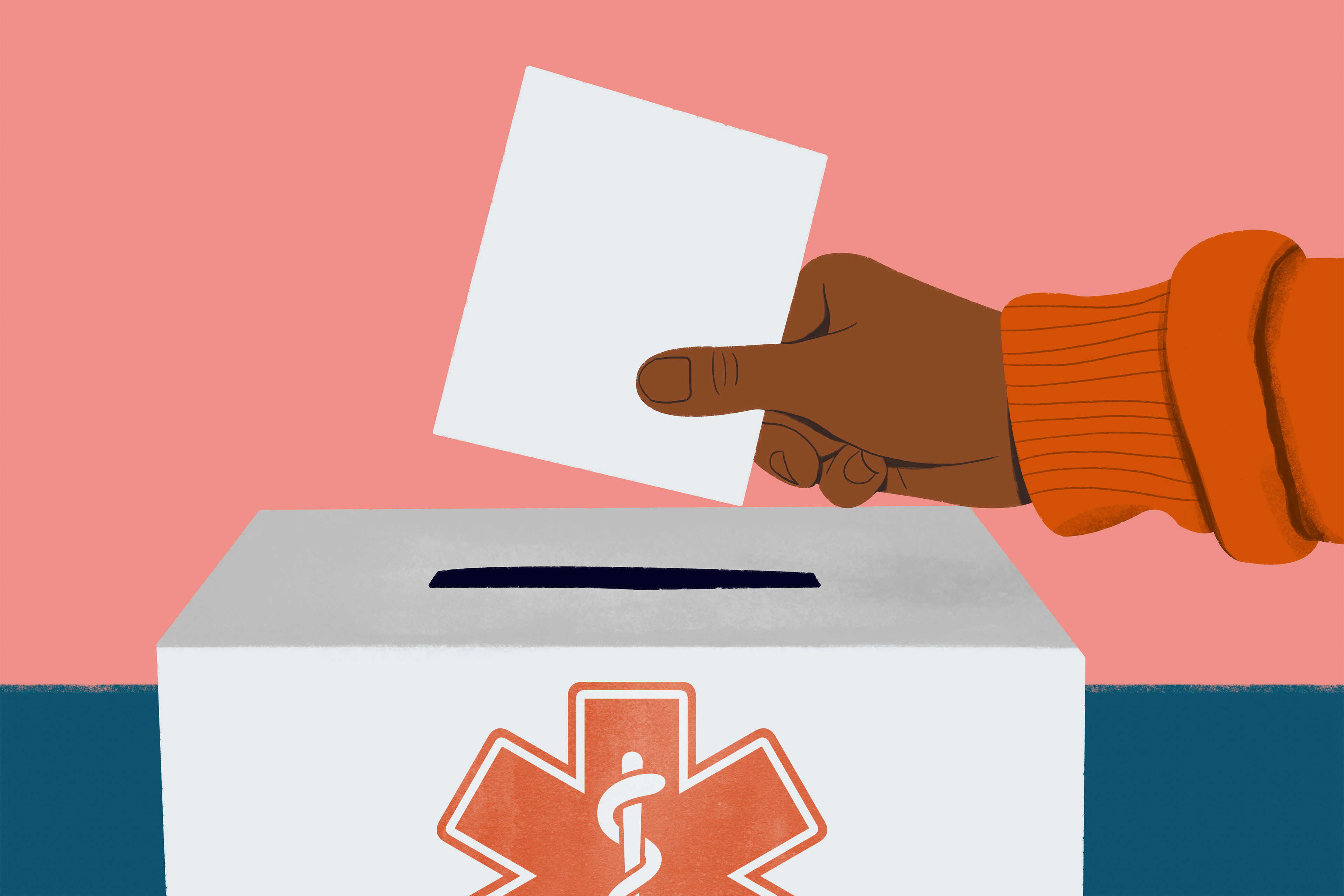
One of Prichard’s trips to the Nashville hospital was via helicopter ambulance. Wieberg said she had heard such flights could be pricey, but she didn’t realize how extraordinary the charge would be — or how her mother’s skimping on Medicare coverage could leave the family on the hook.

Then the bill came.

The Patient: Debra Prichard, who had Medicare Part A insurance before she died.

Medical Service: An air-ambulance flight to Vanderbilt University Medical Center.

Service Provider: Med-Trans Corp., a medical transportation service that is part of Global Medical Response, an industry giant backed by private equity investors. The larger company operates in all 50 states and says it has a total of 498 helicopters and airplanes.

Total Bill: $81,739.40, none of which was covered by insurance.

What Gives: Sky-high bills from air-ambulance providers have sparked complaints and federal action in recent years.

For patients with private insurance coverage, the No Surprises Act, which went into effect in 2022, bars air-ambulance companies from billing people more than they would pay if the service were considered “in-network” with their health insurers. For patients with public coverage, such as Medicare or Medicaid, the government sets payment rates at much lower levels than the companies charge.

But Prichard had opted out of the portion of Medicare that covers ambulance services.

That meant when the bill arrived less than two weeks after her death, her estate was expected to pay the full air-ambulance fee of nearly $82,000. The main assets are 12 acres of land and her home in Decherd, Tennessee, where she lived for 48 years and raised two children. The bill for a single helicopter ride could eat up roughly a third of the estate’s value, said Wieberg, who is executor.

The family’s predicament stems from the complicated nature of Medicare coverage.

Prichard was enrolled only in Medicare Part A, which is free to most Americans 65 or older. That section of the federal insurance program covers inpatient care, and it paid most of her hospital bills, her daughter said.

But Prichard declined other Medicare coverage, including Part B, which handles such things as doctor visits, outpatient treatment, and ambulance rides. Her daughter suspects she skipped that coverage to avoid the premiums most recipients pay, which currently are about $175 a month.

Loren Adler, a health economist for the Brookings Institution who studies ambulance bills, estimated the maximum charge that Medicare would have allowed for Prichard’s flight would have been less than $10,000 if she’d signed up for Part B. The patient’s share of that would have been less than $2,000. Her estate might have owed nothing if she’d also purchased supplemental “Medigap” coverage, as many Medicare members do to cover things like coinsurance, he said.

Nicole Michel, a spokesperson for Global Medical Response, the ambulance provider, agreed with Adler’s estimate that Medicare would have limited the charge for the flight to less than $10,000. But she said the federal program’s payment rates don’t cover the cost of providing air-ambulance services.

“Our patient advocacy team is actively engaged with Ms. Wieberg’s attorney to determine if there was any other applicable medical coverage on the date of service that we could bill to,” Michel wrote in an email to KFF Health News. “If not, we are fully committed to working with Ms. Wieberg, as we do with all our patients, to find an equitable solution.”

Wieberg says that her family’s struggle over her mother’s air-ambulance bill makes her wonder why Medicare is split into pieces, with free coverage for inpatient care under Part A but premiums for coverage of other crucial services under Part B.(Lisa Krantz for KFF Health News)

The Resolution: In mid-February, Wieberg said the company had not offered to reduce the bill.

Wieberg said she and the attorney handling her mother’s estate both contacted the company, seeking a reduction in the bill. She said she also contacted Medicare officials, filled out a form on the No Surprises Act website, and filed a complaint with Tennessee regulators who oversee ambulance services. She said she was notified Feb. 12 that the company filed a legal claim against the estate for the entire amount.

Wieberg said other health care providers, including ground ambulance services and the Vanderbilt hospital, wound up waiving several thousand dollars in unpaid fees for services they provided to Prichard that are normally covered by Medicare Part B.

But as it stands, Prichard’s estate owes about $81,740 to the air-ambulance company.

The Takeaway: People who are eligible for Medicare are encouraged to sign up for Part B, unless they have private health insurance through an employer or spouse.

“If someone with Medicare finds that they are having difficulty paying the Medicare Part B premiums, there are resources available to help compare Medicare coverage choices and learn about options to help pay for Medicare costs,” Meena Seshamani, director of the federal Center for Medicare, said in an email to KFF Health News.

She noted that every state offers free counseling to help people navigate Medicare.

In Tennessee, that counseling is offered by the State Health Insurance Assistance Program. Its director, Lori Galbreath, told KFF Health News she wishes more seniors would discuss their health coverage options with trained counselors like hers.

“Every Medicare recipient’s experience is different,” she said. “We can look at their different situations and give them an unbiased view of what their next best steps could be.”

Counselors advise that many people with modest incomes enroll in a Medicare Savings Program, which can cover their Part B premiums. In 2023, Tennessee residents could qualify for such assistance if they made less than $1,660 monthly as a single person or $2,239 as a married couple. Many people also could obtain help with other out-of-pocket expenses, such as copays for medical services.

Wieberg, who lives in Missouri, has been preparing the family home for sale.

She said the struggle over her mother’s air-ambulance bill makes her wonder why Medicare is split into pieces, with free coverage for inpatient care under Part A, but premiums for coverage of other crucial services under Part B.

“Anybody past the age of 70 is likely going to need both,” she said. “And so why make it a decision of what you can afford or not afford, or what you think you’re going to use or not use?”

A photo of a woman standing in front of a house.
Wieberg, who lives in Missouri, has been preparing to sell her mother’s Tennessee home, where she lived for 48 years before her death in October. The family faces an $81,739.40 air-ambulance bill, which Wieberg’s mom incurred before her death. She had only Medicare Part A insurance, which does not cover ambulance services.(Chris Wieberg)

Bill of the Month is a crowdsourced investigation by KFF Health News and NPR that dissects and explains medical bills. Do you have an interesting medical bill you want to share with us? Tell us about it!

Related Topics

Contact Us

Submit a Story Tip

If You’re Poor, Fertility Treatment Can Be Out of Reach

Mary Delgado’s first pregnancy went according to plan, but when she tried to get pregnant again seven years later, nothing happened. After 10 months, Delgado, now 34, and her partner, Joaquin Rodriguez, went to see an OB-GYN. Tests showed she had endometriosis, which was interfering with conception. Delgado’s only option, the doctor said, was in vitro fertilization.

“When she told me that, she broke me inside,” Delgado said, “because I knew it was so expensive.”

Delgado, who lives in New York City, is enrolled in Medicaid, the federal-state health program for low-income and disabled people. The roughly $20,000 price tag for a round of IVF would be a financial stretch for lots of people, but for someone on Medicaid — for which the maximum annual income for a two-person household in New York is just over $26,000 — the treatment can be unattainable.

Expansions of work-based insurance plans to cover fertility treatments, including free egg freezing and unlimited IVF cycles, are often touted by large companies as a boon for their employees. But people with lower incomes, often minorities, are more likely to be covered by Medicaid or skimpier commercial plans with no such coverage. That raises the question of whether medical assistance to create a family is only for the well-to-do or people with generous benefit packages.

“In American health care, they don’t want the poor people to reproduce,” Delgado said. She was caring full-time for their son, who was born with a rare genetic disorder that required several surgeries before he was 5. Her partner, who works for a company that maintains the city’s yellow cabs, has an individual plan through the state insurance marketplace, but it does not include fertility coverage.

Years after she had her first child, Joaquin (left), Mary Delgado found out that she had endometriosis and that IVF was her only option to get pregnant again. The news from her doctor “broke me inside,” Delgado says, “because I knew it was so expensive.” Delgado, who is on Medicaid, traveled more than 300 miles round trip for lower-cost IVF, and she and her partner, Joaquin Rodriguez, used savings they’d set aside for a home. Their daughter, Emiliana, is now almost a year old.(Joaquin Rodriguez)

Some medical experts whose patients have faced these issues say they can understand why people in Delgado’s situation think the system is stacked against them.

“It feels a little like that,” said Elizabeth Ginsburg, a professor of obstetrics and gynecology at Harvard Medical School who is president-elect of the American Society for Reproductive Medicine, a research and advocacy group.

Whether or not it’s intended, many say the inequity reflects poorly on the U.S.

“This is really sort of standing out as a sore thumb in a nation that would like to claim that it cares for the less fortunate and it seeks to do anything it can for them,” said Eli Adashi, a professor of medical science at Brown University and former president of the Society for Reproductive Endocrinologists.

Yet efforts to add coverage for fertility care to Medicaid face a lot of pushback, Ginsburg said.

Over the years, Barbara Collura, president and CEO of the advocacy group Resolve: The National Infertility Association, has heard many explanations for why it doesn’t make sense to cover fertility treatment for Medicaid recipients. Legislators have asked, “If they can’t pay for fertility treatment, do they have any idea how much it costs to raise a child?” she said.

“So right there, as a country we’re making judgments about who gets to have children,” Collura said.

The legacy of the eugenics movement of the early 20th century, when states passed laws that permitted poor, nonwhite, and disabled people to be sterilized against their will, lingers as well.

“As a reproductive justice person, I believe it’s a human right to have a child, and it’s a larger ethical issue to provide support,” said Regina Davis Moss, president and CEO of In Our Own Voice: National Black Women’s Reproductive Justice Agenda, an advocacy group.

But such coverage decisions — especially when the health care safety net is involved — sometimes require difficult choices, because resources are limited.

Even if state Medicaid programs wanted to cover fertility treatment, for instance, they would have to weigh the benefit against investing in other types of care, including maternity care, said Kate McEvoy, executive director of the National Association of Medicaid Directors. “There is a recognition about the primacy and urgency of maternity care,” she said.

Medicaid pays for about 40% of births in the United States. And since 2022, 46 states and the District of Columbia have elected to extend Medicaid postpartum coverage to 12 months, up from 60 days.

Fertility problems are relatively common, affecting roughly 10% of women and men of childbearing age, according to the National Institute of Child Health and Human Development.

Traditionally, a couple is considered infertile if they’ve been trying to get pregnant unsuccessfully for 12 months. Last year, the ASRM broadened the definition of infertility to incorporate would-be parents beyond heterosexual couples, including people who can’t get pregnant for medical, sexual, or other reasons, as well as those who need medical interventions such as donor eggs or sperm to get pregnant.

The World Health Organization defined infertility as a disease of the reproductive system characterized by failing to get pregnant after a year of unprotected intercourse. It terms the high cost of fertility treatment a major equity issue and has called for better policies and public financing to improve access.

No matter how the condition is defined, private health plans often decline to cover fertility treatments because they don’t consider them “medically necessary.” Twenty states and Washington, D.C., have laws requiring health plans to provide some fertility coverage, but those laws vary greatly and apply only to companies whose plans are regulated by the state.

In recent years, many companies have begun offering fertility treatment in a bid to recruit and retain top-notch talent. In 2023, 45% of companies with 500 or more workers covered IVF and/or drug therapy, according to the benefits consultant Mercer.

But that doesn’t help people on Medicaid. Only two states’ Medicaid programs provide any fertility treatment: New York covers some oral ovulation-enhancing medications, and Illinois covers costs for fertility preservation, to freeze the eggs or sperm of people who need medical treatment that will likely make them infertile, such as for cancer. Several other states also are considering adding fertility preservation services.

In Delgado’s case, Medicaid covered the tests to diagnose her endometriosis, but nothing more. She was searching the internet for fertility treatment options when she came upon a clinic group called CNY Fertility that seemed significantly less expensive than other clinics, and also offered in-house financing. Based in Syracuse, New York, the company has a handful of clinics in upstate New York cities and four other U.S. locations.

Though Delgado and her partner had to travel more than 300 miles round trip to Albany for the procedures, the savings made it worthwhile. They were able do an entire IVF cycle, including medications, egg retrieval, genetic testing, and transferring the egg to her uterus, for $14,000. To pay for it, they took $7,000 of the cash they’d been saving to buy a home and financed the other half through the fertility clinic.

She got pregnant on the first try, and their daughter, Emiliana, is now almost a year old.

Delgado doesn’t resent people with more resources or better insurance coverage, but she wishes the system were more equitable.

“I have a medical problem,” she said. “It’s not like I did IVF because I wanted to choose the gender.”

One reason CNY is less expensive than other clinics is simply that the privately owned company chooses to charge less, said William Kiltz, its vice president of marketing and business development. Since the company’s beginning in 1997, it has become a large practice with a large volume of IVF cycles, which helps keep prices low.

At this point, more than half its clients come from out of state, and many earn significantly less than a typical patient at another clinic. Twenty percent earn less than $50,000, and “we treat a good number who are on Medicaid,” Kiltz said.

Now that their son, Joaquin, is settled in a good school, Delgado has started working for an agency that provides home health services. After putting in 30 hours a week for 90 days, she’ll be eligible for health insurance.

One of the benefits: fertility coverage.

Related Topics

Contact Us

Submit a Story Tip

Opposition to Medicaid Expansion Thaws in an Unexpected Place: The Deep South

For more than a decade, some Southern states have resisted Medicaid expansion under the Affordable Care Act, even though data suggest it could help their residents. Today, the large majority of uninsured Americans who would gain coverage under Medicaid expansion — and who would benefit from affordable access to care — live in non-expansion states in the South.

But the politics are shifting. North Carolina expanded Medicaid in December, after a years-long lobbying campaign by the state’s Democratic governor and hospital industry persuaded the Republican-controlled legislature to pass a bill. 

The Tar Heel State’s move may have helped thaw opposition in Alabama, Georgia and Mississippi, where Republican state House speakers have recently indicated they’re open to expansion options, which could lead to new insurance coverage for more than 650,000 people.

And though resistance remains firm in the seven other states that have so far refused expansion, some analysts predict they’ll inevitably acquiesce. 

“It’s just a question of when,” said Joan Alker, executive director of the Center for Children and Families at Georgetown University

Thanks to North Carolina, where expansion has meant government health insurance for more than 346,000 low-income people so far, the prospect has become “politically safer to consider,” said Frank Knapp, president of the Small Business Chamber of Commerce in South Carolina. Republican lawmakers in his state are considering forming a committee to study the idea.

Under Medicaid expansion, adults earning up to 138 percent of the federal poverty level, or about $35,600 for a family of three, qualify for coverage. Nearly 3 million Americans would become newly eligible for Medicaid if all holdout states expanded, according to KFF.

Strong public support for Medicaid in non-expansion states, and lobbying from influential sectors of the health-care industry — especially hospitals — has eroded some of the opposition. 

There’s also more money on the table. President Biden’s 2021 pandemic-relief law offered states that increased eligibility for Medicaid a financial incentive for two years, more than offsetting the cost of expansion for the period, according to a KFF analysis. But even as discussion builds in statehouses that once quashed any talk of Medicaid expansion, formidable opposition remains. Republican governors in South Carolina and Mississippi, for example, still oppose expansion. Several other non-expansion states appear to have little to no legislative momentum.

In Kansas, Gov. Laura Kelly (D) is once again pressing her state’s Republican-controlled legislature to adopt Medicaid expansion, saying it would lower health-care costs for all consumers and protect rural hospitals.

But Republican House Speaker Dan Hawkins, in a video address to Kansans posted on YouTube, dismissed Kelly’s expansion plan as “billions in new state and federal spending to increase welfare for able-bodied, working-age people.”


This article is not available for syndication due to republishing restrictions. If you have questions about the availability of this or other content for republication, please contact [email protected].


Related Topics

Contact Us

Submit a Story Tip

In California, Faceoff Between Major Insurer and Health System Shows Hazards of Consolidation

For weeks, more than half a million Anthem Blue Cross enrollees who receive health care from the University of California were held in suspense. It wasn’t clear whether they would have to find new doctors or switch plans as the health system and one of its largest insurance partners struggled to reach agreement on a new contract.

UC Health accused Anthem of not negotiating in good faith, while Anthem leaders retorted that UC Health had demanded too much and rebuffed the insurer’s request for administrative efficiencies. In fact, roughly 8 million Anthem members in California were at risk of losing in-network access to UC Health’s vast network of prestigious hospitals and medical facilities, which could have left them with much higher out-of-pocket expenses. While not all patients were made aware of the situation, Anthem notified some enrollees they would be reassigned to new primary care doctors if no deal were reached.

But even as the parties announced an eleventh-hour agreement on Feb. 5, industry analysts say the conflict has become part of a trend in which patients are increasingly caught in the crossfire of contract disputes. Amid negotiations over rising labor and equipment costs, it’s often patients who are ultimately saddled with higher bills as the health industry continues to consolidate.

“This type of contract dispute is a routine feature of the health care system,” said Kristof Stremikis, director of market analysis and insight at the California Health Care Foundation. “At the same time, from a patient’s perspective, it’s an unfortunate feature of our health care system because it creates uncertainty and anxiety.” (California Healthline is an editorially independent service of the California Health Care Foundation.)

Stremikis noted that as mergers occur in the health industry, patients are left with fewer choices. Any time there are disputes, disruptions are felt more widely. And such fights rarely result in lower costs for consumers long-term across California.

A KFF analysis found widespread evidence that consolidation of health providers leads to higher health care prices for private insurance. The same brief from 2020 found some evidence suggesting that large, consolidated insurance companies are able to obtain lower prices from providers, but that has not necessarily led to lower premiums for patients. And a 2022 report from the California Department of Health Care Access and Information found that health care costs have grown “at an unsustainable rate,” and noted that between 2010 and 2018 “health insurance premiums for job-based coverage increased more than twice the rate of growth for wages.” State regulators also found that health plans spent nearly $1.3 billion more on prescription drugs in 2022 than in 2021.

In trying to slow growth, California in 2022 set up an Office of Health Care Affordability, which has proposed a 3% spending growth target for the industry for 2025-2029. But enforcement will start in 2028 at the earliest, using spending data from 2026.

Cathy Jordan, 60, a social worker in Yuba City, California, has been a patient at UC Davis Health for two decades. Jordan was diagnosed at the end of 2021 with aggressive small cell carcinoma, a rare form of cancer. She has undergone surgery, chemotherapy, radiation, and other treatments since then, yet her cancer has returned twice.

“I don’t have the luxury of time — my cancer comes back fast,” Jordan said.

She is among the group of Anthem-insured patients at UC Health who were at risk of losing access to in-network care there, and when she got a notice from Anthem, she grew alarmed, she said.

Jordan’s oncologist, Rebecca Brooks, said in an interview prior to the agreement being reached that it would be “incredibly disruptive” for cancer patients to have to switch providers in the middle of their treatments.

“It’s a detriment to their care,” said Brooks, director of the gynecologic oncology division at UC Davis Health. “It’s going to disrupt treatment and cause worse outcomes.”

Jordan said she appreciates that UC Davis Health has a National Cancer Institute comprehensive cancer center designation; the only other cancer center of that caliber in Northern California not part of UC Health is at Stanford University, several hours away in Santa Clara County.

Jordan is among the Anthem-insured patients at UC Health who were at risk of losing access to in-network care there, and when she got a notice from Anthem, she grew alarmed. “I don’t have the luxury of time — my cancer comes back fast,” she said.(Anne Chadwick Williams for KFF Health News)

Jordan was worried that she and other UC Health patients would have to compete for treatment elsewhere. She was also uncomfortable with the idea of adjusting to a new setting and routine while undergoing intensive medical treatment.

“Someone needs to say, ‘We need to think about these patients.’ Someone needs to step up and say, ‘What’s going to be best for our patients?’” Jordan said. “This is my life.”

Stremikis said such concerns are ever more urgent as the health care industry consolidates. UC San Francisco recently announced it would acquire two struggling hospitals in San Francisco, and it is joining Adventist Health in making a new effort to purchase a bankrupt community hospital in Madera. And UC Irvine recently agreed to buy four hospitals in Southern California.

“There is consolidation vertically up and down the supply chain and horizontally,” he explained. “So when there are disputes between these large entities, it has a larger and larger impact because there are fewer choices for patients.”

While contract disputes between health care providers and insurers are nothing new, there is some evidence that they are increasing, at least in public view. FTI Consulting published data last year that found a steady increase in media coverage of rate negotiations between providers and insurers from 2022 to 2023. In addition to the fight with Anthem, UC Health narrowly avoided a break with Aetna last year by reaching an agreement in April. And regional hospital systems, including Sonoma Valley Hospital and Salinas Valley Health, have been at odds with Anthem within the last few months.

UC and Anthem have now agreed to extend the current contract to April 1 while terms of the new agreement are being finalized. UC Health spokesperson Heather Harper said the rate increases were below the inflation rate.

Anthem spokesperson Michael Bowman said the new contract would allow Anthem members to access care at UC Health for years to come.

“This underscores our mutual commitment to providing Anthem’s consumers and employers with access to high quality, affordable care at UC Health,” Bowman said in an email.

This article was produced by KFF Health News, which publishes California Healthline, an editorially independent service of the California Health Care Foundation. 

Related Topics

Contact Us

Submit a Story Tip

Patients See First Savings From Biden’s Drug Price Push, as Pharma Lines Up Its Lawyers

Last year alone, David Mitchell paid $16,525 for 12 little bottles of Pomalyst, one of the pricey medications that treat his multiple myeloma, a blood cancer he was diagnosed with in 2010.

The drugs have kept his cancer at bay. But their rapidly increasing costs so infuriated Mitchell that he was inspired to create an advocacy movement.

Patients for Affordable Drugs, which he founded in 2016, was instrumental in getting drug price reforms into the 2022 Inflation Reduction Act. Those changes are kicking in now, and Mitchell, 73, is an early beneficiary.

In January, he plunked down $3,308 for a Pomalyst refill “and that’s it,” he said. Under the law, he has no further responsibility for his drug costs this year — a savings of more than $13,000.

The law caps out-of-pocket spending on brand-name drugs for Medicare beneficiaries at about $3,500 in 2024. The patient cap for all drugs drops to $2,000 next year.

“From a selfish perspective, I feel great about it,” he said. But the payment cap will be “truly life-changing” for hundreds of thousands of other Medicare patients, Mitchell said.

President Joe Biden’s battle against high drug prices is mostly embodied in the IRA, as the law is known — a grab bag of measures intended to give Medicare patients immediate relief and, in the long term, to impose government controls on what pharmaceutical companies charge for their products. The law represents the most significant overhaul for the U.S. drug marketplace in decades.

With Election Day on the horizon, the president is trying to make sure voters know who was responsible. This month, the White House began a campaign to get the word out to seniors.

“The days where Americans pay two to three times what they pay for prescription drugs in other countries are ending,” Biden said in a Feb. 1 statement.

KFF polling indicates Biden has work to do. Just a quarter of adults were aware that the IRA includes provisions on drug prices in July, nearly a year after the president signed it. He isn’t helped by the name of the law, the “Inflation Reduction Act,” which says nothing about health care or drug costs.

Biden’s own estimate of drug price inflation is quite conservative: U.S. patients sometimes pay more than 10 times as much for their drugs compared with people in other countries. The popular weight loss drug Wegovy lists for $936 a month in the U.S., for example — and $83 in France.
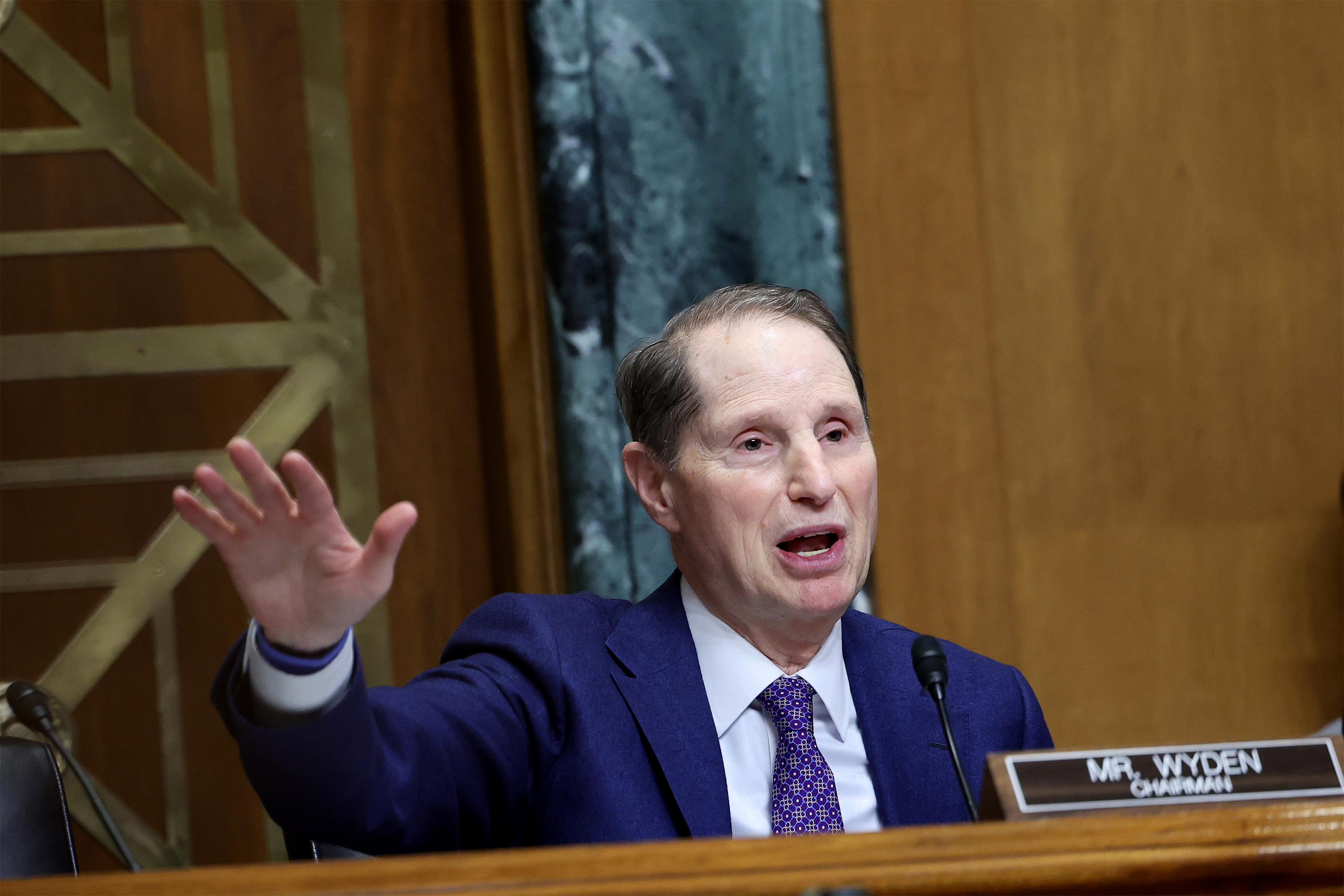
Additional sections of the law provide free vaccines and $35-a-month insulin and federal subsidies to patients earning up to 150% of the federal poverty level, and require drugmakers to pay the government rebates for medicines whose prices rise faster than inflation. But the most controversial provision enables Medicare to negotiate prices for certain expensive drugs that have been on the market for at least nine years. It’s key to Biden’s attempt to weaken the drug industry’s grip.

Responding to Pressure

The impact of Medicare’s bargaining over drug prices for privately insured Americans remains unclear. States have taken additional steps, such as cutting copays for insulin for the privately insured.

However, insurers are increasing premiums in response to their higher costs under the IRA. Monthly premiums on traditional Medicare drug plans jumped to $48 from $40 this year, on average.

On Feb. 1, the Centers for Medicare & Medicaid Services sent pharmaceutical makers opening bids for the first 10 expensive drugs it selected for negotiation. The companies are responding to the bids — while filing nine lawsuits that aim to kill the negotiations altogether, arguing that limiting their profits will strangle the pipeline of lifesaving drugs. A federal court in Texas dismissed one of the suits on Feb. 12, without taking up the substantive legal issue over constitutionality.

The nonpartisan Congressional Budget Office predicted the IRA’s drug pricing elements would save the federal government $237 billion over 10 years while reducing the number of drugs coming to market in that period by about two.

If the government prevails in the courts, new prices for those 10 drugs will be announced by September and take effect in 2026. The government will negotiate an additional 15 drugs for 2027, another 15 for 2028, and 20 more each year thereafter. CMS has been mum about the size of its offers, but AstraZeneca CEO Pascal Soriot on Feb. 8 called the opening bid for his company’s drug Farxiga (which earned $2.8 billion in U.S. sales in fiscal year 2023) “relatively encouraging.”

Related Biden administration efforts, as well as legislation with bipartisan support, could complement the Inflation Reduction Act’s swing at drug prices.

The House and Senate have passed bills that require greater transparency and less self-serving behavior by pharmacy benefit managers, the secretive intermediaries that decide which drugs go on patients’ formularies, the lists detailing which prescriptions are available to health plan enrollees. The Federal Trade Commission is investigating anti-competitive action by leading PBMs, as well as drug company patenting tricks that slow the entry of cheaper drugs to the market.

‘Sending a Message’

Months after drug companies began suing to stop price negotiations, the Biden administration released a framework describing when it could “march in” and essentially seize drugs created through research funded by the National Institutes of Health if they are unreasonably priced.

The timing of the march-in announcement “suggests that it’s about sending a message” to the drug industry, said Robin Feldman, who leads the Center for Innovation at the University of California Law-San Francisco. And so, in a way, does the Inflation Reduction Act itself, she said.

“I have always thought that the IRA would reverberate well beyond the unlucky 10 and others that get pulled into the net later,” Feldman said. “Companies are likely to try to moderate their behavior to stay out of negotiations. I think of all the things going on as attempts to corral the market into more reasonable pathways.”

The IRA issues did not appear to be top of mind to most executives and investors as they gathered to make deals at the annual J.P. Morgan Healthcare Conference in San Francisco last month.

“I think the industry is navigating its way beyond this,” said Matthew Price, chief operating officer of Promontory Therapeutics, a cancer drug startup, in an interview there. The drugs up for negotiation “look to be assets that were already nearing the end of their patent life. So maybe the impact on revenues is less than feared. There’s alarm around this, but it was probably inevitable that a negotiation mechanism of some kind would have to come in.”

Investors generally appear sanguine about the impact of the law. A recent S&P Global report suggests “healthy revenue growth through 2027” for the pharmaceutical industry.

Back in Washington, many of the changes await action by the courts and Congress and could be shelved depending on the results of the fall election.

The restructuring of Medicare Part D, which covers most retail prescription drugs, is already lowering costs for many Medicare patients who spent more than $3,500 a year on their Part D drugs. In 2020 that was about 1.3 million patients, 200,000 of whom spent $5,000 or more out-of-pocket, according to KFF research.

“That’s real savings,” said Tricia Neuman, executive director of KFF’s Medicare policy program, “and it’s targeted to people who are really sick.”

Although the drug industry is spending millions to fight the IRA, the Part D portion of the bill could end up boosting their sales. While it forces the industry to further discount the highest-grossing drugs, the bill makes it easier for Medicare patients to pick up their medicines because they’ll be able to afford them, said Stacie Dusetzina, a Vanderbilt University School of Medicine researcher. She was the lead author of a 2022 study showing that cancer patients who didn’t get income subsidies were about half as likely to fill prescriptions.

States and foundations that help patients pay for their drugs will save money, enabling them to procure more drugs for more patients, said Gina Upchurch, the executive director of Senior PharmAssist, a Durham, North Carolina-based drug assistance program, and a member of the Medicare Payment Advisory Commission. “This is good news for the drug companies,” she said.

David Mitchell, a multiple myeloma patient since 2010, stands in his home office. Mitchell founded Patients for Affordable Drugs, an advocacy group that helped push through the Biden administration’s measures to control drug prices.(Arthur Allen/KFF Health News)

Relief for Patients

Lynn Scarfuto, 73, a retired nurse who lives on a fixed income in upstate New York, spent $1,157 for drugs last year, while most of her share of the $205,000 annual cost for the leukemia drug Imbruvica was paid by a charity, the Patient Access Network Foundation. This year, through the IRA, she’ll pay nothing because the foundation’s first monthly Imbruvica payment covered her entire responsibility. Imbruvica, marketed jointly by AbbVie and Janssen, a subsidiary of Johnson & Johnson, is one of the 10 drugs subject to Medicare negotiations.

“For Medicare patients, the Inflation Reduction Act is a great, wonderful thing,” Scarfuto said. “I hope the negotiation continues as they have promised, adding more drugs every year.”

Mitchell, a PR specialist who had worked with such clients as the Campaign for Tobacco-Free Kids and pharmaceutical giant J&J, went to an emergency room with severe back pain in November 2010 and discovered he had a cancer that had broken a vertebra and five ribs and left holes in his pelvis, skull, and forearm bones. He responded well to surgery and treatment but was shocked at the price of his drugs.

His Patients for Affordable Drugs group has become a powerful voice in Washington, engaging tens of thousands of patients, including Scarfuto, to tell their stories and lobby legislatures. The work is supported in part by millions in grants from Arnold Ventures, a philanthropy that has supported health care policies like lower drug prices, access to contraception, and solutions to the opioid epidemic.

“What got the IRA over the finish line in part was angry people who said we want something done with this,” Mitchell said. “Our patients gave voice to that.”

Arnold Ventures has provided funding for KFF Health News.

Related Topics

Contact Us

Submit a Story Tip