
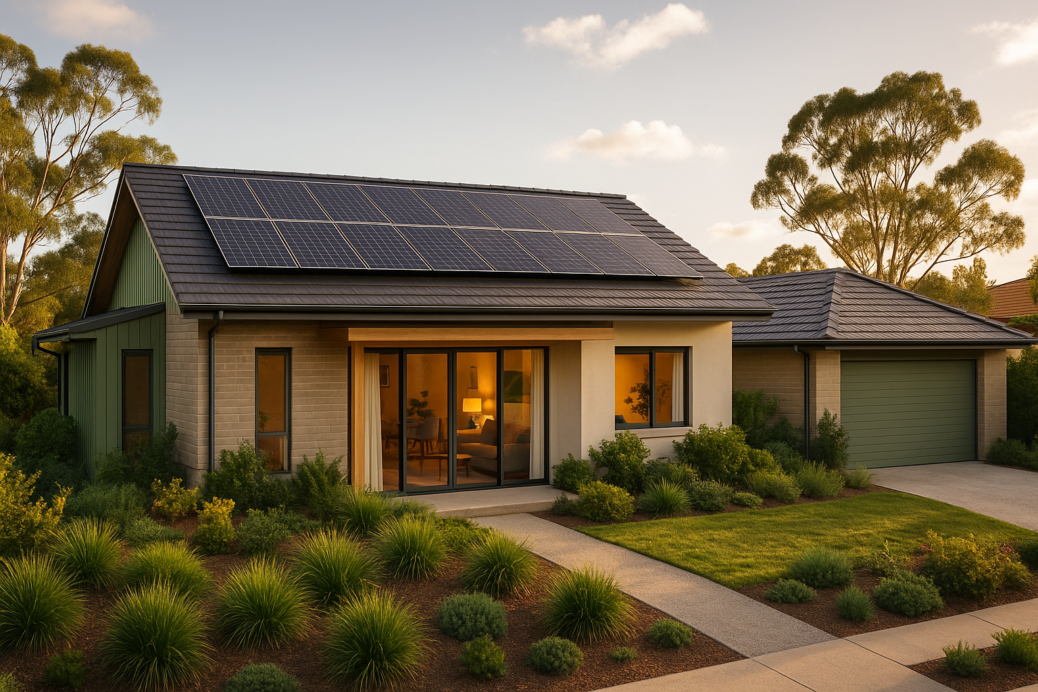
Why Energy-Efficient Homes Are Australia’s Hottest Property Trend

Key takeaways
We’re experiencing a structural shift in the Australian property market—not just a passing trend.
Energy-efficient homes have moved from being an ethical or fringe choice to a mainstream and financially savvy investment.
EE homes sell for an average of $118,000 more than non-EE homes nationally—a 14.5% uplift.
In Melbourne, EE homes command a 23.8% premium (roughly $197,000 more).
Even regional areas are showing strong premiums—21.3% higher on average.
This isn’t just about sustainability—it’s about real, measurable capital gains.
Over the decades I’ve spent observing the ebbs and flows of the Australian property market, every now and then a shift comes along that’s not just cyclical—it’s structural.
And right now, we’re living through one.
Domain’s latest Sustainability in Property Report 2025 confirms what many of us in the property industry have already been sensing: energy-efficient homes are no longer just a niche or ethical choice.
They’ve become one of the most financially savvy moves a buyer—or investor—can make.
In fact, as Domain’s Chief of Research and Economics, Dr Nicola Powell put it, “Energy-efficient homes are no longer an ethical choice—they’re a smart financial choice.”
And the numbers back her up.
According to the report, energy-efficient (EE) homes are selling for an average of $118,000 more than their non-EE counterparts, a whopping 14.5% uplift nationally.
In some locations, that premium is as high as 75%.
Table 1. The price premium of EE homes compared to non-EE homes.
| Houses | Units | |||
| % price difference | $ price difference | % price difference | $ price difference | |
| Sydney | 12.3% | $180,500 | 12.9% | $105,000 |
| Melbourne | 23.8% | $197,000 | 17.8% | $95,000 |
| Brisbane | 14.1% | $120,000 | 9.8% | $65,000 |
| Adelaide | 12.1% | $97,500 | 8.3% | $45,000 |
| Perth | 16.1% | $118,000 | 19.2% | $92,250 |
| Canberra | 10.8% | $94,000 | 17.6% | $84,000 |
| Hobart | 10.8% | $78,000 | – | – |
| Darwin | 7.8% | $53,000 | – | – |
| Combined capitals | 11.0% | $100,000 | 8.6% | $56,000 |
| Combined regionals | 21.3% | $135,000 | 30.8% | $160,000 |
| Australia | 14.5% | $118,000 | 12.0% | $75,000 |
Yes, you read that right.
In Melbourne, EE homes command an average of $197,000 more than non-EE homes—a 23.8% boost.
Perth sees a 16.1% uplift, while regional Australia shows even stronger growth in some cases, with a 21.3% premium on average.
These aren’t just nice-to-haves.
They’re high-demand assets in a rapidly evolving market.
The features that buyers are chasing
So, what are the features driving these premiums?
The data is compelling.
A north-facing home can add a staggering $375,500 in value nationally.
Solar panels fetch an additional $140,000, while double-glazing boosts value by around $145,000.
Table 2. Median house price premium by EE feature.
| Non-EE median | Value add from EE features | |||
| Double-glazed | North-facing | Solar | ||
| Sydney | $1,460,000 | $495,000 | $615,000 | $140,000 |
| Melbourne | $825,000 | $175,000 | $473,500 | $220,000 |
| Brisbane | $850,000 | – | $352,750 | $164,500 |
| Adelaide | $800,500 | – | $218,000 | $129,500 |
| Perth | $732,000 | – | $368,000 | $148,000 |
| Canberra | $870,000 | $107,500 | -$250 | $148,751 |
| Hobart | $725,000 | – | – | $100,000 |
| Darwin | $680,000 | – | – | $60,000 |
| Combined capitals | $910,000 | $90,000 | $440,000 | $105,000 |
| Combined regionals | $633,000 | $164,500 | $196,000 | $187,000 |
| Australia | $810,000 | $145,000 | $375,500 | $140,000 |
Even more telling is buyer behaviour.
Listings that include energy-efficient features get 13.8% more views for houses and 6.5% more for units.
Buyers are actively seeking properties that offer cost savings, comfort, and sustainability.
This aligns with what Dr Powell described in the report:
“Features like solar panels and energy smart designs can add tens, even hundreds of thousands to a home’s value, and while new developments have made energy-efficient homes more accessible, there’s still more work to be done—especially when it comes to upgrading existing homes and reimagining sustainable living in our major cities.”
Middle Australia is driving the shift
Contrary to the misconception that green homes are a luxury trend, some of the strongest demand and price premiums are coming from regional and outer-metro suburbs—think Broken Hill, Calamvale, Port Pirie, and Collie.
In these middle-income areas, energy efficiency isn’t just a feel-good addition, it’s a practical tool to combat rising energy bills and cost-of-living pressures.
It’s about affordability, not ideology.
This is what makes the shift so significant.
We’re not talking about a niche market anymore.
Over 52% of houses and nearly 40% of units sold in 2025 included at least one energy-efficient feature, like solar panels, double-glazing or passive design.
This is mainstream now.
Table 3. The annual proportion of sellers using EE keywords in listings.
| Houses | Units | |||||
| Area | 2025 | Annual change | 5-year change | 2025 | Annual change | 5-year change |
| Sydney | 40.5% | 1.9 ppt | 8.1 ppt | 34.6% | 1.2 ppt | 2.8 ppt |
| Melbourne | 55.4% | 1.5 ppt | 6.6 ppt | 42.0% | 0.5 ppt | 4.2 ppt |
| Brisbane | 54.8% | 1.5 ppt | 8.0 ppt | 42.6% | 2.4 ppt | 5.7 ppt |
| Adelaide | 63.1% | 3.0 ppt | 8.5 ppt | 42.7% | 2.6 ppt | 7.5 ppt |
| Perth | 57.2% | 3.1 ppt | 8.2 ppt | 43.8% | 1.2 ppt | 4.8 ppt |
| Canberra | 72.1% | 3.9 ppt | 19.7 ppt | 69.2% | 3.2 ppt | 17.1 ppt |
| Hobart | 49.2% | 0.8 ppt | 6.1 ppt | 36.8% | -1.9 ppt | -0.7 ppt |
| Darwin | 50.4% | 1.0 ppt | 9.7 ppt | 28.4% | -9.2 ppt | -10.9 ppt |
| Combined capitals | 53.7% | 2.2 ppt | 8.7 ppt | 40.0% | 1.1 ppt | 4.5 ppt |
| Combined regionals | 49.0% | 0.9 ppt | 7.8 ppt | 35.0% | 0.4 ppt | 4.1 ppt |
| Australia | 52.2% | 1.8 ppt | 8.5 ppt | 39.1% | 1 ppt | 4.6 ppt |
The ACT leads by example
If there’s one state showing the rest how it’s done, it’s the ACT.
With mandatory energy efficiency ratings and forward-thinking new-build standards, Canberra has the highest share of EE homes in the country—72% of houses and 69% of units.
That’s not just impressive, it’s proof that good policy, strong standards, and public awareness can reshape an entire housing market.
Dr Powell notes:
“Through greater education, targeted incentives, and strong policies—like we’ve seen in the ACT—we can help more Australians enjoy healthier, more cost-efficient and sustainable homes.”
What this means for property investors
For investors, this isn’t just an interesting trend. It’s a clear opportunity.
If you’re investing in property today, you need to be thinking beyond cosmetic renovations and short-term capital growth.
Buyers and tenants alike are increasingly favouring energy-efficient features because they translate to comfort and lower bills.
That opens the door to:
-
Renovations with smart energy upgrades (solar, insulation, double-glazing).
-
Buying in areas where energy upgrades offer outsized value-add.
-
Marketing properties in a way that highlights their sustainable features (remember, EE listings attract more eyeballs).
This trend isn’t just a wave to ride, it’s a long-term current that will keep gathering strength.
The bigger picture
Australia’s housing market is evolving.
Energy efficiency is no longer just about being green, it’s about economic resilience, liveability, and future-proofing.
The rise of the EE home reflects a broader shift in what buyers value, and the properties that respond to those values will outperform over the next decade.
We’ve seen this story before: structural change driven by social pressure, economic imperatives, and policy momentum.
The difference now is that the financial incentives are lining up with sustainable living.
For developers, builders, homeowners and investors alike, the message is clear: green homes are not just good for the planet—they’re good for your balance sheet.
And the future?
It belongs to those who can combine capital growth with climate-conscious design.